




Abstract
The aim of this article is to reconstruct the ways in which the organizational elites of the Quantified Self and Maker movements curate their respective pioneer communities. Based on a media ethnography carried out in Germany, the UK, and the USA it is demonstrated that the two movements adopt different curatorial models: curation through the use of an ‘unenforced trademark’ in the case of the Quantified Self movement and curation through ‘franchising’ in the case of the Maker movement. The fragility of both models is not necessarily a disadvantage to either and it has contributed to the rapid global spread of both communities. An analysis of these curatorial practices demonstrates that while these communities like to present themselves as having emerged from local groupings, rising ‘from below’, they are, in fact, figurations whose origin and overall exertion of influence can be traced back to Silicon Valley and the Whole Earth Network.
Keywords
We live during times in which the way we shape our lives and society is no longer imaginable outside the realm of digital media and their infrastructures. In media and communication research this situation is referred to as ‘deep mediatization’ (Couldry and Hepp, 2017). Over the years mediatization research has focused on the ways in which everyday life, politics, bureaucracy, organizations, sports and religion are subject to change as a consequence of a fully mediatized sociality (see, for example, Lundby, 2014). However, recent critiques emphasize that mediatization research should pay closer attention to mediatization’s emergence. Generally, the response to this critique, from a political economy perspective at least, would argue that these driving forces originate from state agencies and the larger (tech) companies (Murdock, 2017). Of course, we cannot imagine deep mediatization – which is also a driven by ‘deep capitalism’ (Murdock, 2017: 130) – beyond these institutional and corporate actors. However, alongside these ‘corporate actors’ other ‘collective actors’ play a significant role in laying the foundations upon which deep mediatization processes take place (Hepp, 2020: 17–19).
Fred Turner (2006) provides a useful illustration in his historical study, From Counterculture to Cyberculture, in which he demonstrates that we cannot understand the development of the personal computer, the internet and the ‘new economy’ without also considering the Whole Earth Network, an ‘extraordinary influential group of San Francisco Bay Area journalists and entrepreneurs’ (Turner, 2006: 3) who have had a major influence on technological change. The name of this network refers to the Whole Earth Catalog, a periodical published by Stewart Brand between 1968 and 1972 that resembled today’s all too familiar ‘network forum’ (Turner, 2006: 5) of exchange and encounter. This network imagined a world shaped by personal computers and computer networks long before these ideas entered the public consciousness.
In the following, I would like to call these groups or networks ‘pioneer communities’. There are several reasons for this. They typically refer to themselves as (social) ‘movements’ with whom they share the desire to change society, in this case, through media technologies. But on closer inspection they are not social movements in the strictest sense of the term (Bean and Rosner, 2014: 26). They are too apolitical and are too close to the corporate and political worlds to fall into this category. They act more like ‘intermediaries’ (Bourdieu, 2010: 151) who present themselves as a ‘movement’. In addition, they are not simply ‘innovators’ or ‘early adopters’ (Rogers, 2003: 261–266): they neither have the broad financial liquidity to adopt technologies that might ultimately fail, nor do they introduce new ideas into a system as ‘role models’. Rather, they form the imaginative ‘haze’ within which ideas and concepts of technological development are able to emerge and spread.
We are dealing with an independent phenomenon which is why ‘pioneer communities’ as a descriptive concept is useful. The concept operates in a metaphorical field in which the term ‘pioneer’ is located: In biology, the variety of plants, animals, and fungi that first colonize a barren habitat is referred to as a pioneer community. In martial terms a pioneer is a soldier employed to perform engineering and construction tasks in order to pave the way for others. Colloquially, the word ‘pioneer’ refers to a forerunner. In this sense, then, a media-related pioneer community is a community of people that ‘creates’ spaces of opportunity for the transformation of culture and society through media technology. The Whole Earth Network, then, can be considered as a pioneer community. Since when the Whole Earth Network was making its mark, many examples of media-related pioneer communities have followed but this article will focus on two specific examples: the Quantified Self and Maker movements.
We can define pioneer communities by the following criteria (Hepp, 2016, 2020: 32–3): They are (1) a ‘community of practice’ (Wenger, 1999) in the sense that their members possess a shared ‘we’ and that they build up long-term structures. Their members adopt (2) a ‘forerunner role’ within a certain domain and are accepted as such by other members of this domain (but not necessarily all). Within their domain (3) they act as ‘intermediaries’ (Bourdieu, 2010: 151) who, through their practices, implicitly and explicitly connect different spheres of activity (development, everyday media use, politics). Their members (4) can be characterized as employing experimental practices in relation to their respective domains, that is, practices which move beyond more established ways of doing. And finally, (5) pioneer communities develop shared visions of possible future scenarios that are perceived as ‘sociotechnical imaginaries’ (Jasanoff and Kim, 2015) of media-related developments.
Pioneer communities tend to have a certain ‘life cycle’: by offering a particular thematic frame such as self-development through numbers (Quantified Self) or manufacturing (Maker) they arise out of the context of many different other figurations: in the case of the Quantified Self and Maker movements, the DIY and Open Source movements, and New Age and Self-Awareness groups. Pioneer communities have a development phase, a peak phase, and a phase during which they enter decline. The peak phase is accompanied by broader media coverage and the creation of thematically related start-ups and companies, and the phase of decline is characterized by the community dwindling to a smaller group of dedicated enthusiasts. This entire ‘life cycle’ of pioneer communities is, in turn, by and large experienced by their ‘organizational elite’ (Hitzler and Niederbacher, 2010: 22): members who (a) take responsibility for important events, (b) publish widely on issues relevant to the community, and (c) speak publicly on behalf of it.
The organizational elite of a pioneer community is not, however, influential through hierarchical structures. Rather, it gains influence through the multi-layered, fragile practices of ‘curation’ that go beyond the simple arrangement of objects. 1 These include: ‘defining’ the community and its basic ideas and practices; ‘selecting’ practitioners, topics and practices that best represent the community; ‘arranging’ and ‘presenting’ them to audiences and to the community itself. Curation, therefore, refers to the ‘idea’ of pioneer communities as well as to their ‘organization’.
The aim of this article is to reconstruct the fragile process of curation performed by pioneer communities’ organizational elites through a comparison of the Quantified Self and Maker movements. The reason for focusing on these two social figurations is that they represent different models of curation: Curating through an ‘unenforced trademark’ in the case of the Quantified Self movement and curating through ‘franchising’ in the case of the Maker movement. In both cases curation is about arranging the discourse on the communities’ ideas, as well as organizing local groups (meetups, spaces) that exist beyond (and partly in advance of) the organizational elites.
My main thesis is that the organizational elites’ curation takes on forms beyond marketing and branding. It is an attempt to organize a community of thematically interested individuals who are engaged in different local groups. This is the reason why fragile models are chosen instead of hierarchically integrated organizations. Fragility is, therefore, not necessarily a problem, but what might actually lie behind the ‘success’ of pioneer communities in laying the foundations for a wider adoption of certain technology-related everyday practices and the progress of deep mediatization.
To substantiate this thesis, first, I will briefly outline the current state of research and then discuss its methodological approach. This is followed by sections that focus on the two models of curation and their fragility. Finally, I will present some general conclusions and argue why these models of curation are necessarily fragile: it is not only because of pioneer communities’ unique nature, it is also a consequence of their aforementioned ‘life cycle’. 2
Current research: the organizational elites of the Quantified Self and Maker movements
In many ways, the Quantified Self and Maker movements are intimately related: both date back to the mid-2000s, both were formed in the San Francisco Bay Area, both were ‘founded’ by former journalists (Gary Wolf and Kevin Kelly from Wired in the case of Quantified Self, Dale Dougherty from O’Reilly Media in the case of the Maker movement), and both managed to curate the extension of their influence and notoriety from the US to Europe and other parts of the world. However, there are obvious differences between the Quantified Self and Maker movements that can be identified through the orientation of their practices (self-awareness versus manufacturing), their visions of media-related collectivity and societal transformation, their events, and the reach of their published works (for example, websites, journals, reports) (see Hepp, 2020: 33–6).
Previous research has shown interest in both communities, particularly from the perspective of their members. In the case of the Quantified Self movement this concerns the practices of tracking and self-measurement (Crawford et al., 2015, Didžiokaitė et al., 2018; Lomborg and Frandsen, 2015; Pantzar and Ruckenstein, 2014), the movement’s proximity to emerging approaches to personal health (Ajana, 2017; Lupton, 2015; Nafus, 2016; Sharon, 2017; Williamson, 2015), and data security and surveillance issues related to the practice of self-tracking (Abend and Fuchs, 2016; Esmonde, 2019; Fotopoulou, 2018; Lupton, 2014; Sharon and Zandbergen, 2016; Swan, 2013). A number of studies have also investigated the public discourse surrounding the Quantified Self movement, be it in the technology magazine Wired (Ruckenstein and Pantzar, 2017) or general media coverage (Hepp et al., 2020). While this research is rich in nature and can only be touched upon here in rudimentary form, a study of the Quantified Self’s organizational elite’s engagement does not yet exist. Gina Neff and Dawn Nafus (2016), for example, clearly distinguish between the widespread phenomenon of self-tracking and the more focused phenomenon of the Quantified Self movement itself (see also Greenfield, 2016). Nevertheless, they neglect to discuss the pioneer community’s elite in any real detail.
Perhaps tangential, but still comparable in regard to the lack of emphasis on organizational elites, is research into the Maker movement. Researched topics include Maker spaces as localities of innovation and learning (Barniskis, 2013; Davies, 2017; Lange, 2015; Peppler et al., 2016; Toombs et al., 2014), the relation of the Maker movement to the do-it-yourself and hacker movements (Hunsinger and Schrock, 2016; Ratto and Boler, 2014), new forms of civic participation through its events (Kostakis et al., 2015; Nascimento and Pólvora, 2016; Richterich, 2017), its engagement in (industrial) development (Irani, 2015; Ramsauer and Firessnig, 2016), and a general reflection on ‘making’ as a countercultural and pedagogic practice (Gauntlett, 2018). Studies into reporting on the Maker movement can also be found which either focus on the community’s publications in Make: magazine (Nguyen, 2016; Sivek, 2011) or general discourse on the movement. But again, the role of the Maker movement’s organizational elite is discussed only marginally (Bean and Rosner, 2014), even in publications that focus on its historical roots (Turner, 2018).
As set out in the introduction, and against the background of this gap in previous research, it is the aim of this article to focus on the organizational elite and how they curate these two communities. This requires a deepened understanding of pioneer communities which are defined here as a hybrid of the social movement and the think tank (Hepp, 2016: 925): Alongside social movements (Porta and Diani, 2006), these communities share their decentralized structure and deterritorial dispersion across different local groups. More specifically, much like the open source and hacker movements (Baack, 2015), they come very close to what Hess (2005: 516) refers to as ‘technology-oriented and product-oriented movements’. However, pioneer communities are much more open to new forms of entrepreneurship and policy-making, lending them a certain affinity with think tanks (McGann and Sabatini, 2011).
While the organizational elite of pioneer communities make use of marketing concepts (Bean and Rosner, 2014), they are not simply ‘brand communities’ (Marzocchi et al., 2013). As explained in the introduction, they are communities of practice that adopt a ‘forerunner role’ within a certain domain; they act as ‘intermediaries’ (Bourdieu, 2010); and they advocate experimental practices and promote ‘sociotechnical imaginaries’ (Jasanoff and Kim, 2015) of media-related developments. When considered as such, beyond their larger events that bear the characteristics of a marketing exercise, these figurations become solidified in the context of local groups of people who interact with each other.
To summarize, pioneer communities represent a form of community that is described in social sciences as ‘post-traditional’ (Giddens, 1994; Hitzler et al., 2008): This does not mean that these communities do not refer to cultural traditions like personal self-development in the case of the Quantified Self movement, or home tinkering in the case of the Maker movement. But, in contrast to traditional communities such as families, membership of pioneer communities is based on choice. Due to the absence of traditional structures their organizational elite has to be engaged in maintaining their communities while at the same time their influence is much more limited than can be seen in more conventional organizational arrangements.
Methodical approach: a media ethnography of the transnational organizational elite
The results presented in this article form part of a broader project that explores the Quantified Self and Maker movements in Germany, the UK, and the USA. These countries were selected mainly because the two pioneer communities have their origins in the USA, while their European influence unfolds in major ways in Germany and in the UK. The aims of this article as outlined in the introduction can be broken down into the following three research questions:
While the broader pioneer communities research project collected a variety of data, this article focuses on a more concentrated ‘media ethnography’ (Murphy and Kraidy, 2003; Pink et al., 2016) to reconstruct the curatorial practices and instruments of their organizational elite. It can best be described as ‘an ethnography about humans who use, distribute or produce media’ (Bachmann and Wittel, 2006: 183). As media-related practices take place in various locations, media ethnography is often carried out as a ‘multi-sited ethnography’ (Marcus, 1995) and its typical instrument contains ‘accumulated ethnographic miniatures’ (Bachmann and Wittel, 2006: 191), that is, a collection of numerous short stays at different events (conferences, faires) and institutions (meetups, spaces).
With reference to the research questions we conducted interviews with members of each community’s organizational elite (person-based access). We attended events important to both communities, visited meetups, spaces, and the organizational elite’s places of work (location-based access). We contrasted these modes of access with the self-representation of the pioneer communities as evident in their key texts (text-based access). Our analysis relies on a total of 29 interviews with elite members, 11 participant observations at events (conferences, faires), and 23 local meetings (spaces and meetups), as well as a qualitative content analysis of the key texts published by the respective movements (self-representations on websites, book and essay publications) (see Table 1).
Data basis.
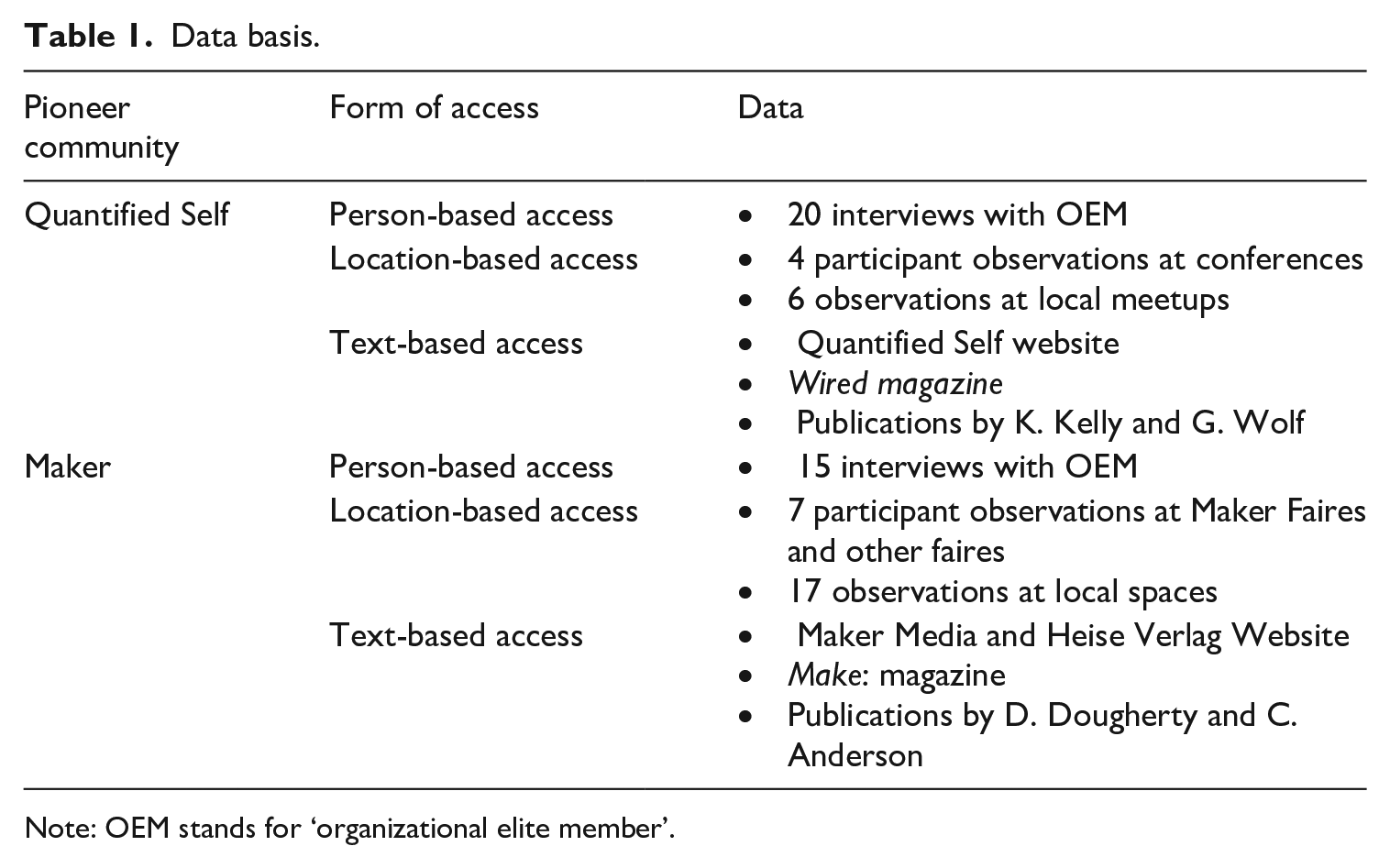
Note: OEM stands for ‘organizational elite member’.
The data were collected between 2014 and 2020 based on a ‘theoretical sampling’ process (Glaser and Strauss, 1999: 45), that is, the main actors, events, and texts were determined step by step as our knowledge of the field expanded. The analysis took place by means of coding within the framework of a Grounded Theory approach (Corbin and Strauss, 2008; Morse et al., 2009). Beginning from a transcription of the data, these were at first openly coded using MaxQDA and then, using selective and axial coding, a step-by-step category system was developed (see Table 2). Categories upon which our further analysis is based are: ‘practices of curating’ with the sub-categories ‘arranging’ (of topics and experimental practices), ‘definition’ (what characterizes each member of the pioneer community), ‘selection’ (who speaks for the pioneer community), and ‘presentation’ (of the related technologies and projects). The second main category is ‘curatorial instruments’ with the sub-categories ‘conferences’, ‘faires’, ‘meetups’, ‘prototyping institutions’, ‘publications’, ‘spaces’, and ‘websites’. Finally, there is a set of sub-categories that represent the ‘fragility of curating’: ‘discursive fragility’, ‘financial fragility’ and ‘organizational fragility’. These have all been integrated into the core category ‘models of curation’ under the two dimensions ‘unenforced trademark’ and ‘franchising’.
System of categories.
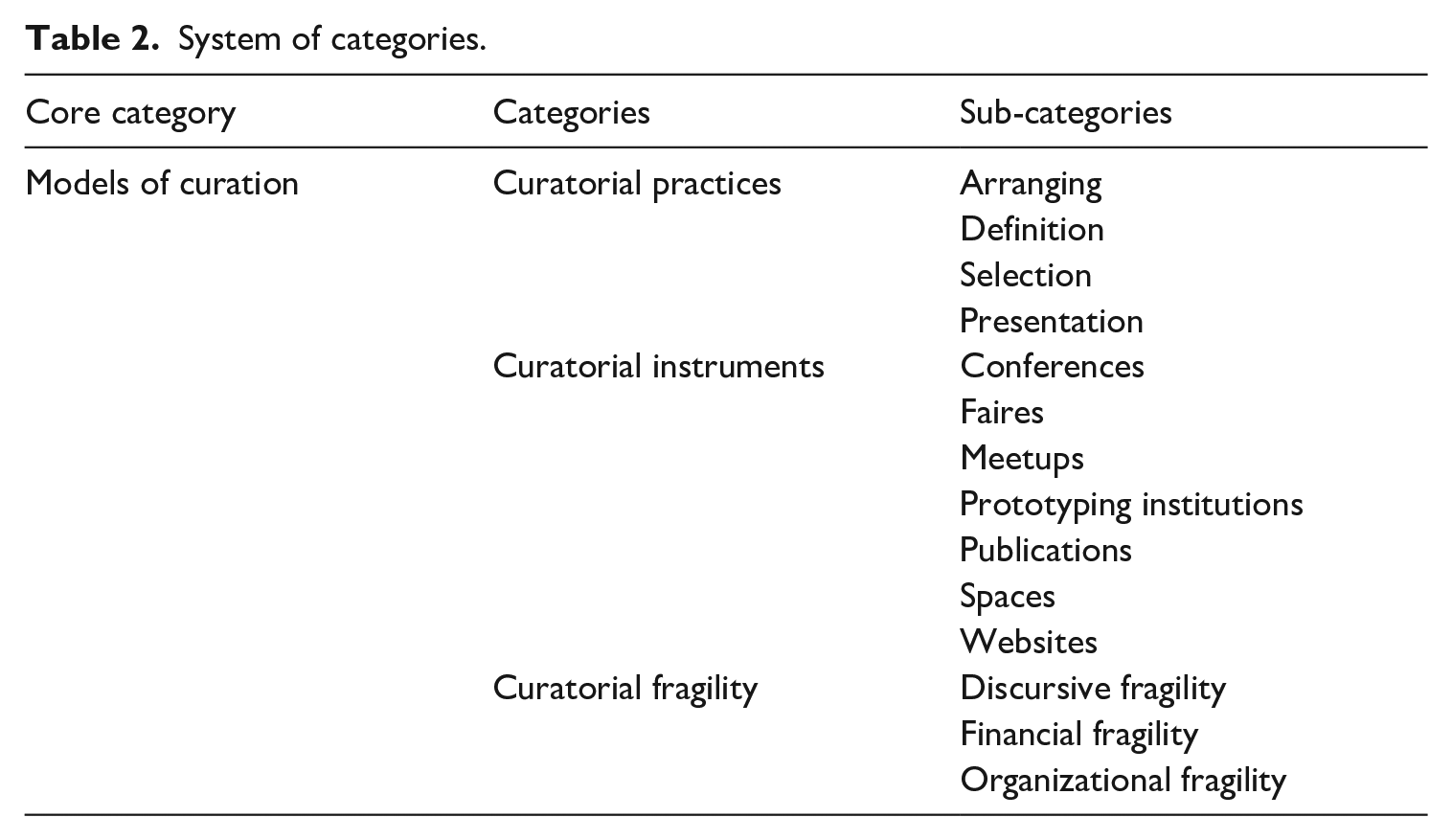
These categories form a complex network that cannot be easily hierarchized. This is due to the fact that the ‘practices of curating’ unfold across different ‘curational instruments’, that is, a practice does not necessarily directly correspond to an instrument while fragility is a phenomenon that works across both. This is the reason why, for each of the two pioneer communities, the interplay of practices and instruments of curation is discussed first and, on this basis, is followed by a description of the fragilities that emerge in their varying forms. To help orientate the reader categories are always italicized. Overall, the analysis along these categories aims to make the similarities and differences between the two curatorial models more tangible.
The Quantified Self movement: curating through an unenforced trademark
The Quantified Self movement’s curatorial model can best be described as curation through an unenforced trademark. This is an expression used by Gary Wolf to explain how the movement is held together in a way that goes beyond pure marketing: Initially setting out to register ‘quantified self’ as a trademark but formally not finishing this process. This makes for a highly ambivalent situation as nobody else can register the term, affording a certain amount of control to the movement’s organizational elite, but at the same time ‘Quantified Self’ is not positioned as a regular brand and remains open to various forms of use and development. Only such a fragile ambivalence secures the type of openness necessary for the community’s diffusion: It allows the organizational elite to stimulate discourse on the identity of the ‘Quantified Self’.
3
In the words of Gary Wolf: if somebody says quantified self, say they release a product and, say this is great for quantified self, we find it and I think we’ll send them an email and at minimum invite them to a meeting and at maximum I’d say, to me this is like a counterproductive way to use quantified self. (interview with Gary Wolf, 2017)
4
It was around this idea that Gary Wolf and his colleagues established the Quantified Self Lab in Berkeley, California which is responsible for the Quantified Self website and promoting and supporting the main conferences in the US. This already indicates the curatorial instruments of this particular pioneer community.
The first of these instruments is publications. Besides publishing magazine articles (Wolf, 2009, 2010) and books (Kelly, 2016), the Quantified Self website 5 evolved from the original blog launched by Gary Wolf and Kevin Kelly 2009. The structure of the website demonstrates the extent to which it addresses the curation of the pioneer community, especially the ‘About’ and ‘Get Started’ sections, as well as the ‘Blog’ that focuses on defining the community’s core principles. The ‘Show and Tell’ section and the ‘Blog’ serve to select Quantified Self projects and actors, to arrange them in the overall discourse on the community, and to present them as exemplary.
This interplay of defining, selecting, arranging and presenting also permeates other curatorial instruments. This becomes clear in the meetups, which were developed shortly after the original blog was launched. Typically, the main event at each meetup is the Show and Tell, which was developed as a format in the first two meetings held in the Bay Area. Gary Wolf calls this ‘the most important thing’ that happens at their events. In essence, the format is about selecting a person to present from a personal point of view a meaningful self-measurement project and explain its potential to others.
The meetup format is curated by selecting and presenting members and projects as exemplars of the movement. The interviews we conducted with members of the Quantified Self’s organizational elite show clear preferences toward certain kinds of project: they should be experimental and originate from one’s own life situation and the promotion of products or companies should be avoided. During the movement’s formative years, the format was adopted on the basis of personal enthusiasm. For example, Steven Dean, a member of the New York organizational elite who participated in the second Quantified Self meeting in the Bay Area, told us that he came across the format there and was so enthusiastic about it that he began a meetup in New York where he applied the same method. Our data show that just as in New York, the largest meetups in Europe – in Amsterdam, Berlin and London – were realized according to this format (as explained to us by Florian Schumacher [OEM Germany], Maarten den Braber [OEM Netherlands], and Adriana Lukas [OEM UK]).
Conferences represent a third curatorial instrument. The first Quantified Self US conference was held in Mountain View in May 2011, followed by events in 2012 (Palo Alto), 2013 (San Francisco), 2015 (San Francisco) and 2018 (Portland). The first European conference took place in Amsterdam in November 2011, and it remained the location for subsequent European conferences in 2013, 2014, 2015, 2017, and 2018. Once again, the quick spread of the conferences from California to Europe was based on personal relations: two of the main organizers of the first European conference were participants in the 2011 US conference who were so enthusiastic about the event that they were able to persuade Gary Wolf to support them in their organization of a European counterpart. In various respects, these conferences serve to curate: these events are entirely processes of selection, arrangement and presentation of speakers, products and topics. The Show and Tell sessions are an important part of the European conferences as well, as is a session explaining how to set up new Quantified Self meetup groups.
The opening speeches are – besides (online) publications and TED-talks – the primary instrument for defining the core identity of the pioneer community. The movement is fundamentally understood as an ‘international community of users and makers of self-tracking tools’ who share an interest in ‘self-knowledge through numbers’. 6 However, the definition of what constitutes the community is much more resonant: it describes projects that focus on the individual (n = 1) and his or her personal development through self-measurement. It is less about the mass collection of data by corporations, which is discussed as a risk. The movement is oriented toward self-controlled access to one’s own data and is, at least in part, skeptical about the exploitation of data through large tech corporations.
The final curatorial instruments of note are prototyping institutions. These are institutions established by the organizational elite to provide orientation towards future development. One clear example was the Quantified Self Institute 7 which was established shortly after the first conference in Amsterdam at the Hanze University of Applied Sciences in Groningen (Netherlands) in 2012. The institute focused on methods and techniques of self-reliance (prevention, self-management and lifestyle interventions) and the use of Quantified Self approaches to fostering healthy ageing. In the interviews we conducted with the organizational elite, the institute is referred to as ‘prototyping’ (interview with Gary Wolf, 2017) and as an institution where ‘everything finds its place’ (interview with Joost Plattel, 2017).
The curatorial role of an institution like this is clear: it seeks to select certain topics as essential, arranging and presenting them in research, teaching, and knowledge transfer. During its peak phase, the institute was highly successful: only six months after its foundation it was the subject of reports on Dutch national television and, as a result, cooperation and research funding flourished (interview with Martijn de Groot, 2017). Between 2016 and 2017, the Quantified Self Lab in Berkeley, together with the Quantified Self Institute Groningen, experimented with another prototyping institution: a special issue of the journal Methods of Information in Medicine (2017, vol. 56 no. 6) on single subject (n-of-1) research design, data processing, and personal science. The publication of this thematic issue explicitly aimed to gather experience in scientific peer review and to examine the extent to which a publication of this type could be harnessed as an instrument for curating the professional discourse on the Quantified Self.
All of these instruments are integrated through the idea of an unenforced trademark. As Gary Wolf says in one interview referring to his co-initiator of the movement, Kevin Kelly: any attempt to control the use of ‘quantified self’ is ‘counterproductive’ for the movement which can only grow because of its openness: ‘we don’t control it in a legalistic sense but we try to lead’ (interview with Gary Wolf, 2017). This is achieved on the one hand by using the term ‘quantified self’ and a logo across the different curatorial instruments as if it were a trademark, while on the other being openly and actively against other uses of the term, which in the best case can be integrated into the community’s identity discourse.
This self-elected partial loss of control can be considered one of the reasons for the rapid spread of the Quantified Self community. Only through loose control could new meetup groups be initiated in such geographically dispersed locations, and it is only in this way that Quantified Self could become a synonym for technologies of self-measurement in public discourse. At the same time, this curatorial model results in a threefold fragility.
Discursive fragility is an inevitable component of a curatorial model which assumes that it cannot control the discourse. In our interviews with the organizational elite we consistently find references to experiences of ‘detachment’ from the original idea. The Finnish Quantified Self and Biohacking group, for example, has its own conferences and is more oriented toward health and the body. To cooperate with them an ‘extreme tolerance for ambiguity’ (interview with Gary Wolf, 2017) was required. Discursive fragility also refers to the broader societal discourse on the quantified self in media coverage of self-measurement and self-tracking. Here a ‘dystopic’ representation of the movement affects where and when followers are portrayed as uncritical enthusiasts and nerds (Hepp et al., 2020). Within the community, this is viewed as ‘voyeuristic interest’ by the media, framing Quantified Self members as ‘weird people’ who are ‘obsessed and compulsively tracking every aspect of their lives’ (interview with Steve Dean, 2018).
An organizational fragility emerges when one considers the community’s institutions that currently exist: at its core, it consists of the Quantified Self Lab in Berkeley with Gary Wolf and three other part-time members. Temporary organizational structures are set up for conferences. All meetups are based on the commitment of individuals and do not have permanent offices, much like the London meetup which is maintained by one person who initiates meetings and has had to change location several times (interview with Adriana Lukas, 2019). In general, all of the local meetup organizers we interviewed in Amsterdam, Berlin, London and New York report that the meetups have shrunk significantly over time: while in the early years (between 2011 and 2015) the meetups grew to 120 participants and were ‘more like a conference’ and ‘too much for a volunteer organizer’ (interview with Steve Dean, 2018), since 2016 their number and frequency has substantially decreased. And the most apparently permanent organization – the Quantified Self Institute at the University of Applied Sciences in Groningen – closed at the end of 2017 because the idea of the institute could not be adapted to the university’s structures (interview with Martijn de Groot, 2018).
Finally, there is financial fragility. This is perhaps best expressed in the following quote, in which a member of the Dutch organizational elite describes the financial situation of the Quantified Self Institute Groningen shortly before its closure: ‘we got grants but they got smaller and smaller [. . .] the second grant was half the size of the first grant, the third grant was half of the second and now we don’t have any grants any more’ (interview with Martijn de Groot, 2017). This quote points to two more general issues: First, funding the Quantified Self movement was and is to a large extent dependent on particular projects that are typically collaborations with other parties (companies, public and state agencies), there is no permanent structural funding. Second, funding was relatively easy to obtain while there was a degree of hype surrounding the movement. Since self-tracking has become more widespread and Quantified Self has lost the attraction of ‘newness’, and since data security issues are seen more critically (Hintz et al., 2019), it is increasingly difficult to find financial backing. Here a paradox emerges: curating through an unenforced trademark enabled the rapid spread of the pioneer community. At the same time, however, it left behind a highly fragile structure which reaffirms the fast decline in its ‘life cycle’.
The Maker movement: curating through franchising
Maker Media Inc. and (since going out of business in July 2019) the Make: Community LLC – both headed by Dale Dougherty – are the main curatorial organizations for the Maker movement. Both institutions are embedded within another curatorial model: curation through franchising. This model is built around the printed and digital versions of Make: magazine, a website with a community area, the Make logo, a mascot, and the promotion of Maker Faires as the main events for the movement. Franchising means that Maker Media, and later the Make: Community, license the name and concept of Make: magazine as well as of the Maker Faire for a moderate fee. For each faire the licensing fee is always below US $1000 and is often only around US $100 (plus expenses for an attending member of Maker Media [interview with Sabrina Merlo, 2020]). These low costs are associated with the use of basic design and presentation elements. For German-speaking countries, Heise Verlag is the licensee for Make: magazine and the Maker Faire and holds the rights to sub-license in these countries. In the UK, Maker Media did not succeed in establishing a national version of the magazine nor a Maker Faire. The situation is different in other countries where the Maker Faire is realized under license by various local, regional and national organizers (in 2018, there were a total of around 200 Maker Faires worldwide). It is remarkable that Maker Media has not approached any of the licensees for a faire, but in each case they were contacted by them (interview with Sabrina Merlo, 2020). Again, a quote by Dale Dougherty is helpful in gaining an understanding of this curation by franchising approach. In one interview he said the following about the foundation of Make: magazine in 2005: When I came out with the magazine it wasn’t like I created ‘makers’ but I did give them a name that they didn’t have, so that they could connect. (interview with Dale Dougherty, 2017)
This quote makes it clear that Dougherty does not believe he ‘invented’ the experimental practices and the group of people we now call ‘makers’ but he claims to have given them a name and in so doing a discourse that revolved around a shared identity. This coinage, together with founding the magazine and the faires, resulted in a step-by-step developmental process for the franchising model. Again, the curatorial practices are based on defining, selecting, arranging and presenting, which in this case extend across the instruments of publications, faires and local spaces. 8
What is now called the Maker movement came into being as a journalistic endeavour to spread the term ‘maker’ along with Make: magazine. Accordingly, publications were a crucial instrument for the curation of the movement, first of all by defining what a maker is. Make: magazine was crucial for the pioneer community’s discourse about what constitutes the identity of a maker whereby the selection and presentation of exemplary makers and maker projects were central. With the licensing of Make: magazine to the German publishing house Heise Verlag, this definitional discourse was transferred to German-speaking countries. In the first German issue, there was an editorial on what constitutes a maker’s identity – a discussion which endures to this day (interview with Daniel Bachfeld, 2016). This identity discourse also involves other publications. These include books written by members of the organizational elite, such as Dale Dougherty’s Free to Make (Dougherty and Conrad, 2016), the widely discussed Makers: The New Industrial Revolution by Chris Anderson (2012) and magazines such as HackSpace magazine in the UK which addresses ‘the modern maker’ and is published by the Raspberry Pi Foundation, a provider of low-cost micro-computers.
The faires are another significant instrument in the movement’s aim to ‘curate things’ (interview with Dale Dougherty, 2017). The idea of the faires as an opportunity for makers to meet face to face came shortly after plans were made to publish the US version of Make: magazine. They were inspired by rural America’s homely and familiar country faires. For each faire, makers and companies related to the movement are selected and arranged into an overall picture of the Maker movement, and then presented accordingly. Care is taken to ensure that ‘private makers’ and their projects are presented and that only as many companies as are needed for financial reasons are involved. As a licensee, Heise Verlag operates in this space with a clear allocation of contingents: We have a rule of thumb, at least 75–60% should be makers, private makers [. . .] 20–25% or something like that are ultimately sponsors, so commercial companies [. . .] who say that through their contribution they support the Maker movement. (interview with Daniel Rohlfing, 2016)
The faires are also a resource for attracting new authors and ideas for Make: magazine, and operate as a site for its promotion (interview with Daniel Bachfeld, 2016).
The third curatorial instruments are spaces. A fundamental difference between these and the Quantified Self meetups is that the relevant maker- and hackerspaces are independent units, in part with a history that goes back further than Maker Media’s activities. But since these are the places where the Maker movement manifests itself locally, they became a special focus for the organizational elite: committed spaces are selected to present themselves at a faire or in Make: magazine or to become organizers of so-called Mini Faires. For the spaces that they prefer, the organizational elite generates visibility and representation within the Maker movement’s identity discourse. Members of the organizational elite generally try to establish intimate contact with these spaces. On the one hand this ensures productive feedback and on the other it works to promote their own definitions, their identity or brand, and their products. In Germany, Heise Verlag has set up ‘120 hacker spaces [and] FabLabs as special sales outlets that sell or provide copies of Make: magazine’ (interview with Daniel Bachfeld, 2016). Initially, this works as an advertising strategy for increasing subscriptions. At the same time, however, it is also a matter of positioning their own idea of being a maker within each space.
These three curatorial instruments are held together by the franchising model. Maker Media, and its successor the Make: Community provides licensing arrangements, design strategies and organization guidelines for both Make: magazine and the Maker Faires, while organizing yearly meetings and an online exchange platform for Maker Faire licensees. Although the franchising model requires a greater degree of organizational integration than the Quantified Self movement’s unenforced trademark, it also remains fragile.
Organizational fragility develops from the fact that although companies such as Maker Media and Heise Verlag form the basis of engagement for the organizational elite, these publishers compete with a range of other organizations. In the USA as well as in Germany and the UK, these are the different local spaces, each with their own forms of organization. Their members’ sense of belonging to the Maker movement broadly differs. In addition, when it comes to digital platforms for networking makers, Maker Media is one among many others and it is not certain whether the maker community, which grew out of Maker Media, can firmly establish itself. Other efforts like those from MakerNet.work, which began with a lot of enthusiasm and commitment (interview with Nathan Parker, co-founder, 2017_05_08), were ultimately unsuccessful. Despite the licensing model, the faires are always based on a situational organizational structure which must be established with local cooperation partners for each individual event.
A discursive fragility is inherent in the franchising model itself: in other cultural contexts, licensed concepts are always appropriated. Heise Verlag employees were keen to articulate how, for example, both Make: magazine and the Maker Faire cannot be realized in German-speaking countries as a one-to-one facsimile of the American original: the electronic components used in Europe are different from those in the USA and German makers tend to be more oriented toward understanding the workings of a particular project than in the US (interview with Daniel Bachfeld, 2016). Likewise, due to the history of German hackerspaces, German makers partake in a different identity discourse compared to the Anglo Maker movement and the commercial success of a maker project is often considered with a degree of derision. With the Maker movement’s global spread, its discursive fragility tends to become intensified. Publications less close to the US organizational elite such as HackSpace magazine in the UK were established, broadening the movement’s identity discourse. Discursive fragility also concerns the public discourse surrounding the movement. On the one hand, there is a positive framing of the Maker movement as a ‘utopia’ of alternative manufacturing (Hepp et al., 2020), while on the other, delivering a public discourse in search of ‘colorful pictures’ (interview with Daniel Rohlfing, 2016) became more important than reflecting on the community’s core ideas. There is a further struggle surrounding the subject of makerspaces, both in Germany and in the UK. This is especially apparent when companies discover them as experimental locations for innovation (such as the BMW-funded MakerSpace in Garching near Munich), or when ‘alternative’ spaces become shared places of work financed by structural funding projects (such as the Building Bloqs Space in London).
Financial fragility manifested itself in the development of Maker Media, which was already close to bankruptcy for the first time in 2015. It was not surprising that Maker Media had to cease operations in June 2019 and Make: Community LLC is now responsible for Make: magazine and the Maker Faires. In one sense, the franchising model already emerged out of a situation of financial fragility: Dale Dougherty explained in his interview that the idea of realizing the Maker Faires required ‘a commercial eco system [that was] able to support it’ (interview with Dale Dougherty, 2017). To build upon their vision they had no ‘gambling funds’ or ‘cultural funds’ and, as a consequence, there was a need to persuade private companies to sponsor and financially support their endeavours. The result was the Maker Faire model described above which was also licensed. But this did not provide a secure financial footing by any means. Financial fragility encouraged Maker Media to take on risk capital which was eventually one of the reasons for its bankruptcy in 2019. In 2017, Dale Dougherty described the ‘business’ of Maker Media as ‘marginally successful’. He went on to say, ‘I’m mostly losing money [. . .] but I believe in it and I’m trying to keep it going’ (interview with Dale Dougherty, 2017). Even if Heise Verlag’s financial situation as a family business is comparatively stable, it is still a matter of ‘being in the black’ for them (interview with Daniel Rohlfing, 2016).
Conclusion: fragility as a reason for success
Essentially, this article has demonstrated that two curatorial models can be identified with reference to the two pioneer communities under discussion: curating through an unenforced trademark and curating through a franchise model. Curating through an unenforced trademark means that the organizational elite established the ‘quantified self’ as a quasi-brand, but do not, however, enforce trademark rights. Rather, they take the use of the name by others as an opportunity to engage in an exchange and subsequently promote and endorse the pioneer community through conferences, meetups and online activities. Franchising the Maker movement means that the rights to the name, the organizational principles, and the visual design features of Make: magazine and the Maker Faires were licensed to produce regional and national editions of the magazine and the faires.
In both cases the aim is to create a community through which a thematic idea and experimental practices can spread and local contacts and groups can be established. In both models, the curation of each community succeeded in comparable ways: being able to define what constitutes it, selecting those who may speak for it, arranging topics and experimental practices, and presenting all of the above in specially developed contexts such as conferences, faires or publications. Both models remain fragile in the sense that they do not lead to a stable organizational structure and they cannot control the discourse surrounding their pioneer communities or secure permanent funding for their internal and external communications, events and meetings.
On the surface, this fragility can be understood as a general characteristic of post-traditional communities: since these are based on choice and not on tradition, they are necessarily fluid entities. Fragility is important here, however, in a broader context to capture the role pioneer communities play in deep mediatization processes. As we have seen, the organizational elites of both communities are driven by the wish to circulate their ideas globally but they have limited resources to achieve this aim. The two curatorial models can be seen as a response to the contradiction of global engagement and limited resources. The related expansion of each movement, however, is a multi-layered process of social ‘translation’ (Callon, 1986; Fredriksson and Pallas, 2017): ideas occupy new cultural contexts against the background of existing organizational structures, discursive horizons, and funding opportunities, and have to be translated and reconfigured in their shadow. At this point, organizational, discursive, and financial fragilities create opportunities for a variety of interpretations. The fragility of the two curatorial models does not necessarily represent a restriction, but is, perhaps, the secret to the ‘success’ of the rapid spread of both pioneer communities over the last decade.
Beneath the surface, their fragility has deeply temporal dimensions. As already mentioned, both movements – together with others – grew out of the Whole Earth Network context. They emerged from experimental practices and the desire of one group to disseminate their ideas. With the increasing appropriation of these practices and ideas, however, the communities lost their ‘pioneering character’ and become part of the everyday life of ‘ordinary’ media use. This is a general characteristic of pioneer communities, which lay the foundations for the wider adoption of certain technology-related everyday practices and for the progress of deep mediatization. Parts of what appear to be signs of fragility are possibly indications of the pioneer community’s ‘life cycle’: their ability to focus public attention on the ‘new’ during their infancy, the possibility of acquiring resources through the interest they generate alongside the opportunity to build temporal organizational structures, and their eventual reduction to a core of pure enthusiasts towards their coda. One aspect of such a ‘life cycle’ is that many members of the organizational elite migrate at the cycle’s end to the next pioneer community, as can currently be seen with the Quantified Self movement where many elite members have wandered over to the biohacking scene. The fragility of curating is, then, an acute expression of the pioneer community phenomenon: being pioneering means to be fragile, because you are only a pioneer for a certain amount of time.
Footnotes
Appendix
QS interviewees quoted from in this article:
Gary Wolf, organizational elite member (OEM) USA, 7 February 2017.
Joost Plattel, OEM Netherlands, 17 June 2017.
Martijn de Groot, OEM Netherlands, and formerly QS Institute, 17 June 2017 and 5 February 2018.
Steve Dean, OEM USA, 2 January 2018.
Adriana Lukas, OEM UK, 12 March 2019.
Maker interviewees quoted from in this article:
Sabrina Merlo, OEM USA and formerly Maker Media, 5 March 2020.
Dale Dougherty, OEM USA and Maker Media/Make: Community, 10 February 2017.
Daniel Bachfeld, Heise editor and journalist, 11 July 2016.
Daniel Rohlfing, OEM Germany and Heise event organizer, 10 August 2016.
Nathan Parker, co-founder of the MakerNet.work, 8 May 2017.
Acknowledgements
I would like to thank the Department of Communication at Stanford University and especially Fred Turner for the offer of a Visiting Scholarship. My stay there from February to April 2020 enabled me to collect some of the data on which this article is based.
Funding
The author disclosed receipt of the following financial support for the research, authorship, and/or publication of this article: This article is based on research conducted in the project ‘Pioneer Communities’ (funded by German Research Foundation, DFG HE 3025/13-1).