



Abstract
Attitudes of distrust and paranoia toward scientific and political institutions are increasingly identified as major troubles in online communication and often lumped together under the umbrella term of conspiracy theories. However, this term encompasses two distinct communication practices that deserve to be distinguished. Traditional conspiratorial thinking adopts pseudo-scientific arguments, while newer manifestations lack coherent theories, promoting trolling, and antagonism. We argue that these strands align with different types of digital communications and are supported by different technical infrastructure and cultures of use, with classic conspiracy theories prevalent in early online venues and “conspiracies-without-theory” more common on social media. By comparing the Flat Earth Society’s Internet forum and its subreddit, we highlight their stark differences. The forum prioritizes pseudo-scientific discourse, while the subreddit fosters confrontational antagonism and unmoderated escalation. Recognizing these distinctions is vital for understanding their communicative profoundly different nature and developing targeted strategies to address them effectively.
Keywords
Introduction
The prevalence of conspiratorial ideas in online communication has become a much debated topic, since some of these ideas escaped the fringes of the Web and trickled into the mainstream (Bleakley, 2023; de Zeeuw et al., 2020; Tuters et al., 2018). Conspiracism, broadly defined as a form of distrust and paranoia toward institutions, is nothing new to the Internet (Birchall and Knight, 2022), yet with the advent of social media, it may have found new momentum and expression.
To investigate this mutation, we focus, in this article, on a conspiratorial group with a long digital existence, the Flat Earth Society. Its different expressions online illustrate how digital conspiracism comes in two different flavors: one that imitates the discursive style of modern science and another that embraces forms of communication, which are similar to that of oral cultures. The former are akin to classic conspiracy theories, while the latter have been called “conspiracies-without-theory” (Rosenblum and Muirhead, 2019) because they offer nothing like a systematic (if preposterous) framework for interpretation.
Our objective is to contrast these different styles of conspiracism to highlight how the shift from the early regime of Internet blogs and forums to the rule of social media has transformed the way in which digital folklore is created. Conspiracy discourses come in handy for this objective thanks to their exaggerated communicational traits and their long history in digital media (Venturini, 2022).
After a first period of expansion in the 1960s and 1970s, conspiracy theories experienced a quiet decline until the early 2000s, when their fortune turned for the better in the wake of the 09/11 attack and the advent of Internet forums (Uscinski and Parent, 2014). In these years, a multitude of conspiracy forums thrived online, albeit in closed communities at the margins of the Internet (Clarke, 2007). This was the case of the Flat Earth conspiracy, which was resurrected by Daniel Shenton through a highly popular website that led to the official relaunch of the Society in October 2009. Rising from its ashes, the Flat Earth Society suddenly became an online sensation attracting hundreds of thousands of daily visits (Garwood, 2008; Weill, 2022).
The advent of social media brought about another upswing in conspiracy discourse, as the new digital platforms turned out to be quite favorable to the diffusion of conspiracy thinking (Wood, 2016). At the same time, the platformization of the Internet seems to be associated with a change in the epistemic structure of conspiracism (Tuters and Willaert, 2022). Departing from their original imitation of the experimental approach and pseudo-scientific evidence, conspiratorial communities evolved toward the repetition of self-evident statements and the nonchalant manipulation of truth (Muirhead and Rosenblum, 2018). Their purpose became trolling, in the best cases, and, in the worst, the delegitimization of all epistemic authorities in the name of a populist distrust of elites and of a prejudice against scientific knowledge (Muirhead and Rosenblum, 2016).
In the case of the flat earthers’ community, this shift from pseudo-scientific to anti-scientific practices came about when YouTube and Twitter influencers, such as Paul Michael Bales and Eric Dubay, started challenging of the hegemony of the Flat Earth Society (Olshansky et al., 2020; Paolillo, 2018).
Moving from alternative truth to post-truth, conspiratory discourses adapted to the environment of online platforms and their way of favoring communication that is emotionally charged and based on blatant exaggeration, violent imaginary, caustic irony, and nonsense (Phillips, 2019; Rochlin, 2017). In many ways, the new conspiracies-without-theory embody the “second orality” (Ong, 1982) of online communication: the capacity to adapt to the ephemeral and memoryless environment of digital media, by developing traits of emotional impact, ease of assimilation, and adopting the repetition-with-variation typical of Internet memes (Hagen and Venturini, 2024). In a media landscape that prioritizes flow over archival practices, social media users propagate their (sub)cultures by conveying content through memorable and repeatable forms (Venturini, 2022). This phenomenon influences conspiracy theories, as it does with all types of online content.
The new conspiracies-without-theory are not worse or better than the old one, but they are distinctively different from them, which means that the way in which we deal with them should also change (Rosenblum and Muirhead, 2019). Debunking and fact-checking initiatives may be a reasonable way to undermine the belief in traditional conspiracy theories (Banas and Miller, 2013). Revealing the inconsistencies and fallacies of these pseudo-theories may not convince the hardcore believers, but it can at least sway those who are on the fence (McIntyre, 2021). Debunking, however, makes little sense against conspiracies-without-theory because this type of discourse is less interested in consistency or evidence than it is in memorability and repetition (Weill, 2022).
This does not mean that fact-checking and debunking efforts should be abandoned. The new conspiracism has joined rather than replaced the old one, which remains alive and kicking in its established virtual communities (De Zeeuw and Tuters, 2020). This is precisely the case of the flat earth, whose ideas we can explore in two parallel digital communities that embody the pre- and post-platforms Web: the Flat Earth Society’s forum and the Flat Earth Society subreddit.
Pseudo-scientific versus anti-scientific online conspiracism
A way to describe the difference between the conspiracy theories prevalent in early and current websites and the conspiracy-without-theory prevalent in social media platforms, is to use the distinction between pseudo-science and anti-science. While the former attempts to mimic the language and methods of science (but distorts or misrepresents its evidence, Gordin, 2021), the latter outright rejects scientific methods and principles. Pseudo-scientific practices imitate the scholarly jargon and style, although misappropriating and misrepresenting its concepts and evidence. They rely on the cherry-picking of data, the leveraging of anecdotal evidence, and the use of logical fallacies (Wood et al., 2012). Conversely, anti-scientific practices reject the scientific method, adhere to preconceived notions without engaging in open debate, and prioritizing subjective beliefs (Muirhead and Rosenblum, 2018). In anti-science, the emphasis is not on the quest for alternative truths but on the appeal to emotions and values in a post-truth epistemic framework (Fuller, 2018).
In social media, online conspiracism seems to have shifted toward anti-scientific discourse to the expense of its earlier pseudo-scientific practices. This shift, we argue, may be linked to the affordances of the different media environments (Forberg, 2022) and can be described through the notion of secondary orality (Ong, 1982). By prioritizing real-time communication, short-form content, and immediate interaction, social media resembles more to oral cultures than to written communication typical of books, journals, and early websites (Venturini, 2022). This shift in communication style creates an environment conducive to the spread of the emotionally charged narratives and misinformation narrative typical of anti-scientific practices. The fast-paced and fragmented nature of social media platforms favors the dissemination of catchy slogans, sound bites, and appeals to emotions rather than reasoning (Hagen and Venturini, 2024). Akin to oral societies, where consistency and evidence accumulation are less important than the capacity to preserve culture encapsulating it in sayings and formulas, the secondary orality of social media favors contents that are catchy and sticky (Jenkins et al., 2013).
In contrast, pseudo-scientific practices are more likely to be observed in pre-platform online environments, such as Internet forums, which rely on more literate forms of communication. The forum-based nature of early websites allowed for more extensive discussions and for the presentation of pseudo-arguments that imitated the language and appearance of scientific discourse. Conspiracy theories tend to rely here on longer articles, reference, archival data and efforts to appear credible in an academic context (Harambam and Aupers, 2015).
Seen through the lens of Ong’s oral/written distinction, the difference between pseudo- and anti-scientific practices provides valuable insights into the shifting landscape of conspiracy theories across different media contexts and enhances our understanding of the interplay between media affordances, user practices, and the dissemination of conspiracy theories in contemporary online communication.
The Flat Earth Society as a least likely case
The Flat Earth Society has a rich and long history that spans over a century. It originated in the mid-19th century when Samuel Rowbotham, writing under the pseudonym “Parallax,” published a pamphlet titled “Zetetic Astronomy: Earth Not a Globe” in 1849. This publication laid the groundwork for the modern belief that the Earth is flat. Rowbotham’s model proposed a flat disk-shaped Earth, with the North Pole at the center and the South forming the circumference. To promote and defend the Flat Earth theory, Rowbotham engaged in public debates with renowned scientists of the time. These debates and his growing following led to the formation of the Universal Zetetic Society, which aimed to investigate and propagate the belief in a flat Earth. The society published a magazine called The Earth Not a Globe Review as a platform to discuss and disseminate their ideas. After Rowbotham’s death, William Carpenter continued advocating for the flat Earth concept. In 1885, Carpenter authored a book titled One Hundred Proofs the Earth is not a Globe, which further contributed to the society’s literature and arguments (Garwood, 2008).
In 1956, Samuel Shenton, a member of the Royal Astronomical Society, breathed new life into the Flat Earth Society, aiming to preserve the legacy of the disbanded Universal Zetetic Society. However, the society soon found itself in direct conflict with scientific consensus as NASA’s (National Aeronautics and Space Administration) space program gained prominence in the 1960s, presenting photographic evidence of Earth’s spherical shape. Undeterred, Shenton dismissed these photographs as deceptive, asserting that they could mislead the “untrained eye.” Surprisingly, this perspective garnered attention and resonated with individuals who may not have initially aligned with the Flat Earth Society but were enticed by the conspiracy theory (Weill, 2022). Following Shenton’s passing in 1971, Charles Kenneth Johnson assumed the presidency of the society. Under Johnson’s guidance, the Flat Earth Society transcended its narrow focus on the flat Earth theory. Johnson immersed himself in various studies, scrutinizing evidence both supporting and opposing his beliefs. In his quest, he began postulating the existence of a larger conspiracy targeting the flat Earth concept, thus shifting the society’s focus toward a broader confrontation against established science. During the presidencies of Shenton and Johnson the society earned a large number of memberships, but, in 1995, the society’s headquarters, located in California’s Mojave Desert, was destroyed by fire, resulting in the loss of its archives and membership lists. Financial difficulties and declining subscriptions’ revenues further plagued the society. Eventually, on March 19, 2001, with Johnson’s death, the Flat Earth Society disbanded again, leaving only a few hundred members and nearing bankruptcy (Garwood, 2008).
After this sequence of events, however, in 2004 the society saw a resurrection when Daniel Shenton launched a popular website dedicated to the Flat Earth conspiracy. The website’s success led to the relaunch of the Flat Earth Society in October 2009, accompanied by the creation of a new website that housed the society’s “Official Forum.” With its newfound online presence, the society experienced a surge in popularity, attracting hundreds of thousands of daily visitors (Weill, 2022).
Paradoxically, however, the official forum soon evolved into a space of contention among Flat Earth believers. Critics accused the society’s founder, Daniel Shenton, of primarily seeking to monetize the visibility gained rather than genuinely fostering a community of individuals interested in the Flat Earth theory. For this reason, in 2012, a dedicated group of highly engaged users who had grown dissatisfied with the direction of the official forum decided to take matters into their own hands. They first created new social media pages for the Flat Earth Society, including the subreddit r/flatearthsociety, and subsequently launched another website complete with a forum, a wiki-style encyclopedia, and a library, all under the name “The Flat Earth Society” (tfes.org). These new online spaces rapidly gained popularity, attracting the most ardent Flat Earth believers and finally substituted Daniel Shenton’s forum as the most trustful web spaces in which to discuss the Flat Earth conspiracy. This duality within the Flat Earth Society ranks created a sort of schism between Daniel Shenton, which retained the trademark rights but seemed less interested in supporting the flat earthists, and the new tfes.org’s community, which instead emerged as a grassroots community driven by disillusioned users seeking a more stable and secure online venue to discuss their beliefs.
To resume, over more than 150 years, the Flat Earth Society has leveraged various communication mediums, transitioning from pamphlets and bulletins to web forums and social media. Remarkably, despite these changes, its community has maintained an unwavering commitment to its core principles, centered on the provision of empirical evidence to substantiate its theories, and actively participating in debates with the scientific establishment. Due to its historical continuity, its commitment to an organic theory, and its homogeneity throughout different mediums the Flat Earth Society constitutes an ideal case to study the possible shift from pseudo- to anti-scientific practices within a specific conspiracy community. Observing a shift inside the flat earth narrative would have substantial implications for the broader landscape of conspiracy theories, as it would suggest that even long-standing and firmly rooted conspiracies can undergo transformations when exposed to the dynamics of social media.
Research design
Drawing on Olshansky et al. (2020), we hypothesize that oldest online medium, such as forums, are more likely to host pseudo-scientific conspiratorial practices (characterized by analytical reasoning and the verification of “proofs”), while social media are more likely to reflect a shift toward anti-scientific practices (characterized by emotionally charged communication and dogmatic statements). We suggest that these differences are linked to the different communication’s regimes, or styles of communication, that animate the two media: with the older forum functioning according to slower, more articulated and more lettered forms of discussion and social media embracing a more ephemeral, memetic, and oral style of communication.
In this context, our study seeks to address two key research questions:
Among the digital venues in which the Flat Earth Society is active, we decided to focus on the tfes.org forum and on its subreddit for different reasons. First, the study of the Flat Earth has so far concentrated mainly on YouTube and Twitter (Olshansky et al., 2020; Paolillo, 2018) leaving forums and Reddit as relatively understudied. A second reason is related to our contrastive approach. Internet forums and Reddit share a similar structure that facilitates their comparison, but while the former follow a strict chronological order to organize content, the second is steered by a recommendation system optimized to capture and retain users’ attention. Furthermore, the provision of social networking features—like profile pages, following, unfollowing, and private messaging (Anderson, 2015)—gives Reddit a social media dimension that lacks in the Flat Earth Society’s forum. Finally, if the tfes.org’s forum was built up and maintained as a place of discussion for “genuine” flat earth believers, its /r/flatearthsociety/ subreddit was instead “polluted” by adversarial online trolling and attacks directed to flat earthers and was shut down in January 2018.
To answer our research questions, we employed a quali–quantitative approach (Venturini, 2024). First, we used computational methods to examine the communication’s regimes of the two platforms and measure their structural features. Then, we complemented this distant reading by a close reading of both the forum and the subreddit’s threads.
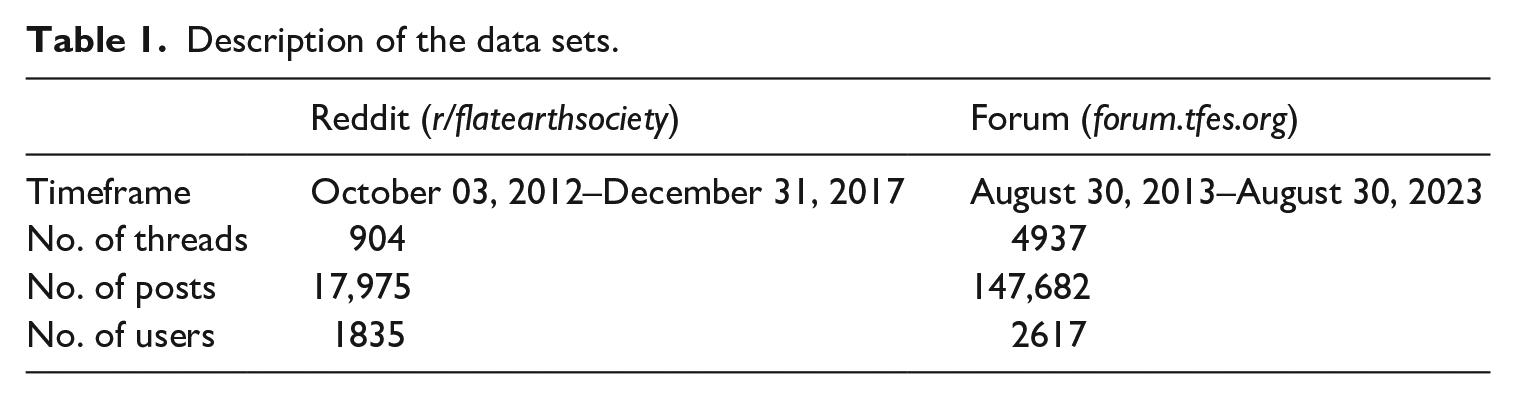
The data sets we worked on were collected through scraping techniques (Table 1). In the case of the forum, we directly gathered all the information contained in the forum (forum.tfes.org/) from the first post published to September 2023. Instead, in the case of Reddit, all the posts from the opening of r/flatearthsociety until its closure in January 2018 were retrieved through pushshift’s archive (files.pushshift.io/reddit/).
Description of the data sets.
The computational analyses conducted can be divided into three categories. The first category pertains to the study of the ephemerality of discussions. In this case, we computed the average number of posts, the average time gap between the creation of two threads (in hours), and the gap between the creation of two posts within a thread (in seconds). Percentiles, median, and mean were calculated for each of these three measurements and represented with standard box and violin plots.
The second category of metrics focuses on the concentration of original content production among different users on the two platforms and the presence of a hierarchy in their popularity. First, we measured the percentage of users who generated original content (i.e. new threads or posts that are not responses to other users). Second, we adapted the H-index to assess user popularity. In our case, the H-index was calculated for each user to ensure that the author had published at least H-posts, each of which had received at least H-comments.
The last set of computational analyses concerns metrics designed to measure the complexity of language used by forum and subreddit users. The first metric involved implementing the Flesch Reading Ease Index, which assesses how easy a text is to read (Gkikas et al., 2022). A higher index indicates simpler text. The second metric relates to an index of difficult word usage computed using the Python package textstats (Hansen et al., 2023). In this case, difficult words are those not among the top 10,000 most common words in the English vocabulary, with an additional coefficient based on word length.
To further enhance these analyses with a qualitative interpretation of the context, a close reading was conducted on the most liked and/or commented threads in the forum and subreddit. The qualitative analysis of online discussions allows us to delve deeper into the nuances of user interactions and the social dynamics within the two digital communities. Netnography, as applied in our case, involved a systematic observation and interpretation of the forum and subreddit conversations, taking into account the topics, tone, and underlying contextual factors that shape the discourse (Caliandro, 2018). This qualitative analysis provides us insights into the motivations, sentiment, and emergent narratives among participants, contributing to our understanding of the online communities’ dynamics.
Results
Comparing structural features of the communication’s regimes
The quantitative results reveal notable differences between the subreddit and the forum in various aspects of online discussions. First, it is observed that threads within the subreddit generally contain a lower average number of posts compared to those in the forum. Moreover, the discussions in the subreddit exhibit shorter durations, and the time intervals between consecutive posts are notably shorter in Reddit when compared to the forum, as illustrated in Figure 1(a) to (c).
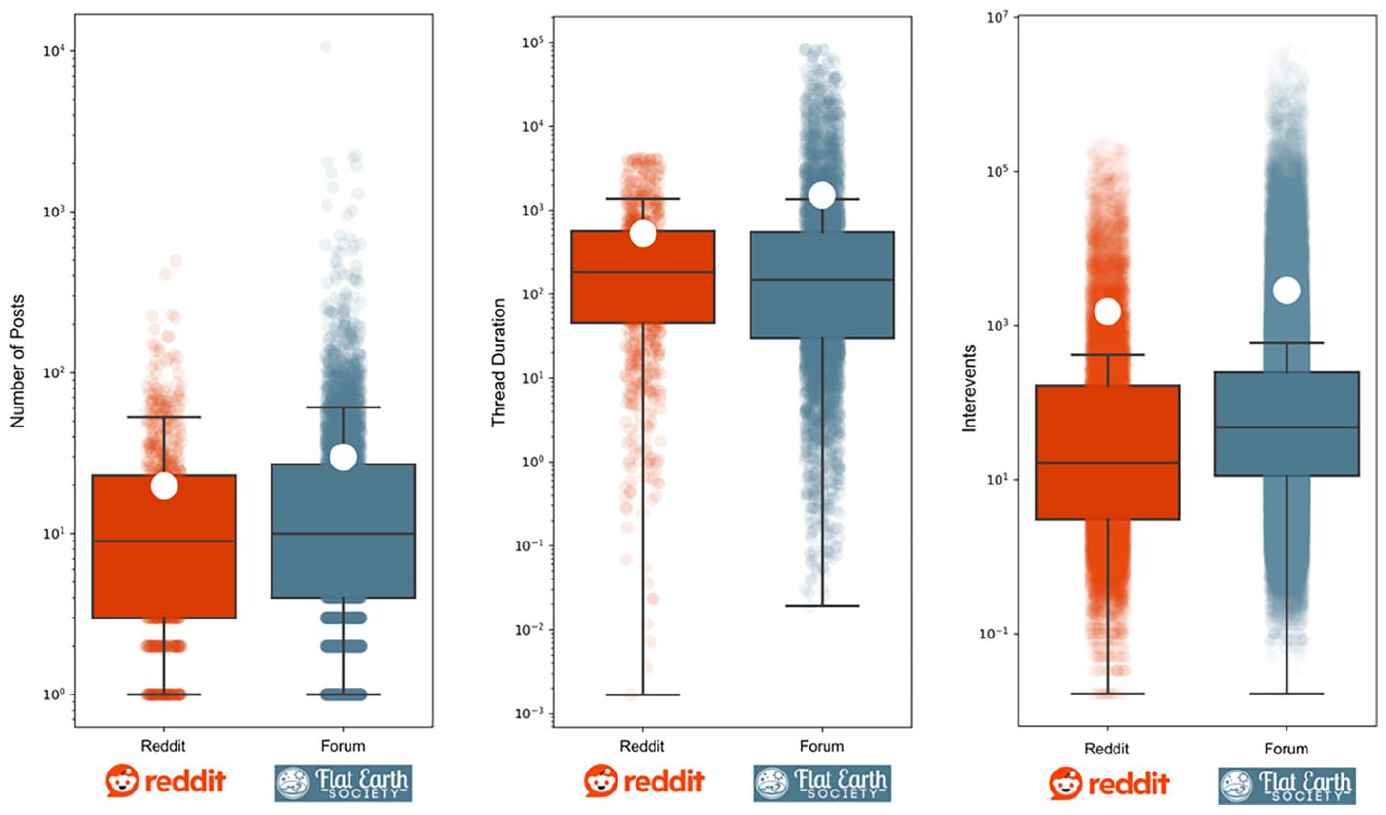
Box plots visualizations of (a) the number of posts in r/flatearthsociety versus forum.
Furthermore, there is a significant contrast in the production of original content between the two platforms. Only approximately 20.9% of users in the subreddit contribute original content, whereas a much larger proportion, approximately 67%, of forum users engage in generating original content. This discrepancy indicates that the forum fosters a more active pattern of content creation.
While the average H-index in both Reddit and the forum is similar, it is worth noting that the forum’s authors can achieve substantially higher H-index values. This disparity reflects the presence of a more formally established hierarchy within the forum community compared to the relatively flatter structure in the subreddit, as illustrated in Figure 2.
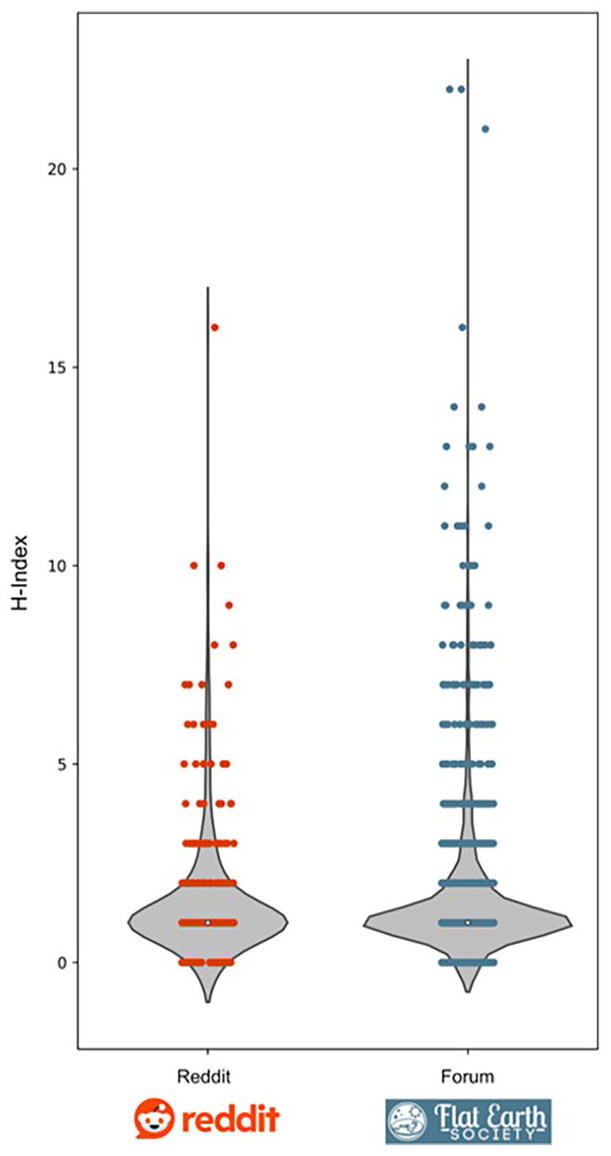
Violin plot visualizations of the “H-Index” for user popularity. A higher H-index indicates that a user (i.e. a red point for r/flatearthsociety and a green point for the forum.tfes.org) is more influential.
Finally, the analysis of the Flesch Reading Ease Index suggests that posts in the subreddit exhibit higher readability, with an average score of approximately 75. In addition, when examining the presence of difficult words, subreddit posts contain fewer of them in comparison to forum posts, as illustrated in Figure 3(a) and (b). These findings collectively provide insights into the distinct characteristics and dynamics of the two online platforms, highlighting variations in engagement, content production, and linguistic complexity.
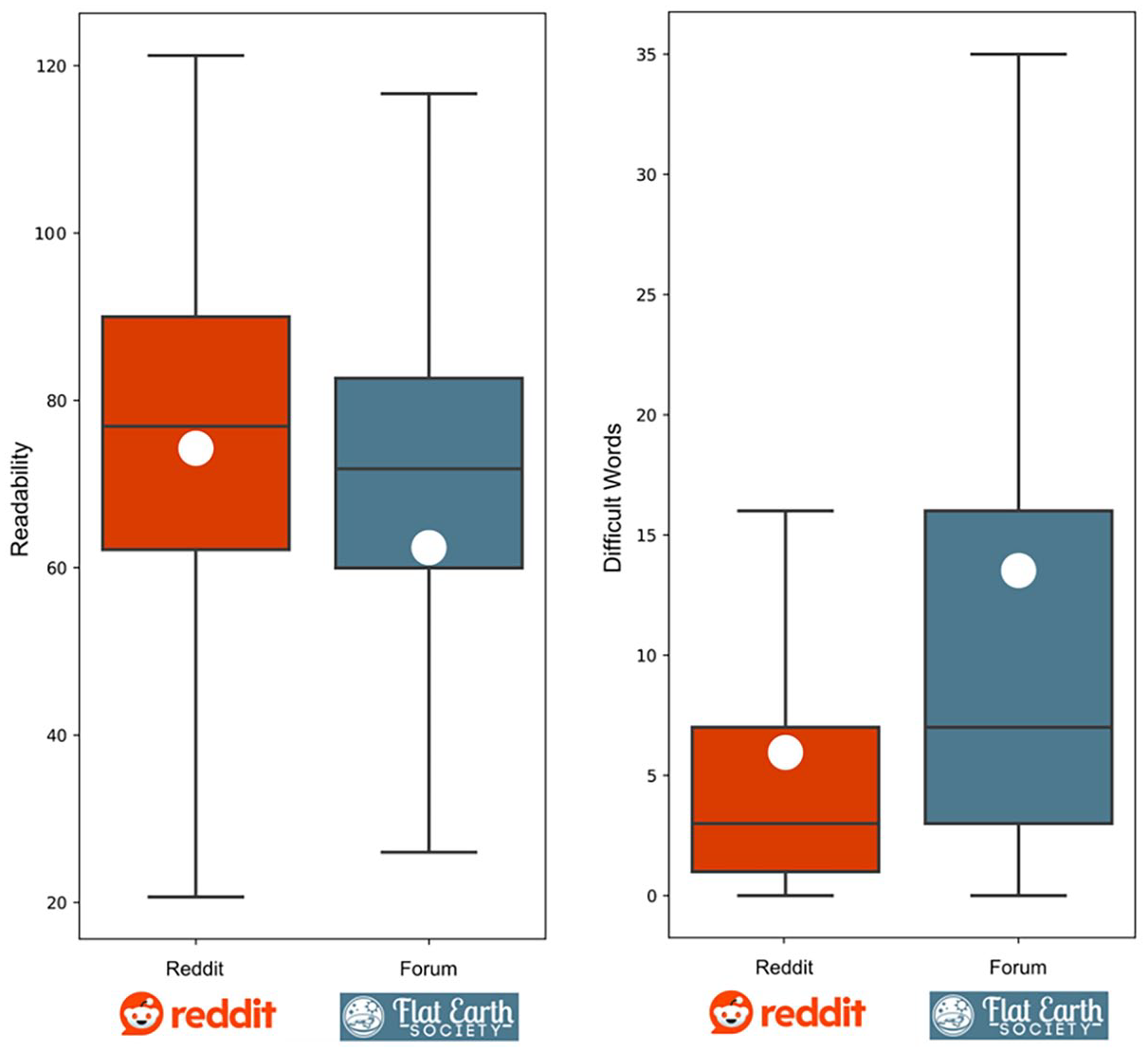
Box plots visualizations of (a) the “Flesch Reading Ease Index,” which assesses how easy a text is to read (on the right). A higher index indicates simpler text. (b) The “Index of Difficult Word Usage” (on the left). A higher index indicates more complex text.
Discursive consistency and rhetorical soundness: the pillars of the forum
The forum of the Flat Earth Society is characterized by a strong self-discipline of the members, which is facilitated by various communication devices, such as a good conduct manifesto and the tangible presence of the admins who keep the forum constantly monitored, organize the topics menu, and moderate the debates by enforcing the rules and punishing those who violate them or lack basic discourse civility. By continuously posting warnings, the moderators make it very clear how users are expected to behave. One of the best examples in this sense is the copy-paste message posted in several threads to reassure users and to help avoid over-reacting to trolling bait, because doing so could sparks flame-war-like dynamics that may risk to submerge out the moderation: There’s a trend that’s been developing recently. People report posts and when the matter is not immediately dealt with, they PM me to inform me they’ve placed a report. You know who you are, and there are many of you. Too many. Don’t do that. This forum has multiple moderators and an active administrator.
This tight moderation and outright control of the forum is generally welcomed by users who experience it as a shield from external attacks by haters and trolls and from critical comments of Round Earth believers. This sense of protection seems to reduce exposure anxiety and stimulates debate, which abide by the epistemic standards of the community and functions as a powerful community building strategy—ironically a perfect counterpart of the despised, alleged Round Earth propaganda that “the government implements to teach the false and hide the truth.”
Such institutional setting coevolves with an emergent organizational routine informed by accounting for the opinions of other members and the tendency to negotiate dialogic consensus through articulate arguments, that build on (supposed) pieces of evidence, careful citation of (however, unscientific) sources, and avoidance of intentional ambiguity and tongue-in-cheek arguments: One can prove a negative using deduction in the empirical sense you’re talking about. Whether or not the conclusion or the premises of an argument contain negatives doesn’t affect the logical validity of the proof. We can modify the previous example: If there is a baseball at location X, Y, Z, then my detector will detect photons as from a baseball at location X, Y, Z. My detector does not detect photons as from a baseball at location X, Y, Z. Therefore, there is not a baseball at location X, Y, Z. As before, the proof is valid (conclusion must be true if premises are true) even if it isn’t sound (all premises are true). And, we can certainly debate many aspects of the premises. P1 can certainly be false for many reasons. We’d need to better define “baseball.” P2 could be false if my detector is bad or faulty or insufficient in some way. The list goes on. But, the proof is still valid. I see what you’re getting at, though. The claim “there are no unicorns anywhere” would be insurmountably difficult to prove. But, we could still construct valid deductive arguments in such a proof. They just almost certainly wouldn’t be sound.
The tone is formal and conversational fluency is articulate: rather than impulsive and reactive communication, posts are clearly carefully written, and sometimes edited and re-edited, after being published.
The most active members behave like experts, answering the questions of the new members and even admitting the existing gaps and limitations of the available theoretical explanations of certain issues. Another central tool for this training of newbies is the section of the forum called “Library: A comprehensive collection of Flat Earth literature, consolidated in one place for everyone’s benefit,” which collects and organizes all past, present and future sources related to the theory. In general, the debate moves toward discursive agreement and is constantly corroborated by (flawed) data, reference to sources with an appearance of rhetorical soundness and respectability, detailed critical analysis and minutely eviscerated reasoning. This is true especially of the sections of the forum called “F.E. Investigations,” “F.E. Theory” and “F.E. Projects,” in which users act like very scrupulous and motivated researchers. In these sections are present long and detailed posts that remind the methodology of scientific research where users describe the step-by-step processes of their experiments and report their results. One clear example is the “Recreating the Bedford Level Experiment” thread: The Old Bedford River, as well as being famous in flat earth circles, is probably the UK’s longest stretch of straight, uninterrupted, near inert water. This makes it an excellent place for measuring the shape of the Earth, given that the surface of inert or near inert water conforms to the shape of the planet. Observing three targets placed at the same height above the surface of the water will reveal and confirm that shape. If the targets all appear to be at the same height, [. . .] the surface of the river is flat. If the middle target appears higher than the near and far target [. . .] the surface of the river is curved. Neither of these statements is interchangeable: i.e., if the surface of the river is curved, the three targets can never appear at the same height; and if the surface of the river is flat, the middle target can never appear above the other two (dramatic, unusual, and temporary atmospheric effects notwithstanding). The experiment, therefore, is conclusive.
Despite the logical flaws of their thesis, the structure of the argument clearly matches that of a scientific field experiment and is highly representative of the embeddedness of the pseudo-scientific thinking in the development of conspiracy theories within the community of the forum.
Tribal flame wars and additive centrifugal layers: the marks of r/flatearthsociety
In opposition to the communitarian vibe of the forum, r/flatearthsociety appears as an instance of a crowded and pluralistic platform, with a high presence of critical and oppositional voices, including mockers or haters who intervene in threads as trolls, with the aim of prying, provoking, or blaming conspiracy theory supporters. This makes the communication atmosphere tense and reactive. On frequent occasions, a simple question sparks a flame war: a heated, confrontational argument characterized by ad hominem attacks, cursing, and personal offenses (Dery, 1994). Strongly opposed to authority, members of r/flatearthsociety display a profound diffidence and skepticism also against any internal hierarchy. The conversational style is simplistic and vague, characterized by highly ambiguous statements, open-ended terms, tongue-in-cheek allusions and vague empirical correlates, which all lend themselves to ex-post reinterpretation according to needs. Simplistic and emotionally charged, confrontational exchanges foster a tribal thinking that, while inciting the subreddit’s flat earthers against an external enemy (e.g. the “Globetards” versus “Flattards” flame war), can also scale up inside the same subreddit’s community, at the point of indicating the “fake flat-earthers that divide us” as the real threat. This constantly tense atmosphere, which can be inflamed at any moment by a vitriolic confrontation, leaves little space for discursive agreement and constructive negotiation.
By constantly chasing the “answer that everyone is waiting,” the participants in r/flatearthsociety are fully embedded into a kind of post-truth discursive game, in which the logical weakness and disputability of the statements can be seen not as a flaw but as a powerful route to the debate escalation. The goal of the conversation is not to establish truth as an intersubjective compromise, but to hammer one’s truth to everyone else through a hyper-simplified logic, as, for example, in the recurrent claim about photos: “Pictures are not valid evidence.” In a classic example of the new conspiracism described by Muirhead and Rosenblum (2018), extreme skepticism and paranoia are celebrated as a constructive response. Contents in this arena are not intended as carriers of a specific and stable meanings, but rather as flexible devices that can be elastically reinterpreted according to needs and circumstances, with no concern for consistency or self-contradiction. They need to be as vague and alluding as possible, while at the same time, strongly hinting at the existence of mysteries and secrets. The “real sources” become a mythical entity, a sort of cognitive Graal, which is both inaccessible and the true foundation of knowledge.
This anti-scientific and post-truth epistemology substitutes the logic of pseudo-scientific argumentation with the logic of fictional efficacy based upon well-experimented narrative schemes and tropes: suspense, mystery, coups de theatre, hero versus villain, and so on. In line with this logic and with social media secondary orality, conspiracies-without-theory resemble more to folktales than to scientific explanations, and their appeal comes not from their consistency or (pseudo-)credibility, but from the fact of being outrageous or funny, or otherwise catchy and memorable.
Discussion
Our quali–quantitative analysis of the structural features of the discussion taking place in the Flat Earth Society’s forum and on its r/flatearthsociety subreddit confirmed that these two digital environments are organized according to two radically different communication regimes, that closely remind the contrast between literate and oral cultures. While the Society’s forum builds on the accumulation of documents that both embody and preserve the legacy of the community (those stored in Flat Earth’s Library in the first place, and also the most influential threads in the forum), the subreddit is characterized by a much more rapid and ephemeral communication, where ideas need to be exaggerated to become memorable and constantly repeated to assure their survival. The quantitative analysis of the rhythms of the two platforms makes this different manifest with the discussion in the subreddit being shorter (both in terms of time and number of replies) and faster (with replies following each other more rapidly).
Our close reading of the discussions in the two communities also revealed that their different regimes of communication are indeed associated with very different cultural dynamics. The permanent storage and accessibility of conspiratorial contents allows the community of the forum to carry out forms of accumulation and construction of an internal legacy and hierarchy. This is manifested in the statistical analysis by the fact that the community of the forum is both more active, with more users contributing original content to the discussion rather than just reacting, and also with some users accumulating more social capital in the group as revealed by their higher conversational H-index. In the forum, the discourse follows a centripetal trajectory, with discussions adhering to the specific themes without being capriciously diverted into tangential directions. Drawing on the archive of their previous conversation the participants indulge in pseudo-philological comparisons between old and new discussions, and also highlights the periodical recurrence of certain errors and naivetés. The need to empirically ground statements using experiments, the constant appeal to pseudo-scientific and religious literature, the tendency to submit the validity of statements to the scrutiny of other users (in the spirit of an informal type of peer-review), the adoption of a form of inductive–argumentative exposition, structured within a linear and articulated discourse; all this contributes to bringing the forum’s community back to the classical forms of traditional pseudo-scientific discourse of classic conspiracy theories.
The communication regime of Reddit leads to different conspiracy practices. Instead of a cumulative culture, discussions seem to be driven by the here and now of confrontational exchange. The large amount of diverse, highly fragmented information that is continuously poured into the threads, its random, sudden changes of argumentative direction, its lack of concern for logical consistency make it very difficult if not virtually impossible to compare old and new debates, let alone attempting a pseudo-philological analysis or trying to establish whether a certain thesis or opinion had been supported against another. What counts in online platforms, such as Reddit is the flow of communication rather than its content.
To understand this type of communication (and the way in which it resembles in many ways the situation of oral societies) it is interesting to read it against the famous description given by Goody and Watt (1963) of the consequences of literacy: Literate societies . . . cannot discard, absorb, or transmute the past in the same way. Instead, their members are faced with permanently recorded versions of the past and its beliefs; and because the past is thus set apart from the present, historical enquiry becomes possible. This in turn encourages skepticism; and skepticism, not only about the legendary past, but about received ideas about the universe as a whole. From here the next step is to see how to build up and to test alternative explanations: and out of this there arose the kind of logical, specialized, and cumulative intellectual tradition (p.344).
Finally, whereas the forum’s discourse is structured, linear and the discussions follow an essential centripetal trend, in the subreddit the discourse is characterized by a thematically centrifugal motion that leads it to endless, meandering digressions, creating a chaotic concoction of arguments whose only trace is eventually their emotional impact. As shown by Massanari (2015), the social dynamics of many subreddits are the result of a complex mix of elements, such as playfulness and geek culture, which can lead to prosocial collective attitudes and also to socially dysfunctional interactions, as in the case of the Flat Earth subreddit. The fact that the same conspiracy led to a dysfunctional escalation in one platform and to a civil (albeit misguided) interaction in another confirms that such outcome depends to a large extent on platforms’ affordances and cultures of use.
In the forum, communication is directed by a stringent moderation that creates an environment that is well suited to that part of flat earthers who seek an intimate space for an obstinate defense of the original theory. On the flip side, the r/flatearthsociety presents itself as a place permeated by role-playing between those who promoted earth flatness and those who try to debunk it. In such an environment one cannot take for granted that anyone is a true believer and the discourse seems to revolve around mere adversarial posturing and deep bullshitting (Frankfurt, 2005). This dichotomy illustrates the connection between technological affordances and cultural practices: an elective affinity between a given community and a given platform.
Conclusion
In recent years, we have witnessed the emerging of an ambiguous relation between post-truth movements and online communities. This alliance has taken its roots in a sort of paradigm shift that has substantially changed the hermeneutic assumptions and epistemological structure of conspiracism. In this article, we examined this shift by comparing the Flat Earth Society’s forum with its more recent subreddit. The shift from an attempt to emulate scholarly demonstration to an exchange of memetic formulas (Hagen and Venturini, 2024) reflects the evolution from pseudo- to anti-science (Fuller, 2018).
The storytelling in the Reddit community tends to adopt relatively simple and open narratives easy to memorize and repeat, more similar to traditional folktales than to (pseudo-)scientific theories. Somewhat like oral societies, whose culture could not be preserved by writing and archival, online subculture live in a communicative environment (that of the so-called Web 2.0), which favors flows and the constant hopping from one trend to the next. The only way for ideas to survive in this ephemeral media environment is to be repeated and propagated over and over again. In this sense, it is no surprise to see Reddit flat earthers gravitating toward shorter and simpler stories compared to the longer meticulously crafted posts in the Flat Earth Society’s forum.
The comparison between our two Flat Earth online communities delivers a sobering message. Speaking of conspiracy thinking as a general category may be very misleading. As seen in our example, two online communities that in principle refer to the same conspiracy ideology differ, as a matter of fact, in all possible dimensions: epistemic model, argumentative style, content, user motivation, and so on. The new wave of conspiracies, which is mostly channeled through social media, seems to have little or no interest for logical consistency or evidence soundness. This makes classic debunking strategies unfit to deal with conspiracies-without-theory: in the time spent by critically assessing and confuting conspiratorial statements, the focus of the discussion has already shifted somewhere else, with the conspiracists always keeping the high ground. Moreover, the strong emotional impact of this new type of conspiratorial communication provides ideal material to spread to other social media users and even mainstream media (Forberg, 2021), which are increasingly engaged in the competition for an ever more volatile collective attention.
Countering this new type of conspiracism calls for a clear understanding of which kind of community is targeted. Classic countering strategy, based on debunking and preemptive information inoculation (Banas and Miller, 2013), implicitly choose to address traditional conspiracy theories. This choice still makes sense: traditional systems of conspiratorial thinking have not disappeared from society or from the Internet. They thrive in older venues, such as close websites, forums, mailing-list, chat groups, and in important niches of online platforms. One can, for example, still find long and articulated YouTube videos discussing fueling institutional distrust through the classic pseudo-scientific arguments and it is telling that the subreddit we examined has been closed down, while the Flat Earth Society’s forum is still thriving.
At the same time, however, debunking cannot be the only or the main way to fight conspiracism online, as their approach risks falling short when dealing with conspiracies-without-theory. As highlighted by the online convergence of different memetic conspiracies during the COVID-19 (Tuters and Willaert, 2022), conspiracies-without-theory have a great potential to spread and wreak havoc in the contemporary media system. In dealing with this type of content, attempts to counter the conspiracy’s arguments by means of institutional account and evidence can be counterproductive (Marwick and Partin, 2022), as they provide new “oxygen of amplification” for further cycles of inflammatory content (Phillips, 2018).
Opposing conspiracies-without-theory calls for new approaches. How this can be done while maintaining a strong focus upon reliability of information and compliance with the rules of civilized debate is a challenge to be taken very seriously (De Maeyer, 2019), urging a thoughtful exploration of innovative strategies in addressing the evolving landscape of conspiratorial communication.
Footnotes
Funding
The author(s) disclosed receipt of the following financial support for the research, authorship, and/or publication of this article: This work is part of the project “Understanding Misinformation and Science in Societal Debates” (UnMiSSeD) supported by the European Media and Information Fund.
