



Abstract
The reception to 2020's The Last of Us Part II was a maelstrom of misleading marketing, unprecedented leaks, and a vicious fallout characterized by prejudiced online harassment and sprawling conspiracies. Through an in-depth analysis of Part II's reception, this article seeks to apprehend the increasing frequency of such controversies in popular culture as a distinct transformation of online fandom, which is defined by the agendas of the alt-right. The “anti-woke” campaigns emblematic of these communities are best understood through what this article defines as alt-fandom, where conspiracy theories are fabricated in order to defy the supposed ideological and narrative transgressions of a new text. In the case of The Last of Us franchise, the challenges posed by its corrosive alt-fandom are endemic to a new reception climate confronting the production of media texts.
On June 19, 2020, Naughty Dog released The Last of Us Part II amidst an array of political tensions and sociocultural uncertainty that began with the emergence of COVID-19 and extended to global lockdowns, Black Lives Matter protests, and the mainstreaming of alt-right conspiracies such as QAnon and anti-vax movements. Despite similar critical acclaim to 2013's The Last of Us (henceforth Part I), Part II's fraught release, characterized by misleading marketing and damaging leaks, entangled the game in a divisive media culture that serves as a battleground for wider ideological conflicts and conspiracy theories. Although conspiracism has strong links to “sociotechnical networks” such as Reddit, Twitter, and 4chan (Braithwaite, 2016; Heikkilä, 2017), the indignation surrounding Part II, which extended to targeted harassment and death threats, has troubling resonances in terms of how self-regulated fan communities disguise and legitimize prejudiced agendas. This article examines the subreddit r/TheLastOfUs2 as an exemplar and consequence of what we define as alt-fandom: a specific online community that demonstrates endemic transformations to the infrastructure of online fan cultures and reflects the disconcerting pipeline between entertainment and extremism.
Fan culture historically refers to the various levels of engagement from audiences who gather to discuss, interpret, and even promote any given text, usually in service of finding an “alternative social community” (Jenkins, 1992, p. 2). Theorizing oppositional fan behavior, Gray identifies those who exist on the margins of these communities as “anti-fans” who “strongly dislike a given text or genre” yet still regularly engage with it through being “variously bothered, insulted, or otherwise assaulted by its presence” (2003, p. 70). Hills (p. vii) argues that anti-fandom “can also shade into fandom…when fans rail against parts of their fan object, and profess to hate a new storyline, character or album,” thereby forming part of the unfolding history of the fan object (Duffett, 2013, p. 55). Gray notes that anti-fan rhetoric can slip into such prejudice akin to an “e-lynch mob,” betraying the “darker dimensions of antifandom” (2005, p. 852). This signals to him a “dire need for a social–psychological examination of textual hatred” (p. 852), something which the prevalence of communities like our case study—r/TheLastOfUs2—and their penchant for hate speech and online harassment only makes more urgent. However, the relatively benign concept of the anti-fan is too imprecise a term to specifically understand the ideological prejudices which characterize the popular reception of many contemporary media texts.
This paper argues that throughout the 2000s a conflation of cultural and political conditions has created a new corrosive reception environment that fosters the growth of alt-fandoms: the rise of franchising (and familiarity as a mode of cultural production); an intensification of fan engagement alongside this unprecedented flood of “content” that bottlenecks spectators into increasingly narrow reception streams; large-scale upheavals in the political and social meaning of diversity, inclusion, and justice, all of which have become contested and divisive spaces in the media and online; and the emergence of the alt-right as a site for conspiracy theories, white nationalism, antifeminism, and antisemitism. This novel series of factors creates a distinct tunnel from the alt-right to various spheres of popular culture, thereby binding audiences to texts in ways that alter and continue to test the limits of acceptability and public responsibility. In turn, this significant shift in modes of reception most clearly articulates the distinction between anti-fandom and alt-fandom. Thus, this paper defines the alt-fan according to the following criteria:
They are pre-existing fans of a particular franchise who ideologically reject new developments in the franchise; unlike an “anti-fan,” their opposition is rooted in an unreasonable sense of ownership over the franchise's characters, themes, narrative rules/lore, and the franchise itself; They are conspiracy theorists whose beliefs often center around a “woke agenda,” which is used to smuggle alt-right ideologies (white nationalism, antisemitism, homophobia, transphobia) into fan spaces under the guise of textual criticism; They identify themselves as being the “true” victims of the supposed “woke economy,” whether in terms of being perceptually supplanted by more diverse audiences in fan spaces or through the justification that they have been misled by the text's producers (often through deceptive marketing or via leaks); Their intentions are to see a text's perceived transgressions undone, to delegitimize its success, and discourage positive reception (critical and public). Common activity includes targeted harassment and defamation of specific individuals deemed responsible for the text's apparent agenda, review bombing, and cultivating elaborate conspiracy theories. Their alt-fandom is sustained in a principal online location (e.g., a subreddit or YouTube channel), which allows them to return to the same community, form their own conspiracy canons, and, critically, even self-moderate the rules through which their activity and conduct is validated.
Although this article began as a specific investigation of the discriminatory and conspiratorial reception to Part II on r/TheLastOfUs2, the case study can also be understood as a template for the formation of alt-fandoms and how they organize their activity around incendiary rhetoric. Unlike other screen media, the adopted perspectives and gameplay mechanics of video games further complicate the fan's relationship to the text. Prevalent across The Last of Us franchise (three games including the DLC Left Behind [2014]) is an important gameplay mechanic of playing as different characters, which are also a starting point for ideological divisions that begin to occur in its player-base. In the case of Part II, the revelation that players would have to play as Abby—the killer of Part I's protagonist, Joel—fractured the fanbase and led the new alt-fans to begin a sustained conspiratorial campaign against the sequel on r/TheLastOfUs2. The key to their conspiracy canon is the belief that a woke agenda commandeered the franchise to promote identity politics, which is used to explain away Part II's critical acclaim and divisive narrative.
The belief that texts are being co-opted as vessels for a woke or “SJW” (social justice warrior) agenda has become pervasive in discourses surrounding media franchises. As Condis (2014) argues, “‘ideology’ or ‘politics’ is always the label given to what someone else cares about” (p. 207); Braithwaite (2016) extends this understanding to video game culture through the distinction that “SJWs are talking about ideology; real gamers are talking about games” (p. 6). This entrenched understanding of the relationship between games and political ideologies coupled with an increasing wariness of reprisals from alt-fans has led developers to preemptively reframe their new franchise games as apolitical. For instance, DICE asserted that Battlefield 2042 (2021), which features global war, refugees, and a climate apocalypse, was “not social commentary” in order to “avoid the P-word” (Winkie, 2021); the narrative director of Far Cry 6 (2021) aimed to circumvent any potential controversy by saying they “didn’t want to make a political statement” (Khavari cited in King, 2021); and an adaptation of the Resident Evil games, Infinite Darkness (2021), saw Netflix and Capcom ask reviewers “not to mention politics” (Clayton, 2021). Beyond gaming, Star Wars is an eminent example, with few entries in the franchise matching the enmity generated by Rian Johnson's The Last Jedi (2017). Despite widely positive reviews, many fans harassed and threatened Johnson and his cast, concealing misogyny and racism largely on the basis that the film did not conform to the established narrative rules of the franchise. Not dissimilar to the ideological fractures that characterize The Last of Us communities on Reddit, indignant alt-fans of r/StarWars created r/SaltierThanCrait as a haven for those who despised the “political” film; as a counter, devoted fans created r/StarWarsCantina, where positive appraisals of the films are encouraged and regulated. 1
Although the developers of the aforementioned texts aimed to conceal the political dimensions of their products, what differentiates The Last of Us franchise is Naughty Dog's promotion of feminist and queer perspectives, which can be traced to key individuals who shape the franchise. Since the release of Part I, writer-director Neil Druckmann has been positioned by Naughty Dog as the progressive voice behind the games and increasingly by alt-fans as an antagonist and idealogue in the divisive discourses surrounding identity politics in video games. In this way, Druckmann can be understood as a fulcrum of the various conspiracies surrounding and internal to Part II: as an agent for sowing progressive and inclusive politics in gaming; as a traitor to “real” fans of Part I who misconstrued and venerated its masculine hero, Joel; and as a fraud who claims authorship over the first game's “true” author, its co-director Bruce Straley.
Conspiracy and Alt-Fandom on Reddit
The theorization of fandoms on social media has undergone rapid transformations as technology and sociopolitical activity have become increasingly enmeshed. Steinkuehler argues that “something has fundamentally changed” in online discourse surrounding games in the last decade, with 83% of game players experiencing “hate and harassment” online (2022). Contemporary criticism of this transformed discourse often turns to the algorithms that underpin, organize, and guide user behavior toward types of new content consistent with their patterns of behavior. Benkler et al. (2018) argue that these “algorithmic” processes create “echo chambers that reinforced our biases, were removing indicia of trustworthiness, and were generally overwhelming our capacity to make sense of the world” (p. 4). Yet the proclivity to isolate algorithms as the progenitors of internet behavior fail to thoroughly diagnose the culture that orientates alt-fandoms and the users who generate the platform's content. Massanari (2016) more productively looks to Reddit as a site for “toxic technocultures” that “implicitly allows anti-feminist and racist activity communities to take hold” (p. 336), using it as a primary example “because of its entanglement with geek masculinity, and its complicated relationship around issues of race and gender” (p. 333). Although Massanari identifies the infrastructure of Reddit as supporting events such as #GamerGate, limited consideration is given to fandom, which has become the base requirement of contemporary toxic technocultures. Nonetheless, the example of #GamerGate endures as a portent of the ideological tensions that now birth the alt-fandoms found on Reddit.
Tracing #GamerGate's impact from 2014 over the ensuing years also reveals an intensification of feeling and activity around gender representation, which has continued to contend with the ever-increasing sociopolitical consciousness of the video game industry. Braithwaite (2016) notes that “Gamergaters situate themselves as the ‘real’ victims, oppressed by calls for diversity and at risk of losing ‘their’ games to more inclusive ones” (p. 1). In the case of Part II, we can observe a binding of these various factors: a now-established toxic technoculture on guard against any gestures toward gender inclusivity and racial diversity; a video game franchise intent on challenging ideological stereotypes and narrative expectations; and the functioning of social media platforms like Reddit, which authorizes users to moderate themselves. Understood together, these factors produce an unrestricted ecosystem that is utilized by alt-fandoms whose activity remains shackled to their oppositional posturing.
As the primary site for Part II's alt-fandom, r/TheLastOfUs2 demonstrates the dangerous potential of Reddit's moderation system and how these communities persevere despite their explicit intentions to harass and defame. The subreddit was created eight days before the release of The Last of Us on June 6, 2013, which speaks to the ease and often-anticipatory creation of subreddits with no direct contemporary purpose. Consequently, the subreddit's history shows that it remained dormant until 2019, presumably as anticipation began to build around the release of Part II, with an influx of new members and activity in April 2020 (see Figure 1) coinciding with the game leaks. Henceforth, the subreddit quickly emerged as the alternative location for channeling a collective sense of outrage at Part II's perceived transgressions. The subreddit's raft of moderator-created community infrastructure—such as user flairs, post flairs, customized upvote (the profile of Bruce Straley), and downvote (the profile of Neil Druckmann) buttons, and a set of rules that purport to uphold the community's ethical purview (see Figure 2)—set the parameters for the alt-fandom.
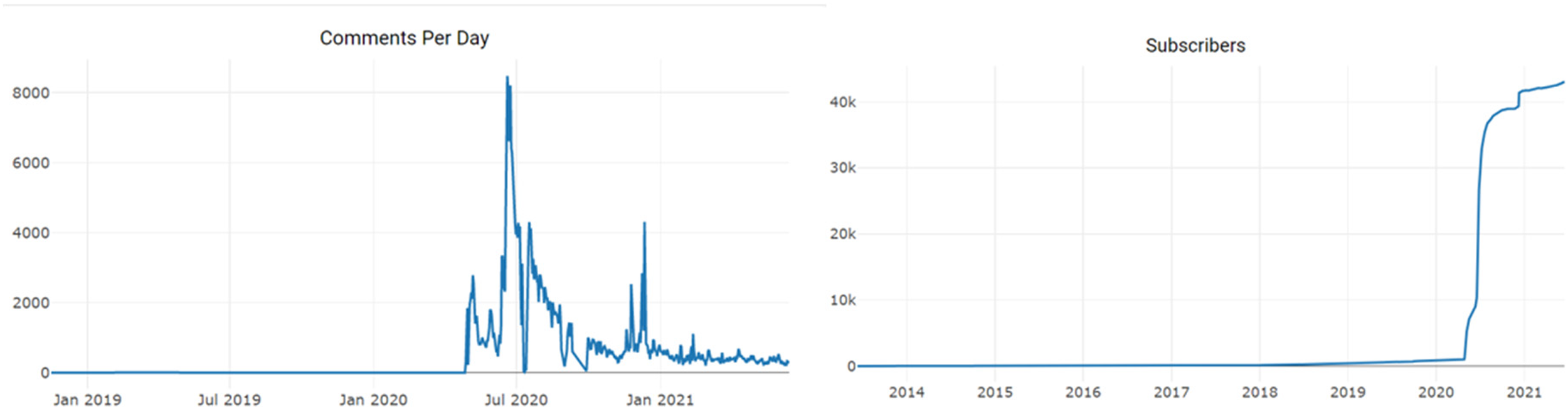
Subscriber and user activity on r/TheLastOfUs2.
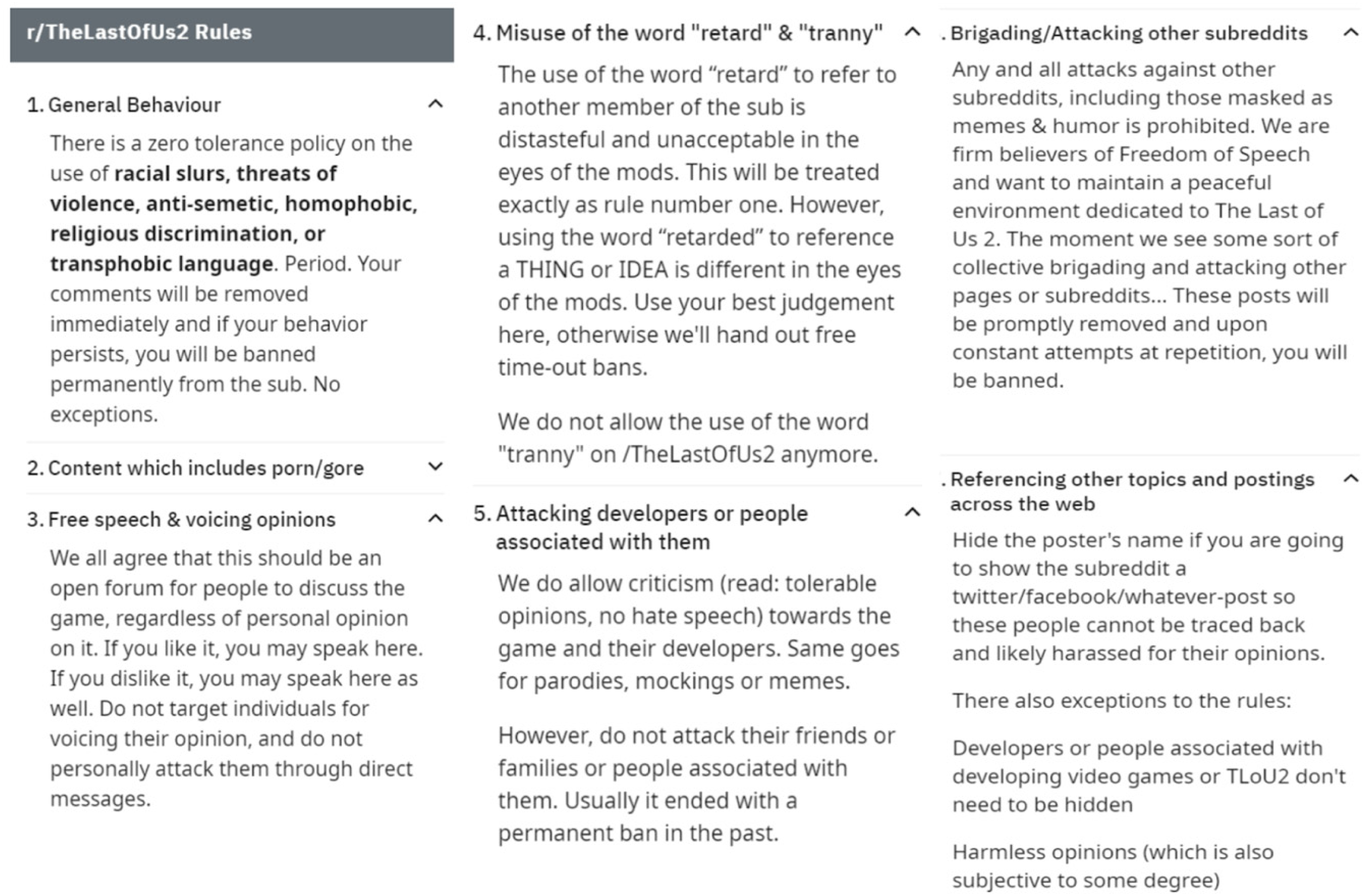
The rules of r/TheLastOfUs2 (November 2020).
While the subreddit's first rule explicitly bans the use of racial, sexual, and gender slurs, in truth, a great amount of the daily content on the subreddit is defined by these discriminatory perspectives; further complicating this initial rule 2 is the exception for the use of “retarded” when describing a thing or idea, the insistence on their belief in “free speech,” and permitting criticism “towards the game and their developers” while banning attacks on “their friends or family or people associated with them.” All of these features speak to the contradictory and unclear boundaries of a community that is suddenly thrust into oppositional activity while attempting to appear to be adjudicating within generally accepted social and cultural norms. Yet behind the compulsion to fully assign responsibility to the community's moderators, Reddit's general absolution of direct content regulation merits consideration. In this context, we contend that r/TheLastOfUs2's rules are purposefully opaque and inscrutable, and that this ambiguity sanctions a culture of conspiracy and damaging behavior veiled behind the appearance of equitable guidelines and the possibility of discipline.
Manufactured Expectations and Misleading Marketing
The key threads of alt-fan criticism leveled at Part II can be traced back to Part I and Left Behind, where the franchise's hallmark gameplay and identity politics were carefully managed by Naughty Dog's viral marketing practices. In the lead-up to the release of Part I in 2013, the game's cast intentionally lied in interviews and press releases about the possibility of playing as Ellie while official marketing for the game also omitted this revelation. In an interview following the game's release, Druckmann explained the approach: “From a marketing standpoint, something we were very conscious of initially—We said, “Here are things we will lie about in interviews.” If somebody asks, “Do you play as Ellie?” we would say no.” (as cited in Takahashi, 2013). 3 Although the game's ending generated moral questions relating to Joel's decision to save Ellie, Left Behind transformed the burgeoning franchise into a political maelstrom due to the revelation of Ellie as a gay character. In the course of eight months spanning the release of the two games, Naughty Dog redefined the narrative and thematic potential of video games and set the development of Part II on these newly established ideological foundations. According to Druckmann, “The takeaway for us is, ‘Okay, that approach worked. Let's do that again. Let's make a game that we want to play that isn’t out there yet.’ Also, how popular Ellie ended up being says a lot about whether games can sell with a female protagonist” (Takahashi).
In the six years between Left Behind and Part II, Naughty Dog enacted a sporadic approach to maintenance marketing by releasing teasers and short sequences from the upcoming game over the course of three years. This campaign begins on October 30, 2017, with the release of the first footage for Part II: a cutscene involving Abby. Speaking on the official PlayStation YouTube channel about this first glimpse at the game, Druckmann knowingly frames the marketing strategy as a “puzzle” to be solved: “We’re pretty sure that we’re going to see all sorts of theories about whom these characters are, where and when this scene takes place, and how all of this fits into Ellie and Joel's next story. For now, we’re keeping mum, but we’re excited to see what y’all make of this piece of the puzzle” (PlayStation Europe, 2017). Further pieces were added on June 11, 2018, with the release of the E3 gameplay trailer and again on September 24, 2019, in the official trailer for the game. Although other brief cutscenes are released during this period, these trailers provide the most compelling evidence for the ways that Naughty Dog sought to disguise the game's true narrative and instead fabricate several scenarios that are not seen or experienced in Part II.
Despite the E3 trailer most accurately representing the final game, it also generated growing unease regarding the minimized role of Joel; to assuage these concerns, 2019's official trailer ends with Joel asking Ellie, “you think I’d let you do this on your own?,” implying a familiar and comforting continuation of their dynamic from Part I. This constitutes Naughty Dog's most significant deception in the lead-up to Part II. In the actual game, this line belongs to a new character, Jesse, not Joel, and within the first hour of gameplay, we experience Joel's death at the hands of Abby. Although the lie about playing as Ellie in Part I successfully preserved the first-play experience, fabricating the ongoing role of Joel in Part II instead deprived players of an experience promised by the official trailer, and only exacerbated the ideologically motivated response to his death. Naughty Dog's misleading marketing is not a Manichean evil, as r/TheLastOfUs2 would suggest; however, the altered expectations created from their subterfuge directly engendered a sense of betrayal that fostered the growth of conspiracism and the formation of Part II's alt-fandom.
Loss of Control: Leaks and Outrage
On April 2, 2020, Naughty Dog announced that due to the emerging pandemic, Part II would be delayed indefinitely; a day later, two short gameplay clips were leaked to YouTube. The videos were quickly taken down, but their short time online coupled with the game's delay began a sequence of leaks. A day after, Reddit user u/HowPrude posted to r/TheLastOfUs2 that “someone in the comments of the video said that they saw a potentially true leak” revealing three major plot points: (1) that Joel is killed by Abby; (2) that the player is required to play as Abby for half the game; (3) and, incorrectly, that Ellie dies at the end. The tenor of the comment quickly escalates, claiming that this is “the complete opposite of what I want and what every fan wants,” and that Druckmann and the game's co-writer Halley Gross are “going to be burned at the fucking stake by fans.” A collection of accurate and inaccurate leaks in the coming days spread from 4chan, falsely citing Naughty Dog family members as sources. The ideological prejudices of 4chan, which holds a reputation as the “Internet's bogeyman” with enduring connections to the alt-right (Colley & Moore, 2020), filters into the tone of the leaks being shared on Reddit, and connects the game to a wider woke conspiracy, demonstrating how alt-fandom emerges via the porous boundaries between sites principally designed for entertainment (Reddit, Twitter, Facebook, YouTube, and TikTok) and ones which facilitate the alt-right (4chan and Truth Social).
Weeks later on April 27, a series of entire scenes from Part II were leaked to YouTube. These included Joel's death, the player fighting Ellie as Abby, Dina telling Ellie she is pregnant, Ellie and Dina's near death at the hands of Abby, and an in-game level list confirming that the narrative was split between Abby and Ellie. Given how swiftly screenshots of the leaks scattered across social media, Naughty Dog released an official statement on Twitter expressing their disappointment and asking fans not to spread them and spoil the game. For alt-fans, this confirmed the validity of the leaks and gave inadvertent authenticity to the mistruths accompanying them; for Naughty Dog, this represented a tangible loss of control over their reputation as a prestigious AAA studio and the carefully managed image of their as-yet-unreleased game. Subsequently, throughout May and until the game's release in June, various leakers were inventing their own versions of the game to smuggle alt-right prejudices into fan discourse. Chief among these was the false leak that Abby was a transgender character, which fuelled a cocktail of bigotry and anger at the game's “agenda.” Within only a “few hours” of the leaks, Druckmann expressed how this quickly translated into “death threats, antisemitic remarks, and just craziness I never could have anticipated” across “every social media” (Miller, 2020).
To justify their breach of Naughty Dog and veil the racist and transphobic attitudes tethered to the leaks, many leakers claimed to be operating under the guise of consumer rights. A widespread rumor claimed that the leaked videos were released by a disgruntled Naughty Dog employee, mobilizing earlier reports surrounding the company's “crunch culture” to validate the leaks as ethically justified, though this was soon confirmed to be false (Schreier, 2020). In a bid to remove “spoilers and vitriol” as the firestorm surrounding Part II intensified, Naughty Dog was among the first to be given access to a new feature on Twitter that allowed users to choose who could reply to their tweets (Allen, 2020). Yet this new kind of censorship only exacerbated the perception that Naughty Dog was exerting extreme control over criticism of their game and studio. The ripple effect of these leaks clearly characterizes a broad pattern of alt-fandom whereby the fervor surrounding an as-yet-unreleased title becomes uncontainable, concealment inspires rebellion in the form of leaks, and in an attempt to mitigate damage, producers inevitably inflame and compound the negative vortex engulfing their product.
Threads of Hate and Conspiracy
Although Part I already contained many of the political dimensions that provoked outrage in Part II (such as resistance to stereotypes of women, Ellie's sexuality, and a diverse cast), these are largely subsumed by the familiar heterosexual masculinity of Joel. However, in Part II, his murder (notably at the hands of a woman and the last time the player adopts a male perspective) dismantles this heteronormative prism. Despite alt-fan conspiracies that Joel's death was ideologically motivated, Druckmann asserts that the decision related to issues of narrative potential and closure: “in my mind, Joel's arc was pretty much done” (PlayStation, 2020). McKeand (2020) argues that “Naughty Dog wanted the players to feel how Ellie felt in that moment: angry, hateful, disgusted”; in stripping Joel's death of its narrative context, however, leaks of this scene exacerbated these feelings of grief and shock. According to Druckmann, despite “understandably … (losing) their shit,” fans had to “live with that frustration and anger” (Miller, 2020) for two months before the game released, allowing visceral and irrational responses to fester and cement in alt-fan communities like r/TheLastOfUs2. In this interim period, key conspiratorial themes, images, and beliefs crystallized into foundational symbols that sparked the alt-fandom and trapped these individuals in an “ideological silo of like-minded people” (Min, 2021, p. 415). Here, the savageness of Joel's death (bludgeoned by a golf club) became a symbol of outrage expressed repeatedly in memes, discussion posts, and on the subreddit's banner.
Comments on r/TheLastofUs2 characterize Joel's death as “disrespectful” (u/Nyan_Man), an instance of “SJW bullshit” (u/Harry-the-pothead), and intended to “pander” to “woke journos” (u/tom_oakley). To these alt-fans, this key event is a perceived betrayal not only of Part I but emblematic of a wider cultural effort to supplant white masculinity from media spaces; his death is thus a microcosm of the lingering #GamerGate conception of gamers being “at risk of losing ‘their’ games to more inclusive ones” (Braithwaite, 2016, p. 1). The backlash to Joel's death is thus better explained through the link between alt-fandoms and conspiracism rather than simply as an instance of fan discontent. As Douglas et al. (2017) account for, conspiracy beliefs and behavior are “particularly appealing to people who find the positive image of their self or in-group to be threatened” (p. 540). In this example, the r/TheLastOfUs2 community frames their oppositional activity as an act of resistance against cultural discourses and institutions that perceptually threaten to supplant them.
Although Joel's death unsettled and ruptured the desired trajectory of Part II for many players, the locus of outrage was his killer, Abby, which stemmed from three leaks: that she kills Joel, that the player must play as her, and incorrectly, that she is a transgender character. This latter leak was quickly and deliberately mobilized by conspiracists as a symbolic representation of the woke agenda via an anti-feminist and transphobic fixation on her muscular appearance. One thread on r/TheLastOfUs2 explains that she is a “gender confusion…and her anatomy looks like a man's” (u/Pinakuala); others describe her presence as “cramming this stuff [diverse sexualities] down our throats” and “simply more FORCED agenda” (u/TheAnswer2233; u/deleted). Hate messages received by Laura Bailey (Abby) (Figure 3) reflect the malice that came to characterize Part II's alt-fandom. Upon the game's release, the revelation that Abby was not transgender failed to abate the conspiracy rhetoric; indeed, the use of the slur “tranny” was still so frequent on r/TheLastOfUs2 that a specific rule was made to ban its “misuse,” although the derogatory term “troon” was still permitted.
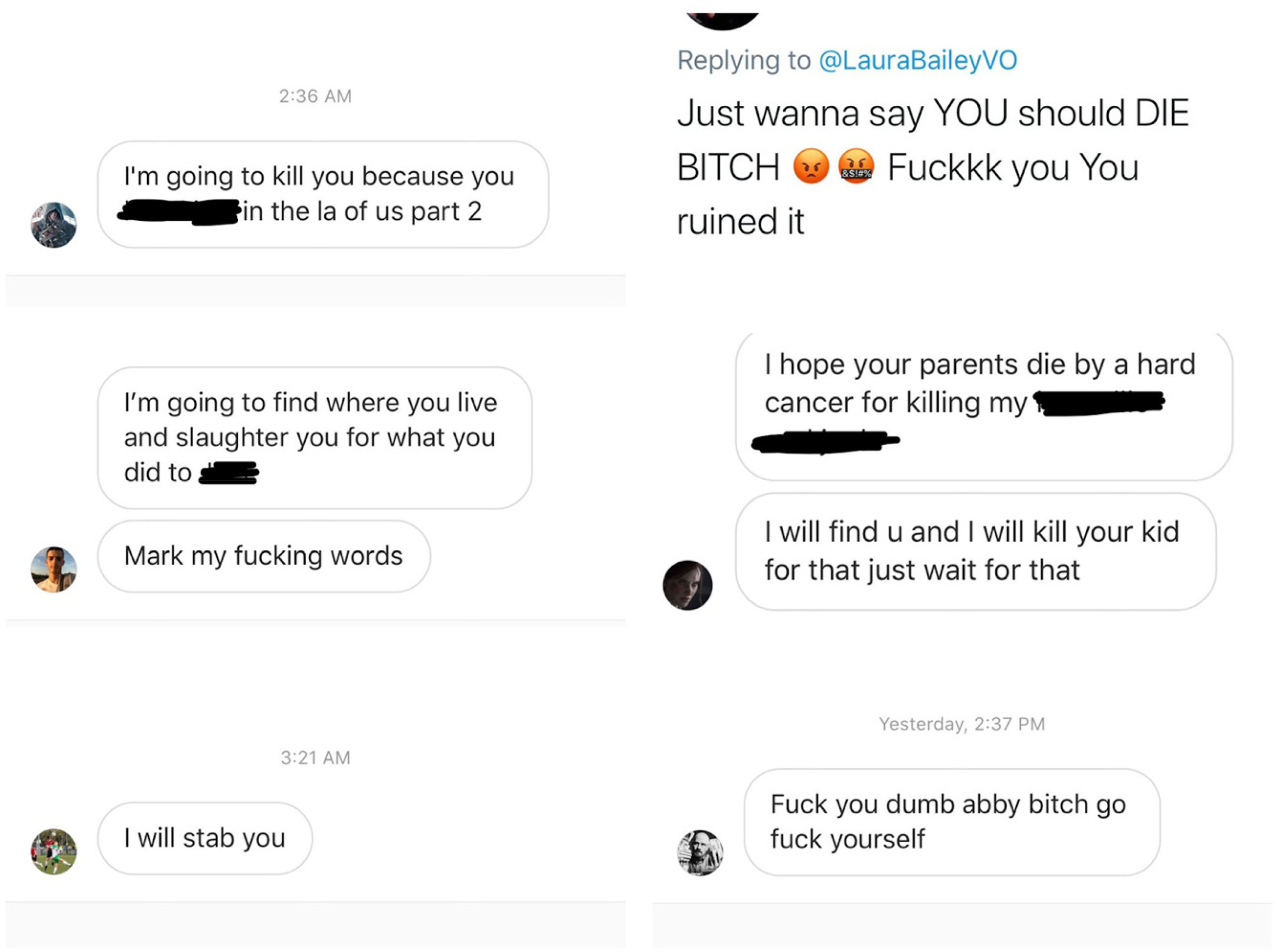
Twitter messages received (and compiled) by Laura Bailey on July 4, 2020.
All of this activity, particularly after the game's release, is indicative of a disconnect from reality for these alt-fans who appear unable to acknowledge examples that contradict or invalidate their campaigns. This dissonance further echoes #GamerGate, where conspiracy theorists attempted to legitimize their continuous attacks on critics and journalists under the guise of seeking “ethics in game journalism.” In the case of r/TheLastOfUs2, alt-fans attempt to obscure their bigotry by moralizing over the game's portrayal of violence, sex, and gender identity (Figure 4). A review by u/SnowPirateKite, the author of Figure 4, reflects their ideological interests in a number of niche subreddits, including as a moderator of r/antisex and a contributor to r/AdulteryHate, r/AntiVegan, and r/AntiPornography. The thousands of upvotes for Figure 4 reflect r/TheLastOfUs2's willingness to align themselves with deeply conservative beliefs and political concepts.
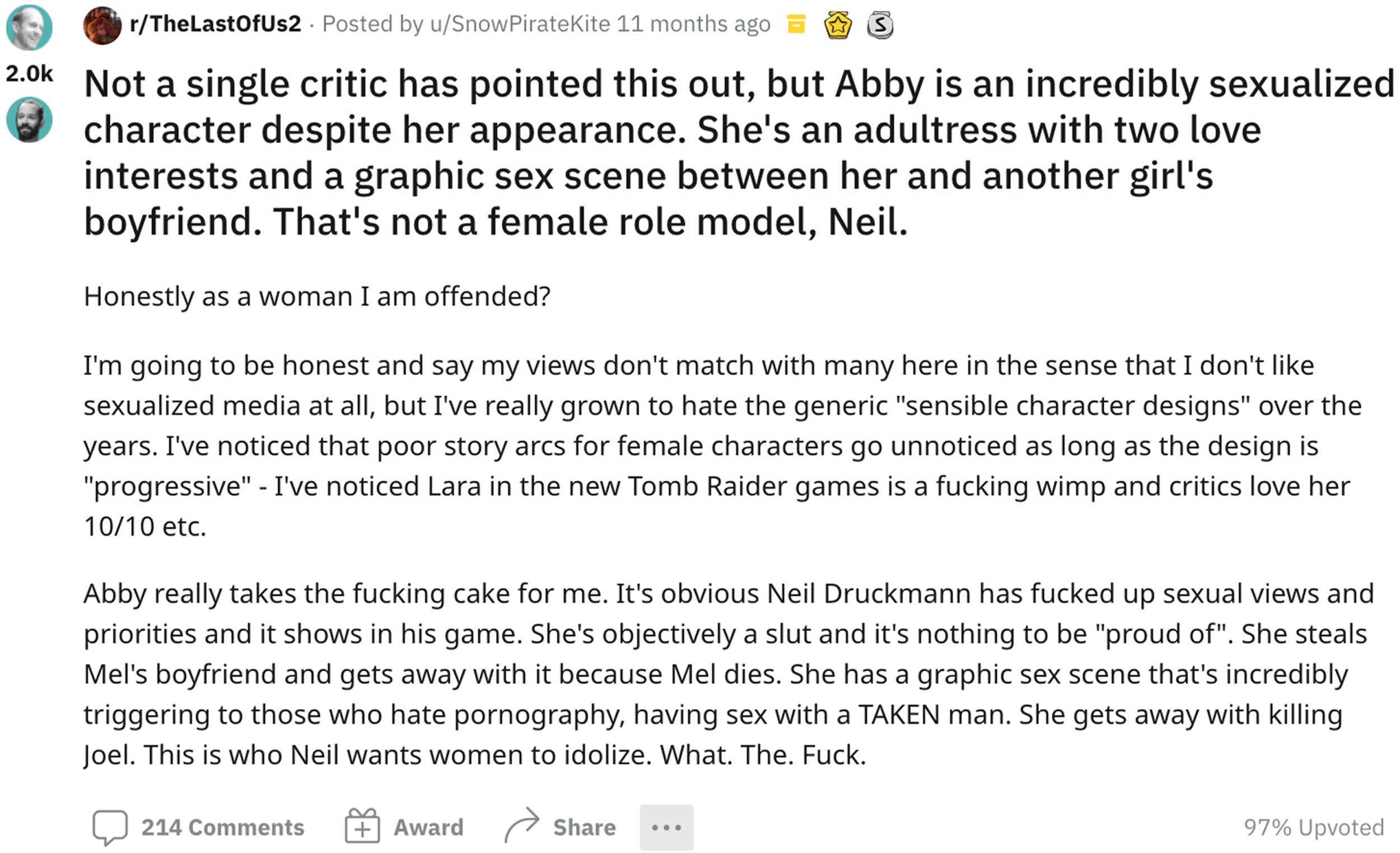
r/TheLastOfUs2 post moralizing contempt toward Abby's narrative.
A common refrain of alt-fans criticizing Part II is the pretence of objectivity (Figure 5), which, in the case of Abby, authenticates the idea that she is “objectively” a “bad role model.” Here, the pervasive conflation of moral standards, conservative politics, and rigid perspectives on what is acceptably “right” and “wrong” conceals the actual sources of contention: that Joel is killed by a woman, that the player must then play as this character, and that the game intends to challenge prejudices by enforcing this shifting perspective. This unambiguous view of morality and “objective” criticisms betrays the community's “Manichean narrative structures” (Oliver & Wood 2014, p. 954), which work to insulate their conspiracies from doubt and authorize an avoidance of the game's ideological challenges. A search of the term on r/TheLastOfUs2 reveals 230 posts that deploy the qualifier “objectively” either in the post's title or body. This claim of objectivity infers a lack of bias in the perspectives being shared, yet their ensuing critiques are consistently built on the prejudiced foundations fostered by the subreddit. In a meme mocking a post on r/thelastofus (the largest subreddit for fans of the franchise) which called Abby “one of the greatest video game characters of all time,” u/Dan-TAW123 asserts that “it's subjective what you like, but objectively she's one of the worst characters ever written”; similarly, u/Sanjay–jurt and u/superwildejellyfish express their outrage with a list of 64 characters (inarguably better than Abby) spanning the like of Crash Bandicoot to Lego Yoda, of which only two are women.
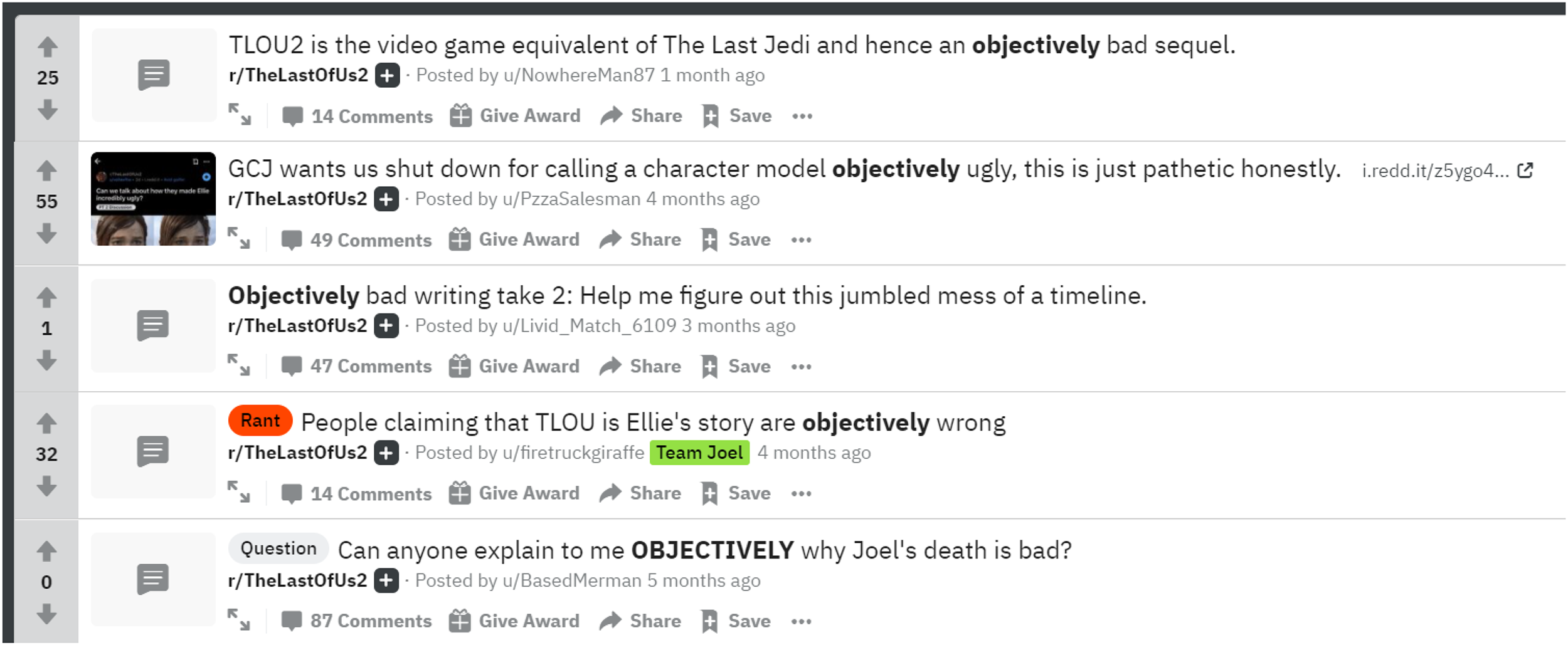
A sample of posts showcasing the community's frequent use of “objectively.”
Archives kept by the community r/AgainstHateSubReddits (where r/TheLastOfUs2 has appeared multiple times) reflect some of the subreddit's more insidious history. The striking feature of this activity is the total abandonment of the aforementioned moral posturing in favor of expressions of extreme alt-right rhetoric. In a post responding to a photo of Ian Alexander (the trans man who plays Lev) at a protest against Donald Trump's inauguration, the top comment (with 120 upvotes in 10 hours) writes “I hear the Middle East is pretty great for people like Ian” (u/RS-XG). Another replies that “China would be a luxury for these…’things.” They need to be sent to the Middle East where they throw gays off buildings and still tell me America was never great” (u/Timren1). Similar hate speech repeatedly appears in other comments, but, critically, any resistance against it is both infrequent and fiercely rejected. One user (u/Weidz5) attempts to distance themselves from the overt bigotry, writing “Fuck this…I hate the ham-fisted social messaging being forced into the game, and I am 100% against it, but I don't hate LGBT people. Grow the fuck up.” Despite broadly aligning themselves with the prevailing anti-woke sentiment of the subreddit, this comment was swiftly downvoted (−15), representative of a clear rejection of conservatism in favor of extremist messaging. In an example of how this violent imagery is repeated on the subreddit, functioning as a kind of gruesome motif, an early post at the time of the leaks detailed how a player “allowed Abby to be killed almost 100 times throughout the game including throwing myself from rooftops and cliffs” (u/ssmithsimms).
A Political Agenda: Creating Malevolent Forces
The nexus of r/TheLastOfUs2's conspiracy canon is the extensive attempts to find causal links between Part II and any internal or external agents that may have been factors in the game's narrative developments. This conspiratorial preoccupation with locating and holding responsible specific “malevolent forces” (Fenster, 2008, p. 953) has become a vital part of the psychological infrastructure of alt-fan communities; Douglas et al. define the epistemic motives of conspiracy theories in relation to causal explanations that involve “slaking curiosity when information is unavailable, reducing uncertainty and bewilderment when available information is conflicting, finding meaning when events seem random, and defending beliefs from disconfirmation” (2017, p. 538). Indeed, the conspiracism surrounding Part II is typified by these motivations that in turn seek to attribute the game's apparent failures to several causal agents: Neil Druckmann, Anita Sarkeesian, and Bruce Straley. Villainizing Druckmann and Sarkeesian and valorizing Straley enabled r/TheLastOfUs2 to map disparate agendas and ideologies onto the game and legitimize and sustain their hate campaign.
The primary conspiracy for the ideological direction of Part II sought to connect Druckmann to feminist media critic Sarkeesian, whose online platform Feminist Frequency interrogates the representation of women in popular media. An oft-cited source on r/TheLastOfUs2 is Sarkeesian's Tropes vs Women video series, which was funded via a Kickstarter campaign in 2012 and ultimately produced 20 videos from 2013 to 2017. In a 2013 keynote for the International Game Developers Association (IDGA), Druckmann talks extensively about the philosophical motivations that contributed to the development of Part I. Referring to the design of Ellie, Druckmann notes the dominant representation of women in video games: “we sexualise, we objectify, we marginalise, and we reduce these female characters to a lot less than what they can be” (2013). Although Druckmann's self-proclaimed “awakening” coincided with Sarkeesian's Kickstarter, the discrepancy between Ellie's development during Part I's production (2009–2013) and Sarkeesian's series (not beginning until 2013) makes clear that it could not have been entirely foundational to the franchise's feminist perspectives. Nonetheless, Druckmann's acknowledgment of Sarkeesian in his keynote alongside his introduction of her as the recipient of the Ambassador Award at the GDCA (Game Developers Choice Awards) in 2014 form the basis of a perceived public connection that alt-fans of Part II return to in order to substantiate their conspiracies about the game's ideological agenda.
r/TheLastOfUs2 regularly features posts with titles such as “Did Anita Sarkeesian kill Joel?” (u/TheDancing4Skin) and “Why Anita Sarkeesian Is To Blame For The Last of Us 2 Failure! Dont LET THEM GET AWAY WITH THIS!” (u/UndeniableMaggot), emblematic of the irrational and inflammatory desire to blame Sarkeesian for direct narrative events and the game's apparent feminist agenda. In a post titled “sarkeesian influence…” one user (u/Un0rth0doxgamer) seeks to reconcile the events of Part II with a wider Sarkeesian-SJW conspiracy: The Last of us part 2 is sarkessian's (sic) fantasy turned into a game. The main focus of the game is on 4 females, all males take secondary roles if they aren’t killed off…Of course this is indeed a political agenda…a statement to prove that females are better than males, and this indeed is the new norm…Sarkessian always claim's (sic) there is such a lack of female characters in video games, when the opposite is true, and only proves that she really isn’t into video games (other than trying to sabotage them for her own nefarious purposes). There is a very significant amount of females in games, she's just oblivious to them.
The conflation of Sarkeesian with Part II's supposed agenda also fails to recognize the contributions of female creative talent who, unlike Sarkeesian, actually worked on the game. In particular, the game's co-writer Halley Gross eludes the kind of vitriol directed at Sarkeesian despite the obvious implications of her role; posts on r/TheLastOfUs2 do acknowledge Gross, however the dominant post type questions why she is not receiving more blame. The common response to these posts is to redirect blame back onto Druckmann via a series of typical assertions: that Druckmann hired Gross to do his bidding (“Well Halley Gross was an advocate for his concepts, that's why Neil specifically chosen her as co-writer for Part 2” [u/TaJoel]); that Gross is a distraction from the blame that should be directed solely at Druckmann (“OP, why are you always making posts trying to somehow absolve Neil of his crimes?…He has shown no remorse for what he's done, and he continues to publically [sic] mock anyone who attempts to hold him accountable for his abhorrent behavior” [u/BigHardDkNBubblegum]); or that while Gross had considerable writing duties on the game's script, the ideas were not hers (“Point being that ultimately the majority of the main ideas came from Neil himself and it seems Halley was there to put all of that into script form with some contributions of her own” [u/unitwithasoul]). Although Sarkeesian is understood by the alt-fandom as a “malevolent force” (Fenster, 2008), Gross’ relative lack of political activism diminishes her appeal as an SJW/woke character in their conspiracy narrative.
Tendencies in how Sarkeesian and Gross are conceptualized are united by a common denominator: a voracious desire to ultimately discredit and attack Druckmann. In keeping with the targeted harassment toward Bailey and Sarkeesian, Part II's leaks marked the beginning of a sustained and systematic social media hate campaign directed at Druckmann. Yet unlike the treatment of Bailey, which is marked by misogyny and transphobia, Tweets, Reddit posts, and YouTube videos often vilify Druckmann with antisemitic rhetoric. The broad motivation of this activity is to attack his perceived political motivations and discredit him as a writer, director, and creator of Part I, all the while paradoxically holding him wholly responsible for Part II. Like Sarkeesian, Druckmann's online activity is often marked by a willingness to personally respond to such criticism and publish collections of hateful replies and direct messages. In one such tweet on July 6, 2020, almost three weeks after the release of Part II, Druckmann published a series of messages (see Figure 6) that he describes as “vile, hateful, and violent,” noting that he “feels it's important to expose.”
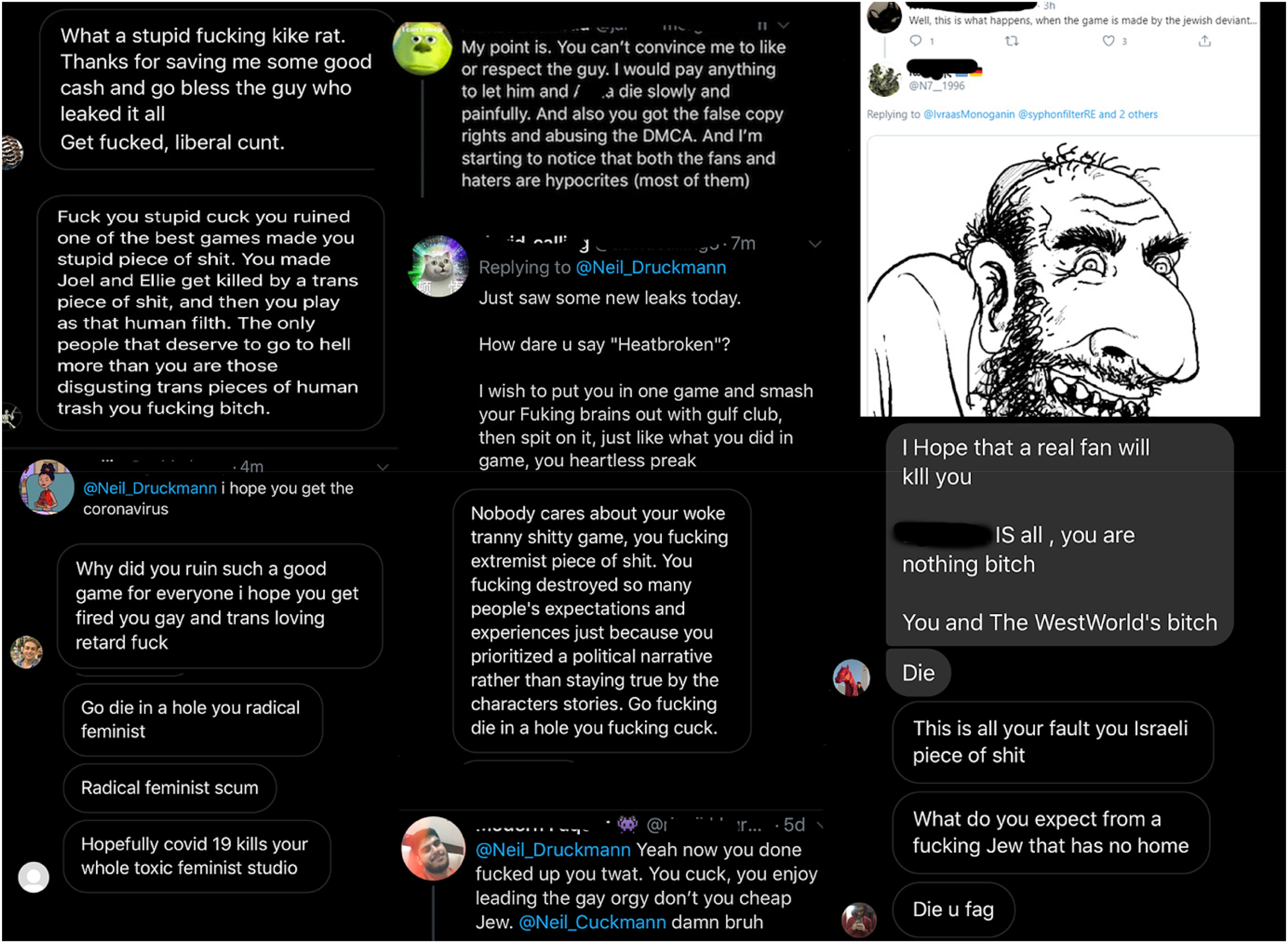
Hateful Twitter messages directed at Neil Druckmann, compiled by him.
Despite Druckmann's intentions to expose and thereby critique these responses, each new instance of engaging in this way only further inflamed the alt-fandom. Emboldened by evidence that Druckmann was also blocking negative or abusive Twitter users, activity on r/TheLastOfUs2 quickly turned being blocked by Druckmann into a virtual badge of honor. On the subreddit, there are 22 posts about being blocked by Druckmann with each featuring either a screenshot of the blocked notification or a meme about being blocked. The relationship between Druckmann's Twitter activity and the waves of these blocking campaigns are closely linked. On February 15, 2021, Druckmann tweeted, “if your game deals with serious subject matter then it's political. If that's a problem, make a different game…otherwise you owe it to your game to lean into it, doing your damnedest to treat (it) as honestly, completely as possible”; on February 19, 2021, a Reddit user (u/_makeouthills) posted a screenshot of a Twitter exchange about being blocked, presumably in response to this tweet. The post (“Wow, Cuckmann is now blocking people just for saying they prefer Part 1”) features 83 comments (739 upvotes) that span the now-usual array of responses to the game and Druckmann. This cycle of harassment, blocking, and boasting is emblematic of the prized nature of generating a direct response from Druckmann, and more critically, how this predictable outcome is then mobilized as evidence of him “censoring” criticism.
A further tenet of the alt-fandom's conspiracy narrative is not only that Druckmann should be stripped of credit for Part I but also that the game's co-director, Bruce Straley, should be valorized as its true creative author. This constitutes the most extensive conspiracy theory of r/TheLastOfUs2, with users often posting exhaustive collections of “evidence” and analysis that purports to reveal and authenticate him in this way. Tellingly, unlike Druckmann, Straley's public engagement in the franchise and its politics is limited, making him an ideal “unseen force” for conspiracist ideation (Oliver & Wood, 2014, p. 954). A significant contributor to the cultivation of Straley conspiracism is u/Elbwiese, a former moderator on the subreddit. In a 5456 word post titled “Bruce Straley and The Last of Us,” u/Elbwiese catalogs a series of tangential information, which they deem “circumstantial evidence,” in order to: (1) reveal Straley as the most important author of The Last of Us; (2) discredit Druckmann's involvement in Part I; and (3) align the community's criticism of Part II with Straley's absence from the game's development. Through a collection of disparate interview excerpts and news stories, u/Elbwiese organizes their post according to various topics: “A Collaborative Process” features a number of interviews that attempt to disperse the responsibility of creative and technical processes not just from Druckmann to Straley, but to a further collection of contributors at Naughty Dog; “Straley and Druckmann” initiates a more specific reframing of processes and roles between Druckmann and Straley related to writing duties and responsibility for the game's narrative; “The Evolution of the Story” begins with an interview excerpt of Druckmann and Straley discussing the narrative development of Part 1, to which u/Elbwiese interjects, “to me it feels like Straley is trying to be diplomatic here, but when one reads between the lines then it seems that he had to reject Druckmann over and over and over again until he finally got it into his thick egotistical skull.”
u/Elbwiese's reliance on interpretation and semantic manipulation of language coupled with the referencing of extensive sources (interviews, tweets, and keynotes, official The Last of Us books, all spanning a roughly seven-year period) creates the impression of a comprehensive “myth” debunking, promising answers to the alt-fandom's paranoid questions of authorship and alternative reasons for the evolution of the franchise. The will in this post to identify specious patterns in language (often highlighted through bold text to emphasize the potential inference) and create links between disparate pieces of information (commonly sequenced as though they are part of a long-term ulterior narrative) all identify this activity with broader trends in conspiracy theories. An experiment conducted by Whitson and Galinsky (2008) intending to probe the relationship between self-control and conspiracy theories revealed that “a lack of control creates a need to perceive patterns in one's environment, even when the patterns perceived are illusory” (p. 117). Posts in the ilk of those created by u/Elbwiese are consistent with this finding, and in turn, evince Douglas et al.'s (2017) contention that conspiracy theories “provide broad, internally consistent explanations that allow people to preserve beliefs in the face of uncertainty and contradiction” (p. 539). Indeed, u/Elbwiese's post is littered with uncertainty: frequent and presumably unintentional qualifiers of certainty punctuate “evidence” with statements such as “it would be fair to guess,” “I get the direct impression,” “I firmly believe,” “it feels completely in-character,” and conclusions that end with variations on “the departure of Straley seems to be the most plausible explanation in my opinion.”
Whether in relation to Druckmann, Sarkeesian, or Straley, the conspiracy and hate rhetoric is endemic of a basic pattern found across all alt-fandoms: discredit and defame a “responsible” party (in this case, Druckmann), fortify the contempt for the text by aligning this party with progressive political movements, and transfer responsibility and recognition for earlier texts in the franchise to others. Although the response to Part II can partially be understood as the result of the divisive social and political tensions of 2020, there is a greater cultural shift at work that provides a compelling rationale as to why Naughty Dog sought to obscure and fabricate aspects of Part II's narrative in the lead-up to its release. The same ideological motivations informing the tempest surrounding Part II—an insatiable appetite for political conflict, online harassment campaigns, anti-woke conspiracies, and an impossible set of expectations—are central to the alt-fandoms of many media franchises. Despite the specific features of its conspiratorial canon, the response to Part II is, therefore, not an outlier, nor should it necessarily be considered an unexpected or shocking development in the volatile environment of contemporary cultural reception. Rather, the case study provides a conclusive framework for a now-common mode of social engagement and an alarm for the damaging potential of the complex interactions between real-world politics, conspiracism, social media, online anonymity, and fandom.
Conclusion
Naughty Dog's management strategy for Part II is indicative of a contradictory condition of contemporary media culture: in attempting to conceal key narrative details in the lead-up to its release, the marketing campaign successfully encouraged intense online engagement and speculation, yet also fostered extensive leaks, fractured expectations, and created fertile ground for conspiracy theories and alt-fandom. Despite the predictable failure of this approach to stem these negative consequences, this style of marketing continues to be adopted for the promotion of new screen texts. Amazon's The Rings of Power (2022) was produced with unprecedented secrecy in fear of spoilers to the point that cast members were hired without knowledge of what roles they would play, and consulting Tolkien scholar Tom Shippey “parted ways” with the show after speaking to fan publications; Jennifer Salke, head of Amazon Studios, suggests this all generates “healthy,” if “intense,” fan curiosity (Breznican & Robinson, 2022). After details about the show were finally revealed, immediate retaliation against its diverse cast emerged with thinly veiled tweets about “meeting quotas” and “woke casting” (Hibberd, 2022), eventually manifesting in an alt-fandom of its own (r/Rings_Of_Power). This suggests that studios are aware of this cultural condition and struggle to maintain control over the reputation of their property, and that their clandestine marketing tactics are at least partly deployed to mitigate the anti-woke narrative and formation of alt-fandoms in advance.
A noteworthy point of development for our case study is HBO's television adaptation of The Last of Us. Despite Gray's argument (2020) that adaptions or sequels may operate as an avenue to “renovate or cure” (p. 30) the dislike for divisive texts, a survey of r/TheLastOfUs2 suggests this is unlikely to be the case. Some members plan to boycott the show in the fear its success would lead to an adaption of Part II, or an “over-focus” on Left Behind's romance (u/VimalTP; u/ShepardRahl); others already decry it as “woke” over its perceived “blackwashing” (u/WildPurplePlatypus; u/TheCelestialOcean; u/EntrepreneurSome3707) and having “no straight white males in leading roles” (u/f3llyn). This early reception clearly affirms the underlying thesis of this article: to the alt-fan, anti-diversity is an immovable fixation that supplants the actuality of any text. Rather than marking a point of reconciliation for fans of the franchise, it therefore seems more probable that HBO's adaptation will be folded into the conspiracy canon and met with similar resistance by alt-fans. In contrast, in the lead-up to the series’ premiere, Druckmann has continued to frame the franchise's inclusivity as a matter of authenticity: I think the diversity of cast is important to the story and I want us to do an even better job than we did on the game. I know the joy I felt when I watch a movie or play a game that I really like and I see myself in it. And a side effect of what we’re doing, of trying to make the story more authentic, is that it gives that feeling to more people and could inspire more people to tell their stories and I like that. (Playstation, 2023).
As a microcosm of sociopolitical aggrandizing in popular culture, Part II expresses the dangerous imbalances that have formed through the digital democracy of online opinion-making and how, in an attempt to navigate around such potential threats, creative agents can inadvertently inflame the reception of their own work. The Last of Us franchise is trapped in an environment where the consumer is given equal footing to the producer, augmented by a possessiveness of popular media texts that are ostensibly governed by “the fans.” In our case study, the more myopic and singularly minded “gamers” who were drawn to Part I's familiar elements inevitably collided with Part II's clear ideological perspectives. Indeed, the central mechanism of the game—an enforced perspective change from Ellie to Abby—acts as both an extended meditation on the philosophy of choice and a knowing provocation of a particular video game culture often typified by the stereotype of geek masculinity. As Druckmann states, “it's ironic or maybe sad—I think that people will benefit the most from this kind of story are the ones that are yelling the loudest right now, but I hope there's enough in the game to draw them in and just normalize stuff that is normal” (as cited in Wilson, 2020). In truth, the concept of choice pervades the franchise at large: in Joel's choice to save Ellie in Part I; in Naughty Dog's choice to lie and mislead their audience about the reality of both games; in Ellie's journey to choose revenge and retribution in Part II; in Ellie's choices to forgive Joel and not kill Abby; and crucially, in both games, the player's inability to choose who to play and not to play as. Which choices are tolerable offers insight into the ideological tolerances that either comfort or spurn alt-fandoms.
In this fragile and often volatile relationship between studios and audiences, a zero-sum game emerges in which no one or nothing is immune from condemnation. Paradoxically, the ideological vilification that plagued Part II cannot be successfully circumvented by traditional metrics of success: it was lauded by critics, earning the most Game of The Year awards of all time, and became the fastest-selling PlayStation exclusive ever in its opening weekend. Despite this acclaim, Part II's reputation as a divisive title is now its preeminent legacy. In the complex and troubling aspects of this case study, the architecture of a new reception culture materializes. Enabled by a wider trend of leaking and spoiling texts, this culture is ultimately characterized by the radical ideology of the “alt-fan,” who masquerades as apolitical yet seeks to resist diversity in popular media and instead enforce a bygone status quo. In effect, the traditional fan and creative producer together must contend with an online attention economy that rewards harmful behavior, and by extension, facilitates the ongoing narrowing of ideological tolerances through which a new product must thread itself.
Footnotes
Declaration of Conflicting Interests
The author(s) declared no potential conflicts of interest with respect to the research, authorship, and/or publication of this article.
Funding
The author(s) received no financial support for the research, authorship, and/or publication of this article.
