




Abstract
Digital media are often praised for having offered new ways to participate with news. But how has participation with news changed in recent years? A pre-registered analysis of survey data from 2015 to 2022 in 46 countries (N = 577,859) shows that participation with news has declined. This decrease is observed in most countries and for most forms of participation, including liking, sharing, commenting on news on social media and talking about the news offline. The only form of participation that has increased is news sharing via private messaging apps. Overall, participation with news was higher among younger people, the university-educated, those with high interest in news and those with low trust in news. Over time, participation has declined more for those with lower trust in news, those without a bachelor’s degree and for women. Within countries, increases in political polarization were associated with lower participation.
Introduction
Participation in public life – whether in-person or mediated; offline or online – is often praised as a civic good. While some forms of participation are ambiguous or even outright harmful, decades of media research, political theory and social science sees more participation as, on balance, positive and declines in participation as worrying (Couldry et al., 2010; Norris, 2011; Strömbäck, 2005; Verba et al., 1995).
This is one of the reasons the rise of digital media, and later social media platforms and messaging application platforms more specifically – all of which can make participation easier and more accessible to a greater number of citizens – gave rise to early optimism around the promise of the ‘participatory culture’ (Jenkins, 2006), ‘participatory politics’ (Loader and Mercea, 2011) and ‘participatory journalism’ (Singer et al., 2011), enabled by what was in industry circles and public debate variously called ‘web 2.0’ and the ‘social web’.
While initial optimism regarding the potential for participation on digital platforms has been replaced by a growing body of more evidence-based and often more critical work, an important basic empirical question remains unanswered: has participation increased over time as digital media and various platforms have become more integral parts of our media environments and life more broadly? And if so, have these heightened levels of participation remained high?
In this article, we focus on news specifically and present a pre-registered analysis of survey data from 2015 to 2022 in a total of 46 countries (N = 577,859). While other studies suggest that digital media has enabled greater and broader participation with news above and beyond those who engage offline, we show that, in recent years, participation with news has declined by 12% –such that in 2015, on average, our respondents participated in 1.86 different, compared to 1.64 ways in 2022 (see Figure 1). The number of respondents reporting not participating in any way with news increased by 19% during the same period. The decline in participation is observed in most countries and for most forms of participation, including liking, sharing and commenting on news on social media, as well as, importantly, talking about the news offline.
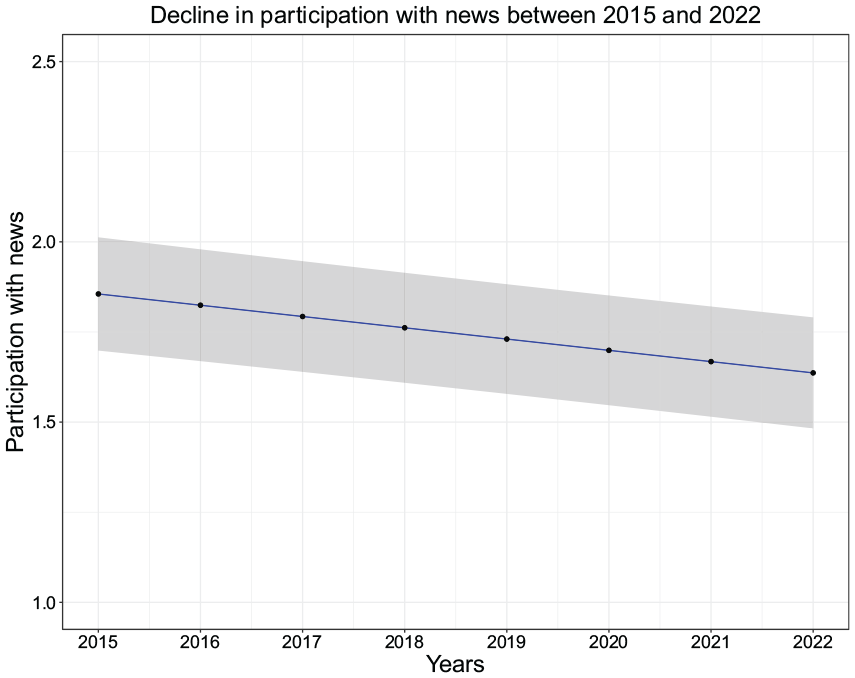
Overall decline in participants with news between 2015 and 2022 in 46 countries.
Some forms of participation have substantially declined between 2015 and 2022. For instance, sharing news on social media has decreased by 29%, commenting on news on social media has decreased by 26% and talking about the news face-to-face has decreased by 24%. The only form of participation that has steadily increased is news sharing via private messaging applications such as WhatsApp, which has grown by 20%.
Looking at the individual-level correlates across the entire period, we find that participation with news was higher among those with a bachelor’s degree, among women, younger people, those with high interest in news and those with low trust in news. Over time, participation has declined more for those with low trust in news, those without a bachelor’s degree and women – to the extent that, by 2022, their participation levels had dropped below those of men.
Participation is higher in countries with higher levels of interest in news, and looking at patterns within countries, we show that increases in political polarization are associated with lower levels of participation. Our results are very far from the idea that ‘the age of social media is ending’ (Bogost, 2022), but they do reveal an important change in how people participate with news, both offline and via digital platforms and social media.
Participation, participatory journalism and the importance of comparative longitudinal survey work
People have always found ways to creatively engage with and repurpose even the most standardized, one-way, mass media content for their own ends. But the affordances of digital media have made it easier – for those who want to – to complement offline forms of participation with online participation, whether it’s commenting on, discussing or sharing news, or creating their own content.
Many strands of scholarship have focused on these phenomena, whether framed in Henry Jenkins’ terms of ‘participatory culture’, highlighting how historical distinctions between media producers and media consumers are more blurred today (Jenkins, 2006), Axel Bruns’ notion of ‘produsage’, where digital media users increasingly play the role of producers (Bruns, 2008), or ‘networked publics’ as described by danah boyd (2010) and others (Varnelis, 2008), to capture how participation in public life is restructured by networked technologies. Further work has highlighted critical aspects sometimes overlooked in earlier work, including how participation is shot through with profound racial and gender inequalities (Jackson et al. 2020), can express dislike (Gray, 2021) or hateful anti-fandom (Click, 2019) or constitute trolling (Phillips and Milner, 2017). Work has also emphasized how participation is often premised, at least in part, on the tools provided by self-interested private platform companies that profit from particular forms of what Jose van Dijck (2013) has called ‘cultures of connectivity’.
While this growing body of scholarship presents a more nuanced and less optimistic picture of participation – especially participation enabled by platform companies – it continues to be the case that social scientists interested in, for example, the effect of social media use on social capital, civic engagement and political participation tend to find, as one meta-analysis put it, ‘small-to-medium size positive relationships’ (Skoric et al., 2016, see also: Boulianne, 2020). And while some differences in news participation are aligned with historic inequalities in participation in public life (Oser and Boulianne, 2020), not all of them are. Some research has found that young people and women are more likely to participate via social media (Vaccari, 2013; Vaccari and Valeriani, 2021; Valeriani and Vaccari, 2016). Other research, however, has concluded that online and offline forms of participation tend to be mutually reinforcing (Oser and Boulianne, 2020).
‘Participatory journalism’ has become the broad phrase under which scholars have approached these issues. Research started with an interest in comments sections on news sites, discussion forums and user blogs (Lasica, 2003) – all of which represented a break with a long tradition of ‘we-publish-you-read’ approaches to journalism – but more recent studies have placed a greater emphasis on the role of social media platforms, used by both individual journalists, news media organizations and members of the public to distribute, engage with and discuss news content (Singer et al., 2011). The broad focus has often been on ways in which non-journalists can participate in the production, editing, distribution, consumption and discussion of news – in ways that are collaborative (working with journalists and/or news media) or parallel (active engagement with news content, but not directly with the professional producers), individual or collective, emergent or organized. Aspects of this have also been researched as, for example, ‘citizen journalism’, ‘engaged journalism’, ‘interactive journalism’ or ‘reciprocal journalism’.
At the same time, recent studies of newsrooms have found that, despite growing concerns over the reliance on platform companies, problems with harassment and trolling, and limited editorial and commercial returns on investments in participation, newsrooms prioritizing participation can ‘create opportunities for meaningful audience involvement’ (Belair-Gagnon et al., 2019; Schmidt and Lawrence, 2020). Private sector publishers – who have clear commercial incentives to meet potential audiences where they are – tend to invest more in social media than their public service counterparts (Nielsen and Ganter, 2022; Sehl et al., 2021), even as others report a sense of ‘participation fatigue’, leading them to close down comment sections and user forums, and to reconsider their social media strategies (Porlezza, 2019; see also Toff et al., 2021). These journalism-focused studies also capture the self-interested – even existential – concerns underlying some of the interest in participation as ‘at a moment of intense uncertainty within the news industry, a growing number believe the key to the profession’s survival depends on journalists improving their relationship with the public’ (Ferrucci et al., 2020).
That’s what some in journalism and the academy believe, and as a result there is considerable interest in participation. But what about the public journalists and news media want to connect with? As Suau et al. (2019) pointed out, ‘studies about participatory journalism have traditionally been focused on the study of the participatory options offered by news media, or the attitudes of journalists towards the participatory options offered to the users [and] just in recent years research started to be focused on the users themselves and their attitudes towards being involved in online participatory practices’. This is perhaps indicative of how journalism studies can be newsroom-centric, and while some qualitative studies have focused on the public (Borger et al., 2016; Swart et al., 2018), and some quantitative studies of participation by the public at large do exist, most of them are either single-country case studies (Larsson, 2019), focussed on specific platforms (mostly Twitter, as data has been easier to access, Ackland et al., 2019), or cross-national but focused on a single moment in time (Kalogeropoulos et al., 2017).
A recent literature review (Engelke, 2019) summarizes 378 studies published from 1997 to 2017 on online participatory journalism, and highlights that work in this area (a) has tended to focus on a few unusual countries in Western Europe and North America, (b) has produced a significant number of studies focused on journalists and news media rather than the public and (c) that analysis of public (from journalists’ point of view, ‘audience’) participation – especially comparative and longitudinal analysis – is rare. Another literature review (Segado-Boj, 2020), covering some of the same period, concludes that ‘further use of surveys [is] suggested’.
We conducted a large-scale comparative and longitudinal analysis of survey data to better understand the evolution and determinants of participation with news. When much scholarship has, crudely put, focused on the supply side, we focus on the demand side. Our focus is on participation with news, such as talking about the news offline or online, sharing, liking and commenting on news on social media, or voting in online polls on news websites – rather than broader participatory practices involving personal creativity, self-expression and fan culture more widely. We do not cover the extent to which people consume news or are exposed to it. 1 Our analysis is the most ambitious to date in terms of the number of countries (46 countries), the time span (eight years) and the variety of forms of participation (nine forms of participation).
Our main hypothesis is that, despite the growing popularity of digital and social media, and the professional and scholarly interest in the potential for participation, participation with news has declined. We base this hypothesis on the results of audience and media research more broadly, rather than work specifically on participation. First, news is a much smaller part of online media use than offline media use. Just a few percent of the time spent on the Internet is with news, and media users’ ongoing shift towards more digital, mobile and platformed media at the expense of broadcast and print, means most of them consume less news (Hindman, 2018; Nielsen, 2020). Second, survey research suggests a significant decline over time in interest in news from much of the public in many countries, suggesting many people are less motivated to actively seek out news in an increasingly high-choice media environment (Newman et al., 2022; Prior, 2007). Third, consistent and selective news avoidance, both of which limit the possibility and likelihood of participating with news, is on the rise in many countries (Newman et al., 2022; Toff et al., 2023). Finally, some news media have restricted or removed comment functions on their websites and apps, and – more consequentially – some digital platforms, Facebook in particular, have taken a series of steps to reduce the amount of news that their users see on the platform. More broadly, qualitative analysis finds that ‘sharing’ has lost its central place in the terminology employed by social media platforms in their self-presentation, suggesting a greater emphasis on other forms of use (John, 2024).
H1: Participation with news has decreased over time.
In line with previous scholarship, we define participation as a broad category that includes, among others, interacting with news on social media, sending news via email and talking about the news offline (see Table 1 for a list of all forms of participation that we covered). Of the research questions (RQs), RQ1 investigates whether all forms of participation with news have changed similarly over time. It could be that, even as people become less likely to like news on social media, they may be just as likely to talk about the news offline with their friends and colleagues. This helps us get at the relative importance of the various reasons behind Hypothesis 1 above, because some possible factors contributing to a decline in participation with news are only relevant for specific kinds of participation. For instance, if participation is declining because social media platforms have downranked news, then we should expect participation with news on social media to be primarily affected. Similarly, if participation is going down because news websites have deactivated their comments sections, or increasingly put their articles behind paywalls, then we should mostly see a decrease in participation on online news sites. On the contrary, if participation with news is going down because of a more general decline in use, lower interest and increased news avoidance, we should expect most forms of participation to go down. These explanations are not mutually exclusive, but they each make distinct predictions about specific forms of participation.
Measures of participation with news in the Digital News Report.
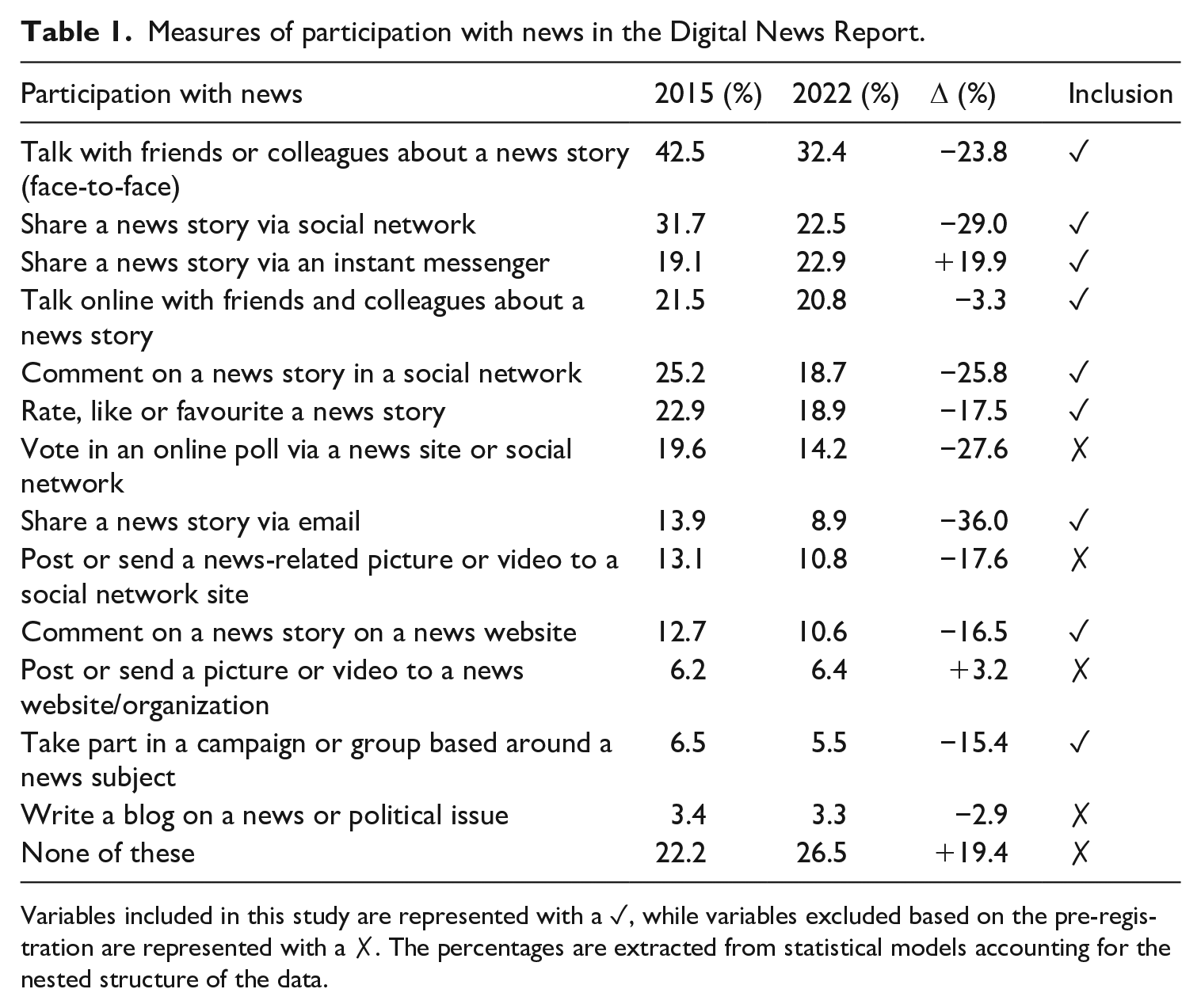
Variables included in this study are represented with a ✓, while variables excluded based on the pre-registration are represented with a ✗. The percentages are extracted from statistical models accounting for the nested structure of the data.
RQ1: How did various forms of participation with the news vary over time?
We also explore how five individual-level factors predict participation with news: trust in news, interest in news, education, age and gender. Previous work has shown that those who trust the news the least are more likely to participate with news online, especially by sharing and commenting on news articles (Fletcher and Park, 2017). Interest with news should be positively associated with participation as people who are more interested in the news consume more of it (Newman et al., 2022). Past work has shown that those who are most interested in hard news were more likely to comment on the news, while those most interested in any kind of news were more likely to share news via email (Kalogeropoulos et al., 2017). Women are more likely to participate with news, especially online, whereas age appears to play a minor role (Kalogeropoulos et al., 2017). Education also appears to be a weak predictor of participation with news (Ha et al., 2018; Kalogeropoulos et al., 2017), even though the most educated are more interested in news and consume more of it (Newman et al., 2022).
RQ2: What socio-demographic factors predict participation?
We are also interested in changes to the level of news participation among different groups, and explored changes in the composition of those who participate, bringing a longitudinal perspective on the ongoing ‘reinforcement versus mobilization’ debate (Oser and Boulianne, 2020) – that is, whether new forms of participation increase or decrease pre-existing structural inequalities between different groups.
RQ3: Which sociodemographic groups participate more or less over time?
Next, because we are dealing with a large, cross-nationally comparative dataset and previous research underlines that the use of the same media often develops quite differently in different contexts, we looked at country-level predictors explaining:
Differences in participation between countries, that is, why do people participate more in some countries than others?
Differences in participation within-countries, for example, how are changes in political polarization within countries associated with overall participation at the country level?
We analysed the effect of changing levels of political polarization and freedom of discussion. Related work suggests that people in countries with lower freedom of discussion may be more reluctant to participate with news, because of friction added by the state, fear of repression or other chilling effects (Ong, 2021; Oz and Yanik, 2024). For instance, in countries with lower freedom of discussion, people may be less willing to publicly participate with news critical of the regime, and may instead prefer more private and secure forms of participation, such as news sharing via encrypted messaging applications.
Political polarization may, on one hand, reduce participation by increasing the toxicity of online and offline discussions (as qualitative work by, e.g. Duyn, 2022; Powers et al., 2019 has found), or on the other hand, spark participation as people become more motivated to defend and signal their viewpoints online (as, e.g. work on expressive partisanship would suggest Huddy et al., 2015; Mason, 2018). Yet, even in polarized countries like the United States, political interest and public sharing of political news remains low (Mcclain, 2021; Wojcieszak et al., 2023). It is thus likely that political polarization may increase participation among a minority of the population with strong partisan identities, while reducing participation among a silent majority with weaker partisan identities. Moreover, polarization may increase public forms of participation among strong partisans and increase private forms of participation among weak partisans.
RQ4: What country-level factors predict participation?
Finally, we explore whether the effect of the above within-country variables has changed over time by interacting them with time.
RQ5: What country-level factors predict changes in participation?
Data
We analyse data from the Digital News Report surveys between 2015 and 2022 (Newman et al., 2020, 2021, 2022). 2 Respondents were drawn from opt-in online panels assembled by the polling company YouGov (and their partners), based on nationally representative target quotas for age, gender and region in every country, with additional quotas for education and political orientation (based on past vote) in some countries and years. Because the samples are non-random, certain groups and characteristics may be over-represented, such as those who use the news more or those with higher trust. The main strength of the dataset is that the same questions have been asked each year in many countries, making longitudinal analyses between and within countries possible.
Countries
The dataset covers 46 countries. While together they account for more than half of the world’s population, these countries are not a representative global sample. Specifically, the Global North is over-represented, while countries with low levels of press freedom (Reporters Without Borders 3 ) and low life expectancy, education, and income are under-represented (United Nations’ Human Development Index 4 ). The dataset contains 292 country-years, but data were not collected from all 46 countries in every year (see Figure 1). This sampling bias amplifies the over-representation of Global North countries.
Measures
Our dependent variable is participation with news. Every year, and in every country, participants responded to the following question ‘During an average week in which, if any, of the following ways do you share or participate in news coverage? Please select all that apply’. The response options are listed in Table 1, together with the percentage of participants selecting them averaged across years and countries.
Participation with news was computed as the sum of the responses in Table 1 (✓). As Matthes (2013) argues, participation should be computed as a formative scale based on the sum of all items because each represents something different, and there is no underlying construct that explains the correlations among different forms of participation. The response ‘None of these’ was excluded because selecting this option is equivalent to scoring zero on our participation metric. We excluded the other options because they were not included in the Digital News Report survey in 2022. Note that in 2015 and 2016, sharing news via an instant messenger was not offered as an option but is nonetheless included in our participation variable – thus in 2015 and 2016, the maximum participation score is eight, while it is nine for the other years. Although this is not ideal, in practice this inconsistency makes it harder to find evidence of a decline in participation posited in Hypothesis 1. We address these concerns in Supplementary Appendix B and C, by showing that excluding sharing news via an instant messenger (or excluding 2015 and 2016) doubles the size of the yearly decrease in participation that we report in H1 (from –0.03 to –0.06).
The individual-level variables include age (in years), gender (female or male) and formal education (no degree or degree). Interest in news was measured with the following question ‘How interested, if at all, would you say you are in news?’ from [1] ‘Not at all interested’ to [5] ‘Extremely interested’. Trust in news was measured with the following question ‘I think you can trust most news most of the time’ from [1] ‘Strongly disagree’ to [5] ‘Strongly agree’. The selection of these variables was restricted by the questions present in all surveys between 2015 and 2022.
We included two country-level variables from the V-Dem project, an annual expert survey widely used in political science research. 5 Political polarization (i.e. ‘is society polarized into antagonistic, political camps?’; v2cacamps_osp) was measured on a scale from [0] ‘Not at all. Supporters of opposing political camps generally interact in a friendly manner’ to [4] ‘Yes, to a large extent. Supporters of opposing political camps generally interact in a hostile manner’. Freedom of discussion (i.e. ‘are citizens able to openly discuss political issues in private homes and in public spaces?’) was measured in a similar way (v2xcl_disc), with values ranging from [0] ‘low’ to [1] ‘high’. For each country-level variable, we have one value per country-year.
Statistical analyses
The analysis plan and the statistical models were pre-registered 6 : https://osf.io/mzp7k/?view_only=ceb8221308e240cb87ff0884b8357482
We analyse the data using the random effects within-between (REWB) framework (Bell et al., 2019), using a modelling approach specifically designed for cross-sectional time series data that is cross-sectional at the individual level but longitudinal at the country level (Fairbrother, 2014). As with the country fixed effects modelling, this approach allows us to estimate within-country effects, thus effectively controlling for all stable (time-invariant) country-level variables regardless of whether they were measured. But unlike fixed effects, this approach also accounts for the nested structure of the data (individuals within years, years within countries), and allows us to simultaneously estimate the effects of individual-level variables and stable country-level variables. We therefore estimate:
Individual-level effects, for example, do people who trust the news more across countries and years participate more with the news?
Between-country effects, for example, do countries where people trust the news more participate more with news?
Within-country effects, for example, are increases in news interest within countries associated with increases in participation at the country level?
We estimate these effects by including terms for (a) an independent variable, (b) the mean of that independent variable across all years for each country and (c) the mean of that independent variable across all years for each country subtracted from the country-year mean (Fairbrother, 2014). In the pre-registration, we detail how we computed these terms in R.
Although this approach has the advantage of being able to address all of our RQs and hypotheses using the same type of model, it is crucial to remember that we are not able to estimate within-person effects as we have repeated cross-sectional surveys rather than repeated measures for specific individuals. Findings related to change over time need to be clearly conceptualized at the country level to avoid the ecological fallacy – though if individual-level estimates are aligned with patterns of change at the country level, this risk is lower. Note that we have much more statistical power to detect individual-level effects (N = 577,859) than within-country effects (N = 292) and between-country effects (N = 46).
Results
How did participation with news change over time? (H1 – Model 1)
In support of H1, we find that participation with news has decreased over time (b = –0.03, p < .001). There has been an average yearly decrease in participation of 0.03 on the nine-point scale. Figure 1 offers a visualization of the decline across all countries.
Figure 2, which is based on descriptive statistics rather than model outputs, shows that this decrease in participation can be observed in most of the countries covered by the Digital News Report. Looking at the 38 countries where we have four or more datapoints, participation with news has decreased in 22 countries (e.g. Argentina, Denmark and the United States), remained stable in 10 countries (e.g. Germany, Finland and Japan) and increased in 4 countries (e.g. Canada, Belgium and South Africa). 7
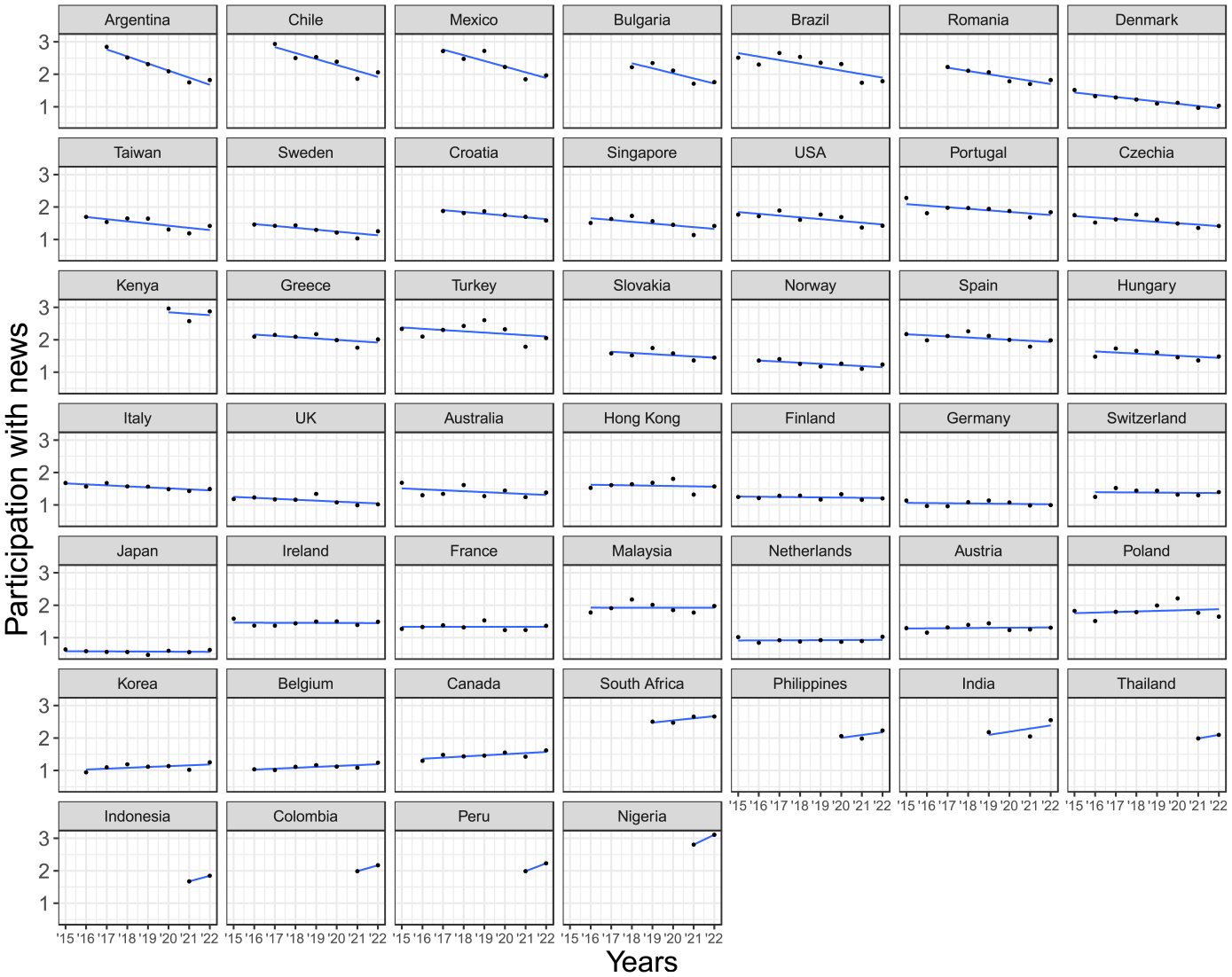
Participation with news between 2015 and 2022 per country.
Three non-preregistered exploratory analyses further support H1. First, when including all forms of participation available in the Digital News Report (see Table 1), we observe an average yearly decrease in participation of 0.06 points on the 13-point scale (p < .001; see Supplementary Appendix D). Second, when looking at changes in the percentage of participants selecting the option ‘None of these [forms of participation]’, we observe a yearly decrease in participation with news of 0.01 points on the one-point scale (p < .001; see Supplementary Appendix A). In other words, there is evidence of a decrease in participating versus not participating in binary terms, as well as a decrease in the number of different ways people participate with news. Finally, when excluding the years 2015 and 2016 (because at that time the survey did not include sharing news via an instant messenger), the yearly decrease in participation doubles from –0.03 points to –0.06 points.
How have the various forms of participation with news changed over time? (RQ1)
We observe a decrease in participation with news for seven out of the nine forms of participation covered here. Liking, sharing and commenting on news on social media are all decreasing, together with sharing news via email, commenting on news on news outlets’ websites, talking about the news offline and participation in online campaigns (b
What factors predict participation with news? (RQ2 – Model 2)
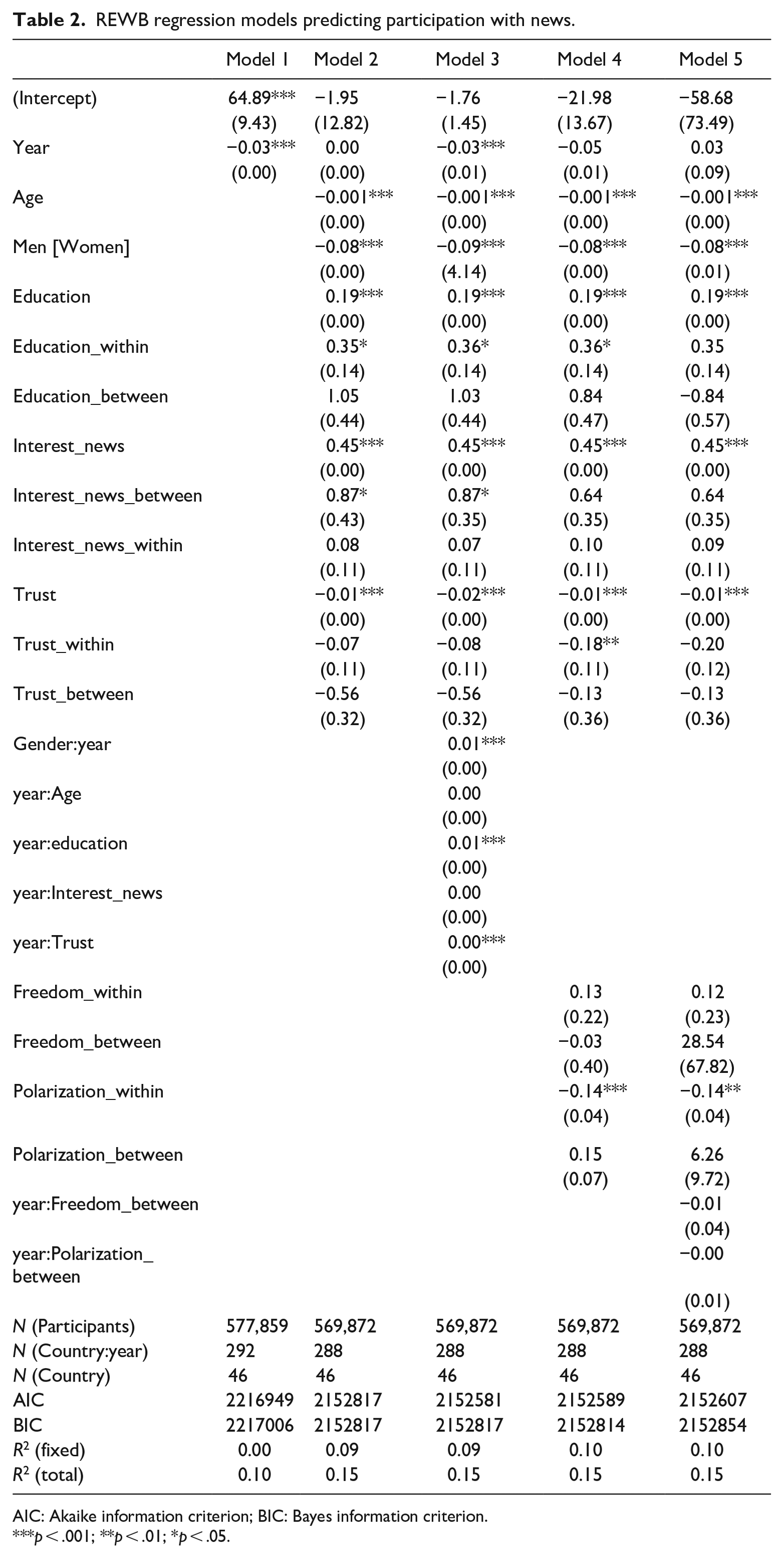
Analysing the data across all countries and all years, the strongest predictors of participation with news at the individual level are interest in news (b = 0.45, p < .001), having a bachelor’s degree (b = 0.19, p < .001), being a woman (b = 0.08, p < .001), being younger (b = − 0.001, p < .001) and having lower trust in the news (b = –0.01, p < .001).
If we focus on the country level, the strongest predictor of differences in participation between countries is national levels of interest in news (b = 0.87, p = .02). This means that countries where the average level of interest in news is higher tend to have higher levels of participation. In Table 2, we report all the models described in the results section.
REWB regression models predicting participation with news.
AIC: Akaike information criterion; BIC: Bayes information criterion.
p < .001; **p < .01; *p < .05.
The effect of year is no longer significant in Model 2 because the variance that was previously captured by year in Model 1 is now better explained by other variables. This makes sense given that time is not a causal factor, such that participation did not decline purely because of the passing of time. Exploratory analyses suggest that it is interest in news and trust in news, not demographic variables, that capture most of the variance in participation over time (see Supplementary Appendix G). Moreover, if we separately model the effect of time (year) on trust and interest, the data show that both trust in the news (b = –0.01, p < .001) and interest in the news (b = –0.04, p < .001) have declined between 2015 and 2022. This suggests that participation may be declining in part because of growing negative attitudes towards news.
What factors predict changes in participation with news through time? (RQ3 – Model 3)
To get a descriptive sense of how participation among different groups has changed over time, we interacted the individual-level variables with time (in a separate model for each individual-level variable without control variables; see Figure 3). Over time, participation has declined more for those without a bachelor’s degree compared to those with a degree (b = 0.01, p < .001), thus widening the already large participation gaps by education. Participation with news has declined more for women than for men (b = 0.01, p < .001), meaning that by 2022, participation was higher among men, the opposite of the situation in 2015. Finally, participation with news has declined more for those with lower trust in the news (b = 0.005, p < .001) to the point that, by 2022, the previously documented differences in participation by trust (Fletcher and Park, 2017) have disappeared. Figure 3 also highlights the large overall differences in participation levels by age and interest in news, even as differences in participation among those in similar age groups and with similar interest levels have declined at a similar rate.
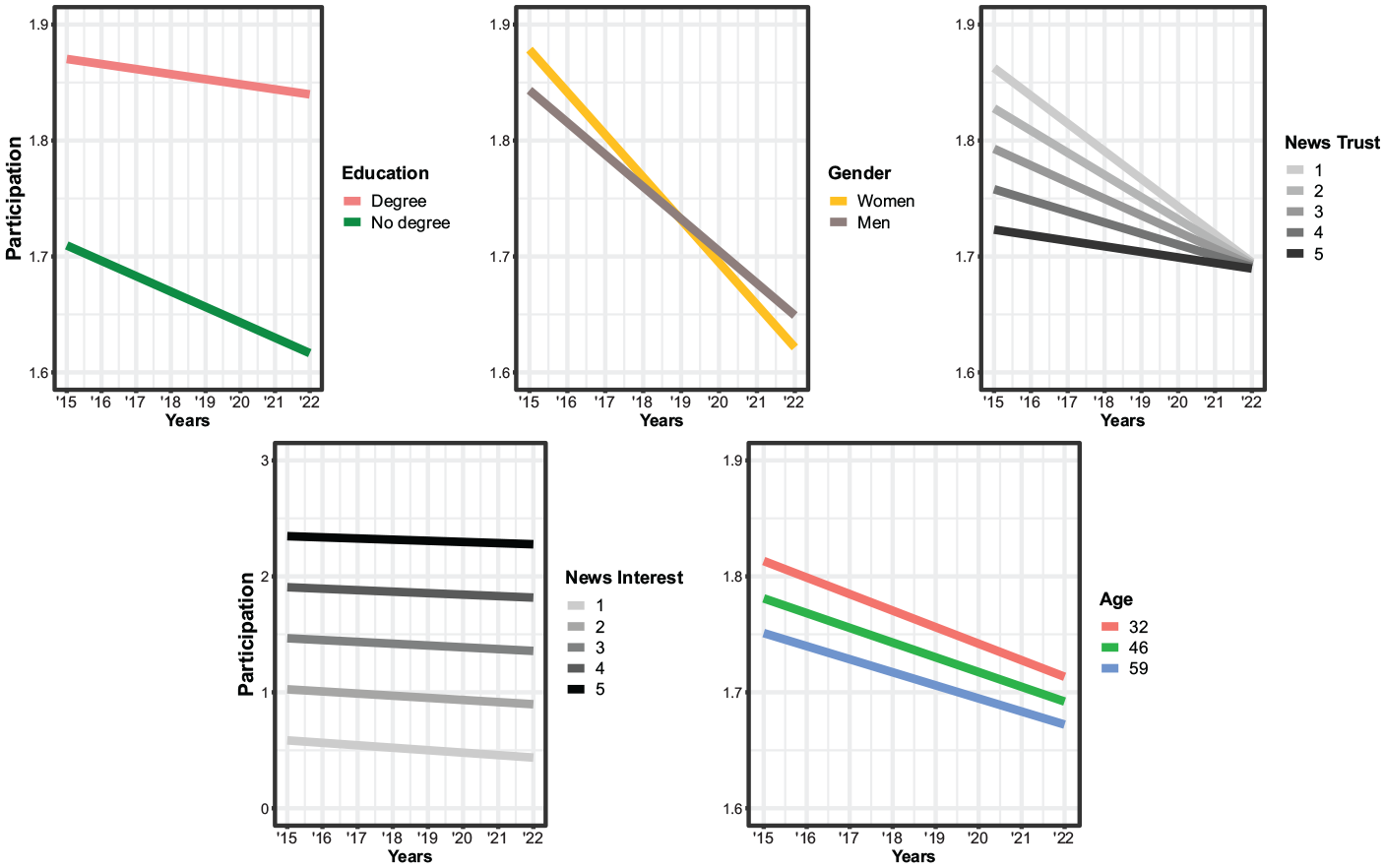
Changes in participation throughout time by education, gender, trust in news, interest in news and age.
While the within-country estimates tell us about the effect of changing levels of variables rather than linear trends over time, we do note significant differences by education within countries (b = 0.35, p = .01). This means that, within a given country, if the sample for a given year contains more people with a degree, participation levels will typically be higher, and vice versa.
What country-level factors predict participation with news? (RQ4 – Model 4)
In Model 4, we introduce additional country-level variables. The only significant country-level predictor of participation with news is political polarization within countries, indicating that in years when political polarization is higher than normal within a country, participation with news tends to be lower (b = –0.14, p < .001) – even as we effectively control for all other stable country-level variables. This helps explain why countries where participation has decreased the most, are also countries where polarization has increased the most (e.g. Chile: b = 0.28; Mexico: b = 0.24; Brazil: b = 0.13; Bulgaria: b = 0.38; Romania: b = 0.16; Denmark: b = 0.09). Freedom of speech had no statistically significant effects between- or within-countries. 8
What country-level factors predict changes in participation with news through time? (RQ5 – Model 5)
Although there is evidence that higher than average political polarization lowers participation levels within countries, when we interact this (and freedom of discussion) with time in Model 5, we do not find evidence that the strength of this effect is either increasing or decreasing over time in a linear fashion.
Discussion
While our data clearly show that a significant part of the public use online options to participate with news in various ways, and that digital media is known to have increased forms of participation with news, we also find that participation with news has decreased in recent years. Pre-registered analysis of longitudinal data from 2015 to 2022 in 46 countries (N = 577,859) shows a decrease in participation with news in most countries and for most forms of participation. Between 2015 and 2022, people became less likely to report liking, sharing and commenting on news on social media, and less likely to report talking about the news offline, sharing news via email, commenting on news outlets’ webpages, and participating in online campaigns. The only form of participation that increased during this time was news sharing via private messaging apps.
Looking at the predictors of participation with news across the entire 2015–2022 period, we found that those with a university degree, women, younger people, those with high interest in news and those with low trust in news, participate with news more. Given what we know about inequalities in news use and participation that existed during the twentieth century, this broadly supports the ‘mobilization’ thesis, the idea that new participatory opportunities can help, however marginally, to reduce historic, pre-digital, structural inequalities in participation (except in the case of education).
But when we zoom in on trends from 2015 onwards, there is also evidence that at least some of those inequalities may be starting to re-emerge. In a reverse of the situation in 2015, men now participate more than women, and differences in participation between those who trust the news the most and those who trust the news the least have now all but disappeared. Furthermore, the gap in participation between those with a bachelor’s degree and those without has widened during the same period, with participation declining only among those without a bachelor’s degree. If the ‘mobilization’ effects are waning, and participation with news increasingly resemble traditional forms of news use and political participation, in the long term, perhaps reinforcement will become the more pronounced effect.
In addition to documenting these demographic shifts, we also found that increases in political polarization within countries are associated with lower levels of participation. While far from conclusive, and subject to different dynamics across contexts, this suggests that even if polarization may motivate a minority to engage in more forms of expressive partisanship, the wider effect is more of a chilling effect as people seek to avoid political disagreements. The overall decline in participation with news, as well as the changes to who is most likely to participate is important for those who care about participation, whether offline or online (forms of participation that meta-analysis suggests reinforce rather than substitute for one another; Oser and Boulianne, 2020).
While our analyses documents changing patterns of participation, and offers some insight into why participation has declined, such as growing political polarization in some countries, much of the variance is left to be explained. In the paragraphs below, we speculate about why participation with news is declining.
Participation with news could be going down because the ‘opportunity structures’ are weakening (Esser et al. 2012). For instance, many news websites disabled or greatly limit online commenting, which, all else being equal, should lead to a decline in commenting on news websites. In addition, some social media platforms such as Facebook have downranked news in favour of peer content and what are variously termed ‘creators’ or ‘influencers’, including celebrities, and individual political figures, which should lead to a decline in interactions with news on these platforms.
This, however, does not explain why people report talking about the news less offline, or why they share less news via email. An additional reason could be a general sense of fatigue around social interactions about news, either because the political climate is becoming increasingly hostile (the political polarization hypothesis), or because the news is increasingly negative and expected to bring down one’s mood.
The decline in participation with news documented here is in line with a sharp decline in interest in news, a recent increase in news avoidance, and a small but robust decline in trust in news documented by the Digital News Report in the last seven years (Newman et al., 2022). We believe that the decline in participation with news is at least, in part, a symptom of broader negative perceptions of news. Our data do not allow us to investigate this, but one possible way to examine it would be to systematically compare patterns of participation across sectors and topics (e.g. culture, entertainment, politics and popular culture more broadly) to see if the patterns we have identified for news are specific or general. Analysing this would also be a necessary part of establishing – beyond individual companies’ ups and downs, or specific and not always representative examples – whether social media interactions as a whole are in decline (Bogost, 2022).
Our findings should motivate further research investigating the causes of the decline in participation. For instance, it may be worth testing additional individual-level variables, such as political orientation or news perceptions. Moreover, based on theoretical assumptions, future studies should test additional country-level variables to explain between-country differences and within-country changes in participation.
It would also be worth studying potentially new forms of participation with news not covered here. Indeed, we cannot rule out the possibility that participation with news has simply changed instead of gone down. That is, old forms of participation are being replaced by new ones. Yet, it’s important to note that we included very broad forms of participation such as ‘Talk with friends and colleagues about a news story’ or ‘Talk online with friends and colleagues about a news story’, and that a growing number of respondents are reporting engaging in none of these.
Most forms of participation investigated here can be interpreted as ‘small acts of engagement’ (Picone et al., 2019), as most of them are casual and require little investment. Yet, these small acts of participation, on the aggregate, have the potential to empower users and potentially allow them to engage in forms of ‘interpretative resistance’ (Picone et al., 2019). Despite the existence of dark forms of participation (Quandt, 2018), the decline in participation – and the possible return of structural inequalities in participation – is unlikely to be a positive outcome for democracy, especially when seen in the light of the broader decline in interest in news documented here and elsewhere (Newman et al., 2022).
The main limitation of this study is that participation with news is based on recall, not participants’ actual behaviour. Only weak conclusions can be drawn regarding the actual percentage of participants engaging in these behaviours (e.g. ‘During an average week 36.5% of participants talk about the news face-to-face’), since the correlation between self-reported media use and logged media use is on average moderate (Parry et al., 2021). Perhaps slightly bolder conclusions can be drawn from the comparisons between different forms of participation (e.g. ‘More people talk about the news face-to-face than share news via email’), since recall biases should affect all forms of participation to a roughly similar extent. Finally, stronger conclusions can be drawn from the trends we observe over time (e.g. ‘Participation with the news has decreased between 2015 and 2022’), since recall biases should be identical across the years and thus cannot explain change over time.
We should also keep in mind that we are not able to analyse what happened to news participation before 2015. It could be that 2015 (or the years immediately preceding it) represented a peak in news participation – with participation levels many times higher than 20 years earlier, for example. If so, the decline in participation we observe post-2015 (which could, of course, be reversed in the next 10 years) would have to be seen in a different light. However, the available data do not allow us to speculate further.
In the Supplementary Appendix, we show that our results are robust to a variety of factors, such as the inclusion of all forms of participation, the exclusion of 2015 and 2016 and the exclusion of sharing news via instant messaging apps.
So, even as both journalists, news media industry professionals and researchers have expressed considerable optimism around the potential of increased participation with, among other things, news, data from 577,859 survey respondents in 46 countries suggest that, if we turn to whether and how the public engages with these opportunities, between 2015 and 2022, participation with news has been going down, both online and offline. Scholars contributing to the academic literature around participatory culture, participatory politics and participatory journalism will benefit from considering how the public at large engages – or, perhaps, engages less and less – with some of the practices they study. Journalists and news media focused on improving their relationship with the public in part through various forms of audience engagement and the like will want to stay across these developments. Finally, platform companies will want to understand these macro trends as well, whether they are trying to reduce and restrict the role of news on the services they operate or perhaps increase it to differentiate themselves from their competitors.
Supplemental Material
sj-docx-1-nms-10.1177_14614448241247822 – Supplemental material for News participation is declining: Evidence from 46 countries between 2015 and 2022
Supplemental material, sj-docx-1-nms-10.1177_14614448241247822 for News participation is declining: Evidence from 46 countries between 2015 and 2022 by Sacha Altay, Richard Fletcher and Rasmus Kleis Nielsen in New Media & Society
Footnotes
Funding
The author(s) disclosed receipt of the following financial support for the research, authorship, and/or publication of this article: This research was supported by Google UK as part of the Google News Initiative. Sacha’s current postdoctoral position in Zürich is supported by the European Research Council (ERC) under the European Union’s Horizon 2020 research and innovation program (grant agreement no. 883121).
Supplemental material
Supplemental material for this article is available online.

Notes
Author biographies
References
Supplementary Material
Please find the following supplemental material available below.
For Open Access articles published under a Creative Commons License, all supplemental material carries the same license as the article it is associated with.
For non-Open Access articles published, all supplemental material carries a non-exclusive license, and permission requests for re-use of supplemental material or any part of supplemental material shall be sent directly to the copyright owner as specified in the copyright notice associated with the article.
