




Abstract
An increase in international funding for LGBT+ rights advocacy in Uganda has resulted in not only a mushrooming of organizations but also intra-community competition for visibility, attention, and limited resources. Against this backdrop, we set out to study how organizations relate to each other in the Ugandan LGBT+ Twittersphere. Following an analytical framework around rationalities of mediated participation, we study with whom Ugandan LGBT+ organizations relate through mapping retweets and @mentions emanating from selected Twitter accounts. The resulting network maps reveal a dividing line between more well-funded and internationally connected organizations and lesser established organizations. By supplementing the network analysis with qualitative readings of key accounts and semi-structured interviews, we conclude that access to international funds and negotiating visibility explains the network structures. The article thus reveals interesting Twitter practices, showing LGBT+ organizations use the platform as a means for negotiating and claiming space inside the Ugandan LGBT+ community.
Introduction
Although state-sponsored discrimination of lesbian, gay, bisexual, transgender (LGBT+) individuals is a legacy left behind by the former colonial power, the Ugandan government has actively pursued even harsher policies of oppression. Ugandan state-sponsored discrimination gained international notoriety when one of the harshest pieces of legislation against homosexuality was introduced in 2009 (Tamale, 2009). Repression is rationalized by claiming that homosexuality and LGBT+ identities are unwanted Western imports leading to the moral corruption of Ugandan culture, including its intersection with (newborn) Christian morality in the country (Strand and Svensson, 2023a). Although the 2009 Anti-Homosexuality Bill was successfully challenged in court in 2014, repression has intensified in the past decade. In spring 2023, the Ugandan Parliament again passed one of the world’s toughest laws against LGBT+ individuals. Specifically, the bill of 2023 sought to criminalize the very act of identifying as LGBT+. Similarly, the clause on “promotion of homosexuality” effectively attempts to silence all human rights advocacy for LGBT+ (Human Rights Watch, 2023). It follows from these developments that Ugandan LGBT+ individuals regularly face human rights abuse in the shape of extrajudicial violence and social discrimination (Svensson and Strand, 2023).
Previous research on the Ugandan LGBT+ community has focused on the historical roots of discrimination, contemporary triggers, and legal analysis of anti-homosexuality legislations (Boyd, 2013; Tamale, 2009; Wahab, 2016). Relatedly, studies have also scrutinized the role of traditional media in enabling and sustaining state-sanctioned homophobia (Strand, 2018). However, the agency of the LGBT+ community itself appears to be a neglected area in academic research (with exceptions, primarily when members of the local community publish (e.g. Jjuuko, 2013; Jjuuko and Mutesi, 2018; Nyanzi, 2014). Postcolonial narratives of donor dependency in development research and the imposition of Western values through aid (Becker, 2020; Rodriguez, 2022) tend to strip local actors of their agency, approaching them as (helpless) victims unable to uphold cultural norms and values in the face of Western funding (Dickson et al., 2023). However, the coordinated resistance against several attempts to pass anti-homosexuality acts reveals a determined and organized community neither deterred by domestic homo-hostility nor by lack of funding (e.g. Jjuuko and Mutesi, 2018). The study presented here zooms in on LGBT+ activist organizations themselves and their use of self-controlled social media platforms. In particular, we are interested in their intra-community connections, how Twitter is used to connect to other actors and accounts. Thus, our aim is to understand the organization ecology by studying what activists and organizations appear as more central or peripheral in the Ugandan LGBT+ Twittersphere. Following an analytical framework on rationalities of mediated participation, we discuss how organizations negotiate and seek influence in the larger community and how they relate to the struggle for LGBT+ rights in Uganda. After a background section on the Ugandan media landscape, we will tease out our research questions in more detail. The article will then proceed by attending to our analytical framework, methods, results, analysis, and a concluding discussion.
The Ugandan media landscape and the promise of digital media
When it comes to covering LGBT+ rights in Uganda, few local journalists adhere to basic journalistic rules of engagement—that is, to include multiple perspectives, show independence from special interest, and strive for accuracy, which leads to frequent misrepresentations of the community (Meyen et al., 2016). Consequently, Ugandan mainstream media coverage of LGBT+ ranges from ambivalent and reluctant to antagonistic, sometimes even outright hostile in the tabloid press (Bompani and Brown, 2015, Strand, 2018). In addition to being highly discriminatory, tabloids have also increased the community’s vulnerability by outing alleged homosexuals, including publishing home and work addresses, as well as instigating violence by calling for public hangings (Borlase, 2012). Although non-tabloid media have refrained from such outings, their coverage of LGBT+ is often discriminatory. Indeed, LGBT+ organizations and individuals are rarely given space to draw attention to the community’s plights, promote their rights, self-define or to provide a first-person narrative of their concerns (Strand, 2018). Not surprisingly, this exclusion and subsequent denial of visibility appear to be the most pronounced in state-controlled media channels (Strand, 2018).
With Ugandan LGBT+ access to mediated spaces mostly controlled by unsympathetic mediators, digital platforms such as social media promise more open, free, and networked forms of communication. Before the introduction of such self-controlled digital platforms, Ugandan LGBT+ had limited (if any) access to spaces where they had an opportunity to voice their concerns, provide their perspectives, or respond to false and discriminatory media reporting. Research in activism, social change, and development has underlined digital media and its affordances in this regard. Indeed, platforms such as Twitter, can provide spaces for marginalized groups to communicate and organize (e.g. Earl and Kimport, 2011; Tufte, 2017). It should, however, be noted here that only 2.5 million Ugandans (out of 46 million) are estimated to be social media users in 2021 (CIPESA, 2021: 3). After the Ugandan government banned Facebook in response to alleged election interference in 2021, Twitter emerged as the most popular social media in Uganda (Statcounter, 2023).
Previous research on the Ugandan LGBT+ community’s digital media practices indicates a complex relationship between digital affordances and their benefits to LGBT+ people (Strand and Svensson, 2019, 2023a, 2023b). A study of the Facebook and Twitter practices of the main umbrella organization for LGBT+ people in Uganda—Sexual Minorities Uganda (SMUG)—concludes that these platforms are under-utilized for opposing the false and inaccurate reporting of the domestic mainstream media pertaining to the community and its rights struggle (Strand and Svensson, 2019). Nor are self-controlled digital spaces used for challenging the logics of oppression found in Ugandan society—the rationale used by local actors for legitimizing their oppression of LGBT+ individuals (Svensson and Strand, 2019). Nonetheless, the community at large is digital media literate in the respect that they are acutely aware of the risks that come with digital life. For example, sophisticated vetting systems have been adopted to identify community members and allies (Svensson and Strand, 2018). However, despite awareness-raising programs to increase the community’s adoption of safer online behavior, a recent study concluded that study participants had multiple personal experiences with hate speech, cyber-stalking, unlawful release of intimate visual material, and blackmail (Strand and Svensson, 2023b).
Aim and research questions
The 2009 anti-homosexuality bill catapulted the Ugandan LGBT+ struggle into the international limelight (Jjuuko, 2013: 383), and Uganda became the perfect target for organizations and countries wishing to portray themselves as progressive and modern in relation to what in Western media was labeled as “the world’s worst place to be gay” (Peters, 2014: 17). Indeed, the Global Philanthropy Project, a US-based organization that tracks LGBT+ funding, reports that Uganda has been among the top six recipients globally (Global Philanthropy Project, 2021). This resource influx has been pivotal for the emergence and formation of the contemporary Ugandan LGBT+ community, characterized by a continuous mushrooming of new LGBT+ organizations. The community has grown from 24 organizations in 2012 (Nyanzi, 2013: 962), to 128 organizations expressing interest to join SMUG (Interview, SMUG Director, Kampala, 5 January 2022).
Given the proliferation of LGBT+ organizations’ competing for resources, studying how organizations relate to each other provides important insights into organizational positioning and intra-community relationships. Thus, we analyze how community members connect and relate to each other on Twitter by means of what has been described as Twitter’s “primary interactive affordance[s]” (Hemsley et al., 2018: 1), that is, redistributing messages/tweets sent by other users by retweeting them, or addressing other users by mentioning or “tagging” them by using the @ character. Our research questions are phrased accordingly:
RQ1. What accounts and relations emerge as central in the Ugandan LGBT+ Twittersphere regarding being retweeted and @mentioned?
RQ2. Why is this so, and according to which rationale?
By studying the online relationships of Ugandan LGBT+ organizations, we further our understanding of who is deemed important, how these actors negotiate themselves in relation to the larger LGBT+ community and how they understand the LGBT+ struggle in Uganda. This leads us to our analytical framework.
Analytical framework
Much has been said about the Internet and its supposed potential for social change and development. Early research on the Internet and digital media was largely techno-optimistic, suggesting that the Internet would rejuvenate the so-called public sphere in a Habermasian fashion, juxtaposing commercial instrumental rationality with more civic communicative rationality (e.g. Castells, 2001; Curran et al., 2016). Instrumental rationality refers to participants choosing from various actions and picking the one they believe most appropriate for achieving their desired ends (Mueller, 1989). Habermas (1996) contrasts this with communicative rationality. According to him, the truth in our claims needs to be open for contestation because they are inevitably based in our lifeworld of background assumptions, loyalties, and skills. Therefore, to deal with our inherent subjectivity, Habermas (1996) points to critical interpersonal discussion as the preferred mode of communication. Communicative rationality thus occurs when communication is free from coercion, deception, strategizing, and manipulation, and thus would constitute the ideal speech situation.
Theoreticians of deliberative democracy have attempted to apply Habermas’ normative philosophy and to evaluate democratic procedures according to the ideas of an ideal public sphere where everybody is heard, can voice their concerns, and where the best arguments jointly take shape (Dryzek, 2000; Fishkin, 1991). Hence, deliberative democrats position themselves against the instrumental rational idea that decision-making is about aggregation and reconciliation of pre-established individual self-interest. The Internet was given early attention because of its potential to engage citizens in deliberations within a larger framework of increasing civic participation (Dahlgren, 2009; Kies, 2010).
To nuance this instrumental versus communicative dichotomy, Svensson (2011) suggests expressive rationality—revolving around performing, expressing, and negotiating identity and meaning—as an addition when studying civic communicative practices. It is not enough to approach political participation as either being governed by self-interest (instrumental rationality) or being governed by a greater civic good (communicative rationality). This is especially the case online. Users of digital platforms rarely meet the strict standards of communicative rationality suggested by Habermasian theoreticians. However, when they do communicate with each other, they produce meanings, identities, and communities in ways beyond instrumental and communicative rationality (McAfee, 2000). Walsh (2004), for example, argues that people neither gather to exchange political information nor to deliberate on behalf of a common good. She claims that when people act together in movements or protests, they develop identities that help them understand who they are. These understandings will then guide their future political engagements. Thus, expressive rationality, which combines identity expression and performance, is an important addition for understanding (mediated) political participation (Svensson, 2011).
Drawing on Castells (2001) idea of networked individualism, Svensson (2011) underlines that online users connect to causes, organizations, and brands—whose connotations are deemed rewarding when negotiating and expressing (political) identity. In other words, (political) identity is expressed, and (political) meaning is negotiated through connecting to others in digitally enabled (semi) public networks. Translated to our study of the Ugandan LGBT+ Twittersphere, studying such connections here may tell us a lot about how users negotiate political identity, meaning, and how they understand the LGBT+ struggle in Uganda.
Methods
For this article, we focus on Twitter because it is the preferred social media platform in Uganda (Statcounter, 2023), also by the LGBT+ community (Interviews, Kampala 2021-2023). Facebook has been blocked by the government since the 2021 elections and is currently only accessible through Virtual Private Network (VPN) services. Twitter is considered a better and more reliable platform for accessing and spreading news (Interviews, Kampala 2021-2023). The platform is often described as an elite platform dominated by “Twitterati” (Bruns and Burgess, 2011: 45), such as political actors, media professionals, and social activists seeking to influence society (Jungherr, 2015). Interviews conducted in relation to this article reveal that the LGBT+ community understands and takes advantage of the presence of elite actors such as embassies, ministries, and international allies present on Twitter.
Data collection
The time period 1 January 2022 through 31 July 2022 was selected because it covers three events of importance to LGBT+ activists. The period includes (1) the Ugandan Periodic review, an event where the UN Human Rights Council’s review of Uganda’s human rights performance is presented (27th January), (2) the annual celebration of murder activist David Kato’ legacy: the Kuchu Remembrance Day (26th January), (3) the 10-year anniversary of first Uganda Pride (June to July). All events constitute instances where we would expect activists and organizations to actively engage in communication with the local community, external stakeholders, and allies.
The Twitter accounts included in the study were identified by merging two different sources: The umbrella organization SMUG’s membership list consisting of 68 organizations and the list of stakeholders contributing to the Ugandan civil society report for the UN Human Rights Council the Uganda periodic review (OCHR, 2022). In total, 72 organizations were identified as working with LGBT+ rights advocacy and/or providing LGBT+-friendly services. Of the 72, 57 had a Twitter account. Tweets from these accounts during the time period specified above were archived by means of the Twitter Application Programming Interface v2 using Academic Research access (Twitter, 2022). Archiving was completed on 7 September 2022. Explorative analysis of the data revealed that 26 accounts had not been active during the studied time period. Thus, our final dataset is based on 9083 tweets provided by 46 accounts.
Data analysis
Our analysis made use of both quantitative and qualitative approaches, described below.
Quantitative phase
Relationships between accounts were visualized using Gephi, allowing for the mapping of relations between Twitter accounts as undertaken by @mentions and retweets. The former of these functions is often thought of as indicating a willingness to interact with other users. By including an @-character before a username, the tweet’s author can signal relevance for and address the specified other user (e.g. Jürgens and Jungherr, 2016). For retweets, we can think of this functionality as something akin to the two-step model of communication (Lazarsfeld et al., 1944) where one user retweets or redistributes the content originally provided by another user (Larsson, 2015). While the precise situated meanings of an @mention or a retweet arguably remain with each sending account, these ways of communicating on Twitter nevertheless provide users with two different approaches to interact with each other (e.g. Venturini et al., 2021). With this in mind, we separate the relations uncovered resulting from @mentions and retweets in our analyses.
In the forthcoming visualizations of relations expressed by @mentions and retweets, the sending (i.e. the 46 accounts serving as the basis for our dataset) and receiving accounts (any account receiving an @mention or a retweet by one or more of the sending accounts) are represented as nodes. The size of each node represents its in-degree value—a bigger node implies that the corresponding account has received more @mentions or retweets compared to smaller nodes. Node color is indicative of the account’s out-degree. A deeper node color suggests more activity from the corresponding account in terms of sending @mentions or retweets. Finally, the network maps are structured using the ForceAtlas2 algorithm. This technique places highly connected nodes—accounts connected by @mentions or retweets—closer to each other and less connected nodes further away from each other (Venturini et al., 2021).
Qualitative phase
While our adopted approach allows for useful insights into how the accounts make use of Twitter to connect to each other, the ways in which the raw data are structured as it is archived from the Application Programming Interface (API) sets limitations to some further analytical ideas. For instance, the data do not allow for analyzing patterns regarding the “liking” of tweets. It should also be noted that the Twitter algorithm tends to highlight popular tweets in users’ feeds (the so-called popularity principle, for example, van Dijck, 2013). However, these limitations are beyond our control.
Assessing popular and active accounts
Furthermore, no system is immune to data loss (e.g. Driscoll and Walker, 2014). Online content is notoriously ephemeral (Matassi and Boczkowski, 2021), which certainly also applies to Twitter. When the qualitative phase of our analysis was initiated, we visited the accounts online and discovered that some had been canceled or had been restricted with password protection—characteristics that were not in place during the archiving of tweets as described above. Reminding the claim by Walker and co-authors (2019) that “the ever-changing nature of social media data makes it difficult for any given two researchers to collect the same exact dataset in real-time” (p. 1537), these accounts were not included in our qualitative analysis.
The qualitative phase of our analysis consisted of close readings of the most retweeted tweets in combination with similar assessments of the most @mentioned and @mentioning organizations’ accounts in the network maps. This reading was guided by our research questions, but otherwise largely unstructured. By doing this, we got a more qualitative understanding of parts of the material, and we knew exactly what some organizations had tweeted about, retweeted and @mentioned as well as how, in what regards and concerning what topics some organizations were retweeted and @mentioned. This was important for us when preparing for interviews which constitute the last step of the analysis.
Semi-structured interviews
During fieldwork in Uganda (April 2023), the first author conducted semi-structured interviews with four social media information officers responsible for five Twitter accounts. Three of the information officers worked for organizations that were centrally located in the network maps; one worked for a more peripheral organization. We interviewed Tanja handling social media at Freedom and Roam Uganda (FARUG), the main lesbian organization in Uganda; Nathalie at Uganda Key Populations Consortium (UKPC); Yan at Trans Youth Initiative Uganda (TYI-Uganda); and Linda handling social media at both Queer Youth Uganda (QYU) and Sexual Minorities Uganda (SMUG). Recruiting interview participants was done through snowballing previously established contacts. All interviewees were given aliases to protect their identity.
Interview themes revolved around their workday, tasks and work processes, editorial thought processes, who their intended audience is, their expected reach, and the rationale behind posting, retweeting and @mentioning practices. Interview participants were instructed to reflect on these questions in relation to the time period chosen, that is, before the introduction of the 2023 Anti-homosexuality Bill. Interviews lasted between 60 minutes and 120 minutes. Participants were provided with food and beverages in connection with the interview; otherwise, no compensation was offered. The interviews were not recorded as recorded material could pose a security risk to participants and would have created difficulties in the recruitment of participants. Hence, the first author took notes during the interview and directly after supplemented these notes from memory. Interview notes were e-mailed to the co-authors, who commented and asked for clarifications.
The interview sample consisting of four interviews representing five organizations must be considered as limited. Nevertheless, the interviews provided important input for further analysis of our network maps as discussed above. Furthermore, it is important to understand the interviews’ chronological placement within the study. The study began with network mapping, followed by a qualitative read of Twitter feeds, both of which generated questions—questions that were integrated into the interview guide for the semi-structured interviews. The interview data were subsequently used to deepen and support interpreting the first two steps.
Quantitative results
Before analyzing the results of the network maps and what our interview participants had to say about their organizations’ Twitter practices, we will present our network maps, starting with the map based on @mentions.
@mentions
Figure 1 provides insights into the direct connections between the identified organizations and the accounts they chose to relate to during the selected time period.
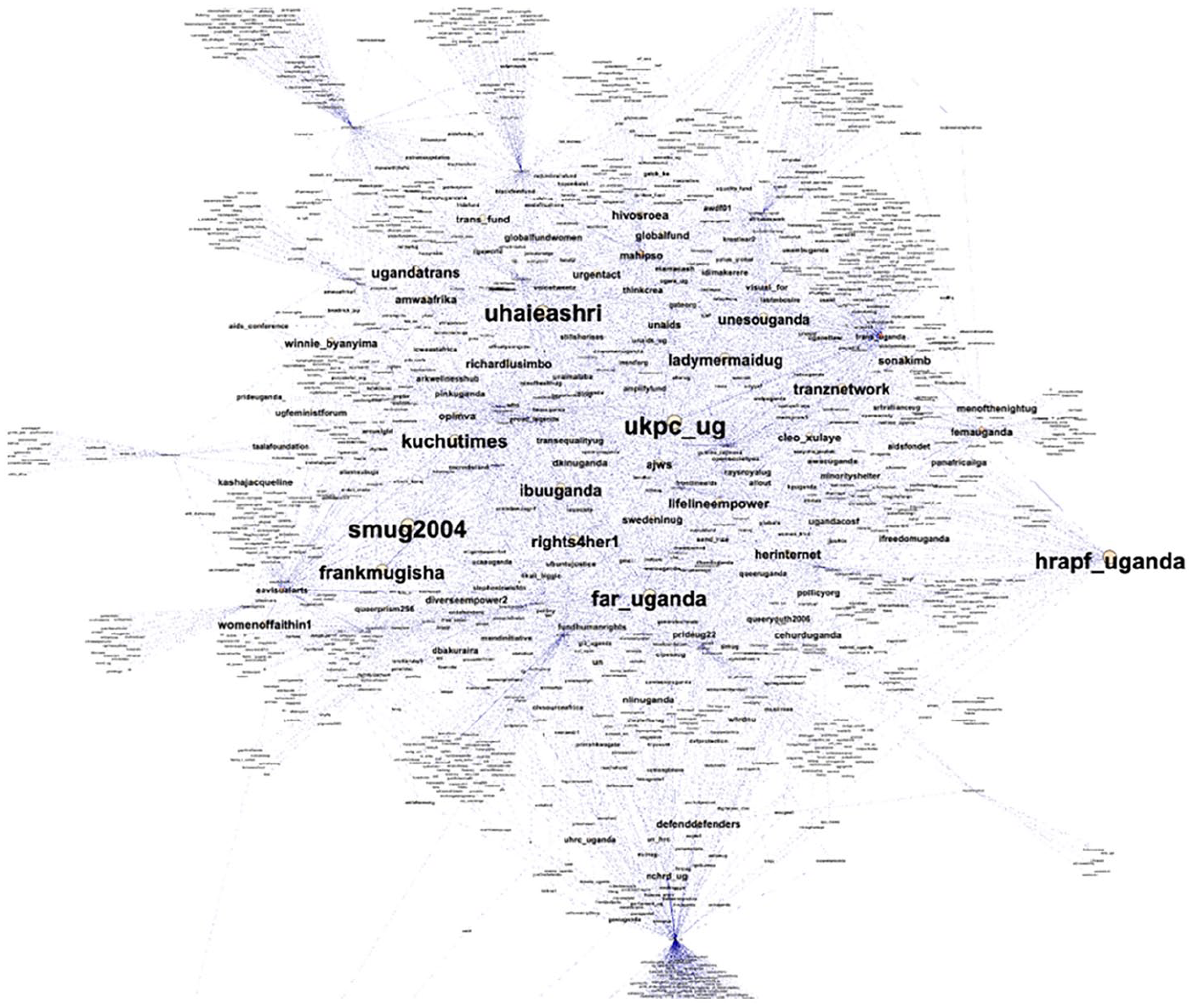
Network of users based on @mentions.
As mentioned previously, bigger nodes indicate accounts who had received more attention in terms of @mentions. We refer to these accounts as receivers.
Noteworthy receivers include the following:
Having conducted qualitative fieldwork in Uganda for almost 15 years, we know that these organizations are among the most well-funded in the Ugandan LGBT+ community and are well-connected to international media, transnational LGBT+ activists and international human rights organizations as well as development partners. These organizations are well-connected to critical resources, that is, international funding.
Beyond receivers, characterized by large nodes, we can also gauge Figure 1 to identify what we refer to as senders—accounts represented by nodes characterized by deeper color. The most active accounts @mentioning others are introduced below. All accounts were read qualitatively.
When analyzing the map, there seems to be a general pattern where the most active organizations—the senders—are more recently established organizations, and thus most likely seeking partnerships or members as well as proximity to those who are more internationally connected and well-funded. This, however, does not explain the position of the National Coalition of Human Rights Defenders Uganda (NCHRD_UG). NCHRD is a well-established organization that sometimes also distributes small grants. We would expect them to be courted by smaller organizations. That is, they would be a receiver, rather than a sender. The next map, Figure 2 provides a tentative answer to this anomaly.
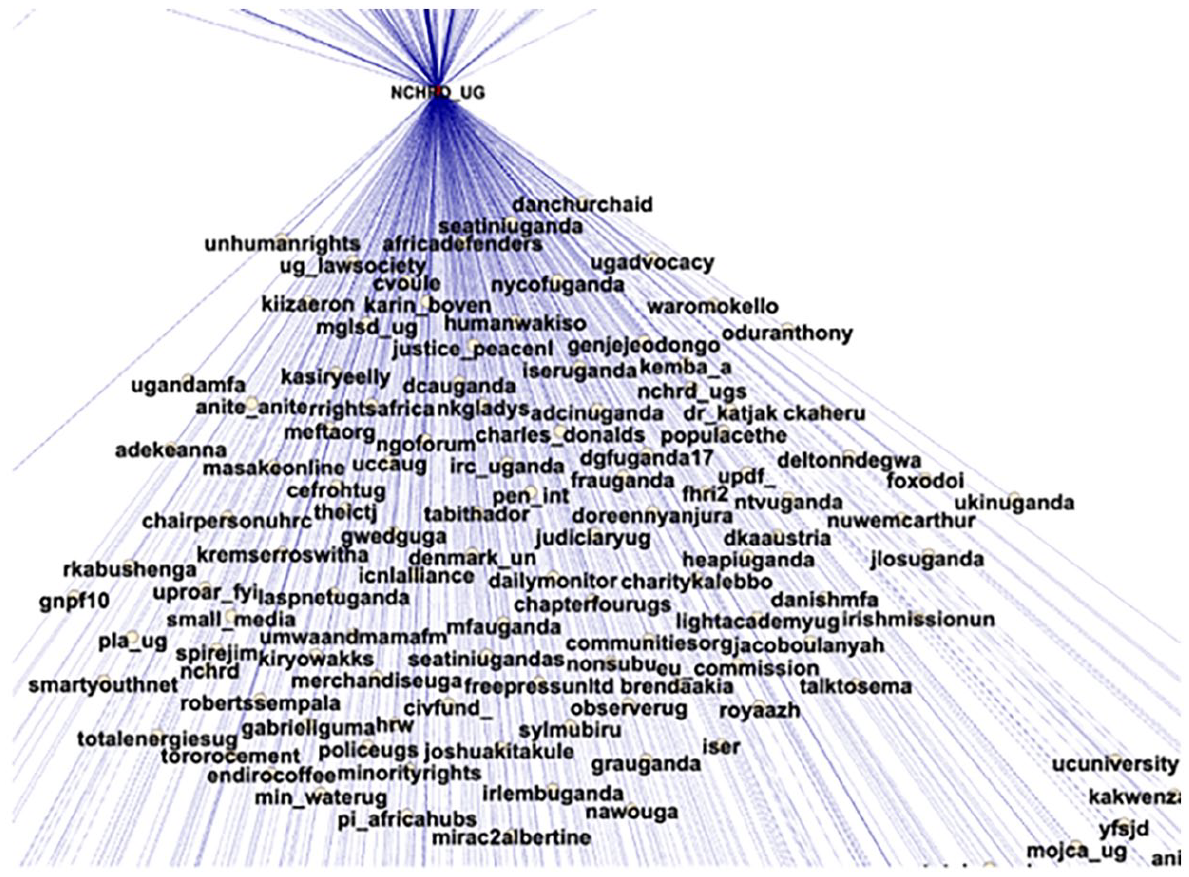
“Zooming in” on the NCHRD_UG account. Selection from Figure 1.
Figure 2 shows NCHRD as active in communicating with different actors and not only toward the center of the network. Being a national chapter, it is likely that they need to negotiate, showcase proximity, and maintain affiliations to other chapters as well as to LGBT+ rights defenders in Uganda. Furthermore, they allow for memberships. Their active engagement may reflect their desire to recruit new members. We have attempted to get an interview with them.
Retweets
The retweet map shown in Figure 3 exhibits several similarities with the @mention map shown in Figure 1.
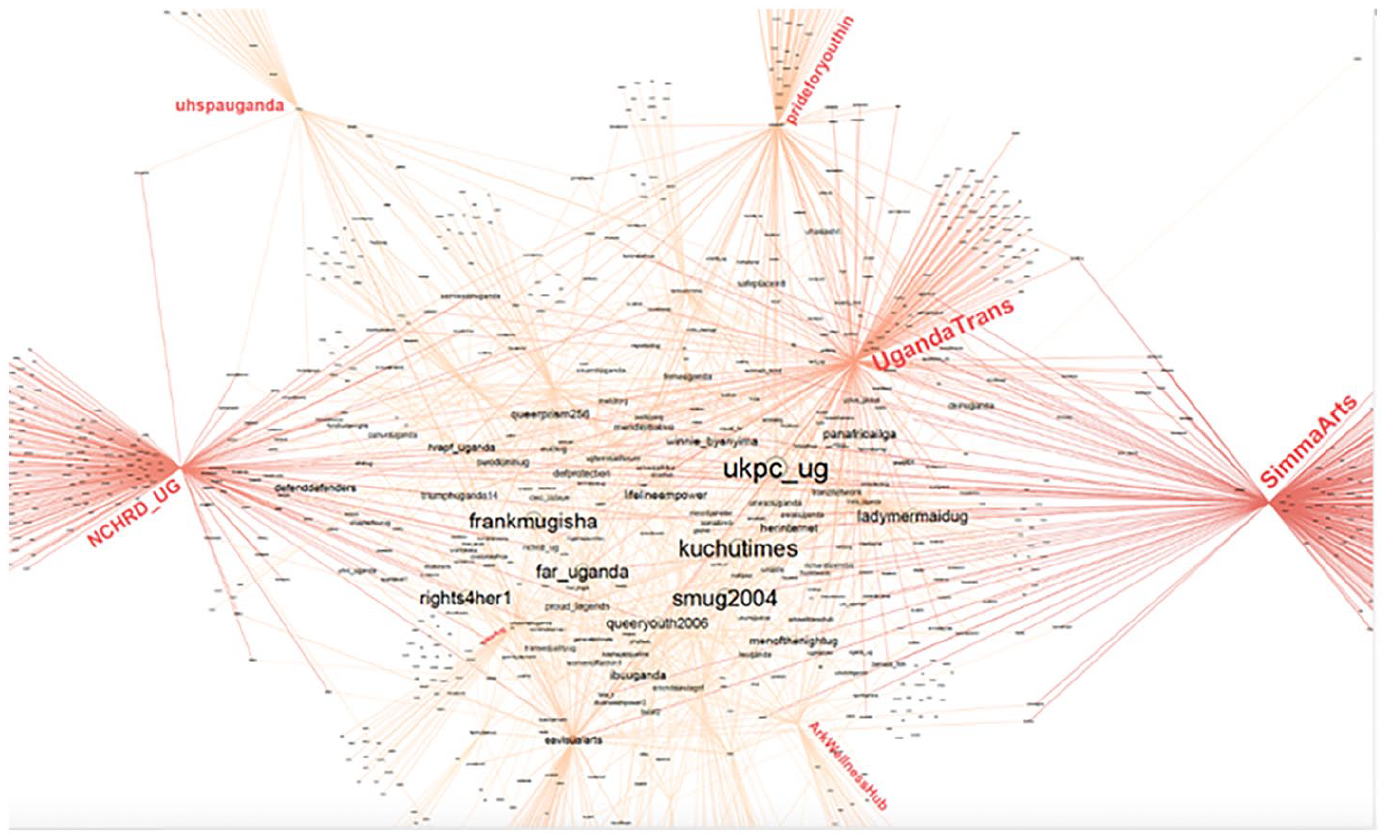
Network of users based on @mentions.
Figure 3 provides insights into the connections between the identified organizations and the accounts they chose to retweet during our studied time period. We start by looking at receivers of retweets (shown in Figure 3 as comparably larger nodes).
Much like for the sender accounts identified in Figure 1, we provide insights into those accounts in Figure 3 that emerged as represented by nodes with deeper color. These senders of retweets are discussed below.
For retweets, similar patterns emerge as for @mentions—younger organizations strive for visibility in the Ugandan LGBT+ ecosystem by seeking partnerships/ members and proximity to those more internationally connected and well-funded.
Analysis and interviews
A first look at these maps suggests a rather instrumental rationale to @mentioning and retweeting practices. It seems that the studied accounts are keen to relate to those who could benefit them in gaining access and proximity to funds and international donors. Indeed, the biggest nodes in both Figures 1 and 3 represent older, well-established, internationally recognized, and well-funded organizations such as SMUG, UKPC, and FARUG.
Following the outline of expressive rationality, the community expresses itself through these retweets (RTs) and @mentions, and this can tell us something about how they approach the LGBT+ struggle in Uganda. A possible interpretation is that the Ugandan LGBT+ community—their approach to, and understanding of, the LGBT+ struggle—revolves around international connections, and that they are interested in negotiating themselves as part of a global LGBT+ movement. This also resonates with results from previous qualitative research conducted on SMUG’s Facebook and Twitter accounts which, apart from intra-community communication, was more geared toward an international audience rather than a domestic one (Strand and Svensson, 2019).
However, qualitatively reading the Twitter feeds of the most @mentioned accounts at the center of the network (Figure 1) complicates this picture. This reading reveals a use of Twitter for cheering LGBT+ achievements in Uganda and globally and for spreading (mostly positive) reports, news, and views shared by these organizations to inspire and mobilize supporters to stand up for LGBT+ rights. The content of these feeds is about awareness rising and thus, to some extent, about mobilization, spreading of reports and viewpoints in support of these organizations’ own opinions, as well as cheering others.
This impression was confirmed in the interviews. Linda (in charge of the accounts for SMUG and QYU) talks about Twitter as a means for boosting the LGBT+ community and spreading (positive) news to the local community. As domestic mainstream media most often do not even mention LGBT+ issues, in Uganda or elsewhere, reposting and sharing LGBT+ stories on Twitter is seen as important. Here, international news sources are better, or even the only source, for good news. Nathalie (UKPC) says she wants to show the community that there are international media that are supportive of LGBT+ rights. “New Vision (government newspaper, authors’ remark) will not post anything positive of LGBT+ people, or anything at all,” she argues, “and we want to advocate for homosexuality, put it on the agenda.” Hence, this is about advocacy through agenda-setting and spreading positive news to boost the community.
We should remember that most of the local grassroots community, individual, same-sex desiring individuals are not on Twitter but rather on WhatsApp. Reflecting on whom they actually think they reach on Twitter, Nathalie estimates that they primarily reach other Civil Society Organizations (CSOs), their own members, and international partners such as HIVOS (an international development organization based in the Netherlands). HIVOS is their main funder, and Nathalie explains that “we need to keep them up to date [. . .] you know Twitter can be used as a way to report to them.” In other words, Twitter is also used for instant reporting and keeping (mostly) international funders informed on projects’ progress.
Using Twitter to make the LGBT+ struggle in Uganda visible internationally seems central. Our interview participants all talked about the importance of “international allies,” and maintaining their interest and engagement in what is happening in Uganda. Tanja (FARUG) tells us they have a large international following on Twitter, who in turn might have a big following of their own. Hence, if this international following retweets FARUG, their message will reach even further, she argues. Indeed, the primary use of Twitter seems to be passive (Dyer, 2017). Centrally located LGBT+ organizations imagined their largely passive Twitter audience as primarily international.
Nevertheless, there are also domestic allies and important power centers in Uganda that are targeted on Twitter. Linda, for example, refers to central Members of Parliament (MPs). “If you @ someone on Twitter, you know your message has been seen, that the MP has seen it, even if they don’t respond.” Nathalie is similarly targeting ministries in general, the Ministry of Health in particular, with her @mentions, but also for reaching international allies present in the country such as UNAIDS (the Joint United Nations Programme on HIV/AIDS) and certain foreign embassies (i.e. the “Twitterati”).
Concerning the practice of retweeting, Nathalie tells us that she notices tweets from accounts that @mention and retweet them. Whether UKPC cares about all the RTs and @mentions they get, Nathalie answers that she mostly responds to @mentions when UKPC is tagged as an organization. “I start my day by going through these tweets, check what is important and in line with the work we are doing and then decide what should be retweeted or responded to.” In other words, there seem to be elements of branding and visibility negotiation within the Ugandan LGBT+ community in their Twitter retweeting and @mentioning practices. @Mentioning and retweeting become a strategy to get the attention from the center of the LGBT+ Twittersphere (as illustrated in the network maps, see Figures 1 and 3). Let us therefore turn to more peripheral accounts seeking this attention (i.e. intensely colored nodes in Figures 1 and 3).
When qualitatively reading trans_uganda’s @mentions, they seem to follow two patterns: (1) If participated in an event with other organizations or organized by a more in the network centrally located organization, these are then @mentioned. (2) When making a statement, such as the importance of SRHR (sexual and reproductive health rights) for transgender women sex workers (8th March 2022), this statement is then accompanied by @mentioning what we interpret as possible allies (rather than opponents) of such a statement (such as UHAI and UKPC). The same pattern repeats when reading eavisualarts @mentionings. They also repost open employment positions and art challenges/rewards in their feed with the added @mention to the account it concerns (or first posting it). These more peripheral organizations (except for NCHRD) are not @mentioning MPs or ministries, but rather more centrally located Ugandan LGBT+ organizations. This suggests that it is first when you as an organization have secured funding and built up an international following, that you can be more effective in your advocacy work and turn to international allies and domestic power brokers. This is confirmed in the interview with Yan (TYI-Uganda). While Linda (SMUG and QYU) tells us she will refrain from retweeting if they have just posted an important tweet (to make sure their tweet is on top of their feed), Yan tells us (s)he retweets as much as possible from other organizations: “You know we are a young organization; we need to be seen.” Their strategy seems to work. Nathalie (UKPC) tells us that “of course,” they retweet member organizations as well as their sub-grantees. Even seemingly banal tweets such as “love is love @UKPC” will be noticed and liked, even though she will not retweet such a tweet.
The lack of Sender–Receivers (i.e. large nodes with deeper color) in the network maps underlines the above and suggests a community with a set of elite activists and organizations @mentioned and retweeted substantially, who do not seem to have the same need to negotiate proximity and connection to other local and more peripheral activists and organizations. They rather direct their (Twitter) attention to international allies, partners, and domestic power brokers. As we attended to in the introduction, the international attention and funding to the Ugandan LGBT+ struggle have resulted in a continuous mushrooming of new LGBT+ organizations. We see here that newer organizations need to negotiate themselves and their standing in relation to this growing LGBT+ organization ecology. In other words, the affordance of Twitter differs somewhat. For centrally located organizations, Twitter gives them access to the “Twitterati,” that is, high-profiled domestic MPs, foreign embassies, and international allies, important in their advocacy work and for their funding. For younger and more peripheral organizations, Twitter gives them a means to be seen and to negotiate a place in an expanding Ugandan LGBT+ organization ecology.
Another interesting tendency is what can be referred to as the global LGBT+ calendar that automatically seems to generate tweets, such as “International Transgender Day of Visibility” (31 March) or “Zero Discrimination Day” (1 March), and so on. It becomes apparent that Ugandan LGBT+ organizations negotiate themselves as part of a global LGBT+ movement. When bringing this up in the interviews, our participants reason about these posts as being educative however, “showing our members that there is a history to the LGBT+ rights struggle,” but also as a celebration, taking time to celebrate “our big and diverse rainbow family.” At the same time, these days are centered around Western boxed-like LGBT+ identifications that do not always resonate with local more fluid sexual identifications (Svensson and Strand, 2023).
The most retweeted tweet at the time of download (7 September 2022) with 114 retweets came from HRAPF (Human Rights Awareness and Promotion Forum) 3 May and is about highlighting International Sex Worker Rights Day (see Figure 4) as sex work and LGBT+ rights are linked in Uganda. So, let us end with this tweet which is representative in its celebration of a day in the global LGBT+ calendar, and connecting this with an advocacy message, here to decriminalize sex work.
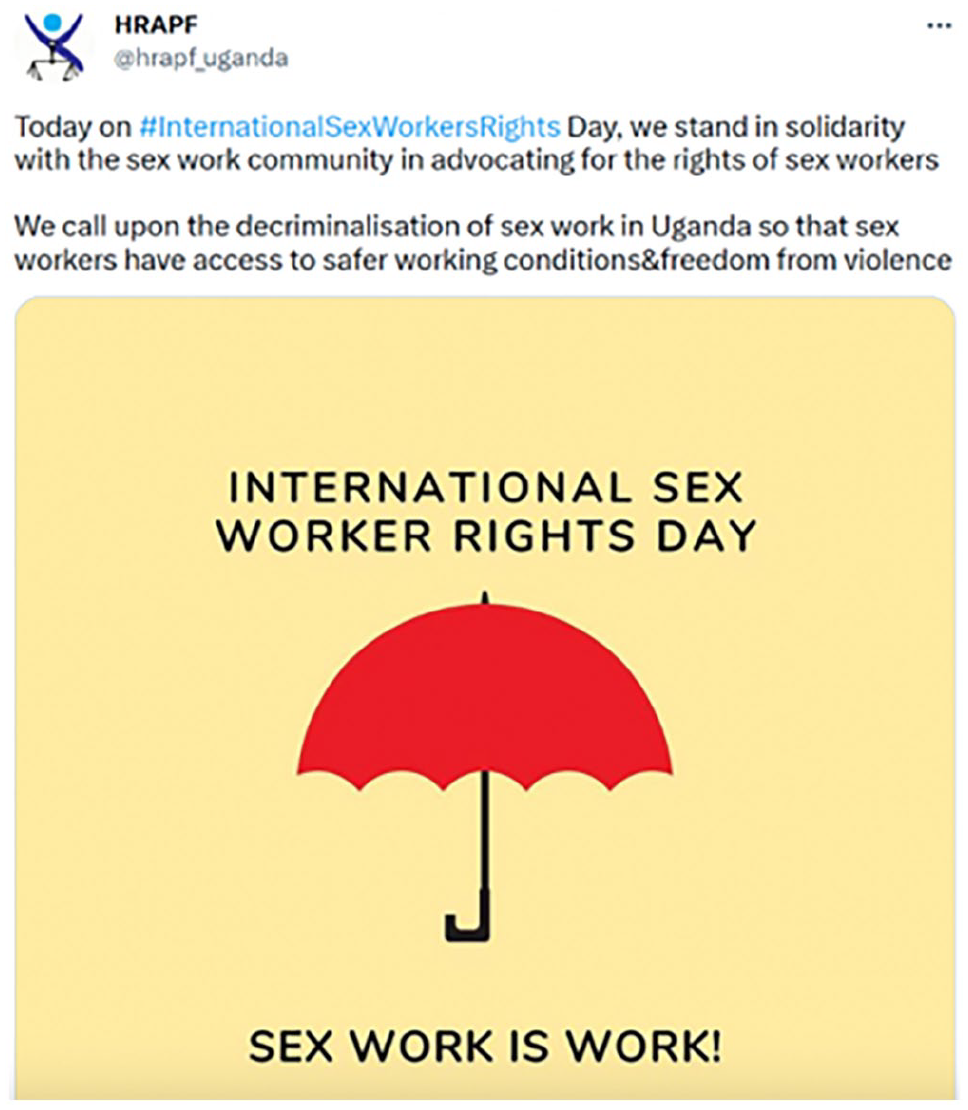
Most retweeted tweet during the sampled period.
Concluding discussion
Given the growing Ugandan LGBT+ organization ecology, we set out to study who relates to whom by mapping organizations’ retweeting and @mentioning practices during the first 7 months of 2022. Our study, based on quantitative network analysis, qualitative content analysis and interviews, has revealed interesting uses of Twitter. It is employed both as an instrument for advocacy work and as a means for these organizations to express and negotiate themselves as either part of a larger global LGBT+ community, or to be seen and negotiate a place in an expanding Ugandan LGBT+ organization ecology. The network maps (Figures 1 –3) provided insight into what accounts are central and revealed a dividing line between more well-funded and internationally connected organizations, and younger, more peripheral ones. Our qualitative data suggest that access to funds and visibility are rationales behind this network structure. Hence, the affordance of the platform differs. Centrally located organizations use Twitter to link and relate to a global community, to funders, and to advocate for LGBT+ rights by alerting international allies and domestic power brokers. Newer and more peripheral organizations use Twitter to make themselves locally visible to more centrally located, well-connected, and well-funded ones. Furthermore, Twitter is also used to boost and mobilize the community through positive news, reports, and issues of the day. However, much like anything else online, Twitter and its uses is likely to change and develop in a myriad of ways. For instance, the Elon Musk purchase and subsequent changes related to his interpretation of free speech could be an interesting case for future research—detailing if and how these changes on the ownership and policy level influence the actual contents provided to the social media platform now known as X.
Visibility, connectivity, and money seem to guide the Ugandan LGBT+ community’s fight for their rights and how they understand themselves as political actors. Following our analytical framework, this suggests an instrumental rationale for using Twitter for advocacy and visibility but also an expressive rationale when positioning yourself within the Ugandan LGBT+ community. What is harder to find are traces of communicative rationality. There seems little room for different opinions and debating with adversaries without caricaturing each other. An exception is NCHRD who actively @mentions government accounts in what seems to be a genuine attempt to promote a dialogue across opinions and not just merely alerting specific MPs. Nevertheless, they do not appear to have been very successful, suggesting that Twitter’s logic is not geared toward communicative rationality.
Our analytical tool of rationalities of mediated participation has proven useful in understanding Twitter use and the reasons behind, here, the Ugandan LGBT+ community’s retweeting and @mentioning practices. Nonetheless, these theories tend to be normative and to make sweeping generalizations about motives and rationales. This study has underlined that the rationales of mediated participation are contextual, both in terms of geography and concerning the issue at hand. In addition to being internationally infamous for its state-sanctioned homophobia, Uganda is a country in Africa marked by poverty. In a country with little (or no) domestic resources available, the importance and focus on establishing and maintaining beneficial international contacts might not be surprising. In resource strapped context, expressive rationality will be influenced and embedded in the economic realities of the social agent, that is, in some sense, instrumental in nature. Theoretically, this means that rationalities of mediated participation are not a given. They are moving and morphing geo-temporally and topic wise, depending on both context, time, and the issue at stake. What we have contributed with here, then, is an empirical study of what rationalities and combination of rationalities are at play when Ugandan LGBT+ organizations participate on Twitter in a time of domestic state-repression, international attention, fight for survival, celebration of Pride and local activists’ achievements.
For international allies and local LGBT+ organizations, our study underlines the role that International funding plays in shaping local activism as well as how actors make themselves visible locally and globally. Local organizations might want to consider what local values, practices, and situated understandings risk getting sacrificed in an increasingly global (Western) understanding of LGBT+ rights and how these should be furthered. For example, sexuality and identity expression are context specific. African fluid sexual identity expressions are often juxtaposed with more essentialist boxed-like LGBT+ identities ascribed to the West (Svensson and Strand, 2023). Closely linking the Ugandan LGBT+ struggle with an international LGBT+ movement might unintentionally push more local practices around sexuality and identity expression into the background. This might be especially the case as international actors tend to connect individual LGBT+ rights (or human rights) to a progressive West, not seldom positioned against a backward Africa in an orientalist fashion (Dickson et al., 2023). International funders, however, might want to consider if and how their funding distorts activist relations on the ground, or inadvertently silence certain discourses. To avoid the spreading of “white cultural ways” (Dickson et al., 2023: 9), more of core funding where programs and projects are decided together with organizations on the ground. This is, however, a topic for another study.
Footnotes
Funding
The author(s) disclosed receipt of the following financial support for the research, authorship, and/or publication of this article: This research was supported by the Swedish Research Council [project no: 2020-04003].
