




Abstract
Advocacy organizations rely on social media services, such as Facebook and Twitter, to engage their supporters. These services increasingly influence how citizens and advocacy organizations engage politically online through the technical features and policies they choose to implement—a phenomenon that can sometimes disrupt the work of advocates. Interviews with digital strategists at several US advocacy organizations revealed low levels of awareness of this phenomenon, despite its potential impact on their work; substantial dependence on these services for advocacy work; and a shared sense of necessity to embrace these tools, despite their potential downsides. Implications for the scholarship and practice of Internet governance and digitally mediated advocacy are discussed.
Keywords
Political advocacy has changed significantly over the past two decades. One of the most significant changes has been the emergence of the Internet and related technologies as ubiquitous and interconnected platforms for political information, expression, and participation. Citizens in many societies take for granted the instant availability of political news and opinions through desktop and laptop computers, smart phones, and tablets, as well as the opportunity to participate in electoral and issue campaigns through these devices and social media services such as Facebook and Twitter.
Political activists have also embraced social media services and tried to harness their technological affordances for their benefit (Obar, Zube, & Lampe, 2012). By lowering the participation costs for individuals and organizations alike, these services allow activists to communicate with supporters more quickly, coordinate action more efficiently, raise money from a wider pool of supporters, and expand their tactical repertoires (Borge & Cardenal, 2011).
Despite the beneficial ways in which activists can use social media, some scholars have raised concerns, arguing that social media services can increasingly influence how citizens and activists engage politically online through the technical features and policies they choose to implement—a phenomenon that can sometimes disrupt the work of activists and advocacy organizations (MacKinnon, 2012; Youmans & York, 2012). Such disruptions could have significant consequences for the conduct of political advocacy, particularly if they become widespread and systematic.
This article probes various aspects of the relationship between social media services and the work of advocacy organizations through the lens of privatized Internet governance (IG), a growing area of interest within IG studies. It contributes to this literature in three ways: First, unlike studies that have focused primarily on how growing reliance on social media and similar information intermediaries can impact individuals (Balkin, 2009; MacKinnon, 2012), this study focuses squarely on the impact of this reliance on the work of advocacy organizations. Second, it relies on empirical data gathered from digital political strategists—the staff members who deal most directly with the technical features and policies deployed by social media services, and third, the article foregrounds the role of the policies and technological features that private information intermediaries such as Facebook and Twitter choose to implement—a perspective seldom taken in the study of the relationship between the Internet and activism, save for a few exceptions (e.g., Youmans & York, 2012).
Based on in-depth interviews with digital strategists at several US advocacy organizations, this study assesses the strategic importance and uses they assign to social media; their experiences using these tools and their attitudes toward such experiences; and their levels of concern about issues of interest to IG scholars and experts, such as data security, monetization of user data, lock-in effects, and other related issues. Among other findings, interviews suggested a low level of awareness or concern about various aspects of social media services that are the subjects of many IG debates. Interviews also indicated significant reliance on social media for advocacy work and a broadly shared sense of a strategic necessity to embrace these tools, despite the comparatively low levels of control organizations can exercise over their presence in these digital spaces.
Information Intermediaries, Privatized IG, and Advocacy
Widespread Internet adoption has fueled not only changes in how organizations and individuals conduct activism but also scholarly debates on the Internet’s specific impacts on the practice of activism. Depending on who is making the argument, the Internet has fueled the emergence of Internet-mediated advocacy organizations that are significantly different from their predecessors (Karpf, 2012); enabled the emergence of network-based forms of activism that eschew traditional organizations to varying degrees (Bennett & Segerberg, 2012; Shirky, 2008); simply enhanced preexisting processes or fundamentally reshaped advocacy, depending on who is conducting the research and what they are studying (Earl & Kimport, 2011); has only had a marginal impact in bringing new voices to a political system still dominated by elites (Hindman, 2009); or has created a false idea of what constitutes activism for the digital age (Gladwell, 2010).
Different as these theoretical perspectives may be, one element that binds them together is their general treatment of the Internet as a relatively unified and value-neutral communication platform. By and large, they do not take into account the perspective of IG, which has been defined as “the collective rules, procedures, and related programs intended to shape social actors’ expectations, practices, and interactions concerning Internet infrastructure, transactions and content” (Drake, 2004, p. 125). This perspective paints a more fragmented, less value-neutral picture of the Internet as an actor—one in which its many overseeing bodies, constituent companies and entities, and even technical components may have agendas of their own. Such a perspective allows us to zero in on the causal mechanisms that yield either positive or negative relationships between the Internet and related technologies (e.g., social media) and activism. Combined with qualitative research such as the type presented in this article, this approach can further clarify causal relationships that were previously unclear (Lin, 2005).
Private Information Intermediaries
The forms of activism mentioned above rely increasingly on a new generation of private information intermediaries, such as social media services, app stores, and search engines, that have become synonymous with the contemporary Internet. Laura DeNardis (2014) has defined private information intermediaries as “private systems that do not provision actual content but rather facilitate information or financial transactions among those who provide and access content” (p. 153).
Although IG certainly falls within the purview of nation-states and international bodies, many aspects of IG have historically not been the exclusive purview of governments, but of relatively new transnational institutions and corporations (MacKinnon, 2012). This governance includes the development and implementation of technical protocols and use policies, all of which embody certain values. Many science and technology studies (STS) scholars argue that technologies tend to embody values and create legal and normative regimes that enable or proscribe specific forms of personal expression and political action (Lessig, 1999; Winner, 1980; Zittrain, 2008). In other words, the Internet’s architecture “is not external to politics and culture but, rather, deeply embeds the values and policy decisions that ultimately structure how we access information, how innovation will proceed, and how we exercise individual freedom online” (DeNardis, 2013, p. 1).
As the popularity of private information intermediaries such as Facebook, Twitter, YouTube, Instagram, Apple’s app store, and others continues to grow and become more closely identified with everyday Internet use, the corporations that operate them find themselves assuming an increasingly important regulatory role—in other words, they enact privatized IG or, as DeNardis and Hackl (2015) have also called it, “governance by social media rather than of social media.” Despite rhetorical attempts to present themselves as neutral platforms (Gillespie, 2010), social media companies assume this governance role through the technological features and the policies (end-user license agreements, terms of use, developer guidelines, etc.) they implement that dictate how their services are used.
A certain strain of political communication, deeply interested in the evolving nature of political organizations in the age of digital media, has paid close attention to the relationship between private intermediaries and political campaigns and organizations (Chadwick, 2007; Karpf, 2012, 2016; Kreiss, 2012; Nielsen, 2012; Stromer-Galley, 2014). Scholars working along these lines have usually resorted to the concept of technological affordances, which refers to what tasks a user can perform with a technology in question (Hutchby, 2001). There is some overlap between the concepts of private information intermediaries and technological affordances. For example, when Karpf (2016) argues that an advocacy organization may be able to use an online petition to build a relationship with a signer but that this depends on the petition host’s terms of service and that this is “an internal policy decision and depends on the mission, the vision, and the business model of the petition hosting organization” (loc. 1571), he is highlighting the relationship between the affordances of the technology (the online petition) and the policies an intermediary like Change.org chooses to enact. The key difference between the two concepts is the emphasis that the IG lens places on the origin of those affordances—the entities (mostly corporations) that decide which features to implement (or not) and which use policies to enact (or not). Because the objects of study of the political communication scholars cited above have been political campaigns (Kreiss, 2012; Nielsen, 2012; Stromer-Galley, 2014) or advocacy organizations (Karpf, 2012), their emphasis has rightly fallen on how certain technological affordances enable or inhibit certain kinds of engagement, rather than on the entities behind those affordances and their terms of use. Although this study delves into the impact of these decisions on the work of digital strategists, it relies on the IG-rooted concept of private information intermediaries to connect the dots between those decisions and their ultimate impacts.
Internet scholars and experts have expressed concern about the effects of privatized IG. Much research has been conducted on how the policies and architectures of private information intermediaries can affect individuals (boyd, 2008; Butler, McCann, & Thomas, 2011; Hull, Lipford, & Latulipe, 2011; Waters & Ackerman, 2011), but scholars are also beginning to document and critique the effect that privatized IG can have on activists who rely on private intermediaries to communicate and organize collective action (Benkler, 2011; DeNardis & Hackl, 2015; Hestres, 2013; MacKinnon, 2012). This is particularly important given that corporate priorities often diverge from those of society as a whole:
Many corporate executives argue that human rights are neither their concern nor their responsibility: the main obligation of any business, they point out, is to maximize profit and investor returns. But what kind of world are they helping to create, and should that not concern them? (MacKinnon, 2012, p. xxiii)
Advocacy Organizations, Digital Strategists, and Intermediaries
Although this strand of scholarship has focused to date on the effects of privatized IG on individual activists, the effects of this phenomenon on the work of advocacy organizations deserve greater attention. Advocacy organizations around the world continue to play a critical role in mobilizing public opinion and resources in ways that enact political and social change (Andrews & Edwards, 2004). In the United States, they have played critical roles in the passage of landmark legislation, such as the Civil Rights Act, the Affordable Care Act, and important environmental laws (Agnone, 2007; Bosso, 2005; Starr, 2011; Watson, 1993), among others. They have also been instrumental in mobilizing collective actions against government policies, such as the Iraq War (Bennett, Christian, & Terri, 2008) and free trade agreements (Van Aelst & Walgrave, 2004), and securing resources, rights, and relief for marginalized populations (Cress & Snow, 1996). Given the vital role that advocacy organizations fulfill in various societies and their growing reliance on social media for their efforts (Obar et al., 2012), it is important to gain a better understanding of the effects that governance provided by social media services can have on advocacy groups. This can help us refine our understanding of the extents to which the relationship between Internet-enabled technologies such as social media and activism can be detrimental or beneficial, and the causal mechanisms underpinning such effects.
This article focuses not only on advocacy organizations but also on digital strategists—the professionals whose job it is to manage interactions between advocacy organizations and their supporters via digital media. The growing importance of these professionals within our constantly evolving hybrid media system (Chadwick, 2013) has been documented by several political communication researchers (Karpf, 2016; Kreiss, 2016). As gatekeepers of the relationships between advocacy groups and their supporters, their attitudes about issues, such as privacy or monetization of personal data, and how they decide to handle such issues on a day-to-day basis become increasingly important and worthy of attention by scholars.
Research Method
Semi-structured interviews of approximately 45 min in length were conducted with at least one current or former digital advocacy staff member at seven environmental and climate change advocacy organizations: 350.org, the 1Sky campaign, the Energy Action Coalition (EAC), the Environmental Defense Fund (EDF), Greenpeace USA, the Sierra Club, and the Natural Resources Defense Council (NRDC). Based on the number of digital advocacy staff at each organization, their availability, and willingness to be interviewed, a convenience sample (n = 16) was interviewed between October 2013 and January 2014 as part of a broader research project on Internet-mediated climate change and environmental advocacy. Although the organizations’ advocacy areas overlap, there is a range of diversity in their staff sizes, ages, and annual revenues.
Respondents were chosen based on the key roles they have played in planning or executing digital advocacy strategies for advocacy organizations or campaigns. They include professionals who have worked in government, political campaigns, online strategy consulting firms, and advocacy organizations, but happened to be working at environmental or climate change advocacy organizations at the time they were interviewed. Not all interviews are quoted in this article to avoid duplicative responses. The categories discussed below emerged inductively during open coding of answers that strategists gave to open-ended questions about their use of social media for organizing and communication with supporters.
Interviews With Online Strategists
Utilitarian Conceptualization of Social Media
Before delving into the relationship between intermediaries and the work of digital strategists, I sought a baseline understanding of how these strategists viewed the tools of their trade and how that understanding compared to current debates about such tools among experts. None of the respondents were familiar with the conceptual category of private information intermediaries as Internet scholars and experts have come to think of them, whether by this or any other name. Instead, respondents viewed social media strictly through the lens of their utility for different communicative and mobilization purposes. Virtually all strategists reported a high level of reliance on social media to communicate with supporters and other potential audiences. Most reported using it to engage with their supporters and new audiences, but not nearly as much for mobilization; instead, they pointed to email—an Internet application not typically considered social media—as the tool of choice for the latter purpose. Comments about the indispensability of email surfaced in virtually all interviews, confirming prior findings from the field of political communication (Karpf, 2012; Nielsen, 2011).
Organizations’ size, age, and annual estimated revenues.
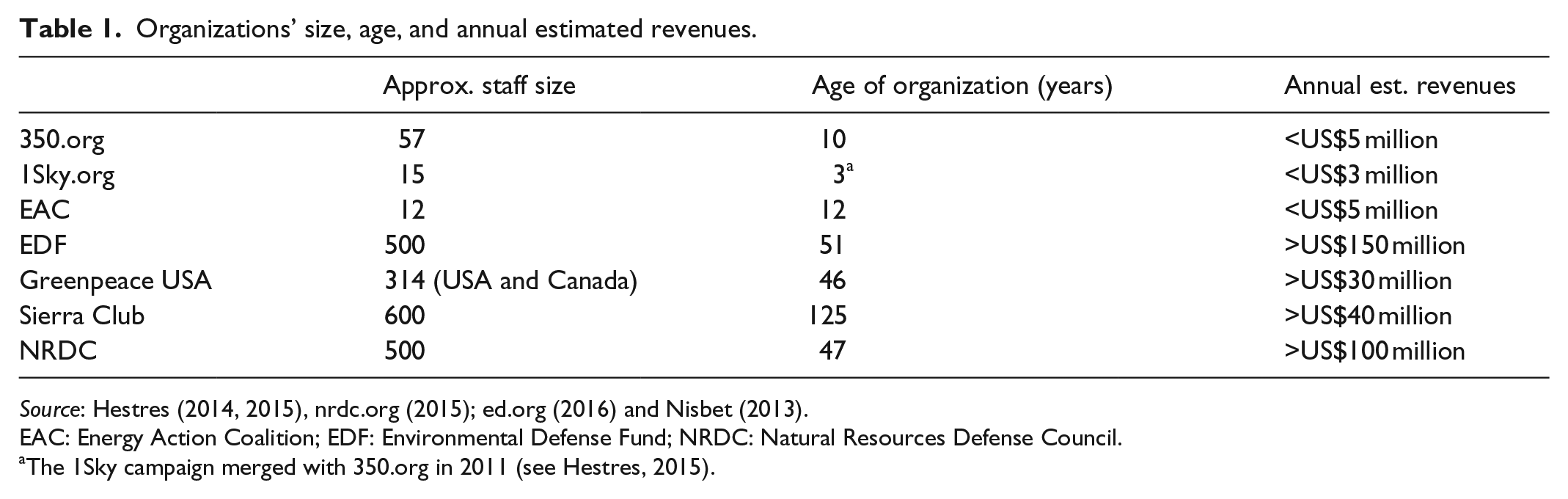
Source: Hestres (2014, 2015), nrdc.org (2015); ed.org (2016) and Nisbet (2013).
EAC: Energy Action Coalition; EDF: Environmental Defense Fund; NRDC: Natural Resources Defense Council.
The 1Sky campaign merged with 350.org in 2011 (see Hestres, 2015).
“I would say social media platforms are not particularly useful for mobilization, and I really don’t find that any other organizations feel otherwise,” said Sierra Club’s director of digital innovation Michael Grenetz (personal communication, October 30, 2013). David Acup, senior director of interactive marketing and membership at EDF, also emphasized the primacy of email and websites as drivers of action:
I would say that social media sites are complementary to what we do, but for the most part we are using our website and our email list . . . our direct channels are the ones we rely on most. Social media complement what we’re doing, but they’re not the bulk of what we’re doing. It’s just the way our membership wants to be engaged. (Personal communication, October 21, 2013)
NRDC email coordinator Liz Langton confirmed this broadly shared view and also contrasted the potential that each type of tool has to reach different audiences:
When we’re reaching out via email, it’s definitely more targeted . . . to our existing audience. Whereas on Twitter—more so Twitter and somewhat Facebook—it’s a bit broader in that it can reach new audiences a little bit easier than through email . . . [Social media] is very effective to reach new people. (Personal communication, January 7, 2014)
The importance that these strategists attach to social media as outreach tools is perhaps best exemplified by Sierra Rise, a new project from the Sierra Club that provides attractive and easily shareable social media content meant to reach new audiences (“Sierra Rise,” 2014). The site offers compelling images with overlaid text, videos, and other online artifacts related to Sierra Club messages and campaigns, along with tools to share them easily via intermediaries such as Facebook and Twitter. In its purpose, design, and functionality, Sierra Rise closely resembles Upworthy, a viral content site co-founded by former MoveOn.org executive director Eli Pariser and Peter Koechley, former managing editor of The Onion (Carr, 2012). “Sierra Rise is mostly focused on what’s going to get our community to share with a secondary audience to get them to join what we’re doing,” said Sierra Club’s Grenetz (personal communication, October 30, 2013).
But the opinions expressed above were not unanimous. Former NRDC online director Apollo Gonzales, who was also a project principal at digital strategy consulting firm EchoDitto and now works independently, sees great potential for social media to fulfill at least some of the strategic functions that have traditionally been conducted through specialized advocacy tools—precisely because of their ability to reach new audiences:
You’re going to reach your audience with email, but I don’t feel we ever saw really effective sharing or tell-a-friend use via email.
1
The number of “tell-a-friends” was always abysmal . . . Now you can put a “share on Facebook” or “tweet this” button at the end of an email or an action page . . . and people are telling a friend, it’s just not called tell-a-friend. And I think that’s where social far outpaces email: exposure to new audiences [emphasis in original]. (Personal communication, November 11, 2013)
Coping With Rapid Social Media Innovation
Because advocacy organizations can exercise a much lower level of control over social media services than they can over specialized tools such as database-driven email tools, the policies and technological features deployed by the former have greater disruptive potential than the latter. Interviews revealed that disruptions do occur, but take on a wide variety of forms—as do organizational responses, which can sometimes turn disruptions into strategic wins.
One of the most pervasive disruptions is the constantly evolving nature of social media services such as Facebook and Twitter. These companies must continuously fine-tune their platforms to retain and grow their audiences, entice them to spend more time using their services, and share more information through them. Since these companies cater to an audience overwhelmingly interested in apolitical social interactions (Nadkarni & Hofmann, 2012), they have little incentive to accommodate the needs of advocates or their ability to cope with their rapid pace of innovation. By contrast, intermediaries that provide specialized tools, such as website hosting, electronic customer relationship management (eCRM) systems, or advocacy platforms, have a financial incentive to cater to the advocacy community and involve it in the development cycle because it is their primary customer base.
The rapid pace of innovation characteristic of social media sites can impose costs on advocacy organizations, both in terms of time and money. EchoDitto’s Gonzales specifically identified both the high frequency of change in social media services and the lack of transparency of their development calendars, as disruptive to organizations (personal communication, November 21, 2013). Liz Langton revealed that NRDC employs outside experts to help it optimize its use of Facebook:
Facebook is nuts! They change, it feels like, every other week. We have an outside firm that helps us keep up to date on all the changes and we’re constantly reconfiguring what we do and how we do it in order to meet the outreach numbers that we expect. We do spend time and money making sure we are using the tools accurately and appropriately. (Personal communication, January 7, 2014)
Organizations with multi-million dollar budgets such as NRDC may be willing and able to make these expenditures, but organizations with fewer resources may not have such options. These choices include ephemeral hacks that can temporarily relieve disruptions, but are unlikely to solve them permanently. EAC’s then-digital director Jeff Mann reported an instance when another EAC staffer discovered a way to invite a large number of supporters to a Facebook event. If EAC (or any other organization) wished to invite all its supporters to an event, doing so without this workaround could be a time-consuming chore. But shortly after the workaround had been implemented, Facebook changed its events tool yet again, rendering the workaround useless. This example suggests that smaller organizations such as EAC may have a much harder time coping with constant platform changes than organizations with multi-million dollar budgets and the resources that money can buy, such as NRDC and EDF.
Content Censorship in Social Media Services
Some strategists recalled instances when social media disrupted their work more directly by censoring content. Greenpeace USA online organizer Dionna Humphrey recalled two such instances of censorship:
We did try to run some ads on LinkedIn once that were rejected because of the content, and it was a little suspect that they rejected our ad because there was nothing controversial about the content. We’ve had that a couple of times on Facebook as well, when Facebook as turned down our ads. (D. Humphrey, Personal communication, October 29, 2013)
Greenpeace received no satisfactory explanations for the ad rejections from Facebook or LinkedIn (unfortunately Ms Humphrey was not able to provide the ads’ content for review). Both companies have teams of employees that review ads and decide whether to accept or reject them, so their rejections cannot be blamed on automated processes. But the companies’ respective advertising guidelines may provide clues as to the reasons behind the rejections. Of the two companies, LinkedIn’s advertising guideline is the most explicitly restrictive when it comes to content (LinkedIn, 2014). Under the heading “Provoking, Offensive or Discriminatory,” the company issues the following guideline:
Although Humphrey claims that “there was nothing controversial about the content,” it is possible that an ad reflecting Greenpeace’s typically blunt, anti-corporate approach would not pass muster under this guideline. The guideline seems restrictive enough to preclude a wide range of political advertising, including corporate campaigns like the ones that have made Greenpeace famous.
Facebook’s guidelines do not explicitly restrict advocacy ads as do LinkedIn’s, but the company reserves itself such discretion in the approval or rejection of ads that it would be difficult to contest an advocacy ad rejection: “Facebook reserves the right in its sole discretion to determine whether particular content is in violation of our community standards” (Facebook, 2013). Since some private information intermediaries have shown a tendency to censor content within their platforms to avoid political controversies (Benkler, 2011; Hestres, 2013), these rejections may represent additional instances of a worrisome trend in privatized IG that is exacerbated by the growing dependence of advocacy organizations on social media.
But online strategists are not entirely devoid of agency in situations when they face outright content censorship from social media services. Such cases may lend themselves to creative, jujitsu-like advocacy tactics that turn intermediary disruptions into net positives for an organization.
The Sierra Club’s Grenetz recalled such an instance: In 2013, FWD.Us, a pro-immigration reform organization co-founded by Facebook CEO Mark Zuckerberg, launched an ad campaign supporting key US senators who supported the Keystone XL pipeline project, under the assumption that strengthening them politically would eventually allow them to support immigration reform (Sengupta, 2013). In response, Credo Mobile, a progressive and politically active mobile services company, created a Facebook ad criticizing Zuckerberg for FWD.Us’ promotion of Keystone XL—an ad that Facebook promptly banned (Rowell, 2013).
It was then that Sierra Club became involved. “When [Facebook] censored the ad,” said Grenetz, “we did a campaign about it—and it blew up”—meaning that it was very successful (personal communication, October 30, 2013). This is an example of an advocacy organization turning an instance of censorship suffered by a like-minded organization into a successful advocacy opportunity. Although in this particular case it was not Sierra Club’s content that was censored, Facebook’s censorship may have brought the issue greater attention than it would have otherwise received had it simply approved the ad.
Ideological Affinity and Tool Choice—or Lack Thereof
The Credo/FWD.Us episode highlights another difference between social media and specialized advocacy tools: Specialized tools allow organizations much greater flexibility in choosing intermediaries that broadly share their ideological leanings and goals.
Large technology services and consulting ecosystems cater to the two main ideological factions of American politics. Companies such as Salsa Labs, ActionKit (founded by former MoveOn.org staffers), Blue State Digital, and EchoDitto (founded by former staff members of the Howard Dean presidential campaign), and many others, offer a wide range of online communication and mobilization services, including design, web development, software as a service, and strategy consulting, exclusively to liberal organizations and Democratic political campaigns. A similar ecosystem exists for the conservative side, although on a more limited scale (see Karpf, 2012, for more on ideologically aligned technology ecosystems). Organizations can therefore obtain technology services from vendors they feel will not contract with clients that oppose the organization’s values or contravene those values in their corporate practices. For instance, the Human Rights Campaign, an organization that promotes equality for the lesbian, gay, bisexual, and transgender (LGBT) community, will most likely hire technology vendors and consultants that do not discriminate against this community in their corporate practices or work with organizations, such as the Family Research Council, which opposes LGBT equality.
Respondents indicated that their organizations exercise such choices whenever possible. Michael Silberman, global director of Greenpeace’s Mobilisation Lab project, described how Greenpeace would not sign a contract with Salesforce.com, a constituent relations management (CRM) platform widely used in the nonprofit world, until it pledged to move away from the “dirty cloud”—a pejorative term for cloud computing systems that rely on coal power plants to meet their energy needs—and instead embrace clean energy (personal communication, October 18, 2013; Jones, 2013).
Advocacy organizations do not have this level of flexibility in relation to social media services. Because a relatively small number of such intermediaries have built massive market shares in their respective niches—Facebook in social networking, Twitter in microblogging, Google in search, and its YouTube division in video sharing—and have become intertwined in a social media ecosystem to which users have become accustomed, advocacy organizations have little choice but to maintain profiles in these services, regardless of their corporate practices or the political leanings they might display. This can sometimes put advocacy organizations in the awkward position of using non-specialized intermediaries to campaign against some of these very intermediaries—case in point, Facebook’s ban of Credo’s anti-Keystone XL ad.
Strategists revealed a sense of acceptance or even resignation to this situation. Regarding Facebook, Greenpeace’s Humphreys said, “there’s nothing else like it . . . there still isn’t another option. That’s where the conversation is happening, so in order to be relevant, we have to be there” (personal communication, October 29, 2013). Similarly, EAC’s Jeff Mann said that his relatively small organization depends on social media “a ton” because “we’re going where people are” (personal communication, November 8, 2013). Garth Moore, former Internet director at the 1Sky climate campaign and currently at the One anti-poverty campaign, concurred with the necessity of using these tools:
Our ethos is that these are free tools and we’re lucky to have them to expand our outreach. We’ve not been thrilled with Facebook’s constantly changing algorithms or Twitter’s lack of metric tools. But overall, we continue to publish and engage as much as possible and worry more about message and marketing efforts. (Personal communication, January 22, 2014)
Technological Architecture, Intermediaries, and Lock-In Effects
Even if viable alternatives to the dominant social media services became available, lack of data portability could make migrating across platforms a difficult, if not impossible, task (as would be the case for individual users). Private intermediaries such as Facebook, Yahoo, and Google have discussed and tried to develop common standards for data portability, but no standards exist today that would allow users or organizations to easily migrate all their data and interactions from one social media platform to a comparable alternative (Bojars, Breslin, & Decker, 2008). Advocacy groups may experience a lock-in effect similar to that of individuals who have invested too much time and effort curating their profiles and accumulating online interactions in one platform to switch to another. This lock-in effect echoes worries about walled gardens—closed technological ecosystem that is not interoperable with others—that some scholars have expressed (Zittrain, 2008).
Attitudes regarding this prospect varied among respondents. Some characterized the potential need to migrate or rebuild communities developed through social media as daunting, while others were more sanguine about the prospect. NRDC’s Langton fell in the latter camp:
If we had to change platforms . . . let’s say Facebook ended tomorrow and this new platform opened up, we’d have to figure out a way to rebuild that audience. That doesn’t necessarily scare me because I figure we would all be on the same boat. It would just be a necessary annoyance. (Personal communication, January 7, 2014)
Greenpeace USA’s Dionna Humphreys expressed the opposite view and emphasized the challenges of potentially migrating from a major social networking platform such as Facebook and Twitter to a hypothetical alternative:
For a big organization like us to consider . . . let’s say somebody came up with the new Facebook, we wouldn’t just jump ship, for sure . . . we’d have to see what it’s about before making a decision like that. If we were talking about using Instagram video vs. Vine, that’s pretty insignificant. But if there were a new Twitter or a new Facebook, it wouldn’t be an instantaneous decision for sure. (Personal communication, October 29, 2013)
The One campaign’s Moore also described an approach that prioritizes certain non-specialized intermediaries over others:
We rate our networks into tiers: Tier one is Facebook; Tier two is for Twitter and YouTube; Tier three is for Google Plus, LinkedIn, Instagram, Pinterest, and Vine . . . It would be extremely difficult [to migrate from] Facebook and Twitter, given our large volumes and high engagement rates. Tier three and below would be acceptable to replace or lose simply because overall engagement is so low. (Personal communication, January 22, 2014)
Unsurprisingly, the possibility, however unlikely, that key social media services such as Facebook may one day disappear or stop providing key user interaction data—a less improbable scenario—has crossed the minds of strategists. (It is worth remembering cases where very popular intermediaries suddenly became unpopular and irrelevant, or radically changed their focus—for example, MySpace, Friendster, and the original Digg.) But interviews revealed no belief that these platforms should facilitate such transitions, despite the contributions that advocacy organizations make to their social and interest graphs. Gonzales laid the responsibility on organizations (or clients, from his current perspective) to exercise discipline in data collection and preservation:
If you are disciplined about the data that you are collecting . . . and make sure that you are getting that data out of the system, then when things change you can go back to both your strategy and the data that you pulled and recreate whatever needs to be done. If Facebook decides tomorrow that they’re no longer going to report age demographic information on the people on your page—that sucks. But if you’ve been disciplined in the way you hold on to your data, you should have something that you can go back to that says, “This is what our audience looked like yesterday . . .” Then you can go into it with eyes wide open that you could lose everything tomorrow. (Personal communication, November 21, 2013)
But the ability of organizations to exercise such data collection and preservation discipline may depend on their resources. Large organizations with multi-million dollar budgets, such as the Sierra Club and NRDC, could dedicate enough staff time to these tasks, or simply automate them, while smaller organizations, such as EAC, may have to risk losing valuable data due to lack of resources.
Privacy, Data Security, Monetization, and Related Issues
The privacy and personal data security of users across various private information intermediaries is an ongoing concern of policy experts and Internet studies scholars (Fuchs, 2011; Montgomery, 2013; Waters & Ackerman, 2011; Zimmer, 2010). Constantly shifting privacy settings, invasive user data monetization strategies, data security vulnerabilities, and shifting notions of privacy among younger users are just some of the issues that are front and center in Internet research and policy agendas. Revelations of the National Security Agency’s (NSA) vast, ongoing online surveillance programs, divulged by former NSA contractor Edward Snowden in 2013, have only heightened these concerns.
But such concerns did not register as high priorities among respondents in relation to their use of private information intermediaries for advocacy. This is not to suggest that respondents are not concerned on a personal level about issues such as online privacy and surveillance. Given their generally progressive leanings, it is reasonable to assume that if asked their personal opinions about them, they would express high levels of awareness and concern. Rather, it is to say that they do not see these concerns as relevant to their use of social media in the context of their work. EDF’s David Acup said,
We haven’t had any issues around privacy. The information that you can get out of Facebook is relatively modest, so the amount of data mining and analysis that we can do on those tools is pretty modest. So there isn’t any invasion of privacy there, at least not that we’ve seen or heard. (Personal communication, October 21, 2013)
Acup did mention rising annoyance among users with “retargeting”—the use of cookies and JavaScript to follow online audiences across multiple websites with ads that are supposedly relevant to them based on goods and services they have showed interest in before. But he did not raise privacy concerns that are commonly associated with this practice (Helft & Vega, 2010). Instead, he argued that the tactic was not yet sophisticated enough to lower the annoyance factor by showing users truly relevant ads across websites. When asked about potential concerns regarding privacy, data monetization, and related issues connected to the use of information intermediaries, Greenpeace USA’s Dionna Humphreys replied,
I don’t know that we’ve ever discussed that. I think that as Facebook continues to reinvent itself it blurs the lines of privacy a little bit . . . It’s not something that we’ve had a discussion about in terms of what’s happening and how is this affecting our supporters. (Personal communication, October 29, 2013)
Discussion
Discussion of Empirical Findings
The first pattern that emerges through the interviews is the overwhelmingly instrumental view that strategists hold of private information intermediaries. Understandably, activists are focused on their organization’s or movement’s goals and successfully executing the strategies that will ultimately achieve them. Consequently, the relevant categories for strategists have little to do with those relevant to IG and everything to do the strategic usefulness of each particular tool. This attitude is reflected in the distinctions strategists made across interviews between email and social media as tools for engagement and mobilization, respectively. They mostly regarded mass email as the killer app that drives actions such as petition signatures, donations, and event attendance, while social media serve as tools for rapid response to unfolding events, new supporter recruitment, and ongoing engagement with existing and new supporters through online communities.
Strategists seemed to recognize the pitfalls of reliance on social media more clearly when disruptions associated with them became most blatant—particularly when they involve censorship. As the case of Credo’s anti-FWD.Us ad shows, outright censorship by information intermediaries can shift attitudes among strategists from seeing them as collective action platforms to something like traditional media outlets that must be chastised for engaging in censorship. This incident highlights the inherent tensions of treating social media as neutral collective action platforms, when in fact they are corporate entities with social and political agendas that can differ—sometimes substantially—from those of advocacy organizations, and will not hesitate to implement technological features or policies to support their agendas. This tension can often put activists in the awkward position of treating some of the very services on which they depend as targets of their advocacy efforts. But aside from blatant instances like censorship, the general attitude among respondents toward disruptions stemming from technical or policy choices of information intermediaries is to treat them as inevitable consequences of using these tools, to be sidestepped, hacked, or simply endured because “there’s nothing else like it” or they see a need to “go where people are.”
There are potential remedies available to activists affected by social media platform policies and architectures, including migrating to new social media platforms en masse, embracing “civic technologies” such as Wikipedia, applying legal remedies anchored in consumer safety laws, appealing to sympathetic governments, advocating industry self-regulation, and direct, long-term advocacy targeting social media platforms (Youmans & York, 2012, pp. 324-325). But interviews revealed no palpable sense of a need for such measures or even awareness of their availability. The exception seems to be cases involving outright censorship, when strategists will not hesitate to target information intermediaries with advocacy campaigns.
Theoretical Relevance
This article’s main theoretical contribution to ongoing debates about the role of technologies like social media in modern activism is to foreground the relevance of privatized IG to these debates. Whether scholars and commentators find mostly positive (Bennett & Segerberg, 2012; Karpf, 2012; Shirky, 2008) or negative (Gladwell, 2010; Hindman, 2009) relationships, these may not be inherent to the Internet or associated technologies themselves. Rather, they may be the result of specific policy decisions and technical features implemented by private intermediaries, such as Facebook and Twitter, that activists and advocacy organizations have recently embraced as tools of their trade. These causal mechanisms reflect specific decisions taken at certain moments by agents of relevant actors that comprise the Internet, including social media services such as Facebook, Twitter, and the like, to satisfy specific motivations, such as maximizing engagement, profit, and control over their respective platforms. Given that most social media services (or, indeed, most private intermediaries) are not originally built with advocacy in mind, this leaves many theoretical questions open, such as the following: What factors determine whether the policies or technological features deployed by intermediaries help or hinder activism? To what extent do these successes or failures depend on the skill of digital strategists, good fortune, or other unknown factors? Is a different dynamic at play with intermediaries that cater exclusively to the advocacy community? Regardless of how these and other related questions are answered, the privatized IG perspective should be a useful and welcome addition to the study of Internet-enabled activism.
Another finding that is relevant to the existing theory is the differences between large and small organizations’ ability to cope with disruptions caused by policy or technical changes implemented by social media services. Interviews suggested that large organizations, such as NRDC and EDF, which tend to have bigger budgets, larger staff, and greater resources to hire contractors, are better able to cope with such disruptions than smaller organizations, such as EAC. These findings point to an ongoing relevance of resource mobilization theory (RMT; McCarthy & Zald, 1977) in the digital era. RMT “is based on the notion that resources—such as time, money, organizational skills, and certain social or political opportunities—are critical to the success of social movements” (Eltantawy & Wiest, 2011). Findings from this article suggest that organizations able to mobilize greater resources—particularly money and staff—are better able to cope with policy and technical social media service changes and perhaps better able to take full advantage of them for advocacy. In other words, the ability to marshal resources still matters.
Limitations of This Study
A potential limitation of this study is its relatively narrow focus on social media services at the expense of specialized advocacy tools such as database-driven email and CRMs. While this focus was justified and useful in this case, the interaction between specialized tools and online advocacy must not be overlooked in the long run. Some scholars have made great strides in understanding the relationship between online infrastructure and various facets of political communication and mobilization (Karpf, 2012; Kreiss, 2012; Stromer-Galley, 2014), but more research is required in this area, particularly studies that encompass all tools used in advocacy. Another potential limitation of the study is the similarities between advocacy organizations where most of the respondents worked at the time of the interviews. Despite the fact that the organizations share certain advocacy goals, there is enough diversity between the organizations themselves that their commonality of purpose should not be regarded a weakness. Furthermore, respondents have worked in other organizations and roles before their interviews, so their experiences did not derive exclusively from working at climate change and environmental groups. Nevertheless, future research into these topics would benefit from even greater diversity within samples, or from samples of specific advocacy communities, depending on the research questions.
Finally, it should be noted that all organizations discussed in this article are based in the United States, and none specializes in information technology policy issues. Given the vast differences that can often be found between the regulatory approaches of different jurisdictions, such as between the United States and the European Union (EU; Movius & Krup, 2009), this study might have yielded different findings had the organizations been based in the EU instead of the United States. Likewise, strategists at organizations that focus on technology policy, such as the Electronic Frontier Foundation and Demand Access, might have responded to questions posed during this research in ways that organizations that do not focus on such issues might have done.
Implications for Practitioners and Scholars
Interviews also revealed some disconnect between how practitioners of online advocacy view private information intermediaries and various concerns articulated by Internet scholars and policy experts. Given the increasingly important role that the Internet plays as a platform for political communication and participation, it would be beneficial to bridge this gap. If current trends hold, private information intermediaries—particularly social media services—should become even more important as collective action platforms. This means that the technological architectures and policies these corporations enact will increasingly dictate what activists can and cannot do online to further their goals.
It is in the interest of both experts and practitioners to bridge this gap. As gatekeepers of the social media-based interactions between citizens and advocacy organizations, digital strategists have a growing responsibility to take into consideration how their approach to digital interactions through intermediaries such as Facebook and Google impacts their supporters, the organizations that employ them, and the broader public sphere. Meanwhile, academics and other experts could gain valuable insights about their objects of study from greater interaction with these professionals. Increased interaction between practitioners and their counterparts in the scholarly community would raise awareness about critical issues of privatized IG among the former and relate scholarly work even more intimately to the day-to-day practices of digital strategists. This increased interaction, for example, could result in greater awareness among practitioners about various aspects of privacy and data security, which could lead to more rigorous internal policies related to these concerns. It could also lead to the conceptualization and enactment of more alternatives for advocacy organizations when social media companies, purposefully or not, disrupt their work. Greater interaction could also lead academics to extend their research into areas of concern to practitioners, such as the rapid pace of change within non-specialized intermediaries. Ultimately, such interactions should lead to better scholarship, policy work, and advocacy practices.
Footnotes
Acknowledgements
The author thanks Drs Laura DeNardis, Kathryn Montgomery, Matthew Nisbet, and Todd Eisenstadt; Ms. Kate Olden; and two anonymous reviewers for their help with this article.
Declaration of Conflicting Interests
The author(s) declared no potential conflicts of interest with respect to the research, authorship, and/or publication of this article.
Funding
The author(s) received no financial support for the research, authorship, and/or publication of this article.