




Abstract
Research shows the growth of online information has led to a decline in audience trust in mainstream news. However, how this lowered trust in the news affects different audiences’ attitudes and news consumption behaviour is less understood. Our thematic analysis of 40 semi-structured interviews with Australian heavy and non-news users of mainstream news shows that responses vary with respect to the effort taken to verify dubious news. Among heavy news users, responses include ‘pragmatic scepticism’, ‘selective trust’ and ‘generalised cynicism’ which tend to drive verification and fact-checking behaviours. These findings suggest that mistrust in mainstream news is not necessarily a bad thing, as it can lead to greater critical involvement with news and information. However, many non-news users depicted ‘critically conscious’ or ‘cynically disengaged’ attitudes towards news. A lack of trust can drive a low-effort response, particularly among non-news consumers, creating a downward spiral of disengagement.
Introduction
On digital platforms, mainstream news competes with partisan media, user-generated content and many other sources of information to reach audiences. Individuals encounter a plethora of narratives online, and it is becoming increasingly challenging for citizens to determine the veracity of information they find there. According to Park et al. (2022a), more than two-thirds of global news audiences are concerned about misinformation, and more than half are actively avoiding news. This is because many people encounter bias and negativity in mainstream news media and are overwhelmed by the amount of news and information available.
Previous research into news consumption tells us that audiences can acquire a generalised scepticism on social media and online platforms due to the volume of information online (Fletcher and Nielsen, 2019). This culture of low trust, which is characterised by ‘a pervasive, generalised climate of suspicion’ (Sztompka, 1998: 22), can lead to alienation and passivism. A recent study suggests that some news audiences who are bothered by the information uncertainty disengage altogether (Chan et al., 2022). However, another way to deal with the overwhelming volume of information is through news literacy practices, such as critically engaging with information, and verifying dubious information by comparing multiple sources and fact-checking. Here, news literacy is defined as the knowledge and skills necessary to navigate news environments (Tully et al., 2021).
The current study examines how people manage the overwhelming volume of news and its negativity through a lens of ‘mistrust’ which is deferring trust and applying scepticism. This can be differentiated from ‘low or a lack of trust’. We asked the following research questions: How do news audiences respond to the overwhelming volume of news that is often untrustworthy? What are the different responses to mainstream news among heavy and non-news consumers, in relation to trust and mistrust in news?
A qualitative approach was adopted to better understand how audiences encounter and respond to mainstream news, especially when it is deemed to be untrustworthy, whether through verification or disengagement. An analysis of semi-structured interviews with 20 heavy and 20 non-news consumers reveals a typology of audience responses to untrustworthy news. Audience responses range from pragmatic scepticism, selective trust and generalised cynicism among heavy news consumers, to critically conscious and cynically disengaged among non-news consumers. Low trust in the news does not automatically result in disengagement. Rather, the efforts to verify the information is an important factor. The results highlight the need for a nuanced understanding of the concepts of trust and mistrust in news and their possible consequences.
While there has been much scholarly discussion about a crisis of trust in news (Fisher et al., 2020; Knight Foundation, 2022; Waisbord, 2018), the findings in this article suggest that mistrust in news does not necessarily result in negative outcomes for audiences. For example, among heavy news consumers, it can drive a high-effort response of greater engagement with news and information for the purposes of verification. Nevertheless, the lack of trust can contribute to a low-effort response of disengagement, particularly among non-news users.
Literature review
The relationship between trust, distrust and mistrust
While trust is often viewed as a unipolar construct, others have argued that trust and distrust are separate constructs and that both can co-exist (Lewicki et al., 1998; Park et al., 2020; Van De Walle and Six, 2014). However, there are few empirical studies examining them together and comparing their outcomes.
Many theoretical attempts have been made to define these somewhat different but linked concepts of trust, distrust and mistrust. Lewicki et al. (1998) define trust as confident positive expectations regarding another’s conduct, and distrust as confident negative expectations regarding another’s conduct. Distrust is the unwillingness of the distrustor to engage in an action based on negative expectations regarding the distrustee (Bijlsma-Frankema et al., 2015; Harrison McKnight and Chervany, 2001), resulting in alienation and passivism (Sztompka, 1998) or, as Lewicki et al. (1998) state, ‘a fear of a propensity to attribute sinister intentions to, and a desire to buffer oneself from the effects of another’s conduct’ (p. 439). Bertsou (2019) further defines distrust ‘as a negative attitude held by an individual towards the political system or its institutions and agents’ (p. 215), recognising that distrust can exist as a generalised sentiment not tied to potential action. These studies equate distrust to a lack of trust.
Although the terms ‘distrust’ and ‘mistrust’ are used interchangeably in much scholarly literature, some argue they are different concepts and need to be considered separately. For example, Lenard (2008) differentiated between mistrust and distrust through the attitudes present, describing mistrust as ‘a cautious attitude towards others; a mistrustful person will approach interactions with others with a careful and questioning mind-set’ and distrust as ‘a suspicious or cynical attitude towards others’ (p. 313). This suggests that scepticism and cynicism can result in different behaviours when people encounter untrustworthy news.
When low trust is formed by both normative and empirical judgements, it can lead to insecurity, cynicism and fear (Devine et al., 2020). Cynicism is an attitude against a system that results in rejection or disengagement. However, when there is a lack of trust, rather than responding with cynicism, people can adopt a critical attitude. This critical attitude can be labelled as scepticism that involves evaluation of the system presented, and seeking alternative sources that support its veracity. Scepticism, therefore, recognises shortcomings and seeks to rectify these rather than turning to outright rejection. In this aspect, we can differentiate mistrust from low trust.
Quiring et al. (2021) differentiate between scepticism and cynicism, arguing that cynicism is based on observable imperfections of media, such as exaggerations or sensationalism, while in contrast, scepticism combines a critical attitude that is aware of the flaws in news reporting with a tolerance for its inherent limits. Cynicism leads to complete and automatic rejection, while scepticism involves critical and balanced engagement. Importantly, their study found that generalised media trust was positively correlated with scepticism but negatively related to cynicism.
While a certain amount of scepticism is seen as a positive trait and an important element of news literacy, Li (2023) points out that not all scepticism is healthy. They make a distinction between accuracy and identity-motivated scepticism towards misinformation on social media, which is a useful distinction in the context of news consumption. Accuracy-motivated reasoning occurs when a person reflects on the process of opinion formation. They search for biases in their judgements and re-evaluate. Identity-motivated reasoning occurs when people use their identity to filter dubious information and believe in information that is congruent with their existing beliefs. They tend to override incongruent evidence. Accuracy-motivated sceptics are less likely to fall for misinformation and seek verification through mainstream news media, producing ‘normatively desirable outcomes’ (Li, 2023: 19). Identity-motivated scepticism increases people’s susceptibility to misinformation and encourages news avoidance on social media.
While many studies have differentiated trust, distrust and mistrust (see Devine et al., 2020; Kang and Park, 2017; Lewicki et al., 1998; Saunders et al., 2014; Van De Walle and Six, 2014), there is no consensus; most studies imply that distrust is a lack of trust, and mistrust is a separate construct. Put simply, distrust is a low level, or lack of trust and mistrust is a sceptical attitude that defers trust judgement and results in verification behaviours. A lack of trust, or distrust, may lead to cynical attitudes. However, less is known about how these concepts are related and further results in cynicism or scepticism.
The complex relationship between trust and news consumption
There has been growing concern about a crisis of trust in news as part of a wider decline of trust in social, economic, political and media institutions (Flew, 2021), heightened by the growth of online platforms and the disinformation environment (Waisbord, 2018). Others contend that the alleged trust crisis depends on one’s perspective and question whether the concept of trust continues to be relevant (Jakobsson and Stiernstedt, 2023). So why does trust matter in the context of news consumption in the digital age? Trust is generally seen as a prerequisite for public connection (Uslaner, 2004). Only when people believe the news, can they be informed by it and act upon it. From a democratic standpoint, it is clear that distrust in the news may have negative consequences – an overall lack of trust in society and its systems, disengagement from the democratic process and other adverse behaviours such as spreading misinformation.
However, the relationship between trust and news consumption is not as straightforward. There are mixed findings about the link between news use and media trust (Strömbäck et al., 2020). People do not always trust the news that they consume (Tsfati and Cappella, 2005, 2003; Wölker and Powell, 2018).
More importantly, there is a complex relationship between news consumption, trust and news avoidance. In a high-choice information environment, citizens can become overwhelmed by the amount of news and information they encounter and limit their exposure. Even for heavy news consumers, it can become simply too much.
For many, news avoidance is strongly associated with negativity. The news tends to focus on doom and gloom, which people find upsetting and makes them feel powerless (Newman et al., 2023; Park et al., 2022a; Toff and Nielsen, 2022). Research reveals that levels of news avoidance have been increasing in recent years, particularly during the COVID-19 pandemic (Park et al., 2022b; Park et al., 2023). For many citizens, especially during lockdowns, reducing the amount of news they consume was a well-being strategy (Mannell and Meese, 2022). Others tuned out altogether (Mindich, 2005).
The decision to avoid news might be selective and reflect a lack of interest in the news and a higher interest in other options like entertainment (Prior, 2007), or a particular partisan perspective (Iyengar and Hahn, 2009), or they turn away from the news because they feel their issues and concerns are misrepresented and underrepresented, a decision that is also related to trust (Arguedas et al., 2023). Goyanes et al. (2021) examined different individual-level factors (i.e. cognitions and dispositions) that are associated with intentional news avoidance and found that political interest, news overload and trust were all related to avoidance.
Traditionally, news avoiders have been classified as people who consume relatively little news, whereas news seekers have relatively high levels of news consumption (Ksiazek et al., 2010). News avoiders intentionally decide to consume little to no news despite the availability and accessibility of news – this is consistent with what Golman et al. (2017) described as active information avoidance, or when an individual knows that information is available and has access to the information but still decides to avoid that information. Edgerly (2022) describes news avoiders as people whose media habits ‘do not involve regular news exposure’ (p. 1828), while Gil de Zúñiga et al. (2017) differentiate between news avoiders who minimise news exposure by not seeking news out themselves, and those who actively and intentionally avoid all news.
Because of the traditionally accepted importance of journalism’s role in society (Fenton, 2010), the trend of news avoidance has raised concerns about it, leading to lower levels of civic participation (Edgerly, 2015). However, Woodstock (2014) found some people who intentionally limit the amount of news they consume – news resisters – have more time for civic participation and ‘renewed interest in the public sphere when they reduce their news consumption’ (p. 7).
We can conclude that news avoidance is not a behaviour limited to people with low interest in news but rather a pervasive phenomenon among a range of news audiences, even among heavy news consumers. Nevertheless, news avoidance seems to be related to audiences’ trust in news. In Australia, people who distrust news are more likely to avoid it (76%) compared to those who trust news (64%). Similarly, those who access news less frequently and are light news consumers tend to avoid news (74%) more than heavy news consumers (65%) (Park et al., 2023). According to Boczkowski (2021), the increase in the volume of information to users can be understood as information abundance, which can be both positive and negative. His study found experiential appreciation of home audiovisual content in contrast to devaluation of news content, and that avoidance may not always be intentional.
Globally, the proportion of people who say they do not access any news through mainstream media is growing (Newman et al., 2023). However, there is very little research examining people who do not access news at all and whether trust and mistrust in news is related to non-news consumption.
Methodology
The findings in this article draw on a subset of 40 semi-structured interviews with adult Australians from a larger project. Semi-structured interviewing was chosen because it is an effective way to elicit reflexive and descriptive responses to questions about the role of the news media in people’s lives (Galletta, 2013). A total of 60 participants were recruited through the McNair yellowSquares consumer research panel to ensure a suitable mix of participants based on their level of news consumption. In this article, we excluded the 20 moderate news users to contrast heavy versus non-news consumers.
We adopted a two-stage process to select participants for the study. The first stage was to ask structured questions about the participants’ news habits and attitudes. This consisted of 10 multiple-choice and basic demographic questions. The questions ranged from interest in news, trust, political orientation and engagement, media literacy and confidence, and news avoidance and consumption.
In the second stage, we tailored each participant’s interview guide based on their responses to the questionnaire. For example, if the participant selected social media as a source of news, further questions about social media news consumption were added to the interview questions. If a participant’s mainstream news consumption was reported to be less frequent than once a month, we asked questions about alternative pathways to news.
Conceptions of ‘news’ in the digital era are changing, but in this study, it refers to news produced by the mainstream news media, not by alternative news and information sources. Participants were asked to describe what they meant by news which generated a variety of responses (Fisher et al., 2024). However, references to ‘news’ in this article refer to perceptions of the mainstream news unless otherwise specified. Participants’ perception of trust in the news also followed suit. We asked mainly about their trust in mainstream news, reflecting their responses to the initial survey question (Tsfati et al., 2023). We defined heavy news users as those who access mainstream news more than once a day and non-news users as those who say they access news less often than once a month or never. To recruit both heavy and non-news users, we used a screening question, ‘Typically, how often do you access news? By news we mean national, international, regional/local news and other topical events accessed via any platform (radio, TV, newspaper or online)’ (as used in the Reuters Institute Digital News Report, see Newman et al., 2023). We recruited 20 heavy news users, who access news more than once a day, and 20 non-news users, who access news either less often than once a month or never.
Semi-structured interviews were conducted between 31 October 2022 and 11 November 2022. Five members of the research team interviewed participants. Each interview lasted approximately 30 minutes. The interviews were conducted via Zoom and recorded with the participants’ consent. The recordings were transcribed using Otter.ai software and checked by the interviewer for accuracy.
We used Atlas.ti to conduct a thematic analysis (Braun and Clarke, 2006; Braun and Clarke, 2021). Thomas’ (2006) five-step qualitative analysis process was applied: data cleaning, close reading of the text, creation of categories and themes, recognising overlapping and uncoded text, and ongoing revision and refinement. This method enables the researcher to ‘build a comprehensive, contextualized and integrated understanding’ (Bazeley, 2013: 191).
To ensure reliability of coding, which is often a disadvantage of multiple coders (Bazeley, 2013), three members of the team collaborated on developing the coding structure and revised it six times after testing. The five interviewers were assigned to code transcripts of participants that they did not interview. During the coding process, the team reviewed and modified the coding sheet multiple times. Research ethics was approved by the lead author’s institution (#9186).
A summary of participants is in Table 1.
Summary of participants.
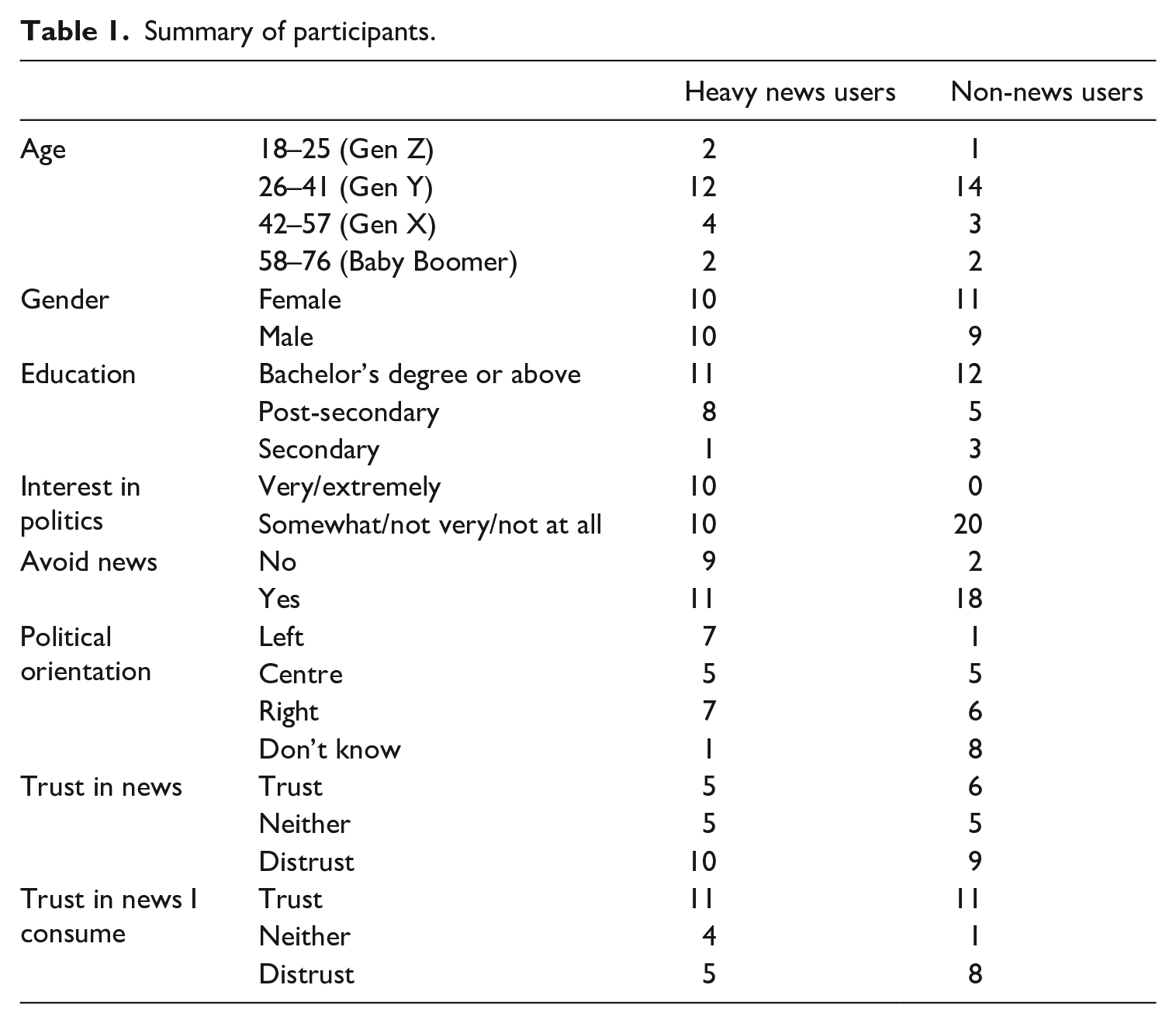
Among heavy news users, half were female and half male. There was a mix of age groups and half reported having an undergraduate or post-graduate university degree. Half of them expressed high interest in politics. However, half of them also avoided news sometimes. Their trust in the news was very diverse. Only 5 said they trust news in general, 5 neither trust nor distrust news, and 10 said they distrust news. When it comes to news that they choose to consume, 11 say they trust, 4 neither trust nor distrust, and 5 distrust the news they consume.
Among the non-user group, 11 participants were female and 9 male. There was a mix of age groups. Importantly, not all non-news consumers have low levels of formal education and are disengaged from society. Just over half had an undergraduate or post-graduate university degree (12), 5 had a post-secondary qualification, and 5 completed year 10 or 12 of high school. However, none of them said they have a high interest in politics, and the majority (18) avoid news. Almost half (eight) reported that they don’t know their political orientation, reflecting their lack of interest in politics. The difference from heavy news users was mainly that non-users were much more likely to distrust news that they chose to consume (eight).
While this is by no means representative of Australian audiences, the goal was to deepen our understanding of the diversity in audiences’ responses to news in the digital environment, particularly from people who identify as non-consumers of mainstream news.
Results
The interviews reveal a complex relationship between audiences’ trust in news and news consumption. Audiences responded to untrustworthy news with cynicism or scepticism. Those who exert low efforts to deal with dubious information adopted cynicism as a way to cope with untrustworthy information in the news. On the other hand, those who were on the higher end of the effort continuum adopted scepticism, which spurred them on to engage in verification activities. Audiences’ perception of news has shifted, particularly among those who are not frequent consumers of mainstream news. Their cynicism and disengagement with mainstream news media did not necessarily mean they were disengaged with news altogether. Rather, they relied on non-traditional alternative sources of information.
Among heavy news users, there were three distinct ways of responding to untrustworthy news: pragmatic scepticism, selective trust and generalised cynicism. Among the non-news users, two types of news attitudes emerged: critically conscious and cynically disengaged. We mapped these five different types of responses to mainstream news across two axes: level of news consumption and the amount of effort to verify dubious information. While the causal relationship between trust, efforts of verification and news consumption is beyond the scope of this study, we were able to identify a pattern of cynicism and scepticism across these different types of user responses (see Figure 1). However, we emphasise that these typologies do not encompass all of the different types of responses among audiences, and that these are not mutually exclusive categories; news consumers may have one or more of these attitudes. In the diagram, we listed each interviewee under one category as an example and noted that an individual can belong to more than one category.
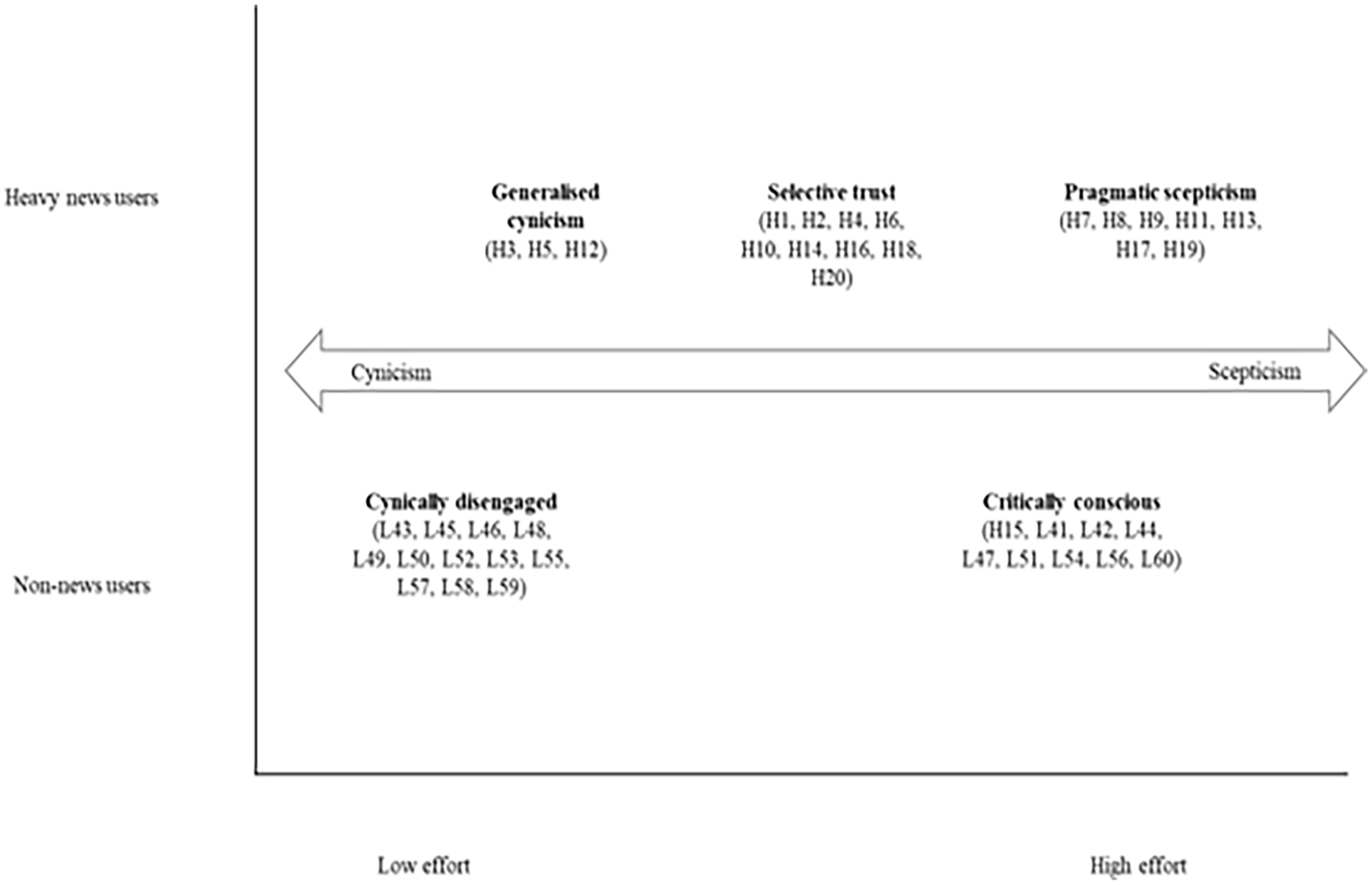
Responses to mainstream news by a continuum of efforts.
Pragmatic scepticism
Pragmatic scepticism occurs when audiences defer judgement of news until they verify it. For example, when H19 (M, Gen Z) sees something, he does not ‘trust it straightaway’. H11 (F, Gen Y) does not trust the news in general or the news she chooses to consume. She has high confidence in her news literacy, and says she looks for journalistic style and the seriousness of the reporting to distinguish news from misinformation. She is not too worried about the digital environment because she believes that by being vigilant through fact-checking, she is confident she can discern trustworthy news. H7 (M, baby boomer) does not trust mainstream news brands or anything ‘opinion based’. He checks multiple sources and then makes up his own mind about an issue: ‘. . . do your own research and make an informed decision yourself’.
Exercising pragmatic scepticism is knowing how to check the source of information if the news article seems dubious, especially if the information is new. Those who adopt this strategy know which sources are more reputable, such as trusted news brands, and often compare doubtful information with these trusted sources. In effect, exposure to dubious information online results in additional news and information consumption, which is in part what leads them to be heavy news consumers.
Pragmatic scepticism means accessing and checking multiple sources. Rather than blindly distrusting or undermining the information, audiences develop a healthy scepticism, and create a habit of confirming the veracity of information before making a judgement. For example, H2 (M, Gen X) always checks other news sources and H4 (M, Gen Y) ‘double cross-checks’ news, while H7 (M, baby boomer) would ‘certainly go elsewhere to find out if it was fact or not’ and H9 (F, Gen Y) will ‘have a look and see if there’s another article about it and sort of see if they’re different, it sort of gets me thinking like, oh, maybe this isn’t true’. Rather than staying within the news source, they tend to seek external sources to ascertain their veracity.
Selective trust
This group is typically made up of heavy news consumers who rely on a few trusted sources of news and question the veracity of sources outside of their familiar news repertoire. They use trusted brands that are ‘reputable’ (H4) or ‘like a proper site’ (H18), as important trust heuristics – a short cut – to determine the veracity of information. They have a predetermined repertoire of news brands or cues that lead them to trust the information. They rely heavily on authoritative sources such as official channels and specialist bodies, as well as their personal networks. For example, H1 (F, baby boomer) thinks only factual straight news is trustworthy. She only trusts news from the public broadcaster, ABC, and actively distrusts all other sources of news. H20 (M, Gen Y) does not trust news generally and relies on certain brands that seem neutral for trustworthy news, while H2 (M, Gen X) looks for trust cues such as representation of diverse groups. Familiarity with news presenters is also an important trust cue: H6 (M, Gen X) trusts TV news but not newspapers, saying newspapers are repetitive and recycled across multiple mastheads, and many of them are owned by Rupert Murdoch.
When opting to selective trust, audiences are more likely to exercise caution on certain topics, especially politics. This attitude towards news is similar to what Schwarzenegger (2020) describes as ‘selective criticality’ (p. 370). In her study, she found that these audiences have a personal news repertoire that differentiates between trusted and dubious sources of news and that they apply a critical lens only to the latter. They differentiate news topics that are easier to verify and are therefore inclined to trust. This was evident in comments from H10 (M, Gen X), who said ‘there are certain news stories, which there’s really no way you can spin them any other way . . . they’re just facts as facts’. Participants in this group believe certain news topics are more commercially or politically driven, and once they question the motivations of the news organisations, they exercise caution in trusting the news. For example:
It depends on the topic more than anything . . . because there’s some things like, for example . . . the floods up at the river Murray at the moment, like, you can’t lie about it. It’s happening. Like if you go up there yourself, you can see it. But things like Covid, then it’s a little bit different because it’s, yeah, I don’t know. It’s just like the vaccines and all that can be a little bit different. (H10, M, Gen X)
Instead of having a broad range of news sources, those who are selectively trusting tend to ‘just go towards the sources that I trust rather than go wide’ (H11, F, Gen Y). This group tends to lack trust in the news generally and have low trust in the overall content of digital platforms, but is actively consuming news, mainly from sources that they trust.
Generalised cynicism
Participants who adopt generalised cynicism are similar to pragmatic sceptics in that they defer their trust judgement. However, rather than engage in fact-checking and verification, they tend to develop cynicism towards the overall news environment. For example, H12 (F, Gen Y) has overall low trust in news because she believes the news media don’t fact-check and are commercially driven to post things quickly. She is also suspicious of clickbait-type headlines. However, she does not necessarily try to verify the information herself either:
I use the Nine News app because it’s easy, it’s on my phone. Everything sort of gets on there first, but I don’t particularly trust that they have 100% the most accurate information because they’re just the ones that quickly post and don’t really follow up with how truthful it is. (H12, F, Gen Y)
This group is suspicious of the motivation of news organisations that have a ‘narrative that’s being pushed in the mainstream media’ (H3, M, Gen Y), and ‘lead you to feel a certain way’ (H5, F, Gen Y). These attitudes also apply to digital platforms, with H10 (M, Gen X) saying ‘Facebook is becoming a very strong news channel . . . it’s also, pushing a particular agenda’. Despite these strong feelings of distrust and suspicion towards the mainstream news, they continue to regularly consume news and most of them are heavy news users.
Critically conscious
This group mainly consists of non-news users. They are well-educated individuals, several with postgraduate degrees, who decisively and critically choose to opt out of consuming mainstream news media. This is largely due to its negativity and detrimental impact on the mental health of themselves and/or their children. However, they actively seek information about issues important to them from alternative quality sources when needed, such as official or specialist websites and publications. For example, L56 (F, Gen X) is a school teacher who describes herself as ‘critically literate’ and teaches critically literacy in primary school. She says she does not trust the mainstream news media and turned away from it when she had children because, ‘I don’t want my 9,10 year-old kids to be hearing about wars, all the negative things you know’. She is sceptical about what she hears and actively searches for independent information ‘rather than be fed’. Similarly, L42 (M, Gen Y) has a Master’s degree and teaches science. He says he finds the news too negative and repetitive so, instead, he researches topics independently from official websites and online publications because ‘I want to read for myself, unfiltered’.
The negativity of news featured strongly in this group of news users. L60 (F, Gen Y) is a young lawyer who used to pride herself on being a heavy news user. Over time the negativity became overwhelming, and she decided to change her life by removing the news: ‘It’s absolutely been a conscious choice for me to make that switch’. If she needs to find out information, she now looks to non-news sources or asks a friend. For L54 (F, Gen Y), the negativity of the mainstream news was too much for her on top of her often emotionally taxing job as a domestic violence worker. Like the other critically conscious non-news consumers, she actively seeks the information she needs rather than relying on the news: ‘Sometimes my family calls me a little private investigator because I will do research into something before I put my opinion into it’.
Universally, these critically conscious participants say they feel happier without the negative thrum of mainstream news in their lives, something they share in common with Woodstock’s (2014) ‘news resisters’. However, unlike ‘news resisters’, they are not politically or civically active. Instead of accessing mainstream news, they seek and research information about specific topics from alternative credible information sources, reflecting the shift in news and journalism (Edgerly and Vraga, 2020; Maares and Hanusch, 2023).
In this aspect, their behaviour is similar to those engaged in pragmatic scepticism as they are both making high efforts to discern trustworthy information. However, the difference is that critically conscious non-news consumers have chosen to disengage from mainstream news altogether and go to alternative sources instead.
Cynically disengaged
Finally, the cynically disengaged group is typically made up of non-news users who have developed a deep cynicism towards the mainstream news media and have turned away from it. They believe the news is driven by commercial, political, and personal agendas and that it is controlled by government and media owners who manipulate what we read and see. As a result, they disengage from the mainstream news altogether.
L45 (M, baby boomer) says he was a heavy news consumer until the COVID-19 pandemic and the 2020 US presidential election. He says the truth was missing from the reporting of COVID-19 and thinks that news is contradictory and decided by faceless algorithms: ‘So why should I trust it? Why should I trust anything just because somebody else tells me to? They’ve got to prove their trust in the first place’. COVID-19 was the tipping point for L57 (M, Gen X) as well; in addition to feeling overwhelmed, he thinks the mainstream news media are ‘all controlled by the same bureaucrats . . . It’s like they want to control our thought pattern’. He is particularly cynical about political journalists who he believes have a ‘hidden agenda’ and ‘pull the wool over our eyes’.
The cynically disengaged group also included individuals who rejected mainstream news because it tends to mis- or under-represent their interests (Arguedas et al., 2023). They feel mainstream news coverage is largely one-sided, and that it does not include perspectives or issues that are most important to them. For example, L53 (M, Gen Y) says the mainstream news offers nothing he wants: ‘What do I need to know? . . . I just have very little interest . . . unless it impacts directly on loved ones’. If something does happen, he will hear about it from his wife.
In contrast to the critically conscious non-news users, participants in this group are less active in seeking alternative information from non-news sources and tend to rely mainly on family, friends or community members to find out what is going on. Several participants who said they felt underrepresented were only interested in hyperlocal news about their community. Examples include L59 (F, baby boomer), who uses specialist apps to get the information she needs about petrol prices or local bushfires. During widespread flooding across the eastern coast of Australia in late 2022, she says her town did not receive any attention when it was impacted, so she relied on posts from residents on Facebook as a source of information. L58 (F, Gen Y) is not sure what is true or false in the news because she says it only shows one side of the story and twists things. She finds the mainstream news too negative and not local enough. Instead, she enjoys looking at the local Facebook community page when something happens. The immediacy of eyewitness accounts led her to trust citizen journalism more than mainstream news because ‘news reporters, they have to actually come in from . . . wherever they are from the news centre . . . So, it’s probably harder for them, when they have to come in, when you’ve got actual bystanders . . . right there at the right time’.
Similarly, L43 (F, Gen Y) gets local information she wants from Facebook community pages, which she trusts more than the mainstream news. She says the comments from other local community members are informative because they offer more context and different perspectives, particularly in relation to COVID-19 and vaccinations:
The news kind of told me, to go and have your vaccination. That’s it. There’s no ifs or buts about it. You have to get it . . . Then later on, people went and developed side effects, which kind of now looking back, it does kind of make sense that people were going against it where the news only kind of told me one side of the story.
For other information, L43 relies on her personal network, like her mother who told her about the rising interest rates over coffee. Unlike critically conscious non-news consumption, which tends to be associated with active alternative information seeking, those who disengage due to under-representation show a sense of apathy about the news media and high reliance on people they know – or the two-step flow (Katz, 1957) – as a source of news.
In this sense, we categorised this group as ‘low effort’ because they disengage with mainstream news altogether rather than trying to make sense of it. Those who acquire a cynically disengaged attitude are similar to heavy news users who have developed a generalised cynicism. The main difference is that those with generalised cynicism still choose to consume mainstream news, whereas those who are cynically disengaged reject and avoid mainstream news media.
Discussion
Trust is generally seen as a prerequisite for public connection (Uslaner, 2004). Only when people believe the news, will they engage with it and act upon it. However, in reality, the relationship between trust and news consumption is not so straightforward. There are mixed findings about the link between news use and media trust (Strömbäck et al., 2020; Tsfati and Cappella, 2003). This may be explained by the different responses that audiences adopt when they encounter news that seems untrustworthy. Through qualitative interviews, this study explored the diverse range of responses to mainstream news and their possible outcomes. We distinguish ‘mistrust’ from ‘distrust’ to reflect these divergent responses. Mistrust refers to a sceptical attitude audiences adopt when encountered with untrustworthy news, whereas distrust is a lack of trust that can lead to cynicism. It should be noted that these expressions of cynicism and scepticism are not neatly distinct or mutually exclusive, with some participants articulating attitudes across the typology.
The first research question addressed how audiences are responding to the volume of news that is seemingly untrustworthy. Overall, participants in our study reported having low trust in the news; more than half said they did not trust the news. This is somewhat lower than has been found in national surveys (Park et al., 2023; Park et al., 2022b). A lack of trust is usually assumed to have a negative impact on democracy, but some scholars have also noted the positive consequences. For example, Luhmann (1979) explicitly recognised the importance of low trust in social interactions as it keeps people alert and capable of innovations without naively and blindly relying on one another. We propose that mistrust can also be important and useful in a democratic society in which citizens exercise wariness, watchfulness and anticipation of injurious actions by institutions and organisations.
In our study, participants responded to untrustworthy news in different ways based on the amount of effort they were willing to exert. Some participants responded with a cynical attitude, which is a disposition to disbelieve others, or they can ask questions and check the veracity by applying scepticism (Cappella and Jamieson, 1997). A low-effort response entailed a cynical attitude and disengagement from the news. On the other hand, those who put in a lot of effort to verify the news adopted scepticism. Having high mistrust resulted in further engagement with news through verification and fact-checking. This may explain why the relationship between trust and news consumption is not straightforward.
To explore how mistrust can result in positive consequences, the second research question asked about the relationship between news consumption, trust and mistrust among heavy versus non-news consumers. We note that the level of trust in news was not that different between heavy and non-news participants. However, participants ranged in their responses to the mainstream news environment, with some adopting a high-effort strategy to cope with the volume of dubious information, and some adopting a low-effort strategy and choosing to disengage with mainstream news. Those who are willing to invest more effort in verifying the information are those who have developed mistrust in the news, thereby deferring their judgement and applying caution, which results in the positive consequence of seeking out more news and information.
Audiences’ lack of trust in news, particularly among non-news users, was derived from their perception that the mainstream news media were not fulfilling their needs and interests. This led them to turn away from mainstream news media. Previous studies have differentiated these different responses to untrustworthy information. Those who are driven by identity-motivated scepticism tend to turn away from the information they see as biased, whereas those who are motivated by the accuracy of information investigate further by verifying and fact-checking (Li, 2023). Our findings also align with Toff and Nielsen’s (2022) study that highlights links between mis- and under-representation, low levels of trust and news avoidance. Similarly, in a political context, Devine et al. (2020) found that those with high trust in news tend to be loyal and committed, resulting in participatory behaviour, compared to those who have low trust in news, and who may develop insecurity and fear that can lead to withdrawal.
This is why those who have low trust in mainstream news and take a low-effort approach are those who disengage with news. We found that many non-news users fall into this category. They have developed a cynicism towards the mainstream news media and make judgements based on their identity rather than on the specific news story. On the other hand, there are also people – mainly heavy news users – who develop a critical scepticism towards mainstream news and instead of turning away from untrustworthy news, continuously evaluate the information they consume. Rather than assuming that all mainstream news is untrustworthy, they exercise higher efforts to verify the information and engage further with the news. However, to audiences, news is not a fixed concept with many dimensions (Robertson, 2023). As such, participants often adopted more than one strategy in dealing with untrustworthy news. It can also differ by topic or the context of the story.
Nevertheless, the consequences of low- and high-effort responses may have different democratic outcomes for society. A sceptic may seek mainstream news sources and find responsible journalism more trustworthy as they verify the information. On the other hand, a cynic may continue engaging with news and find untrustworthy news and reinforce their cynicism.
This may potentially create an upwards or downwards spiral where those who have high mistrust continue with their verification activities, encounter trustworthy and validating news, and increase their engagement. Those with low trust in news may encounter low quality news, which validates their cynicism, leading them to disengage from news even more, leaving them with their negative experiences of untrustworthy news.
Scholars emphasise the importance of understanding news from the audiences’ perspective and that it often misaligns with traditional norms of journalistic news in their daily practices (Edgerly and Vraga, 2020; Swart and Broersma, 2023). Our study found this to be the case, particularly among non-users of mainstream news. Being a non-news consumer of mainstream news did not mean that they were news avoiders. Sometimes it meant they were engaging in different sources of news from non-mainstream media and alternative information sources.
Conclusion
This study contributes to a more nuanced understanding of a growing scepticism in news, which appears to be a natural consequence of an increasingly pluralistic media environment (Schudson, 2019). Perhaps reassuringly for the news industry, we found scepticism and mistrust of the mainstream news are strongly associated with heavy news use and can lead to higher engagement rather than rejection and avoidance. For non-news consumers, this can lead to further engagement with non-mainstream, alternative news sources.
Importantly, we also found that not all non-news users are alike: some are diligent information seekers, and some are dejected and apathetic, while others are cynical mainstream news rejectors. They can also move across categories. Our study found that non-news users are not all disengaged with social and political issues, nor are they necessarily limited information consumers. Instead, they can have their own repertoire of trusted sources of information, including their online and offline personal networks. However, to date, we have very little knowledge about the range and quality of these non-news sources of information that these groups rely on. From studies on information disorder, we can infer that these groups are more vulnerable to misinformation (Li, 2023), which can have a negative impact on the overall health of democracy in a country. However, further investigation is needed to fully understand this understudied 7% segment of the Australian adult population (Park et al., 2023).
Naturally, this study has limitations. We cannot generalise the results to a broader population, as we conducted a small sample qualitative study. Nevertheless, several of the findings do mirror previous studies, which underscore the validity of the data and analysis. The data was also collected at the end of 2022, when the COVID-19 pandemic still had an impact on how people perceive and consume news and information, which would have influenced the participants’ responses.
Additional research into whether positive consequences result from engagement with two-step news flows over mainstream news media, such as higher community engagement or sense of connectedness, particularly among non-news users, would be a valuable extension of this study. The interviews also revealed a link between participants’ political orientation and their perceptions of news and news trust. Those with strong political identities tend to adopt high-effort strategies, and those who say they don’t know their political orientation are exercising low efforts. Further research is needed to explain this relationship.
Despite these limitations, this article found a continuum of responses based on efforts taken to verify dubious news and information. While there has been much concern about falling levels of trust in news, these findings suggest that mistrust in mainstream news is not necessarily a bad thing. While, on the one hand, it can drive a low-effort response of disengagement, particularly among non-news consumers, on the other it can lead to high-effort responses of greater critical involvement with news and information.
Footnotes
Compliance with ethical standard statement
The present study was approved by the Human Ethics Committee at the University of Canberra (9186).
Funding
The author(s) disclosed receipt of the following financial support for the research, authorship, and/or publication of this article: The research is funded by the Australian Research Council Discovery Project (DP210100157) ‘The rise of mistrust: Digital platforms and trust in news media’ (2021–24).
Author biographies
 .
.