




Abstract
This theoretical and empirical investigation builds upon the concept of ‘slantwise behavior’ to further complicate notions of the ‘digital disengagement’ of subjects within technological infrastructures such as Facebook. It has been previously suggested that the ubiquity of the data privacy paradox is the most common reason for disengagement practices. Our study contributes to this discussion by examining subjects’ disengagement on Social Network Sites (SNS). While numerous concepts concerning disconnection and disengagement from SNS have been conceptualized by media theorists, largely based on a binary construct of resistance or domination, our work proposes an alternative conceptualization of subjects’ disengagement. By employing a qualitative methodological approach and using 30 semi-structured interviews to capture subjects’ discursive patterns, we illustrate that disengagement on Facebook can be seen as a hybrid reaction and a complex phenomenon in which certain disconnection practices cannot be easily classified as resistance practices or as indications of the internalization of domination but rather are best understood as slantwise behaviors, that is, actions that may unintentionally lead to obfuscation.
Keywords
Introduction
In 2018, news circulated about Cambridge Analytica’s unauthorized use of Facebook data to target political advertising toward users during the 2016 US Presidential election and the Brexit campaign (Cadwalladr and Graham-Harrison, 2018). Facebook failed to ensure the privacy of user data, and the event revealed the limitations of the social network’s ability to protect its users from data collection by third-party apps (Tufekci, 2018). The term ‘privacy policies’ emerged in the 1990s (Turow et al., 2018) and referred to the data use notices associated with several websites. While activists have called upon users to quit using Facebook, a large number have decided to maintain their profiles despite their growing privacy concerns. This is known as the ‘privacy paradox’ in which users, although suspicious about their information privacy, react in ways that contradict this suspicion (Kokolakis, 2017). This is an example of a behavior that is ‘disconnected or oblivious’ to power relationships’ construction or assumptions (Campbell and Heyman, 2007), and therefore, it calls for further investigation and should not be reduced to a mere ‘paradox’.
Several recent media studies (Casemajor et al., 2015; Hesselberth, 2018) within the disconnectivity paradigm have emerged to explain individuals’ disengagement within SNS. Scholars have long studied diverse phenomena of disengagement with digital communication as either forms of overt or covert resistance or as indications of internalization of domination (Foucault, 1977). In their investigations, these scholars have used a variety of analytical tools that have often been based on binaries: disconnection/connection, refusal/acceptance, leaving/staying, use/non-use, passive non-participation/active non-participation, and more. Within such conceptualizations, ‘digital disconnectivity or disengagement’ is rarely considered an ‘aberration, whether temporal, demographic or ideological’ (Kuntsman and Miyake, 2019: 902). Conceiving of general acts of non-participation (e.g., not engaging in posting, commenting, sharing, etc.) by individuals as a form of resistance against the growing power of digitization, we propose to consider them beyond the domination and resistance paradigm and emphasize power and agency 1 (Brown, 1996; Crehan, 2002). As Campbell and Heyman (2007: 2) eloquently noted when referring to anthropological work on resistance, ‘[t]he analytical framework in most of this literature falls along an axis with two endpoints, resistance and naturalized or internalized domination. It is not that these works fit neatly into one or the other of the two endpoints, but rather that complexity and contradiction are still conceived of through a combination or interaction of the two extremes’.
We argue that Campbell and Heyman’s point holds true in this case as well. On the one hand, proponents of the ‘data cynicism’ argument look at disengagement as a ‘cognitive coping mechanism for users, allowing them to overcome or ignore privacy concerns and engage in online transactions’ (Hoffmann et al., 2016, n/a), a form of internalization of domination. On the other hand, proponents of ‘active non-participation’, look at it as a form of resistance, either overt or covert. This axis, while meaningful, fails to capture an important set of phenomena in which ‘action makes little or no sense in terms of naturalized meanings and practices within the society and seems contrary even disruptive to socially dominant groups’ (Campbell and Heyman, 2007: 1). In this article, as a conceptual entry into rethinking agency, disengagement acts, and discourses, we will foreground the range of disengagement practices and discourses, identify what we, in the footsteps of Campbell and Heyman (2007), label as the ‘slantwise behavior’ currently unfolding. We consider certain practices of individuals’ disengagement as not always intentionally resistant or ideological but as dispersed acts that may disrupt dominant norms and power without aiming to bring about systematic change (Campbell and Heyman, 2007: 2), a kind of counter-conduct in the realm of everyday practice (Demetriou, 2016).
Emerging vocabularies around the ‘non-use of technology’: From domination to resistance
Since the mid-1990s, within the field of new media studies, empirical and theoretical studies have sprung up that tackle the role of digitally mediated networks by focusing on the challenges and problems of connectivity (Castells, 1996; Mayer-Schonberger, 2011). A variety of conceptualizations were developed, including networked individualism (Wellman, 2001), networked sociality (Wittel, 2001), networked collectivism (Baym, 2007), and networked publics (Boyd, 2008). Connectivity 2 is one of the most foregrounded areas of interest within media scholarship, whereas disconnectivity tackles ‘the discomfort with, and disengagement from, technologically mediated forms of connectivity’ (Hesselberth, 2018: 1999), which is discursively framed in individuals’ discourses and acts within SNS. Two dominant discourses emerged within the scholarship of disconnectivity: The first revolved around the non-use of technology and focused on individual users and human agency (Selwyn, 2006). The second discourse conceptualized non-use as a form of empowerment, resistance, and/or agency (Casemajor et al., 2015; Portwood-Stacer, 2013).
The first strand of research conceptualizes digital disengagement through the lens of individual users (Hesselberth, 2018: 1996). Using both qualitative and quantitative methodologies, studies within this research paradigm have considered ‘the non-use of technology as deviation from the norm; a deficit to be overcome, a problem to be solved’ (Hesselberth, 2018: 1997) or as a ‘possibility to act otherwise’ (Selwyn, 2003: 12). As a result, to explain non-users, several classifications and taxonomies emerged such as ‘resisters’, ‘rejecters’, ‘excluded and expelled’, ‘forced’, ‘reluctant’, ‘partial’, and ‘selective’ (Wyatt et al., 2005); ‘active’, ‘lapsed’, and ‘rare and non-users’ (Selwyn, 2006); and ‘lagging resistance’ (Baumer et al., 2013). Such classifications entangle digital disengagement in a temporal perspective bound to a specific time and context of non-use that is attached to the concerns and purposes of the moment (e.g., privacy concerns).
Similarly, works that consider the non-use of technology to be part of individual purposes or concerns are gaining popularity among scholars. Resignation or ‘acts of resignation’ (Draper and Turow, 2019) refer to the non-use of technology as a form of inaction or withdrawal that encompasses limited or inconsistent actions that individuals undertake in response to their frustrations or feelings of futility with digitalization (Hoffmann et al., 2016; Marwick and Hargittai, 2018). Portwood-Stacer (2013) defined such feelings as a sort of ‘performative media refusal’, whereas Hoffmann et al., (2016) and Lutz et al. (2020) defined them as an adoption of a cynical stance – what they have called ‘data privacy cynicism’ – namely, a coping mechanism. Hargittai and Marwick (2016) explained frustration among social media users in terms of their inability to negotiate between their desire to manage their privacy settings and their feeling that these efforts will inevitably fail. While subjects try to control their online actions, feelings of resignation arise from a perception that privacy bridges cannot be bypassed (Hargittai and Marwick, 2016: 11). Most conceptualizations produced by these studies have explained feelings of futility as coping strategies or attitudes implemented by users to cope with the cognitive dissonance caused by temporal threats from or concerns about digital connectivity. These authors conceive of digital disengagement as a form of ‘[i]naction in the face of risk, [which] thereby, becomes a rationally as well as affectively defensible choice’ (Lutz et al., 2020: 4). One of the major limitations of this strand of scholarship is that it ‘feeds into the paradigm of datafication from which whoever disconnects arguably seeks to withdraw’ (Hesselberth, 2018: 1957).
The second strand of research examines digital disengagement through a critical lens, theorizing it as a form of empowerment or resistance and often conceptualizing it as a mediated political action vis-à-vis data mechanisms. Scholars in this tradition emphasize the individual uses, discourses, and practices involving non-use (Casemajor et al., 2015; Morrison and Gomez, 2014). Casemajor et al. (2015) distinguished between passive (non-use of technology due to imposed contextual reasons) and active non-participation, which they understand as ‘politically willful engagement in a platform in order to disrupt it’ (Casemajor et al., 2015: 856, our emphasis) by refusing to provide platforms with personal data or by using platforms against their original aims. They understood ‘[d]igital active non-participation as a form of political action rather than as mere passivity’ (Casemajor et al., 2015: 851, our emphasis). While the development and business models of SNS are based on the active participation of users through extensive content production and interaction and a positive view of mediated participation (Coleman and Blumler, 2009), various practices and actions challenge these business models by attempting to disrupt them (Marwick, 2012).
Casemajor et al. (2015) categorize these practices into three major operational strategies: Obfuscation, which refers to the production of actions that aim to produce misinformation in order to become ‘invisible’ within social media platforms while flirting with passive participation, sabotage, which disrupts the logics of platforms either by confusing their technological infrastructure or by subverting their linguistic and communicative system, and finally, exodus, which represents a withdrawal from platforms that rely on dispositive of passive participation, and it can be the basis upon which better active participation practices are built.
As we will demonstrate later in this article, both strands of scholarship have been criticized because they either ‘lean stronger toward foregrounding the role of individual agency in the use or non-use of technology’ (Hesselberth 2018: 2003), or they ‘romanticize’ and overemphasize the resistance aspect by frequently engaging in ‘a paint-by-numbers analysis of channeling that leads inexorably to the conclusion that it offers a “site of resistance”’ (Brown, 1996: 732) for the subjects that are disconnected to one degree or another and for various reasons. Our conceptualization takes this critique by Hesselberth (2018) as its starting point and expands existing typologies of disengagement by contributing the notion of slantwise disengagement.
Toward a new conceptualization of disconnectivity: Slantwise disengagement
As mentioned above, according to Casemajor et al. (2015), ‘obfuscation’ refers to the production of actions that aim to produce misinformation in order to become ‘invisible’ within social media platforms while ‘flirting’ with ‘passive participation’. Casemajor et al.’s (2015: 856) definition of active non-participation as ‘politically willful engagement in a platform in order to disrupt it’ seems insufficient for our research. As we will illustrate later in this article, many of our interviewees did not engage in any form of slantwise disengagement in order to disrupt Facebook, nor they see their (dis)engagement as politically willful; instead, they often take actions that they feel would protect their personal data more effectively, not against Facebook per se, but often against employers, the government, and other social and political actors.
While previous findings point out that privacy cynicism/apathy/fatigue emerge from institutional privacy threats (data capitalism etc.), we are aware that in many circumstances, users are more concerned about social privacy threats (Raynes-Goldie, 2010; Young and Quan-Haase, 2013). For example, Raynes-Goldie, (2010) argues that SNS users are more concerned about controlling who has access to their personal information rather than how companies and third parties will use their information. This demonstrates that users are more concerned about their social privacy rather than their institutional privacy. In the same vein, Young and Quan-Hasse (2013) findings demonstrate that users are more concerned about controlling access to their data than about institutions use or misuse their personal information. These users are often taking measures to mitigate their privacy concerns (ibid). These findings, recall for a more nuanced approach in understanding privacy along with slantwise disengagement. Particularly, it is significant when evoking forms of disengagement to integrate them from insights from the research on privacy threats which might explain slantwise disengagement in users’ perspectives (Lutz and Hoffmann, 2017). In our case, regardless of whether these slantwise disengagement actions are successful in protecting privacy, they seem to be defined as obfuscations.
As outlined in the previous section, considerable scholarly work has addressed power through the binary concepts of domination and resistance, situating itself within disconnectivity paradigm. While this approach is valid in many cases, it needs to be further refined as it is increasingly showing its limitations. In some empirical studies, it seems that scholars have tried ‘heavy-handedly to label diverse phenomena as either resistance or domination’ (Campbell and Heyman, 2007: 3). To this extent, slantwise ‘is a significant contribution because the resistance/naturalization axis has resulted in widespread distortion’ of research data, ‘notably by analysts forcing accidental defiance, avoidance, and similar phenomena into resistance, a category best reserved for actions and meanings that actors themselves understand to be defiant’ (Campbell and Heyman 2007: 2). The frequent references to active non-participation – as well as the concept of helplessness and cynicism on the other extreme of the binary – is indicative of this effort. These approaches seem to ignore important phenomena ‘in which action makes little or no sense in terms of the naturalized meanings and practices’ (Campbell and Heyman, 2007: 3) within SNS. By moving beyond this and other binaries – all related to the resistance/internalization of domination dichotomy – we can more effectively study diverse phenomena that do not fall naturally on this axis.
Situating our theoretical efforts within Scott’s (1989) conceptualization in which forms of ‘everyday resistance’ are visible in small acts of resistance that might be significant despite their lack of revolutionary potential, we move one step forward to include Campbell and Heyman’s (2007) notion of slantwise action. As the authors note, as perceptive as Scott’s argument is, it frays at some places. He acknowledges that to use the word resistance requires some degree of intentionality. This is in line with Casemajor et al.’s (2015) conceptualization of active non-participation, where intentionality also appears crucial. Campbell and Heyman (2007: 4) describe instances wherein ‘people frustrate the normal play of a given power relation by acting in ways that make sense in their own frameworks but are disconnected or oblivious to that power relationship’s construction or assumptions’. A recent empirical investigation that applied the slantwise concept to geo-surveillance is enlightening with respect to how this concept can fuel productive conversations about the use or non-use of technology. Swanlund and Schuurman (2019: 600) have demonstrated how the use of VPNs can ‘be an example of slantwise action. While they [users] may have no explicit motive to challenge the powers that conduct geo-surveillance, their actions nevertheless can frustrate them’. They go on to conclude that ‘this type of action is valuable’, and ‘encourage others examining resistance not to ignore it’ (Swanlund and Schuurman, 2019: 600). Responding to this call, we apply the idea of slantwise action to Facebook users’ attitudes toward the data privacy paradox and enrich the ongoing debate surrounding the phenomenon.
This bring to the fore the concept we propose, namely, slantwise disengagement which is defined as a form of disengagement that is not intended as resistance by the subjects who employ it nor is it perceived as such by other actors, yet it may, when employed en masse, disrupt or obfuscate Facebook’s mechanisms by depriving the platform of users’ personal data. The concept we propose systematizes practices of disengagement by contextualizing them in the ecology of social media. ‘Slantwise’ describes actions in which individuals unintentionally and explicitly challenge power structures (in this case, SNS) but nevertheless challenge them as an unintentional consequence of their actions. Swanlund and Schuurman (2019) study point that users employing VPN frequently unintentionally frustrate surveillance attempts – they do not intend to obstruct; they may not even be aware that their behavior exerts an obstructive influence. These users’ acts do not intend to obstruct, they may not even be aware that their behavior exerts an obstructive influence. An example from Campbell and Heyman’s work is the reluctance of Mexican immigrants to the US to be included in the population census. They avoid being recorded because they are not sure to understand everyday politics in their now setting (2006: 14). However, even though unintended as resistance, their avoidance obfuscates the state’s ‘bird’s eye view’ of its population.
The second component of the term ‘slantwise disengagement’ is inspired by Kuntsman and Miyake’s (2019: 906) theorization. We consider ‘the range of motivations, practices and experiences and the richness of both popular and academic vocabularies used to describe them – disconnection, withdrawal, opting out, leaving, non-use, non-participation, detox, unplugging, suicide and more – point to what we coin a continuum of digital disengagement’. Kuntsman and Miyake therefore imagine disengagement as a continuum, as opposed to ‘the one-dimensional understanding of digital refusal and its effects’. This theoretical perspective seems more inclusive and encompasses different modalities and degrees of participation and lack thereof. Considering disengagement as a rather multi-dimensional phenomenon located in various points of the spatiotemporal continuum linked with offline and online everyday practices and motivations of users as structured and orchestrated by multiple socio-technological environment (ibid) is more useful.
Therefore, our conceptualization adds to the ‘continuum of digital disengagement’ different types of practices which otherwise might be dismissed linking – sociality and refusal – considered as unintentional slantwise actions. Slantwise disengagement can be seen as a concept open enough which does not ‘misses out’ improvisation methods from users to secure their personal data from various actors. This is not to say that previous studies on disengagement (e.g., Casemajor et al., 2015; Lutz et al., 2020) are not significant. Indeed, we see disengagement and its instances (or materializations) as ‘active’ or ‘passive’ forms of participation rather multi-dimensional, unintentional which might explicitly challenge the power structures of the technological environment in which they take place. These practices might form a new type of subject who is disengaged in a slantwise manner. Our critique of previous research has focused on the fact that it may render certain subjects invisible in its search for acts that fall on the axis between domination and resistance. Slantwise disengagement moves one step forward and beyond this distinction between participation and non-participation to present a more nuanced and multispatiotemporal concept which challenges and enriches previous conceptualizations. Thus, slantwise disengagement presumes agency – and can be seen as a possibility of subjects to opt-out from the digital which otherwise are dismissed by researchers.
Methods
This study presents a qualitative examination of the meanings and discursive attributes identified by Facebook users in Cyprus regarding the data privacy paradox and disconnectivity-related practices. For the purpose of this study, we are interested in identifying firstly slantwise disengagement practices and acts rather than forms and types of active and passive disengagement. The main research question which guided our inquiry is the following: In which types of practices and acts subjects engage and how they discursively negotiate these practices on Facebook.
This research adopts an exploratory design (Neuman, 2014), which aims to uncover ‘a new topic or new aspects of an existing area of concern’ (Zhang and Flynn, 2020: 887). In line with Flynn and McDermott (2016: 88), we seek to discover ‘knowledge about an issue, to gain initial insights or clarifications, and to test whether or not any propositions or hunches’ that we have hold any merit. The ‘hunch’ that led to this research was that to say that the subjects are merely cynical or, in some form or another, resisters, seems to represent only part of the picture. Moreover, we need to note that in exploratory research projects, in many cases, the initial research questions are revised by reference to the data gathered. This project initially planned to study the various forms of cynicism and disengagement, and new forms came up through the responses of our subjects.
We therefore strive to enrich the relevant debate with new analytical tools pertaining to the various movements of subjects on Facebook in response to privacy concerns. Given the limited knowledge available about behaviors by which subjects attempt to exert some control over social media platforms’ collection of their data, we ‘cast a wide net’ (Zhang and Flynn, 2020: 887) and recruited participants through an open call that we published via social media to identify suitable participants. The target participants were SNS users with varying degrees of engagement in social media. As we’ve argued previously disengagement acts are often bounded to a specific time and context of non-use and attached to the concerns and purposes of the moment (e.g., privacy concerns) in which they emerge and their technological environments. Acts which can pose a risk to personal privacy are considered significant to further uncover and discuss slantwise disengagement practices, experiences, motivations, and behaviors bounded to a specific condition or context. In the online questionnaire we covered themes to approach disengagement and privacy concerns indirectly as well as non-participation in social media, for example: How often do you visit Facebook? How much time you spend on Facebook? Are you aware about the privacy protocols of Facebook? Do your privacy concerns lead you to more subversive actions in social media? If yes, please define. Also, five questions concerned the demographic characteristics of the participants.
Along with this we defined a list of criteria about representiveness of the subjects (gender, nationality, age, education) to be aligned with the different forms of digital inequality research which can further affect slantwise disengagement (Robinson et al., 2015) and impact the findings of our study. We choose this method of recruitment since previous research in digital inequality studies has shown that social media sites can be useful for targeting underrepresented populations (Nunan and Knox, 2011). The usage patterns for social media platforms might not line up with access disparities (Robinson et al., 2015). In line with Hewitt-Taylor (2011) noted, a qualitative, exploratory study usually involves a small number of participants.
Demographic composition of the sample.
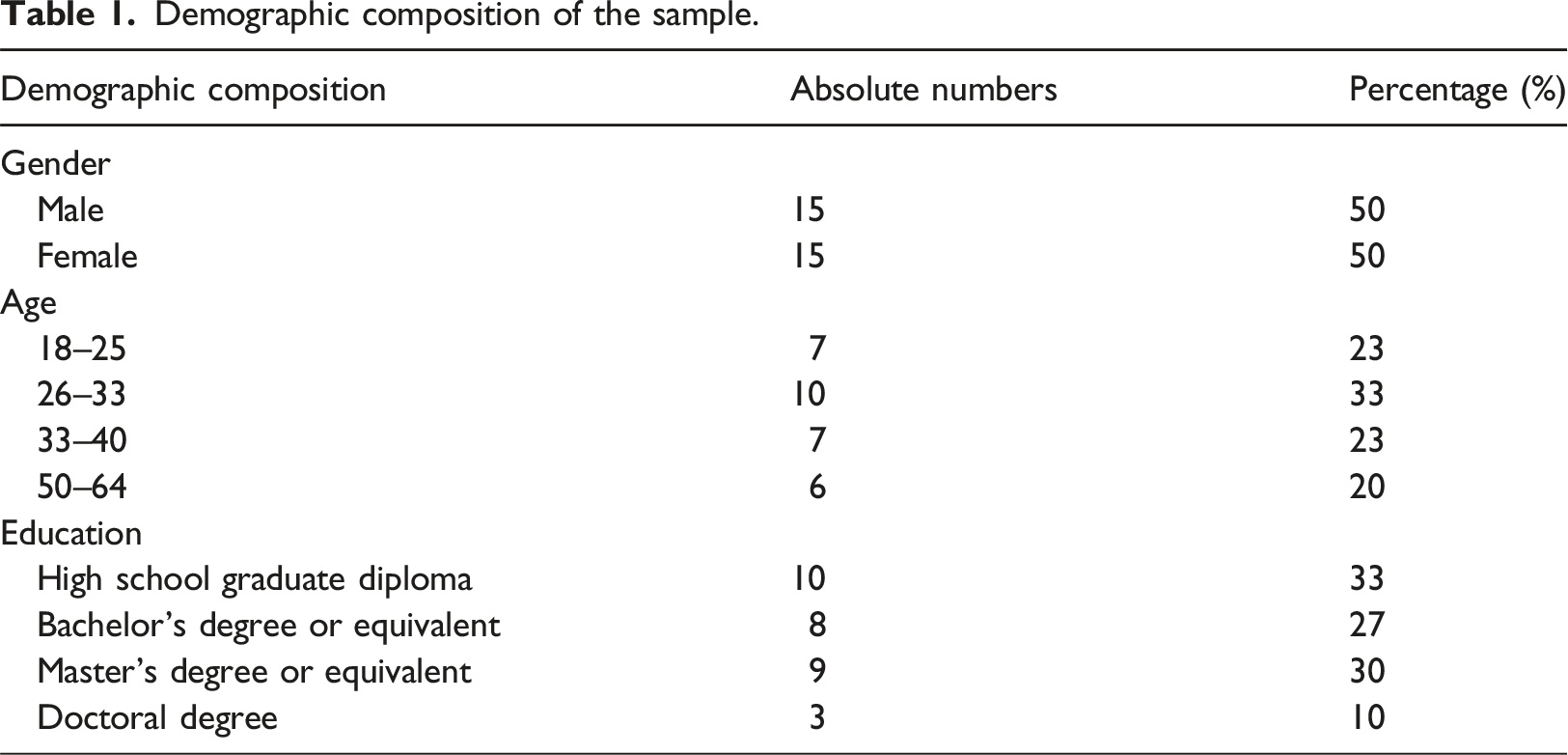
All interviews conducted face-to-face, were recorded, and transcribed with participants’ consent. During the interviews, participants were asked questions related to their experience and understanding of Facebook use, their privacy settings (e.g., aware of the Facebook privacy protocols, the GDPR), their privacy strategies if any, their general concerns for online privacy and privacy on Facebook, and whether they had encountered any negative experiences (in line with Young and Quan-Haase, 2013) related to their Facebook activity.
All respondents were residents of the Republic of Cyprus at the time of the interviews, and the interviews were conducted in person. This allowed researchers to investigate the role of group-specific values. The sample was comprised of 15 women and 15 men. This approach allowed us to collect in-depth data on the participants’ experiences and conduct a comprehensive exploration of what these SNS users perceived as acts aimed at maintaining their privacy. The semi-structured interview questions were based on themes identified in previous research (e.g., Baruh et al., 2017; Lutz et al., 2020; Pangrazio and Selwyn, 2019). The data were collected between November and early December of 2020. This period was chosen because of the application of the General Data Protection Regulation (GDPR) in European countries in 2018. 3 The GDPR was made effective in almost all EU countries at the beginning of 2020, fueling public debates about data collection practices and privacy issues.
The data were analyzed using thematic content analysis, ‘a systematic and flexible method suitable for exploring individual lived experiences’ (Zhang and Flynn, 2020: 888). Themes were identified through repeated readings, and these themes were classified into categories related to the data privacy paradox and users’ control actions on Facebook. During this process, distinct lines of argumentation were identified. Each interview was transcribed, and the transcriptions were coded and categorized. The extracts used in the analysis were selected rigorously based on whether they fulfilled criteria of content, length, variety, structure, clear argumentation, ideas, and meaning.
Findings: Untangling the privacy-related feelings, attitudes, and actions of subjects
In this section, we will present accounts of participants who even though did not have any intent to resist, took actions that resulted in obfuscation – that is, slantwise actions. This is not to say that we did not encounter either cynical or intentionally resistant practices amongst our respondents. We did come across many such practices. However, this article focuses more on its contribution, namely, practices of slantwise disengagement. In such practices, most commonly, subjects’ motives were individualistic, and most of these subjects appeared to feel that hackers, pedophiles, ‘Facebook friends’, employers, or the government are the biggest privacy-threatening actors, rather than the platform itself. More interestingly, some of these participants refrained from posting or interacting, often from purely self-interested motives.
A common approach was to ignore technical features of social media altogether and, instead, focus on encoding the content itself to limit the audience. This can take different forms depending on the visibility of the encoding practices. The emphasis here is on the adoption of a consciously moderate line of action, which was often discursively illustrated by users as a restricted use of their accounts. Most of these subjects stated that they would engage in activities on Facebook only when they concerned strictly work-related matters, and they avoided disclosing any intimate or personal information. Others refrained from even using a profile picture of themselves, let alone posting their daily activities or even expressing agreement with a certain view by liking a comment or post, sharing content, and so forth. Such practices can be conceptualized as ways in which users appropriated an imposed environment (De Certeau, 2014) by utilizing the tools this very environment provided to partly subvert it.
This argument is constructed around subjects’ pervading tendency to individualize responsibility. The subjects emphasized that they avoided what is fundamentally afforded and encouraged by Facebook (Papa and Photiades, 2021): the constant self-generation of personal data in the form of posts, likes, the following of pages, comments, clicking on ads, and other types of activity. Users reported that they incorporated various platform affordances, such as limiting the visibility of their posts to close friends exclusively or, conversely, limiting what is visible to ‘friends’, by means of the ‘hide’ option. Users attempted to establish boundaries through the manipulation of their news feed content to minimize feelings of a lack of control generated by algorithmic processes. This type of manipulation generally took the form of consciously and intentionally ‘unfollowing’ individuals, pages, or groups: I usually go through my stories and posts and unfriend and unfollow complete strangers or block those without a photo on their profile. (Andreas, 25 years old, student)
Such acts can be considered small ephemeral corrective practices or solutions that subjects employ to overcome Facebook’s control over their data. Although these acts were perceived by the interviewees as corrective, they still responded to the internal built-in logic of Facebook’s affordances. Affordances create the possibilities for both action and constraint, but it ultimately rests upon users to either comply or resist and selectively engage (Georgakopoulou, 2007; Gibson, 1977). As Gangneux (2021: 11)) indicated, data activists have identified a number of practices and ‘tactics’ – ‘social appropriation of technological features and the development and reshaping of social expectations attached to them’ – exercised by users that constitute ‘knots’ of resistance that potentially undermine existing power relations.
The interviewees in this category understood that although these acts are small and often inutile, they are necessary to avoid becoming ‘trapped’ or ‘hooked’ (sic) in data collection mechanisms. An interviewee stated: I think it’s feasible to keep a low profile and have less information stored in these mediums. Or if you are so concerned about this and filled with stress, stay away from it altogether…. For me personally, in the past, I had a lot of information online. I recently began minimizing it. (Andreas, 25 years old, student)
In doing so, users sought to alleviate the affective dissonance that emerges from the awareness (albeit often incomplete) of being under surveillance. In this sense, users navigated their way through Facebook by ‘laying low’ – trying to go unnoticed by avoiding sharing and posting information that they consider private. Another interviewee stated that he constantly posts fake photos and does not disclose his real identity: I can continuously post fake photos, and nobody will ever know my real identity… Yes, theoretically, you are trying to fool the system just so you can protect yourself as a user. (Chris, 31 years old, background in computer science)
Some users even labeled their actions as forms of resistance, a rhetorical act that is quite important in this context because even words ‘do things’.
4
‘Fooling the system’ is also an important notion and an interesting use of language. Usually, the word ‘system’ in the context of resistance acts refers to the state, an official, or in De Certeau’s (2014) terms, the ‘proper’. An interviewee reported maneuvering tactically to fool the system (in this case, Facebook) by evading it: Look, on a personal level, I think that the best form of resistance is instead of trying to avoid having your data collected to rather deprive those collecting them of coherence and continuity. So, an example would be to have a joint account on Facebook or for more than one person to be using Google. The fact that it isn’t a single individual using them creates an amalgam which is not necessarily representative. I have found this to be of great benefit. (Takis, 27 years old, Ph.D. student)
This is an example of how subjects practice agency through different tactics. Regardless of whether these tactics have the desired outcome, they are recognized as ways of exercising agency by the interviewees and are, therefore, effective at least on the rhetorical level: The other thing is going incognito – which I also discovered through porn. You’re giving it everything fresh. It cannot build patterns and thus begins anew with a generalized perspective as opposed to a personalized one. (Nick, 30 years old, gardener)
Thus, on Facebook, the antagonism that results from the power imbalance between subjects and Facebook’s affordances may give rise to tactical approaches that are largely centered upon modalities of avoidance and invisibility. ‘Invisibility’ is a much-sought-after quality because it directly confronts the data privacy paradox and the affective dissonance it entails. Because of a generalized institutional mistrust, users feel powerless and resort to what, in most cases, is the only viable option – restriction of their use of Facebook – which ultimately results in obfuscation in Casemajor et al.’s (2015) terms. If ‘tactics mean doing what you can with what you have’ (Alinsky, 1989: 50), then the interviewees in this category move tactically on Facebook. They avoid participating and sharing information, and they even attempt to ‘fool the system’ – to mess with the algorithm and effectively evade providing their personal information in order to obfuscate and/or sabotage Facebook. This tactical maneuvering resonates with Gangneux’s (2021) findings that in their attempt to resist the pervasiveness social media corporations establish, users employ tactics that allow them to actively regain ‘control of their time as well as to negotiate their relationships and the expectations attached to connectivity and being always available’ (Gangneux, 2021: 9).
Neither active nor passive: Slantwise disengagement
This section explores the discursive meanings of what we call slantwise disengagement. As one of our interviewees aptly stated: I think it’s a risk, however, you can handle it appropriately, for example, by not uploading photos of your private, intimate space, such as your garden or home. (Yiota, 32 years old, artist)
This point combines risk awareness and certain mitigation tactics. In the subjects’ discourses, privacy breaches were recognized as a direct risk. Ioanna, a 26-year-old bartender, did not participate fully and proactively but rather adopted a cautious approach toward Facebook by abstaining from producing data by producing content. Although this may seem trivial and mundane, en masse deployment of such minor acts or refusals to act (see Kyriakides, 2018) may indeed cause major issues, like obfuscation, for a corporation like Facebook. Given that Facebook’s business model relies heavily upon content produced by users, users not producing content and abstaining from feeding the platform with personal data and preferences are not ideal customer segments at best, a liability for the company at worst.
While some of the interviewees made explicit references to resistance practices, others seemed to be confused about the privacy-related perils on Facebook, in the sense that they believed they were threatened mostly by hackers, but they did not speak of their behaviors as resistance practices. When asked ‘who (person, institution, companies, etc.) is more likely to breach your privacy and to what purpose?’, Andreas, a 25-year-old student responded, ‘I would say most likely it’s professional hackers’, and Ioanna stated, ‘I don’t know exactly how hackers operate, and as a result, nobody can be safe or know for sure if their accounts are entirely safe’. To support his claims of feeling secure with respect to privacy breaches, Yiorgos said, ‘I can’t really think of anyone who would want to hack me’. Similar accounts were recorded by 8 out of the 30 interviewees, who seemed to conflate privacy breaches with malicious and illegal practices such as hacking, identity theft, and so on. Sophia, a 32-year-old bar manager, told us she uses a VPN to illegally download material from torrent sites or film and television networks not available in Cyprus – another practice that results in obfuscation, albeit unintentionally, as geolocation is also an important data point for Facebook to target users with ads, monetize data and so forth. Similar tactics were described by another interviewee. Maria, a 25-year-old accountant described a case when one of her friends was downloading a ‘pirate movie’ without the use of VPN and she received a €200 fine. She then goes on to use a VPN in order to avoid such fines and prosecutions.
In general, most of the interviewees chose not to produce content, not to comment on posts, and not to interact more broadly because they believed that if they did these things, they would be profiled by potential employers or the government: I’m hesitant in posting comments on pages because I’m afraid I will be categorized negatively by companies or even targeted, when involved in political discussions, by the government. (Sophia, 33 years old, bar manager)
Maria, a 20-year-old student shared an identical view; she refrains from posting or interacting frequently on Facebook because she does not want ‘this information to be available to a future employer’.
Such a positioning toward social media corporations is neither merely a cynical nor a resistant stance; it involves agency because not doing something by choice may be as empowering as actively doing something to protect one’s privacy. However, we recognize that resistance is a highly contested term in social and political sciences, and therefore we are hesitant to label these actions as such because they do not neatly fit in the resistance analytical category. In Casemajor et al.’s (2015) terms, these users do not refrain from using Facebook in order to disrupt it. Rather, they act from self-interest so as not to expose themselves to scrutiny by potential employers, to avoid being prosecuted for torrent downloads, and so forth. Nevertheless, their actions equally result in obfuscation, like the subjects in the previous category. In this case, a passive attitude, at least toward privacy concerns, results in non-actions that disrupt Facebook’s business model’s main premise – that is, its dependence on content creation and interaction between users. This kind of slantwise disengagement is exemplified, we believe, in the following statement by Androulla: ‘I also visit a music forum, and I don’t post very often. Even if I do, I might use a VPN because people are weird’. Androulla unintentionally obfuscates – or even sabotages, one might argue – the algorithms of this particular website. She posts with the use of a VPN not to protect her privacy from the website’s data collecting mechanisms but rather because ‘people are weird’. She perceives stalkers, trolls, and so on as the primary threat to her privacy, but the tactic she utilizes to counter this threat is the use of VPN, which obfuscates the platform as well. In other words, the intention to obfuscate is completely absent, but the results of obfuscation are present. Similarly, Nick’s quote (presented in the previous section) is an example of how a slantwise act can be transformed under certain circumstances into a resistance act. Nick, initially discovered incognito browsing in order to obfuscate his wife, but later, he used the same tactic to obfuscate Facebook.
Another line of argument evident throughout the subjects’ discourses is that they were rarely proactive: Their actions primarily involved the restriction/limitation of their Facebook activity. This ‘pulling back’ of one’s reach is, among other things, associated with a tendency toward the individualization of responsibility, and it was observed in the majority of the interviews. In some cases, this restriction comes with an acknowledgment by interviewees themselves that they had consented to the terms and conditions of Facebook upon creating their accounts. This resulted in their internalizing responsibility for the collection of their data, a process evident in the discursive reconstructions of users’ experiences on Facebook: Ultimately, it’s our choice, and we face the consequences. (Christina, 29 years old, waitress)
I mean that since they ask for my consent and I choose to give it, then I thereby have a share of responsibility for all this. (Yiannis, 27 years old, waiter)
Subjects in this category argued that Facebook is not a ‘safe place’, hinting at the precarious position they find themselves in when on Facebook. This sense of a lack of safety was usually accompanied by a generalized feeling of powerlessness and the perception of an omnipresent threat, a ‘risky place’ (Draper and Turow, 2019), albeit, as previously mentioned it is not a cynical stance, in the sense that subjects refrain from being active on the platform. Another interviewee claimed that they operated in roughly the same way that an abused spouse operates in constant fear. In this sense, they portrayed Facebook as the ‘abusive other’ who demands to know their whereabouts. It was precisely these users, then, who claimed that consent is relative and that privacy must be established as a human right – non-negotiable and independent of formal consent. Maria, a 20-year-old film student, stated: From my perspective, companies and governments are actually not looking to protect me but to watch and manipulate me.
Through their discourses, these users conveyed defensive sentiments and a feeling of having to barricade themselves against attacks inflicted by unknown sources (e.g., hackers, pedophiles, gossiping, etc.). An interesting example was provided to us by Yiota, a 39-year-old artist, who refrains from posting her work (especially work in progress), because ‘it’s known that ideas can be stolen through these mediums. So, I think that usually it’s not a good idea to publish all your work because someone involved in the same industry can steal your ideas. Sometimes I publish my work online only after I’ve shown it physically at some event’. Gossip is yet another reason some of our subjects refrain from posting: ‘It happened to me 1 day I took a photo of the sun and made it into a painting, uploaded the picture on Facebook and then took it down after a while because I felt exposed; I don’t want people to discuss about me…’
Conclusions
The empirical investigation presented in this article has offered a new insight into the conceptualization of non-participation on Facebook and more broadly. By overcoming the restrictive, albeit conceptually useful, binary between active and passive, we were able to examine the phenomenon of non-participation, or partial withdrawal, through a new lens and, therefore, to introduce slantwise disengagement.
Taking as our point of departure a non-technologically deterministic approach to distance ourselves from a classification of subjects who intentionally counteract the hidden logics of platforms, we consider inaction as a spectrum rather than an axis. The axis perspective may have led previous scholars to ‘a paint-by-numbers analysis of channeling that leads inexorably to the conclusion that it offers a “site of resistance”’ (Brown, 1996: 732). To challenge the axis of resistance versus the internalization of domination, our conceptualization is also informed by recent literature on critical software studies, where user subjectivities created by algorithmic media tend to be understood as subordinate to data power (Gehl, 2014). It is clearly stated within critical software studies that data activism, as a grassroots response to top-down datafication, can pursue practices such as obfuscation and encryption in order to resist corporate or state surveillance and employ campaigns, training, and software to strengthen the agency of datafied citizens. By challenging the axis, we believe we are able to see beyond it and include more subjects and different aspects in our empirical investigation. Additionally, regarding passive non-participation, we understand passive subjects as largely an academic construct, resembling a ‘straw person’ or ‘ideal type’, as Livingstone (2007) suggests when describing the ‘passive audience’.
Building upon James Scott’s notion of everyday resistance, where even small acts of resistance are seen as meaningful despite their lack of revolutionary potential (Scott, 1989), Campbell and Heyman’s (2007) notion of slantwise action is useful here. The authors describe instances in which ‘people thwart the normal play of a particular power relationship by acting in ways that make sense within their own framework but are disconnected from or disregard the construction or assumptions of that power relationship’ (2007: 4). By the same token, we introduce the notion of slantwise disengagement to describe such ‘slantwise’ disengagement, in which the individual may not intend to challenge power structures but does so nonetheless. Indeed, slantwise disengagement allows us to imagine online activity (or lack thereof) that lies between the tidy dichotomy of power and resistance. As we illustrated in the relevant section, even if our interviewees have no explicit motive to challenge the surveillance powers, their actions may still frustrate them. Often, their motives are rather based on self-interest, avoiding gossip or physical harm, idea theft and so forth, instead of expressing data privacy concerns.
This article constitutes less of an attempt at a conclusive elucidation of the discourses and agentic possibilities of our subjects and more of an effort to initiate and introduce a preliminary conceptual framework that may prove significant in establishing an in-depth dialogue within the field of disconnectivity theory. Such a dialogue would facilitate the revisiting of certain well-established concepts and, perhaps, their further theoretical and empirical development. The present study is characterized by an experimental ethos with regard to both its design and its utilization of conceptual tools. It is precisely through this experimental character that we hope our work will allow for the further exploration of the debate around disengagement, withdrawal and participation. In writing this article, our intention was the formation of a framework for further, multidisciplinary research into the realm of data power relations – research that would grasp the complexity and nuanced nature of subjects’ interaction with algorithmic processes. It is equally important to further develop a critical conceptualization that does not reduce disengagement into merely celebratory accounts that glorify non-participation as resistance or look at them as indications for naturalization and embodiment of hegemonic discourse.
Footnotes
Declaration of Conflicting Interests
The author(s) declared no potential conflicts of interest with respect to the research, authorship, and/or publication of this article.
Funding
The author(s) received no financial support for the research, authorship, and/or publication of this article.
