



Abstract
Politicians can use social media to prompt citizens to engage by means of calls to action—statements, often in imperative form, that explicitly encourage audiences to take immediate action. This study makes a twofold contribution to this field: (1) Theoretically, we relate three factors shaping social media campaigns (audiences, affordances, genres) to calls to action related to three main campaign functions (information, mobilization, interaction). (2) Empirically, we show the applicability of this framework to systematic platform comparisons in the Western European context, taking the use of Facebook, Instagram, and Twitter by political actors in Norway as an example. Conducting a standardized manual content analysis, we find that calls for certain kinds of action are more common than others, probably related to shortage of time and resources in election campaigns. Which calls to action are used is clearly affected by the platforms on which they are published.
Keywords
Introduction
Social media have become an essential part of election campaigns. They provide citizens with a variety of action possibilities that potentially can “facilitate both existing forms of participation and generate novel political actions that would not have been possible or feasible without them” (Theocharis et al., 2023: 792). Taking a broad view of participation, citizen engagement on social media can range from relatively passive acts of consuming political information to more active forms of participation, such as debating political issues or convincing others to vote for a specific party. Political actors can try to make strategic use of this potential by encouraging citizens to political acts that can help their campaign succeed. One means of doing so are calls to action—statements, often in imperative form, that directly address audiences and explicitly encourage them to take immediate action (Ilany Tzur et al., 2016). Such appeals have always been part of election campaigns, for example, in pamphlets, campaign posters, or politicians’ face-to-face conversations with citizens.
However, social media facilitate calls to action particularly well: They enable campaigners to post their own messages and use the platforms’ linking, interaction, and network features. The dynamic change of existing and the rise of new platforms even lead to the continuous development of new tools that campaigners can utilize, such as clicking on, swiping, liking, commenting upon, and sharing content. Hence, calls to action can perform two tasks at once: They can both be effective means of voter mobilization (Vaccari and Valeriani, 2021) and increase user engagement that provides social media algorithms with popularity cues, which in turn can increase the visibility of the engaged campaign content. Studying calls to (political) actions on different social media platforms may thus indicate what needs campaigns are seeking to fulfill during election campaigns, as well as whether and how campaigns adapt to the opportunities offered by social media. At the same time, they must take into account that campaign innovations are constrained by the campaign environment and the parties’ overall campaign strategies, needs, resources, practices, and expertise.
Although the centrality of calls to actions in campaigning is obvious, research thereon is limited so far. Several authors have identified the use of calls to action as a key style of political campaigning on social media (Zhang et al., 2017) and have found them to be widely used, with the domination of calls to vote (Keller and Kleinen-von Königslöw, 2018; Stromer-Galley et al., 2021; Wurst et al., 2023). Timing matters: the use of calls to action increases as election day approaches, primarily driven by a surge in appeals encouraging citizens to vote (Stromer-Galley et al., 2021; Wurst et al., 2023). While most previous studies on calls to action in social media campaigning have focused on broad categorizations of calls for mobilization (Keller and Kleinen-von Königslöw, 2018; Stromer-Galley et al., 2021), a few studies differentiate between calls for mobilization, information, and interaction: In their study of the German and Austrian election campaigns on Facebook in 2013, Magin et al. (2017) found that about half of the parties’ posts included any calls to action. Studying the German 2021 election campaign, Wurst et al. (2023) found that over 40% of parties’ posts included calls to action. Magin et al. (2021) investigated how parties used Facebook during the European election campaign 2021 in 12 countries and found that calls to information were most common, followed by calls to mobilization and calls to interaction.
Answering the call from previous studies (Jungherr et al., 2020; Kreiss et al., 2018), we take parties’ campaigning strategies as a point of departure and compare which kinds of calls to action Norwegian parties distributed on three different platforms—Facebook, Instagram, and Twitter—during the 2021 parliamentary election campaign. Our study makes a twofold contribution: (1) Theoretically, our study builds on five interconnected concepts which Kreiss et al. (2018) identified to shape social media campaigns in the US context. Focusing on the concepts of audiences, affordances, and genres, we relate it systematically with calls to action related to the three main campaign functions of informing, mobilizing, and interacting with citizens (Magin et al., 2017). (2) Empirically, we show the applicability of this framework to systematic platform comparisons in the Western European context, taking the use of Facebook, Instagram, and Twitter by political actors in Norway as an example.
So far, only few studies analyzed how Norwegian political actors use social media. They investigate, for example, how personalized social media campaigns are (Enli & Skogerbø, 2013; Larsson, 2019), the role of media logic (Enli, 2015) and populism (Kalsnes, 2019; Magin et al., 2024) in political actors’ social media campaigns, the target groups of social media campaigns (Larsson & Ihlen, 2015; Skogerbø & Larsson, 2021), and which engagement different kinds of content create (Kalsnes, 2016; Larsson, 2015; Larsson, 2019; Larsson, 2020; Tønnesen et al. 2023). However, in Norway, studies like ours on the strategic use of calls to action are missing, and platform comparisons are rare. The majority of previous studies focus on one platform—mostly Facebook (Kalsnes, 2016, 2019; Larsson, 2016)), followed by Twitter (Karlsen and Enjolras, 2016; Larsson & Ihlen, 2015)—or compare these two platforms (Enli, 2015; Enli & Skogerbø, 2013; Kalsnes, Larsson & Enli, 2017). Rather few studies have investigated Instagram (Larsson, 2019; Skogerbø & Larsson, 2021) or compared more than two platforms (for exceptions see Larsson, 2020; Steffan, 2020). This lack of broad platform comparisons is in line with one of the most central gaps in this research on social media campaigning (Larsson, 2020) and makes it difficult to systematize both empirically and theoretically how the characteristics of different platforms shape social media campaigns. Thus, our study also makes a novel contribution to the knowledge on social media campaigning in Norway.
Conceptual framework
Factors shaping parties’ social media use
Which opportunities to inform, interact with and mobilize citizens, campaigners use on social media is shaped and constrained by characteristics of both the platforms and the campaign context (Plasser and Plasser, 2002). Although “new technology offers opportunities, campaign innovations will be formed in interplay with and fused with the existing practices” (Karlsen, 2010: 220). This context-sensitivity infers that one should refrain from uncritically transferring findings from one country to other and from “generalizing the results of single-platform studies to ‘social media’ as a whole” (Kreiss et al., 2018: 8).
By means of interviews with campaign professionals during the 2016 US presidential campaign, Kreiss et al. (2018) identified five interconnected concepts shaping social media campaigns which, however, start at different points: (1) “Campaign timing” refers to when within the electoral cycle the campaign takes place and affects all parties and platforms equally. (2) The importance of the “candidate personality” depends strongly on the country context, the party, and the individual candidates. The remaining three factors vary between social media platforms: (3) “audiences” (who uses the platform how, including demographics, purposes of use, and attentiveness toward the campaign), (4) “affordances” (actual and perceived functionalities), and (5) “genres” (communicative styles; Kreiss et al., 2018).
Taking the context-sensitivity of social media campaigns into account, we transfer this framework to the European context and test its empirical applicability taking the example of Norway as a typical Western European country. Campaign timing affects how calls to action are used on social media platforms overarchingly, as described below. However, it is important to note that election campaigns are much shorter in Norway than in the United States, and most intense in the last 4–5 weeks before Election Day (popularly referred to as “the short campaign,” see Aardal et al., 2004). While candidate personality is pivotal in the person-centered US electoral system investigated by Kreiss et al. (2018), it is less relevant in Norway as an example of what Plasser and Plasser (2002) has labeled the West-European style of campaigning. West-European campaigns are party-centered, labor-intensive, publicly financed, managed by party staff, moderately professionalized, and highly centralized with the candidates’ and the parties’ campaigns as a rule being strongly intertwined and jointly organized. Therefore, we neglect candidate personality in our study. This leaves us with the platform-specific affordances, audiences, and genres as platform-specific factors shaping calls to action. In order to relate these systematically with the three main campaign functions of information, mobilization, and interaction, we will now first introduce these.
Calls to action related to campaign functions
The ultimate goal of election campaigning is to win as many votes as possible. To this end, three interrelated functions of election campaigning are essential: informing, mobilizing, and interacting with citizens (Magin et al., 2017). Fulfilling any of these functions requires the citizens as intended recipients of campaign messages to act. One means by which parties can stimulate such citizen behavior beneficial to them are calls to action—as said, explicit encouragements, often in imperative form, prompting the recipient to act. Of course, message features other than such explicitly formulated calls may also prompt participation (Wurst et al., 2023). For example, a social media post can intend to inform citizens without explicitly asking them to inform themselves. However, research has emphasized the importance of being explicitly asked to participate as a requisite for participation (Verba et al., 1995)—a risky strategy, it would seem, since such imperatives can also lead to opposite results (Heiss et al., 2019; Xenos et al., 2017). Studying the use of calls to action related to information, mobilization, and interaction can yield insights into political actors’ strategic considerations for using social media within their overall campaign strategies.
Information
A key device of political campaigning is informing citizens by disseminating partisan messages and parties’ positions on important issues (Magin et al., 2017). Despite the interactive potential of social media, research has demonstrated that many campaigns employ a traditional top-down campaign approach of one-to-many broadcasting and thus focus on informing citizens instead of involving citizens in more active participatory acts (Hoffmann et al., 2016; Magin et al 2021; Koc-Michalska et al., 2021). With regards to calls for informing, previous research has shown that parties often refer to additional information beyond the social media post and add explicit calls to inform to their posts (Wurst et al., 2023). Campaign timing is important in this regard. During the hot campaign phase, parties have little time to produce content, while news media heavily increase their political news coverage (Haugsgjerd and Karlsen, 2022). Social media’s linking features make it easy to direct citizens, particularly to favorable online news articles and information on party websites. Sharing highlights from such sources accompanied with an embedded link and an encouragement to “read more” is a resource-efficient way of integrating social media efforts into the campaign and extending the fleeting moment when citizens are exposed to a campaign message in their social media feeds into further reading about the parties’ stances. We hypothesize:
H1: Parties’ calls to inform will mainly be geared toward getting users to inform themselves through parties’ own channels (e.g. party websites) and news media.
Mobilization
While mobilization in political communication research escapes easy definition, it often refers to parties’ efforts to integrate voters into the campaign, that is, by encouraging supporters to persuade other voters to vote for the party (Klinger, 2013; Russmann et al., 2021). In our study, we understand mobilization broadly and in line with what Vaccari and Valeriani (2021) have labeled political participation: political actions deliberately aimed at achieving political influence (e.g. influencing the election outcome). Calls to mobilization comprise appeals to the users to participate in political action deliberately aimed at achieving specific outcomes. In this understanding, calls for mobilization include attempts at reaching voters both “directly” (e.g. through potential voters’ doorsteps, mailboxes, TV screens, or Facebook newsfeeds) and “indirectly” (e.g. through attracting, organizing, and encouraging them to join in on the campaign efforts). Previous research shows that calls for mobilization are most prevalent of all calls to action (especially compared to calls for interaction) and revolve predominantly around appeals to vote (Magin et al., 2021; Keller and Kleinen-von Königslöw, 2018; Wurst et al., 2023). Thus, it seems likely that calls to vote are the most valuable form of mobilization for the parties at the time of the campaign our study focuses on, while calls for voters to be involved in the campaign might be more suited before this intense phase:
H2: When asking citizens to mobilize themselves and others during an election campaign, political actors will mainly focus on asking users to vote.
Interaction
Facilitating interaction between politicians and citizens is perhaps the feature of social media that has been the most heralded (Pineda et al., 2022; Tromble, 2016). From a strategic perspective, interaction offers political actors opportunities to persuade voters more dialogically (Magin et al., 2017) and contributes to posts’ visibility due to social media’s popularity bias. Despite some meaningful examples of citizen–politician interaction, however, research suggests that most political actors are very reluctant to use interactive features such as asking for comments, emails or to engage in chatting (Larsson, 2013; Grusell and Nord, 2020; Magin et al., 2017). For example, Wurst et al. (2023) found that German parties even avoided innocuous encouragement to like posts in their Facebook and Instagram campaign messages.
The non-use of opportunities offered by social media does not necessarily result from lacking competence but might rather reflect the strategic distribution of limited campaign resources in tightly timed campaigns. Maintaining meaningful interaction with potential voters on social media platforms is difficult and resource-intense; for instance, responding to and moderating potentially hundreds or thousands of comments is almost impossible to keep up with (Koc-Michalska et al., 2021). Thus, the campaign timing might even decrease calls to interact in the short campaign. Moreover, citizen interaction can be unpredictable and represents a potential threat of losing message control; “the challenge for campaigns is in determining how best to engage citizens to help the campaign win, while not getting drowned out or sidetracked by those citizens” (Stromer-Galley, 2014: 14). To tackle this challenge, campaigns can turn to tactics of “controlled interactivity,” reaping the benefits of online interactions while mitigating their risks (Stromer-Galley, 2014; see also Freelon, 2017; Larsson, 2021). This involves fashioning their online practices to make potential supporters feel as if they were interacting more reciprocally than they actually do. For instance, politicians may ask their followers to like a post rather than to comment on it. While the latter act brings along the risk of problematic comments, the former act simply boosts posts’ visibility. We hypothesize:
H3: When asking citizens to interact, political actors will focus on controlled interactivity.
Platform characteristics shaping calls to action
Below, we relate the campaign functions to platform characteristics. Due to the context-sensitivity of campaigns, it is important to take the Norwegian context into account here. Norway’s media landscape can be characterized as hybrid and digital as literally all journalistic media (both newspapers and broadcasting) are distributed and consumed on multiple platforms (Skogerbø and Karlsen, 2021) and are still central news sources (Newman et al., 2021). Trust in news is comparably high (Knudsen et al., 2023), Internet penetration is high (98%), and the Internet has become the overall most important source for news consumption (Newman et al., 2021). In the electoral year 2021, 82% of all Norwegians from 9 years used social media the average day (Medienorge, 2023), which makes social media an attractive channel for election campaigning. However, different social media platforms vary significantly concerning their audiences, affordances, and genres. The parties must consider this when using calls to action. We compare Facebook, Instagram, and Twitter (now X) as three of the most central platforms for political campaigning in Norway.
Concerning audiences, Facebook is hugely popular. In 2021, it was used by overall 75% of the Norwegian population and is a catch-all platform in terms of age distribution (18–24 years: 69%; 25–34: 70%; 35–44: 78%; 45–54: 79%; 55+: 77%; Newman et al., 2021). Concerning affordances, Facebook’s link-embedding features facilitate easy dissemination of online content on other websites. Another pivotal feature of Facebook is the algorithmically filtered “newsfeed”: Posts are prioritized based on various popularity cues quantified from the feedback signals citizens can give a post by clicking on it, which can be considered a Facebook-specific genre. Some researchers argue that algorithmic “newsfeedworthiness” matches journalistic “newsworthiness” (Trilling et al., 2017). This indicates that many Facebook users respond to content resembling editorial media’s presentation of political news, which can create a perception of what the platform is for. Overall, Facebook’s audiences, affordances, and genres facilitate using the platform to “broadcast as usual.”
Concerning audiences, all age groups use Instagram, but its popularity decreases with increasing age (total: 48%; 18–24 years: 66%; 25–34: 57%; 35–44: 54%; 45–54: 48%; 55+: 35%; Newman et al., 2021). In Norway, young voters are somewhat less interested in politics than older ones and less inclined to vote or participate in other forms of political activities (Bergh, 2015). By providing an opportunity to reach a voter group that is notoriously hard to reach (Klinger and Russmann, 2017), Instagram can be especially appealing for campaigns. Concerning affordances and genres, Instagram’s features may also call for adaptation to the platform: it does not support clickable links in the “feed,” restricting the embedment of content from traditional online media. Consequently, campaigns may be encouraged to abandon habitual, press-oriented social media practices and adjust content according to campaign objectives and platform-specific genres, particularly visual content.
Concerning audiences, Twitter is the least used of the three platforms in Norway (total: 18%; 18–24 years: 29%; 25–34: 22%; 35–44: 19%; 45–54: 16%; 55+: 14%; Newman et al., 2021). However, it is a central communication channel during campaigns: Mirroring findings from other countries, previous studies on Norway have found Twitter to be populated by elite users primarily (Enjolras et al., 2013) with journalists and politicians dominating (Kalsnes, 2016; Larsson and Moe, 2014). From a strategic perspective, it therefore makes sense to use Twitter as a tool for addressing journalists rather than citizens, as has been found in other campaign contexts (Boulianne and Larsson, 2023). Concerning affordances, Twitter provides only short text (maximum 280 characters), which gives less room for calls to action. Consequently, although Twitter and Facebook share features of link-embedding, explicit encouragements to click on these links are probably less used on Twitter. Concerning genres, many tweets are part of an ongoing conversation that is ill-suited for calls to action.
We assume that these platform-specific audiences, affordances, and genres affect how parties use calls to action. For example, Facebook and Instagram might provide a better-suited audience for calls to action addressed to citizens than Twitter with its elite usership. Facebook’s audiences, affordances, and genres provide parties with good opportunities to call citizens to inform themselves by following links to party websites and online news. On Instagram, we might expect more diversified, less press-oriented calls to action because the platform represents one of the few places to meet younger audiences online. However, while researchers have argued that “campaigns must produce their own creative content for very different platforms” (Kreiss et al., 2018: 2), real-life campaigns do not necessarily follow this pattern (Bossetta, 2018). For example, although “one platform may encourage (or even necessitate) a certain type of content, other platforms with similar functionalities can support the reappropriation of content across multiple channels.” (Bossetta, 2018: 491) Previous studies have found that campaigns have shared much of the exact same content across platforms, even in highly resourced American campaigns (Bossetta, 2018) that we can expect to go furthest in tailoring campaign messages to each specific platform. A potential reason thereof is that campaigners’ aspirations for differential use of platforms do not match their actual practices in the resource-scarce, fast-paced short election campaign. Due to the limited number of (particularly non-US-centric) cross-platform comparisons of social media campaigning (for exceptions, see Steffan, 2020; Wurst et al., 2023), we do not have clear expectations of the use of calls to action on different platforms and pose a research question (RQ):
RQ1: How does the use of informing, mobilizing, and interacting “calls to action” differ between Facebook, Instagram, and Twitter?
Method
Sample and data collection
We test our hypotheses and answer our RQ by means of a standardized manual content analysis of all posts published on the official Facebook, Instagram, and Twitter accounts of nine Norwegian political parties and one organization represented in parliament and their leaders. The nine parties are from Left to Right: the Red Party (R; socialist), the Left Socialist Party (SV), the Labor Party (Ap; Social-Democrat), the Green Party (MDG), the Center Party (Sp; center-left), the Christian People’s Party (Krf; center-right), the Liberal Party (V), the Conservative Party (H), and the Progress Party (Frp; populist-right). The sample also includes posts from Patient Focus, an organization that nominated candidates on an electoral list within one constituency. Ap and H are largest (±20% in the latest elections). Since the 2021 election, Ap leads a minority coalition with Sp.
We coded all posts published during 4 weeks prior to the election including Election Day (17 August to 13 September 2021). The post content and meta data from Facebook and Instagram were collected using CrowdTangle. Owned by Meta, CrowdTangle allows for archiving of Facebook page posts and Instagram posts combined with metadata (e.g. the number of likes/comments the posts had received at the time of archiving). Tweets and related metadata were collected using the Twitter API v2 for academic research. Offered by Twitter, the API provides comprehensive historical access to tweets from open accounts—such as those operated by the political actors under scrutiny here.
Data from all three platforms was archived on 15 September 2021. For three Facebook posts, metadata were collected, but the posts had already been deleted at the time of coding; therefore, these could not be coded. Our sample of manually coded posts consists, therefore, of 2197 posts (see Figure 1).
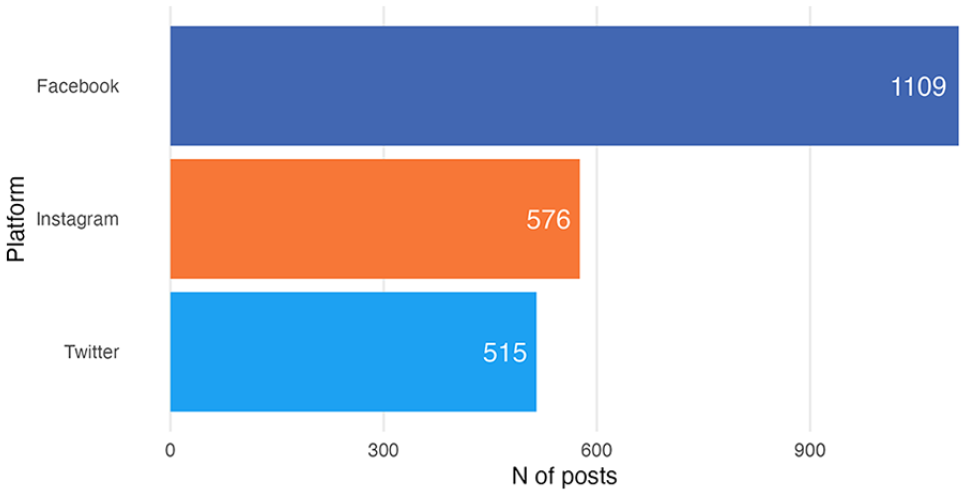
Number of posts per platform.
Measurements
Our analysis builds on the larger international comparative project (Digital Election Campaigning Worldwide (DigiWorld)), which investigates election campaigns on social media in various countries, using a joint codebook. We coded all materials manually, providing us with one decisive advantage: computational procedures such as topic modeling and natural language processing are based on text only but neglect visual materials such as pictures and videos. However, visuals are central to being able to fully understand the meaning of posts since they can include additional calls for action, and they are pivotal for catching user attention and benefiting from the social media algorithms which make highly engaged content visible to even more users. This centrality is reflected by the fact that only 13% of all posts in our sample did not include any visuals. Our coding included the entire text of each post, images, videos (including audio tracks of videos), as well as, image captions, hashtags, mentions, and geotags. For practical reasons, we coded the first image/the (first minute of the) first video included in a post. This decision was made based on the assumption that users are more likely to notice the first rather than subsequent visuals.
For each post, we coded which calls to action it contained (= 1) or not (= 0). The codebook included calls to look for more information in 12 different ways, calls to be mobilized in 14 different ways, and calls to interact with the political actors in 8 different ways. In order to take the campaign’s hybridity into account, our categories included both calls for online and offline action. A first check of the categories showed that the residual category “call for other forms of informing online” was the second largest among the “calls to information.” We therefore assessed the 117 posts in this category and identified several sub-themes, which we recoded into new categories and merged with existing categories, extending their scope. Moreover, categories that had been coded very rarely were recoded into larger categories for our analyses. Table A1 in the supplemental provides an overview of the final calls to action categories, as well as details on the recoding of categories.
Reliability
The materials were coded by three student coders who were intensely trained on the codebook. We tested inter-coder reliability based on 140 randomly selected Norwegian posts (5.4% of the full Norwegian sample). Reliability was calculated using Brennan and Prediger’s kappa, which is chance-corrected and more robust than Krippendorff’s alpha regarding variables with skewed distributions as ours (Quarfoot and Levine, 2016). Reliability was sufficient (information: 0.83; mobilization: 0.84; interaction: 0.84).
Data analysis
Inspired by previous similar research (Koc-Michalska et al., 2014, 2016; Vaccari, 2008), we created one index per family of functions—one each for informing, mobilizing, and interacting. This was undertaken by summarizing the total number of indicators coded for each of the three functions and then dividing that sum with the total number of indicators in our study. This provided three indices ranging from 0 (no function addressed) to 1 (all functions addressed), indicating the degrees to which political actors employed the different functionalities. Given the non-parametric nature of these indices, we opted for suitable analysis techniques as described in the following section.
Results
We start with an overall view of how Norwegian political actors prioritized between Facebook, Instagram, and Twitter during our studied period. Figure 1 provides an overview of the total number of posts per platform. Figure 2 offers an overview of how parties and party leaders prioritized across platforms.
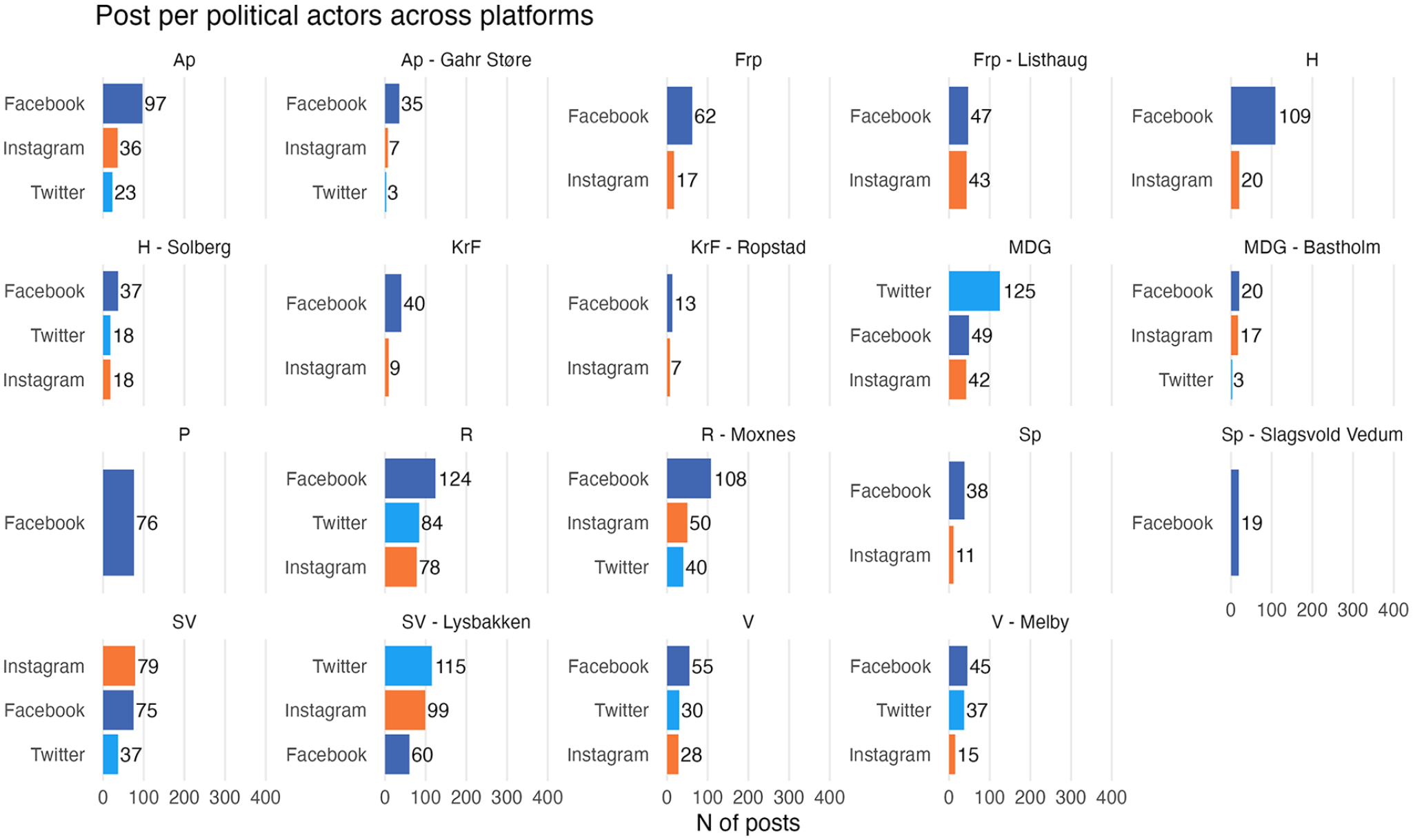
Number of posts per political actor across platforms.
While Facebook takes a clear lead with close to double the number of posts than for both Instagram and Twitter (see Figure 1), some interesting differences can be discerned between the different political actors (see Figure 2). Indeed, while all parties used Facebook to some extent, a minority refrained from using Instagram (P, Sp—Slagsvold Vedum) while a slightly larger number of actors (Frp, Frp—Listhaug, H, KrF, KrF—Ropstad, P, Sp, Sp—Slagsvold Vedum) did not use Twitter during the 2021 election. The low use of Twitter may be understood against the established view of the platform as a stomping ground for a societal elite (Enjolras et al., 2013; Rogstad, 2015; Larsson, 2017). Indeed, Twitter avoidance by the populist Frp and their leader is well-documented (e.g. Larsson, 2020). The results presented here suggest this tendency has spread also to other actors, and may also suggest that Twitter is losing ground to other platforms. In sum, the results indicate that the political actors are largely orienting to where the most potential voters are. Given the much higher popularity of Instagram in Norway, it is interesting to note the closeness between Instagram and Twitter.
Moving beyond the degree to which political actors used the platforms, we turn to the results of the content analysis. First, regardless of the type of call to action, an average of 0.73 of such appeals per post were coded for Instagram (Sd: 0.72). Almost on par is Facebook (0.68; Sd: 0.72), while the mean for Twitter emerged as less than half than the mean reported for Facebook (0.28; Sd: 0.48). A Kruskal–Wallis H test determined that these mean differences were significantly different from each other (p < .000). Post hoc testing employing Dunn’s test indicated that while the means reported for Instagram and Facebook were not significantly different from each other (p > .005), both means were significantly different from the mean found for Twitter (p < .000).
Below, we present the means and standard deviations for our three indices of informing, mobilizing, and interacting functions, respectively (see Figure 3).
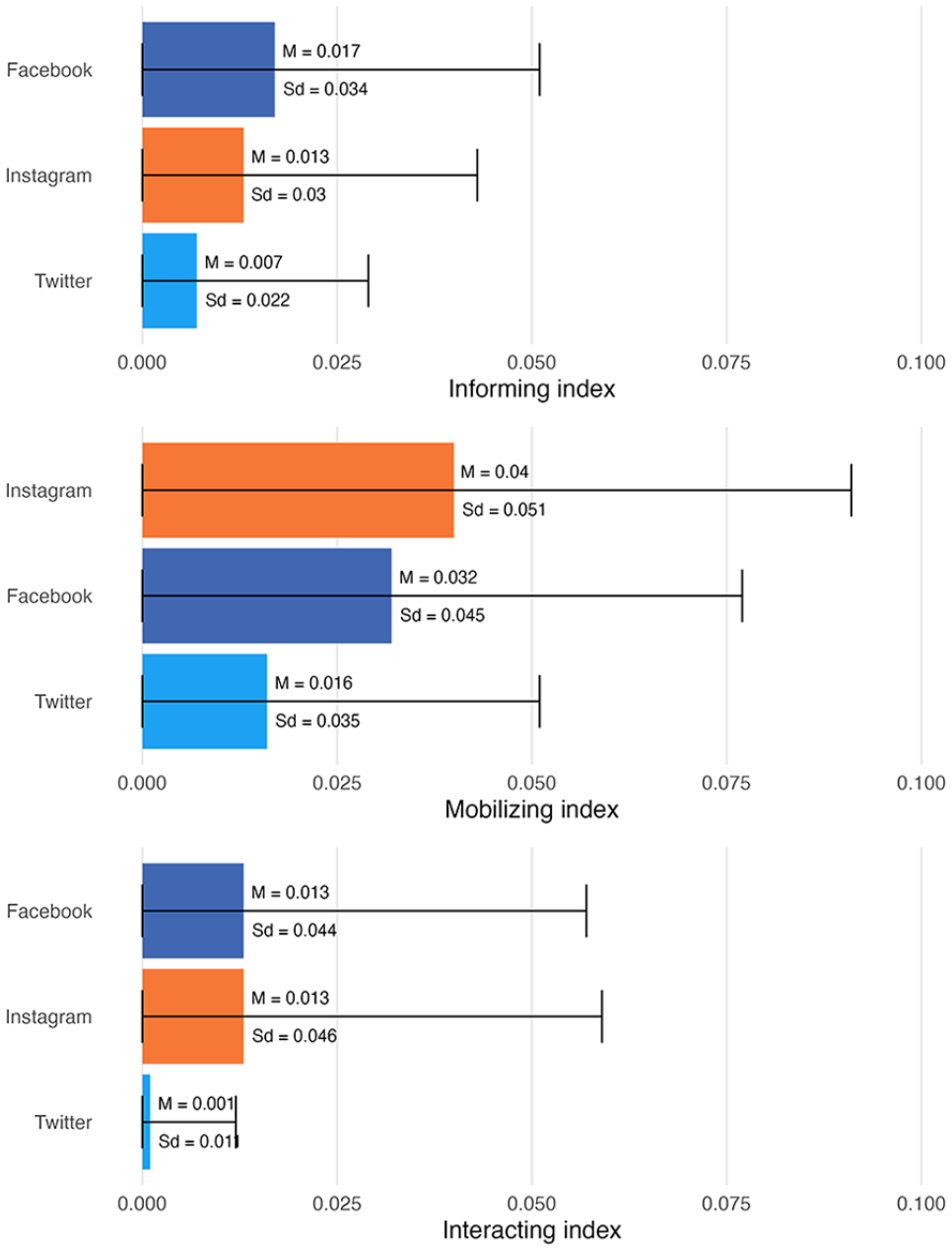
Means and standard deviations for informing, mobilizing, and interacting indices across platforms.
A series of Kruskal–Wallis H tests showed that all means reported in Figure 3 were different across all platforms for each index (p < .000 for all comparisons). Subsequently, post hoc testing using Dunn’s test was performed to gauge the individual mean differences for each index. For the informing index, Dunn’s test suggested significant mean differences between all reported means—the mean for Facebook (M: 0.017, SD: 0.034) emerged as significantly higher (p < .000) than the one reported for Instagram (M: 0.013, SD: 0.03). Both Facebook and Instagram show means higher (p < .000 for Facebook, p < .005 for Instagram) than Twitter (M: 0.007, SD: 0.022), indicating that while the reported differences are quite small, Facebook was preferred for informing functions over the other platforms.
A different picture emerges for our mobilizing index (see Figure 3). Again, Dunn’s test proved the means for Instagram (M: 0.04, SD: 0.051), Facebook (M: 0.032, SD: 0.045), and Twitter (M: 0.016, SD: 0.035) all significantly different from each other (p < .000 across all comparisons). Again taking into account that these results suggest quite low degrees of use, mobilization efforts appear to take place more often on Instagram than on the other platforms studied. Finally, for our interacting index, as the statistics reported for Facebook (M: 0.013, SD: 0.044) and Instagram (M: 0.013, SD: 0.046) were quite similar, the non-significant Dunn’s test (p > .005) for this comparison was not surprising. Equally expected was the significant difference between the means for Facebook and Instagram when compared with the same statistic for Twitter (M: 0.001, SD: 0.011).
Taking the limited use of these features into account, we can nevertheless see that while Facebook is preferred for informing features, Instagram is leading when it comes to mobilizing varieties. For interaction, the two platforms are essentially in a tie. Overall, Twitter emerges as the least employed platform for all three indices—an interesting contrast to the comparably frequent use of Twitter uncovered in Figures 1 and 2.
Our next and penultimate analytical step is to provide more detail on the degrees to which Norwegian political actors made use of specific calls to inform (see Figure 4), be mobilized (see Figure 5), and interact (see Figure 6). For examples of specific sampled posts from Facebook, Instagram and Twitter belonging to each index (informing, mobilizing, interacting) see Supplemental Appendix.
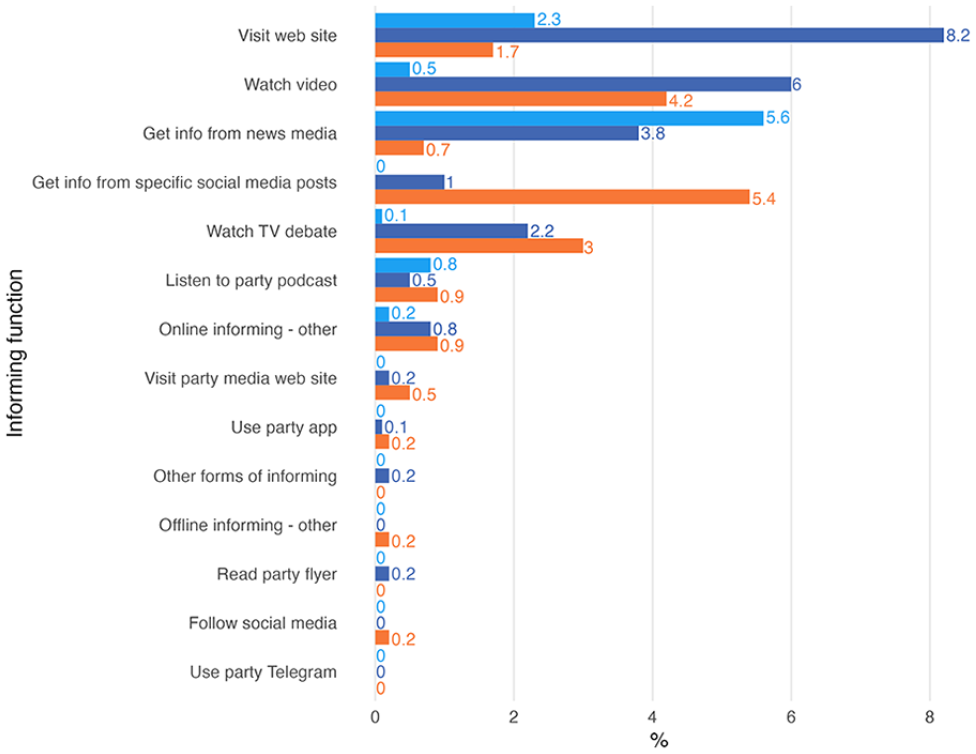
Percentage of posts that contain informing functions per platform.
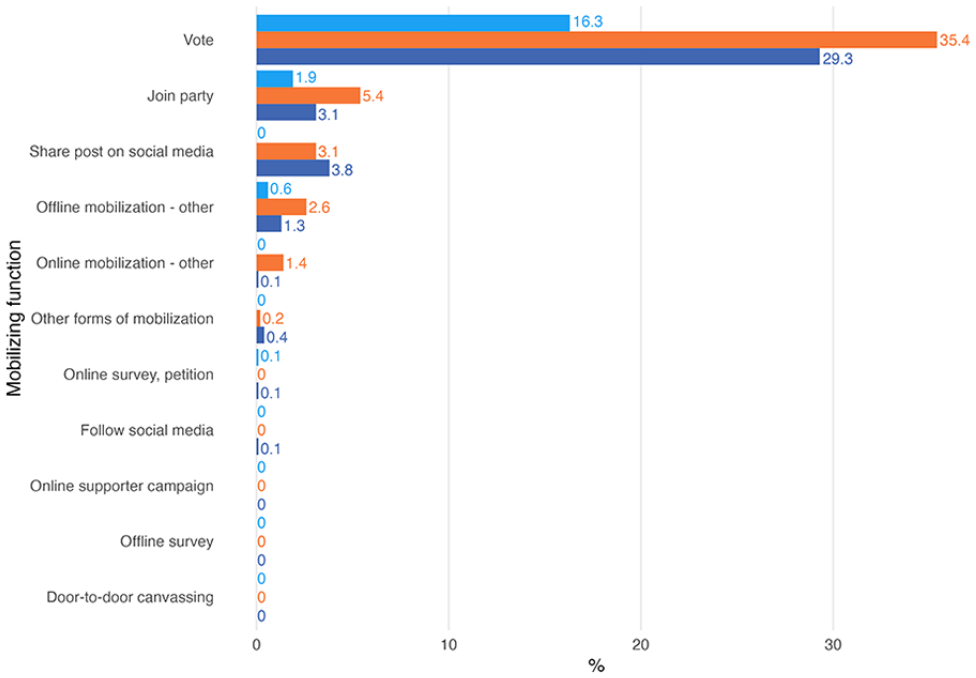
Percentage of posts that contain mobilizing functions per platform.
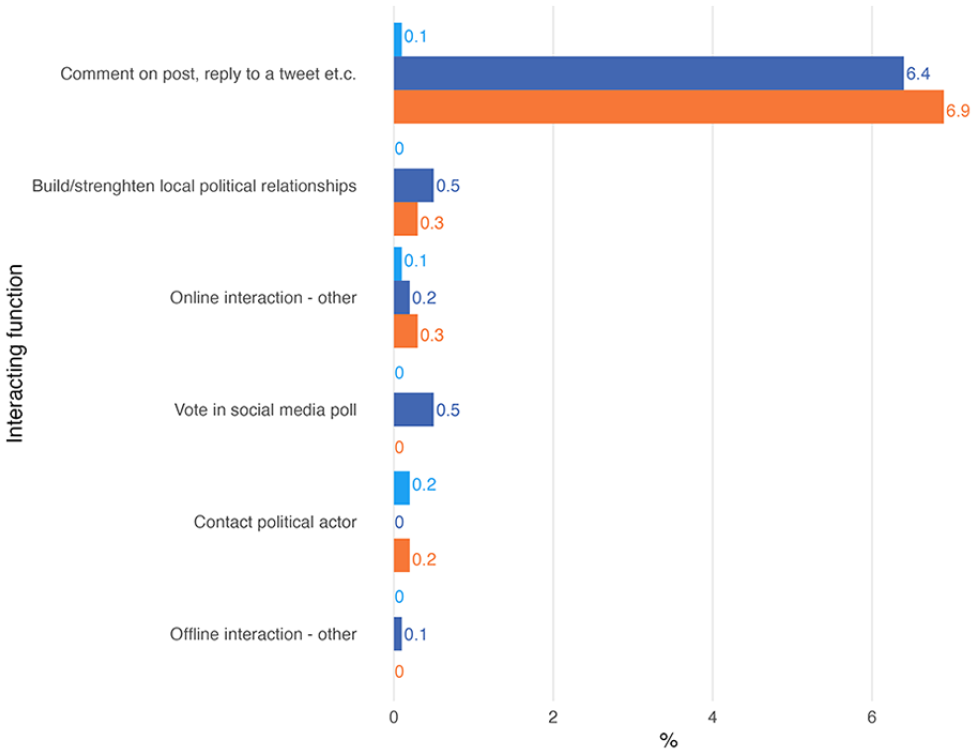
Percentage of posts that contain interacting functions per platform.
For Facebook, it seems that political informing efforts largely serve to steer potential voters away from the platform, visible in the categories visit website (8.2% of Facebook posts), watch video (e.g. on YouTube; 6%), and get information from news media (3.8%). For Twitter, the most common call to inform is get information from news media (5.6% of tweets), followed by visit website (2.3%)—rather like Facebook. For Instagram, however, a somewhat different picture emerges. Political parties appear eager to steer users onto their own channels also here, but they are obviously interested in keeping the users on the platform. The largest category was get information from specific social media posts (5.4% of Instagram posts). This category typically includes the encouragement to find a link to more information in the “Instagram bio” or to “swipe” to see more images in an image carousel. On Instagram, press-oriented calls to get information from news media only appeared in 0.7% of the posts. Figure 4 also indicates that seven of the coded categories were rarely found on any of the three platforms. While a mere 8.2% of Facebook posts, 2.3% of tweets, and 1.7% of Instagram posts urged users to visit party websites, even fewer posts encouraged potential voters to get information from the social network presences of political actors or on party apps. In sum, informing efforts emerged as primarily steering voters to party websites.
Mobilizing voters is related to certain risks, as previously discussed. Figure 5 suggests that Norwegian political actors are prone to risk aversion, with one clear exception: 35.4% of all Instagram posts, 29.3% of all Facebook posts, and 16.3% of all tweets included appeals to go vote. While these voting requests effectively overshadow all other varieties of mobilizing, we can nevertheless pick out a few other interesting tendencies. First, calls to join a party appear as slightly more common on Instagram (5.4%) than on Facebook (3.1%) and Twitter (1.9%). One possible explanation for this is the coveted group of younger voters who are likely to be found on this platform. While this percent difference is small, this suggests that parties prioritize Instagram over Facebook and Twitter when it comes to mobilizing. Again accounting for small differences, Instagram appears to be prioritized over the other two platforms also when it comes to other forms of offline mobilization (which includes calls to donate to the campaign or talk to friends and family) and online mobilization (where examples include use of the Amnesty International campaign hashtag #stoppnetthets [“stop web bullying”]). Calls to share posts were about as common on Facebook (3.8%) as on Instagram (3.1%). However, such calls look different on the two platforms. On Instagram, the encouragement to tag friends constituted over half of the calls to share posts, compared to only 7.1% on Facebook.
The results on calls to interaction (see Figure 6) seem to point in a somewhat different direction than for informing and mobilizing. Specifically, the category vote in social media poll emerged as diminutive (0.5% of Facebook posts) when compared to the degree to which users were asked to comment on a post. As previously discussed, interaction potentially creates problems for those operating these social media accounts. While a mere 6.9% of Instagram posts, 6.4% of Facebook posts, and 0.1% of tweets contained encouragement to comment, this indicator is the most commonly addressed interacting function.
Discussion
Our comparative analysis on how parties used Facebook, Instagram, and Twitter in the 2021 Norwegian election campaign shows both platform-overarching trends and clear differences between the three platforms, some of which are well-known. In line with H1, we find that the most common calls to information across platforms comprise asking the users to inform themselves through news media, via videos (e.g. on YouTube, including the parties’ own YouTube channels) and their party websites. Our findings also support H2, which postulated that when calling citizens to mobilize themselves and others, the parties focus on asking users to vote. This may be explained by the campaign timing as we investigated the last 4 weeks before Election Day. However, H3 that postulated the parties to focus on controlled interactivity is not supported since we find that by far the most common call to interaction is to ask users for commenting on posts. Indeed, this should in relation to the fact that calls to interaction are, in line with existing research (Kalsnes, 2016; Magin et al., 2017), quite rare. This indicates that parties avoid risky and resource-intensive situations, regardless of platform.
These overarching trends conceal, however, interesting differences between the platforms, which can be clearly related to their audiences, affordances, and genres (RQ1). That the parties publish by far the most posts on Facebook reflects that this is still the most popular social media platform in Norway (Newman et al., 2021). The parties seem to consider Facebook a channel to address the general audience and to employ “broadcast as usual.” Interesting is also that the number of posts/tweets hardly differs between Instagram and Twitter despite Twitter having way less users in Norway (Newman et al., 2021), while calls to action are overall least common on Twitter. Both findings reflect that Twitter is an arena where the political elites, journalists, and opinion leaders can be reached (Karlsen, 2015). These groups are important to reach out to larger publics but they are not the target groups for calls to action. Since many Twitter users are politically interested and already well-informed and the Norwegian twittersphere tends to be characterized by political homophily to a certain degree (Enjolras and Salway, 2023), the parties may think they do not need to ask their followers to inform about the campaign using materials beneficial for the parties. If they do, they use particularly links to news media that fits the needs of this specific audience well. However, with the ongoing upheavals in the Twittersphere, the platform is unlikely to be used more frequently in the future compared to the strong presence of some parties and party leaders in 2021.
Also calls to mobilization are clearly affected by the platforms’ core audiences: While being most popular in Norway, Facebook is losing grounds to Instagram, particularly when it comes to both calls to vote and other mobilizing varieties. This change might be explained by parties’ knowledge that young voters (who are hard to reach on other channels) are more likely to be reached on Instagram than on Facebook.
When it comes to affordances and genres, it is noticeable that all platforms are used to draw voters away from social media platforms and into party websites, videos, news media, and other channels, which highlights how the hybrid media system (Chadwick, 2017) facilitates and extends election campaigns. However, this pattern is particularly strong on Facebook, which provides good opportunities of linking in its posts; but much weaker on Instagram, which is dominated by visuals and has much smaller affordances to embed links directly. Moreover tweets do not contain any calls for comment on posts (the overall most common call to interaction) by contrast to Facebook and Instagram posts, which is probably due to the platform’s genres: Twitter content consists pivotally of ongoing conversations in which the users do not need to be asked to interact first.
Our finding that the parties hardly make use of social media polls illustrates that they by far do not exploit the potential of the platforms’ affordances and genres. Just as no user could use the full potential of his or her smartphone, no political organization is able to tap into the full potential of social media. The use of certain and the avoidance of other tools may be explained by organizational and resource-wise constraints and limitations.
Naturally, our study has limitations. First, it is restricted to three platforms during the “short campaign” of the 2021 Norwegian election. For instance, we do not have data on how the social media strategies of parties are coordinated with other campaign efforts. The transferability of our findings to other contexts, both temporarily and spatially, is thus limited. We focused on the three platform-related factors identified by Kreiss et al. (2018)—audiences, affordances, and genres—while neglecting the two platform-overarching factors. However, our study has proven the applicability of this framework to the European context and thus offers a good starting point for future comparisons of campaigns with routine phases and for long-term comparisons that would allow for systematically testing the influence of campaign timing on social media campaigns. Country comparisons are important to learn how context affects the uses of calls to action. For example, comparing party-centered countries such as Norway with candidate-centered countries such as the United States could help clarify the connection between candidate personality (Kreiss et al., 2018) and the use of calls to action. Relatedly, further insights into the influence of ideology, material resources, and incumbency status over different strategies employed could be useful. Finally, what in the end is pivotal for parties is whether their strategies work out. Our study does not help answering this question since we only looked into the content of the posts and can therefore not say anything about the degree to which users actually follow the calls to action. Future work should look at the influence of strategies uncovered here on the engagement metrics (likes, shares, comments, and so on) typically offered by social media platforms.
Taken together, our study has proven that platform-related factors shaping social media campaigns (audiences, affordances, genres) can both theoretically and empirically be fruitfully linked with the main campaign functions of information, mobilization, and interactions. Our findings show that parties vary considerably when it comes to utilizing different social media platforms, an observation that indeed makes it worthwhile to reflect over the roles that time and resources play when assessing political parties’ social media strategies. The parties obviously try to make strategic use of the specific audiences, affordances, and genres of different platforms by running platform-specific campaigns. Future research should dig deeper into systematic platform comparisons in order to better understand the logic of social media campaigning in its entirety as well as potential risks related to it. This can be both useful for strategists planning social media campaigns and insightful for researchers trying to identify and understand overarching trends in political campaigning and the role different social media play in this context.
Supplemental Material
sj-docx-1-nms-10.1177_14614448241229156 – Supplemental material for Calls to (what kind of?) action: A framework for comparing political actors’ campaign strategies across social media platforms
Supplemental material, sj-docx-1-nms-10.1177_14614448241229156 for Calls to (what kind of?) action: A framework for comparing political actors’ campaign strategies across social media platforms by Anders Olof Larsson, Hedvig Tønnesen, Melanie Magin and Eli Skogerbø in New Media & Society
Footnotes
Funding
The author(s) disclosed receipt of the following financial support for the research, authorship, and/or publication of this article: This publication is part of the project ‘Digital Election Campaigning Worldwide (DigiWorld)’. The authors would like to thank all collaboration partners who contributed to the infrastructure of the project, the coding scheme, and the creation of the dataset used in this publication. A list of all collaborators can be found on the project website:  .
.
Supplemental material
Supplemental material for this article is available online.
Author biographies
.
References
Supplementary Material
Please find the following supplemental material available below.
For Open Access articles published under a Creative Commons License, all supplemental material carries the same license as the article it is associated with.
For non-Open Access articles published, all supplemental material carries a non-exclusive license, and permission requests for re-use of supplemental material or any part of supplemental material shall be sent directly to the copyright owner as specified in the copyright notice associated with the article.
