



Abstract
This article asks what digital literacy tactics low-literate Dutch adults employ to bypass their low-literacy to be able to participate in digital society, and what the consequences are for their socio-digital exclusion and inclusion. It contributes to a better understanding of the impact of digitalization for low-literate citizens, and the linguistic and digital barriers encountered in everyday life. Drawing upon participant observations and semi-structured interviews with low-literate adult citizens in four libraries, a community center, and a school for adult education (N = 73), this article develops a taxonomy of five tactics which enables low-literate citizens to digitally participate despite their linguistic and digital barriers: (1) informal support structures, (2) formal support structures, (3) non-written communication, (4) translation software, and (5) optimal character recognition. We show how these tactics of appropriating the affordances of information and communications technologies (ICTs), and making use of social networks enable low-literate Dutch citizens to participate in socially situated manners, making use of social support structures and digital literacies developed in relation to “foreign” languages. Consequently, this study counters the stigma on such marginalized groups, who are often assumed to be unable or unwilling to participate, and presents them as not adhering to the dominant discourse of participatory culture. Hence, the added value of this study is threefold: (1) it centers the capabilities of low-literate citizens stemming from social capital and obfuscated linguistic potential, (2) it gives visibility toward more hidden everyday (digital) practices of marginalized subgroups with a larger distance toward the digital society, and (3) it foregrounds the lived experiences of the user and their (limited) use of ICTs, and how tactics are developed and practiced to bypass linguistic and/or digital barriers showing situated agency and problem-solving capacities. We argue that digital literacies should not be considered as a prerequisite for digital participation and inclusion, as our findings show that low-literate Dutch citizens are a highly diverse group that are capable of participating, despite their low (digital)-literacy. However, they do so in socially situated and non-written manners, in line with their digital and linguistic capabilities and barriers.
Introduction
The Netherlands is considered one of the European frontrunners in terms of digitization (Digital Ecnonomy and Society Index [DESI], 2022). However, almost one in six Dutch citizens between 16 and 65 years does not possess the level of reading and writing necessary to participate in society, including in digital processes (Royal Library—Koninklijke Bibliotheek, 2020). As the use of most online technologies requires at least a basic level of linguistic proficiency, a large portion of these low-literate citizens 1 also lack digital literacies (Court of Audit, 2016). Given the increasing digitalization of society, this means that low-literate adults run the risk of being excluded from society on, simultaneously, the societal and the digital level (Goedhart, 2021; Helsper and Reisdorf, 2017). This leads to large-scale social and digital inequalities (Helsper, 2021; OECD, 2018; Ragnedda, 2016; Scheerder et al., 2019; Selwyn, 2004). While tasks such as filling in a tax form or transferring money via online banking might seem mundane, these are highly complex for low-literate subgroups, due to their limited linguistic proficiency and lower levels of digital literacies. This article examines what sorts of socio-digital tactics low-literate Dutch citizens employ to bypass their limited functional and/or digital literacies to be able to participate in an increasingly digitalized society.
Prior research has emphasized the significance of a foundational level of linguistic proficiency to cultivate digital literacies and participate online (Goedhart et al., 2019; Hargittai et al., 2019, van Dijk, 2020). However, a comprehensive understanding of the interplay between low-literacy, digital literacies, participation, and its implications for social and digital inequalities remains lacking (Buddeberg, 2019; Tsatsou, 2022, van Dijk, 2020). Moreover, the challenge of including low-literate individuals in scientific research due to their limited ability to respond via email, messaging, surveys, or questionnaires hinders explorations of how they understand and navigate digital media to cope with linguistic limitations in daily life, while implicit assumptions regarding their participation are prevalent (Buddeberg, 2019; Dera and van Steensel, 2022; Grotlüschen et al., 2019). This article argues for a reconceptualization of participation in light of disadvantaged publics, considering the potential for alternative participatory avenues facilitated by information and communications technologies (ICTs) and external intermediaries. This accounts for how low-literate populations appropriate participatory practices and construct socio-digital tactics to bypass their linguistic and digital barriers, and the resulting potential for inclusion or exclusion. Hence, we ask: What socio-digital tactics do low-literate Dutch citizens employ to bypass their low literacy, and what are the consequences of these tactics for digital participation and their digital inclusion and exclusion in society?
To answer this question, we take an ethnographic approach to study how low literate Dutch citizens appropriate ICTs and make use of their social environment and limited linguistic proficiency to participate in digital environments. Drawing upon participant observations and semi-structured interviews with low-literate Dutch citizens in four libraries, a community center, and a school for adult education, we develop a taxonomy of tactics through which they bypass linguistic and digital barriers. By foregrounding the lived experiences of low-literate citizens and their (limited) understanding of ICTs, we provide more thorough insights into the impact of digitalization within the everyday lives of marginalized subgroups in society. Showing their situated agency and problem-solving capacities stemming from social resources, we argue that low-literate citizens are a highly diverse group that is capable of participating on their own terms, despite their limited levels of digital literacies and functional literacy. Hence, we challenge the assumption that digital literacy is a prerequisite for digital participation and digital inclusion. Instead, we contextualize the ambivalent concept of participation within their own situated lived experience of what it means to participate in everyday life, visualized in a taxonomy of five tactics that draw upon socio-digital resources, capabilities, and potential.
Understanding the “literacy” in low digital literacy
In the context of an increasingly digitalized culture, it is essential to reconsider the requirements for civic, digital, and social participation (Friemel et al., 2021; Goedhart et al., 2019). However, for low-literate citizens, the meaning of participation remains largely unclear (Bawden, 2008; Friemel et al., 2021). To understand the media-related skills necessary for low-literate individuals to participate in social and digital life, we must explore basic participatory skills in everyday situations, including functional and digital literacies (Grotlüschen et al., 2019). Current perspectives on low-literacy often adopt an instrumentalist and deterministic approach, emphasizing its limitations for participation and inclusion (Buddeberg, 2019; Dera and van Steensel, 2022; Grotlüschen et al., 2019). However, large-scale surveys examining the participation of low-literate populations often overlook a person’s ability to manage literacy tasks in everyday life (OECD, 2018; Stokmans, 2022). Furthermore, they downplay the role of external actors in participatory processes and how affective dimensions of human-technology relationships shape the enactment, perception, and understanding of ICTs (Buddeberg, 2019; Friemel et al., 2021). Consequently, low-literate citizens are often perceived as a “vulnerable subgroup” (Streich, 2009: p. 303).
Furthermore, a basic level of reading and writing skills is often said to be necessary, to become digitally literate and make use of the affordances that digital media afford (Bawden, 2008; Carpentieri, 2015). In the Netherlands this is considered linguistic level 2 F/B1 (see Stichting Lezen en Schrijven [SLS], 2017), in accordance with the Common European Framework of Reference for Languages. However, studies indicate that despite facing difficulties with reading and writing, the majority of low-literate individuals are capable of participating in society, such as finding employment or managing a family (Buddeberg, 2019; Koppel and Langer, 2020). Redefining literacy as a sociocultural phenomenon, following Gee’s (2010) and Street’s (2003) perspectives, helps resolve apparent contradictions in understanding low-literacy. Low-literate individuals may lack functional literacy but aren’t entirely illiterate, as they can utilize social capital and resources, often through third-party support, to participate effectively (Asmar et al., 2020; Buddeberg, 2019; Helsper, 2021). Viewing literacy merely as a set of technical skills ignores its social context and ideological influences (Lankshear and Knobel, 2008; Street, 2003). Thus, (functional-) literacy is reconceptualized as a dynamic, socially shaped phenomenon, varying across different contexts and intertwined with notions of knowledge, identity, and being (Street, 2003).
The rapid proliferation of digital technologies and digitalization continuously redefines notions of (il-)literacy and navigation within digital environments. Traditionally, digital literacies were perceived as individual cognitive attributes in line with the concept of the digital divide (Smit et al., 2023; van Dijk, 2020). However, the New Literacies strand (Lankshear and Knobel, 2008; Leu et al., 2017) contends that digital literacy is a shared and co-produced phenomenon within social relations. Accordingly, digital literacies encompass individual knowledge, skills, and dispositions, embedded within the support provided by friends, family, and other social ties (Buddeberg, 2019; Kaun and Forsman, 2022). Social support structures play a crucial role in facilitating the exchange of ideas, knowledge, and resources, significantly influencing participation (Fingeret, 1983; Kwak et al., 2004). Therefore, it is not solely the absence of digital knowledge and skills that leads to exclusion or vulnerability, but rather the lack of social support networks (Asmar et al., 2020; Buddeberg, 2019; Friemel et al., 2021).
We therefore argue that we should understand digital literacies as relational conditions, situated in socio-cultural practices, instead of purely neutral and/or technical tools to navigate the digital. This provides a cohesive understanding of why and how functional and digital (il-) literacies affect social and digital inequalities in an increasingly digital society where progressively more citizens run the risk of digital exclusion.
Reconsidering participation
Participation in various societal layers is widely recognized as a crucial principle for fostering inclusion, reducing inequalities, and promoting thriving citizenry (Jenkins, 2006; Jenkins et al., 2015). However, the concept of participation remains contentious and subject to debate (Claridge, 2004; Hussein, 1995; Kelly, 2001). The notion of digital participation, where “digital” serves as a modifier, often emerges as a normative construct, emphasizing the use of digital technologies for communication, interaction, and resource acquisition (Bourdieu, 1986; Helsper, 2021; Pangrazio and Sefton-Green, 2021). This normative perspective revolves around citizens efficiently engaging with the government and peers, or managing their affairs, such as accessing social welfare or benefits through e-governmental platforms. Rooted in a neo-liberal framework of active citizenry that assumes universal collective participation in democratic, civic, and economic spheres (De Certeau, 2005; Jenkins et al., 2015), this approach advocates for specific skills and knowledge required to function in society. It perpetuates an operational meritocratic logic, emphasizing the need for basic literacy, calculus, and digital literacies, without considering diverse user needs, usage patterns, affective dispositions, and levels of functional literacy and digital skills that digital services can accommodate.
Digital technologies prioritize digital skills and competences, while also incorporating traditional literacies like reading and writing as secondary elements. For instance, non-written forms of communication using emoticons, GIFs, and other means offer alternative communicative actions outside conventional literacy frameworks (Gee, 2010). Thus, ICTs provide non-literary modes of communication that align more closely with the linguistic capacities and limitations resulting from low literacy (Koppel and Langer, 2020; Stokmans, 2022). This potential for diverse communication via digital media opens up broader participation possibilities, particularly advantageous for low-literate citizens. However, there is limited understanding of how different low-literate subgroups navigate this meritocratic space, appropriate ICT affordances to overcome linguistic and digital barriers, and determine crucial aspects of participation in the digital society.
By exploring the tactics low-literate citizens use to participate, despite their low-literacy, we make visible how they leverage their limited digital literacies and capabilities with ICTs, and what they themselves deem important in their appropriation of participatory actions. De Certeau (2005) proposed that an invisible world of mass cultural participation can be made visible, by exploring what he called “the tactical”. He conceptualized tactics in opposition to strategies, as tactics are developed and determined by “the absence of power”, while strategies are constructed by the acceptance or “postulation of power” (p. 38). Hence, strategies can be understood as the mechanisms and structures through which power manifests itself, whereas tactics are understood as ways to acquire agency to battle, oppose or play such power structures in calculated manners. In the context of this study, strategies represent institutional and technological structures that exert power over low-literate subjects by confronting them with, and excluding them due to their limitations in how they participate: with lower levels of functional literacy.
Methodology
To gain comprehensive insights into the tactics employed by low-literate Dutch adults to overcome their literacy challenges and engage in societal activities, we conducted weekly participant observations and semi-structured interviews with this population in the Netherlands between November 2020 and January 2022. 2 Employing these methods enabled us to explore both formal and informal spaces where digital literacies are learned, practiced, and enacted from a user-centric perspective. Integrating observations with interviews allowed us to not only observe digital practices in real-time but also elicit participants’ reflections on these practices afterward. This approach helped overcome some of the inherent limitations of relying solely on interviews as we could directly observe digital actions, moving beyond the reliance on retrospective accounts and enhancing the depth of our understanding.
Participants were recruited using a mixture of snowball sampling (respondents referring us to others, who consequently were asked about difficulties with linguistic proficiency and digital skills) and selective sampling (being directed toward low-literate adults by organizations, partners, people, or specifically searching for low-literate adults within a larger population) (Spradley, 2016). Low-literate citizens were identified with the help of external partners (educational practitioners, employees of libraries, social workers, volunteers in community centers) that all had prior knowledge of participants’ levels of literacy because they had been involved in testing them. To indicate if someone is low-literate, these tests apply the national NT2 reference framework for non-native speakers and the official reference levels of language for native Dutch speakers (NT1) (SLS, 2017). We used the linguistic proficiency levels (A2 and 1F respectively, see SLS, 2017) as a parameter to include participants.
The research took place at an educational institution, four libraries, and a community center situated in two areas in the Netherlands with a relatively high percentage of people living in poverty and lower levels of functional literacy, ranging between 10% and 24% of inhabitants in the studied areas (Huijts et al., 2020). Citizens could come to these institutions for courses to increase their level of digital literacy or get help with technical questions about their digital devices. We used participant observation to study N = 73 participants with an average age of 48 (standard deviation of 5.8), 62% female and 38% male, with 14 nationalities. Making fieldnotes and research diaries allowed us to collect data while we observed low-literate adults when they used ICTs for their personal interests, and examined how they make use of the affordances of digital technologies, despite their literate limitations. Before observing digital practices (e.g. smartphone use), participants were asked if the researcher could watch along and make notes while observing user-interaction with the device. From this sample, 12 low-literate adults were recruited to participate in additional semi-structured interviews. This was done to gain a more thorough understanding of how they experience digital in- and exclusion on a daily basis, and to talk with them about such topics instead of speaking about them in relation to participation and/or inclusion/exclusion. The interview sample contained participants with an average age of 54 years (standard deviation of 8.7), 68% female and 32% male, of four different nationalities. The participants were anonymized when the interview data were stored, so this could not be related back to individuals. The names mentioned in this article are pseudonyms.
Informed consent was acquired from all participants. Occasionally it was difficult to acquire informed consent from participants due to their difficulties with reading and writing, especially for participants that did not speak Dutch or English. This was handled by carefully acquiring oral consent. The first author introduced himself, his role, and the topic of the study, sometimes with the help of translation software, to acquire informed consent in written and/or oral form. If participants did not understand the purpose of the research and/or could not give their informed consent, they were excluded from the study. The study gained final approval from the Ethics Board of the University of Groningen (CETO) on 17-05-2023 under reference number 572 – 93593093.
The low-literate population in the Dutch adult educational system is divided into two subgroups: NT1 and NT2, based on whether Dutch is their first or second language, respectively. The NT1 group comprises Dutch natives, while the NT2 group consists of immigrants, refugees, expats, and similar groups. Our observational sample included twenty-nine respondents from the NT1 group and 44 respondents from the NT2 group. In our interview sample, four respondents belonged to the NT1 group, and eight belonged to the NT2 group. The NT2 group exhibited higher average levels of education (high-school level) and digital literacies but showed lower levels of literacy in the Dutch language. Conversely, our NT1 sample had lower average levels of education (primary-school level) and digital literacies, but demonstrated higher proficiency in Dutch oral language. Both subgroups follow different linguistic (educational) programs (Dera and van Steensel, 2022). Despite this, within digital literacy educational programs, they are often grouped together under the generalized term of the “low-literate citizen.”
The observations focused on how low-literate adults understood and practiced digital literacies within informal and formal educational settings. The observations followed the participant observation model put forth by Spradley (2016), moving from more general to focused observations. We conducted weekly observations at a center for adult education, where a group of low-literate adults (NT1 and NT2) followed a 32-week digital skills course. We also observed weekly at libraries’ walk-in desks, where visitors would drop by, ask questions or be seated in front of a computer or laptop to practice digital skills. In addition, once a week observations took place at a local community center, where residents during specific hours when an ICT-professional was present could ask ICT-related questions. As they needed to register beforehand, employees or volunteers in the community center mostly already were informed which individuals were low-literate, as they asked for help in literacy tasks before. We focused on how participants make use of ICTs in a broad array of contexts, specifically aimed at daily routines and everyday practices, as studies show that perceptions and applications of how to make use of software and hardware in diverse everyday contexts show how participation is experienced and translated in action (Alper, 2017). It rendered tactics visible of how low-literate adults try to bypass their linguistic limitations and use ICTs to leverage their digital capabilities.
The interviews, conducted in diverse settings such as institutions, community centers, homes, cafes, and during walks, averaged 45 minutes. This explored the translation of literacies into daily practices and media use despite linguistic barriers. The interview protocol began with questions about general digital media usage, preferences for specific devices and applications (e.g., smartphones with WhatsApp), frequency of use, purposes, and contexts. This approach aimed to understand users’ motivations. Field notes and a research journal documented observations. Interviews were audio-recorded, transcribed, and then thematically analyzed using Atlas.ti, following Clarke and Braun’s (2017) iterative coding process. This involved constructing initial codes, reanalyzing transcripts for more detailed codes, and repeating the process to capture a comprehensive representation of the cultural settings. From this analysis, we developed a taxonomy of five socio-digital tactics that low-literate adults use to interact with ICTs.
Clusters of participatory tactics
Below we present a taxonomy of socio-digital tactics containing five thematic clusters (see Figure 1), ranging from social to autonomous tactics on a continuum (see horizontal axis in Figure 1). Social tactics are more socially situated and dependent upon interaction with third-parties, mostly as part of one’s social circle and/or support structure. Autonomous tactics are related to individual and/or personal enactment of ICTs, and are deployed in practice without the specific need of social actors and/or third parties. The NT1 group makes use of more social tactics to understand and enact ICTs in their everyday lives. The NT2 group uses more autonomous tactics where the social component seems less determinant. They exhibit a more purpose oriented heterogeneous use of hardware and software, because they trust their digital literacies more and are less afraid to experiment with different ICTs and make mistakes. Complexity of digital tasks differs within all tactics, and is handled in diverse manners dependent upon differences in skills, knowledge, experience, social networks, pragmatic reasoning, and affective dispositions in human–technology relations (Smit et al., 2023). What tactics are used, thus, mainly depends on affective considerations, such as trust, fear, and intuition, rather than platform or everyday life context. Hence, we argue that these factors primarily determine what hardware and software are used for what purposes, and in what manner, which are facilitated by a spatial context, not constructed or ordered by it.
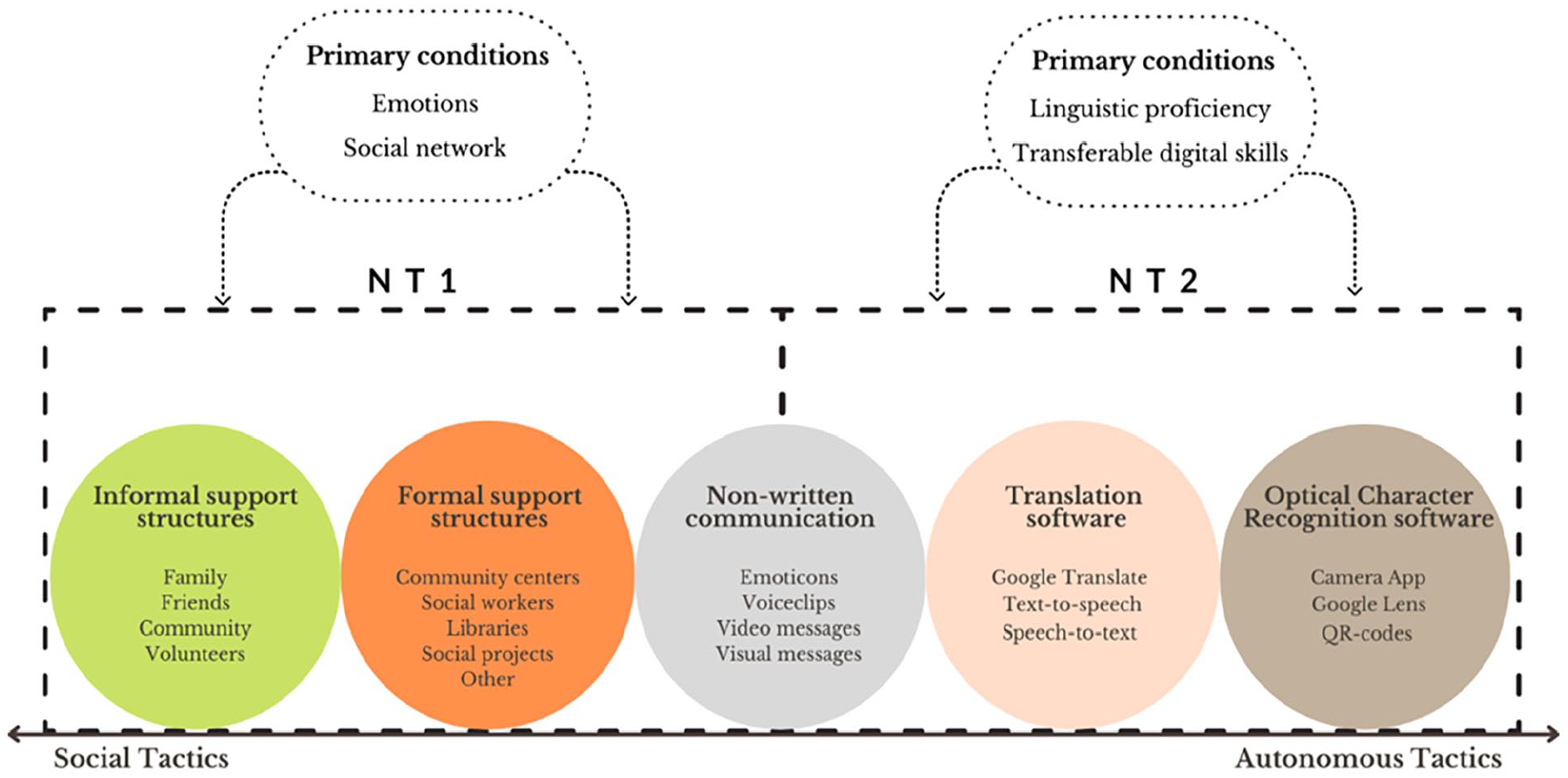
Tactics deployed by low-literate citizens, divided into NT1 and NT2 groups.
Informal support structures
Low-literate citizens utilize informal social networks to access informal support from actors within their social circles, which comprises four layers: (1) family, (2) friends, (3) community, and (4) volunteers. The choice of support network is influenced by spatial, temporal, and affective factors. For instance, when facing an online banking issue, an individual might first seek assistance from a nearby family member due to the personal nature of the matter, avoiding sharing financial situations with friends or neighbors. If a family member is readily available, located nearby, and trusted with the matter, the low-literate individual would approach that individual for help. In this sense, the tactic of informal support is very personal and ad hoc, and dependent on proximity, availability, urgency, and the social resources of an individual.
The first cluster of tactics that low-literate citizens in the NT1 group make use of is what Asmar et al., (2020) call “literacy support.” Literacy support prioritizes traditional literacy tasks, for example, adults having difficulties with reading and writing and drawing support from people in their social circle to help them read a letter from the tax authorities. Literacy support takes place in informal settings, for example, the home, and often not only regards helping with technical literacy tasks, but also the affective dimension surrounding low-literacy. The way this functions in practice is illustrated by Anna (58, NT1): Low-literates are often ashamed of their low-literacy and want to keep it to themselves. However, almost everybody in my age group has questions about digital things and does not feel ashamed when that person doesn’t know how to do online banking or emailing.
As described by Anna, stigmas still exist on the topic of low-literacy, while digital low-literacy is not that heavily connoted, and is not so much felt as a negatively affected subject, especially for the age group of 50+ years. This shows how implicit norms in society regarding low-literacy and digital literacies affect how they are practiced in everyday life, and how they are “felt.”
In addition, Anna expresses that she has “issues of trust” and feels “ashamed to explain to unknown people that I have trouble with reading and writing.” Hence, low-literate people mostly ask for help within informal spaces like their own social circle, because these people are familiar with their linguistic limitations, and thus the feeling of shame is lessened. Others mention that not shame, but especially the perceived risk of doing something wrong determines if they want and/or need help. For example, Johanna (53, NT1), describes: With internet banking I do not want to learn about it or try it myself, because I’m too afraid to do something wrong and lose my money [. . .] I feel more comfortable asking a family member or friend for help. I trust them and know they can help me in a way that does not give me stress.
Emotions such as fear or stress are thus very important in the underpinnings of this tactic. Similarly, DigiD (digital identifier needed for e-governmental services) proves very difficult to use and fosters many negative emotions, as described by Gea (57, NT1): Just logging into DigiD gives me so much stress that I want to stay as far away from it as possible. I often just close my laptop or put my phone away to save myself from disappointment. I don’t understand why there are a dozen security checks and everything is made so difficult for people like me. I have such negative experiences with it that I only want to use it when my brother or son helps me.
These examples demonstrate the assumption by governments that linguistic proficiency and a basic level of digital literacies are prerequisites for accessing essential public services like DigiD. However, for most low-literate citizens, using this service individually and autonomously with security measures like two-factor authentication is either impossible or very challenging. They often rely on intermediaries, such as family members, friends, or neighbors, to facilitate the process.
Low-literate citizens tend to prioritize informal spaces over formal ones when dealing with personal issues involving sensitive information, as they feel safer seeking assistance from friends, family, and individuals within their social circles. This preference leads them to avoid formal settings like libraries or schools, where they might have to ask someone they do not personally know for help with sensitive information. This dependency on social networks highlights the importance of informal support structures that low-literate individuals construct around themselves. Seeking help within these informal networks is considered a pragmatic tactic, as the assisting actor serves as a mediator between instrumental and informational/digital paradigms, allowing them to overcome linguistic barriers and negative emotions associated with using ICTs.
Such informal support structures play a significant role in digital participation and inclusion (Buddeberg, 2019). While low-literate citizens expressed gratitude for the help provided by intermediaries, observations also revealed that some supporters had limited digital literacies themselves. This connects to existing literature, highlighting that such informal support may be pragmatic and directly available, but may also not be suited to enhance digital literacies directly (Buddeberg, 2019; Friemel et al., 2021). For example, low-literate citizens face challenges in accessing and understanding high-quality formal support, hence, often rely on inadequate informal assistance.
Formal support structures
Low-literate citizens utilize both informal and formal networks of support. The primary distinctions between these networks lie in the level of privacy surrounding a topic, the affective dimension involved, and the depth of knowledge possessed by the supportive actors. Formal support structures offer more comprehensive knowledge on complex technical issues but may prioritize the affective dimension less. Low-literate citizens perceive formal supporters as “outsiders.” Three layers of formal support are identified: (1) community centers and social workers, (2) libraries and social projects, and (3) other governmental agencies. These support structures fall under the concept of “digital care work” as defined by Kaun and Forsman (2022), which involves a prominent focus on engaging with digital literacy tasks within formal spaces like libraries. The most accessible formal support structures are community centers located near the homes of low-literate citizens, as well as social workers assigned to specific individuals. When these actors cannot provide the necessary assistance, low-literate citizens turn to the second layer, seeking help from librarians or library-related programs. Harry (69, NT1), for example, states: “When my social worker doesn’t have time, I go to the library nearby to ask questions about how to message someone or how to find something on a website.”
The third layer consists of consulting governmental agencies, and is understood as the most formal and “distant” supportive layer: For simple questions I go to friends and family, but if I have a more difficult question about an allowance or fixing a problem online, I wait for my weekly meeting with my social worker, because I trust him more with important things. If it is very urgent, I mostly go to the library or the nearby community center to see if an employee or volunteer can help me. They mostly have a computer or laptop there, so I can use it together with someone there to answer my question.
This example of Johan (43, NT1) shows that low-literate citizens can make an educated guess about how complex their question regarding a digital service is, and critically reflect on which actor is best equipped to help them. In selecting an actor within this formal support network, various factors such as spatial, temporal, and affective considerations play a significant role. The limited mobility of some interviewees, constraining their ability to traverse long distances, the urgency and complexity of the issue at hand, and the literacy level of the individuals all influence their decision-making process. Crucially, individuals evaluate who can most effectively and promptly resolve the issue, with a key emphasis on trustworthiness.
Material and informational considerations also shape low-literate citizens’ choices when seeking support. For instance, Johan opts for a library or community center due to the availability of hardware that can handle complex issues beyond the capabilities of a smartphone. Moreover, his understanding of the complexity of a question determines which actor he deems most suitable to provide assistance. This aligns with the concept of multi-dimensional social support described by Asmar et al. (2020), where aid operates on multiple levels simultaneously. In addition, privacy regulations pose challenges in formal settings like libraries, where helping employees or volunteers may need to access personal information and financial details. 3 Consequently, informal spaces become more conducive to assisting low-literate citizens with intricate, sensitive, and personal issues, providing a better fit for their needs.
In contrast, the help provided by such support structures, which is primarily oriented toward showing how digital acts should be enacted within a meritocratic logic, does not naturally result in the advancement of digital literacies or wellbeing of disadvantaged citizens. Instead, it increases the degree of dependency of disadvantaged citizens on external (institutional) actors, and simultaneously marginalizes their agency and autonomy. Hence, we should understand these supportive structures as a dynamic which digitally includes low-literate citizens by extension through intermediaries, transferring ideas, information, skills and resources to leverage digital media for participatory actions. However, this does not directly result in lessening social and digital inequalities, empowerment or strengthening resilience and self-reliance. It holds citizens responsible for their successes and failures (see Juhila et al., 2021), and asks disadvantaged citizens to vocalize and articulate their shortcomings and needs to acquire the necessary help, instead of scrutinizing the design of digital infrastructures and the norm to digitally participate in essential public services. In sum, it promotes the internalization of neoliberal ideology and legitimatizes a retreating government, negatively affecting the matrix of social power and feeding into the current status quo.
Non-written communication
A cluster of tactics employed by both NT1 and NT2 groups is non-written communication. This tactic makes use of the affordances of primarily smartphones to communicate in “different” manners. For example, communicating with the help of emoticons, audio clips, video messages, and similar instances of communication. This way of communicating is primarily done with people in, or close to, an individuals’ social circle. For example, Hans (49, NT1) describes how he communicates with his social worker to arrange meetings or discuss urgent matters: My social worker knows I can use WhatsApp on my smartphone, but I am not someone that often looks at my smartphone or have it with me when I go outside. So if he calls me, I often don’t pick up the phone. At first he then would send me a [textual] message via email or WhatsApp. I would send him a voice clip and say I do not understand his message, so then we started communicating through voice clips on WhatsApp and also emoticons to quickly reply.
This example implies that Hans can communicate efficiently, as long as the communication is in visual or audio form. Smartphones especially afford these alternative means of communication. However, communicating with for instance governmental agencies in the Netherlands still mostly requires communication in traditional textual form. The friction this causes in practice is illustrated by Lee (41, NT2): I do not understand why I cannot simply make a print screen of Google Maps of where my home is, or where I traveled to, to get reimbursed or let a governmental agency know where they can find me. Instead, they ask me to fill in a complex form, which I first need to download, then need to open in Word, a program that I do not have on my smartphone.
This highlights how certain norms within the e-governmental context compel users to adhere to more traditional forms of communication. These traditional communication methods can be seen as strategies employed by powerful actors, confronting low-literate citizens with their literacy limitations. For instance, Necla (49, NT2) mentions feeling “dumb and frustrated” due to this forced mode of communication, negatively impacting her mind-set, motivation, and attitude toward governmental agencies. As a result, she becomes less eager to interact with them in future affairs. Late tax submissions or non-responsiveness to governmental emails can lead to issues with severe financial consequences. When discussing such issues with respondents, they feel unheard by institutional actors. To them, it seems as if institutions consciously exclude them by prioritizing traditional communication methods, rather than adapting their communication approaches to leverage the potential of contemporary ICTs and accommodate the capabilities of low-literate citizens.
Translation software
Low-literate citizens within the NT2 group make use of more autonomous tactics, wanting to solve the issues at hand themselves instead of directly asking for help. Using translation software is such a tactic. Low-literate citizens in the NT2 group describe that they primarily make use of Google Translate on a smartphone, to translate sentences from their native language to the Dutch language, as described by Karim (51, NT2): “I can use my phone in my own language, and use something like Google Translate often to see how I can say things in Dutch while speaking to my phone in Arabic.” This illustrates the presence of digital literacies in combination with linguistic proficiency in ones’ own native language, and how digital literacies can be transferred to a different linguistic setting and enacted to provide linguistic proficiency in Dutch. Kasia (39, NT2) also describes that she often uses Google Translate to translate sentences in the Dutch language to her native language or vice versa. She uses the speech-to-text or text-to-speech functionality on her smartphone to avoid having to type, due to a lack of linguistic proficiency in the Dutch language: When I go to a supermarket, I always take my smartphone with me. When I want to know how a product is called in Dutch, I open Google translate with the speech-to-text function, and say the product in Polish. I then click on Google translate to get the Dutch word and play the audio function to an employee of the supermarket to show me where the product is.
This example illustrates how low-literate adults in the NT2 group, like Kasia, use specific digital literacies in their native language to communicate with individuals in other languages. While such digital literacies empower individuals and enhance their self-reliance, it raises questions about their participation and inclusion within broader society. We refer to this dynamic as a form of semi-participation: consciously excluding oneself from broader society by not learning the dominant language, yet still being able to participate in limited ways using digital tools like Google Translate. This tactic relies on the user’s digital literacy and the capabilities of linguistic software on specific hardware to overcome linguistic barriers. It enables individuals to stay within their comfort zone and communicate, while potentially isolating themselves from broader cultural groups.
Optical character recognition
Another category of tactics employed by respondents part of the NT2 group is the use of optical character recognition software (OCR). This is primarily done by using the camera application on a smartphone or software like Google Lens. In this manner, information is attained in a solely visual manner, which can then be translated into textual form, or vice versa. For example, Mohammed (46, NT2) describes how he uses QR-codes on objects, products, and websites and screens to gain more information: When I want to go to the movies, it takes me a lot of time to buy a ticket online, and I’m afraid to buy a ticket at a ticket office, because I don’t know if they would understand me. Some movie theaters have QR-codes on movie posters, so I can scan these with my smartphone and be directly steered towards the right webpage where I only have to fill in the amount of tickets, the time, and how I want to pay.
This example shows how QR-codes can be utilized for low-literate adults to circumvent issues of oral language proficiency, and while being low-literate, are still able to leverage their digital literacies to accomplish everyday tasks without the need of a basic level of literacy. A similar example is Maria (35, NT2) who uses Google Lens to buy secondhand toys for her children. She scans objects with the camera on her smartphone, which then translates the visual image to textual information, that is, showing a list of websites where the toy can be bought. Maria additionally mentions: A friend showed me how to configure Google Lens so that Marktplaats.nl [a Dutch second-hand digital marketplace, similar to Ebay] shows up as one of the top results, so I can click on the link and immediately see the second-hand object on the website.
In this manner, she can find the desired objects, without having to go to the homepage, typing in the name of the toy, filling in the search query with possible filters, and then searching for the item. Google Lens allows her to bypass the need for all this textual input, primarily utilizing visual components to find an object. Using OCR as a tactic thus needs a specific set of digital literacies, which is dependent upon hardware and software such as the smartphone with a camera, and an application utilizing the camera to translate visual information into textual form. Such examples show how daily tasks can be fulfilled without the need of a basic level of reading and writing by utilizing digital literacies developed with limited traditional literacy. They also show commercial entities’ strategies that leverage tactics of consumers, so that users of their products are still able to use them, without the need of a basic level of reading and writing. Low-literate citizens appropriate the affordances of such digital media to make use of them within the context of their own capabilities and potential.
Conclusion
Our analysis shows that low-literate Dutch citizens employ a wide variety of tactics to participate in the digital society and bypass their linguistic and digital barriers, depending on different spatial contexts, availability and types of aid, affordances of digital media, and affective underpinnings of human-technology relations. Our taxonomy of tactics renders visible the ways in which low-literate Dutch citizens oppose strategies and societal norms in their own situated manners, articulating a more social alternation of participation. This resembles the understanding of participation by Ndekha et al. (2003): “a social process whereby specific groups with shared needs living in a defined geographic area actively pursue identification of their needs, take decisions and establish mechanisms to meet these needs” (p. 326). This form of social participation is more in line with how low-literate Dutch citizens shape their own participatory actions in everyday life. Furthermore, low-literate users’ everyday digital practices are not always rational, structured or explicit. The tactics employed to digitally participate can be qualified as ad hoc, intuitive, pragmatic, and affective.
Our research highlights the significance of social participation in yielding social resources, which, in turn, facilitate various dimensions of social support. For low-literate NT1 citizens, access to social support structures becomes crucial in enabling their participatory actions and promoting inclusion. Notably, we observed substantial disparities in the development and application of digital literacies between the NT1 and NT2 groups, shedding light on the diversity within these understudied subgroups. The NT1 subgroup exhibited a preference for more social tactics, possibly due to their higher average age and lower average level of education compared with the NT2 subgroup. Conversely, respondents in the NT2 group possessed higher literacy levels in their native language, leading to the development of more digital literacies as they utilized these skills to compensate for their limited proficiency in Dutch. However, the NT1 group’s lower literate capabilities in Dutch hindered the progress of digital literacies related to this language. These findings suggest that while digital literacies are reliant on traditional literacy in specific languages, they can also be partially transferred across languages and socio-cultural contexts with the aid of ICTs.
The emotional burden of low-literacy and low digital literacy differs significantly. Seeking help for digital issues can serve as a conduit to address emotionally sensitive questions related to functional literacies, which are simultaneously obscured, lessening the emotional impact. This approach could be utilized in policy and education to engage and include low-literate citizens who might otherwise feel ashamed or uninterested in pursuing education. Moreover, digital inclusion policy needs to shift away from solely focusing on individual technical aspects. Instead, it should reframe digital literacy education as relational socially situated capabilities nurtured within the context of various actors and socio-cultural settings, emphasizing the importance of social support structures. Furthermore, addressing demographic, structural, and stratified inequalities requires adopting an intersectional approach to socio-digital inequality. Policy should be shaped based on recognizing the interconnectedness of social and digital inequalities, taking into account linguistic and digital barriers.
Our emic approach reveals the intricate dynamics that underlie the appropriation and translation of various forms of participation into everyday practices. It also highlights how participation and inclusion can be achieved without relying on linguistic proficiency. However, we acknowledge that our results may not be entirely exhaustive, as low-literate adults are challenging to reach and maintain contact with. Consequently, our sample exhibits an unequal balance in gender, age, and nationality, potentially influencing the outcomes. Furthermore, our findings should be interpreted within the specific Dutch context, characterized by a robust social welfare system and well-structured institutional support from (semi-)governmental actors, which may differ from other countries. Despite these limitations, our taxonomy of tactics illuminates the potential for participatory action without requiring linguistic proficiency. This bottom-up perspective showcases the diverse experiences of participation in social, digital, and spatial contexts as perceived by low-literate citizens themselves, providing an alternative to top-down accounts of these crucial societal processes.
Footnotes
Acknowledgements
We would like to thank all the participants for sharing their experiences, perspectives and opinions with us. We would also like to thank the libraries, community centers and the educational institution for their help with recruiting participants for this study and allowing us to gather data at their facilities.
Funding
The author(s) disclosed receipt of the following financial support for the research, authorship, and/or publication of this article: This publication is part of the research project ‘Informed Citizenship for All. Digital Literacy as Prerequisite for an Inclusive Society’, funded by the Dutch Research Council (NWO), grant no. 410.19.008, and supported by the National Library of the Netherlands (KB), the Ministry of the Interior and Kingdom Relations (BZK) and Stichting Kinderopvang Stad Groningen (SKSG).
