



Abstract
Many public administrations advocate digital services that allow for the deployment of algorithmic automation and the use of artificial intelligence. This shift has been discussed as the expansion of the digital welfare state. However, numerous citizens remain excluded from digital services provided by the state. In this context, welfare service centers have emerged as important interfaces of the digital welfare state. These service centers undergird many of the operations of digitalization as a large-scale, societal infrastructure project. In this article, we elaborate the specific characteristics of welfare service centers in Sweden, relying theoretically on interface theory and broken world thinking. Methodologically, we rely on ethnographic methods including in-depth interviews and observations. The article ultimately argues that the digital welfare state continues to be based on material inequalities and exclusions.
Keywords
Introduction
The digital welfare state has emerged as a utopian and dystopian vision of the future based on the efficient and cost-effective organization of public administration that is powered by algorithmic automation, data-based analytics, and artificial intelligence (Alston, 2019). Although major government digitalization strategies have come of age, the discourse on introducing digital technologies for service delivery and administration in welfare provision is still going strong. In relation to these developments, there is a growing number of studies that engage with the digital welfare state from the perspectives of the people it implies (Kaun et al., 2023), the technologies introduced as well as their implications (Allhutter et al., 2020), and the emerging politics and forms of governance of the digital welfare state (Dencik, 2022; Ulbricht and Yeung, 2022). There are a number of studies that engage with the changing practices of caseworkers that emerge with the introduction of new digital infrastructures such as Robotic Process Automation that requires additional support for marginalized citizens (Bernhard and Wihlborg, 2022). However, while there are in-depth studies exploring specific digital infrastructures for welfare provision (Sztandar-Sztanderska, 2019), little attention has been paid to institutions at the margins of the digital welfare state, such as libraries that deliver digital care work (Kaun and Forsman, 2022) and as considered in this paper, welfare service centers. These institutions are rarely connected with emergent technologies of the digital welfare state, but they undergird and are an important precondition of digital welfare services.
This article zooms in on welfare service centers as one example of these marginal yet central institutions of the digital welfare state. We investigate what kinds of tasks related to digital infrastructures of the welfare state are conducted at these service centers and how they reflect the characteristics and consequences of digital public administration. Taking service centers as the starting point, we elaborate two main arguments. First, if we want to understand the contemporary digital welfare state, we need to investigate the margins of it, namely the places that prepare, maintain, and repair issues with digital infrastructures for welfare provision in different ways. Second, institutions such as welfare service centers act as interfaces of the digital welfare state. It is hence crucial to develop an understanding of their outlooks, inner workings, and logics. To engage with these two entangled arguments, we draw on ethnographically inspired fieldwork at eight welfare service centers in two major Swedish cities, interviews with caseworkers and citizens, and documents on the mission of the service centers. In the analysis, we suggest that although the digital welfare state is often imagined as immaterial, flexible, and situated in the cloud rather than on the ground, the welfare service centers emerge as concrete, material places that provide maintenance, repair, and care for citizens. We conclude that the service centers and similar public spaces (e.g. public libraries and schools) need further attention in the context of discussions of the digital welfare state.
The emergence of the digital welfare state
We understand the digital welfare state as emerging through the process of introducing data-based technology and digital tools into public administration to deliver welfare services that has direct implications for citizens and residents in the context of the specific state. Earlier research has addressed questions regarding digitalization and welfare primarily in terms of changing employment markets through digital automation and the challenge of meeting new needs in highly digitized states (Busemeyer et al., 2022). However, this approach is complicated when the welfare state administration itself increasingly encompasses a plethora of different digital processes and technologies (Bullock, 2019), such as identity verification, eligibility assessment, welfare benefit calculation and payment, fraud prevention and detection, risk scoring, and need classification as well as digital communication and information (e.g. the increasing use of chat bots) (Alston, 2019). In many countries, the digital welfare state is already underway in domains such as education, public administration, and social services. This includes online portals and platforms, mobile apps catering toward citizens for managing their access to benefits, and systems for automating decisions within the welfare sector. Accordingly, the digital welfare state is increasingly reliant on automated decision-making or decision support systems utilizing algorithms to perform actions. These technologies are based on data-driven insights, which in the case of core welfare provision involve personal data about individual citizens. Here, we can distinguish between backend automation, namely the handling of incoming applications as well as the processing and filing of paperwork, and frontline automation, namely the profiling, matching, and targeting of beneficiaries and citizens (Etscheid et al., 2022; Winkler, 2023).
Digitalizing welfare services implies processes of implementing and delegating tasks to algorithmic systems—both rule- and knowledge-based—with the aim of optimizing performance and services. Emerging digital welfare systems perform a myriad of functions in society: some are mundane and perceived as relatively unproblematic and beneficial for citizens, while others have the capacity to disrupt and change life circumstances (Pink et al., 2018). The introduction of digital tools into the bureaucratic process has been considered as radical disintermediation in that it follows a zero-touch and screen-to-screen logic, with citizens interacting directly with bureaucratic systems instead of via gatekeepers such as caseworkers (Buffat, 2015). This includes forms of both self-government, where citizens are involved in the co-production of administrative outputs (Pors and Schou, 2021), and open-book government, where citizens have the larger freedom to access their own files and registries (Buffat, 2015).
The process of digitalizing welfare services has been linked to fundamental changes in the organization and bureaucracy of the welfare state, such as the shift from street-level to screen- and system-level bureaucracy (Bovens and Zouridis, 2002; Hansen et al., 2018), the digital disciplining of both caseworkers and citizens (Jorna and Wagenaar, 2007), and changes in the perceptions of citizens (Hansen et al., 2018). Furthermore, there has been a focus on changes in the relationships between clients and caseworkers through digital mediation (Germundsson and Stranz, 2023). One of the major interests in this context has been to what extent the discretion of caseworkers, that is, the degree of freedom to make decisions, is fostered or constrained at the intersection of digital infrastructures (Ranerup and Henriksen, 2022). Ethnographic inquiries have also highlighted the roles of the digitalization of record processing and digital communication with clients, which potentially introduce new forms of miscommunication (Dubois, 2010). Additional studies have explored alternative spaces, technologies, and professions that cater to underserved populations and support their access of digital infrastructures (Van Deursen and Van Dijk, 2019). Here, Bertot (2009) has explored the role of librarians as intermediaries for digital services, and Madsen (2018) explored the role of telephone calls for citizens’ interactions with public agencies.
Another related strand of research builds on early e-governance studies, exploring the shift in the responsibilities of both caseworkers and citizens through the digitalization of welfare services. Jannick Schou and Anja Svejgaard Pors (2019) explore, for example, the implications of Danish public services’ digital by default imperative, including the obligation to use digital platforms to reach out to public agencies by default. They show that the digital by default paradigm leads to a diverse set of exclusions of citizens that are situated and specific. They nuance theories of the self-service society that is implied in digital infrastructures of public administration (Eriksson, 2012). Others have explored the increasing administrative burden that emerges when digital services shift responsibilities to citizens (Madsen et al., 2022) and how the citizen–public administration relationship becomes close encounters of the digital kind (Lindgren et al., 2019). On a more political level, scholars in the field of critical data studies have countered the suggestion that digitalization and algorithmic automation within the welfare state are merely managerial and administrative changes; rather, they highlight the broader social and political ramifications, considering these processes as far-reaching public governance reforms (Benjamin, 2019; Eubanks, 2018; Reutter, 2022).
The focus of previous research has thus been on digital infrastructures themselves as well as the changing practices of caseworkers and the perceptions and attitudes of citizens. However, little, with few exceptions mentioned above, has been said about the sites of the digital welfare state that serve populations that are digitally excluded and that at the same time aim to reinforce the digitalization project. These places that undergird and constitute the preconditions of the digital welfare state are still underexplored. As we argue, welfare service centers are one such place. In the following section, we briefly present the structure, governance, and target groups of Swedish welfare service centers as the background to the subsequent analysis.
Swedish welfare service centers and their clients
The extent and scope of the digital welfare state is hard to estimate. Not only are there different definitions and understandings of what should be counted as part of the digital welfare state, but also many digitalization projects and initiatives in the public sector emerge as pilot projects and are hence rather short-lived (Eneqvist et al., 2022). At the same time, the Swedish state, in line with many other countries, has in recent years set an ambitious digitalization agenda (Regeringskansliet, 2017). The large-scale state project of digitalization includes the push to digital first. This is a version of the digital by default agenda of the Danish state (Schou and Pors, 2019) and is predominantly motivated by the desire for efficiency gains and increased fairness in decision-making through digital services (Regeringskansliet, 2017). Citizens that are digitally excluded, that is, do not have access to or skills about digital infrastructures, are advised to seek support at welfare service centers explored here and that operate on the national level or so-called citizen offices (Medborgarkontor) that is operated on the municipal level.
At the same time, Sweden has invested in the reorganization of analog service delivery at welfare service centers. Since 2019, the National Government Service Centre has taken over responsibility for the welfare service centers across Sweden. The aim has been to increase the number of service centers from 103 in 2019 to 150 in 2023. The newly established service centers should especially serve populations in so-called vulnerable areas. 1 The total cost for the delivery of these state welfare service centers reached SEK 955.8 million in 2022, which does not include the costs for actual benefit payments. The service centers estimate the cost per visitor to be SEK 361 on average. In 2020, in connection with the reorganization of the National Government Service Centre, the government funding was increased by SEK 54 million to support the establishment of additional service centers. This increase was sustained and even extended in the following years, with the aim of delivering welfare services with broad geographical spread across the whole country and a balance between offices in cities and the countryside. There have been experimental projects with mobile and pop-up units in some mid-sized cities as well. In 2022, 123 welfare service centers catered to a total of 2.6 million visitors across 6 regions. The service centers deliver help with the Swedish tax agency, employment services, pensions agency, and insurance agency. There is a plan to extend the services to also include the migration agency. The listed agencies in turn have increasingly closed their separate service centers. Clients, to use the official terminology of the service centers and that includes both residents with and without Swedish citizenship, come from all age groups, but the groups aged 25–34 and 35–44 dominate the visitor statistics. The group that is growing the quickest at the moment consists of people aged 65 and above. There are more men than women visiting the service centers (Statens servicecenter, 2023).
Beyond these general demographics of the clients, in our observations, we identified two larger groups visiting the service centers. On the one hand, there is a larger group of clients who are socially marginalized and digitally disconnected not necessarily because of lacking access to digital devices or an Internet connection but due to diverse neurological and cognitive diagnoses, including severe dyslexia and learning variations. On the other hand, there is a group of clients who have recently moved to Sweden, including both those in more privileged positions and vulnerable newcomers. Clients within this group prefer to have digital access to all services, but they at first experience difficulties navigating the online digital services of Swedish public agencies. In addition, certain documentation must be presented as physical copies when registering for the first time in Sweden. The two groups are implicated in the digital welfare state in different ways, as we show in the analysis.
Welfare service centers as analog interfaces of the digital welfare state
How can we then understand welfare service centers in relation to the digital welfare state? The service centers have emerged as intermediaries between citizens and the digital welfare state. While digital media and infrastructures have been discussed as forms of disintermediation that allow for self-service and offer direct access to records, repositories, and registries, welfare service centers take the role of mediation, namely translating and providing a bridge between citizens/residents and government agencies and their digital infrastructures (Buffat, 2015). They have become analog interfaces of the digital welfare state.
A basic definition of an interface suggests that it is “the place at which independent and often unrelated systems meet and act on or communicate with each other. . . . Interfaces are a surface forming a common boundary of two bodies, spaces, or phases” (Merriam Webster, n.d.). This basic definition has been nuanced in interface theory, which emerged in the 1990s as part of Internet and software studies. Theoretical contributions to the field have highlighted the aesthetic origins and implications of interface design. Steven Johnson (1997) argues as follows in his 1997 book Interface Culture: The word [interface] refers to software that shapes the interaction between user and computer. The interface serves as a kind of translator, mediating between the two parties, making one sensible to the other. In other words, the relationship governed by the interface is a semantic one, characterized by meaning and expression rather than physical force. (p. 14)
Johnson highlights historical examples of graphical user interface development, with its roots in the Xerox Palo Alto Research Center during the 1970s. These include interface features such as the desktop, windows, and links, all of which are now standard for all computer users and structure our experiences of interacting with digital infrastructures: Information filters will guide us through this transition, translating zeros and ones of digital language into the more familiar, analog images of everyday life. These metaphors, these bitmappings will come to occupy nearly every facet of modern society: work, play, romance, family, high art, pop culture, politics. But the form itself will be the same, despite its many guises, laboring away in that strange new zone between medium and message. That zone is what we call the interface. (Johnson, 1997: 41)
Alexander Galloway revisited the concept of the interface in 2012, emphasizing the procedural character of interfaces. Interfaces should be thought of as processes and practices that are constantly emerging and produce interface effects. Galloway (2012) argues that “an interface is not a thing; an interface is an effect” (p. 36). Since these conceptual engagements with software interfaces, the metaphor has traveled to other areas, including urban geography. For example, Martjin de Waal (2013) proposes studying the city as an interface (i.e. in terms of platforms, programs, protocols, filters, and agency) to renew the thinking and terminology of the field.
The notion of the interface in this study is not merely used as a metaphor; rather, it is taken literally. As certain groups of clients remain for different reasons excluded from interacting with the digital infrastructures of the digital welfare state, the service centers are the interfaces for and access points to digital services. Extending Galloway’s (2012) argument to understand interfaces as processes and practices, the service centers as interfaces of the digital welfare state have emerged through practices of maintenance, repair, and care, as we show in the following sections. These conceptual elements are inspired by broken world thinking, which was suggested by Steven Jackson (2014) as a way to approach societal infrastructures. Instead of exclusively foregrounding emergent technologies and innovation, Jackson suggests foregrounding threats, cracks, and breakdowns. This kind of perspective thus advocates a focus on the practices of maintenance, repair, and care in response to the brokenness of societal infrastructures. Following upon this conceptualization, we propose considering interfaces as practice; moreover, rather than speaking of static interfaces, we speak of interfacing, which includes maintenance, repair, and care.
Approaching welfare service centers
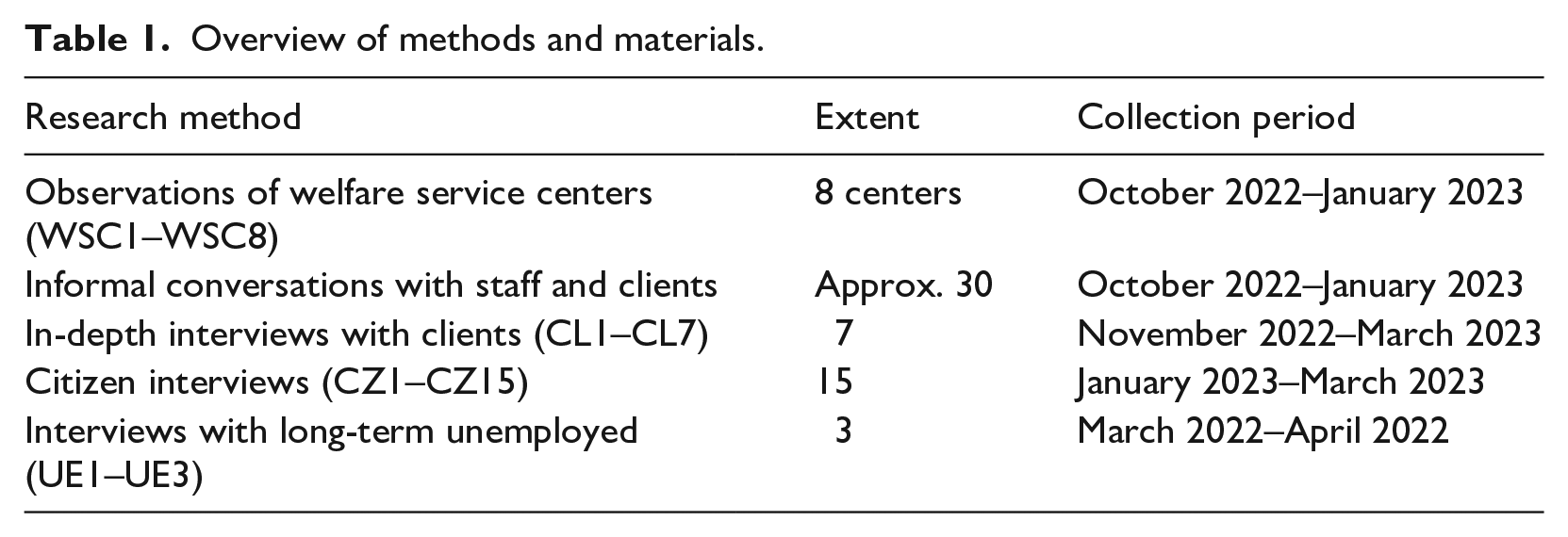
The analysis is based on ethnographically inspired fieldwork (Atkinson, 2014; Hammersley, 2006), including observations at eight welfare service centers in two major cities in Sweden to allow for an in-depth and explorative approach to the analog and digital work conducted at the welfare service centers. The visited service centers were spread out across the two cities and included offices in the city centers as well as in so-called vulnerable suburban areas, which had strong implications for the outlook, workload, and characteristics of the cases handled. The observations lasted between 2 and 5 hours for each visit, and 3 service centers were visited repeatedly amounting to in total 11 field visits. During the observations, which were conducted between October 2022 and March 2023, we informally interviewed both clients and service center employees, mainly caseworkers but also security staff. The observations and conversations were documented in extensive field notes that were taken during and after our visits to the service centers.
For the informal interviews, which amounted to around 30 conversations, we followed up with 7 longer formal interviews after the observations. To contextualize the observations and formal and informal interviews with clients at the service centers, we additionally conducted 3 individual interviews with long-term unemployed and 15 citizens who were employed but had experiences with the digital interfaces of the welfare state. These contextualizing interviews captured attitudes and experiences regarding the current forms of digitalization, including applications of artificial intelligence in the case of one specific government agency (employment services).
The empirical part of the project was approved by the national ethics review board, and we followed the general formal guidelines for work with vulnerable social groups. To ensure the anonymity of our research participants, we do not specify the welfare service centers and cities where the fieldwork was conducted. Specific quotes and episodes are identified with numbers rather than contextual descriptors to ensure that individual cases remain unidentifiable. In Table 1, we detail the materials and descriptors used in the analysis.
Overview of methods and materials.
The collected materials were analyzed through manual coding inductively, with the first author identifying specific expressions for practices related to digital infrastructures. The authors discussed the first round of coding for internal and external validation while consulting findings from previous research.
Analog and digital interfacing of the digital welfare state
In the following section, we present findings derived from the materials described above, but before delving into the analysis, we would like to introduce a scene that we have encountered in slight variation repeatedly during our fieldwork. It illustrates the kind of digital frictions that emerge within the digital welfare state representing simultaneously very typical experiences of both caseworkers and clients at welfare service centers: A woman is sitting in the waiting area for her number to be called. After 10 mins a service worker wearing a green shirt with white letters saying e-days do yourself an e-favor enters the area checking a smart phone and calling the next number in line. The woman who waited patiently approaches her. They walk over to a computer station at a high desk together and the service worker asks what she needs help with. The woman explains that she has received an email about her child benefits. She is asked to submit additional information from her employer and about her salary. She is directed to the application or website of the insurance agency, but just cannot find her way. She needs help. The case worker unlocks the screen of the stationary computer and navigates the woman through the platform, while never touching the keyboard or mouse herself. The woman is supposed to learn by doing the clicking herself. Help to digital self-help is the slogan of the welfare service centers.
In the following, we disentangle the experiences described above moving from spatial arrangements to practices of interfacing the digital welfare state. The following section is structured first around the physical arrangements at the welfare service centers, highlighting how the digital is always dependent on material arrangements. Second, we zoom in on specific practices of maintenance, repair, and care that emerge at the service centers in relation to infrastructures of the digital welfare state.
Spatial arrangements of the service centers
Returning to the initial definition of interfaces as places where independent systems meet, act on, and communicate with each other, the spatial arrangements at the welfare service centers come to the fore. Dubois (2010) speaks of spatial fragmentation in the context of French welfare centers, referring to the rotating desk principle involving shifting workstations for caseworkers at the frontline.
Similarly, the spatial arrangements at the different service centers that we visited reflect boundaries and divides within the digital welfare state, not only between the administration and the clients but also between different geographical areas and social groups. While the service centers in the heart of the big cities are often smaller in size and offer independent access to workstations with computers and printers, the service centers at the fringes of the city and in so-called vulnerable areas differ considerably not only in terms of access to computer workstations but also in the type of furniture (washable imitation leather and plastic benches instead of sensitive materials). All the service centers, however, share the principles of open space and rotating desk arrangements. This means that caseworkers walk the room, equipped with smart phones with the queuing numbers in a smartphone application. Instead of one orderly queue, the waiting clients are drifting in the open space area, waiting for their number to be shouted out by a caseworker. In many cases, the waiting areas are not big enough to offer a seat to all the waiting clients. Caseworkers fetch clients and guide them to shifting workstations placed in the office area. Often conversations between the caseworkers and the clients can be overheard by others. Despite the fact that there are no separate rooms or areas for the meetings between clients and caseworkers, and although many of the strongly frequented offices have at peak times of the month waiting times of up to an hour, the noise level is low. People wait in silence and patiently.
Dubois (2010) not only highlights the overall spatial arrangements but also emphasizes the particular role of the desk in administration: The desk is a separate world within the universe of administration; it is both a boundary and a link between the administration and the outside world. Placed at the intersection of the interior and the exterior, the public and the private, reception agents reproduce this double allegiance in their practices. (p. 76)
The function and outlook of the administrator’s desk have changed since the investigation of Dubois (see Figure 1). The boundary drawing and distinction between the public (the bureaucrat) and the private (the client) is more fluid. In most cases, the workstations are spread out across the room and arranged in islands of four computers. The caseworkers and clients are also standing next to each other, looking at a screen together rather than facing each other across a desk. This arrangement embodies help to digital self-help, which is the main aim and working principle at the welfare service centers we visited. The clients are supposed to find their way through the websites, profiles, and digital services, while the caseworkers guide them along the way. Besides the spatial arrangements of the desks and workstations, the aspiration to digital by default is also visible in the relatively low-scale handling of actual paper records. All the offices have relatively few archiving stations, folders, and filing cabinets. One of the marked characteristics of the welfare state, paper trails, seems to have disappeared (Gitelman, 2014; Vismann, 2008).
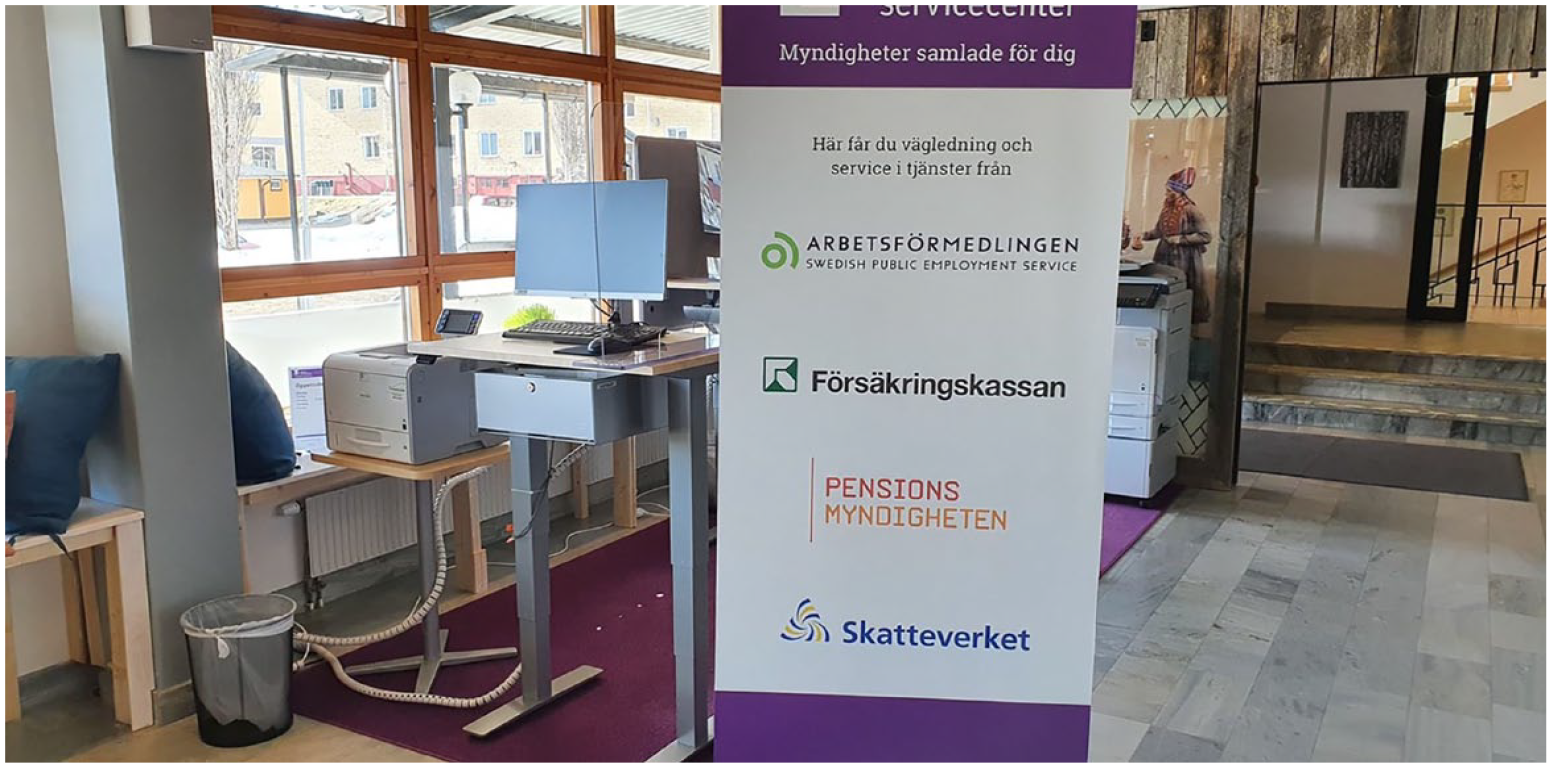
Typical workstation at a welfare service center.
The principle of help to digital self-help is also reflected in specific policies. For example, clients with a digital ID must execute certain tasks themselves, including checking in on the development of their cases. Rather than providing help directly, the caseworkers provide help in navigating the digital gateways and layers of the welfare state: they are interfacing the digital welfare state and citizens as the main element of their job. This marks an important shift in the character of the work that is conducted by the caseworkers, which is further highlighted in their job title. They are service workers rather than caseworkers. Dubois (2010) discusses the communication and explanation of decision-making processes within the public administration as one of the major tasks of caseworkers. In our observations, we saw a clear shift away from this task toward the explanation of different digital platforms that are gateways to public services. This interfacing that is provided at the welfare service centers includes elements of maintenance, repair, and care, which are described in further detail below.
Maintaining
The interfacing practices provided at the service centers concern maintenance tasks, namely the upkeep and support of the digital welfare state. In this context, the role of providing support for digital self-help emerges as the main interfacing practice of maintenance. Along these lines, the service centers are part of the national digital day (digitalidag 2 ) initiative, which highlights digital services across civil society and social sectors in Sweden. The digital day is an annual event across public agencies to enhance and spread digital services among clients. The service centers are attempting to attract attention for the initiative through the distribution of information folders and posters as well as a specific dress code. The initiative is an expression of a larger move to involve civil society representatives, including libraries, the Swedish church, and the public sector (e.g. public agencies with direct client contact), in the push toward digitalization and digital services by default. As part of this initiative, the welfare service centers highlight digital day by wearing special T-shirts and handing out information sheets that emphasize the advantages of digitalization more generally.
This aim and push toward digital self-service are reinforced in a number of posters placed across the service centers. The posters contain the following message: “Do yourself an e-favor. We show you how” (Gör dig själv en e-tjänst. Vi visar dig hur). Hence, besides focusing on the task of explaining the processes and decisions of state bureaucracy, as highlighted by Dubois (2010) in his study of welfare service centers, caseworkers actively maintain the narrative of a digital welfare state as a smooth solution to current challenges, including the lack of resources. Clients should be trained in digital self-service and in the long run move out of service centers.
Repairing
In many ways, the service centers are interfacing the digital welfare state through forms of repair. For example, when clients reach the limits of digital self-help and self-service, the centers come in to solve and repair these evolving issues. These practices of repair emerge in different ways for the different visitor groups. For the more privileged clients, repair often emerges in the context of very complex cases that include several steps of validation and checks, especially if something goes wrong with the process. For example, we spoke with several clients who have lived and worked parts of their lives abroad and are now applying for their pensions. In such cases, specific documentation and exchanges with foreign administrations are necessary. One client shared the following experience: I lived and worked in Germany when I was young, and now I receive parts of my pension even from there, and now the German tax office contacted me and claimed taxes from me, and they wanted specific documents. Parts of the documents I could get online and print at home; others I needed a physical copy of, and then the Germans—they like stamps—so I had to get some official stamps on the documents and submit the originals to them [laughs]. (Informal conversation at WSC5)
The clients in this group prefer digital services but have not managed to conclude all the necessary steps in the different platforms involved.
Another aspect of the repair practices at service centers are failures in other interfacing infrastructures. Reoccurring issues are the long waiting times for calls and dissatisfaction with call center help. One client shared the following: For me, it is best to go to the service center. You often have to wait for such a long time when you are calling or you are calling the wrong number or are redirected to the wrong person, and then you have to start over again. You just get so angry. You just don’t have the time to wait all day by the phone. The line is often busy or something. You just get very tired of it. (Informal conversation at WSC7)
The repair work is also related to the fact that the service centers are interfacing with public agencies and in some cases are repairing the relationship between the public agency and the client. In one episode, the caseworker at the service center was on a phone call with the tax agency. The mood was shifting quickly, causing a tense tone in her voice. She insisted that the tax agency caseworker support her in her effort to correct a mistake in the processed documents. At some point, she exclaimed, “You need to take this case, here and now. She is right here and does not understand” (observation WSC2), all the while trying to retrieve documents at the workstation together with the client.
Hence, the practices in relation to infrastructures of the digital welfare state that we encountered are not frictionless. On the contrary, they often emerge in the context of interface frictions, whether between citizens and digital platforms or between service workers and different agencies. Minna Ruckenstein (2023) explores frictions in algorithmic relations as mundane ways in which users relate to algorithmic infrastructures in diverse contexts. Similarly, frictions in relation to digital infrastructures emerge in the context of the digital welfare state and are handled—that is, repaired—at the service centers.
In this mediation between the different public agencies that the service centers support, the caseworkers are constrained by infrastructural aspects. Most problematic are supporting cases related to employment services, as the caseworkers do not have access to the relevant service infrastructure. Consequently, they cannot give details on the specific cases and processes. This constraint was identified as a major issue by several caseworkers.
Caring
The care work provided by caseworkers at the service centers is related to the emotional and affective dimensions of interfacing the digital welfare state. For many among the vulnerable clients, the support needed is related not so much to issues of navigating digital infrastructures but rather to affective dimensions. One caseworker shared the following: Those who come here often have different issues, with the language, with writing, or they just want to get a reinsurance that their paperwork was submitted in the correct way and will be processed correctly. They sometimes fill out forms at home at their own computer and submit there, but then they show up here and want reassurance that they have submitted, for example, their activity reports for the employment services correctly. “Can you check?” is a reoccurring request. Others come here just for the social contact and small talk, just to meet somebody. But yes, I have thought about this a lot. Why are people taking the hassle of getting here through a snowstorm and everything? (Informal conversation at WSC3)
Several clients we talked to at the service centers confirmed this picture of the affective dimensions involved in interfacing with the digital welfare state. Many clients need reassurance that they have done everything right at home, as failure might have critical consequences, including missed benefit payments.
The care-related interfacing at the service centers also includes clear demarcations of the boundaries of care work. In one episode, a caseworker made clear to a client that they could not give them specific recommendations for schools. The client initially asked for help navigating the platform where parents and caregivers submit their priority lists for schools. From a question related to digital infrastructure, the conversation quickly moved to the specific schools and their advantages and disadvantages. The caseworker remarked explicitly that “like everything in Sweden, you need to find out and choose yourself. We cannot help you with that” (informal conversation at WSC5). The conversation was then redirected to the screen and the platform that initiated the visit.
Discussion and conclusion
Previous research engaging with the digital welfare state has focused on digital infrastructures and specific applications themselves as well as the changing practices of case and service workers. Broader explorations of specific place that supposedly support the introduction and further expansion of the digital welfare state by supporting marginalized and digitally excluded populations are still rare. Furthermore, conceptual work that goes beyond the analog/digital division is still lacking. This article is an attempt to fill these research gaps.
Accordingly, we have presented practices of interfacing that are currently conducted at welfare service centers. These practices include repair, maintenance, and care work. The focus has been on how these practices emerge in relation to the digital infrastructures of the welfare state, with their varying implications for different social groups. Adding to previous research on the digital inequalities emerging in the context of digital public services, this article deepens our understanding of specific places, such as welfare service centers, as necessary preconditions of the digital welfare state. Such places still remain largely invisible in discussions of digitalization, algorithmic automation, and artificial intelligence in the public sector and beyond. To conceptualize this role of the service centers, we introduce the notion of the interface, which helps make sense of the practices that emerge at the centers in relation to the digital infrastructures of the welfare state.
One common feature that we observed is that the interfacing practices at the welfare service centers are often redirected from the case itself to the digital mediation of welfare. Instead of explaining the logics of benefit approval, processing, evaluations, and access criteria set by specific public agencies, which was one of the earlier major tasks of caseworkers at service centers (Dubois, 2010), we observed conversations focusing on navigating the different platforms and profiles that have to a large extent replaced the paper-based forms and files. This is related to the diverse tasks that the caseworkers at the service centers must deal with. As several caseworkers confirmed, they need to have a rather broad knowledge of all agencies for which they deliver services rather than the specialist expert insights that used to be required for their work. The common denominator has become not the decision-making process itself but the digital infrastructure, namely the platforms that mediate digital welfare.
Both the increased reliance on digital services and the fact that welfare service centers cater to clients of different national agencies are forms and expressions of the centralization of welfare provision. The service centers gather diverse welfare services delivered by the employment services, the social insurance services, the pension services, and the tax agency, which all have diverse areas of responsibility. Similarly, digital services are further standardizing and streamlining services. In the future, it remains to be seen whether one centralized platform will deliver all services at the national level.
We have shown that service centers interface citizens and state services in diverse ways. We have particularly focused on the forms of maintenance, repair, and care that have come to the fore. All these forms of interfacing are important ways of undergirding and fostering the digital welfare state further. This has become especially apparent in the strong focus on help to digital self-help, which the service centers center their work around. While the implementation of digital public services is mainly justified through efficiency and fairness arguments and immense resources are directed toward supporting digital self-help, certain client groups remain outside of the digital welfare state. The reasons for their exclusion are not easily tackled through the kinds of information campaigns or skills and literacy training that we touched upon above. In particular, the affective dimensions of state–citizen relations that emerge at the welfare service centers remain important to both clients and caseworkers. In this sense, welfare service centers should be considered as important analog parts of the digital welfare state, filling crucial functions beyond training people for digital self-help. This acknowledgment also highlights the remaining boundaries of the digital welfare state that need further attention. We suggest that service centers and similar public spaces, such as public libraries and schools, need further attention in the context of discussions of the digital welfare state. Further research is needed that advocates people-centered approaches to digital welfare and related infrastructures including those in the periphery highlighting the politics of digitalization in the public and welfare sector and beyond. Public administration and welfare provision figures here as an example of broader societal shifts that are connected with digitalization including further individualization, standardization, but also fragmentarization in later modern societies.
Future research could combine the analysis of welfare service centers with investigations of other “marginal” spaces within the digital welfare state, including libraries and cultural centers that support vulnerable and digitally excluded populations in their interactions with the digital welfare state. Here, it would be especially interesting to engage with the intersections between the analog, that is, paper-based work, and the digital, that is, online applications.
Footnotes
Funding
The author(s) disclosed receipt of the following financial support for the research, authorship, and/or publication of this article: The research was supported by the Baltic Sea Foundation.
