



Abstract
Eliciting user reactions is an important tactic for political actors using social media like Facebook to seek attention for campaign messages on policy issues. Still, little is known about policy issues’ effect on user reactions and how structural factors play into this relationship. Applying a standardized manual content analysis on Facebook posts from political parties and their top candidates during the German, Hungarian, and Norwegian national election campaigns in 2021/2022 (N = 4988), we investigate the relationship between policy issues and two of Facebook’s “emotional reactions” (“angry” and “love”). We find that posts addressing the economy, energy policy, and foreign policy drive more “angry” reactions, while environmental posts drive more “love” reactions. While effects are largely uniform across different party types, there are more variations between countries. Our analyses suggest that differences between individual parties and candidates and situational factors are vital to understanding the relationship between policy issues and user reactions.
Keywords
Introduction
Election campaigns revolve around policy issues, and determining which policy issues to focus on is a central component of creating a campaign strategy (Wagner and Meyer, 2014). However, on social media platforms, a central area of contemporary campaigning, issues’ substantive relevance is not the only strategic aspect political actors must consider. Since being heard is a key challenge in the information-abundant social media environment, parties need a communication strategy that helps them gain visibility. Emotions are regarded as important drivers of message diffusion on social media (Zerback and Wirz, 2021), especially on Facebook, which offers users emoji-based “emotional reactions” to publicly express their responses to content. Since “user reactions” are key in the algorithmically determined circulation of political content on social media (Berger and Milkman, 2012), eliciting such engagement has become an important tactic of effective political communication (Bene, 2017; Keller and Kleinen-von Königslöw, 2018). In other words, when parties decide on which policy issues they emphasize on these platforms, they must consider these issues’ emotional reception.
Empirical studies have linked emotions to information-processing (Marcus et al., 2019), political participation (Valentino et al., 2011), and voting decisions (Brader, 2006). While it is nothing new that election campaigns are affective and include emotional appeals, the propagation of social media amplifies this development (Klinger et al., 2023). Different social media enable different forms of emotional interaction which affect public debate conditions (Wahl-Jorgensen, 2019). One particularly influential form of emotional interaction is Facebook’s “emotional reactions” (Wahl-Jorgensen, 2019).
“Emotional reactions” gives citizens an easy way to express their emotions about issues and for campaigns to measure and align their strategies to such reactions. Two of Facebook’s “emotional reactions” are particularly telling: the “angry” and “love” buttons represent anger and strong positive emotions, respectively (Jost et al., 2020). These “emotional reactions” are the most accessible proxy for parties to measure how voters react emotionally to campaign messages on social media. Parties can scrutinize which “emotional reactions” messages receive and consciously use emotions to their advantage. Ultimately, “emotional reactions” may contribute a certain affective spin to election campaigns’ issue agenda. Therefore, understanding the relationship between “emotional reactions” and one of the most important components of election campaigns—issue agenda—can yield crucial insights about the potential of social media for political campaigns and political participation.
We still have limited understanding of whether and how policy issues trigger “emotional reactions.” Although dominant media effect theories (e.g. the agenda-setting and priming theories) argue that media primarily influence politics through their issue agenda and user engagement shapes the issue agenda on social media, policy issues’ engagement-triggering potential is less studied (Magin et al., 2021). While “emotional reactions” provide a useful venue into this topic, the relationship between policy issues and “emotional reactions” is largely unexplored (for notable exceptions, see Blassnig et al., 2021; Eberl et al., 2020), and we still lack the comparative insights on how policy issues affect distinct “emotional reactions” that could further theoretical knowledge on this topic.
To break new ground, it is first necessary to establish whether there is a systematic relationship between policy issues and “emotional reactions” on Facebook. We have chosen to study Facebook because its “emotional reactions” is a prominent example of how social media’s “emotional architecture” can influence public discourse online (Wahl-Jorgensen, 2019). To that aim, our study (1) investigates the relationship between policy issues and the “angry” and “love” reactions to messages posted by parties and top candidates on Facebook during election campaigns and (2) explores how structural factors on the meso (party) and macro (country) level play into this relationship.
We apply a comparative and multilevel research design. Identifying general patterns and advancing theoretical knowledge on political communication on social media necessitates cross-national empirical studies (Esser and Vliegenthart, 2017) outside the oft-studied US context. These calls from previous literature are especially relevant for studying emotions and policy issues on social media because their relations presumably are highly contextual. Therefore, we compare three European countries: Germany, Hungary, and Norway that held national elections in 2021/2022. The countries differ, despite many similarities (e.g. Facebook being the most used social media platform in all of them; Newman et al., 2022), on a few dimensions and allow for comparisons on party- and country-level contextual factors.
Our analytical strategy is twofold: first, we apply a standardized manual content analysis on Facebook posts from political parties and their top candidates during the German, Hungarian, and Norwegian national election campaigns in 2021/2022 (N = 4988). Furthermore, we draw inspiration from previous, similar research (Bruns and Enli, 2018; Bruns and Moon, 2018) and complement our quantitative analyses with examples of individual posts that became especially popular in terms of “emotional reactions.” In so doing, we aim to provide a deeper understanding of the factors triggering “emotional reactions” to political posts.
Conceptual framework
Relevant to understanding individuals’ emotional responses to policy issues are appraisal theories, which suggest that emotions and action tendencies result from individuals’ evaluation of events and their causes (Scherer, 2005). Individuals evaluate personally relevant issues according to perceived threat, responsibility attachment, and coping potential, resulting in discrete negative (e.g. anger, sadness) or positive (e.g. pride, hope) emotions. Anger occurs more likely if an individual perceives a situation as important, goal-incongruent, and intentionally caused by others who could be held responsible (Zerback and Wirz, 2021). Moreover, since both anger and enthusiasm prompt habit-reliance and decrease information-seeking (Marcus et al., 2019), these emotions potentially lower the threshold of sharing emotional expressions in responses to political posts.
Individuals’ affective responses do not however determine emotional expressions in mediated contexts. Therefore, our study relies on a sociological perspective that understands emotions as evolving from interactions between individuals’ affective responses, culture, and underlying social structures. Emotions become public and political through naming, articulation, and circulation (Wahl-Jorgensen, 2019; Wettergren, 2005), for example, on social media.
“Emotional reactions” on Facebook
Facebook provides six emoji-based buttons representing different emotions: “love,” “haha,” “wow,” “sad,” “angry,” and “care.” These “emotional reactions” drive visibility within Facebook more strongly than the “like” button (Merill and Oremus, 2021). Facebook has therewith created new opportunities for political actors to scrutinize user reactions, gauge the reception of their messages, and align their communication strategies to what provokes emotional responses and is thus perceived as successful (Jost, 2022; Jost et al., 2020).
Our study is limited to “love” and “angry” reactions. Research has found these to be the most often used “emotional reactions” within political communication (Pew, 2018). Moreover, while citizens’ motivations behind clicking on “like” or other “emotional reactions” are ambiguous, “love” and “angry” have been argued to represent “positive and negative one-click expressions of emotions” (Jost et al., 2020) and to mirror “users’ apparent emotional responses” (Eberl et al., 2020: 50). Furthermore, “angry” and “love” represent emotions with a mobilizing potential, meaning that the consequences of eliciting these “emotional reactions” might be stronger than with other “user reactions.” “Angry” signals anger, one of the most potent emotions in political campaigns: research suggests that this “negative emotion” can increase campaign messages’ persuasiveness, increase citizens’ attention toward campaign messages, and mobilize them to participate in political actions (Valentino et al., 2011). “Love,” shaped like a heart, is not explicitly linked to a discrete emotion but is often framed as representing strong positive emotions. While less persuading and mobilizing than anger, positive emotional states have also been linked to increasing citizens’ willingness to participate in politics (Brader, 2006; Valentino et al., 2011).
The choice of citizens to express “emotional reactions” on a political post and what they inscribe in such an act is shaped by several factors: their own culturally contingent interpretation of their affect toward the content and publisher of the post; their motivation and individual resources for political participation; the potential reactions of the individual’s Facebook network to the emotion expressed (since clicking on “emotional reactions” becomes visible to the network); the technical opportunities, constraints, and communication norms of Facebook, as interpreted and acted upon by individuals; and the specific situation. While we can never know for sure what motivates engaging in these forms of engagement (Koc-Michalska et al., 2021; Lomborg and Bechmann, 2014), the practical outcome of such use is nevertheless the same. By reacting to a Facebook post, users help boost its visibility. For political actors, invoking “emotional reactions” accordingly contributes to spreading and intensifying messages, putting additional emphasis on the policy issues they highlight and possibly strengthening their election chances.
Factors influencing “emotional reactions”
The selection of issues that political actors choose to address in their campaigns is a strategic decision. Since parties’ and candidates’ campaign practices on the micro-level are embedded in context factors on the macro-level (countries) and meso-level (parties), these need to be considered when we want to explain them (Strömbäck, 2007). Figure 1 summarizes the factors included at each of our three levels of analysis.
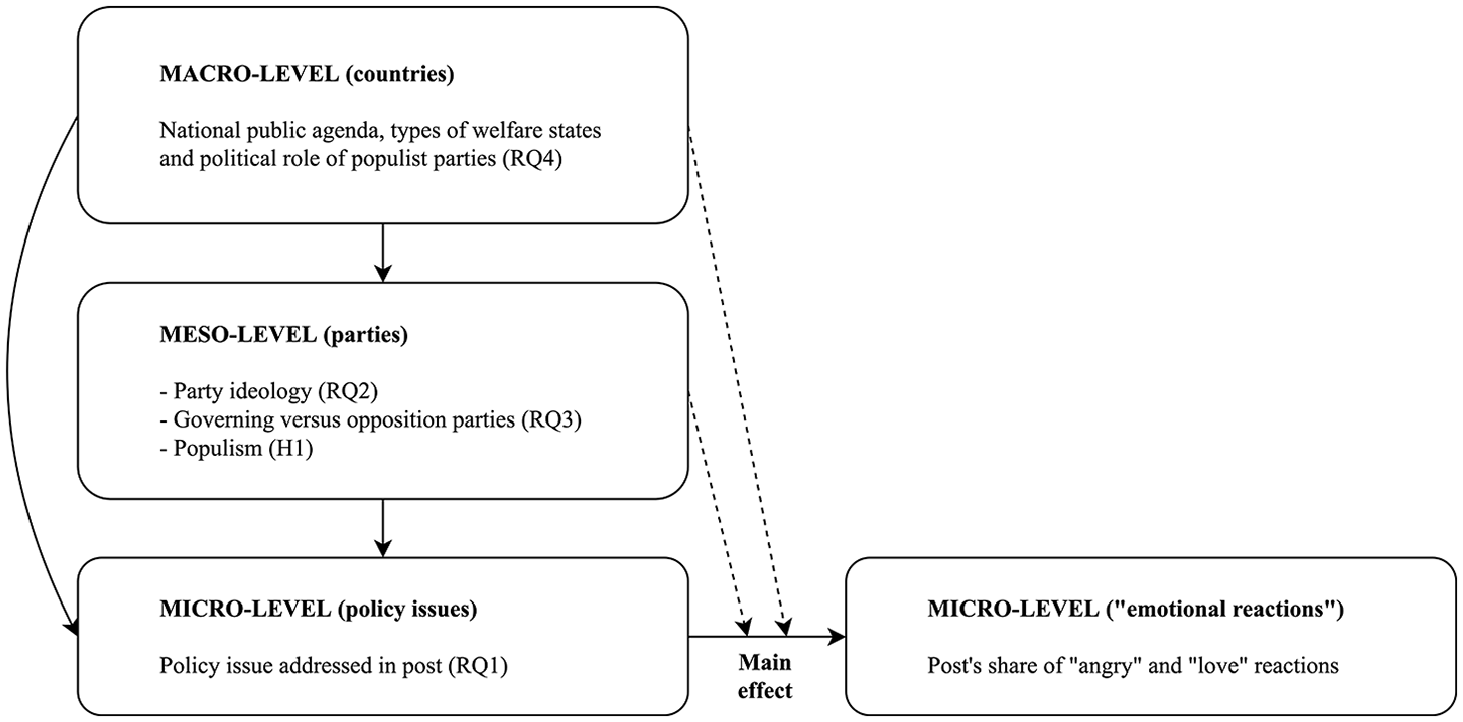
The relationship between policy issues and “emotional reactions” on Facebook.
Micro-level (policy issues)
Despite the central role of policy issues and “emotional reactions” in election campaigns, their relationship is widely unexplored. Some studies have found connections between policy issues and user engagement in general (Bene, 2021), policy issues and negative user comments (Stetka et al., 2019), and certain policy issues and user engagement. While the environment and economy seem to decrease user engagement (Bene et al., 2022), foreign policy has been found to both increase (Heiss et al., 2019) and decrease user engagement (Trilling et al., 2017).
Our study includes five policy issues that were prevalent in parties’ and top politicians’ campaign material on Facebook in the recent national election campaigns in Germany, Hungary, and Norway: economy, energy, environment, foreign policy, and social policy (see “Method” section for selection criteria). The policy issues differ in personal relevance for citizens and thus their emotion-eliciting potential, as suggested by appraisal theories. While environmental and foreign policies arguably are less personally relevant for most citizens, many citizens have concrete experiences with the effects of social policy, energy policy, and economic policy. Although economic issues are often complex, which in itself could generate lower user engagement, economic policy may have serious and tangible effects on individuals during crises, and economic crises have been linked to negative emotions and low political efficacy. All three investigated election campaigns happened during crisis times such as the Covid-19 pandemic and, for Hungary, the war in Ukraine, which may have spurred citizens’ calls for radical change.
However, “emotional reactions” are specific forms of mediated expressions of emotions and citizens’ motivation to click on them is shaped by several factors (see above). Therefore, the assumption from appraisal theories needs to be tested empirically.
To date, studies investigating the relationship between policy issues and “emotional reactions” more specifically are scarce. Blassnig et al. (2021) found that parties’ top issues did not receive more “emotional reactions” than posts on other issues. However, as their study focuses on parties’ “owned” issues and aggregates the “emotional reactions,” whether different policy issues drive different “emotional reactions” remains an open question. Eberl et al. (2020) investigate whether the salience of policy issues (according to constituents) drives “angry” and “love” reactions and find that salience only influences the number of “angry” reactions, suggesting a weaker link between policy issues and positive emotional responses. Due to the overall scarce and mixed state of research, we formulate a research question:
RQ1. Does the number of “angry” and “love” reactions differ between policy issues?
Meso-level (parties)
We expect that policy issues will generate different numbers of “emotional reactions” depending on who posts them. We have therefore included party types (meso-level) in our analysis. Specifically, we expect three structural differences between party types to influence this relationship: party ideology (left/right), government versus opposition party status, and whether the party can be characterized as populist.
Party ideology
Political actors’ decisions about issue salience can help explain electoral success or defeat (Wagner and Meyer, 2014). While changing issue positions during election campaigns is often a dangerous strategy, changing issue salience can be smart if one wants to cater to current events and citizens’ concerns (Sides, 2006). This makes determining which policy issues to focus on central in creating a campaign strategy. Two key strategies are broadly discussed in the literature: parties can either focus on issues citizens identify them with and find them competent to handle (issue ownership strategy: Petrocik, 1996), or on issues that currently concern citizens (“riding the wave” strategy: Ansolabehere and Iyengar, 1994). Combining both strategies—provoking emotions about an issue the party “owns” and the citizens are concerned about—can gain campaign visibility and engagement. If parties do not adjust their strategies, however, Facebook kind of does it for them: the algorithms that determine the visibility of content steer which issues become salient for users. Thus, “emotional reactions” will play a role in issue salience independent of the parties’ strategic decisions. The same issue will probably generate a different number of “emotional reactions” depending on who posts it, depending on parties’ different placement on the classical left/right ideological cleavage. Left-leaning voters might be more emotionalized by “left-wing issues” (e.g. social policy, environment), right-leaning voters more by “right-wing issues” (e.g. foreign policy, energy, economy). Since research on this question is lacking so far (but see Sandberg, 2022, for a discussion of socially mediated issue ownership), we formulate a research question:
RQ2. Does the ideological leaning of parties moderate the relationship between policy issues and “angry” and “love” reactions?
Governing versus opposition parties
Appraisal theory suggests that anger may occur if an individual is unhappy with the status quo, thinks this negative situation could have been avoided, and holds someone accountable for it (Jost et al., 2020; Schemer, 2014). Parties currently in opposition may leverage this anger-provoking potential more strongly than governing parties when expressing their dissatisfaction with the status quo in their posts. However, it is also conceivable that citizens hold government parties—who made the decisions in the last term—responsible for negative developments. This might foster more “angry” reactions on the posts of governing parties. Due to these conflicting conclusions, we formulate a research question:
RQ3. Do government or opposition parties attract more “angry” reactions with their posts on policy issues?
Populism
In line with previous studies, we understand populism as a “thin ideology” comprising a set of ideas about the relationship between the (corrupt) elite and the (pure) people, which can be advocated by both left- and right-wing political parties (Mudde, 2004). In Europe, right-wing populist communication has been studied quite extensively and findings show that populist communication indeed elicits emotions (Reinemann et al., 2016; Wirz, 2018; Wirz et al., 2018). Populist politicians use social media actively, and their messages on Facebook and Twitter (now X) engage reactions (Jacobs et al., 2020; Sandberg et al., 2022). Schmuck and Hameleers (2020) found similar results regarding platforms, and they also point out that the populist style of messages was more important for triggering reactions than the content. Right-wing populists were more successful in this regard than left-wing. Furthermore, populist parties are more active on social media and have more followers than other parties (Engesser et al., 2017). Since they draw their success from protesting against the establishment, they have a particular interest in generating negative emotions. Therefore, we hypothesize:
H1. Posts on policy issues receive a higher share of “angry” reactions when addressed by populist parties.
Macro-level (countries)
Which content is addressed how often and which posts users engage with is to a certain extent shaped by the country context in which they are published. The geographical region people come from can affect their behavior on social media. Following a most similar systems design, we chose to compare Germany, Hungary, and Norway, all European parliamentary representative democracies with some differences. First, they belong to different geographical regions within Europe (Germany: Continental Europe; Hungary: Eastern Europe; Norway: Northern Europe), which makes them interesting to compare since previous research showed some differences in user engagement between these regions (Bene et al., 2022). It is not likely that the geographical location in itself affects user engagement but rather structural differences related to each region. We identified three factors characterizing their political systems that seemingly influence “emotional reactions” on issues: the national public agendas, the type of welfare state, and the role of populist parties in the national party systems (Table 1).
Relevant structural differences between Germany, Hungary, and Norway.
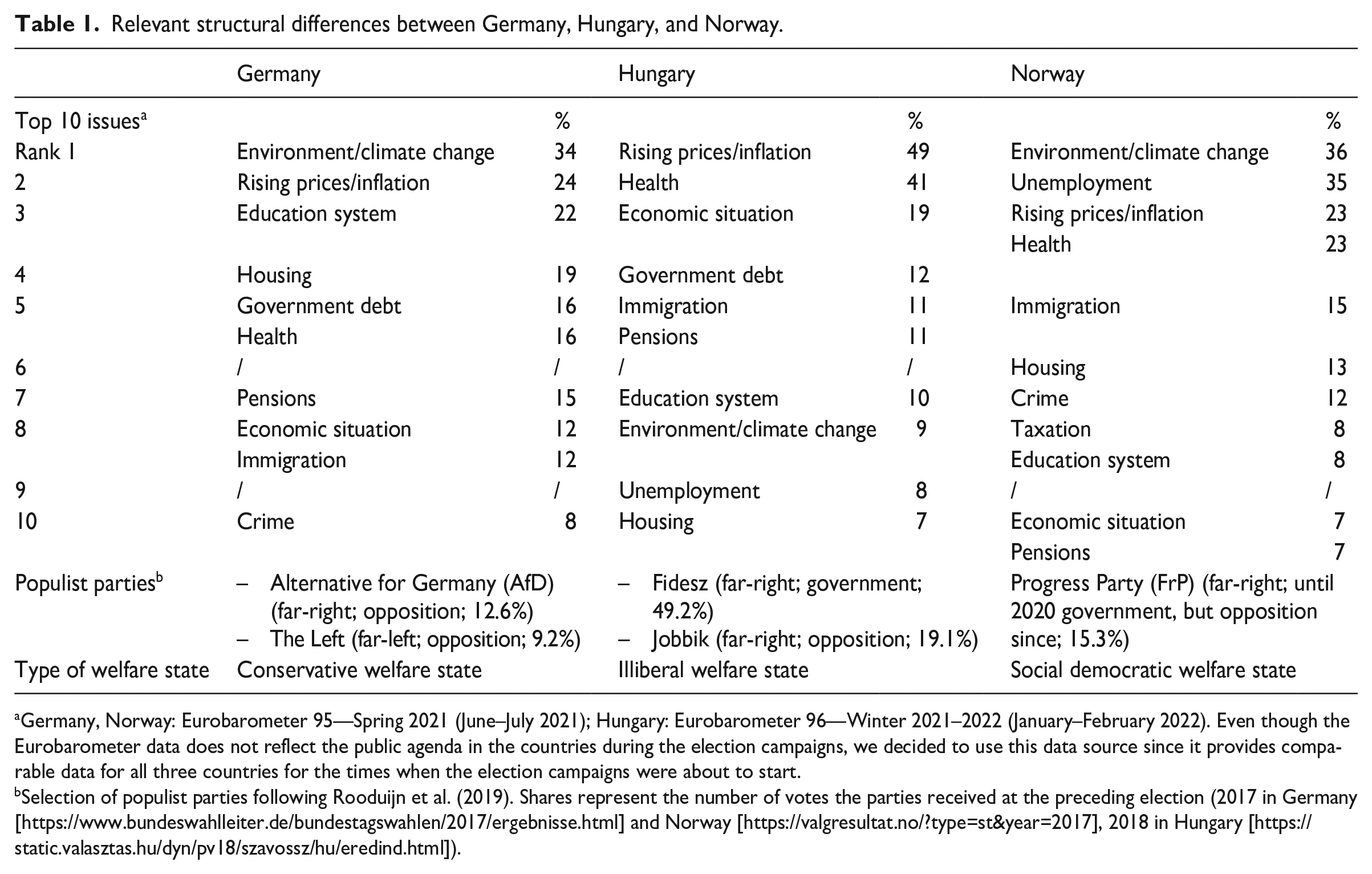
Germany, Norway: Eurobarometer 95—Spring 2021 (June–July 2021); Hungary: Eurobarometer 96—Winter 2021–2022 (January–February 2022). Even though the Eurobarometer data does not reflect the public agenda in the countries during the election campaigns, we decided to use this data source since it provides comparable data for all three countries for the times when the election campaigns were about to start.
Selection of populist parties following Rooduijn et al. (2019). Shares represent the number of votes the parties received at the preceding election (2017 in Germany [https://www.bundeswahlleiter.de/bundestagswahlen/2017/ergebnisse.html] and Norway [https://valgresultat.no/?type=st&year=2017], 2018 in Hungary [https://static.valasztas.hu/dyn/pv18/szavossz/hu/eredind.html]).
National public agenda
The more relevant citizens consider an issue, the more users will pay attention to and react to posts on it. Therefore, we consider the national public agenda a potential relevant factor influencing the amount of reactions on certain issues. Since the public agenda—the topics considered important by the population—are influenced by national problems and events, it is not surprising that the national public agendas in the forefront of the elections investigated here considerably differed. Even though neither campaigns are mere mirrors of the public agenda nor are the Facebook users representative of the national population, it is strategically wise to address central concerns of the population to win votes.
Types of welfare states
One issue we investigate in our study is social policy. How important this issue is to the citizenry and how strongly they will react to it in which manner might be affected by the structural importance of social policy in their countries. Relevant in this respect is the difference that the three countries belong to different types of welfare states, which might be reflected in different “emotional reactions” to social policy issues. Norway is a social democratic welfare state with a universalistic view on social security and social services, considering very generous services a state task. Germany is a conservative welfare state connecting social security with participation in the labor market and assigns care tasks to families, particularly women (Eggers et al., 2019). The process of democratic decline Hungary is currently facing makes the classification challenging. However, Szikra and Öktem (2023) classify Hungary as an illiberal welfare state, combining decreasing social spendings in some areas (e.g. elimination of early retirement opportunities) with increasing spendings in others (e.g. families).
Political role of populist parties
Due to populist parties’ particular success of eliciting emotions and generating user engagement on social media (see section “Populism”), the centrality of populist parties in a party system might affect “emotional reactions,” leading to higher user engagement in countries with more central populist parties. Empirical findings on such a contagious effect of populism are mixed and do not allow any clear statements as to whether and to what degree this phenomenon exists (Rooduijn et al., 2012). The political role of populist parties differ in the three studied countries and might be an important structural factor for our study. At the time of the elections, populist parties were most central in Hungary (Rooduijn et al., 2019), being governed by the populist Hungarian Civic Alliance (Fidesz) and with the populist Movement for a Better Hungary (Jobbik) as largest opposition party. Germany had two smaller populist opposition parties. In Norway, Rooduijn et al. (2019) classify only the Progress Party (FrP) as populist, a former governing party that went into opposition during the term in 2020, but this classification has recently been questioned (Jenssen, 2017).
Due to the complexity of the interrelations between country characteristics and user reactions and the lack of previous research thereon, we formulate a research question:
RQ4. Does the number of “angry” and “love” reactions on policy issues differ between Germany, Hungary, and Norway?
Method
Sample and data collection
We answer our research questions and test our hypothesis through a quantitative content analysis of the Facebook pages of political parties and their top candidates in the 2021/2022 national election campaigns in Germany, Hungary, and Norway. The investigation period in each country covered 4 weeks before the respective parliamentary election and ended on election day (DE: 30 August–26 September, 2021; HU: 7 March–3 April 2022; NO: 17 August–13 September 2021). We chose to investigate election campaigns as phases of intense political communication allowing for good cross-country comparability. We focus on the most influential political actors, defined as the parties that made it into the national parliaments and their party leaders/top candidates (Table A1 in the Supplemental Appendix). We coded all posts published by these actors in the period investigated. The post content and metadata were collected using the CrowdTangle API. Our sample comprises 4988 Facebook posts (DE: 1529; HU: 2429; NO: 1030).
Measurement
Our dependent variables are the numbers of “angry” and “love” reactions from the automatedly collected meta.
Independent variables coded per post (micro-level)
For each post, we detected which classical policy issues it addressed. Each issue was coded binary (present/not present) in a separate variable, allowing all present issues to be coded per post. To ensure a sufficient number of observations from each country, our analyses focus on issues that were present in at least 3% of the posts in each national campaign, leading to four topics: social policy (e.g. labor and social issues, wages, pensions, health, pandemic, health insurance, family policy, education, childcare, education—DE: 27%; HU: 6%; NO: 56%), the economy (e.g. regulation of the economy like taxation, austerity, or trade agreements—DE: 23%; HU: 8%; NO: 30%), foreign policy (e.g. international agreements or EU relations—DE: 6%; HU: 7%; NO: 6%), and energy (e.g. energy safety or legislation concerning energy prices—DE: 4%; HU: 4%; NO: 11%). Since environmental policy (e.g. climate change, protection of forests, animal protection) was a key issue in Germany (18%) and Norway (28%), we made an exception and included it in the analysis despite being addressed in only 2% (n = 42) of the Hungarian posts. Also, considering certain issues that clearly differ in importance between the countries can contribute to our theoretical understanding. For the distribution of policy issues per party, see Table A2 (Supplemental Appendix).
Independent variables coded per account (party)
For each page, we coded whether the owner party was in government or opposition in the term coming to an end; whether the party is ideologically left or right leaning; 1 whether the party is populist according to Rooduijn et al. (2019); and which country the party campaigned in (for an overview see Table A1).
Control variables
As the “emotional reactions” on a post may be affected by both post- and account-level factors, we include several control variables in our models. For each post, we include whether it included images/videos; whether it contains original content (in contrast to content shared from other originators); and the total amounts of user reactions (likes and all six “emotional reactions”; collected automatedly by CrowdTangle). We also included whether the post included populist appeals, which previously were found to drive “angry” and “love” reactions (Jost et al., 2020). Populism was measured as a three-dimensional concept consisting of references to the people, anti-elitism, and exclusion of out-groups (Reinemann et al., 2016; for more details, see Table A3 in the Supplemental Appendix).
Reliability
Separate national coder teams (number of coders: DE: 4; HU: 4; NO 3) were intensively trained on the joint English codebook from the project “Digital Election Campaigning Worldwide (DigiWorld)”, allowing for cross-country comparability. Due to the national elections taking place at different times and the coding materials being in different languages, we could not perform cross-country reliability tests. However, to ensure cross-country comparability, we jointly developed the codebook based on a similar one we had jointly developed in “Campaigning for Strasbourg (CamforS)” where the cross-country reliability test showed satisfying coefficients. During the joint development phase, we had intense discussions on the categories and their meaning, and we also exchanged during coder training. Reliability was satisfying for all variables used in our analyses (Table A4 in the Supplemental Appendix). We calculated Brennan & Prediger’s kappa which, different from Krippendorff’s alpha, provides a chance corrected indicator for the reliability of individual categories while being robust for binary codings also for sparse categories which makes it better suited for evaluating the reliability of our variables (Quarfoot and Levine, 2016).
Analyses
First, we ran a two-level negative binomial regression analysis to identify what predicts “love” and “angry” reactions. Due to the nested nature of our dataset, we used random intercepts on the level of accounts, and country dummies were added as fixed effect to the models, meaning that a third level (country-level) also is controlled for despite the two-level design. We opted for negative binomial regression since our dependent variables are overdispersed count variables. We calculated four regression models for each engagement type (“love” and “angry” reactions, respectively) as dependent variables whose results are shown in Table A5 (Supplemental Appendix). Models 1 (“love”) and 5 (“angry”) contain all policy issues and control variables, models 2 (“love”) and 6 (“angry”) include interaction terms between policy issues and party ideology, models 3 (“love”) and 7 (“angry”) include interaction terms between policy issues and party position (government/opposition), and models 4 (“love”) and 8 (“angry”) include interaction terms between policy issues and countries.
In addition, we include scatterplots to allow for more insights into the relationship between policy issues and “emotional reactions” (Figures 2 to 6). The degree to which individual posts received “love” and “angry” reactions and total user reactions is visualized by placement along the different axes and by node size. Color is used to identify the countries. Nodes representing posts that emerged as particular drivers of “love” and “angry” are provided with summary captions to indicate the topic of such emotional-evoking content. In these graphs, we do not use absolute numbers of love and “angry” reactions but see these reactions relative to the parties’ or candidates’ number of followers to not disadvantage smaller parties.
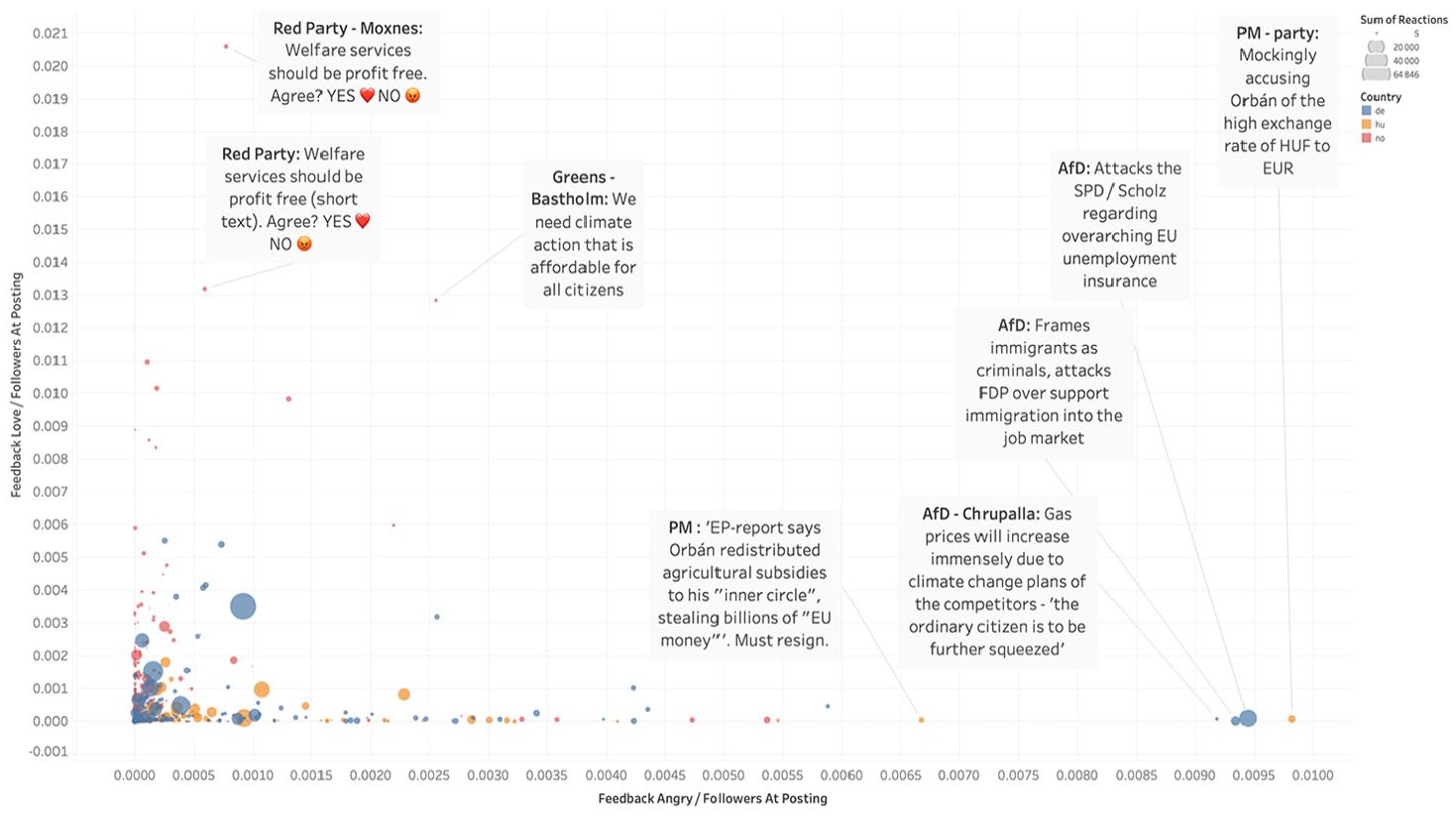
“Angry” and “love” reactions to economic policy.
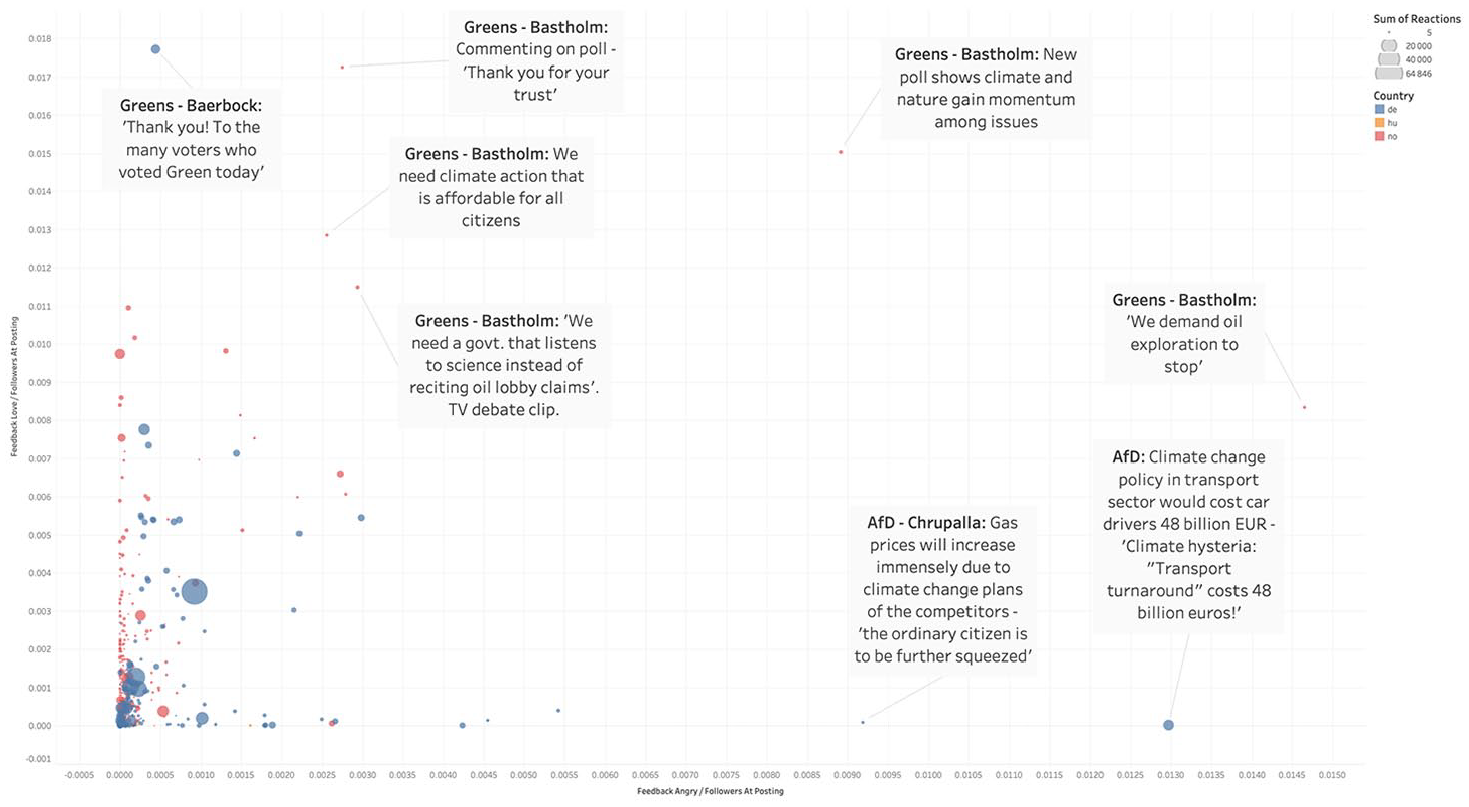
“Angry” and “love” reactions to environmental policy.
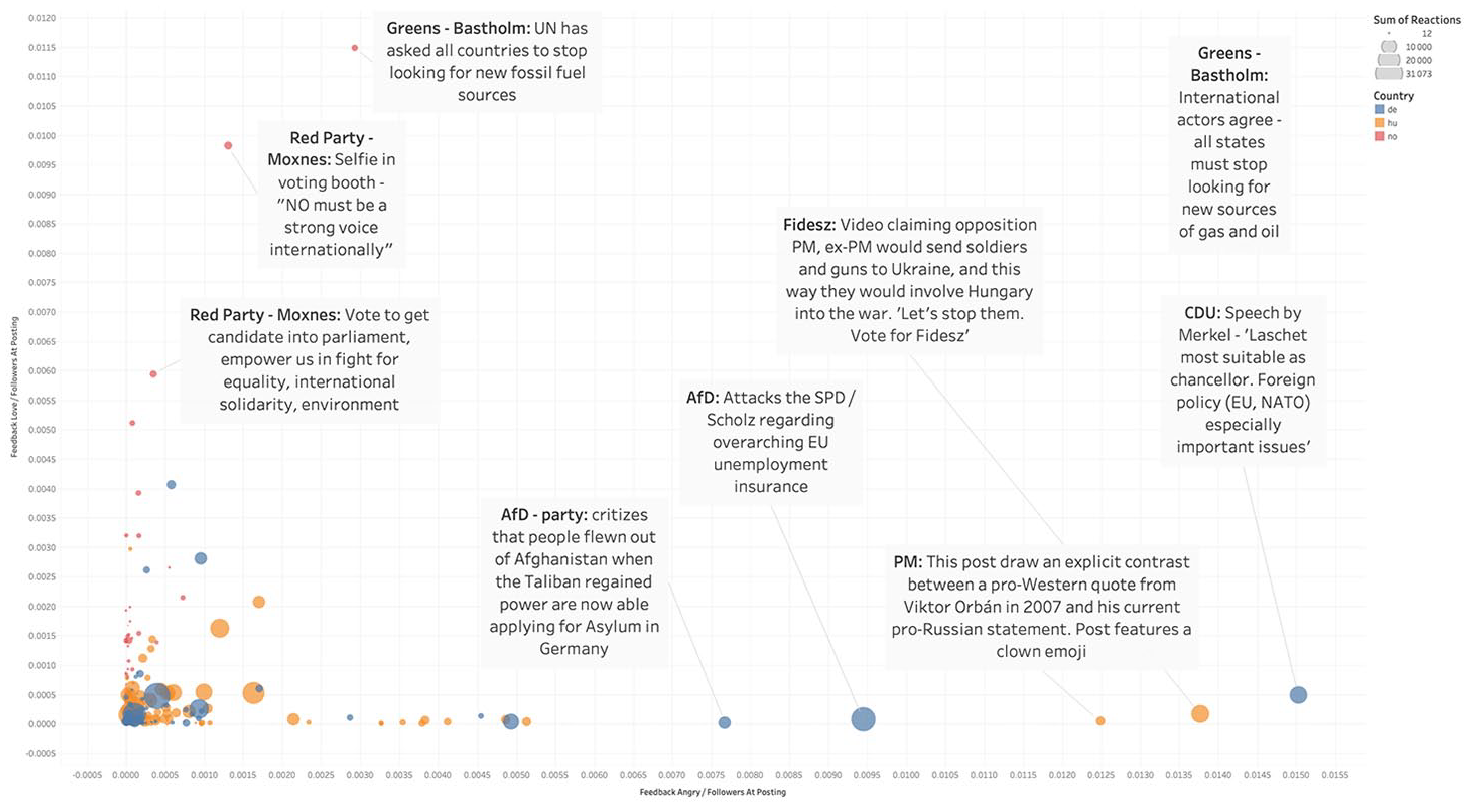
“Angry” and “love” reactions to foreign policy.
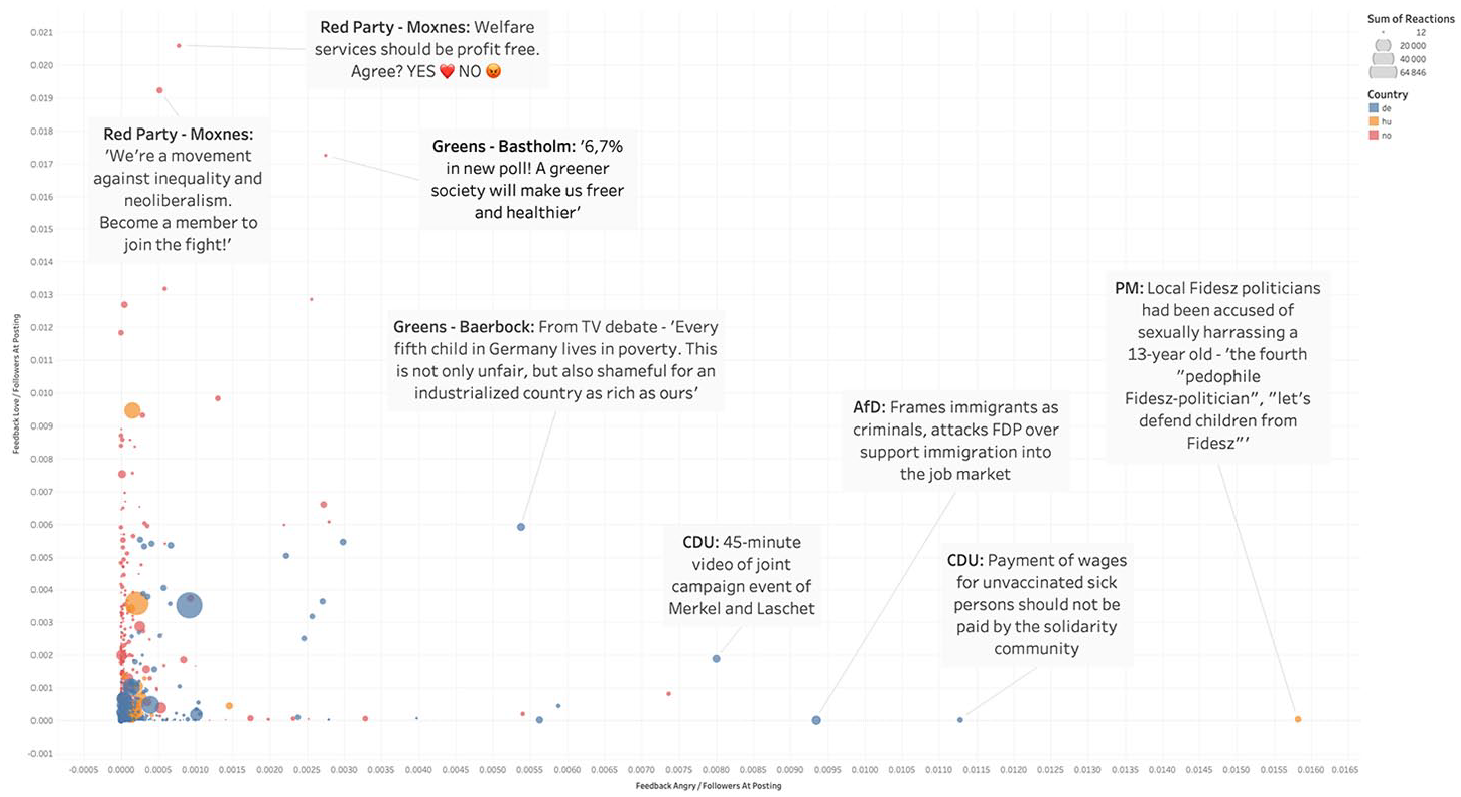
“Angry” and “love” reactions to social policy.
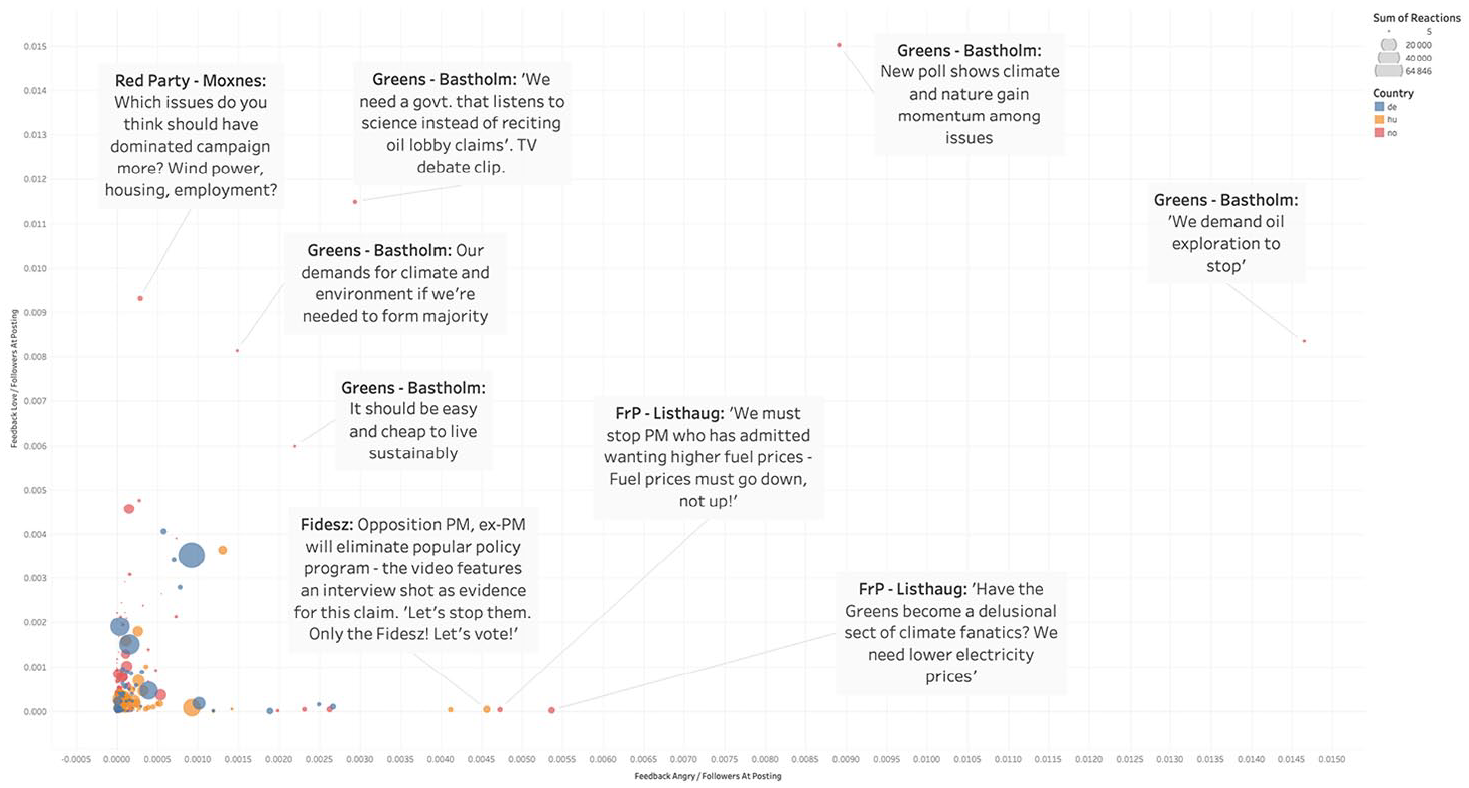
“Angry” and “love” reactions to energy policy.
Findings
Overall, our independent variables’ contribution to the number of “love”/“angry” reactions is minor (Table A5 in the Supplemental Appendix). It is mostly explained by differences across accounts as measured by the random intercept and the overall popularity of the posts added as fixed effects in the form of the number of user reactions, and the number of followers. When only the random intercept, the number of likes, and the number of followers are included, we receive a marginal R2 (only fixed effect)/conditional R2 (both fixed and random effects) of .303/.779 for “love” and of .390/.734 for “angry.” When including all independent variables, we receive .346/.790 for “love” and .398/.735 for “angry” models. Still, we find some interesting differences between the “emotional reactions” to the five issues under investigation.
Micro-level (policy issues)
Through our regressions, we find that different policy issues drive different degrees of “angry” and “love” reactions (RQ1). Posts addressing economic policy and energy policy increase the share of “angry” reactions and decrease the share of “love” reactions. Posts addressing foreign policy provoke significantly more “angry” reactions than posts not addressing this issue, but have no effect on “love” reactions. Environmental policy is the only issue increasing the share of “love” reactions. Social policy has a significant negative effect on “angry,” but not on “love” reactions.
To better understand what drives particularly many “love” and “angry” reactions, we take a closer look at the posts that yielded the most “love” and “angry” reactions for each of five policy issues—that is, variations concealed in the regression models. When comparing the scatterplots of particularly “emotional” posts within each of the policy issues (Figures 2 to 6), some overarching patterns emerge. Different graphs’ skew, with dissimilar scaling of vertical and horizontal axes for different policy issues, displays whether the node distributions lean toward “love” or “angry” reactions. Summarizing the post distributions for different policy issues, the environment, and energy—and partly social policy—seem to attract more “love” reactions. Economic policy is more balanced, while foreign policy’s skew toward the right suggests that the issue rather provokes negative than positive emotions. We will come back to the scatterplots when comparing the countries (macro-level) below.
Meso-level (parties)
At the meso-level, we find the above-mentioned effects of policy issues on “angry” and “love” reactions to be largely uniform across party types. The ideological leaning of parties does not seem to moderate the relationship between policy issues and “angry” and “love” reactions, with one exception: left-leaning and right-leaning parties generate fewer “love” reactions when they address energy policy than populist parties do (marginally significant for right-wing parties) (RQ2). This also means that populist parties do not provoke more “angry” reactions than other parties when addressing the economy and foreign policy (rejecting H1). However, government parties provoke more “angry” reactions than opposition parties when they address environmental policy (Figure A1 in the Supplemental Appendix) and less “angry” reactions with their foreign policy posts (marginally significant) (RQ3). Moreover, while addressing social policy does not have any significant effect on “love” reactions in our models, there is a significant negative interaction effect between social policy and party status (government vs opposition), meaning that government parties evoke less “love” reactions when addressing social policy than oppositional parties. Overall, the meso-level does not seem very relevant for understanding the relationship between policy issues and “emotional reactions.” However, we find more differences at the country level.
Macro-level (countries)
RQ4 explores whether the share of “angry” and “love” reactions to policy issues differs between countries. The regression models show country-level differences for foreign policy, environmental policy, and somewhat for economic policy. Figures 2 to 6 provide a more granular view of how users react to different policy issues in the countries.
Economy
Our regression models show a uniform effect of the economy on “angry” and “love” reactions across countries. However, the interaction is marginally significant in Germany in the “love” models (model 4), which means that posts addressing the economy trigger some more “love” reactions in Germany than in Hungary (but not more than in Norway). Turning to the scatterplots of the top emotion-provoking posts on the economy, Norwegian parties’ and politicians’ posts predominantly receive “love” reactions, whereas in Hungary, “angry” reactions dominate the top posts (Figure 2). In Germany, the economy does not seem to be too emotionalized, with more “love” than “angry” reactions (as the only one of the five issues in Germany’s case). In the seemingly most anger-inducing post on the economy, the Hungarian left-leaning Dialogue for Hungary (PM) blames the current Prime Minister Orbán for the high exchange rate of the Hungarian currency to euros.
Environment
The environment received a higher share of “angry” and “love” reactions in Germany and Norway than in Hungary, indicating that this is a less prevalent and emotionalized topic in the Hungarian election campaign (see model 1 and Figures A2 and A3 in the Supplemental Appendix). From Figure 3, we also see that posts addressing the environment predominantly received “love” reactions, especially in Norway. Hungarian posts are nearly non-existent in the figure. In Germany, the two most anger-inducing posts on environmental issues came from the right-wing populist party Alternative for Germany (AfD) and their party leader Chrupalla, attacking opponents and focusing on climate measures’ costs for “ordinary citizens.” Posts from the Norwegian Greens’ party leader Bastholm seem divisive, especially the post containing the party’s (controversial) demand to stop Norway’s lucrative oil exploration.
Foreign policy
The regressions show that foreign policy drives significantly more “angry” reactions than posts not containing this issue in Hungary and Germany, but not in Norway (model 8 and Figure A4 in the Supplemental AppendixM). Figure 4 shows that foreign policy is the only issue clearly skewed toward “angry.” Reiterating the regression findings, foreign policy seems to be anger-dominated in Germany and Hungary. Here, it is important to note that Hungary’s election campaign ran within the first months of Russia’s war against Ukraine, influencing the prevalence and emotionality of the issue. The German Christian Democratic Union’s (CDU) post seemingly represent one of the election campaigns’ least sympathetically read post. In this post, the outgoing chancellor Merkel promotes a CDU/CSU-led federal government with Armin Laschet as chancellor (Laschet was very unpopular) and emphasizes that foreign policy is an important issue citizens should consider when voting for a candidate. This seems to be the only post pinned to the “angry-axis” that is not attacking other parties.
Social policy
For social policy, the regressions show that the country context does not matter (models 5 and 8). Figure 5 shows that social policy is skewed toward “love” in Norway and Hungary and toward “angry” in Germany. The post receiving the most negative reactions is from Hungary’s Dialogue for Hungary (PM), attacking opponent Fidesz and one of their local politicians.
Energy policy
The regressions did not show country differences in “angry” and “love” reactions to energy policy. Figure 6 has a quite tight distribution of nodes in the bottom-left corner, indicating that energy policy is not as “emotional” as the four other policy issues. Among the most angry-inducing posts are three posts attacking opponents.
In total, our regression shows that the country context matters more for the relationship between “angry” and “love” reactions than the party context.
Finally, Figures 2 to 6 also show some interesting country patterns across policy issues: while Norwegian posts generally receive more “love” than “angry” reactions, German posts largely receive the same amount of “angry” and “love” reactions and Hungarian posts are dominated by “angry” reactions. These patterns might say something about the general political climate and discourse culture in the countries.
Conclusion
This study aimed to find out whether and under which structural conditions different policy issues triggered “angry” and “love” reactions to Facebook posts by political actors from Germany, Hungary, and Norway in national election campaigns. Although our independent variables’ contribution to the number of “love”/“angry” reactions is minor, we find interesting differences between issues. Different from previous studies on issues and “emotional reactions” which looked at the top issues of parties and found none (Blassnig et al., 2021) or top issues of parties’ constituents, finding a relationship only for “angry,” but not “love” (Eberl et al., 2020), we investigate issues in general and how different issues affect “angry” and “love” reactions across parties. Going beyond parties’ “owned” issues, we find differences in “angry” and “love” reactions and these effects are largely uniform across party types (meso-level). Specifically, we find that posts addressing the economy and energy policy trigger more “angry” and less “love” reactions (in the latter case except for populist parties). Posts addressing the environment increase the share of “love” reactions in Germany and Norway, but not in Hungary, reflecting that the environment was a major issue in the German and Norwegian campaigns while playing only a subordinate role in the Hungarian campaign. Foreign policy drives more “angry” reactions (but not in Norway). We do not find any direct effects between social policy and “angry” and “love” reactions. Taken together and echoing previous studies, we find that specific issues drive more emotions than others (see, for example, Schemer, 2014). We cannot explain this relationship with issue ownership. Future studies could look at more granular policy issues and control for factors related to issue ownership (e.g. drawing on Sandberg, 2022). The small effects of our main independent variables (policy issues, party types, and countries) on “angry” and “love” reactions underscores the necessity of investigating how other message characteristics interact with policy issues and “emotional reactions” in future studies, for example, the presence of attacks, as indicated by the findings from our scatterplots.
Country-level differences are much smaller than one might have expected, given the clear structural differences between the three political systems, but this is, however, in line with previous research (Magin et al., 2021). With only three countries, we cannot perform a rigorous statistical test of the influence of structural factors on user responses, but we have some possible explanations for why we find so few differences across countries. It might be that an overarching culture of how to use “angry” and “love” reactions have been established on Facebook, at least in the geographical part of the world that we are studying. In the same vein, our findings might simply indicate that the countries we investigate, despite all their differences, are still too similar to each other when it comes to user reactions. Future studies should investigate how issues affect user engagement in more countries from more diverse geographical regions. This would not only allow for including country-related factors in the regression models but also for identifying other relevant influencing factors that we might have overlooked. Such studies could include user reactions beyond “angry” and “love” in order to find out whether the similarities we find are “reaction-specific” or “overarching.”
While the post examples discussed above help us understand the mechanisms behind what drives “emotional reactions,” our approach can say rather little about any situational and account-specific contingencies of “emotional reactions” and policy issues. With this limitation in mind, future efforts should strive to combine content analyses such as the one presented here with deeper insights into the rationales of those choosing to engage with posts. For example, it does not seem unlikely that “angry” reactions could result from supporters of political opponents showing their disagreement—or from a party itself rallying support by evoking anger toward issues, opponents, or out-groups, as suggested by the cited studies of populist parties’ social media practices. The anger expressed in response to a post can thus be directed toward the issue discussed, the party itself or another party. From the parties’ strategic perspective, it is important to keep in mind that the visibility of content on social media is affected by both social media’s algorithms and citizens’ reactions to policy issues: posts eliciting anger or strong positive feelings can grab people’s attention and entice them to show their response, Facebook’s algorithms then amplify posts that quickly generate high levels of “emotional reactions,” meaning that the posts can get more attention and reactions.
We initially coded the issues in more detail, yet we had to aggregate categories to reach sufficient case numbers, affecting particularly the nuances in the social policy issue. This is another limitation of the present study. Looking into the relationship between issues and “emotional reactions” for individual countries might provide more nuanced results. At the same time, even though we compare three countries, it is unclear how far our findings from this most similar systems design can be transferred to other contexts. Further research on a broader range of countries—particularly beyond the Global West and North—is urgently needed in this field.
Since we studied “emotional reactions,” Facebook was the sole social media platform included in the analysis, which also limits our conclusions. Social media have varying digital architectures, audiences, and norms (Bossetta, 2018), suggesting that findings from one particular platform may not be transferable to other social media.
Despite these limitations, however, our study provides new insights into how policy issues spark “emotional reactions” on social media. From a campaign communication perspective, both attracting “angry” and “love” reactions can be beneficial, especially if the response aligns with the campaigner’s intention to evoke negative or positive emotions or at least emotional displays (although unsympathetic “angry” reactions might also help spread messages to a more supportive audience). Appraisal theories even suggest that anger may have a greater impact on political efficacy than positive emotions (Valentino et al., 2011), which can range from micro-actions (e.g. sharing a political stance with their own Facebook network by means of “angry” or “love”), to voting decisions.
The effect we find of policy issues on “angry” and “love” reactions across party types suggests that social media provide campaigns with opportunities to emphasize issues citizens care deeply about and which have a mobilizing potential. However, the effects are small and need further exploration. Moreover, we do not know whether and how campaigns align their tactics based on these signals. The study’s theoretical implications should be tested empirically in future studies. Following the argument that emotions play a crucial role in the dissemination of messages on social media platforms, eliciting emotions can be a tempting strategy for parties and candidates vying for elections. However, what makes the strategic incitement of “emotional reactions” tricky is that the resulting reaction patterns are largely unpredictable. While there might be some overarching patterns in citizens’ “emotional reactions” to political posts, it is hard to predict what content will reach whom and how people will react. Individual politicians and individual situations have a lot to say in how people react to posts. It is therefore difficult, if not impossible, to steer these user reactions by means of issues, which makes these a difficult strategic tool in election campaigns.
Supplemental Material
sj-docx-1-nms-10.1177_14614448231208122 – Supplemental material for Between anger and love: A multi-level study on the impact of policy issues on user reactions in national election campaigns on Facebook in Germany, Hungary, and Norway
Supplemental material, sj-docx-1-nms-10.1177_14614448231208122 for Between anger and love: A multi-level study on the impact of policy issues on user reactions in national election campaigns on Facebook in Germany, Hungary, and Norway by Hedvig Tønnesen, Márton Bene, Jörg Haßler, Anders Olof Larsson, Melanie Magin, Eli Skogerbø and Anna-Katharina Wurst in New Media & Society
Footnotes
Acknowledgements
This publication is part of the project “Digital Election Campaigning Worldwide (DigiWorld)”. The authors would like to thank all collaboration partners who contributed to the infrastructure of the project, the coding scheme, and the creation of the dataset used in this publication. A list of all collaborators can be found on the project website:  . The authors would also like to thank the editor and anonymous reviewers for helpful feedback on the manuscript.
Funding
The author(s) disclosed receipt of the following financial support for the research, authorship, and/or publication of this article: Márton Bene was supported by the Incubator program of the Center for Social Sciences, Eötvös Loránd Research Network (project number: 03013645) and Bolyai János Research Fellowship awarded by the Hungarian Academy of Sciences (BO/334_20). Jörg Haßler and Anna-Katharina Wurst contributed as part of the junior research group “DigiDeMo” which is funded by the Bavarian State Ministry of Science and the Arts and coordinated by the Bavarian Research Institute for Digital Transformation (bidt).
Supplemental material
Supplemental material for this article is available online.
Notes
Author biographies
.
References
Supplementary Material
Please find the following supplemental material available below.
For Open Access articles published under a Creative Commons License, all supplemental material carries the same license as the article it is associated with.
For non-Open Access articles published, all supplemental material carries a non-exclusive license, and permission requests for re-use of supplemental material or any part of supplemental material shall be sent directly to the copyright owner as specified in the copyright notice associated with the article.
