




Abstract
The live character of suddenly breaking global media events along with the massive volume of digital traces they produce pose considerable challenges for research in the current communication environment. In this methodological article, we use the 2019 Christchurch mosque attacks as an empirical context for methodological reflection. We suggest a new type of ethnographic investigation of events—a digital team ethnography augmented by computational methods for studying media events. We show how “fieldwork” and the related “field” are constructed as part of the empirical workflow and present a four-phase model to structure the research process: (1) research readiness, (2) mobilization of fieldwork, (3) exploring the computationally organized ethnographic field, and (4) deep dives that enable thick description on social media. We conclude with a reflection on the benefits and limitations of the proposed methodological approach for the study of global media events.
Keywords
One of the key difficulties that the contemporary Internet offers the ethnographer is its unpredictability: Events can develop and blow over very quickly, move from minor insignificant incidents to mass events without warning, and involve unanticipated combinations of different forms of interaction (placing corresponding stress on the ethnographer’s ability to move fast and to recognize and capture different forms of data on the fly).
A pioneer of digital ethnography, Christine Hine aptly describes the challenge that many media and communication studies scholars also face today—how to study suddenly erupting media events (Dayan and Katz, 1992) today characterized by liveness, globalized communication, multiplicity of participants, and “data on the fly” (Frandsen et al., 2022; Sumiala et al., 2018; Sumiala and Tikka, 2020). This article starts with the premise that such media events quickly evolve into global phenomena on social media (e.g. Steensen and Westlund, 2021) and thus demand a specific methodological orientation and tactics to handle the unforeseen amount of data that emerge and disappear quickly.
There are many possible ways to conduct data collection and analysis of events dispersed across different platforms, including, for example, issue or controversy mapping (Burgess and Matamoros-Fernández, 2016; Marres, 2015; Venturini and Munk, 2021). However, we argue that an ethnographic approach, carried out as an interdisciplinary team effort and enhanced with computational tools, has considerable advantages in studying the construction of media events through social media. Digital team ethnography with diverse methodological expertise bears a unique readiness to face the complexities of media events unfolding across digital platforms on a global scale. Following Christine Hine (2015), we claim that it allows for “scaling up and spreading of ethnographic interest, multiplying the capacities of a single ethnographer and allowing the team to develop reflexive, embodied understandings of multiple aspects of a phenomenon” (pp. 189–190).
In this methodological article, we outline a process of digital team ethnography and the related fieldwork in the context of one particular media event, the Christchurch mosque attacks in New Zealand on 15 March 2019. The violent attack generated massive media attention; the perpetrator, a far-right extremist, attacked two mosques during Friday prayers and live streamed the massacre using Facebook Live and a GoPro camera, thus showing the attack from a first-person shooter perspective. The massacre left 51 people dead and several others injured, gaining global visibility across social media platforms and journalistic media (Uusitalo and Valaskivi, 2020).
We begin this article by briefly outlining why we consider digital team ethnography suitable for studying global media events on social media. Next, we discuss recent developments in digital ethnographic research and fieldwork in dialogue with team ethnography as a digital exercise. We then illustrate how the “field” is constructed as a part of the empirical workflow and present a four-phase model of how to organize the research process and fieldwork: (1) research readiness, (2) mobilization of fieldwork, (3) exploring the computationally organized ethnographic field, and (4) “deep dives” that enable thick description of the empirical phenomenon. This approach enables the team to conduct fieldwork on and across different digital media platforms; here, we illustrate the four phases of fieldwork in the context of what at the time of research was Twitter (currently known as X). We conclude with a reflection on the benefits and limitations of the digital team ethnographic approach.
Why study global media events with digital team ethnography?
In recent decades, much ink has been spent on discussing how people in contemporary society bring “social” to life through events (e.g. Sonnevend, 2016; Sumiala et al., 2018; Wagner-Pacifici, 2017). Drawing on existing philosophical and sociological literature, events can be characterized as temporally bound intensifications of social action and related moments of heightened sociality (Wagner-Pacifici, 2017). The first theory of media events, however, was developed already in 1992 by media and communication studies scholars Daniel Dayan and Elihu Katz. They argued that a media event is a special genre powerful enough to interrupt everyday media flow that brings the viewer into touch with society’s values, inviting the audience to participate in the event (Dayan and Katz, 1992: 5–9). While media events have been studied extensively since their original conceptualization, recent literature emphasizes that in the digital age, they are performed through increasingly complex articulations (e.g. Frandsen et al., 2022).
Contemporary media events are considered to comprise a multiplicity of platforms, actors, time zones, and narratives as well as intertwined contents, logics, and social practices of both news and social media (Sumiala et al., 2018). While the incident triggering the media event always takes place in a specific location (here, Christchurch, New Zealand), the social experience(s) of the event emerge in the dispersed media environment. Consequently, contemporary media events as global spectacles are not reducible to certain locus or any specific local audience or community (Bolin and Ståhlberg, 2022). Such liquid condition (Ilan, 2021; Widholm, 2016) poses particular demands for empirical research.
As global media events unfold live across various platforms, their scale and volume extend beyond individual human perception, and the solo “ethnographer’s ability to make sense of situations as a unified whole” (Hine, 2015) is fundamentally limited (p. 3). To be sure, it has always been true that ethnographers cannot be omniscient and that their capacity to participate in events is limited. However, the context of the current media environment brings new complexity into play. Although the ethnographer can follow the events unfolding on social media and online news sites, because of the algorithmic content curation, individualized content, and the enormous flow of information, no two people ever see the same set of posts, memes, videos, and so on.
Media events that erupt and evolve rapidly leave little time for planning and initiating fieldwork. While media events may gain extensive attention “en direct” in digital media, this attention soon fades away (Sumiala et al., 2018). From the perspective of observing and data gathering, this characteristic means that data emerge, transform, and disappear quickly through human action, content moderation, and the algorithmic logic of digital platforms (Hammelburg, 2021; Pink et al., 2018). Unlike many other social research scenarios, such events require an immediate response from the researchers (Donner and Diaz, 2017; Horsley, 2012). We argue that this condition of “a moving empirical target” and the expanding scale of digital traces invites a digital team ethnographic approach to embrace the complexity of global media events.
As a method, digital team ethnography enables researchers to participate and immerse themselves in the uniquely situated reality of the event, exploring its construction and circulation in the contemporary environment. As the studied phenomenon unfolds across numerous digital platforms, a team can spread out and have a multi-sited presence on the different platforms. An interdisciplinary team can also develop relevant competencies and skill sets for each continuously evolving platform. Furthermore, digital team ethnography provides a valuable means of developing a dynamic understanding of the event in question as an object of research. It can also be adapted during the research process, and as such, it has the potential to cope with the constantly changing circumstances of media events that demand constant evaluation.
The methodological approach we present here is inspired by Beneito-Montagut et al. (2017). It applies an interpretative and collaborative approach that enables a team of researchers (often interdisciplinary) to share the experience of being in the field together (Clerke and Hopwood, 2014; Creese et al., 2008; Schlesinger et al., 2015). Consequently, the “ethnographic object” is constructed jointly by the team (Jarzabkowski et al., 2015; Wasser and Bresler, 1996). Although teamwork has been the model for ethnographic research since long before the arrival of the Internet (Erickson and Stull, 1998), we argue that digital team ethnography permits a diverse set of experts to explore dispersed social phenomena in collaboration; this allows merging ethnographic and computational approaches to increase our understanding of the complex ways in which global media events are constructed in the present communication environment (Beuving, 2020; Ford, 2014; Lohmeier, 2014; Sumiala et al., 2016).
Rethinking fieldwork in digital contexts
As with all ethnographic research, digital team ethnography relies on carefully conducted fieldwork. Since the 1990s, the ideas associated with “fieldwork” and “the field” have become subject to increasing scrutiny among ethnographers (Gupta and Ferguson, 1997; Hastrup and Hervik, 1994; Okely, 1992). Globalization, the increasing mobility of people, and the study of their dispersed social relations have contributed to the redefinition of ethnographic fieldwork as increasingly characterized by a multi-sited practice (Marcus, 1995). This trend has only intensified with the rise of digital and social media and the related development of digital ethnographic approaches (Hine, 2008, 2015; Kozinets, 2015; Pink et al., 2016). Hine (2008) notes how online ethnography has transferred “the researcher as an embodied research instrument to the social spaces of the Internet” (p. 257). Similarly, the practices of fieldwork have migrated to the online domain. This transformation has raised new theoretical and practical questions, such as how to conduct fieldwork, how to enter the field, which platform and which empirical phenomenon to study, and which digital traces to follow, not to mention how to capture the data before it disappears.
In any digital ethnography, fieldwork practices involve following, archiving, lurking, and turning digital and computational methods into ethnographic devices (Airoldi, 2018; Bonini and Gandini, 2020; Caliandro, 2018; Markham, 2013). Annette Markham (2013) invites scholars to reimagine the field more as a “movement, flow, and process” instead of an “object, place or whole” (p. 438). Thus, the field is carved out through the ethnographer’s engagement with the subject (see also Marcus, 2012). As Vered Amit (1999) notes, the more complex the notion of the field becomes, the more significant the ethnographer’s role is in constructing the field as part of the research (p. 14). In the following sections, we present our digital team ethnographic approach, structured around four analytical phases, and illustrate how one particular global media event—the Christchurch attacks in New Zealand—was constructed through social media. Yet, it is important to acknowledge that these separate phases serve an analytical purpose only; in practice, the phases overlap as researchers move back and forth between them. Another caveat is in place here; while in ethnography the key focus is often on people participating in and experiencing the event in different online and/or offline contexts (e.g. Hammelburg, 2021), in this study, the event an sich is constructed as the object of ethnographic exploration.
The four phases of digital team ethnography
As the name suggests, digital team ethnography is, first and foremost, a collaborative effort. Therefore, who the team members are and what their expertise is matters. Our team comprises a dozen researchers at different career stages, an interdisciplinary collective of digital anthropologists, media and communication scholars, digital culture scholars, political scientists, and computational social scientists. It is worth noting that this team was not created ex nihilo, as many members had already collaborated previously, which enabled the team to strive toward a shared framework regarding theory, methodology, and everyday research practices.
In the “hands-on” empirical phase of our digital team ethnography, we followed the digital traces and artifacts related to the event (Marcus, 1995; Markham and Gammelby, 2018) across social media platforms and online news sites as the event unfolded. This meant observing, navigating, exploring, and making sense of the different aspects of the media event by following connections across actors, posts, and platforms. An essential part of the fieldwork process was making collective decisions (on the go) concerning which leads to follow and how to interpret what was observed. Here, expertise in using computational methods was of particular value as it expanded the scale of inquiry beyond the limits of the individual ethnographer and human perception (Evans and Foster, 2019). Computational methods helped us not only expand the scope of the ethnographic field but also visualize and contextualize the event as the field (Harju and Huhtamäki, 2021), rendering it more accessible and comprehensible as a context of observation and description regarding the different sites of the media event in question.
Research readiness
Fieldwork always begins with preparations that aim to understand the possible contexts in which the research object (here, a media event) will occur (Blommaert and Dong, 2010). Preparations are also vital for ethical fieldwork; in messy and data-saturated contexts, research ethics should be enacted rather than assigned (Markham et al., 2018), and research readiness is thus essential for establishing contextual ethical practices within the team.
Building research readiness in digital team ethnography involves several steps: building the team, planning which platforms to observe and how, designing the data collection, creating research infrastructure, and setting up a shared communication channel. In team ethnography, team members and their collaboration play a vital role in the research process. Compatibility is essential as a mismatch between team members might lead to tensions, mistrust, and difficulties in creating a shared understanding (Mauthner and Doucet, 2008; Woods et al., 2000). We argue that the very nature of “the digital” has benefits for team ethnography, with digital data being readily shareable among the team for joint sensemaking and writing. Nevertheless, interdisciplinary collaboration requires effort in developing a shared language, concepts, and eventually ontological and epistemological foundations, and we devoted time to building common ground before we embarked on digital team ethnographic fieldwork.
While each media event is unique, they also share similar recurring elements one can prepare for. Based on previous research (Sumiala et al., 2016; Sumiala and Tikka, 2020), we claim, for example, that information and messages constructing these events spread rapidly on different social media platforms and that journalistic news media play an important role in constituting and shaping the events (Uusitalo and Valaskivi, 2020). This knowledge shapes fieldwork practices as each digital media platform provides different forms of access, shaping the collection of material. For example, news media sites can be behind paywalls, whereas at the time of the research, Twitter (currently X) and Facebook allowed very contrasting forms of data collection, the first being somewhat liberal and the latter increasingly limited (Tromble, 2021). We decided that we would commence fieldwork by focusing on the globally central platforms of 2019 (the year of the attack), which would therefore also be prominent in constructing the global media event.
We thus focused on Twitter, YouTube, Instagram, and Facebook, 1 with different empirical research strategies; access to and data collection from these platforms was allocated to team members according to their interests, experience, and technical skills. Numerous tools designed to capture natively digital data are available online (Rogers, 2019). Thus, some team members focused on preparing for qualitative tracing of the event, others on digital and computational data collection tools to capture the event. Due to Twitter’s key role in covering breaking news (Bruns and Weller, 2016) and affordances allowing data collection (at the time of this research), we also developed a specific collector tool that uses event-specific search terms defined as fieldwork progressed. Digital team ethnographic research thus offers a range of techniques that contribute to a more nuanced understanding of the phenomenon (Markham, 2017). Allocating researcher roles and developing and testing suitable data collection methods are crucial steps in building research readiness. They facilitate quick mobilization of fieldwork, ensuring efficient and timely data collection when a live media event suddenly occurs.
In addition, in projects that potentially include a large amount of data, the creation of research infrastructure is a critical step in establishing research readiness. It is crucial to create shared storage to which the whole team has access. While sharing screen captures and other documents can be managed with standard tools, collecting more considerable amounts of data requires a specific infrastructure. We thus set up a dedicated virtual server hosted on the national research IT infrastructure. We then developed and tested our own data collector tool, a tailor-made Python script that connects to the Twitter Streaming Application Programming Interface (API): Streaming here refers to a practice suitable for managing large volumes of data. As each tweet is represented in JSON 2 with detailed metadata—including the sender, users mentioned, links to images, and videos—the resulting data may extend to hundreds of gigabytes or more. We used MongoDB, a flexible database, to store, manage, and query the data.
Twitter (currently X) presents an excellent example of the continuously changing nature of social media platforms. At the time of our research, collecting tweets live was the only way to capture extensive data sets without paying additional fees, and hence, we developed our own collector. In 2021, Twitter announced Academic Research API, allowing registered researchers to retrieve historical tweets, discussion threads, and user profiles (Tornes and Trujillo, 2021). However, at the time of writing, Twitter was moving to a new mode where data access is in most cases fee-based. Importantly, collecting data through live streaming allowed the collection of tweets and user data that might later disappear (via moderation or “self-deletion” by users), whereas using the Academic Research access only allows the collection of tweets that continue to be available on Twitter. At the same time, Twitter’s Terms of Service insisted that data removed from the platform should also be deleted from collected data sets. The academic community is, however, voicing the need to investigate content that has been removed (Bruns, 2019).
Finally, as we were located at three universities, we also needed to set up a suitable channel for communication and group discussion. When selecting this backchannel, it is important to consider that it also functions as a set of fieldnotes that will be revisited and annotated throughout the analysis.
Mobilization of fieldwork
On Friday, 15 May 2019, at 7:07 am in Finland (6:07 pm in New Zealand), our group discussion channel was activated with a message from one of the team members, which said, “Should we follow this case?” The message referred to the Christchurch mosque attacks that the team member had noticed on Twitter. By then, the rapidly developing event had already been unfolding for 5 hours. In this methodological rapid-response situation (Donner and Diaz, 2017), our research team was soon mobilized, illustrating the importance of research readiness. In this second phase of our digital team ethnography, we immersed ourselves in the live event to gather information and collect data, pushing other commitments aside as much as possible. Regardless of our preparation and planning, we could not have anticipated this phase to be as chaotic and demanding as it was, forcing us to work overtime and set aside existing commitments. Another surprise was the extent of pre-planning by the perpetrator. This enabled him to publish a manifesto and share live footage via multiple channels and platforms, resulting in a plethora of social media responses. The empirical observations made during fieldwork in this time-intensive phase were captured in the collective fieldnotes in the group discussion channel.
Taking fieldnotes is an ethnographic practice to describe the empirical phenomenon. In team ethnography, however, fieldnotes have the additional function of sharing observations, making possible collaborative reflection and interpretation (Erickson and Stull, 1998). In our case, over 300 messages in our discussion channel during the first 24 hours of fieldwork illustrate how we, as a team, started to construct the ethnographic field by making sense of the event. However, the fieldnotes were not limited to observations; they also reveal the team’s reflexivity, which is considered a crucial element in ethnographic interpretation (Hammersley and Atkinson, 1995). Their existence and extent also illustrate the collective research decisions made regarding data collection.
Moreover, our fieldwork practices consisted of following and archiving (Hine, 2015; Markham, 2013). Following connections (e.g. hyperlinks, hashtags, and conversation threads) involves contemplation and reflection on both the empirical phenomenon and the research questions (see Marcus, 1995). We also exploited the infrastructural properties of digital sites, moving across social and news media platforms by following links and embedded material (Airoldi, 2018: 666; Caliandro, 2018). The practices and tools used for collecting and archiving material consisted of a mix of “low-tech” and “high-tech” methods (Rogers, 22 November 2019, personal communication, Tampere), ranging from written notes, personal field diaries, screenshots, and screen recordings to automated screen scraping and computational collection of Twitter data through its streaming API. The team members focused on observing the live situation according to previously allocated researcher roles.
By following the event-related tweets, posts, videos, and news stories and sharing our observations, we began the process of collaborative sensemaking. As Wasser and Bresler (1996) argue, the research team can act as an “interpretative zone . . . where multiple viewpoints are held in dynamic tension as [the] group seeks to make sense of fieldwork issues and meaning” (p. 6). Our initial observation was that one or more perpetrators had attacked two mosques in Christchurch, killing 48 people and wounding several others. 3 A 28-year-old Australian man was arrested. In her public response, Prime Minister Ardern was quick to call the massacre a terror attack. During the first day, we realized that the perpetrator had carefully designed the attacks, having planned to disseminate the massacre via digital media platforms to attract public attention. Before the attack, he had uploaded a “manifesto” on various file-sharing sites and emailed it to over 70 media outlets. He left traces of his plans on Twitter, Facebook, and 8chan, including a link to his Facebook profile where he live streamed the massacre.
Along with other material, the live footage spread instantaneously in the hybrid media environment. By the time we, the researchers, examined the perpetrator’s social media accounts, they had already been closed down by the service providers. However, the 17-minute video was still in circulation (and persisted for 6 months after the attack). In the recording, a man greeting the perpetrator at the entrance of the Al Noor mosque is shot dead, becoming the first victim of the massacre; his words gave rise to the solidarity symbol “Hello, brother,” which soon transformed into #hellobrother. We encountered this solidarity symbol when one of our team members noticed an illustration with “Hello brother” in a tweet by a Canadian user with a low follower and tweet count: The first victim of the terrorist attack in #Christchurch, New Zealand, is seen standing by the door of the masjid. He is heard saying “Hello brother” to the gunman before he is brutally gunned down. His last word to his killer was “brother” #NewZealandTerroristAttack.
The illustration was created by Akbar Bisul, an Indonesian artist. Circulating on Instagram, Facebook, and Twitter, the illustration became a popular symbol of solidarity. These observations and insights that emerged through following the connections were discussed in our collective fieldnotes and illustrated by snippets of empirical material.
We soon started to make research decisions, including which search terms to include in the Twitter data collector. As Markham (2013) notes, “in digital contexts, there’s a temptation to collect and archive everything, just in case” (p. 439), particularly in the case of live events where digital traces are likely to fade away rapidly. However, because it is impossible to gather all the data that make a phenomenon unique (boyd and Crawford, 2012; Markham, 2013), fast and justifiable decision-making is essential (Hine, 2015). For example, the computational data collection on Twitter required constant attention, reflection, and interpretation from the whole team, being a balancing act between collecting sufficient relevant data and avoiding collecting “everything.”
We thus began to collect data with generic search terms, including the catch-all “Christchurch,” adding new search criteria based on empirical ethnographic observations. The final set of search criteria is as follows: christchurch, christchurchmosqueattack, christchurchshooting, christchurchattack, JeSuisChristchurch, PrayForChristchurch, Al Noor, mosque shooting, mosque massacre, BrentonTarrant, NewZealandShooting, JeSuisHuman, JeSuisMuslin, HelloBrother, NewZealandTerroristAttack, and NewZealandStrong (including the misspelled JeSuisMuslin, highlighting the need to develop other means to ensure the transparency of the research process to the entire team).
By using search terms instead of hashtags, we aimed to capture a broad sample of the discourses and ensure post hoc analysis and exploration. That is, being forced to rely on Twitter streaming API, we had only one chance to define the search criteria live, while most of the analyses were to be done after the mobilization phase. Furthermore, as each retweet includes information about the original tweet, we could also “go back in time” and capture tweets sent before we became aware of the event. In addition to updating the search criteria along the way, collecting tweets required constant monitoring to ensure the Twitter collector was running properly. Ideally, the team would be able to run computational analyses on the collected data for insights into emerging trends and patterns already during the mobilization phase. In our case, the infrastructure only allowed collecting data. Computational analysis capabilities were developed in the next phase.
Exploring the computationally organized ethnographic field
There was a noticeable shift in pace when moving into the third phase of our team ethnography, as the sense of urgency subsided. This phase included organizing the Twitter data with computational methods for different analytical purposes as well as the subsequent exploration of the computationally (re)constructed ethnographic field where we utilized the knowledge gained from the qualitative ethnographic observation earlier on. Importantly, although the qualitative researchers and computational scientists worked in close collaboration throughout the research project, organizing the Twitter data involved much effort from the computational scientists. However, due to the real-time, multi-sited fieldwork already conducted together, the team was able to orient themselves regarding the data collected; in this section, we will focus our attention on the data collected from Twitter.
Moving into this phase, we had some 12 million tweets stored in a database that only the data scientists could access through a command line interface. The scale of the event took us by surprise, and it took time to organize the data, first, to enable access to the database for the whole team and, second, to access the timeline of tweets with relevant metadata, including content, sender information, timestamp, and any other actors mentioned.
Two critical decisions regarding data organization allowed us to begin exploring the data and the computationally organized, (re)constructed ethnographic field: The first was utilizing data sprints (Venturini et al., 2020), and the second was the use of analytical notebooks (Kery et al., 2018) that combine textual documentation and Python code in its outputs, including tabular representations of data, visualizations, and data exports as spreadsheets. The data sprints were usually one-day events where the research team worked on certain thematic areas emerging from the data. The use of analytical notebooks proved to be a key “epistemological breakthrough” when, instead of exporting Twitter data as spreadsheets, we decided to use analytical notebooks among the entire research team. This solution enabled the qualitative researchers to explore and arrange the data independently without the computational scientists’ constant technical help. Thus, during data sprints, each researcher had access to Jupyter notebooks 4 that, prepared by the computational scientist, were designed to enable configuration to add to the flexibility of the exploration. For example, the researchers could use keywords for full-text queries in the notebook and list the results in ways that allowed analyzing individual tweets. This enabled the team to apply computational methods flexibly and explore the field without learning the details of the underlying research infrastructure.
While these steps may seem simple, they required hours of discussion among the research team that (coming from different disciplines) had limited shared vocabulary. For example, we defined the term “original tweet” as a tweet that was either captured “live” (as the tweet was sent) or collected through a retweet (i.e. where the original tweet is retained). Most of the tweets in our full data set are, in fact, retweets, each of which also includes the details of the original tweet. To simplify the sorting of data and analysis, we decided to focus on original tweets rather than investigating the endless possibilities of how individual tweets traveled. Moreover, we compiled analytical notebooks for investigating individual tweets and tweeters, both of which turned out to be useful when exploring the field and following the individual digital artifacts (see Harju and Huhtamäki, 2021).
By exploring the computationally organized ethnographic field, the team members identified several diverging thematic areas that, in addition to “Hello brother,” included “live streaming” (referring to the perpetrator live streaming the massacre) and “#51lives” (the total number of victims). Each thematic area reflected and revealed a different dimension of the media event. To complement the qualitative exploration, we applied computational exploratory analysis (see Tukey, 1980) that seeks to minimize the predetermined structure in the analysis, allowing instead the potential patterns to emerge from the data. In addition to simple descriptive visualization of actor activity and hashtag frequency, in line with the network sensibility (Markham and Lindgren, 2014) adopted by our team, we used visual network analytics (Huhtamäki et al., 2015) to examine and visualize the configurations of interactive dynamics. Furthermore, topic modeling identified potential discussion themes latent in the data (Mohr and Bogdanov, 2013).
Next, we follow the thematic thread of #hellobrother and describe the fourth and final phase of the digital team ethnography presented in this article: thick description enabled by “deep dives,” as we call it.
Deep dives for thick description
Ethnographic inquiry aims at a deeper understanding of a given empirical phenomenon. During the phases described thus far, our research team had promptly responded to the live media event, collected data, organized the data for further qualitative analysis and different analytical purposes, and enabled the whole team to access and explore the data via analytical notebooks. The final phase mainly concerns qualitative ethnographic analysis enhanced or augmented by computational tools—deep dives for thick description. Computational augmentation of ethnographic analysis refers to, for example, various data visualizations to highlight different aspects of the data and the empirical phenomenon. This way, computational augmentation enhances ethnographic inquiry by expanding the ethnographic field and contextualizing it. We demonstrate this in the following section, illustrating and reflecting on the theme “hello brother.”
The theme #hellobrother was first picked up by one of the team members on the night of the attack. The search term hellobrother (catching mostly tweets with the hashtagged version) was swiftly added to our custom-made collector for Twitter data. Following #hellobrother as a digital artifact allowed us to take a deep dive into the data and, at the same time, document the process and develop the methodology. Starting with extracting the tweetset that included the hashtag #hellobrother, we soon realized that, ideally, we should also have included this greeting as a phrase (i.e. “hello brother”) and not only in the form of hellobrother, as both were prevalent in the material. However, due to the retweeting mechanism where the original tweet is retained, we were able to capture many of the tweets related to the emergence of the digital artifact #hellobrother, even if this required some extra work. The final extracted hellobrother tweetset contains 43,659 tweets.
We soon realized that instead of investigating the tweetset in the data-centric JSON format (see Figure 1), taking deep dives required not only the possibility of exploring the tweets in their authentic environment (i.e. Twitter) and in their original format (including links and images) but also the possibility for organizing, arranging, and augmenting the data in various ways to make this possible.
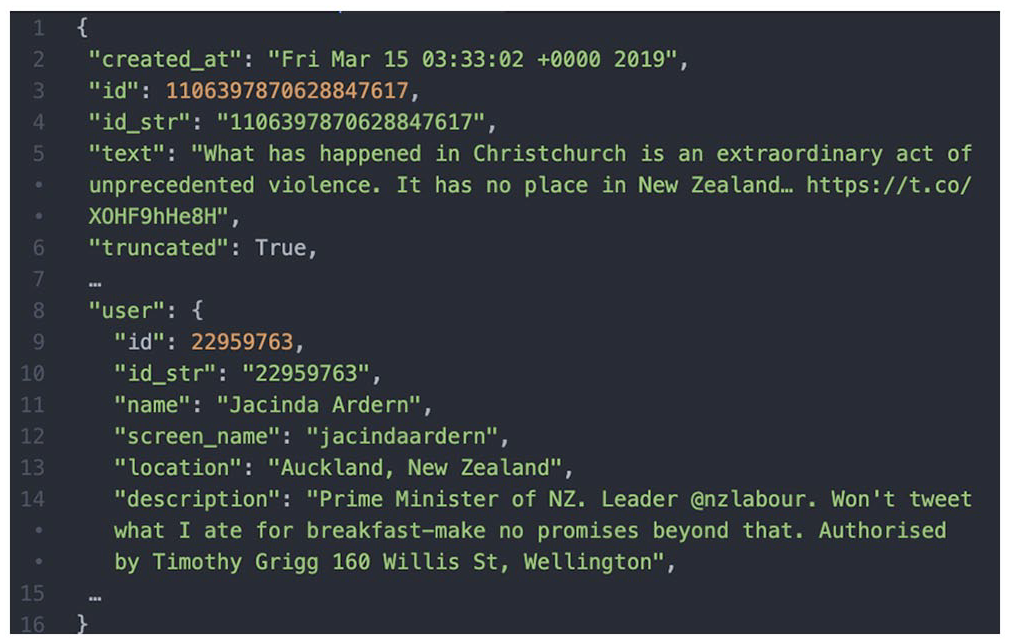
Example of a tweet represented in JSON.
In order to meet this requirement, we developed what we call a compilation view of the collected data set. Of all the possible ways of representing and visualizing the data, the easy-to-use, interactive compilation view of tweets (Figure 2) allows for a more detailed qualitative analysis. The compilation view repurposes (see Rogers, 2019) Twitter’s oEmbed API, 5 a feature originally designed for embedding tweets into other online content, to visualize the collected data as they would appear on Twitter. Thus, to (re)represent the #hellobrother tweets in their natural environment, so to speak, a process we call resurrection (Harju and Huhtamäki, 2021) was developed: It uses the oEmbed API to fetch the tweets in the data set from Twitter in a format that allows their display on an interactive interface (the compilation view) in tweet-like fashion (see Figure 2). With functioning links and other embedded material (e.g. pictures, videos, follower account, retweet account), the compilation view allows the ethnographer to analyze and follow individual tweets, displaying the tweets either in temporal order or in order of popularity (e.g. by retweet count). This proved to be a more useful format for detailed qualitative analysis than Jupyter notebooks described earlier, as it affords contextualization and access to the surrounding tweets; these offer important ethnographic “hints” and pointers to, for example, conversation threads. To support the application of the resurrection process in research, we provide a sample Jupyter notebook (https://github.com/HYTE-research/resurrection) that collects the necessary data using Twitter oEmbed API and creates a compilation view for a deep dive of the most retweeted hello brother tweets.
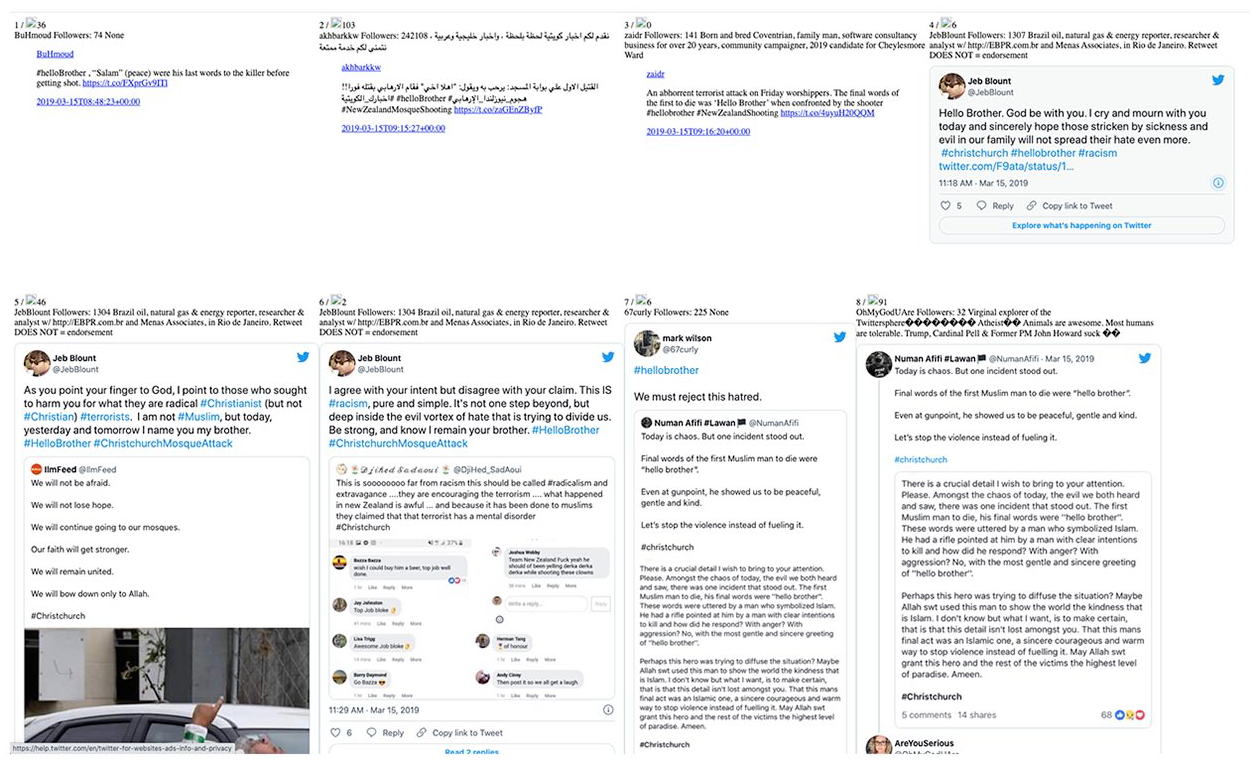
Compilation view representing the first #hellobrother tweets in temporal order.
Importantly, as only tweets containing #hellobrother were included in the final data set, some of the tweets that appeared in these resurrected threads on the compilation view were not in the #hellobrother data set but were brought up due to conversation threads. In this way, the compilation view’s contextualizing capacity grants researchers access to the surrounding tweets, which are not part of the data set (i.e. the collected tweets) and are yet intrinsically part of the conversation. This capacity to reconstruct the original context is essential to our digital team ethnography on live media events. It illustrates not only the complex ways in which the relationally emerging (often also cross-platform) context is constitutive of the empirical phenomenon but also the difficulty of grasping it. In addition, the context contributes to constructing the ethnographic field even if it does not constitute a part of the collected data set. Thus, as a means of computational augmentation, the compilation view is an important part of digital team ethnography as it expands the ethnographic field by giving access to the resurrected tweets (see Figure 2) in their original context at the time of collection. However, not all data can be resurrected due to data loss (i.e. deletion and moderation of tweets), as removed tweets can no longer be fetched from Twitter via the Twitter API, and they appear in the compilation view only in textual form as retrieved from the database.
To illustrate, once the #hellobrother data set was sorted, the tweets were computationally organized in the compilation view in temporal order (however, we also compiled the most popular view of the data set), starting from the first occurrence of #hellobrother as per our data collection. Among these was a tweet by a user @OhMyGodUAre 6 stating that #hellobrother needs to trend (see Figure 3). Interestingly, through the resurrection mechanism, the compilation view also showed a tweet by the user @NumanAfifi, although this tweet did not contain #hellobrother at all. We were thus puzzled why this tweet appeared in the compilation view. After further exploration, it became evident that the tweet appeared in the temporal compilation view because Twitter’s oEmbed API also displays the “previous tweet,” that is, the tweet to which the tweet in the data set responds, thus providing more context.
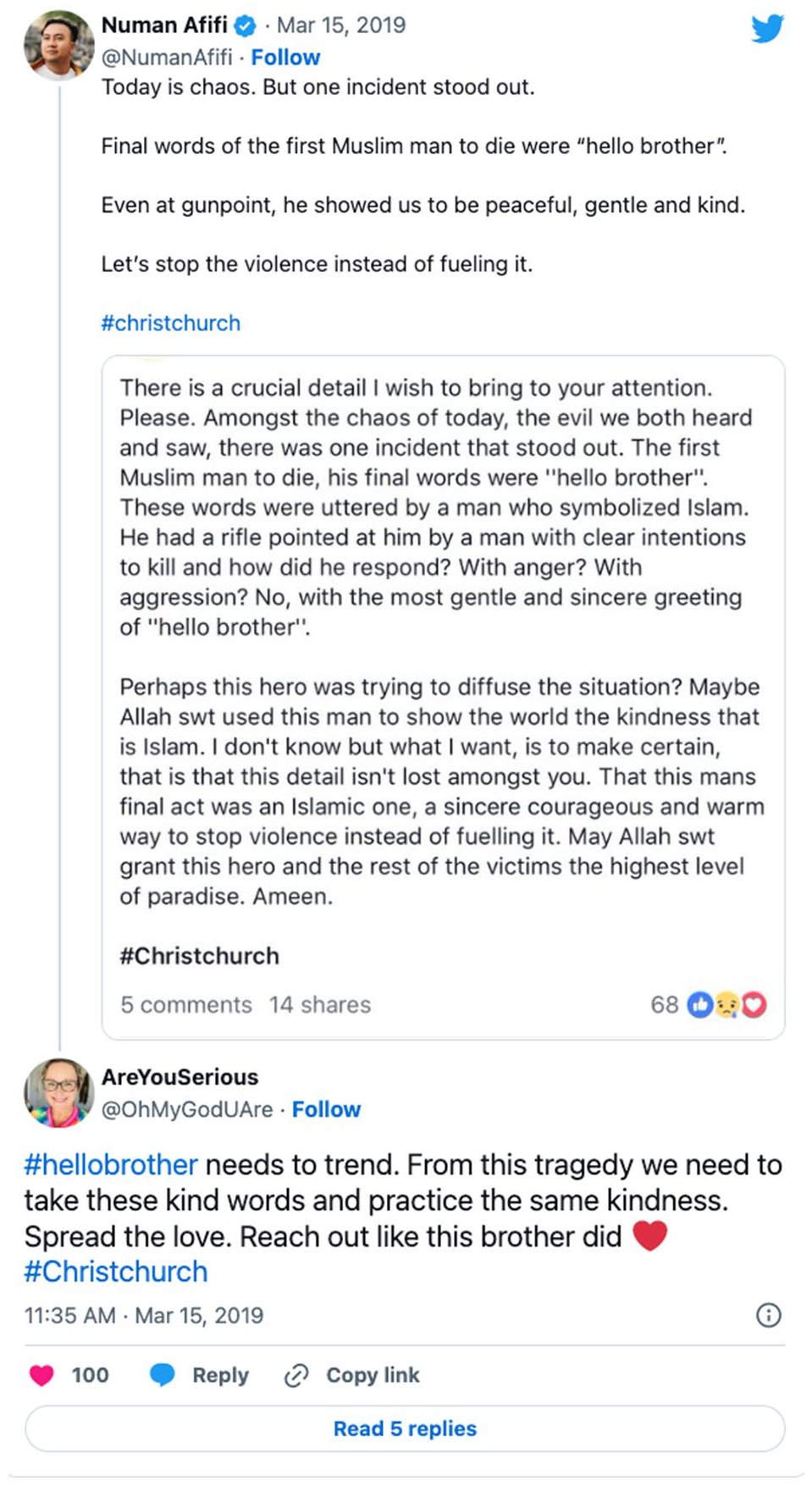
Resurrected tweet stating that #hellobrother needs to trend.
Although the tweet by @NumanAfifi contains the phrase “hello brother,” this tweet is not in the #hellobrother data set (because the phrase “hello brother” is not in the list of search terms). Interestingly, this tweet contained a text written by someone else. This affect-laden piece was, in fact, shared on Facebook, describing the massacre and the words of the first victim: Here, too, “hello brother” is mentioned in the text, not as a hashtag (Figure 3). This text was traced to Facebook, where a social media user had publicly shared it, from where @NumanAfifi had shared it again on Twitter. This short thread, and the co-text that the compilation view made available, proved invaluable as it allowed us to trace the first occurrence of #hellobrother and the origins of #hellobrother in the context of the live media event.
At the same time, the thread showcases cross-platform relationality and the fluidity and complexity of the ethnographic field: how digital artifacts travel and transform, how they contribute to the construction of the ethnographic field, and the affective layers they gain (Harju and Huhtamäki, 2021) as they are altered along the way. Thus, the computationally augmented ethnographic field benefits qualitative ethnographic research in many ways, most notably in expanding the ethnographic field and contextualizing the data set, but also in organizing it in various ways. The computational and qualitative ethnographic approaches thus exist in a complementary relation.
Digital team ethnography as a relational, processual, and live fieldwork practice
In this article, we started with the premise that, in the current communication environment, media events (the Christchurch attacks are a case in point) develop suddenly and spread rapidly across diverse social media platforms, becoming global phenomena (e.g. Steensen and Westlund, 2021). Live media events generate enormous volumes of data that circulate across different platforms and disappear quickly.
To tackle this methodological challenge—how to study global media events—we have introduced a digital team ethnography as a flexible and adaptable method to tackle the globally circulating social media data “on the fly.” At the core of this methodological exercise is fieldwork, which is key to the ethnographic effort in studying media events. Here, we have demonstrated how different scholarly expertise—qualitative ethnographic orientation augmented with computational tools—can work together during fieldwork and (re)construct the field as a site of empirical observation.
We put forward a workflow for digital team ethnography that involves four phases, proceeding from an open-ended and multi-sited exploration toward an interpretive inquiry of a more specific empirical case. The phases progress from creating research readiness and mobilizing fieldwork to explore the computationally organized field and taking “deep dives” that allow thick description of the empirical phenomenon. While we have illustrated this workflow in the context of Twitter, we argue that it can also be applied in the context of other social media platforms, even if the computational approaches require potentially significant context-sensitive adaptation. Following the phases will allow a team of researchers inspired by an ethnographic approach to conduct fieldwork of live media events on ever-changing social media. This methodological approach is based on an intensive collaboration and interaction between qualitative and computational researchers, simultaneously making observations in the field under construction. This is crucial, as observations emerging from being in the field together as a team also guide what is (and what is not) further examined (Blee, 2019) as part of the live media event.
We argue that the iterative practice involving constant movement between empirical observations and theoretical interpretation results in increased reflexivity in collaborative sensemaking practices and, therefore, a more thorough understanding of live media events in the current era. At the same time, it should be noted that creating a shared understanding through constant iteration within the interdisciplinary team is a complex and time-consuming process. Despite the shared fieldnotes and data sprints, it is not always easy to verbalize and share the richness of the empirical data, observations, and interpretations with teammates. Moreover, multi-sited team fieldwork can also lead to a fragmented research focus. Live media events inherently consist of multiple and even conflicting aspects that surface from the fieldwork. When an array of intriguing observations with diverse conceptual underpinnings emerges from the field, deciding where to focus one’s attention can be challenging.
The idea presented in this article of digital team ethnography to study global and live media events on social media also highlights the role and agency of ethnographers as fieldworkers whose collective decisions actively shape the emerging ethnographic field. Consequently, the field becomes inseparably connected to the team’s conceptual and professional resources in conducting fieldwork. As with all methodologies, digital team ethnography has challenges and limitations. The type of data collected, and the type of field (re)constructed, is always partial. Global media events unfolding live can never be fully grasped. Even with the aid of computational tools, it is not possible to capture “all the data” of an event. Furthermore, as the team must make decisions “on the fly,” a digital odyssey will likely occur. One small mistake in typing a search term, for example, can lead to a quota of data that cannot be used in the process.
To summarize, the digital ethnographic fieldworkers or the field do not pre-exist; they only exist in relation to the fieldwork process and the related team of ethnographers. Consequently, we emphasize the nature of digital team ethnography of live media events as a highly relational empirical exercise that is fluid, processual, and co-constructed by the team. As a method of empirical research, digital team ethnography provides valuable tools for collecting real-time data and thus (re)constructing the field for empirical observation and interpretation. As such, it has the potential for studying how global media events as moving empirical targets are constructed in the present social media–saturated world and how events bring “the social” to life through circulation of posts by multiplicity of actors across platforms.
Footnotes
Declaration of conflicting interests
The author(s) declared no potential conflicts of interest with respect to the research, authorship, and/or publication of this article.
Funding
The Hybrid Terrorizing research consortium (HYTE) is funded by the Academy of Finland (funding decisions 326643 and 308850).
