




Abstract
While live event experiences have become increasingly mediatized, the prevalence of ephemeral content and diverse forms of (semi)private communication in social media platforms have complicated the study of these mediatized experiences as an outsider. This article proposes an ethnographic approach to studying mediatized event experiences from the inside, carrying out participatory fieldwork in online and offline festival environments. I argue that this approach both stimulates ethical research behavior and provides unique insights into mediatized practices. To develop this argument, I apply the proposed methodology to examine how festival-goers perceive differences between public and private, permanent and ephemeral when sharing their live event experiences through social media platforms. Drawing on a substantial dataset containing online and offline participant observations, media diaries, and (short in situ and longer in-depth) interviews with 379 event-goers, this article demonstrates the value of an ethnographic approach for creating thick descriptions of mediatized behavior in digital platforms.
Introduction
As an event-goer and user of social media platforms, I frequently receive, share, and come across photos and videos of live event experiences, such as the one in Figure 1. Present-day cultural events are extremely visible within online platforms, to such an extent that an event should not be regarded as an event in itself, but rather an eventsphere that encompasses the field of experiences, happenings, and media texts connected to the event through which it is discursively re-mediated (cf. Volkmer & Deffner, 2010). In embarking on my study of eventspheres, however, it became apparent that these are not easy to grasp from the outside (see also Neumayer, Rossi, and Struthers in this special issue). Increasingly, shared content is ephemeral, and the larger part of sharing is done within semi-private chats or groups. Besides the current difficulties for social media researchers due to restricted access to APIs (application program interfaces), we should also question how much of the content production and mediatized experience of the event is captured when (only) scraping material from online platforms.

“We’re here!” at Lowlands Festival, posted on Facebook.
I propose a live ethnographic approach to the study of mediatized event experiences, advocating for a combination of digital methods research, online observation, and participatory fieldwork in online and offline festival environments. I argue that this approach serves two purposes. First, studying the field from both the outside and the inside provides unique insight into mediatized practices. Second, participating in the studied eventspheres stimulates ethical research behavior. Carrying out participatory ethnographic work on the ground changes your perspective on digital datasets, since you face the people whom you research.
This article demonstrates the value of this approach, drawing on extensive research in three field studies: the Dutch events Oerol, 3FM Serious Request, and Pride Amsterdam. In the first section, I will describe the theoretical framework for and positioning of this study. Second, I will delineate the specific research design resulting in substantial datasets comprising online and offline participant observations, media diaries, short in situ interviews, and longer in-depth interviews. The third section will illustrate the value of an ethnographic approach for gaining insight into enactments and understandings of the categories public-private and permanent-ephemeral by analyzing the various ways in which event-goers show that they are there live. The fourth section addresses how participatory fieldwork invites the researcher to reflect on her position and promotes a transparent relationship between the researcher and the participant.
Throughout this article, I will argue for participatory research—being there live—as a means for getting insight from the inside and taking an ethical position as a researcher. Integrating this into research designs with online observations and digital methods paints a picture of eventspheres from diverse perspectives. Combining an outsider perspective with a situated one as an insider creates humane and unique thick descriptions (Geertz, 1973) of live experiences in mediatized events.
Re-Appropriating Ethnographic Tradition
This article regards media as fundamental elements in our everyday lives and experiences, intimately embedded in our daily practices (cf. Baym, 2010; Madianou, 2016; Moores, 2000). The works of Mark Deuze (2012) and Nick Couldry and Andreas Hepp (2017) have convincingly argued that every element of life and society is co-constructed with media, as are the ways in which we form meaningful connections, and thus there is no life outside or without media. This article takes up the call by Couldry and Hepp (2017) to study this situation of (deep) mediatization and thus provides a practical methodological option for the materialist phenomenology which they propose. Building on this premise of mediatization, an event cannot be regarded as in itself isolated from the media through which it is experienced, shared, and envisioned. Therefore, in this study, events are considered as eventspheres: “‘reciprocal’ processes of mediation where the meaning of ‘experienced’ events is reconstructed” (Volkmer & Deffner, 2010, p. 220). The eventsphere encompasses the field of experiences, happenings, and media texts connected to the event through which it is discursively re-mediated. Consequently, these eventspheres are, as Sarah Pink et al. (2016) note, “constituted and experienced through online/offline or digital/material entanglements” (p. 148).
To acknowledge the embeddedness of media in everyday life calls for research that is sensitive to these everyday practices in context (cf. Domingo, 2015). The mediatized event is embodied in a variety of places—online and offline—which include many domestic and non-public contexts (Hammelburg, 2021; Pink et al., 2016). Regarding events as eventspheres, lived out in digital-material-sensory environments (Pink et al., 2016), means that much goes on below the radar, in private, less visible places both in the physical world and online. Gathering large digital datasets and analyzing these in digitally native ways through digital methods can provide an etic perspective on the structures of what is going on in the public online components of the eventsphere. However, to address media as entangled in all parts of the eventsphere asks for additional research strategies (Postill & Pink, 2012). An ethnographic approach enables the researcher to study media use as embedded and embodied, as part of the event experience including its places, people, and practices (Hine, 2015; Lingel, 2017). This challenges the researcher to “be there live” in a wide array of places—online and on the ground, public and private—“situated in the ongoingness” (Pink & Lanzeni, 2018, p. 1) of these live events as they are experienced and (re)mediated.
This wide array of places translates into multiple fields for the researcher to study. As media use in the eventsphere encompasses a wide range of activities—hashtag use, sending direct messages, taking selfies, and watching TV, to name a few—it is so diverse that the field to research this in is vast. Furthermore, as in praxis these activities are intertwined, many platforms interact with each other as well as with practices on the ground, eventspheres comprise deeply entangled combinations of online activity in a wide variety of platforms (Madianou, 2015) and on-the-ground practices which are constructed within specific localities (Hammelburg, 2021; Postill & Pink, 2012). As Jessa Lingel (2017) argues, we should get over the digital/non-digital divide and consider mediatized practices as “entwined fabrics of technologies and people” (p. 7) which are best studied in a combination of multiple networked fields which include various communities, and “the many different technologies and platforms that matter in the everyday lives of users and communities” (p. 7). Lingel’s proposal for “networked field studies” is valuable for the study of eventspheres, especially for its openness to combining several fields and media technologies as opposed to demarcating specific case studies of platforms or field sites.
As these fields are constantly forming themselves, changing in a multitude of ways, examining them demands a flexible and iterative approach. Studying evolving eventspheres asks for “live research.” Ethnographic research methods such as participant observation and interviews “allow us to refigure social media as a fieldwork environment that is social, experiential and mobile” (Postill & Pink, 2012, p. 125). They provide the possibility of adapting to the situation encountered and changing plans when the fields ask for adjustments.
Media Studies has a rich ethnographic tradition with studies focusing on a broad spectrum of media texts and platforms (cf. Ang, 1985; boyd, 2008; Hermes, 2005; Morley, 1992), yet combining the digital and the physical within unfolding events brings with it particular demands. As this special issue exemplifies, platform-driven changes and emergent digital practices ask for re-iterating research methods in Internet Studies. The so-called post-API era ushers in a shift for digital researchers (Rogers, 2020). Others illuminate the need for alternative ethics for the use of digital data and call for new forms of mixed methods, combining work with large datasets (big data) and ethnography, incorporating the ethnographic attention for the participant and the situatedness of moments in the practice of research with large datasets (Luka & Millette, 2018; Pink & Lanzeni, 2018). Digital ethnography seems to be blooming, with researchers and research communities doing the work of finding methods and ethics for digitalized fields. 1
Re-appropriating the ethnographic research tradition means bringing reflexivity and a conscious ethical stance to the digital. Ethical research entails more than a checklist or approval from the ethics board of an academic institute. It is, or should be, an ongoing process regarding one’s accountability throughout all stages of the research project. As a strong advocate for this, Annette Markham (2006) argues for seeing method and ethics as thoroughly intertwined. In good research practice, she argues, the researcher reflects on both methodological and ethical considerations throughout the work, constantly tailoring to the specific research questions and contexts. The situations, practices, or people under study, and our research questions about them, should guide the methods and approaches we choose; we should not let methods drive the research (Markham, 2006; Markham et al., 2018). An ethnographic approach, and particularly participatory fieldwork, takes the experience and self-understanding of participants and of the researcher seriously (Keane, 2014).
From these methodological reflections and current discussions on the ethics of doing ethnographic work in combined digital-physical fields, two questions arise which I will regard in this article. First, I aim to consider whether the online parts of the eventspheres are public or private spaces (cf. Markham, 2006). Unsatisfied with the simple answer, that content posted on public profiles is public, I seek to formulate a subtler answer based on users’ self-understanding of their posting. Second, I investigate how we as researchers can study both public and more secluded areas of eventspheres while respecting event-goers’ privacy. For this, I propose a research design for the live field study of mediatized events, which I will delineate in the following section.
Designing Research for the Live Field Study of Mediatized Events
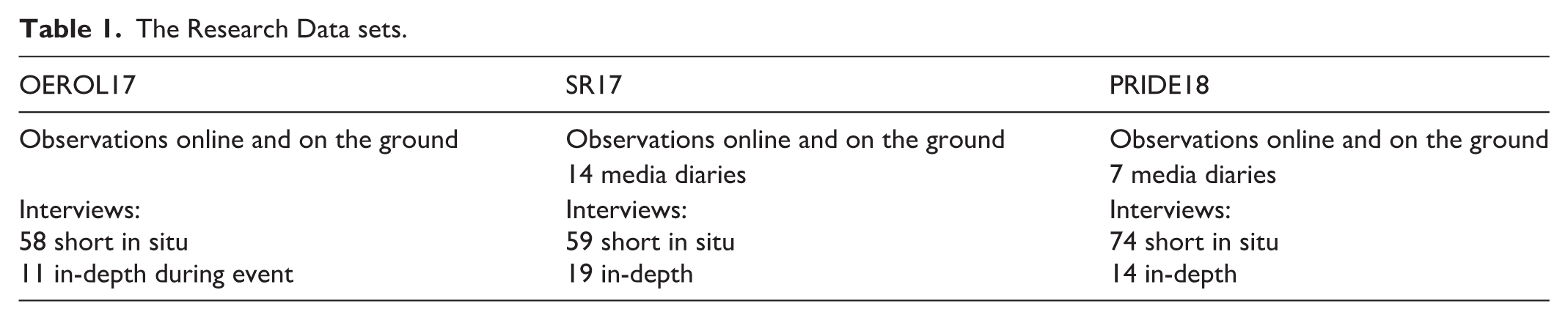
For this article, I use elements from an extensive dataset that I collected around three events that took place in the Netherlands in 2017 and 2018. The full dataset comprises online and offline participant observations, media diaries, short in situ interviews, longer in-depth interviews, and large datasets of images with metadata from Instagram. Focusing on the value of the live ethnographic work, this article is mainly based on the analysis of the ethnographic data described in Table 1.
The Research Data sets.
The research design is iterative and was continuously updated throughout the study, for I intended to be adaptive and reflexive, and stay open to new platforms and practices emerging during fieldwork (Lingel, 2017; Markham, 2006; Markham et al., 2018).
Introducing the Eventspheres
The field for this study encompasses the eventspheres of three large Dutch events: Oerol festival 2017 (Oerol17), 3FM Serious Request 2017 (SR17), and Pride Amsterdam 2018 (Pride18). Oerol is Europe’s largest festival for location-based theater and art. The festival has been organized every year, since 1982, for 10 days in June on the Dutch island of Terschelling and attracts over 50,000 visitors per event. 3FM Serious Request is an annual fundraiser for the Red Cross organized by the Dutch national radio station 3FM in the week before Christmas. This event is inherently a media event: three radio DJs are locked up in a Glass House studio for a week to make radio shows 24/7. Thus, the main event is the radio show, and people are invited to join in this event in several mediated ways. SR17 reached approximately 10,000,000 people through the event’s own media channels and 500,000 visitors on the ground (Van Stuivenberg et al., 2018). Pride Amsterdam is one of the most popular Pride events in the world. Since 1996, it has been organized for 9 days at the end of July/beginning of August in the city center of Amsterdam, and the latest events have attracted hundreds of thousands of visitors.
This combination of selected events provides a dataset that is comprehensive concerning media use, covers various event types, and is internationally relevant. My analysis of the three eventspheres is not comparative; rather, the objective is to see whether and how certain practices recur in different situations. Furthermore, since each eventsphere encompasses a distinct combination of used media, the study of all three events sheds light on a broad range of media use incorporating both broadcast and networked media. While the studied events were organized in the Netherlands, they have an international character. Oerol17 has an international outreach, attracting both artists and visitors from all over the world. SR17 is a format that is implemented in eight countries other than the Netherlands worldwide. Pride Amsterdam is by far the most international of the three events. The event is part of the international organization InterPride, and the global Pride movement and LGBTI+ (Lesbian, Gay, Bisexual, Transgender, Intersex, and other gender and sexual diversities) community. Because it is one of the world’s top Pride events, it attracts many international visitors.
When speaking of the events in this article, I refer to the eventspheres encompassing the full field of experiences, happenings, and media texts connected to the event through which it is discursively re-mediated. This includes the programming and content of the event proper, and all connected media texts shared before, during, and after the event.
Joining the Eventspheres
The challenge in this research project was to appropriate existing ethnographic and digital methods, and experiment with new forms therein, to do live research, studying the eventspheres while unfolding. To make this feasible, I intentionally selected events that lasted a week or longer to have ample time and space for iteration. The resulting research design can be implemented in a 1-day event, yet this would necessitate a research team. In each eventsphere, I started fieldwork with unstructured participant observations, carried out in online and offline event spaces. I used these to familiarize myself with the places, activities, and publics in the event, as well as to get a general taste of participants’ media use online and on the ground. In the online observations, carried out before, during, and after the events, I looked for what kind of content was posted where; whether and how locations, hashtags, tagging, and mentions were used; and whether there was any streaming going on via Facebook Live. This gave me a general taste of the online behavior of participants. These observations informed the rest of my research, leading to new lines of questioning or topics, and made it easier to dive deeper into the eventspheres as I had a good sense of what was going on.
As privately shared and ephemeral content is prominent within the eventspheres, I experimented with various methods to capture some of this. I quickly accepted that Snapchat was off the radar for me, but for privately shared content on Facebook and WhatsApp I had my hopes up. I found a script to enable people to donate content (Verheijen & Stoop, 2016) and sent out calls for donation, but event-goers were not keen on sharing their private conversations in this manner: I received zero data in two field studies and many critical responses and questions about this form of data collection. Iteration in the field thus explicated questions about the ethical desirability of the method, which I will come back to later. Instagram Stories—ephemeral content that is only visible for followers of an account—were possible to capture through online observations. With an Instagram account created for this research project, I started following people who were at the event so that I could observe their Instagram Stories. Since these Stories are only up for 24 hr, I did a round of observation there every day during and the day after the event. To capture these Stories and observations for analysis, I took notes and decided to make screenshots of Stories. For the collection and analysis of more permanent digital content, digital methods were applied. Through the tool Instagram Scraper (Rieder, 2015), posts from Instagram were collected by hashtag and location to get a sense of how this content was employed to join in the eventspheres. 2 Considering the scope of this article, analysis of these Instagram datasets is not foregrounded here. Important to note here is that online observations and data collection through digital methods tools are limited by privacy settings: only public profiles can be detected and thus observed or scraped. The final section of this article reflects on the ethics of the research tactics described here.
By far, the most valuable datasets for this research project were gathered in the field, talking to people. Informed by research questions and my observations, I set out to do participatory fieldwork in the form of semi-structured qualitative interviews. Two types of interviews were carried out in all three field studies: 192 short in situ interviews (averaging 3.5 min) held at event locations and activities with one to six persons at a time (a total of 319 participants), and 44 longer in-depth interviews (averaging 30 min) carried out during and shortly after the events with one to four persons, but predominantly individually (a total of 60 participants) at the periphery of event locations or at home via video conference. Where the short in situ interviews provide unique insights into the multitude of live media experiences in place and in the moment, the longer interviews offered room for a more in-depth exploration of these experiences. A total of 379 people participated in the interviews: 120 in the Oerol17 study, 128 in the SR17 study, and 131 in the Pride18 study.
For the design of this ethnographic portion of the research and the first phase of analysis, I followed a grounded theory approach (Charmaz, 2014; Strauss & Corbin, 1998). Audio recordings of interviews were transcribed and initially coded using MaxQDA (2018). The analysis that followed was performed using grounded theorizing and discourse analysis looking for interpretative repertoires (Wetherell & Potter, 1988). While clustering initial codes and finding my way in what people had shared with me, I continuously aimed to work with my datasets iteratively, going back and forth between my developing ideas and the data (Hammersley & Atkinson, 2007). I made a customized research design for each field study that was flexible and open to revision during field research. Since my objective was not to formally compare cases, it was unnecessary to have the same design for all three eventspheres. Moreover, customizing and readjusting along the way have several advantages. First, customizing to each specific field enabled me to follow the structure of it, aligning with the publics, locations, and content in the eventsphere to optimize perceptibility. Second, adjusting along the way allowed me to work iteratively, constantly tweaking the research design theoretically and practically based on my experiences in the field as the events unfolded. Furthermore, this approach invited me to go back and forth between theory, fieldwork, and analysis, each time bringing insights and questions from one area to the next. To cultivate this way of working, I did two things. First, throughout the fieldwork I made notes of my experiences, thoughts, and ideas, reflecting on my research questions and methods. Second, I started the analysis of data during fieldwork. This helped me to notice emerging topics and categories which I could then use as sensitizing concepts (Bowen, 2006). Continuing analysis in the months after fieldwork, before making the research plan for the next field study, enabled me to bring new categories and questions into each field study.
For example, one of the things I changed after the first field study was my interviewing plan. After experiencing how difficult it was to grasp ephemeral and private content and to get a clear in-depth insight into personal media behavior in the events, I decided to include media diary chats in my research design. A total of 21 people, 14 for SR17 and 7 for Pride18, participated in an individual WhatsApp chat with me during the events, logging their media use. WhatsApp was very convenient for this since the participants already used this app daily; logging could be done with text, images, video, and spoken messages; I could remind them or ask short clarifying questions immediately; and the diary chats could be easily exported to txt files to keep for analysis and archive. Based on these diaries, I carried out in-depth interviews with these participants after the event to talk to them about their media behavior and experiences during the event. Through this method, I was able to gather examples of private and ephemeral content and explore the meaning and use of it together with the participant in the interview.
In the following section, these datasets will be used to illustrate the value of live ethnographic research, of being part of the field. It addresses how event-goers and followers experience ephemerality versus permanence and private versus public when sharing their event experiences.
We Are Here! Insights from Eventspheres
“Being there” is one of the most prominent themes in my datasets: people want to show that they are part of the eventsphere, that they are there in the eventspace (Hammelburg, 2021). Whereas much of the content asserts “We are here!,” the meaning and breadth of this differ. On the one hand, it is uttered in an identity-forming and sometimes political way, deliberately claiming public visibility. On the other hand, people use more ephemeral content in, what feels like, intimate and private spaces to tell those close to them where they are. Exploring these two kinds of “We are here!” in the experience of event-goers reveals that layered socialities (cf. Postill & Pink, 2012) and implied audiences complicate general assumptions about and understandings of the categories of public and private. This exemplifies the value of an ethnographical approach by making more subtle issues apparent and going beyond analytic dichotomies.
Event-Goers as Ambassadors
Here [at Pride18] I go full force [. . . ], showing that we are here and what is happening on all social media platforms. I am usually not so personal on social media, but now I am. [. . .] I find it very important that there is constant attention for [. . .] what I do or what the people here do.
The above account by Gijs and the Instagram Story by Vera in Figure 2 echo the quintessential LGBTI+ chant “We’re here! We’re Queer! Get used to it!,” taking a personal position and claiming visibility in the public eye for it. This ambassadorship, not surprisingly often mentioned in the interviews I did around Pride18, already stood out to me when talking to people in my first field study Oerol17. In all three studied eventspheres, I met event-goers who acted as ambassadors to show the world the beauty, the importance, the true image of the event. Being an ambassador goes beyond being a witness: it is showing what takes place and taking a stand, purposefully spreading content from the event for it to be seen by a wide audience. Moreover, by taking this stand, the ambassador positions oneself within a certain social group, a collective. Whereas media use in events is largely habitual, ambassadorship is enacted purposefully and consciously. Many interviewees, like Gijs quoted above, note that they change their media habits for it. They seek a wide audience where they generally do not openly share too much personal information online.

Instagram Story during Pride18 by Vera.
Within the digital elements of the eventsphere, ambassadorship is often enacted through the platformed language of hashtags. Ambassadors employ the hashtag for their content to spread beyond their personal network, seeking visibility and findability. Furthermore, as Axel Bruns and Jean Burgess (2011) and Zizi Papacharissi (2015) have addressed in their work, hashtags articulate socialities and relate content and user to specific publics. Whereas the hashtag seems the prominent means for spreading and connecting, locational features of platforms such as location, check-in, and filter are often used in similar ways. These hashtags and locations then provide an entry for digital methods research. Through hashtag searches, API-allowing large datasets with content from the eventsphere can be gathered. Locational features, however, prove to be more complex. The digital methods tools enable gathering content by GPS coordinates, yet these are often lacking in the posts while users add locations in platform-specific ways such as location-filter on Snapchat or a location as a category within Instagram. How this use of location becomes meaningful within the eventsphere is then difficult to capture through these tools. Furthermore, while digital methods can work well to gather large quantities of content, find patterns therein, and analyze relations through hashtags, it is necessary to come in closer to grasp the meaningful ways in which event-goers employ these features—for instance, as ambassadors.
As ambassadors, event-goers often aim to correct a particular image of the event or its visitors that they expect their implied audiences to have. Davida, a visitor and volunteer at Oerol17, says that by sharing posts and Stories from the event she tries to “bring across that it is so lovely here. Many people think that only older people go to Oerol, and this way I can show that that is not the case at all.” Many of my interviewees at Pride18 explain that they want to promote awareness, represent or support the LGBTI+ community, and put a positive image of LGBTI+ out there. Adi explains to me that he and his partner post more photos at gay events than at other events to [. . .] spread the word a bit and [. . . ] find maybe some more acceptance from everybody. [. . . ] I think it is good to like spread this to show that it is not just a fetish or whatever, it’s also just a normal thing just to go to.
Implied audiences and implied images often govern how my interviewees manage the visibility of their content or decide what to post. For instance, ambassadorship for Robert means changing his Facebook privacy settings for photos of Pride18 to increase visibility of this “celebration of homosexuality,” also among some of his family members who are critical of this. For Femke, her implied Facebook audience is a reason not to share her Pride18 experiences there: “Didn’t post anything on Facebook. Everyone gay-friendly anyway.”
Ambassadorship is often accompanied by a sense of collectiveness. Ambassadors feel connected to certain groups or socialities, in which they position themselves by publicly and proudly showing that they are there. These mediatized socialities are often diverse and layered, ranging from the event-public to personally built-up audiences. This is discernible in all three events studied, but my fieldwork from Pride18 provides the richest portrayal thereof. Pride18 is closely tied to the worldwide LGBTI+ community, which is often expressed by my interviewees and is recognizable in their use of hashtags and locations. However, the enactment of this—the concrete socialities in which this takes shape—differ. Let us briefly consider two people who both post about Pride18 as ambassadors, with different stories and implied audiences involved. For Shevan, who fled Syria because being gay endangered him there, ambassadorship is imperative in Pride18: Because some friends [. . .] still live in Syria or the Middle East or whatever. They are my friends on Instagram, Facebook. So, when they see these photos, it kind of gives them hope. [. . .] It is not only about me; it is about all of us you know.
Whereas Shevan has his friends abroad in mind when posting, Nikki shares Pride18 experiences through Instagram Stories with an audience of unfamiliar followers. She tells me that she has many followers on Instagram who are struggling with their LGBTI+ identity, often living with parents or within a community disapproving of their them being gay or trans. Nikki makes sure to post Pride18 Stories as she knows her followers especially respect her for being so open and see her as an example for living a proud LGBTI+ life. These two young ambassadors, Shevan is 28 and Nikki only 19 years old, share their Pride18 content openly connecting to other young people worldwide who cannot or have trouble being openly LGBTI+.
Often my interviewees note that the sociality of ambassadorship is empowering, yet it can also be a vulnerable position. Many Pride-goers mention that they can receive unkind or even hateful reactions to LGBTI+-related content. Again, visibility is key here. When placing Pride-related content on their social media accounts, this can be seen by people whom they might meet face-to-face the next day at work, school, or their grandmother’s birthday party. Navigating all these socialities which partly overlap and coincide within the same platforms can be complicated. Vareen tells me that she uses hashtags in her Instagram Stories to make Pride-content visible to a wider audience while specifically excluding some followers whom she knows “because I just can’t predict how they will respond, and I don’t particularly want their reactions [. . .] because it is gay-related and they might have certain conceptions about that.” Concurrently, Vareen feels empowered putting herself forward as Pride ambassador, being part of the Pride community, and vulnerable in the gaze of particular others. Her navigation of visibility in online platforms—intentionally seeking large audiences using Pride and LGBTI+-related hashtags while blocking other specific audiences—is telling for how in mediatized eventspheres various social layers, both online and offline, commingle. Furthermore, the practice of purposefully using hashtags or locations in content that is generally secluded and ephemeral, such as Stories on Instagram and Snapchat, complicates the understanding of this content as meant to be seen only for a limited time by a select group of followers or friends.
Ephemeral Fun in Smaller Social Circles
Where ambassadorship engenders connections to larger social groups and seeking a wide audience, a large part of the eventsphere is constructed of more ephemeral interpersonal communication. Event-goers share personal event experiences within various social circles through Stories, Snaps, and Apps not discernible from the outside. Many of my interviewees distinguish between “I’m here” posts as described above and those which are shared within closer circles. They speak of sharing funny, quirky, and sometimes very personal and emotional images, images which are part of a conversation with selected others. These practices show a diverse landscape of socialities functioning online and offline, some formed specifically for the event and others formed alongside different social connections that people tap into with their event experiences.
Engraved in these varying forms of sociality lies a layered and diversified system of anticipated visibility which is often crucial in event-goer’s choices of platforms and functionalities. Many of my interviewees critique the practice of always showing everyone where you are and tell me that they prefer to, as Jo puts it, “share it with people who are dear to me, not with the whole of the outside world.” In my interviews, these terms of “those dear to me” versus “the outside world” are recurrent. However, when examining this more closely, it becomes clear that distinctions therein are not strictly made in these two opposites. Users tailor to their needs, use the platforms they feel good about, in ways that fit their socialities (cf. the example of Aira in Madianou, 2015). As Walter explains, “I send photos to my friends through WhatsApp, to those nearest to me. Those on Instagram form sort of a next circle of people who can see that I am there.”
In the studied eventspheres, the direct messaging platform WhatsApp is the prominent platform for sharing event experiences with specific others and within private groups. 3 Event-goers take part in various private chats in which they can immediately share their event experiences. These chats can be one-on-one or group chats, with group chats including those specific to the event—sometimes existing for years covering multiple editions and growing very large—as well as groups of family members, colleagues, friends, sports clubs, and so on. As the platform harbors this wide variety of groups that can grow to include up to 256 participants, it stretches the notion of “private.” WhatsApp combines many levels of communication, multiple socialities, ranging from the extremely personal to the very general.
The focus on “the chat” as the main feature within WhatsApp affords conversational use. Consequently, WhatsApp users are always involved in continual conversations that they can tap into at any moment to share their live event experiences with specific others. Whereas these can be images exclusively shared privately, for very special experiences, event-goers often seek this specific audience alongside the wider audience of Instagram and Facebook. As Rachel explains, “It was really cool so besides sharing it on Instagram, I also shared it with certain people through WhatsApp.” Rachel here hints that the implied audience of her Instagram profile is not sufficient in this event experience. She wants to make sure that it is seen by a specific audience that is receptive and knowledgeable. Event-goers share their experiences where they know they will be valued and affirmed. Particular elements of the event—a place, a hobby, a memory—can trigger the urgency to share content with particular others who will understand its meaning. Barbara tells me that her theater friends do this at Oerol17 “when they see a play related to something we made together before, or which they think will interest me.” The shared social context and memories between Barbara and her theater buddies provide meaning to the content. Moreover, Barbara appreciates the effort taken to send it directly to her as “when posted on Facebook or Instagram it dissolves into the mass.” Targeting content to specific audiences affirms both the experience and the social bond.
Event-goers seek to share their live event experiences with specific receptive audiences and aim to exclude others. Aligned with sociality and anticipated visibility, event-goers, especially the younger ones, tell me that they use Snapchat and Instagram Stories more light-heartedly and spontaneously than other platforms. As Karima explains, “the threshold to post on Snap is much lower. Also because on Facebook, I have many more followers: on Snap this might be 50, on Facebook it can be hundreds. Many more people will see it all.” Similarly, Jen tells me that Snapchat feels more personal for her than other platforms: “[It] gives me the possibility of choosing to whom I send my photo. [. . .] and I only use it with people with whom I really spend a lot of time.” Generally, (parts of) platforms for ephemeral content feel safer, less out in the open, since they defy the hazard of the permanence of online content (boyd, 2008). As Eric says, “you know that it won’t haunt you. [. . .] Clearly, there is the desire to share the moment, but you are afraid of the consequences. Then Snapchat is a good fit.” Often my interviewees mention that—because of their ephemerality and less serious disposition—they use Snaps and Stories for sharing funny content or making silly jokes with their friends. Amer and Nilson tell me, “It is a personal style of humor which you share.” “[. . .] a kind of visual language which you develop with friends, those visual cues, inside jokes.” These secluded platformed spaces for inside jokes and group-specific references are vital parts of the eventsphere, for they shape the experience of the event-goer. Yet they stay below the radar for the researcher as an outsider.
Notwithstanding the significance of the secluded set-up of these platforms, the practice of anticipating and navigating visibility is messier. Interestingly, my interviewees often chose platforms for their more personal and secluded feel, while these are de facto quite openly accessible. Many event-goers are not merely concerned about how many people will see their content; rather, they care about who will see it. Facebook friends differ from followers on Instagram or Snapchat (cf. boyd, 2008; Van Dijck, 2013). Consequently, while a photo might be visible exclusively to friends on Facebook and publicly on Instagram, the Instagram post can feel more intimate and appropriate due to its implied audience. Lenny, who I met at Oerol17, reflects on this paradox of visibility he encounters in his online behavior: While I have more followers on Instagram, I am more conscious about what I post on Facebook. [. . .] It is kind of funny, that you often share things with a huge audience, Instagram being fully public, anyone can follow you, and that you reflect on that less than when you post on Facebook with people who you know better.
For many young event-goers, posting on Facebook has a gravity to it, while sharing on Instagram and Snapchat is done more light-heartedly. Some of my interviewees very precisely know their audiences, yet often habitual use among peers has made these platforms feel comfortable, intimate, and personal to them even when the content is published publicly.
I Was There! An Ethical Stance
This layered landscape of socialities and anticipated visibility complicates the standpoint for the researcher, as content that is publicly spread can be intended for peers, while more secluded and ephemeral content, which is difficult to capture for the researcher, can be intended to add to the public eventsphere. This again puts forward the question of how we can gain profound understanding of the eventsphere without sacrificing event-goers’ privacy and autonomy. Combining digital and ethnographic methods, and emic and etic perspectives, seems a promising way to do so. The different perspectives each beget their particular ethical questions, and in this way the research design practices Annette Markham’s credo that ethics is methods and method is ethics (Markham, 2006). Studying eventspheres live by participating in the field is distinct from studying an event from a distance as you face the embodied and lived praxis of the event-goers you study. I will illustrate this in three concrete dilemmas I have encountered concerning the blurring of public and private: use of a tool to gather WhatsApp content, the choice and set-up of my Instagram account for research, and screenshotting during online observations.
Recognizing WhatsApp as an essential platform for communication in Dutch eventspheres, I was eager to gather content from it, to get insight into the ongoing conversations within WhatsApp groups, while I also wanted to respect the private setting of the direct messaging app. I experimented with a tool through which event-goers can donate their WhatsApp chats (Verheijen & Stoop, 2016), which gives full agency to the user. Getting zero response during the first two events showed that event-goers are not keen to participate in this way. Talking to event-goers in the field revealed the unease they felt with donating their WhatsApp chats. They openly spoke to me about their chats, even showed me personal messages and photos, and in my latter two field studies participants shared content through their media diaries; however, they felt very uncomfortable donating a complete chat. These chats are experienced as private spaces in which they feel comfortable because they do not have to worry about the outside world seeing it. Giving a researcher full access to this private space and making solid what is a fluid, continual conversation feel uncomfortable.
A second dilemma arose during online observations on Instagram. I created a research profile on Instagram to search for content and follow event-goers who were there. By using a research account, I ensured that it was visible to event-goers that I was carrying out research at the event. I used an image with letters as a profile picture, which I felt would hint that I was not following “as a person,” and in my bio I included a link to the official university page about my research project which includes my contact details. Whereas this might tick the boxes of a checklist for ethical research practice, talking to event-goers in the field nuances this. Most Instagram users do not examine every profile that starts following them. Most likely, the majority of the event-goers I followed on Instagram did not know that I was researching them.
Furthermore, the third dilemma occurred when observing Instagram Stories: I felt I needed some fixed material to capture what I found, and I decided to make screenshots. As noted in the previous section, Instagram Stories are often considered an intimate space where content is shared which is intended to be temporarily visible for an audience of peers. My screenshotting violates this understanding. It poses the question whether I have the right to make permanent what was intended to be ephemeral. I decided to keep a private research database of screenshotted Stories, as I felt this content was essential for a thorough analysis and better understanding of this substantial part of the studied eventspheres. For dissemination, display in publications, and presentations such as the one at hand, I asked for informed consent directly from the user.
Throughout these three dilemmas, it became clear that visibility is again a key issue here. When gathering content through digital methods and online observations, the event-goers whose practices and experiences I research could not or were unlikely to see me. Doing participatory fieldwork, however, I faced them and this encounter forced me to regard my status as a researcher more than other methods have. Where the study of digital material is by many Ethics Committees not regarded as research with human participants, the people whose content I study are of course indeed human. Being part of the event on the ground, days in a row and many hours a day, this was unavoidable for me. In the field, you stumble upon ethical dilemmas and the unevenness of the relationship between researcher and researched by sensing hints of social unease within yourself and in the people you meet. I experienced this unease, for instance, when transitioning from observation to interviewing, when you decide to speak to people who you have been watching for a while already. Furthermore, as event-goers and locations became familiar to me, the online observation started to feel a bit like stalking. Especially at Oerol17, the smallest event studied, I would recognize people at event sites because I had seen them online. Their use of Instagram locations had told me where they were the day before, I knew their relationship to the person next to them because of their captions, and their hashtag use had informed me about matters such as their fandoms, home towns, and sexualities. They did not know me and did not know that I had been watching their posts. In the field, I felt the social discomfort of this unevenness, of not being as visible to them as they were to me (cf. Hine, 2015).
Being There Matters
Being part of and visible within the eventsphere is important both for event-goers sharing their live experiences and for the researcher who gains miles by participating in the field as the event unfolds. Drawing on substantial ethnographic fieldwork comprising online and offline participant observations, media diaries, and (short in situ and longer in-depth) interviews with 379 event-goers, it has become clear that commonplace categories of private-public and ephemeral-permanent are rather more confluent than dichotomous. Many platforms include a range of possibilities in terms of visibility and sociality, and the various platforms differ in actual publicness and perceived openness due to their implied audiences. Moreover, event-goers have many strategies that complicate this, such as contextually managing privacy settings within platforms and using functionalities such as hashtags and location in particular ways. The categories—private-public and ephemeral-permanent—are often not experienced as such as for most of my interviewees it is not about how public a platform is, but for which audience their content will be visible. This anticipated visibility is aligned with various socialities within and outside of their eventspheres.
The value of an ethnographic approach lies in its ability to make meaning and subtle nuances visible, where they would have not been distinguishable as such when studying digital datasets from the outside. I have demonstrated how event-goers act as ambassadors in the studied events. The content these ambassadors share is for the large part discernible through digital methods, as more public platforms and settings are chosen and hashtags and locational functionalities are purposefully used to find a large audience. Furthermore, through digital methods tools, we can analyze networks of prominent figures in the online parts of the eventsphere and map online socialities. However, to identify the story of ambassadorship, it is necessary to step into the field and speak to event-goers about what they are doing as the event unfolds. This reveals the experience and meaning of posting, and also shows what is not posted. Furthermore, vast parts of the live eventsphere stay below the radar of digital methods tools, as much content is ephemeral and often shared within platforms or parts of platforms that are secluded. Often, event-goers seek specific audiences whom they expect will understand what their content means in that moment, generally in reference to shared stories within certain socialities.
As posting aligned with various socialities—and the many levels of anticipated visibility therein—does not follow the public-private dichotomy, the understanding of online parts of the eventspheres as public spaces (cf Markham, 2006) is convoluted. Publicly visible content is often not posted with a wide audience implied. This asks the researcher to question whether it is right to capture public profiles and publicly shared content for research (cf. Association of Internet Researchers [AoIR] & Markham, 2016; Franzke et al., 2020). In participatory fieldwork, hints of social unease point out, to the sensitive researcher, ethical dilemmas and force you to recognize your position as a researcher within the specific context. Being there live means facing the people you study openly, engaging in an embodied relationship between the researcher and the participant.
This study of mediatized live event experiences exemplifies the value of an ethnographic approach and bringing observations from one place to another in an iterative research design. From this, I argue for further exploration of ways to combine digital and ethnographic methods in research designs to comprehensively and ethically explore continually developing digital structures from the outside and everyday live media use from the inside.
Footnotes
Acknowledgements
To my interviewees and those donating content, I am grateful for your openness and willingness to share beyond the context of your own direct event experiences and familiar circles. My encounters with you have truly enlightened this research project in so many ways. Furthermore, I deeply appreciate the efforts of reviewers to read this paper closely and provide valuable advice for developing and improving it. The amazing organizers of and participants in the Urbino AoIR Flashpoint Symposium, thank you for your warm welcome, support, questions, and discussions. And special thanks to Stefano Brilli, Elisabetta Zurovac, and Giovanni Boccia Artieri for realizing this special issue.
Declaration of Conflicting Interests
The author(s) declared no potential conflicts of interest with respect to the research, authorship, and/or publication of this article.
Funding
The author(s) received no financial support for the research, authorship, and/or publication of this article.
Informed Consent
The images in this article were donated to the author with informed consent for specific use in publications and presentations of her research.
