




Abstract
On the 8th of September, 2022, the world paused as the BBC announced the death of Queen Elizabeth II. After 70 years on the throne, the longest-reigning British monarch had died aged 96. The Queen’s death immediately became a global media event that would eventually culminate in the state funeral broadcasted live and followed online worldwide. While many legacy media maintained the classical ceremonial mode of reporting the media event, the narratives and visuals on social media instantaneously challenged and re-narrated the ‘official’ media event dramaturgy. Through digital media ethnography of the media event, unfolding live in both legacy media and on social media platforms, this article demonstrates how diverse social media publics reacted to the legacy media narratives. Special emphasis is placed on the coverage of and the reactions to three parts of the event on BBC and on Twitter: (1) breaking news of the Queen’s death, (2) the Lying-in-State and (3) the State Funeral. The article concludes with a reflection of how the performances of live participation on social media created diverse dramaturgies and how those dramaturgies spoke to very different publics and consequently created a variety of possibilities to interpret the event and its meaning in history.
Keywords
The mediated life and death of the Queen
An event is a dialogue between a prompting occurrence and a collective performance. Stressing one or the other may lead not only to constructing different dramaturgies but also to producing different events (Katz and Dayan, 2018: 145)
On the 8th of September 2022, the world paused as the BBC announced the death of Queen Elizabeth II in a solemn manner by interrupting the regular TV broadcast. The Sun, a tabloid newspaper, marked the occasion with a front cover of Goodnight Ma’am – The Queen dies aged 96 after 70 years of remarkable service leaving Britain and the world in mourning. The longest-reigning British monarch, Queen Elizabeth II, had died in Balmoral, Scotland. As a public figure and a symbol of British nationhood, the Queen has a special significance in modern media history, in Great Britain and well beyond. To follow Clancy (2021), we maintain that while the royal image has always been mediated and the history of royalty is a history of representation, the evolution of modern mass media (and later the Internet) has greatly intensified and complicated the relationship between the Queen, the royal family and the media. The Queen herself sums it as follows: ‘I have to be seen to be believed’ – Queen Elizabeth II (Clancy, 2021: 63).
Consequently, the public – whether British, Commonwealth or global – ‘knows’ the Queen second-hand through the media (Billig, 1992). Hence the relationship between the royal family, and the Queen as its head, is best characterised as mediated, shaped by a complex interplay between media logics, public interest and the demands of the Monarchy. The relationship has typically been characterised by conflicting expectations, changing trust relationships, as well as public gains benefiting all parties. Due to the rapid technological expansion and evolving digital media forms, people today have more access to the Monarchy than ever before, a shift in media history that has only intensified mediation of the Monarchy and of the controversies around the public image of the royal family in the eyes of digital publics. Clancy (2021: 64–65) accurately names the Queen’s era a ‘media monarchy’.
The mediation of the Monarchy regularly involves public events and related rituals and ceremonies (Billig, 1992; Shils and Young, 1956). During her long-lasting reign, Queen Elizabeth II played a significant role in many iconic media events that had a lasting impact in modern (media) history. Her crowning in 1953 was a landmark event orchestrated in concert with the royal family and the BBC (Scannell and Cardiff, 1991; Shils and Young, 1956). What is more, this event has unique significance also in the development of classical media event theory. Dayan and Katz (1992), pioneers of media event theory, consider Queen Elizabeth’s coronation a paradigmatic example of the event category they name Coronations, the scripted genre the authors (1992) label the most ceremonial of the three event genres (i.e. Coronations, Contests and Conquests) (see also Clancy, 2019). While contestation already emerged in 1953 (Örnebring, 2004; William, 2022), the dominant narrative of the event is about consensus over significance and the power of rituals.
More recent examples of media events marking the meaning of the royal family and orchestrated by mass media are the wedding of Prince Charles and Princess Diana in 1982, and the death of Princess Diana in 1997. They are considered ceremonial media events and iconic rituals of their times (Scannell, 1999; Sonnevend, 2016). In addition to media events of royal celebrations, several media scandals (Lull and Hinerman, 1998) and disruptive media events (see Cottle 2006; Liebes, 1998; Sumiala, 2013) associated with the royal family, have also kept the Queen in the limelight. Recent examples include the media drama consisting of sequential media events around Prince Harry and Meghan Markle leaving the royal family in 2020 and the scandal around Prince Andrew’s connections to the American sex offender and financier Jeffrey Epstein. In addition to disruptive media events and scandals generated by tabloids and news media, other forms of fictional media have kept Queen Elizabeth II in the spotlight (Clancy, 2021: 64). Films (for instance, The Queen, 2006) and historical drama series (for example, the Netflix blockbuster, The Crown, 2016–2023) have all endorsed the role of Queen Elizabeth II as a prominent media event figure and an icon in her media monarchy.
From this perspective, and with her unique role and place in the 20th century and early 21st century media event history, one could expect nothing less than a global eventisation (Couldry et al., 2009) incited by her death. Following Julia Sonnevend’s (2016: 20–21) insight on event theory, the Queen’s death as a global media event had spectacular and iconic features; it was extensively covered in different parts of the world, being embedded in historic meaning(s) and significance of the royal history of the United Kingdom, and it will likely be ritually remembered. The event had the power to condense history, thus potentially having a lasting global resonance not only with British national and Commonwealth history, but also with global history.
While the media coverage of the Queen’s death has instigated academic interest (see e.g. Clancy, 2019, 2024; Gullace et al., 2023; Hallgren, 2024; Nuzulia and Firmonasari, 2023), the complex dynamic and interplay between its performance and the related dramaturgies in more traditional news media, such as the BBC, and social media (e.g. Twitter) has not been sufficiently addressed (however, see. Hallgren, 2024). This article is an attempt to fill this gap. The article contributes to the study of media events in the framework of mediating the Monarchy. We examine the death and the funeral of Queen Elizabeth II as a moment of symbolic condensation and intensification of time and history (cf. Dayan and Katz, 1992). More specifically, we focus on the idea of live participation on social media and shed light on how social media publics respond to the performance of a live media event orchestrated by legacy media. We also consider how media representations and performances shape the public image of the Queen as a symbol of the Monarchy.
We take inspiration from one of the last co-authored publications on media events by Katz and Dayan (2018: 145) and argue that the study of such performative and communicative gestures and the related dramaturgies between the occurrences (the Death, the Lying-in-State and the Funeral) and the mediated responses by the social media audiences as active publics provides scholarship with new analytical tools. These tools can be applied to better understand the dynamics between legacy news media and social media performances of the present-day media events (see also Frandsen et al., 2022: 2) and mediation of the Monarchy (Figure 1).
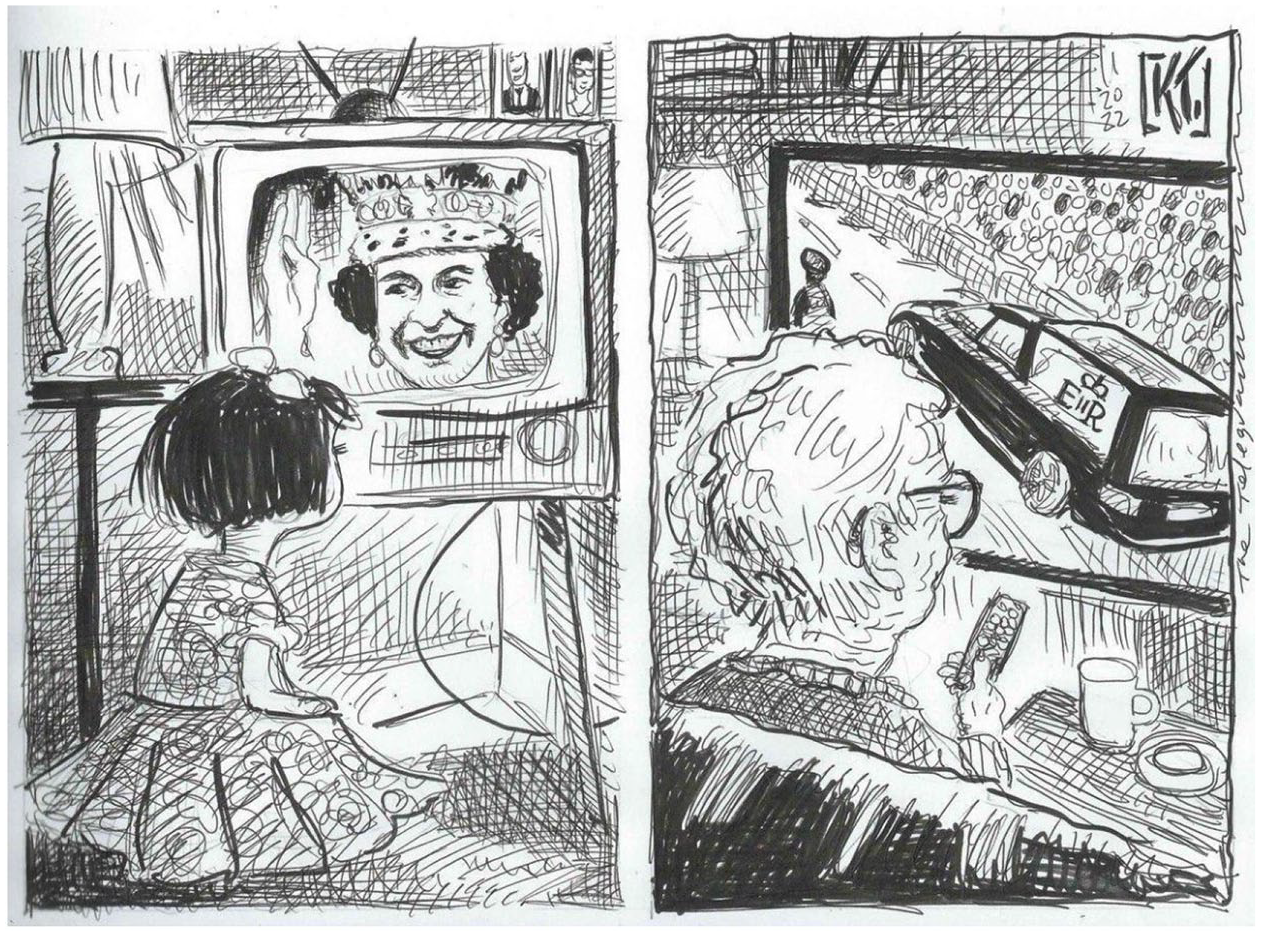
Twitter 20 September 2022. Image by Kevin Tobin, Illustrator, Editorial Cartoonist at the Telegram.
The article uses digital media ethnography (Tikka et al., 2023) as a methodological approach to analyse how the event unfolded live on the BBC and simultaneously on Twitter 1 ; the study addresses the dynamics between the event’s ceremonial style of reporting by the BBC and the active, participatory role of social media audiences and the related publics. We focus specifically on live engagements (see Hammelburg, 2021) between legacy media and social media performances. While death often triggers a ‘sphere of consensus’ (Hallin, 1986) in public discourse as people come together in mourning and momentarily forget their differences, this was markedly not the case with the death of Queen Elizabeth II. The event was contested – and this contestation quickly emerged across multiple media platforms (see also Mortensen, 2015; Valaskivi et al., 2022).
In her article Seen to be grieved: Queen Elizabeth II’s death and the unsettlement of the modern media event Hallgren (2024: 269) argues that by ‘centering a narrative of grief, legacy and reverence’, the mainstream media event of the Queen’s death was ‘steeped in nostalgia for a unified British culture and nation state’. However, and by contrast, the counternarratives which Hallgren calls ‘viral events’ around the Queen’s death were characterised ‘by counter memory work that drew critical connections between the present—the moment when the Queen died—and the past—the imperial legacy over which she presided’(Hallgren, 2024: 270). Our digital media ethnographic endeavour points to a similar direction and underlines the significance of live social media participation and ‘dual screening’ in creation of alternative dramaturgies around the Queen’s death as a media event.
The article is structured as follows. We begin our analysis by providing a conceptual discussion in today’s theorising of media events and the emergence of audiences as co-constitutive of media events unfolding live on multiple media platforms. Next, we discuss our methodological approach: digital media ethnography. We will discuss the death of Queen Elizabeth II in the framework of ethnographic observation and digital participation in the live event. In our empirical observation, we place special emphasis on three phases in the legacy media performance of the event: (1) the Death of the Queen as a breaking news event; (2) the period of Lying-in-State and (3) the State Funeral. 2 The observation and collection of empirical material covers the BBC news and Twitter as well as the Royal Family’s official YouTube channel from 8th September to 20th September, 2022. The article concludes with a reflection of how the performances of live participation on social media created diverse dramaturgies and how those dramaturgies spoke to very different publics and consequently created a variety of possibilities to interpret the event and its meaning in history.
Media events as symbolic condensations of history
The original idea of Dayan and Katz was that media events are best characterised as mediated, ritual and symbolic performances of the social. They comprise a special genre that is powerful enough to interrupt everyday media flow, bring the audience into touch with the society’s central values and invite the audience to participate in the event (Dayan and Katz, 1992: 5–9). One of the key critiques has to do with the theory’s assumed presentist nature (see e.g. Sonnevend, 2016; Sreberny, 2016; Ytreberg, 2022). The book’s subtitle ‘The Live Broadcasting of History’ suggests that media events unfold ‘live’ in front of the (mass media) screens of the audience. However, according to media historian Ytreberg (2022: 9), Dayan and Katz placed more emphasis on the role of the media in contemporary events and less on events as a broader category of social and historical phenomena. Zelizer (2018) suggests there is a need to consider ‘mnemonic schemes’ as temporal frameworks of interpretation that guide the ways in which media events are produced as well as made sense of in ‘real time’ (see also Sumiala, 2024). In this article we recognise mediation of the Monarchy and the Queen as a key historical framework of interpretation of her death as an event, but wish to emphasise the significance of social media live participation as a performance of symbolic condensation of history in this media event.
Participation as dual screening in media events
One important shift in theorising today’s media events has to do with the increased focus on publics as co-constitutive of media events. When Dayan and Katz offered their original theory of media events, their focus was on the construction of media events, narration and performance on live television in particular nation states. Of course, social media were not yet present at that time – but events travelled across media (for instance, from television to radio to newspapers) and many events were already contested in the early 1990s. Still, audience reactions to media events, particularly in fragmented global environments and across various media, was not a key concern for Dayan and Katz (Sonnevend, 2016: 6–20).
Audience has always been central to the constitution of events (Lang and Lang, 1953; Wagner-Pacifici, 2017). But with the development of social media platforms and mobile communications, the agency of social media audiences as publics has become fundamental in making and shaping today’s media events (Sumiala, 2021; Sumiala, 2024). And while many would still argue that legacy media remains the primary source of information (e.g. Frandsen et al., 2022), more and more often various publics become constitutive of events by posting, discussing and processing media events on social media as they simultaneously follow the event live on mainstream news media. This practice of participation can also be called dual screening which Vaccari et al. (2015: 1041) define as ‘the bundle of practices that involve integrating, and switching across and between, live broadcast media and social media’. We argue that this characteristic of dual screening is what makes the commentary of the social media publics different from the coverage offered by legacy media. Where in the context of political communication and campaigning, dual screening has been found to enhance agency and empowerment of the social media users (Chadwick et al., 2017), in the context of global media events, we claim, it enhances feelings of participation.
In addition, dual screening opens possibilities for revealing the simultaneously existing, parallel and even conflicting narratives related to media events, thus potentially contesting the dominant dramaturgy and narrative performed by legacy media. In this way, social media audiences as publics contribute to the multiplication of centres in any given media event through performances that include posting and circulating messages on digital media platforms. This is how, to use the classical notion of Dayan and Katz (1992), the public sphere is brought to life.
Liveness as co-existence of multiple audiences
These developments in media events and media event theory cannot be understood without rethinking another key concept; liveness. No doubt media events, as ‘live broadcasting of history’ (as the subtitle of the 1992 book by Dayan and Katz suggests), demand liveness for their very existence (Marriott, 2007: 59; see also Scannell, 2014). The power of media events as a symbolic performance of the social draws on the idea of ‘the whole world is watching’ (Dayan and Katz, 1992) the event on their screens. In mass media events, liveness enlists the publics as emotionally engaged yet distant participants, thus endorsing asymmetry between producers and audiences (Frandsen et al., 2022: 11).
In the context of social media, we cannot understand liveness without considering the active participation of the publics in the making and shaping of events. Furthermore, with social media, liveness must be approached from a variety of perspectives. According to van Es (2017), the idea of liveness can be analysed in relation to three categories: ontological, phenomenological and rhetorical. Here, liveness as an ontological category refers to technology whereas liveness as a phenomenological category refers to the experience of social involvement. Finally, liveness as a rhetorical category refers to ideology (Feuer, 1983)—that is, liveness as socially constructed, dependent on certain values and as procuring certain outcomes. Furthermore, Frandsen et al. (2022: 10) consider liveness as a participatory act where:
Users comment on social media in real time on the live broadcast of events, thus contributing to creating and negotiating the collective understanding and experience of such events.
In today’s media events – such as the death of the Queen discussed in this paper – liveness can be viewed as ‘the co-existence of and converge between different forms of liveness’ (Frandsen et al., 2022: 11). Following van Es (2017), we can thus see liveness as using different technologies used to take part in the live event (ontological) which in turn gives rise to a social experience (phenomenological); in the context of social media, this can be established for example through collective commenting on the event or dual screening as a mode of participation. In addition, as per van Es (2017), liveness can be viewed as serving certain values (ideological): in the context of this study, values relating to the British Monarchy or the Queen as its symbol, for example, and the responses the participants on social media contribute.
Thus, we argue that liveness in media events emerges from the different aspects related to technology, experience and ideology that intersect with each other. These aspects naturally differ in terms of which media outlets or platforms, which social experiences, or which values or ideological underpinnings associated with the media event, here the death of the Queen, are concerned in the live participation of the event. Consequently, liveness enables the co-existence of multiple audiences actively participating in the event using multiple technologies.
Methodology: digital media ethnography
One of the key difficulties that the contemporary Internet offers the ethnographer is its unpredictability: Events can develop and blow over very quickly. . . and involve unanticipated combinations of different forms of interaction. . . (Hine, 2015: 18).
Hine (2015) describes the challenge media scholars face when trying to examine media events and these events’ evolving in digital media spaces (see also Tikka et al., 2023). The death of the Queen illustrates how such events emerge on multiple platforms, created by diverse actors participating in the event in a variety of time zones (see e.g. Sumiala and Tikka, 2020) and coming from different cultural and socio-political contexts. Thus, while the Queen’s death took place in the specific location of the United Kingdom and was immediately associated with certain frame of reference related to the history of the British Monarchy, the social experience(s) related to and triggered by the death event that emerged on social media originated among diverse digital publics located in dispersed locations, bearing diverse histories and relationships with the Queen and the British Monarchy.
Such fluid condition of dispersed data and publics pose particular challenges for empirical research (see also Harju and Huhtamäki, 2021) and influences the process of collecting material through digital media ethnography as well as the material’s interpretation. As in any digital media ethnography, fieldwork practices in studying media events unfolding in the contemporary media environments involve following, archiving and lurking. Markham (2013: 438) maintains that scholars carrying out fieldwork should reimagine the digital field more as a ‘movement, flow and process’ instead of an ‘object or place’. The digital field is ‘carved out through the ethnographer’s engagement with the subject’ (Tikka et al., 2023).
To study a moving target, as a live media event, has its limitations. A digital media ethnographer can never fully cover all the material circulating in the digital field, nor can their findings be quantified or generalised. What the ethnographer can do is to grasp certain performative dynamics and related dramaturgies intensified in the actions of the participating publics. And by doing so, ethnography has a unique capacity to make meaning(s) of these fleeting moments. As American sociologist Alexander (2008: 782) argued, ‘icons are symbolic condensations that root generic, social meanings in a specific and “material” form’. The Queen was an icon and her death also communicated complex social meanings that need to be untangled.
The actual observation phase lasted from 8th September, when the death of the Queen was announced, to 20th of September, the day after the funeral. During the ethnographic observation and data collection, we followed the event on diverse media sites, making observations and taking notes about how the publics globally responded to the death event, how the responses changed over time (between the announcement of death and the state funeral), capturing empirical material as screen shots as well as field notes. In this collective effort, we followed the key legacy platform live-streaming the event, the BBC, and social media platforms, mainly Twitter. We also followed the Royal Family’s official YouTube channel as complementary to the other two sources. The official channel had less narration in their live-stream, but otherwise the content was similar, if not identical, to that of the BBC.
Empirical data collection was divided so that one researcher followed the live broadcast on BBC while another researcher followed both the live broadcast on the Royal Family’s YouTube channel and Twitter, tracing various discussions and conversation threads taking place simultaneously. From a methodological perspective, the researchers’ own practice of dual screening mirrored the actions of the media users commenting on the live broadcast; this was found necessary to understand the communicative actions of the performing publics who, in their comments on social media, frequently not only referenced historical and factual events in the past (like the colonial history of Britain, for example, or the merits of the Queens as the longest reigning monarch in the UK history) but also commented on what is happening live on the broadcast they were watching at the same time. The methodological choices were thus aligned with the goal of examining the Queen’s death through the lens of media event theory, with the aim of shedding light on the diverse forces shaping the historical and widely televised (and commented on) event as a media event.
The death of the Queen: three phases of the media event
In this section, we analyse the ethnographic material by dividing it into three phases that follow the chronological order of the event: the announcement of the Queen’s death, the Lying-in-State, and the public funeral of the Queen. We start by describing how the media event was launched in and by legacy media (here, in particular the BBC) and the live participation this triggered on Twitter. We then move on to discuss the middle part of the event, the Lying-in-State, and its performative construction in both legacy media and on social media. In the third section, we focus on the mediated performance and narration around the funeral on BBC and Twitter.
‘Operation London Bridge’
There is no question about it; as a media event, the Queen’s death was designed to attract a global media audience. It was designed as a visual spectacle pregnant of ritual symbolism and value. The starting point in our empirical analysis is the moment when the BBC news announced the death of the Queen in a special news broadcast that interrupted the ‘normal flow’ of daily programmes (Dayan and Katz, 1992). The short announcement started with a black screen, and a moment of silence that was followed by the news anchor Huw Edwards’ statement:
The BBC is interrupting its normal programmes to bring you an important announcement. This is BBC news from London. Buckingham Palace has announced the death of Her Majesty the Queen Elisabeth II.
This announcement was followed by an audio-visual tribute to the Queen which included her image with the year of her birth and death. The National Anthem, ‘God Save the Queen’, accompanied the tribute (Figure 2).
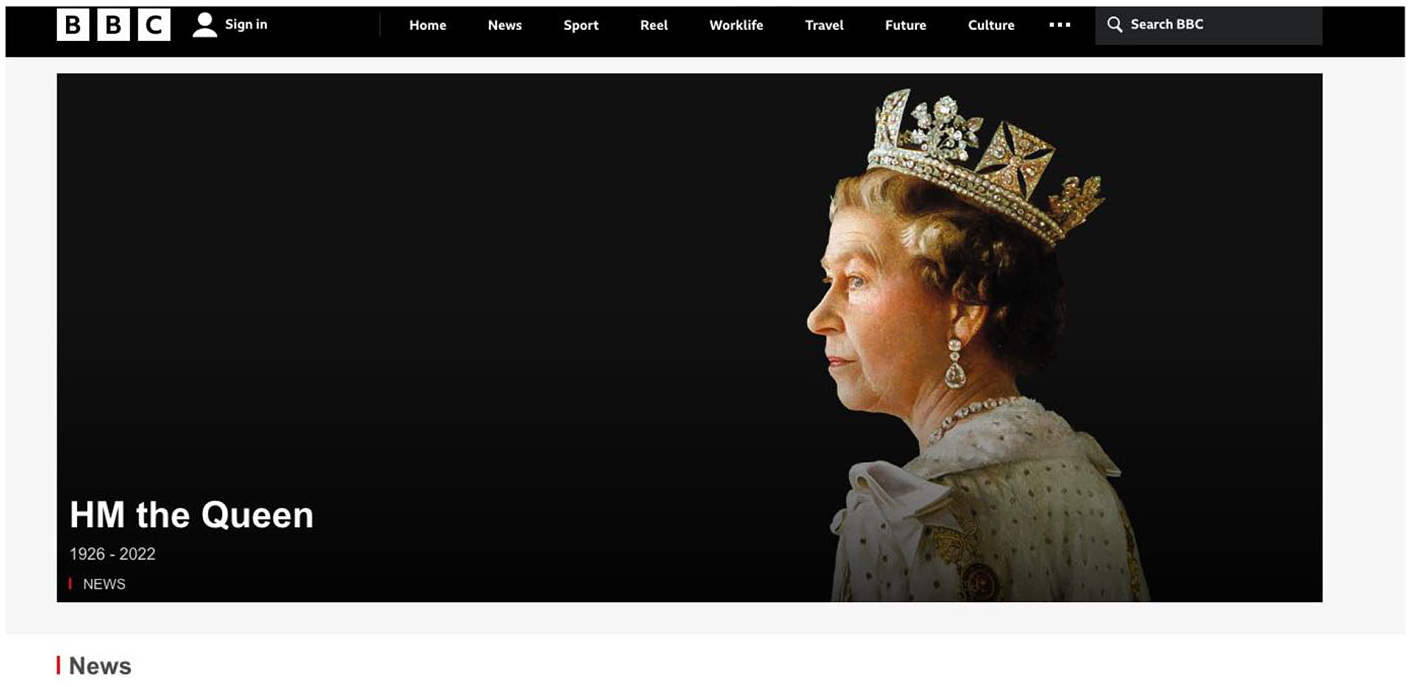
Screenshot BBC News 8 September 2022.
As a major interruption of the daily routine, the news of the Queen’s death immediately began to circulate worldwide. The announcement by the BBC was followed by a pattern typical of (legacy) media events. The announcement interrupted the everyday media flow, shifting legacy media into a ritual mode of reporting (Sumiala, 2013: 84). Legacy media also began to prepare the audience for the following steps in the protocol. This setting of protocol was called Operation London Bridge and included a collection of plans starting from her death in Scotland to the state funeral in London. With this reporting, the nation (and the world via their screens) was carried over to a mourning period of ten days. In addition, the Queen’s life and its high moments were brought to the fore in the first phase of the event with a tone of respect and admiration. In the BBC obituary, the Queen’s long reign was ‘marked by her strong sense of duty and her determination to dedicate her life to her throne and to her people’ (BBC 8 September 2022).
While the BBC performed their tributes to the Queen and thereby contributed to the dominant ‘nation mourns’ narrative, on social media the public reaction to the news of the death of the Queen was anything but unanimous. While the ‘royalists’ were saddened by the death of the Queen and expressed their tributes and condolences with ritualised expressions such as ‘God save the Queen’ or ‘Rest in Peace’ (RIP), still many others in their tweets articulated their explicit anger and resentment towards the Queen and her reign, as well as the Royal Family as an institution. Tweets highlighting and criticising the British colonial history surged quickly; for example, discussions and commentary tagged with #BlackTwitter and #IrishTwitter that were critical of the monarchy were performed in unison and began trending on Twitter and other social media platforms as soon as the news broke.
Australia’s media is proving once again and beyond a shadow of a doubt today they speak only for the white, the privileged and the thoroughly mainstream. They should all have a long hard look at #BlackTwitter and #IrishTwitter today and wake the fuck up. #NewsCorpse [9 September 2022 on Twitter]
The different hashtags brought together different publics (including the self-proclaimed anti-colonialist publics) in solidarity for the oppressed and the colonised, and collectively voiced nuanced and oppositional counternarratives that challenged the official legacy media narrative around the Queen and her legacy as a unifying symbol of the British nation and the Commonwealth people. In many of the tweets, the message was explicit: #AbolishTheMonarchy.
In addition to the critical views voiced on British history and the longstanding harmful effects of the British colonial rule, social media participants expressed their anger toward the expected mourning of the Queen’s death. Contestation over the normative demand for mourning with debates about who, indeed, should mourn and why, supported and legitimised the critical voices, as we see below:
I don’t know who needs to hear this (liberals [Ukrainian flag] Twitter, idiots) but you have literally zero right to tell Irish people and ANYONE who lived under British colonial oppression how they should feel about the Queen passing. #IrishTwitter [8 September 2022] Now is always the time to talk about colonial violence, massacres and stolen wealth that monarchs participate in. You don’t get to tell ppl how they can express what they thought of Elizabeth Windsor, especially given how imperialists like to silence those they oppress. [9 September 2022]
Some participants felt the public norms of mourning were violated by the angry commentary on social media, below a response referring to Twitter comments on members of the royal family:
Please show some respect. He has just lost his mother. [10 September 2023]
At the same time, Twitter saw a continued wave of #RIPBOZO tweets and memes (which started as soon as the news broke), often in conjunction with the image of the Queen and another relevant hashtag tying #RIPBOZO to the Queen in this context. Not unique to the Queen, #RIPBOZO is a popular meme used in celebration when someone (usually a celebrity) dies to illustrate how little you care about their death. This trending hashtag is yet another indication of the multiple and divergent publics – and centres – of the event.
Lying-in-State
Announcing the death of the Queen on BBC and other legacy media launched a series of major and minor events relating to the death event. For example, one thread related to the live following of the journey of the coffin from Balmoral, Scotland, via various locations to Westminster Hall in London where the Lying-in-State took place. From Balmoral, the cortege first travelled to the Palace of Holyroodhouse in Edinburgh, followed the next day by St. Giles Cathedral (Edinburgh) where the Queen laid in rest for a day giving people a chance to pay their respects to the Queen.
What is more, during this time (before Lying-in-State even started on 15th September), the social media publics were actively following events related to both the upcoming Lying-in-State (lasting 4 days) as well as the planning of the state funeral. Many expressed their anger on Twitter as they learnt about the extensive ritual procedure following the death of the Head of State on news, including closures and cancellations of services. Cancellations and rearrangements concerned for example major surgeries and other medical appointments, funerals, as well as closing of food banks and public parks, causing disruptions in everyday life.
Despite the complaints voiced on social media, the ritual procedure on BBC continued as planned. The next major ritual event was called Lying-in-State, a spectacle in London where people could visit the Queen’s coffin in Westminster Hall to say farewell, to pay their respects to Her Majesty the Queen. This ritual event lasted from 14th to 19th September. During this period, up to 250,000 people paid their final respects to Queen Elizabeth II. The queue was miles long, taking up to 12 hours to reach the Westminster Hall.
The BBC dedicated a live stream to the Lying-in-State. This service, the BBC explained, was being offered globally and was aimed for those who wanted to pay their respects to the Queen but could not travel to London or were not able to queue. The stream was available on multiple sites, including the BBC home page, the BBC News website and app, as well as the iPlayer, BBC Parliament and Red Button (BBC 14 September 2022).
In addition, the BBC (19 September 2022) provided detailed information on its news site on the practicalities related to attending the Lying-in-State, sharing information about the length of the queue, the route, as well as food and other services available for those waiting in line. The BBC also provided guidelines on how to behave and what to bring and what not to bring to Westminster Hall.
One of the key elements in the BBC narrative of the event was the close attention paid to the crowd as ‘Queen-loving subjects’; for example, the BBC repeatedly emphasised the large number of people who came to pay their respects to the Queen. The queue extended along the banks of the River Thames and nearby streets. The official UK Government website provided a live queue tracker for finding the best time to go as well as a map of the route.
BBCs’ live stream of the Westminster Hall showed people quietly walking towards the coffin and stopping there for a very brief moment to pay their respects to the Queen. People’s symbolic and emotional expressions ranged widely even in these short moments. TV cameras witnessed how some said prayers, others bowed. Some people looked as if they were silently crying and in tears where others just stood there for a moment in silence. This live streaming of the flow of mourners was interrupted only when something unanticipated happened (e.g. disruptive behaviour in front of the cameras). Such interferences were handled by cutting the live stream and switching off cameras.
As a closure to the Lying-in-State phase in the ritual media event, the BBC posted stories of people who were among the last ones to pay their respects to the Queen, underlining the uniqueness of the moment and a sense of community it triggered among the crowd:
Ms Heerey, who was viewing the Lying-in-State for the second time, told BBC Radio 5 Live it felt ‘very surreal’. ‘I couldn’t believe I was there,’ she said. ‘I just felt very honoured that I had the opportunity to be able to go in there and see her and say my farewell.’ Sima Mansouri, the second to last to see the Lying-in-State said that she thought she and Ms Heerey would be ‘friends for ever’ after bonding in the queue. ‘Everybody just wanted to come together and be happy and peaceful and talk about memories,’ said Ms Mansouri, who is originally from Iran but lives in Croydon, South London. ‘[Chrissy] was a little nervous, being the last person, but I said, “Don’t worry. I’ve got your back. I’m here”.’ [BBC 19 September 2022]
One peculiar incident in the Lying-in-State phase that gained special attention in the BBC and elsewhere in the legacy media as well as on social media, and which was received in a very unanimous and positive light, was the national and global football star David Beckham’s visit to the Queen. Beckham was reported to queue for 12 hours among the rest of the crowd. His decision to stay in line with ‘common people’ was admired by the BBC and other media, and his emotional appearance when paying his respects to the Queen was reported in detail. His respectful behaviour was contrasted with some other celebrities having jumped the queue and not waiting for ‘their turn’ (Independent 19 September 2022).
Some people also voiced their dissatisfaction toward both the monarchy and the future King during the Lying-in-State phase of the event as well as during the time leading up to it. Most notably, there were arrests both in Scotland and in London for holding anti-monarchy or anti-royalist signs, with protesters holding blank signs also approached by the police (BBC 13 September 2022).
Social media participants were quick to echo the sentiments expressed on the streets and the hashtag #NotMyKing was soon trending, reflecting the texts of some of the slogans on the street:
Really taken aback by the level of interest in my arrest, but very glad that there’s concern about undemocratic arrests and denial of free speech. This isn’t about me; it’s about democracy, and the freedoms we all should have. #NotMyKing #CharlesIII [12 September 2022]
In this way, freedom of speech and indeed the rights of the citizens (not only regarding expressing their opinion, but also their right to peaceful protesting) became a hot topic on social media. Many voiced how they felt ‘obliged’ not only to advocate for the Monarchy, but also to mourn for the Queen, and how their own feelings were not legitimised.
Yet, throughout the 10-day mourning period, many believed that expressions of opinion that diverted from hegemonic mourning or ran counter to that of the royalists were not appropriate; in reply to the expression of opinion that led to the arrest mentioned in the above tweet, someone commented as follows:
Not the time nor the place, how would you feel if we was disrespectful to member of your family whom passed, pick a better time [12 March 2023]
Also, some commentators found the very idea of social media participation upsetting and disrespectful:
If you take photos and videos of you ‘paying your respect’, and post them to social media, you’re not paying respects, you’re partaking in self promotion. [9 September 2022 relating to TV presenter Dan Wootton putting down flowers in front of Buckingham Palace]
In the ritual media coverage of the BBC, many elements resonated with the classical Dayan and Katz media event style of ceremonial reporting. The Lying-in-State was reported by the BBC as a unique, historical moment where people had the opportunity to gather to mourn and pay their respects to the Queen, whether queuing up or watching the BBC live stream on their various screens and devices. Essentially – and importantly – as the media event progressed on social media (here, Twitter), the issues of interest to the people shifted from more globally resonating themes (e.g. British colonial history) to more locally felt issues, including NHS (National Health Service) closures and cancellations of funerals and other appointments. Twitter comments criticised the unequal situation when many funerals were postponed to accommodate the ritualistic funeral of the Queen.
The funeral
On the 19th of September, the Queen’s death as a global media event culminated in the state funeral broadcasted live by the BBC and other legacy media institutions and channels. Global publics across the world watched the ceremony on their screens.
There were contrasting opinions on how well the BBC performed as the public broadcaster of the event. While some were highly impressed by the BBC’s performance, others offered explicit criticism of the coverage and its style of orchestrating a ‘hegemonic’ media event:
The BBC should now do 11-days of nonstop documentaries and features on republicanism, the crimes of the British empire, the dangers of unaccountable elites, and working-class history. For balance. [19 September 2022] In reply to the above tweet: Apart from the fact no one would watch because no one would be interested. I was sure I was a republican until this week. I discovered I am anything but and have been in awe of the ceremonial transfer of a head of state that took place. [19 September 2022] Whether you’re a Royalist or not, a BBC supporter or not, the coverage of the funeral on the BBC was unbelievable! A beautiful, poignant, flawlessly filmed spectacle. The work and expertise to capture such an extravaganza is something to be proud of. [20 September 2022]
The BBC funeral broadcast included several parts. Before the actual funeral ceremony, journalists tuned in the audience by once again repeating the highlights of the long reign of the Queen. Her legacy as a ruler was underlined by several reports and historical documentations. In addition, studio guests with different professional expertise (including academics, but also, for example, famous TV personalities) contributed to the affirmative narrative of the media event.
The reporting of the funeral ceremony again followed the classical transcript of a media event. Cameras showed guests arriving in Westminster Abbey, and a special focus was given to the members of the royal family. The tone of the reporting was highly ritualised, even majestic.
The nation has paid a final farewell to Queen Elizabeth II, with a state funeral and military procession. World leaders and foreign royalty joined King Charles III and the Royal rin the congregation at Westminster Abbey. Hundreds of thousands of people lined the streets as the coffin was taken to Windsor where she was laid to rest. At the funeral, the Dean of Westminster paid tribute to the Queen’s ‘lifelong sense of duty’. The Very Rev David Hoyle spoke of her ‘unswerving commitment to a high calling over so many years as Queen and Head of the Commonwealth’ [BBC 20 September 2022]
The BBC explained the different phases of the ceremony and the ritual in close detail.
When analysing the social media material, Twitter in particular, the primary observation is that by the time of the funeral the conversations were moving from commenting on the Queen and the legacy of the Royal institution to commenting and discussing the rest of the royal family, as well as the more mundane and everyday issues relevant in the local British context.
In this participatory ‘dual screening’ (Vaccari et al., 2015) comments were flying as high-profile guests and the members of the royal family arrived, for example, Princess Catherine and her children, Princess Charlotte and Prince George, received very positive commentary with lots of conversations under #PrincessCharlotte (her crying at the funeral or keeping her big brother Prince George in check):
This is Made My Day Gosh. Princess Charlotte The way she’s Flip their hair she’s like a Princess of Wales Catherine Her mom. Slaying gosh. . . (sic) (with heart emojis) [19 September 2022]
Whereas the presence of Harry and Meghan triggered continuous controversy. For example, negative comments on Harry and Meghan holding hands was compared to the US president Joe Biden and Jill Biden holding hands, calling out the hypocrisy about criticising Meghan:
Have the haters [ie those disapproving of Harry & Meghan holding hands] noticed that Joe and Jill Biden are holding hands? I love to see it [19 September 2022]
Also, further comments were made in a chat alongside the live video stream from the Westminster Abbey:
How can someone comment on the stream ‘Get Andrew away from those choir children’ (with sad face emoji) Lizzie ain’t seeing diana cos diana is actually in heaven. Lizzie going to the slammer (with skull emojis) [19 September 2022]
Many of the social media comments and responses resonated with the tabloid publicity around the royal family’s past and present intrigues and scandals, and consequently contributed to the live participation via social media expanding (and pluralising) the narrative layers of the media event.
The number of people using a woman’s funeral as an excuse to belittle, gossip & throw mud at the royals they don’t like is disgraceful #PrinceHarryandMeghan #PrincessofWales #Charlotte #princeGeorge #PrinceWilliam #KingCharles #Queen #DuchessMeghan #PrinceHarry #queensfuneral [19 September 2022]
After the ceremony in Westminster Abbey, the BBC’s cameras followed the procession to Wellington Arch. In addition to closely capturing members of the royal family, the crowds on the streets taking part in this event (in London and other places in the UK) were given considerable attention in the BBC event coverage. Time and again, the BBC ceremonial reporters paid attention to the mourning crowd expressing proudness and astonishment by the number of people paying their respects.
The comments on social media reflected the spectacular nature of the BBC performance as follows:
Netflix will never be able to afford this many extras for The Crown Omg, this Queen funeral thing isn’t done yet? How long are they going to string this thing out? [19 September 2022]
The BBC funeral broadcast lasted several hours and climaxed in another procession in Windsor where a committal service was held at St George’s Chapel at Windsor Castle. The last part of the event, in which the Queen was interred with Prince Phillip, her late husband, in the King George VI Memorial Chapel, was held in private with only the closest family attending the private service.
The Queen was buried on a Monday and ’everything was closed’, other funerals cancelled, surgeries postponed. On Twitter, someone noted:
Kids, if you’ve ever wondered what a Sunday in the 1980s was like, today is the closest we’ve come to it since. [19 September 2022]
Multiple histories and centres – multiple media events?
Focusing on the coverage and related mediation of the death of Queen Elizabeth II, this article aims to contribute to the study of present-day media events as global, iconic and scattered events that spread to various digital media platforms across the world (see also Sonnevend, 2018; Sumiala, 2024). We placed special emphasis on the idea of live participation on social media and the power of the audiences as publics to challenge the legacy media dramaturgy and the related communicative performance and narration of the Queen’s death as a media event. Building on and further elaborating on Katz and Dayan’s (2018) analysis of today’s media events as fragmented global performances, as well as on Frandsen et al. (2022) and her colleagues research, and Scannell (2014) and van Es’(2016, 2017) studies on liveness in media events, we argue that the Queen’s death as a media event provides important analytical insight on how the dynamics between the legacy news media performance and narration and the active role of social media publics and live participation in the event is carried out in that moment of condensed sense of history. It also sheds light on how the social – a critical aspect in media events – is brought to life through these performances of mediated Monarchy and the Queen as symbolic condensation.
In this theoretical constellation, the element of live participation can be seen to be intensified by following the event on news media through the practice of dual screening (Vaccari et al., 2015) that includes simultaneous real-time commentary of the event and its circulation on social media. In this present-day condition, as our empirical examples demonstrate, the level of connectivity between the ‘official’(BBC) and the ‘viral’ (Twitter) narratives about the event can vary greatly (see also Hallgren, 2024). The BBC performance and narration of the Queen’s death as a media event still follows a classical Dayan and Katz ceremonial style, and no critical voices were observed to be articulated in the official media performance. Instead, the orchestration of the event was filled with respect towards the legacy of the Queen, her invaluable symbolic role as bringing Great Britain and the Commonwealth nations and people together both in her life and in her death. Furthermore, in all the three phases analysed here, the narration underlined the great history of the nation and the image of the Crown as its symbol. An extensive part of the BBC narrative was focused on people’s spontaneous tributes to the ‘death news’ and the widespread expressions of mourning carried out in diverse on-site and online contexts.
Yet, for many participants who followed the legacy media performance on their screens, the ‘official’ media performance and the related narrative functioned as a stimulus, giving them a reason to voice their anger, disappointment, and frustration with the Royal institution and the Queen as its main symbol. It was as if a collective trauma which had been repressed for decades was now unleashed (see also Clancy, 2024) and demanded to be voiced in counternarratives and performances that became part of the event. In these communicative performances generated by live participants on social media, the Queen was constituted as a symbol of British colonial history and its brutality towards its subjects. For some others, live participation through the practice of dual screening (Vaccari et al., 2015) offered possibilities to engage with the symbolic battle on social media and endorse and/or challenge other public voices.
In sum, in line with van Es (2017), we may then argue that social media platforms as digital communication technologies (here, Twitter) afforded ontological means for this live engagement to take place. As a phenomenological category, live participation enabled social media publics to come together in real time and feel a sense of belonging through the performative dynamics and the related narratives triggered by the death event and its legacy media performance. The live rhetoric in these performative gestures in re-narrating the event connected participants with different values, ideologies and moral standings (e.g. royalists, anti-royalists), but also built boundaries between and among the social media publics. In this condition modalities of rejection, ironic endorsements, appropriation and re-scripting were also activated as means of live participation (see also Katz and Dayan, 2018: 147).
All in all, the performances of live participation on social media created diverse dramaturgies that spoke to very different publics and consequently created a variety of possibilities to interpret the event and its meaning in history. Thus, multiple digital communities of belonging triggered by the Queen’s death were able to align with each other in this historical momentum of condensed and heightened sociality.
That said, the ‘centre’ in this media event was anything but fixed; rather than one entity (produced by legacy media such as the BBC), it can be viewed as a relational concept, even a moving target that changes scale (from national to global), focus (what is at stake in the media event) and site (mainstream news media, social media platforms) as the event evolves (see also Frandsen et al., 2022: 5). So, instead of arguing that the media events (and related theory of media events) in the present digital communication environment are losing their power as some scholars (Frosh and Pinchevski, 2018) have suggested, we claim that the very dynamics between legacy media performance and the dual screening as a participatory practice on social media in fact endorses the media event’s power to bring the sense of history, and the present sense of the social – not only as cohesive performance and narrative as Dayan and Katz (1992) argue in their original theory – but also polyphonic to life. While these actively participating publics did profoundly both agree and disagree with each other in their interpretation of the Queen’s death, the loud articulation of their opinions made the event stronger (Bittner, 2023). What we saw was in fact a simultaneous live broadcasting and live streaming of the history of the public image of the Monarchy (Dayan and Katz, 1992). In voicing agreement and disagreement, the boundaries, icons and foundations of communities were loudly articulated.
Footnotes
Funding
The author(s) disclosed receipt of the following financial support for the research, authorship, and/or publication of this article: The authors have received funding from EU CHANSE Call. DiDe project number: 472 and from Kone Foundation. Grant number: 202101882.
