



Abstract
Although the Reddit-led short squeeze of GameStop shares in 2021 drew comparisons with Occupy Wall Street, this article focuses on one key area of difference: where Occupy exemplified the theoretical model of connective action through its discursive and technological openness, mobilisation around the short squeeze followed a different pattern characterised by discursive and technological disconnections, which we argue partly reflects the intervening decade of platformisation. Our case shows how platforms can establish boundaries as well as brokerage points in contentious politics, with particular regard to repertoires of action, collective identities and discourses. We show how in our case, these boundaries impeded discursive and technological connections, instead organising users into relatively disconnected zones and ultimately reducing their power and impact over broader discursive systems. Our argument is explored using three data sets from Reddit, Twitter and legacy news media outlets, using a combination of non-negative matrix factorisation (NMF) topic modelling and manual content analysis.
When the Reddit community WallStreetBets coordinated its headline-grabbing short squeeze of GameStop shares in early 2021, one of its founders made the claim: ‘What’s being accomplished now is what Occupy Wall Street tried and failed to do – a power shift, a shift in some control from Wall Street to Main Street’ (Brown, 2021). Within this quote lies the puzzle originally motivating our article: how exactly should we interpret the GameStop short squeeze within the theoretical and real-world tradition of contentious politics, and what does that say about transformations in the media environment between 2011 and 2021? At one level, there is an intuitive continuity between Occupy Wall Street and WallStreetBets, when focusing on the mobilisation of a digital crowd around shared antagonism towards financial elites. Yet, there are also points of disjuncture, imperfectly glossed over in the above quote (what, to take the obvious example, is meant by ‘power’?). This article argues that where Occupy illustrated a model of digital mobilisation characterised by relatively open discursive and technological networks, WallStreetBets shows how platforms can set rules that impede discursive and technological connections, instead organising users into relatively disconnected zones and ultimately reducing their power and impact over broader discursive systems.
In the wake of Occupy Wall Street, Bennett and Segerberg (2013) developed their influential ‘connective action’ framework partly inspired by the symbolic inclusiveness and technological openness of Occupy’s core personal action frame, ‘we are the 99%’, which diffused through a network comprising different technological layers ‘stitched’ together by platforms like Twitter. A decade later, we argue that WallStreetBets illustrates how digital mobilisation can instead be ‘reorganised’ by platforms (in other words, subject to platformisation) in a way that is neither symbolically inclusive nor technologically open: first, the foundational action facilitating contention in the short squeeze was enabled by the advent of mass trading platforms like Robinhood affording greater – if constrained – possibilities to exercise financial power while decreasing the importance of exercising discursive power in broader political systems; second, diverging affordances and use cultures on Reddit and Twitter meant that users talked about the short squeeze in markedly different ways, further limiting the emergence and diffusion of common interpretations that could shape broader discourse (as evident in the news media coverage). The combined effect of this evolution of the platform ecosystem was a core community within Reddit mostly focused on coordinating financial action, in a way that was relatively disconnected from discourse in other social media spaces and legacy news.
The article first introduces the main features of the case. This is followed by the discussion of key theories and concepts for our argument, especially connective action and platformisation, leading up to our research question. We then introduce our three data sets – Reddit, Twitter and digital news reports – and explain the main features of our mixed methods approach that combines non-negative matrix factorisation (NMF) topic modelling with manual content analysis of a subset of high-performing posts and a random sample of news items. We present the results for our NMF topic models, suggesting clear differences between our three data sources (Reddit, Twitter and news media). This is corroborated by the key findings emerging from the content analysis, which show that whereas the Reddit community focused on coordinating action, this was deliberately not inclusive for a wider public audience and was primarily focused on taking financial action. Twitter was more communicatively open and inclusive but positioned citizens as spectators rather than participants. News media focused more on the institutional dimension of politics, often positioning Redditors as an irrational crowd through the language of ‘frenzy’.
We conclude by discussing what the case reveals about the possible impact of platformisation on contentious politics. We contrast our case with the model of connective action, where symbolic inclusiveness and technological openness enable scalable networks capable at times of exercising power in political systems. In our case, we instead find that platform affordances enabling contentious action (on Reddit, and by extension Robinhood) work at cross-purposes with those supporting political claim-making (on Twitter), with the curious result that those at the centre of the action largely eschewed a fully articulated political position while observers in other parts of the platform ecosystem were left to reconstruct their imagined grievances and political objectives.
The GameStop short squeeze
WallStreetBets has existed as a subreddit since 2012, offering a place for so-called ‘retail investors’ (i.e. individual amateur investors) to share strategies and jokes. In January 2021, WallStreetBets made international headlines by coordinating a ‘short squeeze’ of GameStop stocks – GameStop being the company selling video games whose falling share price had reflected its challenges, such as adapting to digitalisation. A common trope used to decode the short squeeze has been ‘David versus Goliath’. Here, the role of Goliath was occupied by large institutional investors like Melvin Capital, who had bet on making a profit from the declining value of GameStop’s shares (a form of speculation called ‘short selling’). The role of David was taken up by the Redditors, whose coordinated buying of GameStop shares held the promise both to generate wealth for themselves while also inflicting theoretically unlimited losses on the aforementioned Wall Street investors. At face value, this ‘short squeeze’ was a striking success: GameStop’s stock increased by more than 1600%, costing billions of dollars in losses to hedge fund investors like Melvin Capital (Goodwin, 2021); the WallStreetBets subreddit meanwhile gained 6 million new members in a month (Asarch, 2021).
A key event at the height of the short squeeze prevented what might have otherwise been even more dramatic share price surges: at the height of trading activity, the Robinhood trading app, which many Redditors were using to buy shares, stopped allowing purchasing of GameStop shares (while continuing to allow them to be sold), a controversial decision that was subsequently the subject of class action lawsuits and US congressional hearings. After the Robinhood incident, GameStop shares rapidly declined again, and although there were significant future fluctuations, the peak of the short squeeze had passed. It is worth noting that criticisms of Robinhood go well beyond the GameStop episode to their core business model itself, which has been claimed to expose users to higher risks through information asymmetries, conceal the platform’s real revenue sources under claims of ‘no-commission trading’ and incentivise trading indiscriminately through ‘gamification’ (Kelleher et al., 2022; Tan, 2021).
To date, most academic work about this case has focused on the relationship between Reddit activity and the GameStop share price. In general, studies seem to agree that there is a positive relationship between the two: general volume and tone of Reddit comments is positively associated with GameStop share price (Betzer and Harries, 2022; Lyócsa et al., 2022), with a small minority of power users having the most impact (Anand and Pathak, 2021); and a particular role for Reddit sentiment in up market movements (Long et al., 2023).
Yet, if researchers have found a broad consensus about the measurable financial impact of WallStreetBets, there remain significant disagreements about how to interpret the subreddit’s goals and motivations and the role played by different platforms for the development of the case, or the ‘movement’ as it has sometimes been labelled. On one hand, Hasso et al. (2021) analyse past trading activity to argue that the short squeeze represented ‘not a pure digital protest against Wall Street but speculative trading by a group of retail investors, in line with their prior high-risk trading behaviour’. On the other hand, Chohan (2021) argues that ‘a seething rage against the “machine” of late-stage American capitalism led to the genesis of the Gamestop Short Squeeze movement’, and Schou et al. (2022) similarly interpret WallStreetBets as ‘a large social movement determined to take on Wall Street and create social justice for a generation of Millenials hurt by the Financial Crisis of 2008’. At the heart of this disagreement is ambiguity about what motivated those participating in the short squeeze, and uncertainty about its impact on the broader political and discursive system beyond driving up GameStop’s share price. Ruiu and Ragnedda (2022) summarise this ambiguity in their overview of academic analyses of the GameStop case when they talk about the ‘double face of the operation, either anti-capitalist or speculative driven’ (p. 14). In contrast to studies about the share price, Glassman and Kuznetcova (2022) meanwhile point to divergence in how social and legacy media interpreted events, such as that WallStreetBets focused on establishing credibility around the prospects for the short squeeze strategy ‘rather than attempts to organize any large-scale political / financial movement’, in contrast to legacy media’s attempts to construct a narrative around ‘populism’.
Literature review: connective action and platformisation
The following section draws together literature on the two key concepts underpinning the study: connective action and platformisation. This ordering emphasises a significant chronological dimension: connective action emerged as a concept in the years immediately after Occupy yet has remained one of the dominant theoretical frameworks for understanding digital protest. Platformisation emerged later over the 2010s, both as an empirical trend and a concept, reflecting the increasing complexity and interdependence of platform ecosystems. After introducing these two concepts, the section concludes with a discussion of the potential mechanisms through which platformisation might (re)shape digital mobilisation dynamics.
When Bennett and Segerberg (2013) developed their framework about the evolution of digitally enabled protest, Occupy Wall Street was one of their paradigmatic cases for crowd-enabled connective action. Instead of a traditional model of contention where action is co-ordinated by organisations and communication centres on collective action frames, crowd-enabled connective action was imagined as networked in two key respects, enabling action to be more horizontally than hierarchically structured. First, connective action was discursively networked through ‘emergent inclusive personal action frames’, which could be personalised to accommodate a wide range of different motivations for participation. Second, connective action was technologically networked through the dense layering of multiple communication technologies. When it came to Occupy, this kind of personal action frame was evident in the slogan ‘we are the 99%’, which in contrast to traditional collective action frames was defined by its symbolic inclusiveness and technological openness, and which diffused through ‘dozens upon dozens of important layers’ of different communication technologies like Tumblr, Facebook, Twitter and websites (Bennett and Segerberg, 2013: 163). In the decade since its publication, the connective action framework has been used to describe a range of movements in different geographical contexts, such as feminist (e.g. Zeng, 2020), anti-racist (Shahin et al., 2021), labour rights (Caraway, 2016) and pro-democracy (Khalil and Storie, 2021). 1
It is useful at this point to acknowledge the multiple ways in which connective action has already been critiqued in the literature. Some of these critiques focus on how well connective action describes the actual practices of protest movements, such as the argument that connective action does not sufficiently differentiate between how various digital technologies actually work, and how specific affordances shape action (Pond and Lewis, 2019). A key theoretical critique is that connective action counter poses networks with collective identity in a way which misrepresents how they can complement one another in mobilisation processes (Gerbaudo and Treré, 2015: 867), as illustrated through examples like the ‘multitudinous identity’ of the 15M movement (Monterde et al., 2015) or the collective dimension of personal testimonial campaigns like #metoo (Gerbaudo, 2022). We can conclude from these existing contributions, then, that connective action was from its inception subject to refinement and critique. We would argue that the above critiques of connective action would have been as legitimate in 2013 as they are today. In this article, however, we want to focus on the ways that connective action might be changing over time, and have different relevance to the digital contention of 2011 and 2021.
For this reason, we introduce a parallel strand of research, where academics have tracked the increasing prominence of platforms as technical infrastructures that mediate our digital lives. Van Dijck et al. (2018: 4) define platforms as ‘programmable digital architecture designed to organize interactions between users . geared toward the systematic collection, algorithmic processing, circulation, and monetization of user data’, and they emphasise that platforms cannot be studied in isolation as they inhabit meso-level ecosystems of interdependent platforms, as well as macro-level ‘platform societies’, which shape their dynamics. Platformisation as a general dynamic, then, involves ‘the penetration of infrastructures, economic processes and governmental frameworks of digital platforms in different economic sectors and spheres of life, as well as the reorganisation of cultural practices and imaginations around these platforms’ (Poell et al., 2019: 1). With specific attention to the news industry, Nielsen and Ganter (2022: 21) talk about the increasing importance of ‘platform power’ as the capacity to set the standards and change social rules that make (and break) connections among those engaging with platforms. Shaping public discourse is therefore increasingly complex in a digitalised environment that is fragmented, hybridised and mediated by an ecosystem of different, and increasingly powerful, platforms. Jungherr et al. (2019) discuss this capacity to have topics, frames and speakers reproduced across complex media systems in terms of ‘discursive power’.
Research has explored how different platforms shape the ‘possibilities for action’ (Evans et al., 2017) in specific ways through the concept of affordances, namely, ‘what material artifacts such as media technologies allow people to do’ (Bucher and Helmond, 2017), facilitating different kinds of political participation (Theocharis et al., 2023) and political communication (Yarchi et al., 2021). We adopt a relational view of affordances, meaning we do not equate affordances simply with the technical features of a platform, such as a ‘share’ button. Moreover, following Burgess (2021: 25), we see affordances as one dimension of platform cultures, which result from how these combine and coevolve alongside particular user populations (with different combinations of ages, geographies and identities) and platforms’ business models (their ways of operating and generating revenue). Existing research on affordances for the two social media platforms in our study can guide our theoretical expectations for the different kinds of communication they might facilitate, focusing on one contrast that is particularly relevant for our analysis. Twitter’s material functions include retweeting and hashtags, thereby affording the formation of transient and diffuse weak-tie networks (Valenzuela et al., 2018); Papacharissi’s (2014) study of Occupy, for example, documents how Twitter’s ‘expressive affordances’ assemble dispersed networks of both supportive and opposed citizens, in sometimes agonistic discussions. In contrast, Reddit’s affordances include echoing users’ beliefs and creating a feeling of subreddit membership (Prakasam and Huxtable-Thomas, 2021), supported by the ‘karma’ system of upvoting and downvoting (Squirrell, 2019), enabling the formation of more persistent subreddit communities that are defined by highly differentiated norms and communicative dynamics (Halavais et al., 2020; Rajadesingan et al., 2021).
Bringing together our two core concepts, how can we think about platformisation as a dynamic process that might transform contentious action over time? We propose three mechanisms relevant for our case through which platforms might plausibly reorganise the dynamics of connective action, which will then inform our data analysis. We can consider the platformisation of:
Action repertoires. Although mobilisation in connective action requires digital networks, action repertoires do not and in fact often involve more traditional repertoires like street protest. We can think of action repertoires as being platformised to the extent that they are inseparable from the architecture of specific platforms and therefore also contingent on the behaviour of platform actors. In our case study, then, the action of trading shares on Robinhood is more anchored to specific ‘mobile investing platforms’ like Robinhood (Tan, 2021), compared, for example, with street protest, and more vulnerable to platform power as our case study illustrates.
Collective identity. Platformisation might shape the degree to which collective identity is imagined through and within the boundaries of particular platforms. In our case, for example, a collective identity imagined in platform terms (i.e. WallStreetBets conceiving of themselves as Redditors) might be contrasted with movement identities that span multiple technological layers of a connective action network (e.g. Occupy on Tumblr and Facebook).
Discourses. The iterative development of affordances and use cultures over time leads to a consolidation of the rules, norms and ‘vernaculars’ (Gibbs et al., 2015) shaping how people communicate with one another within specific platforms – a ‘co-evolution’ of users, business models and affordances (Burgess, 2021). For example, we can contrast on one hand, Burgess and Baym’s (2022) description of Twitter moving away from earlier periods of playful experimentation towards a more serious mode of news and information sharing, and on the other hand, Massanari’s (2015) account of Reddit’s layered self-referential reproduction of discourses of play. In general, then, a maturation of the communicative platform ecosystem might involve greater gaps and translation barriers between increasingly sedimented and differentiated platform vernaculars.
In each of the three mechanisms described above, platformisation is imagined as potentially impeding the open discursive and technological network formations that define connective action. Bearing in mind these potential mechanisms, we investigate the following research question in our article:
RQ: How did platforms organise communication during the GameStop short squeeze in line with, or against, the expectations of connective action?
Data and methods
With the above research question in mind, it is worth stating explicitly the logic of comparison in our study. Our comparison is not, then, between the Occupy movement and WallStreetBets. These two cases vary along many dimensions apart from platform intermediation, such as strategic goals, repertoires of action and political context. Our empirically grounded comparison is between discussion of the GameStop short squeeze in three different digital spaces – the WallStreetBets subreddit, the #GameStop hashtag on Twitter, and relevant US digital news – which we assume share central roles in digitally networked political discourse while being defined by different platform affordances and use cultures. Our aim is to then interpret the pattern of these overall results through the lens of connective action – here the Occupy movement as discussed in the academic literature serves as a paradigmatic case – while acknowledging that any differences with the connective action model can only be speculatively linked to processes of platformisation given the confounding factors at play.
Our data consist of texts published on these three different digital spaces between 22 January and 11 February 2021, covering the main peak of the short squeeze trading activity. From Reddit, we collect submissions to the/WallStreetBets subreddit using the PushShift application programming interface (API), to maximise completeness of the historical data set (Baumgartner et al., 2020). We subset these data using a machine learning model to identify only submissions relevant to the topic at hand. We use the support vector machine (SVM) algorithm from the R package quanteda.texmodels (Benoit et al., 2022) and train it on 500 randomly selected submissions that we manually coded. 2 It is worth emphasising that we do not collect data from Reddit overall (i.e. across subreddits) but rather focus on the subreddit/WallStreetBets. While WallStreetBets is in one sense representative of the platform – as an example of a subreddit moulded and steered by the platform’s affordances promoting tightly knit groups – the corollary of this high degree of differentiation is that the actual content should be assumed not to be representative of aggregated communication on the platform. In other words, we assume that the short squeeze would have been discussed differently on r/politics and r/WallStreetBets. Nevertheless, we restrict our focus to WallStreetBets because of its centrality in driving the events of the short squeeze, which would place it at the centre of potential discursive mobilisation networks.
Tweets are collected from the #GameStop hashtag using the Twitter V2 API. We remove tweets written by bots as identified by Botometer (Yang et al., 2020). 3 Digital news articles are identified through Media Cloud using the search term ‘gamestop’ for the collection ‘U.S. Mainstream Media’ and retrieved through webscraping with the tool paperboy (Gruber, 2022). The final data set then includes three corpora: 85,579 Reddit submissions, 113,343 Tweets and 1365 digital news articles from 19 news outlets.
We analyse our data using a mixed methods approach in two stages, combining topic modelling across the whole data set with manual content analysis of a subset of high-performing posts in Reddit and Twitter, and randomly sampled news articles.
Topic models
To compare how discussion differs across the different digital spaces, we use NMF topic models from Scikit-learn (Pedregosa et al., 2011) and estimate separate models for our three corpora. NMF is an alternative to the more commonly used latent Dirichlet allocation (LDA), which has the advantage that it can be used with weighted representations of terms, making it better suited to be used on short texts, such as Reddit submissions and tweets (Chen et al., 2019). We preprocess the data by removing punctuation, numbers, URLs, stopwords, infrequently used words (occurring in less than 10 documents), short documents (less than five words after preprocessing) and weighting terms by term frequency-inverse document frequency (tf-idf). We made the decision to use three individual models rather than one model for all texts from our three different sources after evaluating several combined models. The across-platform models were less interpretable and dominated by topics that were prominent in tweets, which makes up the majority of texts in the combined corpus, rather than showing the differences and similarities between the three linked but ultimately separate discussions.
We then use several different statistical indicators to determine an optimal number of k. For each corpus, we estimate a range of models with a predefined range of 15–30 topics and calculate normalised pointwise mutual information (Newman et al., 2010), semantic coherence (Mimno et al., 2011) and exclusivity (Roberts et al., 2014). For the news corpus, this approach suggests an optimal number of topics (k) of 19 for the Reddit corpus, 25 for Twitter and 18 for the news corpus.
We interpret the chosen models using two types of output generated by the models: the 10 words with the highest score for each topic and the 10 documents with the highest score for each topic (see Online Appendix). Two coders analysed this information independently to label each topic. Like in most applications using topic models, not all topics were relevant or interpretable: some topics resulted from texts that were included by mistake (e.g. Twitter T19, which almost exclusively contains spam: ‘|, playstation, #ghanawelcomesnengi, mainland, #silhouttechallenge, bridge’) while others had no substantive meaning, but can be regarded as linguistic artefacts (e.g. Reddit T3: ‘=, restrict_sr, flair, q, amp, t’) and were disregarded (Maier et al., 2018).
Manual content analysis
In a second analysis step, we used manual content analysis to evaluate a sample of high-performing Twitter and Reddit posts, and a random sample of news articles. This is intended to complement the topic models in two ways. First, focusing on prominent social media content can help us look for any particular characteristics for the subset of content, which will be most visible (and therefore presumably most influential as per Anand and Pathak, 2021) for platform users. Second, manual content analysis allows for a more targeted coding, as it allows the usage of predefined categories of interest, unlike the unsupervised approach of topic modelling, which infers categories from the data.
We first sampled the 200 highest-performing posts on our social media platforms – 100 each for both Reddit and Twitter. For Reddit, high performance was determined using the upvote score; for Twitter, we generated a ‘prominence’ score combining retweets and likes to most closely approximate Reddit’s upvote metric. For news media, we randomly sampled 100 articles, given our assumption that articles from the ‘U.S. Mainstream Media’ collection on MediaCloud had already passed a certain threshold of public salience.
We then developed a codebook to manually code each document according to several variables reflecting key elements of contentious action (see online appendix for full codebook). First, we coded whether the post was ‘political’, defined as whether ‘an issue or actor is public, collective, and contested .; to mark something as collectively and publicly relevant and debatable and as an object of politics’ (Wiesner, 2021: 268). After an initial review of the data, we developed three specific sub-codes for different kinds of political content: content referring to institutional politics, such as government (e.g. ‘Congress needs to step in to the GameStop saga’), anti-elitist politics that might express a hostility towards elites like hedge fund managers without integrating these claims within a formal political arena (e.g. ‘Down with Wall Street!’) and finally, informal and political consumerist content that is related to using purchasing power to express or pass judgement on political or ethical questions (e.g. boycotting the Robinhood app over its decision to pause selling buy orders for GameStop shares). These sub-categories were coded separately as dummy variables, so that a single post could be coded as containing multiple kinds of political content (e.g. both institutional and anti-elitist). Second, we coded for the presence of ‘calls to action’ where the author specifically asked their audience to do something, whether buying shares, ‘holding’ (i.e. not selling) shares, signing a petition or sharing a news article. Next, we coded for the presence of ‘insider language’ which presumed some kind of prior non-widely held information on the part of its audience. We inductively developed two sub-codes for this insider language: on one hand, highly technical terminology that is only intended to be understood by a narrow audience of people familiar with financial investing; on the other hand, slang used to signal membership of online communities in Reddit and Twitter (such as self-identifying as an ‘autist’ or ‘ape’, or the slogan ‘to the moon’). Finally, for news media articles, we coded for the presence of quotes from social media platforms, differentiating between Reddit and Twitter, respectively. After several pilot testing rounds involving revisions to the codebook, we achieved acceptable reliability according to general thresholds for Krippendorff’s alpha on a sample of 75 posts, with a minimum alpha of 0.73 and an average across all variables of 0.89.
Results
Topic models
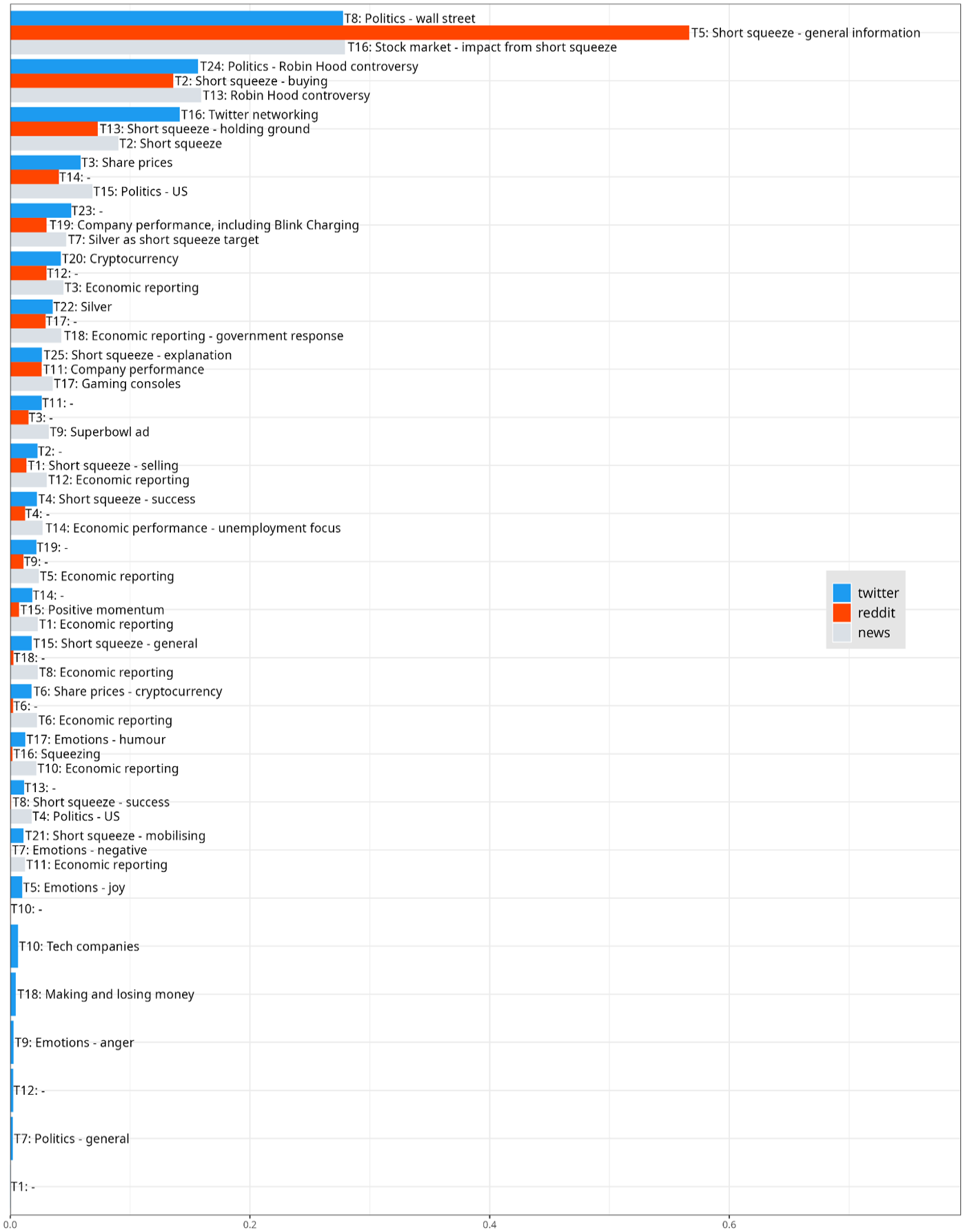
In assigning labels to our topics, we attempted where possible to define both a specific topic and a more general theme, such as ‘Short squeeze – selling’ or ‘Politics – Robinhood app controversy’. This enabled us to aggregate individual topics within broad themes, and in particular to contrast the salience of more political versus more financial market-oriented topics. Figure 1 shows the prevalence of topics in our three corpora, as measured by the mean document-per-topic probabilities (γ) over all documents in a set.
Prevalence of topics in three models (average gamma values).
On Reddit, the most common theme for topics was sharing information and coordinating action around the short squeeze itself: for example, topic 1 labelled ‘Short squeeze – selling’ (key terms sell,  , cant, damn, rocket, fucking, selling) or the emoji-dominated topic 13 labelled ‘Short squeeze – holding ground’ (
 ,
,  ,
,  ,
,  ,
,  ,
,  ). The most prominent topic 5 labelled ‘Short squeeze – general information’ (shares, short, price, $, gme, can) is somewhat of an outlier across the three topic models, which we interpret to signal how the short squeeze acts as a common thread running through a large amount of the Reddit discussion. Meanwhile, there were no clear topics related to political discussion, whether defined in terms of institutional politics like government, or even the Robinhood app controversy.
On Twitter, we observed a greater mix of different thematic content. Some topics revolved more narrowly around the progress of the short squeeze, at times mirroring the affect and emoji-driven language on Reddit (e.g. topics 4 and 18). However, the most salient topics in our Twitter data set had a greater political focus, such as the largest topic 8 labelled ‘Politics – Wall Street’ (people, amp, wall_street, money, game, rich), or topic 24 labelled ‘Politics – Robinhood app controversy’, which included user handles for both @Robinhoodapp and for US Congresswoman Alexandria Ocasio-Cortez.
In news media, we encountered some difficulty distinguishing different topics from one another, given that many topics appeared to include very similar key terms associated with the genre of economic reporting (e.g. topics 1, 8 and 11). Nevertheless, there was also some focus on politics, in particular US politics (e.g. topics 4 and 15), as well as the Robinhood app controversy (topic 13). A clear difference from the other two data sets is that for obvious reasons, we do not see topics defined by communicating strong emotions, informal language or emojis.
Content analysis
As explained above, we carried out a manual content analysis on a sample of 100 documents from each of our three data sets. The analysis is organised according to the variables described previously: politicisation (with sub-codes for institutional politics, anti-elitism and informal/consumerist politics), calls to action, insider language and quoted content from social media.
First, and in line with our topic models, we found differences in the distribution of ‘political’ content across our three data sets. Figure 2 highlights that institutional political content – such as references to government actors – was particularly differentiated by platform, being highly present in news articles (61%), somewhat present on Twitter (27%), and relatively absent from Reddit (10%). An example of this kind of institutional political content is the tweet ‘I wish the SEC had as much of an issue with Insider Trading as they seem to have with Outsider Trading. #Robinhood #GameStop #WallStreetBets  ’. A chi-square test of independence showed this association between platform type and institutional political content to be significant, χ2 (2, N = 300) = 52.70, p < .001. Regarding other sub-categories of political content, we found more minor differences. Anti-elitist content was more common on Twitter than Reddit (e.g. see Image 1 for a representative example), and consumerist content was more common on social media than news (such as one Reddit user posting that they had used some of the profits from their investment to buy Nintendo Switches for the Children’s Minnesota Hospital). A chi-square test, however, showed these associations not to be significant (p > .05). Overall, news media contained the most content, which was political in at least one of the above ways (71%), followed by Twitter (62%), and then Reddit (40%), with the relationship between platform and politicisation being significant, χ2 (2, N = 300) = 17.10, p < .001.

Example anti-elitist content from Twitter.
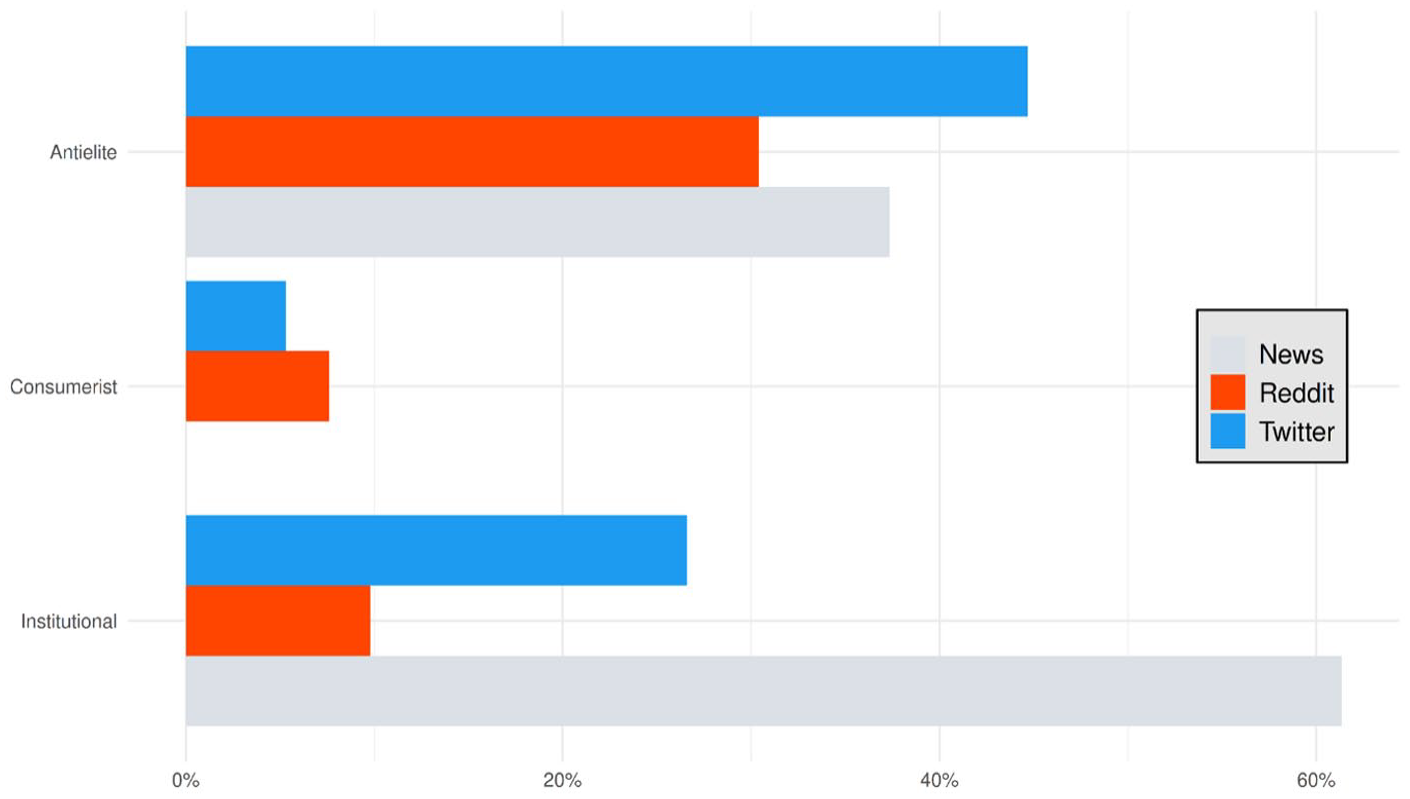
Share of political content among top 100 Tweets, top 100 Reddit posts and 100 news reports (excluding NAs).
It is interesting to note that when Reddit posts did contain formal/institutional political content, it often did so via screenshots from Twitter which in turn were often written by journalists from both legacy and digital native outlets. For example, Image 2 is the third most upvoted Reddit post in our data set, which supportively reposted political analysis from a digital commentator and journalist on Twitter rather than articulating that analysis themselves as a Reddit user. We can also summarise from our coding that more news articles quoted Twitter content (20%) than Reddit content (12%), all of which emphasises that political discussion in its most traditional form tended to be conducted more via news media and on Twitter rather than on Reddit. When it comes to informal/consumerist political content, the reverse diffusion path is evident: the most high-performing tweet containing ‘informal’ political content actually links to a media story profiling an image from the original Reddit post referenced previously, about Redditors buying Nintendo Switches for a children’s hospital.
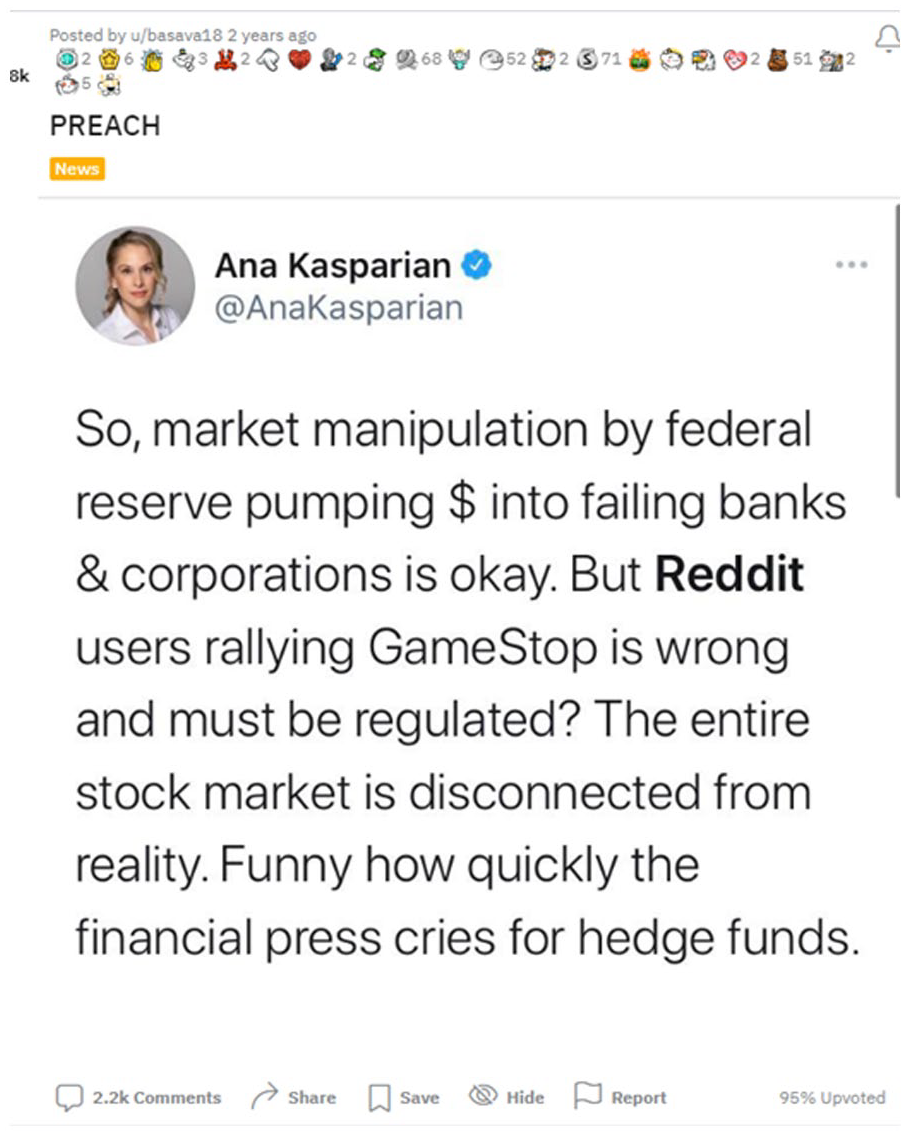
Example of a formal/institutional political Reddit post originating from Twitter.
Second, our variable coding for the presence of ‘calls to action’ finds more frequent calls on Reddit (28%) compared with news media (8%) or Twitter (4%) – this association between platform and the presence of a call to action was significant, χ2 (2, N = 300) = 25.50, p < .001. On Reddit, these calls to action are primarily market-oriented and usually centre on users encouraging one another to buy or ‘hold’ (i.e. not sell) GameStop shares. In fact, our proportion of 28% somewhat under-represents this theme in our data: we only coded for explicit calls to action (i.e. directly calling on others to buy or hold shares), but a large number of Redditors implicitly made such calls to action by sharing their own investment portfolios and their decisions to buy or hold, thereby modelling their behaviour to other users. Twitter had far fewer calls to action generally – either explicitly or implicitly – and we noted a greater emphasis on observing, interpreting and explaining events. For example, one of the most high-performing tweets stated ‘Watching Reddit take on Wall Street is so crazy. 2021 is already crazy and we are only in January  #GameStop’ – here, the tweeter positions themselves as the audience watching actions that have been coordinated on Reddit, rather than as a participant; therefore, there is no action demanded apart from sharing reactions with fellow Twitter users. When calls to action were present in news media this usually reflected quotes from Reddit users calling for others to buy or old shares.
Finally, we consider our third variable around whether documents contained ‘insider language’, that is, language that requires some kind of prior knowledge to interpret, and which we therefore understand as functioning more to reinforce collective identity by reinforcing discursive boundaries, rather than facilitate connective action. In general, we found as per Figure 3 that high-performing Reddit posts contained a much higher proportion of such exclusive language (56%) than Twitter (21%) or news media (12%). The association between platform type and volume of insider language was significant, χ2 (2, N = 300) = 44.80, p < .001, driven primarily by differences in the volume of social media slang. However, there is also an important difference in the kind of exclusionary language present on different platforms. On Reddit, we identified a range of terms, which we assumed would not be meaningful for the average layperson, such as ‘diamond hands’, ‘to the moon’, ‘tendies’ as well as coded references to collective identity mentioned previously like ‘autists’, ‘apes’ and ‘retards’. We interpret the function of these terms to be, in part, demarcating the subreddit’s genuine membership from outsiders – although structurally the forum is open, the community is creating social boundaries through language use that separates members who can understand and express themselves fluently, and those who cannot. On Twitter, on the other hand, there was generally less exclusionary language. When social media slang did appear it was often native to Twitter rather than adopted from Reddit: the most common coded term to be used was ‘stonks’, an insider reference to an Internet meme popularised in the GameStop episode by a tweet from Elon Musk.
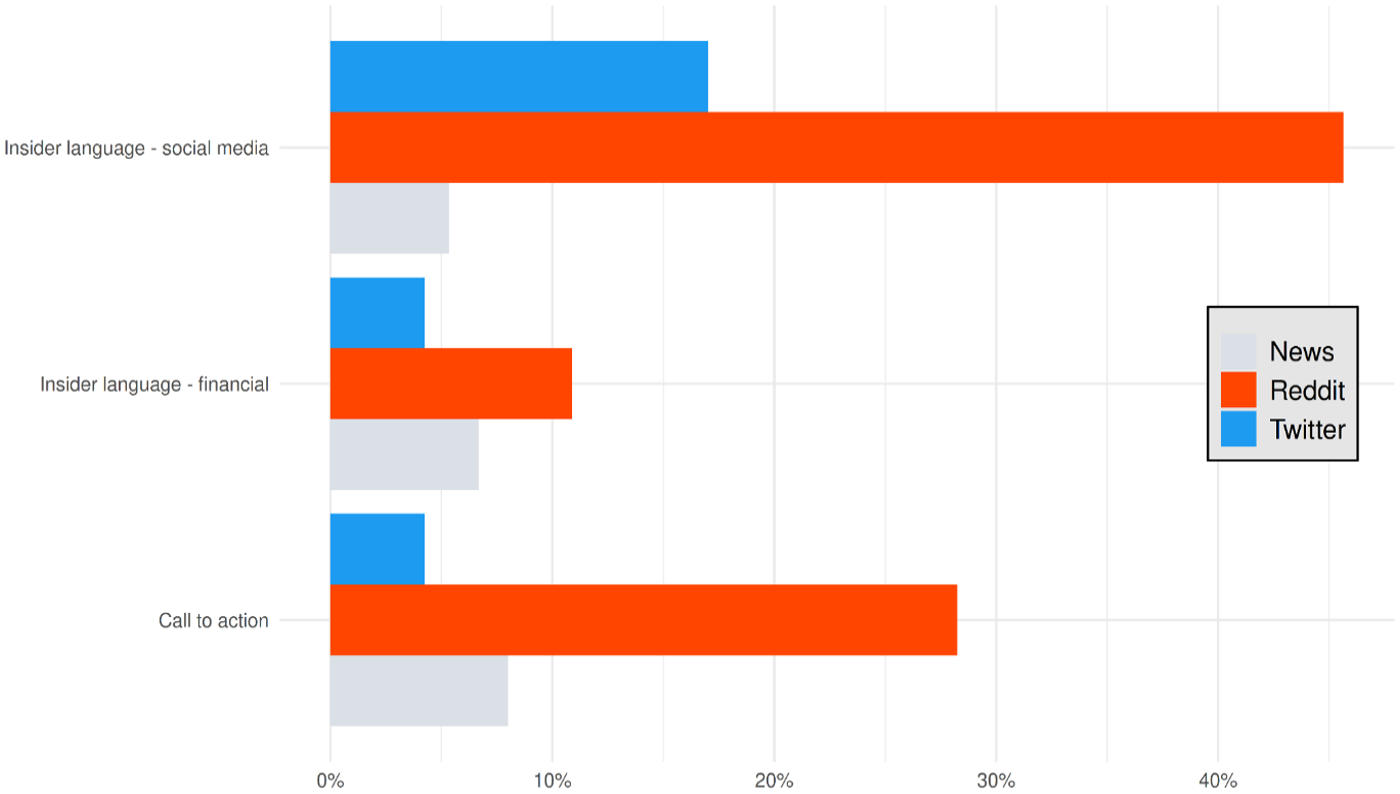
Share of coded documents with calls to action and insider language (excluding NAs).
It is worth emphasising the lack of shared insider social media slang across platforms. There are no references to the Twitter slang ‘stonks’ in any of the high-performing Reddit posts. Similarly, there are no references to key Reddit slang terms ( ‘ape’, ‘retard’, ‘autist’) in any of the high-performing tweets. If this insider language is intended to facilitate the construction of a shared identity, it is clear this is tied more to specific platform communities than to shared support for the short squeeze itself.
Finally, it is unsurprising that this kind of social media slang is relatively absent from legacy news media articles. In our qualitative notes, we observed instead that Redditors were most often constructed in terms of an irrational crowd. ‘Frenzy’ and ‘mania’ were the most common journalistic descriptors of the short squeeze, alongside other similar terms like ‘madness’, ‘mob’ and ‘craze’. We draw attention to this journalistic construction because of the way it potentially mutually reinforces the Redditors’ mode of collective identity building, which appears deliberately opaque and alienating to a more general public audience. Although Redditors may refuse to adopt the position of a rational political subject through labels like ‘retard’ as an ironic route to group identity building, news media portrayals of their irrationality appear more sincere and embedded in long-standing fears of the crowd and crowd psychology.
Discussion
Our research question asked how platforms organised communication during the GameStop short squeeze in line with, or against, the expectations of connective action. In some respects, the short squeeze conformed to these connective action expectations: platforms enabled crowd mobilisation around rapidly scaled up digital networks, substituting for the traditional role of formal organisations, with participation able to encompass a wide range of personalised motives from pure financial self-interest to political retribution. Yet, our results also show that communication fragmented in some ways along platform lines, in contrast to the integrative expectations of the connective action framework. We summarise these ‘disconnects’ in the following section before relating them back to the way platforms and their affordances have developed over time.
On Reddit, language was above all oriented towards mobilising action, but in terms of investment decisions, very much focused in particular on buying and holding GameStop shares. Hence, one could argue that it was narrowly oriented to the action repertoire of mass trading, rather than developing connections with wider political discourse or digital networks. Even other common topics around communicating emotion or constructing collective identity were closely bound up in creating and maintaining the coordination of trading activity, and often revolved around exclusionary slang. Topics that politicised the GameStop issue in a broader political context, meanwhile, were absent from our topic model and relatively underrepresented in our manual content analysis.
On Twitter, meanwhile, we find an inverse distribution of emphasis in communication functions. Action mobilisation took a backseat in favour of topics and posts that emphasised understanding and interpreting events from the perspective of a more diffuse audience of citizen observers. Our topic modelling and content analysis align in revealing a greater proportion of Twitter content linking the short squeeze both to formal political arenas and a kind of populist anti-elitist sentiment, compared with Reddit.
Finally, news media differs again from both Reddit and Twitter: our topic modelling emphasised comparatively higher internal consistency in news media’s use of language, reflecting the influence of professional norms and practices in generating news content. Our manual content analysis reinforced this impression that news coverage above all discussed the short squeeze in the context of formal and institutional politics, while frequently constructing those involved in the short squeeze as swept up in a ‘frenzy’ or ‘mania’. News articles were also more likely to quote Twitter content than Reddit, despite Reddit being the protagonist of the short squeeze’s action, again emphasising the limited discursive power of Redditors in shaping the broader debate.
We argue that the divergence described above can be partly explained by the structuring role of the different platforms in our study. As mentioned previously, one of Reddit’s affordances is creating a sense of membership among users anchored to a particular theme, reinforced through a structure which demarcates different sections of the platform according to communities of shared interests maintained by subreddit-specific rules and user moderators (Halavais et al., 2020). In the case of r/WallStreetBets, our data show how users circulated collective identity labels ( ‘apes’, ‘retards’) and coded insider language (‘to the moon’, ‘diamond hands’) as a way of reinforcing social boundaries of who was and was not a member of the group. Moderators even explicitly limited the scope of political discussion (with one rule stating ‘Nobody cares about your political opinions’), presumably to decrease the level of toxicity evident in other more political subreddits. Importantly for our argument about platformisation we can also track the evolution of some of these practices over time: a search using the WayBackMachine shows that the rule excluding political opinions from WallStreetBets was first introduced in January 2019, suggesting that part of the evolution of the group identity involved refinement of the platform-enabled rules of what – and what not – to talk about. This meant, however, that the same platform affordances that made Reddit an effective space to coordinate the action of the short squeeze by building a sense of group membership, also foreclosed the potential for developing inclusive action frames that were capable of diffusing through other parts of the media ecosystem. The tension between WallStreetBets’ need to build trusting relationships between group members while also scaling up the number of people buying shares is evident in the course of the short squeeze itself, where multiple spin-offs splintered off in an attempt to restrict membership to a ‘core’ of trusted users, as membership exploded on the original forum (see Glassman and Kuznetcova, 2022).
In contrast, and as previously described, Twitter affords the possibility of forming large and diffuse weak-tie networks that assemble and disperse around transient issues. In general, this is enabled by Twitter’s structural openness, the networking capabilities of hashtags and user retweets, and the minimalist approach to content moderation. In our case study, we observed how Twitter users were therefore less focused on coordinating the action of the short squeeze than observing and interpreting events. The end result was a more wide-ranging and more politicised discussion on Twitter, which in its most prominent content emphasised hostility towards economic elites like hedge fund managers. We therefore observe a disconnect between those organising the short squeeze on Reddit and those interpreting its political significance on Twitter. This disconnect is underscored by our analysis of news media, which illustrates the relative lack of discursive power exercised by Redditors in the wider media system: news most frequently deligitimised the motivation and rationality behind the short squeeze by characterising it as a ‘frenzy’, and turned more often to Twitter than Reddit for source material.
Conclusion
Connective action is a model premised on discursive and technological openness, where personal action frames cascade across technological layers to both mobilise participation and shape public discourse. In the GameStop short squeeze, we observe a different dynamic, where platforms establish boundaries as well as brokerage points. The case shows platforms setting rules about what new action repertoires are possible (and when they stop), providing the scaffolding for emerging collective identities (and who lies outside them) and modelling what kind of communication is appropriate (and what is out of bounds). This amounted to a series of disconnections where the different communicative functions of contentious politics were organised into separate zones. The effective coordination of action on Reddit, which generated a concrete financial challenge to elite fund managers who had shorted the share, involved to some extent the foreclosure of politicised action frames; language revolving around ironic ambiguity and insider slang, largely eschewing links to institutional politics, provided the mechanism to establish group membership and coordinate (financial) action. Meanwhile the affordances that enabled Twitter users to interpret and assign political meaning to unfolding events, such as the easy formation of transient weak-tie networks, positioned them as spectators rather than participants in directly shaping the course of the contentious action.
Just as Nielsen and Ganter (2022) have traced the rise of ‘platform power’ in the context of news publishing to describe the increasing role of platform intermediaries in making rules, and forming or breaking social connections, we interpret the GameStop short squeeze as a parallel case study exemplifying the rise of platform power in mediating contentious politics. This platform power manifests in two ways.
First, there is the largely obscured power of Robinhood as the dominant platform enabling Reddit users to easily buy and sell GameStop shares. This corresponds with our theoretical discussion about the ‘platformization of repertoires of action’. The consequences are not just evident at the micro level as described in our study, that is, that Redditors primarily post content coordinating trading activity on Robinhood and similar platforms. These consequences are also significant at the macro level, in that, whatever political claim-making was implicit in WallStreetBets’ actions was integrated within and adjudicated by the financial field rather than the traditionally conceived public sphere. In other words, it did not matter what politicians or the media said about WallStreetBets – so long as Redditors drove up the GameStop share price and inflicted losses on Melvin Capital, then their (largely implicit) anti-elite argument would be vindicated. And, of course, the most overt demonstration of Robinhood’s platform power was its decision to put a stop to selling GameStop shares at the peak of the trading activity, effectively short-circuiting the momentum and upward trajectory of the short squeeze.
Second, we point to the ways in which the co-evolution of platforms, use cultures and affordances over time on communication-oriented platforms like Reddit and Twitter create potential barriers to connections between them. Whereas connective action suggests a model where individuals hold agency in switching between technological modalities and spreading personal action frames, our case suggests how collective identities can in part be structured by platform boundaries, and how different affordances and use cultures produce markedly different ways of talking about the same issue. The affordances of building strong group membership on Reddit by emphasising social boundaries, and the affordances of assembling transient weak-tie networks on Twitter, appeared to create disconnected zones of discourse, one focused on action-coordination separated from the other focused on interpretation and reaction.
Drawing together the above two points – the structuring role of Robinhood and the diverging affordances and use cultures of Reddit and Twitter – creates a portrait of contentious action where its constituent elements are disaggregated along platform lines. The contentious action itself takes place on one platform (Robinhood), action coordination happens on a second platform (Reddit) and political claim-making is reconstructed in a dissonant fashion by a periphery of other platformed spaces for discussion (such as Twitter and digital news). Although the implications of such a model of political action are impossible to generalise from a single case study, we believe that this model of disconnected action has the potential to recur as the influence of platform power continues to grow.
Supplemental Material
sj-docx-1-nms-10.1177_14614448231182617 – Supplemental material for The tension between connective action and platformisation: Disconnected action in the GameStop short squeeze
Supplemental material, sj-docx-1-nms-10.1177_14614448231182617 for The tension between connective action and platformisation: Disconnected action in the GameStop short squeeze by Michael Vaughan, Johannes B Gruber and Ana Ines Langer in New Media & Society
Footnotes
Acknowledgements
The authors would like to acknowledge feedback from Paul Lagneau-Ymonet, participants in the 2022 American Political Science Conference, reviewers for the 2023 International Communication Association Conference, and the journal’s two anonymous peer reviewers for their insightful comments
Authors’ Note
All authors made a significant contribution to the project by collaborating in the conception, study design, execution, analysis and interpretation, as well as in drafting and revising the manuscript.
Funding
The author(s) disclosed receipt of the following financial support for the research, authorship and/ or publication of this article: This work was supported by the German Federal Ministry of Education and Research, funding code 16DII125.

Supplemental material
Supplemental material for this article is available online.
Notes
Author biographies
References
Supplementary Material
Please find the following supplemental material available below.
For Open Access articles published under a Creative Commons License, all supplemental material carries the same license as the article it is associated with.
For non-Open Access articles published, all supplemental material carries a non-exclusive license, and permission requests for re-use of supplemental material or any part of supplemental material shall be sent directly to the copyright owner as specified in the copyright notice associated with the article.
