



Abstract
This article examines how platformisation reshapes topical diversity across news outlet types in Norway. Using Latent Dirichlet Allocation (LDA) topic modelling and diversity indices on more than 220,000 articles from 22 national, regional, local and niche outlets, it compares content published on proprietary websites with that on Facebook, Instagram and TikTok. The findings reveal a ‘flattening’ of the news agenda on social media. While distinctions between news outlet types remain clear online, they largely disappear on social media, where engagement-driven logics promote soft topics. The effect is strongest for local outlets, whose civic and community-oriented reporting gives way to sports, human interest and entertainment news. Ownership explains little once editorial type is considered. The study demonstrates how platformisation erodes local journalism’s distinctiveness and challenges media policies designed to safeguard diversity and democratic pluralism in the digital public sphere.
Introduction
Over the past two decades, platformisation – the growing integration of platform infrastructures into the production, distribution and financing of cultural goods – has reshaped the media landscape structurally, economically and epistemically (Nieborg and Poell, 2018; Poell et al., 2019). It extends platform logics into domains once governed by professional and institutional norms. For example, news organisations now operate in a landscape structured by platform Application Programming Interfaces (APIs), algorithmic recommendations and audience metrics that increasingly mediate editorial visibility and circulation, thereby redistributing communicative power, understood as the capacity to shape what information becomes visible, salient and publicly consequential (Gillespie, 2018). This shift dislocates news from editorial control, transferring distribution power from newsrooms to platform companies such as Meta (Facebook, Instagram, WhatsApp), ByteDance (TikTok) and Snap Inc. (Snapchat) (Ekström and Westlund, 2019; Steensen and Westlund, 2021).
These transformations demonstrably affect how news is framed and circulated on social media, leading, for example, to reduced diversity of news through a narrowing of the news agenda (Nielsen and Ganter, 2022) – a phenomenon sometimes described as ‘agenda compression’ – where a limited set of high-performing topics dominate across outlets (Zuckerman, 2020). At the same time, research on news diversity – especially within Nordic media systems, which constitute the empirical emphasis of this article – has established that outlet type, ownership structures and media policy continue to shape content pluralism (Garz et al., 2024; Sjøvaag and Pedersen, 2018). Yet, the intersection of these research strands remains underexplored. Existing research suggests that platformisation produces uneven and strategically selective forms of convergence, rather than wholesale homogenisation, with outlet type and platform logics jointly shaping adaptation strategies (Klein et al., 2023). How these dynamics translate into changes in between-outlet topical diversity across platforms, however, remains insufficiently understood.
This article addresses this gap by providing a large-scale, comparative analysis of topical diversity across news outlet types (local, regional, national and niche), ownership structures and platforms in Norway – a high-choice, highly institutionalised and pluralistic media market. Drawing on a data set of all published content in 2023 from 22 national, regional, local and niche outlets with different owners, we compare the topical distribution of content on proprietary platforms with that on Facebook, Instagram and TikTok. By combining Latent Dirichlet Allocation (LDA) topic modelling with diversity indices across both proprietary and social media platforms, the article captures how platform logics interact with news outlet types and ownership structures within a national media system known for emphasising diversity as a key dimension in governmental media policy (Grönlund et al., 2024). In doing so, the article offers rare empirical evidence on the degrees to which platformisation selectively erodes the editorial distinctions that media policy seeks to preserve.
Understanding how platformisation affects cross-outlet diversity matters because media and news diversity – understood as the availability of a wide range of outlets, voices, topics and perspectives in the public sphere – are regarded as fundamental to the functioning of democracy (Committee of Ministers, 2018). In the Nordic context, media policy has historically promoted diversity through instruments such as press subsidies, public service broadcasting and ownership regulations. Norway, in particular, has maintained a relatively pluralistic media landscape, characterised by a mix of public broadcasters, national dailies, regional newspapers and local media outlets (Grönlund et al., 2024). If platform logics compress differences between news outlet types, then institutional mechanisms designed to sustain diversity (such as Norway’s press subsidy system) may lose effectiveness. This article therefore speaks not only to theoretical debates on platformisation and platform governance but also to broader concerns about the resilience of editorial autonomy and democratic pluralism in platform-dominated media landscapes.
The article first reviews research on news diversity and platformisation before presenting the research questions and methodological approach. The findings are then presented and discussed, with particular emphasis on the implications for media diversity and democracy of what we identify as news ‘flattening’ – a measurable convergence of topical profiles across outlet types and social media platforms.
News diversity
News diversity has long occupied a central place in theories of journalism and democracy and remains a key concern in contemporary media policy and scholarship. It is commonly linked to journalism’s capacity to support informed citizenship by ensuring a plurality of topics, perspectives and voices in the public sphere. As a concept, however, news diversity is multifaceted and has been operationalised in different ways across the literature. Napoli’s (1999) influential typology distinguishes between source diversity (the variety of content providers), content diversity (the range of ideas, topics and viewpoints available) and exposure diversity (variation in what audiences actually consume).
More recent frameworks emphasise the interdependencies between these types of diversity. Sjøvaag’s (2016) model and Hendrickx et al.’s (2022) ‘gears’ of news diversity framework show how content diversity emerges from the interaction between editorial routines, ownership structures, economic pressures and distribution infrastructures. Rather than treating diversity as a purely textual property, these models conceptualise it as the outcome of selection processes embedded in specific organisational and market contexts. We understand news diversity in this relational sense, with a specific focus on content diversity, operationalised as topic diversity. Topic diversity is the most frequently examined dimension in empirical news diversity research and is defined here, following Joris et al. (2020 Appendix 3), as ‘the primary subject of the content at a general level’.
Empirical research offers mixed evidence regarding developments in topical diversity over time and across media systems. Beckers et al. (2019) found that newspaper diversity in Belgium increased from the 1980s to the early 2000s before declining modestly after 2003, with later centralisation of editorial operations associated with greater content overlap across titles (Hendrickx and Van Remoortere, 2024). These studies suggest that corporate strategies matter: centralisation and content sharing tend to homogenise topical agendas, whereas decentralised editorial structures preserve differentiation. However, other research finds no uniform decline. A longitudinal study of newspapers in Denmark, Norway, the Netherlands and the United Kingdom reports a modest increase in between-outlet diversity over time (de Vries et al., 2022), suggesting that in high-choice digital environments outlets may cultivate more distinct editorial profiles.
Nordic research further underscores the importance of outlet type and organisational role. A comprehensive study by Sjøvaag and Pedersen (2018) found that different types of Norwegian news outlets complement one another: public broadcasters contribute geographic and thematic range, local newspapers focus on civic and community affairs, and niche outlets provide depth in specialised domains. This study also found that ownership concentration had a limited effect on topical diversity. A recent study of the Swedish media market reports similar patterns (Garz et al., 2024). However, Morlandstø and Mathisen (2023) demonstrate that while local and regional outlets in Norway cover a wide array of topics, their output clusters around a limited set of dominant topics, particularly sports and soft news, with investigative reporting and accountability-oriented coverage remaining scarce. What is less systematically addressed in this literature is how these patterns of topical diversity are shaped by journalistic selection and coordination practices in newsrooms with multiple platform publication strategies. As we will turn to next, research on social media news production shows that content distributed on social platforms is not merely a mirror of website publishing, but the result of additional layers of selection, editing and strategic coordination.
Platformisation of news
The platformisation of news distribution and consumption reconfigures the institutional and organisational conditions for news diversity. Social media platforms not only serve as gateways to news but also shape the visibility and success of news items through algorithmic filtering, engagement-driven metrics and opaque content moderation policies (Nieborg and Poell, 2018; Nielsen and Ganter, 2022). Since news organisations increasingly rely on platform-owned infrastructures and tools whose design and functionality lie outside their control (Kristensen and Hartley, 2023), platform-specific routines, social media editors and audience metrics have become important when deciding which topics to prioritise and how to present them (Anter, 2024). These practices introduce new selection rooted not only in newsroom routines but also in platform infrastructures and algorithmic values, which may privilege certain topics and stylistic presentations over others. As Degen et al. (2024) demonstrate, journalistic norms and quality standards are adapted in context-sensitive ways on social platforms, with considerable variation across organisations and platforms.
Zuckerman’s (2020) notion of ‘agenda compression’ captures how these selection pressures may lead outlets to increasingly converge on a limited set of topics that perform well on platforms. In practice, this convergence can operate both at the level of topic selection and stylistic presentation: stories that lend themselves to emotional framing, personalisation or dramatic narration are more likely to be foregrounded, while routine, procedural or complex civic reporting may receive less prominence. Empirical studies support these claims, while also highlighting the need for analytical precision. Welbers and Opgenhaffen (2019) show that Facebook versions of news stories on immigration emphasise emotional and dramatic angles more strongly than their newspaper equivalents, suggesting that platform adaptation often concerns how topics are framed rather than which topics are covered per se. This shift has been described as ‘social news softening’ (Klein et al., 2023), referring to an increased reliance on emotionality, personalisation and narrative appeal in platform-distributed news. However, previous research has paid comparatively limited attention to between-outlet differences in these adaptation processes. Klein et al. (2023) identify differences between ‘elite’ and ‘popular’ media, but do not systematically examine how softening strategies vary between local, regional, national and niche outlets. Local news organisations may be especially susceptible to platform-driven homogenisation. Competing with national and global content within the same feeds, local outlets face constraints and may prioritise topics that are more likely to generate engagement, such as crime, entertainment or scandal (Toff and Mathews, 2024; Steensen, 2026a). Over time, such pressures may narrow the topical distinctiveness of local outlets, even in media systems that otherwise display strong structural diversity.
Although Norway’s media system has generally shown resilience in maintaining diversity across outlet types (Sjøvaag and Pedersen, 2018), the shift towards platform-based distribution raises new questions about whether established patterns of differentiation persist under platform conditions. Ownership diversity – understood in political–economic terms, referring to differences in ownership structures and degrees of concentration across media groups – appears to play a limited role in shaping topical variation. Geographical and editorial orientation (local, regional, national, niche) remain central. Yet, we still know little about whether adaptations to platform logics, such as softening strategies or selective amplification of high-performing topics, produce convergence across outlet types.
Given this state of the literature, this study adopts an exploratory approach. Although recent work has identified tendencies towards softening and convergence, existing findings remain context-dependent and uneven across outlet types and platforms. Accordingly, we investigate as follows:
RQ1: How does platformisation affect the topical diversity of Norwegian news across proprietary and social media platforms for local, regional, national and niche outlets?
RQ2: To what extent do ownership structures influence these patterns of topical diversity across platforms?
Before addressing these questions empirically, the next section outlines the main characteristics of the Norwegian news media market.
The Norwegian news media market
The Norwegian news media market is both diverse and highly concentrated. According to the Norwegian Media Authority, Norway had 250 newspapers in 2023, including 28 national and 222 local or regional titles (Medietilsynet, 2024a). Norwegian news outlets were early adopters of social media for news distribution and had an explorative approach concerning how to utilise the various platforms for reaching audiences with their content (Ihlebæk and Larsson, 2018). The most popular social media platforms for news distribution and consumption in Norway are Facebook, Instagram, Snapchat and TikTok (Bekkengen, 2024).
The ownership of Norwegian news outlets is dominated by three large groups – Amedia, Schibsted Media and Polaris Media – which together control more than 70% of total newspaper circulation. Amedia has the largest portfolio of local and regional outlets. Schibsted Media leads the national and digital market. Polaris Media (partly owned by Schibsted) focuses on regional and local titles in central and northern Norway. Smaller actors include Tun Media, owned by agricultural cooperatives and Mentor Medier, a value-based private company that publishes a few niche publications. The public broadcaster NRK holds a strong position on all platforms in terms of audience reach but has recently withdrawn from social media platforms to maintain editorial autonomy (Moe, 2024). The TV 2 Group, owned by Denmark’s foundation-based Egmont, operates the largest commercial broadcaster under a public-service licence. Together, these ownership constellations illustrate a hybrid model combining corporate and foundation-based logics within a relatively small media market (Syvertsen et al., 2014).
In terms of audience trust and financial stability, the Norwegian news media market stands out internationally; 42% of Norwegians pay for online news – the highest level worldwide – while trust in news remains comparatively strong (Bjørgan and Moe, 2024). Yet, recent years have seen record-low advertising revenues and persistent fragility among local outlets (Medietilsynet, 2024b). Nevertheless, the press subsidy system remains vital for sustaining the structure of the news media market. In 2024, 424.4 million NOK (approximately 37 million Euros) was distributed to 162 newspapers, supporting local and regional titles as well as national niche publications that contribute to democratic pluralism (Medietilsynet, 2024c).
Data and methods
To address our research questions, we compiled a data set comprising all articles published online throughout 2023 by a sample of 22 Norwegian news outlets. These outlets were deliberately selected to represent the breadth of the Norwegian media landscape, reflecting different owners and including national, regional and local outlets from across the country, as well as a few niche publications and a national broadcaster. Niche outlets are defined, following the national Regulation on Public Subsidies for News and Current Affairs Media (LOVDATA, 2023), as news media offering broad coverage of politics, economics or public life, yet exhibiting a narrower overall content profile than other news and current affairs outlets. Access to the data was secured through formal agreements with the three largest owners, Schibsted, Amedia and Polaris. Schibsted and Polaris provided complete archival data sets of content from the selected outlets, while Amedia granted API access to its content database. These data sets, retrieved in June/July 2024, encompassed all materials published online in 2023, including both paywalled and non-paywalled content, representing a range of genres (news, opinion, features, letters to the editor, etc.). For the outlets not owned by these three publishers, we obtained permission to scrape content from their websites, adhering to robots.txt files. The scraping, also conducted in June/July 2024 using Python, included both open and paywalled content, but we cannot be certain that every single item was retrieved.
The data were compiled into a unified database. The total corpus initially consisted of 234,301 items. After removing duplicate entries, items not published in 2023, and extremely short texts (fewer than 15 words), the final sample consisted of 224,905 items. This constitutes the main data set used in our study.
To compare this proprietary content with what the same news outlets published on social media platforms, we obtained corresponding data sets from Facebook, Instagram and TikTok, which are the three most used social media platforms by Norwegian news media, in addition to Snapchat (Kiberg, Olsen and Krumsvik, 2025). Facebook and Instagram data were retrieved in February 2024 via CrowdTangle, a public insights tool formerly provided by Meta and discontinued in 2024. Because CrowdTangle systematically tracked all content published by public accounts, it enabled the retrieval of a complete record of posts (including metadata) from the 22 news outlets’ accounts in 2023, with the exception of deleted posts and ephemeral formats such as Stories. For TikTok, we were granted access to the platform’s research API, which enabled us to collect metadata (including video descriptions) for videos posted by the four outlets in our sample that maintained active TikTok accounts in 2023 and that were accessible via the research API. We also submitted a request for access to the Snapchat API, but despite regulatory obligations under the EU Digital Services Act, the company denied our application without explanation.
An overview of content by outlet and platform is presented in Table 1. All data sets were processed and analysed in RStudio. Several iterations of R code were developed and revised with assistance from OpenAI’s ChatGPT models, predominantly models 4.0, 4.5 and 5.0.
List of news outlets and the number of items in the data set that are published on their own, online platforms and on their Facebook, Instagram and TikTok accounts.
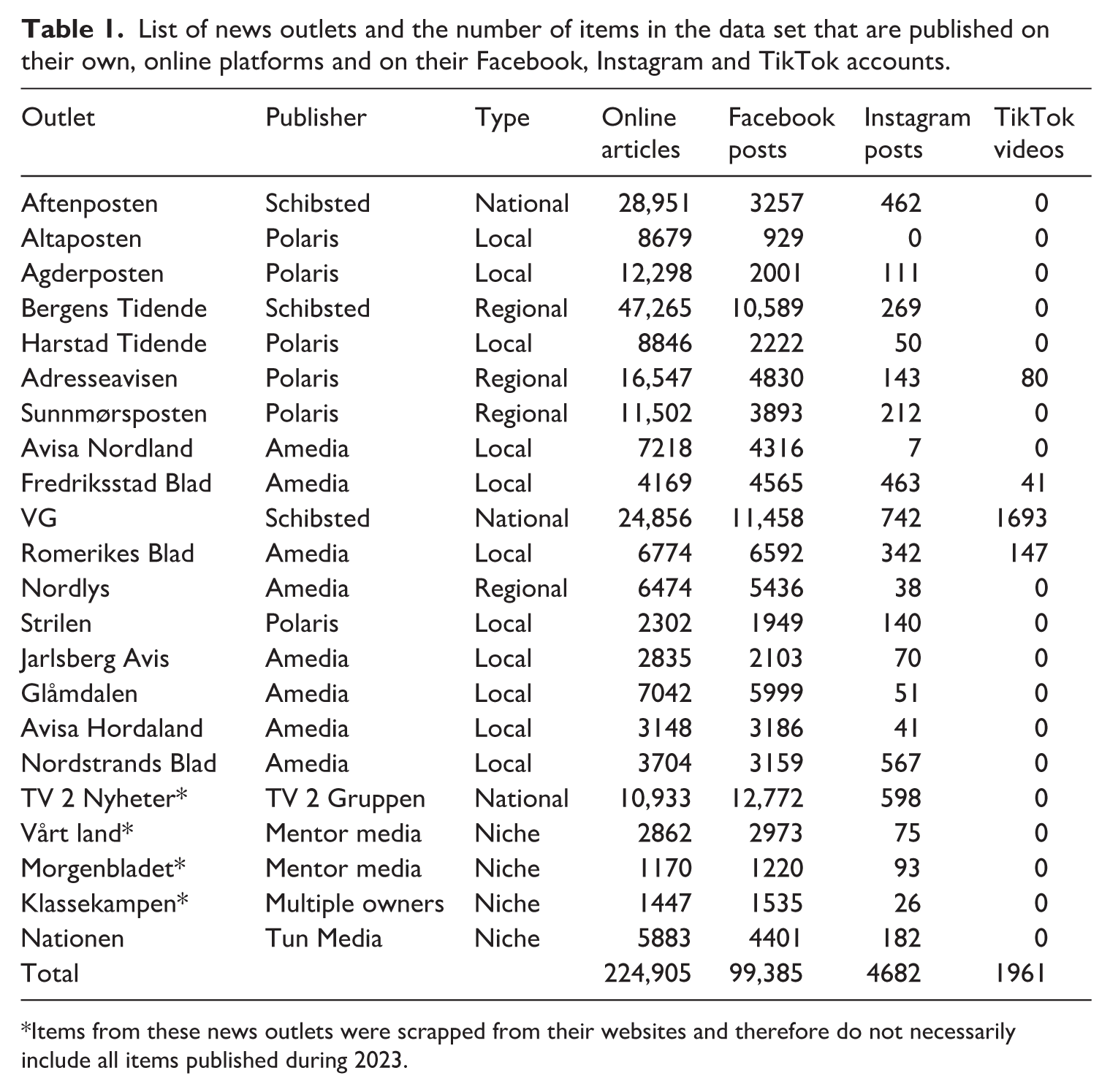
Items from these news outlets were scrapped from their websites and therefore do not necessarily include all items published during 2023.
Topic modelling
To identify topical patterns across the content, we applied LDA, a widely used topic modelling method in natural language processing. LDA models each document as a mixture of topics and each topic as a probability distribution over words, enabling the discovery of latent thematic structures in large text corpora. We used the MALLET (MAchine Learning for LanguagE Toolkit) implementation of LDA (McCallum, 2002), which is known for its optimised Gibbs sampling algorithm, improved topic coherence and suitability for large-scale data sets.
Our modelling followed four best-practice criteria outlined by Maier et al. (2018): (a) rigorous text preprocessing; (b) careful tuning of model parameters (e.g. number of topics); (c) systematic evaluation of model quality; and (d) interpretative validation of the resulting topics. Preprocessing steps included translating articles from Nynorsk to Bokmål (the two official Norwegian languages), converting all text to lowercase, removing punctuation and stopwords, and applying tokenization and lemmatization procedures. Model tuning involved training and comparing multiple configurations to select the optimal number of topics and iterations. Topic evaluation and interpretation were conducted by manually inspecting topic-word distributions and organising them into meaningful clusters. We conceptualised topics largely thematic, in line with Wendelin et al.’s (2017: 137) definition of news topics as one of the fundamental elements that ‘define the rules structuring news selection’. This means that we related topics to general news themes such as politics, sports, culture and so on, when clustering them.
Integrating social media content with topic modelling
To analyse how topic distributions compared across proprietary and social media platforms, we matched posts from Facebook, Instagram and TikTok to items in the main data set. For Facebook, the matching relied primarily on URLs shared in the posts, which pointed back to original stories on the news outlets’ websites. Because Instagram and TikTok do not allow hyperlinking in posts or video descriptions, we used a cosine similarity algorithm to identify corresponding or highly similar texts in the main data set. After a manual validation of the results – based on a random selection of 2% of Facebook posts, 5% of Instagram posts and 10% of TikTok video descriptions – these approaches allowed us to match 89% of Facebook posts, 94% of Instagram posts and 44% of TikTok videos with items in the main data set. The remaining Facebook (11%) and Instagram posts (6%) were too short to be matched or contained non-journalistic content, such as self-promotion or discount campaigns and were therefore excluded from the analysis. The lower match rate for TikTok is attributable to the brevity of many video descriptions (some had empty descriptions), implying that we could not match them. However, it could also be that TikTok videos to a larger extent are produced with an ‘off-site strategy’ (Anter, 2024; Kiberg et al., 2025) in mind and therefore represent exclusive content not related to what the news outlets published on their proprietary, online site.
A full account of these methodological procedures, including a detailed description of the steps followed in the topic modelling and R scripts used, is available through an open science data repository along with a dataset containing the metadata and analysis of all items (Steensen, 2026b).
Comparing topical diversity
To compare topical diversity across different news outlet types and ownership structures, we conducted a principal component analysis (PCA) of outlet-level topic distributions for each platform and calculated the variance and mean distance to the centroid – that is, the average position of all news outlets in a ‘topic space’ – within each news outlet type (local, regional, national and niche) and ownership group. These measures capture both the overall breadth of topical coverage and the extent of convergence or differentiation among news outlets in their topical profiles across platforms.
In addition, we performed PERMANOVA tests (permutational multivariate analysis of variance) to assess how much of the observed topical variation between news outlets could be statistically explained by news outlet type and ownership structure. This approach tests whether the centroids of different groups (e.g. local vs national, Amedia vs Schibsted) differ significantly in multivariate topic space, thereby identifying systematic rather than random variation.
Finally, we calculated three complementary statistical diversity indices to measure the internal topical diversity within each news outlet on each platform. Shannon entropy captures the overall evenness of topic distribution, giving equal weight to all topics regardless of frequency. Simpson’s index emphasises the dominance of the most common topics, decreasing as a few topics account for a larger share of coverage. The Gini coefficient, commonly used to measure inequality, provides a direct measure of imbalance in topic distribution – the higher the Gini value, the more unevenly topics are represented. Taken together, these indices offer a multidimensional assessment of both the variety and balance of topical coverage across platforms and news outlet types.
Findings
We present our findings in the following order: First, we present the topics identified through LDA topic modelling of the main data set (articles published on the news outlets’ proprietary platforms). Then we present the results for each platform (Online, Facebook, Instagram and TikTok), emphasising the following:
The PCA analysis with ‘topic spaces’ visualising distances between news outlet types and ownership structures;
Results of the PERMANOVA tests to highlight the effect of news outlet type and ownership structure for topical variance;
The topical profiles of each news outlet type within the platform in question.
Topics identified through LDA topic modelling
The topic modelling of all items published by the 22 news outlets on their proprietary platforms identified 28 distinct topics, which were manually grouped into 12 broader clusters: Politics (five topics), Sports (five topics), Business/Economy (three topics), Local development (three topics), Breaking news (two topics), Human interest (two topics), Culture (two topics), Consumer (two topics), Crime, War and conflict, Weather, and Health and fitness (see Table A.1 in the Appendix and Steensen, 2026b for a detailed discussion).
Topic variance on online platforms
On their proprietary online platforms, there are clear differences in topic prioritisation across news outlet types and ownership groups (see Figure 1)
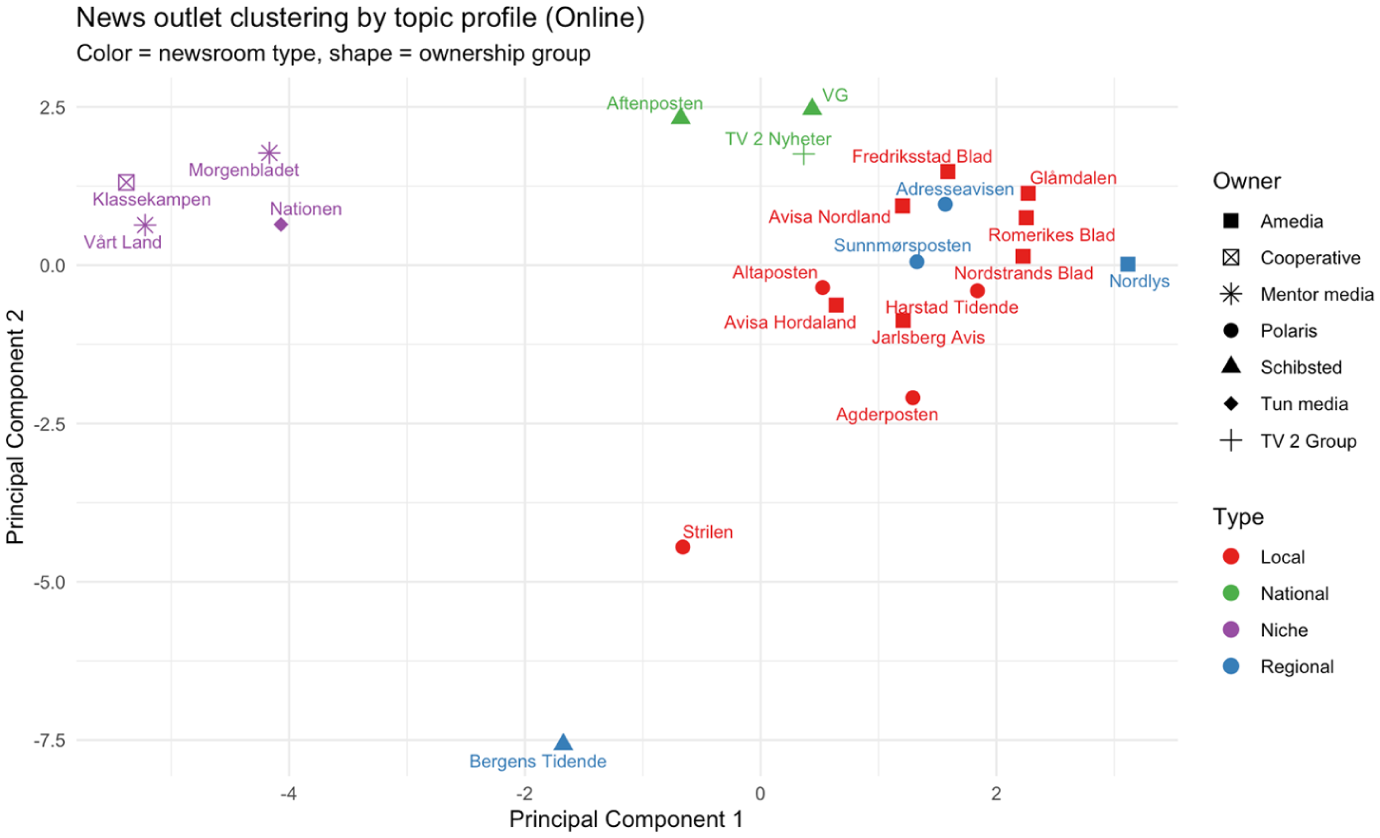
Principal component analysis (PCA) of topic distributions in articles from 22 Norwegian news outlets, grouped by news outlet type and owner. Each point represents a news outlet’s average topic profile on its online platform in 2023, plotted along the first two principal components (PC1 and PC2), which capture the largest variation in topical focus across outlets. Shorter distances between points indicate greater topical similarity between news outlets.
The PERMANOVA analysis, which included both news outlet type and ownership as explanatory factors, produced a highly significant model (F = 5.16, p = .001) explaining 76.0% of the total variance in topic distributions across news outlets (see Table 2). This indicates that structural characteristics – editorial type and ownership – jointly account for most of the variation in topical focus. Because these factors are strongly correlated (e.g. Amedia primarily owns local newspapers), their independent effects are difficult to disentangle. When we restrict the analysis to the three major ownership groups that each include multiple news outlet types (Amedia, Polaris and Schibsted), the explanatory power of news outlet type increases (R2 = .61, F = 4.72, p = .001), while ownership no longer adds significant explanatory strength. This suggests that topical orientation is primarily driven by editorial type (local, regional, national or niche), whereas ownership reinforces these distinctions.
PERMANOVA results for news outlet type and ownership effects on topic distributions (Online).
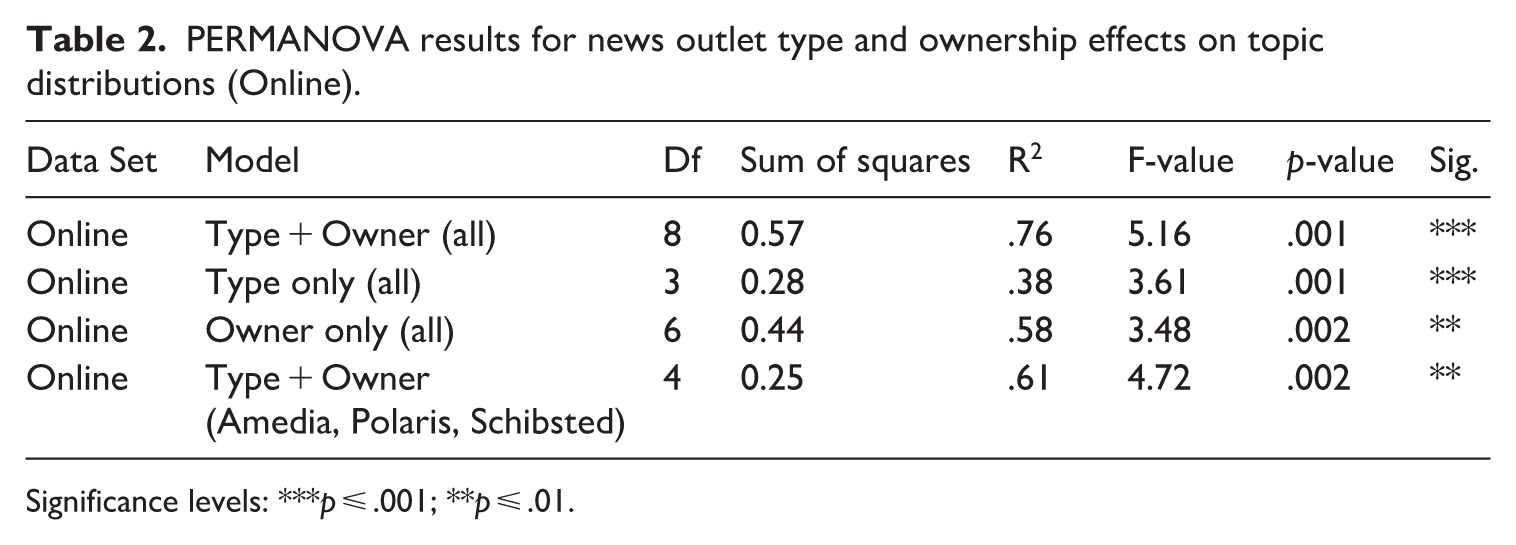
Significance levels: ***p ⩽ .001; **p ⩽ .01.
Given this significance of news outlet type over ownership structure, we find it most meaningful to present the topical profiles of each of the four news outlet types concerning what they published on their online, proprietary platforms (see Tables A.2–A.5 in the Appendix for details):
National outlets emphasise Sports (23.9%), Politics (11.9%) and Breaking news (11.2%) topic clusters, while Human-interest topics and entertainment together make up about one-fifth of their output. Overall, the three national news outlets covered a wide range of topics with high evenness, reflected in high entropy (≈3.0) and Simpson’s index values (≈0.93–0.94), and moderate Gini coefficients (≈0.43). This indicates broad topical coverage but a high degree of similarity across the outlets.
Local news outlets focus mainly on Politics (19.6%) and Local development (16.5%) topic clusters, followed by Sports (12.6%), Human interest (11.5%) and Breaking news (9.5%). Their coverage is broadly distributed but centred on community-oriented topics. They show comparable levels of topical diversity, with entropy and Simpson values similar to national outlets, yet they exhibit somewhat greater variation between outlets.
Regional outlets show a somewhat more varied profile, with relatively high shares of the Sports (18.5%), Business and economy (18.1%), Local development (16.7%) and Politics (12.4%) clusters. They record slightly lower entropy (≈2.9) and Simpson scores (≈0.92) and higher variance in their topical profiles than the national outlets. PCA confirms this picture: regional outlets display very high within-type scatter (variance ≈19.8, mean distance to centroid ≈3.4), indicating that each outlet develops its own distinctive topical mix.
Niche outlets have the most concentrated topic mix, dominated by Politics (34.4%) and Culture (15.1%) clusters, while consumer and business-oriented topics account for around 20 percent combined. These outlets have little coverage of Breaking news and Sports topics compared to the other types. They are the least diverse type, with entropy ≈2.7, Simpson ≈0.89 and Gini ≈0.60, showing a concentration on a smaller set of dominant topics.
Topic variance on Facebook
The difference between types and ownership structures of news outlets is preserved when the outlets choose what to publish on Facebook. Figure 2 displays a strong clustering pattern, even if there is a higher degree of diversity among the niche and national news outlets.
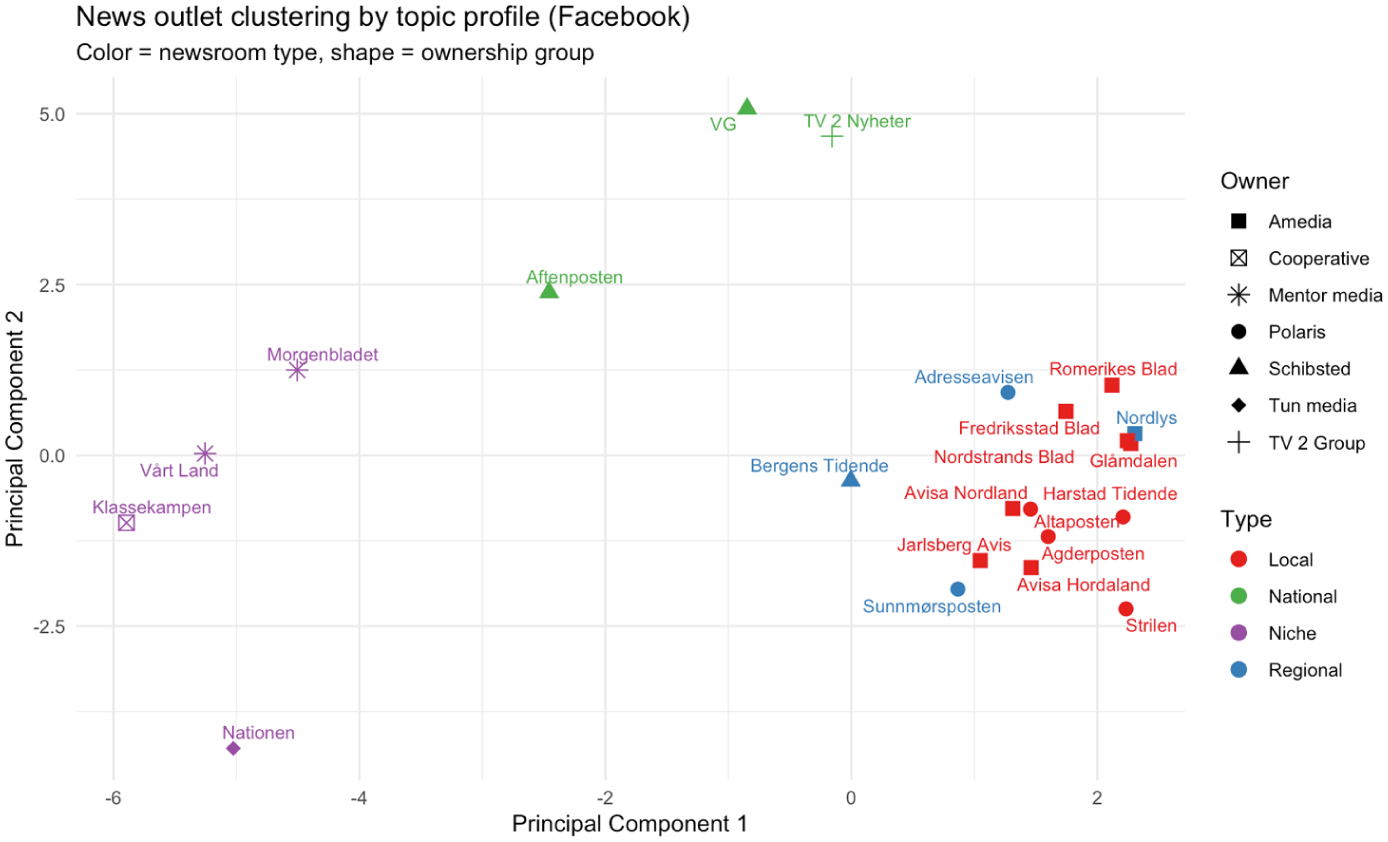
Differences between news outlets in how they prioritise the 28 topics identified through LDA topic modelling when they publish content on Facebook in 2023.
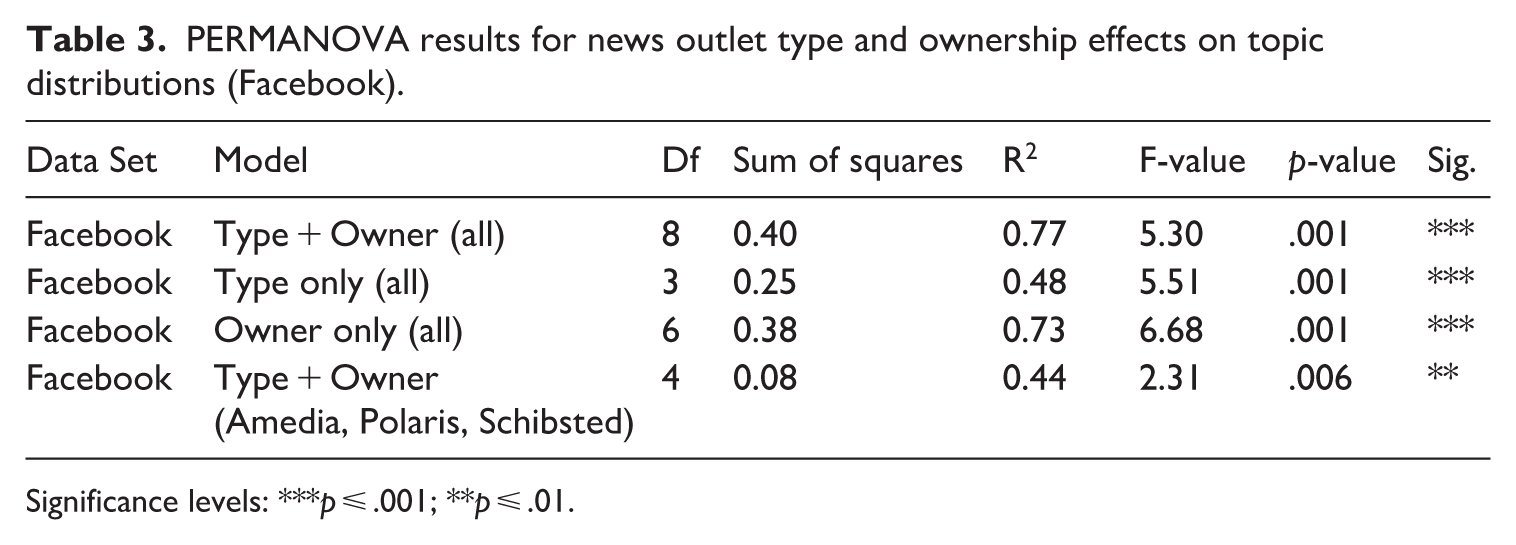
A PERMANOVA test including both type and ownership produced a highly significant model (F = 5.30, p = .001) explaining 76.5 % of the total variance in topic distributions on Facebook (see Table 3). When limiting the analysis to the three largest ownership groups, the explanatory power of outlet type remains substantial (R2 = .44, F = 2.31, p = .006), whereas ownership adds little additional explanatory strength. This indicates that also on Facebook, differences in topical focus primarily follow outlet type while ownership reinforces these patterns.
PERMANOVA results for news outlet type and ownership effects on topic distributions (Facebook).
Significance levels: ***p ⩽ .001; **p ⩽ .01.
Overall levels of topical diversity remain high on Facebook. Entropy values for local and national outlets remain close to 3.0, and regionals even increase slightly (≈3.1, Simpson ≈0.95). However, PCA shows that scatter within news outlet types decreases substantially: for example, regional outlets’ variance drops from ≈19.8 (online) to ≈4.4 (Facebook). This suggests that although breadth of coverage is maintained, news outlets converge towards more similar topical profiles on the platform. Other significant findings concerning the effect of news outlet type for topical profiles on Facebook can be summarised as follows:
Compared with their proprietary online outlets, local news outlets on Facebook post more Breaking news and Sports, while reducing coverage of Politics and Local development (see Tables A.2–A.5 in the Appendix).
Regional outlets show a similar adjustment, with slightly less Business and Local development content and more Sports and Breaking news than in their online editions.
For national outlets, the Facebook topic mix becomes even more concentrated around Sports and Breaking news, with reduced shares of Politics, Culture and War and conflict clusters.
Niche outlets maintain their political and cultural focus on Facebook, but with a minor decline in political content and a relative increase in Human interest and Consumer clusters.
Topic variance on Instagram
On Instagram, the picture is slightly different. The regional and local newspapers still constitute a somewhat distinct cluster (see Figure 3), but the outlet types or ownership structures do not explain as much of the difference as for Facebook and the news outlets’ proprietary platforms.
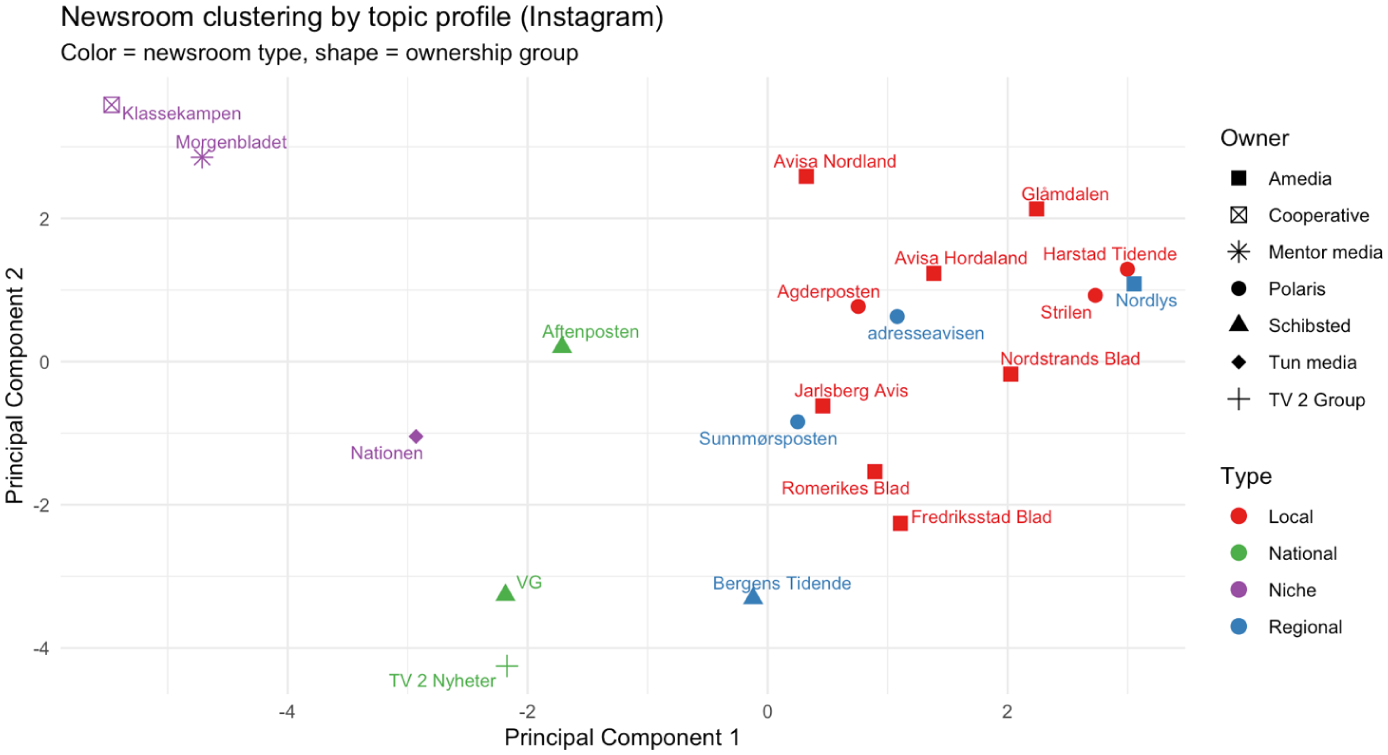
Differences between news outlets in how they prioritise the 28 topics identified through LDA topic modelling when they publish content on Instagram in 2023. One news outlet (Altaposten) did not have an Instagram account and for Vårt land we were not able to match any of the Instagram post.
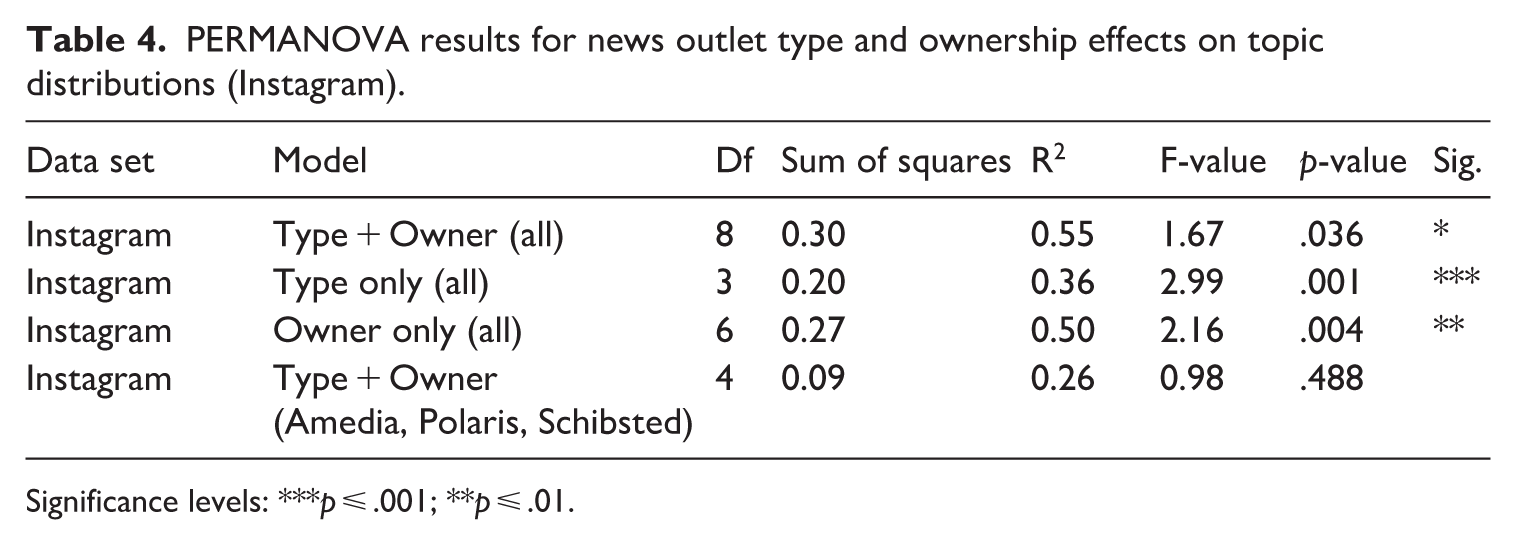
The PERMANOVA tests confirm that relationships are weaker than on Facebook (see Table 4). The combined model including both type and ownership is still significant (F = 1.67, p = .036) and explains 54.8% of the total variance in topic distributions on Instagram, but when limiting the analysis to the three largest ownership groups (Amedia, Polaris and Schibsted), the model is no longer significant (F = 0.98, p = .488; R2 = .26). This suggests that topic variation across news outlets is less structured by ownership or type on Instagram, where overall differences in editorial focus appear smaller and more diffuse than on proprietary platforms and Facebook.
PERMANOVA results for news outlet type and ownership effects on topic distributions (Instagram).
Significance levels: ***p ⩽ .001; **p ⩽ .01.
Across all news outlet types, entropy scores drop (locals ≈2.8, nationals ≈3.0, niches ≈2.6) and Gini coefficients rise on Instagram, reflecting narrower and more unequal topical distributions. PCA confirms a strong homogenisation effect: national outlets show extremely low variance on Instagram (≈0.2) along the main principle component, and all types cluster more tightly in the topical space. In other words, Instagram both reduces topical breadth and diminishes distinctions between outlets.
Overall, the content published on Instagram shows lower shares of hard-news topics (e.g. Politics, Business/economy, Local development) and higher shares of softer categories (e.g. Human-interest topics and entertainment) compared with both online and Facebook content (see Tables A.2–A.5 in the Appendix):
Local outlets post less Politics and Local development, and more Sports and Human-interest.
Regional outlets reduce Business/economy and Local development, with modest increases in Sports and Culture.
National outlets concentrate more on Sports and entertainment, with lower proportions of Politics and War and conflict topics
Niche outlets keep their emphasis on Politics and Culture, but have reduced presence of Breaking news and Sports.
Topic variance on TikTok
The TikTok data, which only includes four news outlets, shows a high degree of variance in topic distribution (see Figure 4), signalling very different approaches to what topics are published on the video-sharing platform. However, the two local news outlets (both owned by Amedia) exhibit quite similar profiles, while the national tabloid VG and the regional paper Adresseavisen have very different topical profiles.
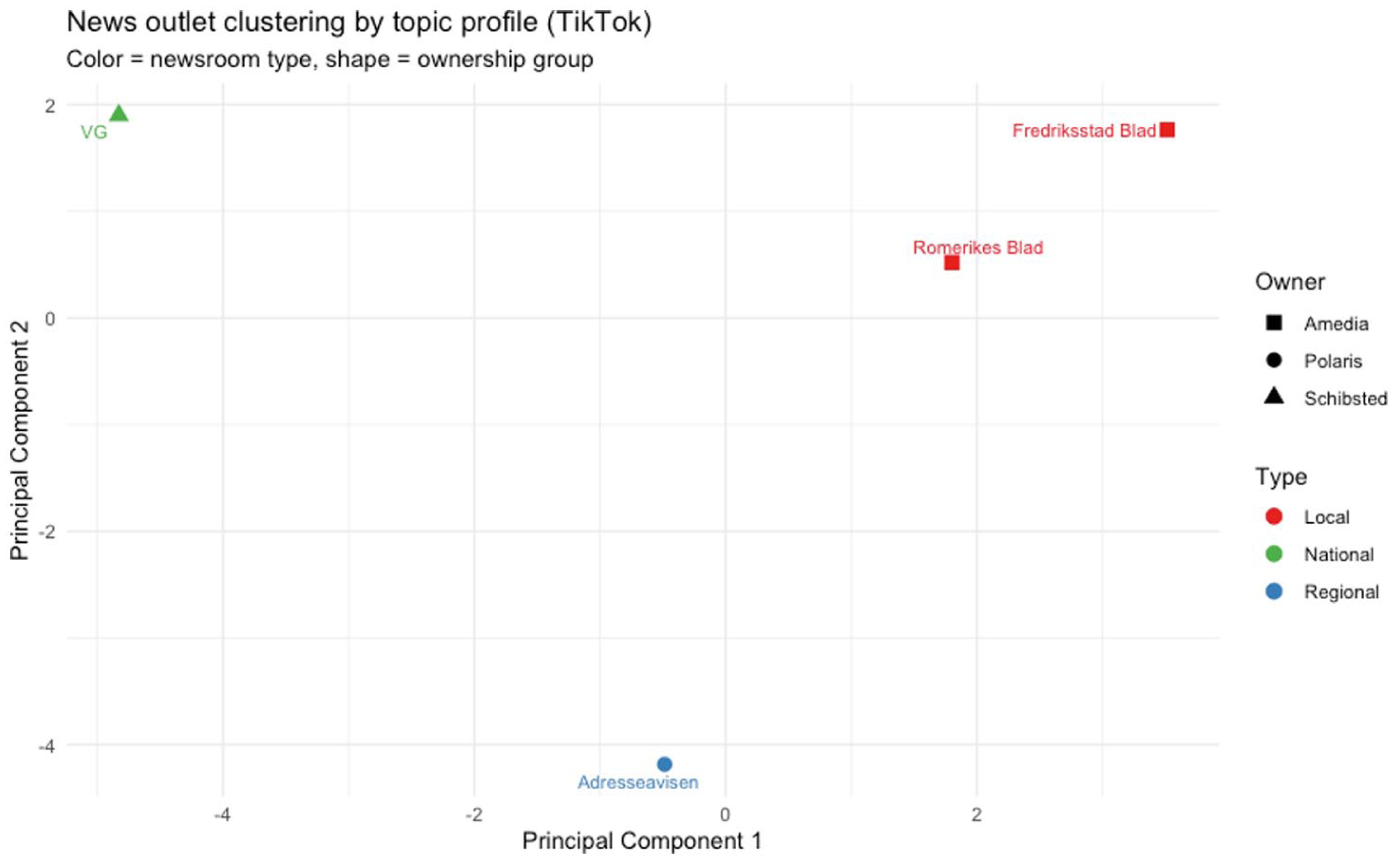
Differences between four news outlets in how they prioritised the 28 topics identified through LDA topic modelling when they publish content on TikTok in 2023.
Because the TikTok data set includes only four news outlets, a PERMANOVA test was not conducted. However, the distribution of topics is quite different on TikTok than on the other platforms, even when we only consider what the same four news outlets published on the other platforms. Fredriksstad Blad (Local, Amedia) mainly published Human-interest and Consumer topics on TikTok, with smaller shares of Local development and Sports compared with what they published on other platforms. Romerikes Blad shows a similar distribution but with a much higher share of Sports topics both compared with Fredriksstad Blad and to what they published on other platforms. Adresseavisen also prioritised Sports but included much more content concerning Human interest, and they prioritised Politics equally to what they did online and on Facebook. In contrast, VG’s TikTok profile features a markedly higher share of Crime and War and conflict content than any of the other outlets and compared with their topical profiles on other platforms. They also emphasised Breaking news more on TikTok but prioritise Politics as much as on their online platform and on Facebook.
Discussion and conclusion
The findings demonstrate that platformisation significantly shapes news diversity across outlet types in Norway’s high-choice media market. On proprietary websites, topical differentiation among local, regional, national and niche outlets remains pronounced, but it becomes muted on Facebook and largely flattened on Instagram and TikTok (RQ1). Here, ‘flattening’ refers to a measurable reduction in between-outlet differences in topical profiles, observed as tighter clustering and lower dispersion across outlets on social platforms compared with proprietary sites. For example, PCA variance within regional outlets dropped from 19.8 on proprietary platforms to 4.4 on Facebook and became minimal on Instagram, demonstrating a substantial compression of topical diversity between outlets on social platforms. This effect follows a clear gradient across outlet types: convergence is strongest among local outlets, weaker among regional outlets, moderate among national outlets and limited among niche outlets. The gradient matters because it shows that platformisation does not affect all news outlets equally, but disproportionately reshapes segments of the media system most closely tied to local democratic functions, such as proximity-based public service, community relevance and local accountability (Jenkins and Nielsen, 2020). On social platforms, civic and place-specific topics (politics, local development, business) shrink among local outlets, while sports and human interest expand, making outlets resemble each other across regions. National outlets retain some distinctiveness, as politics remains prominent, but also converge around human-interest content, while niche outlets remain the most distinct yet narrow their repertoires, particularly on Instagram. Overall, this pattern supports earlier findings that platformisation favours a limited set of high-traction topics (Dijck and van Poell, 2013; Helberger, 2019; Napoli, 2011; Nieborg and Poell, 2018).
Ownership structures (RQ2) further explain variation in topical diversity, but largely through their overlap with outlet type. While type and ownership together explain much of the variance, the distinct influence of ownership diminishes when controlling for outlet category. This indicates that institutional role and audience remit matter more than corporate affiliation (Garz et al., 2024; Sjøvaag and Pedersen, 2018). Ownership tends to reinforce, rather than determine, editorial orientation, while platformisation compresses remaining differences across social media. For example, outlets belonging to different media groups display more similar topic distributions on Facebook and Instagram than on proprietary platforms, particularly through increased emphasis on human-interest and sports content. Yet, ownership thus functions primarily as a structural background condition shaping resources and coordination capacity, whereas outlet type captures the editorial mission most directly structuring topical priorities. Platformisation further reduces these remaining differences by encouraging convergence in topical priorities across outlet types on social media.
These dynamics reveal a structural tension between journalism’s institutional foundations and the logics of platform distribution. Journalistic institutions remain oriented towards public relevance and differentiation, while platform infrastructures prioritise attention and engagement across content providers. Although topical diversity across Norwegian outlets remains substantial on proprietary sites, convergence on social media illustrates how platformisation redistributes editorial power. As platforms increasingly mediate public exposure to news, they amplify emotionally resonant and shareable content at the expense of civic or place-specific reporting, especially for local outlets – a tendency also documented by Toff and Mathews (2024). The result is a form of algorithmic homogenisation in which news produced in distinct local contexts becomes structurally similar. The ‘flattening’ of news on social media represents a subtle erosion of editorial autonomy. This erosion does not take the form of direct interference, but of indirect constraint: editorial choices are increasingly shaped by anticipatory adaptation to algorithmic visibility criteria rather than by independent news judgement alone. This is visible, for instance, in our findings, where civic and place-specific reporting among local outlets becomes less prominent on social platforms, accompanied by a stronger emphasis on sports and human-interest content. This aligns with broader concerns that platform governance introduces an algorithmic layer of editorial influence that transcends national systems and weakens diversity mechanisms grounded in public-service and subsidy regimes (Helberger et al., 2018; Nieborg and Poell, 2018; Nielsen and Fletcher, 2023).
At a democratic level, these developments point to a reconfiguration of how news diversity and editorial independence are sustained in high-choice media markets. Norway’s media policy has long tied diversity to institutional pluralism, supporting a mix of local, regional, national and niche outlets. In a platformised environment, however, such differentiation risks erosion as all outlets adapt to the same platform logics. From a governance perspective, the findings raise concerns about the lack of transparency and accountability in algorithmic ranking systems that increasingly function as de facto moderators of news visibility. Ensuring distribution and exposure diversity, not only content diversity, will therefore be essential if platforms are to serve public rather than purely commercial values (Dijck et al., 2018; Helberger et al., 2018). More broadly, our findings echo international debates about the concentration of communicative power among a few global intermediaries and the democratic need to preserve editorial independence, transparency and plurality in the digital public sphere (Ananny and Crawford, 2018; Gillespie, 2018; Iordache and Raats, 2023; Poell et al., 2021; Srnicek, 2017). From a regulatory perspective, our study suggests that media policy frameworks premised on institutional diversity may be insufficient in platformised environments. While subsidy schemes and ownership regulation support pluralism at the level of production, platform infrastructures increasingly shape distribution and exposure in ways that escape national oversight. This points to the need for policy interventions that address algorithmic visibility, transparency and the conditions under which journalistic content circulates across platforms, particularly for local and civic news. As argued by Mattis et al (2024), nudging towards news diversity through recommender design could be one solution.
Despite these contributions, our study has limitations. It focuses on a single media system, the Norwegian, and results may differ in markets with other regulatory conditions or levels of platform dependency. Methodologically, the matching of social media content to proprietary items posed challenges, particularly for TikTok, where the data set was smaller and many videos lacked textual descriptions and might have been produced exclusively for the video-sharing platforms, implying a potential higher degree of diversity than what our analysis shows. Moreover, the analysis did not consider visual framing, a crucial aspect of Instagram and TikTok communication, nor potential differences in source diversity or narrative style.
Future research should therefore extend this approach by examining how platformisation affects multiple dimensions of news diversity, including source and viewpoint diversity. Comparative cross-national studies could test whether similar flattening occurs in less regulated media systems, while longitudinal designs could assess whether platform-driven topic selection spills over into proprietary news production over time, and also track how platformisation evolves as algorithms, financial models and user practices change. Linking content analyses to audience exposure data would also clarify how production diversity translates into actual news consumption, bridging the gap between editorial output and public exposure in a rapidly platformised information environment.
Supplemental Material
sj-docx-1-nms-10.1177_14614448261430018 – Supplemental material for Flattening the and news: Platformisation the erosion of topical diversity across news outlet types
Supplemental material, sj-docx-1-nms-10.1177_14614448261430018 for Flattening the and news: Platformisation the erosion of topical diversity across news outlet types by Steen Steensen, Håvard Kiberg, Bente Kalsnes, Gunhild Ring Olsen and Lasha Kavtaradze in New Media & Society
Footnotes
Acknowledgements
The authors thank research assistant Guneshwar Sing Manash for making the data available for analysis.
Data availability statement
The dataset underlying this study — comprising metadata and topic model scores for 224,905 articles published by 22 Norwegian news outlets in 2023 — is openly available in the DataverseNO repository: Steensen, S. (2026). NorwegianNewsTopics (2023): Topic Modeling of Norwegian News. DataverseNO. 
Declaration of conflicting interests
The authors declared no potential conflicts of interest with respect to the research, authorship and/or publication of this article.
Funding
The authors disclosed receipt of the following financial support for the research, authorship and/or publication of this article: This research was funded by the Norwegian Media Authority.
Ethical approval
No ethical approval was sought for this study, as it does not involve research on humans.
Supplemental material
Supplemental material for this article is available online.
Author biographies
References
Supplementary Material
Please find the following supplemental material available below.
For Open Access articles published under a Creative Commons License, all supplemental material carries the same license as the article it is associated with.
For non-Open Access articles published, all supplemental material carries a non-exclusive license, and permission requests for re-use of supplemental material or any part of supplemental material shall be sent directly to the copyright owner as specified in the copyright notice associated with the article.
