




Abstract
Social media platforms have been adopted rapidly into our current culture and affect nearly all areas of our everyday lives. Their prevalence has raised questions about the influence of new communication technologies on moral reasoning, judgments, and behaviors. The present scoping review identified 80 articles providing an overview of scholarly work conducted on morality in social media. Screening for research that explicitly addressed moral questions, the authors found that research in this area tends to be atheoretical, US-based, quantitative, cross-sectional survey research in business, psychology, and communication journals. Findings suggested a need for increased theoretical contributions. The authors identified new developments in research analysis, including text scraping and machine coding, which may contribute to theory development. In addition, diversity across disciplines allows for a broad picture in this research domain, but more interdisciplinarity might be needed to foster creative approaches to this study area.
Social media refers to Internet-based communication channels that allow users to generate value from perceived asynchronous interactions and (self-)representation within a broad set of audiences (Carr and Hayes, 2015). Social media is a relatively recent development in communication technology (Edosomwan et al., 2011), although some scholars place the beginning of social media in Cicero’s time in ancient Rome (Standage, 2013). However, for the current definition of social media, the advent of Web 2.0 in 2004 and the development of associated apps ushered in the types of social media currently used by millions of people (Sajithra and Patil, 2013). As with many advances in communication technology, critics have raised concerns about the adverse effects of this new technology, particularly on young people. Just as people blamed television and telephones for leading teenagers astray in past generations (Orben, 2020; Thiel-Stern, 2014), alarm bells have been rung about social media leading to a decline in community springing from the loss of face-to-face communication (Turkle, 2015; Twenge, 2017) and the potentially negative consequences of echo chambers (O’Hara and Stevens, 2015). However, in contrast to other media channels, social media may also provide (digital) spaces for individuals to engage in social learning by observing and judging (moral) behaviors of other users in this shared intangible space. It is unlikely that social media will prove to be responsible for all the immoral behavior in the world. But, any development that has the extraordinary reach that social media has had in the past decade and a half should be the source of study to examine its effects on moral behavior and reasoning; this has been true for social media.
What sets social media apart from other types of communication technologies is its unique affordances. Social media affordances allow users to access, engage with, and share abundant information (Evans et al., 2016; Treem and Leonardi, 2012). One form of information shared via social networks is observable violations of and adherence to social norms that may inform, for instance, users’ moral reasoning and judgment (Crockett, 2017). The accessibility of information about moral, ethical, virtuous, or immoral, wicked, and despicable acts by individuals (Gabriels and De Backer, 2016) and institutions (Schultz et al., 2013) via social media may have an impact on users’ moral behaviors, judgments, reasoning, intuitions, emotions, and self-views in a digital society beyond that seen with other communication modalities. Consequently, social media is an educational tool for people in societies to teach each other about social norms, moral standards, and ethical behaviors. However, although research on non-social media has gained much attention in the past, scholarship on social media’s relationship with morality is more fragmented and scattered across disciplines, paradigms, and research themes. We believe there is a dire need for a scoping review mapping this research and providing a directive into future research agendas.
Some writers argue that digital media may exacerbate the expression of outrage and other moral emotions (Crockett, 2017); others suggest that exposure to moral violations fosters awareness of ethical issues (Bagdasarov et al., 2017). In response to Crockett (2017), several scholars argued that research on effects of moral content on social and digital media exists in their field, but lacks attention in other academic disciplines and thus requires more scrutiny (Huskey et al., 2018). Thus, the debate between two fields—psychology Crockett (2017) and communication (Huskey et al., 2018)—might serve as a central example for the lack of intersectional awareness of social media morality research. Thus, it is crucial to understand what research has been conducted to guide the development of new research agendas in this area. Thus, there is a need for a scoping review focusing on social media and its relation to morality.
Although we could locate no published reviews of research on social media and morality, there has been an explosion of research examining social media in the past decade. A cursory search of Google Scholar using the terms “social media” and “morality” yielded just over 2000 hits for the calendar year 2011 and over 20,000 for the calendar year 2021. Because of the burgeoning nature of research in this area, with simultaneous calls for increased research, a scoping review appears particularly useful (Peters et al., 2015). A scoping review aims to examine the nature and volume of the extant literature within a given domain to identify critical research themes and gaps in the prior research (Peters et al., 2015) to help to inform the development of new research programs. Furthermore, a scoping review is preferable to a quantitative synthesis, such as a meta-analysis, because there is no known dominant hypothesis in the body of work to drive the calculation of effect sizes. A scoping review can provide the first step in summarizing and categorizing the existing work, which can help develop research questions for later syntheses (Peters et al., 2015; Pham et al., 2014).
Morality in the social media context
Prior scholarly work addressed morality in many different contexts. Psychological research, in general, examines moral questions via a wide range of research themes (Ellemers et al., 2019). Media effects research looked at moral questions, too. For example, Grizzard et al. (2014) found that video game players who engage in immoral behaviors within the video game experience become more morally sensitive in the non-mediated offline context. Eden et al. (2014) focused on the effects of entertainment media. They showed that—over time—morally relevant content in entertainment media influenced moral judgments by making moral intuitions more salient. Notably, these results by Eden et al. (2014) were consistent with the Moral Intuitions and Media Exemplars (MIME) Model (Tamborini, 2011; Tamborini, 2012), which applies Moral Foundations Theory (MFT) (Haidt and Joseph, 2004) to entertainment media research. This MIME model, however, was also criticized (Bilandzic, 2011) for the general complexity and difficulty of defining morality in a media entertainment context and from a narrative perspective. Others included emerging technologies that allow for immersive digital environments to investigate how these virtual environments promote empathy and morality when viewing historical events (Frentzel-Beyme and Krämer, 2022). Here, we were explicitly interested in this context of social media and questions regarding morality. We understand that social media may also be consumed for entertainment reasons and, therefore, may have similarities to traditional entertainment media. However, we were specifically interested in research that allows users to relationally interact with other users and entities as compared to fictional characters.
We based our definitions of morality on the scoping review by Ellemers et al. (2019) because their review provided a cogent foundation for understanding the extant research in moral psychology. Although Ellemers et al. (2019) intended to understand morality research in general (not in online or social media contexts), they identified categories of moral experiences. We used these categories of (a) moral behavior, (b) moral reasoning, (c) moral intuition, (d) moral judgment, (e) moral emotions, and (f) moral self-views to organize our review of how morality is investigated in the context of social media.
Moral behavior
First and central, there are many ways users display moral or immoral behaviors on social media. These users include private users or other entities with active accounts, such as firms, organizations, public figures, and even governmental agencies. Research in moral psychology defined moral behaviors as acts that avoid unfair and foster fair treatment of others and prevent harm to and promote the well-being of others (Aquino et al., 2009; Graham et al., 2011). In social media, moral behaviors might manifest, for instance, as promotive and prohibitive voice behaviors (Bhatti et al., 2020). Social media users leverage the platforms’ features and functionalities to voice the need for improvement as a society (promotive voice behavior) or to point out potentially harmful actions and draw attention to them (prohibitive voice behavior). However, immoral behaviors might manifest, for instance, as knowingly spreading misinformation (Effron and Raj, 2019), online shaming (Kasra, 2017), cyberbullying (Vismara et al., 2022), or ghosting (Jonason et al., 2021). These are examples of online behaviors through which users deliberately harm others. According to Ellemers et al. (2019), these behaviors become (im-)moral when judged as such. In addition, whether a behavior is judged as being (im-)moral depends on individuals’ moral reasoning. In addition, Haidt (2001) argued that not all moral decisions are made deliberately; we additionally discuss moral intuitions as antecedents of moral judgments and thus behaviors.
Antecedents of moral behavior
Moral reasoning
What makes a behavior moral or immoral? Like other prominent dual-process theories, prior research has identified two paths for forming moral judgments about distinct behaviors. Rational, informed, and deliberate reasoning is one way to form moral judgments about a behavior’s moral or immoral nature (Cushman, 2013). We define moral reasoning as a deliberate comparative process of what is right and wrong based on thoroughly processed information. Individuals consult internal sources of information, such as personal convictions (Blasi, 1980), and external sources of information, such as individual attributions of other people’s moral character (Reeder and Spores, 1983), to generate a moral judgment. Graeff (2014) used interview data on cyberbullying in social networks from tweens and found that kids who intervene in cyberbullying were more likely to engage in higher-order moral reasoning (i.e. perspective-taking) than kids ignoring or joining cyberbullying. These findings suggested that more deliberate reasoning on moral matters may help form moral judgments about behaviors online. Understanding how social media interacts with moral reasoning helps to create policies for social media’s role in forming moral judgments.
Moral intuition
However, people do not always carefully curate whether an observed behavior is moral. Sometimes, judgments are formed habitually without much deliberation. Thus, a second part to reach moral judgments about behaviors follows Haidt’s (2001) theorizing, and we define moral intuitions as fast cognitive processes independent of rationalization, deliberation, reasoning, or reflection. They are intuitive moral truths about right and wrong innate to the human condition, directly affecting moral judgments and preceding moral reasoning as part of an individual’s moral foundation (Shweder and Haidt, 1993). These moral foundations are cultural values individuals hold dear. In the context of social media, Cook and Kuhn (2021) found that condemnation or approval of job-related consequences (i.e. firing) following what employees posted on social media depended on whether the content violated a moral foundation. Therefore, people form moral judgments intuitively based on their preexisting understanding of what is right and wrong and independent of deliberate reasoning. Thus, moral intuitions and reasoning represent a two-system processing perspective, informing moral judgments, and, consequently, moral behaviors.
Moral judgment
Following the processes of moral reasoning and moral intuition, moral judgments can therefore be interpreted as outcomes of information processing informing an individuals’ evaluation of behavior as being (im-)moral. Individuals may form moral judgments about behaviors they observe online. Moral judgments are evaluations by people about whether specific behaviors are subjectively immoral or moral. These judgments function as individuals’ instruments for “the creation of meaning and the determination of truth” (Blasi, 1980, p. 3) within the moral domain. For example, Ferreira et al. (2017) showed that participants who subjectively judged social media ads as more moral also perceived these ads as less controversial. These judgments consequentially led to less ad avoidance by social media users. Hence, moral judgment significantly impacted message perceptions, consequent behavior, and message engagement in social media. It is, therefore, vital to understand moral judgments as precursors to behavior.
Implications of moral behavior
Moral emotions
Moral behaviors not only have antecedents, but also implications (Ellemers et al., 2019). These implications include affective reactions based on the processes leading to moral judgments and consequently behaviors. Intuitive and fast-acting moral intuitions are often associated with affective reactions or gut feelings (Ciaramelli et al., 2007). However, Cushman (2013) also stated that moral reasoning and intuition involve affective and cognitive information process capabilities within a dual-systems framework. Based on research focusing on the affective associations of morality, we define moral emotions as the immediate emotional reactions to behavior one has engaged in or observed (Ellemers et al., 2019). Research defined emotional reactions like guilt and shame (e.g. Tangney et al., 2006), disgust (e.g. Schnall et al., 2008), and outrage (e.g. Batson et al., 2007) as morally charged emotions. Analyzing more than 200,000 Twitter messages from federal US politicians, Brady et al. (2017) found that messages containing moral emotions were positively associated with message diffusion. Moral messaging, especially when tailored to evoke moral emotions, has implications for political polarization and may affect moral reasoning and judgment.
Moral self-views
Last, and as a self-reflective process based on moral reasoning, intuitions, behavior, and emotions, we define moral self-views as an instrument to form and develop personal beliefs and attitudes about being a moral person (Aquino and Reed, 2002). Prior research (Reed et al., 2007) showed that the centrality of one’s moral identity within the self-concept has implications for moral judgments. Notably, participants who perceived moral identity as more self-relevant judged an organization’s act of giving time (vs money) as more moral, especially when moral identity was made salient and the reason for giving time was a moral purpose. In the context of social media, Bindra and DeCuir-Gunby (2020) found that moral self-views (i.e. moral identity) had a differential effect on moral behavior dependent on participants’ race. While Black students engaged more with race-related issues on social media independent of their moral identity, only White students high in symbolization dimensions of moral identity engaged more with race-related issues. These findings indicate that self-presentational motives might affect how students perceive morality online.
Objectives of this scoping review
The need for a scoping review becomes evident when screening the extant literature on social media and morality for its diversity in (a) research questions and themes, (b) methodological approaches, and (c) contexts of study. A recent systematic review of empirical research in moral psychology (Ellemers et al., 2019) focused on clusters of research questions and themes concerning moral constructs (i.e. moral behaviors, judgments, reasoning, emotions, and self-views). In the context of social media, research examined (im-)moral behaviors (Swenson-Lepper and Kerby, 2019), judgments (Ferreira et al., 2017), reasoning (Graeff, 2014), intuitions (Cook and Kuhn, 2021), emotions (Brady et al., 2017), and self-views (Bindra and DeCuir-Gunby, 2020), too. Our first objective was to map these research questions to the body of work examining social media and morality. In particular, we examined their connection to source, message, and receiver communication characteristics through social media. Exploring this question will help identify avenues for future research and inform a needed research plan on social media’s relationship with morality. We asked:
Prior research on social media and morality examined results from qualitative (DeSmet et al., 2014) and quantitative methodologies (Sabri, 2017). Furthermore, based on the rich informational content offered by social media, prior research used other computational methods, such as natural language processing (Hopp et al., 2021) and web scraping of messages (Brady et al., 2017), too. Regarding cross-sectional and experimental research methods, in which moral concepts have been assessed explicitly or implicitly within surveys and decision tasks, Ellemers et al. (2019) identified four measurement instruments used to investigate questions about the psychology of morality. Research on morality in social media, too, used these four types of assessment: (a) hypothetical moral dilemmas (e.g. Bagdasarov et al., 2017), (b) self-reported traits and behaviors (e.g. Bastiaensens et al., 2015), (c) endorsement of abstract moral rules (e.g. Erceg et al., 2018), and (d) positions on moral issues (e.g. Ouvrein et al., 2018). Because of the variety of operationalizations, our second objective was to identify the different methodologies used in research in this area. Thus, we aim to inform future research by identifying gaps in research methodologies. We asked:
Our third objective was to address how prior studies on social media and morality have differed across disciplines and contexts. Different research areas have addressed the question of morality in the digital age. That is, contributions have been made, for example, in the fields of public health (Laer, 2014), business strategy (Ferreira et al., 2017), political sciences (Brady et al., 2017), communication sciences (Valenzuela et al., 2017), and psychology (Garcia and Sikström, 2014). We aimed to identify contributions from different research fields on social media’s relationship with moral behaviors, judgments, reasoning, intuitions, emotions, and self-views. We asked:
Methods
Review protocol and registration
We created the review protocol in this current study based on the Preferred Reporting Items for Systematic Reviews and Meta-Analysis (PRISMA-ScR) extension for scoping reviews (Tricco et al., 2018). We revised the initial protocol based on additional feedback from other media psychology and communication scholars. We pre-registered the final protocol with the Open Science Framework (OSF; http://bit.ly/MoralitySocialMediaSR).
Eligibility criteria
We followed the PCC (population, concept, context) approach when developing our inclusion criteria (Peters et al., 2020). We defined our population of interest as social media users. We included individual, institutional, and organizational users, political actors, public figures, and other entities that hold active accounts to generate and interact with content.
We defined our concept of interest as (im-)morality. Notably, we were interested in work where the responsible scholars explicitly examined morality. We wanted to avoid making judgments about morality as a third party because culture, religion, and prior experiences significantly impact individual definitions of morality; what is moral in one culture might be immoral in another (Graham et al., 2009; Haidt, 2001; Haidt et al., 1993). Thus, we included research in which the authors explicitly framed their research endeavor as a moral question. We included the concepts of moral behavior, judgment, reasoning, emotions, and self-views. Although we included in our pre-registration that we would examine moral intuitions, too, during the coding procedure, we became aware that moral self-views and intuitions became hardly distinguishable. Thus, we omitted moral intuitions as a separate code and included studies with an intuition focus within moral self-views studies.
We defined the context of interest as social media use. To explore research findings across fields, we included all academic disciplines, such as business strategy and economics, public health, political and communication sciences, sociology, and psychology.
We included research articles between 2006 and 2021 because social media, as we defined it here, started with Facebook going public in 2006. Research on social media published before 2006 was not relevant to this review. Furthermore, we included only research articles published in English and excluded dissertations, unpublished work, non-peer-reviewed research, and books because we were interested only in original research findings.
Information sources and search strategy
We consulted the first 10 Google Scholar search results pages using the terms “morality social media” and “ethics social networking” to identify relevant keywords for the literature search. We executed our literature search on Web of Science and EBSCOhost (details of the search on Web of Science and included databases for Web of Science and EBSCOhost appears in Appendix 1) on 25 May 2021. We did not consult additional sources based on the number of research articles identified in this source.
Selecting sources of evidence
We selected the sources of evidence for the current scoping review throughout multiple rounds of exclusion. After extracting the identified records on Web of Science and EBSCOhost, we excluded duplicates and retracted articles, book sections, case studies, reports, newspaper articles, and records with missing data. Then, six coders (both authors and four research assistants) used the online tool “abstrackr” (http://abstrackr.cebm.brown.edu) for coding these records based on title and abstract (assigning codes for “relevant,” “not relevant,” and “uncertain”). We assessed inter-rater reliability based on 50 articles coded by all six coders. After discussing and clarifying additional instructions, all six coders independently screened the records identified for screening. We included all records coded as “relevant” and “uncertain” by the six screening coders for further screening. The first author (D.N.) then undertook a second round of title and abstract screening to clarify the status of all records coded as “uncertain.” Next, we subjected the remaining records to full-text screening and coding, which the two authors of the current articles did independently. We report a complete list of all coded variables in the final, revised codebook (OSF; “Revised coding materials and protocol”; “Codebook_Revised.docx”).
Data items and data charting process
The authors of this article coded a random subset of articles included in this review independently. Throughout the process, we consulted each other when codes became unclear and engaged in clarifying conversations. We coded the extracted research articles on the manuscript and the study level to address our three main research questions.
At the manuscript level, we coded metadata of the respective research to capture the number of studies, affiliated country of the first author, general research design (qualitative, quantitative, or mixed-methods), and general context of the study. We coded whether the research examined positively (e.g. helping behavior) or negatively (e.g. cyberbullying) framed concepts of morality or both. We were interested in whether scholars included a non-mediated comparison group to contrast the effects of social media on moral questions.
We coded for the research theme (moral behaviors, judgments, reasoning, emotions, and self-views) at the study level and the theoretical foundation for morality and social media. We further coded for the number of participants and observations (in case the unit of analysis was text messages or a nested design), sample source, population, population characteristics (gender, race, country of origin), and social media platform in the focus of the study. Then, we coded for the specific type of research design (quantitative research: e.g. cross-sectional; qualitative research: e.g. focus groups). Within quantitative research, we coded the instruments used for assessing morality and social media measures and how the authors operationalized the respective concepts of interest (morality and social media). Most of the included qualitative research was exploratory, so we did not code for instrumentalization and operationalization for these articles.
Methodological quality appraisal
We did not appraise the methodological quality or the risk of bias in the studies included in this review. Instead, we provided a birds-eye overview of the current state of the art of research on morality in social media. We set a foundation for future research to address the identified research gaps. This process was in line with best practices in conducting scoping reviews (Tricco et al., 2018).
Results
Literature search
Figure 1 summarizes a detailed overview of how we screened and assessed sources of evidence for eligibility. Initially, we identified 12,738 articles, excluded duplicates, and retracted articles, book sections, case studies, reports, and newspaper articles. A total of six trained coders then screened the remaining 6983 articles based on our inclusion and exclusion criteria by abstract and title. We discussed the inclusion and exclusion criteria with our coders. They all coded the same 50 randomly picked articles to ensure at least moderate intercoder reliability based on Fleiss’ kappa because of the multiple codes for more than two coders (κ = .467, z = 12.80, p < .001). Then, we randomly divided the articles between the coders, who assigned the code exclusion, inclusion, or uncertain, though the latter two retained the article for follow-up screening. This process yielded 694 included and 485 uncertain articles. The first author of this article screened them again based on their abstracts and titles, resulting in 381 articles eligible for full-text evaluation. These remaining 381 articles were, again, screened based on our predefined eligibility criteria (see methods section of this article), but in this round of the inclusion process we considered the full text of the manuscript (vs abstract and title only). Based on this detailed screening procedure, we retained 80 for coding these articles and classified 87 as theoretical or conceptual contributions, which we used as supporting literature without including them in this review.
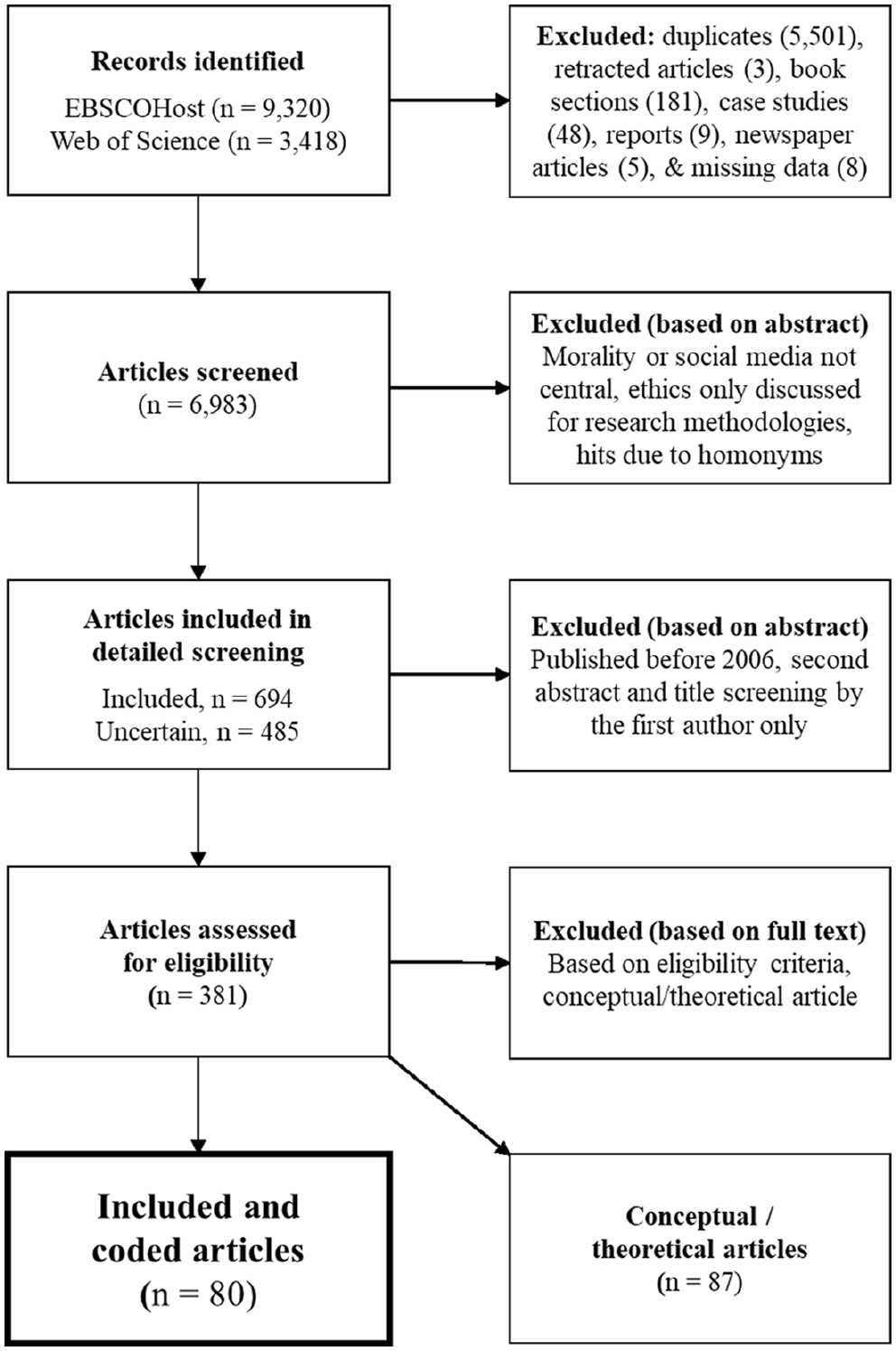
The flow of articles throughout the screening process.
Characteristics of sources of evidence
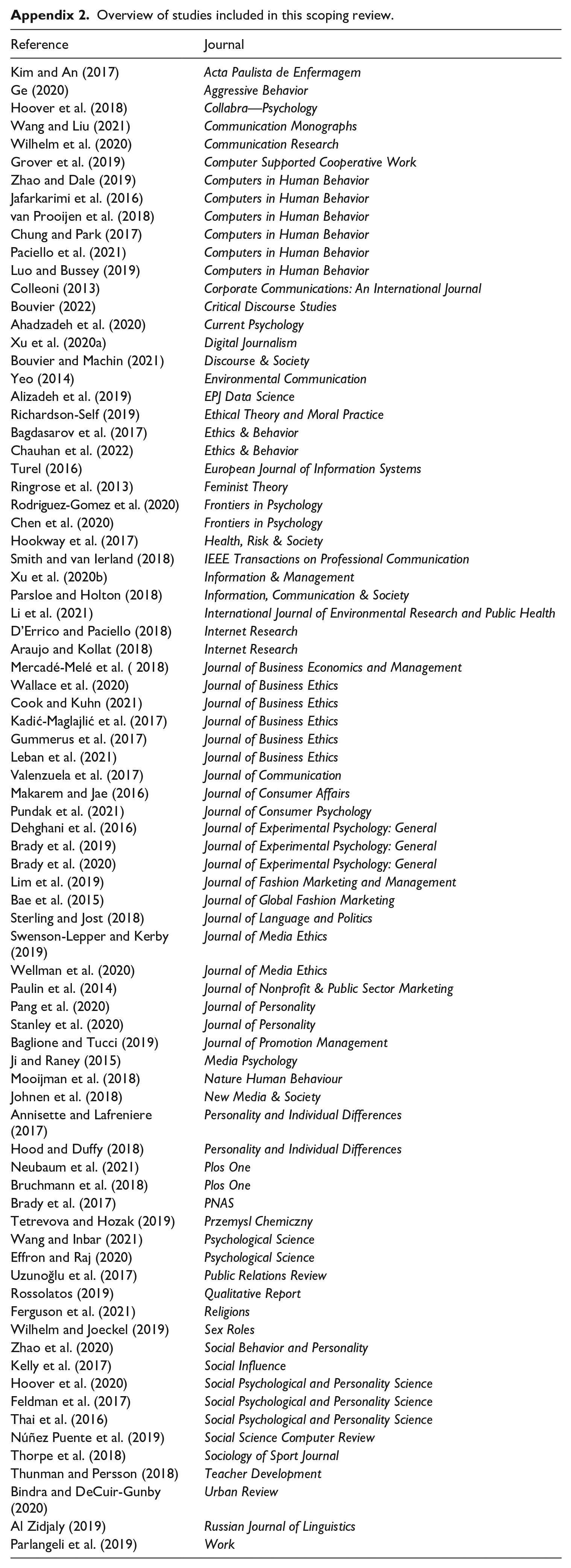
Appendix 2 provides a complete list of the included research studies. Generally, at the manuscript level, we found that first-listed authors affiliated with institutions in the United States conducted most research on morality in social media (40%), followed by first-listed authors affiliated with institutions in China (10%), Australia (8%), Germany (6%), and Canada (4%). As shown in Figure 2, research on social media and morality gained traction in 2013 and increased dramatically in the following years. There has been a significant increase in academic interest in morality in social media after 2016.
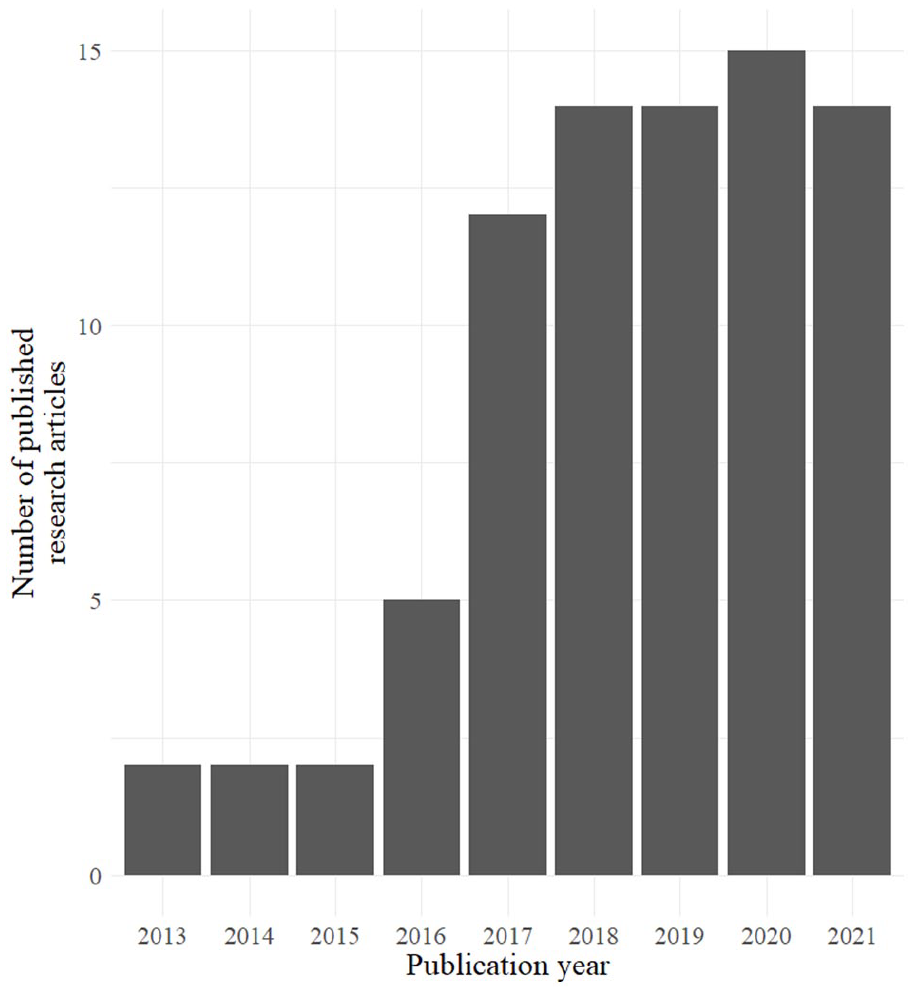
Publication density over recent years.
The platforms capturing the most research interest were Facebook (33%) and Twitter (27%). In comparison, 31% of research studies did not define any specific platform. Only a few studies examined morality in the context of non-American platforms such as Weibo (3%) or WeChat (2%). Instagram (1%) and LinkedIn (1%) were studied in only a few reports. In 33% of studies, the researchers used non-student samples, 31% used messages and text-based data for analysis, 23% used student samples, 9% used special populations (e.g. influencers), and only 3% used adolescence and children. In addition, we found that the majority (89%) of included studies focused on moral behaviors, judgments, reasoning, emotions, and self-views in social media without including a non-mediated contrast. Only a few (4%) investigated these potential differences between mediated and non-mediated situations. Some (4%) contrasted social media and other media (e.g. news outlets) information regarding moral questions, and others controlled for social media use in a mediated setting, for example, examining correlations between increasing social media use and perceived morality (3%).
Research themes and theories
Addressing RQ1, Table 1 provides an overview of research themes addressed and theories used in prior research on morality in social media. A majority of research examined research questions around either moral behaviors (32%) or moral judgments (32%), followed by moral self-views/intuitions (14%), reasoning (12%), and emotions (10%). Noticeably, when looking at the theories used, we found that only about half (56%) of research studies used any explicit theoretical foundation to develop their arguments. When researchers used a theoretical foundation, they were most likely to rely on MFT (20%; Haidt and Joseph, 2004), Moral Disengagement (8%; Bandura, 1999), and the Moral Intuitionist Model (4%; Haidt, 2001).
Research themes and theories (manuscript level).
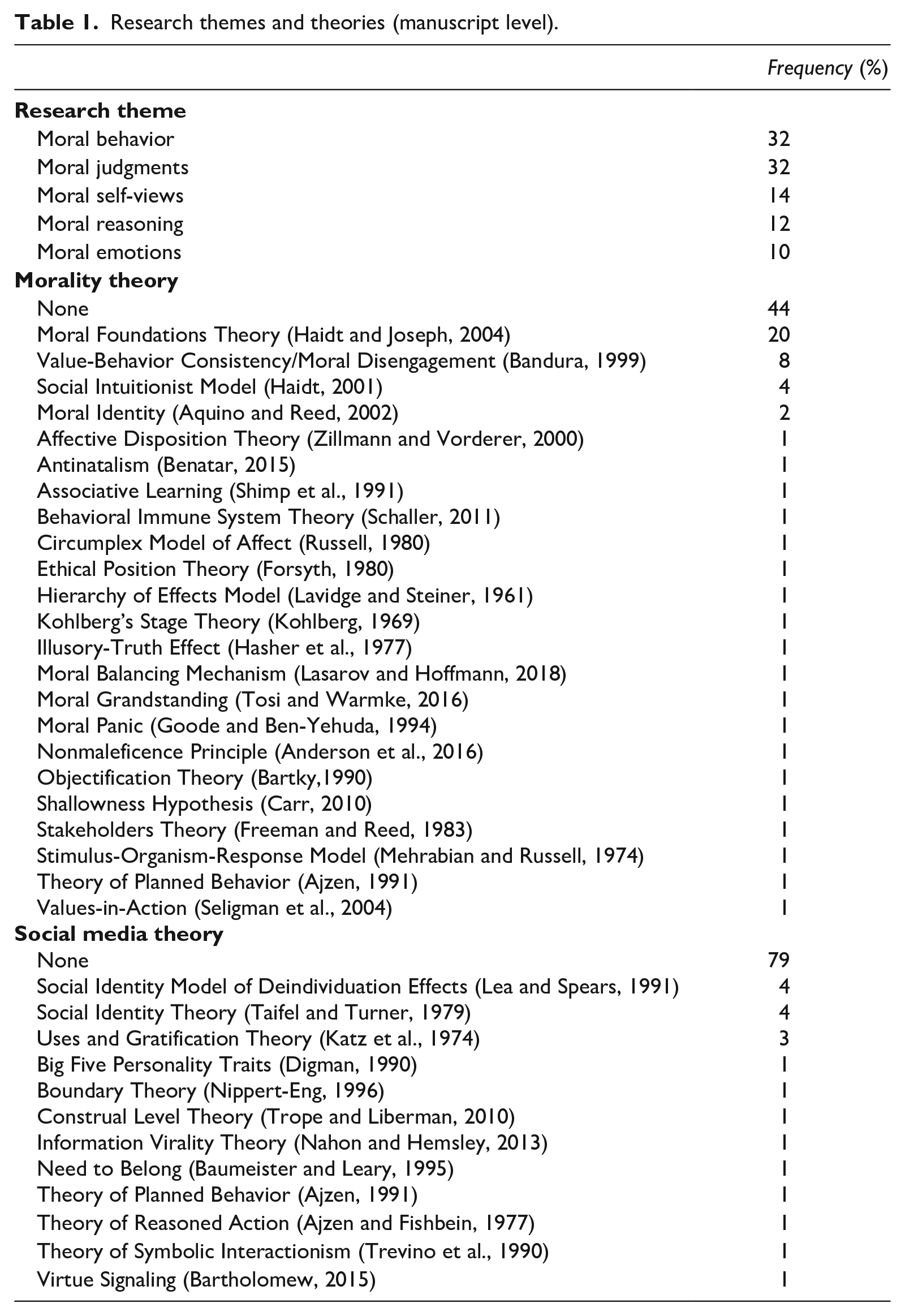
Even less theoretical groundwork was reported concerning social media’s context and possible effects (79% reported no theoretical framework in their argument development). In only 3% of studies, the most frequently named theoretical foundations for expected effects in social media, we identified the Social Identity Model of Deindividuation Effects (Lea and Spears, 1991) and Social Identity Theory (Taifel and Turner, 1979).
Methods and materials
To answer RQ2 (Table 2), most research employed quantitative methods (73%), followed by qualitative methods (25%), and only 3% combined quantitative and qualitative methods to examine their research goal. Within quantitative research projects, we found that most studies employed cross-sectional methods (39%), quantitative content analyses (27%), and experimental research (25%). Within qualitative research projects, we found that most studies used qualitative content analyses (32%), interviews (26%), discourse analyses (21%), and focus groups (11%).
Methods, instruments, and operationalizations (manuscript and study level).
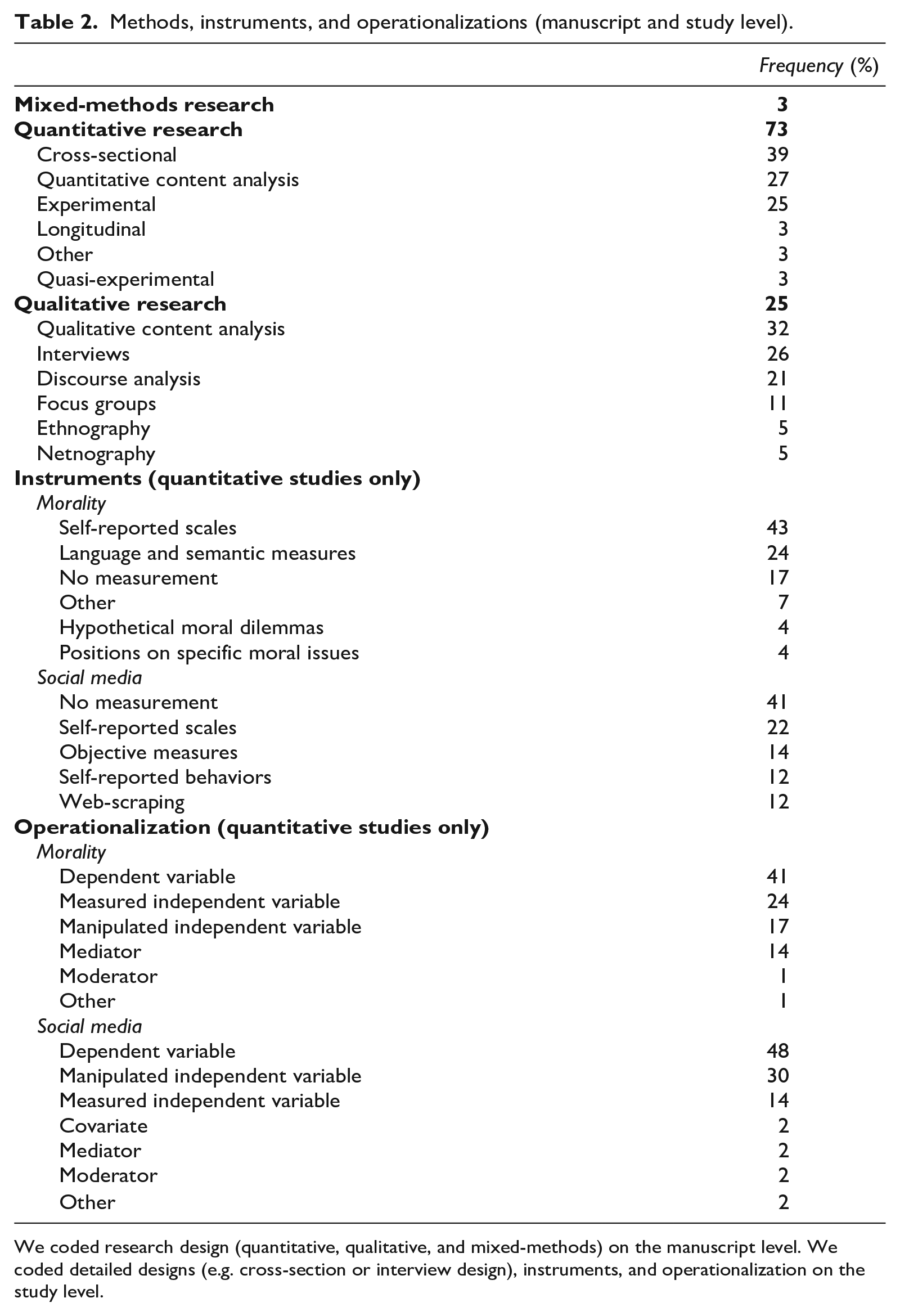
We coded research design (quantitative, qualitative, and mixed-methods) on the manuscript level. We coded detailed designs (e.g. cross-section or interview design), instruments, and operationalization on the study level.
Quantitative studies used self-reported scales (43%) and language and semantic measures (24%) most frequently to assess moral concepts; 17% of studies did not measure morality at all. Furthermore, these quantitative studies used self-reported scales (22%); objective measures, such as liking behavior (14%); self-reported behaviors (12%); and web-scraping techniques (12%) to assess social media concepts. Most research did not measure social media concepts at all (44%). Instead, they used social media as the general context in which they studied morality. Notably, these articles used social media or a particular platform to deliver moral information but did not investigate, for example, the central mechanism that affects how users perceive moral information.
Last, we found that the concepts of morality (41%) and social media (48%) were dependent variables in prior research. However, scholars also more frequently measured (24%) and less frequently manipulated (17%) morality as an independent variable. But, they more frequently manipulated (30%) and less frequently measured (14%) social media concepts in their work. Moral concepts were also used as mediators (14%).
Disciplines and context
In response to RQ3 (Table 3), we found that the dominant journal categories (according to their Web of Science classifications) that reported research on morality in social media were “Business” (12%), “Psychology, Multidisciplinary” (12%), “Communication” (11%), “Psychology, Experimental” (8%), and “Psychology, Social” (8%). In addition, a wide array of other journal categories reported research on morality in the context of social media. Such journals represented categories spanning from “Urban Studies” and “Sport Sciences,” to “Chemistry, Multidisciplinary,” and “Computer Science, Information Systems.” Within these categories, scholars covered a diverse set of topics concerning morality.
Journal categories (manuscript level).
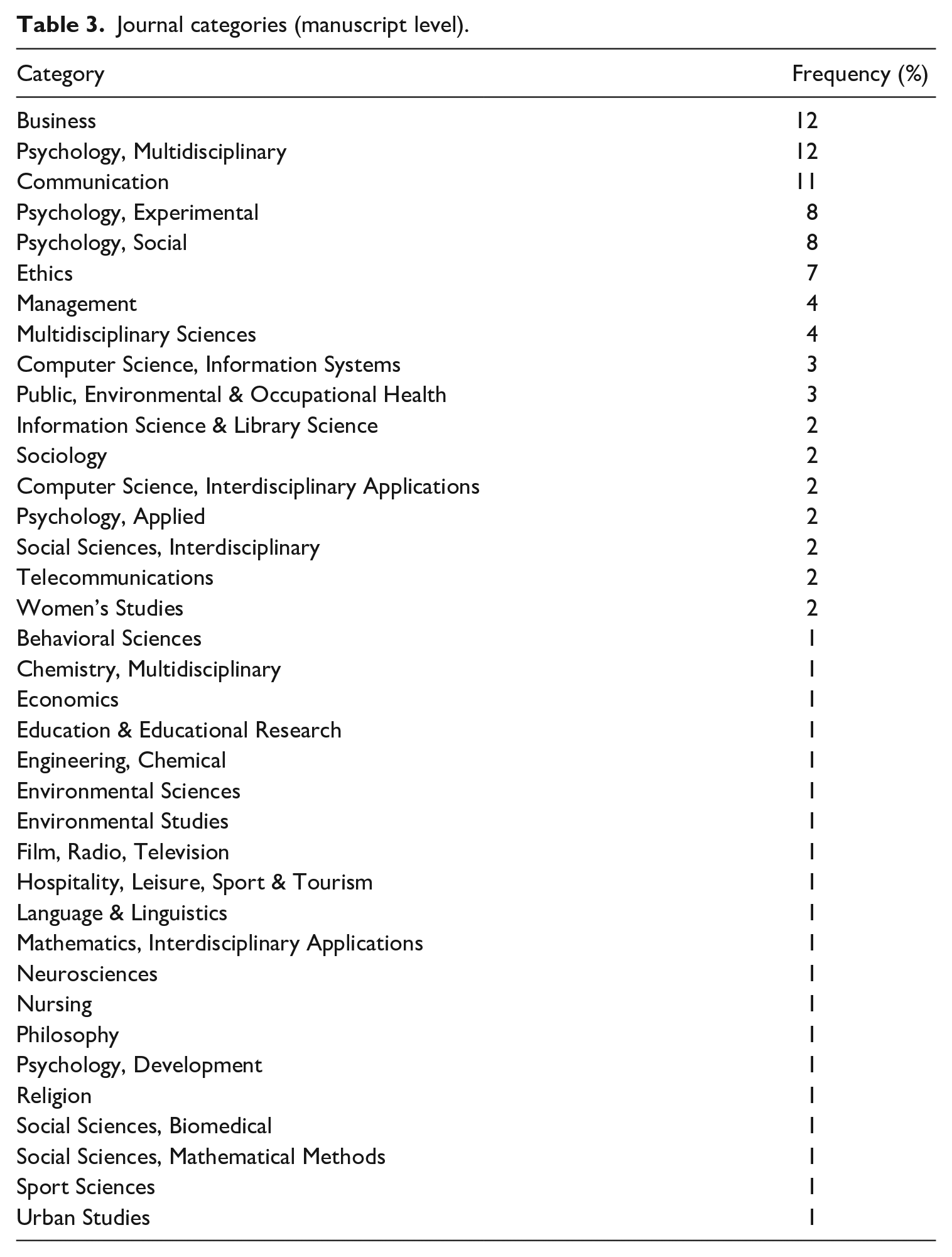
Some research focused on psychological questions emphasized political topics, such as the psychology of political extremism (Alizadeh et al., 2019) and activism (Parsloe and Holton, 2018). More prominently, though, the research covered topics of mental health and well-being, such as shaming (Pundak et al., 2021), sexism (Paciello et al., 2021), and suicidal ideation (Li et al., 2021). But scholars also investigated more positive topics, such as intellectual humility (Stanley et al., 2020) and helping behavior (Parlangeli et al., 2019). Communication research often addresses political topics, such as political partisanship (Bruchmann et al., 2018) and controversy (Smith and van Ierland, 2018). Research on business-related topics often focused on corporate social responsibility (Colleoni, 2013) and cause-related marketing tackling societal issues, such as animal cruelty (Lim et al., 2019).
Furthermore, on the one hand, about 44% of studies on morality examined negatively framed questions of immoral or generally negative moral frames (e.g. online shaming). On the other hand, 33% examined positive aspects of morality (e.g. donation behavior). And 24% of studies did not distinguish between positive and negative moral frames and examined morality on a continuum (e.g. moral semantics in tweets).
Discussion
Summary of evidence
The present research was a scoping review of the morality and social media literature. We summarized the characteristics of 80 published research reports. We found that a US-based researcher led the most typical paper in this area of inquiry. Since 2016 these typical research projects have investigated moral behaviors in the context of Facebook using non-student samples within the theoretical frame of MFT (Haidt and Joseph, 2004), but not mentioning any theoretical frame for social media use. It was most likely a quantitative study using cross-sectional self-reported survey techniques with a measured moral construct and likely negative in a tone such as online shaming. This work was almost equally likely to be published in business, psychology, and communication journals.
Research themes and theories
In summarizing this work, a few findings seem particularly notable. First, this review speaks to the need for greater theoretical development and testing of existing theories between and within interrelated fields, such as psychology and communication. Though some of the reviewed scholarly work presented in this current research has used theory to develop their research projects, there is still a significant shortcoming in applying and advancing existing theory. Some scholars have applied traditional theories of personal and social behavior and mass communication theories to propose hypotheses about morality and social media (Ngai et al., 2015). But more work is needed to describe and summarize existing theoretical phenomena in the context of social media and to evaluate whether these new communication channels for human interaction may create boundary conditions to moral questions and phenomena (DeAndrea and Holbert, 2017). Prior research showed that traditional social theories hold in the social media framework and can be analyzed using social media mining data (Tang et al., 2014). But it also argued for developing new theories based on the complex and new types of social data available via social media mining. The findings from this scoping review point to the need for theories describing the motivational drivers of social media use, separately from theories of motivation generally. The overall atheoretical nature of work in this area suggests that theory development and rigorous testing and advancing is needed to understand the unique experiences of moral expression in social media. Such a theory would help to refine research questions and foci.
Methods and materials
It is encouraging that most studies using human research participants were also including non-student samples. The diversity in studied populations may contribute to the generalizability associated with research bodies. Furthermore, we believe a strength of research on morality in the context of social media is the availability of new data types. Using social media mining data as an innovative source advances prior research. These data-mining techniques need to be employed with caution and in strict accordance with some form of ethical research guideline to protect the individuals who often provide their data involuntarily. But it is encouraging and indicative of a future direction for research that almost a quarter of studies included in this review used at least some language-based and semantic measures to gain a more nuanced understanding of the investigated population. These findings regarding the instrumentation also reflect the general methodology used in research: Though cross-sectional survey research was still the most prominent, quantitative content analysis was the second most prevalent methodology employed. The vast new toolbox of data sources researchers can use may have facilitated these developments. Particularly interesting in the future would be to compare findings using different data sources to replicate and extend traditional theories and findings using new measurements provided by social media. We believe that the lack of theoretical testing and advancement presented in this review might also be addressed using new data sources that can be used to gain more insights to human behavior. In triangulation with traditional research methods, researchers can use these data mining techniques to draw a more complete picture of the fuzzy and complex topics of moral behaviors, reasoning, intuition, judgments, emotions, and self-views.
Disciplines and context
Addressing our third research question, we found that many academic disciplines have inquired about morality in the context of social media. However, psychology, communication, and business journals have provided new developments and knowledge. Although these disciplines all addressed questions of morality in social media, they had these conversations and academic discussions in parallel and across different contexts. First, the psychological disciplines often examined questions of shaming, bullying, and issues regarding the mental health and well-being of individuals who navigated social media. Second, communication disciplines investigated social movements and justice, the social influence of current politics, and people’s rights movements. Third, research within business disciplines inquired about the role of firms in society, the morality of public relations and advertising, and corporate social responsibility strategies. Our findings show great diversity in the fields interested in moral questions within social media contexts. Our research, however, also suggested that more interdisciplinary communication is needed. For example, more evidence is needed about whether moral advertising and corporate communication strategies affect individuals’ mental health and well-being. Furthermore, future research may also follow public calls to examine whether policy changes and regulations are needed to control and oversee the effects of political and corporate decision-making on children, adolescents, and young adults (Przybylski et al., 2021).
Additional characteristics of research
In addition, it was notable that few studies compared morality in social media with similar moral concepts in other or unmediated contexts. If research is to address the question of whether social media provide a new and influential context to questions of human morality, it seems that comparative studies are needed. That is, research should focus on the differences in interaction patterns in face-to-face interactions compared to mediated interactions with others, particularly regarding moral behaviors, judgments, moral emotions, as these concepts may manifest in mediated and non-mediated contexts (e.g. (cyber) bullying, stalking, and hate speech). Notably, while traditional media mostly occurred in private spaces, with little to no audience, and with a lack of two-way interactions, social media now provide a tool to extent face-to-face interactions into a public forum. Particularly, in the context of, for example, social learning (Bandura and Walters, 1977), this change in visibility and interactivity is important. Yet, we found very few studies addressing this question.
In a similar vein, we noticed that most of the research available in the English language was conducted in Western societies and led by Western authors, most often in the United States and led by American scholars. This lack of diversity is concerning, as prominent theories of moral psychology show that moral perceptions are heavily influenced by cultural norms (Haidt, 2001; Haidt and Joseph, 2004; Haidt et al., 1993). To address these imbalances in the representation of moral norms within social media technology, future research in this field should comprise intercultural teams, made accessible across more languages, and heavily scrutinized and tested by scholars representing diverse cultural backgrounds.
Limitations
Like other research, the project we report here comes with several limitations. First and foremost, and aligning with our prior discussion, it is crucial to mention that the current work was conducted by a group of researchers who were encultured in Western societies (the United States and Germany). Though we, as authors, represent two different cultures, we still lack a deep understanding of non-Western cultures’ norms. We tried to address this issue by explicitly only including research in which the authors stated a clear focus on moral questions. We tried to avoid judging the morality of a given research topic and only included research in which the authors communicated to examine moral questions. However, future research on moral reviews should include research teams representing multiple cultural backgrounds to be more inclusive of scholarly work that covers moral topics.
In addition, we concluded our data collection efforts in May 2021. Thus, in the time between data collection and this article’s publication, we believe an abundance of new research will already be published. Thus, we encourage researchers to replicate and extend this work to keep an overview of research on this topic up to date.
Conclusion
With this scoping review on morality in social media, we aimed to provide scholars across disciplines interested in morality research in a mediated world with an overview of existing work. This work identified relevant research gaps that we hope will steer research and academic conversations toward a more future-directed pathway. We provided an overview of prominent research questions, themes, methodologies, and disciplines that address morality’s role in social media platforms.
Footnotes
Appendix
Overview of studies included in this scoping review.
| Reference | Journal |
|---|---|
| Kim and An (2017) | Acta Paulista de Enfermagem |
| Ge (2020) | Aggressive Behavior |
| Hoover et al. (2018) | Collabra—Psychology |
| Wang and Liu (2021) | Communication Monographs |
| Wilhelm et al. (2020) | Communication Research |
| Grover et al. (2019) | Computer Supported Cooperative Work |
| Zhao and Dale (2019) | Computers in Human Behavior |
| Jafarkarimi et al. (2016) | Computers in Human Behavior |
| van Prooijen et al. (2018) | Computers in Human Behavior |
| Chung and Park (2017) | Computers in Human Behavior |
| Paciello et al. (2021) | Computers in Human Behavior |
| Luo and Bussey (2019) | Computers in Human Behavior |
| Colleoni (2013) | Corporate Communications: An International Journal |
| Bouvier (2022) | Critical Discourse Studies |
| Ahadzadeh et al. (2020) | Current Psychology |
| Xu et al. (2020a) | Digital Journalism |
| Bouvier and Machin (2021) | Discourse & Society |
| Yeo (2014) | Environmental Communication |
| Alizadeh et al. (2019) | EPJ Data Science |
| Richardson-Self (2019) | Ethical Theory and Moral Practice |
| Bagdasarov et al. (2017) | Ethics & Behavior |
| Chauhan et al. (2022) | Ethics & Behavior |
| Turel (2016) | European Journal of Information Systems |
| Ringrose et al. (2013) | Feminist Theory |
| Rodriguez-Gomez et al. (2020) | Frontiers in Psychology |
| Chen et al. (2020) | Frontiers in Psychology |
| Hookway et al. (2017) | Health, Risk & Society |
| Smith and van Ierland (2018) | IEEE Transactions on Professional Communication |
| Xu et al. (2020b) | Information & Management |
| Parsloe and Holton (2018) | Information, Communication & Society |
| Li et al. (2021) | International Journal of Environmental Research and Public Health |
| D’Errico and Paciello (2018) | Internet Research |
| Araujo and Kollat (2018) | Internet Research |
| Mercadé-Melé et al. ( 2018) | Journal of Business Economics and Management |
| Wallace et al. (2020) | Journal of Business Ethics |
| Cook and Kuhn (2021) | Journal of Business Ethics |
| Kadić-Maglajlić et al. (2017) | Journal of Business Ethics |
| Gummerus et al. (2017) | Journal of Business Ethics |
| Leban et al. (2021) | Journal of Business Ethics |
| Valenzuela et al. (2017) | Journal of Communication |
| Makarem and Jae (2016) | Journal of Consumer Affairs |
| Pundak et al. (2021) | Journal of Consumer Psychology |
| Dehghani et al. (2016) | Journal of Experimental Psychology: General |
| Brady et al. (2019) | Journal of Experimental Psychology: General |
| Brady et al. (2020) | Journal of Experimental Psychology: General |
| Lim et al. (2019) | Journal of Fashion Marketing and Management |
| Bae et al. (2015) | Journal of Global Fashion Marketing |
| Sterling and Jost (2018) | Journal of Language and Politics |
| Swenson-Lepper and Kerby (2019) | Journal of Media Ethics |
| Wellman et al. (2020) | Journal of Media Ethics |
| Paulin et al. (2014) | Journal of Nonprofit & Public Sector Marketing |
| Pang et al. (2020) | Journal of Personality |
| Stanley et al. (2020) | Journal of Personality |
| Baglione and Tucci (2019) | Journal of Promotion Management |
| Ji and Raney (2015) | Media Psychology |
| Mooijman et al. (2018) | Nature Human Behaviour |
| Johnen et al. (2018) | New Media & Society |
| Annisette and Lafreniere (2017) | Personality and Individual Differences |
| Hood and Duffy (2018) | Personality and Individual Differences |
| Neubaum et al. (2021) | Plos One |
| Bruchmann et al. (2018) | Plos One |
| Brady et al. (2017) | PNAS |
| Tetrevova and Hozak (2019) | Przemysl Chemiczny |
| Wang and Inbar (2021) | Psychological Science |
| Effron and Raj (2020) | Psychological Science |
| Uzunoğlu et al. (2017) | Public Relations Review |
| Rossolatos (2019) | Qualitative Report |
| Ferguson et al. (2021) | Religions |
| Wilhelm and Joeckel (2019) | Sex Roles |
| Zhao et al. (2020) | Social Behavior and Personality |
| Kelly et al. (2017) | Social Influence |
| Hoover et al. (2020) | Social Psychological and Personality Science |
| Feldman et al. (2017) | Social Psychological and Personality Science |
| Thai et al. (2016) | Social Psychological and Personality Science |
| Núñez Puente et al. (2019) | Social Science Computer Review |
| Thorpe et al. (2018) | Sociology of Sport Journal |
| Thunman and Persson (2018) | Teacher Development |
| Bindra and DeCuir-Gunby (2020) | Urban Review |
| Al Zidjaly (2019) | Russian Journal of Linguistics |
| Parlangeli et al. (2019) | Work |
Acknowledgements
We want to thank Dr Allison Eden and Dr Sonja Utz for providing valuable feedback on developing the pre-registered reviewing protocol and codebook. We further want to thank our research assistants Larissa Kurz, Cara Limpächer, Andres Niederstadt, and Jonah Patrick Cooper for supporting us with screening studies for inclusion.
Declaration of conflicting interests
The author(s) declared no potential conflicts of interest with respect to the research, authorship, and/or publication of this article.
Funding
The author(s) received no financial support for the research, authorship, and/or publication of this article.
