




Abstract
In the extant ample research on news engagement on social media, a majority of studies thus far have centered mainly on users’ motivations, gratifications, and characteristics and less on platforms in which they operate. Yet, it is well recognized that users’ behavior is shaped by technological interfaces, and that users differentiate between platforms and switch to suit their specific needs. The current study, therefore, adopts a cross-platform (Facebook, Instagram, TikTok, YouTube, Twitter, and instant messaging apps) approach to explore how users’ engagement with news varies, with a focus on users’ perceptions of platforms’ affordances as a main predictor. Based on an online survey in eight countries (the United States, United Kingdom, France, Israel, Sweden, Germany, Hong Kong, and Japan), the study identifies as key affordances, which determine both receiving and dissemination of news, users’ perceptions regarding a platform’s personalization, network association, anonymity, and content persistence. The findings also highlight the differences between countries and between platforms.
Introduction
According to recent surveys, close to half of social media users in Western countries employ platforms for news purposes (see Reuters Institute, 2022 digital news report). These users receive news to their social media feeds, in instant messaging groups, or by private messages. Such a variety of modes allow them to view news stories (and potentially reads/watches) that originated with other network members (users, publishers, etc.). They can also take a more active role in disseminating this news by sharing it, commenting on it, either publicly or privately, or conveying their emotional reactions to it using emoticons (Choi, 2016a; Costera Meijer and Groot Kormelink, 2015; Dvir-Gvirsman, 2022).
Thus far, most studies on the receiving and dissemination of news have focused on users’ motivations, gratifications, and characteristics (e.g. Choi, 2016b; Dvir-Gvirsman, 2022; Kalogeropoulos et al., 2017; Kumpel et al., 2015; Weeks and Lane, 2020). Rather less research has been devoted to the technical–behavioral aspects of news use (Park et al., 2021), notably, the platforms per se. The number of platforms available to users has increased over the past decade, such that today an average user has accounts on more than six platforms. 1 In light of these developments, it was suggested that “[c]ontemporary media use can be better understood as a story of juxtaposition of different platforms, rather than one where one media systematically replaces another” (Matassi et al., 2022: 3). In such an environment, users practice platform swinging (Tandoc et al., 2019): They identify differences between platforms and can navigate between them according to their needs. Consequently, for each social media platform, users develop sets of habits and practices that are couched in their understanding of this particular platform (Boczkowski et al., 2018).
Given the overall importance of social media platforms today, the current study adopts a comparative angle by exploring how news use plays out across different platforms. To this end, the study operates with the concept of perceived affordance (Fox and McEwan, 2017), which taps users’ understanding of the platforms on which they operate. Perceived affordance shifts attention from the actual materiality of a platform’s interface (its affordances) to users’ perceptions of its features, since it is these impressions that determine their behavior online. In particular, we are interested in such perceptions regarding four affordances that were previously tied to news use: user anonymity, content persistence, content personalization, and association (Fox and Holt, 2018; Neubaum, 2021; Neubaum and Weeks, 2022; Treem and Leonardi, 2013). Via an online survey, we asked users to evaluate their perceptions of affordances on the social media platform(s) they regularly use, and test whether these perceptions shape their willingness to receive and disseminate news. Furthermore, since perceptions of technology and its affordances are culturally sensitive (Costa, 2018), the study opts for a comparative approach, collecting data in eight countries: the United States, United Kingdom, France, Sweden, Germany, Israel, Hong Kong, and Japan.
In comparing both the platforms and the countries, the study offers an innovative research perspective that allows for a more granular understanding of news use.
Unpacking users’ perceptions of platforms has revealed the mechanisms through which technology mediates behavior; thus, for example, it is self-evident that by ensuring anonymity, platforms may encourage certain behaviors over others. Such approach contributes to the theoretical understanding of technological mediation (for review see Flanagin, 2020), and more specifically, allows us to refine what is known as the object-centered approach, which “tends to focus on the technology as a whole, emphasizing its uniqueness or newness in time” (Flanagin, 2020: 24), and allow for better theoretical undersetting of technological mediation (for review see Flanagin, 2020). This course of inquiry has put into relief the characteristics of the digital environment in which users feel comfortable interacting with news. By discerning whether, for instance, users look for public, open spaces or rather private closed ones, we could gain knowledge on how to optimize the design of digital environments so as to promote news exchange.
Social media affordances
Evans et al. (2017) defined the affordance as the “multifaceted relational structure between an object/technology and the user that enables or constrains potential behavioural outcomes in a particular context” (p. 36). While, on this definition, and also according to other scholars (Bucher and Helmond, 2017; Fox and McEwan, 2017; Nagy and Neff, 2015), affordances are a relational property, more often than not, they are conceptualized as stable properties of platforms (Evans et al., 2017). Such an “objective” approach whereby platforms are ranked as high/low on a given affordance does not account for the differences in the ways users experience either affordances or platforms (Fox and McEwan, 2017; Nagy and Neff, 2015; Norman, 1990). Fox and McEwan (2017) argue that, since users’ behavior is ultimately determined by their perceptions, the above objectivization “may lead to attributions toward a channel rather than clarifying the mechanisms driving effects” (p. 301). In other words, to conceptualize affordances as inherent qualities of a technological object is to ignore the context in which they are situated. Such a perspective disregards a crucial link between the object’s architecture and its effects on the user’s cognition or behavior. Therefore, Fox and McEwan (2017) suggest that studying “individuals’ perceptions [emphasis mine] of these affordances will provide greater insight into social interaction” (P. 301).
What, then, are social media affordances? Scholars differ as to what they identify as affordances within platforms: While some use the term to refer to specific features such as buttons, others designate by it more general principles that shape platforms’ architecture, such as content persistence (Bucher and Helmond, 2017). Given our focus on users’ perceptions, we conceptualize and operationalize affordances in line with Fox and McEwan (2017), as quoted above.
News use and perceived affordances
In their overview of the literature, Fox and McEwan (2017) identified as many as 10 perceived affordances: bandwidth, synchronicity, editability, persistence, association, anonymity, privacy, personalization, and conversational control. The current study focuses on four of these, deemed relevant to news use based on past research—anonymity, content persistence, personalization, and association—and controls for the other six. Of the four selected, the most research attention has been accorded to anonymity: whether or not the source of a message is identifiable. Anonymity has been studied extensively in the context of online political expression, a behavior closely tied to news dissemination (Gil de Zúñiga et al., 2014). The idea that, by reducing costs, anonymity can be a factor in political expression goes back to the spiral of silence theory (Neubaum and Weeks, 2022). While by and large research has demonstrated that perceived anonymity increases expression (Jaidka et al., 2021), some studies found this effect to be non-significant (Fox and Holt, 2018). Persistence of content also impacts costs and benefits of expression and could be seen as the flipside of the same coin. Persistent content, which endures on the platform (e.g., a post on Facebook), increases both gains and risks in comparison to content that is fleeting (e.g., a story on Instagram) (Neubaum, 2021). Indeed, perceived content persistence was found to increase willingness to self-censor (Fox and Holt, 2018).
Ostensibly, news dissemination might carry similar costs and benefits to other types of political expression (Gil de Zúñiga et al., 2014). News dissemination is known to be motivated by users’ need for socialization: establishing communication with others and practicing impression management, namely maintaining an ideal self-image (Choi, 2016b; Duffy and Ling, 2020; Kumpel et al., 2015). Past studies have stressed how sharing is a double-edged sword: users are both reluctant to share since they fear the network reaction, and at the same time, see news as content that can be used for social gain (Costera Meijer and Groot Kormelink, 2015), and to convey political standing (Gil de Zúñiga et al., 2014).
Thus, we put forward the following hypotheses:
H1. Perceived anonymity will be positively related with news dissemination behavior on social media.
H2. Perceived content persistence will be negatively related with news dissemination behavior on social media.
Perceived content persistence could also enhance users’ preference to receive news, by making such messages easier to search for and find. Indeed, Chen and Peng (2022) found a positive association between such perceptions and motivations to seek information. Thus, we hypothesize:
H3. Perceived content persistence will be positively related with receiving news on social media.
Personalization is yet another fundamental characteristic of social media platforms that has attracted massive research attention. Through various mechanisms—from algorithms to self-curation—social media users’ feed is tailored to suit their tastes and interests (Thorson and Wells, 2016), thereby greatly influencing the information they receive. The question remains, however, whether users do indeed prefer personalized news. Findings in this regard differ: while some studies reported infrequent use of low-level affordances to curate news (Groot Kormelink and Costera Meijer, 2014; Lee et al., 2019), others found that as many as half of users are availing themselves of this strategy (Merten, 2021). Information coming from interviews and focus groups suggests that users prefer to consume news via messaging apps like WhatsApp and Telegram precisely because they feel that news there is socially personalized (Lou et al., 2021; Masip et al., 2021). Given such inconsistent results, we formulate a research question rather than a hypothesis as concerns this affordance:
RQ1. What is the relation between perceived personalization and receiving news on social media?
Even less is known about the possible effects of personalization on news dissemination, with only one experiment probing this issue: Thürmel et al. (2021) showed that, when news was personalized and users were aware of this, they found it to be more fitting and therefore reported a higher likelihood of sharing it. Furthermore, users are known to practice selective sharing (Shin and Thorson, 2017), a fact that also supports the idea that personalization will likely increase dissemination. Selective sharing is easier when personalized content is congenial with users’ preferences. Thus, we hypothesize:
H4. Perceived personalization will be positively related with news dissemination behavior on social media.
Finally, we consider association, which relates to social media’s capability to create connections between users and between users and content (Treem and Leonardi, 2013). For example, many social media platforms display, on one’s profile page, what other users one is connected with, thus providing one with information regarding the network of users. In addition, social media platforms frequently provide information not only on who shared a piece of content, but also on who besides them interacted with the content. Association can be conducive to news consumption in two ways: first, it eases access to information and allows users to “bookmark” content; second, it can reveal the source of information (Treem and Leonardi, 2013). Association promotes news dissemination since all dissemination mechanisms on social media hinge on the association between users and content. In this connection, Chen and Peng (2022) demonstrated a positive relation between association and the motivation to use social media for information seeking and sharing, interpreting this finding as an indication that users rely on their connections for the desired information. Similarly, Fox and Holt (2018) found that perceived association was negatively correlated with willingness to self-censor—or, in other words, that it prompts users to express what’s on their mind. Thus, we hypothesize:
H5. Perceived association will be positively related with news dissemination on social media.
H6. Perceived association will be positively related with receiving news on social media.
The current study
In light of the prevalence of platform-swinging (Tandoc et al., 2019) in today’s online environment, the current study explores news use on multiple platforms. Investigating perceived affordances across platforms allows for a more holistic view that better captures the dual nature of affordances as entities on the interface between users and platforms. Furthermore, insofar as perceptions of affordances are culturally specific (Costa, 2018), we ensure that our findings are robust by analyzing data from eight countries. In highlighting the relational nature of affordances, such an approach avoids what is known as “digital universalism”: a reductionist idea that cultural differences do not affect the ways people interact with technology (Willems, 2021). Such a presumption, whether explicit or implicit, of a “universal” relationship between all users and technology is prevalent in the wealthy, white Western milieu, and is usually applied indiscriminately (Costa, 2018).
Method
Samples
The study was conducted in eight different countries: the United States, United Kingdom, France, Germany, Sweden, Japan, Israel, and Hong Kong, using online panels. Recruitment was carried out by Qualtrics panels between April and June of 2021 (for dates and sample size in each country see Online Appendix). 2 Included in the survey were users who had an active account in at least one of the six major social media platforms that are extensively used worldwide for the purposes of news consumption (Newman et al., 2021): Facebook, Instagram, YouTube, Twitter, and TikTok. In addition, for each country we examined its most popular instant messaging platform: Facebook Messenger for the United States and Sweden; WhatsApp for the United Kingdom, France, Germany, Israel, and Hong Kong; and Line for Japan (Newman et al., 2021). All respondents answered the survey in their respective language. 3
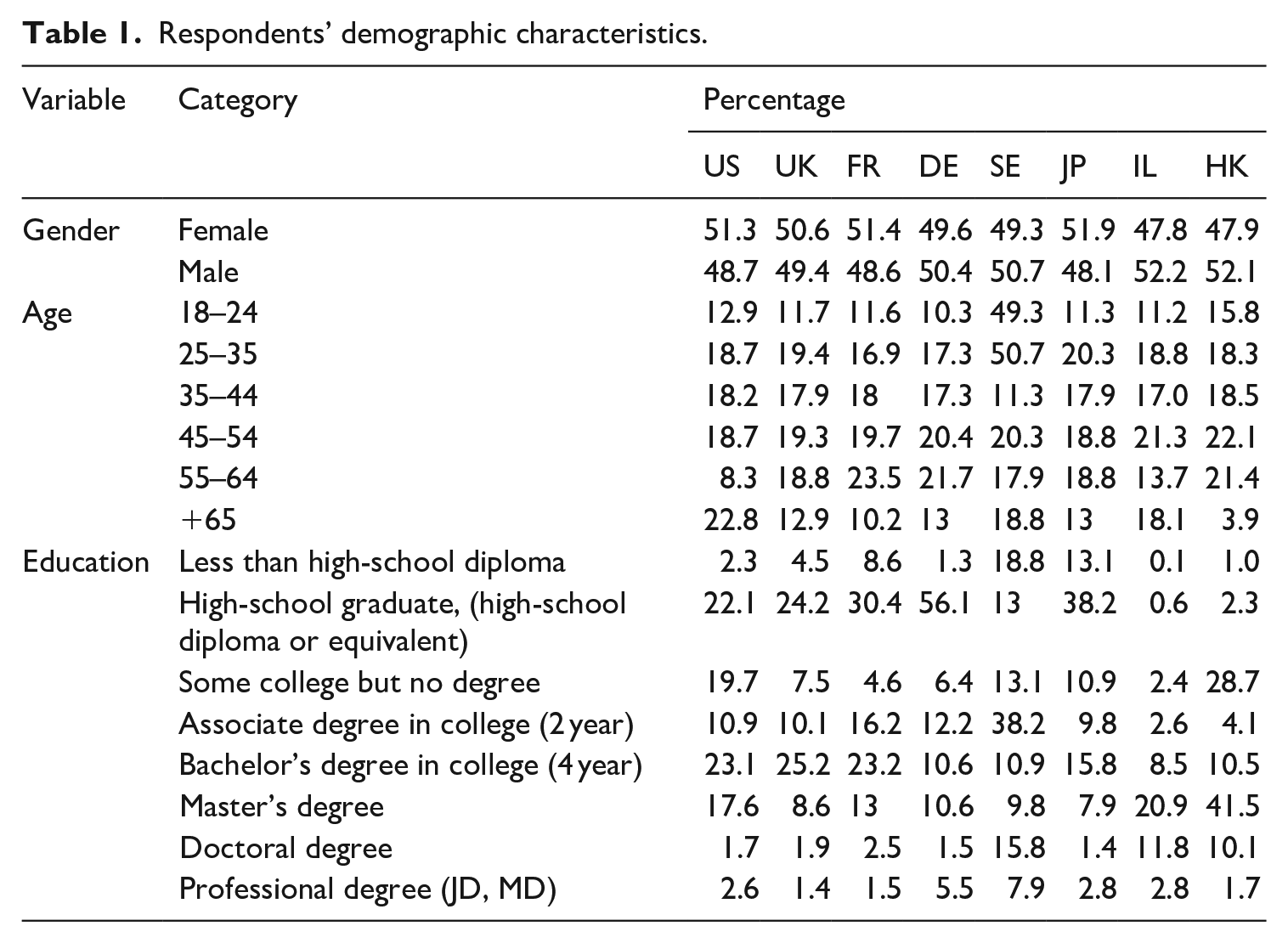
Of the 18,909 participants who started the survey, 11,905 completed it and passed quality control. 4 Demographic information regarding all samples appears in Table 1.
Respondents’ demographic characteristics.
Procedure
In the survey, participants were first asked about their age, gender, and education levels to ensure demographic quotas. After that participants were presented with a list of six media platforms (as specified above) and ticked all platforms in which they had an active account, amounting to an average of 3.5 accounts per participant (SD = 1.5). Next, participants were asked about their news consumption, political interest, and political leaning, followed by questions about the social media platform(s) they had ticked in the preceding section. For each platform the items gauged perceived affordances, perceived network size, perceived network heterogeneity, social use, and news use. Thus, all these variables were measured at the platform level. The order of the platforms on the list and of the questions about them was randomized.
Measurements
News use
Respondents were explicitly instructed to address only their use of content originally created by news organizations and/or journalists; to facilitate the task, they were provided with country-specific examples of such content and organizations. For each platform, the scales comprised platform-specific items gauging the frequency of the various actions involving news (between 7 and 11 items depending on the platform), rated on a 1–5 scale (1 = Almost never to 5 = Almost all the time). Items referred to both receiving news (e.g. “receive news stories, articles, etc., directly from news organizations”/“receive news stories, articles, etc. directly from friends”/“read news headlines”/“read other users’ comments on news”) and disseminating it (e.g. “send a news story to a group”/“tag a news story”/“upload news video”). A detailed list of statements in relation to each platform, as well as the factor analysis, which supported a two-factor solution (dissemination and receiving), are provided in the Online Appendix (News dissemination: M = 2.1; SD = 1.0; News receiving: M = 2.4; SD = 1.0).
Perceived affordances
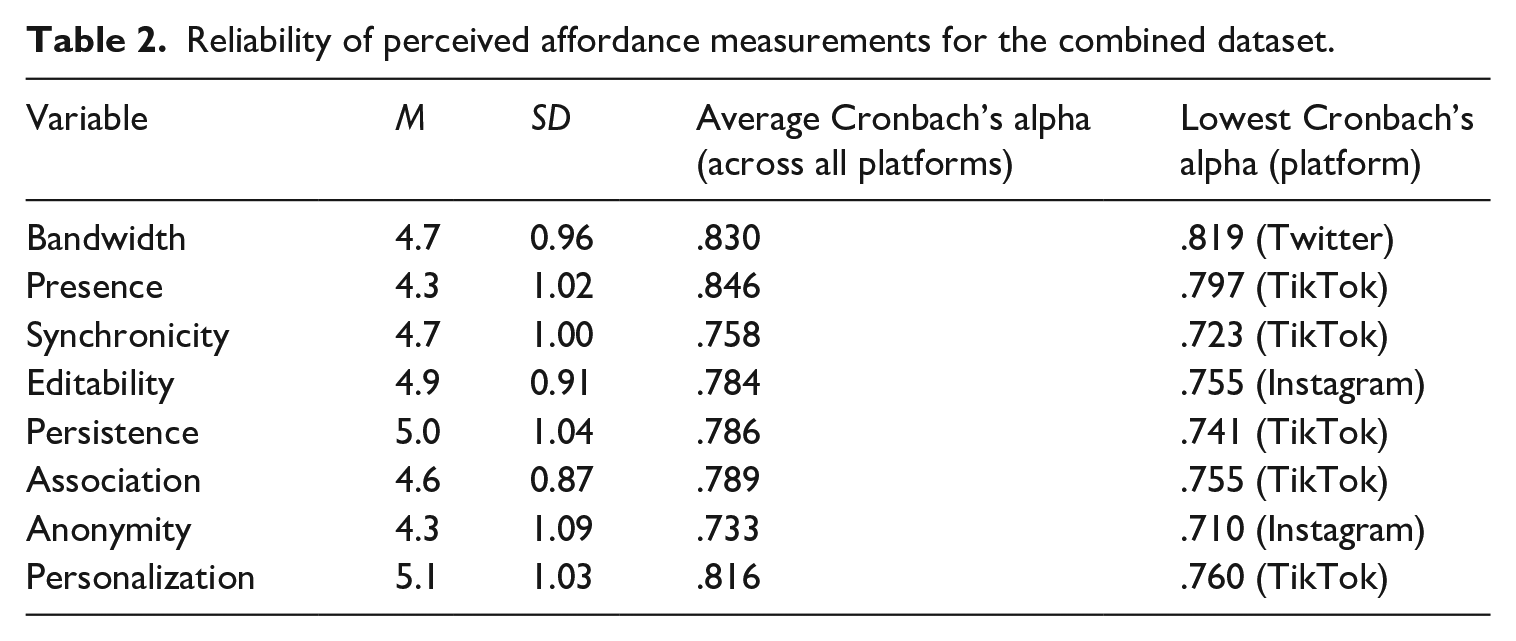
Respondents’ perceptions of affordances on each platform were measured based on a modified, condensed version of the first of the scales developed by Fox and McEwan (2017) comprising questions regarding bandwidth, presence, synchronicity, editability, persistence, association, anonymity, privacy, and personalization. 5 Affordances that did not figure in our hypotheses were included in the analysis as control variables. For each platform, each perceived affordance was measured by averaging responses, on a 7-point Likert-type scale (1 = Strongly disagree to 7 = Strongly agree), regarding 3–5 statements, such as “This channel allows me to convey emotion,” “This channel allows for instant communication,” and “I can retrieve past messages in this channel.” Reliability statistics for the measurement of each affordance are summarized in Table 2. In three cases, namely, anonymity, persistence, and synchronicity, reversed items dramatically lowered reliability and were not included in the final calculation of the scale, leaving two items per scale, with privacy gauged by only one item. 6 See the Online Appendix for a full list of the statements used to measure each affordance, and of those omitted.
Reliability of perceived affordance measurements for the combined dataset.
Control variables
Platform-level variables
Heterogeneity was measured using items adapted from Diehl et al. (2016): Each respondent was asked to estimate, on a 5-point scale (1 = Very similar to 5 = Very different), their belief that people with whom they interact on the platform are different from them in background (social, economic, ethnic, religious, etc.) and in political views. The average of these two estimates served as the platform’s heterogeneity rating (M = 3.01, SD = 0.98, Cronbach’s alpha = .744).
Network size
Platforms differ as to the nature and size of their social networks. For instance, while the ties on Facebook are mostly bidirectional (Friends), those on Twitter, Instagram, and TikTok are unidirectional (Followers/Follow). To neutralize the impact of these differences on the estimations, we standardized network size according to platform and country. For each platform participants were asked to estimate its network size using the terminology specific to the platform (Facebook: friends; Twitter, TikTok, Instagram, Link: follow; 7 YouTube: subscribed; WhatsApp: groups; Facebook messenger: Contacts).
Frequency of use was measured via one item for each platform: “How often do you check your XX account?” (for YouTube: How often do you watch YouTube videos?”). Answers were given on a 5-point scale ranging from Almost constantly to Less than once a week (M = 3.1; SD = 1.53).
Social uses scale included four items, regarding staying in touch with other users, sharing information about one’s life with other users, meeting people one wouldn’t meet otherwise, and diversion (reading funny posts, playing games, etc.). The phrasing of these items was also platform-specific (see Online Appendix). Answers ranged from 1 = Almost never to 7 = Almost all the time (M = 3.4; SD = 1.3; average across platforms: Cronbach’s alpha = .767, lowest score YouTube: Cronbach’s alpha = .716).
Individual-level variables
In addition to measuring respondents’ news use on the various platforms, we also gauged their news consumption on other channels (television, radio, and newspaper or website), by asking them to rate, on a 6-point scale (1 = Never to 6 = Every day or almost every day), the frequency of their exposure to the most popular news media outlets in their country (between 20 and 24 outlets), based on the Reuters Digital News Report (Newman et al., 2021). The full list is available in the Online Appendix (M = 2.6, SD = 0.94). We also asked participants to rank the following channels according to their subjective importance as a news source: face to face conversations with family and friends, news posted on social media by family and friends, news posted on social media by news organizations, TV, radio, news websites, and print media.
We also measured political leaning and political interest. As people living in different countries might have different conceptions of the political axis and politically charged issues, we measured respondents’ political leaning by asking them to place themselves on a 7-point liberal–conservative scale (1 = Liberal/Left, 7 = Conservative/Right; M = 4.2, SD = 1.61). Political interest was determined by averaging subjects’ responses to five 1–5 Likert-type scale questions (1 = Not at all to 5 = Very much so) regarding their feeling that (a) political issues are important to them, (b) they are confident about their political opinions, (c) they are politically knowledgeable, (d) they maintain their political opinions over time, and (e) they are interested in politics (M = 3.4, SD = 0.96, Cronbach’s alpha = .847).
Statistical analysis
The structure of our data is multilevel in two ways: first, participants are nested within countries; and second, since participants answered questions about all platforms they use, we ended up with repeated observations for each participant (within-subject analysis), such that platforms are nested within participants. Given this data structure, all analyses were multilevel regressions with random intercepts by participant and country.
Results
Before turning our attention to the testing of the study’s hypotheses, we take advantage of this rich dataset to probe the role of social media platforms in news consumption. Although social media has been argued to play a prominent role in disseminating news (e.g. Choi, 2016a; Costera Meijer and Groot Kormelink, 2015), our findings align with studies showing that users still set greater store by more traditional channels (Nielsen and Schroder, 2014; Vermeer et al., 2020). Figure 1 presents the perceived importance of each channel. In all countries, TV was ranked first, followed by news websites (with a negligible gap in Israel and Hong Kong). In half of the countries in our sample, social media came last, or nearly so, falling behind TV and news websites not only in perceived importance but also in the frequency of use (see Figure 2). In most countries, the percentage of respondents who reported never using TV or websites for news was low, while nearly 20% in each country reported not receiving news via social media platforms. This overall pattern, however, is punctuated by noticeable differences between countries. In the United States and France, a similar percentage reported not getting news via websites and social media, while the differences in Israel, Hong Kong, and Japan are relatively large. It should also be noted that the Japanese sample stands out, compared with other countries, on account of very low news consumption.
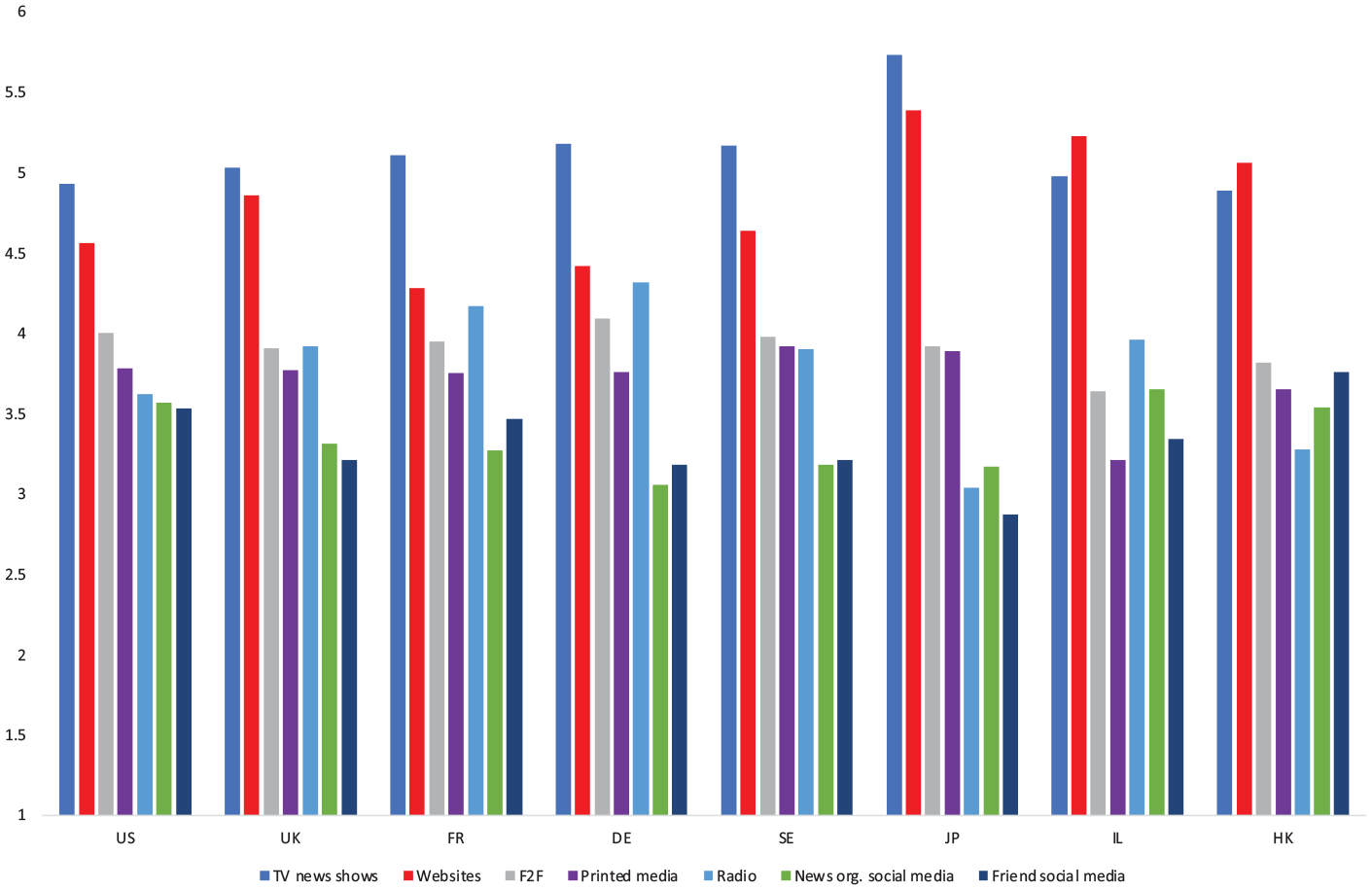
Mean importance of news channels according to country.
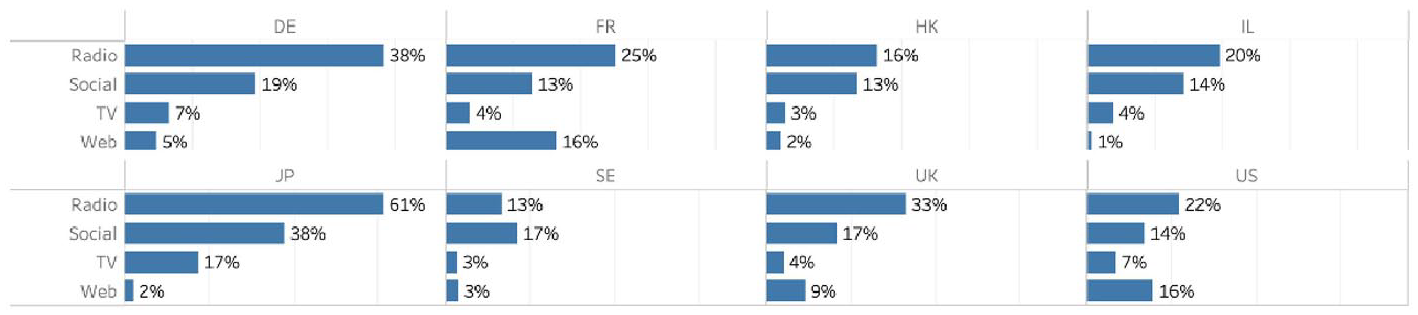
Share of participants (%) who reported never using a channel to receive news by country.
Finally, Figure 3 demonstrates differences in receiving and disseminating news across countries and platforms. Messaging apps were used less frequently for news than Facebook, Twitter, or even TikTok. TikTok emerged as an especially dominant platform for news dissemination in all countries but Israel. However, this finding should be considered against its smaller market size (reflected in the number of participants in the sample who have an active account on a respective platform). The differences that emerged in the use of the different platforms for news consumption suggest a variance that could be explained by users’ perceptions of these platforms’ affordances.
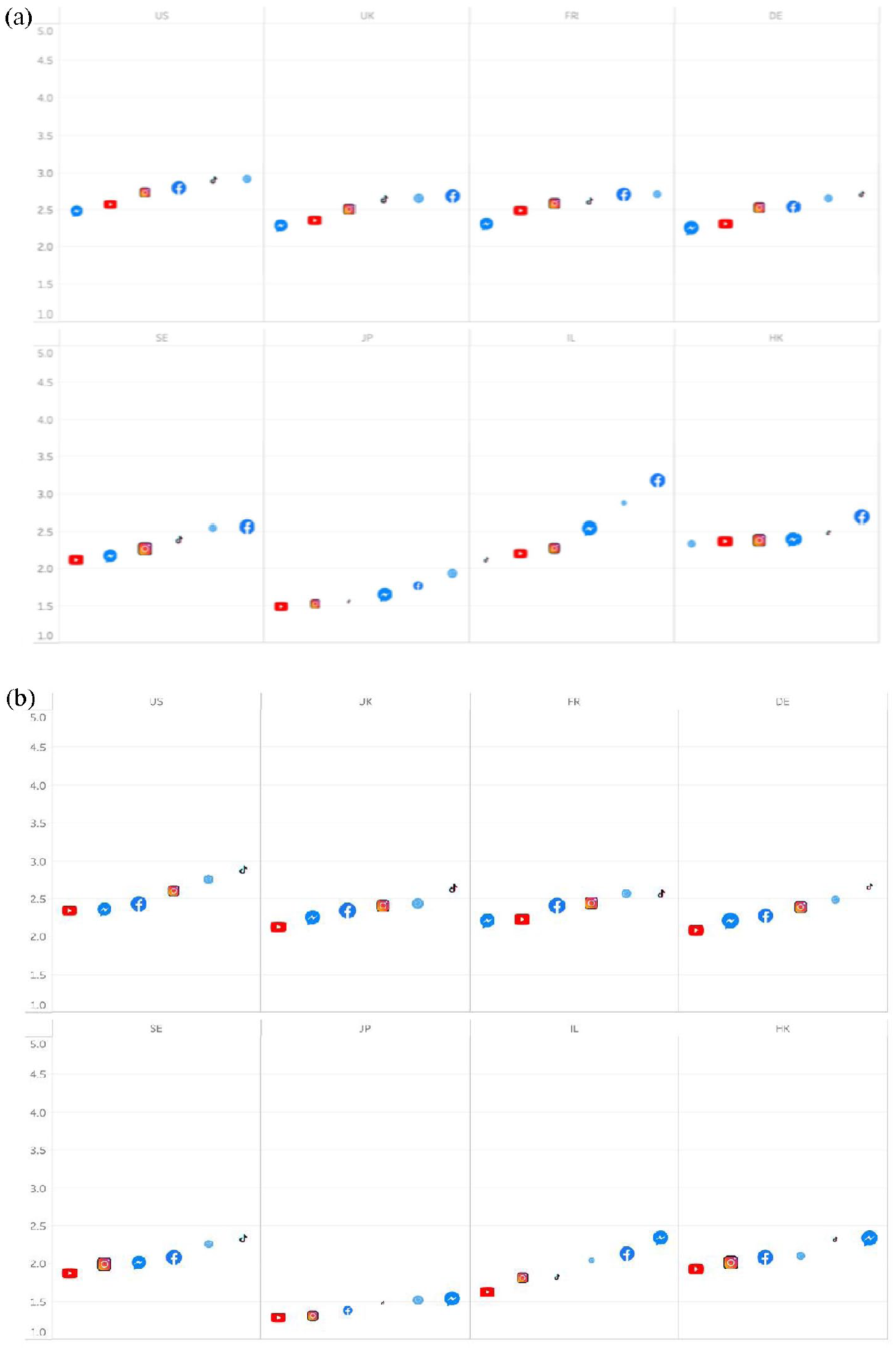
(a) News dissemination according to platform and country. Marker size indicates the number of participants who reported having an active account in each of the platforms. (b) News receiving according to platform and country. Marker size indicates the number of participants who reported having an active account in each of the platforms.
Predicting the extent of receiving and disseminating news
We tested our hypotheses by means of multilevel modeling (MLM) regressions, with news and dissemination as dependent variables. Country and participants’ ID number were second-level variables (ICC news receiving was 9% and news dissemination 10%), and perceived affordances (measured at the platform level as described above) were first-level independent variables. For each participant, we controlled for demographics, political interest, and news consumption; and for each platform, for the size and perceived heterogeneity of its network, as well as for the frequency of its use for news and for social purposes. To address differences among platforms that are not captured by these variables, we also controlled for the name of the platforms being evaluated (i.e. Facebook/Instagram, etc.).
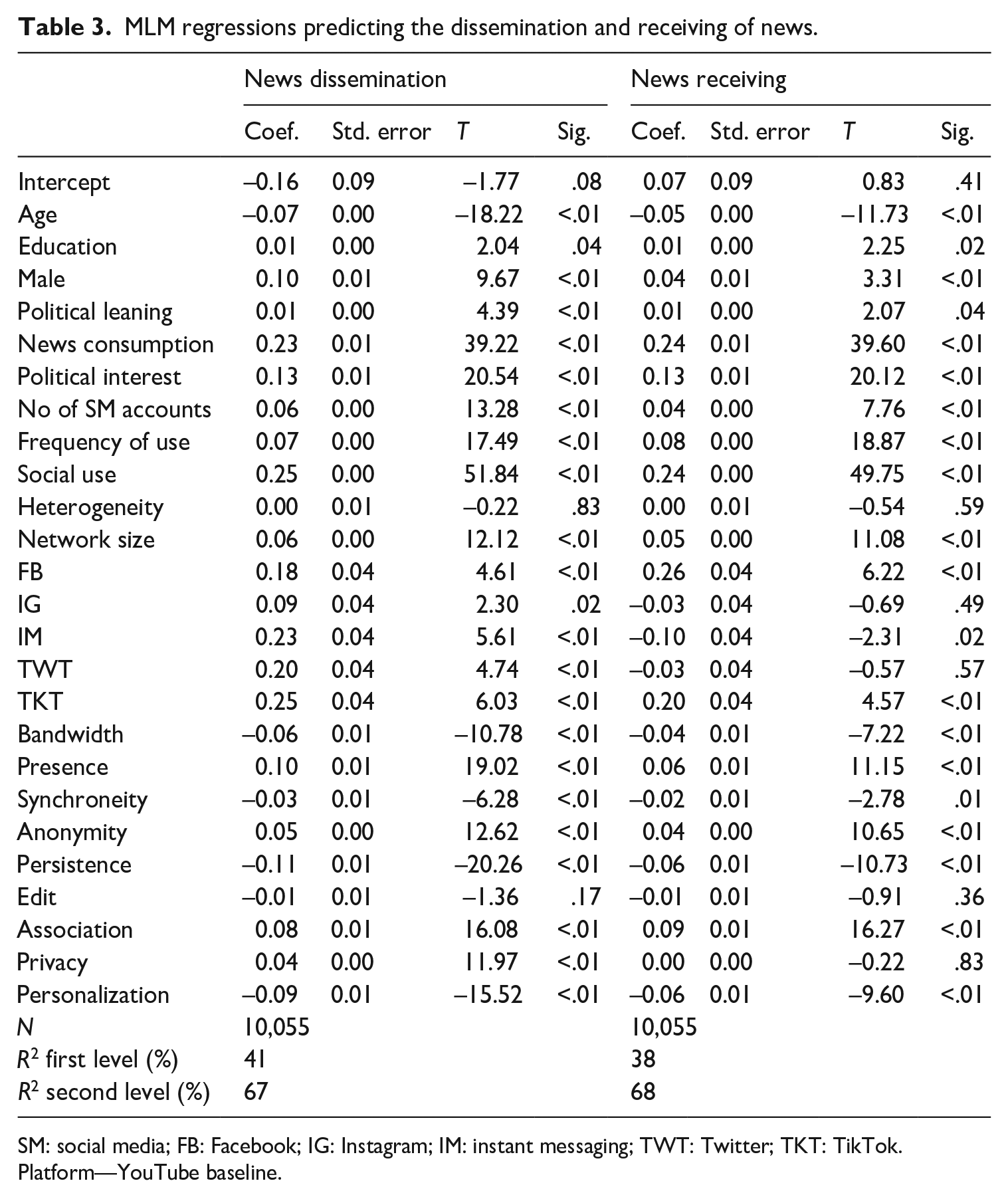
The results of the models are presented in Table 3. As concerns dissemination, H1 predicts that this practice will be positively associated with anonymity, and negatively with content persistence. Both these hypotheses were supported: Participants were more likely to disseminate news when they felt this behavior to entail less of a risk, either because the content would not endure for long or due to anonymity. In this connection, the effect of privacy would likely prove salient as well, but this factor was not directly addressed in the study’s hypotheses. In our analyses, privacy had a positive effect on dissemination (but not on receiving), consistent with our other hypotheses, as it augments the user’s control and thereby lowers risk from disseminating news.
MLM regressions predicting the dissemination and receiving of news.
SM: social media; FB: Facebook; IG: Instagram; IM: instant messaging; TWT: Twitter; TKT: TikTok.
Platform—YouTube baseline.
Our assumption regarding personalization (H4), however, was not supported: The predicted association did not emerge between this variable and news dissemination. Quite to the contrary, the impression that a platform offered personalized, tailored content decreased respondents’ tendency to disseminate news. In contrast, our assumption that perceived association would be positively related with news dissemination (H5) was borne out.
As for receiving news, counter to expectations, this practice was negatively related with perceived content persistence (H3). However, it was positively related with perceived association, thus aligning with H6: having a wider network to rely on increased social media use for news purposes. As concerns RQ1, which addressed the relation between perceived personalization and receiving news, the relationship emerged as negative, as in the case of news dissemination: Users prefer to receive news where content curation is less obtrusive.
A number of other findings warrant a brief discussion. According to Figure 4, which presents the size of the effects obtained, in addition to the perceived affordances targeted by our hypotheses, perceived presence likewise emerged as a key affordance that shapes both the receiving and dissemination of news. In both cases, presence increases news use. Furthermore, the figure reveals a similar pattern of results regarding all affordances for both receiving and disseminating news. On the whole, with the exception of privacy, perceived affordances seem to have shaped both these tendencies in a similar way, although in most cases, the effect on dissemination was stronger.
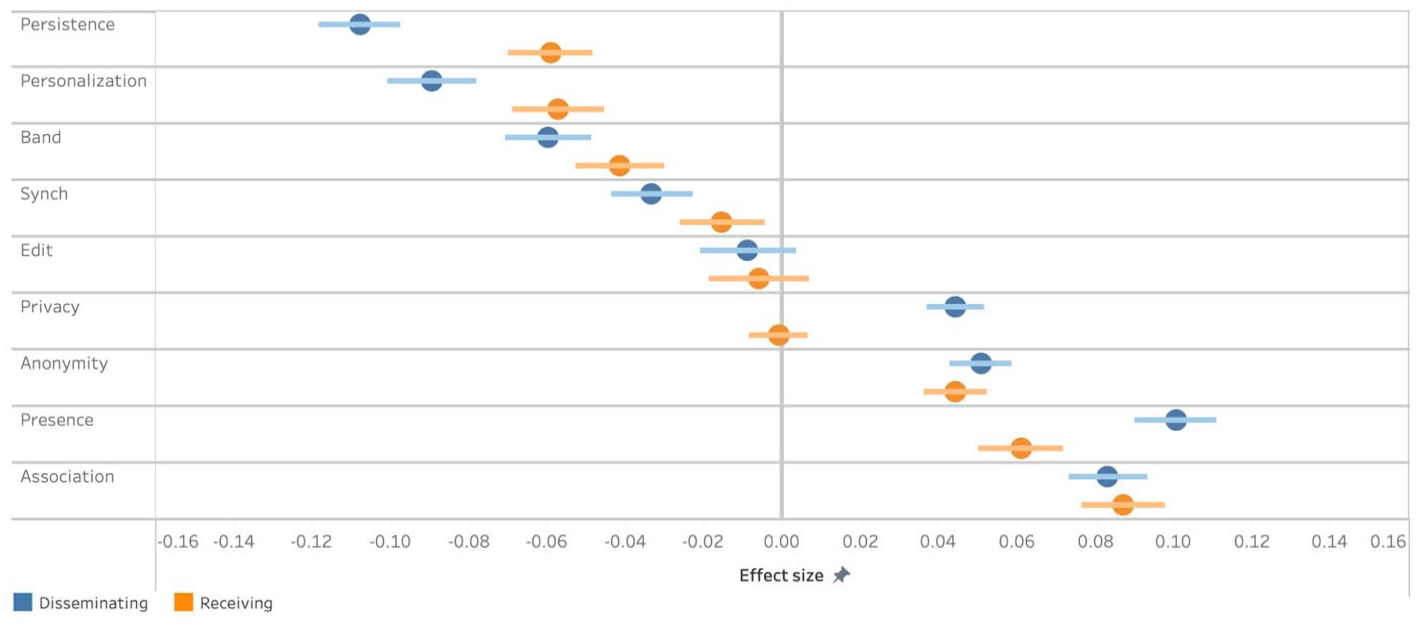
Effect size.
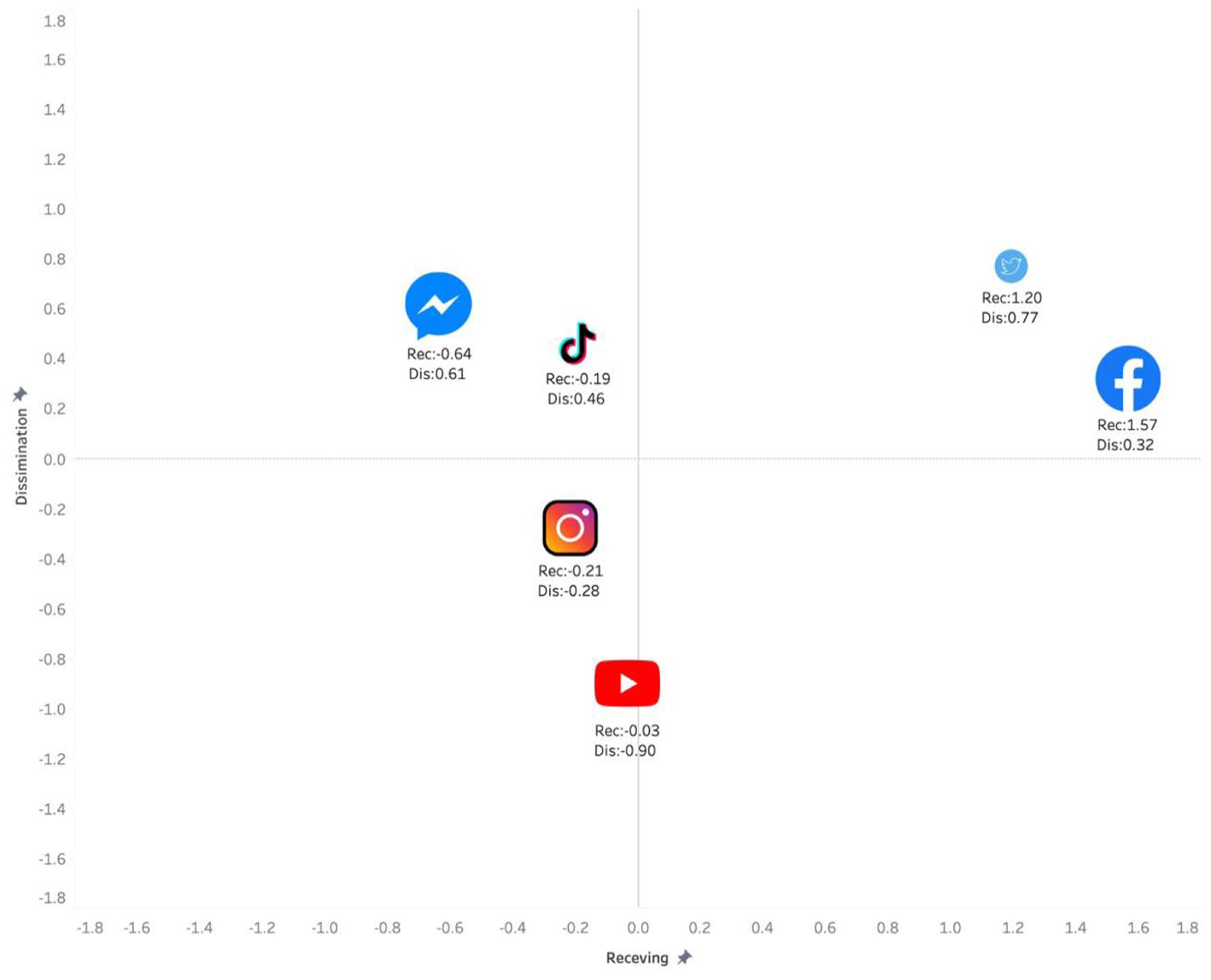
Another noteworthy point is that, even after accounting for nine perceived affordances (of the 10 listed by Fox and McEwan, 2017), noticeable differences are observed between the six platforms. Figure 5 shows the average use of each platform for disseminating and receiving news, after controlling for the effects of all IVs included in the model. In the figure, platforms are arranged in three clusters. The first comprises platforms that are used for news; of these, Facebook is by far the most popular platform for receiving news, while Twitter for both receiving and disseminating it. The second cluster contains platforms used primarily for disseminating news: TikTok and messaging apps. The third cluster are platforms whose use is, by and large, not related to news: YouTube and Instagram (significance tests are also summarized in Figure 5). This pattern indicates that the current analysis does not account for many factors at the platform level that may influence news use.
Significance of differences in news engagement across platforms.
Finally, while platforms do play a role in shaping news use, we cannot underestimate the importance of personal factors. Age, political interest, and news consumption via traditional channels are all well-known predictors of news use, and are powerful in the current analysis as well, as is also gender in terms of news dissemination. Another strong predictor, even after controlling for frequency of use, is utilizing platforms for social gains—possibly indicating that users do not allocate different platforms for specialized purposes.
Variance across countries
As already stated, the strength of the current study lies in its dataset, which allows comparison on two planes: across platforms and across countries. We tested the robustness of our findings to cultural differences by repeating the analyses elaborated above separately for each country. As can be seen in Table 4, the pattern of results that emerged for all Western countries is identical to the one reported above, except for one case: in the United States, personalization had no effect on receiving news. However, in both Japan and Hong Kong, many effects are null.
Summary of hypotheses’ testing according to country.
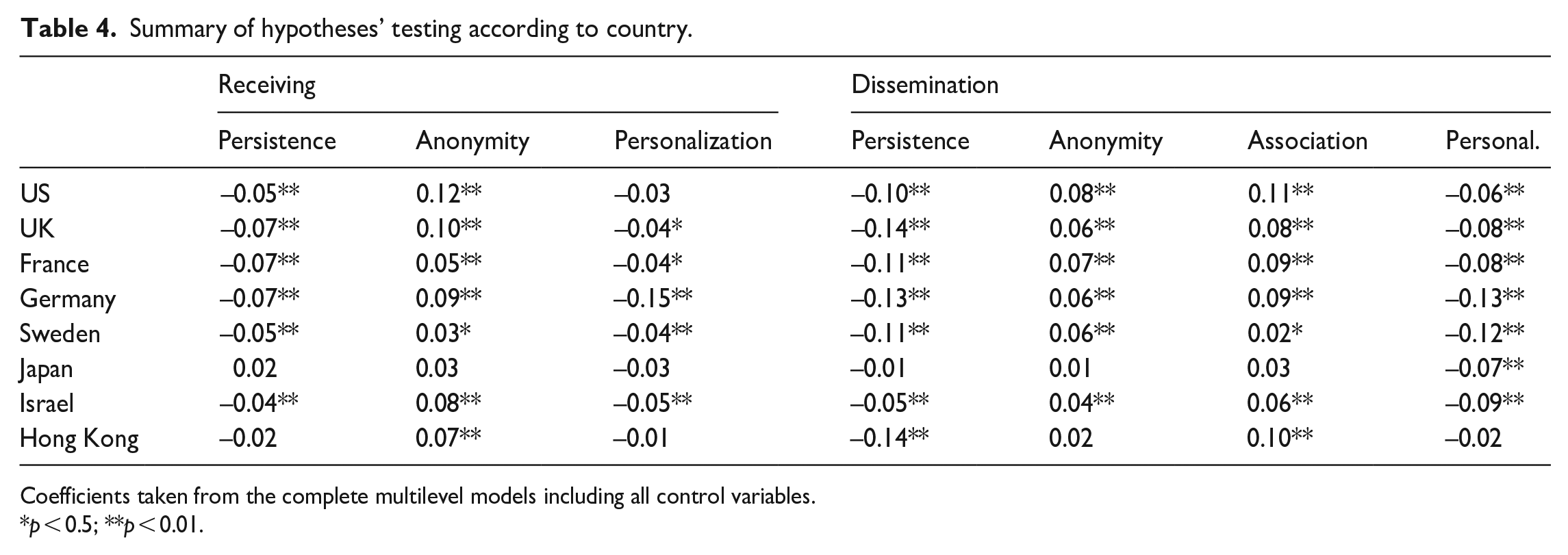
Coefficients taken from the complete multilevel models including all control variables.
p < 0.5; **p < 0.01.
Discussion
In a bidimensional comparative approach, across platforms and across countries, the current study has explored how users’ perceptions of social media affordances impact their news use on the platforms targeted. Our analyses attest to a substantive influence of perceived affordances in this regard: We have accounted for 9 out of the 10 affordances listed by Fox and McEwan (2017), all but one of which (editing) proved strong predictors of news dissemination, and all but two (editing, privacy)—of receiving news. Thus, this study corroborates past theorization that users’ perceptions of technological affordances are vital for shaping their online behavior. As we further discuss below, we have also established the relative importance of the affordances investigated in the mind’s eye of respondents, thus gaining insight into how the use of online news may be sustained. The following discussion of our results amply illustrates the benefits of understanding what users look for in social media platforms they employ for news purposes—for such knowledge sheds light on the meaning they attach to news use: on their goals and motivations, and on how technology could help them achieve their objectives. It is important to acknowledge at this juncture that the discussion of our hypotheses below is mostly salient to Western users (Costa, 2018). We will revisit the issue of cultural differences in what follows.
News use on social media is a social practice
We found that news dissemination depends on users’ perceptions regarding a platform’s content persistence, anonymity, and privacy. It appears, therefore, that users may see public involvement with news as a performative act fraught with risks (Costera Meijer and Groot Kormelink, 2020), which they are looking to diminish by minimizing their own visibility (Costera Meijer and Groot Kormelink, 2020; Duffy and Ling, 2020). This conclusion implies that news use on social media is very much a social practice. Furthermore, while users did receive and disseminate news when the platform interface signaled the presence of other users, they viewed this circumstance as bearing both benefits and risks that had to be taken into account and managed (Duffy and Ling, 2020; Picone et al., 2016). Thus, users seem to believe that mastering social media affordances is one way to ensure that their social needs will be adequately met and channeled appropriately.
The effect of personalization on news use operated in the direction opposite to the one we anticipated: the association emerged as negative. In terms of receiving news, this finding dovetails with the ambivalent outcomes of past research (Groot Kormelink and Costera Meijer, 2014; Lee et al., 2019; Lou et al., 2021; Masip et al., 2021). In our study, this dichotomy was accentuated even further, as participants ranked instant messaging apps relatively low as channels for receiving news, whereas interviews and focus groups in past research had assigned them high value due to the personalized content they afford (Lou et al., 2021; Masip et al., 2021). The negative association between personalization and news use revealed in our study can be explained based on work on selective exposure, and specifically on the argument that, although news consumers prefer like-minded information, they do not actively steer away from disagreeable content (Garrett, 2009). News diversity is considered normatively desirable, and consumers may not set great store by curation and tailored news content, especially in the context of the ongoing public debate regarding the role of algorithmic curation and personalization in creating echo chambers and thus exacerbating rifts in society.
Even more surprising is our finding that perceived personalization decreased dissemination of news on social media, as according to past research in this area (Thürmel et al., 2021), which is very sparse indeed, perceived personalization is conducive to dissemination. One possible explanation for the negative relation we obtained between personalization and news dissemination behavior could be that social personalization—controlling and sending messages to specific users—is perceived as restrictive of news dissemination. Admittedly, personalization limits the risk of a backlash when an unexpected audience is exposed to the content shared. However, it also narrows the size of the audience your message can reach. Given the dominance of social media in our world, this issue warrants further research.
Is news use on social media a separate form of news consumption?
Our analyses have revealed both similarities and differences between patterns of news use on social media and on other platforms.
In contrast to other, more traditional platforms, on social media we found a negative relation between receiving news and content persistence. This finding could perhaps be explained by the distinctive way news is received on social media: more through pushing than pulling (Dvir-Gvirsman, 2022; Wojcieszak et al., 2022). Although content on social media is searchable (Bucher and Helmond, 2017), when it comes to news, research has demonstrated that most users are passive and rely on what is presented to them in their feed. It should also be noted that the scale we employed here to measure the receiving of news, while constructed in accordance with other scales used in studies on news consumption, did not tap news searching behaviors (e.g. Choi, 2016b; Costera Meijer and Groot Kormelink, 2015; Weeks and Lane, 2020). It could be that the negative association we found between content persistence and the receiving of news can be attributed, in part, to the absence of news searching behavior from our scale. At the same time, the omission of items tapping news searching from most scales for measuring the receiving of news on social media, in and of itself, validates the above outcome: researchers do not appear to regard searching as part of the arsenal of news gathering behaviors on these platforms. The negative, rather than an expected positive, association between the receiving of news and content persistence may also be a derivative of the overall pattern revealed in the analysis, whereby perceived affordances have a similar impact on both news dissemination and receiving. Other conjectures about this finding are offered below.
Demonstrating similarities across platforms is our finding that individual characteristics have proved to be strong predictors of news receiving and dissemination. To the extent that online behavior derives from an interaction between users and platforms’ features (Park et al., 2021), our findings allude to the greater importance of the former factor. Older males, with stronger interest in politics are the key demographics for news, marking news use on social media as a behavior not dramatically different from other forms of news consumption.
Two additional findings that help understand the workings behind news use on social media are that (a) perceived affordances have a similar effect on disseminating and receiving news and (b) social use is strongly predictive of news use. Taken together, these findings may be interpreted in two ways. The first is that users do not assign much weight to selecting a particular platform over another. On this interpretation, the first finding indicates that users appreciate a platform’s features irrespective of their immediate objective, while the second—that they tend to choose a certain platform for multiple purposes and stick to it. One would expect a truly sophisticated user to swing platforms in search of features optimal for the task at hand (Tandoc et al., 2019). The second interpretation would suggest that the two aspects of news use (dissemination and receiving) are tied together, and users do not necessarily discriminate between them—hence the first finding. The stronger effect obtained across the board for disseminating news can be accounted for by the arguably greater social weight of this behavior. Such an angle on news use creates a picture of a continuum: For news to be shared, it first needs to be circulated and received; and given the social quiddity of news use on social media, social uses may serve as the scaffolding for news circulation. Therefore, social use and news use are essentially intertwined.
Cross-country differences
The value of comparative approach when studying perceived affordances must be underscored yet again. Our analyses yielded identical patterns of news use on social media platforms in all the countries studied except for Japan and Hong Kong. Japanese users were also dramatically different in their news consumption. Costa (2018) aptly notes that “the concept of affordance has often been used to describe situated patterns of usage within particular Anglo-American social contexts, as if they were stable properties of a platform.” Yet cultures differ in the meaning they assign to the concepts of privacy, anonymity, or network association. Even the social meaning of news use could vary among cultures. As such, no sweeping generalizations are feasible about the ways in which affordances are perceived and constructed, or about their importance to users and influence over their online behavior.
This study is not without limitations, five of which need to be considered. First, perceptions regarding affordances did not account for all differences we found in the use of platforms for news purposes. Even after controlling for all variables in the model, the analyses demonstrated that Facebook and Twitter were used the most frequently for all types of news use, and IM and TikTok for news dissemination, while neither Instagram nor YouTube were frequently used for news at all. Notably, the ranking of the platforms was different when we did not control for the variables specified in the model (compare Figures 3 and 6, for results after and before controlling for all variables, respectively). These disparities in ranking indicate that the cross-platform variance is a function of both users’ perceptions of affordances and their profiles. That is, differences in the frequency of using the different platforms for news purposes can be explained, in part, by the perceived characteristics of media environment (as measured by perceived affordances of a platform) and the identity of users (as measured by age, interest, etc.). However, as the substantive differences between platforms endure, users’ choices and preferences could be driven by factors other than affordances, including, for example, branding or imagined audience. In connection to the latter factor, our analysis controlled for the size and perceived heterogeneity of a network, but other characteristics may come into play such as the level of hostility (authors) or the extent of use. Likewise, the news content users are exposed to could differ dramatically across platforms, both in form (as in the case of TikTok) and in type.
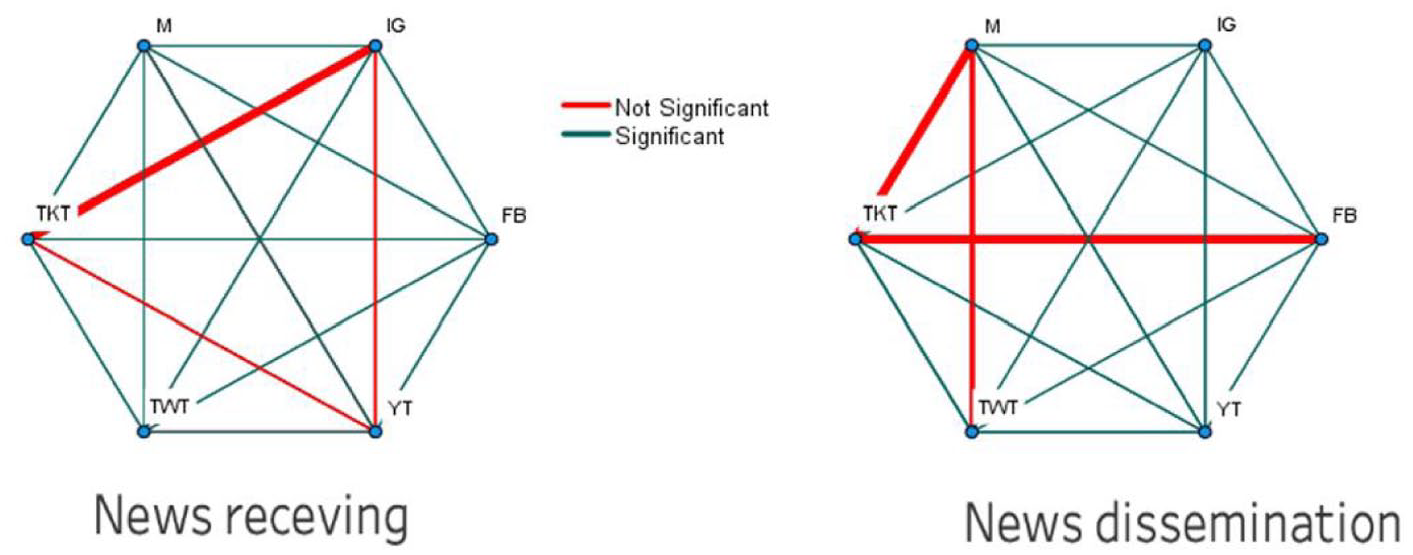
News receiving (horizontal axis), and dissemination (vertical axis), across platforms.
A second limitation of this study concerns the samples employed: these are not representative, as online panels are known to be more biased than alternative recruitment strategies. A third, and related, limitation is that, in some cases we found low reliability when introducing reversed items to the perceived affordances scales. To come up with a survey of a reasonable length, we had to shorten the original scales, substantially abbreviating four of our nine affordances’ scales. Fourth, for news use indices, we relied on self-reports rather than actual behavior. Such reports could be biased if, for instance, users cannot accurately remember in which platform they have seen a specific news post. They will likely report their general tendencies and preferences. Finally, as already mentioned, our data did not discriminate between the types of news content users are exposed to in their platforms of choice. A more nuanced analysis is left for future research.
Supplemental Material
sj-docx-1-nms-10.1177_14614448231154432 – Supplemental material for Unpacking news engagement through the perceived affordances of social media: A cross-platform, cross-country approach
Supplemental material, sj-docx-1-nms-10.1177_14614448231154432 for Unpacking news engagement through the perceived affordances of social media: A cross-platform, cross-country approach by Shira Dvir-Gvirsman, Daniel Sude and Guy Raisman in New Media & Society
Footnotes
Funding
The author(s) disclosed receipt of the following financial support for the research, authorship, and/or publication of this article: The authors received funding support from European Research Council starting grant #680009.

Supplemental material
Supplemental material for this article is available online.
Notes
Author biographies
References
Supplementary Material
Please find the following supplemental material available below.
For Open Access articles published under a Creative Commons License, all supplemental material carries the same license as the article it is associated with.
For non-Open Access articles published, all supplemental material carries a non-exclusive license, and permission requests for re-use of supplemental material or any part of supplemental material shall be sent directly to the copyright owner as specified in the copyright notice associated with the article.
