




Abstract
Given that terrorism is omnipresent on social media, it is imperative to study how seeing terror content online is related to individuals’ attitudes, behaviors, and emotions. This study investigates how exposure to terrorism on social media associates with terror-related online self-disclosure and how self-disclosure, in turn, relates to fear of terrorism. A quota-based survey of young social media users (16- to 25-year-olds; N = 864) in Germany revealed that exposure to Islamist and far-right terrorism is related to higher online self-disclosure. Political ideology moderated the relationship between exposure to far-right terrorism and online self-disclosure, but not when exposed to Islamist terrorism. Attitudinal differentiation was negatively associated with self-disclosure. Additionally, we found an interaction effect of exposure to Islamist terrorism and attitudinal differentiation on self-disclosure. Finally, the results showed that online self-disclosure was positively related to fear of terrorism. By and large, our findings highlight the relevance of social media for the levels of fear.
The so-called Islamic State hijacked World Cup tournament hashtags, such as #Brazil2014 and #WC2014 to spread their message (Milmo, 2014). The far-right terrorist who killed 50 people in Christchurch, New Zealand, filmed and live-streamed the act directly to Facebook (Wakefield, 2019). After the terrorist attack at the Brussels Airport, individuals around the world disclosed their emotions on social media (Kwon et al., 2017). Such pattern is by no means unique to the Brussels terrorist act, but is common practice, as individuals tend to discuss terrorism events on social media (Kwon et al., 2017). Social media, defined as web applications “that allow the creation and exchange of User Generated Content” (Kaplan and Haenlein, 2010: 60), have become a central avenue for various terror content, be it extremist content, posts by peers from one’s social network, firsthand videos, or terror-related memes (Downing, 2021; Ferrara, 2015; Kwon et al., 2017). Social media platforms have often been brought into connection with potential terrorist mobilization, but these platforms also serve as a space for the general public to share terror-related information and disclose feelings (Eriksson, 2016; Eriksson Krutrök and Lindgren, 2018; Kaufmann, 2015; Mirbabaie et al., 2020). The focus of the present article is mainly on the latter. More precisely, how young social media users, as an audience of terrorism content, encounter terror posts, self-disclose their feelings related to the topic, and how such self-disclosure relates to fear of terrorism. Self-disclosure can be defined as “the process of revealing personal, intimate information about oneself to others” (Brunell, 2007: 810) and online self-disclosure is at the heart of social media users’ activities, especially as a response to stressful events (e.g. Zhang, 2017). Therefore, it is crucial to study the concept in relation to terrorism within a digital context. In this study, self-disclosure refers to, based on previous research (Karsay et al., 2019), the extent to which individuals typically share terrorism-related personal feelings as well as their worries and fears. Since young adults out of all age groups spend most time on social media in Germany, where the present study was conducted (Beisch and Schäfer, 2020), in the whole European Union (EU) (European Parliament, 2022) as well as, for instance, in the United States (Pew Research Center, 2021) and encounter Islamist and far-right terrorism there, this can be related to various attitudinal, behavioral, and emotional outcomes.
Although the chances of becoming a direct victim of a terror attack are extremely low, terrorism is a prevalent concern among EU citizens (De Roy van Zuijdewijn and Sciarone, 2021; European Commission, 2021). Especially in youth, exposure to terrorism content contributes to feelings of threat and insecurity, due to the possibility rather than probability of being a victim of terrorism (Comer and Kendall, 2007). Previous research has shown that emotions, such as fear, are frequent reactions to terrorism (Matthes et al., 2019; Von Sikorski et al., 2017). Furthermore, following social media with regard to violent crime was found to be linked to higher fear of violence compared to following traditional media (Näsi et al., 2021). Moreover, younger individuals in general showed more fear of violence compared to older ones (Näsi et al., 2021). Against this background, it is particularly important to study the mechanisms that are related to young adults’ engagement with terror on social media, in terms of emotional online self-disclosure, and how this relates to fear of terrorism.
In addition to seeing terrorism on social media, individuals also self-disclose their feelings and emotions about the topic. Thus, young individuals’ terror-related online self-disclosure may play an important role in explaining the association between exposure to terrorism on social media and fear of terror. Individuals who are exposed to terrorism on social media may have a need to disclose their emotions, because terrorism can be considered a negative and distressing event. Generally speaking, in times of stress, individuals tend to disclose online more (Zhang, 2017). The aim of such action is to elicit support from one’s social network that can work as a coping mechanism (Stiles, 1987). However, exposure to terrorism on social media may not always result in self-disclosure, but this relationship may be moderated by other factors, namely, political ideology and attitudinal differentiation. Political ideology, conceptualized as a broad belief system (Burke et al., 2013), is a key concept in explaining cognitive, emotional, and behavioral reactions to current events and public discourses. Depending on whether exposed to Islamist or far-right terrorism, political ideology as a predisposition, that is, self-positioning on a scale from “left” to “right,” may be involved in shaping responses. We extend previous literature by treating political ideology not merely as a control variable but by investigating how and to what degree it is associated with modulating terror-related emotional self-disclosure. Given the political nature of terrorism, this adds significantly to the existing literature. Attitudinal differentiation, that is, the extent to which individuals perceive the difference between ordinary Muslims and Islamist terrorists, may play a role in moderating the relationship between exposure to Islamist terrorism and self-disclosure. First, an overlap between the group of general Muslim population and Islamist terrorists, who misuse Islam to justify their acts of violence, is often present in the media (Matthes et al., 2020; Von Sikorski et al., 2022). Second, undifferentiation in the media is related to negative attitudes toward Muslims (Von Sikorski et al., 2017, 2021), likely because the negative affect connected to the Islamist terrorists is transferred to Muslims as a whole due to the outgroup homogeneity effect (Park and Rothbart, 1982; Tajfel and Turner, 1986). This study takes an innovative approach by extending the concept of attitudinal differentiation and introducing it to general associations with exposure to terrorism and online self-disclosure. Especially in the face of content related to Islamist terrorism, it is crucial to study the role of individuals’ perceived differentiation between the two groups.
With an aim to shed light on these relationships and to fill research gaps, we conducted a quota-based cross-sectional survey with young social media users (16- to 25-year-olds) in Germany. First, most research to date has focused on terrorism news exposure (e.g. Von Sikorski et al., 2021). Since the role of social media for terrorism content has increased and social media reactions toward terrorist events have growing societal relevance, it is crucial to account for the hybridity of media events (Sumiala and Valaskivi, 2018) and to study associations related to exposure to such content online. Previous studies on social media and terrorism have used digital media ethnographical approach or network analysis looking into the content of communication, such as hashtags or tweets, to increase discursive understandings of terrorist attacks (Eriksson, 2016, 2018; Eriksson Krutrök and Lindgren, 2018; Stieglitz et al., 2018; Sumiala et al., 2019). This is a crucial, but different line of research. Prior research has called for a psychological perspective of social media communication in the context of terrorism, particularly, in terms of individuals’ sharing of emotions and feelings (Stieglitz et al., 2018). A psychological approach is important when focusing on the micro-level, the individual processes. Studying this is especially relevant among young adults, who spend more time on social media (Pew Research Center, 2021) and may be particularly susceptible to and distressed by this content (Hatton and Nielsen, 2016). Research has shown that exposure to media coverage of proximal and distal terror attacks relates to postattack posttraumatic stress disorder symptoms in youth (Comer and Kendall, 2007). Furthermore, the prominence of social media and the decreasing importance of traditional media is especially apparent in young individuals (Ohme, 2019). Social media thus play the most relevant role as sources of information for many adolescents and young adults (Ohme, 2019). Hence, young individuals’ reactions to terrorism on social media and behaviors are important to understand. Second, research on terrorism has largely focused on Islamist terrorism, underemphasizing far-right terrorism (Schuurman, 2019). Taking into account the role of Islamist violence as a major part of international terrorism (Egger and Magni-Berton, 2021) and the increased frequency as well as intensity of far-right terrorism (Institute for Economics & Peace, 2020), it is crucial to comprehensively study the mechanisms that are related to exposure to these types of terrorism. Third, research on online self-disclosure of sensitive topics in general (Moors and Webber, 2013) and of terrorism more particular is scarce. Prior research has focused on individuals’ responses to terrorism threat in terms of avoidance intentions, such as avoiding going to large-scale events or using public transportation, as a coping mechanism (Sloan et al., 2021). However, keeping in mind the relevance of (online) self-disclosure in coping with stressors (e.g. Zhang, 2017), it is important to study these relationships in the context of terrorism and especially among young individuals. Fourth, no research thus far has considered moderators of the relationship between exposure to terrorism on social media and online self-disclosure. Thus, we introduce political ideology and attitudinal differentiation as key moderators in this line of research.
Terrorism on social media and online self-disclosure
Terrorism as a term is elusive in nature and its definition varies in the literature. Nonetheless, scholars have proposed central components to define terrorist acts, which include (1) the use of violence, (2) the intentions to spread fear, and (3) the aim to affect individuals’ political attitudes and beliefs (Moghaddam and Marsella, 2004: 16). Terrorists’ goal is to achieve psychological effects that go beyond the immediate victims of attacks (Hoffman, 2018). To do so, terrorists utilize the mass mediated publicity and increasingly also social media platforms (Weimann, 1983, 2015). Thus, the “theater of terror”—staging attacks in a way that reaches big media audiences—may be reinforced by the rise of the Internet and social media (Weimann, 1983, 2015). Jenkins (2006) argues that terrorists want “a lot of people watching, not a lot of people dead” (p. 119), for which social media seem a particularly suitable space as they have a potential to reach wide audiences. From the theoretical perspective of research on cultural traumas, terrorist events may be understood as being traumatic for the society as a whole, which became evident, for example, in the aftermath of the 9/11 attacks (Alexander et al., 2004) and in later attacks where social media debates have played a larger role (e.g. Eriksson, 2016, 2018).
The focus of the present study is on Islamist terrorism and far-right terrorism for several reasons. The two terrorism types share similarities, and also differ on some aspects. Islamist terrorism, committed by, for example, perpetrators affiliated to or sympathizing with the so-called Islamic State, and the emergence of far-right terrorism in Western Europe and North America can be considered as most prominent terrorism threats (Institute for Economics & Peace, 2020). Islamist or jihadist terrorism can be defined as religiously inspired terrorism that exploits traditional Islamic concepts (Europol, 2020). Islamism refers to the assembly of political movements around the globe, out of which only “a tiny highly radical subset” commits acts of violence (Piazza, 2009: 64). Maher (2016) discusses jihadism with respect to political ideology, stating that jihadist beliefs can be seen as “similar to totalitarian strains of political thinking” (p. 26). International terrorism, defined as terrorism that involves the territory or citizens of more than one country (Moghaddam and Marsella, 2004), is mainly formed by Islamist violence (Egger and Magni-Berton, 2021). Far-right terrorism refers to violence used by far-right extremists with its basis grounded in supremacism or the idea of a certain group of people being superior to others (Europol, 2020). Recently, Western countries have witnessed an increase in the frequency and intensity of far-right terrorism (Institute for Economics & Peace, 2020). From the year 2014–2019, the incidents of far-right terror in the West have risen by 250% and during the same time period, the deaths have increased by 709% (Institute for Economics & Peace, 2020). However, during this time period, Islamist terrorist attacks in the West remained more lethal, resulting in 471 fatalities (Institute for Economics & Peace, 2020). Islamist terrorism typically receives more media attention, whereas far-right terrorism is underreported (Kearns et al., 2019). It can therefore be argued that Islamist terrorism is in the public’s attention more (Kearns et al., 2019), however, both types of terrorism can be considered relevant for individuals’ levels of fear. Moreover, scholars have called for studies that investigate far-right terrorism in addition to Islamist terrorism (Godefroidt, 2022; Schuurman, 2019). Therefore, it is relevant to comprehensively study these two types of terrorism.
Today, by far the most terrorist attacks are committed in conflict affected countries and war zones, for instance, in Afghanistan or the Sahel region (Institute for Economics & Peace, 2022). Still, Europe was shaken by a number of horrific terrorist attacks, including the 2015 Stade de France and Bataclan attacks in Paris, the 2016 Nice truck attack, the 2016 Brussels metro attack, or the 2020 Vienna attack—just to name selected attacks in countries neighboring Germany. In a recent Eurobarometer report, 82% of Germans stated that they feel like an EU citizen (European Commission, 2022). As such, terrorist attacks in neighboring EU countries may concern individuals in Germany and relate to threat perceptions. The year 2015 marked a stark increase in terrorism in Europe, perpetuated mostly by members of the Islamic State. Since the so-called Islamic State targeted Germany’s capital in 2016 in the horrific Berlin truck attack, terrorism was among the most pressing concerns of German citizens in 2017 (European Commission, 2017). Other Islamist terrorist attacks in Germany include the 2011 Frankfurt airport attack on US soldiers, the 2016 Ansbach and Würzburg attacks, or the 2020 knife attack in Dresden.
The global terrorism index (GTI) ranks 163 countries worldwide by taking property damage and terrorist incidents in the past 5 years in the country into account, as well as number of fatalities and injuries (Institute for Economics & Peace, 2022). A higher GTI indicates a higher terrorism index (i.e. more and/or more severe incidents). With a GTI score of 4.73 out of 10, Germany ranked place 33 in 2021, after the United States on rank 28 (4.96) and the United Kingdom on rank 31 (4.77), but before France on place 35 (4.56). No terrorism-attributed deaths were recorded in Germany in 2021, following 11 fatalities in 2020—one of the fatalities was attributed to Islamist terrorism and 10 attributed to a far-right perpetrator. In 2021, a total of three Islamist terrorist attacks were carried out in Europe, with two fatalities, and 40 politically motivated attacks were carried out in the West (Institute for Economics & Peace, 2022).
Nearly half of these politically motivated attacks (far-left and -right) were committed in Germany (Institute for Economics & Peace, 2022). Far-right extremist organizations have a long history in post-Second World War Germany and far-right terrorism can be broken down into four generations, beginning in the 1960s (Koehler, 2016). These organizations varied in size, formal structure, international connectedness, and time periods of activity. After Germany’s reunification in the beginning of the 1990s, outbursts of far-right violence spread throughout the country (e.g. Hoyerswerda, Rostock Lichtenhagen, Mölln). Given the heterogeneity of far-right organizations, classifying them as terrorist organizations in legal terms is often difficult, especially considering differences between German law and legislation of the EU (Zöller, 2014). Notably, the discovery of the National Socialist Underground (NSU) in 2011 changed the public discourse dynamic and increased pressure on the authorities. The NSU had killed 10 people over the course of 7 years. The trio committed bomb attacks, numerous robberies, and attempted murders, undetected by authorities. Other severe far-right attacks include the 2016 Munich shooting, the 2019 attack in Halle, and the 2020 murder of nine in Hanau. Other cases, for instance, the 2020 murder of German politician Walter Lübcke was related to far-right extremism but is not officially classified as a terrorist act. Horst Seehofer, former Minister of the Interior, Building and Community in Germany, recognizes far-right extremism and terrorism as one of the biggest threats to the free and democratic basic order (Bundesamt für Verfassungsschutz, 2021).
Nowadays, terrorist content is prominent on social media in manifold ways. Social media platforms prevail as a space for terrorists to interact with each other and their followers (Ferrara, 2017). Moreover, during and in the aftermath of terrorist events, social media play a role as a place for firsthand information, sharing eye-witness content, and disclosing emotions (Allan, 2014; Eriksson, 2016; Eriksson Krutrök and Lindgren, 2018; Kaufmann, 2015; Kwon et al., 2017; Mirbabaie et al., 2020). Thus, on one hand, individuals may encounter terror-related content spread by terrorists (Bouko et al., 2022; Ferrara, 2015, 2017). For example, the so-called Islamic State strategically disseminated execution videos and other violent material to generate a “spectacle of fear,” which included the wide usage of social media (Chouliaraki and Kissas, 2018; McCrow-Young and Mortensen, 2021). Ferrara (2017), with a computational approach, identified 25,000 Twitter accounts related to the Islamic State supporters. A large number of these supporters gained followers widely before getting suspended (Ferrara, 2017). Further looking into these and related tweets, the author identified over 3 million tweets generated during the period between January 2014 and June 2015 (Ferrara, 2017). Frischlich (2021) examined Instagram posts by an Islamist extremist influencer revealing that some of these posts included calls for violent jihad and that such posts attracted the largest user responses (i.e. likes and comments). Notably, the prevalence of terrorist content online and policy regulations of terrorism content have sparked a line of scholarship (Bechtold, 2020; Conway and Macdonald, 2021; Gorwa, 2019; Hutchinson et al., 2021; Winter et al., 2020). There exist terror-related policy measures and regulations that may make exposure to such content on social media scarcer (Amarasingam et al., 2021; Bechtold, 2020; European Commission, 2020). This is especially the case in the EU, where governments and the EU institutions are introducing new frameworks to regulate and take down terrorist content from online platforms, whereas, for example, in the United States, looser frameworks prevail (Bechtold, 2020). However, regulation of such content is not an easy task since policy decisions juggle between restricting the content and freedom of expression (Bechtold, 2020). Moreover, not only institution-driven regulations aim at restricting terrorist content, but also social media corporations (e.g. Twitter), for example, with the help of algorithm-assisted account censorship (Amarasingam et al., 2021; Berger and Morgan, 2015; Winter et al., 2020). These actions may push terrorists to migrate to different social media platforms (e.g. Telegram) (Amarasingam et al., 2021).
On the other hand, and even more relevantly, individuals likely encounter posts about terrorism from other social media users or from, for example, official social media accounts of news organizations (Eriksson, 2016; Stieglitz et al., 2018; Uusitalo and Valaskivi, 2022). Terrorist attacks can be described as hybrid media events, where social media and traditional media are intertwined and global audiences are reached (Sumiala et al., 2016, 2019). Previous research has analyzed social media debates in the aftermath of terror attacks, such as the 2011 Norway attack (Eriksson, 2016; Kaufmann, 2015), the 2013 Boston Marathon Bombing (Kwon et al., 2017; Stieglitz et al., 2018), the 2015 Charlie Hebdo attack (Sumiala et al., 2019), the 2016 Brussels Airport Bombing (Kwon et al., 2017), the 2017 Stockholm truck attack (Eriksson, 2018), the 2017 Manchester Bombing (Merrill and Lindgren, 2021; Mirbabaie et al., 2020), the 2017 Turku stabbing (Sumiala and Harju, 2019), and has also employed a cross-event approach (Eriksson Krutrök and Lindgren, 2018). Drawing on in-depth interviews after the Norway attack, Kaufmann (2015) found that individuals used Facebook for personal statements. Interviewees pointed out to the role of social media in expressing one’s well-being and emotions: social media users were able to describe, distribute, and experience emotions in a networked way (Kaufmann, 2015). Eriksson (2016) showed in the context of the Norway attack as well that the conversations on social media surrounded first, the Norwegian nation and togetherness and later on, debates about the explanations of the attacks. Kwon et al. (2017) analyzed tweets posted in the immediate aftermath of the Boston and Brussels bombings. The authors found that the majority of tweets included an episodic frame (i.e. the narrative provided concrete information about the occurrence and evolvement of the event; Iyengar, 1994) and mentioned present issues (e.g. offering condolences to the families) (Kwon et al., 2017). The audiences are no longer silent actors that only receive information, but online users also create content and evolve frames (Meraz and Papacharissi, 2013) and shape the collective understanding of the attacks (Eriksson, 2018). In the context of the Manchester bombing, Mirbabaie et al. (2020) identified that the individuals who were characterized as “mourners”—the ones that paid tribute to victims and people affected—retweeted most tweets, showing the relevance of social media for collective grief in order to cope in times of crisis (Moore et al., 2019). During the first week after the Stockholm attack, the most prominent ways of Twitter usage were for information (i.e. news) or logistics, and also saliently for appreciation, concern, and memorialization (Eriksson, 2018). Individuals thus use social media in triggering events, such as terrorism, shootings, or natural disasters, not only for sharing information about the event, but also for the process of sense-making (Heverin and Zach, 2012) or memorialization practices for showing grief and sorrow (Takahashi et al., 2015). To acknowledge the diversity of the content, it is important to highlight that social media users may also see terror-related political satire, memes, or cartoons that feed into more general security and political debate (Berkowitz, 2017; Downing, 2021; Merrill and Lindgren, 2021; Sumiala et al., 2019). Memes, as cultural forms, serve as strategies for countering terror-related fear and also have a potential to engage the public (McCrow-Young and Mortensen, 2021). Taken together, these studies show that social media users encounter various types of content about terrorism and terrorist attacks.
When individuals see terrorist content on social media, be it information about terrorist events or worries disclosed by the peers in their social network, this may be related to feelings and emotions that individuals want to share with others. (Online) self-disclosure can be considered to be a key coping mechanism in the context of crises, stress, or traumatic events, such as terrorism, making it relevant to study in this specific context for several reasons. First, contemporary issues, including technological advancements and global terrorism, may have increased individuals’ need to feel intimately connected with others by revealing themselves (Farber et al., 2004). Second, exposure to terrorism can trigger awareness of one’s own mortality and unconscious death anxiety (Das et al., 2009). As a consequence, individuals may seek for reassurance of their feelings and use self-disclosure as a coping mechanism in order to find comfort in their (online) social network and reduce stress (Stiles, 1987; Zhang, 2017). Self-disclosure is central in developing closeness with others in offline environments (Brunell, 2007), and also in computer-mediated environments (Kim and Dindia, 2011). Third, self-disclosure functions as means for expressing one’s feelings, emotions or fears about certain situation or topic to elicit reassurance (Brunell, 2007). Social media allow individuals to share their feelings right away after the triggering event has occurred and across geographical distances (Choi and Toma, 2014). Thus, the processes of online self-disclosure are specifically relevant to study within the digital context and in relation to terrorism.
However, the role of (online) self-disclosure in the context of terrorism remains largely unexplored. Research has shown that the valence (i.e. positive or negative) and intensity of emotional events substantially shape individuals’ social sharing (Uysal and Öner-Özkan, 2007). Research focusing on stressful life events reveals that people tend to disclose online when in times of stress, which in turn can increase life satisfaction and decrease depressive symptoms (Zhang, 2017). Studies in crisis situations have shown that the crisis-induced stressors, for example, during the COVID-19 pandemic, can lead to more frequent online self-disclosures (Matthes et al., 2021). These findings affirm the research conducted in offline environments that have indicated that experienced distress triggers self-disclosure (Stiles, 1987). Such rationale is supported by the basic idea of the fever model of disclosure (Stiles, 1987). Based on this theoretical framework, self-disclosure appears as a response to upsetting or stressful events with an aim to maintain psychological well-being (Stiles, 1987). Therefore, self-disclosing about terrorism, which is arguably a distressing event, can be assumed to be more likely when seeing terrorism online. Terrorism can be considered a stressor due to the perceived risk to oneself, one’s family, and others (Nellis and Savage, 2012). The aim of self-disclosure is to elicit support from one’s social network that may help to cope with the situation (Stiles, 1987). It is important to highlight that due to the study design, we cannot confirm causal direction of the explored relationships. Drawing on the literature, we assume:
H1. Exposure to (a) Islamist terrorism and (b) far-right terrorism on social media is associated with higher online self-disclosure.
The moderating role of political ideology
According to terror management theory (TMT), cultural worldviews (CWVs) and self-esteem bolster adverse psychological outcomes in times of crisis by offering stability (Pyszczynski et al., 1999). Whereas CWV describes a shared belief system about the world, self-esteem mostly relates to social comparison processes and adherence to CWV-specific norms (Pyszczynski et al., 1999). One important factor of individuals’ CWV can be political ideology, which Burke et al. (2013) describe as “broad, culturally transmitted system[s] of belief” (p. 185). While numerous studies highlight shifts in political ideology in response to terror exposure (e.g. Echebarria-Echabe and Fernández-Guede, 2006), political ideology as a predisposition may be involved in shaping responses to terror exposure. As such, exposure to terrorism on social media might not always be related to self-disclosure (as hypothesized in H1) but rather depend on the individuals’ political ideology and the type of terrorism at hand (i.e. exposure to far-right or Islamist terrorism).
Social identity theory (SIT; Tajfel and Turner, 1986) distinguishes between ingroup and outgroup, and suggests that activated group identities may significantly alter emotions, attitudes, and behavior. Generally, ingroup behavior is met with more benevolence than outgroup behavior and individuals go to great lengths to uphold a positive group image (see Brewer, 1979; Oakes and Turner, 1980). In the context of terrorism associated with specific subgroups of society (i.e. Islamist and far-right extremists), different cultural identities may be activated and shaped by political ideology.
Past research among former far-right extremists has shown how their social identity gave rise to the “feeling of being personally affected by media coverage of right-wing extremism” (Baugut and Neumann, 2018: 711). Of course, positioning oneself on the right side of the political spectrum is by no means equal to far-right extremism. Yet, far-right perpetrators are less likely to be regarded as ingroup members by individuals with left-leaning political ideology than right-wing ideology. In an attempt to uphold the positive image of the right-leaning ingroup (and oneself), right-wingers may react to exposure to far-right terror with less online self-disclosure compared to left-wingers. Analyzing effects of ingroup versus outgroup terrorist propaganda, Rieger et al. (2019) found that ingroup propaganda elicited more perceived shame and guilt than outgroup propaganda. By minimizing the potential “contact points” with far-right terrorists and not self-disclosing, emotional costs associated with shared group membership may be reduced.
In contrast, individuals leaning to the right may react to Islamist terror with more online self-disclosure compared to individuals leaning to the left. As specified in TMT, CWVs are solidified and may even be intensified in the face of terror (Pyszczynski et al., 1999). Online self-disclosure as a response to Islamist terrorism in right-leaning individuals may therefore serve as a mechanism to cope with the exposure to threats attributed to outgroup members by drawing attention to the issue and reinforcing the CWV. Taken together, we hypothesize:
H2. The hypothesized positive relationship between exposure to Islamist terrorism and far-right terrorism on social media and online self-disclosure is moderated by political ideology. Individuals leaning to right show (a) more online self-disclosure when exposed to Islamist terrorism and (b) less online self-disclosure when exposed to far-right terrorism on social media compared to individuals leaning to left.
Attitudinal differentiation and online self-disclosure
Attitudinal differentiation can be defined as individuals’ perceived heterogeneity of an outgroup and perceived variability between the members of this group (Brauer and Er-Rafiy, 2011; Park and Rothbart, 1982). In the context of Islamist terrorism, attitudinal differentiation relates to individuals’ perceptions of whether a group of terrorists and a group of Muslims—because the members share a common attribute, that is, self-identification as Muslims—are two clearly distinguishable categories (see Von Sikorski et al., 2017). These perceptions may be related to terrorism-induced self-disclosure. Previous research has also suggested that a discourse about terrorism on social media often focuses around Muslims being inherently violent (Downing and Dron, 2022). Attitudinal differentiation is likely shaped by exposure to the media that constantly report about terrorism in the undifferentiated manner, connecting ordinary Muslims to Islamist terrorists, and such attitudes may further alter intergroup relations and behaviors (Von Sikorski et al., 2017, 2021, 2022). Attitudinal differentiation, as opposed to attitudinal undifferentiation, may improve ingroup individuals’ outgroup attitudes. Yet, to date, the role of attitudinal differentiation in online self-disclosure has not been empirically tested.
The rationale of attitudinally distinguishing or connecting Islamist terrorists to Muslims can be based on SIT (Tajfel and Turner, 1986). SIT postulates that ingroup members tend to see an outgroup and its members as homogeneous (Tajfel and Turner, 1986). According to SIT, social behavior ranges between interpersonal and intergroup behaviors (Tajfel and Turner, 1986). On the one hand, interpersonal behavior is determined by individual characteristics and interpersonal relationships (Tajfel and Turner, 1986). On the other hand, intergroup behavior is driven by belonging to a certain social group (Tajfel and Turner, 1986). As soon as social behavior can be defined as intergroup behavior, ingroup members (i.e. non-Muslims) may perceive members of an outgroup (i.e. all Muslims) as less variable than members of one’s own ingroup (Park and Rothbart, 1982; Tajfel and Turner, 1986).
Possessing less attitudinal differentiation, in other words, perceiving a higher overlap between Islamist terrorists and Muslims, may relate to higher online self-disclosure. That is, when individuals perceive that the line between the two groups is blurred, this can be seen as an indication of intergroup hostility, which in turn, increases a need to share their emotions in order to cope with the situation (Park and Judd, 2005). When one perceives the whole group of Muslims as threatening, the need to disclose feelings is higher due to increased threat perceptions compared to the ones that clearly distinguish between Muslims and Islamist terrorists (Von Sikorski et al., 2021). Therefore, individuals with higher levels of attitudinal differentiation see that terror threat is posed by a much smaller group consisting of terrorists only. Drawing on TMT, online self-disclosure thus may serve as a coping mechanism due to heightened threat perceptions attributed to outgroup members by reinforcing the CWV (Pyszczynski et al., 1999). Hence, we theorize that individuals’ perceptions that these two groups are less distinct increase self-disclosure:
H3. Young adults’ attitudinal differentiation is negatively associated with online self-disclosure.
Moreover, attitudinal differentiation may moderate the relationship between exposure to Islamist terrorism and self-disclosure. TMT predicts that when individuals are made aware of their mortality, as in the face of terrorism, they tend to defend the beliefs of their own CWV, which enhances stereotypic thinking (Greenberg et al., 1992; Schimel et al., 1999). Given the fundamental motive to secure oneself from death, outgroup derogation will arise when differences between people are seen as challenging one’s CWV beliefs (Greenberg et al., 1992; Pyszczynski et al., 1999). Hence, individuals with low attitudinal differentiation will perceive a threat to their CWV as higher compared to people with high attitudinal differentiation. When individuals’ CWV is threatened due to exposure to Islamist terrorism, online self-disclosure may similarly as for political predispositions act as a coping mechanism against the exposure to threats that may be attributed to the outgroup by pointing attention to the issue. Following this logic, we state:
H4. The hypothesized positive relationship between exposure to Islamist terrorism on social media and online self-disclosure decreases with rising levels of young adults’ attitudinal differentiation.
Online self-disclosure and fear of terror
Research has shown that exposure to terrorism increases emotional responses, such as anxiety and fear (Gadarian, 2010; Iyer et al., 2014; Slone, 2000), death anxiety (Das et al., 2009), and fear of terrorism (Matthes et al., 2019; Nellis and Savage, 2012). Fear can be defined as an emotion that is of negative valence and is induced by a threat that is seen as personally relevant (Lang, 1984). Fear of terrorism has been found to be predicted, not only by exposure, but also by various attention- and cognition-related predictors (e.g. Andersen and Mayerl, 2018; De Coninck, 2022; Nellis and Savage, 2012). Previous research has focused, for example, on attention to news (Nellis and Savage, 2012), knowledge about terrorist groups (Andersen and Mayerl, 2018), and attitudes toward Muslims (De Coninck, 2022) with an aim to explain fear of terrorism. Furthermore, Williamson et al. (2019) showed that accessing media sources actively (e.g. via newspapers or Internet) is associated with fear of terrorism to a higher degree than accessing media passively (e.g. via radio or television). This indicates that a selection of content and an active engagement may exacerbate feelings of fear, making self-disclosure a relevant concept in predicting fear of terrorism. Although online self-disclosure can be regarded as a coping strategy to stressors (Zhang, 2017), can improve online social well-being (Huang, 2016) and even psychological well-being (Chen and Li, 2017), not all disclosure is beneficial (Moors and Webber, 2013). In the context of terrorism, instead of mitigating fear, it may relate to the opposite outcome. Thinking and communicating about negative events, which is implied in terror-related self-disclosure, can increase event salience and make the event more memorable (Nolen-Hoeksema et al., 1994). Furthermore, expressing negative emotions interferes with distraction, which is a process that can reduce the negative influence of a negative event (Nolen-Hoeksema and Morrow, 1993; Tice and Bratslavsky, 2000). These processes can be translated to computer-mediated environments; thus, online self-disclosure may result in similar outcomes as in face-to-face encounters (Choi and Toma, 2014).
The theoretical framework of social sharing puts forward that individuals engage in sharing and expression to cope with emotions that were triggered by a certain event (Rimé et al., 1992). Social sharing has been shown to have an enhancing effect of individuals’ initial emotional response to the triggering event (Lambert et al., 2013; Rimé et al., 1992). As individuals’ emotional reaction to terrorism is often fear (Gadarian, 2010; Iyer et al., 2014; Slone, 2000) and since disclosing about negative events increases negative affect (Rimé et al., 1998), it is likely that terror-related self-disclosure amplifies the reaction and relates to fear of terrorism. Choi and Toma (2014) suggest that even an act of written expression may be sufficient to induce negative affect. In fact, the authors found that regardless of the means (e.g. face-to-face interaction, Facebook posts, or Twitter posts) used for self-disclosing, individuals experienced increased negative affect after sharing about negative events (Choi and Toma, 2014). Terrorism, by definition, can be considered a negative event and therefore, disclosing about it can relate to amplified negative affect. Against this background, we suggest:
H5. Higher online self-disclosure is associated with higher fear of terror.
The hypothesized model is displayed in Figure 1.
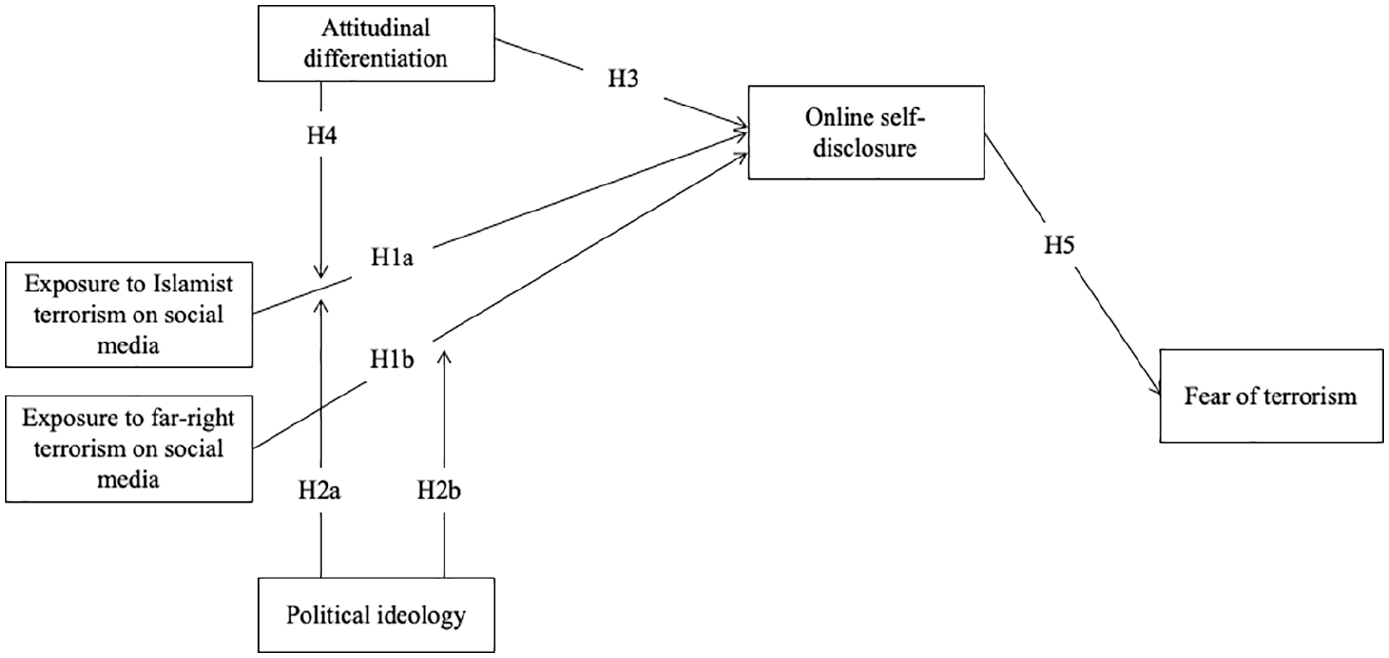
Hypothesized model. For clarity reasons, control variables age, gender, education, Muslim religious affiliation, and sample provider are not shown.
Method
We administered a cross-sectional online-survey among 16- to 25-year-olds in Germany. Apart from age as an inclusion criterion, participants had to be smartphone users and current or former social media users. This study was part of a larger survey. Two professional polling companies recruited the participants. 1 The sample was quota-based to approximately meet the gender (53.8% female, 0.7% diverse) and age (M = 21.14, SD = 2.73) distribution of our targeted population. A soft quota for education level was implemented (36.50% no degree, elementary or secondary school; 50.20% high school degree; 13.30% university degree). The data were collected between 15 July and 17 August 2021. No terrorist attacks were reported in Germany during this time frame. Before the start of the data collection, we sought ethical clearance from the Institutional Review Board of the Department of Communication at the University of Vienna (ID: 20210531_037). To ensure sufficient quality of the data, speeders 2 and participants who failed to answer three attention-check items correctly (mock-items, for example, “I have never used a computer before”) were excluded from the analysis. Additionally, one case was excluded due to missing values. The final sample included N = 864 adolescents and young adults. Data can be accessed online: https://osf.io/3uwav/.
Measures
All measures can be found in the Online Appendix: https://osf.io/3uwav/.
Exposure to Islamist and far-right terrorism on social media
Two items were used to gauge exposure to Islamist terrorism on social media on a 7-point Likert-type scale (1—never, 7—all the time; for example, “I have seen or read posts on social media about Islamist terrorism”). The items were combined to a mean-based index, Spearman–Brown’s coefficient (ρ) = .73, M = 3.22, SD = 1.60. An adapted version of the items was used to measure exposure to far-right terrorism on social media, Spearman–Brown’s coefficient (ρ) = .80, M = 3.14, SD = 1.65.
Fear of terror
Fear of terror was assessed with three items based on the work of Fischer et al. (2007) (1—strongly disagree, 7—strongly agree; for example, “I am worried that I personally could be a victim of a terrorist attack”). Principal component analysis indicated one-dimensionality and the resulting scale proved to be reliable (Cronbach’s α = .91). Thus, the items were collapsed (M = 3.72, SD = 1.68).
Terror-related online self-disclosure, political ideology, and attitudinal differentiation
We used two items based on the work of Karsay et al. (2019) and adapted them to measure terror-related online self-disclosure (1—never, 7—all the time; for example, “When you think about terrorism, how often do you typically share on social media your personal feelings?”). Prior to answering questions on self-disclosure, participants were asked to think about their social media usage during and after any terrorist attacks. Thus, these questions were not restricted to any specific attack. After ensuring sufficient correlation, Spearman–Brown’s coefficient (ρ) = .89, they were combined to a mean-based index (M = 3.01, SD = 1.79).
Participants were asked to self-assess their political ideology on a 10-point scale from 1 (left) to 10 (right) (M = 4.55, SD = 1.93).
Building on an instrument based on the operationalization by Von Sikorski et al. (2017, 2022), attitudinal differentiation was gauged with four items (1—strongly disagree, 7—strongly agree; for example, “The majority of Muslims have nothing at all to do with terrorism”). Principal component analysis suggested a unidimensional factorial structure. The scale proved to be reliable (Cronbach’s α = .91), therefore, the items were collapsed (M = 4.96, SD = 1.68).
Control variables
We statistically controlled for age (in years), low education (dummy), high education (dummy), female gender (dummy), and diverse gender (dummy). Ninety-seven participants (11.20% of the total sample) reported Muslim religious affiliation. For non-Muslim individuals in Germany, Muslims as a group can be considered to be a categorization cue. To ensure that the results cannot be traced back to this group categorization and since outgroup evaluations are an essential part of this study, we included Muslim religious affiliation as a dummy-coded variable. We also included sample provider as a control variable in all analyses.
Statistical analysis
The statistical analyses were conducted with R and with IBM SPSS Version 27. Hayes’ PROCESS tool was used to assess the conceptualized moderated mediation models (model 9; Hayes, 2017). Data were bootstrapped 5000 times. Metric measurement scales were mean-centered and political ideology was z-standardized prior to the analyses.
Results
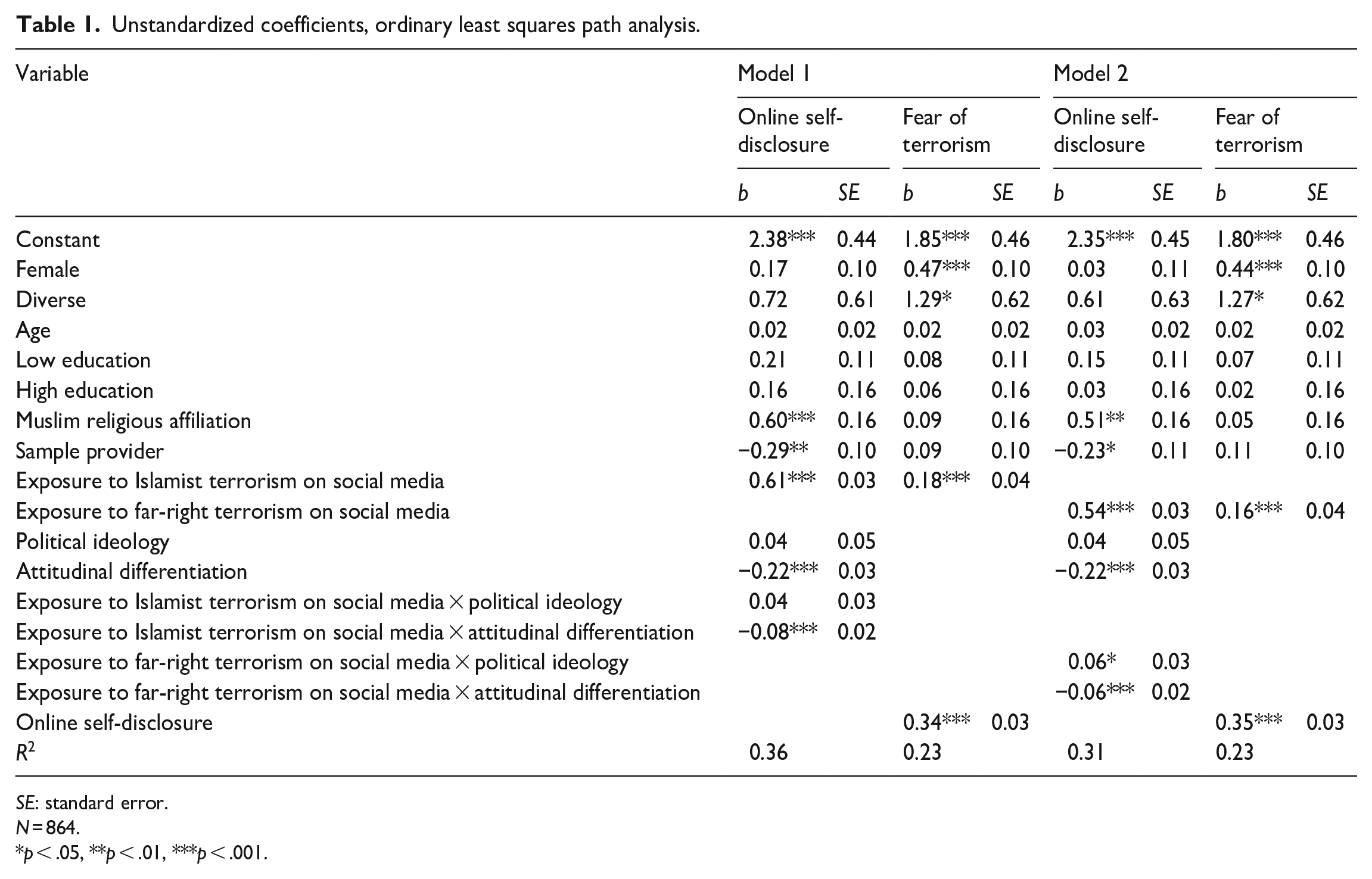
We found that exposure to Islamist terrorism on social media was associated with significantly higher online self-disclosure (b = 0.61, SE = 0.03, p < .001). Furthermore, exposure to far-right terrorism on social media was significantly related to higher online self-disclosure (b = 0.54, SE = 0.03, p < .001). Thus, our first hypothesis (H1a and H1b) was confirmed. Table 1 shows all results. There was no significant interaction effect of exposure to Islamist terrorism on social media and political ideology on online self-disclosure (b = 0.04, SE = 0.03, p = .210). However, we found a significant interaction effect of exposure to far-right terrorism and political ideology on self-disclosure (b = 0.06, SE = 0.03, p = .041). The significant interaction was plotted with the Johnson–Neyman technique (Hayes and Matthes, 2009), displayed in Figure 2. Against our expectations, individuals leaning to right on the political spectrum were more likely to self-disclose online when they had been exposed to far-right terrorism on social media compared to individuals leaning to left. Therefore, our second hypothesis (H2a and H2b) was rejected.
Unstandardized coefficients, ordinary least squares path analysis.
SE: standard error.
N = 864.
p < .05, **p < .01, ***p < .001.
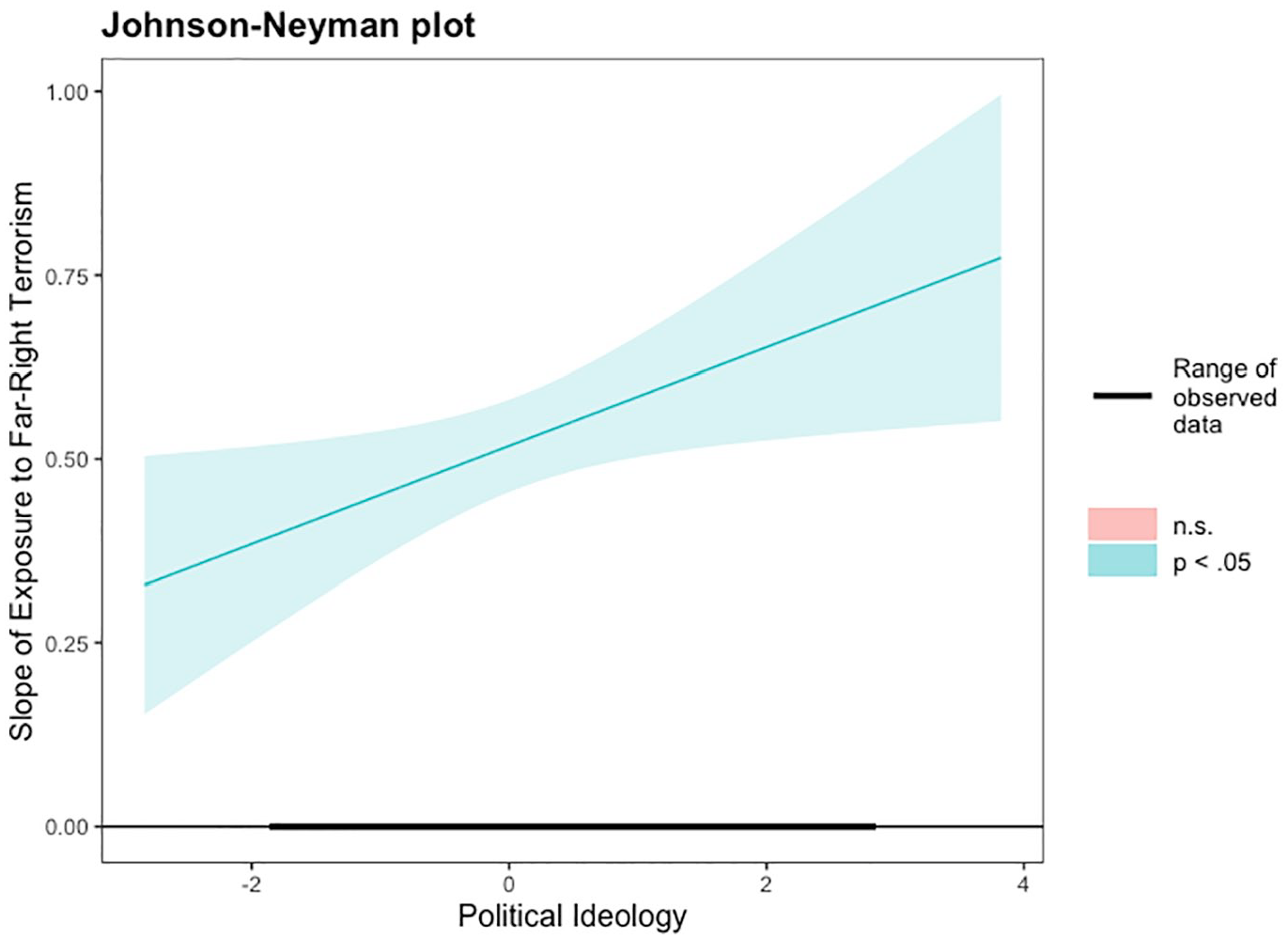
Johnson–Neyman plot for interaction of exposure to far-right terrorism on social media and political ideology on online self-disclosure.
Next, our findings revealed that young adults’ lower attitudinal differentiation was associated with significantly higher self-disclosure (b = −0.22, SE = 0.03, p < .001). Hence, our third hypothesis (H3) was supported. Looking into moderation effects, we found a significant interaction effect of exposure to Islamist terrorism and attitudinal differentiation on online self-disclosure (b = −0.08, SE = 0.02, p < .001). The Johnson–Neyman plot of the significant interaction is visible in Figure 3. The finding indicates that young adults’ lower attitudinal differentiation was associated with more online self-disclosure when they had been exposed to Islamist terrorism on social media compared to young adults with higher attitudinal differentiation. This confirms our fourth hypothesis (H4).
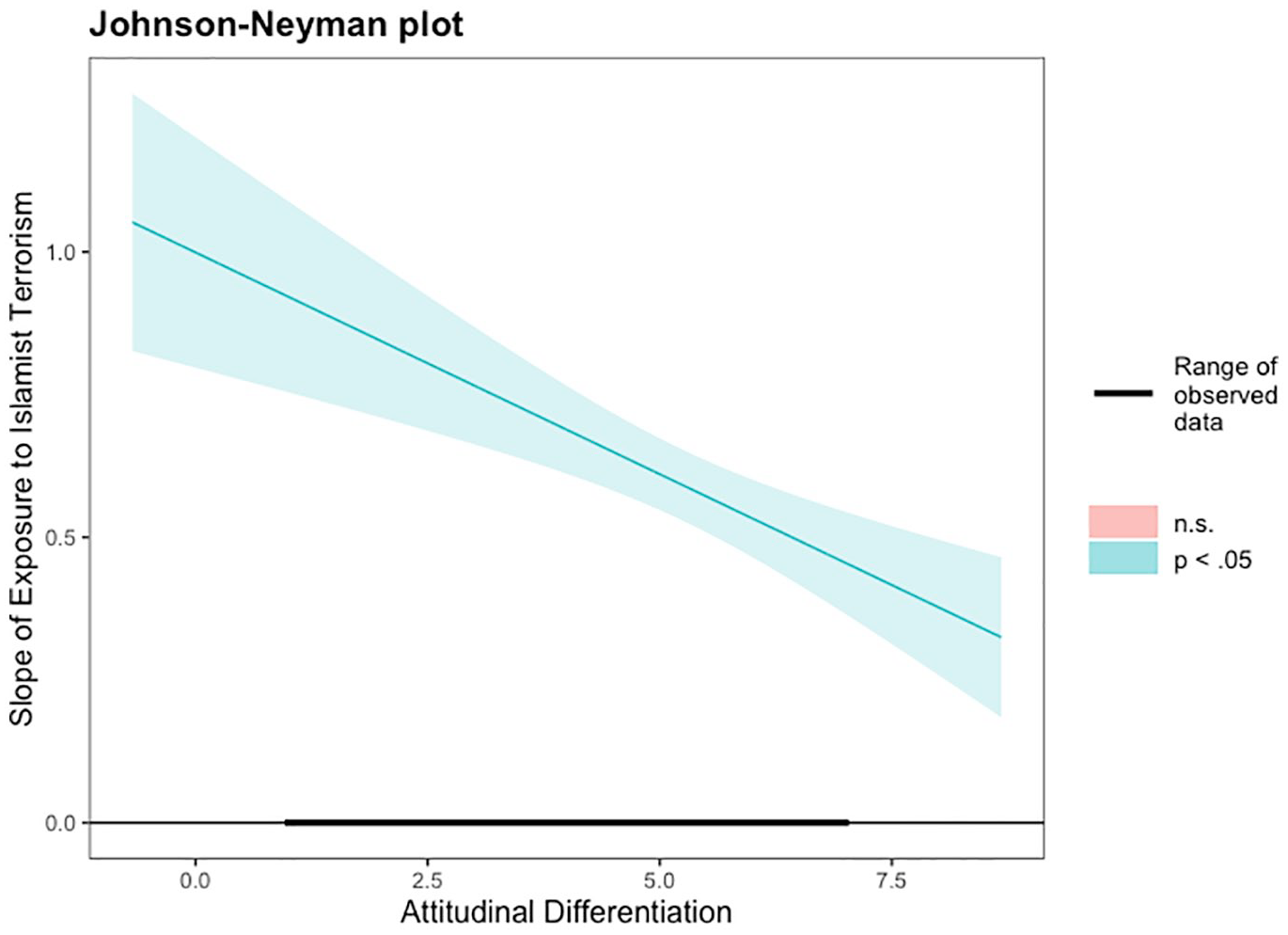
Johnson–Neyman plot for interaction of exposure to Islamist terrorism on social media and attitudinal differentiation on online self-disclosure.
Finally, the results showed that higher online self-disclosure was related to higher fear of terrorism (model 1: b = 0.34, SE = 0.03, p < .001; model 2: b = 0.35, SE = 0.03, p < .001). This result supports our fifth hypothesis (H5). In additional analyses, we also checked the overall index of partial moderated mediation. For model 1, in case of political ideology, the index of partial moderated mediation was not significant (b = 0.01, SE = 0.01), CI [−.01, .03] and for attitudinal differentiation it was significant (b = −0.03, SE = 0.01), CI [−.04, −.01]. Similarly, the same index for model 2 for political ideology was not significant (b = 0.02, SE = 0.02), CI [−.01, .05] and for attitudinal differentiation significant (b = −0.02, SE = 0.01), CI [−.04, −.01].
Also, although we did not hypothesize this relationship, we found a significant interaction effect of exposure to far-right terrorism and attitudinal differentiation on online self-disclosure (b = −0.06, SE = 0.02, p < .001). Exposure to Islamist terrorism (b = 0.18, SE = 0.04, p < .001) and exposure to far-right terrorism on social media (b = 0.16, SE = 0.04, p < .001) were positively related to fear of terrorism. When it comes to control variables, Muslim respondents reported higher online self-disclosure (model 1: b = 0.60, SE = 0.16, p < .001; model 2: b = 0.51, SE = 0.16, p = .002). The dummy-coded variable for sample provider on self-disclosure was significant (model 1: b = −0.29, SE = 0.10, p = .005; model 2: b = −0.23, SE = 0.11, p = .029). Female (model 1: b = 0.47, SE = 0.10, p < .001; model 2: b = 0.44, SE = 0.10, p < .001) and diverse participants (model 1: b = 1.29, SE = 0.62, p = .036; model 2: b = 1.27, SE = 0.62, p = .040) reported higher fear of terrorism.
Discussion
Using the data from a quota-based survey conducted among adolescents and young adults, the present study investigated how exposure to terrorism on social media relates to terror-related online self-disclosure when taking the moderating role of political ideology and attitudinal differentiation into consideration. Moreover, the study explored the association between online self-disclosure and fear of terrorism. Social media serve as platforms for potential terrorist communication, and are also a space for general public to post terror-related information and disclose emotions (Eriksson, 2016; Eriksson Krutrök and Lindgren, 2018; Kaufmann, 2015; Mirbabaie et al., 2020). The present article focused mainly on the latter. Given the relevance of social media as a space for terror content, it is crucial to understand based on what predispositions young social media users engage with this content and how it relates to their levels of fear. Research on terrorism-related discourses on social media has applied various theoretical frameworks, such as cultural and collective traumas (e.g. Eriksson, 2016, 2018), public controversy in the digital public sphere (e.g. Sumiala and Harju, 2019), sense-making (Stieglitz et al., 2018), (hybrid) media events (Sumiala et al., 2019), mediality (Kaufmann, 2015), and framing (Eriksson Krutrök and Lindgren, 2018). To add to the theoretical discussion and to our knowledge about terrorism in digital world, we applied a media psychological perspective, incorporating research on self-disclosures (Stiles, 1987) as a key coping mechanism in crisis situations, and theories of terror management (Pyszczynski et al., 1999) and social sharing (Rimé et al., 1992).
It is important to note that due to the data being cross-sectional, the study is unsuited to make causal conclusions. Our findings revealed that social media exposure to Islamist as well as far-right terrorism, respectively, was related to significantly higher online self-disclosure. This finding indicates that individuals turn to online self-disclosure in hope to find reassurance, comfort and cope with the stress that comes with the situation (Stiles, 1987; Zhang, 2017). Social media, due to easiness and immediate accessibility to one’s social network, may even facilitate self-disclosure. This result is also in line with the fever model of disclosure (Stiles, 1987). From a theoretical point of view, being exposed to terrorism may trigger mortality awareness and unconscious death anxiety (Das et al., 2009). To cope with this, individuals may look for comfort in their social network and self-disclose (Stiles, 1987; Zhang, 2017). In a broader sense, studies on the debates on social media in the aftermath of terrorist attacks have revealed similar patterns, showing that social media users tend to show togetherness (Eriksson, 2016), mourning (Mirbabaie et al., 2020), or concern (Eriksson, 2018)—processes that can be described as cultural traumas (Alexander et al., 2004; Eriksson, 2016, 2018), collective grief (Moore et al., 2019), sense-making (Heverin and Zach, 2012), and memorialization (Eriksson, 2018; Takahashi et al., 2015).
Next, we found no significant interaction effect of exposure to Islamist terrorism and political ideology on online self-disclosure. That is, Islamist terrorism seems to prompt self-disclosure for young individuals at the politically left and right side. Drawing on TMT, we assumed that online self-disclosure as a response to Islamist terrorism in right-leaning individuals may be a mechanism to cope with the exposure to threats attributed to outgroup members by pointing to the issue and reinforcing the CWV, to a larger extent than in left-leaning individuals (Pyszczynski et al., 1999). Based on our findings, it can be speculated that individuals from both political camps are shocked by Islamist terrorist crimes, therefore disclosing their feelings, worries, and fears on social media. Thus, when being exposed to Islamist terrorism, political ideology does not seem to play a role in whether individuals self-disclose or not. Furthermore, we found an interaction effect of exposure to far-right terrorism and political ideology on self-disclosure, but to the opposite direction of our expectations. This finding indicates that individuals with right-leaning political predispositions were more likely to self-disclose online when they had been exposed to far-right terrorism compared to left-wingers. We argued that with an aim to uphold the positive image of the right-leaning ingroup, right-wingers would refrain from self-disclosure online, in order to minimize the potential “contact points” (see Brewer, 1979; Oakes and Turner, 1980; Rieger et al., 2019). Although right-wingers often condemn political violence, the extremist ideas and political views at the right end share some rhetoric, such as concerns related to weakened national identity and prejudiced views toward ethnic minorities (Ravndal, 2018). Previous research has shown that after the 2017 Finsbury Park far-right terrorist attack, individuals distanced themselves from ideological stances at the right end and refrained from reporting nationalistic attitudes and showing immigration skepticism (Pickard et al., 2022). Similar shifts in ideological positions were not visible in individuals on the left (Pickard et al., 2022). In the same vein, in the immediate aftermath of the 2019 Christchurch attack, individuals showed an increase in warmth toward Muslims in both political camps, but soon after the attack, right-leaning individuals reverted the attitudes toward Muslims to pre-attack levels (Shanaah et al., 2021). However, there may exist alternative explanations for our finding. It seems plausible that individuals leaning to the right feel more shocked because an attack comes from a perpetrator that could be regarded as an ingroup member—something that, according to their perceptions, was not anticipated. This argument can be based on the SIT, which postulates that ingroup individuals see similarities to other ingroup members in terms of positive characteristics (Tajfel and Turner, 1986). By the same token, right-leaning individuals may not feel as surprised by an attack committed by self-proclaimed Islamists, since according to their rhetoric, “they” (i.e. non-natives) aim to threaten Western values and societies (see Todd, 2015), explaining the null finding. However, in the case of far-right terrorism, right-wingers may have a greater need to show emotions in order to distance themselves from a perpetrator regarded as an ingroup member, not only by shifting the ideological positions (Pickard et al., 2022), but also by showing it to the outside world, in this case to the online audiences. Yet, more research is needed to back up these explanations and to gain a nuanced understanding of the underlying mechanisms. Future research should also look into the specifics of the content of these emotional self-disclosures.
Furthermore, our findings showed that young adults’ attitudinal differentiation is negatively associated with online self-disclosure. Based on the concept of differentiation (Von Sikorski et al., 2021), when individuals hold higher levels of attitudinal differentiation, they perceive that terror threat is posed by a small group of terrorists only. Bringing the debate to the context of TMT (Pyszczynski et al., 1999), online self-disclosure is less likely for individuals who attribute the threat to a smaller group compared to the ones that attribute the threat to a larger group. In addition, we found that attitudinal differentiation moderated the relationship between exposure to Islamist terrorism and online self-disclosure. This means that individuals’ low attitudinal differentiation was associated with more online self-disclosure when exposed to Islamist terrorism compared to the ones with higher attitudinal differentiation. These findings play into the relevance of explicit differentiation of Muslims from Islamist terrorists in media products (Von Sikorski et al., 2021, 2022), as such attitudes can further put strains on intergroup relations. Importantly, not only the exposure but even the perceptions of a higher threat, due to terroristic attributions to Muslims in general, can relate to higher self-disclosure. As explained by TMT, mortality salience, triggered by exposure or thoughts of terrorism, may initiate a worldview defense (Greenberg et al., 1992). Therefore, individuals may feel the urge to engage in these defenses in order to manage terror and thus use online self-disclosure as a coping mechanism.
Finally, our results indicated that higher online self-disclosure relates to increased fear of terrorism. This finding suggests that although the initial motivation to engage in self-disclosure might be rooted in reducing stress, terrorism-related self-disclosure may not serve as a coping strategy in terms of fears. Considering the theoretical framework of social sharing (Rimé et al., 1992), it may be that individuals exposed to terrorism wish to share their feelings, which can enhance the initial subconscious response and relate to more fear of terrorism. Since individuals generally react to terrorism negatively (Gadarian, 2010; Iyer et al., 2014; Slone, 2000) and keeping in mind that disclosure regarding negative events increases negative affect (Rimé et al., 1998), our finding is not surprising. It might be, however, that different strategies of self-disclosure on various types of social media platforms (e.g. private vs public sharing) may relate to reassurance in case of terror and help to cope with emotions. However, this is a strain of research that should be explored in the future.
Limitations and future research
We acknowledge that the study comes along with several noteworthy limitations. First and foremost, the study is based on cross-sectional data, which does not allow us to draw inferences about the causal direction of the hypothesized relationships. Nonetheless, a survey approach has an asset with regard to external validity (Iyengar, 2001). The study is based on a large sample of adolescents and young individuals, a highly understudied group. Adolescents and young adults may be hard to reach, which is also visible in high attrition rates (the loss of study participants) in longitudinal studies (Cotter et al., 2005). Selective attrition may further influence the research findings, which can threaten validity of the findings (Flick, 1988). This study is a first step in investigating these relationships. Therefore, experimental studies should further test the explored relationships to determine their causality. Such studies should employ experimental designs where participants are exposed to different social media contents of terrorism (e.g. in a laboratory setting) to understand better the way individuals engage with it in terms of self-disclosure and to investigate the consequences of this action on fear of terrorism. Furthermore, although not without challenges, future research should aim to employ longitudinal panel designs in order to test these relationships over time. As self-disclosure is something that can occur repeatedly, future studies should implement several measurement points (e.g. mobile experience sampling). Additionally, qualitative approaches should be taken to study in-depth online environments in terrorism context and the relationships of this study, in order to better understand socio-cultural contexts.
Second, even though externally valid survey approaches are important, self-report measures pose a limitation. Our study employed self-reports for all our measures, which may suffer from perceptual bias. That is, we did not assess the exact terrorism content that the participants were exposed to nor the exact online self-disclosures that they engaged in. This is particularly relevant in the face of the two kinds of terrorism content in question—namely, far-right and Islamist terrorism (see Abbas, 2017). To exemplify, Meier (2020) focuses on the German context and illustrates how national security elites make sense of white supremacist terrorism, emphasizing how institutional factors and hegemonic national identity shape overall lower threat perceptions and weaker policy responses compared to other forms of terrorism. In a similar vein, counterterrorism measures in the United States are embedded in historically grown exclusionist and racist, anti-Black discourses, and practices (Meier, 2022). Against this institutional and cultural backdrop, it is important to highlight issues related to the conceptualization and operationalization of terrorism on the very basis of capturing terrorist activity in large-scale databases and official reports. For instance, there are severe differences in the reported frequency and characteristics of terrorist attacks between the Global Terrorism Database and US governmental reports, also dependent on the (Islamist) background of the attack (Kaczkowski et al., 2022). Related to this, by asking participants explicitly for terror content on social media, we can only grasp exposure to content that participants associate with terrorism. These perceptions might, however, be shaped by biases in news reporting and information processing. Previous research suggests that it largely depends on perpetrator characteristics whether a violent act is labeled as terrorism in the press—attacks committed by Muslim perpetrators are more likely to be labeled terrorism than attacks committed by non-Muslim perpetrators, such as far-rightists (Betus et al., 2021; Hase, 2021; Kearns and Betus, 2022; Zdjelar and Davies, 2021). Similarly, readers are more likely to label Muslim perpetrators of violent attacks as terrorists compared to non-Muslim perpetrators (West and Lloyd, 2017). In the context of the present study, this could imply that participants held different views of what constitutes terrorism content and were more inclined to connect terrorism content on social media to Islamist terrorism than to far-right terrorism. To study in-depth which social media content induces online self-disclosure and in turn fear of terrorism, a combination of content analysis of the actual social media content and the outcomes (see, for example, Boer and van Tubergen, 2019) or online self-disclosure in terms of for instance, data donations are warranted in the future. This was unfortunately beyond the scope of the present study.
Third, we did not distinguish between different social media contents, but looked into exposure to terrorism on social media in general. Given that terror content on social media is diverse and can include various range of messages, such as eye-witness material (Allan, 2014), posts that sympathize with families of victims (Kwon et al., 2017), or also memes (Downing, 2021), it is important to account for this in future research. It is possible that (audio)visual content is related to higher self-disclosure and in turn even higher fear of terrorism as compared to only textual posts or that fear is induced depending on the content specifics, but this needs to be investigated in the future. Fourth, although we have identified the relevance to study Islamist and far-right terrorism, future research should compare exposure to more types of terrorism, including, for example, separatist terrorism, left-wing terrorism, or single-issue terrorism (Europol, 2020).
Conclusion and implications
This study explored how exposure to Islamist and far-right terrorism on social media is related to young social media users’ attitudes, emotions, and behaviors. The results revealed that exposure to Islamist and far-right terrorism is associated with higher online self-disclosure. This relationship is moderated by political ideology in case of exposure to far-right terrorism and by attitudinal differentiation in case of Islamist terrorism. Higher online self-disclosure is associated with higher fear of terrorism. Taken together, our findings indicate that exposure to terrorism on social media and disclosing emotions related to it online can significantly relate to heightened fears of terrorism. Thus, even though the use of social media can have psychological benefits, this does not hold true in case of terrorism. However, predispositions—such as perceptional distinction between ordinary Muslims and terrorists—that may be influenced by the media, can be considered as important protective factors when coping with fear. Scholars should strive to increase our understanding on different (online) coping strategies in the face of terrorism.
Footnotes

Declaration of conflicting interests
The author(s) declared no potential conflicts of interest with respect to the research, authorship, and/or publication of this article.
Funding
The author(s) received no financial support for the research, authorship, and/or publication of this article.