




Abstract
The article analyses local contestation of data centres in the Dutch province of North Holland. I explore why and how local councillors and citizen groups mobilized against data centres and demanded democratization of decision-making processes about digital infrastructure. This analysis is used as a vantage point to problematize existing policy and academic narratives on digital sovereignty in Europe. I show, first, that most debates on digital sovereignty so far have overlooked the sub-national level, which is especially relevant for decision making on digital infrastructure. Second, I insist that what matters is not only where digital sovereignty lies, that is, who has the power to decide over digital infrastructural projects: for example, corporations, states, regions, or municipalities. What matters is also how power is exercised. Emphasizing the popular democratic dimension of sovereignty, I argue for a comprehensive democratization of digital sovereignty policies. Democratization in this context is conceived as a multimodal multi-level process, including parliaments, civil society and citizens at the national, regional and local levels alike. The shape of the cloud should be citizens’ to decide.
Do you see yonder cloud that’s almost in shape of a camel?
By th’ mass, and ‘tis like a camel indeed.
Methinks it is like a weasel
It is backed like a weasel.
Or like a whale?
Very like a whale.
The shape of the cloud
In a famous exchange between Hamlet and the King’s councillor Polonius, Hamlet describes the shape of a cloud first like a camel, then like a weasel and finally like a whale, with Polonius agreeing in a servile way with each subsequent description. This article starts from the observation that tech corporations have for a long time defined what the ‘cloud’ is for both governments and citizens, who have agreed passively to whatever vision tech companies suggested to them. The very metaphor of the ‘cloud’ has allowed digital tech companies to present data as immaterial and ephemeral, drawing attention away from the complex and often energy-intensive digital infrastructure needed to maintain data flows and storage (Hogan and Vonderau, 2019; Hu, 2015; Johnson and Hogan, 2017; Nobrega and Varon, 2020; Starosielski, 2015; Vaughan, 2020; Winseck, 2019). Against the corporate drive to obscure the materiality and politics of data, this article focuses on a case of contestation of a key element of digital infrastructure, namely data centres. I analyse the local contestation of data centre construction in the Dutch province of North Holland and explore why and how local councillors and citizen groups mobilized against data centres and demanded democratization of the decision-making process. I use this analysis as a vantage point to problematize existing research on digital sovereignty in Europe and insist that more attention should be paid to digital sovereignty’s popular democratic foundation.
The article hopes to enrich and expand further the growing field of data centre studies, which has so far explored a wide variety of topics including the environmental consequences and energy demands of data centres (Levenda and Mahmoudi, 2019; Libertson et al., 2021; Vonderau, 2019a), the political economy (Lehuedé, 2021; Maguire and Winthereik, 2019; Pickren, 2018; Vonderau, 2019b) and geopolitics of data centres and the ways in which they have been imbricated in broader surveillance structures (Hogan, 2015; Hogan and Shepherd, 2015; Hu, 2015), the architectural impermanence of data centres (Velkova, 2019), and finally, the role of local political initiative in creating the conditions to attract data centres (Burrel, 2020; Huang, 2022). Within this body of literature, the local contestation of data centre construction has been often mentioned and acknowledged, but rarely studied in detail, with few important exceptions such as research on local protests for and against data centres in Ireland (Brodie, 2020a, 2020b; Parker, 2019).
Beyond filling in a gap in the literature on data centres, this analysis of the contested politics of data centre construction offers a new perspective to debates on digital sovereignty, defined as a ‘form of legitimate, controlling authority over – in the digital context – data, software, standards, services, and other digital infrastructure’ (Floridi, 2020: 2). While past discussions on digital sovereignty (Nora and Minc, 1980; Nordenstreng, 2012; Nordenstreng and Schiller, 1978) often saw it as a counter-hegemonic project, tightly connected with democratization and socialization of information, more recent state policy discourses (Belli, 2021; Danet and Desforges, 2020; Martin, 2022) tend to interpret the concept predominantly in geopolitical terms in the context of inter-state competition. Contrary to this contemporary line of thinking, conflicts around data centres in North Holland show clearly that decisions on digital tech policy should be seen not merely as a matter of big state competition, but also as contested issues in domestic democratic politics and power relations.
The case of North Holland is particularly interesting to analyse, first, because it was thanks to devolution and the decentralization of spatial planning (i.e. the state ‘leaking’ sovereignty to the sub-national level) that local executives in the municipality of Hollands Kroon could enter in direct negotiations with tech giants such as Google and Microsoft. And it was again local councillors’ and citizen mobilization against data centres that politicized the issue in local and national media. Ultimately, after controversies in the provinces of Hollands Kroon and later Flevoland, the Dutch Senate mandated the government to come up with a national strategy on data centres. Thus, the Netherlands, a state that has been actively trying to attract tech corporations (Invest in Holland, 2022) and has no strong digital sovereignty ambitions has now been forced by local activism and national parliamentary oversight to develop a national policy on data centres.
Second, and equally importantly, both debates on sovereignty, more generally speaking, (Stopford et al., 1991; Strange, 1995) as well as debates on digital sovereignty, in particular (Floridi, 2020; Powers and Jablonski, 2015), tend to focus on where sovereignty resides, that is who has supreme power and authority. They discuss much more rarely how sovereignty is manifested, that is how exactly power is exercised. Local citizens and councillors in North Holland demanded more democratic participation and oversight of decision making because they perceived their local executives had acted behind their backs. Making decisions at the local level does not necessarily mean making them democratically. Thus, to understand resistance to data centres in North Holland, we need to pay attention also to the recent wave of citizens and parliamentarians reasserting popular sovereignty and demanding to have a say in policy making at various scales: local, national and transnational alike (Bickerton et al., 2022; Crespy and Rone, 2022; Rosanvallon, 2008). While Big Tech companies might have captured both the imagination and the regulatory zeal of policy makers (Nachtwey and Seidl, 2020; Popiel, 2020; Popiel and Sang, 2021), the citizens of North Holland and the Netherlands in general have made an important step towards having a say in what the shape of the cloud should be.
The article proceeds as follows: Section 1 gives a general theoretical background on debates around digital sovereignty and argues that democratic participation at the local level (and beyond) has remained a blind spot in the literatures on state policy and international political economy. Section 2 presents the main research questions of the article as well as the methods used to address them. Section 3 discusses the key concerns behind citizen mobilization against data centre construction in the province of North Holland. Section 4 discusses the key actors and their actions in opposing data centres. Finally, the ‘Conclusion’ argues that we need to strive for comprehensive democratization of digital sovereignty conceived as a multimodal multi-level process, including citizens and parliaments at various levels of governance.
Digital sovereignty: moving from geopolitics to local democracy
The digital sovereignty debates are not new
Recent debates on ‘digital sovereignty’ can be traced back to Russia and China’s coordinated efforts to create a doctrine that opposes US dominance of Internet communications, including key platforms, standards and services online (Budnitsky and Jia, 2018; Powers and Jablonski, 2015).
1
Still, in the wake of Edward Snowden’s revelations of mass surveillance online as well as the 2016 Cambridge Analytica scandal, the governments of democratic states such as Brazil and Germany also started promoting digital sovereignty, leading many to fear the advent of a ‘fragmented Internet’ (Mueller, 2017). In 2020, the German Presidency of the Council of the European Union stated that it aimed to promote ‘digital sovereignty’ as ‘a leitmotif of European digital policy’ (Pohle and Thiel, 2020). What is more, considering that the ‘cloud’ is currently associated above all with US proprietary services such as AWS (Amazon Web Services), Microsoft Azure, Google Cloud, Alibaba Cloud, IBM Cloud, and so on, scientists and citizens in countries such as Sweden have increasingly problematized public–private partnerships and outsourcing of key public services and infrastructures (Newlove-Eriksson et al., 2018). The recent surge of interest in digital sovereignty has been clearly demonstrated by a study in the ProQuest database: while the term ‘digital sovereignty’ appeared only six times in general publications before 2008, it was used almost 240 times between 2015 and 2018 (Couture and Toupin, 2019). As every new trendy term, ‘digital sovereignty’ has been used in a variety of fields in multiple often conflicting ways. It has been
mobilized by a diversity of actors, from heads of states to indigenous scholars, to grassroots movements, and anarchist-oriented ‘tech collectives’, with very diverse conceptualizations, to promote goals as diverse as state protectionism, multistakeholder Internet governance or protection against state surveillance. (Couture and Toupin, 2019)
At the same time, scholars discussing the so-called ‘return of the state’ in Internet governance noted that the state had never completely gone away. Even in the 1990s period of utopian beliefs that state governments had no sovereignty over cyberspace (Barlow, 1996), combined with de-facto deregulation and liberalization, states had still retained some form of control over decisions on content, data, standards, and infrastructure (Haggart et al., 2021; ten Oever, 2021; Wu, 2010). Crucially, rather than being completely new, current debates about digital sovereignty are a reiteration of much older debates, predating the 1990s, on the relation between state sovereignty and international communications. The question of state sovereignty with relation to the emerging communication technologies was hotly debated from the late 1960s throughout the 1980s, with the rise of the New World Information and Communication Order (NWICO) movement (Nordenstreng, 2012), among whose demands was to promote the creation of national communication policies to contest Western hegemony. In 1978, two key publications appeared that problematized state-corporate relations in the field of information and communications: Nordenstreng and Schiller’s reader ‘National Sovereignty and International Communication’, as well as Simon Nora and Alain Minc’s report in French on ‘The Computerization of Society’, in which they wondered how the French state could defend its sovereignty when confronted with the then powerful monopolist IBM.
Notably, many of these older debates saw in ‘computerization’ a force that could drive decentralization of power and ‘the socialization’ of information (Nora and Minc, 1980). They thus saw democratization as a key aspect of state policy in the field of communications. This is different from today when on the one hand we have, policy and political economy debates that focus on executive state power, and on the other hand, a distinctive and growing body of scholarship on social movements and Indigenous communities that discusses digital sovereignty as autonomy from the state and/or self-determination in terms of ownership and management of data, content and infrastructure (Couture and Toupin, 2019; Kukutai and Taylor, 2016; Pinto, 2018). There is little dialogue between these two strands of the literature: critical scholarship on participation from below has little effect on how states as well as international political economy researchers discuss digital sovereignty policies (Danet and Desforges, 2020; Lambach and Oppermann, 2020; Martin, 2022; Pohle and Thiel, 2020; Winseck, 2019). This article argues that we can draw inspiration from older debates on state communication policy and search for a synthesis between democratic participation and fostering state policies in the field of the digital. One possible way to ground such a synthesis is through reasserting the popular democratic dimension of ‘digital sovereignty’, in which power not only comes from the people but is also exercised by the people and for the people.
Where power lies: The ‘defective state’ leaking sovereignty
The question of sovereignty, digital sovereignty included, is ultimately a question of power. In this section, I argue that not only the recent literature on digital sovereignty state policies, but also international political economy, more generally, has identified power as residing mainly in the hands of states or corporations (Lehdonvirta, 2022; Strange, 1997, 2015), but rarely in the hands of sub-national actors such as municipalities or regions, or ‘the people’ understood as the sovereign. Yet, the rising contestation of data centres in the Netherlands (and all across the world, see Brodie, 2020b; Lehuedé, 2022) shows that this might need to change.
In his classic study ‘Power: A Radical View’ (2005, second edition), Steven Lukes offers a complex ‘three-dimensional’ view of power, which includes behaviour, (non)decision making and conflict, but sees power also in the control over the political agenda that prevents certain issues from becoming issues at all (Lukes, 2005: 29). Drawing on Lukes’ framework, political economist Susan Strange distinguishes between relational power (the power of A over B, for example, of states over other states, or of states over firms) and structural power that defines the field of interaction for all actors (Strange, 2015, second edition). In her writings from the 1990s, including a paper called ‘The Defective State’, Strange argues that transformations (driven by technological disruption and deregulation, among other factors) in the security, production, financial and knowledge structures have led to a considerable reconfiguration of structural power, and consequently state sovereignty: ‘state authority has leaked away, upwards, sideways, and downwards’ (Strange, 1995: 56) to multinational corporations, civil society organizations, supranational bodies such as the UN, but also to sub-national entities such as regions and municipalities (pp. 67–68). The implication of state sovereignty ‘leaking away’ is that it is no longer enough to explore the relations between states to understand how power flows and operates in the international political economy.
The problem is that, while Strange acknowledges that state sovereignty has leaked also downwards and sidewards to civil society organizations, regions and municipalities, most research on the ‘new diplomacy’ promoted by Strange herself and her colleagues has focused above all on ‘bargains’ between states and corporations (Stopford et al., 1991: 22; Haggart, 2017; Winseck, 2019), while often neglecting bargaining between states, corporations and sub-national entities such as regions or municipalities, for example (with rare exceptions such as Kuswanto et al., 2017). Indicatively, two fields that have shown considerable interest in local agency and power relations have been community approaches to digital sovereignty (Kukutai and Taylor, 2016) as well as research on digital infrastructures (Burrel, 2020; Hogan, 2015; Huang, 2022). After all, it is local communities and municipalities that have both tried to attract tech corporations and have experienced firsthand the effects of infrastructure construction, including landscape and air pollution, surge in energy demands, and water shortages. Ultimately, both the International Political Economy (IPE) paradigm advocated by Strange and the current policy discourses on digital sovereignty (Danet and Desforges, 2020; Martin, 2022) discussed in the previous section have ignored the local level as a place where power could reside.
How power is exercised: the ‘return of the people’?
To be sure, the IPE and policy literatures have another important blind spot as well: they are both silent when it comes to the question how sovereign power is exercised. Considering that, since the French revolution at least, we accept that the prime source of sovereignty is not God but the People, it is important to analyse how the People control ‘bargains’ between states and corporations, or as we explore in this article, between states, corporations and municipalities. Thus, we need to focus not only on where sovereignty lies but also on how sovereignty is exercised.
Following the recently developed ‘new conflicts of Sovereignty’ framework (Bickerton et al., 2022) as well as Rosanvallon’s (2008) analysis of manifestations of popular sovereignty in his seminal book ‘Counter-democracy’, this article aims to fill this gap. Within the ‘new Conflicts of Sovereignty’ framework, conflicts of sovereignty are conceived not only as clashes between different states or between state and supranational sovereignty, but increasingly also as clashes between popular democratic sovereignty as embedded in parliaments and civil society, on the one hand, and executives concentrating power, be it at the state or the supranational level, on the other hand. Scholars of trade and economic policy in Europe have already focused on clashes between popular sovereignty and technocratic executives (Crespy and Rone, 2022; della Porta, 2020; Gerbaudo, 2021; Rone, 2020). But this type of focus has been often absent from studies on digital sovereignty policies. While current debates on digital tech regulation draw attention to the need for more state regulation as a potential solution to Big Tech’s power grab (Fairfield, 2021; Simons and Ghosh, 2020), only a few authors have explored explicitly the key role of democratic procedures and the necessity for public participation in decision making over the digital (Haggart and Keller, 2021; Rone, 2021). Such an approach is in a sense a reply to Nora and Minc’s call from 1978 to decentralize power and ‘socialize’ information.
This article thus analyses data centre contestation in North Holland with two main goals: First, to problematize dominant narratives on digital sovereignty that focus on geopolitics and identify power above all as an attribute of states and corporations, while ignoring sub-national entities and civil society as loci of power. Second, to complement (and complicate) these policy and academic narratives with a discussion on strengthening the popular dimension of digital sovereignty policies at the local level and beyond. I do this by looking at different types of manifestations of popular sovereignty through institutions such as political parties, local councils, and national parliaments, but also through forms of counter-politics identified by Pierre Rosanvallon (2008), including media oversight and bottom-up mobilization. When analysing the North Holland case, I pay particular attention to such forms of manifesting popular sovereignty to show how taken together they contributed to the assertion of people’s sovereignty over the digital.
Case background, research questions and methodology
The article poses two key exploratory questions
RQ1. Why did local citizens and politicians in Hollands Kroon oppose the construction of Big Tech data centres in their province?
RQ2. How, through what types of actions and interventions, did local citizens and politicians mobilize against data centres?
By addressing these questions, I hope to open new avenues in empirical research on data centres but also to contribute to theories of digital sovereignty by bringing forward its sub-national and popular dimensions.
Before I describe the methods used to address the research questions, a bit of background information on the case of North Holland is important. The Province of North Holland in the North-West of the Netherlands consists of 45 municipalities and three water boards managing the surface water in the environment. Most controversies around data centre construction took place in the Municipality of Hollands Kroon, created on 1 January 2012 as a merger of four former municipalities, namely Anna Paulowna, Niedorp, Wieringen, and Wieringermeer. In the period I explore – between 2018 and 2022 (when new local elections took place) – the municipal council of Hollands Kroon consisted of 10 parties, in order of the number of seats they had: Senioren Hollands Kroon (Seniors of Hollands Kroon), VVD (People’s Party for Freedom and Democracy), CDA (The Christian Democratic Appeal), Onafhankelijk Hollands Kroon (Independent Hollands Kroon), PvdA (Labour Party), GroenLinks (GreenLeft Party), D66 (Democrats 66), Christian Union, LADA (Local Alternative Democracy Differently), ANDERS! (Different!). This distribution changed as the controversy around data centres unfolded and several councillors quit their parties. Finally, the day-to-day management of the municipality is the responsibility of the College of the Mayor and the Aldermen, who are in effect the holders of local executive power. As we will see in the discussion, a lot of the tensions around data centres were in effect tensions between the council and the Aldermen over the way decisions on data centres were taken.
When it comes to data centres in particular, their construction was made possible first by the decentralization of spatial planning in the Netherlands (van Straalen et al., 2016). Second, it was facilitated by the 2008 zoning plan amendment Agriport. The first Microsoft hyperscale data centre was established in Hollands Kroon in 2016. In 2018, the first Nimble/Google data centre application was submitted with the centre finalized in 2020. Most of the contestation analysed in this article has to do with the Wieringermeer Area Plan proposed by the municipality. It was precisely the plans to build further data centres of Microsoft and Google west of the A7 highway that provoked resistance from local citizens and politicians (interview with Jan Meijles, 2021).
In analysing local resistance to data centres, the article draws on qualitative content analysis of a sample of articles from the regional newspaper Noordhollands Dagblad (NHD) that consists of seven editions that appear as a morning newspaper north of the North Sea Canal in a joint of 98,000 print copies, as well as online. The data from the qualitative content analysis is triangulated with five in-depth semi-structured qualitative interviews with local politicians and activists. The article analyses more specifically 111 articles from the period 1 January to 1 June 2021, which were retrieved from the newspaper’s digital archive by searching for the term ‘data centre’. These articles provide a snapshot of a period of intense contestation on the topic. The first article containing the term ‘data center’ is from 2011. It is also the only article with this term for the year. One can see a steady increase in interest in the topic over the years, with 2020 and 2021 both having more than 100 pieces discussing different aspects of data center construction (Figure 1).
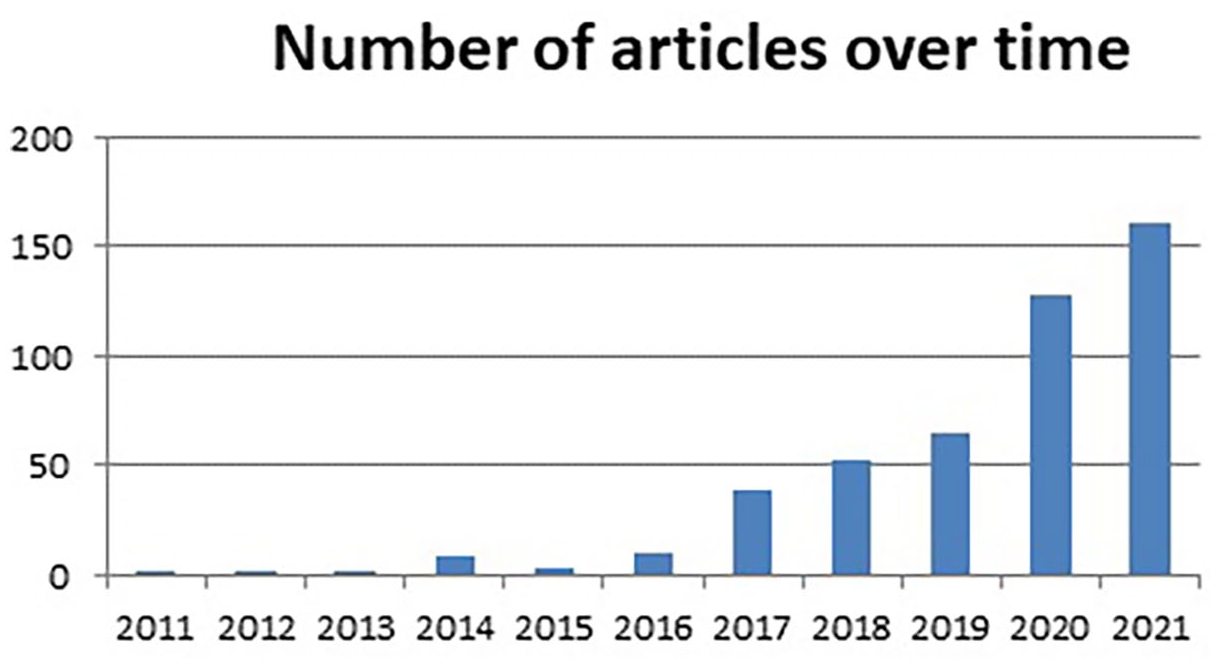
Number of articles featuring ‘data centers’ in the Noordhollands Dagblad over time. The articles for 2021 are until 30 October 2021.
The newspaper articles on data centres were coded using inductive qualitative content analysis (Hsieh and Shannon, 2005) that allows the categories to emerge from the text rather than identifying predefined categories. The analysis revealed nine key topics of concern for local citizens: (1) the effects of data centre construction on water consumption, and related to this (2) potential soil pollution from chemically treated water; (3) lack of access to data centres and secrecy surrounding their sites; (4) the effects of data centre construction on energy demand as well as strategies to mitigate these effects; (5) construction related problems, including landscape integration of data centres but also the hosting of migrant workers; (6) business opportunities created by data centres; (7) state strategies to encourage data centre construction; (8) employment opportunities (or the lack of them) opened by data centres; (9) democratic participation of citizen groups and the local council in decision making.
Seven of these nine topics appear with a similar frequency and are often discussed together in articles on data centre construction. Notably, opinions pointing to the business opportunities created by data centres and the way they fit into the nation-wide investment strategy are severely underrepresented. This is most probably due to the fact that the NHD has a clear editorial line against the construction of data centres (Editorial, 2021). This does not make it less relevant though, especially considering that we have set out to explore precisely local resistance. In this context, it is even more useful. The relevance of the arguments against data centres discussed in the newspaper was confirmed in all my interviews. It can also be confirmed by comparing them with the key topics the local municipality of Hollands Kroon considered necessary to feature in the ‘Data Centers’ section of its website (Gemeente Hollands Kroon, 2022). In the next section, I discuss first the key concerns citizens had about data centres before moving to a discussion on the forms of local mobilization and contestation that followed.
What is wrong with data centres?
One of the first key concerns outlined in both the interviews and the sample of articles from the NHD had to do with water consumption, especially data centres’ use of potable water to cool down servers. The problem with this practice is related above all to the industrial use of potable water, with concerns among farmers and citizens alike that in situations of heat waves and extreme weather conditions their needs for potable water might be compromised (Booy, 2021). Equally important, local farmers have been concerned by the fact that the water used to cool data centres includes chemicals that might cause soil pollution (Muller, 2021a). A further issue with regard to these water worries has to do with lack of access; for example, a waterboard employee was not allowed to enter specific sites due to security considerations (Muller, 2021a). But lack of access is defined not only in physical terms: local environmental regulators have also failed to establish which exact chemicals are used to cool down water since it turned out they are trade secrets (Muller, 2021a).
Furthermore, a number of complaints and investigations were opened with regard to the energy consumption of data centres. Building data centres in locations such as the Dutch province of North Holland has allowed big tech companies to use renewable green energy from local windmill farms, thus effectively presenting themselves as ‘Green’. Still, for citizens in local municipalities where both the data centres and windmills are built, this deal means having to live with both bulky data centres and windmill parks in sight (interview with Jeff Leever, 2021). Ultimately, citizens indirectly subsidize Green energy through their bills, which is then used by private foreign corporations (Muller, 2021b).
‘Green’ and sustainable development rhetoric has been used as part of PR strategies not only by Microsoft and Google. One of the big scandals surrounding data centre construction in the province of North Holland had to do with promises made by the Aldermen, that is the local executives, who argued that residual heat from data centres could be used to power greenhouses or even homes, even though they knew that this was still not practically possible at the time (Van Galen, 2021c). It is important to note that the whole debate around data centres takes place in a province where issues of sustainability are discussed often and in depth with multiple NHD articles on the municipality of Haarlem, for example, discussing how it would meet its 2030 carbon emission goals (Schenkeveld, 2021). Local politicians and activists often asked, for example, why could not data centres’ roofs be covered with solar panels to produce further renewable energy (interviews with Fabian Zoon, Jeff Leever, Jan Meijles).
In addition, activists from movements such as Data Non Grata or Red de Wieringermeer (Van Galen, 2021a) expressed concerns over the landscape integration of data centres: big bulky data centres with uninteresting architecture deteriorate the aesthetic qualities of the landscape. Local councillor Jeff Leever referred to the wind farms needed to power data centres as ‘The new Red Light District’, emphasizing that the multiple blinking red lights on wind mills cause substantial light pollution (interview with Jeff Leever, 2021). Ultimately, worries about the landscape have also been worries about limited amounts of land in a densely populated country (interview with Fabian Zoon, 2021).
Local citizens complained also that promises that data centres would provide employment seem to have been overblown. Maintaining the functioning of data centres has been associated with relatively few jobs, while construction jobs in data centre building were short-lived. The figure that combines all data centre-related employment woes has been the Expat Hotel in the Opmeer municipality neighbouring Hollands Kroon. Local citizens complained about ‘loud Poles leaving garbage and destruction and not allowing them to sleep’ (van de Luytgaarden, 2021). Such attitudes to foreign workers can certainly be defined as xenophobic but still, the very presence of these workers was considered a visible proof that opening jobs has been more of a PR rhetoric than a genuine expansion of opportunity for locals in a region perceived as less developed within the context of the Netherlands.
Nevertheless, the single biggest grievance beyond all these substantive complaints around data centres has been the procedural grievance about the lack of democratic participation not only of citizens but also of the municipal council itself. Jan Meijles form the citizen group Red de Wieringermeer pointed out that one of the key questions at stake in the contestation of data centres had been the unaccountable power of corporations: local citizens found highly problematic the way Microsoft operated, starting to construct their new data centre before they even had official permission and refusing to grant access and information to local councillors and authorities (interview with Jan Meijles, 2021). In a newspaper article in the NHD, Meijles was quoted saying, ‘we are not against data centers per se, but the way in which this council nevertheless makes new data centers possible is undemocratic and is at odds with previous decisions of the city council’ (Muller and Timmer, 2021). In a similar vein, Councillor Lars Ruiter emphasized he is not against data centers but is for more information and chances for democratic participation (interview with Lars Ruiter, 2021).
Muriël van Nieuwenhuijzen, spokesperson for the citizen group Data non Grata, claimed that ‘With the arrival of data centers, the Trojan horse has been brought in and farmers are once again faced with the negative consequences and very great damage caused by ill-considered policy by the municipality’ (Van Galen, 2021b). Similar complaints about lack of participation have been heard also regarding building a new transformer station at Rozenburg in the province of South Holland – local citizens emphasized that there had been ‘only fake participation’: ‘We have not seen anyone from the municipality. There has only been fake participation where all our questions have been brushed aside in a kind of app conversation’ (Willemse and Boele, 2021). Meaningful participation has been made difficult also by the lack of information on data centres, considering the secrecy with which most negotiations between tech giants and the board of governance of the municipality of Hollands Kroon were conducted. Councillor Ruiter describes data centers as ‘black boxes’ (interview with Lars Ruiter, 2021) and this is precisely how they felt to local citizens. Similar secrecy has surrounded also data centre projects in other places in of the Netherlands such as Groningen (Mayer, 2019) and, most recently, the municipality of Zeewolde in the province of Flevoland, where Facebook conducted negotiations with local executives under complete secrecy: using the subsidiary company ‘Polder Networks’ and calling the whole project ‘Operation Tulip’ (Sethi, 2022). Ultimately, the question for many local politicians and activists is not ‘to build or not to build’, but ‘who decides’. Local councillor from the GreenLeft Party Lilian Peters argued that ‘it is not citizens that sign the final contract but still, it is the community that should set the conditions before a building permission is given’ (interview with Lilian Peters, 2021).
All in all, citizens’ concerns about data centre construction had a lot to do with substantive worries (water, electricity consumption, landscape integration, etc.) but also with procedural worries: the lack of democratic participation and transparency when it came to ‘bargains’ conducted by local executives and big tech corporations, under the benevolent eye of the state (we should not forget that the Netherlands explicitly tries to attract foreign investment in tech [Invest in Holland, 2022]). Citizens’ concerns led to several important political developments (including party splits, citizen mobilizations, politicization in the media, and parliamentary control) that allowed people to reassert their power and demand to have a say in ‘bargains’, that is decision making, over digital infrastructure. After discussing why citizens wanted to intervene in the process, in the following section, I discuss the political dynamics of reasserting popular sovereignty.
The political dynamics of reasserting popular sovereignty
Demanding more democratic participation in decision making on data centres
In this section, I explore how data centre construction in North Holland became politicized through different institutional and non-institutional manifestations of popular sovereignty in politics and counter-politics, including party politics, parliamentary oversight, bottom-up mobilization and press oversight.
To begin with, data centres became the object of contention and cause for several inner-party controversies and splits. In October 2020, local Councillor Lars Ruiter published in the NHD a critical opinion on further data centre construction on agricultural land west of the A7 highway, quoting many of the concerns discussed in the previous section. Ruiter’s opinion piece in the local newspaper caused a stir and a disagreement with his own party VVD, after which he and the party agreed it is better to part ways. Afterwards, Ruiter continued as a councillor from the opposition OHK (Independent Hollands Kroon; Interview with Lars Ruiter, 2021). Similarly, Jeff Leever from the Seniors Party formulated several critical questions towards the executive, which he was then forced by his party to retract. In the ensuing disagreements over data centres, Leever also quit his governing party – the Hollands Kroon Seniors Party – and joined OHK (Interview with Jeff Leever, 2021).
Meanwhile, opposition parties were also active on the issue. Lilian Peters from the GreenLeft Party noted that the procedure around giving permits to data centres was often presented by the Aldermen as including multiple complex procedures. Still, Peters, who is herself an experienced civil society organizer, asked her partner for legal advice on the topic. After substantive desk research, he formulated 20 questions to be posed to the Aldermen with regard to data centre construction. Peters compared the questions to ‘shooting with hail’: ‘some were hitting target, some – not’ (Interview with Lilian Peters, 2021). Peters points out as particularly important the discovery that the Aldermen had falsely claimed that excess heat from data centres could be reused. She recalls a 2018 visit at the Microsoft data centre when the company clearly stated that excess heat could not be reused at this point. It turned out that the problem was known by the executives years ago but they still continued to claim excess heat could be reused (Interview with Lilian Peters, 2021). Ultimately, in Hollands Kroon, local councillors from both the right and the left started opposing data centres, voicing common concerns beyond political dividing lines. 2
Their efforts in questioning data centres and demanding more democratic participation were often supported by active citizens groups exercising a power of prevention (Rosanvallon, 2008) and protesting against what they perceived as an unwelcome project. Among the most active groups were ‘Data Non Grata’, representing farmers worried about the loss and pollution of important agricultural land, as well as Red de Wieringermeer, more on the green-left, protesting against landscape pollution but also against unaccountable corporate power and against non-democratic decision making. Rather than actually listening to people’s opinion, Hollands Kroon Aldermen hired a communications company to win citizens’ support for the expansion of the mixed industrial area of Agriport, with glasshouses, agriculture, related enterprises and data centres by at least 750 hectares. This area included an area west of the A7 as well. The communication company organized an event with ‘tables’, where citizens could express their views. According to Meijles, the vast majority were against the plans. The college of the Mayor and Aldermen thus suggested that the municipality stopped the project. The board of the municipality agreed unanimously, so the whole project was stopped, inclusive the area west of the A7. But only a few months later, the Aldermen insisted that ‘plans in the pipeline must go on’ (Interview with Jan Meijles, 2021). This type of deliberate neglect of the will of citizens and the board of the municipality was precisely one of the reasons for growing indignation and bottom-up mobilization also outside of the council. Citizen activists organized petitions as well as small protests. At the local level, the lines between party and citizen organizations were often blurred. Red de Wieringermeer collaborated with the GreenLeft Party (interviews with Lilian Peters and Jan Meijles), and in our interview, it was Jeff Leever from the OHK (Independent Hollands Kroon) that emphasized the importance of citizen mobilizations such as Data non Grata.
Beyond local politicians and citizen activists, another key type of players that raised awareness of concerns around data centres were journalists exercising the power of democratic oversight (Rosanvallon, 2008). As already discussed, the regional newspaper NHD, part of the group of Telegraaf, engaged in an intensive public oversight and had numerous publications on data centres. Journalists not only reported: they proactively requested information and took part in questioning recent developments. For example, one of the crucial interventions in the debate on data centres in North Holland was made by a journalist at the national Telegraaf newspaper who made a request for public information, revealing (on the basis of records from local executive meetings) that problems with data centres were privately known by executives but simply not mentioned in official communication (interview with Lilian Peters, 2021). All interviewees pointed out the importance of the regional NHD newspaper as a tribune for politicians and concerned citizens to voice worries over data centres. But it was not only the local NFD and the national Telegraaf that covered the story. National television also played a key role at a later stage of the debate. Peters, for example, singled out the Sunday talk and satirical news commentary show ‘Zondag met Lubach’ (interview with Lilian Peters, 2021) that included a special feature on the relation between green energy and data centres. The combination of local media coverage in the NHD, as well as national media coverage in both newspapers and TV, led to a rise in salience of data centres in both local and national political debates, with the Senate getting involved in the issue as well. And while the contestation of data centres described so far could be analysed through the prism of manifestations of popular sovereignty, some conflicts developed as inter-institutional ones, between executives at different levels of governance.
Struggles between different levels of governance
Indeed, the debate on data centres did not jump from the municipal level to the national one directly. The regional level of governance also proved highly interested in regulating digital infrastructure. After concerns about data centres were raised, the province of North Holland argued it was only the province level that had the authority to issue construction permits for tech giants’ data centres due to their serious environmental consequences (Vuijk, 2021). The presence of diesel generators to secure back up electricity in case of system failure gave reasons to provincial level politicians to interfere and take up responsibility for the environmental assessment new data centre construction required (Interview with Fabian Zoon, 2021). The provincial councillor from the PvdD Party (Party for the Animals) Fabian Zoon argued that it is natural that local executives saw mainly the benefits from data centres in terms of business opportunity or tax revenue. Still, at the provincial level, politicians were concerned about broader issues of electricity and water management, as well as general environmental impact and thus, they wanted to see what can be done about the issue (interview with Fabian Zoon, 2021).
The debate around data centres in Hollands Kroon was further connected to a broader on-going debate about the decentralization of spatial planning in the Netherlands, with some experts considering also the regional level not the right one to make decisions on data centres (Pen and Wernaart, 2021). In an opinion piece for NHD, Pen and Wernaart, for example, argued for the need to have a more centralized government policy with a clear mandate to make good deals for local citizens and the country in general: ‘The interests of our own citizens are of course leading and not the bravado of the local aldermen to be able to sit down at the table with a multinational’ (Pen and Wernaart, 2021). What these authors’ analysis misses, however, is that the problem with data centres construction in Hollands Kroon comes not only from the amateurishness and ‘bravado’ of the local executive council negotiating with the biggest companies in the world. Indeed, such accusations against local executives have become a trope in themselves, which however has been criticized as failing to see the structural conditions that force municipalities to compete and make sacrifices to attract investment (Burrel, 2020; Huang, 2022).
Beyond executive overreach, the real problem has been also, very emphatically, one of lack of democratic process and citizen participation. Moving decision making to the much stronger national executives, without ensuring proper mechanisms of parliamentary control, but also community deliberation and participation (at the national, regional, and municipal level), would just perpetuate the problem instead of solving it. Concentrating power over decision making at the national level was seen by local councillor Peters as a reassertion of a problematic centre-periphery model of power distribution and decision making (Interview with Lilian Peters, 2021).
As the salience of data centres rose first locally and then nationally, decision making on digital infrastructure was no longer a matter of quiet politics (Culpepper, 2011) but became a very public matter of democratic discussion by citizens and for citizens. To be sure, going back to Lukes’ definition of the three dimensions of power, citizens could only affect decision making, relational, dimensions of power, that is ‘bargains’ over data centres, while broader structural issues such as, for example, should data centres’ ownership be socialized (Muldoon, 2022) never even appeared on the agenda to be debated. Even so, reasserting democratic procedures in decision making at various scales was an important first step in changing how power over digital infrastructure is exercised.
Finally, an important caveat to this analysis is due. In the discussion earlier, I have limited my attention to bargains between the state, corporations and various actors at the sub-national level. However, such a focus misses the opportunity to explore a more complex multiscalar approach to digital infrastructure – one that takes into account also the power and interests of the data centre industry as a whole (rather than single Big Tech corporations), or competition between regional blocks such as the European Union (EU) and North America. One of the reasons why I chose to explore a single national context – the Netherlands and the role of sub-national players within – has been the fact that at both the national and sub-national level, there are clear and well-established ways for democratic intervention and participation through representative bodies (national and local), citizen mobilization, but also local and national media. How would democratizing decision making in the data centre industry look like? What avenues do we have to pursue it? How can popular sovereignty manifest itself institutionally and non-institutionally assuming a complex multiscalar distribution of power? These important questions are beyond the remit of the current article. Yet, they open important avenues for future research that could build on the argument made here to expand it and complicate it.
Conclusion: strengthening popular digital sovereignty
The regulation of digital infrastructure construction, as well as infrastructure’s own role in Internet governance are increasingly relevant fields of scholarly and policy intervention (Musiani et al., 2016). The process of regulating infrastructure is bound to local debates about scarce resources in the context of the global sustainability transition. Still, awareness of specific local environments, resources and democratic demands seems to be largely absent from official EU and European member states’ discourses around digital sovereignty. This lack of policy focus on the sub-national and popular democratic dimensions of digital sovereignty can be explained with the empirical and very practical lack of participation of citizens that has so far marked key decisions on digital infrastructure construction. In ‘bargains’ between national and local executives, on one hand, and powerful foreign corporations, on the other hand, the ‘will of the people’ has often appeared only as an afterthought, if considered at all.
This situation has been questioned in recent debates around data centre construction in the Netherlands. While controversies around data centres have erupted in several Dutch provinces, this article has focused in particular on the case of the Hollands Kroon municipality, where local councillors across political divides, as well as civil society groups such as Data Non Grata or Red de Wieringermeer have jointly opposed data centre construction. Local political controversy has led to the involvement of the Provincial authorities of North Holland but also to increased media and parliamentary attention at the national level, putting additional pressure on local and national executives to justify their decisions. What is more, in the 2022 Dutch local elections, parties supporting data centres often suffered defeats (correspondence with Jan Meijles). Digital sovereignty has been problematized and contested from below by citizens and politicians arguing that decisions over constructing data centres should be made democratically and not behind closed doors.
Of course, democratic procedures in practice never run as smooth frictionless mechanisms and we can expect conflicts and diverging interests between different levels of government. Most recently, the Dutch higher chamber of parliament – the Senate – called on the government not to sell land to Facebook’s parent company Meta for a data centre Meta was planning to build in the Dutch municipality of Zeewolde. In this case, the city council had approved the sale but the Senate posited that rules need to be developed at the national level, restoring power to the central government (NL Times, 2021). Still, what has changed in the Netherlands (in comparison with previous years as well as with other countries) is that decision making over data centre construction is now made in public: it has become a matter of democratic politics. It is precisely this respect for democratic mechanisms and procedures, no matter how messy they are, that can guarantee popular sovereignty over the digital and avoid the current collusion between private corporations and public executives that has marked so much of digital policy (Popiel, 2020).
Drawing on the case of contestation of digital infrastructure construction, I argue that digital sovereignty, interpreted simply as increased state regulation of the Internet (or c, as autonomy from state institutions), is not enough. What we need to strive for is a comprehensive democratization of digital sovereignty conceived as a multimodal multi-level process, including parliaments, civil society and citizens at the national, regional and local levels alike. The shape of the cloud should be citizens’ to decide.
Footnotes
Funding
The author(s) disclosed receipt of the following financial support for the research, authorship, and/or publication of this article: Minderoo Centre for Technology and Democracy.
