




Abstract
Networked authoritarian governments’ use of digital repression creates uncertainty and amplifies risk signals for ordinary citizens using social media for political expression. Employing theoretical frameworks from the risk and decision-making literature, we experimentally examine how citizens perceive and respond to the risks of low-effort forms of online activism in an authoritarian context. Our online field experiment demonstrates that emotional responses to the regime’s risk signals about online activism drive decision-making about contentious online political expression as compared with cognitive appraisal of risk. Moreover, the relationship between anticipatory emotions and contentious online political expression varies significantly depending on individuals’ involvement with the controversial topic of expression. We discuss the importance of emotions and citizen risk judgments for understanding online activism within networked authoritarian contexts.
Keywords
Throughout the past decade, governments, both democratic and authoritarian alike, have focused on managing challenges posed by digital technologies on their monopoly of power, resulting in a rise of repressive strategies used to undermine or even prevent citizens’ contentious online political expression (COPE) (e.g. Morozov, 2011; Rød and Weidmann, 2015; Tucker et al., 2017; Tufekci, 2017). Recognizing that protests, rather than coups, are the primary threat to their hold on power, authoritarian governments have developed a range of online and offline repressive strategies when they perceive their legitimacy or power is threatened (Davenport, 2007; Kendall-Taylor et al., 2020; Stern and Hassid, 2012). These strategies include online censorship, redefining illegal online behavior, intimidating citizens by indirect or direct threats of punishment, or dominating online spaces with disinformation (e.g. Earl et al., 2022; Feldstein, 2021; Kendall-Taylor et al., 2020; Sanovich et al., 2018).
Often employing a mix of these strategies in which information and communication technologies (ICTs) are treated simultaneously as a threat to regime power, while also an instrument of control, authoritarian governments respond to online dissenters by targeting them with extreme sanctions. Their goal is to create a perception that COPE is futile, with no chance of producing substantial political or social change (Pearce and Kendzior, 2012). This exercise of state power, whereby governments create accessible, yet repressive, online environments through legal, technical, and/or coercive means, becomes what MacKinnon (2011) has termed “networked authoritarianism.” In networked authoritarian contexts, some online political activities remain generally unpunished while others are punished on grounds that are often undisclosed to the public. Citizens continue to enjoy accessing platforms that enable online political activities but, when, why, and in what form, even seemingly innocuous, online political practices may result in punishment remains unclear. The net result is the creation of a highly uncertain environment for citizens using ICTs for political purposes.
This uncertainty and how citizens cope with networked authoritarianism is an essential aspect of their overall online experience (Dal and Nisbet, 2022). Nevertheless, the tension between citizens’ desire to engage in online political activism and the use of repression by non-democratic governments is still emergent as a research area (e.g. Morales, 2019). As a response, we suggest a social–psychological approach for understanding the online political experience of individuals living in networked authoritarian contexts. Through an online experiment conducted within a networked authoritarian context (i.e. Russian Federation) in 2018, we investigate the cognitive and affective processes that mediate the relationship between risk signals (e.g. the likelihood of hazards, events, or behaviors) about COPE embedded in news media and an individual’s likelihood of engaging in online political expression, a low-effort form of online activism.
In doing so, we enhance the scant theoretical understanding of the psychological processes by which networked authoritarian regimes influence online contentious expression through mediated risk signaling. Our study demonstrates a common mechanism of authoritarian repression by showing how media-embedded risk signals influence the affective and cognitive risk components pertaining to online expression, and that when responding to the risk of political expression, only the affective dimension predicts online activism intentions. While positive emotions associated with online political expression have a direct effect on the resulting intention for engaging in the behavior, negative emotions exert an influence only for those who are highly involved with the topic of expression. Our study also responds to the great need for more comparative political communication research outside of Western, democratic communication systems that are the exception, rather than the norm globally (Rojas and Valenzuela, 2019).
Mediated “risk signals” of digital repression targeting contentious online expression
Although all types of political regimes resort to repression at times, authoritarian regimes focus on promoting a passive citizenry by curtailing organic political mobilization and suppressing dissent, often with violence, in contrast to democratic regimes that stress the norm of ideally active, engaged citizens, and the benefits of political mobilization (Linz, 2000). When it comes to digital repression (Earl et al., 2022), what differentiates networked authoritarian contexts from democratic ones are the greater range and magnitude of possible negative consequences of engaging in COPE (e.g. arrest vs digital surveillance) and greater uncertainty of whether, when, and how negative consequences may follow (Feldstein, 2021; Gohdes, 2020; Kendall-Taylor et al., 2020). Likewise, how ordinary citizens negotiate activism-related risks become a highly important in relation to the consequences of digital repression under authoritarianism (Morozov, 2011; Roberts, 2018, 2020), which may have different outcomes in the short- (e.g. direct and indirect deterrence, demobilization) versus long-term (e.g. backfire, remobilization) (Chenoweth et al., 2017; Hess and Martin, 2006; Pan and Siegel, 2020; Rasler, 1996).
Individuals perceive risk differently given their subjective interpretations of both the likelihood and the severity of consequences based on their reliance on biased assessments of complex and vague risk “signals” found in their social environment (Kahneman and Tversky, 1984; Slovic, 1992). The biased sense-making of risk signals often occurs in contexts that bring together individual responses with group dynamics and specific institutional and cultural influences (Kasperson et al., 1988). Accordingly, the interplay between socially constructed risk signals and psychological processes influences the degree of perceived risk and the behavioral responses.
Mediated channels that carry risk signals to individuals, such as the news media, may over or under-emphasize certain aspects of a risk event, thereby biasing the type of information an individual receives. These mediated channels are important as individuals often learn about the potential dangers of a risk object through hazardous events experienced by others. In addition, accurate information about risk-related features is often not readily available or accessible to individuals. As a result, individuals rely on secondary information channels that may differ significantly from each other regarding the socio-cultural references, images, symbols, and tone used in describing a risk event. Social stations like the news have the power to intensify or attenuate risk signals for the individual by providing a range of cues and information such as familiarity with precedent cases, voluntariness, immediacy and severity of consequences, mechanisms, and how others respond to the same risk (Kuran and Sunstein, 2007).
In this study, we define “risk” as the uncertainty about whether social media users will be targeted by sanctions if they engage in COPE (e.g. legal, physical, political) in the absence of reliable, unbiased sources of relevant information. This raises the question of how do citizens get informed about the risk of COPE? In networked authoritarian regimes, the state-controlled or coopted news media are employed by the government to disseminating “risk signals” about what attitudes and behaviors are acceptable or rewarded and those that are may be legally, socially, economically, and physically punished in some way (Nisbet et al., 2017).
News media, therefore, is a critical component of these regimes’ information and control strategy (Earl et al., 2022; Roberts, 2018). After all, these regimes often show intentional efforts to highlight certain signals (e.g. calls to action attracting repressors’ attention) while withholding or softening others to encourage particular behaviors in the long run (e.g. self-censorship, informational apathy). Consequently, they may benefit from the potentially inaccurate and manipulative pictures portrayed in the news media acting as a primary source for the available risk information concerning contentious expressive behavior.
Processing “risk signals” of contentious online political expression
We provide a theoretical framework on how risk signals from authoritarian regimes may influence COPE through anticipatory emotions and cognitive appraisal of risk. When processing risk signals stemming from different channels, such as the news media, people are “cognitive misers” and rely on mental shortcuts (i.e. heuristics) resulting in biased judgment- and decision-making (Hastie and Park, 1986; Popkin, 1991). At the same time, they also engage in analytic/deliberative and experiential/affective modes of thinking simultaneously (Chaiken and Trope, 1999; Slovic et al., 2004). While the former mode involves cognition-based calculations about the likelihood of adverse or harmful outcomes with varying levels of severity, and determines how much risk individuals reason exists, the latter entails the use of feeling-based, intuitive reactions, and results in quicker responses to risk by way of their overall affective impression of the risk object (Chaiken and Trope, 1999; Slovic et al., 2004, 2005).
The experiential mode is primary in dealing with risks because the analytic mode, too, relies on individuals’ evaluation of objects based on the automatically associated emotions (Damasio, 1994; Loewenstein et al., 2001; Zajonc, 1980). Affective impressions serve as a guide for rapid and efficient decision-making, especially in situations with high uncertainty and limited information about consequences (Cooper and Nisbet, 2016; Finucane et al., 2000; Slovic, 2004). In this “affect-as-information” framework, feelings influence decisions and behavior when they occur in response to the anticipated decision or behavior (Clore et al., 2001; Loewenstein et al., 2001).
Anticipatory emotions involve integral affective responses (positive and negative) to the uncertainty of the potential future consequences of one’s decision or choice (Baumgartner et al., 2008; Ortony et al., 1988) and may stem from learned or constructed representations of a stimulus (Tompkins et al., 2018). They transform judgment and decision-making into a less costly process when lacking motivation or resources for systematic and cognitively demanding risk calculations (Slovic et al., 2004). Accordingly, hot processes of decision-making driven by affective responses provide information to guide judgment and motivate behavior (Evans et al., 2015; Peters et al., 2006), with positive feelings increasing the likelihood of engaging in the activity and negative ones diminishing it, while often occurring in tandem with each other (Dal and Nisbet, 2022; Larson et al., 2001; Smith and Ellsworth, 1985).
In sum, “low-cost” behaviors such as COPE do not require a great deal of time, effort, or resources as compared to their physical counterparts, such as street protests (Earl and Kimpor, 2011; Halupka, 2014). As a result, affective responses to political objects or situations in online contexts are more likely to result in fast and biased decision-making processes outpacing more deliberative risk evaluations (Lodge and Taber, 2005; Taber and Young, 2013; Weeks and Garrett, 2019). That is, even though anticipatory emotions and cognitive appraisal of risk continuously co-occur, the former may be more effective when dealing with the risks of COPE in networked authoritarianism (Dal and Nisbet, 2022).
Another factor that is common to both risk signaling and COPE is issue involvement. Involvement, as a precursor of political participation and online expression (Brady et al., 1995; Nekmat and Ismail, 2019), indicates having personal relevance with, and attaching importance to, a given issue (Petty and Cacioppo, 1979). Involved individuals, thus, are the ones most likely to express contentious online opinions and mobilize about an issue or topic issue (Nekmat and Ismail, 2019). At the same time, issue involvement may play a role in the interplay between risk messaging, risk perceptions, and risk behaviors (De Graaf et al., 2015; Kievik et al., 2012). For example, individuals with high issue involvement are more likely to respond to messages that highlight negative consequences or outcomes than those with low involvement as they are more likely to pay attention and respond to the risk signals embedded in the message (De Graaf et al., 2015; Maheswaran and Meyers-Levy, 1990). This linkage translates into greater issue involvement amplifying the relationship between risk perceptions and the intention to engage in risk mitigation behaviors (Kievik et al., 2012). In the context of COPE and consistent with the risk scholarship, therefore, we would expect that risk signaling that shape risk perceptions about COPE about a particular issue would be most impactful among those who are highly involved with the topic.
Current study and hypotheses
This study builds upon recent scholarship that has begun to unpack the relationships between anticipatory positive and negative emotions, cognitive appraisals of risk, and COPE in networked authoritarian contexts. For example, Dal and Nisbet (2022) found that anticipatory emotions, rather than cognitive appraisals of risk, are associated with online political expression in a three-wave panel study of Turkish Internet users—a high-risk context for contentious political expression. They also showed whether one is opposed to the Turkish government or not moderates the relationship between negative emotions and expression. Overall, the results of their study indicated that low-cost, high-risk online expression in a networked authoritarian regime is driven by the emotional dimensions of risk rather than cognitive.
The current study expands upon prior work by examining how mediating affective and cognitive states, induced by exposure from mediated risk signals (such as that found in news), influence COPE in a networked authoritarian regime. As such, the focus of our study is not on how specific message attributes of news stories influence audiences, but rather the mediating social–psychological mechanisms by which social media users process mediated risk signals and the consequences for the likelihood of engaging in COPE. This is an important question to unpack since understanding the mechanisms by which authoritarian regimes influence online behaviors provides the basis for designing counter strategies for this malign influence on political mobilization. Thus, our first set of hypotheses reflect the expected inducement of affective and cognitive risk states based on a simulated risk signal, while our second of hypotheses state our expectations on how these mediating mechanisms may be associated with the likelihood of engaging in COPE:
H1a–c: Exposure to a mediated risk signal will significantly (a) decrease the positive emotions, (b) increase negative emotions, and (c) increase the cognitive appraisal of risk associated with COPE as compared with no exposure.
H2a–c: (a) Positive emotions will be associated with a greater behavioral intention to engage in COPE while (b) negative emotions, and (c) cognitive appraisal of risk will be associated with less behavioral intention for COPE.
Moreover, given the impact of risk perceptions on behavior may vary depending on the individuals’ issue involvement, we hypothesize that issue involvement will moderate how risk perceptions are associated with behavioral intention to speak out online about a controversial topic:
H3: Issue involvement will moderate the relationship between risk perceptions (emotions and cognitive appraisal) and behavioral intention to engage in COPE.
Figure 1 illustrates our theoretical model.
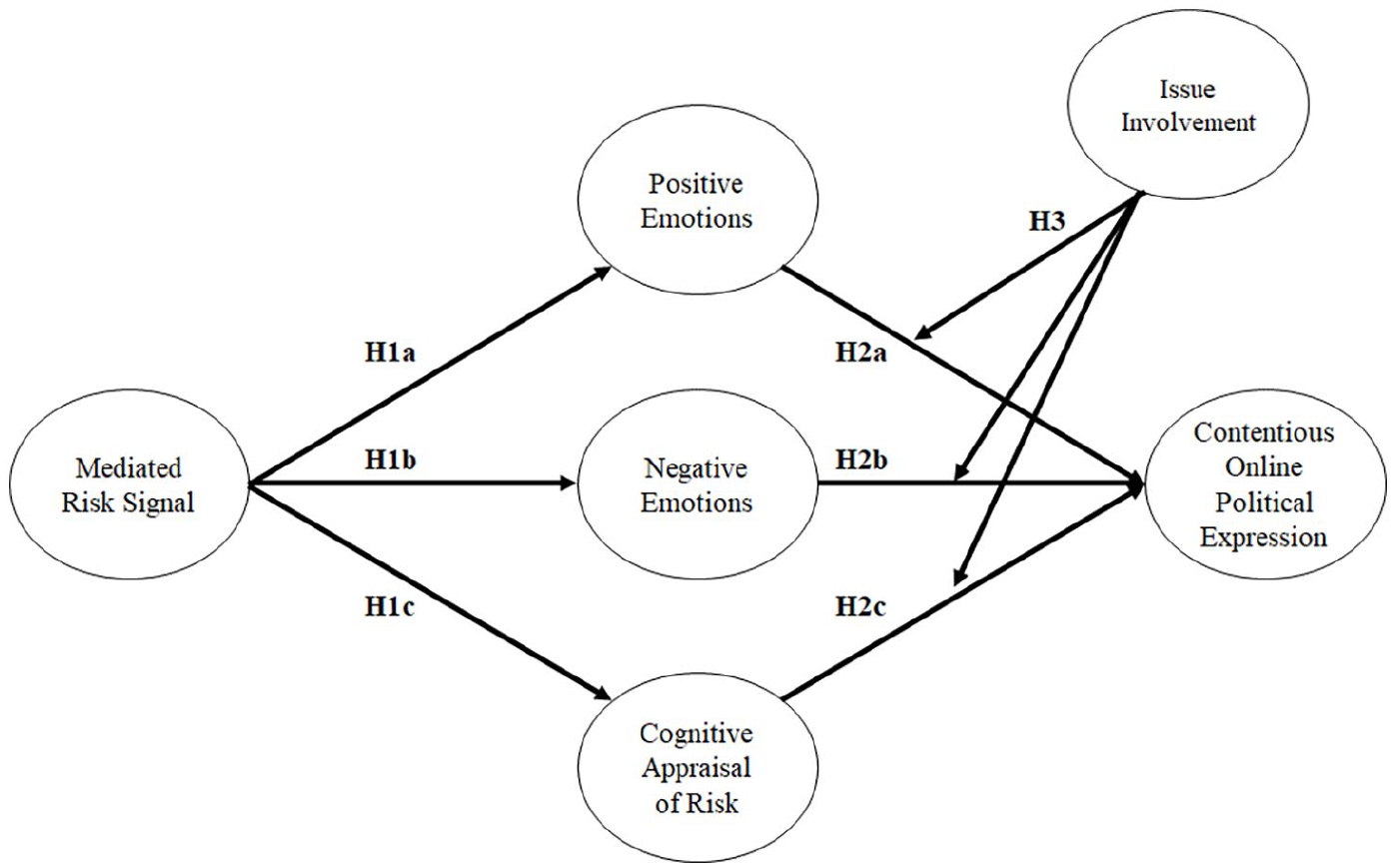
Theoretical model.
Method
Study context
Russia provides an optimal study context to explore the uncertainty and risk associated with COPE. Since a wave of social media protests in 2011, the Russian government has created legislation and regulations that erode the freedom of online speech and substantially increase the risks of contentious online expression (Freedom House, 2021; Lonkila et al., 2019; Nisbet et al., 2017; Van der Vet, 2019). These legal changes have led to a nearly 40% increase in the number of criminal cases or threats of charges being brought due to online expression or activity from 2016 to 2017 (Freedom House, 2018). As of 2019, the Russian government was imprisoning their citizens for online activities at the rate of one every 8 days (Freedom House, 2021). In 2022, Russia’s invasion and war on Ukraine further intensified online repression with severe penalties for any Russians who share or post online information about the war that is inconsistent with Russian government propaganda or criticize state institutions (Jack, 2022).
We evaluate our hypotheses within the context of COPE about Russian governmental corruption. Corruption has become the major political issue about which the political opposition, led by jailed opposition leader Alexei Navalny, has mobilized around for the past several years (Dollbaum, 2020). The cycle of COPE and digital repression has continued with additional online and offline anti-corruption protests throughout Russia during Winter and Spring 2021 that were inspired by the release of an online anti-corruption documentary about President Putin’s “palace” (Dixon, 2021). This burst of protest activity was again followed by a series of crackdowns and repressive measures against online activists by the government (Freedom House, 2021).
Data collection and study design
We conducted a self-administered Russian-language web survey, approved by an American university IRB, with adults over the age of 18 who live in Russia recruited through a Russian online commercial opt-in panel contracted by Qualtrics (see Supplemental Appendix B for descriptive statistics and Supplemental Appendix D for additional information on data collection). The data collection occurred between 16 and 21 April 2018. Hence, it started approximately 1 month after Vladimir Putin’s Presidential Election victory and 3 days after the blocking of Telegram for failing to comply with the government’s user data requests. In almost 2 weeks after the survey was completed, the reactions against the Telegram ban resulted in mass protests in Moscow against the government’s curb on Internet freedom (Roth, 2018).
A post-test only, between-subjects experiment was embedded in the survey to demonstrate the influence of available risk signals about government repression on perceived risk of, and engagement in, COPE with the final sample containing 951 valid cases. The risk signal was manipulated by having respondents read a fabricated online news story about protesting corruption on social media that supposedly appeared on Interfax News Service, a Moscow-based independent major news agency, approximately 1 week prior to the survey. Both the questionnaire and stimuli were edited and translated by a former Russian journalist who holds university-issued translator certificate.
Participants were informed that the study was about their social media and online news habits and were told to answer questions about a randomly selected online news story as part of a digital journalism project. The sponsor of the study, an American university, was not disclosed to respondents to avoid possibility of response bias, but participants were informed at its conclusion and allowed to withdraw their data if desired. Respondents were randomly assigned to experimental conditions inducing affective and cognitive risk perceptions about COPE by reading a news story reporting severe government repression (N = 477) or the lack thereof (N = 474) (see Supplemental Appendix D for experiment details). Treatment conditions started with a paragraph reminding respondents about the spring 2017 protests against government corruption and questioned whether their anniversary would also trigger a new wave of protests remains unknown. Then, we introduced the manipulations via specific article and section headings, as well as informational and visual content. Following the treatment, respondents were asked about their perceived risk of, and intention to engage in, COPE about government corruption.
Measures
For risk signal, we created a dummy variable with 1 indicating assignment to a condition with severe governmental response and with 0 indicating the lack thereof as reported in the news story. To construct our variables of anticipatory emotions toward COPE, the survey asked respondents how they feel about “posting about government corruption on social media sites or blogs” using a selection of emotions adopted from PANAS-X scales (Watson and Clark, 1999; Watson et al., 1988) on a 7-point scale. From the PANAS-X negative emotions scale we focused on the dimension that was most relevant to the study’s context of authoritarian risk signaling about COPE, the “fear” dimension. We selected five out of the six emotional measures—“afraid,” “frightened,” “scared,” “nervous,” and “jittery.” For positive emotions we selected five items that were relevant to COPE from the joviality, self-assurance, and attentiveness dimensions of the PANAS-X—“enthusiastic,” “determined,” “proud,” “strong,” and “confident” (see Supplemental Appendix G for factor loadings). We averaged the anticipatory emotion scores together to create measures of positive emotions (α = .92), and negative emotions toward COPE (α = .93).
We measured cognitive appraisal of risk by asking respondents to report how likely they think it is for someone like them to face a list of negative consequences for criticizing Russian authorities’ corruption on social media. Accordingly, we improve Dal and Nisbet’s (2022) measurement by more clearly comparing how emotions and cognitive appraisals are associated with COPE in networked authoritarian regimes. Adapted from the validated scales used in the Cognitive Appraisal of Risky Events questionnaire (Katz et al., 2000), our measure addressed the expected risk dimension of outcome expectancies by asking for the perceived likelihood of facing negative consequences. The negative consequences listed in the scale varied in terms of severity (see Supplemental Appendix A for item wording and Supplemental Appendix H for robustness checks concerning this variable) and were measured on a five-point scale averaged with higher likelihood indicating cognitive appraisal of greater risk (α = .93).
Following the risk components, we asked respondents’ intention to engage in COPE about corruption among the Russian government and political leaders on their most preferred social media outlet on a 5-point scale (see Supplemental Appendix A). A principal component analysis of the five measures indicated the loading on one factor that explained 81.16% of the variance and the items were averaged together with higher likelihood of COPE coded high (α = .95). Issue involvement was measured by averaging three items assessing the personal importance of government corruption to the participant, how much attention they paid to and the perceived need for activism targeted at governmental corruption (α = .74). In addition, we measured regime opposition, political efficacy, attention to political news and information, reliance on Russian TV and newspapers as well as frequency of both non-political and political posting on social media, others’ participation in COPE about governmental corruption (see Supplemental Appendix D) as well as age, sex, education level, and employment status as our control variables. Supplemental Appendices A and E provide item wording and explain our measurement, respectively.
Results
The goal of our experiment was to examine how mediating states (cognitive appraisal of risk, positive and negative emotions) stemming from exposure to a mediated risk signal influence participants’ likelihood to engage in COPE. As such, this type of study does not require a message manipulation check, but rather an assessment of significant variation in the mediating states across the different study conditions as expected (O’Keefe, 2003). Therefore, we conducted one-way analyses of variance (ANOVAs) confirming that the positive, F(1, 932) = 3.95, p < .05; negative emotions, F(1, 932) = 27.84, p < .001; and cognitive appraisal of the risk, F(1, 937) = 21.70, p < .001, significantly varied across study conditions in the direction desired. The effect sizes were small (d = −.35 for negative emotions, d = .14 for positive emotions, d = −.30 for cognitive appraisal of risk). This is most likely due to (a) the field experiment occurring in an authoritarian context where such risks are common and (b) a single brief treatment. Citizens in authoritarian contexts are bombarded daily with mediated risk signals from multiple sources about contentious expression and participation that likely have a large cumulative effect on attitudes and behavior (McGuire, 1992).
We employed a series of ordinary least squares (OLS) regressions to assess our hypotheses as well as moderated mediation analyses to test our full theoretical model as a post hoc test (Hayes, 2022). Confirming H1a, respondents in high-risk signal condition have weaker positive emotions (b = −.19, p < .05) toward posting about corruption on social media (Model 1). Political efficacy (b = .45, p < .001), political posting frequency (b = .19, p < .001), low levels of newspaper use (b = −.04, p < .05), as well as being male (b = .20, p < .05), younger (b = −.01, p < .05), and having low education (b = −.06, p < .05) are also significant predictors of feeling more positively about posting on the topic of corruption.
Testing H1b, exposure to a risk signal results in significantly greater negative emotions toward online political expression (b = .43, p < .001). As Model 2 shows, political efficacy (b = −.31, p < .001), regime opposition (b = −.17, p < .001), attention to news (b = .16, p < .01), as well as being female (b = .26, p < .01) and younger (b = −.01, p < .05) are also significant predictors.
Finally, as suggested by H1c, reading about harsh punishments imposed on activists is associated with significantly cognitive appraisal of a greater risk (b = .30, p < .001). Moreover, as per Model 3, regime opposition (b = −.23, p < .001), non-political posting (b = .06, p < .05), low political efficacy (b = −.12, p < .05), and being younger (b = −.01, p < .001) are other significant predictors of the cognitive appraisal of risk about COPE (Table 1).
OLS regressions predicting risk components and COPE.
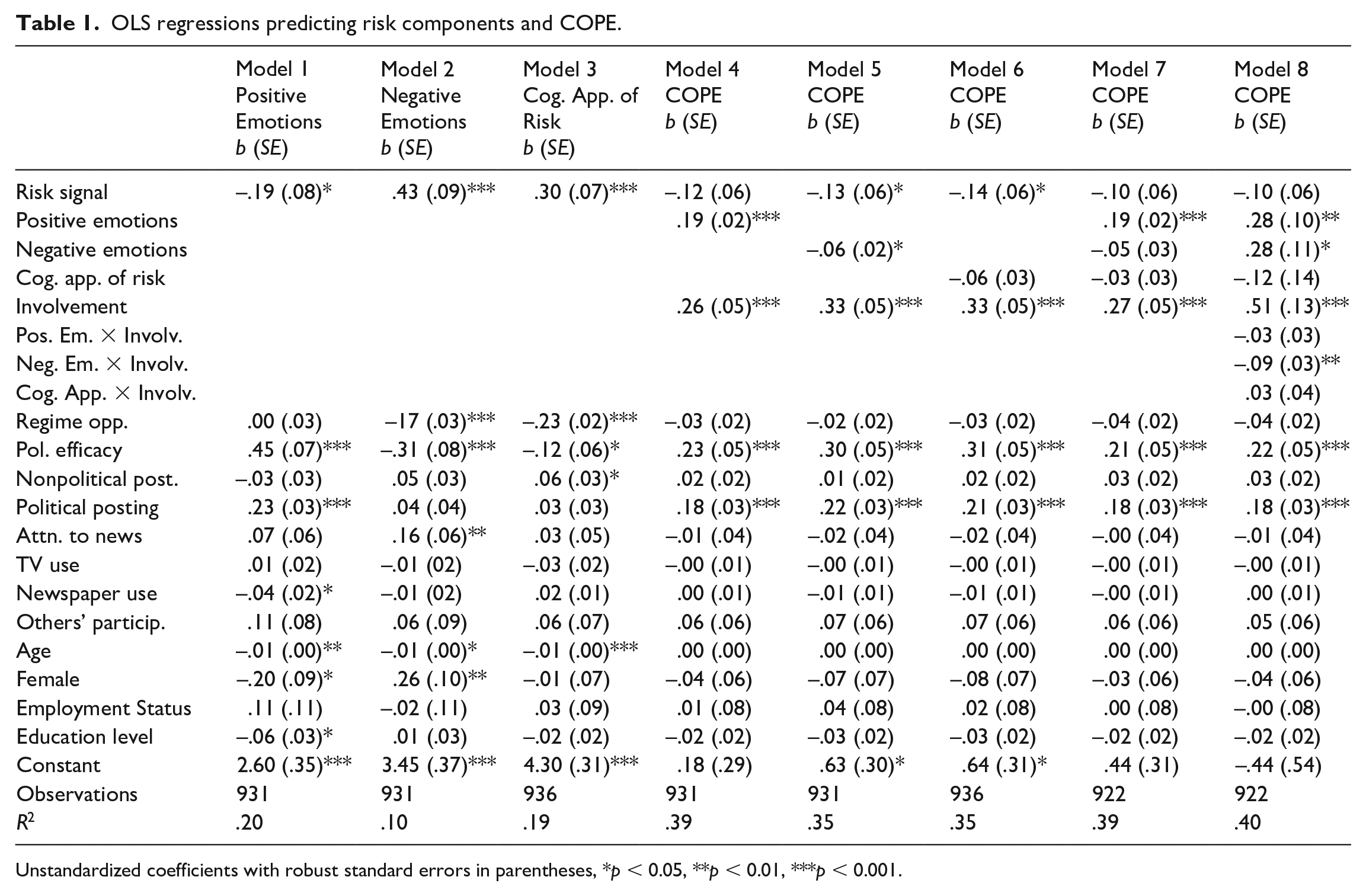
Unstandardized coefficients with robust standard errors in parentheses, *p < 0.05, **p < 0.01, ***p < 0.001
The next set of hypotheses focuses on risk perceptions’ influence on the intention for COPE. We first entered positive emotions, negative emotions, and cognitive appraisal of risk separately (Models 4–6) from the regression predicting intention to engage in COPE. These models show that anticipatory emotions significantly predict COPE (b = .19, p < .001 for positive emotions; b = −.06, p < .05 for negative emotions) unlike the cognitive appraisal of risk (b = −.06, p = n.s.). Given that our theoretical framework supports having affective and cognitive risk components in the equation at the same time, we ran Model 7 with all three risk measures. The findings reveal that feeling more positively about COPE is associated with having greater intention for engaging in the behavior (b = .19, p < .001), confirming H2a. Political efficacy (b = .21, p < .001), political posting (b = .18, p < .001), and involvement with governmental corruption (b = .27, p < .001) also predict greater intention. As for negative emotions (H2b) and cognitive appraisal of the risk (H2c) there are no main effects on intention to engage in COPE when all three measures are in the model simultaneously. However, the test of moderation by involvement outlined below provides partial support for H2b.
The analysis for H3 tests whether the relationships between emotional and cognitive risk components and the intention for COPE vary by levels of issue involvement. We find that involvement is a significant moderator for the relationship between negative emotions and behavioral intention (b = −.09, p < .05) whereas the moderation is not significant in the case of positive emotions (b = −.03, n.s.) and cognitive appraisal of risk (b = .03, n.s.). Graphing the interaction (see Figure 2) reveals that only the slope for high involvement (i.e. one standard deviation above the mean) is significant (b = −.14, p < .001). Namely, while greater negative emotions significantly reduce intention for COPE for individuals that are highly involved with the topic of corruption, they do not have a significant influence on those who report a mean or low (i.e. one standard deviation below the mean) involvement.
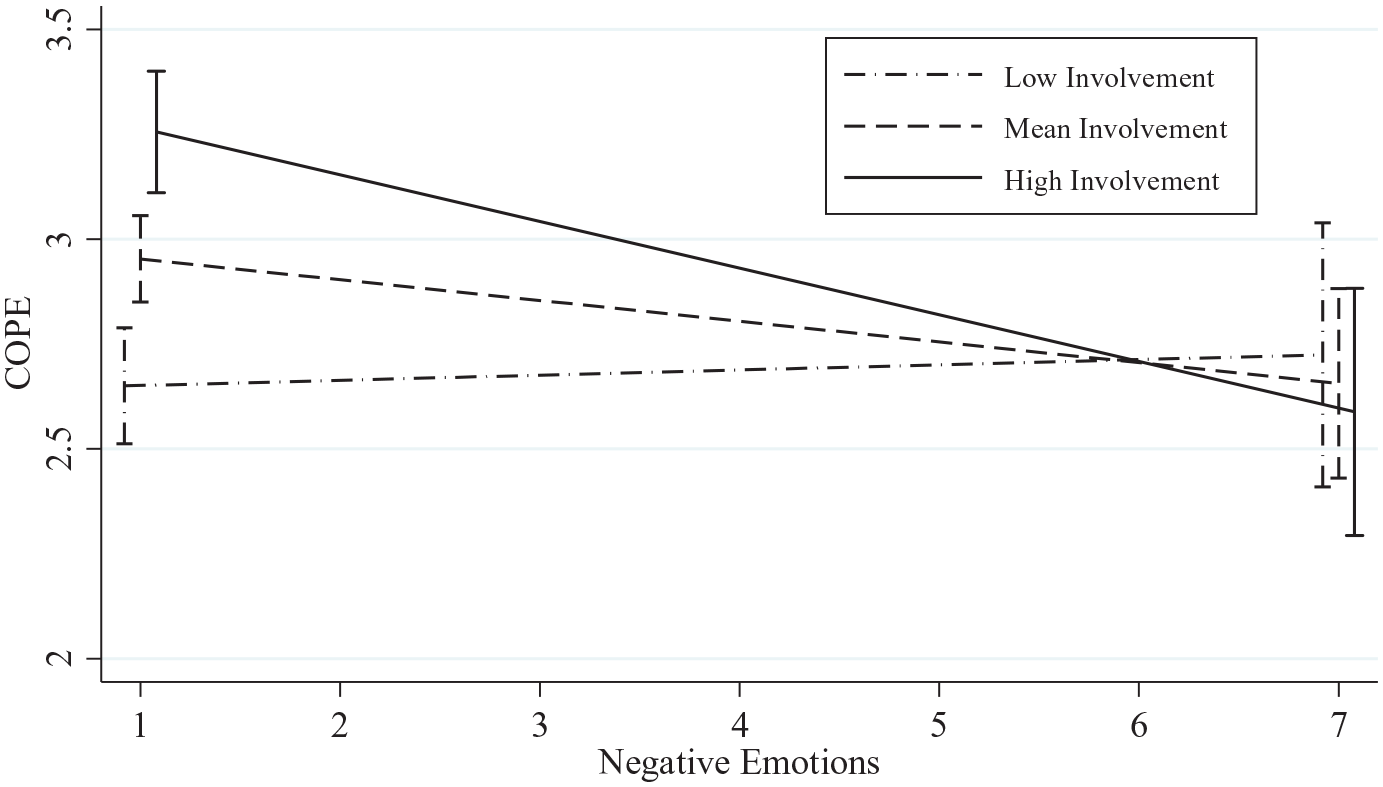
Effect of negative emotions on intention for COPE conditional on involvement (95% CIs).
In addition, as a post hoc analysis, we assess for indirect effects of exposure to either a high or low-risk signal condition on the intention for COPE by way affective and cognitive risk perceptions. We estimate a mediation model with all risk components using PROCESS in SPSS (Hayes, 2022). The macro tests each step in the models through sequential regression analyses and bootstraps samples for 10,000 times with 95% confidence intervals. Our analyses reveal a significant indirect negative effect of reading about government repression on COPE intention by diminishing positive emotions associated with expression (b = −.03, p < .05, 95% confidence interval [CI] = [−.07, −.00]). However, neither negative emotions (b = −.02, 95% CI = [−.05, .00]) nor cognitive appraisal of risk expression (b = −.01, 95% CI = [−.03, .01]) serve as a mediator between exposure to risk signals and COPE intention.
We further investigate whether the interaction we find in relation to H3 is part of a moderated mediation between exposure to risk signal and intention for COPE via negative emotions associated with the behavior. Employing the PROCESS macro (Model 14), we find that for highly involved individuals, exposure to a high-risk signal has an indirect negative effect on the intention for COPE through greater negative emotions associated with the behavior (Index of Moderated Mediation [IMM] = −.04, p < .05, 95% CI = [−.08, −.01]). In contrast, we do not observe any moderated mediation via positive emotions (IMM = −.00, 95% CI = [−.00, .02]) or cognitive appraisal of risk (IMM = .01, 95% CI = [−.02, .04]).
Discussion
Understanding the tug-of-war between governments and aggrieved citizens around online mobilization requires more than knowing what networked authoritarian governments are doing to suppress online political activism. In this regard, how ordinary citizens process and respond to their government’s restrictive and repressive strategies informs our understanding of the communicative dimensions of networked authoritarians from a citizen-centric perspective.
In this study, we contribute to our knowledge on what happens at the individual level versus the repressive strategies used against ICTs’ contentious capacity. We achieve this by stressing a previously unaddressed theoretical connection between risk signals and citizens’ judgment and decision-making processes with respect to a low-cost, but high-risk, COPE in a networked authoritarian context. By simulating mediated risk signals about authoritarian regime repression against those who may engage in COPE, though both cognitive and affective dimensions of risk are activated, we determine that it is the “risk-as-feelings” pathway that drives contentious online speech rather than “risk-as-analysis.”
We reveal two different pathways by which mediated risk signals about the consequences of COPE influence behavior. The first is through dampening positive feelings about COPE, which in turn reduces the likelihood of engaging in it. The second pathway is through negative feelings and is contingent upon one’s level of involvement. At low to average involvement, negative emotions have no effect on the likelihood of engaging in COPE. However, among those highly involved—who are potentially most likely to engage in contentious activism against a networked authoritarian regime—negative emotions significantly reduce the likelihood of expression. In contrast to positive and negative emotions, we found no significant relationship between cognitive appraisal of risk and likelihood to engage in COPE. The study results, therefore, indicate that overall positive and negative feelings about COPE influence risky behaviors more so than cognitive appraisals—consistent with the risk-as feelings framework.
Putting it all together, these findings show that for low-cost behaviors such as COPE, affective drivers may be more influential than those that are cognitive in dealing with potential risks. The reason may be that affective associations are more easily and quickly retrieved at a “lower cost” than more deliberate, cognitive processes –matching the “lower cost” of COPE as compared with “higher cost” of contentious behaviors such as street protests. Furthermore, we find those individuals with high issue involvement, and are most likely to engage in online mobilization, are demobilized by risk signals amplifying negative emotions. This inducement of citizen passivity and diminished online dissent is the logic and goal of networked authoritarianism.
Methodological considerations
This study addresses some of the methodological weaknesses of previous survey work examining risk perceptions and online expression (e.g. Dal and Nisbet, 2022) through an experimental design focused on a specific expression context (i.e. corruption) and more comprehensive measurement of risk perceptions that in total provides greater internal validity and causal leverage. However, there are limitations to be noted as well. Our online experiment excludes individuals who completely refrain from using the Internet as a risk response. After all, our participants may be individuals who already exhibit greater tolerance toward the risk of being punished for online activism. This potential self-selection bias may have resulted in those who are less tolerant toward such risk being underrepresented among study participants. Although, at the same time, this bias would be associated with an under-estimation of the effects of risk signals and cognitive and emotional responses on behavior, indicating the results may be conservative in magnitude.
Another limitation is the measurement of intention instead of behavior. Although difficult in highly repressive contexts, future experimental designs may seek ways to measure actual expression on social media in the presence of manipulated risk signals. In addition, we would like to acknowledge a limitation to our post hoc analysis of the interaction between involvement and risk perceptions as we cannot statistically rule out the possibility that the relationship between involvement and COPE may be moderated by negative emotions, rather than the other way around. Our research design did not experimentally manipulate this aspect of the study and thus we recommend future scholarship attempt to untangle the directionality of this relationship.
Implications and future directions
The rise of the Internet and social media as platforms for contentious expression and mobilization has changed the threat matrix globally for authoritarian regimes globally as mobilized citizens have become the primary source of their downfall rather than elite-driven coups (Kendall-Taylor et al., 2020). In this context, our study adds to our understanding of the psychological, primarily emotional, levers underlying the growing range of digital repression strategies that authoritarian regimes use to repress COPE and political mobilization by their citizens—ranging from high-profile, selective prosecutions of online dissent (e.g. Jack, 2022) to comprehensive systems of rewards and sanctions employing “social credit” (Liang et al., 2018). From a practical standpoint, this implies that if positive feelings associated with online political activism are strong enough, the threatening capacity of the punishments imposed by governments remains limited. Likewise, demonization and criminalization of online political activities may also mean that government supporters, too, may feel less positively about online political expression, and thus, become less visible in online spaces. However, if digital repression leads to a passive online citizenry among supporters and opponents of a regime alike, that is consistent with the control logic of authoritarianism and likely considered a “win” by authoritarian governments.
Hence, from an activism perspective, the dominance of affective risk components can be quite promising for understanding online mobilization and counter-repression strategies. As seen previously in the Arab Spring (Pearlman, 2013), whether the dominant feelings citizens associate with activism are either emboldening or dispiriting plays a significant role during the mobilization. Our study demonstrates that even in a highly repressive networked authoritarian context like Russia the salience of risk signals makes a difference. That is, the salience of government repression about a specific grievance or topic shapes how they feel about engaging in contentious online political expression about it. This provides guidance on what topics are most readily available for online mobilization. This primacy of affective factors means strategic messages countering mediated risk signals about online expression should be highly emotive and saturated with affective cues, rather than provide detailed information aimed at deliberative, systemic processing.
Another question that arises is how risk signals and citizen risk perceptions influence risk mitigation behaviors such as the use of virtual private networks (VPNs), employing subtle memes or contentious cues, or migration away from using more open social media platforms to end-to-end encrypted messaging apps. In other words, an outcome of risk signaling about COPE may not only be quantitative changes in online expression, but also qualitative changes in content, technology, and platform use that may vary across a range of individual differences (e.g. privacy literacy). As the use of circumvention technologies is increasingly globally across a range of country contexts, our study provides interesting pathways for future research on psychological and contextual factors that may lead to their adoption.
This makes investigating how governments selectively respond to online activism about different issues important for future research (i.e. strength and nature of a risk signal) may be an important contextual factor for understanding why and how much citizens in digitally repressive environments engage in online political expression and activism. For instance, a March 2018 Russian law created fines and jail time for publishing online content disrespecting society or insulting the officials exercising state power (Kravchenko, 2019). Subsequently, in August 2019 online protestors used the hashtag “#thievesinpower” to link the issue of corruption to how garbage contracts were abused by officials, causing widespread landfill problems (Baranovsky-Dewey, 2019). In the context of risk signaling, thus, a discrepancy between what the law says versus to what extent it is enforced against protestors may potentially encourage social media users to openly associate officials with corruption despite the “risk” of being prosecuted for insulting them. Likewise, others’ participation in online activism, which we used as a control variable in our study, should be further investigated as the congruence between repression and citizens’ response may amplify or attenuate the risk signal.
In sum, this study expands the scope and breadth of the psychometric paradigm of risk by understanding that risk perceptions underlie much of our everyday behavior—including online expression. By integrating theories of risk and decision-making with that of online political behavior we are able to provide a more comprehensive model of what drives low-cost, high-risk online contentious behavior in networked authoritarian contexts. The study results indicate that affective responses, especially among the most involved, rather than cognitive appraisals of risk, influence decision-making in this context. The results also provide insights on how both authoritarian regimes and pro-democracy organizations may each influence these affective responses through communicating risk signals as means to either repress or encourage online activism—demonstrating once again that social media are simultaneously technologies of liberation and control.
Supplemental Material
sj-docx-1-nms-10.1177_14614448221135861 – Supplemental material for Signaling silence: Affective and cognitive responses to risks of online activism about corruption in an authoritarian context
Supplemental material, sj-docx-1-nms-10.1177_14614448221135861 for Signaling silence: Affective and cognitive responses to risks of online activism about corruption in an authoritarian context by Aysenur Dal, Erik C. Nisbet and Olga Kamenchuk in New Media & Society
Footnotes
Funding
The author(s) received no financial support for the research, authorship, and/or publication of this article.

Supplemental material
Supplemental material for this article is available online.
Author biographies
References
Supplementary Material
Please find the following supplemental material available below.
For Open Access articles published under a Creative Commons License, all supplemental material carries the same license as the article it is associated with.
For non-Open Access articles published, all supplemental material carries a non-exclusive license, and permission requests for re-use of supplemental material or any part of supplemental material shall be sent directly to the copyright owner as specified in the copyright notice associated with the article.
