



Abstract
Grounded in the conceptual frameworks of protest framing and digital repression, this study examines the adaptive messaging strategies employed by Vietnamese environmental activists in response to escalating repression, through physical coercion, across two key periods: before and after mid-2021. Our analysis of the Facebook content of one of Vietnam’s leading environmental groups indicates significant changes in the group’s adoption of protest frames, topical frames, and narrative roles, highlighting how activists balance public engagement with safety under authoritarian constraints. Specifically, after a wave of arrests of high-profile environmental activists, activists shifted their message framing strategies from motivational to diagnostic, focusing more on information provision rather than encouraging public engagement. In addition, after the arrests, activists increasingly shifted their narrative roles, increasing their blame on corporations as villains, while positioning the environment as a primary victim. This study enriches our understanding of digital activism in authoritarian contexts, offering theoretical insights and practical guidance for movements under similar constraints.
Keywords
Social media has been seen as a catalyst for expanding the public sphere, especially in authoritarian countries where mainstream media is under strict government control (Howard & Hussain, 2012; Yasseri et al., 2016). While it offers platforms for dissent and organization around shared causes (Bennett & Segerberg, 2012), authorities routinely monitor online activities and target activists offline (Deibert, 2019), challenging the notion of social media as a free and open space for social and environmental movement campaigning. This duality requires activists to adjust their campaigning strategies to sustain their movements while avoiding backlash, as they navigate between digital and physical realms (Tufekci, 2017; Yasseri et al., 2016).
Vietnam serves as a compelling testbed for examining these theoretical issues. Until the mid-2010s, the country experienced relative openness, allowing social media to become a critical arena for activism and public dialogue (Bui, 2016). This period enabled significant social movements, often with tacit blessing from authorities (Luong, 2021; Thayer, 2009). The Vietnamese party-state has always kept a wary eye on civil society’s potential to challenge its authority, however (Morris-Jung, 2015). This caution led to tighter control over public discourse from 2016 onward, especially after conservatives consolidated power within the ruling Communist Party (K. G. Nguyen & Luong, 2023). A critical shift in Vietnam’s repression tactics occurred in mid-2021, marked by a wave of high-profile activist arrests. This escalation from digital surveillance to physical coercion highlights the intensification of state control, making the pre- and post-mid-2021 periods pivotal for understanding how Vietnamese activists navigate these escalating constraints. By analyzing how environmental activists strategically adapt their framing across this period, this study provides insights into the changing landscape of repression in Vietnam.
Scholars in this field have proposed the broad theoretical concept of digital repression to explain the shifting environment composed of digital technologies and platforms, highlighting the complexities of interactions that transcend both online and physical spaces (Earl et al., 2022; Feldstein, 2021). This concept offers nuances to understanding strategies that repressors may adopt in dealing with social movements. However, little is known about how these strategies influence the framing of movements and the collective action discourse activists employ in their campaigns. This is the goal of this research.
Drawing from several theoretical concepts, including digital repression, protest framing, and narrative role, rooted in the broader areas of political sociology and environmental justice (Schlosberg, 2007), this study explores how Vietnamese environmental activists navigate their advocacy campaigns amid escalating digital repression. This research addresses a gap in understanding their strategic framing within an authoritarian context. It analyzes how activists craft messages that resonate while avoiding repression, highlighting the adaptability of social movements under restrictive regimes. Using social movement framing theory (Benford & Snow, 2000), the study examines Facebook posts from a key activist group in Vietnam, focusing on the protest and topical frames activists employ to spearhead the framing of their environmental movements. This research underscores the importance of strategic communication for advocating change in restrictive environments and enhances the understanding of digital activism.
Vietnam’s Surging Environmental Challenges Amid Economic Expansion
Since implementing the “Doi Moi” reforms in 1986, Vietnam has notched up remarkable economic growth, with gross domestic product (GDP) per capita rising from under $600 in 1986 to nearly $3700 by 2024. The country has consistently maintained an average annual GDP growth rate of 6% to 7% over the past few decades, reflecting its transition from one of the world’s poorest nations to a middle-income economy (World Bank, 2024). This transition has spurred the development of a robust private sector and rapid industrialization (Revilla Diez, 2016). The private sector in Vietnam has become a significant contributor to the national economy, accounting for nearly 45% of the country’s GDP as of 2023. This sector also plays a crucial role in generating employment, providing about 85% of jobs in the country (Viet Nam News, 2024).
However, these economic developments have not been matched by comprehensive environmental protections, uncorking numerous environmental challenges (McElwee, 2012). Chief among them: The rapid expansion of Vietnam’s private sector, particularly in real estate and natural resource exploitation, has driven significant deforestation and environmental degradation, exacerbated by deregulation and reduced state oversight. This rush to exploit resources has intensified conflicts between private enterprises and local communities, highlighting the challenges faced by a developing nation amid rapid industrialization (McElwee, 2012). This dynamic also influences the government’s approach to handling dissent, particularly when environmental issues are at stake, as the state must balance economic interests with growing public demand for environmental accountability (Kerkvliet, 2019).
The economic growth in Vietnam has not only elevated income per capita but has also catalyzed the emergence of a middle class that is increasingly attuned to environmental sustainability. This mirrors trends in other developing nations, where economic growth comes with heightened public concern for environmental protection (OECD, 2020). Simultaneously, the country has witnessed a marked rise in environmental protection movements, fueled by an expanding middle class and the proliferation of social media. These platforms have fostered a more vocal and organized form of digital activism, amplifying environmental issues and garnering substantial public support. This growing momentum has, in turn, pressured both the government and the private sector to take ecological concerns more seriously (T.-D. Nguyen & Datzberger, 2018).
The Role of Social Media in Facilitating Online Environmentalism
In a country where the mainstream media are under strict government control, the internet and social media have become vital platforms for public discourse, allowing Vietnamese citizens to express views, air grievances, and rally around environmental causes (Bui, 2016). Facebook is the most popular platform with more than two-third of Vietnam’s population (73 million) being active on this social media site (DataReportal, 2024). Contrary to Western media portrayals of Vietnam as intolerant of public criticism, the authorities have managed online and offline criticism with a calibrated mix of toleration, responsiveness, and repression (Kerkvliet, 2019; Luong, 2022). The Vietnamese party-state also uses social media as a tool to monitor public opinion, identify corrupt activities by local officials, communicate its own messages to the tech-savvy population, and regulate the dissemination of other information (Luong, 2022).
Social media’s rise in Vietnam has aligned with shifts in political opportunities. The early 2000s saw increased public protests, driven by new communication technologies. In 2007, public protests successfully halted the privatization of a major park in Hanoi, marking a significant moment for collective action (Wells-Dang, 2010). Other high-profile cases of environmental activism attest to the growing power of social media in Vietnam. The anti-bauxite mining movement in 2009, spearheaded by intellectuals and activists, utilized digital platforms to oppose government plans in the Central Highlands, raising awareness about environmental exploitation (Thayer, 2009). In 2016, the anti-Formosa protests marked a significant moment in Vietnam’s digital activism history. After a toxic discharge from the Taiwanese-owned Formosa Plastics steel plant, public outrage surged on Facebook, sparking large-scale protests that pressured the government into taking action and led to Formosa paying substantial damages (Nguyen-Van-Quoc & Trell, 2024). Overall, the 2014–2016 period has been considered the crescendo of Vietnam’s digital activism.
Several Facebook pages have been instrumental in rallying public support for environmental protection in Vietnam, raising awareness and, at times, achieving tangible results in curbing harmful development projects. Chief among these is Save Tam Dao, a movement founded on October 7, 2018, to oppose a large-scale hotel project by the Sun Group within Tam Dao National Park. This development, promoted as eco-tourism, posed significant risks to the park’s protected areas, raising concerns about deforestation and ecological damage. The campaign began in August 2017, when members discovered the project plans during a mountain-climbing trip, exposing extensive tourism-focused development on forest land. Despite ongoing efforts by Save Tam Dao, the project continues to move forward. Nevertheless, the campaign has substantially raised public awareness and highlighted the need to prioritize conservation over commercial exploitation. Other Facebook-based movements have similarly sought to protect Vietnam’s natural sites, often leading successful efforts to halt projects threatening national treasures. Together, these movements illustrate the powerful role of social media in mobilizing Vietnamese citizens around conservation issues, filling a critical gap where traditional state-controlled media typically avoids contentious environmental topics.
Although these pages were created for specific campaigns, they have actively advocated against the commercialization of Vietnam’s natural gems, with the root causes often identified as a combination of corporate greed and corrupt authorities. While state news media in Vietnam tend to avoid directly confronting authorities, social media platforms provide activists the space to inform the public about these projects (Bui, 2016). The ruling Communist Party of Vietnam (CPV), wary of public criticism, typically resorts to repression, using both legal and extralegal measures to suppress dissent (Amnesty International, 2020). The CPV perceives civil society as a threat to its authority, especially given the country’s history of political mobilization (Morris-Jung, 2015). In response, it has employed both legal and extralegal measures to suppress activism, with the 2018 Cyber-Security Law serving as a prominent tool to control online dissent (Committee to Protect Journalists, 2018). The arrest of high-profile environmental activists began in mid-2021 and has persisted, with a total of six activists detained, the most recent case confirmed in September 2023 (Wee, 2023). As the cybersphere has become a battleground for ideological struggles between the state and civil society (A. N. Vu & Le, 2023), there remains a significant gap in the literature regarding the strategic messaging employed by civil society stakeholders in Vietnam, particularly in environmental advocacy. This study seeks to fill this gap by examining how environmental activists navigate the political landscape through strategic framing, contributing to the broader discourse on state-society interactions.
Digital Repression
Repression is often defined as actions taken by governments or powerful entities to control or suppress the behavior, thoughts, or speech of individuals or groups, frequently through coercive or violent means (Davenport, 2007). This can include tactics such as censorship, imprisonment, surveillance, and physical force, aimed at maintaining power and suppressing dissent or opposition. Earl’s (2003) prominent typologies of repression focus on traditional media, categorizing repression by (1) agent type (i.e. state or private actors), (2) its visibility (i.e. observable actions like political arrests versus unobservable actions such as anonymous threats), and (3) its form—either coercion (i.e. direct violence against protesters) or channeling (i.e. restrictive protest laws or permitting requirements).
As social movements increasingly adopt digital technologies, the repression landscape has evolved, necessitating new conceptualizations of repression and collective resistance. Earl et al. (2022, p. 1) define digital repression as “actions directed at a target to raise the target’s costs for digital social movement activity and/or the use of digital or social media to raise the costs for social movement activity, wherever that contestation takes place.” Physical coercion within this digital landscape includes arrests of bloggers, online surveillance, harassment of protestors online, and lawsuits against online activists. A review of the literature reveals a significant gap in understanding how digital repression, especially physical coercion, shapes message framing strategies. This study uses the case of environmental activism in Vietnam to explore how physical coercion influences framing tactics under conditions of escalating digital suppression.
Framing
Social movement framing theory is essential for understanding how movements construct and convey messages to mobilize support. According to Benford and Snow (2000), success of a movement hinges on framing issues to resonate with supporters, align with societal values, and counter opposing narratives. The concept involves three key components: diagnostic framing, prognostic framing, and motivational framing. Diagnostic framing identifies a problem, and attributes blame or causality (Snow & Benford, 1988). For example, in the “6,700 people for 6,700 trees” campaign in Vietnam, activists framed the government’s plan to cut down trees as an environmental and cultural issue (Duong et al., 2019). Similarly, faith-based organizations in the United States identified a “housing gap” as a major issue, blaming absentee landlords and economic neglect (Fitzgerald, 2009). Prognostic framing involves proposing solutions to the identified problem, outlining strategies, tactics, and objectives (Snow & Benford, 1988). For instance, in the Singapore protests against immigration policies, activists proposed solutions such as voting out the ruling party or urging the government to address concerns about overpopulation and job competition (Goh & Pang, 2016). Environmental non-governmental organizations (NGOs) use prognostic framing to advocate for policy changes (H. T. Vu et al., 2020). Motivational framing provides a call to action, including emotional appeals, moral imperatives, and incentives for participation. It seeks to galvanize individuals by highlighting the urgency of the issue and the moral responsibility to act (Snow & Benford, 1988). For example, online protests against Chinese government land expropriation used motivational framing to engage collective identity and agency, encouraging individuals to see themselves as part of a larger group capable of effecting change (Pu & Scanlan, 2012).
In recent years, social movements have increasingly relied on social media to mobilize support, frame messages, and navigate challenges. Platforms like Twitter and Facebook were instrumental in coordinating demonstrations and amplifying the voices of activists, which traditional media often overlooked or censored (Howard & Hussain, 2012). Nasution (2021), for example, highlights the #GejayanMemanggil movement in Indonesia, where social media was pivotal in shaping discourse, constructing collective identities, and mobilizing protest actions. This aligns with the findings of Tarafdar and Kajal Ray (2021), who analyzed the 2012 Delhi gang rape protests, demonstrating how social media facilitated the consolidation, expansion, and intensification of protest cycles. Wright (2020) examines the dynamics of collective action in digital spaces, exploring how movements like Digital Rights navigate opportunities and threats in advocating for internet freedom. Collectively, all these studies emphasize the evolving nature of social movements in the digital age, illustrating how essential digital platforms can be to mobilize public support and challenge established power structures across various contexts. In Vietnam, where government control over public discourse and media is extensive, activists must carefully craft their protest frames to resonate with the public while avoiding state repression. This study asks:
RQ1: What are the differences in the use of the three protest frames by environmental activists (RQ1a)? What are the differences in the use of protest frames (RQ1b) under the influence of digital repression (i.e. physical coercion)?
The choice of framing strategies by environmental activists in Vietnam is influenced by the need to communicate the multifaceted consequences of neglecting environmental protection. These movements reflect broader dilemmas faced by many developing countries, where the pursuit of economic growth is often on a collision course with environmental preservation. In Vietnam, rapid industrialization and urbanization have put immense pressure on natural resources, leading to conflicts over land use, resource extraction, and pollution (McElwee, 2012). As a result, environmental activists must navigate a complex landscape where their goals align with broader societal interests in sustainable development but often clash with powerful economic and political forces (T.-D. Nguyen & Datzberger, 2018).
In that context, the use of topical frames in online social movements is particularly insightful, as it reveals how these movements tailor their messages to resonate with diverse audiences and adapt to specific sociopolitical settings. By emphasizing particular themes or issues, topical frames enable movements to engage more effectively with their target audiences and adapt to changing circumstances (Mendelsohn et al., 2024; Törnberg & Wahlström, 2018). By strategically employing topical frames, social movements can highlight their cause, attract supporters, and challenge dominant narratives (Mendelsohn et al., 2024; Törnberg & Wahlström, 2018). For instance, Mendelsohn et al. (2024) found that variations in framing strategies are evident across different issues. In the U.S., immigration-related tweets often focus on humanitarian concerns, while LGBTQ tweets emphasize civil rights and equality. This adaptability highlights the importance of tailoring messages to align with the values and priorities of diverse audiences, enhancing the effectiveness of social movements in achieving their objectives. The #StopAsianHate movement leveraged moral framing to emphasize the protection of vulnerable groups and evoke empathy and action (Wang et al., 2024). Rathnayake et al. (2018) highlight how different topical frames on Twitter, such as #BlackLivesMatter and #AliveWhileBlack, serve distinct purposes within the movement against racial discrimination. #BlackLivesMatter emphasizes structural change, while #AliveWhileBlack focuses on personal narratives and coping with everyday racism, illustrating how topical orientation influences engagement and collective identity formation. In seeking to understand the nuances of topical framing strategies by environmental activists in Vietnam, this study asks:
RQ2: What are the differences in the use of topical frames by environmental activists (RQ2a)? What are the differences in the use of these topical frames (RQ2b) under the influence of digital repression (i.e. physical coercion)?
Narrative roles serve as powerful tools in the mobilization and motivation of audiences within social movements. By assigning specific roles such as heroes, villains, victims, and beneficiaries to various actors, movements craft narratives that resonate deeply with their audiences, making complex issues more relatable and emotionally engaging. These roles are not just symbolic; they provide a strategic framework that influences public opinion and fosters collective action (Polletta, 1998; Snow & Benford, 1988).
Heroes in social movements are often portrayed as morally upright individuals who embody the movement’s values and ideals. These figures are depicted as courageous defenders standing against injustice and oppression, which inspires others to join the cause, creating a sense of solidarity and shared purpose (Polletta, 1998). For example, in movements like the California Farm Worker Movement, leaders such as Cesar Chavez were framed as heroic figures, galvanizing widespread support and participation (Ganz, 2010). This strategic use of heroes within narratives helps to create a compelling moral framework that motivates collective action by appealing to the audience’s sense of justice and righteousness (Ganz, 2010).
Conversely, villains are depicted as the embodiment of systemic injustices that the movement seeks to address. By framing corporations, government entities, or other powerful actors as villains, activists highlight the moral and ethical failings of these entities, rallying people to the cause against these perceived threats (Jasper, 1997; Tarrow, 1998). Victims, in turn, evoke empathy and a sense of urgency, emphasizing the human toll of the issues at hand. This portrayal serves to humanize the cause, making it more compelling and motivating for the public to take action (Cheded & Hopkinson, 2021; Davis, 2002).
The use of narrative roles not only sustains the momentum of social movements but also enhances their ability to achieve social change. By connecting with the audience’s moral and emotional sensibilities, these narratives transform abstract issues into personal stories that resonate deeply, making the movement’s goals more tangible and relatable (Goodwin et al., 2001; Polletta, 1998). Given the centrality of these roles in shaping public perception and mobilizing support, it is essential to explore how Vietnamese environmental activists strategically deploy these roles on social media, particularly within a politically constrained environment. Understanding the evolution of these narrative roles in response to changing political conditions offers critical insights into how activists navigate repression while maintaining their campaigns. This context leads to the third, and final research question:
RQ3: What are the differences in the use of narrative roles on social media messages by environmental activists (RQ3a)? What are the differences in the use of narrative roles (RQ3b) under the influence of digital repression (i.e. physical coercion)?
Method
This study content analyzed Facebook posts from Save Tam Dao, arguably the most prominent and enduring environmental activist group in Vietnam. Created to oppose a large-scale hotel project in Tam Dao National Park, Save Tam Dao has amassed 23,000 followers, reflecting its substantial public engagement and impact. This page has consistently advocated against the encroachment of commercial projects on protected natural areas, raising significant public awareness and mobilizing sentiment in favor of conservation over commercial exploitation. Save Tam Dao has experienced occasional disruptions to its online presence, possibly linked to its environmental advocacy, leading to temporary shutdowns of its page. These interruptions underscore the challenges faced by environmental activists in Vietnam’s restrictive digital environment, highlighting Save Tam Dao’s resilience and commitment to maintaining public discourse on conservation issues.
The data collection timeframe (October 7, 2018 to January 31, 2024) was chosen because it spans from the page’s creation to the start of data collection for this study, allowing a comprehensive assessment of activists’ strategic messaging across both phases.
The data cleaning process involved several steps: duplicate posts were removed, and non-textual content such as images and videos were retained only if accompanied by captions or descriptions relevant to the framing analysis. This process resulted in a final sample of 902 posts. A codebook was adapted from previous studies on environmental activism on social media and refined based on qualitative assessments of the data primarily for coding development (Benford & Snow, 2000; Lück et al., 2018; Molder et al., 2022; H. T. Vu et al., 2020). It consisted of 14 items including those on protest frames, topical frames, as well as narrative roles. Most items were coded as either present or not present. After several rounds of pilot coding, codebook pretesting, revising, and training, two graduate students coded 200 randomly selected posts. Intercoder reliability tests using Cohen Kappa’s Alpha indicated acceptable agreements for all variables, with α values ranging from 0.73 to 0.91. One of the two graduate students coded the rest of the data.
Measures
The protest frame, adopted from Benford and Snow (2000), had four options including diagnostic, prognostic, motivational, and an option for “others.” Only one dominant protest frame was coded for each post.
Topical frames, adapted from Chu et al. (2023) were six items including health and safety, political accountability, sustainability and survival, grassroot activism, environmental watchdog and media advocacy, corporate influence and greed as well as an option for “others.”
Narrative role, adapted from Lück et al. (2018), consisted of five variables and an option for others. Those variables were hero, villain, beneficiary, victim, and becoming (a) crusader(s). For each of the variables, coders were instructed to select between several types of actors (e.g. non-human, government/politician, business, NGOs, individuals, celebrity/public figure, specific community, and/or others).
Analysis Strategy
To answer RQ1, which was about the differences in the adoption of three protest frames, chi-square tests were adopted to compare the overall use of the three variables (e.g. diagnostic, prognostic, and motivational). We also compared the use of these three frames between the two time periods representing prior to and after digital repression intensified.
To answer RQ2, which was about the differences in the presence of the topical frames, we also used chi-square for the comparisons between the overall use of these frames and that between two different time periods.
Similarly, to answer RQ3, chi-square tests were employed to compare the use of the overall use of narrative roles and that between the two time periods.
The protest and topical frame variables as well as the narrative role ones were recoded into binary (present = 1; non-present = 0). Because of the imbalanced distributions with some variables having only a few counts, we only performed statistical tests on those with 10 counts or more to avoid violation of chi-square assumptions (i.e. expected frequencies are smaller than five) (McHugh, 2013).
Results
Of the 902 posts from the Facebook page, 892 (98.9%) included a protest frame. Among the protest frames, diagnostic was most popular (452 or 50.1%); Motivational was second (348 or 38.6%); Prognostic was least favored (92 or 10.2%). But the motivational frame was the only one that saw a significant decline after mid-2021, dropping to 33.2% after mid-2021 from 43.2% prior to that. In answering RQ1a, Pearson’s chi-square test results indicated statistically significant differences in the use of the three protest frames, χ2(N = 892, df = 1) = 105.38, p < .001, between diagnostic and prognostic; χ2(N = 892, df = 1) = 586.18, p < .001, between diagnostic and motivational, and χ2(N = 892, df = 1) = 65.62, p < .001, between prognostic and motivational.
RQ1b was concerned with comparing the use of these three protest frames between the two time periods (see Table 1 for details about descriptive data). Results from a Pearson’s chi-square test showed statistically significant differences in the use of diagnostic between the two time periods, χ2(N = 892, df = 1) = 15.49, p < .001. This means that diagnostic was used significantly more frequently after the start of the wave of arrests of high-profile environmental activists. Pearson’s chi-square test results did not show statistically significant differences in the use of the prognostic frame prior to and after the arrests, χ2(N = 892, df = 1) = 2.78, p < .095. This demonstrates that from the time Vietnam enacted the resolution identifying civil society as a destabilizing force to the regime’s legitimacy until the initial arrests of prominent environmental activists, there were no differences in the adoption of the prognostic frame between the two time periods. However, descriptive data showed a limited number of posts using this frame during both periods of time (61 times before mid 2021 and 31 times after that). Test results showed statistically significant differences in the use of motivational between the two time periods, χ2(N = 892, df = 1) = 8.97, p < .01. This means that the motivational frame was preferred by environmental activists before mid 2021, underscoring an era where activists could leverage a more open political climate to inspire collective action.
Use of Protest Frames Across Two Time Periods.

Note. Percentages for the three protest frames were calculated based on the total number of posts with a protest frame (892).
p < .001; **p < .01.
RQ2a asked about the use of topical frames in social media content from the environmental activist group. Descriptive data revealed that of the 902 Facebook posts, 875 (97%) used one of the six topical frames. The sustainability and survival frame appeared most frequently (36.1%). Political accountability grassroot activism was second (26.7%). Corporate greed & economic influence was third (20.6%). Grassroot activism was fourth (8.2%). Environmental watchdog and media advocacy was the second least popular (6.5%) posts. Health and safety appeared least frequently (1.6%) (see Table 2 for more details). Pearson’s chi-square test results indicated statistically significant differences between health and safety and political accountability, χ2(N = 875, df = 1) = 5.19, p < .05, and health & safety and sustainability, χ2(N = 875, df = 1) = 8.04, p < .01. The use of the political accountability frame differed significantly from that of sustainability, χ2(N = 875, df = 1) = 180.57, p < .001; grassroot activism, χ2(N = 875, df = 1) = 28.64, p < .001; environmental watchdog & media advocacy, χ2(N = 875, df = 1) = 22.26, p < .001; and corporate greed & economic influence, χ2(N = 875, df = 1) = 82.73, p < .001. Sustainability was present in the content significantly more frequently than grassroot activism, χ2(N = 875, df = 1) = 44.35, p < .001; environmental watchdog & media advocacy, χ2(N = 875, df = 1) = 34.47, p < .001; and corporate greed & economic influence, χ2(N = 875, df = 1) = 128.11, p < .001. Similarly, the grassroot activism frame was used significantly more than environmental watchdog & media advocacy, χ2(N = 875, df = 1) = 5.47, p < .05, and corporate greed & economic influence, χ2(N = 875, df = 1) = 20.32, p < .001. There were also statistically significant differences between the use of environmental watchdog & media advocacy and that of corporate greed & economic influence, χ2(N = 875, df = 1) = 15.79, p < .001.
Chi-Square Results of Topical Frame Use Across Environmental Activist Posts.
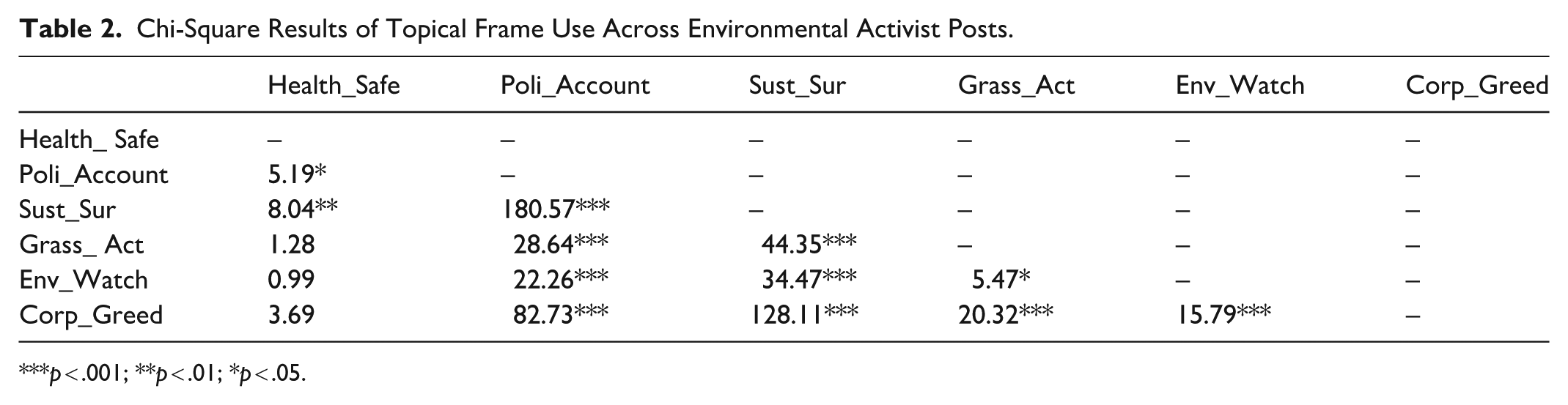
p < .001; **p < .01; *p < .05.
RQ2b was concerned with the differences in the use of topical frames prior to and after the arrests of high-profile environmental activists in mid-2021 (see Table 3 for details). Test results showed significant differences in the several topical frames between the two time periods. Health & safety, χ2(N = 875, df = 1) = 10.28, p < .001, and grassroot activism, χ2(N = 875, df = 1) = 12.53, p < .001, were used more frequently between 2016 and 2021. Corporate greed and economic influence were preferred after mid-2021 compared with prior to that, χ2(N = 875, df = 1) = 20.16, p < .001. Other topical frames did not see statistically significant differences between the two time periods.
Differences in Topical Frame Usage Before and After Arrests.

Note. Percentages = Numbers of topical frames divided by total numbers of posts published during the three time periods. Percentages may not add up to 100% due to rounding.
p < .001.
RQ3a was about the presence of five narrative roles (i.e. hero/heroines, villains, beneficiaries, victims, and becoming crusaders) being attributed to seven types of actors (i.e. non-human/environment, government/politician, business, NGOs, individual/public member, celebrity/public figure, and specific community) (see Table 4 for details). According to descriptive data, the two roles including Villain and Victim were attributed most frequently with Villain appearing a total of 355 times out of 706 times (50.3%) narrative roles were present in the content while victim appearing 259 times (36.7%). Other narrative roles were seldom used.
The Use of Narrative Roles by Environmental Activists Across Two Time Periods.
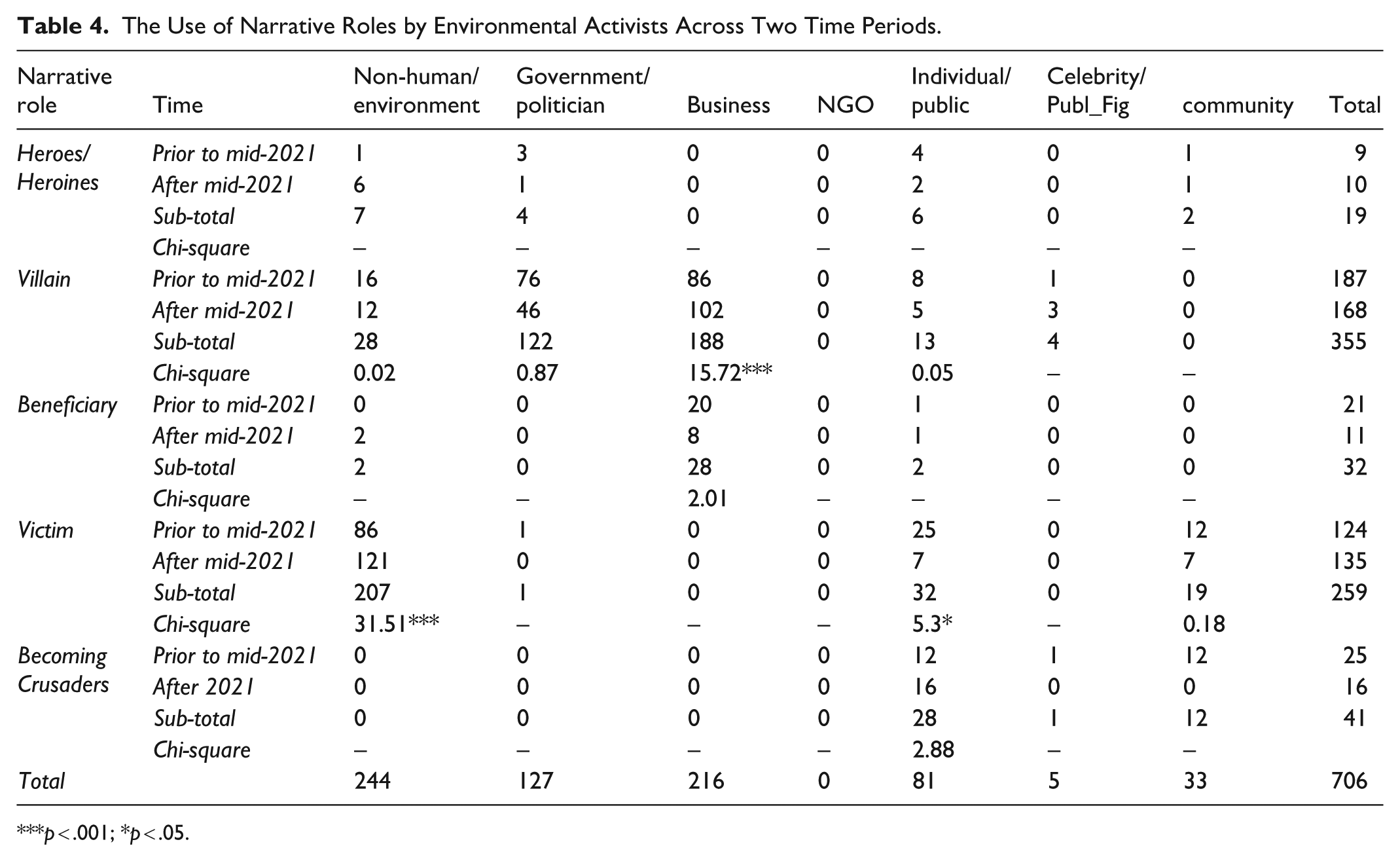
p < .001; *p < .05.
Of the seven types of actors, Villain was attributed most often to businesses with 188 times out of 355 (53%). This narrative role was attributed to government/politicians 122 times (34.4%), to non-human/environment actors (28 times, 7.9%), to individuals 13 times (3.7%), and to celebrity/public figures four times (1.1%). Pairwise comparisons using Pearson’s chi-square tests indicated this role was attributed to businesses significantly more frequently than to government/politicians were, χ2(N = 875, df = 1) = 37.15, p < .001, and to non-human/environment, χ2(N = 875, df = 1) = 7.61, p < .01. Villain was attributed to government/politicians significantly more frequently than to non-human/environment, χ2(N = 875, df = 1) = 4.52, p < .05.
Victim was attributed to nonhuman/environment 207 times out of 259 times this role was used (79.9%). It was attributed 32 times to individuals/public, 19 times to specific communities, and one time to government/politician. Chi-square test results showed statistically significant differences in the attribution of this role between nonhuman/environmental actor and individuals/public, χ2(N = 875, df = 1) = 9.88, p < .01, and between nonhuman/environment and specific communities, χ2(N = 875, df = 1) = 5.78, p < .05.
RQ3b was concerned with the comparison of the attribution of narrative roles to seven groups of actors between the two time periods: prior to and after the arrests of high-profile environmental activists. Pearson’s chi-square test results indicated statistically significant differences in the attributions of the roles to three groups of actors. Specifically, the villain role was attributed more frequently to businesses after the arrests, χ2(N = 875, df = 1) = 15.72, p < .001, compared with prior to those. The victim role being attributed to nonhuman/environment significantly more often after mid-2021 than before that, χ2(N = 875, df = 1) = 31.51, p < .001. On the contrary, before those arrests, the victim role was attributed to individuals/public more often than it was after those arrests, χ2(N = 875, df = 1) = 5.3, p < .05.
Discussion
This study explored the use of frames (e.g. protest and topical) and narrative roles by environmental activists in Vietnam, focusing on how escalating digital repression shaped their campaigns. By analyzing two key periods—before and after mid-2021—this study highlights how activists adapted their messaging to balance advocacy with safety concerns.
The findings indicate that while activists predominantly used diagnostic and motivational frames, their relative usage shifted significantly between the two periods before and after mid-2021. Prior to a series of arrests of environmental activists, the employment of diagnostic and motivational frames was nearly proportional. Motivational frames were more prominent during this period, likely because the political climate allowed for greater public engagement in environmental advocacy. However, after mid-2021, as physical coercion intensified, the motivational frame saw a sharp decline. This shift reflects a strategic response, as motivational appeals became riskier due to the increased likelihood of governmental repercussions. The diagnostic frame saw a significant increase after mid-2021. Activists likely turned to this frame as a safer strategy to inform the public without explicitly calling for actions. Perhaps, one reason for this shift is that state-owned media were unable to report on sensitive environmental issues, leaving activists to fill in the information gap. The prognostic frame was the least employed, likely due to the growing risks of proposing solutions in a repressive environment. Activists may have feared retaliation for suggesting alternatives to state policies or advocating significant changes to governance. This aligns with previous research, which indicates that proposing solutions in authoritarian regimes can be seen as directly challenging the ruling power, often leading to further suppression (Benford & Snow, 2000; Kerkvliet, 2019).
Our analysis revealed a significant shift in topical frame usage among activists, providing further evidence of a move away from frames that once promoted direct collective action. This is illustrated by the marked decline in the grassroots activism frame after mid-2021, a period coinciding with the arrests of prominent activists and intensified physical coercion. Previously essential to mobilizing public demonstrations, both motivational and grassroots frames saw sharp decreases in use as activists recalibrated their strategies under mounting repression. In contrast, the corporate greed frame notably increased after mid-2021. This shift likely represents activists’ strategic adaptation to escalating repression, where the deliberate villainization of corporations serves as an indirect critique of state authority. Perhaps, recognizing the dangers of directly challenging state power, the activists in our study appear to have strategically leveraged rhetorical approaches that target corporate negligence and framing grievances to implicitly critique state complicity while avoiding severe repression (Nguyen-Van-Quoc & Trell, 2023). This tactic of using corporations as proxies for authoritarian regimes extends beyond Vietnam. In Cambodia, grassroots movements confronting state-sanctioned land concessions similarly highlight foreign corporate wrongdoing to indirectly expose corrupt local elites (Young, 2020). Likewise, exiled Belarusian opposition activists pressured multinational corporations—such as potash giant Belaruskali—to cut economic ties with the Lukashenko regime, explicitly framing these businesses as integral components of state repression (Ekeløve-Slydal & Dale, 2022). Thus, this calculated focus on corporate villainization reflects activists’ broader strategic approach under authoritarian conditions—leveraging economic critiques as less politically provocative and safer alternatives to direct challenges against state power.
Similarly, the slight decrease in the use of the political accountability frame hints at the chilling effects of physical coercion. By reducing the use of the political accountability frame, activists sustained a critical narrative on governance without appearing to confront the regime’s core power structures. The prominence of the sustainability and survival frame adds another layer of strategic caution among activists. Remaining the most frequently used frame across both periods, this framing aligns with broader international conversations on sustainability. By positioning their advocacy within globally accepted environmental goals, activists lowered the likelihood of being seen as dissidents by the regime. Domestically, the focus on sustainability also plays into the regime’s own need to maintain legitimacy by addressing environmental concerns. Thus, activists navigated these complexities by adopting frames that both avoided direct political confrontation and resonated with the regime’s performative legitimacy goals.
Findings of this study revealed a nuanced shift in how activists attributed narrative roles as they adapted to escalating repression. The villain role was strategically adjusted: While businesses were consistently framed as villains, after mid-2021, this role was increasingly assigned to corporations, with government and political actors receiving less emphasis. This shift in narrative roles likely served to sharpen activists’ messages by clearly delineating moral boundaries and highlighting a specific antagonist—corporations—as the primary source of harm. The villain narrative explicitly evokes moral outrage and emotional solidarity among audiences. By personifying corporations as morally culpable actors, activists reinforced a collective sense of injustice and urgency without directly implicating political authorities, thereby maintaining a safer rhetorical strategy. Similarly, the victim role saw a significant change between the two periods. Prior to mid-2021, individuals and the general public were often cast as victims, emphasizing the human toll of environmental degradation. However, as physical coercion escalated, activists shifted to assigning the victim role primarily to non-human entities, such as the environment itself. This depersonalized framing—emphasizing abstract concepts like “the environment” or “ecosystems”—is likely a deliberate rhetorical strategy. By positioning the environment as an abstract victim, activists may indirectly channel citizens’ concerns whose voices are otherwise suppressed, safely evoking public empathy without provoking immediate state repression. This approach parallels broader practices observed in other authoritarian contexts, such as China and Russia, where activists similarly employ abstract, culturally resonant environmental frames to implicitly critique state policies and mobilize support without triggering direct political retaliation (Qiaoan & Saxonberg, 2025; Wu & Martus, 2021). Thus, activists strategically use depersonalized framing to balance the imperative of raising awareness and applying pressure with the necessity of maintaining political safety.
Ultimately, these nuanced framing shifts toward safer, less confrontational narratives observed among Vietnamese activists underscore a broader global pattern. Recent studies indicate that activists in authoritarian contexts consistently recalibrate their framing to minimize confrontation and repression. For instance, activists in China adopt culturally resonant, state-aligned rhetoric to appear constructive rather than oppositional, while grassroots movements in Russia deliberately emphasize apolitical, local civic issues, avoiding direct challenges to national political structures (Chen, 2021; Qiaoan & Saxonberg, 2025; Zhelnina, 2023). Similarly, Egyptian advocates under intense repression increasingly employ universal human-rights or socially acceptable cause-based frames to safely continue mobilizing support without explicitly confronting the regime (Magued, 2023). Vietnamese activists similarly adopted safer frames, yet their particular combination of corporate villainization and depersonalized environmental victimhood underscores how sociopolitical conditions uniquely shape activist framing strategies. This highlights a key theoretical insight: While framing adaptations under repression are broadly universal, specific rhetorical choices reflect distinct contextual opportunities and constraints.
Conclusion
This study underscores the adaptive strategies of environmental activists in Vietnam as they navigate digital repression. By examining shifts in frame usage and narrative roles across two distinct periods, this research contributes to our understanding of digital repression’s impact on activist messaging in authoritarian settings. The findings highlight how digital repression not only restricts individual freedoms but also reshapes collective action by steering activists toward safer, less confrontational frames that still engage public support.
The study offers both theoretical and practical contributions. Theoretically, it extends the concept of strategic framing, showing how activists recalibrate their frames and roles in response to authoritarian constraints. Practically, it provides a blueprint for activists in similar environments, showcasing how they can sustain advocacy while minimizing risks. These insights are invaluable for environmental and social movements operating under repressive regimes, offering lessons in resilience and adaptability.
The study has certain limitations. Relying solely on social media data may not capture the breadth of offline activism, and future research could benefit from incorporating interviews with activists to gain more nuanced perspectives. In addition, exploring the interplay between online and offline activism could deepen our understanding of how digital and traditional protest methods complement each other in restricted environments.
But overall, this research advances our knowledge of digital repression’s influence on activist messaging, demonstrating the resilience of environmental movements within authoritarian settings. By uncovering these adaptive framing strategies, the study adds to the growing discourse on digital activism, providing a foundation for future research and a model for movements worldwide navigating similar challenges.
Footnotes

Funding
The authors received no financial support for the research, authorship, and/or publication of this article.
Declaration of conflicting interests
The authors declared no potential conflicts of interest with respect to the research, authorship, and/or publication of this article.