




Abstract
News media are increasingly interwoven with social media platforms. Building on institutional theory, we trace the repercussions of the platform infrastructure inside a media organization by focusing on organizational discourses and practices in connection with the journalistic use of social media. The empirical material includes interviews, field notes, chat logs, and documents collected from a public service media organization during a 6-month on-site and virtual ethnography. The findings show how platform pressures intertwine with content production, audience representation, journalistic values, and organizational development, thus manifesting the infrastructuralization and institutionalization of platforms in the media industry. While the interviewees articulated tensions related to adopting social media, the fieldwork data revealed forms of mimetic and normative isomorphism, mediated by platform data and professional roles in the organization. Moreover, the platform infrastructure seems to cultivate both critical and aspirational talk in the organization, which implies a more complex relationship beyond coercive platform power.
Keywords
Introduction
Scholars have increasingly discussed the datafication and platformization of mediated practices, emphasizing the growing power of the platform giants in society, from media structures to everyday lives (e.g. Gillespie, 2015; Van Dijck et al., 2018). Digital media platforms, such as Facebook, Google, and Twitter, are argued to operate as infrastructures that shape societal action (Helles and Flyverbom, 2019; Plantin et al., 2018), and their power is manifested through the structural conditioning they impose on communication practices and related processes (e.g. Flyverbom and Murray, 2018; Van Dijck, 2014). Typical of these developments are the platforms’ subtle and institutionalized effects that become part of the accepted operating environment of individuals and organizations. Social media giants also strategically characterize themselves as platforms or technology companies to portray themselves as neutral actors and to escape regulation and social responsibility (Caplan and boyd, 2018; Gillespie, 2010; Napoli and Caplan, 2017).
In the context of media organizations, previous research has explored platforms’ role in shaping news distribution and audience measurement (e.g. Villi and Noguera-Vivo, 2017; Lehtisaari et al., 2018; Koivula et al., 2022; Chua and Westlund, 2022; Ferrucci, 2020; Hanusch, 2017; Walters, 2021; Zamith, 2018), investigated the dependencies and tensions between social media platforms and media organizations (Meese and Hurcombe, 2021; Nielsen and Ganter, 2018), and traced the broader infrastructural configurations and surveillance economy in the media system (Helles and Flyverbom, 2019; Turow, 2011). Overall, mediated by algorithms and data, platforms are intrinsically merged with the media system and mutually entangled with everyday media practices (e.g. Gillespie, 2015). Yet infrastructures of algorithms and data are often regarded as neutral necessities (Flyverbom and Murray, 2018), and their structuring role is not easily visible.
Following the proposals made by Napoli (2014) and Vos and Russell (2019), we turn to institutional theory from organization studies to conceptualize the ways in which platforms shape organizational and journalistic processes in news media. Institutional theory highlights how organizations adapt to the pressures of their external environment through rules, norms, and routines that lead them to restructure themselves by forced regulation or by imitating other organizations (DiMaggio and Powell, 1983; Meyer and Rowan, 1977). This process is known as isomorphism, which refers to the increasing similarity of actors or processes. A few works in journalism studies have used institutional theory to theorize how media organizations have adapted to the algorithmic systems of the platform society (Caplan and boyd, 2018; Napoli, 2014; Vos and Russell, 2019). The field, however, has only emerging empirical knowledge on the institutional structuring done by the platforms to practices in media organizations (cf. Koivula et al., 2022; Meese and Hurcombe, 2021; Nielsen and Ganter, 2018). Some recent studies have suggested that the earlier, rather gloomy picture drawn in research is perhaps not the whole story (Chua and Westlund, 2019, 2022; Lewis and Molyneux, 2018).
While existing studies have investigated similar patterns using interviews, we expand the understanding of the organizational and journalistic practices affected by the media–platform relationship using an ethnographic approach. We aim to trace the negotiations and tensions related to the platform infrastructure inside a media organization by following the strategic internal organization and related discussions in connection with the journalistic use of social media. Our empirical data were collected from a Nordic public service media (PSM) organization during a 6-month virtual and on-site ethnography and consisted of interviews, field notes, and chat logs. The studied network is a part of the large PSM organization with over 3000 employees, and it functions in a way that involves several departments and roles, from journalism to marketing and R&D. Using this versatile empirical data, we ask: How are the institutional pressures arising from social media platforms negotiated both discursively and through practices in a media organization? As our empirical data focus on social media used to disseminate journalistic products, we use the term social media platform(s) to refer to public social media services used for content distribution and audience interaction, such as Facebook, Instagram, and TikTok.
The article is structured as follows. First, we present literature that explores the power of platforms in the media sector and then connect platformization with institutional theory. After describing our data and method, we proceed to the “Findings” section, where we first describe the practices of the studied development network and then explain how three forms of institutional isomorphism are present in the discourses and practices of the network. Our findings support and expand earlier research by showing how organizational structures, content production, and audience relationships adapt to social media platform logic, in processes mediated by data and professional roles. Yet platforms also cultivate both aspirational and critical discourses in the organization, thus contributing to the development of media in more complex ways beyond issues related to content and distribution.
Power of platforms and the news media
The potential societal power of social media platforms has elicited public and academic discussions, most notably in the interdisciplinary field of platform studies. Scholars have discussed how platforms operate as infrastructures that shape and intervene in societal sectors (e.g. Gillespie, 2015; Van Dijck et al., 2018). Some parts of the literature focus on the hidden infrastructural forms of business ecosystems, company ownership, and even concrete technological structures (Plantin et al., 2018; Van Dijck et al., 2018), while others highlight the ways in which the sociotechnical environment generated by platforms enables and constrains the activities and expression of users—be it individuals or organizations—on those platforms (e.g. Gillespie, 2015). For example, studies have shown that platforms shape the processes of political communication (Kreiss and Mcgregor, 2018; Nelimarkka et al., 2020) and change the production and circulation of cultural content (Nieborg and Poell, 2018). As Van Dijck et al. (2018: 2) put it, platforms are “gradually infiltrating and converging with the institutions and practices through which democratic societies are organized.”
An expanding stream of research explores how social media platforms intervene in one democratic institution—the news media. Media content production and distribution have been shown to be strongly intertwined with the algorithmic system of social media platforms (Caplan and boyd, 2018; Bell and Owen, 2017), and some scholars suggest that established news media organizations have become dependent on the platforms (Caplan and boyd, 2018; Napoli, 2014; Nielsen and Ganter, 2018). Nielsen and Ganter (2018) showed that the relationship between media publishers and platforms (or “digital intermediaries” Facebook and Google) revolves around the tension between the operational opportunities offered by the platforms (e.g. larger reach, interactivity) and the more strategic question of dependency. Meese and Hurcombe (2021) showed in their industry-level interview study that these dependencies exist but change over time according to company and context. In particular, media companies readjust and diversify their strategies in response to changes in Facebook algorithms (see also Bailo et al., 2021). Studies have also focused on the changes in gatekeeping and distribution practices following the advent of social media (e.g. Villi and Noguera-Vivo, 2017; Larsson, 2018; Vos and Russell, 2019), showing, for example, how platforms intervene in the ways news reaches people through algorithmic systems (Haapoja and Lampinen, 2018; Toff and Nielsen, 2018).
The prevalence of platforms in content distribution has changed not only the practices of media users but also the journalistic work and ways to measure audiences. A specific feature of platforms, often discussed in connection with platform power, is their underlying principle of datafication—transforming features of social life and social interaction into data that can be quantified and measured (Van Dijck, 2014). This includes the practices of knowing, capturing, and representing audiences through data mining (Kennedy and Moss, 2015). While the measurement and management of audiences is a long-established practice in the media industry (Bolin and Andersson Schwarz, 2015), social media platforms and the data they provide add to the mixture (Zamith, 2018). Lawrence et al. (2018) showed that the question of audience interaction has transformed into a question of measurable engagement over digital platforms and virality. These transformations can have profound consequences: As analytics and audience metrics are widely used in newsrooms, they inform how journalists conceptualize their audiences (Tandoc, 2019; Zamith, 2018). Thus, the media industry seems to be burdened with a prevalence of metrics and an obsession with traffic (Petre, 2015) and relies on the quantitative prediction of its audiences (Bolin and Andersson Schwarz, 2015).
Existing research predominantly adopts a critical stance and highlights the power of platforms in shaping media and journalism. News media’s reliance on social media platforms has also led to attempts to reconfigure the relationship: Chua and Westlund (2019, 2022) introduced and empirically explored the concept of platform counterbalancing, suggesting that publishers are becoming keener on turning audiences into paying customers than driving traffic and digital advertising (see also Lewis and Molyneux, 2018). For PSM, platformization has raised additional questions about publicly funded organizations operating on third-party platforms. The European Broadcasting Union (EBU) and PSM organizations in different European countries have launched initiatives to translate their values and remits to online services, such as the PEACH algorithm, which is the first attempt to implement PSM-specific editorial values in automated media systems 1 or the BBC’s “responsible machine learning in the public interest” project (BBC, 2018). These developments signify efforts to lessen news media’s reliance on market-driven digital platforms, but as Bonini and Mazzoli (2022) noted, most are still at an early stage, and their viability is difficult to assess. In this study, we follow such developments and configurations on-site in a PSM organization and explore them from the perspective of institutional theory and isomorphism.
Isomorphism and the platforms
Institutional theory in organizational sociology refers to a research tradition that investigates the ways in which organizations are pushed to adapt to the pressures of their external environments (Greve and Argote, 2015; Meyer and Rowan, 1977). This happens as organizations compete for resources and customers, and their institutional legitimacy in society (DiMaggio and Powell, 1983). In an organizational context, social mechanisms such as rules, norms, and routines are affected by institutional forces (e.g. DiMaggio and Powell, 1983; Scott, 2008). Institutional theory is a powerful framework for investigating the diffusion of institutionalized practices across organizations. In connection with media industry studies, institutional theory has been used, for example, to explain how decisions over content are made (e.g. Moe and Syvertsen, 2007) and to explore behavior in the media industry when faced with uncertainty relating to the market and new technology at large (Villi et al., 2019; Lowrey, 2011).
Katzenbach (2012) suggested that technologies form an institutional structure, as they regulate, constrain, and facilitate communicative behavior. In this line, scholars have suggested that institutional theory is a feasible approach to studying institutional dependencies between media organizations and platforms. Some recent studies have looked at the institutional pressures caused by changing algorithms in the news media (e.g. Bailo et al., 2021). Vos and Russell (2019) used institutional theory to re-theorize the institutional relationships and power structures between journalism and Silicon Valley. Caplan and boyd (2018) highlighted how platforms functioning as algorithmic systems work as administrative mechanisms for news media, as they provide a common language and a mediating structure for action. The authors suggested that the algorithmic and data-driven logic of platforms becomes a mechanism that restructures sectors and industries as they organize, homogenize, and synthesize them (also Ananny, 2016; Gillespie, 2015; Napoli, 2014). In terms of institutional theory, this shaping and restructuring of action and relationships in the media industry is key to understanding the institutional dynamics between digital platforms and news media.
A central concept in institutional theory is isomorphism—the idea that organizations become similar over time due to the pressures of their environment and through imitation (DiMaggio and Powell, 1983). DiMaggio and Powell (1983) distinguished three different forms of isomorphism: coercive, mimetic, and normative isomorphism. Coercive isomorphism is related to political influence by formal or informal pressures from structures upon which the organization is dependent. Mimetic isomorphism is not derived from authority but stems from organizational responses to uncertainty, which leads organizations to model themselves according to other organizations. Finally, normative isomorphism reflects professionalization, the development of professional norms, and collective unity among organizations in a field. Caplan and boyd (2018) used this framework to present a theoretical argument regarding the forms of algorithmic isomorphism in news media. They discuss how the changing environment of news distribution has, for example, forced the media to change their dissemination practices (also Boczkowski et al., 2018), how media organizations are adopting newsfeed journalism styles and metrics by imitation (also Bolin and Andersson Schwarz, 2015), and how social media-specific roles have emerged in newsrooms (also Bakker, 2014). It is notable that Facebook and other platforms promote such actions by educating media organizations on how to adapt their practices to the changing algorithmic system (Bolin and Andersson Schwarz, 2015).
Overall, this literature draws a picture of platforms as an increasingly important part of the macro-level structural social processes that affect how organizations in general and media organizations in particular balance their activities in response to the pressures of their environment. However, we have little empirical knowledge of the isomorphic tendencies inside news organizations as they navigate the platformed environment. Following in the footsteps of these studies, we set out to investigate how a PSM organization negotiates platform pressures in both organizational discourses and practices emerging around social media.
Data and methods
Our empirical case is a development network team in a Nordic PSM organization. The organization produces news content for television, radio, and online platforms. The research materials were collected in connection with a larger research project that investigated innovation and social media in media organizations. The current investigation explores the organizational practices and activities formed around the journalistic use of social media, with the main focus on a semiformal “social media development network” established to facilitate the journalistic use of social media for content distribution and production across organizational units and an overlapping group of social media managers. Following our empirical context, we use the term social media to refer to major public social media services, such as Facebook, Instagram, and YouTube. The development network had a weekly meeting, in addition to which bigger and smaller subgroups communicated via group chats on several online platforms (video calls, instant messaging, intranet). Our material consists of ethnographic observations (on-site and remote), qualitative interviews, and various internal online communication logs of the development network. In addition, we used a variety of supportive materials, including the public strategy document of the media organization and two workshop memos linked to the intranet community. The media products of the company were investigated if mentioned in the interviews or during the meetings.
Observations were conducted during a 6-month period between February and June 2019 by two of the authors who participated in eight meetings of the development network. In these meetings, a network member or an invited presenter gave a talk on a given topic, followed by a discussion. The topics included, for example, an introduction to TikTok by an outside expert, a lecture on the use of biometric data in storytelling from the company’s R&D department, and experiences from a conference trip by two employees. These data consisted of approximately 20 hours of observation, resulting in 46 single-spaced A4 pages of field notes.
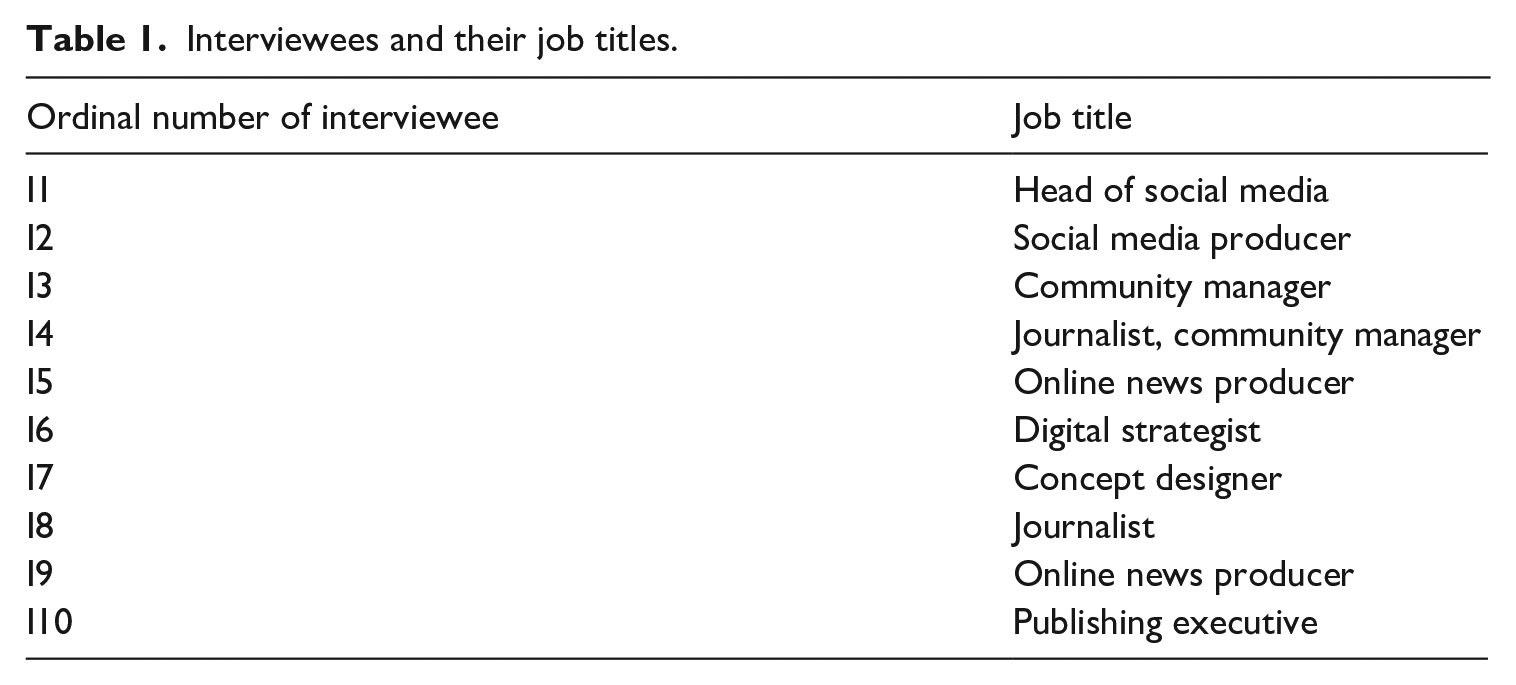
Qualitative, thematic interviews were conducted with 10 active participants of the network (see Table 1), chosen with snowball sampling that originated from the company’s head of social media who also acts as the team lead. The interviews utilized a semi-structured method and were conducted in May–Aug 2019, nine by the second author and one by the first author. The average length of an interview was 56 minutes. The interviewees (eight females, two males) were aged between 29 and 55 years, with 5- to 30-year experience in the field of media. Their working titles included, for example, executive web producer, social media manager, journalist, concept designer, community manager, and digital strategist. In the “Findings” section, the interviewees are referred to by ordinal numbers.
Interviewees and their job titles.
Chat data included the development network’s internal WhatsApp channel between August 2018 and September 2019 (823 lines of text, 32 images, three videos), their Google Hangouts log from January to September 2019 (145 pages, 147 participants), and screenshots from the development network’s intranet community. These channels were also observed using a virtual ethnography approach during the field study period. All data were accessed with the permission of the development network leader, and the presence of a researcher was made clear to all participants, both in the digital channels and during the observed meetings. To secure the anonymity of our informants, the names or other information on the development network are not revealed.
Our analysis followed an abductive strategy and was conducted with the aid of Atlas.TI. All interviews, field notes, and chat logs were analyzed jointly. The analysis started with an inductive, descriptive coding of the interview content and the chat logs conducted by the first author and was aided by notions recorded in the field notes. During this stage, the focus was to identify larger sections of material, for example, entire responses or small stories told by the interviewees or as part of the chat discussion. After this stage, the codes were rearranged and combined to identify 14 main codes: innovation, company and social media, platforms, social media team, analytics, concrete social media work, internal social media, interaction, reaching audiences, imitation, future, benchmarking, distribution, and media loyalty. Next, all the passages coded under codes directly related to social media work, social media platforms, and analytics were rearranged under more general themes of (1) organizational practices, (2) social media practices and audience interaction, (3) analytics and metrics, and (4) media content–related notions. During the final stage of analysis, these grouped quotations, as well as the related field notes, were revisited using the concept of isomorphism and its three forms (DiMaggio and Powell, 1983) to theorize the identified practices. In the following section, we report our findings following these four broad themes.
Findings
Organizing for social media
The development network under research crosses organizational boundaries: it included members from various units, and their tasks ranged from reporting to administration. The network consisted of various assemblies, some of which had been born organically over time. First, there was a named group of employees in social media manager positions, as well as the head of social media, who were the official, smaller core group on top of social media activities for the organization (eight members at the time of research). They communicated using WhatsApp and occasionally other channels. Second, the company’s intranet hosted a large virtual community for everyone in the organization interested in social media. This group consisted of over 600 members but was not very active. Third, the head of social media organized a weekly seminar-type meeting on varying themes with approximately 150 people on the invitation list. These meetings were the site of our observations and the main physical arena where the development network convened.
On the one hand, these activities and structures reveal the professionalization of social media activities: they were led by the head of social media, and a few other members’ job descriptions were directly focused on social media. On the other hand, the variety of communication channels and communities reveals an organic, responsive approach to their changing work environment. The communication of the development network was spread across platforms outside the organization’s official communication infrastructure; some interviewees expressed their disappointment with the random unofficial Facebook groups employees used to communicate.
The weekly meetings and the intranet community were designed as arenas for everyday help and benchmarking. They were channels where members could share their experiences, best practices, and tips; ask for assistance; and initiate strategic discussions concerning social media use. They were also a structure for the systematic monitoring of the operating environment. The nature of the meetings, however, had changed over time as an interviewee noted:
It started from the idea to keep everybody up to date so that you can come and ask for advice and share your knowledge, and then it has kind of developed toward a format where we have superstar presentations, like this spring when we discussed Jodel, TikTok, and YouTube. (I3)
Thus, the various groups and the evolving weekly meetings, in particular, were an organizational structure conforming to the changing technological environment. This structuring has its roots in the company’s strategy from 2017, which incentivizes the use of new technologies, urges the organization to “interact with audiences in new ways to make people participate,” and legitimizes a shifting emphasis on young audiences. The development network seemed to regard their own role as central for the implementation of the strategy: some active members noted in the interviews how they should get more people involved.
Normative isomorphism: how to do social media “right”?
In light of our data, it is evident that the organization takes its strategy seriously and explores innovative ways to utilize social media. However, these practices were accompanied by a deeply ingrained notion of the competitive and tensioned setting between news organizations and platforms and an aspiration to keep up with the fast-flowing technological environment. One interviewee stated how the media organization has received feedback about having terrible FOMO (fear of missing out): “. . . you are top—notch in all media development—–but you still feel like you are constantly missing out on something. You are constantly afraid of something” [I3]. The development network, however, seemed essential in providing an arena for such aspirations across the organization and fostering a culture that allows for innovating and testing (Koivula et al., 2022):
All the audience questions [to social media influencers who just presented their work] make me think that the most difficult part for media organizations in using social media is to deal with the uncertainty and change. There is no way to directly tell what works and with what recipe, but they need to try out everything and follow the leads that work. This requires a different organizational culture, permission to innovate and test. (Field note April 3, 2019)
The peer support and search for best practices connect to an experienced necessity to adopt social media into journalistic work and seemed to build on an idea that there exists a certain way of doing things right on social media. This could be considered a sign of institutional pressure becoming solidified as a normative structure of practices (DiMaggio and Powell, 1983; Vos and Russell, 2019). The task for the media organization is to find these correct practices, which require agile testing and digital percipience. These underlying assumptions formed the basis of discussions in the network’s weekly meetings and were visible in the interview data.
During the five years I have done this social media thing, we have finally reached the understanding in this house that we really have four channels, and the fourth one is social media—it is a real click generator for us too. From Facebook, we bring clicks, and on Instagram, we bring our news to young people in a lighter format. (I9)
As the quotation suggests, a major motivation for the organization to use social media is to reach younger audiences. This connects to the first major role of social media in the discussions: it is a tool for marketing to reach audiences “where they already are,” particularly the young generations. Relatedly, social media is a tool for listening to and monitoring audience insights, which is another typical way of using social media for marketing purposes. Hence, there was a strong customer orientation. Simultaneously, there was an awareness of the competition over attention, as mentioned above, and a need to reverse engineer the platforms’ algorithms to understand what works. Reaching audiences became a constant cat-and-mouse chase when network members tried to keep up with the changes on the platforms.
In the last meeting, we just wondered how there was a sudden leap in the Facebook traffic, has somebody turned a level in the algorithm because several people noticed that we had more traffic from Facebook even though we didn’t change anything—then, of course, we tried to figure out reasons for that or is it just that did we change something in our work and how, and if, then let’s do more of that because it seems to work. (I1)
Second, social media was described as a tool for interacting with audiences. It has been suggested that the requisite for interaction is what drives media organizations to engage with social media (e.g. Lawrence et al., 2018). The organization has made a strategic choice to concentrate interaction on their social media sites instead of their proprietary platforms. This raised tension in everyday decisions: Some interviewees saw social media platforms as equally important as their own platforms; some considered them to have a strategic function in bringing traffic to proprietary platforms. Nevertheless, several presentations held in the meetings emphasized the integral role of social media in all journalistic work. From the perspective of normative isomorphism, the strategic decision to interact on social media contributes to the discussion of building a strong conversational presence on social media and following the correct—conversational—ways of being there, which was present throughout our data:
. . . this style of interacting with people seems to become more common and is natural for people, so to what extent can we bring something similar to our own platforms, but quite often the conclusion is that it works so well on social media that copying it as a mock-up to our own platform would not create a good user experience.” (I3) my social media concern theme is how do we get these Insta[gram] successes to the corporate goals for this year! (WhatsApp chat, January 17, 2019)
Interacting was not only related to the conception of doing social media “right” but also fostered a vision of the media as a new kind of actor in society. Social media platforms promise a ubiquitous, engaging, and interactive presence for the media, a dream of a future where “our activity has effortlessly merged with people’s everyday” (Workshop memo, February 15). This vision seemed to be somewhat pushed by platform logics and relied on the existence of platforms and their affordances. Thus, the media organization is simultaneously a competitor of the platforms but also constrained and supported by them. This complex setting seemed to cultivate aspirational talk in the organization:
So that wherever we put it out, what’s the user interface, where the customer meets us and does this have anything to do with social media anymore or is it personalized, something, like digital service. (I3)
At the same time, however, the interviewed network members expressed a discrepancy between the values of the media organization and the values of the platforms. They repeated the familiar narrative in journalism that the gatekeeping power of media organizations has been given to algorithms. Our interviewees seemed to have, on the one hand, accepted this as their reality, but on the other, they actively pondered ways to shift the balance. For example, they described how social media algorithms seemed to favor content that supports populism or fake news and wondered if the PSM could be the one who corrects the system:
. . . those algorithms favor what is popular so that it easily distorts the value system and maybe weighs the messages in the wrong way—we have thought about it a lot that one duty for us on social media journalistically precisely is that we could bring balance to the value system. (I2)
Hence, the publisher–platform relationship circulated around the idea of balancing PSM values and the commercial values of platforms. However, the ideas about leveling the playing field between media organizations and platforms came mainly from interviewees in managerial positions with larger strategic responsibilities instead of members whose main job was to produce journalism. Furthermore, our interviewees’ thoughts on how to shift the balance centered on things they should do on platforms (e.g. promote freedom of speech, counter hate speech) rather than, for example, abandoning social media.
Normative–coercive datafication of audiences and quality
Journalism has gradually adopted an obsession with audiences and understanding what they find relevant (Tandoc, 2019). Our data show that in the wake of the platform society, this obsession with audiences turns into an obsession with metrics provided by the platforms—even in a PSM organization with smaller economic pressures. When asked, our interviewees admitted and stressed the significant role of analytics in their daily work. In practice, the above-mentioned ethos of interaction and participation becomes measurable, trackable, and commensurable with the help of platform metrics.
There was a firm conception that metric data will reveal the true success of their products. Data and platform metrics have become trustworthy numbers that can define the quality of journalism (Caplan and boyd, 2018; Bolin and Andersson Schwarz, 2015). While qualitative feedback—which is often negative—was considered merely a burden, metrics are the way to build insights into gut feelings, to tell what the audience really thinks (Kennedy and Moss, 2015). The audience is the analytics, as an interviewee strikingly put it—whether originating from social media metrics or their own streaming platform:
The analytics confirm a hypothesis of interesting content. So you can first think that this is a super good idea and topic, but only when you see the analytics then it is true, so far it is only a hypothesis that something interests people—we cannot know. But analytics is absolutely the thing that to a large extent leads the work. It is the audience, the analytics. (I6)
Furthermore, when we asked the interviewees to describe a successful media innovation, they all connected their reflections to metrics and the virality of content (see Bell and Owen, 2017). However, some interviewees reflected on the problematic aspects of this practice and pondered the differences between the metrics flowing from the company’s own platforms and the social media metrics, which did not necessarily match, and that there was no organization-wide conception on how to relate them.
—we had those Insta[gram] dramas, they have been fascinating. I cannot say right now if they were successful because I haven’t seen the numbers. I’m such a nerd. I want to see the numbers. (I10)
The metrics also formed a way to effectively follow if the organization is reaching its goals and simultaneously forced the actors to constantly adapt their work and practices in response to the feedback mediated by the platforms. The organization used third-party social media management software to trace the engagement generated by its content. There were several data analytics teams who build dashboards that provide such information to managers. Some interviewees even connected the unpredictability of platforms to innovation work, stating that it is the cat-and-mouse game with the platform algorithms that incur innovations in the organization:
—this connects to the data-driven logics of online journalism. Like when we constantly follow data considering our goals, it quite often leads to small or big innovations. When we see that numbers go in that direction and then we try something else and notice that, ok, now the numbers exploded, like big time. These are innovations; greatly they are. (I7)
By promoting datafied practices, the reliance on metrics reveals a form of normative isomorphism, but the overarching and ubiquitous presence of data talk across our data sets also indicates that the datafied indicators of both audiences and successful content are becoming informally coercive in media organizations. Data are, in a way, structuring journalistic work while also shaping and building the organization.
Mimetic isomorphism of content
The interview data, as well as the discussions in the weekly meetings, showed how platforms converge with and produce new journalistic styles and formats the journalists adapt to. This form of mimetic isomorphism includes both the format (video, images) and structure (length, size) of the content imposed by the platform as well as the styles of visual and literal narration deemed appropriate for a given platform. Moreover, it affects the way journalists are present on a platform: new, anonymous platforms, for example, require new thinking. As expressed by one informant in a meeting on the anonymous app Jodel, “First we went nuts when FB forced us to be online with our own name, now when we need to be anonymous, we are horrified again” (field note, March 20). Like the general adoption of social media, this form of isomorphism was expressed as a necessity and is critically reflected particularly in the interviews:
. . . like, for example, that Facebook started to promote short videos a few years back and now we are constantly trying to sniff what video length is particularly preferred by Facebook, and we try to do that length. So that’s rather crazy—we have considered in our internal meetings how heavily content forms favored by the algorithm are affecting our own content development, and we have concluded that too much. (I2)
Furthermore, the desire to imitate successful content producers on a platform, be it other media organizations, new types of media actors (e.g. Buzzfeed), or social media influencers, was constantly present. In one meeting, two social media influencers who had a collaboration contract with the organization discussed their work. In a meeting focused on potential ways of adopting Jodel, a seemingly general discussion of the app’s features and user cultures soon turned into a discussion of metrics and forms of content that could work on the platform:
[A person] ponders how fantastic it is to have a channel where you don’t have to push things and always publish something, but you can just be there as a human. However, immediately after this comment, people start discussing what will break through on a given platform, and somebody mentions a prison document on Reddit as an example—apparently, something that was heavily followed there. (Field note March 20)
The discussions related to content, both in the weekly meetings and in the interviews, were strongly connected to the algorithmic content distribution and a strive to figure out how the algorithms work, as described earlier. However, at the same time, these considerations reached beyond technology; the informants strived to understand target audiences and the typical communication styles on a given platform. The interviewees also expressed a constant pressure generated by the changing platform logics over time, acknowledging that they cannot use the previous year’s social media plans anymore:
But because the way people use the platforms changes then also what people want on that platform changes. So it is not typical for them to click a link and leave the [platform]—if they go to Instagram, they want content that is entertaining and visually enjoyable and that’s perfectly fine and has to be fine for us too. We cannot force people anywhere, it will not be customer-oriented anymore. (I10)
Discussion and conclusion
In this study, we asked how a PSM organization negotiates the institutional pressures and tensions related to social media platforms discursively and through organizational and journalistic practices. Previous research has discussed how a media organization, when creating and distributing content on social media, acts in an environment shaped by the infrastructure, interfaces, algorithms’ affordances, and metrics of platform intermediaries (e.g. Caplan and boyd, 2018; Napoli, 2014; Nielsen and Ganter, 2018; Tandoc, 2019; Vos and Russell, 2019). Our investigation adds to this line of research by empirically showing how the influence of platforms is present as forms of institutional isomorphism in the practices and discourses of a PSM organization: the normative pressure of doing social media right, the normative–coercive way of seeing innovations and audiences as data, and mimetic pressures in content production. Furthermore, our findings extend previous research by suggesting that organizational structures and forms of innovation are adapting to platformization and by showing that platform data and professional roles act as mediators of isomorphism.
The platformed activities of media organizations in connection with audience metrics and content production have been extensively discussed in previous research (e.g. Bell and Owen, 2017; Tandoc, 2019). Our findings frame these notions as mechanisms of institutional isomorphism, showing how content adaptation and audience metrics intervene with definitions of journalistic quality and media innovation. As a form of mimetic or even coercive isomorphism, network members prefer content that “work” according to the indicators made available by the platform, thus following the platforms’ algorithmic logic. In light of our findings, the “culture of the click” (Christin, 2020) has developed into a culture of engagement (Edlom, 2022; Meier et al., 2018). A shared yet vague normative understanding of doing social media “right” means reaching audiences by producing spreadable content, but also interacting and engaging with them. Hence, the measurement of audiences and content performance is strongly connected to the more general ethos of interaction, which could be argued to be a byproduct of the institutional environment of social media (Caplan and boyd 2018; Lawrence et al., 2018). Thus, the PSM organization balances between classic broadcasting logics and measurements and the datafied ways of knowing the audience (Kennedy and Moss, 2015) offered by the platforms. Data make the audience tangible, as our empirical material illustrates. Consequently, the translation of audience interest into data (Tandoc, 2019; Zamith, 2018) and basing news judgment on that data result in reframing and blurring of the boundaries that separate the news organization from its environment and other similar organizations. In essence, data become a mediating element for isomorphism, as it fundamentally shapes the organizing principles of contemporary media organizations (see Alaimo and Kallinikos, 2021). This, in turn, raises questions about the definitions of journalistic processes, news organizations, and even the institution of journalism (Reese, 2022).
Our work contributes to research on platform–publisher dynamics by showing that organizational development work adapts to platform pressures, which is an intra-organizational form of isomorphism. Traces of this are visible in the emerging social media–centered positions, in the formation of teams, and even in the strategy document of the PSM organization that emphasizes interaction. In particular, the existence of the development network itself is a prime example of organizational practice and structure shaped by the changing technological environment of the platforms. Organizing the network and its effort to involve people across departments are intra-organizational forms of isomorphism. The meetings of the development network and personal training offered by the social media managers support mimetic and normative isomorphisms by sharing the operative practices and routes to success, as well as spreading the know-how of social media professionalization within the organization. Professionalized social media managers, in particular, emerged as central intra-organizational mediators and middlemen of normative isomorphism. Thus, as the network contributes to the institutionalization of social media practices in the organization, it is an organizational structure that works to sustain all three forms of isomorphism in response to the uncertainty introduced by the changing technological environment (DiMaggio and Powell, 1983).
Finally, our findings revealed a more complex repercussion of platform isomorphism—mimetic aspirational discourse emerging as a response to platform-induced uncertainty. The platforms cultivate a general social imaginary of news media with a ubiquitous presence in all channels used by its audience—a vision of a new type of media actor with a central, dialogical role in society. This is an imaginary that, in the current media ecosystem, is difficult to achieve without platforms. This aspirational discourse of ubiquitous interaction, engagement, and community building is present throughout our data, from the strategy document to interviews and discussions in the development network meetings. Thus, social media platforms correspond well with the ways in which the company negotiates its legitimacy and position as a national state-funded broadcaster. It is notable that the aspired new role is characterized by notions that are strikingly similar to the vision statements of the platforms themselves (e.g. Facebook’s “bring the world closer together “ or “stay connected with friends and family, to discover what’s going on in the world, and to share and express what matters to them”). Hence, it seems that the strategic ideas of how to act as a media organization are imitated from platforms instead of modeling other media organizations. In terms of institutional theory, this solidifies news media and platforms in the same organizational field (DiMaggio and Powell, 1983).
At the same time, there is an awareness of the competitive setting, coercive forms of content isomorphism, and an articulated discrepancy between the values of the media organization and the platforms. These expressed concerns are similar to the strategic risks and tensions identified by Nielsen and Ganter (2018). However, while the interviewees clearly articulated these tensions, corresponding discussions were mostly absent from the observed meetings. Perhaps the pressures of daily work override the critical considerations, as actors are invited to follow the seemingly compelling platform logic (Koivula et al., 2022). Platform counterbalancing or even abandoning social media platforms (Chua and Westlund, 2019) was not seen as a viable strategy for thriving in the digital media environment, regardless of the articulated value tensions. This notion could be a result of the data collection period in early 2019, when the most popular platforms, such as Facebook (now Meta), highlighted virality. In media organizations at that time, there was an emphasis on how to exploit platforms to the organizations’ advantage rather than on how to completely reconfigure the publisher–platform relationship. Although independence from platforms and their operating logic was on the horizon, more focus was still being put on beating the platform logic and doing social media “right,” as our empirical material indicates. Moreover, while pressure for virality has diminished with the decreasing dominance of Facebook, our data show how other platforms and algorithmic systems, such as TikTok, emerge and similarly create novel pressures for content production and media presence. We suggest that recognizing institutional pressures might be harder in the current, seemingly more platform-pluralistic social media landscape. These insights highlight the need for future studies that observe actual practices in media organizations regarding platformization or deplatformization. In a fast-changing environment, it is essential to track platformization processes longitudinally over time (Chua and Westlund, 2022) and across different types of media organizations. Indeed, some of our findings, most notably the aspirational discourses, might be PSM specific, while normative social media work and isomorphism by data are likely to emerge in any media organization.
All in all, our findings suggest that the forms of platform isomorphism intertwine with the discourse of journalistic values and media development practices. Platform isomorphism creeps into the ways of designing media content, evaluating journalistic work, and defining media innovations, thus inducing a profound change in the fundamentals of the field. The legitimacy of the PSM company is, in many ways, dependent on its success in reaching the audience and implementing the universality principle (Hokka, 2019); in this, social media platforms play a key part in the contemporary media ecosystem, which could be argued to further accentuate their role for PSMs. In addition, the institutionalizing presence of platforms cultivates novel values and visions for media actors, including the idea that the PSM organization should “balance the system” instead of only supporting what is popular on social media. While such ideas are rarely implemented as journalistic products, their strong presence in the interviews implies that platform logics might slowly change not only the practices of media work but also journalistic ideals in the long run.
Footnotes
Acknowledgements
The authors would like to thank their informants for allowing generous access to their daily work. We are also grateful to the anonymous reviewers for their insightful feedback during the review process, to Rajapinta Skrivarstuga workshop for commenting on an earlier version of the manuscript, and Liisa Niemi for her help in transcribing the interview data.
Funding
The author(s) disclosed receipt of the following financial support for the research, authorship, and/or publication of this article: This work was supported by the Media Industry Research Foundation of Finland.
