




Abstract
Using data from The Irish Longitudinal Study on Ageing (TILDA), linked to administrative data on high-speed broadband availability from infrastructure maps, this study examines patterns of Internet uses and psychosocial outcomes for over 3500 people aged 50 plus across Ireland. High-speed broadband availability is associated with higher reported levels of home Internet access, greater frequency of Internet use and more engagement with Internet activities. Controlling for demographic and socio-economic circumstances, regression models show that quality of life is higher among daily users of the Internet. Little association is found with loneliness. Quality of life is higher among users of Internet-based communication applications such as email and video calls, and there is some evidence that loneliness may be less pronounced among users of these applications. The findings are consistent with the view that digital engagement can enhance the lives of older people and thus may be supportive of policies and interventions to address potential ‘grey’ digital divides.
Keywords
Introduction
As the populations of developed societies age, factors contributing to successful ageing have garnered significant research and policy attention. While ageing is a complex and dynamic process, previous empirical research has shown associations between subjective indicators such as quality of life (QOL), loneliness and other domains including health (García and Ramírez Navarrro, 2018; Luanaigh and Lawlor, 2008). In parallel with this, and the digitisation of societies, there has been a growing body of literature examining Internet use among older adults. Hunsaker and Hargittai (2018) note that studies in this sphere mostly focus on exploring Internet uses of older people in itself, calling for more research directed at understanding how the Internet and different domains of Internet use can influence older people’s lives. Recent experiences of social deprivation and greater technology use during the COVID-19 pandemic have also cast a spotlight on the link between technology use, health and wellbeing among older people (Haase et al., 2021; Llorente-Barroso et al., 2021). In the present article, we examine how broadband and Internet applications may be associated with prospects for successful ageing using measures of QOL and loneliness.
Baltes and Baltes (1990) introduce a theory of successful ageing whereby individuals respond to gains and losses over time. Three processes contributing to successful ageing are highlighted, leading to the acronym ‘SOC’:
Selection, whereby individuals adjust their goals over time to allow for changes in their endowments of resources and needs;
Optimisation, a process of adding new external or internal resources in response to age-related changes in resource endowments and
Compensation, in which individuals seek to maintain functioning despite inevitable losses of some resources over time.
We posit that high-quality Internet access and the applications supported by it might serve to assist with actions in each component of SOC.
Selection actions, which involve re-evaluating goals, can benefit from ready access to information. Availability of high-speed broadband may facilitate selection activity by affording additional options, a sense of opportunities and comfort to older people. The availability of broadband capable of faster and more reliable delivery of Internet-based services may foster a broader and deeper level of digital engagement, as exemplified by greater frequency of Internet use and the consumption of a wider range of Internet-based services (Cho et al., 2003; Kolko, 2010; Rains, 2008). If higher access speeds improve experiences of Internet use, and this fosters added utilisation of the Internet and Internet-based activities, older people may obtain particular benefits since this group can be vulnerable to experiencing technostress and technophobia (Hogan, 2006; Nimrod, 2020, 2021). Hargittai and Dobransky (2017) note that older people lag in their uptake of faster broadband and find that older adults with high-speed broadband connectivity have better web-based skills.
Optimisation may involve identifying new channels for social contact and belonging, which, in turn, could be facilitated by communications and social media applications. The Internet may help older people optimise their resources by opening up additional avenues of communication and enabling maintenance and establishment of social relations – particularly intergenerational ties, enhanced social networks, social support and social capital (Taipale, 2019). A mixed-methods study by Freeman et al. (2020) reveals that older people are not technology-averse, and technology is used to remain connected to adult children and grandchildren, especially where there is a large geographic separation. Intergenerational support in the adoption of new technologies is recognised as important to allow older people to remain independent and to age in place. The social context is found to have a major influence on the use of Internet by older people, where family and friends’ encouragement is a strong predictor of use (Friemel, 2016). Since Internet-based video calls and streaming services, which have been increasingly adopted by older populations (Bonsaksen et al., 2021; Llorente-Barroso et al., 2015; Vulpe and Crăciun, 2020), require more bandwidth, the availability of faster broadband may encourage greater frequency of use of the Internet and the use of various Internet-enabled functionalities including video-based communication. Similarly, there is reason to suppose that media facilitating communication with others – be that family or friends, or indeed unknown online users – may support social contact, relationships and sense of belonging, which could influence loneliness (Moody, 2001; Şar et al., 2012).
Compensation may include use of assistive technologies or services to offset age-related impairments, for example, loss of mobility or vulnerability to falls. Baker (2013) outlines the benefits of HSB for older people regarding telehealth and caregiving, the use of supportive and smart home technologies to assist with functional decline. Moreover, the use of the Internet on a frequent basis, and the engagement with Internet-based activities for communication purposes, information seeking and as a source of news, for instrumental activities, such as undertaking financial transactions, and for entertainment purposes may enhance QOL in older age by enabling greater self-actualisation of this group (Backonja et al., 2014; Bowling and Gabriel, 2007).
It is also important to note that interactions among the three processes may also be important in ways beyond their individual contributions (Freund, 2008). The general-purpose nature of Internet technologies and services could have a role in facilitating such interactions. While successful ageing is too complex and a multidimensional process to be observed using a single empirically measurable outcome, previous research suggests that SOC actions are related to a range of subjective indicators of successful development throughout the life course (Freund, 2008). In the present article, we use two individual-level subjective outcomes available in a large individual-level dataset to explore associations with Internet use and broadband availability.
The research of this study may also assist policymakers. The rapid evolution, adoption and integration of information and communication technologies (ICTs) has precipitated significant changes across all aspects of social organisation, including the economy, government, health, education, entertainment, leisure and social life. Participation in a relatively recent digital-based citizenship requires the use of, and engagement with, ICT and digital skills. Older people 1 have been identified as a group for which digital exclusion may be an issue, and a ‘grey’ digital divide has been recognised as a policy concern by the United Nations Economic Commission for Europe (2021), the OECD (2015), and the European Union (European Council, 2020; EU Agency for Fundamental Rights 2020). Such organisations also emphasise the potential of ICT to influence older people’s QOL, their sense of social inclusion and wellbeing. The Federal Communications Commission (2010) points to a need to increase the use of high-speed Internet technologies among older Americans.
Many countries have responded by adopting policies to empower older persons to maintain their independence and wellbeing through the provision of high-quality, accessible, and easy-to-use forms of digital communication. Designing such policies and justifying the economic resources spent on this area would be assisted by a better understanding of the extent to which older people who use the Internet benefit from outcomes such as better QOL and reduced loneliness.
The present study aims to inform research, policymaking and planning in the areas of positive ageing and technology, by addressing two specific research objectives (SO):
SO1. To explore whether availability of HSB at an individual’s residence is associated with self-reported home Internet access and online activities among a large sample of over-50s in Ireland.
SO2. To examine whether QOL and loneliness is associated with a range of factors including Internet access and HSB availability, frequency of Internet use and engagement with Internet-based activities such as means of communication, for example, email, video calls and instrumental undertakings, for example, online financial transactions.
Literature review
Quality of life
Scholars have identified conceptual and methodological challenges in the provision of a clear and consistent definition of the concept of QOL (Felce and Perry, 1995; Haraldstad et al., 2019). Challenges arise due to what is typically regarded as the subjective nature of a QOL construct, as well as debate concerning the various domains of which the concepts are composed, and the variety of instruments operationalised for measurement (Barcaccia et al., 2013). The World Health Organization’s definition of QOL is the most widely adopted definition to date, which defines QOL as ‘individuals’ perceptions of their position in life in the context of the culture and value systems in which they live and in relation to their goals, expectations, standards and concerns’ (WHO, 1998: 11). QOL in ageing populations considers multi-dimensional facets including health, functional capacity, physical and social activity, independence and personal control, socio-economic situation, networks such family, friends, care and support systems (Walker and Mollenkopf, 2007). The use of ICT and the Internet by older people may facilitate active, autonomous and positive ageing though promoting lifelong learning, communication, social and economic participation (Bianchi, 2021; Heo et al., 2015; Karavidas et al., 2005; Slegers et al., 2009).
Through in-depth qualitative interviews with older adults, Bianchi (2021) explored the mechanisms as to how Internet services can affect the wellbeing of older adults. The challenges older individuals describe in adopting Internet services are first outlined, including resistance to the adoption of technology, where some see it as not worth the effort, while others describe difficulties with use due to physical and cognitive impairments. These issues also tie in with studies which outline inherent ageism in the design of ICT products and services (Ivan and Cutler, 2021; Rosales and Fernández-Ardèvol, 2020), where older people’s needs are overlooked where technological goods and algorithms are developed by, and targeted at, younger people. Negative stereotypes about older people’s abilities in approaching ICT-based tasks can create anxiety and undermine their confidence leading to self-fulfilling prophecies which must be overcome (Ivan and Cutler, 2021; Nimrod and Edan, 2021).
The interviews documented in Bianchi’s (2021) article then go on to describe that older people’s QOL can be enhanced by learning and training opportunities that arise from the consumption of Internet services, as well as seeking help and support in the use of technologies. Wellbeing of older people is supported where family members assist in learning and problem solving, where tolerance and patience boost confidence, though frustration across generations in technological ability is also recognised.
In an early quantitative study of the effects of computers on the QOL of older adults, Karavidas et al. (2005) analysed responses to a questionnaire returned by retired members of computer clubs. Analysis suggested that more technologically savvy older adults have greater life satisfaction, arising from a greater degree of self-efficacy and lower computer anxiety as their knowledge of computers improves. In a randomised control study, Slegers et al. (2009) did not find a clear-cut effect of ICT training on QOL, concluding there was a lack of support for the hypothesis of a positive effect of learning to use the Internet on QOL. Although it was noted that intervention participants spent more time learning new things, and heavy computer users demonstrated an increase in mastery, feeling more in control of their lives, attributed to frequent computer use.
Using data collected from the English Longitudinal Study of Ageing (ELSA) while COVID-19 social distancing restrictions were in place, Wallinheimo and Evans (2021) find higher QOL scores among more frequent Internet users and for participants who reported using the Internet for communication purposes. However, greater depressive symptoms are found to be associated with using the Internet for health-related or government services information searching. Studies from surveys conducted with older people in Israel before and during the COVID-19 pandemic have also highlighted potential negative effects of technology on wellbeing, documenting evidence of greater stress created by ICT and experiences of technology invasion (Nimrod, 2020). Nimrod (2021) found that older people described as ‘technophobic’, who experience fear or discomfort engaging with modern ICT, had less online activity and had a greater likelihood of seeing the world as threatening.
Loneliness
Loneliness may be defined as a subjective concept where a person experiences an aversive emotional state related to a perception of unfulfilled intimate and social needs (Peplau and Perlman, 1982). It has been recognised that older people are particularly vulnerable to loneliness because of common age-related changes and losses, which can stem from retirement, bereavement of a spouse or peers, relocation of family and friends, or movements to residential homes or care facilities (Cornwell et al., 2008). The use of ICT, particularly Internet-based means of communication, may help overcome time and distance contact challenges. Where Internet use helps maintain or create social relationships, this may promote socio-emotional health and reduce loneliness (Cornwell et al., 2008).
Early studies in this area tend to examine the effect of ICT interventions on social relations and outcomes such as loneliness, relying on small sample sizes. Later studies employ data from population-wide national surveys to discern relationships between reports of ICT and Internet use on health and psychosocial indicators, including instruments of loneliness.
White et al. (1999) examine the effect of ICT training for residents of a retirement community in the United States. Among the intervention group, the study reports a trend towards decreased loneliness scores, statistically significant 2 weeks post-training, though the effect is not significant on 5-month follow-up. Similarly, in a subsequent, larger randomised control trial of ICT training provided to older people, White et al. (2002) report trends towards a reduction in loneliness scores in the intervention group, compared with a control who did not undertake training, though this is not statistically different from baseline. At the end of the training, 60% of the intervention group continued to use the Internet regularly, and these regular Internet users were found to have a lower tendency towards loneliness compared with participants who did not continue to use the Internet. A systematic review and meta-analysis including six studies of digital technology interventions (DTIs) used to tackle loneliness in older adults concludes that there is no evidence to support the effectiveness of DTIs to reduce loneliness (Shah et al., 2021), remarking that the quality of evidence is very low to moderate in the reviewed trials.
In a Canadian study, Erickson and Johnson (2011) find a negative correlation between communicative Internet uses (email, online communities, instant messaging and chat) with loneliness. Using data from a study of ICT usage among older adults in Alabama, Cotten et al. (2013) find a negative association between frequency of going online and loneliness score. Heo et al. (2015) use data from the US Health and Retirement Study (HRS), finding that higher levels of Internet use significantly predict greater levels of social support and reduced loneliness among older adults. Using three waves of the HRS, Yu et al. (2021) find that Internet use is associated with decreased loneliness over an 8-year period. In a longitudinal analysis of the New Zealand Health, Work, and Retirement Study, Szabo et al. (2019) find that use of the Internet for social purposes is associated with improved QOL through reduced loneliness and increased social engagement.
However, Stockwell et al. (2020) do not find an association between the frequency of Internet use and loneliness analysing cross-sectional data from wave eight of ELSA. Weak associations for loneliness and various domains of Internet use, for example, email, video calls and so on are reported.
As the COVID-19 pandemic emerged, Hajek and König (2021) consider the evidence as to the potential of social media use and video chat for mitigating loneliness among older people. The authors find mixed evidence as to any effect, remarking that there remains a paucity of robust evidence in this important area, recommending future research based on nationally representative samples of older people. Qualitative evidence gathered by Llorente-Barroso et al. (2021) during the confinement period of the pandemic in Spain does, however, document that ICT was an important vehicle for emotional support during a difficult time, facilitating communication with loved ones, where grandchildren were a principal driver for screen-mediated contact.
It is also worth noting in the context of the present study that the concepts of QOL and loneliness in themselves may be considered related; it is has been found that loneliness has a direct negative effect on QOL of older people, as well as an indirect effect on QOL via greater incidence of depressive symptoms (Ahadi and Hassani, 2021). Furthermore, Khalaila and Vitman-Schorr (2018) found that Internet use was positively associated with QOL of older people, though the relationship was mediated by a reduction in loneliness associated with Internet use. However, the same study also found that time spent in person with family members was important, where Internet use had no effect on QOL in the absence of face-to-face contact.
Evidence from Ireland
Hogan (2006) examines the extent of ‘technophobia’ using a questionnaire administered to members of retirement associations in the West of Ireland. More than half of the respondents reported using computers, where three-quarters of computer users were using email to stay in touch with family abroad. Despite the relatively high use of computers observed, the study finds that 48% of over 65 years have moderate to high levels of ‘technophobia’. The authors attribute the high level of technophobia to perceptions of little or no knowledge of computers reported by almost 90% of the sample. Women are also more likely to be categorised as experiencing technophobia.
Using 2018 data from The Irish Longitudinal Study on Ageing, TILDA, Doody et al. (2020) estimates that 71% of adults aged over 50 have Internet access in their home, with an urban–rural distinction (74% vs 67%, respectively), and Internet access is lower in older age. Separate studies using TILDA examine QOL and loneliness among older Irish people. Ward et al. (2019) report that 7% over 50s in Ireland experience loneliness on a frequent basis, and almost one-third experience loneliness at least some of the time. Loneliness has been found to be associated with premature mortality in Ireland (Ward et al., 2021), and concern is expressed that social distancing policies increased loneliness for older adults during the pandemic (Ward et al., 2020).
On balance, a review of the literature in the area finds little consensus as to the scale of impact of Internet use on measures of QOL and loneliness in older people, though studies tend to report positive effects. Many findings in this sphere appear to be context specific. The present study aims to shed light on several unexplored or underexplored topics, namely, links between broadband infrastructure availability and Internet use by older people, effects of a lack of Internet access on outcomes, the use of a validated instrument for QOL, and investigation of ICT uses, and psychosocial outcomes applied to the Irish context.
Methods
Data
The data used for this study were collected in 2018 as part of the fifth wave of TILDA. TILDA is a nationally representative survey of those aged 50 years or older living in the Republic of Ireland. The first wave was carried out in 2009–2011, capturing demographic, socio-economic, family and health information on over 8000 participants living in residential households at baseline. Wave 5 of TILDA represented the 10th year of the study and achieved an 81% response rate among over 6800 eligible participants. A computer-assisted personal interview (CAPI) was conducted with 5101 participants face-to-face in their homes. Participants were also given a self-complete questionnaire (SCQ), which contained an array of additional, more sensitive questions concerning their wellbeing and experiences, and for Wave 5 this also included questions on Internet access, use and activities. A total of 4410 SCQs were returned (an 86% response rate). Ethical approval for each wave of the TILDA study is obtained from the Faculty of Health Sciences Research Ethics Committee in Trinity College Dublin. Written consent is obtained from participants, and participants may refuse to take part in or withdraw at any time. Ethical approval for the secondary analysis of TILDA data used in the present research study is part of the overall ethics approval for TILDA.
To examine the extent to which Internet connectivity infrastructure may be associated with older people’s engagement with ICT in Ireland, a proxy indicator for the availability of HSB for every residence was created by spatially linking each residence with the 2017 National Broadband Plan (NBP) 2 map. This map is based on administrative data collected during the planning of a national programme to extend HSB to unserved parts of the country. The map, depicted in Figure 1, distinguishes between three types of areas: (a) places where HSB is already available, (b) places where there is no HSB available but where the incumbent fixed line operator committed to roll out service and (c) places where there is no HSB available and state intervention through the NBP is deemed to be required to provide it. Using geographic information software, the residential addresses of TILDA respondents were mapped to the NBP map to create a variable which indicates whether HSB was available in the homes of TILDA participants. The matched sample of TILDA with the NBP map consists of 5087 TILDA respondents, of which 4291 returned the SCQ.
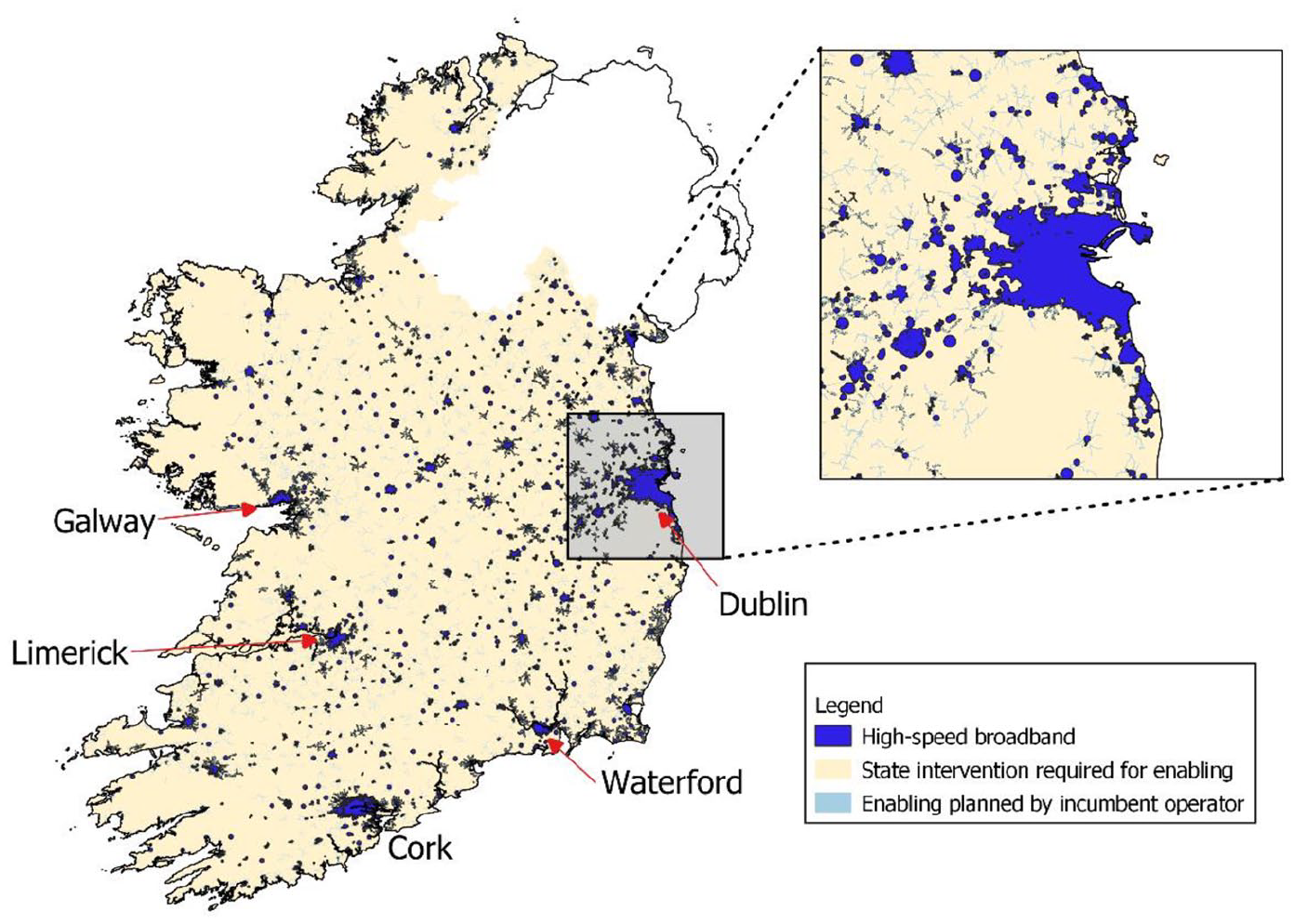
NBP map for Ireland, 2017.
Modelling strategy
Outcomes
This article investigates the effect of Internet access, use and Internet activities on older people’s lives using two outcomes of interest – QOL and loneliness.
In TILDA Wave 5, QOL is measured using the 12-item self-report instrument, the CASP-12 scale. The items included in CASP-12 consist of statements such as: ‘I can do the things I want to do’, ‘I look forward to every day’ and ‘I feel that life is full of opportunities’. These statements are presented to participants in the SCQ, and they are asked to indicate how often (often, sometimes, not often or never), they feel each statement applies to their life. Each item is summed to give an overall score (range 0–36), with higher scores denoting better QOL. Further details on this may be found in the Supplementary File.
From questions included in the SCQ of TILDA, loneliness is measured using the University of California-Los Angeles (UCLA) loneliness scale (Russell, 1996). Responses to five items inform this measurement tool: How often do you feel . . .
you lack companionship?
left out?
isolated from others?
in tune with the people around you?
lonely?
Each question has three response options, ‘hardly ever or never’, ‘some of the time’, ‘often’; where responses to the five items are summed, resulting in an overall score ranging from 0 (not lonely) to 10 (extremely lonely).
Exposures of interest
We are interested in whether Internet access, frequency of Internet use and Internet-based activities are systematically associated with variations in QOL and loneliness among older people. In an ‘Internet uses module’ of the Wave 5 SCQ, TILDA participants are asked a series of questions, detailed in the Supplementary File, which afford the construction of the following variables capturing exposures of interest: Internet access at home, no Internet access, frequency of Internet use, and seven types of Internet uses including e-mail, video calls, information search, financial transactions, social media, news information and gaming/apps. We also explore whether wellbeing outcomes are different among those living in areas where HSB infrastructure is available compared with areas where it is not.
Given the mixed results reported in the literature as to an effect of Internet use on outcomes such as QOL and loneliness among older people, this article adopts a null hypothesis approach as to an influence of the exposures of interest on outcomes investigated. The null may be rejected where empirical estimates meet the statistical significance threshold of p < 0.05.
Modelling strategy
The QOL variable, depicted in Figure 2(a), may be treated as a continuous dependent variable, and thus ordinary least squares (OLS) modelling is deployed. The estimated OLS model of the QOL score may be expressed as follows:

where
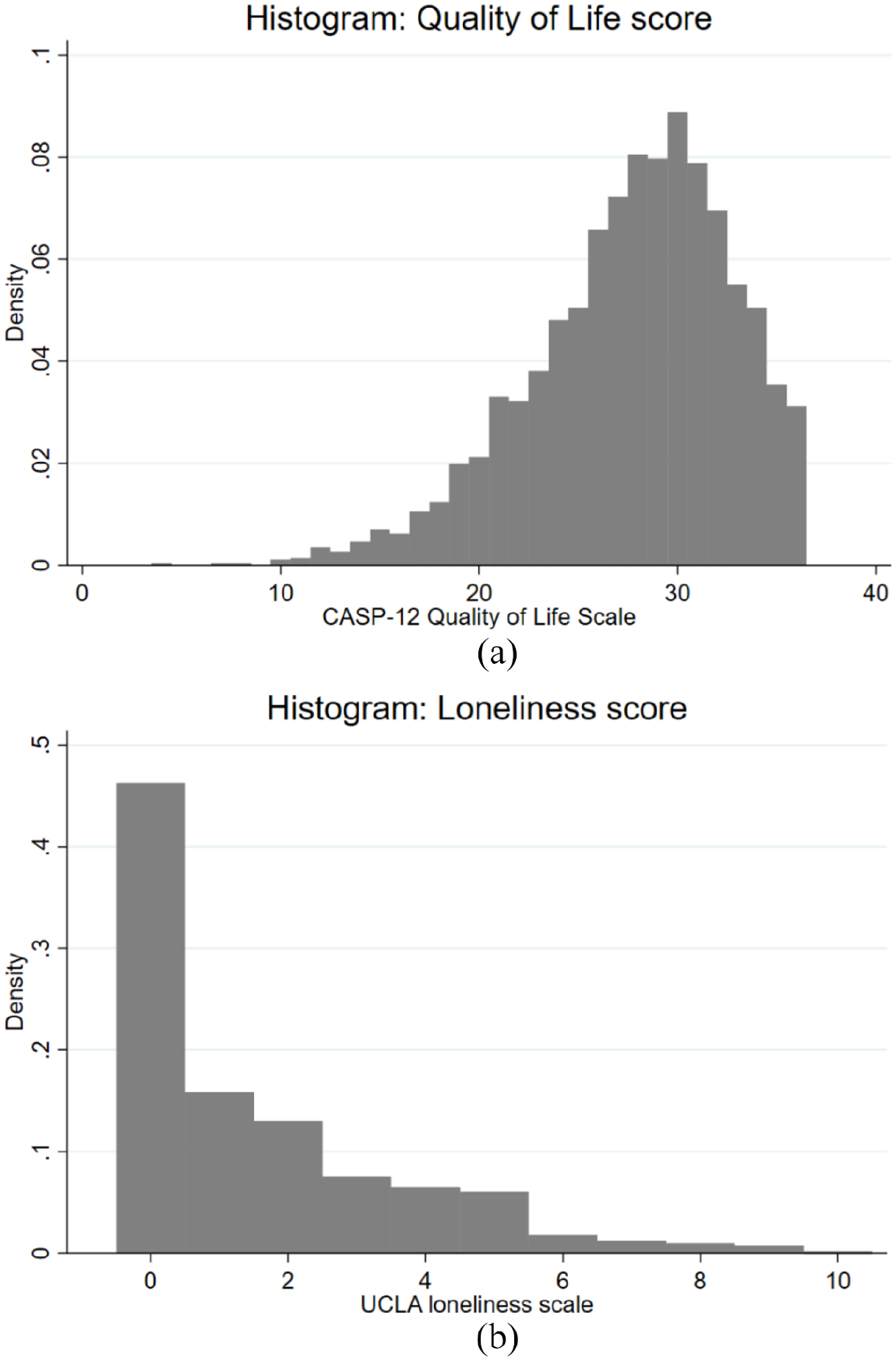
Histogram of outcomes. (a) Quality of Life. (b) Loneliness.
The nature of the loneliness measure is discrete and non-negative, with a skewed distribution (Figure 2(b)). Count-dependent variable models are appropriate for this structure, specifically a negative binomial regression model, since the variance of the loneliness score at 4.2 is greater than the mean score of 1.6. The estimated negative binomial model of the loneliness score may be expressed as follows:

where
Separate regressions are estimated for each outcome and exposure variable of interest, using an appropriate estimator in each case. The most basic model, Model 1, is a univariate model relating an outcome to a single Internet-related exposure of interest (
To maintain a comparable sample for the analyses across the outcomes, TILDA respondents with missing values of the included variables are dropped. The final analytical sample size comprises 3416 TILDA respondents (missingness in the TILDA sample is documented in Supplementary File Table S-1, and the characteristics of the full TILDA and SCQ sample are documented in Supplementary File Table S-2). Standard errors are clustered at the household level to account for participants who live in the same household. A third model is estimated that adds household income as a covariate; however, the sample size is reduced to 2674 due to item non-response on this question.
Subgroup analyses are also conducted to explore whether different groups of the population may be differentially affected by uses of the Internet. Analyses are run separately for whether the respondent lived in an area for which HSB is available or not available, gender (male and female) and age (under 70 and 70 years and over).
Sensitivity analyses
We explore whether the results of the main modelling specification are robust to alternative modelling approaches. Since there are no defined ‘clinical’ thresholds for the outcomes of interest, we split the QOL and loneliness scores into tertiles (following the example of Ward et al., 2019). A dummy variable is created for the third tertile, where the third of the sample with ‘the highest QOL’ are identified (= 1, zero otherwise) and the third of the sample that are ‘most lonely’ are identified (= 1, zero otherwise). These binary outcome variables are modelled in a logistic regression framework, with the same explanatory variable structure as the main models, to examine whether the results on the Internet-use variables estimated for these specifications compare with the main findings. All analyses are conducted in STATA-15.
Results
Summary statistics are presented in Table 1. Prevalence estimates are weighted to account the probability that TILDA participants participated in Wave 5 of TILDA and returned a completed SCQ. The majority, 82.5%, report Internet access in the home, though the proxy for having HSB available to the residence of respondents is lower at 63.4%. No Internet access, be that at home or outside the home, for example, libraries, family and so on, is reported for 14.9% of participants. Many engage with the Internet daily (60.1%), though 18.2% never use the Internet or have no Internet access. In terms of Internet-based activities, 7 in 10 engage in information search (70.0%), the most common activity, followed by email (63.7%), and online financial transactions (52.3%). More than one-third use video calling (37.6%) and social media (35.0%).
Characteristics of sample for analysis, weighted.
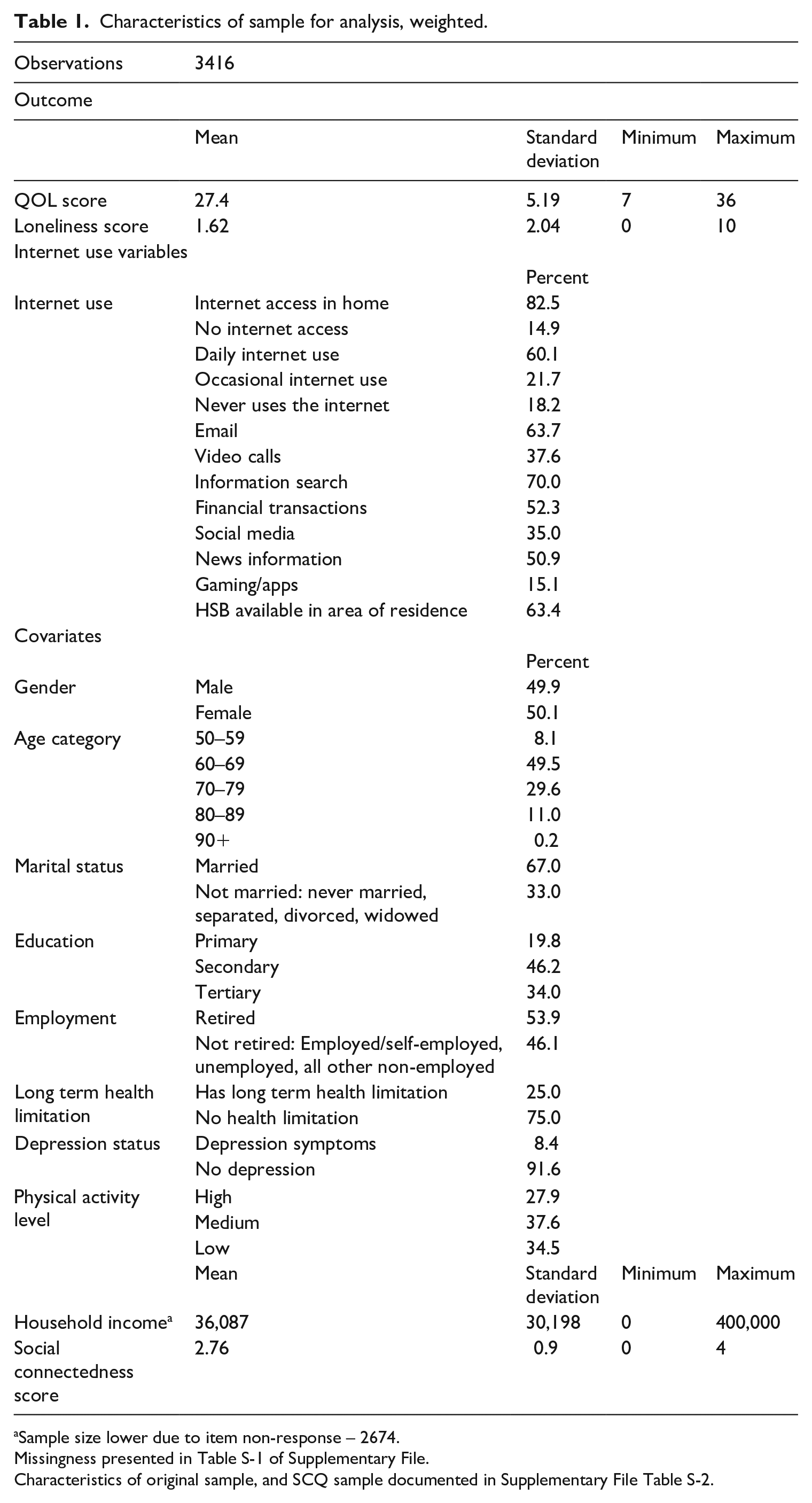
Sample size lower due to item non-response – 2674.
Missingness presented in Table S-1 of Supplementary File.
Characteristics of original sample, and SCQ sample documented in Supplementary File Table S-2.
In terms of covariates, the gender split is even, half fall in the age category 60–69 (49.5%), most are married (67.0%), the majority have second-level education as their highest educational attainment (46.2%), are retired (53.9%); a quarter have a long-term health condition (25.0%) and 8.4% have depression symptoms. Although not a covariate in our analysis due to a strong correlation with HSB availability, we note that 41% live in areas classified as rural.
Table 2, which displays the results in relation to stated objective 1, demonstrates statistically significantly different patterns of uses of Internet according to HSB availability using Pearson’s χ2 statistics tests on categorical variables. Internet access in the home, frequency of Internet use, and the use of Internet activities is higher where HSB is likely to be available in respondent’s areas. For example, 67.1% of whom HSB is likely to be available reported using video calls, while for those for whom HSB is not available, 32.9% reported using video calls.
Reported Internet uses split by availability of HSB, weighted.
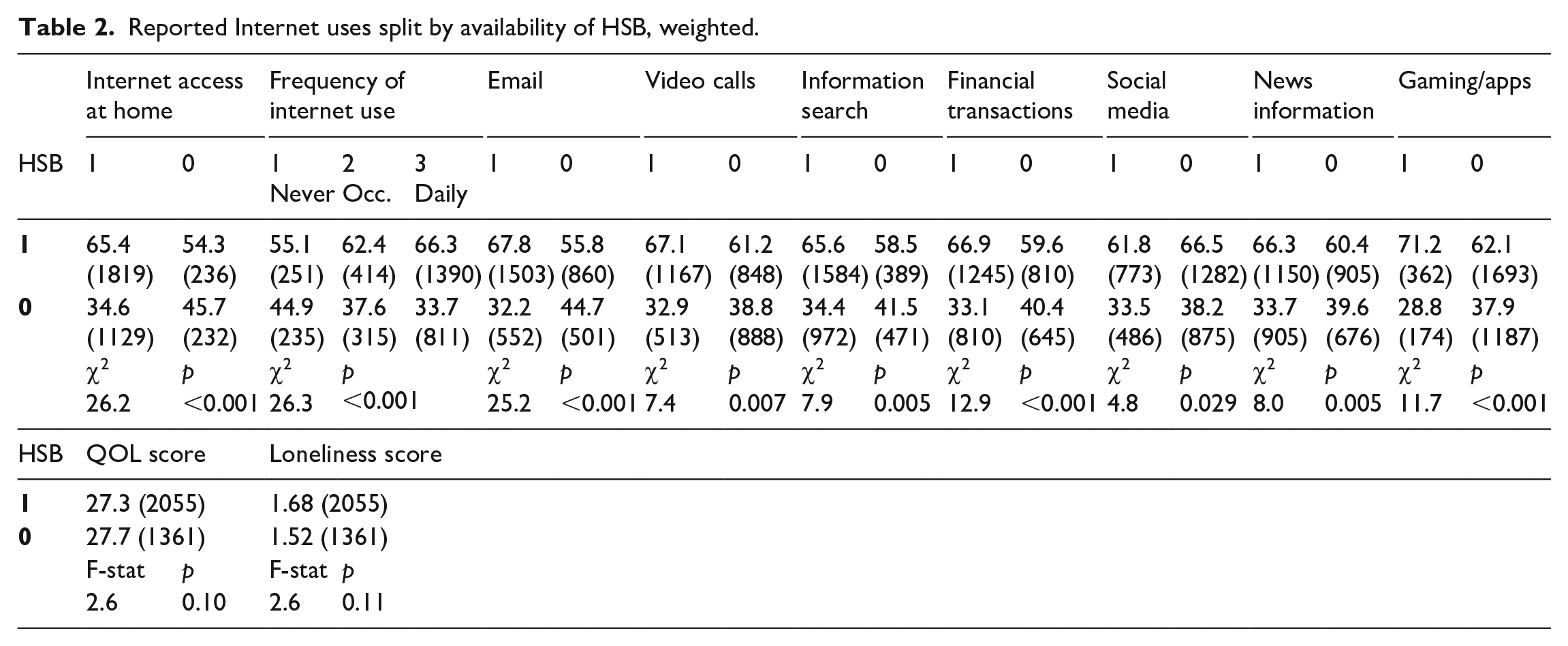
Table 3 reports OLS coefficients from model estimation on QOL score, displaying the results in relation to stated research objective 2. Internet access in the home has statistically significant coefficients on QOL across all specifications – the effect attenuating with adjustment across Models (1), (2) and (3). There is no statistically significant association found for higher availability of HSB in the adjusted models, Models (2) and (3). Compared with never using the Internet, daily Internet use is associated with greater than a one-point higher QOL score in the fully adjusted model (Model (3)) (the full results of this model is provided in Supplementary File Table S-3). Using email, video calls, the Internet for information search and financial transactions all show statistically significant positive associations with QOL. In the fully adjusted model, Model 3, which includes household income, no significant association is observed between QOL and the applications social media use; using the Internet for news information; or gaming or apps.
Estimation results.
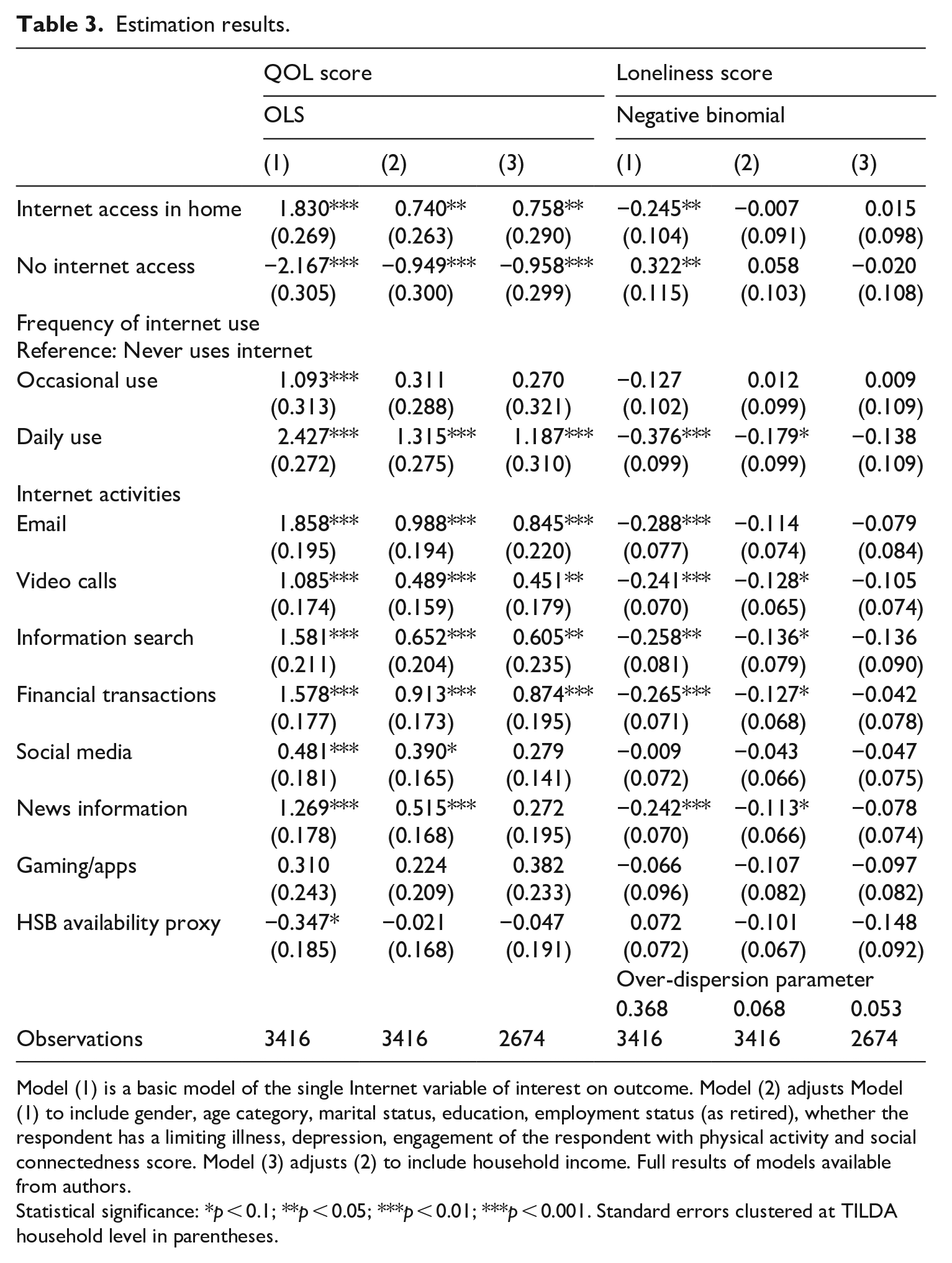
Model (1) is a basic model of the single Internet variable of interest on outcome. Model (2) adjusts Model (1) to include gender, age category, marital status, education, employment status (as retired), whether the respondent has a limiting illness, depression, engagement of the respondent with physical activity and social connectedness score. Model (3) adjusts (2) to include household income. Full results of models available from authors.
Statistical significance: *p < 0.1; **p < 0.05; ***p < 0.01; ***p < 0.001. Standard errors clustered at TILDA household level in parentheses.
Turning to the results for loneliness, Table 3 reports marginal effects on the loneliness score from negative binomial models (calculated at the means of the independent variables). The estimates reveal that, where controls are accounted for, neither Internet access in the home nor the availability of HSB has a statistically significant association with loneliness scores. Loneliness scores are significantly lower among those who use the Internet daily compared with those who never use the Internet, though when income is included in Model 3 the estimate is no longer statistically significant. For the most basic, unadjusted model (Model (1)) of the use of email, video calls, information search, financial transactions and news information indicate a negative association between loneliness and undertaking these activities, though the statistical significance of these effects do not persist when other explanatory variables are accounted for in Models (2) and (3).
Alternate specifications of the dependent variables, using dummy dependent variables set to a value of 1 for being in the upper tertiles of loneliness and QOL, find broadly comparable results to the main analysis (reported in Supplementary File Table S-4).
The results from subgroup analysis reveal some variations in effect by availability of HSB, gender and age. The positive associations between QOL and Internet use are larger in magnitude and more statistically robust for the group living in areas with HSB available than for those that do not (see Supplementary File Table S-5). There were also some differences in effects across gender: the negative association of no Internet access and QOL is stronger for males (see Supplementary File Table S-6). Social media engagement has a statistically significant positive association with QOL for males but not for females, and QOL for females is not significantly associated with the use of video calls. Across age groups, there were also some differential effects. For the group aged 70 years and older, video call use is associated with a higher QOL, but this association is not statistically significant for the group aged under 70 years upon full adjustment (see Supplementary File Table S-7).
Discussion and conclusion
Explaining the results
The majority of the older adults report being able to access the Internet at home, though a lower proportion are found to have HSB available in their residence. This difference reflects gaps in HSB network infrastructure provision that are intended to be addressed through Ireland’s National Broadband Plan (Irish Government, 2017). In the absence of HSB, households may access basic broadband provided through fixed copper wire telephone lines (e.g. using digital subscriber line [DSL] connections), or mobile Internet delivered over cellular networks. Email and information search are used by more than two-thirds of older adults, though only half use the Internet for financial transactions and news information, suggesting that there is further potential to improve access, use and digital skills among this group.
The higher reported rate of Internet access in the home among those for whom HSB is available illustrates variations in infrastructure provision and suggests broader use of Internet applications where better infrastructure is available. A previous study found that HSB at home was associated with greater digital skills among older people (Hargittai and Dobransky, 2017), and the findings of our study may be interpreted as supportive of a theory that the provision of HSB infrastructure facilitates greater digital immersion among older people. We note, however, that we cannot directly test this inference as TILDA does not ask whether HSB is available in respondent’s homes or whether they subscribe to a HSB service where it is offered. Greater frequency of Internet use and a higher prevalence of Internet activities among those with access to HSB may reflect better ease, comfort and efficiency for digital pursuits where there is a faster, more reliable connection.
Our modelling results on QOL are consistent with the theoretical prediction that successful ageing could be assisted by Internet access and use. While we do not have sufficiently detailed outcomes data to distinguish individual channels of causation running through individual SOC activities to the exclusion of others, we had earlier suggested that digital information search and retrieval might be of assistance in selection actions, communications applications might be beneficial to actions associated with optimisation, and remote digital access to key services might be useful for compensation actions. It is notable that all these types of applications proved to have significant associations with QOL, as did the broader metrics of Internet access and daily use. This might indicate a relatively broad-based relationship or one in which interactions among domains is important. The positive associations between Internet use and QOL reported here add to a weight of literature which finds the Internet to be advantageous in terms of positive ageing and QOL (Aggarwal et al., 2020). From the alternative position of not engaging with a digital world, the results suggest there is a lower QOL in older age among non-participants than among those using digital technologies – either due to having no Internet access in the home or never using the Internet. Those who are not engaging with digital technologies and applications may be missing some of the opportunities and advantages provided, where technophobia may maintain a digital divide among this group (Nimrod, 2021).
In contrast, we find little evidence that loneliness is affected by varying levels or patterns of Internet use among older people. This null finding is broadly in line with existing quantitative literature in this arena (Shah et al., 2021; Stockwell et al., 2020; White et al., 1999, 2002). Particularly for this demographic group, but also more generally, loneliness may principally relate to lack of time spent in in-person company. Face-to-face communication is theorised and found to be an important influence for social and emotional loneliness (Moody, 2001), where social loneliness relates to a lack of meaningful friendships or a sense of belonging to a community, while emotional loneliness relates to feelings of emptiness attributable to a lack of intimate relationships. It has previously been documented that older people have a preference for face-to-face interaction, followed by telephone communication (Yuan et al., 2016). Virtual means of communication and relational experiences in an online setting may not be sufficient to substitute for high-quality personal relationships or real-world experiences, though we note that during the difficult confinement period of COVID-19 virtual communication was found in qualitative reports to have a humanising effect and mitigated potential loneliness (Llorente-Barroso et al., 2021). In testing theories on loneliness and Internet use, though be it using a questionnaire administered to a student population, Moody (2001) found that high levels of Internet use were associated with low levels of social loneliness but high levels of emotional loneliness. Our findings here may also be viewed as baring out a theory that Internet use, or availability of high-speed Internet, in affecting levels of loneliness of older people is not clear-cut.
On the other side, the results also reveal that not engaging in the digital world – be that through no home Internet access or reporting never using the Internet – does not appear to be associated with higher risk of loneliness among older people. Older people living entirely offline may rely on traditional forms of communication and information distribution, for example, telephone, radio, television and post services, in combination with existing in-person family and community support.
Taken together, these results support the idea that broadband and digital technologies may be of assistance to older people taking SOC actions in an effort to achieve successful ageing, as proxied by subjective QOL. However, it also seems that there are socio-emotional domains in which these technologies are not as effective at producing beneficial outcomes, for example, reducing loneliness. The findings of our study further attest that associations between Internet uses and various measures of older people’s wellbeing are not universal, where conclusions from one study setting cannot be presumed to be generalisable to another situation. Rather than seeing this as a weakness, this challenges theory and calls for continued theoretical and empirically tested contributions on this important academic, practical and policy-relevant subject.
Strengths and limitations
The TILDA dataset offers a large, national sample and provides rich information on the demographic, socio-economic, locational and health characteristics of older people in Ireland, which allows us to control for potential confounders in relationships between digital engagement, loneliness and QOL. The outcomes are measured using validated instruments that afford comparison with other studies, as called for in systematic reviews in this field (Aggarwal et al., 2020). The main contribution of this article is that it links survey reports with objective administrative information on HSB availability, the provision of which is recognised as particularly important for older people (Federal Communications Commission [FCC], 2010). The availability of geo-codes for both infrastructure networks and TILDA respondents allows us to link these data together for the first time. The study also sheds light on a neglected group in the extant literature where it considers psychosocial outcomes for those who do not have Internet access or never use the Internet, as called for by Damant et al. (2017).
A limitation of this article is that the survey information is self-reported in the SCQ, which while useful for gathering sensitive information, has potential for bias and thus measurement error. Moreover, the survey does not ask respondents details such as whether they know they have HSB available to them, whether they subscribe to a HSB service or anything regarding perceptions of their digital skills and competencies, attitudes and behaviours around Internet engagement, for example, online safety, or how they acquire online abilities. The information on Internet uses only appears in a single wave of TILDA and thus permits only a cross-sectional design for analysis, which does not allow confirmation of causal inferences. It remains possible that older people with higher QOL may be more likely to adopt the Internet, or that some other omitted factor causes both Internet use and higher QOL. As is observed for the rest of the population, there is evidence that the COVID-19 experience has expanded broadband usage among over 65 years in Ireland (Comission for Communications Regulation [ComReg], 2020), while the results reported in this article pertain to the pre-pandemic period for which we have the most comprehensive and reliable data (see reviewed studies, Llorente-Barroso et al., 2021; Nimrod, 2020, 2021).
Implications for policy and future research directions
This study finds widespread Internet access, use and engagement with various digital applications among over 50s in Ireland. However, digital technology adoption by older people merits continued policy attention to exploit the full benefits of ICT among this group. To the extent that provision of HSB infrastructure facilitates access to Internet in homes, frequency of Internet use and the utilisation of applications associated with higher QOL such as email, video communication, information search and financial transactions, future ex post studies should seek to measure the benefits to successful ageing among older people as many jurisdictions subsidise the extension of HSB to poorly served areas. However, on this point we emphasise that this study does not consider or evaluate the costs, risks or broader benefits of investments in telecommunications infrastructure.
The results of this work are also informative for policy development aimed at supporting successful ageing, such as Ireland’s National Positive Ageing Strategy (Department of Health, 2013) as well as loneliness and social inclusion policies, for example, the Roadmap for Social Inclusion (Department of Social Protection, 2020). There are particularly important complementarities between policies to extend digital infrastructures and services and those to promote training and skills development of older people, such as those supported by the Harnessing Digital – The Digital Ireland Framework (Department of the Taoiseach, 2022) and the Adult Literacy, Numeracy and Digital Literacy Strategy (Department of Further and Higher Education, Research, Innovation and Science, 2021; SOLAS, 2020). Llorente-Barroso et al. (2015) emphasise that encouraging digital literacy among older populations is of paramount importance – stating that older people are aware of the great opportunities offered to them from the Internet, and that they demand training and more accessible tools to enable them to optimise their QOL. In assessing the use of voice-controlled Intelligent Personal Assistants (Google Home) by older people, Nimrod and Edan (2021) echo the call for more nuanced policies and interventions to expand access to new technologies and improve older adults’ digital skills.
This article presents a first exploration of the links between HSB infrastructure provision and a set of subjective well-being outcomes among an older population in Ireland. Further studies are required from other jurisdictions to characterise these relationships more comprehensively and establish how much heterogeneity there is across populations. As HSB is provided more widely, it would be useful to know more about who adopts it and who does not, since this could identify the barriers experienced by older people and help refine the business case for investing in corrective measures. Studies could measure indicators of successful ageing in areas where government investment has extended the rollout of HSB, helping to quantify the benefits of such investments for this population.
Where ‘non-use’ of the Internet diminishes QOL for older people, the reasons for this may be further explored through qualitative research. For example, on the subject of the persistence of groups of older people who remain digitally excluded in older age, Kappeler et al. (2021) remarks that while this size of this group is diminishing, their disadvantages become increasingly severe, particularly in societies in which using the Internet is normal and expected; examples include filling out tax returns online, email invoices and thus those digitally excluded may be economically disadvantaged. In a qualitative study of those living offline in Sweden and the United Kingdom, Reisdorf et al. (2016) found that several interviewees reported being happy to be offline, though reported that they had help from family, friends and professionals (e.g. accountants) if the Internet was required, though some reported feelings of being different from others in society, excluded from conversations about Internet trends, and some reported regret at not learning how to use the Internet.
A final strand which warrants further scholarly investigation is the wellbeing effects of unexplored facets of digital uses by older people including online safety, cybersecurity and privacy considerations. Whitty (2019) finds support for the hypothesis that older people are more likely to become victims of cyber-frauds than younger people, and in a qualitative investigation, Bailey et al. (2021) documents that older people who have experienced victimisation online report that such experiences undermine their self-esteem, self-confidence and lead to a loss of trust, feelings of shame and embarrassment.
Conclusion
Ageing of the population across many developed countries and digitalisation of 21st-century societies, as well as recent experiences of the COVID-19 pandemic, have brought the effects of ICT on older people into sharper focus. Theory suggests that digital technologies and services can facilitate successful ageing by enabling selection, optimisation and compensation activities. This study finds that Internet access, use and Internet-based activities are common among those aged over 50 years in Ireland. However, the population coverage of HSB remains incomplete. Where older people have access to HSB, Internet access is more prevalent, encouraging more frequent use of the Internet as well as engagement with Internet-based applications such as video communications. QOL is higher among older people who use the Internet and several digital applications. In contrast, little evidence is found of effects on Internet use on loneliness among this group. The results also suggest that older people who have not yet adopted digital technologies may miss out on opportunities to enhance their QOL. These findings may help inform cross-governmental policies on areas such as successful ageing, infrastructure provision and skills development.
Supplemental Material
sj-docx-1-nms-10.1177_14614448221095218 – Supplemental material for High-speed broadband availability, Internet activity among older people, quality of life and loneliness
Supplemental material, sj-docx-1-nms-10.1177_14614448221095218 for High-speed broadband availability, Internet activity among older people, quality of life and loneliness by Gretta Mohan and Seán Lyons in New Media & Society
Footnotes
Funding
The author(s) disclosed receipt of the following financial support for the research, authorship, and/or publication of this article: This research is supported by the Electronic Communications Research Programme at the ESRI, funded as a joint research programme by the Department of the Environment, Climate and Communications (DECC) and the Commission for Communications Regulation (ComReg). The authors would like to acknowledge the contribution of the TILDA participants and research team. Financial support for TILDA was provided by Irish Life plc, the Irish Government and the Atlantic Philanthropies. These funders had no involvement in analyses or in preparation of this paper. TILDA is funded by the Health Research Board grant TILDA-2017-1.

Supplemental material
Supplemental material for this article is available online.
Notes
Author biographies
References
Supplementary Material
Please find the following supplemental material available below.
For Open Access articles published under a Creative Commons License, all supplemental material carries the same license as the article it is associated with.
For non-Open Access articles published, all supplemental material carries a non-exclusive license, and permission requests for re-use of supplemental material or any part of supplemental material shall be sent directly to the copyright owner as specified in the copyright notice associated with the article.
