




Abstract
This article is interested in populism outside the master frame of institutional politics (populist parties/leaders), considering, instead, the populist potential of celebrities’ everyday politics on social media. To understand this potential, the article suggests, we need to understand how celebrities are compelled by today’s mediatized communicative ecosystem to perform themselves as ordinary advocates for people-victims. We need to examine how the performative logic that this ecosystem forces into platforms accommodates certain emotional claims to ordinariness and normative-moral claims to advocacy—who is (un)worthy of a place in the victimized people that celebrities should advocate for. The article does so by analyzing two paradigmatically different case studies: Lady Gaga’s legacy-status and Greta Thunberg’s influencer-style performances of celebrity advocacy on Instagram. The analytical discussion leads to contemplating the mediatized populist politics of everyday politics that both perform, despite their differences, and its ambivalent relationship with liberal democracy (centrist moderation and neoliberal consolidation).
Keywords
Introduction
In this article, I enquire into the communicative-performative conditions, emotional and moral, under which social networking platforms become hubs of populist everyday politics and the implications this raises for liberal democracy. Both everyday politics and populism are found to have an “elective affinity” (Gerbaudo, 2018) with social media, often for the very same reasons: social media have accentuated the decoupling of political representation from the formal-institutional and technocratic management of citizens’ official interests by mainstream policymakers, valorizing, even more, the informal/extra-institutional and communicative articulation of people’s everyday concerns and demands by “charismatic leaders,” “celebrity politicians,” and “celebrity political advocates” (see also Giglioli and Baldini, 2019; Kissas, 2020; Mazzoleni and Bracciale, 2018; Zeglen and Ewen, 2020). My focus here shall be on non-politician celebrities as “unelected persons [who] may legitimately represent politically the views and values of others” (Street, 2004: 447), since their role in populist everyday politics is rather under-researched. As I wish to argue, in exploring this role, and broadly the connection between everyday politics, celebrities, and populism in the context of social media, two notions are of key importance: ordinariness and victimhood.
Everyday politics is informal and conversational, or, as Turner (2010) has branded it, “demotic,” as well as personal and personalized, in the sense that “the political can be present within the personal, without needing to be framed as explicitly political” (Highfield, 2016: 10). It can be also present in the “mundane forms of social media communication, from selfies to memes, intertextual references through animated GIFs and checking-in to particular locations” (Highfield, 2016). Everyday politics is, therefore, a politics of ordinariness and, as such, appeals to individuals and groups from different socioeconomic backgrounds and with different living conditions, allowing them to come together and interconnect (Papacharissi, 2021); it is, like populism, both people-centric and popular (Canovan, 1999). Populism’s appeal to the people, however, is not exhausted through a celebration of ordinariness but crucially involves interpreting ordinariness as a state of enduring injustice (see Norris and Inglehart, 2019; Rothmund et al., 2020) and the (ordinary) people as a political subject upon which this injustice is inflicted; a victim of the past, the present, and the future yet to be vindicated, as Al-Ghazzi (2021) has it. Hence, populism goes with a politics of victimhood which, in the post-recession era, has engineered the “communication, amplification and monetization of vulnerability on and through social media platforms” (Chouliaraki, 2021: 20) to the extent that everyday politics has now almost collapsed into a realm of victimized people.
Based on the above, the argument I put forward in this article is that celebrities may be deemed to be actors of populist everyday politics insofar as they authentically present themselves as high-profile ordinary advocates for people-victims. It is not about celebrities living a normal, mundane everyday life and standing with the poor and alienated, as the relationship between an individual or collective self and “being ordinary,” as well as “being a victim,” is not stable and fixated, determined by “intrinsic” qualities of everydayness and “objective” conditions of vulnerability and suffering. It is rather a relationship of “no necessary correspondence,” in Stuart Hall’s (1985) words, the (provisional) establishment of which is emotionally and normatively-morally performed, through social media, in today’s mediatized communicative ecosystem.
In the first part of the present article (“Theorizing ordinariness, celebrity advocacy and ‘the people’ of populism”), I discuss and theorize this ecosystem, arguing that along with the technological and economic, it also has a performative dynamic that lies at the heart of the everyday politics of ordinariness and the populist politics of victimhood, capturing how certain emotions that appeal to the “intimacy at a distance” (Thompson, 1995) between celebrities and their followers (ordinariness) turn into social judgments regarding who is (un)worthy of a place in the people-victim that celebrities claim to advocate for (victimhood). The second part of the article (“Analyzing Instagram celebrity advocacy”) empirically demonstrates, by applying multimodal and critical discourse analysis, how such claims and social judgments are articulated in Instagram performances of not only established, “legacy-status” celebrities like Lady Gaga, but also new-emerging, influencer-style celebrities like Greta Thunberg. Strikingly different as they might be, both manifestations of celebrity everyday politics are shaped, as the concluding part contemplates (“The mediatized populist politics of celebrity everyday politics: centrism and neoliberalism”), by the very same platform-embedded performative logic of “centrist populism”: a mediatized populism that does not pose an existential threat to liberal democracy, yet serves to consolidate a neoliberal ethics of political advocacy.
Theorizing ordinariness, celebrity advocacy, and “the people” of populism
Ordinariness as public performance
Ordinariness as a mutable practice of social media communication—not a static, intrinsic quality of a certain communicator—is structured by a logic of interconnectedness, in the sense that “taking public action or contributing to a common good becomes an act of personal expression and recognition or self-validation achieved by sharing ideas and actions in trusted relationships” (Bennett and Segerberg, 2012: 752–753; see also Theocharis, 2015). This personalized connective action is argued to be a technologically afforded condition which counts, at the same time, as a valuable commodity within the digital “economy of attention” (Webster, 2016), where social media are algorithmically set to enable the production, sharing, and appropriation of content that maximizes users’ attention. As Ernst et al. (2017) put it, “social media are built upon the logic of virality, which compels political actors to communicate primarily those messages that users like, comment on, promote, and share within their networks” (p. 1349).
Dissecting interconnectedness and virality in technological and economic terms is helpful but only partially in understanding how social media catalyze ordinariness. As Klinger and Svensson (2018) contend, “what is perceived as a commercial imperative is largely a result of narrative construction, symbolic recomposition, hypothetical resolution, and experimental enactment performed by human actors” (p. 4664, emphasis added). In line with them, I wish to argue that if we are to fully understand ordinariness as a practice of public communication on social media, we should also pay attention to the affective nature and dynamic of interconnectedness and virality, which in its own turn bears analytical interest in the performativity of today’s mediatized communicative ecosystem. Let me explain to some greater extent.
Interconnectedness and virality have ushered in a communicative ecosystem where public actors are subject to an ever-expanding visibility that blurs the boundaries between “actual” audiences and “imagined” publics, frontstage public performances, and backstage private acts (Baym and boyd, 2012); where the media—not only social media but also the media as a hybrid whole—are perceived to be everywhere. Hence, public life is in the media rather than with the media, as Deuze (2012) has provocatively asserted. If anything, this sense of living in the media can be overwhelming, not least because it increases the communicative burdens placed upon public actors, forcing them to act preemptively and present themselves—perform—in everyday, or even private, settings as if they were constantly in the public eye (Kissas, 2019); it affectively effects “a heightened consciousness of everyday life as a public performance” (Gamson, 2011: 1068, emphasis added).
Performing everyday life is what it takes to be ordinary in the arena of “socially-mediated publicness” (Baym and boyd, 2012), but it has its own conditions of possibility, as social media confront their users with their own performative logics: a set of “normative practices and expectations that govern use” (Mascheroni and Murru, 2017) and which can be reduced neither to platforms themselves—a so-called “social media logic” (Hermida and Mellado, 2020; van Dijck and Poell, 2013)—nor to their users. Arguably, interconnectedness and virality entail a media system where different platforms, technologies, communication logics, practices, and actors do not exist and evolve independently, or in isolation from each other, but coexist and co-evolve through—shaped by—systematized relations of symbiosis and interplay (Chadwick, 2017). All these amalgamate into a socially-historically and culturally embedded logic of media performing which different platforms internalize in their own way, or a differentially platformized “media performativity” (Kissas, 2019). Later in the article, I shall elaborate on how media performativity is internalized by Instagram, regulating celebrities’ particular performances of ordinariness, but before that let me first introduce the celebrity as ordinary political advocate.
Celebrities as ordinary political advocates
When we hear the word celebrity, we usually think of famous legacy media personalities from the world of arts, sports, popular culture, and so on, who are intuitively regarded more extraordinary than ordinary. Social media, however, have enabled a “digitally native” generation of youtubers, vloggers, and others, previously unknown “guys next door” who are considered the typical “ordinary user,” to “reach an audience that rivals that of television networks in size” (Khamis et al., 2017: 199) and claim an influencer-style celebrity status (see also Marwick, 2015). In this article, I shall empirically examine cases of both celebrity types to emphatically demonstrate that neither does an extraordinary individual life, as that of legacy-status celebrities, preclude popular public figures from acting as political advocates, nor does a typically ordinary individual self, as that of influencer-style celebrities, suffice for doing so. Celebrities as actors of everyday politics who pursue aspirational civic strategies to “capture the embodiment of a concern about a certain issue” (Craig, 2019: 780) need to be not just ordinary individuals, or not to be extraordinary at all; they need to authentically embody ordinary personae that people can recognize as “authorized to speak and to act officially in its place and its name” (Bourdieu in Pappas, 2019: 109), and, as already noted, between the individual self and its public persona there is “no necessary correspondence” but a performatively enacted relationship.
Celebrity advocacy, so to speak, is a dual performative challenge. On the one hand, celebrities’ possibly extraordinary life should be “domesticated” and “humanized,” for them to authentically interconnect with their followers and feeling like intimate, yet distinguished persons-personalities (Chouliaraki, 2013). On the other hand, a possibly peculiar or idiosyncratic ordinary celebrity self should be “popularized” and “universalized,” for it to authentically embody a public persona of high recognizability and potential virality (Chouliaraki, 2013; see also Corner, 2003; Marshall et al., 2015). This is a challenge that applies both to legacy-status and influencer-style celebrities, as it is built-in platforms’ media performativity itself, in the sense that the platformized logics of media performing regulate, emotionally and normatively-morally, the ways in which celebrities embody an ordinary persona (instead of another) and advocate for a certain people (instead of another). Before delving into and analyzing how Instagram’s media performativity structures celebrity political advocacy, I want to discuss, through the theory of populism this time, the communicative-performative moment of everyday politics that concerns me in this article, that is, when “the people” is presented (by celebrities) as a political subject that suffers injustice—a victimized people.
Populism as victimizing performance
“The people” of populism is, like the ordinariness of everyday politics, not an intrinsic quality of an already existing entity but a performed subjectivity, or as Moffit puts it, “populists do not speak to or for some pre-existing ‘people’ but arguably bring the subject known as ‘the people’ into being” (Moffitt, 2016: 24). In the same vein, when celebrities embody an ordinary persona, claiming to speak in the name of a people that suffers injustice, they bring a constellation of individuals and groups, not necessarily related and equally vulnerable or vulnerable at all, into being as a political subject known as “the people-victim.” Victimization is central to all the three most prominent theoretical approaches to populism as people-making performance, the stylistic, the ideological, and the discursive, albeit not always explicitly and congruently conceptualized across them.
The stylistic approach to populism is interested in the agential-performative, beyond the merely representational, aspect of communication-performance—the symbolic, and even more, the material, technological, and affective communicative acts of people-making (Balwin-Phillipi, 2019; Moffitt, 2016). The populist style is, in most cases, distinctly confrontational, politically incorrect, transgressive, even uncivil to capture “the righteous ‘indignation’ of the public” in the face of a perceived injustice (Higgins, 2017; see also Bucy et al., 2020). By contrast, the ideological approach, prominently put forward by Mudde (2004), contends that the single, particular attempts to stylize the people are always-already governed by an embedded ideology: this (pre)conception of the people as a single and homogeneous (virtuous) social subject that is pitted against the (vicious) establishment, systematically oppressed and wronged by the latter (see also Engesser et al., 2017; Mudde and Rovira Kaltwasser, 2017). Finally, the discursive approach, following Laclau (2005), borrows from the ideological the “people versus establishment” dichotomy, conceptualizing it, however, not as an ideational principle but as a discursive practice that aligns-articulates “common grievances and frustrations” (Katsambekis, 2022: 62), and perceptions of injustice at large (Elchardus and Spruyt, 2016), as a single united, but not necessarily homogeneous, “radical frontier” (Mouffe, 2018).
Can populism be stylistic, ideological, and discursive at the same time? According to Freeden (2017), populism “processes and ideologizes ‘the people’ as a stylized entity” (p. 7) and, as we have seen, not any stylized entity, indiscriminately processed and ideologized, but an entity stylized, through discursive and ideological claims to injustice, as a victim. In this regard, I propose, drawing and expanding on the integrative approach to populism introduced in Kissas (2020), the conception of populism as a victimizing performance of people-making that is technologically-affectively materialized (stylized) in a certain social media platform, and at the same time, semiotically-emotionally and morally-normatively regulated (discursively processed and ideologized) by that platform’s internalized media performativity. Arguably, stories of injustice and victimization inundate everyday politics in our mediatized communicative ecosystem, satisfying platforms’ quest for self-generated, personalized contents that grab users’ attention (Chouliaraki, 2021). Nonetheless, they cannot be considered de facto signs of populism, and need, instead, to be analytically unpacked and interpreted as part of the concrete communicative events where the performative making of the people-victim occurs. The communicative event that concerns me here is Instagram celebrity advocacy, which I empirically access below through Lady Gaga’s legacy-status and Greta Thunberg’s influencer-style celebrity advocacy as performed in a series of posts on their Instagram accounts.
Analyzing Instagram celebrity advocacy
The analytical examples of Lady Gaga’s and Greta Thunberg’s Instagram performances, and the analytical methodology of resemiotization and recontextualization
As I stated in the previous section, I consider it necessary to examine both the legacy-status and the influencer-style celebrity types to gain a better understanding of the role of celebrities as actors of populist everyday politics. What facilitates this better understanding is the sharp contrast between the two types, which the selection of Lady Gaga and Greta Thunberg as specific examples makes even sharper. Gaga may be said to be a “paradigmatic” or “exemplary case study” (Flyvbjerg, 2006) of a talented, super-famous and well-off personality with an extraordinary life and a public actor who rarely uses social media primarily for political causes; these may be, at best, a soft philanthropic activism and raising awareness for the LGBT community (Bennett, 2014), or more recently the endorsement of Joe Biden and Kamala Harris in the 2020 US Presidential Election. Thunberg, on the other hand, stands as an exemplar of a young ordinary girl, completely unknown until very recently, who manages to live with autism and an extremely dedicated climate activist (Murphy, 2021). As the following analysis illustrates, despite these differences at the level of “perceptual realism” (Chouliaraki, 2006)—what we already know about them—both are techno-aesthetically/stylistically and discursively-ideologically reconstructed by Instagram’s media performativity as authentic embodiments of an ordinary persona that speaks in the name of a people while victimizing it, in different (emotional and normative-moral) ways that deserve to be analyzed in-depth.
If there is a platform that is almost synonymous to social media visual crafting of celebrity status nowadays, this is certainly Instagram (Giles, 2018; Leaver et al., 2020). Arguably, it cannot go unnoticed that scholars have even coined the neologism “Instafame” (Marwick, 2015) to thematize the organic role of the platform in the rise of influencer-style celebrities. At the same time, Instagram is home to some of the most famous public figures in the world who did not become famous because of it, and, indeed, the most followed accounts on the platform are still those of legacy-status celebrities (Statista, 2022). Overall, Instagram’s architecture of “self-centred visual imagery”—its organization around users “self-branding snapshots of their daily lives [that] are strongly interlaced with senses of immediacy, mobility and intimacy” (Ekman and Widholm, 2017: 18)—makes it the best choice for getting an analytically robust insight into how both celebrity types perform ordinariness. In addition, in regard to the specific case studies on each type, Instagram poignantly visualizes the contrast between Gaga’s and Thunberg’s “political” use of social media, as through the former’s posts on the 2020 US Presidential Election and the following inauguration (selected here as the only recent examples from her sporadic and rather counterintuitive/extraordinary political advocacy content) and the latter’s posts on autism awareness and world events related to the climate crisis (selected as representative examples from her overflow of “ordinary” activist content). For analyzing these posts, I do not just dwell on Instagram’s image-visuality but move further to propose a comprehensive and integrated analysis of the platform’s media performativity that is based on the analytical categories–tools of resemiotization and recontextualization.
I use resemiotization, a term I borrow from Idema (2003), to refer to the process whereby the unstylized, extra-discursive affective intensity of the mediatized communicative ecosystem is inserted into and articulated by the platform’s “semiotic technology” (Poulsen and Kvåle, 2018) as a meaningful “intensity owned and recognized” (Massumi in Wahl-Jorgensen, 2019: 7) by celebrities and their followers, respectively—that is, a performed emotion. Specifically, resemiotization calls for an analysis of Instagram posts as multimodal texts (Poulsen and Kvåle, 2018) to explicate how the platform’s different technological and semiotic modes of self-presentation (e.g. language, still and moving image, emoji and GIFs, as well as mentions, tags, and hashtags) are combined and coordinated to capture emotions of intimacy: circuits of emotional meaning that allow the indeterminate pressure (on celebrities) to perform ordinariness to turn into concrete performances of embodying an ordinary persona (by celebrities) capable of authentically inviting users to connect, align, and identify as one people-victim.
To better grasp the link between Instagram performances of celebrity ordinariness and the social practice of celebrity advocacy, I extend the techno-semiotic/multimodal focus of resemiotization on emotions to the social-semiotic/discursive focus of recontextualization on the “social and ideological ramifications” of emotions (Wahl-Jorgensen, 2019: 9). I use recontextualization to refer to the process whereby normative or moral claims to advocating for a people that suffers injustice, which are effectively victimizing social judgments over who is/is not worthy a place in this people, are lifted out of a certain social-historical context and selectively re-situated and re-signified within the emotional register of celebrities’ Instagram performances (Chouliaraki and Kissas, 2018). Recontextualization calls, along with the multimodal, for a critical discourse analysis of Instagram posts, that is, an interrogation of the platform’s power “to classify the world into categories of ‘us’ and ‘the other’” (Chouliaraki, 2006: 166) and, in so doing, to reflect and reinforce existing hierarchies of advocacy: connections/alignments with emotionally and ideologically similar others (victims) which, inevitably, entail digital disconnections/dis-alignments with emotionally and ideologically unrecognizable others (the cause or source of injustice), as Döveling et al. (2018) would put it.
In what follows, I analyze, in turn, resemiotization and recontextualization in Lady Gaga’s legacy-status and Greta Thunberg’s influencer-style Instagram performances to unpack and interpret the emotional (gratitude-based and ironic ordinariness, respectively) and normative-moral (advocating for the non-extremist/radical and apolitical people-victims, respectively) variation of their Instagram celebrity advocacy, before reflecting on this variation being demarcated by a mediatized populist everyday politics and its ambivalent relationship with liberal democracy—neither toxic nor entirely amicable.
Gratitude and irony as emotional claims to celebrity ordinariness
The selected posts from Lady Gaga’s Instagram performance of political advocacy splice together marketing-commercial strategies to keep the artist’s 50 million followers awed and impressed with aspirational civic discourses that seek to make her look intimate and accessible. The emotional key to recasting Gaga’s extraordinary individual self as an ordinary persona is the resemiotization of affective pressure, put on her by the hybrid and omnipresent media system of which she is part, into gratitude. Characteristic in this regard is the post from 14 January 2021 (see Figure 1(a)), in which Gaga announced that she would perform at Biden’s and Harris’ inauguration. While the aesthetic design is typical of a promotional Instagram post, Gaga is represented casually dressed, in a white jumper on which there is a heart drawing with the name “JOE” printed inside it—a typical “I love Joe” jumper that an ordinary Biden’s fan would wear. To this visual casualty, the caption verbally attaches a statement that an ordinary Biden’s fan would also make: “
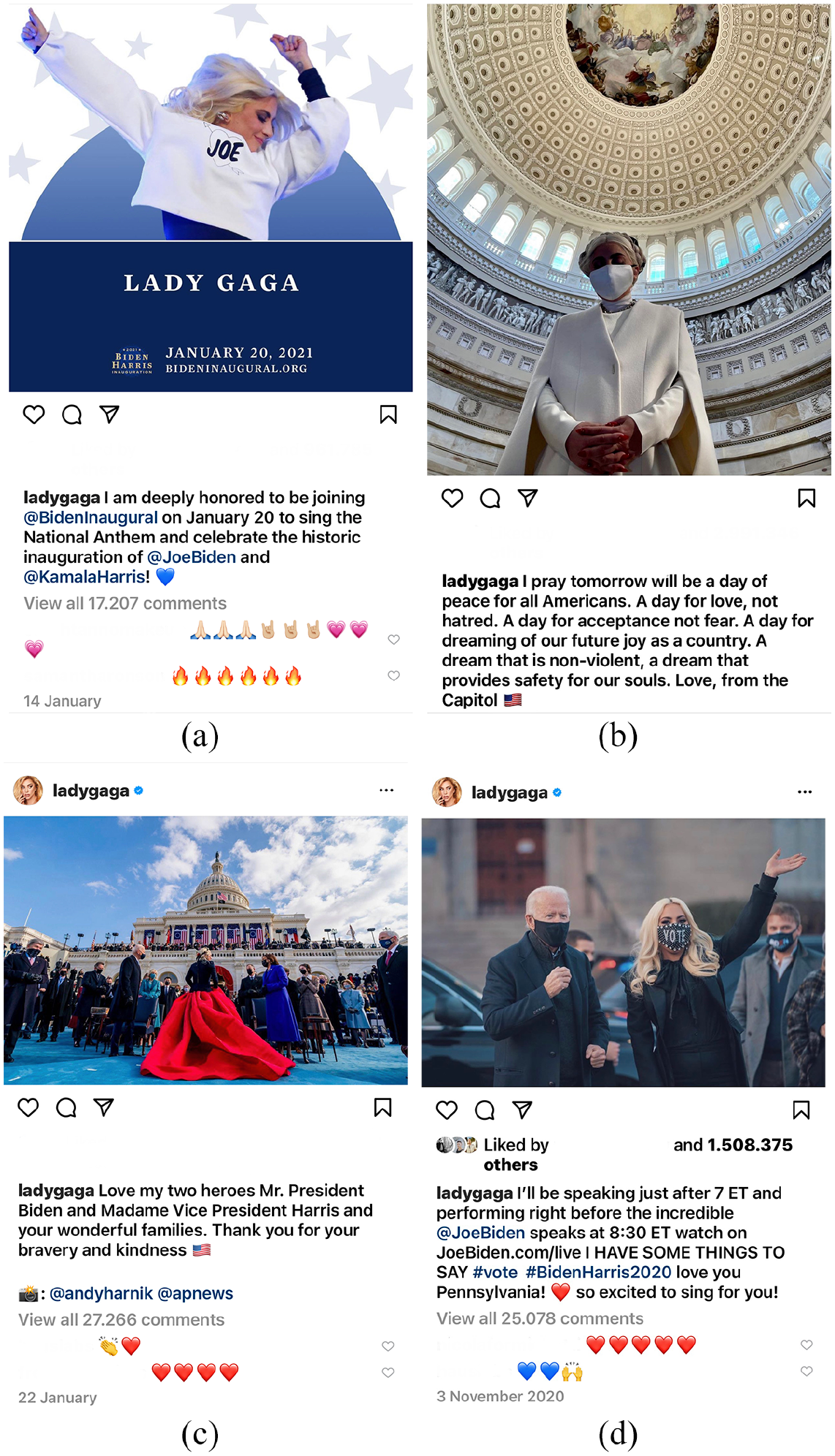
(a) Lady Gaga announces Inauguration performance. (b) Lady Gaga visits the Capitol on the Inauguration Eve. (c) Snapshot from the Inauguration. (d) Lady Gaga announces campaign event with Joe Biden.
Stellar et al. (2017) argue that gratitude belongs to the family of “self-transcendent” emotions and, as such, instigates prosocial forms of behavior and action; it is oriented toward the other, not the self. A closer look into Gaga’s advocacy posts may not contradict but certainly complicates this argument. They reveal how gratitude is multimodally instrumentalized to “calibrate,” rather than suspending, her unique and exceptional individuality, specifically, to reinvent it as a non-institutional equivalent to Biden’s and Harris’s representative legitimacy: a persona who is as well, if not better, connected to the ordinary people and therefore can speak in their name; hence, an ordinary persona. In the post from the inauguration day (see Figure 1(c)), for example, the picture has Gaga at the center facing the Capitol—while Biden and Harris face her—in her voluminous red skirt that undoubtedly draws eyes, almost outshining the two politicians. In addition, the latter are not @mentioned in the caption, where their official institutional accounts would be highly visible and directly accessible, but only tagged in the picture, where usernames are not visible unless someone clicks on it.
On the contrary, as part of the pre-inauguration promotional-style post (see Figure 1(a)) and an earlier post from 3 November 2020 (see Figure 1(d)), before the election, Biden and Harris were mentioned in the captions through the usernames of their personal accounts, though, as they had not had assumed office yet (“[. . .] celebrate the historic inauguration of @JoeBiden and @KamalaHarris”; “I’ll be speaking just after 7 ET and performing right before the incredible @JoeBiden speaks at 8:30 ET”). This downplaying of the “institutional” and foregrounding of the “personal” are also prominent in the post from the inauguration day, where Gaga thanks the President and the Vice President for their (personal) “
In the post from inside the Capitol (Figure 1(b)), Gaga contrasts the forces of hatred, fear, and violence with those of love, acceptance, and safety which she prays to find vindication, subtly reminding that a fortnight before that day, the symbol par excellence of popular sovereignty in American democracy (the Capitol) almost fell into the hands of the extremists—“I pray tomorrow will be a day of peace for all Americans. A day
Unlike Lady Gaga’s, Greta Thunberg’s Instagram performance that is under scrutiny here does not serve as much to equate extra-institutional and institutional representatives of the people, as to totally discredit the latter and place all hopes on the former. Thunberg’s rise to a public figure with just above 14 million Instagram followers is primarily owed to the controversial #climatestrikeonline campaigns that she has continuously spearheaded for more than 3 years now (see indicatively Figure 2(a)), as well as to her “confessional texts” (Redmond, 2008), like the one for the #AutismAwarenessDay, on 2 April 2021 (Figure 2(b)), where she talks about herself and how proud she is to be different (have Asperger) “in a world where everyone strives to act, think and look the same.” In a self-disclosing move that aims at reconciling her hitherto unknown individual (and public) self with the enormous visibility she now faces, the affective energy of Thunberg’s mediatized presence is resemiotized by Instagram media performativity into irony, thereby capturing the cynical attitude of the young challenger who doubts political leaders’ authenticity, sincerity, and truth.
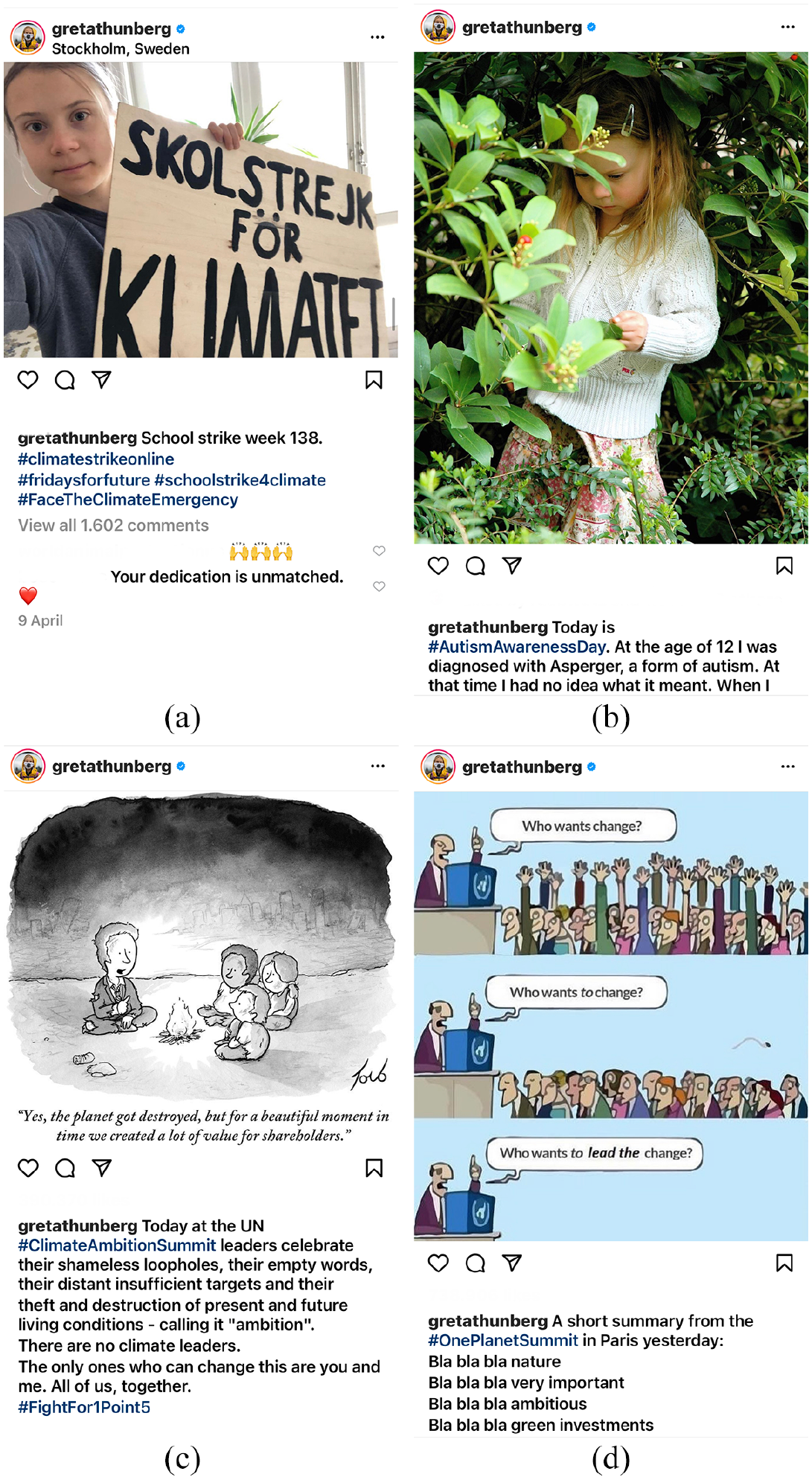
(a) Greta Thunberg’s online climate strike. (b) Greta Thunberg shares her story to raise awareness of autistic people. (c) Greta Thunberg’s reflection on the UN Climate Ambition Summit. (d) Greta Thunberg’s reflection on the One Planet Summit.
Distrust toward political leaders is graphically illustrated in one post, from 12 December 2020, on the UN #ClimateAmbitionSummit (Figure 2(c)) and another, from 12 January 2021 (Figure 2(d)), on the #OnePlanetSummit in Parris. Both deploy cartoon drawings to artfully grasp the human responsibility for the climate crisis that our planet faces, specifically, the obsession with profit-making (2(c)) and the unwillingness to change (2(d)). Although, visually, the cartoons give the impression that this reckless lifestyle applies to us all, in the captions, it is verbally clarified that it is not us, the people, who must take the greatest share of responsibility but world leaders: they are openly accused for “theft and destruction” and mocked, through the ironic use of the words “ambition,” “ambitious,” and “bla bla bla,” for their failed plans to tackle the climate crisis.
Arguably, this transfer of responsibility may serve to victimize the people—“the people have not yet been made aware,” Thunberg admits in a video posted on 10 December 2020—without necessarily relegating irony to apathy, though. As Brock (2018) has observed, irony rather speaks to “a continued disappointment in ‘the disgrace of how the world is, how we ourselves are, and how we might like things to be’” (p. 291). As soon as this disappointment turns into awareness of the injustice that causes it, it can trigger action—“once we become aware, then we can act [. . .]
Taking a closer look into the long caption of the UN post, we can discern a hint to a revolutionary-radical people in the phrase “action needed is not possible within today’s system,” which, however, is not followed, as one might expect, by a call for a new system. On the contrary, the call is made for a “
Non-extremism/radicalism and apoliticism as normative-moral claims to celebrity advocacy
The breathtaking looks that are pictured in Lady Gaga’s posts, especially her appearance inside the Capitol wearing the suffrage-white coat and her performance at the Inauguration in a red-and-blue outfit, have been widely discussed in the media for their symbolisms—sartorial references to the women-rights movement and cross-partisanship/unity, respectively (Krause, 2021; Pareles, 2021). However, these are not the only normative-moral claims to advocacy that are recounted through Gaga’s gratitude-based ordinariness. In the post from the Inauguration Eve (Figure 1(b)), references are also made to Gaga’s “professed religiosity” (Deflem, 2017) and its relation to America’s core-founding values, as she is visually captured with her hands crossed—a posture that points to praying (also verbally confirmed in the caption: “I
In a narrativizing and historicizing move of recontextualization, Gaga’s ordinary persona rearticulates the liberal-progressive claim to advocating for women rights and cross-partisanship with the conservative claim to a nationally-religiously approved advocacy. In so doing, Gaga’s gratitude-based ordinariness does fit neither the “secular Left” nor the “religious Right,” as Graves-Fitzsimmonsv (2017) has rightly opined in the Washington Post; it rather hovers over the “middle ground.” On the one hand, Gaga takes aim at extremists, both misogynists like the former President Donald Trump (“a man who believes his fame gives him the right to
Moving to Thunberg’s performance of ironic ordinariness, it is not some sartorial statements but the threat of an impending disaster—her “environmental apocalypticism,” as Murphy (2021) calls it—that has symbolic value here. This threat is visually traced in the UN post (Figure 2(c))—a cartoon drawing depicts four humans in bad shape sitting around a fire while behind them there is only a ruined landscape—and verbally cued in the caption of the post on the Paris Summit (Figure 2(d)): “unless we start treating this [climate crisis] like the
In her effort to make a case about world leaders’ responsibility for the impending disaster, Thunberg re-situates in her Instagram performance the idea of “savage capitalism”: leaders are to blame for having allowed and promoted an uncontrolled and uncountable (unjust) market freedom. This can be inferred from the phrase that is embedded in the first cartoon drawing (“Yet, the planet got destroyed, but for a beautiful moment in time we created a lot of
This suggestion comes to reaffirm that irony, as Chouliaraki (2013) observes, questions the integrity of dispositional politics and its capacity to inspire organized collective action, leaving us in the end with the reassurance and self-gratification that personal narratives and confessions (such as Thunberg’s disclosure of her own health condition) can offer. Indeed, Thunberg’s performance of ironic ordinariness invites the victims of capitalist exploitation to fight injustice on an individual(ized) and personal(ized) basis, “where doing good to others is about ‘how I feel’” (Chouliaraki, 2013: 3), not about political dispositions and convictions on what is good—“There are no climate leaders. The only ones who can change this are
In the last, concluding section, I reflect on the performative variation in celebrities’ everyday politics on social media, as it has emerged through the analysis of resemiotization and recontextualization in Lady Gaga’s legacy-status and Greta Thunberg’s influencer-style Instagram performances of political advocacy, highlighting the distinctly populist media performativity that structures them in common and the implications it bears for the state of liberal democracy.
The mediatized populist politics of celebrity everyday politics: centrism and neoliberalism
Everyday politics on social media, on digital platforms that are technologically and economically oriented toward pursuing personalized connections and the maximization of attention, is, as I have argued, about performing ordinariness. In examining, especially, how celebrities perform ordinariness on Instagram, this article has not put the emphasis as much on actors’ tactical uses of social media to perform strategies of self-presentation, as on media performativity itself. Media performativity is nothing else than the socially-historically and culturally embedded practices of performing in today’s media-hybrid and media-omnipresent (mediatized) communicative ecosystem, which are internalized by Instagram (and, differentially, by other platforms) to harness certain subjectivities for celebrities to perform—here, the focus has been on the celebrity ordinary persona as an advocate for the people-victim. To explore celebrities’ performative claims to ordinariness and victimhood, stressing, at the same time, that these claims are decoupled from “objective,” intrinsic, and essentialist individual qualities and conditions, I drew on two paradigmatically different case studies of Instagram celebrity advocacy, Lady Gaga’s legacy-status (and rather counterintuitive), and Greta Thunberg’s influencer-style (closer to what is typically expected from an ordinary political advocate). In analyzing them, I have tried to explicate how selected posts resemiotize affective intensities of mediatized communication into concrete emotional claims to celebrity ordinariness and how these claims are also recontextualized as normative-moral, and hierarchical, claims to celebrity advocacy; claims over who causes and who suffers injustice and, therefore, who is (un)worthy of a place in the people-victim that awaits vindication.
In Lady Gaga’s posts, as I have demonstrated, ordinariness is performatively built upon gratitude, a self-transcendent emotion of intimacy that collapses the artist’s unique, talented personality into an ordinary persona, publicly recognizable as an advocate for the decent-moderate victims of extremism (including misogynism). By contrast, in Greta Thunberg’s posts, ordinariness is performatively built upon irony, a self-gratifying emotion of intimacy that allows the previously unknown teenage girl to embody an ordinary persona, publicly recognizable as an advocate for the decent-moderate victims of failed capitalist politics (especially climate politics). In both cases, Instagram’s media performativity sets a high “constitutive limit of alignment” (Döveling et al., 2018), that is, connections are morally-normatively justified and legitimate among all but extremists-radicals (in Gaga’s case) and political hardliners (in Thunberg’s case), thereby victimizing decent-moderate people as a relatively inclusive political subject. Does this mean that celebrity everyday politics on Instagram falls into what some hail as open, inclusionary and, therefore, democratic populism (Katsambekis, 2022; Stavrakakis, 2018)? Not necessarily. Before answering this question, it is important to consider that Gaga’s and Thunberg’s victimized peoples complicate (a) the typical ideological conception of the people in anti-establishment populism and (b) the straightforward discursive relation of populist inclusion to democracy, especially liberal democracy.
Gaga’s and Thunberg’s everyday politics does not identify the cause of injustice with the liberal-capitalist or imperialist elites that left-wing populism resents. It does not identify injustice with the ethnic, religious, or social-cultural minorities, targeted by right-wing populism, either; those responsible for injustice and oppression are, instead, the insurrectionists and misogynists as well as the political hardliners. As for the victims of injustice, Gaga’s and Thunberg’s everyday politics advocates neither for the agonistic-radical people of the Left (Mouffe, 2018) nor for the nationalist, xenophobic, or racist people of the Right (Mudde and Rovira Kaltwasser, 2017); it advocates for the decent-moderate people of the Center, the non-extremist/radicals, and the apolitical (personally motivate and science-driven). Their everyday politics falls, therefore, into what Postill (2018) calls “centrist or technocratic populism,” a populist zeitgeist that pursues a “sensible third way between the proven failures of a corrupt establishment and the dangerous extremism of rival populists” (p. 757). Arguably, this sort of populism can no longer sustain the narrow-focused populist dichotomy “virtuous people versus vicious establishment”; “the establishment” is not always against the people—moderate liberals, even elites, may be included in the people as victims of extremism and capitalist exploitation—and “the anti-establishment” is not always with the people—radicals and hardliners may be excluded from the people as less worthy victims, non-victims, or causes of injustice.
It follows from the above that we can learn more about populist everyday politics, its various and polyvalent styles, ideologies, and discourses, by empirically analyzing, on a case-by-case basis (through different social media performances of celebrity advocacy), how the people is performatively victimized than by sticking to theory’s predilection for styles, ideologies, and discourses that fantasize the people as an anti-establishment coalition. It also follows, and comes to build up onto existing relevant research, that populist everyday politics is characterized by a “democratic ambivalence” (Rovira and Kaltwasser, 2012). On the one hand, the tenet that “populism aims at subverting an existing political order, postwar liberal democracy” (Pappas, 2019: 100) is challenged by Lady Gaga’s and Greta Thunberg’s centrist populism, as it calls into being a moderate political subject, not extremist/radical or ideologically entrenched. On the other hand, suggesting the opposite, that populism aims at reforming the existing political order to secure that liberal democracy still enshrines the volonté Générale (see Canovan, 1999) would also be problematic. This is because, as Urbinaty (2019) insightfully suggests, “the construction of a more inclusive sovereign and the injection of more mobilization from below [. . .] are not necessarily democracy-friendly and in fact can come at the expense of democracy” (p. 121). The issue at stake, as I wish to argue following her, is not only how high the constitutive limit of alignment is (the least possible exclusion), but also how painful, especially for the vulnerable, the social harm from even a minor exclusion can be.
In Gaga’s and Thunberg’s Instagram performances of celebrity advocacy, for example, the minor—and for some even “welcomed”—exclusion/de-victimization of radicals and hardliners renders the decent-moderate people a political subject incapable of resisting the insidious “harms of post-recession neoliberalism” (Chouliaraki, 2021): the rationalization of sexist and self-interested victimhood. The first is a testament to the failure of extending the particularized critique of misogynism to a generalized critique of patriarchy and gendered power relations, and it is the price that Gaga’s centrist populism pays for the non-radical feminist advocacy it puts forward. The second comes to reaffirm the failure of growing the superficial critique of savage capitalism into an in-depth critique of the free-market dynamics and class-based power relations that pervade scientific progress and individualized public action, and this is the price that Thunberg’s centrist populism pays for the apolitical advocacy it authorizes.
Not to be mistaken, the rationalization of self-interested victimhood is an effect not only of Thunberg’s ironic but also Gaga’s gratitude-based ordinariness, albeit less conspicuously. While gratitude is theoretically a more altruistic emotion than irony, both are platformized here to direct our attention to celebrities’ commercially valuable ordinary personae, and their claims to advocating for some single, indivisible-undifferentiated political subject that suffers injustice (the people-victim), not necessarily to the political advocacy for the most vulnerable others, and their contingent, often competing and conflicting interests (the society). Consequently, both Instagram manifestations of centrist populism fail to rise above the utilitarian morality of neoliberal capitalism and turn the “negative” advocacy that profits from ordinary victimhood, an everyday politics against popular injustice, into a “positive” advocacy that would seek to alleviate multiple vulnerability, an everyday politics for social justice.
To conclude, Lady Gaga’s legacy-status and Greta Thunberg’s influencer-style performances of celebrity advocacy have undeniable differences, stylistic (different emotional claims to ordinariness), ideological (different normative-moral claims to advocacy), and discursive (different hierarchies of advocacy), which must be attended to and carefully analyzed beyond the ready-to-hand answers of theory. Instead of resulting in discordance, however, these differences rather mark a performative variation that is controlled by platforms-embedded media performativity, together fashioning populist everyday politics on social media. This is a mediatized politics that instrumentalizes ordinariness to call into being peoples-victims both as audience-followers, commercial/profit-making forces of platform capitalism, and as a contentious amalgam of centripetal (centrism) and centrifugal (neoliberalism) political forces on the verge of liberal democracy.
Footnotes
Funding
The author(s) received no financial support for the research, authorship, and/or publication of this article.
