




Abstract
This study content analyzed 3,300 user comments from the 11 most-viewed YouTube videos about climate activist Greta Thunberg. The analysis reveals that about 4 in 10 comments contained some form of incivility. Moreover, 40% of the uncivil comments reflected ageism, slightly more than one third sexism, and just less than one quarter ableism. The analysis suggests that uncivil comments about Thunberg on YouTube were far from deliberative in nature, ignored her positions on climate change altogether, and focused on her youth, gender, and Asperger’s syndrome.
Teenage activist Greta Thunberg, catapulted to world fame after mobilizing young people to urge the Swedish parliament to take action on climate change. In 2018, she was invited to address the United Nations Climate Change Conference, and 1 year later she attended the UN Climate Action Summit. Although Thunberg is considered as one of the most influential forces for battling climate change, critics of the environmental movement are quick to attack her efforts (Belam & Staff, 2019; Sabherwal et al., 2021). Thunberg, who has Asperger’s syndrome, has been called “deeply disturbed,” a “prophetess in shorts” (Nevett, 2019), and a “teenage puppet” (Parker, 2019).
Engagement in civil discourse based on respectful exchange of ideas has long been viewed as a democratic ideal throughout human history (Lukensmeyer, 2014; Papacharissi, 2004; Sapiro, 1999). Civility speaks to “the fundamental tone and practice of democracy” (Herbst, 2010, p. 3). The emergence of the Web in the early 1990s, gave hope for a democratic zone for rational and critical debate (Sunstein, 2001), a zone that 30 years later is ever shifting in relation to “political and economic spheres” (Stewart & Hartman, 2020, p. 173). Today’s digital media fosters an environment in which incivility spreads more rapidly and widely than ever before (Chen et al., 2019; Sobieraj & Berry, 2011), and can be particularly harsh on young influencers, such as Thunberg.
Climate change is an international issue as environmental break downs in one area can affect the quality of life in another region, even thousands of miles away (Stokes et al., 2015). International consensus is needed to take significant action to prevent climate crises. As global citizens increasingly rely on social media for climate information and to debate the implications of not taking action (Williams et al., 2015), it is imperative to investigate how incivility plays out in climate change communication.
This study quantitatively and qualitatively content analyzed 3,300 user comments on the 11 most-viewed YouTube videos about climate activist Greta Thunberg. With more than 4 billion video views a day and more than 72 hr of video uploads every minute, YouTube is the third most-visited website worldwide. YouTube boasts of 2 billion users, and it is viewed by more people globally than any traditional medium (Mohsin, 2019; Xu et al., 2016). YouTube is more than just a website to hang a video, but it is a social medium in the sense that users depend on each other to help make sense of the world, especially the political world, and they look to YouTube to make social and personal connections around topics of interest (Kaye & Johnson, 2015). Understanding how social and scientific issues, such as climate change, are presented and discussed on YouTube, is rapidly becoming an area of importance (Auer et al., 2014; Schäfer, 2012). YouTube videos are likely to influence public views about climate change (Boykoff & Boykoff, 2007), and are effective in mobilizing the public to take action (Leiserowitz et al., 2013; Myers et al., 2012; Porter & Hellsten, 2014).
The YouTube videos about Thunberg examined for this study were professionally produced by news media, international organizations, and TED talks. This content analysis aims to further understanding of how YouTube users engage in discussion about Greta Thunberg’s perspectives on climate change. Furthermore, it illuminates how ageism, sexism, and ableism undergird incivility and offer a lens through which to observe patterns of social media incivility targeted at Greta Thunberg, a young female activist with Asperger’s.
Literature Review
Research Context
Greta Thunberg has spent her adolescence calling adults to account for their failure to act on climate change. Thunberg went on a one-person strike in her native Sweden against climate change in August 2018, and gained worldwide fame in 2019 when she traveled by boat instead of by plane to New York City to attend the UN Climate Action Summit. By not flying, Thunberg pointed out the irony of the other participants traveling to a climate conference via the most polluting form of long-distance travel—a jetliner (U.S. Environmental Protection Agency, 2020). In her speech before the summit, which quickly went viral, Thunberg delivered a message to the leaders of the world: “People are suffering. People are dying. Entire ecosystems are collapsing. We are in the beginning of a mass extinction. And all you can talk about is money and fairy tales of eternal economic growth. How dare you!”
Thunberg also condemned world leaders during her speech at the Davos World Economic Forum in January 2020. She launched a ruthless tirade as she blamed the leaders’ inaction as a root cause of the climate chaos, and criticized them for not doing enough to stop carbon emissions (Kaonga, 2020). Thunberg is now a major public figure on the global stage, addressing climate issues and appearing frequently on mass media. She was named Time magazine’s Person of the Year for 2019.
Despite Thunberg’s accolades, she is a lightning rod for criticism by social media commentators. Thunberg has Asperger’s syndrome, an “autistic spectrum disorder.” In 2012, Asperger’s syndrome was dropped from psychiatrists’ handbook’ written by the American Psychiatric Association. Advocates for people with autism say the disorder is not linked to mental illness (National Health Service, 2020). Thunberg is particularly vulnerable to online trolls who zero in on her condition as a way to dismiss her work on climate change. For example, conservative commentator Michael Knowles said in an appearance on Fox News that if the movement for climate action was “about science it would be led by scientists rather than by politicians and a mentally ill Swedish child who is being exploited by her parents and by the international left” (North, 2020, para. 11). Like Knowles, many social media users across the world assert that Thunberg is too young, immature, and mentally unsound to speak about climate issues.
Civility and Incivility
Discussing climate change can lead to enhanced understanding of the extent of scientific agreement about climate problems (Goldberg et al., 2019). Discussion often leads to deliberation, the interchange of rational and critical arguments triggered by a common or public problem. The main outcome of deliberation is to find a solution acceptable to all who have a stake in the issue (Habermas, 1989). Deliberations should meet the principles of equality and egalitarian reciprocity (Burkhalter et al., 2002; Fishkin, 1991). Of particular importance is the notion of “discursive deliberation” in which communication emphasizes (a) the use of logic and reasoning instead of power or coercion, (b) identifying solutions to a common social or political problem, and (c) openness to opinions and ideas expressed by others as guided by equality, symmetry, and civility (Delli Carpini et al., 2004).
Civility Online
One of the key conditions of deliberation is civility (Barber, 2010), which is respect for fellow citizens, and is a precondition for democracy to thrive (Carter, 1998). Civility online is based on the same social norms as offline, such as reciprocity, mutual understanding, and respect. In this sense, civil deliberation online occurs when participants have equal and adequate speaking opportunities, attempt to comprehend one anothers’ views, make efforts to fully consider each others’ input, and demonstrate respect for each other (Gastil & Black, 2007).
Incivility Online
Different from civility, incivility generally encompasses offensive language and disrespectable tones that invoke stereotypes and attempt to disqualify opposing points of view (Coe et al., 2014; Warner & Hirschberg, 2012). Incivility is thought to manifest in “behaviors that threaten democracy, deny people their personal freedoms, and stereotype social groups” (Papacharissi, 2004, p. 267). Incivility in its own right can be intimidating and a threat to civil public discourse (Hamilton, 2012), and the inclusion of verbal aggression, such as the use of swear words or threats, increases the punch of incivility. Incivility on social media sites could be triggered by anonymity (Halpern & Gibbs, 2013; Rösner & Krämer, 2016), and the lack of offline, in-person consequences (Hill & Hughes, 1998; Papacharissi, 2002).
Incivility generally takes on five key forms: name-calling, casting aspersions, lying, vulgarity, and pejorative for speech. Name-calling is directly assaulting someone with a disparaging label; casting aspersions means harshly criticizing someone or assailing their character; lying is making a statement about someone or their actions that is verifiably untrue; vulgarity is directing coarse or taboo words at someone or describing them as such; pejorative for speech is using negative words to connote resentment or dismissiveness toward a person (Coe et al., 2014).
Discussion on social media can be civil and rational and stick to the topics at hand, but discussion can also be offensive and uncivil, and thus hamper healthy and constructive deliberation (A. A. Anderson, 2017; Erjavec & Kovačič, 2012; Hughey & Daniels, 2013; Papacharissi, 2004; Shils, 1992). While coarse and aggressive conversation might trigger robust and diverse viewpoints, heated and volatile expression falls short of the democratic ideal of rational and reasoned deliberation.
Incivility on YouTube
YouTube is unique from other social media in that it is video-centered. YouTube users are encouraged to publicly comment on videos they have viewed (Shapiro & Park, 2015), thus opening debate and circulating information about various issues, such as climate change. YouTube is characterized by the absence of authority figures, and thus is allied with the complete freedom to communicate and disseminate information—there are neither fact-checking restrictions nor any peer-review process. It is also a forum where diverse groups post alternative videos, bring up new ideas, and initiate discussion, thus contributing to a pluralistic public sphere (Antony & Thomas, 2010; Milliken et al., 2008).
Although YouTube is often hailed for its deliberative potential, it has fallen short of this ideal. Users, unfettered by any restrictions on speech, all too often spew opinions in a unidirectional manner rather than engage in robust dialogue (Tech Desk, 2020; van Zoonen et al., 2010). YouTube comments are not always related to the video at hand, nor are they always constructive, friendly, or in line with mutual understanding of diverse or contrasting perspectives (e.g., Ben-David & Matamoros-Fernández, 2016), and expressions of hate are detrimental to democratic discourse (Strangelove, 2010).
Incivility on YouTube is contagious. YouTube videos with an uncivil tone are more likely to generate comments of the same ilk (Edgerly et al., 2013). For example, if an initial comment on YouTube contains swearing, it is likely that subsequent responses and comments will also contain profanity or coarse language (Kwon & Gruzd, 2017).
Based on the literature on incivility, and specifically on the five key forms of incivility (Coe et al., 2014), this study poses the following research questions to ascertain the types of uncivil comments about Greta Thunberg on YouTube:
RQ1. How frequently do the types of incivility of name-calling, casting aspersions, lying, vulgarity, and pejorative for speech appear in comments about Greta Thunberg in relation to the 11 most-viewed videos?
Underlying Attitudes of Incivility
Greta Thunberg is one of many climate activists, but attacks on her are unusually excoriating. Most of the attacks focus more on her physical identity than on her ideas (North, 2020). Particularly notable is that critics emphasize that Thunberg is a teenage girl with Asperger’s, and therefore she is not qualified to speak about climate change (Gelin, 2019). In this regard, ageism, sexism, and ableism could be underlying attitudes that drive harsh criticism of Greta Thunberg and her efforts to stop climate change.
Ageism
The concept of ageism was introduced in 1969 as “prejudice by one age group toward other age groups” (Butler, 1969, p. 243). Age is an identity construct used to classify people, whereas ageism is an attitude that is manifested by disrespect, dislike, or dismissal of someone based solely on age (Iversen et al., 2009). Ageism on social media, is often apparent in deprecatory and derogatory language aimed at a group or a person based on age, whether young or old (Edström, 2018; Fraser et al., 2016; Kroon et al., 2019).
Ageism is a way for social media users to denigrate someone for their political or social stances (Edström, 2018; Kroon et al., 2019). In other words, social media users make use of a platform as a way to propagate and maintain discursive discriminatory patterns against a group or a person because of their age (Lloyd-Sherlock et al., 2016; Pritchard-Jones, 2017). In this way, social media help shape an ageist public opinion (Qazi & Shah, 2018).
In an electrifying speech at the UN climate change summit, Greta Thunberg chastised the attendees, “You all come to us young people for hope? How dare you?” By not conforming to archaic ideals of her place in society as a minor, Thunberg has become a target of cruel attacks from adults everywhere (Shand-Baptiste, 2019). She had been reduced to nothing more than a “happy, young girl” by Donald Trump.
It seems that much of the backlash against Thunberg has its roots in ageism, with some suggesting that she is too young to have the authority to speak about climate matters (Bryan, 2019). Thus, this study asks:
RQ2. How is ageism reflected in the uncivil user comments about Greta Thunberg videos on YouTube?
RQ3. How is ageism reflected in the uncivil user comments in terms of ignoring Thunberg’s stances on climate change?
Sexism
Sexism, like ageism, could be an underlying attitude that drives scorching reviews of Greta Thunberg and her efforts to stop climate change. Although sexist comments can be aimed at males, women have been long-suffering victims. Sexism is understood as the explicit devaluation or subordination of women as a result of innate gender differences. Sexism is any expression (act, word, image, gesture) based on the idea that women are inferior to men because of their gender (Glick & Fiske, 2011). Sexists, by this definition, promote negative stereotypes about women’s role in the domestic versus public sphere. For example, women are disadvantaged when “masculine” traits like strength are needed, such as for a career in heavy construction (Huddy & Terkildsen, 1993). Women are valued more for their appearance than for their achievements, and men have been found to deny women’s intellect (Karson, 2017).
Any woman who does not fit into a narrow view of the gendered world is fair game. Women who occupy influential positions associated with masculine traits are often perceived as violators of traditional gender roles. Reactions to this transgression are stronger when they achieve public recognition, because their role incongruity is then more visible. In this sense, incivility toward women who participate in public matters can be viewed “as a form of gender role enforcement” (Krook & Restrepo, 2016, p. 466). Women are often penalized for being assertive simply because they are women.
In online contexts, women endure insults, sexual taunts, and degrading comments because of their gender (M. Anderson & Vogels, 2020; Eckert, 2018; Megarry, 2014). Particularly, women with visibility are often deluged by vitriolic tweets, emails, and comments that draw on sexist name-calling, negative stereotypes, double standards, and sexual objectification (Cuen & Evers, 2016; Sobieraj, 2018).
Women in YouTube videos are subjected to many negative, hostile, and sexist comments (Döring & Mohseni, 2019). Because Thunberg is an outspoken public figure who does not fit the gendered stereotype of a teenage girl; she is prey to sexist contemptuous judgments that overshadow and ignore her contributions to improving the environment and slowing climate change. Thus, this study asks:
RQ4. How is sexism reflected in the uncivil user comments about Greta Thunberg videos on YouTube?
RQ5. How is sexism reflected in the uncivil user comments in terms of ignoring Thunberg’s stances on climate change?
Ableism
The term “ableism” encompasses stereotyping, prejudice, discrimination, and social oppression directed at people with disabilities (Bogart & Dunn, 2019). Ableism promotes the differential or unequal treatment of people because of actual or presumed disabilities (Campbell, 2008). Ableism can take the form of ideas and assumptions, stereotypes, attitudes and practices, physical barriers in the environment, or larger scale oppression (Linton, 1998).
Ableism fits well into a social constructionist understanding of disability. Hahn (1986) asserts that there is a close link between an attitude of paternalism, the subordination of disabled people, and the “interests” of ableism: Paternalism enables the dominant elements of a society to express profound and sincere sympathy for the members of a minority group while keeping them in a position of social and economic subordination. Ableism has allowed the non-disabled to act as the protectors, guides, leaders, role models, and intermediates for disabled individuals who, like children, are often assumed to be helpless, dependent, asexual, economically unproductive, physically limited, emotionally immature, and acceptable only when they are unobtrusive (Hahn, 1986).
Ableism can inflict harm (Harder et al., 2019), such as characterizing persons as defined by their disabilities as inferior to the non-disabled. Carelessly throwing around ableist language perpetuates harmful stereotypes associated with the disabled community, strips people of their value as humans, and dismisses the physical and emotional hardships the disabled live with (Buchanan, 2020).
Greta Thunberg and her ideas are often criticized on the grounds of her Asperger’s syndrome. Thus, this study investigates the content of ableist comments about Thunberg, as well as how ableism is used to dismiss her efforts on climate change:
RQ6. How is ableism reflected in the uncivil user comments about Greta Thunberg videos on YouTube?
RQ7. How is ableism reflected in the uncivil user comments in terms of ignoring Thunberg’s stances on climate change?
Method
Sample
Thunberg started receiving global attention in late 2018, and in September 2019 she made her first speech on a global stage (UN Climate Summit). This study, thus, concentrates on videos published between 12 December 2018 and 3 October 2019, when Thunberg first emerged as a global figure. Because it is not feasible to examine all the videos that were posted during this time period, the sample is based on popularity—most viewed videos. This technique follows the method suggested by Shapiro and Park (2015, 2018). As a result, 11 of the most-popular videos about Thunberg were selected for analysis. Seven of the videos were created by news organizations, two are TED talks, and two were produced by international organizations. The most-viewed list of Thunberg videos included eight parodies, which were excluded from analysis because parody videos are more likely to trigger negative comments (EI Hana & Sabri, 2021). Details about the videos used in this study are provided in Tables 1 and 2.
Overview of the 11 videos.
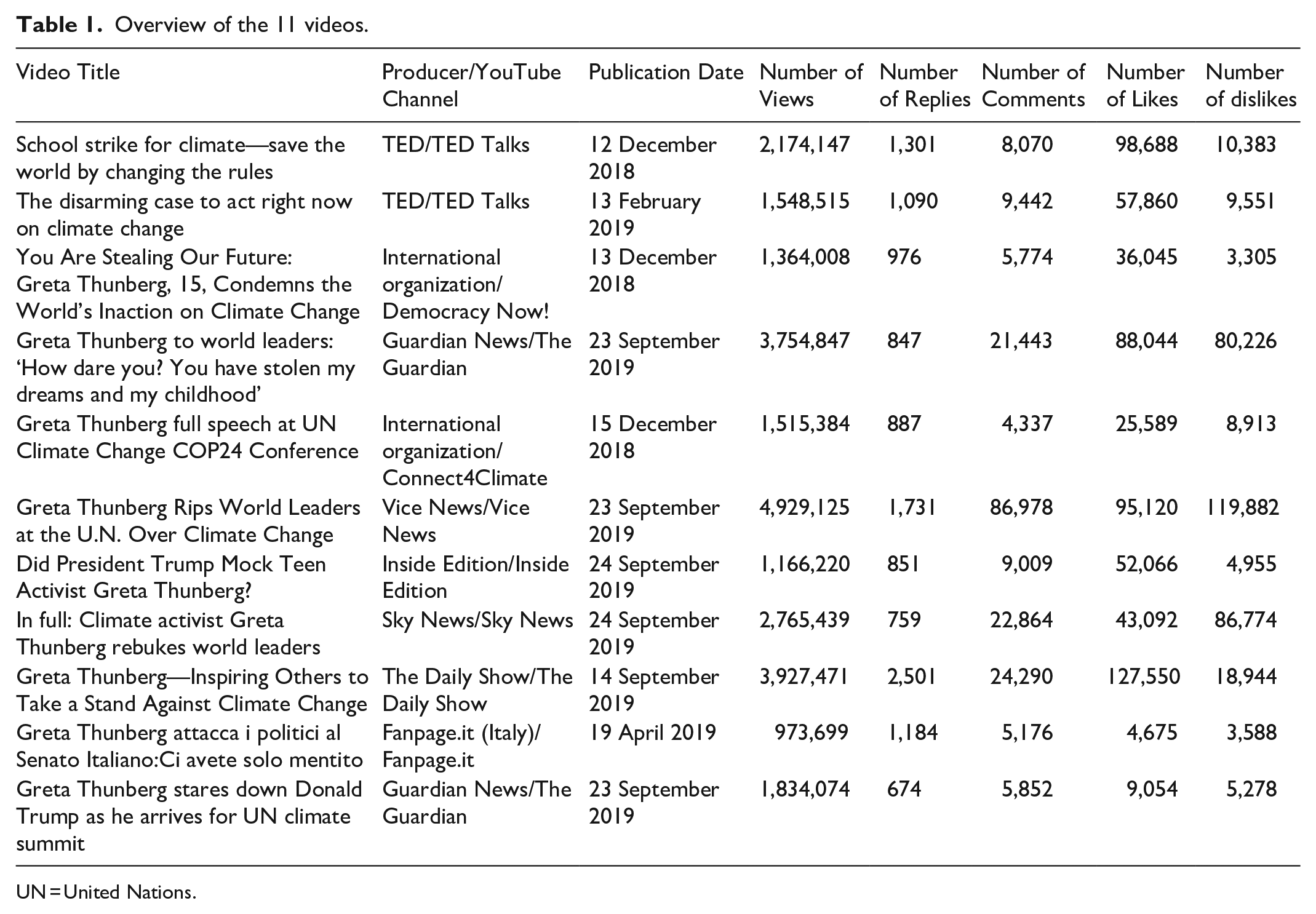
UN = United Nations.
Description of each video.

UN = United Nations.
Using the keywords, “Greta Thunberg,” this study analyzes the user comments made about the 11 videos, using Python programming, specialty software that pulls text from social media platforms (Bonzanini, 2016). The resulting output consists of 11 datasets—one for each video—of user comments, including publication dates, number of views, number of comments, number of replies, number of likes, and number of dislikes.
YouTube’s Application Programming Interface (API) limits access to only the most recent 1,000 comments from each video. Thus, a total of 11,000 comments were downloaded through YouTube’s API. The number of comments of each video represents a different proportion of the total number of comments for each; for example, the 1,000 most recent comments for the video, “Greta Thunberg Rips World Leaders at the U.N. Over Climate Change” represent 1.1% of its total comments (86,978), while the 1,000 most recent comments for “Greta Thunberg full speech at UN Climate Change COP24 Conference” represent 23.1% of its total comments (4,337).
Based on YouTube’s nested comment structure, each comment was classified as an initial comment (a top-level comment) or a reply comment (a comment replying to an initial comment). On the level of initial comments, 300 comments were randomly selected from the 1,000 retrieved comments from each video. In total, 3,300 comments were used for analysis (300 for each of the 11 videos). In all, 30% of the collected comments were coded. One video and its comments were in Italian, necessitating translation into English by an Italian native speaker.
Qualitative Content Analysis
The first phase of the study was a qualitative content analysis, which is a research method for “the subjective interpretation of the content of text data through the systematic classification process of coding and identifying themes or patterns coding categories are derived directly from the text data” (Hsieh & Shannon, 2005, p. 1278). Each comment was examined carefully and classified into categories that represent similar meanings. A qualitative content analysis should distance itself from a pure deductive logic by explicitly including inductive mechanisms (Mayring, 2010). Following Mayring, the categories were inductively expanded or modified as deemed appropriate.
Drawing upon Kaskan and Ho’s (2016) research, the coders looked for presence of explicit and implicit sexist, ageist, and ableist language from the comments. Through an initial reading, the coders listed tentative categories. Two subsequent readings facilitated identification of more evident patterns in the sample: (a) attacks on immaturity (ageism), (b) attacks on appearance and speech manners (sexism), (c) attacks on private matters and disabilities (ableism). To address the problem of the ‘subjectivity of the coding process, two authors discussed every coding discrepancy until they reached an agreement. Although the three tactics are deeply entwined and not mutually exclusive, this study addresses them separately for analytic purposes.
Quantitative Content Analysis
Two authors coded the initial comments based on the definition of incivility—as features of discussion that deliver a disrespectful tone toward the participants of a discussion forum Coe et al. (2014). A codebook was created based on previous studies of incivility (e.g., Coe et al., 2014; Papacharissi, 2004). Three training meetings took place using a subsample of comments to clarify the operational definition of all the variables: name-calling, aspersion, lying, vulgarity, and pejorative for speech. Table 3 provides operational definitions and examples of each of the three forms of incivility (ageism, sexism, and ableism)
Operational definitions and examples of five forms of incivility.

The quantitative analysis counted the number of incidents of ageism, sexism, and ableism. Attacks on immaturity and being manipulated: ageist comments pointing out that Thunberg is a high-school girl who is not educated enough to talk about climate change and that Thunberg is being manipulated by her parents and politicians (Krippendorff’s α = .84). Attacks on appearance and speech manners: sexist language that focuses on Thunberg’s hair, makeup, outfits, or her overall feminine composure or the way Thunberg speaks (Krippendorff’s α = .86). Attacks on private matters and disabilities: ableist words that demean Thunberg because she suffers from Asperger’s (Krippendorff’s α = .87).
Whether each comment mentions, critiques, acknowledges, dismisses, or questions the points about Thunberg’s stances on climate change was also coded. If a comment focuses on any point proposed by Thunberg, it was coded as “to the point.” If not, it was coded as “point-missing” (Krippendorff’s α = .89).
Findings
Quantitative Content Analysis—Incivility
The first research question regards the amount of incivility in user comments about Greta Thunberg videos. Approximately one half (43.7%) of the total comments contain some forms of incivility. Most uncivil comments (53.8%) contain one uncivil statement, 37.1% two types of incivility (e.g., name-calling and lying), and 9.1% contain three or more forms.
Regarding RQ1, the most prevalent form of incivility is name-calling, found in 37.3% of all the uncivil comments. For example, “She is a brat”; “freakishly influential kid with many mental disorders.” Aspersions are the second most common strategy of incivility, making up one quarter (25.8%) of all uncivil comments. For example, “She is chronically attracted to apocalyptic visions”; “She is really reckless with no idea about climate change.” Other forms of incivility take place less frequently: lying (13.5%; for example, “Her words are a hoax” or “a little child deceiving the people”; vulgarity (12.8%, “kick her pompous ass”); and pejoratives (10.6%, “chronically anxious and disturbed”).
In addition, the analysis finds that only 17.5% of the comments focus on any point proposed by Thunberg, while the remaining comments were coded as “point-missing.” Among the uncivil comments, only 4.8% touch on Thunberg’s agenda, indicating that the majority of the uncivil comments do not even address Thunberg’s messages that urgent actions are needed to prevent climate crisis.
The remaining research questions explore incivility as ageism, sexism, and ableism. Attacks on immaturity (ageism) account for 38.1% of all uncivil comments, followed by ridicule of appearance and speech manners (sexism) (36.4%), and put downs based on private matters and disabilities (ableism) (14.6%).
Ageism (RQ2 and RQ3)
RQ2 and RQ3 investigated criticism directed at Thunberg’s immaturity and hence, manipulation by adults, specifically, (a) attacks on age, (b) attacks on the fact she is a student, and (c) attacks on being manipulated. Numerous comments pointed out that Thunberg is “too young,” and that a girl of her age has no business being on a stage dealing with a serious issue like climate change: “What a spoiled child”; “Damn, kiddo. You need more breastfeeding”; “Hi kiddo, what the crap are you talking about.” Many YouTube users pejoratively portray Thunberg as an immature girl who mistakenly “thinks” she is an adult.
Climate change is a problem for all human beings, regardless of age or gender. But YouTube commenters are quick to jump to the assumption that a child does not have a right to deal with climate change: “She is just a toddler.”; “Disgusting, this kid has no say.” These comments imply that Thunberg is immature and inferior to adults, and, as a result, “she doesn’t know what she’s saying.” In other words, a young person cannot have a valid opinion on the climate crisis.
Many users also claim that Thunberg is immature by pointing out that she is a student. Comments like “Go back to school” consistently appear under the videos: “Had she complete her schooling?”; “Go back to school, little bitch.”; “I am sick of her whining”; “Remember kittens, don’t skip school. Meow!” Some users did not hesitate to use expletives: “Fuck off to school.” Several users even humiliate her by arguing she has to receive special education: “Put that fucking small fry to special education.”
The underlying meaning of these comments is that Thunberg should be back in school instead of trying to teach adults. In other words, she must gain more knowledge before she gets up in front of a crowd and speaks on climate change. Such assertion is logically connected to the claim that Thunberg is a whiny girl, who has no idea about the adult world.
Many uncivil comments also infer that Greta Thunberg is too young to have her own thoughts, thus is probably being used by ill-minded adults. The main argument of this discourse is that Thunberg is fed information that she regurgitates for her speeches. For example, one user opined, “She uses professional words that you wouldn’t expect to be in her vocabulary,” implying that someone is helping her write her speech. Another commenter also raised similar skepticism about her intellectual ability: “She probably searched ‘global temperature increase’ on Google and asked her parents about politics. A little rascal.”
Many of the comments contain the word “parents,” which is often used in connection with the claim that they are using their daughter to advance their own agenda. Thunberg’s parents are also involved in environmental crisis and sustainability movement (Rogers, 2019), thus it is possible that they strongly influence their daughter. But many YouTube users went beyond mentioning a possible influence. For example, one user concluded that Thunberg’s parents put the idea of climate change into her head, wondering how Thunberg could know so much at such a young age. Another comment addressed a similar suspicion: “Her parents molded her.”
Arguing that Thunberg’s status is due to her parents’ help, discredits her knowledge and intelligence about climate change. She is portrayed as a puppet who does what others tell her to do. A number of comments proposed an ungrounded hypothesis that her parents write her scripts: “She doesn’t even know what she is saying ahahaha puppet.” Some comments contend that her parents are making good money off her public appearances: “Little psycho . . . Daddy is making a lot of money now. How dare you. . .? Hope we never see you again.”
Some YouTube users speculate that not only Thunberg’s parents but also other adults are manipulating her. “Evil, what they have done to this poor girl?” Particularly, some users raise a strong suspicion that politicians are behind Thunberg. For instance, a commenter suspected a wicked scheme is behind Thunberg’s public appearances: “I just think she is a poor girl who [is] used by people with bad intentions.” Another user proposes a conspiracy theory of ‘brain wash’: “When this girl speaks I hear the considerable brain washing the careful and resolute propagandizing she must have received by those who recognized her considerable oratorical talent and groomed her for this part.”
Another finding regarding the ageist manipulation discourse is the argument that Thunberg is only a mouthpiece for the left or liberal interests, as noted in the following comments: “This kiddo is just reading crappy notes from a lefty adult.”; “Wicked leftists are exploiting this poor girl.” In this vein, Thunberg is considered “just a puppet controlled by politics,” and her performance is a representation of left politicians who are more likely to believe climate change is an urgent and anthropogenic issue. In other words, many comments frame young Thunberg as a tool for leftist political propaganda. This conspiracy theory leads to the conclusion that left or liberal politicians should take the responsibility for Thunberg’s public action.
Taken together, rhetorical attacks on Thunberg’s age, schooling, and being manipulated are used ostensibly with the goal of discrediting Thunberg. Furthermore, many commenters intentionally or unintentionally ignored or avoided what Thunberg intended to say in her speeches. Thunberg is slammed on many fronts, some of which might have nothing at all to do with her positions on climate change but on her age.
Sexism (RQ4 and RQ5)
RQs 4 and 5 concern sexist incivility and attacks on Greta Thunberg based on gender and her biological appearance. YouTube users lash out at Thunberg with sexual taunts and degrading comments: “Bruh why does she look like the female version of Ron Weasley?” “F-k you, climate barbie”; “What a despicable bitch”; “You’re a stupid whore.” Many commenters are a cheap shot at her appearance: “What a homely girl!” “Save money, kiddo. You will need a lot of $ to get plastic surgery”; “She looks like a medieval witch.”
While many comments about Thunberg are subtly couched as jabs at her feminine characteristics, others contain nuanced or explicit male dominance ideology. One commenter thundered, “As a man who is proud my role in this society, this little SHIT girl is disgusting. This bitch just spits out trash words.” Another fired, “Hey, you idiot, little bitch! Learn the history. Who invented the plane? Who made cars? Who invented TV? You are here because of all the great men in history. Get off, little witch!!”
The analysis finds that sexist attacks are hardly logical rebuttals of Thunberg’s ideas. Many comments indirectly discredit her messages about climate change by simply emphasizing and repeating sexist words: “What the hack this little girl has a say to this big matter? That sucks. No way.” Stereotypically feminine labels are traditionally used to silence women’s public speech, and undermine their authority. Sexism based on traditional gender roles prevents women from fully participating in public life (Byerly & Ross, 2008).
The sexist attacks against Thunberg divert attention from the urgency of climate crisis. By going after the messenger, YouTube commenters seek to discredit female climate scientists and activists as legitimate climate actors, and to silence them through sexualized threats. Specifically, such sexist rhetoric punishes Thunberg for being a young woman who challenges the long-standing masculine order.
Ableism (RQ6 and RQ7)
RQ6 and RQ7 focused on attacks on private matters and disabilities. Many YouTube users brought up the fact in a derogatory manner that Greta Thunberg has Asperger’s syndrome: “Down syndrome?”; “Aspergers,” SELECTIVE MUTISM”; “She has OCD, an eating disorder, autism and elective mutism.”; “U can already tell she has mental disorders”; “millenarian weirdo.”
Thunberg has been open about having Asperger’s syndrome, an autism spectrum disorder that is not a mental illness. But YouTube users frame Thunberg as a mentally ill person. She has been mocked, questioned, and bullied because of her condition. Some commenters explicitly disparage Thunberg by saying “she looks loony” or “I get pissed off when the lunatic child steps out of place and speaks too loudly.” Commenters also stigmatize Thunberg, saying that she needs bed rest, medication or incarceration to treat her mental and emotional problems connected to Asperger’s syndrome. “She seems chronically attracted to apocalyptic visions, to fear. Chronically anxious and disturbed.”
The false assumption that Asperger’s is a mental illness led to ableist cheap shots such as making fun of the way she speaks: “Every time she talks, she makes faces that makes her look like she is crapping herself.” In the UN speech, Thunberg showed very stiff facial expressions, but YouTube commenters mock her by closing in on her looks and dismiss her as “very overemotional,” suggesting that people with disabilities cannot control their emotions or themselves.
In relation to Asperger’s syndrome, Thunberg’s voice has also come under scrutiny. Many comments point out that her voice is either too flat or too overdramatic. The comment, “The kiddo has a monotone voice, and mostly whispering,” indicates how much the commenter dislikes her voice. One user battered Thunberg for the tone of her voice with, “The over dramatization of this bitch is so painful. She is anxiety-ridden.”
Thunberg has also become the target of hate simply because she stumbles over her words, lacks eye contact, and shows nervous body language, which are common traits in autistic people. Such put downs include words like “dead eyes,” “unstable,” and “puppet.” In some cases, actress metaphors are used to make fun of Thunberg’s autistic characteristics: “Why does she talk like she’s acting in a Harry Potter movie? She is so robotic”; “She sounds like a 50s movie star I am waiting for her to say ‘Oo Johnny you ole dog’”; “Man, this trailer for the new Hunger Games movie sucks.”
It is hard for people to take Thunberg seriously when they diagnose her with a mental illness. Some YouTube users pathologize her concern about the environment and dismiss her claims about climate change as baseless and the result of autistic spectrum disorder. The main assertion is that because Thunberg is suffering from a mental disorder, her words should not be taken seriously. When Thunberg’s Asperger’s is considered “abnormal,” her words are more likely to be treated as null and void: “She is too crazy in the head to be trusted.” In this way, Thunberg’s climate arguments are easily regarded as untrustworthy and unreliable. If her detractors believe she is mentally disabled, then they contend she cannot truly understand how climate change works and thus, she should not be speaking on a world stage.
Discussion
Given the increasing popularity of YouTube (Allgaier, 2019; Shapiro & Park, 2018), the question of how socio-scientific issues are framed and discussed in this social media platform has become more important than ever before. With this idea in mind, several studies have focused on how YouTube is becoming a hotbed of hate expressions and incivility (e.g., A. A. Anderson & Huntington, 2017; Ben-David & Matamoros-Fernández, 2016). The current study aimed to advance the prior findings about incivility by focusing on user comments in relation to 11 YouTube videos about climate activist Greta Thunberg. This study examined the comments through the lens of ageism, sexism, and ableism—perceptions of Thunberg as a young woman with Asperger’s syndrome.
This study finds that uncivil comments are quite common (43.7%) in the discussion of Thunberg on YouTube. Although the current study focused on Greta Thunberg, one of many activists in the area of climate change, the percentage of uncivil comments is in line with prior studies that found that incivility often goes along with disparaging remarks or expletives in online discussion of extreme weather events (e.g., A. A. Anderson & Huntington, 2017; Chen et al., 2019; Coe et al., 2014). Given that for over a decade scholars have considered deliberation crucial in the implementation of climate change policy (Hayward, 2008; Niemeyer, 2013), the present study indicates that the path to global consensus on agreeable climate change policies might be impeded by uncivil social media communication.
But this is not the whole story. This study also found that incivility was closely anchored in the ideologies of ageism, sexism, and ableism. The majority of the uncivil comments did not even address Thunberg’s work on slowing climate change but instead focused on her personal characteristics. About one third of the comments attack her character and personal life, including her age, schooling, appearance, speech mannerisms, and autism. Particularly noteworthy is the critical emphasis on Thunberg being a mentally ill, teenage girl.
It is not a rhetorical accident that critics of Thunberg almost always call her a “teenage girl.” This infantilization (ageist attack) is invariably accompanied by accusations of an inability to think for herself. This logic is naturally connected to the stereotyped assumption that only adults can discuss socially important topics such as climate change. Many uncivil comments also frame Thunberg as a puppet, who is completely controlled by others such as liberals, and even by her parents who want to propagate their agenda and make money off of their daughter’s public appearances. By stating these opinions as fact, the commenters cultivate the idea that Thunberg does not know anything about climate change.
The analysis also found that sexism is another aspect of incivility in YouTube discourse about Thunberg. Traditional gender roles are based on social constructs of gender, and encompass the activities, responsibilities, expectations, and decision-making power that a given culture has historically assigned to different genders within the public and private spheres (Shnabel et al., 2016). In many cultures, a young girl like Thunberg is expected to remain quiet, docile, and complacent. Women who do not “know their place” are often socially ostracized (Sanchez et al., 2012). By speaking out, Thunberg is not conforming to socially assigned gender roles, and thus is punished with the sharp, mocking criticism dealt out by YouTube users.
Sexism in the form of uncivil comments can also be linked to the neoliberal culture of global capitalism. As a system, global capitalism favors the male (Connell & Wood, 2005) and patriarchal rules (Halbert, 2004; Ross, 2004), and continued use of harmful gender stereotypes (Byerly & Ross, 2008). Martin Hultman at the Chalmers University of Technology in Sweden asserts that men have benefited in an economy that is propelled by fossil fuels and related industries (Givetash, 2019). Industrial modern masculinity is predicated upon the domination and exploitation rather than on the preservation of the environment. Sexist incivility directed at women climate leaders thus serves the function of safeguarding male dominance by disparaging women who challenge the patriarchal social order (Raney & Gregory, 2019). Such sexist incivility was apparent in many comments about Thunberg that blame her for environmental controversy, and that challenge her standing to speak out on environmental/fossil fuel issues that are traditionally seen as masculine. In accordance, this article asserts that incivility is heavily leveraged as a tool to attack Thunberg who violates the masculine hegemony of global capitalism.
From this study’s analysis, it appears that many YouTube users attack Thunberg, using uncivil language because they cannot effectively argue the science of climate change. As a young woman, Thunberg is prey to sexist contemptuous judgments that overshadow and ignore her contributions to improving the environment and slowing climate change, which gives support to the contention that sexism and climate change denial go together, as pointed out by Canada’s Environment and Climate Change Minister Catherine McKenna (“‘Disturbing’ Sexist Abuse Toward Catherine McKenna. . . .,” 2019). Furthermore, incivility in YouTube comments works not only as a tool for disparaging Thunberg, but also as a politicized weapon to attack a different position in climate change communication. In this sense, Thunberg’s attackers are both targeting her as a person and battling against climate science, as seen from the comments that intentionally link Thunberg’s action to left-wing climate activists.
In addition to the ageist and sexist remarks, Greta Thunberg is subject to ableist assaults. Commenters poked fun at Thunberg’s demeanor, facial expressions, and speaking patterns, inferring that people with disabilities cannot think clearly. Asperger’s syndrome is classified as a developmental disorder on the autism spectrum, not a mental illness (Rudy, 2021). Climate change does not care about how the human brain works, and being autistic does not delegitimize Thunberg’s concern about the environment. However, YouTube users pour ableist diatribes on Thunberg, claiming that a mentally ill girl should not be speaking at all. The message is that because Thunberg has autism she should not be allowed to speak to the global public, and she must be too stupid to think through an issue.
Overall, the findings from the qualitative analysis showcase how strongly ageism, sexism and ableism are ingrained in climate change communication, although they are intertwined. On YouTube, ageist, sexist, and ableist incivility functions as a crucial tool to propose and endorse climate change denial perspectives. This reasoning is theoretically important by proposing that incivility is one of the pivotal mechanisms of discussion in YouTube, which can promote a politicized attack on climate change, with an intention to influence the public opinion about the issue and maintain the male dominant culture. The current study contributes to the literature of incivility and climate change communication by illuminating incivility as part of social discourse that contains the ideologies of ageism, sexism and ableism.
Limitations and Future Research
This study relied on a sample of 11 videos about Greta Thunberg. Although efforts were made to use a representative sample by retrieving the most-viewed videos, future research needs to expand the number of the videos about Thunberg produced over a longer time span. This study’s research model could be applied to other climate change activists and social media discussion to compare levels of incivility, sexism, and ageism. Future research should separate male and female YouTube commenters to examine the different patterns of incivility made by each gender.
The number the comments for each video represented various percentages of all comments. However, in line with previous studies showing that concerns about the generalizability of this line of inquiry are overstated (Khan & Vong, 2014; Thelwall et al., 2012), this sampling method is acceptable in social media research. For example, Humphreys et al. (2013) content analyzed only 2% of the total tweets collected. Furthermore, YouTube users are prone to reading/replying to posts that are nearest to the top of the list of comments, thus accessibility to the available discussion is not a function of the artifact attributed to procedural issues like API restrictions but rather the characteristics of the existing post-video discussion.
Another possible limitation is that some of the comments analyzed might have been constructed by bots, but if so, there probably were not enough to have skewed the results.
Although figures could not be found for YouTube, on Twitter, only 9% to 15% of users are estimated to be bots (Varol et al., 2017), thus future research should find a way to identify and remove such content.
Footnotes
Declaration of Conflicting Interests
The author(s) declared no potential conflicts of interest with respect to the research, authorship, and/or publication of this article.
Funding
The author(s) received no financial support for the research, authorship, and/or publication of this article.
