




Abstract
Who governs—and who should govern—online communication? Social media companies, international organizations, users, or the state? And by what means? A range of rhetorical devices have been used to simplify the complexities associated with the governance of online platforms. This includes “constitutional metaphors”: metaphorical allusions to traditional political concepts such as statehood, democracy, and constitutionalism. Here, we empirically trace the ascent of a powerful constitutional metaphor currently employed in the news media discourse on platform governance: characterizations of Facebook’s Oversight Board (OB) as a “supreme court.” We investigate the metaphor’s descriptive suitability and question its normative and political ramifications. We argue that uncritical characterizations of the OB as Facebook’s “supreme court” obscure its true scope and purpose. In addition, we argue that appropriating the socio-cultural symbolism and hence political legitimacy of a supreme court and mapping it onto a different type of actor poses a threat to responsible platform governance.
Keywords
Introduction: platform governance, the language of statehood, and “constitutional metaphors”
An outside observer of the discourses on platform governance might think that the baton of governing the Internet has already been passed on to companies—so common are references to “statehood,” “constitutions,” and other allusions to the government-like role and scope of large technology companies in managing online platforms. For example, Facebook’s CEO Mark Zuckerberg has described Facebook 1 as “more like a government than a traditional company” (Foer, 2019) concerning its governance role. And Facebook’s Oversight Board (OB) is, as we will see, frequently dubbed Facebook’s “supreme court.” The OB consists of 20 members contracted by an independent trust established and funded by Facebook, supported by full-time staff. It became operational in 2020, and mostly reviews user appeals against Facebook’s content moderation decisions. The OB’s scope and powers are established by its charter. It is tasked with interpreting Facebook’s existing community standards in light of earlier decisions and the human rights implications of content removal. Although Facebook is undoubtedly a frontrunner owing to its scale, the language of statehood and constitutionalism arises in broader debates over the private governance of digital technology. In 2018, the normative practices of social media companies were characterized as “platform law” by a United Nations Special Rapporteur (Kaye, 2018).
But can we simply map the language, practices, and institutions associated with statehood, constitutionalism, and the rule of law to the digital sphere—particularly since many of the most powerful “governing” actors in this space are private companies (Gillespie, 2018; Gorwa, 2019; van Dijck et al., 2018)? And what might be the unintended consequences of doing so? Drawing on metaphor theory (Lakoff, 1992; Lakoff and Johnson, 2003) and theories of legitimacy and legitimation (Suchman, 1995), this article identifies constitutional metaphors as a powerful rhetorical device in the media discourse about platform governance—shedding light on the use of one particular metaphor, that of a “supreme court,” to characterize the Facebook OB. Taking a constructionist approach, we investigate how constitutional metaphors iteratively construct new meaning and, in turn, how they may even alter the underlying meaning of existing constitutional concepts, in the context of platform governance. Previous work has critically investigated the use of metaphors to characterize and understand various digital phenomena (Ganesh, 2020; Lindh and Nolin, 2017; Simon and Camargo, 2021; Slupska, 2021). Separately, scholars have also assessed metaphorical understanding of laws and constitutions (Berger, 2009, 2013; Brooks and Gewirtz, 1996; Cloutier, 2019; Tribe, 1987), yet this existing work looks at the metaphorical narration of actual constitutions—not at the use of constitutional language to characterize private governance. Here, by contrast, we empirically trace and critically reflect on the ascent of one particular constitutional metaphor, that of a supreme court, in the context of Facebook’s private governance power.
The social and political stakes of constitutional metaphors in the context of private “platform” governance are high. If the OB continues to be characterized publicly as a “supreme court,” this may accord it the legitimacy associated with a conventional supreme court, as one branch of government in a democratic system. This legitimacy may, in turn, extend to Facebook itself, reinforcing the perception of Facebook as, in the words of its founder, “like a government” (Foer, 2019)—with weighty implications for democracy and the rule of law. Although different people may mean different things when referring to such notions, it is commonly understood that constitutionalism and the rule of law in principle refer to authority that has been legitimated through public consent (Taylor, 2021). Constitutional metaphors in platform governance, however, establish a novel connection between old concepts and new practices, with the effect of legitimating private institutions through association with public governance institutions. Moreover, an equivalent phenomenon may emerge in reverse: eventually, the metaphors’ underlying constitutional concepts may be a “re-conceptualized” and common understanding of the metaphor’s referent—in our example, supreme courts—may change in turn. Thus, the question at hand is whether it could—or should—be accepted that the notion of a supreme court extends beyond democratically legitimated public authority.
The article progresses in three overarching steps. First, we lay theoretical and conceptual foundations and provide background to our case study. In Section “Metaphors and the language of constitutional democracy,” we root our research in metaphor theory and define constitutional metaphors as an analytical concept. In Section “The emergence and spread of ‘Facebook’s Supreme Court’,” we introduce the constitutional metaphor at the heart of this study—the metaphorical depiction of Facebook’s OB as a “supreme court”—and explain the dilemma that its use creates. And in Section “ Legitimacy and legitimation in platform governance: the influence of constitutional metaphors,” we use political legitimacy and legitimation theories to sketch out the normative and sociopolitical significance of constitutional metaphors, noting their potential to bolster the reputation of platform companies’ governance. Second, in Section “ Documenting the rise of the ‘supreme court’ metaphor,” we undertake our empirical analysis. Here, we empirically trace the rise of the OB-as-supreme-court metaphor in media discourse. We find that the use of this metaphor in the media has grown over time. It has become somewhat more reflective, yet significant ambiguities concerning its underlying meaning remain. Third, in Section “Constitutional metaphors: the need for critical reflections,” we consider the normative and performative implications of our empirical findings for platform governance, expounding the possible consequences of such metaphors’ discursive dominance if used uncritically. We conclude with final remarks considering the risks of constitutional metaphors blurring public perception and constructing new meanings, and identify areas for future research.
Metaphors and the language of constitutional democracy
The essence of metaphors is “understanding and experiencing one thing in terms of another” (Lakoff and Johnson, 2003: 5). Metaphors map “one conventional image onto another . . . lead[ing] us to map knowledge about the first image onto knowledge about the second” (Lakoff, 1992: 27–28). In doing so, however, metaphors always highlight some aspects while hiding others. Metaphors can be particularly influential when our knowledge about one concept—for example, how a complicated piece of software functions—is minimal and our understanding of the second concept that is “mapped” onto the first is particularly vivid. In such cases, “metaphors are not only used to make sense; they also function as constitutive” (Lindh and Nolin, 2017: 164). This may be particularly impactful in the case of novel digital phenomena, where, as Lindh and Nolin (2017: 166) have argued, the “functioning and usage [of new technologies] are frequently quite abstract,” and where we may therefore “lack an existing vocabulary to fall back on.” Metaphors may thus fill this vacuum of vocabulary.
Examples abound of the use of metaphor for making sense of emerging digital technology and its societal impacts. Scholars have explored the use of metaphors in cyberspace governance (Slupska, 2021); the characterization of autonomous machines as “computational brains” (Ganesh, 2020), and of COVID-19 misinformation as an “infodemic” (Simon and Camargo, 2021); and naturalistic references to forms of Internet-based software services such as “cloud” computing or technological “ecosystems” (Lindh and Nolin, 2017: 7). Meanwhile, metaphors are also commonly used to characterize otherwise-abstract legal and political concepts; for instance, Montesquieu’s (1748) characterization of judges as “the mouth of the law” (p. 180), or that of the US constitution as a “living” thing (McBain, 1927).
This brings us to our more specific consideration of the point of collision between metaphors for digital technology and metaphors about the law and constitutions. We define “constitutional metaphors” as metaphorical allusions to concepts, institutions, or practices of constitutional democracy in discourse about issues other than constitutional democracy itself. Here, our focus is on using constitutional metaphors in discourses about platform governance (Gorwa, 2019). We argue that the use of constitutional metaphors in the platform governance context warrants particular attention, given that the governance practices of platform companies have often been described as untransparent, harmful, or even outright dangerous (Frenkel and Kang, 2021; Haugen, 2021; York, 2021). As we argue, the use of constitutional metaphors to characterize platform governance may unwittingly consolidate this form of private power. Of course, we do not argue that all references to constitutions or statehood should cease. That would be naïve. In fact, legal and political theory holds much potential for platform governance (De Gregorio, 2021; Kadri, 2018; Klonick, 2020: 2457–2466). However, transplanting such theories to a new context presupposes detailed analysis and apt terminology. The uncritical use of constitutional metaphors provides neither. It is in this context that we undertake our investigation of depictions of Facebook’s OB as a “supreme court.”
The emergence and spread of “Facebook’s supreme court”
The initial idea for—and first metaphorical allusion to—“a Supreme Court for Facebook” 2 stemmed from Noah Feldman, a Harvard Law professor specializing in “constitutional studies, . . . free speech, constitutional design, and the history of legal theory.” 3 From the outset, the idea for the OB involved platforms “setting up their own quasi-legal system” 4 and even envisaged “Facebook as quasi-sovereign.” 5 Although the charter largely withholds such vocabulary, trivializing its use as owing simply to the early drafting process’ euphoria would be inaccurate. The OB’s “Bylaws,” for example, do not refer to customers or users, but to “People,” 6 inevitably alluding to the phrase “We the People . . .” which famously opens the US Constitution. Such amalgams of the public and the private, in language and in substance, are no coincidence but programmatic with the OB, and bring to mind Gillespie’s (2010) observation that platform companies work “not just politically but also discursively to frame their services and technologies” (p. 348).
None of this is to suggest, however, that there is no need for an independent body to undertake an impartial review of Facebook’s content moderation decisions. New bodies like the OB that are expert-led and, to a contested degree, independent and accountable (Klonick, 2020: 2475–2486), represent progress away from entirely “authoritarian” (Douek, 2019: 9–24; cf Pozen, 2018) modes of platform governance. And such progress is necessarily informed by the political and legal theories that guide democratic governance. Thus, when the executives and legal departments of social media companies consider how best to improve their governance structures in response to the growing challenges of content moderation, they did not see the need to reinvent the wheel, but instead turned to existing models.
Nevertheless, the way things are spoken about affects the way they are understood. And the use of “supreme court” as a descriptor for the OB—the origin and prevalence of which we investigate in Section “Legitimacy and legitimation in platform governance: the influence of constitutional metaphors”—inevitably brings with it the weighty social, cultural, and political capital that attaches to supreme courts, particularly in the United States, where Facebook was founded and where its parent company Meta is headquartered. The concept of the United States Supreme Court draws its meaning from an intricate mix of political beliefs and socio-cultural practices forged over centuries, from the 1789 Bill of Rights and Marbury v Madison (1803) 7 to more recent clashes over civil rights or abortion. The Supreme Court consistently ranks as the most trusted institution of government in the United States (GALLUP, 2018). And it is made up of individuals who command professional respect. Thus, mapping common knowledge of the US Supreme Court onto the blank canvas of the OB may bolster its image and ultimately, as we suggest in the following section, enhance the legitimacy of the Board and of Facebook itself.
Thus, we face a dilemma. On one hand, managing content and regulating behavior on social media requires enforceable rules and, in turn, new mechanisms of governance. On the other hand, although these new mechanisms emulate existing ones, they often lack their archetypes’ theoretical grounding, practical safeguards, and legal process. In particular, platform governance has considerably less democratic input legitimation by way of user participation as compared with traditional forms of public governance that rely on some form of public consent (Taylor, 2021). Facebook’s only real experiment with mass democracy, which started in 2009, ended in ignominy in 2012 when it was voted out of existence (Leetaru, 2019). Today, the average Facebook user has negligible influence on the site’s governance or the content of the Community Standards, which provide the basis for the OB’s decision-making. In traditional systems of judicial control over administrative norm-enforcement, democratic influence (or at least accountability) over norm-setting is considered a premise for legitimate rule. Therefore, metaphorical allusions to a supreme court extend to allusions to democracy, which in the case of Facebook are misplaced.
Legitimacy and legitimation in platform governance: the influence of constitutional metaphors
In the empirical analysis that follows, we explore references to the OB as “Facebook’s Supreme Court” (this metaphor is hereafter referred to as “OB:”). Before turning to this empirical analysis, we sketch the sociopolitical and normative significance for platform governance of constitutional metaphors such as OB:SC.
In addition to being governed by states, platform operators themselves also govern the content shared and behavior exhibited on their platforms (Gillespie, 2018; Gorwa, 2019; Klonick, 2018). “Private governance” is not novel to social media or the Internet; private companies perform governance roles in many other domains (Graz and Nölke, 2007). It is not, therefore, inconceivable that social media companies could play a similar role with respect to platform governance. Yet, the use of constitutional metaphors suggests the emergence of something new and distinct: the ascription of a “quasi-sovereign” role to and/or the assertion of a “quasi-sovereign” role by platform operators (Pohle and Thiel, 2020: 7). By adopting the functions, practices, and language of public governance, platform operators blur the boundary between private and public governance, and, ultimately, may lay claim to transformed notions of power (Sharon, 2020), which may be exercised in a less democratic or accountable manner (Taylor, 2021).
Such developments have implications for the political legitimacy and legitimation of platform governance. Political legitimacy is a widely debated concept, and several approaches to it have been advanced (Buchanan, 2002; Pettit, 2012; Weber, 1978). These typically fall into one of two camps: normative approaches seek to define criteria by which the political legitimacy of an actor can be judged. In contrast, descriptive approaches portray legitimacy as something that obtains to actors who are seen as having the right or capacity to govern (Peter, 2017). Thus, legitimacy as a concept incorporates both normative considerations about which actors ought to be regarded as legitimate (Buchanan and Keohane, 2006; Hassoun, 2012; Nagel, 2005), and empirical considerations about which actors are seen as such (Suchman, 1995; Tallberg et al., 2018; Weber, 1994). This unresolved conceptual tension is significant when we consider constitutional metaphors in the context of platform governance. It is possible both to debate the criteria against which a platform operator could be outwardly seen as a legitimate “governor,” and to document attempts by these operators to seek to be seen as legitimate—a process we can refer to as legitimation (Beetham, 2013; Tallberg et al., 2018).
Several Internet law and communications scholars have explored the possibility and implications of “legitimate” governance by technology companies from a normative standpoint. Working within the framework of “digital constitutionalism” (Celeste, 2019; De Gregorio, 2021), Suzor 8 and colleagues (2018) adopt a rights based approach, by identifying “the human rights values that might form an index of the legitimacy of governance [by] online intermediaries.” Suzor (2018: 4) also separately focuses on procedural values inspired by the rule of law within states, such as consent and predictability. He argues that although “the way these principles have historically been applied has been state-centric,” these values can be usefully applied to assess the (legitimate) governance of digital media. Haggart and Keller (2021), meanwhile, propose a framework based on democratic legitimacy, which applies Schmidt’s (2013) tripartite framework of “input,” “output,” and “throughput” legitimacy, developed for the European Union, to several instances of private digital governance, including Facebook’s OB. To varying degrees, each of these examples makes certain assumptions about political legitimacy as it relates to private technology companies that may not be warranted. An inclusive human rights based standard for legitimacy leaves unanswered questions about how tension between different rights should be resolved, as well as failing to consider “the issue of which actors possess rule-setting legitimacy” (Haggart and Keller, 2021: 4, italics added). As a consequence, this risks “taking global platforms’ current private-ordering regime as a given [leaving] no room to consider even a theoretical role for the state” (Haggart and Keller, 2021: 4). Yet, Haggart and Keller’s own proposition—to appropriate Schmidt’s tripartite framework for private forms of platform governance—rests on the strength of the analogy between private platforms and the European Union (EU), which risks conceptual confusion. Furthermore, these contributions share the implicit assumption that private actors can or could hold political legitimacy at all—departing from the common understanding of the state as the sole “locus of political legitimacy” (Nagel, 2005: 113). Those scholars that do accept the possibility of non-state entities, including some private corporations, of being legitimate tend to attach considerable obligations and moral responsibilities to this designation (e.g. Hassoun, 2012). Therefore, although it is beyond the present scope to resolve whether private companies, as non-state entities, can normatively be considered politically legitimate, it seems that, at a minimum, a cautious stance to the question is warranted.
Descriptive approaches to conceptualizing legitimacy, meanwhile, see it as “open to political manipulation” (Tallberg et al., 2018: 6). Here, scholars have explored “the ways in which organizations instrumentally manipulate and deploy evocative symbols in order to garner societal support”; legitimacy in this context is an “operational resource . . . that organizations extract—often competitively—from their cultural environments and . . . employ in pursuit of their goals” (Suchman, 1995: 572–576). And although descriptive approaches to political legitimacy have tended to focus mostly on nation-states and international and multilateral organizations like the EU and International Monetary Fund (IMF), other scholars have identified similar dynamics in the private sector. Building on Jasanoff and Kim’s (2009) pathbreaking notion of “sociotechnical imaginaries,” several recent efforts have assessed the “imaginaries” constructed by big tech (Mager and Katzenbach, 2021), in particular by Facebook (Haupt, 2021; Hoffmann et al., 2018; Rider and Murakami Wood, 2019).
This brief review advocates caution regarding the normative application of political legitimacy to platform operators and highlights the possibility for legitimacy to be “extracted” by platform operators through the appropriation of socio-cultural symbols. We will shortly see that the socio-cultural symbolism of supreme courts has been appropriated in just such a way, to confer legitimacy on the OB itself and, by extension, on Facebook’s own role and status as a “governor.” However, existing studies have analyzed corpora consisting solely of the statements of corporate leaders like Mark Zuckerberg, in what follows, we explore a broader database of media coverage of the OB. As a result, our focus is less on a (potentially deliberate) construction, by Facebook, of the idea that the OB is akin to a “supreme court,” and more on the consequences for platform governance when this metaphor reaches a broader news public.
Documenting the rise of the “supreme court” metaphor
Based on the theoretical framework developed earlier, we turn to empirical analysis. We outline our methodology and data selection, then analyze the evidence for the ascent of the supreme court metaphor in the American news discourse about the OB, identifying several landmark events which shaped the metaphor’s proliferation.
Methodology
The empirical focus of our work is concerned with the development and usage of the “supreme court” metaphor in reference to the OB (hereafter, we refer to the use of the metaphor as “OB:SC”). In particular, we seek to assess whether and to what extent the metaphor is widely used, and how its use has evolved over time. In this sense, our inquiry is serial. We first establish the existence of the metaphor and, in doing so, produce a dataset, then follow with an analysis of the metaphor’s development, paying specific attention to its implications for legitimacy. Our approach resembles an “inductive” content analysis, meaning our categories are constructed and contextualized iteratively, always oscillating between units of analysis—or in our adopted nomenclature, between the “micro” and the “macro” (Hsieh and Shannon, 2005; Mayring, 2014). This distinction does not produce a clean partition; rather, as an analytic tool, it highlights characteristics of the news discourse in general and recurring and particularly notable substantive and linguistic aspects of specific news pieces.
As noted earlier, our focus is on legitimacy and legitimation. We seek to understand how authors and other speakers respond to—or in some cases, entirely skirt—the “why” question (Van Leeuwen, 2007: 93): why use the OB:SC metaphor at all? Although inductive, we make no claims of initial “neutrality.” Our construction of categories was also suffused by the inquiry of similar studies into metaphors and discourse, all notably acknowledging the role of authority in the construction and use of language (Ganesh, 2020; Haupt, 2021; Hoffmann et al., 2018; Simon and Camargo, 2021; Slupska, 2021). Specific categories are outlined in more detail below. Still, briefly, at the macro level, analyzing the dataset as a totality, we asked what the development of the metaphor’s usage could tell us about constitutional metaphors in the news media more generally. Here, context is paramount. Discourse is only intelligible within the complexities of the social context in which the language is formed and communicated. With this in mind, questions of motivation were the first to confront us in the dataset—why did media outlets consider a private decision-making body like the OB newsworthy at all? How did the metaphor diff use between various news outlets? How are authors responding to and reproducing discourse? At the micro-level of individual articles, we asked how authors framed OB:SC. Did the author qualify its usage with quotation marks or other forms of distancing? Was the metaphor used in the article’s title? Did the author note Facebook’s status as a private company and its relationship to the OB? Questions such as these both emerged from and guided our iterative coding process.
Data selection and cleaning
We began by collecting a dataset of online news articles to capture the development and usage of OB:SC—meaning we intentionally only gathered news articles that met our criteria of invoking the constitutional-metaphorical terminology of the OB as a “supreme court.” As such, we excluded earlier coverage that used the term “supreme court” to refer to Facebook’s initial plans to introduce a form of independent oversight that preceded the OB as the entity established to perform this function. Such plans remained vague until Facebook published the OB’s draft charter in January 2019, and it was only thereafter that the nascent body’s institutional contours became apparent. Although the metaphorical term (“supreme court”) remained the same, its functionality changed once it was linked to the OB as a specific institution. Originally, the term outlined an idea of what ought to be done, reflecting the vague objective outlined by Zuckerberg. But once the OB’s institutional structure became apparent from January 2019 onwards, the metaphor morphed into a descriptor of work underway in earnest. Only then could the term supreme court be “mapped” (Lakoff, 1992: 27) onto that of the OB as a specific named institution—instead of creating an imaginary standing on its own. Although both ways that the metaphor was used illustrate constitutional metaphors’ performative potential, only the latter offers a concrete illustration of the possibly legitimizing effects of constitutional metaphors vis-à-vis the specific institution of the OB.
To assemble our dataset of media references to the OB as a supreme court, we used Media Cloud. This platform provides a database of over 1.7 billion news articles gathered since 2008 (Roberts et al., 2021: 1). Researchers can query the database with search terms and Boolean operators; searches produced similar results to Google Trends in analogous research (Simon and Camargo, 2021: 3). The Media Cloud Topic Mapper allows users to search for articles with search operators. After iterative testing, we decided on the following search terms: “facebook” AND “oversight board” AND “supreme court” AND NOT (“privacy and civil liberties”) (specifically excluding “privacy and civil liberties” to avoid irrelevant articles referencing the US Privacy and Civil Liberties Oversight Board). 9 It should be noted that the body’s official name changed from “Facebook Oversight Board” to “Oversight Board” in its late planning process in early 2020. Although we use the latter term throughout the article, the Boolean operators we used for data collection incorporated both versions. To retrieve a representative sample of the US online news discourse on the topic, we queried Media Cloud’s established “United States—National” collection. Our query resulted in a dataset of 522 articles spanning from the first public mentions of the OB in April 2018 to the coverage of the May 2021 decision on banning Donald Trump from Facebook. After reading each article to verify that all mentions were valid invocations of the constitutional language about the OB, 10 we were left with a dataset of 389 articles, whose size alone speaks to the prevalence of the metaphor’s use in mainstream media discourse. The size of outlets spans from globally consumed news media like the New York Times to more tech-focused outlets like TechCrunch, and the collection also varies ideologically, encompassing right-wing outlets like Breitbart and Fox News and centrist and left-of-center entities like Reuters and CNN. While the articles’ authors are almost exclusively journalists, some articles contain direct quotations or interviews by OB members, academics, or politicians, which were also considered in the analysis.
To get a better impression of the representativeness of the usage of OB:SC with respect to the overall media attention that was paid to the OB during the same period, we additionally searched Media Cloud for all articles mentioning the OB, regardless of whether they employed OB:SC, 11 and found similar peaks and troughs over time, with peaks coinciding with major news events associated with the OB.
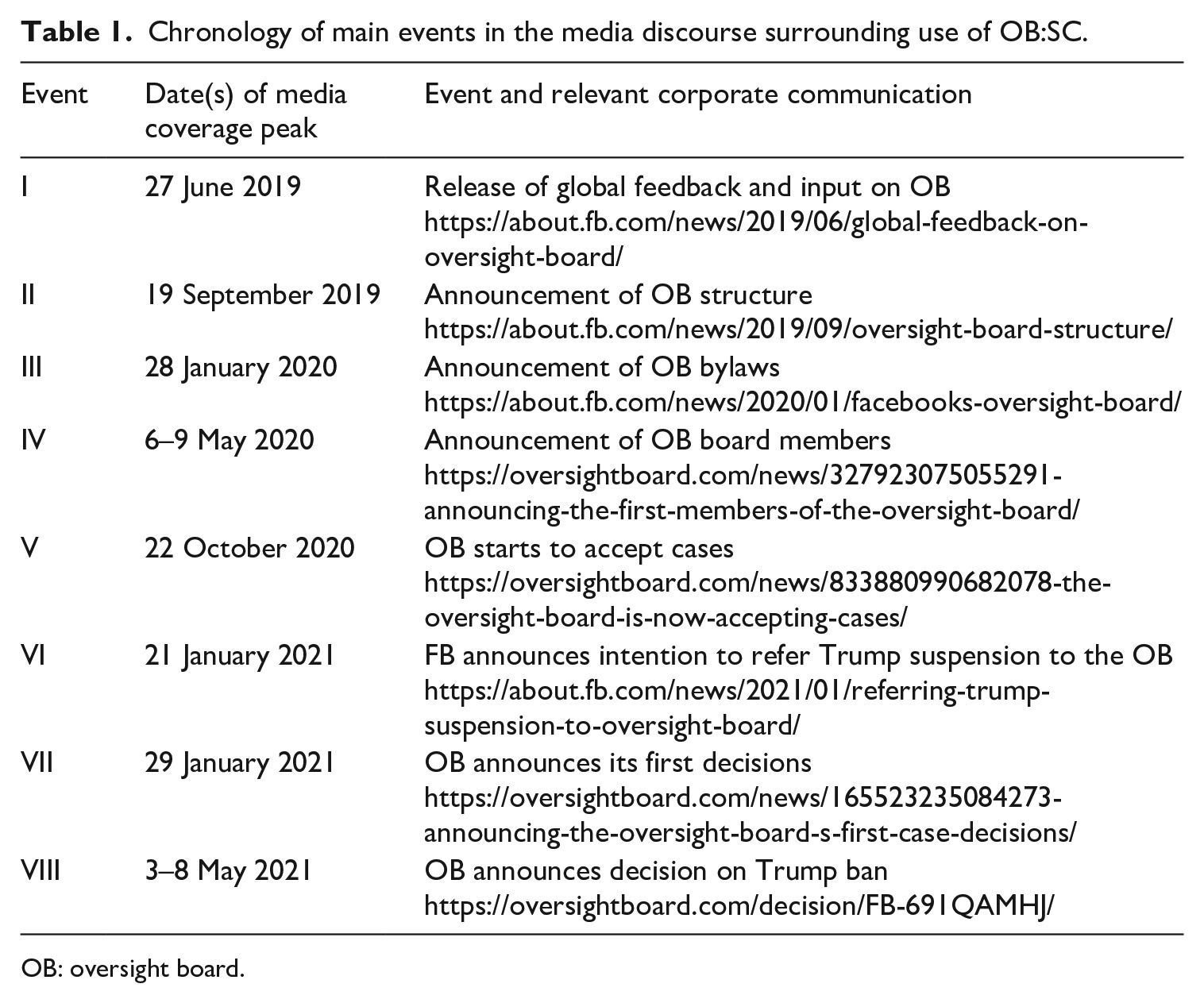
In Table 1 and Figure 1, we identify the main newsworthy events in the OB’s early existence. Figure 1 illustrates the prevalence of OB:SC references in media articles across the period of our study. The numerals overlaid in Figure 1 indicate major spikes in media coverage following key events in the OB’s chronological development, which we detail in Table 1.
Chronology of main events in the media discourse surrounding use of OB:SC.
OB: oversight board.
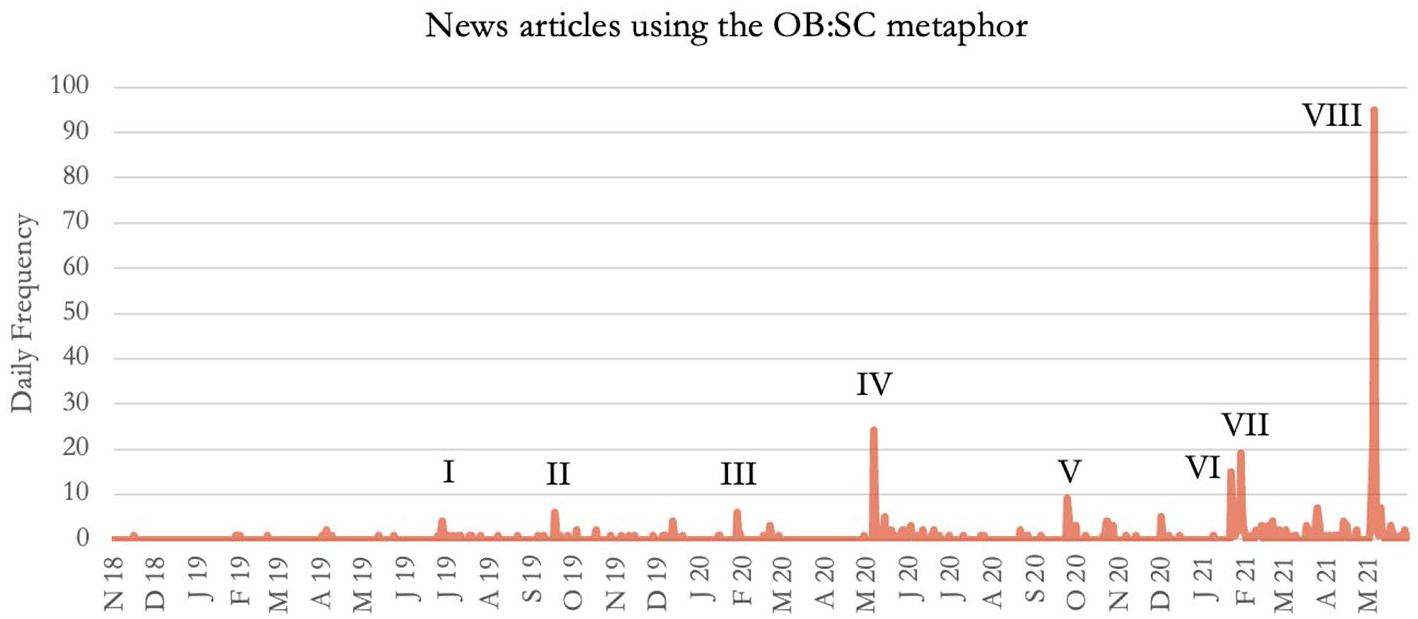
Number of US online news articles using the OB:SC metaphor per day, October 2018 to May 2021 (Media Cloud “United States—National” Collection).
Macro-level analysis: the overall spread of the OB:SC metaphor
We found that the majority of stories involved direct reporting on Facebook’s corporate communications about the OB (see Figure 1 and Table 1). From our coding, 218 of the 389 articles were responses to identifiable events, with the rest being broader opinion pieces, tangential mentions of the Board, or miscellany such as Noah Feldman’s appearance at Donald Trump’s first impeachment hearing. 12
While reports of announcements made by Facebook and its leadership during the initial creation of the OB were minimal, they established a meaningful “precedent” to which later authors would often refer. The first notable event in the creation of what would become the OB was the initial description of the idea by Mark Zuckerberg on 6 April 2018: You can imagine some sort of structure, almost like a Supreme Court, that is made up of independent folks who don’t work for Facebook, who ultimately make the final judgment call on what should be acceptable speech in a community that reflects the social norms and values of people all around the world.
13
Zuckerberg’s initial public articulation of OB:SC would become a meaningful referent for articles using the “supreme court” metaphor. Feldman introduced the metaphor in January 2018 in a white paper produced for Facebook executives Mark Zuckerberg and Sheryl Sandberg. 14 Later that year, Zuckerberg shared his vision for the future OB, though few news outlets adopted the OB:SC metaphor immediately. Then, during the first half of 2019, Facebook made two major announcements regarding the Board—one releasing the first draft of the Board’s charter, and another announcing consultation feedback received on the Board’s proposed remit and structure—in which the use of “Supreme Court” was still present (Peak I in Figure 1).
It appears that when describing these initial milestones in the OB’s early development, journalists reached for language already present, whether from previous articles or Zuckerberg’s own words—or, as in the following example, both. Here, Fox Business cites Zuckerberg as the source of the metaphor and links (see underline) to an earlier article by The Verge, also in our dataset: 15
Nevertheless, the Oversight Board created in September is to be used for exactly that: oversight. The company’s CEO Mark Zuckerberg compared the group to
As the OB continued to ossify into a more tangible entity, we saw a large overall increase in news coverage that invoked its characterizations as a “Supreme Court,” specifically in May 2020 (Table 1: IV). The reason for this was the announcement of the Board’s first 20 members, generating a slew of articles, 34 of which were captured in our dataset. Even an article from newswire Reuters—usually known for the spareness of its characterization of news events—deployed the metaphor, albeit in the third person: The independent board, which some have dubbed Facebook’s “Supreme Court,” will be able to overturn decisions by the company and Chief Executive Mark Zuckerberg on whether individual pieces of content should be allowed on Facebook and Instagram.
17
Notably, after its early announcements, Facebook representatives scarcely used the OB:SC metaphor, save for sporadic instances in media appearances. 18 The term does not appear in the OB’s normative framework, the so-called “Oversight Board Charter.” 19 The OB itself has not used it in any official publications. Nonetheless, many journalists, politicians, columnists, scholars, and others continue to use it frequently when speaking about the OB. Discursively, this is significant. By first introducing the metaphor and then stepping back from it, Facebook stands to have benefited from its perpetuation by journalists and others—in terms of its potentially legitimating effect—while no longer facing accountability for its continued use, let alone face questions about the (in)appropriateness of the metaphor itself. This may be the greatest effect of the metaphor: swaying the public thought process by tilting the discourse toward a path that may lead to almost unquestioned legitimacy for the OB’s decision-making.
Micro-level analysis: how was the metaphor deployed?
Through fine-grained analysis of each article, several distinct categories in how the OB:SC metaphor was used emerge. In what follows, we identify the most common characteristics of OB:SC deployment.
First, we looked carefully at the use of punctuation when the OB as a “supreme court” was introduced to readers. Some authors used quotation marks around “supreme court” as a means of distancing themselves from the denoted meaning and/or attributing the metaphor to someone else, for example, The Facebook oversight board, commonly known as the “Facebook supreme court,” which was established by the social network as a quasi-independent body to hear appeals on Facebook’s decision to censor or ban content, has now been empowered to demand more censorship from Mark Zuckerberg’s platform.
20
The use of passive voice here in “known as” separates the author from the term, though the use of “commonly” nonetheless strengthens it by suggesting it is widespread. Other authors noted (correctly) that the terminology was first used by Facebook. Overall, about 61% of all articles used quotation marks around “supreme court,” and 30% referred to Facebook executives as the source of the metaphor. While these two categories may appear to convey similar ideas and are by no means mutually exclusive, we make a distinction between them because we interpret them as having significantly different roles in the development of discourse. Quotations directly attributed to Facebook and its executives do perpetuate the metaphor, but incorporations—use of the metaphor without direct attributions to Zuckerberg, for example—adopt this language less critically, masking its historical lineage. From our analysis, the latter proved to be twice as common.
Second, as the articles using the OB:SC began to increase, third-person attribution became increasingly frequent as well. Here is a notable example asserting that even some outside the company had used the metaphor: The board, which was first announced in 2018, is made up of 20 journalists, lawyers, activists, and even a former prime minister, and has been labeled by some outside the company as “Facebook’s Supreme Court.”
21
However, beyond these different methods of positioning and attributing the metaphor, others eschewed qualifications or caveats altogether, embracing the OB as “Facebook’s Supreme Court,” sometimes even without quotation marks. 22 We also recorded whether articles used the OB:SC metaphor in the title of the article, which would be especially consequential for those readers who only saw a headline and therefore did not have this description contextualized by further details about the board’s actual function and scope. Of all the articles using the metaphor, about 20% employed OB:SC in the title, though it is worth noting that this distribution skews toward earlier articles, before the official launch of the board in October 2020, where almost 30% of the articles used OB:SC in the title.
We also considered more interpretive qualities regarding whether authors reflected critically about describing the OB as a “supreme court.” Although “criticality” is less analytically concrete—and for this reason evades a more quantitative presentation—than our other measures, we sought to operationalize it by asking whether the author made a note of the descriptive shortcomings of OB:SC, (1) because Facebook and the OB are private entities and/or (2) because of the limited overlap between the OB’s scope and function and that of a supreme court.
Several articles criticized the Board’s makeup. This was only after the OB’s members were announced, and after the Board had officially launched. Therefore, they were less focused on the OB’s (lack of) legitimacy as an institutional entity per se than on its (in)ability to execute specific functions. Most articles of this type noted how the board was unable to carry out its duties more objectively, many of which hailed from right-wing publications, such as Breitbart, with a history of criticizing Silicon Valley for being too “left-wing.” These were less relevant to our thesis concerning constitutional metaphors and legitimacy. However, the shifting nature of critiques of the OB after it was established, from big-picture criticisms of the Board itself, to more fine-grained engagement with specific appointments or decisions, serves to highlight the increasing “incumbency advantage” of an institution once it is established, which is itself relevant to our discussion of legitimacy.
Taken together, our micro-level analysis indicates the widely uncritical use of the metaphor. Although many articles put the metaphor in quotation marks, only very few articles question its descriptive accuracy and potential political consequences. This was to change, however, with the events of January 2021.
External shock: the Trump case
The characterization of the OB as a “supreme court” only became scrutinized at significant scale after an external shock: the Capitol Hill insurrection on 6 January 2021, which caused Facebook to ban President Donald Trump. Trump appealed the decision in February 2021, at which point the company delegated the decision on whether the measure was in accord with Facebook’s normative framework, namely its Charter, to the OB. The OB upheld the ban in May 2021, while requiring Facebook to revisit the case at a later date. Our dataset allowed us to explore the media discussion concerning the case (peaks VI and VIII in Figure 1) and made clear that the emboldened critique of the OB as a supreme court was highly determined by the weighing-in of high-profile public figures. Many news articles employing the OB:SC metaphor—now more critically—in discussion of these news events relied on public voices such as those of senators Elizabeth Warren, Ted Cruz, and Bernie Sanders, to juxtapose the legitimacy of democratically elected officials with the legitimacy of the OB. For example, NPR draws on the following quote from Senator Warren: We need to break up these giant tech companies, and Facebook is one of them. They are crushing competition and in cases like Facebook, they’re acting like they’re bigger than government.
23
As this quote exemplifies, statements by public figures increasingly framed the relationship between large technological companies and public authority as an agonistic struggle. Many public officials held steadfast to the assertion that the OB was not a supreme court. Nonetheless, between event VII on 29 January 2021, when the Board issued its first decisions, and event VIII on 8 May 2021, when the board issued its decision in the Trump case, the use of the metaphor almost quintupled (see chart). Therefore, the Trump case triggered a double effect. On one hand, it prompted increased scrutiny by several public figures infusing criticism toward the metaphor. On the other hand, the Trump case only made the OB—and with it its metaphorical portrayal as a supreme court—more visible. It is an open question as to which of these two aspects affects the Board’s public perception and legitimacy more strongly: criticism by politicians, or the continued prevalence of a possibly legitimizing constitutional metaphor propelled by the media.
Discursive dominance?
In sum, our empirical analysis demonstrates that media discourse surrounding platform governance is extremely fluid, and suggests that, at least for this case study, the news media existed almost as a stage on which executives, scholars, politicians, and the like—in concert with journalists themselves—negotiated the concepts with which an understanding of the phenomenon was formed. Especially noteworthy here is the role of Facebook itself: although the metaphor originated from Noah Feldman and Mark Zuckerberg, the company then largely ceased using it in its public pronouncements. Neither has the OB, to our knowledge, used the metaphor in its official publications. Instead, the metaphor seemingly developed “a life of its own” through its use by journalists and others, earning a degree of discursive dominance in depictions of the OB, and perceptions of its legitimacy in turn. For example, OB member Julie Owono appeared in a podcast titled “Digital Rights and Facebook’s Supreme Court with Julie Owono” on 1 September 2021, however, without herself using the metaphor when describing the Board. 24
This prompts a final set of evaluative questions as to the metaphor’s role in the discourse: the issues of intent, planning, and persuasion. Did Facebook do this on purpose? And if so, to achieve what goal? Related scholarship has noted how the executives of technology companies “utilize” metaphorical devices as “vehicles of persuasion” (Lindh and Nolin, 2017: 1–6). Metaphorical imagery may also form part of broader efforts to “discursively construct” platforms through the use of future imaginaries (Haupt, 2021; Hoffmann et al., 2018). Lindh and Nolin (2017), for example, argue that the overarching aim of large technology companies seems to be disconnected from business models and instead concerned with the improvement of people’s lives, making the world a better place. However, this is, of course, a strategic choice of narrative. (p. 19)
This rationale seems applicable to the supreme court metaphor as well. A multimillion-dollar initiative like the Board established by a multibillion-dollar company like Facebook is not framed in one way or the other by mere chance. And Facebook still utilizes such language in the context of the OB, most strikingly in the Board’s bylaws,
25
alluding to “We the People,” the phrase founding the American republic. Even more bluntly, Feldman, the Board’s creator, argued in internal memos that the [aim] is to create a durable institution to deliver principled, reasoned decision-making that would be widely understood as legitimate [. . . and . . .] to capture the legitimacy benefits of decisional independence while maintaining the Facebook courts’ association with Facebook.
26
However, despite these indications of Facebook’s motivations, we must dissect the company’s possible internal decision-making process from the media discourse about the result of said decision-making process. Whereas the latter is well-documented in our dataset and intelligible through our content analysis, assertions about the former would remain mainly speculative as they are not covered by our data set. Rather, substantiating claims about the company’s intent and possible planning would require a different methodological approach, such as qualitative interviews with company executives (cf. Klonick, 2020: 2426–2427). Whereas this constitutes a promising avenue for further research, it goes beyond this article’s scope and focus. What our analysis does show, however, is that news discourse played a major contributory role in adorning a novel institutional entity with the sociopolitical legitimacy of hundreds of years of political and legal thought and practice.
Constitutional metaphors: the need for critical reflections
In the previous section, we found that constitutional metaphors like OB:SC can be understood as, at least at their outset, an attempt by social media companies to legitimate their private platform governance power—and that the use of a metaphor can persist even after its creator ceases to employ them. In this section, we explore the implications of the OB:SC metaphor and explain our opposition to its use. First, we spell out why the term “supreme court” is not an apt descriptor for the OB. Second, we explain how a metaphorical allusion like OB:SC may legitimate the actors to whom it is applied, and why this is normatively unwarranted. Third, we investigate how constitutional metaphors may reflexively construct a new meaning for the constitutional concepts on which they originally rely.
What is a supreme court anyway?
At first sight, the answer to the question of why the OB does not qualify as a supreme court seems simple. A court is commonly understood to be a branch of government that independently and impartially applies the law when adjudicating disputes among citizens and between a citizen and the state. The OB is not a branch of government, but instead emanates from a privately run trust which is controlled by a private company. Its independence has been contested (Douek, 2019). It does not apply democratically enacted laws, but its scope is instead circumscribed by a “charter” crafted by Facebook itself. Rather than adjudicating disputes among citizens and states, the OB decides whether Facebook’s content moderation efforts vis-à-vis its users comply with norms set by the company. It should be noted that in most of its decisions the Board focused mainly on international human rights law as normative yardstick. This, however, is a choice by the Board—and not “bindingly” reflected in its charter, the bylaws, or the trust agreement.
A supreme court, however, is typically the highest court within the legal system of a given jurisdiction, meaning its decisions cannot be appealed. In many systems, it is also the sole court which has jurisdiction over matters of constitutional law. Many courts are also empowered to perform the function of judicial review, assessing acts of legislation for their constitutionality, and, if necessary, declaring them unconstitutional. Today, most supreme courts or constitutional courts in democratic systems exercise judicial review. The OB does not possess the power to review the terms of service of Facebook as inconsistent with the charter (though it may recommend changes to these terms). That would reminisce judicial review in the constitutional law sense of the word.
The picture looks bleaker still when we turn to the “charter,” the OB’s normative framework. It tells us almost nothing about the “rights” the OB ought to apply. Its sparse references to “human rights norms” and “freedom of expression” remain vague and tentative. 27 The charter neither expressly establishes new rights, nor incorporates existing ones. It remains silent on structural issues like norm-setting or democratic participation. Equating the charter to a constitution is therefore misleading. Thus, the OB evidently does not meet the definition of a supreme court as commonly understood.
Stopping here, however, would risk over-simplification. It is true that the OB engages in norm-based third-party review of whether Facebook’s actions as an institution infringe on individual(s’) “rights.” This is exactly what courts do. And, although there exists no universal definition of what exactly a (supreme) court is, the OB’s practices resemble many features typically encountered in courts. It receives written submissions, deliberates, and gives judgments and reasons for these judgments. It interprets norms. As Shapiro might describe it, it is—or at least may yet become—a “social controller” (Shapiro, 1981: 24). Furthermore, in recent decades, the role of courts and judges has transformed from a pacifier of disputes between individuals into that of a “manager” of complex, long-lasting issues converging law and policy (Chayes, 1976; Resnik, 1982). Such a role is perhaps the most important aspect of the OB’s practice as the OB issues, in its decisions, “policy advisory statements” that “request” or “recommend” structural, procedural, or normative changes to Facebook’s content moderation regime. Furthermore, at least in theory, the OB bases its decisions only on the normative framework it is set to apply. Also, just as we have already seen that private governance exists, so too do courts rule on this private governance beyond public authority. Think of, for example, the peculiar area of sports law and the Court of Arbitration for Sport in Lausanne, Switzerland. There are all kinds of international tribunals and courts. So why not a supreme court for Facebook?
The picture appears more nuanced the closer one looks. This is perhaps the reason the supreme court metaphor gained so much traction. It boils down various complex and interdependent questions into an easy-to-digest and publicly established narrative. However, we argue that this constitutional metaphor forecloses, rather than foregrounds, open debate about the adjustment to power relations that were, for decades, dominated by the notion of the state as the locus of authority. The uncritical use of constitutional metaphors is imprecise and even potentially dangerous, insofar as it may be taken to imply that the entities being “constitutionalized,” such as Facebook, have the status of legitimate governors.
The legitimating effect of the supreme court metaphor
If the OB is not a supreme court, then what is meant by claims that it is? Of course, one could simply say that such claims are false. But that would fall short of its conveyed meaning. The statement establishes a connection between a commonly known concept (a supreme court) and a different context (a private oversight body). It ties much of the former’s socio-cultural significance and political legitimacy to the latter. As Lindh and Nolin (2017: 164) argue, technology companies might utilize metaphors as “persuasive devices” to advance their agenda. At this point, whether or not Facebook itself uses the metaphor is no longer decisive given its repeated use (sometimes critically) in reports, op-eds, podcasts, speeches, and interviews. Ultimately, constitutional metaphors legitimate certain choices regarding platform governance for their mere appearance instead of their substantive functionality, let alone normative desirability. As Klonick (2020) says, “imagining the Oversight Board as a court is to invite debate” (p. 2476; cf Griffin, 2021). The Board obviously “falls short of formal definitions as a court or a legal system” (Klonick, 2020: 2476). Such language’s effects however go far beyond “formal definitions.” Nobody knows precisely what shape the OB will ultimately take or what its role will become, in the midst of epistemic progress wherein meaning-construction is still underway. The OB represents a step into uncharted territory. As such, to the extent that it continues to be portrayed as a supreme court, the OB draws on the legitimating power of century-old ideas of rights based judicial control over administrative action. And rightly so, one might say, given the success of these ideas in the context of the state, constitutional democracy, and its rule of law. However, concepts carry their own baggage. In the case of the term “supreme court,” this baggage is brimful of positive notions of democracy, individual rights, the rule of law, voice, and justice. The OB is not (yet) deserving of such acclaim-by-association.
The construction of meaning through constitutional metaphors
On top of their legitimating effect vis-à-vis certain institutions in the context of platform governance, the use of constitutional metaphors in the platform governance discourse may, in turn, reflexively modify the meaning of constitutional concepts in general. This may sound hyperbolic—but consider that meaning itself is fluid, perpetually modified and advanced by among other things science and culture. As such, meaning never unravels an ideal or universal truth. Instead it is perpetually reconstructed by references to socio-cultural contexts which again are saturated with personal histories and peculiarities; in Lock and Strong’s (2010) phrasing, “meaning is not immanent in how things are, it is immanent in how we talk about them” (p. 148). Modifying language is therefore the first step in modifying meaning. The relationship between language and context resembles a reflexive symbiosis. Societies and cultural practices require communication and thus language, whereas language requires a socio-cultural framework to function as a system of communication. Therefore, altering concepts through the repeated uncritical use of metaphors affects the socio-cultural context in which said concepts operate.
Consequently, new metaphors alter our individual as well as our socio-cultural conceptual systems. Such a change inevitably affects the actions people take and perceptions people hold, since both are to a large extent based on our conceptual system. Especially in the context of scholarly uncertainty on the OB’s nature, the metaphorical use of the term supreme court evokes a performative spin. Once the very potent image of “supreme court” is mapped onto the rather befogged image of the OB, the constitutional metaphor’s entailments outdazzle the remaining questions regarding the metaphor’s adequacy. Iteratively, speech once perceived as metaphorical may become performative.
Simply put, perpetual, uncritical utterances referring to the OB as a “supreme court” may ultimately make it so. This raises serious questions regarding legitimization and perceptions of the OB’s, and by extension Facebook’s, legitimacy. Given recent regulatory efforts mandating online platforms to establish quasi-judicial bodies to deal with user complaints, we may be in the midst of a fundamental reconceptualization of the rule of law in the digital sphere. The European Union, for example, recently proposed to subject large online platforms to so-called private “out-of-court dispute settlement” bodies. 28 If passed, this would effectively establish privately run, amorphous, quasi-judicial, administrative court-inspired institutions “adjudicating” vast swaths of the disputes arising between platforms and their users (Holznagel, 2021) while the centrality of platforms to regulate communication only grows. These developments underline that the struggles of who shall govern our online lives, and by what means, have only just begun.
Conclusion
In this article, we have documented characterizations of Facebook’s OB as a “supreme court,” and situated these characterizations within both the sociopolitical context of private platform governance as well as within theoretical-legal debates over the status and role of courts. These strands dovetail, we have argued, in the concept of political legitimacy. The Janus-faced understanding of legitimacy as simultaneously firm and normative, and fluid and descriptive, provides an apt theoretical frame for the empirical focus of our study. Viewed in this way, the OB seems to have obtained what can perhaps best be described as “quantum legitimacy”: it both is and is not legitimate, a state informed by the manner in which it is observed. Because constitutional metaphors—in this case, characterizing the OB as a “supreme court”—provide a particular lens through which such an observation occurs, we argue that they are themselves a politically important object of study.
Several considerations that we were unable to sufficiently cover here would benefit from further research. This includes the US-centricity inherent to both platform governance (Arun, 2021; Bloch-Wehba, 2019) and to the referents of constitutional metaphors—in this case a “supreme court,” but also proposed “bills of rights” for Internet users—which seem to further reinforce the centrality of American notions of constitutionality to how the Internet and social media are governed.
Constitutional metaphors such as those invoking a “supreme court” carry socio-cultural and political connotations, and their discursive ascent maps these connotations onto the discussed object. To the extent that this eventually increases the object’s legitimacy and power (at least as viewed from certain vantage points), and vice versa, this might alter not only what is meant by certain terminology such as “supreme court.” It is too soon to conclude whether “Facebook’s Supreme Court” will remain the dominant terminology by which the OB is referred to. However, we argue that constitutional metaphors such as this do not merely describe, but also shape broader societal shifts in the balance of power between entities like states and large technology companies. Therefore, constitutional metaphors may have unintended and undesirable normative consequences. Only further reflections on and critique of the discourse can advance us toward more apt terminology, and with it, epistemic progress.
Footnotes
Acknowledgements
The authors wish to thank Thomas Kadri, Rachel Griffin, and Giovanni De Gregorio for their detailed and theoretically rich feedback on our draft, as well as the two anonymous reviewers whose thoughtful comments on an earlier draft helped improve the article substantially. Furthermore, we would like to thank the organizers and participants of the Platform Governance Research Network at whose annual symposium we had the opportunity to present our first ideas in March 2021 and the HIIG Research Sprint on “AI and Content Moderation” in fall 2020 which brought together several of us. Remaining fallacies in fact or weaknesses in argument are our own. Finally, to note one of the many peculiarities of the COVID-19 pandemic: this is a truly virtual paper. Only two of the four authors have ever met in person (so far).
Funding
The author(s) received no financial support for the research, authorship, and/or publication of this article.
