



Abstract
In this study, we explore two parallel networks of discourse during the United Nations Framework Convention on Climate Change (UNFCCC) negotiations of 2019 in Madrid (25th Conference of the Parties, COP25): one produced by news media coverage of the talks; the other by Twitter users who shared news content about the talks. Findings show that transnational public spheres can emerge out of relatively homogeneous moments internal to networks and external to networks (i.e. across multiple networks) at the intersection of certain actors and topics, cultural practices, and commercial and non-commercial (state) institutions. Yet there are persistent divisions along language, geographic, and other lines that encourage the formation of distinct micro-spheres of networked actors (internal heterogeneity), as well as distinct media practices that work to differentiate mass media networks from networks produced by a different set of publics on social media (external heterogeneity).
As climate change intensifies, it is crucial to understand how media coverage enables diverse publics to achieve consensus and express dissent in the search for solutions (Neff, 2020a). These processes of public opinion formation are critical to climate policy-making at the transnational level, which, under the umbrella of the United Nations Framework Convention on Climate Change (UNFCCC), pursues agreement among nation-states to reduce greenhouse gas emissions that contribute to climate change.
In this study, we explore two parallel but related networks of public opinion formation during the UNFCCC climate talks of 2019 in Madrid: one produced by news media coverage of the talks; the other by Twitter users who shared news content about the talks. As these networks disseminated information about the UNFCCC’s 25th Conference of the Parties (COP25), we see them as important channels of communication for a potentially transnational public sphere of dialogue and dissent (Habermas, 1989, 1998), even if the existence and efficacy of such a transnational sphere are matters of debate (Fraser, 2007; Keane, 1995).
Rather than focusing on the question of whether these networks can be called public spheres, a question that risks reducing the concept of a public sphere to “token” status (Benson, 2009: 179), our study responds to the need to empirically develop public sphere theory. We argue that the idea of a specifically networked public sphere (Kaiser et al., 2017) can be empirically developed by studying networked flows of communication through a framework informed by the concepts of consensus and dissensus that underly public sphere theory. Therefore, our study emphasizes public opinion formation as a fundamental dimension of public sphere theory, applying the concepts of public consensus (homogeneity) and dissensus (heterogeneity) to two networked communication environments.
We expect that the persistence of differences in terms of languages and geographies, as well as different social practices (e.g. the practices of professional journalists, citizens and activists, Twitter users), will produce transnational spaces of discourse that are less cosmopolitan public spheres than heterogenous micro-spheres of diverse publics (Keane, 1995; Olesen, 2005; Volkmer, 2003). However, we also anticipate that certain topics and actors will have the capacity to bridge these micro-spheres, producing homogeneous discursive moments of attention, commentary, or debate that gesture toward a transnational public sphere where shared perspectives and effective climate change action may emerge.
Literature review
Public sphere theory is deeply contested terrain, and Benson (2009) has argued that Habermas’ original concept of an open space or network of communicative actions is empirically underdeveloped. In its theoretical development, the concept of a public sphere initially privileged communicative actions capable of generating social integration, cohesion, and consensus in the form of a “common interest” or commonly held public opinion (Habermas, 1989: 56). Although Habermas’ focus on cohesion has been criticized as exclusionary (Fraser, 1990), the concept of a public sphere still can be situated among “partner” concepts such as “public opinion, public life, and the public good” that mark a form of shared, public life as a basis of authority in democracies (Keane, 1995: 1). A focus on cohesion and consensus implicitly acknowledges the importance of difference and dissent, which may fragment, diversify, and invigorate public spheres.
Concerns for consensus and dissensus in processes of public opinion formation feature prominently in early scholarship on the “multiple connections and interrelations of publics which (possibly) form a technologically enabled networked public sphere” (Kaiser et al., 2017: 10). In the 1990s and early 2000s, researchers considered the potential for fragmentation of publics despite the emergence of new global connections (Papacharissi, 2002; Sassi, 1996). Habermas (2006) has noted the potentially deleterious effects on the public sphere of “millions of fragmented chat rooms” (p. 423). These concerns for fragmented online publics parallel the emergence of new theories and research on counter-publics, homophily, and “echo chambers” in digital spaces (Dahlberg, 2007; Flaxman et al., 2016; McIlwain, 2016), which have become enduring concerns in studies of online communication (Benkler et al., 2013, 2018; Chan, 2018; Sampedro and Avidad, 2018). For example, Wolfgang and Jenkins (2015) tested the quality of discourse in homogeneous versus heterogenous online forums and found that homogeneous publics produce substantial discourse about public issues but that the inclusion of diverse alternative publics can diversify dialogue and contribute to productive conversations.
The concept of a public sphere encounters multiple problems when extended to transnational spaces of communication. A transnational public sphere must grapple with irreducibly complex needs for consensus and dissent in flows of discourse spanning geographies, political systems, languages, and cultures. Scholars attempting to conceptualize transnational public spheres have posited that they are likely to be segmented into a plurality of micro-scale spheres of discourse at multiple scales (Olesen, 2005; Stephansen, 2019; Volkmer, 2003). Others have theorized transnational public spheres from the perspective of differences along ethnic, racial, gender, and other lines (Karim, 2003; Mercado, 2015).
In part, because media research engages with similar concerns for transnational communication, social exclusion, and public engagement, media organizations and processes have assumed a prominent place in the theoretical and empirical development of the concept of a public sphere (Benson, 2009). Media portrayals of global scale crises such as climate change are crucial to study because effective and just policy-making requires the support of democratic publics who most often come to know about social problems through media accounts (Beck, 1992; Boykoff, 2011; Hackett et al., 2017). Although these publics remain citizens of different nation-states, they have the capacity to interact with media portrayals and produce their own media content, as in the form of social media posts via commercial platforms such as Twitter, Facebook, and Instagram. Although mainstream news media and political and professional elites often dominate Twitter networks, the lower barrier to entry in this sphere of communication can amplify non-mainstream news, as well as the accounts of non-journalists and other non-elites (Chen et al., 2017; Doğu, 2020). However, research shows online interactions often are thin and channeled by language, culture, gender, race, and other boundaries (Cammaerts and Van Audenhove, 2005).
Broader public access to media also creates the potential for more interaction between processes of meaning-making on the part of professional media sources (e.g. professional journalists) and processes of meaning-making by non-professionals. These interactions may produce some degree of homogeneity in discourse about global problems. However, as research has shown that mass media and public opinion can constitute parallel systems of meaning (Hilgartner and Bosk, 1988; Ungar, 1992), broad public access to social media platforms also potentially increases divergences between professional media and non-professional media portrayals of issues and news events.
Accordingly, research on media portrayals of climate change and international climate negotiations often explores the heterogeneity and homogeneity of reporting across countries, showing the extent to which media domesticate climate change news for national or regional audiences (heterogeneity in coverage) and the extent to which coverage transcends these communities and diffuses shared topics and themes (homogeneity in coverage) (Bruell et al., 2012; Eide et al., 2010; Eide and Kunelius, 2012; Pfetsch, 2008). Scholars have shown that national political and cultural contexts matter a great deal for coverage of climate change, with moments of alignment between these contexts and media portrayals of the issue (Grundmann, 2007). However, Kunelius and Eide’s (2012) study of media portrayals of climate summits demonstrates the emergence of a “cosmopolitan moment” in which news media from around the world produce transnational topics or themes in a somewhat homogeneous manner, perhaps reflecting an existing or nascent transnational public sphere.
Research also shows that different types of media, such as digital-only, nonprofit and commercial media, and different communities of publics, such as scientists, activists, and policymakers, will produce diverse discourses about international climate negotiations (Neff, 2020a, 2020b; Painter et al., 2018). However, in much present research on networks, public sphere theory’s central concern for public opinion formation through consensus and dissensus is less evident than the quantification of network topologies using measures such as betweenness centrality, indegree, and modularity. Sylvestre’s (2016) analysis of social media during the Paris climate talks of 2015 found that non-governmental organizations (NGOs) use the publicity generated by protests to gain central positions in social media networks. Anheier and Katz (2005) found networked hierarchies among civil society groups, with groups from developed nations constituting a center and those from developing nations left on the periphery.
The creation and dissemination of hyperlinks can produce these topologies of power within networks by building an environment that “seeks to steer audience traffic” (McIlwain, 2016: 14). Links contribute to flows of communication by helping to disseminate information and express representational, or symbolic affiliations between actors, such as Twitter users and media outlets (Fu, 2016; Shumate and Contractor, 2013). For example, Zuckerman et al. (2019) studied the French news media “ecosystem,” a concept that places news organizations in dynamic relationship to one another, as structured by story links between a wide range of news sources. This ecosystem was then compared to Twitter discourse, finding that linking in the two ecosystems produced networked clusters of news sources in similar, politically differentiated ways. However, even though scholars have shown the salience of news stories on social media (Karlsson and Sjøvaag, 2016), they also have found a low occurrence of news among tweets. For example, Malik and Pfeffer (2016) found that just 0.8% of analyzed tweets could be linked to news media.
Cultures, including professional cultures, also are potentially important influences on network structures. In studies directly comparing news accounts by professional media sources to Twitter, researchers have noted that the relaxation of institutional and professional constraints among Twitter users can produce divergences in characterizations of news events (Ette and Joe, 2018). Twitter users can influence news accounts (Su et al., 2020), but research indicates that this degree of influence can vary among different types of journalists, as well as run both directions (McGregor and Molyneux, 2020; Valenzuela et al., 2017).
In sum, the extant research on networked publics has brought into view the importance of a wide variety of influences on communication flows, including network topologies and power imbalances and the cultural, economic, and political underpinnings of discourse. What is not as prominent in present research on social networks is a focus on understanding public opinion formation as processes of consensus and dissensus, which are central concerns of public sphere theory. Our study connects these concerns to the topological exploration of transnational networks by foregrounding the concepts of homogeneity and heterogeneity.
Research questions and methodology
Our questions and methods aim to assess the homogeneity and heterogeneity of network structures and information flows within and between two parallel networks: one primarily produced by links embedded in professional media coverage of COP25; the other produced by how users of Twitter’s platform—including both media professionals and their audiences—interacted with (tweeted or retweeted) content produced by professional media. By approaching the transnational sphere of discourse surrounding COP25 as composed of parallel networks, we are able to shed light on the extent to which the prevalence of news topics and organizations is shared (homogeneity) or is different (heterogeneity) among actors in both networks.
Our research questions are as follows:
RQ1. How is the COP25 media network structured by Twitter user activity?
RQ2. How is the COP25 media network structured by links in content produced by media sources?
RQ3. Which topics are most prevalent in the media network structured by Twitter activity?
RQ4. Which topics are most prevalent in the media network structured by story links?
RQ5. How are these parallel media networks different, and how are they similar?
In order to answer these questions, we develop a multi-stage process to gather and analyze parallel network data from two sources: Twitter, which enables us to analyze how a range of users, including journalists, United Nations (UN) agencies, activists, and others, link to news media, and MediaCloud, which other researchers have used to analyze links created by news media organizations (Benkler et al., 2013; Zuckerman et al., 2019). This process reveals affinities between news organizations during COP25 that were produced by Twitter users in one network and by news organizations in the second network. We thus start from a position of difference (two different networks) in order to assess heterogeneity and homogeneity within (internal heterogeneity and homogeneity) and across (external heterogeneity and homogeneity) these two networks.
In studying news networks on Twitter, previous research has used the overlap of followers of the Twitter accounts of news organizations as a starting point to produce network graphs of media relationships (Gaol et al., 2019). However, our study is focused on a single news event, COP25, and we are most interested in how links to news media are shared, as these arguably count as communicative actions central to any definition of an online public sphere. Therefore, we privilege the content of tweets, rather than lists of followers, in building our Twitter network. The method of following links embedded in content to build a network, also known as “spidering,” has been used to study political polarization and the structure of communication flows in the news and on social media platforms (Benkler et al., 2013, 2018; McIlwain, 2016). In our approach, we conduct a “thick big data” (Jemielniak, 2020) analysis, combining a wide computational study with a qualitative focus on its selected sample. The steps we take include Twitter data scraping and quantitative tweet data analysis; social network analysis; media sources analysis; tweet content and sentiment analysis.
We gathered 138,501 tweets dated between 2019-12-02 00:00:00 and 2019-12-13 23:59:00, with the hashtag #COP25. This timeframe roughly corresponds with COP25, which ran from 1 to 15 December 2019, 2 days beyond the official end of the conference. We used a now-defunct Python module “GetOldTweets3” to retrieve these tweets. As a result, we only collected tweets that have not been removed by Twitter because of policy violations or because of the author’s accounts being banned. We used the Python module “langdetect” to recognize the tweets’ languages. The conversation about #COP25 occurred predominantly in English and in Spanish (Figure 1).
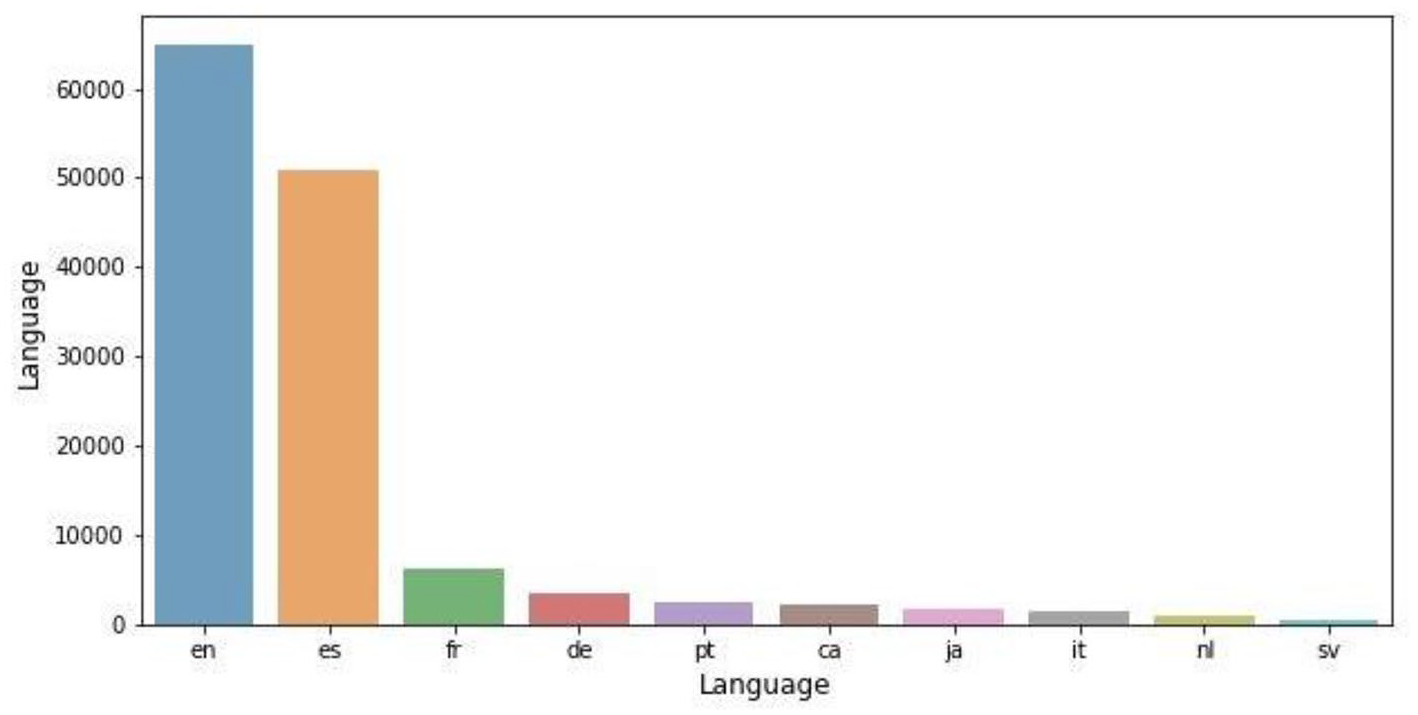
Tweets’ language breakdown.
As we are interested in knowing how Twitter users link to news media, we examined each of the 138,501 tweets and eliminated tweets that included no links. This initial cut reduced the list of tweets to 41,867. We next combed through these 41,867 tweets looking for tweets that included links to the Internet domains of news outlets. 1 We checked both for direct links and for links hidden in common URL shorteners (such as bit.ly or ow.ly) and consolidated separate links leading to the same domains (such as youtube.com and youtu.be). This process showed that a total of 9153 tweets, 6.6% of the original tweets, included links to news domains. This indicates that Twitter users in our corpus were somewhat more engaged with news than users in previous research (e.g. Malik and Pfeffer, 2016), which is perhaps due to how our study and method of gathering tweets centered on a specific global news event.
We then analyzed these 9153 tweets to determine the top 50 news domains in terms of number of tweets. 2 We used these top news domains to build an affinity network of links between these domains produced by Twitter users who shared links to more than one domain. We therefore rely on Twitter users to establish affinities between different domains, as has previous research (Benkler et al., 2018). The final step of narrowing our list to such users produced a list of 1030 edges for our Twitter network, each edge linking a Twitter user and a news domain. This two-mode network is converted into a one-mode affinity network between news domains by using a plug-in for network analysis software Gephi called “Multimode Networks Transformation” (Kuchar and Codina, 2020). The analysis of such affinity networks can be seen as “an illustration of the ‘structured space for debate’ and deliberation in global civil society” (Anheier and Katz, 2005: 216).
As a way to shed more light on the characteristics of users and public opinion formation on Twitter, which also is important context for how our Twitter affinity network diverges and converges with our MediaCloud network, we conduct a sentiment analysis of English-language tweets in the overall corpus and in the smaller subset of tweets used to create our Twitter network. We use the VADER (Hutto and Gilbert, 2014) Python script for sentiment analysis of pre-processed tweets. VADER (Valence Aware Dictionary for Sentiment Reasoning) is a Python library developed specifically to analyze tweets and is particularly useful for studying short texts, including emojis and emoticons. It relies on dictionary mapping of words and other utterances’ lexical features to emotional intensity, with some contextualization (for instance, “not like” conveys negative sentiment). VADER is considered to be a “gold standard” for short-text sentiment analysis (Bonta et al., 2019).
For our MediaCloud network of links created by professional media organizations, we took our list of top 50 news domains and used it as a basis for creating a seed set of outlets for MediaCloud’s “Topic Mapper” platform. 3 MediaCloud takes these seed sites and, based on user-defined search parameters, finds content produced by the sites. It then iteratively spiders out from this content, following links to create a universe of content. Our seed set included collections of media sources, each of which included one or more of our top 50 news domains. These collections were “United States—National”; “United Kingdom—National”; “Spain—National”; “Chile—National”; “France—National”; “Japan—National”; “Germany—National”; “Italy—National”; “Europe Media Monitor.” Because several of our top 50 domains are not included in these collections, we added them separately to create a final seed set. 4
We set “COP25” as the search term for the spidering process, as this way of referring to the Madrid talks is broadly shared by media sources and Twitter users across language and geographic groups. We set the spidering process to include 15 iterations, the highest amount allowed by MediaCloud, and we set the date range for 1 December 2019 to 15 December 2019, which corresponds with the dates for COP25.
This MediaCloud spidering process gathered 10,186 pieces of content from a total of 1286 media sources, which includes added sources that do not meet our criteria as news media sources. There are 1453 links between stories matching our “COP25” search term, and 793 “media links,” which are links among unique media sources. 5 Media links create a directed network (from one source to another) showing affinities between media sources.
Findings
Twitter network
The undirected affinity network created by our analysis of Twitter users who linked to more than one news source is displayed in Figure 2. The size of each node reflects its betweenness centrality, with larger nodes more central to the overall network. The shape of the network has been adjusted for readability.
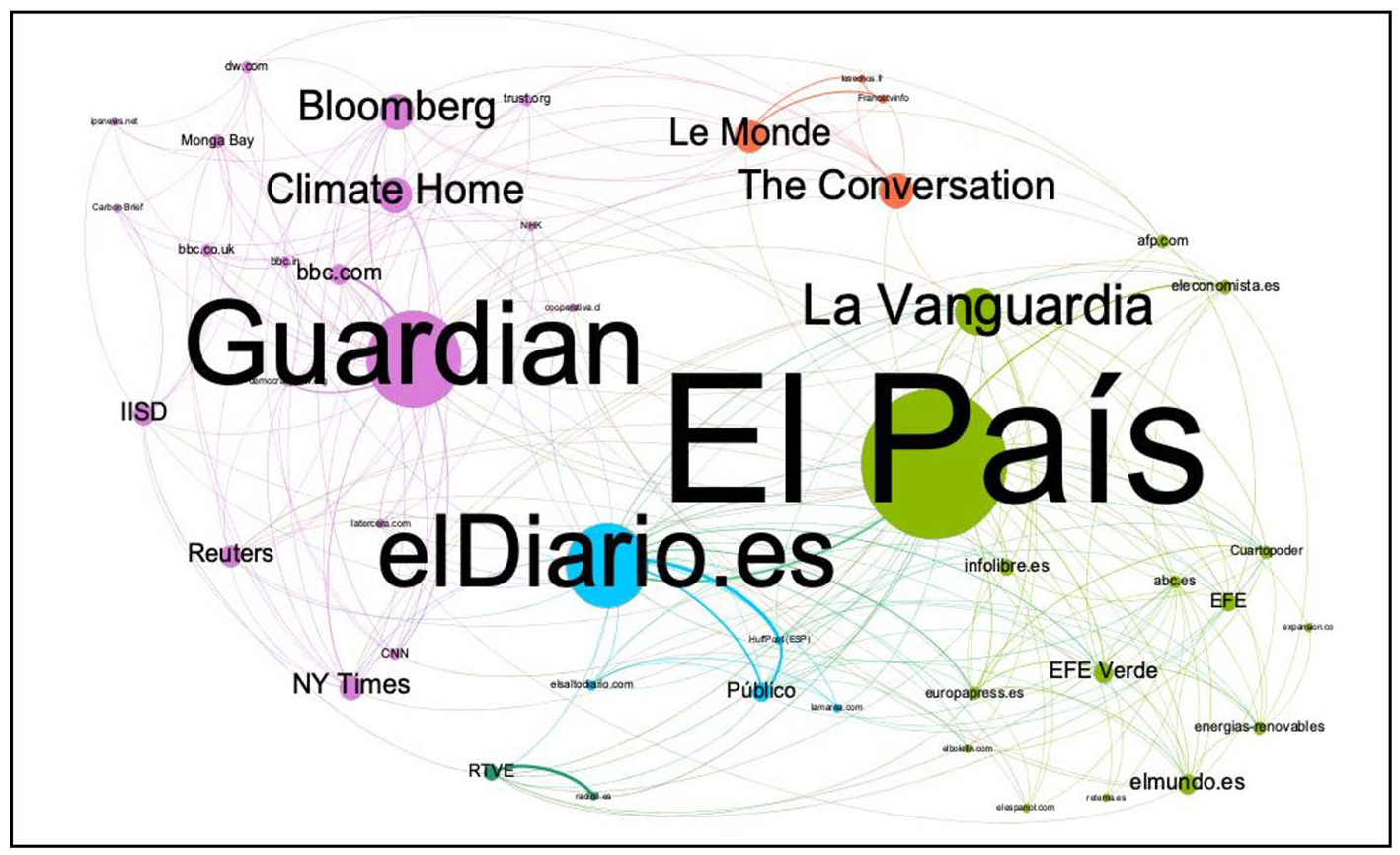
Twitter network.
The 46 nodes and 241 edges in this undirected graph are most obviously divided into the language communities that provide key elements of the structure of this Twitter affinity network (RQ1). COP25 drew significant media attention from Spanish-language news media in Chile (the originally intended site for the conference) and Madrid. Figure 2 shows that Twitter users who shared links to two or more different media sources produced a network structure that draws these Spanish-language sites close together into a large community in which El País has the highest betweenness centrality and a smaller community in which elDiario.es has the highest betweenness centrality. English-language sites also cluster together in a third major community including outlets such as The Guardian, BBC, Climate Home, and Bloomberg. A smaller French-language community includes outlets such as Le Monde and The Conversation. Spain’s public broadcaster RTVE and its music-focused Radio 3 station are closely connected as the sole organizations in the fifth community.
With a few exceptions, the cliques of actors that comprise these communities are very homogeneous, with little mixing of sources from different language groups. Yet there are some divergences from this overall pattern. The French-language community includes French news sources, including Le Monde and The Conversation, which is a nonprofit news network publishing in multiple languages, including Spanish, French, and English. The English-language community includes Japan’s public broadcaster, NHK, as well as La Tercera, a newspaper in Santiago, Chile. The largest Spanish-language community includes Agence-France Press (afp.com).
Finally, few posts by Twitter users produce edges between news sources from different language communities. The Guardian, though, has edges with The Conversation in the French community, and The Guardian and CNN have edges with El País in a Spanish-language community. Spanish wire service Agencia EFE and French wire service Agence France-Presse share an edge; the New York Times shares an edge with elDiario.es.
MediaCloud network
Turning to the directed network produced with a seed set of news sources on the spidering platform MediaCloud, we can immediately detect a similar structure divided along language lines (RQ2). Figure 3 shows a filtered version of the MediaCloud network in order to more prominently display the top five communities detected by MediaCloud’s own clustering algorithm, as measured by the number of nodes included in each community. The size of each node reflects the number of media inlinks, with larger nodes attracting links from a larger number of other media sources in the overall network.
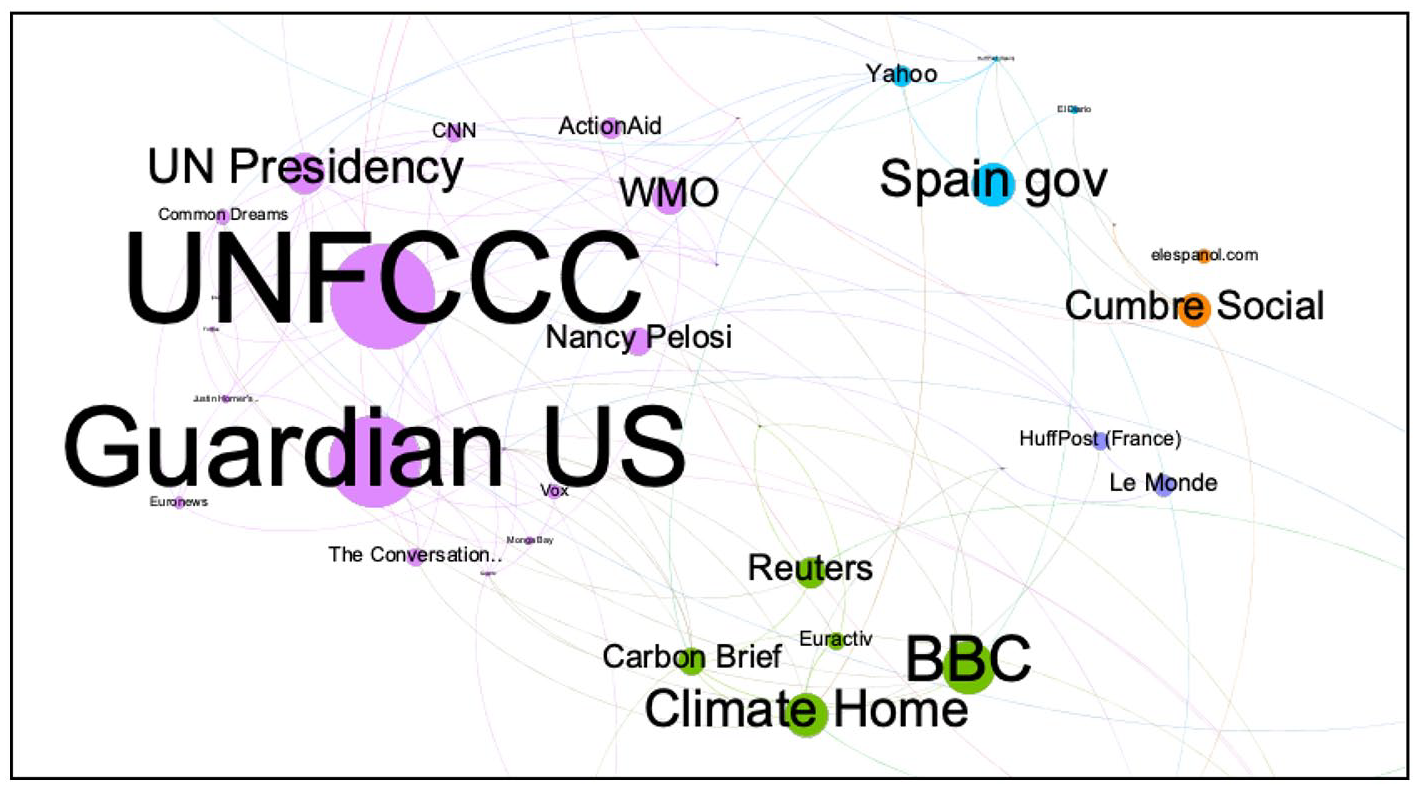
Top five communities in MediaCloud network.
The unfiltered network includes 349 nodes and 567 edges, and as in the Twitter network, the clusters generally are divided into English, Spanish, and French-language communities. Because we placed no constraints on the type of organizations included in the spidering process, this graph mixes news organizations with governments and UN agencies such as UNFCCC.
Most communities are homogeneous in terms of language groups. However, news portal site Yahoo!, much like The Conversation in the Twitter network, does draw a slightly more heterogeneous set of edges from sites such as Huffington Post’s Spanish-language domain; from French public broadcaster Francetvinfo; and English-language sites The Independent and The Guardian.
Network communities also show homogeneity in terms of geography and media ownership. Organizations from the same national media systems tend to link to one another, and the resulting network edges often are between media organizations that share the same ownership. For example, Spanish national newspaper ABC directs an edge to La Voz Digital in Cadíz, both owned by Grupo Vocento. Santiago-based CHV Noticias links to CNN Chile, both under the ownership of WarnerMedia. Huffington Post (Spanish domain) links to US-based Yahoo!, both under the ownership of Verizon.
Most retweeted tweets
We also analyze the most prominent topics in the Twitter and MediaCloud networks (RQs 3 and 4). Table 1 lists news links included in each Twitter community’s most retweeted tweets (up to three items in each community that had at least 10 retweets; Figure 2).
Top news items in Twitter network. a
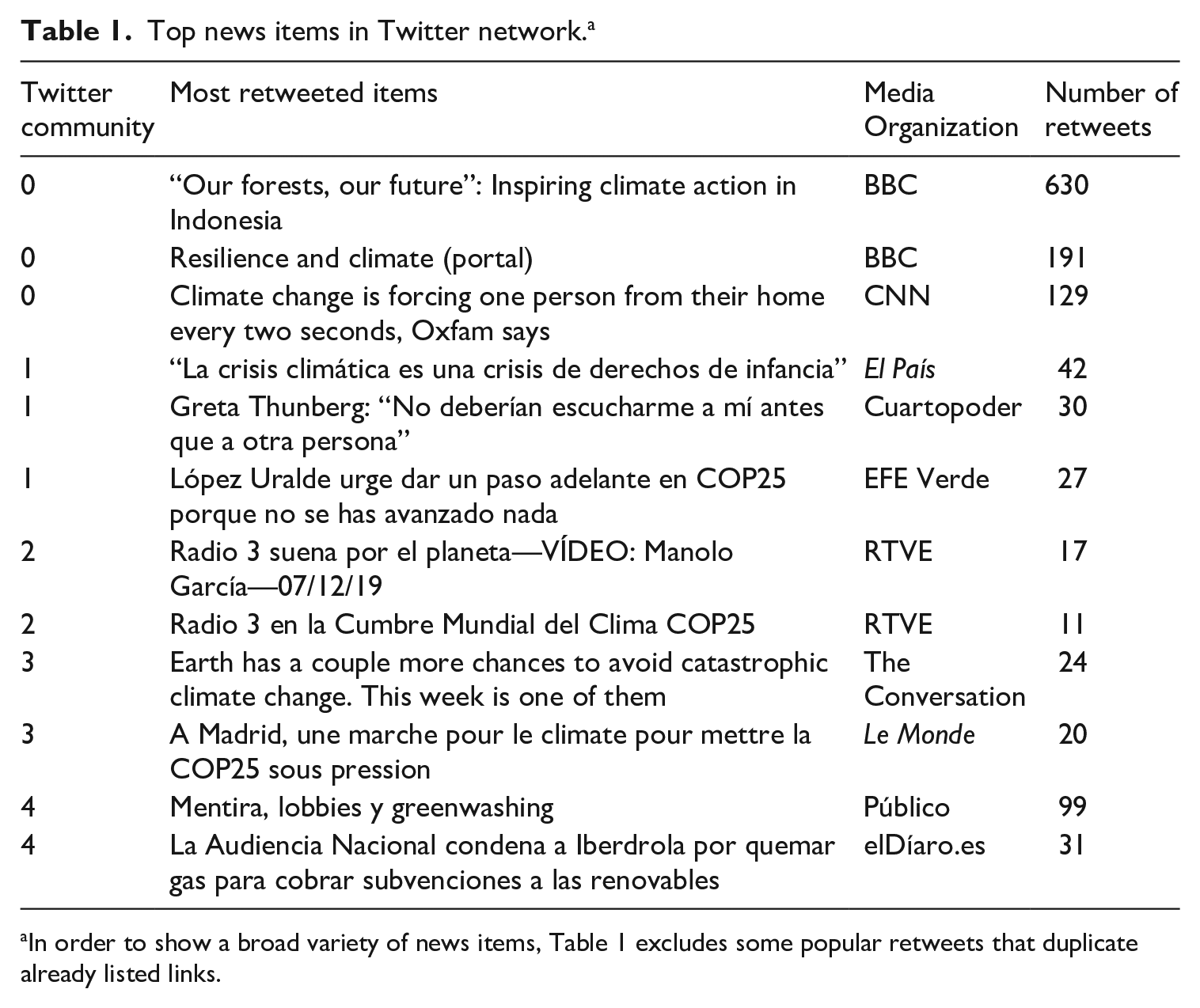
In order to show a broad variety of news items, Table 1 excludes some popular retweets that duplicate already listed links.
Looking at the top topics in the Twitter network in terms of volume of retweets (RQ3), we find that the account for UK public broadcaster BBC’s Media Action international development charity draws a great deal of attention, with many tweets pointing to the Media Action portal and, more specifically, to a post about climate change impacts in Indonesia.
The main Spanish-language communities (1 and 4) are dominated by links to stories from Spanish news sources El País, Cuartopoder, El Díaro, EFE, and Público. An El País story about a United Nations Children’s Fund (UNICEF) official’s speech on climate impacts on children is amplified by a UNICEF Twitter account. Other Twitter users tweet and retweet a link to a Cuartopoder story about a Swedish student climate activist Greta Thunberg. A blog post on Público also receives retweets.
In another Spanish-language-dominated community (2), Spain’s public broadcaster RTVE dominates with videos from a music performance during COP25 and with links to RTVE’s portal for COP25 coverage. Tweets that produce these dominant nodes stem from one of the musicians and from RTVE’s own account.
Paris-based newspaper Le Monde and The Conversation are prominent in the French-language community (3), where popular tweets amplify coverage of COP25 from multiple angles: an overview of COP25 in relationship to the limited time remaining to prevent disastrous global temperature increases (The Conversation); activism and efforts to increase national ambitions for effective greenhouse gas reductions (Le Monde).
Most linked-to content in the MediaCloud network
Table 2 lists the stories, websites, and other items that drew links from the largest number of media sources in the top five communities in the MediaCloud network (Figure 3). This top five ranking is determined by the number of nodes included in each community.
Most linked to items in MediaCloud network, top five communities.
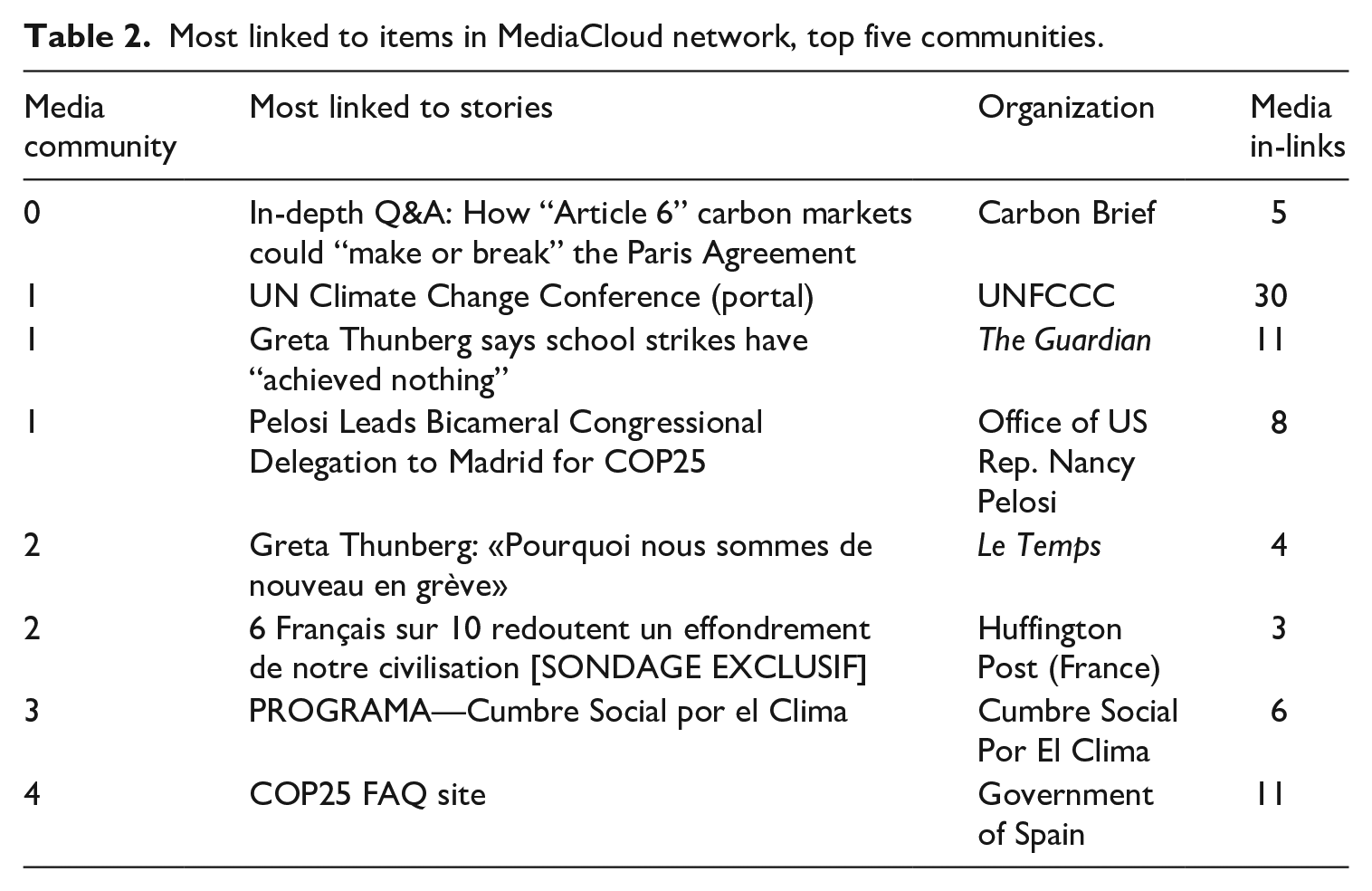
Looking at the top topics in the MediaCloud network (RQ4), Greta Thunberg once again proves a popular focus of coverage, with prominent coverage in communities 1 and 2. Community 0 is dominated by an explainer story from UK site Carbon Brief that provides an overview of negotiations over carbon markets, one of the most contentious dimensions of the COP25 talks.
The MediaCloud network mixes news topics with official and activist-oriented sources of information in the form of links to portal sites and event programs. Information available through the UNFCCC’s main portal site as well as governments and government officials (e.g. the government of Spain and US House Speaker Nancy Pelosi) draw many links from media sources; the program of events for “Cumbre Social Por El Clima,” a parallel climate conference organized by activists, draws a number of links from media sources.
In addition to these five communities, MediaCloud’s community detection algorithm identified another seven clusters (communities 5 through 11). Community 5 is dominated by media links to Chile’s official COP25 portal; Spanish commercial radio network Cadena SER draws the most media links in Community 6; international news commentary site Project Syndicate dominates Community 7 with a commentary piece co-authored by Greta Thunberg. Prominent nodes in other communities include the UNFCCC video streaming site, a call for action from Greenpeace’s branch in Spain, and coverage of Thunberg by German state-owned broadcaster Deutsche Welle, El País, and Italian newspaper la Repubblica.
Language and sentiment analysis of Twitter network
For tweets in English (Figure 4), social media are four of the top five most commonly shared links, with YouTube the most-shared social media platform. As in the MediaCloud network (Figure 3), the website for UNFCCC has a large number of shares on Twitter, ranking third among all links. Traditional news media are rarely linked—the only ones in top 19 are The Guardian (seventh) and BBC (the British domain at number 13 and the international domain at number 18).
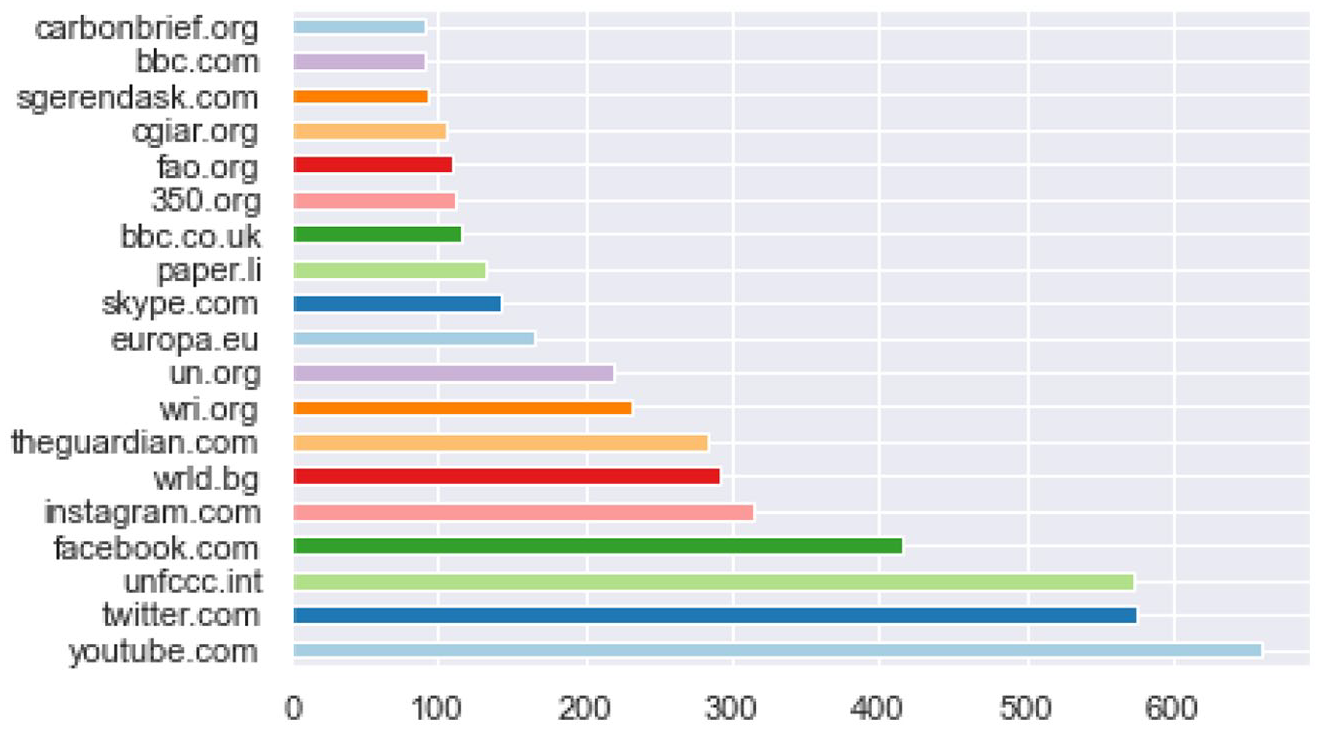
Top domains among English-language tweets.
In Spanish tweets, elDiario.es and El País are among the top three (Figure 5). YouTube does not appear among top rankings, while Instagram is number 1, and Telegram is more popular than Twitter. The especially high position of Telegram may signal that Spanish participants were more likely to direct COP25 discussions from public to private spheres.
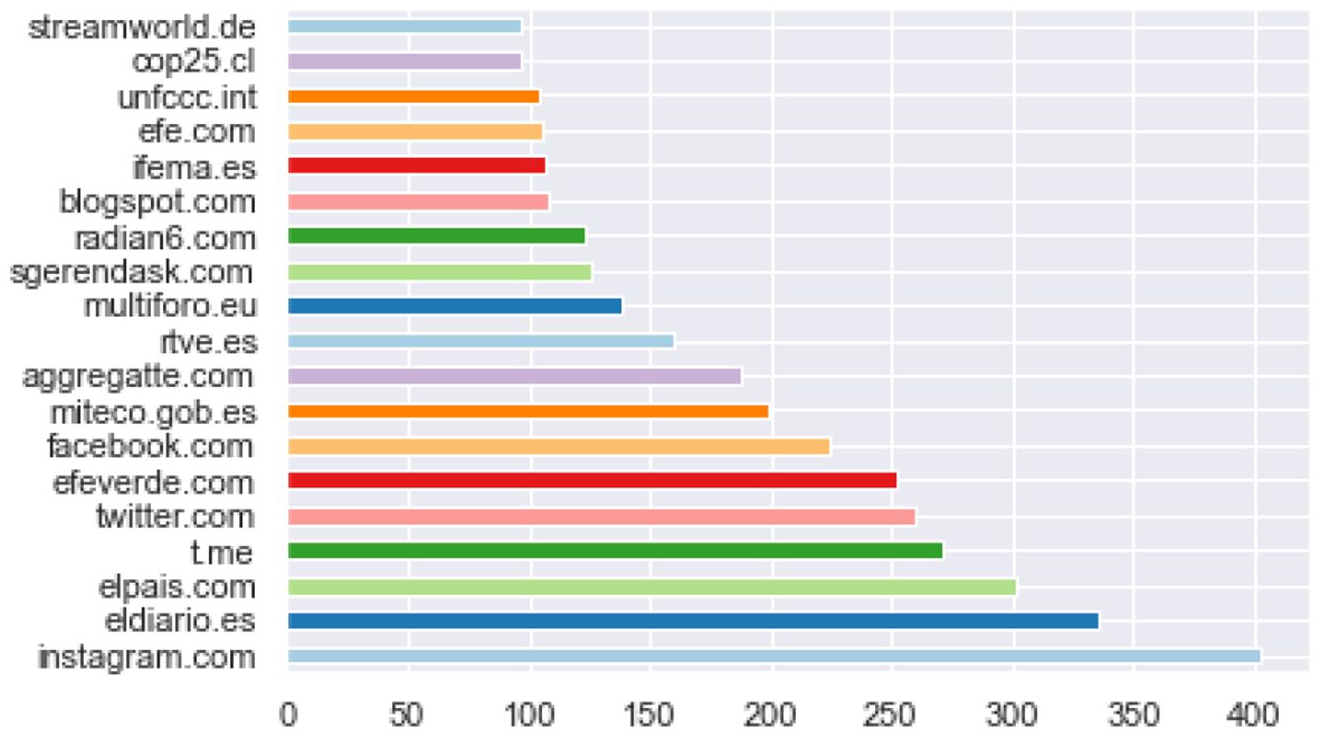
Top domains among Spanish-language tweets.
English tweets with very negative sentiment—containing words of critique, anger, and disagreement—are much more often retweeted than those with very positive sentiment (Figure 6). English tweets with very negative sentiment also appear to be more frequently replied to, although because of the large confidence intervals this finding should be treated with caution (Figure 7). We believe that these results indicate that negative discourse is more engaging, although we interpret this fact as heavily topic-dependent: tweets with very negative sentiment may not necessarily be divisive for the disputants, as they may be replying to them and retweeting them to show shared values more than in other Twitter discussions.
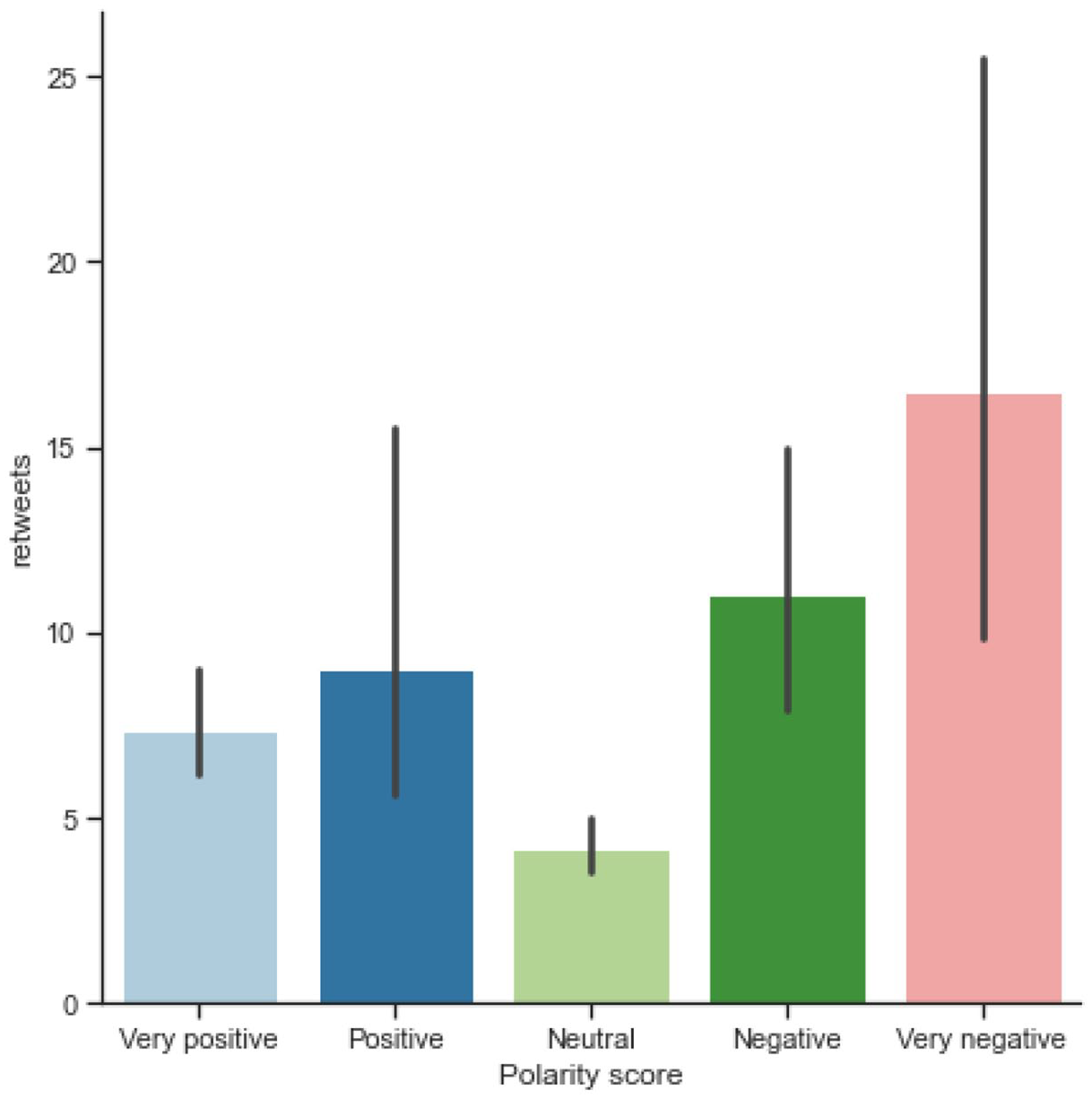
Sentiment of English tweets that were retweeted.
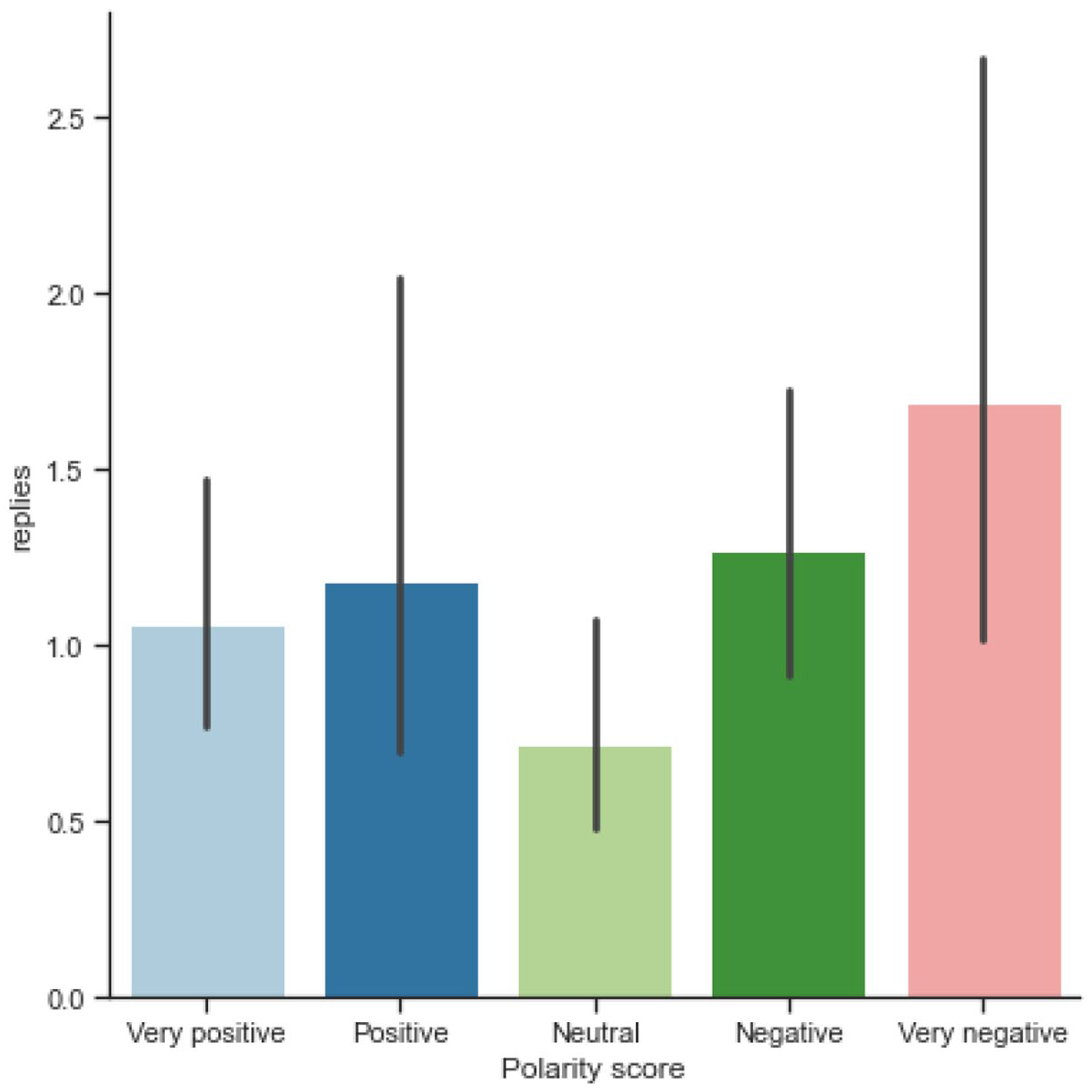
Sentiment of English tweets that were replied to.
Including a link to external media sources decreases the number of favorites, replies, and retweets (Figures 8 to 10; five most prevalent languages shown). The effect is most striking in favorites and retweets in Spanish, German, and Portuguese, while in English the effect may be marginal when confidence intervals are accounted for. Because of the consistent clear prevalence of tweets without links in all languages and categories, except replies-to in German, we believe that this finding is important: Creating original content and participating in the discussion with one’s own voice appears to be appreciated more and be more engaging than posting links, even if they are posted with a commentary.
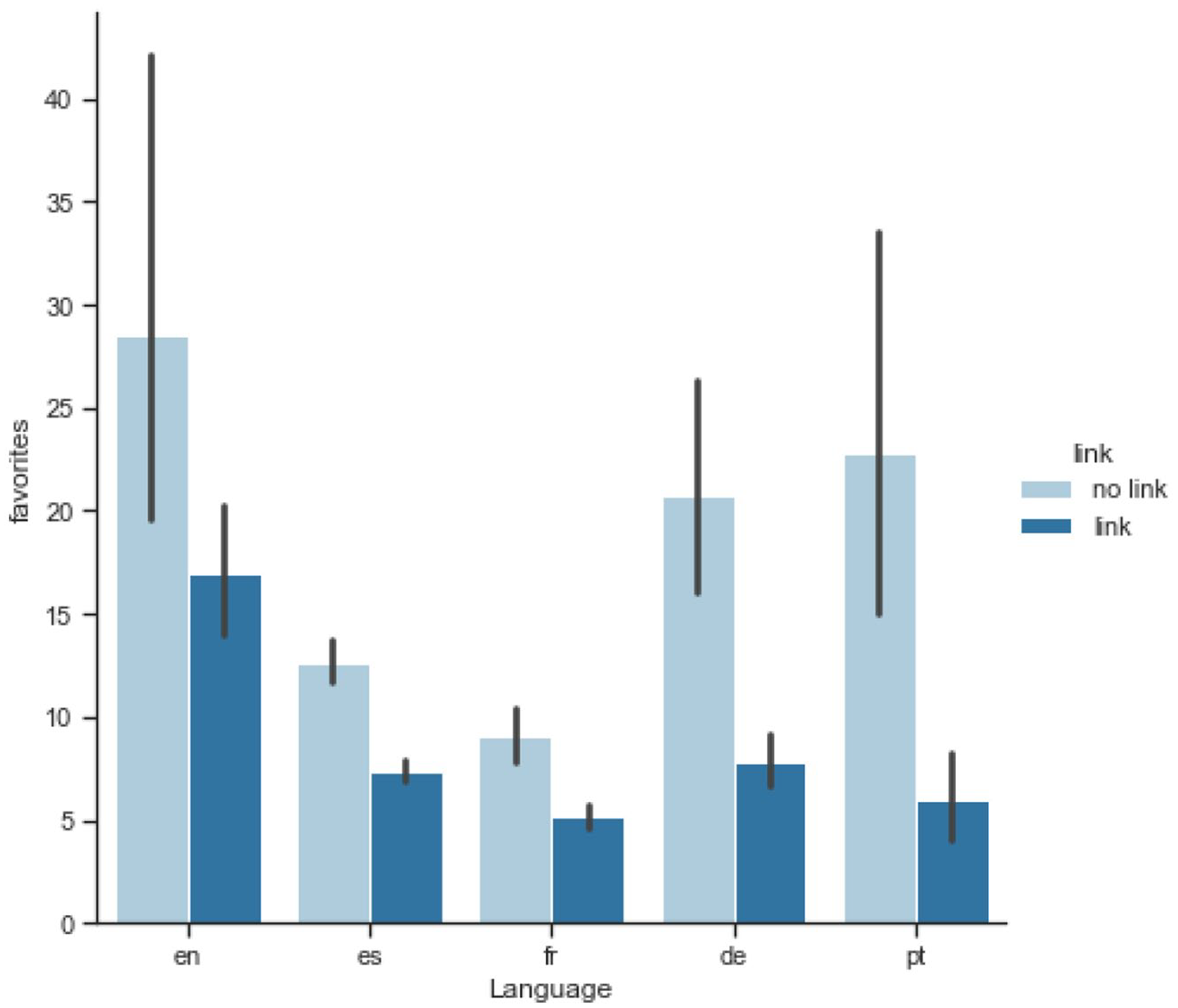
The average number of favorites that tweets with a link and without a link received, by language.
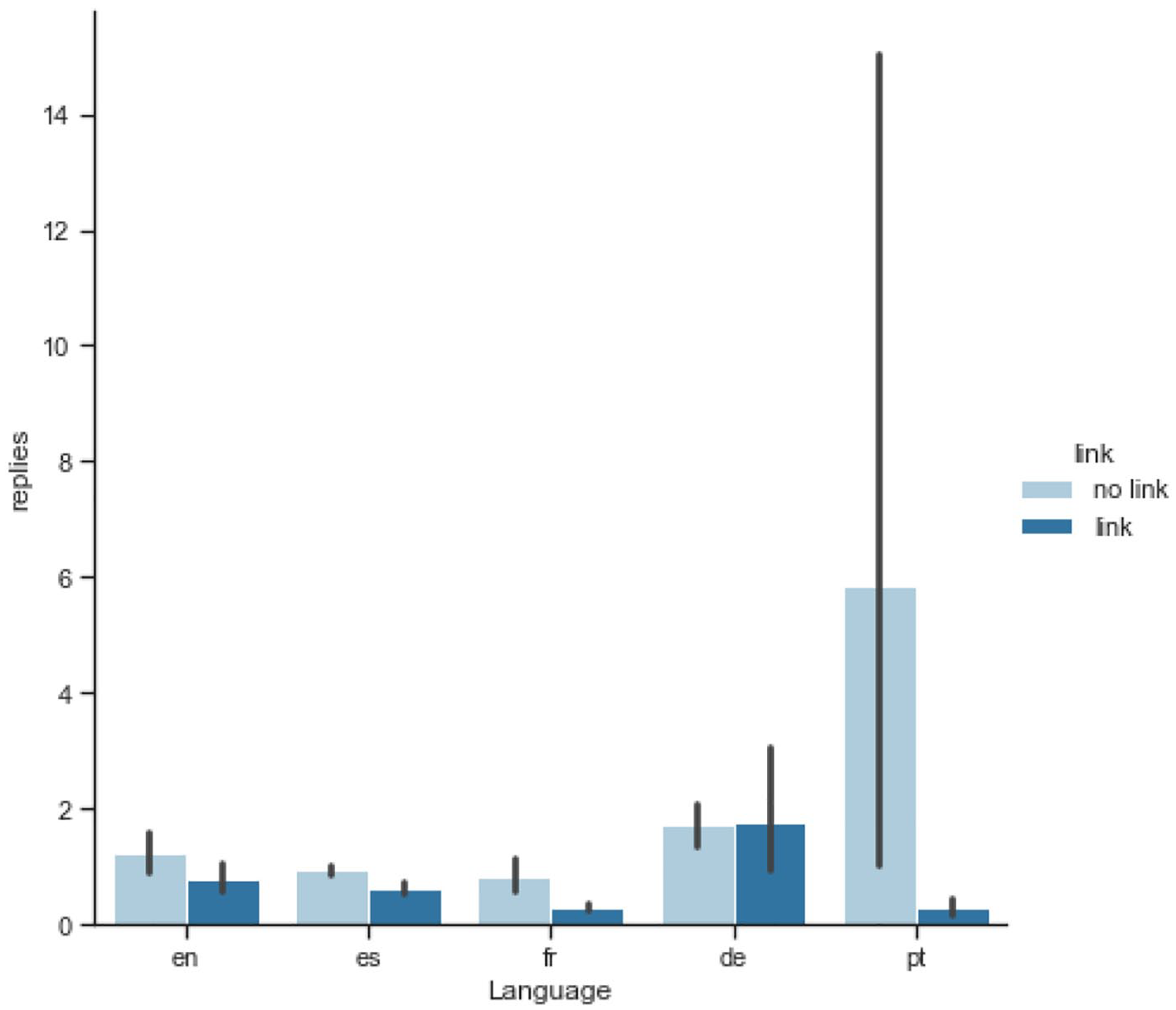
The average number of replies that tweets with a link and without a link received, by language.
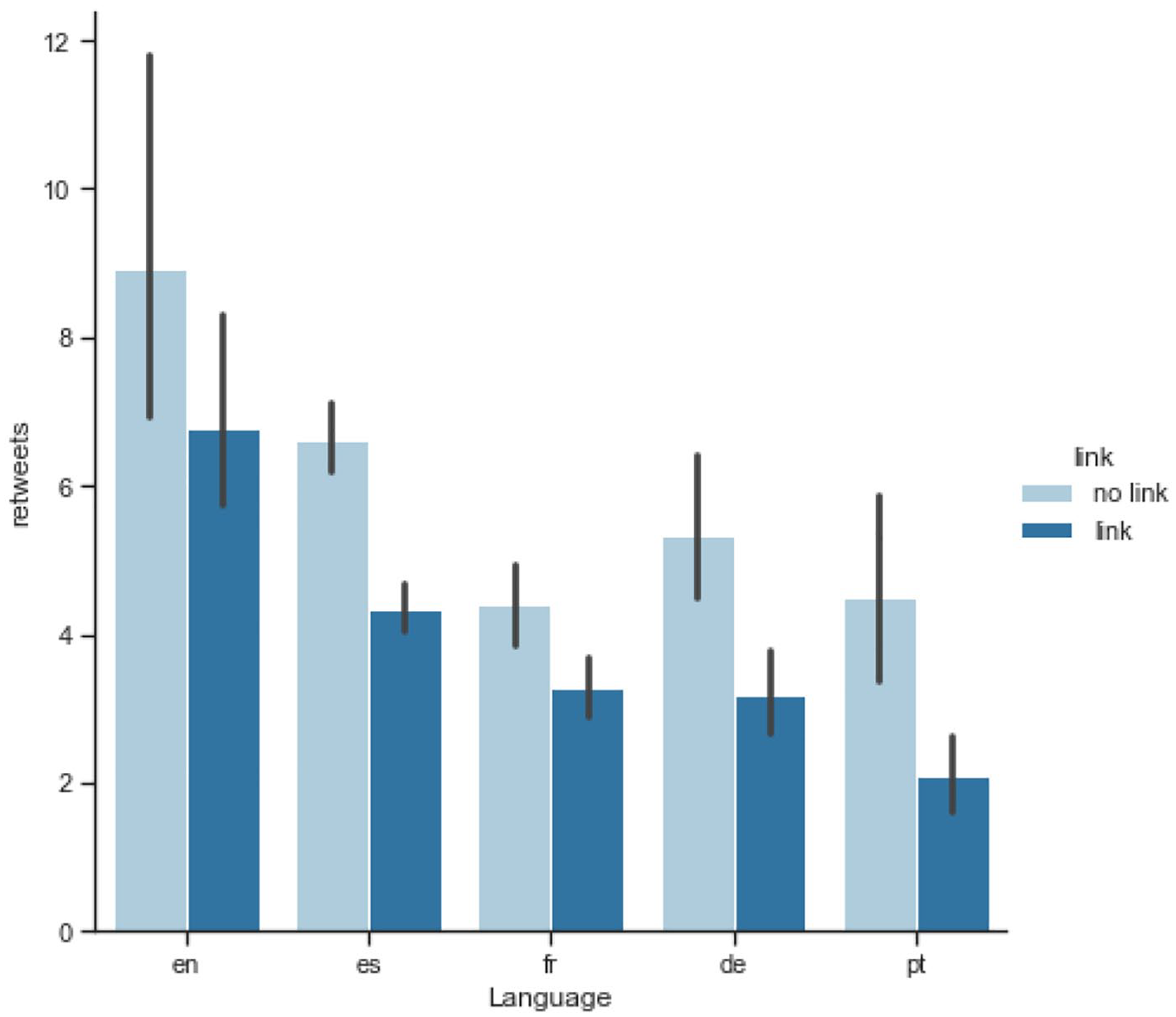
The average number of retweets that tweets with a link and without a link received, by language.
We note that Twitter cultures of replying to, retweeting, and clicking “favorite” also differ across language cultures. Especially in German, the percentage of replied-to tweets is significantly higher than in other languages (see Figure 11). German tweets also are more often favored: when the percentage of tweets favored more than 10 times is considered, German tweets take a very clear lead, while French and Portuguese tweets are most behind (see Figure 12).
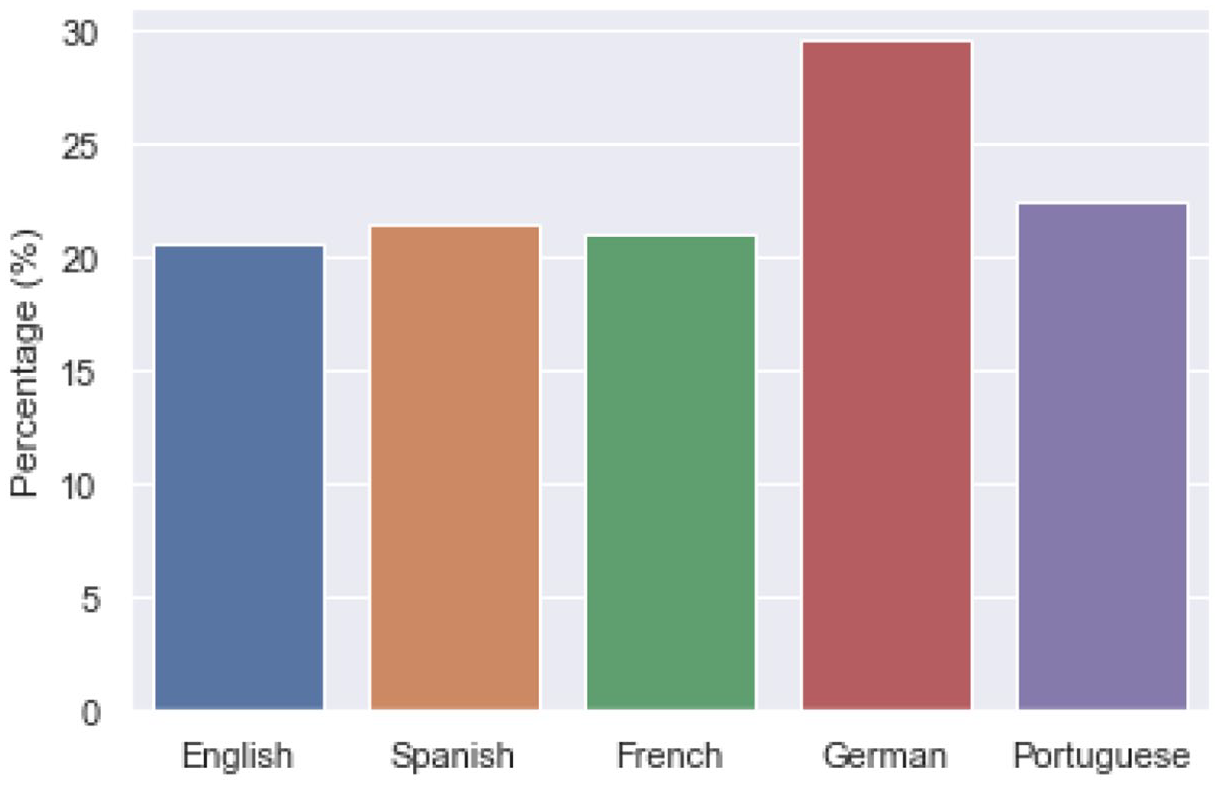
The percentage of replied-to tweets across languages.
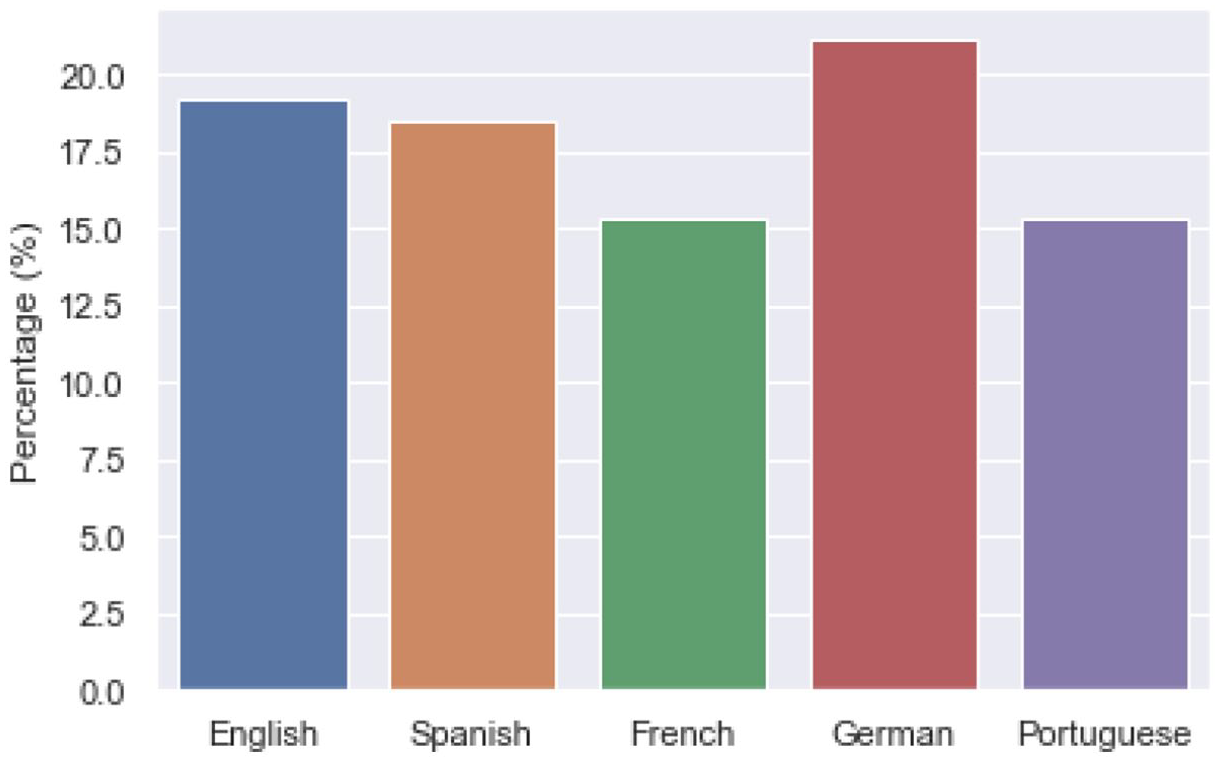
The percentage of tweets favorited over 10 times across languages.
Comparing Twitter and MediaCloud networks
There are important similarities and differences between the Twitter and MediaCloud networks (RQ5). First of all, both networks are structured along language and national lines, as well by media ownership affiliation. The Twitter network is dominated by news sources, but this is an artifact of the way tweets were selected for inclusion in our analysis. When one looks at the overall corpus of tweets, linking to news sources is a relatively rare practice. Still, news sources remain prominent in the MediaCloud network, even as they mix with government and activist sites. Media sources from developed countries also dominate both networks.
In terms of topics, Greta Thunberg clearly was a leading focus of COP25 coverage in the news, and this is reflected in both networks. Also in both networks, we find that aggregation of news sources and information, such as the aggregation demonstrated by various government sites and media sources RTVE and Yahoo!, tends to be associated with network prominence.
However, the MediaCloud network also gives some prominence to much more technical analysis of the talks; in particular, a Carbon Brief explainer of Article 6 negotiations that potentially provides other media outlets with a key resource in their own coverage. This work of sourcing from what have been called “platforms of climate knowledge” that occupy a space between UN processes and news media (Kunelius et al., 2017: 270) does not seem to be as strongly represented in the Twitter network, suggesting a divergence in terms of practices. Still, news sources in the Twitter network benefit greatly from amplification provided by social media managers within their same organization, suggesting that professional journalists and their practices are important contributors to both networks’ structures.
Discussion
We do not claim that our study fundamentally alters or challenges networked public sphere theory. Rather, we seek to connect different strands of network studies and public sphere theory in order to foreground a core concern—homogeneity/consensus and heterogeneity/dissensus—that can fade into the background in research on network topologies. We argue that this shift can help re-imagine and further develop public sphere theory (Kaiser et al., 2017) by bringing crucial aspects of networks into view, such as economic relationships and cultural practices that facilitate consensus and dissensus—key dimensions of public opinion formation—around crucial transnational problems such as climate change.
Our study first of all verifies prior research findings (e.g. Malik and Pfeffer, 2016) that the sharing of news content through direct links is a relatively rare practice on Twitter (RQ1). It is even more rare to find Twitter users sharing links to more than one media organization. When Twitter users do share links to more than one media organization, they produce an affinity network dominated by large Western media organizations such as BBC and The Guardian and, more specifically, organizations prominent in Spain, where COP25 took place.
In our MediaCloud network, we find that media organizations under the same ownership link to each other in the content that they produce (RQ2). This practice carries over to Twitter, where media professionals favor tweets and retweets that reference their own media organizations more than other media organizations. This tendency to remain within the bounds of one’s own organization can be regarded as a source of heterogeneity internal to our Twitter network, as it reduces the number of affinity links. We also note that when we look beyond the large footprints of commercial Spanish news outlets El País and elDiario.es in our networks, news media with non-commercial forms of ownership also tend to have prominence (e.g. trust-owned The Guardian, nonprofit Climate Home, and public-funded BBC). This suggests that in addition to encouraging within-ownership hyperlinking practices, the economic underpinnings of newsgathering can play important roles in sustaining a focus on urgent and complex social problems such as climate change.
Prominent topics in our Twitter affinity network (RQ3) reflect the popularity of certain actors, such as climate activist Greta Thunberg, as well as accounts of the actions of charities (BBC Media Action) to address climate change, and news accounts of the devastating impacts of climate change (e.g. CNN’s reporting on an Oxfam report). We find far less interest in news accounts of the COP25 talks themselves. These topics are produced by Western organizations, most prominently those based in the United Kingdom and Spain.
Non-commercial, governmental actors are very prominent in our MediaCloud network (RQ4), as are news organizations, including environment and climate change-focused news media such as Climate Home and Carbon Brief. As with our Twitter network, Greta Thunberg’s presence at COP25 generates a great deal of interest in the MediaCloud network. We also find a great deal of content linking to official, informational sources, rather than to news accounts: for example, UNFCCC’s main portal and the program for “Cumbre Social por el Clima” feature prominently among our MediaCloud communities.
Among these two networks’ similarities and differences (RQ5), language and geography are obvious sources of internal heterogeneity, as we find strongly separated communities in which media organizations and other actors are based in the same country and share the same language. Economic (ownership) structures also are sources of internal heterogeneity: In our MediaCloud network, media outlets under the same ownership tend to link to one another, and similar linking practices are found on Twitter, where journalists and social media managers amplify their own outlets’ coverage. These practices reduce affinities between media organizations, thereby increasing differentiation (heterogeneity) within each network.
We also find that strong sources of internal heterogeneity can lie in cultural factors, as both our MediaCloud and Twitter data show some distinct practices by language group (e.g. more replies among tweets written in German). Perhaps as a partial counterweight to the role of large institutions in producing the structures of our networks, the culture of Twitter appears to suppress the sharing of links to news media and privileges using one’s own voice, as tweets including links tend to get fewer interactions from other Twitter users. This may contribute to divergences between news networks produced by the practices of media professionals and news networks produced by the practices of non-media professionals using social media platforms (more external heterogeneity).
Shared topics are perhaps the strongest indicators of homogeneity both within (internal homogeneity) and across our networks (external homogeneity). Climate activist Greta Thunberg attracted widespread attention during COP25, providing a common source of news, commentary, and sharing among media organizations and Twitter users regardless of how spheres are segmented. During COP25, Thunberg was the example par excellence of an actor capable of generating great interest both by the media professionals and people beyond the media sphere on Twitter. Divisions in terms of language, geography, and media ownership did not prevent her actions and speeches from attracting widespread, transnational attention during the climate talks.
Non-media institutions such as UNFCCC also constitute a source of external homogeneity (i.e. similarity across both networks), though our Twitter network (Figure 2) does not reflect the high level of linking to such organizations, which are prominent in our language and sentiment analysis of tweets. Both networks also are dominated by actors from developed countries, though in the MediaCloud network this is no doubt related to how our seed set of sites for analysis are primarily from these countries. Nonetheless, this domination aligns with prior research on climate policy-making (Bulkeley et al., 2014; Bulkeley and Newell, 2010).
In this study, we have not considered the question of whether these two networks constitute public spheres; rather our analysis of them reveals important sources of homogeneity and heterogeneity. As consensus (homogeneity of opinion) and dissensus (heterogeneity of opinion) are key concepts underlying public sphere theory, these findings shed some light on how transnational public spheres might arise during international events such as COP25. First of all, the social capital of certain actors such as Greta Thunberg is capable of gathering attention and spurring discourse across diverse publics (external homogeneity). More research is required to understand the exact processes by which such actors accrue and spend such capital, though media attention is clearly a key source.
Second, well-established international venues such as climate negotiations have the institutional infrastructure to sustain public spheres. Diverse publics seek to leverage the power of governments, media organizations, and policy-making bodies such as the UNFCCC to act on climate change, and therefore, these institutions have prominent footprints in the transnational networks examined here. The important role of institutions in the production of network structures to some extent echoes Habermas’ (Habermas et al., 1974) original formulation of the public sphere, in which he argues that public spheres in modern societies can no longer be easily equated with individuals from the same social class, as in the bourgeois public sphere that emerged in Europe in the 17th and 18th centuries. Today corporate entities such as commercial media outlets, states, and international policy-making bodies (i.e. UNFCCC) are central actors in public spheres, and they significantly shape flows of communication in digital networks.
Third, media ownership is an important dimension of network structures, and research on network phenomena as diverse as the spread of misinformation and echo chambers should take account of such economic underpinnings to communication flows. However, news accounts of climate negotiations appear to be a secondary dimension of information flows during COP25, as news link sharing is relatively rare and unlikely to generate replies when it does occur.
Finally, cultural practices, including practices specific to the cultures of commercial institutions such as Twitter, can produce heterogeneity in transnational public spheres, which continue to show divisions along language, geographic, cultural lines.
Our research is limited to small subsets of tweets produced during COP25. We can make no claim about other events, and it is possible that a larger corpus of tweets would shed new or different light on affinities between media outlets. However, these small subsets do allow for a thick form of description capable of suggesting directions for further research. Such research could combine this form of qualitative description with content analyses in order to systematically relate topics and the quality of discourse to the structures of networks. Research also could examine such networks longitudinally, as actors and institutions, and therefore the characteristics of public spheres, change over time. In addition, the complexity of international climate negotiations and weakness of online interactions (Cammaerts and Van Audenhove, 2005) may limit the ability of public spheres to impact climate policy, and more research is needed on the influence and quality of public discourse during COPs.
In conclusion, our study shows that transnational public spheres can emerge out of relatively homogeneous moments, both internal and external (i.e. across multiple networks), at the intersection of media attention, cultural practices, and commercial and non-commercial (state) institutions, some of which have the capacity to effect changes in climate policy. At the same time, there are persistent divisions along language, geographic, and organizational lines that encourage the formation of distinct micro-spheres of networked actors (internal heterogeneity), as well as distinct social media practices (arguably cultures) that work to differentiate mass media networks from networks produced by a different set of publics on social media (external heterogeneity). These differences persist even during transnational events that draw widespread, sustained media focus around the globe. Critical moments of consensus and dissent in efforts to address transnational problems can arise out of these contradictory currents of homogeneity and heterogeneity in global communication flows.
Footnotes
Authors’ note
All authors have agreed to the submission of this manuscript. It is not under consideration for publication elsewhere.
Funding
The author(s) disclosed receipt of the following financial support for the research, authorship, and/or publication of this article: Dariusz Jemielniak’s participation was possible thanks to a grant no. 2019/35/B/HS6/01056 from Polish National Science Centre.
