




Abstract
Debates around climate change are a prominent example of polarized online communication. We examine the German climate hyperlink network and evaluate the degree to which it is shaped by mainstream and skeptical views. By combining the theoretical frameworks of the networked public sphere and counterpublics, we describe the relation between publics and counterpublics and discuss the role of hyperlinks in delineating communities. Our analysis of blogrolls and link lists shows the debate’s structures to be polarized along factional lines with political and scientific institutions supporting the mainstream “climate-friendly” position. We find that skeptics form a counterpublic that is only loosely connected to the mainstream as neither skeptics nor the mainstream want to be affiliated with each other. Skeptics, thus, are mostly excluded within the German online climate network. However, skeptics are part of an “alliance of antagonism” with other groups, such as conspiracy theorists, men’s right groups, and right-wing sites.
Keywords
Introduction
Climate change is a controversial and even polarizing issue for many reasons. There is no single political solution for tackling climate change and its associated challenges, and it is unclear what economic consequences a solution may entail or whether it is scientifically wiser to adapt to global warming incrementally or attempt to mitigate it altogether. The notion that climate change is a dangerous and consequently urgent issue that threatens society is increasingly accepted internationally (Schmidt, Ivanova, & Schäfer, 2013). Consequently, political parties, grassroots activist organizations, charities, companies, and scientific and religious institutions fight climate change on a local, national, and transnational level. Yet there is a vocal minority within both the global and national climate debates that questions climate change or even denies its existence—so-called “climate skeptics.” This is even more prominent online where skeptics form communities in which they can validate and strengthen each other’s opinions and isolate themselves from other ones and form enclaves, often referred to as “echo chambers” (Sunstein, 2001; Williams, McMurray, Kurz, & Hugo Lambert, 2015). Even though much is known about the skeptics’ framing of climate change, their demographics, and industry ties, there is presently little research on their role within society and the types of coalitions they form (e.g. Elgin, 2015; McCright & Dunlap, 2000). This, too, holds true for climate communication in general, which is shaped by the actors mentioned above, all of whom aim to make their voices heard in the public sphere in order to define how climate change is discussed (Anderson, 2009). To fully understand conflicting framings of the same issue, a structural perspective is needed since it enables us to identify different factions, as well as to see the tension between mainstream and outlier positions. In this article, we accordingly focus on the overarching research question: How is online climate change communication structured?
Since this question is relatively broad, we focus on the case of German-language climate change debate and conduct a hyperlink network analysis based on links from blogrolls and link lists that allows us to identify coalitions, associations, and opponents within it. We combine this approach with a content analysis of websites and blogs that complements our interpretation of the network structure. We choose this specific case for several reasons: it offers us both a national and a transnational perspective (covering Germany, Austria, and Switzerland); there exists a broad consensus within these countries that climate change is happening—consequently, a wide range of involved actors acknowledge climate change as such but disagree on potential counter-measures; and, additionally, the climate skeptic groups constitute in our reading counterpublics, that is, a public that is in opposition to the mainstream public(s). Accordingly, our overarching research question can be subdivided:
RQ1. What is the structural relationship between the mainstream public sphere(s) and the climate skeptic counterpublic with regard to their connection to each other (network communities), reciprocity (both inlinks and outlinks), and inclusion (links from mainstream actors)?
RQ2. What is the relationship between different kinds of actors (e.g. from civil society and politics) and topics with regard to identifiable communities within the hyperlink network, and can we identify potential coalitions?
By answering these questions, we will both offer an insight into the structure of the German-language climate debate and describe a particular national debate, as well as provide suggestions for the role of counterpublics within the networked public sphere (NPS).
The online public sphere and counterpublics
The theoretical concept of the public sphere has been shown to be an especially useful framework since it allows for a normative evaluation, a descriptive analysis of communication relationships online, and can be productively combined with hyperlink network analysis, taking into account that the availability of data imposes certain limitations (Benkler, 2006; Papacharissi, 2002; Rogers, 2002). The Internet has reinvigorated the idea of a virtual space which has the potential to empower the civil society and give previously excluded minorities a voice (Dahlberg, 2011; Downey & Fenton, 2003).
Classical conceptualizations of the public sphere strongly rely on the work of Habermas who proposes the need for a strong civil society, an alert mass media, and a critical counterpublic so that a working public sphere can be created and a public opinion can be formed (Habermas, 1962/1990, 2008). Albeit Habermas’ work is still seen as inspiration for many online scholars, and the idea of what constitutes a public sphere has been critically revised. Although classic public sphere concepts describe the relationship between politics, mass media, and civil society and focus on the political public sphere (e.g. Fraser, 1990; Habermas, 1962/1990), more recent attempts define the public sphere as an amalgam of communication on different platforms with shifting roles and interaction among actors from various societal fields (e.g. Benkler, 2006; Papacharissi, 2002).
The online public sphere, often also called NPS (Benkler, 2006; Nuernbergk, 2014), emphasizes the network character of the Internet and its influence on all societal actors, the mode of communication, and traditional understanding of roles (Benkler, 2006, Hogan, 2017). As Benkler, Roberts, Faris, Solow-Niederman, and Etling (2015) point out, the NPS describes “the range of practices, organizations, and technologies that have emerged from networked communication as an alternative arena for public communication, political debate, and mobilization alongside, and in interaction with, traditional media” (p. 3) For Boyd (2010), networked publics “are simultaneously (1) the space constructed through networked technologies and (2) the imagined collective that emerges as a result of the intersection of people, technology, and practice” (p. 39). The authors emphasize both the network’s social dimension and its technological basis—aspects that can be empirically described through network analysis.
Consequently, it is now widely acknowledged that there is not one public sphere but rather multiple publics—some smaller, some larger, some local, some transnational—that are (loosely) connected and have the potential to influence each other (e.g. Bakshy, Rosenn, Marlow, & Adamic, 2012; Chadwick, 2011). Along these lines and based, for example, on hyperlink network analysis, Sunstein (2001) argues that the Internet leads to a fragmentation of the public sphere consisting of mostly unconnected publics in which the same opinions are reproduced, ultimately resulting in radicalized and isolated “echo chambers.”
More generally, the phenomenon of exclusion of minorities or unpopular opinions has been described in counterpublic theory (Downey & Fenton 2003; Fraser, 1990; Mouffe, 2000). It is assumed that groups that are excluded from and/or not being heard in the public sphere may retreat to a safe space where they can voice their opinions, exchange arguments, and form a counterpublic that is in opposition to the mainstream hegemonic public sphere. Since counterpublics touch upon questions of polarization and fragmentation (Habermas, 2008), one major question deals with the counterpublic’s identity and its value for democracy. Counterpublics are often reduced to minorities that seek to change society and democracy for the better, but are not represented in the public debate (e.g. Chávez, 2011; Dahlberg, 2011; Fraser, 1990). However, neo-Nazis and other radical groups also seek representation in public discourse, despite their opposition to democracy (Cammaerts, 2009; Downey & Fenton, 2003; Toepfl & Piwoni, 2015). We consequently propose that counterpublics do not only include progressive social movements but also other fringe movements. But as Asen (2000, p. 426) points out, it is instrumental not to confuse a multiplicity of publics with counterpublics.
In this article, we consequently understand a counterpublic as an (1) issue-specific public, since publics often form around issues (e.g. Benkler et al., 2015), that (2) opposes the hegemonic view and is (3) excluded by the mainstream and/or (4) excludes itself from the mainstream to regroup. Whereas the “echo chamber” concept suggests that echo chambers mostly ignore the main discourse, counterpublic theory posits that counterpublics pay attention to the mainstream public sphere as they try to change it in their favor. Similar to Benkler (2006) and Sunstein (2001), we suggest that we can see these patterns, for example, with a hyperlink network analysis through inbound and outbound hyperlinks. A counterpublic, then, would, for example, have few inlinks from the mainstream public sphere, while also showing only few outlinks to the mainstream. As the counterpublic is inherently dependent on the mainstream, it could be assumed that the counterpublic has more links to the mainstream than vice versa. This view comes with certain caveats, however. In our analysis, we consider reciprocal blogroll links, which can be considered to reflect affiliation among actors but do not reflect concrete information or communication flows. Reducing the network to actors with a reciprocal link with at least one other node also means that actors without a blogroll or link list are ignored, even if they are widely referenced by others or strongly participate in the discourse.
Climate change and the Internet
Since climate change is an abstract and complex issue that we cannot experience directly, we are highly dependent on information and opinions received through the mass media and online sources (Schäfer, 2012). As information is a key resource in these debates, significant research focuses on the involved actors, the messages they are trying to send, how they are represented by the media, and how these actors are connected with each other.
Climate scientists in particular are prominent actors within the climate debate as both their work and their private lives are frequently under public scrutiny. When e-mails by climate scientists were leaked right before a climate summit in 2009—an incident dubbed “Climategate”—journalists and skeptics were quick to cast climate research in doubt, although no evidence for scientific misconduct could be found (Grundmann, 2012). The role of climate scientists within politics, however, and if, where, and how actively they communicate online, interact with journalists, or whether they donate to environmental causes are still aspects of academic interest (e.g. Bromley-Trujillo, Stoutenborough, & Vedlitz, 2015). In his meta-analysis on climate change communication online, Schäfer (2012) concludes that “climate scientists and scientific institutions from the field do not seem to be the major players in online climate communication” (p. 3).
This stands in stark contrast to the way non-governmental organizations (NGOs) utilize the new opportunities the Internet offers to them with regard to different channels, ways of campaigning, potential national and transnational alliances, and a wide reach to inform and mobilize users (e.g. Ackland & Gibson, 2004; Shumate & Dewitt, 2008). Politicians, in contrast, seem to prefer conventional modes of communication when talking about climate change. And yet little is known regarding politicians’ online communication on climate change (Schäfer, 2012). Hyperlink studies show that governmental actors tend to link among each other and disregard other societal fields. Elgin (2015), for example, found that particular institutions tend to preferentially link within their own field, forming distinct clusters. As we will argue, mainstream and counterpublic differ markedly in their make-up of actors, with the mainstream cluster dominated by institutions and the counterpublic cluster dominated by individuals and small, loosely knit groups.
Climate “skepticism” and its potential as a counterpublic
The rift between “skeptics” and what we will call “mainstream” in the remainder of this article has been the topic of several studies (for a summary, see Howarth & Sharman, 2015). It has, for example, been shown that skeptics are usually politically more conservative (McCright & Dunlap, 2011), tend to be more open for conspiracy theories (Lewandowsky, Gignac, & Oberauer, 2015), and are questioning not only climate change but also climate science (Kaiser & Rhomberg, 2015) and that some skeptical think tanks have ties to energy companies (McCright & Dunlap, 2000).
A central point of contention when talking about climate skepticism is the terminology itself. Naturally, “skepticism” is something positive, especially in science (Ditto & Lopez, 1992). Consequently, some scholars are hesitant in calling “skeptics” as such and prefer terms like contrarians or deniers (Kaiser & Rhomberg, 2015, p. 3). Even though we agree with Howarth and Sharman (2015) that labeling a position is problematic, we are in line with Kaiser and Rhomberg (2015) who argue that the term “skeptics” seems to be the most inclusive and least offensive label. In the same vein, we will use the term “mainstream” for the other side of the debate which agrees upon the findings of the Intergovernmental Panel on Climate Change (IPCC) and whom the skeptics prefer to label deprecatingly as “alarmist.”
In this context, it seems necessary to assess the relevance of blogs in Germany to understand how counterpublic actors might use blogs to expand the public sphere (see also Sharman, 2014). Whereas in the United States blogs are widely established and are read roughly by over 30% of Americans (Statista, 2016), the blogosphere in Germany and especially the political one is stuck “in first gear” (Eckert, Chadha, & Koliska, 2014). But do blogs—according to Benkler (2006)—in fact widen the public sphere by giving a diverse set of actors the chance to speak up? The answer to this question is a mixed one (Nuernbergk, 2013, p. 245ff.). Studies show, for example, that not all blogs are equal but that there are so-called “A-list blogs” that are linked to heavily by other blogs and can thus be considered especially prominent and influential within the blogosphere (Ekdale, Namkoong, Fung, & Perlmutter, 2010; Herring et al., 2005). However, most blogs are not from the “A-list” but rather focus on a variety of topics by numerous bloggers. However, the climate blogosphere in Germany is quite lively, with actors from all different kinds of societal fields contributing to the discussion (e.g. science, civil society, journalism, and economy; for example, Kaiser, Rhomberg, Maireder, & Schlögl, 2016; Krauss, 2012; Lörcher & Taddicken, 2015). And several authors were able to show that blogs can be used to counter the mainstream debate by users from counterpublics who are using blogs to communicate, discuss or network, and, occasionally, sway public opinion (Benkler et al., 2015; Nuernbergk, 2013).
Can climate skeptics be considered a counterpublic? According to Asen’s (2000, p. 427) reminder that counterpublics also have to recognize their exclusion and articulate it in a way, this, naturally, differs from country to country. In the United States, for example, climate skepticism is more popular within the public and among conservative politicians than in Germany, where the Green party is a major political force (e.g. Boykoff, 2011; Engels, Hüther, Schäfer, & Held, 2013). In the German-language climate debate which includes Germany, Austria, and Switzerland, climate skepticism is almost invisible—at least in politics and the news (e.g. Brunnengräber, 2013; Kaiser & Rhomberg, 2015). But as Lörcher and Taddicken (2015) point out, skeptics are more active online. Since we understand counterpublics as (1) issue-specific and (2) opposing the hegemonic view, we tend to understand skeptics in the German-language NPS as a counterpublic. However, we also define counterpublics as (3) excluded by the mainstream and/or (4) by themselves in favor of an enclave. As we are not able to test these two factors theoretically, we will test them empirically in this analysis.
Hyperlink networks as indicators for polarization and counterpublics
Contested issues such as climate change lend themselves particularly well to the function of an ideological dividing line, with a faction on each side of the issue. Many studies of blogging have been concerned with community formation, that is, with how individuals who are otherwise unacquainted become involved in discussions with each other and with how these individuals express their group identity (Adamic & Glance, 2005; Huffaker & Calvert, 2006). The potential of blogs for supporting broader public deliberation of societal issues has also been widely discussed in the literature, with mixed conclusions (Koop & Jansen, 2009; McKenna & Pole, 2004; Wright, 2012). Several authors argue that the participating of bloggers in debates on climate change not only influences the public agenda but may impact the mainstream media as well (Nisbet & Kotcher, 2009). Even where this applies only in a very limited fashion, it is important to note that online trace data may reflect the opinions of highly engaged minorities quite well, even when those minorities are not representative of the population as a whole (Borge-Holthoefer & González-Bailón, 2017).
Due to their decentralized and informal nature, social media mesh well with the values and organizational needs of both individuals and grassroots social movements that operate outside the political mainstream (Castells, 2004). In a hallmark study of polarization in political blogs, Adamic and Glance (2005) were able to characterize the behavior of the two camps, finding that conservatives linked to each other more frequently and in a denser pattern. They conclude that they encountered a “divided blogosphere” (p. 43), with the likelihood of bloggers from each faction linking to site from the other faction considerably lower than external links. Marlow (2004) argues that links between blogs act as a proxy to social structure and that blogroll links in particular are indicators of popularity and allegiance, while permalinks reflect influence more closely. Ackland and O’Neil (2011) find compelling evidence that hyperlink structures correlate with frames in a social network study of 161 environmental organizations’ homepages.
The majority of studies that examine blog communication using a network analysis approach base their assessments on hyperlink data taken from within posts, often acquiring the data through automated scraping (see Hogan, 2017, for an overview). Frequently, such data are retrieved from blogs automatically using software to facilitate and scale up the data collection process, with a side effect being the inadvertent inclusion of advertisements and other irrelevant content. Lists of links manually curated by website owners (blogrolls; cf. Bross et al., 2010) are often excluded from these analyses, and there is also a surprising paucity of discussion in the scholarly literature as to their function. McKenna and Pole (2004) trace the origins of blogrolls to programmers linking to each other’s online journals in the late 1990s, when standardized software for publishing blogs was not widespread and such link exchanges functioned as a gift and recognition culture. Marlow (2004) compellingly argues that that blogroll links should be interpreted as explicit signs of endorsement. For Koop and Jansen (2009), blogrolls are indicative of more long-term and ideological allegiances, rather than ephemeral signals that identify informative resources which play a role in relation to short-term issues only. Conversely, both Ackland (2004) and Adamic and Glance (2005) take on a more negative view, remarking that blogroll links have a tendency to become stale, in contrast to “fresh” permalinks used in a blog post, which are considered to be more up-to-date and accordingly characterize ongoing communicative interaction more reliably than blogrolls do. The authors suggest that current debate is better captured by post hyperlinks, rather than blogrolls. Blogroll links appear to be less suitable for studies of ongoing communication on particular individual issues, but should act as suitable indicators of stable ideological allegiances. As we are interested in the structural organization of German climate debate, and specifically in the role that skeptics play, we rely on blogroll links for our analysis.
We acknowledge that our analysis is constrained by the question of representativeness of website link data for understanding public communication as a whole. Links are used for a range of aims and purposes and are subject to both social and technical influences. We stress that concrete data, such as the hyperlink network we analyze, are often more fickle than abstract concepts, such as those of online counterpublics. Another constraint of our data is the fact that the network under study is both partial (due to the snowball sampling approach taken) and simplex (blogroll links only). An ideal network would be complete (the entire Internet) and include all types of possible connections (post links as well as blogroll links). This is particularly important since the nature of blogrolls may change over time, becoming a less salient indicator of affiliation. In our analysis, we rely on the suggestions made by Hogan (2017) and Borge-Holthoefer and González-Bailón (2017) regarding appropriate measures and strategies for reducing the network.
Data and methods
Our study consists of a content analysis of websites and a network analysis of the hyperlinks that connect them. The dataset was compiled in July 2015 using snowball sampling, following links that had been manually checked as being included in a website’s link list or blogroll. As the initial starting point, four German climate blogs were chosen based on previous research on the German-language climate debate (e.g. Krauss, 2012; Lörcher & Taddicken, 2015). 1 We only added websites that were included in a site’s link list or blogroll but restricted ourselves to (1) German-language sites that (2) had a link list or blogroll and dealt with (3) climate to some extent (indicated by a tag, the site’s (sub-)title, or the title of a recent post). We gathered our sample manually as web crawlers cannot differentiate between link lists/blogrolls and hyperlinks embedded within a page and thus are not viable for our research questions that stress the role of hyperlinks as an instrument for signaling affiliation. By following links from the seed website (www.science-skeptical.de), we arrived at a partial network consisting of 9871 websites (i.e. nodes) connected by 16,608 links (i.e. edges). 2 This network consisted of a variety of sites such as mass media, NGOs, and government sites. We then reduced this network to include only those nodes with at least one reciprocal connection with another node to focus on those sites that are both actively involved in the online debate and are recognized by others as doing so (involvement is here understood as contributing to the climate debate via consciously linking and thus attributing attention to other relevant actors within the debate). The resulting backbone network consists of 257 nodes connected by 985 edges. We consider mutual link list/blogroll links to be a salient indicator that the site or blog is participating in and is aware of the ongoing online debate on climate change. In contrast, we consider websites that do not have a link list or blogroll (e.g. IPCC, Wikipedia) as a “resource,” that is, a website that is widely linked to by others but does not contribute actively to the online debate. Borge-Holthoefer & González-Bailón (2017) discuss community detection and backbone extraction as two appropriate strategies for reducing noise in networks and retaining only vital nodes. The global threshold approach used in our study (retaining only nodes with mutual links) is sure to strongly impact network structure and lead to both actors widely mentioned but not actively engaged and those strongly engaged but not mentioned by others to be discarded. Being mindful of this limitation, a surprisingly coherent structure emerges when the network is reduced in this manner.
After network reduction, we proceeded by coding the websites in the dataset by the following properties: topic (the major and overarching topic of the website/blog as identified by the header, sidebar, and keywords provided), stance (whether the site qualified as mainstream, counterpublic (i.e. skeptical), or undefined/unclear in its position on climate change) and who the content creators behind the sites are (e.g. Kaiser et al., 2016). This was done to contextualize the network with additional metadata that help us understand the communities and their connections to each other. Since websites and blogs are hard to code, we established categories that help us shine a light on each site but are yet broad enough so that they can be answered by analyzing each website (content creators were, for example, coded based on each website’s or blog’s imprint which is mandatory by German law). The analysis was carried out by two coders after a coding school and a pre-test in which 10% of the sample was coded (Krippendorff’s alpha for all categories ≥0.9). In what follows, we compare the network graph to a randomly generated network to contextualize its properties and then discuss its characteristics and point out three relevant clusters within the network. Finally, we examine the relation of actors, topics, and stance toward climate per the content analysis and relate this to the network structure and (counter)public sphere theory more generally.
Results
Comparison of the climate network with a random graph
In order to evaluate the structural properties of a network, presenting it side by side with other examples can be illustrative. In the following, we conduct a brief comparison of the climate website network with a simulated graph that has a number of nodes and edges similar to the empirical network. The aim of this comparison is to demonstrate that a random network of equivalent size (in terms of nodes and edges) is likely to have properties markedly different from those that we encountered for the empirical network which, then, shows that the distribution of nodes within the network is not random. The direct comparison reveals the degree of polarization present in the empirical network compared to one that is shaped purely by structural properties determined by an algorithm that determines its shape (see Figure 1 for both graphs). We generate the random graph via the Erdős–Rényi (ER) model, calculated via the igraph library for R (cf. Csardi & Nepusz, 2006). Rather than arguing for the empirical plausibility of such random graphs, we present a probabilistic example to provide an analytical baseline to which the climate network graph can be compared (Figures 2 and 3).
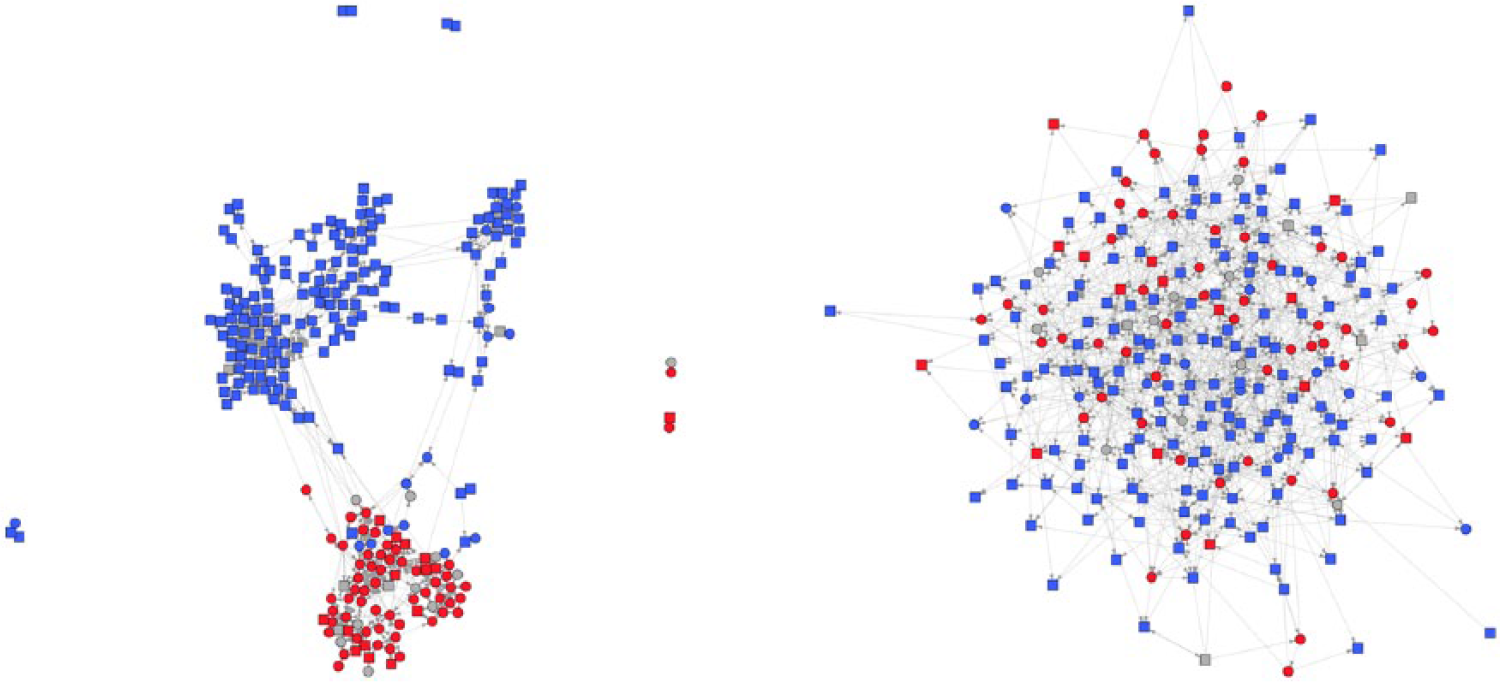
Climate website network graph (left) and Erdős–Rényi random graph (right), both with 257 nodes and 985 edges. Blue nodes represent climate “mainstream” websites, and red nodes represent climate “skeptical” sources. Circles represent individuals, and squares represent institutions. See Table 1 for full network statistics.
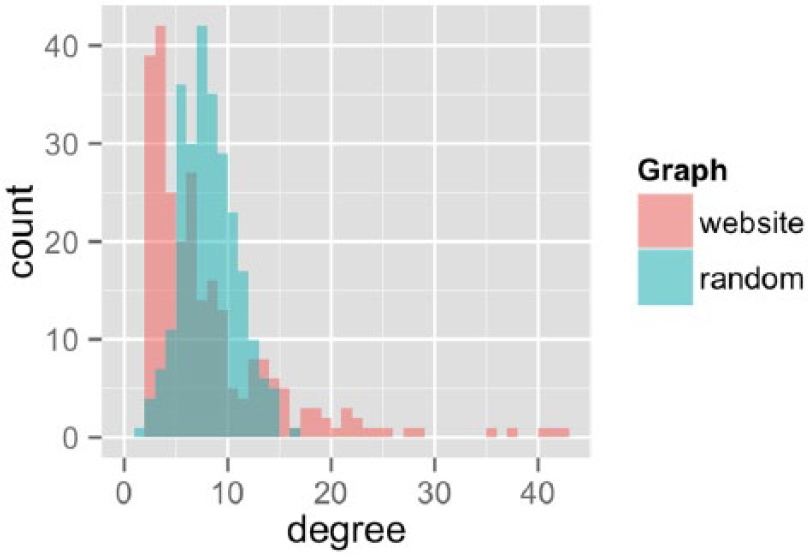
Histogram of degree distributions in the website graph (light red) and the Erdős–Rényi random graph (light blue).
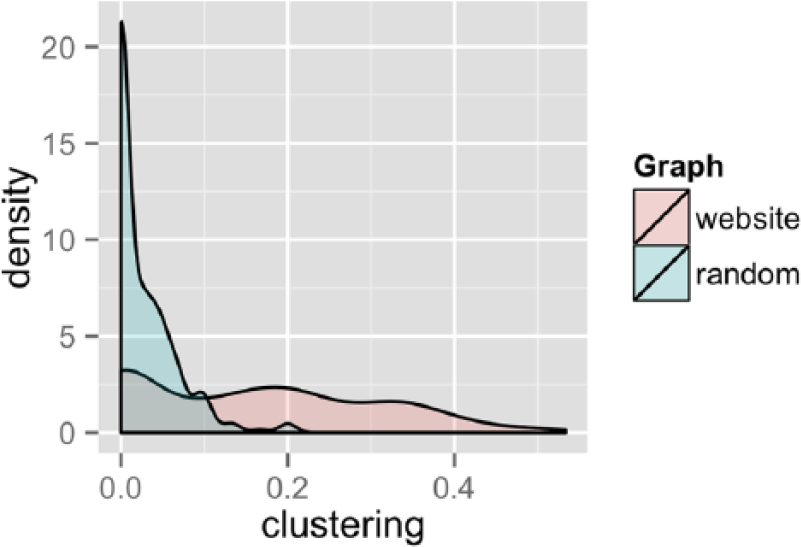
Density plot of the local clustering coefficient distributions in the website graph (light red) and the Erdős–Rényi random graph (light blue).
Visual inspection of the empirical climate network together with the ER graph highlights a number of properties that are relevant to its characterization (see Table 1). The two graphs differ markedly in their mean distance and diameter, with the empirical network exhibiting much higher values for both metrics. The degree distribution of the two graphs also differs, with the climate network exhibiting considerable skew and a higher global clustering coefficient. The perhaps most notable attribute of the blog network is its level of polarization, reflected structurally by three distinct clusters connected by a small number of bridging nodes with high betweenness centrality. According to Hogan (2008), betweenness centrality, since it reflects the number of shortest paths in a graph that include a given node, is “a measure of control […] if a particular node has a high betweenness score that might suggest that it is the only link between many different parts of the network” (p. 146). Hu, Thulasiraman, and Verma (2013) propose a polarization score calculated by subtracting the mean betweenness centrality from the maximum betweenness centrality of the graph and dividing the result by the mean. The resulting polarization score is considerably greater for the website graph, with the random ER graph trailing far behind.
Core network statistics for the climate change website network and the simulated graph.
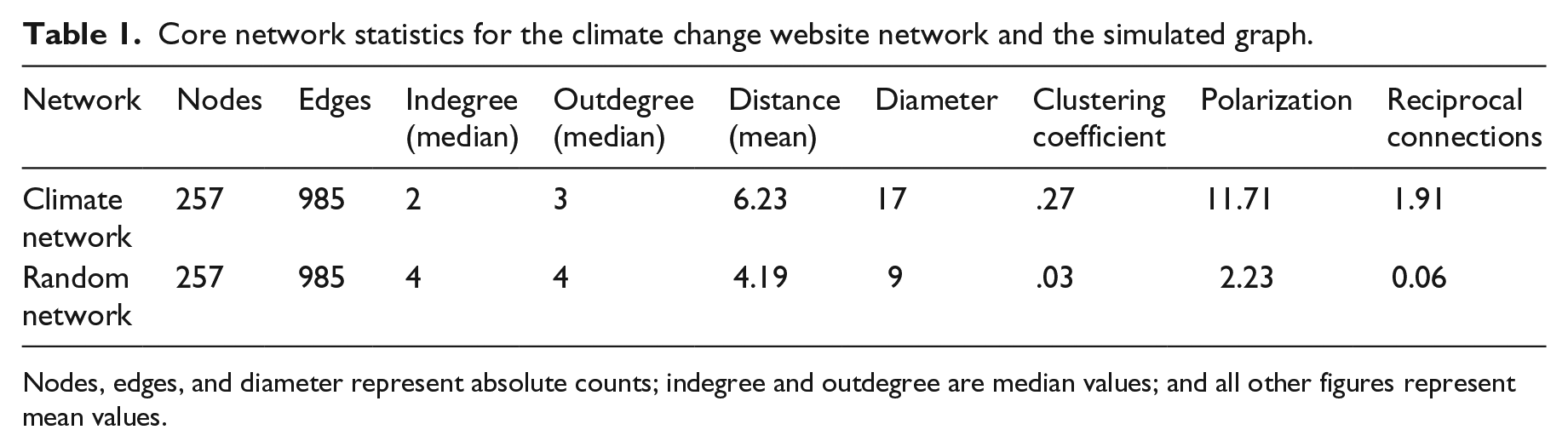
Nodes, edges, and diameter represent absolute counts; indegree and outdegree are median values; and all other figures represent mean values.
The degree distributions of the graphs further illustrate their respective differences and the non-random characteristics of the climate network graph. The ER graph has a normal degree distribution as a result of its random assignment of edges, that is, for most nodes the number of edges is close to the mean. This sets it apart from many empirical networks that have heavy distribution tails. The climate website graph has a left-skewed distribution that reflects a few sites with very high degree, while the majority of sites has a degree that is roughly half that of the ER model.
Examining the degree distributions in concert with the local clustering coefficient distributions of the four networks further emphasizes the high level of polarization in the climate network. The website graph exhibits an essentially flat distribution curve and a far greater range of clustering coefficients. The ER has what resembles a power law distribution, with very few sites exhibiting a high degree of clustering, while most nodes have a low local clustering coefficient.
Like a citation graph, the climate network superficially has properties similar to a scale-free network in terms of its degree and clustering coefficient distribution, but different in respect to its high degree of polarization. What is more, assortatively its clusters form along the mainstream-skeptical line, as well as in relation to a homophily among similar types of actors (scientific organizations, NGOs, public institutions, companies, individuals, etc.) that we describe in more detail below.
Centralization and assortativity of the climate network
In the following, we discuss the climate website network’s properties together with the results of the content analysis in more detail (see Tables 1 and 2, as well as Figure 1). Figure 1 shows the relation of climate “mainstream” (blue) and climate “skeptical” (red) websites. Circles represent individuals, while squares represent institutions like the Federal Environmental Agency or the German Aerospace Center (DLR). The graph reveals not only a polarization along the mainstream and skeptical stance divisions but also internal divisions in the mainstream section (upper left and upper part of the graph). While the largest cluster in the upper left section consists largely of institutions (science organizations, political parties, government institutions, NGOs), the slightly smaller upper cluster consists of a mixture of grassroots NGOs and small, informal groups. The tendency for websites to associate themselves with other sites of the same faction or actor type is statistically reflected in the network’s assortativity in relation to these variables (Newman, 2002). While a site’s topic is non-assortative (0.02), the website network is strongly assortative for both faction (0.46) and actor type (0.43), while the random graph is close to zero on both counts (0.04 and −0.02) (see Appendix 1 for core statistics and centrality measures for the network by actor type and faction).
Contingency table of node counts by factions (mainstream-skeptical) and actors.
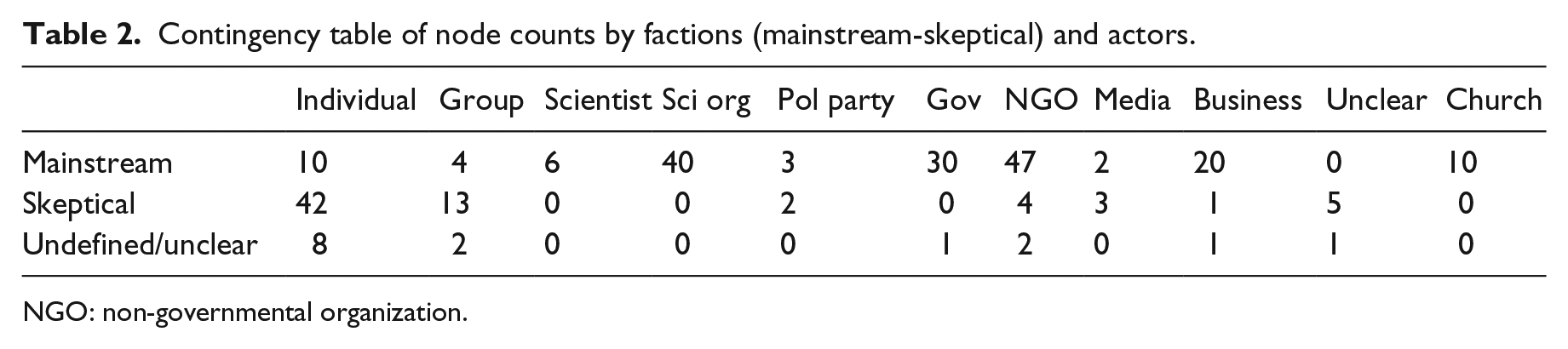
NGO: non-governmental organization.
In Figure 1, the upper cluster in the website graph is the climate activist cluster. It is characterized by climate change activists who band together in local initiatives opposed to issues such as coal mining, nuclear power, and power grid expansion. Several of the blogs within the cluster promote climate camps in order to inform and mobilize citizens. Moreover, the cluster is politically left-leaning, with ties to the Green Party, the German left party Die Linke, and also to the politically radical Antifa movement. This cluster is remarkable compared to the remainder of the mainstream faction due its combination of radical leftist and more moderate civil society and political parties banding together for the common cause of environmental protection.
The upper left cluster, by contrast, consists of scientific and large public institutions, companies, and NGOs committed to climate change in one of several ways. It is politically mainstream and represents the interest of socioeconomic elites. The interlinking between actors from science and administration has been shown in other hyperlink studies before (e.g. Elgin, 2015, p. 238) and underlines the close connection between these societal fields that can be explained by the political relevance of climate change research. We therefore call this cluster climate institutional.
In marked contrast to the mainstream faction, the climate skeptical cluster is dominated by individuals. It consists of several climate skeptic blogs that focus on climate science, climate politics, and also associated issues such as energy politics and environmental protection. Additionally, there are also individual bloggers who combine climate skepticism with a range of other issues, from the purported marginalization of smokers, xenophobia, racism and “men’s rights” to conspiracy theories on issues such as so-called chemtrails and the global monetary system.
In summary, climate change is a largely technocratic and managerial issue in the climate mainstream faction and a lightning rod for political mistrust and antagonism in the climate skeptical individualist cluster. The climate activist camp is even further away from the climate skeptics than the institutional cluster, largely because of its politically opposed outlook.
Relations of actor, topic, and stance groups
In a second step, we focus our attention on the network properties of edges between different actors and topics, as well as the mainstream and skeptical camps, as they result from the manual content analysis. Table 2 shows the relation between the dimensions of stance and actor type. It shows that climate skeptics are over-proportionally likely to be individuals, while scientific organizations, government administration, and NGOs are uniformly in the mainstream faction. The picture for news websites and political parties is more mixed, although they are only a few cases in both categories.
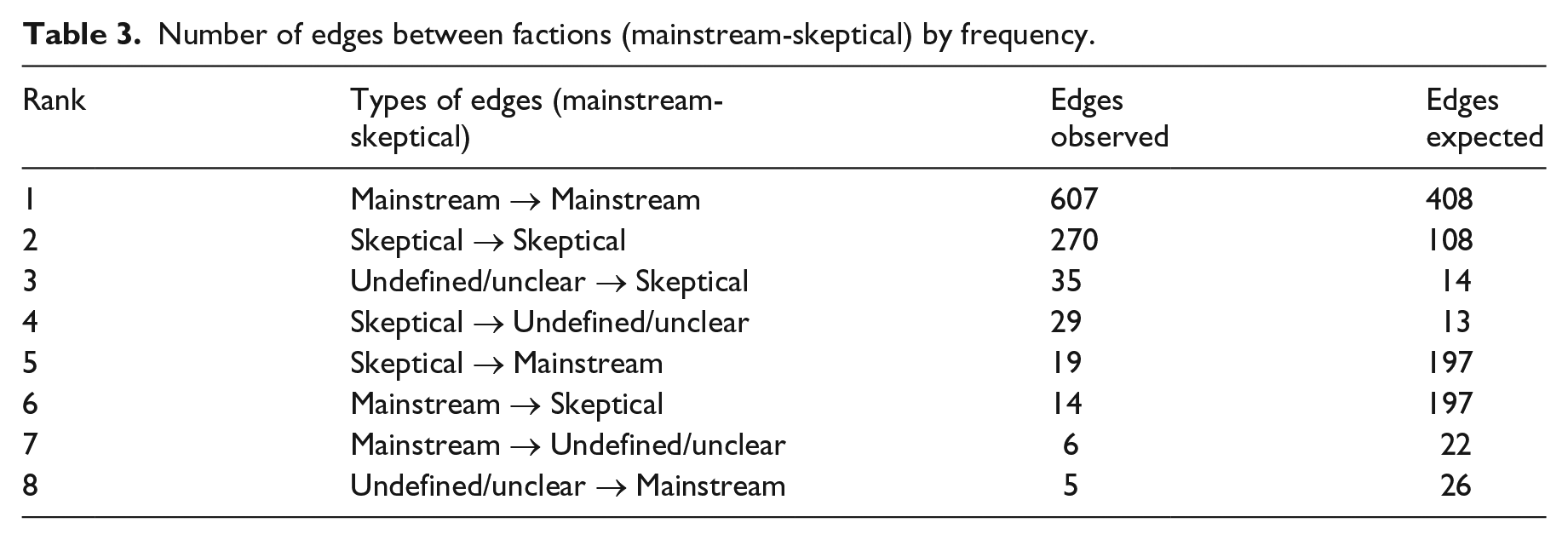
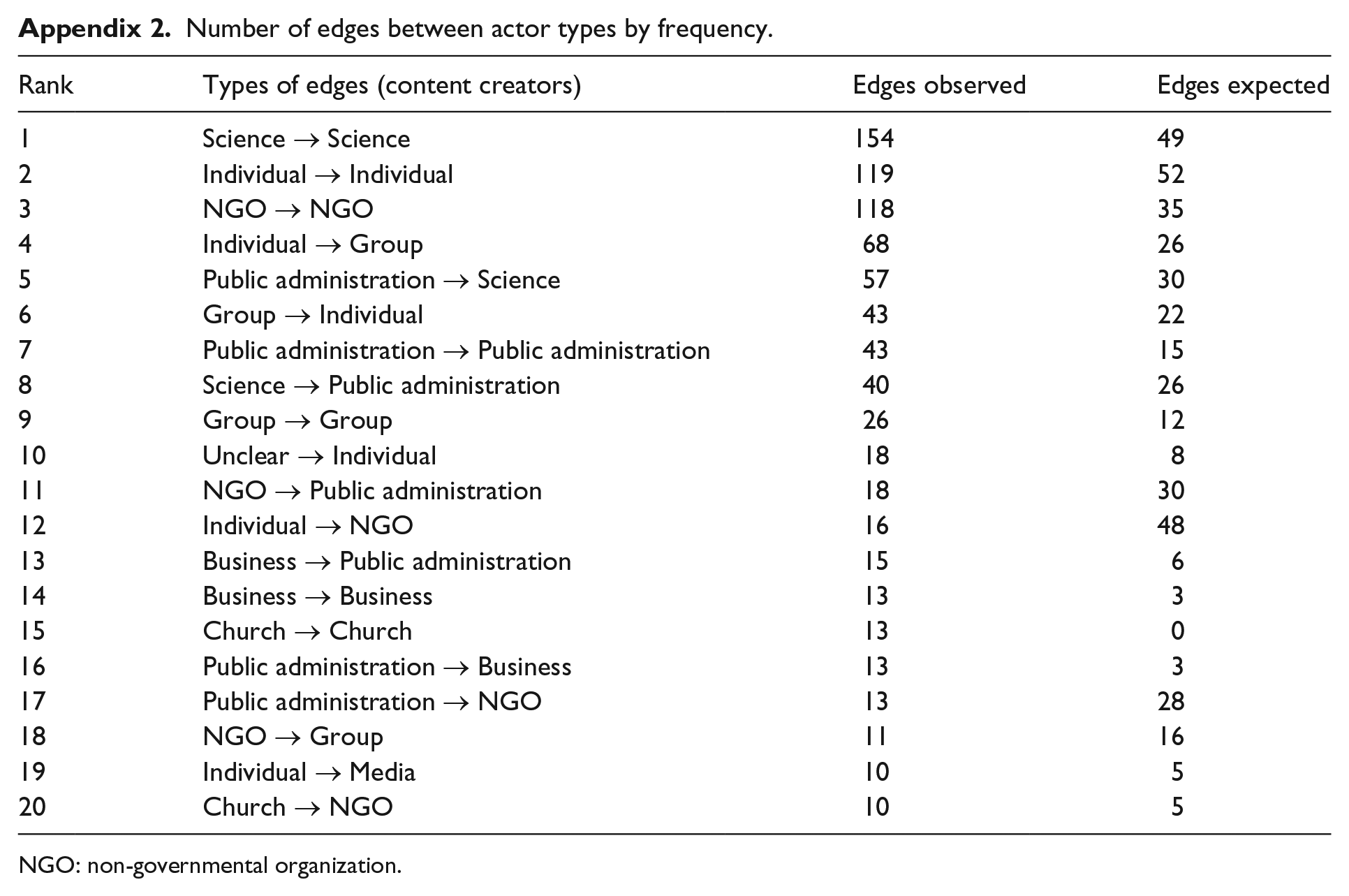
How do the different types of actors and factions relate to each other in terms of linking patterns? Table 3 shows the aggregate linking data for the factions (Appendix 2 shows the number of edges grouped together by types of content creators). To assess these combinations in relative terms, we can compare them with frequencies calculated by randomizing the connection, in other words, by comparing observed and expected combination frequencies. This reveals that scientific organizations, NGOs, and individuals link to their own respective group two to three times as often as chance would predict.
Number of edges between factions (mainstream-skeptical) by frequency.
This pattern also holds for combinations such as public administration linking to science. Conversely, the approach also reveals which combinations should be more frequent in a random network. Random pairing would predict that individuals link to scientific organizations much more often than they do. Scientific organizations also hardly link to NGOs, and individuals do not link to public administration websites. The situation is somewhat less extreme with other actors, but the tendency to link to actors of the same time is notable and echoes previous findings (Elgin, 2015; Shumate & Dewitt, 2008).
The status of skeptics as a counterpublic is highlighted by the distribution of inter-faction links between the two camps. Both camps are much more likely to link to others of the same conviction as their own, but skeptics are even more likely to do so than are mainstream sites. This points toward the isolation of skeptical voices in relation to other views. 3 It is thus also in line with our earlier assumption that counterpublics are in their wish to extend the mainstream public sphere, inherently more dependent on the mainstream than vice versa.
Conclusion
The goal of this study was to show how German-language online climate communication is structured. We established the concepts of the NPS and counterpublics as theoretical frameworks in order to interpret the network’s potential fragmentation and polarization. We were particularly interested in the clusters that form within the hyperlink network and especially the role climate skeptics play. To do so, we conducted a hyperlink network analysis of German-language climate websites based on blogrolls/link lists that can be seen as a proxy for allegiance and thus of the coalitions within the online climate debate.
We want to highlight four noteworthy results. First, we show that climate skeptics form a counterpublic within the German-language climate debate since they are an issue-specific public that challenges the hegemonic view and that is excluded from the mainstream but also isolates itself further. Skeptic websites are mostly created by individuals who only link rarely to more established and more moderate actors. Second, the skeptic counterpublic is not restricted to voices pertaining to climate change but forms an alliance of antagonism with other extreme factions such as misogynists, racists, and conspiracy theorists, that is, radical positions which are also not represented in mainstream public communication. What all these factions seem to have in common are a contempt and antagonism for what they perceive to be the mainstream’s political correctness or do-gooders. Even though the connection between climate skepticism and conspiracy theories has been made before (e.g. Lewandowsky et al., 2015), our study is, to our knowledge, the first which shows the structural connections between climate skeptics, conspiracy theorists, and other factions on the right political fringes. We thus answer Downey and Fenton’s (2003) question “do links lead to a greater sense of solidarity between similar but distinct radical groups?” (p. 199) somewhat positively. However, it remains to be seen whether it is possible to change this cluster’s “antagonism” into something more societally constructive. Third, we show that political and scientific actors are closely connected to each other but ignore the other actors for the most part and do not try to connect with actors from the wider civil society. Even though not surprising, it is interesting to note since these linking patterns show who political and scientific institutions deem noteworthy (mostly these links are also connected to funding for public projects). One hope in this respect were individual blogs by scientists which could have connected science and civil society. And although scientific blogs such as KlimaLounge were very much linked to, they themselves tend to not associate with other sites by blogrolls most of the time and thus actually emphasize the rift between politics, science, and civil society. And fourth, we identify a climate activist cluster that bypasses scientific institutions, blogs, and climate skeptic actors. It is inherently political and rather than asking whether climate change is real, the sites in this cluster focus entirely on what society has to do to counter it.
Against the background of public sphere and counterpublic theory, our results emphasize two aspects. First, we show that counterpublic theory is a fruitful theoretical concept which offers new ways of looking at the processes of fragmentation and polarization of the NPS. Indeed, by only looking at our network through the lens of public sphere theory, our result would have been that climate skeptics form their own echo chamber (Sunstein, 2001). However, by understanding climate skeptics as counterpublics, we can see that even though both sides rarely link to each other, skeptics refer more on mainstream sites than vice versa (as indicated by the mainstream sites within the skeptic community). Although this would be surprising for an “echo chamber,” this is consistent with counterpublic theory. Indeed, counterpublics need the mainstream public sphere both to reaffirm their own oppositional identity (Rauchfleisch & Kovic, 2016) and to keep track of the debate that they want to affect. By combining counterpublic theory with the concept of the NPS, then, we are able to offer an alternative explanatory template for the interpretation of heavily fragmented networks and echo chambers, in particular that touches upon questions of identity and power. Second, even though hyperlink network analysis is a popular and well-tested method to analyze the NPS’ structure regarding communities, by looking at blogrolls/link lists we can show a more stable network that transcends a current debate. And by combining network and content analysis, we can also contextualize the network and its polarization with a content variable.
For the climate change debate worldwide, this study also highlights two major points worth considering. First, the “alliance of antagonism” between skeptics, conspiracy theorists, and other right-wing sites is in line with previous research (Lewandowsky et al., 2015) and emphasizes the connection between a conservative attitude and climate skepticism. By choosing counterpublic theory, we suggest that this alliance is not an echo chamber but an opposition of the mainstream public sphere that might even transcend the national context (German skeptic sites, for example, often also linked to English language skeptic sites). Second, we suggest that skeptics could potentially be also considered a counterpublic in other countries. This, then, would imply that studies that look at how to persuade skeptics could potentially miss the point as skeptics are in opposition to most mainstream institutions and positions in the first place and thus also barely open for potential persuasions. In this sense, it would seem more productive to look for aspects that both sides can agree on (e.g. adaptation measures to fight consequences as rising sea levels) rather than to try to convince skeptics that the mainstream is right.
In general, we show that counterpublic theory is an important theoretical concept that can help us in explaining processes of fragmentation and echo chambers. By accepting that debates are not only centered around one issue but are rooted in a deeper societal discourse, counterpublics help us in understanding the role of a shared identity (cf. Rauchfleisch & Kovic, 2016) in the formation of publics and how these interact with each other and how the feeling of excludedness may forge alliances outside of the mainstream public sphere, and thus push forward digital public sphere theory.
Finally, this study also has some limitations. Due to our decision to crawl the blogrolls/link lists manually, it is possible that not all link lists or blogrolls have been included (e.g. because the website was down or the link lists were well hidden). We are nevertheless confident that our network represents the core of German-language online debate on climate change accurately since our manual snowball crawl method allows for a much clearer distinction between links than a webcrawler could have done. Additionally, our study design does not allow us to make more precise statements about the different framings of climate change skepticism within the skeptic counterpublic. We agree with Fraser (1990), who suggests that counterpublics are “spaces of withdrawal and regroupment” and may serve as “bases and training grounds for agitational activities directed toward wider publics” (p. 68). But as counterpublics often try to extend the public sphere by making their voices and opinions heard, we feel that more research is needed that takes a look at the different types of skepticism both within the skeptic and mainstream clusters. Whereas we focused on reciprocal links, mapping all the hyperlinks from the climate network over a certain time like Benkler et al. (2015), for example, have done might showcase the media sources that are closer to climate skeptics or the knowledge resources that are relevant to the skeptic counterpublic and possible flows of information and communication. And as Toepfl and Piwoni (2015) point out, online comment sections may also be ideal spaces for counterpublic action. Lörcher and Taddicken (2015) add that skeptics are indeed present in the German-language comment sections. Indeed, we were also surprised by the coalitions climate skeptics formed with other radical and democratically somewhat more problematic groups. Since we stopped our crawl at sites that did not deal with climate change, we were only able to get a glance at the broader coalition of “antagonism.” More research is needed to shine a light at the structures and framings of this cluster due to its democratically problematic unruly alliance. Finally, we also did not touch upon the question of power in the context of the relationship between counterpublic and mainstream as our method only allowed us to focus on the network’s structure. Future studies could incorporate this aspect by combining hyperlink analysis with discourse analysis.
Footnotes
Appendix
Number of edges between actor types by frequency.
| Rank | Types of edges (content creators) | Edges observed | Edges expected |
|---|---|---|---|
| 1 | Science → Science | 154 | 49 |
| 2 | Individual → Individual | 119 | 52 |
| 3 | NGO → NGO | 118 | 35 |
| 4 | Individual → Group | 68 | 26 |
| 5 | Public administration → Science | 57 | 30 |
| 6 | Group → Individual | 43 | 22 |
| 7 | Public administration → Public administration | 43 | 15 |
| 8 | Science → Public administration | 40 | 26 |
| 9 | Group → Group | 26 | 12 |
| 10 | Unclear → Individual | 18 | 8 |
| 11 | NGO → Public administration | 18 | 30 |
| 12 | Individual → NGO | 16 | 48 |
| 13 | Business → Public administration | 15 | 6 |
| 14 | Business → Business | 13 | 3 |
| 15 | Church → Church | 13 | 0 |
| 16 | Public administration → Business | 13 | 3 |
| 17 | Public administration → NGO | 13 | 28 |
| 18 | NGO → Group | 11 | 16 |
| 19 | Individual → Media | 10 | 5 |
| 20 | Church → NGO | 10 | 5 |
NGO: non-governmental organization.