




Abstract
This article addresses the need to find alternative ways to envision, develop and govern public service media’s (PSM) online services and data-driven systems. By critically discussing both opportunities and shortcomings of how European PSM organisations developed their online services and personalisation systems, we argue that in their own platformisation processes, PSM have partially lost their distinctiveness and have not been able to provide viable alternatives to the dominant audiovisual media platforms. Thus, building on Mouffe’s agonistic theory and Illich’s conviviality theory, this article proposes a theoretical framework to radically rethink the guiding principles and rationales driving public service platforms, in order to develop viable alternatives to the currently dominant models. By doing so, we envision the development of such services as convivial tools that are based on three principles, namely, symmetry of power (intended as hackability, openness and algorithmic conviviality), independence and environmental sustainability.
Keywords
Introduction
Since their creation in the 1920s and 1930s, not only the remits of public service broadcasters (PSBs) have evolved, but also the overall definition and understanding of public service have changed throughout the years, as the concept of PSB has always been rather elusive (Michalis, 2010: 36). Moreover, since the early 2010s, the digitalisation of the media system has been accompanied by a substantial restructuring of the market, leading to a new era of multimedia and multi-platforms audiovisual services, characterised by an over-abundance of content and outlets, and an emphasis on narrowcasting and on personalised viewing on-demand (Raats et al., 2018: 23), which some designate as a revolution for PSBs (Tambini, 2015).
Whether the digitisation of PSBs and the expansion of their services to a multimedia offer have created a virtuous circle with a thriving PSB market; whether these developments have been regarded as desirable and permitted by regulatory authorities to occur; or whether these changes have brought PSBs closer to commercial market values and models is highly dependent on local conditions (Bardoel and D’Haenens, 2008; Iosifidis, 2010; Michalis, 2010; Tambini, 2015). Indeed, even if PSBs in Western European countries have faced similar challenges, there is not a one-size-fits-all approach, and these developments are shaped significantly by the economic conditions, political contexts and the PSB regulatory framework in each country. Overall, however, digitisation has challenged the remits, objectives and structures of PSBs, as public service codes, laws and regulatory institutions have been re-assessed and redesigned, challenging even the conceptualisation of these organisations.
The transformation of PSBs, which is still ongoing, has been described as a shift towards ‘public service communications’ (Tambini and Cowling, 2004) or a transition to ‘public service media’ (PSM; Bardoel and Lowe, 2007; Iosifidis, 2010). Generally though, the core challenge in this ongoing evolution of PSBs has been characterised as one in which ‘in the multimedia, digitized environment public service providers must mature a character of thought that privileges being effective public service communicators’ while moving beyond their traditional transmission models and structures (Bardoel and Lowe, 2007: 9).
The work of these scholars has thus contributed to the broader rethinking of the role of these organisations in theory and practice. Nowadays, in most Western European countries, PSM are treated as fully fetched media companies, as they have extended their reach online via a number of multimedia and multi-platforms services, launching dedicated apps, online distribution services and social media accounts on Facebook, Twitter and Instagram. Prompted by an increasing competition from both national and international players, which have entered and altered the television industry and its value chain, PSM have started a new stage in their history: a phase primarily characterised by the progressive integration of broadcast and IP-delivery into Internet-connected services and distribution systems.
Alongside these changes in their service offer and organisational structures, this phase required an adaptation of the legal public service remits of these organisations, as they needed to transpose and translate their values and principles in the context of today’s platform ecosystem (Van Dijck et al., 2018). Theoretically, the driving principles and values of PSM are part of a broader literature around PSM’s public values (see, for instance, Knoll, 2012; Lowe, 2016; Lowe and Martin, 2013; Moe and Van den Bulck, 2013), and they have been inscribed in international standards and governance systems (see, for instance, Council of Europe, 2012; UNESCO, 2001). In practice, member organisations of the European Broadcasting Union (EBU, 2012, 2014) have agreed and officially recognised six core values that should be shared and fostered by all PSM, namely, universality, independence, excellence, diversity, accountability and innovation. As PSM strive to adapt to a new platform ecosystem, they need to consider how to ‘remain relevant’ in an increasingly commercialised and competitive ecosystem while fulfilling those values and respecting their public service remits and regulatory obligations (EBU, 2017b).
Within this framework, this article addresses the challenges and implications of the platformisation of PSM, and the need to update the governing principles of their online services. To do so, first, we will review the processes that led to this platformisation, by discussing how the rise of platform organisations and their ecosystems have impacted PSM. Second, we will examine how PSM responded to these challenges with their own platformisation processes, focusing on the implications of the development of PSM’s digital services and their automated and algorithmic-driven media systems. By doing so, we argue that in transitioning from broadcasting media companies to online media platforms, PSM have partially lost their distinctiveness as they have only been able to compete with commercial platforms by emulating their models. As we will see, PSM companies are aware of this gap and already opened a debate on how to realise this shift towards a Public Service Platform (PSP) model, but they have not yet been able to find shared solutions for the design of such PSPs. The inability to develop a (European) public platform model capable of distinguishing itself from commercial platforms risks undermining the future of PSM and their legitimacy in the long-term.
Within this context, in the third section of the article, we argue that in order to build a public model of PSP, a radical change in the way PSM’s online services are designed is needed. Here, we will develop an argument in support of this radical turn: building on Mouffe’s (1999) agonistic theory and Illich’s (1973) conviviality theory, this article will propose an agonistic framework for a radical rethinking of the new media platform ecosystem and a convivial framework for a radical change of the design of PSM platforms. We will finally propose a conceptualisation of PSPs as ‘convivial tools’, advancing three potential design principles inspired by the concept of conviviality, namely, symmetry of power (intended as hackability, openness and algorithmic conviviality), independence and environmental sustainability. By applying these principles, a convivial PSP could be seen as a viable alternative to the commercially funded and privately driven platforms that currently dominate the digital media sphere, but in order to thrive, convivial PSPs can only exist within an ‘agonistic’ (Mouffe, 1999) media platform ecosystem. The conclusion summarises our argument by considering its importance as an original contribution that can strengthen the role of PSM in the platform society.
PSM in the platform ecosystem
The rise of online platform organisations
What have come to be commonly known as platform organisations, often described with acronyms such as GAFAM or FAANGs, 1 are still surprisingly difficult to define, as it is challenging to fully grasp their implications for the future of media, including PSM. Indeed, the notion of an online platform loosely revolves around the idea of powerful tech giants whose global online services operate as digital intermediaries (Evens and Donders, 2018; Gillespie, 2010; Mansell, 2015; Moore and Tambini, 2018), which have become fundamental infrastructures of media and communication systems (Plantin et al., 2018; Van Dijck et al., 2018).
The penetration of these infrastructural extensions into the web and app ecosystems has impacted the media and creative industries, resulting in a platformisation of culture (Nieborg and Poell, 2018), as part of a deeper platformisation process of society (Van Dijck et al., 2018). In turn, these processes have contributed to the creation of complex ecosystems of organisations, and new forms of dependence and control between them (Evens and Donders, 2018; Van Dijck et al., 2018). A defining characteristic of such platform organisations is their programmable architecture that brings together multiple sides, allowing for the interaction through their intermediation services of numerous actors, from users to corporate entities and public bodies. As unique intermediary services on a global scale, platform organisations are, however, not neutral. On the contrary, their services are primarily driven by a profit-logic based on the processes of datafication, commodification and selection (Van Dijck et al., 2018) and supported by data-driven personalisation strategies and recommender systems, which play a central role in the circulation of content in the online audiovisual media ecosystem.
These infrastructural platforms are integrating both vertically and horizontally across different sectors, including the audiovisual media industry. The development of converged infrastructures has contributed to the break-up of the monopoly of legacy players and been marked by the rise of Over-the-top (OTT) or Internet-distributed media services, especially in the television sector (Evens and Donders, 2018; Lotz, 2017). At the same time, in a newly competitive environment, PSM fear the loss of their relevance and audiences in the face of a general ‘platform-mania’ that is spreading across the audiovisual industry (Evens and Donders, 2018). This is in turn creating pressures on incumbent PSM organisations to adapt their content, digital services and technology architecture to comply with and emulate the strategies of dominant digital platforms, and their datafication-driven and commercial business models, in order to fulfil the aforementioned processes of platformisation.
Platformisation of PSM: attempts and implications
The ongoing platformisation of PSM’s services can be inscribed in broader historical transformations, as PSM have always been in a near constant state of flux at the confluence of social developments in technological, economic, political and cultural environments, and their evolution has always been embattled with technological developments, challenges for funding, recognition of goals and remits, and ultimately, for social and political legitimacy in a media environment that is increasingly commercialised and digitised (Van den Bulck et al., 2017: 17). Thus, as calls for alternative visions of the online audiovisual media industry are growing, also through movements like ‘the platform cooperativism’ (Scholz, 2016; Taylor, 2014), attempts to provide different online services have been made by some PSM organisations, either collaboratively or individually.
Examples of these attempts can be found among numerous European PSM organisations, especially in Western Europe, where every PSM has launched its own Video-on-Demand (VoD) service and widened its digital service offer. Actually, some of these services were introduced even earlier than the current dominant platforms. For instance, the United Kingdom can showcase the pioneering streaming service, BBC iPlayer, created in 2007, when Netflix only started to move away from selling DVDs to its Subscription-based VoD model. In the same year, BBC worldwide, Channel 4 and ITV announced a collaborative project for a VoD service offering more than 10,000 hours of programmes, codenamed Project Kangaroo. This was a first, and yet failed, attempt to create a joint VoD service as a collaborative project between different PSM, which was blocked in 2008 by the UK Competition Market Authority (Sweney, 2009). Only in 2019, BBC and ITV proposed a revised version of this initial idea and launched BritBox, which is, however, part of the commercial activities of these PSM as it presents an SvoD model similar to Netflix and other paid streaming services.
While we still have to see how BritBox will develop, other attempts to create joint online services at European level have rarely succeeded. 2 Indeed, cultural specificities and language differences, combined with copyright regimes and geo-blocking restrictions, have often hindered the development of a pan-European PSM offer. Furthermore, while their fiercer competitors can leverage on a global reach, PSM organisations are tightly connected to their national and local audiences, and legally bound by their national public service remits.
Independently though, since 2007, numerous PSM organisations in Europe have developed their own online services and innovative technologies, ranging from audiovisual streaming platforms to dedicated apps for Internet-connected devices while creating their own channels and pages on different social media networks. For examples, in Italy, in 2016, the public broadcaster RAI started its own video and audio content platforms, Rai Play and Rai Play Radio (D’Arma et al., 2021), while in Germany, after a first attempt that was blocked by German broadcasting legislation, by 2010 all regional and national PSM were offering online services. Alongside the launch of such services, PSM have also begun to develop automated media systems with algorithmic-driven personalisation and recommendation systems as a strategic and instrumental response to the growing popularity of personalised services offered by the dominant platforms. Salient examples of such systems can be found throughout Europe, from the Dutch NPO and the Belgian VRT and RTBF to the Norwegian NRK, the Finnish YLE, the Spanish RTVE and the Swiss RTS (see also Sørensen and Hutchinson, 2017).
However, the central question for European PSM in this context is not only how to innovate or expand their services and content online, but whether they can maintain a prominent and distinctive position in a mixed public and private media ecosystem dominated by large platforms: How should they transpose their traditional public service remits and values in a newly competitive environment and its changing governance structures? For instance, while, on one hand, the development of automated media systems and algorithmic-driven recommendation systems in PSM is indeed congruent with the general market and industry trends and it is seen as vital for PSM survival, on the other hand, it also raises concerns and difficult questions for PSM due to their public complexion and social responsibility obligations (Sørensen, 2019; Sørensen and Hutchinson, 2017).
In this context, there is growing interest among PSM organisations, in exploring this area, as indicated in numerous conferences and EBU’s initiatives, such as the AI and Data project and the Digital Transformation Initiative. 3 These networks strive to support EBU members as they struggle with the opportunities and pitfalls of such digital technologies and data-driven strategies while acknowledging the need to differentiate themselves from their commercial counterparts by striking a balance between adapting to the services offered by platform organisations and preserving their public service–oriented approach (EBU, 2018a, 2018b). In practice though, PSM’s data-driven approaches often operate similarly to the commercial models implemented by competing platform organisations (Van Es, 2017). To this regard, tensions and contradictions between public service values and remits in today’s platform ecosystem are particularly evident when it comes to the development of PSM’s personalisation and recommendation systems (Van Es, 2017).
Historically, PSM were created to provide universally accessible services, with highest professional and accountability standards, in order to inform, educate citizens and strengthen their sense of collective identity (Price and Raboy, 2003; Van den Bulck, 2001; Van den Bulck et al., 2017). Such imbued nationalist and paternalistic orientation often clashes with the increasingly international and yet individualised automated media services of today’s platform ecosystem. Thus, when faced with the need to adapt their services and embrace the ongoing digital transformation, these organisations arguably face a ‘crisis of imagination’ succumbing to business models for distributing content that are aligned with commercial rather than public interest frameworks (Van Es, 2017: 3). Indeed, PSM often justify the use of recommender systems to personalise their service offers by highlighting the necessity to increase their reach and relevance, giving audiences ‘what they want’, in their effort to and take back control of the algorithms that drive content delivery (EBU, 2016, 2017a). To address this, scholars have been calling for a more distinctive public service–oriented design of algorithms that provides a truly alternative model to the dominant platforms while criticising current PSM approaches that mimic commercial ones (D’Arma et al., 2021; Sørensen and Hutchinson, 2017; Van Es, 2017; Verdegem and Lievens, 2016).
It should be noted though that these discourses are happening also within PSM’s industry circles, as some organisations are trying out different alternatives to better translate their values and remits in their online services, including their personalisation and recommendation systems. For instance, within the EBU, a group of PSM organisations have joined up to develop the PEACH project (Personalization for EACH), proposing technical solutions to recommendation systems adapted to PSM’s remits. 4 Even though the overall objective is still set in a commercial-like framework, this is a first attempt to implement PSM-specific editorial values in automated media systems, by combining the classic recommender algorithms (content-based filtering) with a novel ‘diversified algorithm’ to diversify users’ consumption and content exposure (see Sørensen and Hutchinson, 2017; Sørensen and Schmidt, 2016). The emphasis on diversity of content and exposure is also at the centre of the BBC R&D project on ‘responsible machine learning in the public interest’ (BBC, 2018). In this case, researchers and engineers have investigated alternative approaches to ‘public service personalisation systems’ that may foster diversity of exposure, by testing machine learning systems that could be used as responsible AI systems designed to ensure ‘fairness, transparency and accountability in workflows and systems’ (BBC, 2018).
In their efforts to translate their values and remits into their online services, some PSM organisations are also exploring new ways and models of storing and using audience data, especially personal data. While they emphasise the need to collect data in order to customise and improve their services, some PSM are also attempting to position themselves as ‘trusted data holders’, to distinguish their practices from the opaque data management systems of dominant platform organisations. For instance, the ‘Databox’ management system is a collaborative project between BBC and Nottingham University that developed an open platform to manage secure access to data and enable only authorised third parties to provide the owner authenticated control and accountability (BBC, 2020). Furthermore, the Beyond Platform Initiative, a recently formed consortium of German PSM, is reflecting on how alternative data management systems and Internet infrastructures could be developed collectively. 5
Because these initiatives are still at an early stage, as they are currently being discussed and trialled, it is difficult to evaluate how they are being operationalised and implemented in practice, and whether they could constitute viable alternative in the future. Furthermore, these examples are not exhaustive, and it is beyond the scope of this article to discuss them in detail. They do demonstrate, though, that there is an appetite, and perhaps even a momentum, to bring forward alternative solutions to the dominant business models and industry practices that are influencing the developments of the audiovisual industry. Thus, we suggest that if PSM are to sustain their role and to uphold their values and remits, they will have to build meaningful PSPs, governed by public service principles and oriented towards public values, rather than profit maximisation and reach. Thus, how should these values and principles be coded into the design of these PSPs in order to move towards a truly pluralistic audiovisual media ecosystem, where PSM organisations may still represent a credible alternative to commercial ones? To address this question, in the next section, we propose to mobilise the agonistic theory of Mouffe (1999) and the conviviality theory of Illich (1973), advancing and discussing how these PSPs could be designed as viable alternatives.
Agonistic and convivial frameworks for a radical change of PSM and the media platform ecosystem
First, we should stop thinking of PSM organisations as solely content producers (press, radio, TV, websites) and start envisioning them as public service providers of media content and online platforms services, driven by public values. In this way, for every kind of commercial platform – from Netflix, to Uber or Airbnb – there could also exist a public version of it, just as some ‘cooperative’ versions of Airbnb (Fairbnb) and Uber (La’Zooz) already exist (Schneider, 2015). PSPs, together with already existing forms of platform cooperativism, would therefore not replace existing commercial organisations, but they would provide viable alternatives and increase the diversity and pluralism of the media platform ecosystem.
We believe that for a radical change in the design of platform services that incorporates public service models and pursue public values, a radical rethinking of the platform ecosystem is needed. Building on Mouffe (1999), we argue that these changes can only happen within an agonistic framework, which could theoretically complement the existing institutional and political economy approaches in this area. We mobilise this concept because we believe that an agonistic theory of platforms’ ecosystem can be useful to open the debate about the coexistence, within the same ecosystem, of very different platforms (commercial, public and cooperative ones).
For decades, media scholars have discussed the need for democracies to have a pluralist media ecosystem (Garnham, 1990; Karppinen, 2013; McChesney, 2003). Today, we should also begin to debate and advocate a fiercely pluralist platform ecosystem, or ‘agonistic platform pluralism’, similar to the concept of ‘agonistic algorithms’ developed by Crawford (2016). Building on Mouffe’s (1999) political concept of ‘agonistic pluralism’, 6 Crawford advocates the need to apply the logic of this concept to the understanding of algorithms and to the design of recommender systems. She argues that this logic of agonistic pluralism will help us understand these entities (algorithms) because it emphasises that ‘algorithmic decision-making is always a contest’ (Crawford, 2016: 82). From a broader perspective, an agonistic ecosystem is a world in which different – agonistic – social and cultural values thrive and coexist, without the need to generate a wide consensus over them. When these agonistic values are for instance encoded in the recommendation algorithms that fuel online platforms, they provide users with suggestions of cultural content in strong contrast with each other and contribute to increasing the diversity of users’ cultural consumption. Thus, an agonistic pluralist ecosystem of platforms would be an ecosystem where different capitalistic, public service and cooperative platforms conflict with each other in terms of design and results, but coexist dialogically (Mouffe, 1999).
While this framework allows us to conceptualise the possibility of having alternative and conflicting models coexisting within the same online platforms’ ecosystem, we now need to push this thinking forward and advance design principles that can support the development of PSPs. By building on the conviviality theory, and particularly on the work of Illich (1973), on Tools for Conviviality, we argue that the design of PSPs should work as ‘convivial tools’, designed and developed on the basis of three core principles, namely, (a) symmetry of power (intended as hackability, openness and algorithmic conviviality), (b) independence and (c) environmental sustainability. In order to thrive and constitute a viable alternative though, a ‘convivial’ PSP can only exist within an agonistic media platform ecosystem. If agonistic theory represents the ‘how’ of the theory of change we propose here, the convivial theory is the ‘what’ of this theory of change.
PSP as a ‘convivial tool’: Ivan Illich ‘reloaded’ for the platform society
Since its publication in 1973, Illich’s book Tools for Conviviality has influenced media scholars and especially those coming from cultural studies and the political economy of media traditions (Pauly, 1983). Aided by his frequent visits to Berkeley, Illich’s work has also inspired many pioneers of the Internet and digital media, such as Stewart Brand and Lee Felsenstein (Crosby, 1995; Illich, 1983; Levy, 1984).
The popularity of Illich’s arguments waned during the 1980s and 1990s, but with the Web 2.0 evolution of the Internet, Illich’s ideas slowly came back in style. For some, Web 2.0 and social media seemed to presage the advent of more convivial technologies and Illich was cited by scholars such as Mattelart (2003), Burgess (2007) and Gauntlett (2009, 2011) who passionately advocated a convivial engagement in making and producing media objects. Ippolita (2012), Deuze (2011, 2013) and McQuillan (2016) have recognised the value and centrality of Illich’s ideas for contemporary critical media studies. As Nowicka and Vertovec (2014) observed, ‘the authors concerned with media ecology, participatory media or complex systems of modern communication technologies often relate to Illich when considering the workings of such systems on human interactions, structures of collectivity or the rise of civil society’ (p. 343).
Our appropriation of Illich’s work offers a novel application of his concept of conviviality to PSP and a basis for elaborating a set of principles that could drive their development.
What is a ‘convivial tool’?
Illich (1973) imagined a world where people had an open relationship with the material world surrounding them, including the technologies they used: ‘I choose the term “conviviality” to designate the opposite of industrial productivity. I intend it to mean autonomous and creative intercourse among persons, and the intercourse of persons with their environment’ (p. 11). Conviviality is about being vigorously engaged in relationships, conscious of values and meanings. For Illich, a convivial technology was a tool that people could manipulate, transform, adapt and control. He defined the word ‘tools’ quite broadly, to comprise all ‘rationally designed devices, be they artefacts or rules, codes or operators’ (Illich, 1973: 20–21). Thus, convivial tools ‘give each person who uses them the greatest opportunity to enrich the environment with the fruits of his or her vision’ (Illich, 1973: 21). Furthermore, conviviality revolves around the idea of free and equal access to such tools. Conviviality, as Gauntlett (2011: 168) noted, is therefore about having the power to shape one’s own world, and as Illich indicated, individuals must retain this power, while society must not seek to drain it from them.
PSPs as convivial tools
As previously mentioned, we argue that in order to build viable alternative to the existing dominant models of online platform services and automated media systems, we should design convivial PSPs and therefore reflect on how the properties of conviviality could be applied to these systems. Designing PSPs means imagining a different political economy of audiovisual media ecosystem, one that is not only oriented towards profit and embraces platforms that are consistent with public service values, or what EBU called ‘contribution to society’ (EBU, 2015). To shift towards an agonistic pluralism, PSPs should offer not only content but also automated and algorithmic-driven media systems that are significantly different from those provided by commercial platforms. In this sense, a PSP must be clearly distinguishable from a commercial one to legitimise its existence and thrive in its distinctiveness. We acknowledge that this argument could face criticism and resistance; however, our aim is to provoke a debate on the principles that could guide the design of future PSPs and envision alternative governing structures. Thus, within this context, we propose that PSPs should be inspired by convivial design principles, intended as guiding principles that could be further developed and operationalised in practice. More specifically, we advance three principles: (a) symmetry of power (a multi-layered principle articulated as hackability, openness and algorithmic conviviality), (b) independence and (c) environmental sustainability (see Figure 1).
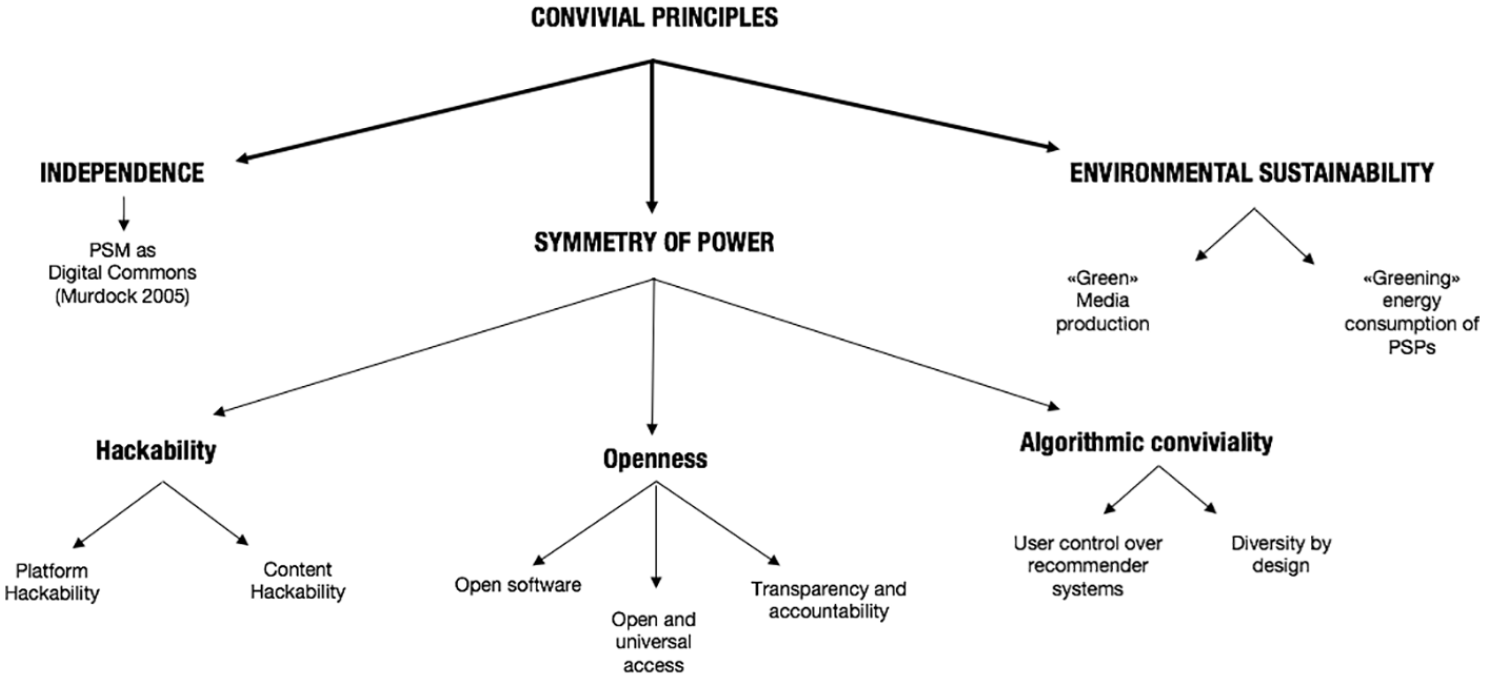
Visual illustration of the composition of the three convivial principles for PSPs.
These principles are conceived as a possible complement and update of the traditional core PSM values. We do not expect them all to be taken literally but to serve as inspiration for a gradual transformation of PSPs into more convivial tools. Thus, while it is beyond the scope of this article to discuss in-depth how each principle could be operationalised and implemented in practice, we hereby present them to open a debate on the design and governance of online PSPs.
Symmetry of power
It means that the PSP should be designed to foster horizontal, dialogical, non-authoritarian and non-extractivist relations between users and the platform. A convivial tool according to Illich was a technology that people could control or on which people hold a certain power. This means that a convivial PSP should employ human-centred design approaches, whereby users play a participative role in the co-design and testing processes of the platform. This principle also means that the platform should be designed in such a way as to rebalance the asymmetry of power that often exists in today’s commercial online platforms and their users’ data exploitation practices (Van Dijck, 2014; Van Dijck et al., 2018; Zuboff, 2019).
Indeed, power asymmetries emerge at different levels in the relationship between users and platforms, both at the level of extraction and management of personal data (see Couldry and Mejias, 2019; Zuboff, 2019), and at the level of control over the content offer. To address these issues in the development of convivial PSPs, the principle of symmetry of power should be articulated in its three interrelated sub-principles of hackability, openness and algorithmic conviviality.
(a) By hackability we refer to the design of a PSP that can be easily adapted and modified by users. ‘Hack’ here is broadly intended as any new brilliant, original, disruptive solution that may come ‘from below’, from the users and might improve the platform and its services. We also intend hacking here as ‘the promise of making computer technology accessible to non-professionals’ (Söderberg, 2015: 4). The link between conviviality and hacking ethos was already highlighted by Burgess (2007): ‘In Illich’s assertion that each user can master his tools, lies the ethos of technological mastery and the principle of hackability’ (p. 219). For our purposes, hackability is interpreted as a form of technological mastery at both the platform and content level. We therefore distinguish between platform hackability and content hackability.
Platform hackability could be achieved for instance by allowing some expert users (academic researchers, no profit institutions and technical experts) to test new ideas in a collaborative environment, where new technologies, services and solutions could be tested and improved, similar to a Sandbox testing environment for software development, which some PSM have already started to develop in their innovation centres. 7
Examples of content hackability instead concern the ability for the user to download, edit and remix content produced by PSPs under Creative Commons licences. This principle could be applied by favouring the production and increasing the discoverability of educational audiovisual content released under Creative Commons. A convivial platform should therefore encourage a ‘making and doing’ culture rather than a ‘sit back and listen’ one (Gauntlett, 2011). A ‘maker’ culture means enabling creative reuse for educational and non-profit purposes, by for instance allowing teachers and students to freely download, use and edit content in classrooms.
(b) Openness is hereby understood with a threefold meaning: as open software, open and universal access, transparency and accountability.
First, PSP should adopt open-source software for production and distribution as much as possible. Second, they should grant universal access to its contents, expanding Creative Commons licences as much as possible. This second aspect builds on the existing PSM’s values of universality and accessibility, proposing that PSP’s content should be universally available, reusable and easily accessible for every citizen, and PSP should build effective strategies to reduce the digital divide. Third, openness is also about transparency and accountability of PSP’s services, whose functioning mechanisms should be accountable and subject to public scrutiny. Openness is in this sense an intrinsic aspect of an accountable institution driven by a public service mission, as PSP should be encouraged to develop public data systems that are ‘open, accountable and fair’ (Van Dijck et al., 2018: 158). Examples of transparency and accountability of PSPs in practice could be seen both at the level of personalisation and recommendation systems, and at the level of data management. In the latter case, building on current debates on algorithmic transparency and auditing systems (see, for instance, Ananny and Crawford, 2018; Gorwa et al., 2020; Helberger and Moeller, 2018; Mazzoli, 2020), PSPs should not only find creative and user-friendly ways to explain how their personalisation and recommendation systems work, but they should also develop media and critical data literacy programmes, through online webinars, interactive tutorials and ad hoc trainings in collaboration with educational institutions. Concerning data management practices, an example of a potentially convivial approach to PSPs can be found in the BBC Databox project, through which BBC R&D division has developed an open-source networked device to experiment with different models of personal data processing, which ensures users’ privacy and compliance with the General Data Protection Regulation (GDPR). 8 Furthermore, in alignment with the GDPR and its data portability principle, users should also be able to easily access data gathered on them from the platform, download and possibly use them for non-profit purposes, under a Creative Commons licence.
(c) Algorithmic conviviality refers to a partial decentralisation over the control on personalisation and recommendation systems of PSPs. It is inspired by the idea of Illich (1973) that the people ‘need above all the freedom to make things among which they can live, to give shape to them according to their tastes’ (p. 11). Algorithmic conviviality would therefore allow users to actively shape a recommender system according to their tastes, and give them the ability to actively filter, select and edit their preferences to create their personal mix of content. Indeed, while ideally PSPs should use a ‘diversity sensitive design’ principle for their recommender systems (Helberger et al., 2018; Resnick et al., 2013; Sørensen, 2019), it is also important to empower users and share with them the control over their media content diets. Building on Illich’s insights, a ‘convivial’ personalisation and recommendation system should foster an increased competence, rather than increased dependence on it. In this sense, users could be nudged to diversify and widen their content consumption, but they would also be allowed to adapt it to their needs. PSPs should, for example, let a feminist user play with/modify/tune the recommender system so that it could suggest her a list of films authored by young female directors with female protagonists who passed the Bechdel test. 9
A decentralised approach in this sense would not necessarily go against the national public service remits, but it would give the opportunity to capitalise and leverage on the existing diverse content offer accessible through the PSP’s portals while reducing the paternalistic approach traditionally imbued in PSM. Furthermore, it would give users the possibility to opt out from the default recommended content to create their personal mix of local, regional and national content. In this sense, the example of PEACH recommendation systems could represent a useful starting point to create automated media systems that combine different design principles for their algorithmic-driven recommendation systems. What could be improved from this idea is to ensure that users are given the choice to personalise their content diet independently from the default mechanisms presented to them. In addition, it is still unclear to what extent these proposed diversified algorithms are applied by EBU members and whether they have been successful on a wider scale. Thus, there is still room for improvement in both the design and implementation of existing practices if we want to gradually move towards a more convivial PSP.
Independence
The second main principle we propose builds on the core value of PSM’s independence, intended as independence from private and state interest, and freed from the control of political parties. Independence has always been a core value for PSM and their provision of free, unbiased information and diverse political opinions (Council of Europe, 2012; UNESCO, 2001), which differentiates them from state-owned media companies (Tambini, 2015). However, their independence is often threatened and cannot be given for granted, even in those countries that have more stable democratic systems (see Połońska and Beckett, 2019). Indeed, even if traditional European PSM, as Hallin and Mancini (2004) showed, are based on three different models of governance, such systems can still be exposed to different forms of political influence. Thus, in order to be truly convivial, and especially to fend off the identity, reputation and legitimacy crisis that is currently underway, PSPs should be radically reformed and transformed into ‘digital commons’, as Murdock (2005: 2) claimed. These could be public institutions not directly depending on the decisions of political parties, but by an independent national/international board, that can experiment with participatory budgeting, civic crowdfunding (Bonini and Pais, 2017), citizen structural participation (Carpentier, 2011) and the increased accountability of financial investments. This principle is inspired by the Illich’s belief that convivial tools are appropriate and congenial alternatives to tools of domination: a PSP independent from political parties’ control is an institution independent from the tools of domination of politics.
Environmental sustainability
The third guiding principle regards the design of environmentally sustainable PSPs. Building convivial PSP also means taking into account the environmental impact of the media (Maxwell and Miller, 2012) and digital technologies, which produce 4% of greenhouse gas emissions (LePage, 2019). A convivial society according to Illich is a society that does not divorce from its impact on the environment, as industrial capitalism did so far. Thus, convivial PSP companies should commit themselves towards a transition to renewable and zero-emission energy sources, in order to be ‘sustainably digital’ (Ferreboeuf et al., 2019; Widrat, 2019). They should also approve and respect an ethical code of media production that forces them to lower the carbon footprint of their production routines. Thus, for a PSP to be convivial, it should also deal with the enormous consumption of electricity needed by the audiovisual streaming infrastructures, including data centres, and commit to ‘green’ the sources of energy.
Some European PSM already started to report on environmental issues, but ‘there is a lack of detailed strategies to reduce their impact’ (Fernández-Lombao et al., 2017: 586). The issue of environmental sustainability of PSM is slowly gaining traction within internal debates of these companies. To this regard, the first Sustainability Summit, organised by the EBU, was held in 2020 followed by a second one in April 2021. In these occasions, experts in the field pointed out that the three domains that bear the biggest impact on the environment are buildings, servers and streaming, and they discussed potential strategies to reduce their energy consumption. Such strategies include, but are not limited to, optimising and streaming airflow, cleaning workloads and removing unnecessary equipment, consolidating virtual machines, replacing old equipment with energy-efficient technologies and using new air economizers (Gaye and Mehta, 2020). Furthermore, as highlighted by some of the PSM’s representatives in these events, alongside the reduction of greenhouse gas emissions and promotion of green productions in collaboration with other industry players, it is pivotal to also cover these issues as part of their editorial and programming strategies to raise awareness and adequately inform their audiences. 10 Thus, to both innovate new data-intensive services and reduce their environmental impact, PSPs should invest in researching and developing a multi-layered set of strategies and set a positive example for more sustainable industry standards and practices.
Conclusion
This article has argued that in today’s platform society (Van Dijck et al., 2018), PSM need to transition towards a new configuration of values sustained by PSPs that uphold traditional public service values and embrace new principles and values as alternatives to the commercial platforms offering audiovisual services. Attempts to develop accountable data management practices, such as the BBC R&D project ‘Databox’, or collaborative efforts to develop distinctive personalisation systems, such as the EBU’s PEACH project, demonstrate how PSM organisations are partially addressing these issues (Van den Bulck and Moe, 2018). However, existing industry examples also show a lack of imagination when it comes to the development of new online services by PSM organisations, combined often with raising tensions between the economic and regulatory constraints of different national remits, and the global evolution of the online audiovisual media industry.
We believe therefore that there is a strong need for a deeper rethinking of the guiding principles and rationales that should be driving public service–oriented alternatives. To do so, we argue that the theoretical framing around agonistic pluralism and the theory of conviviality can provide a robust road map for reimagining the next shift to PSPs. In this context, we propose a conceptualisation of PSPs as ‘convivial tools’ that could inspire the design of alternative online audiovisual media services. The principles we advanced, namely, symmetry of power (intended as hackability, openness and algorithmic conviviality), independence and environmental sustainability, would underpin the design of a convivial PSP as a viable alternative to the commercially funded and privately driven platforms that currently dominate the audiovisual media ecosystem. Such PSPs could in turn contribute to the rise of what we have called ‘agonistic platform pluralism’, intended as a mixed ecosystem of public, non-profit and private platforms, truly driven by different set of values and fuelled by recommendation systems that afford users to take different actions and return very different results.
Conviviality therefore should be upheld as a goal to strive for, but we are aware that when it comes to its achievements in practice, there could be obstacles and challenges to face. It is more realistic to think that each PSM organisation could gradually move towards the adoption of one, or some of these principles, adapting them gradually to its services. There are indeed economic, financial, technical, legal and political constraints that could challenge the operationalisation of the principles hereby presented. It is likely that the principle that would face the highest constraints will be the transformation of PSPs into digital commons, as it requires a radical paradigm shift on the part of political parties and civil society towards the role of PSM in the platform society, combined with an appropriate and truly independent governance system of these commons. Other possible obstacles could concern the technical constraints deriving from the current lack of interoperable systems, the proprietary nature of recommender systems and copyright issues, especially when it comes to the hackability of platforms and content. Limited funding and resources could also impact the speed of the required transformation, and the conversion to green and renewable energy.
In conclusion, we are aware that the theory of conviviality has its weaknesses. Illich’s critics have repeatedly emphasised the ‘visionary’ aspect of his theories as the ‘convivial’ society is for many only an ideal and utopian vision of society that is difficult to achieve (Hoinacki, 2003). Thus, turning PSM into convivial institutions would be a complex task that requires political, social and cultural changes. However, we believe that both Mouffe’s agonistic theory and Illich’s theory of conviviality constitute original frameworks within which to situate a possible theory of change for PSM, and they can contribute to strengthening the role of these organisation
Footnotes
Acknowledgements
The authors would like to thank Robin Mansell and José Van Dijck for reading a first draft of this article and giving us valuable advice, and the anonymous reviewers, whose very detailed comments stimulated significant improvements to the article.
Funding
The author(s) received no financial support for the research, authorship and/or publication of this article.
