




Abstract
This study examines the political implications of social media through the lens of digital disconnectivity. Specifically, it focuses on politically motivated unfriending and examines its influence on individuals’ political engagement, namely political expression and information consumption on social media. Furthermore, considering the importance of minority–majority relations for understanding disconnection phenomena, we investigate whether the impact of unfriending is more pronounced among opinion minorities than majorities. Using a two-wave panel survey conducted in the post-Umbrella Movement Hong Kong, we find that politically motivated unfriending predicts an increased level of political expression, but that it is only significant among people who perceive themselves as holding minority opinions. At the same time, we find no relationship between unfriending and information consumption on social media. Based on the findings, we discuss the implications of unfriending for building digital “safe spaces” and its distinct role in promoting political engagement in times of political conflicts.
Introduction
Over the past decade, the global proliferation of social media platforms has motivated the scholarly community to examine the impact of what appeared to be a more accessible, open, and egalitarian form of communication technology. A rich body of literature has focused on the “connective” affordances enabling people to connect with those from different backgrounds, collapsing the old boundaries of geography, demography and time, and expanding access to a wide spectrum of viewpoints and ideas (Backstrom et al., 2012; Ellison et al., 2007; Goel et al., 2010; Marwick and boyd, 2011). Thanks to the unprecedented connective capacity, scholars have argued that social media play a pivotal role in developing the ideas of “network society” and “networked public” (boyd, 2008; Castells, 2012). Empirical evidence also abounds that social media could promote citizen engagement and cultivate a better informed citizenry (Boulianne, 2015, 2019; Skoric et al., 2016), potentially fulfilling Barber’s (1984) promise of strong democracy that is rooted in individual citizens’ direct involvement in the processes of democratic governance.
However, although connectivity is often implicitly positioned as the key element of the social media logic, research has also uncovered a range of disconnective practices and examined their political implications (John and Dvir-Gvirsman, 2015; Skoric et al., 2018; Yang et al., 2017; Zhu et al., 2017). Among the most studied phenomena are unfriending, which refers to a person deliberately cutting a previously established digital tie (Sibona, 2014). Research shows that political disagreement is among the main reasons for unfriending (Rainie and Smith, 2012) and that weak ties that are the sources of diverging views are most likely to be unfriended (John and Dvir-Gvirsman, 2015). Studies show that the expansion of weak ties and the weakened social boundaries online promote inadvertent exposure to political differences (Brundidge, 2009; Kim, 2011). Still, when disagreement and conflict emerge, weak ties tend to be far less resilient (Grevet et al., 2014), particularly in the context of rising polarization among citizens (Iyengar and Hahn, 2009; Iyengar et al., 2012). Unfriending can thus provide opportunities for people to elude those they disagree with, functioning as both content filtering and social exclusion (John and Agbarya, 2020). Overall, it indicates a return to a less open, less interconnected, and more small-group based form of communication. How would this change shape individuals’ engagement in the public arena and impact the democratic potential of social media? To answer the question, this research examines the political implications of social media from the lens of digital disconnectivity. Specifically, we focus on unfriending with an aim to assess its impact on citizens’ political engagement.
To date, a handful of studies have utilized surveys to gauge the scope and implications of politically motivated unfriending. Findings suggest that it is associated with heightened political participation like online commenting and participation in street protests, arguably because repeated exposure to view-reinforcing messages could bolster one’s political self and conviction (John and Dvir-Gvirsman, 2015; Zhu et al., 2017). However, the causal inference was rather weak given the cross-sectional design of the above studies—political participation and unfriending were measured at the same time, which is insufficient to establish the direction of the relationship. It could suggest either that people who cocoon themselves in the enclaves of the like-minded are empowered to express their political views and take actions, or alternatively that people who are politically engaged are also more inclined to shield themselves from the other side. To address the methodological limitation, this study uses a two-wave panel survey to provide a more robust test of the direction of this relationship.
We further expand the research focus by distinguishing between two forms of political engagement, namely political expression and information consumption. Past research has concluded that those are two important pathways to offline engagement, including voting and protest participation (Boulianne, 2015, 2019; Skoric et al., 2016). More importantly, they are the two key components of democratic citizenship, as it is normatively beneficial to have citizens who are both informed about politics and actively engaged in the democratic process (Delli Carpini and Keeter, 1996). We thus examine whether social media unfriending influences these two types of political behaviors differently. More specifically, does digital disconnectivity promote political expression within the enclaves of the like-minded at the expense of hearing the other side?
Furthermore, we seek to identify the boundary condition under which the political impact of unfriending occurs, specifically, the opinion minority status. Previous research suggests that for oppressed groups, politically motivated unfriending can be both an expression of power to protest against the hegemony of a dominant majority and also a means to avoid confrontation, which provides them with a greater sense of control and freedom to speak their minds (John and Agbarya, 2020). This study further examines the implications of unfriending by comparing its political impact for opinion minorities versus majorities. We argue that by building digital “safe spaces,” unfriending provides opinion minorities with more opportunities to express their views.
We conducted this study in the context of post-Umbrella Movement Hong Kong. Following the city’s handover to China in 1997, there has been a series of large-scale demonstrations against Beijing’s growing interference in local affairs. It re-ignited a culture of political activism (Lee and Chan, 2008), and fostered a more politicized identity in rejection of the pan-Chinese cultural identity promoted by Beijing (Veg, 2017). In 2014, the Chinese central government mandated that the candidates for Hong Kong’s Chief Executive election must be vetted by the nominating committee that is mostly pro-Beijing and consists of largely non-elected professionals, business, and trade elites. Incensed by Beijing’s ruling, pro-democracy supporters staged a large-scale social movement, latter dubbed the Umbrella Movement. Protesters occupied central districts of business and government headquarters and blocked the main roads for 79 days, demanding political reform and universal suffrage. Social media, especially Facebook, played a crucial role in disseminating information and mobilizing citizens to join the street protests (Wong and Chan, 2015). As the blockade paralyzed the city’s traffic and interrupted local businesses, public sentiment toward the movement became more polarized. The pro-democracy protesters did not only clash with the riot police, but were also confronted by the pro-government supporters who demanded the restoration of order and law. In addition to the city streets, the flame wars were also waged on social media. Political discussions on Facebook were rife with extreme opinions even among people who did not have a clear political inclination previously (Lee, 2016). As the conflict intensified on the ground, social media were flooded with yellow and blue ribbons that symbolized allegiance to the two opposing camps. People sought out like-minded others in their political discussions in Facebook groups, and the cyberbalkanization was mirrored by the rising opinion polarization among the general public as well (Chan and Fu, 2017). It deepened the division between the pro-government and pro-democracy camps within the city-state’s party system, and empowered the pro-independence faction. Despite the mass protests, political reform was stalled and the Chief Executive was still selected by an electoral college that favors pro-establishment interests (Freedom House, 2018). Within this context of heightened political conflicts, our study examines the influence of digital disconnection on political participation, and asks whether it is more prominent among people who perceive a large incongruence between their views and the dominant majority opinion.
With one of the fastest Internet connections worldwide, a large percentage of Hong Kong residents are active social media users. Past research shows that Hong Kong has one of the highest Facebook penetration rates in the world; around 50% of the Internet users aged 16–64 reported to be actively using Facebook in 2015 (Kepios, 2016), while others estimated that more than 60% of the population access it at least once every month (Perez, 2013). The penetration rate continued to rise to 82% in 2019 (Statista, 2020). Instagram and Twitter had around 11% and 10% of the total population respectively in early 2015 (Kepios, 2016). In this study, we focus on the disconnection behaviors on social network sites (e.g. Facebook, Twitter and Instagram), and exclude instant messaging platforms from our analyses (e.g. WhatsApp, WeChat). Given that Facebook played a crucial part in the Umbrella Movement and is the dominant platform, we argue that social media in this study refers mainly to Facebook and the disconnection practices performed on it.
Unfriending and political expression
Social media afford individual users an expanding repertoire of tools to express themselves in a (semi-)public arena (Theocharis, 2015). By doing so, they play an increasingly important role in shaping information flows and public discourse, alongside traditional media and political elites (Chadwick, 2017). Online expression can also provide important pathways to offline political engagement (Boulianne, 2015, 2019; Skoric et al., 2016). Given this, it is crucial to understand the factors that can facilitate political expression on social media. We suggest that political unfriending can encourage people to express their political views for the following three reasons.
First, unfriending can promote homogeneity in one’s online social network. Whom we connect to largely determines what kind of information is available in our newsfeeds (Thorson and Wells, 2016). Hence, unfriending also shapes our information environments. John and Gal (2018) find that people often see unfriending as a mechanism for filtering content and protecting the integrity of their personal information ecologies. Existing research has suggested that politically motivated unfriending often targets political disagreements (Bode, 2016; John and Dvir-Gvirsman, 2015; Rainie and Smith, 2012), and we can thus expect it to produce a more homogeneous social and informational environment. We also know that network homogeneity can stimulate political activity (Eveland and Hively, 2009), largely because like-minded interactions can bolster political selves and provide multiple social reinforcements (Centola and Macy, 2007; Knobloch-Westerwick and Meng, 2011).
Second, unfriending prevents future encounters with people holding opposing views, which can reduce social anxiety over potential conflicts and, therefore, remove people’s inhibitions about speaking up their minds. Existing research on informal political talk shows that “cross-pressure” is a main explanation why competing claims in one’s social circle can make a person withdraw from politics (Eveland and Hively, 2009; Mutz, 2002). That is, political disagreements are often seen as disturbances to social harmony; they arouse anxiety, which prevents people from publicly taking sides (Mutz, 2002). This line of research focuses on conflict avoidance as a response to political disagreement. It sees avoidance as a tactic for averting confrontation through inactivity or topic avoidance (e.g. not talking about issues that will likely evoke disagreement; Hopmann et al., 2019). This type of conflict avoidance is often used as a strategy in emotionally close relationships (Cowan and Baldassarri, 2018; Dailey and Palomares, 2004). Differently, when it comes to more distant relationships, individuals tend to avoid conflict through eluding the person, such as through social exclusion and by turning away (John and Agbarya, 2020; John and Gal, 2018). Unfriending can be a means to achieve this type of avoidance, since it allows people to dissociate from others online. Indeed, Grevet et al. (2014) find that in the context of controversial political events, digital tie dissolution like unfriending and blocking on Facebook is utilized as a means to avoid confrontation with weak ties. We thus argue that digital tie dissolution can relieve the concern over potential conflicts, which may in turn facilitate the expression of dissenting or unpopular views.
Of course, people do not always respond to interpersonal political disagreement with avoidance, as they also seek to convince others to change their opinions (Conover et al., 2002). Some research suggests that political disagreement can actually facilitate political expression, arguably because people are motivated to correct the opinions they perceive as inaccurate, persuade others, and assert under-represented identities (Barnidge et al., 2018). This tendency may be heightened in the context of a political contest where an engaged and passionate political citizen is considered desirable (Mutz, 2006). However, the willingness and ability to engage in this kind of interaction depends on perceived inclusivity (John and Gal, 2018). Empirical evidence also suggests that in times of political conflicts, individuals tend to see persuasive attempts as being futile and hence refrain from engaging in them, especially when they do not share a close personal relationship (Grevet et al., 2014). Others find that in a contentious political context, exposure to objectionable views from one’s Facebook friends is associated with the feelings of shock, disappointment, anger and a sense of betrayal, which motivates people to cut the tie rather than to engage in dialogue to resolve the difference (John and Gal, 2018; Schwarz and Shani, 2016). According to the literature on post-decisional confirmation bias (Festinger, 1964; Fischer and Greitemeyer, 2010), the emotional and social cost associated with the act may motivate individuals to become more expressive and defensive of their political preferences and beliefs.
Finally, politically motivated unfriending can be seen as a political statement as well. For example, in an interview study conducted during the Israel–Gaza conflict of 2014, some interviewees reported that they used unfriending as a way of saying no or “giving the finger” to an objectionable view and/or the person who expressed it, while others saw it as an expression of collective identities (John and Gal, 2018). In other words, in these instances, unfriending is an expression of one’s strong opinion or identity. Based on the theories and empirical findings on expression effects, individuals tend to comply with the opinions or positions they have expressed previously (Valkenburg, 2017). Consequently, political expression can strengthen expressers’ pre-existing political preferences (Cho et al., 2018). We thus argue that unfriending as a form of political statement can be self-mobilizing; that is, by strengthening one’s conviction, it can motivate individuals to be more outspoken. Based on this line of reasoning, we propose the following hypothesis.
H1. Politically motivated unfriending (W1) is associated with an increased level of political expression on social media (W2).
The moderating role of perceived opinion minority status
Previous studies suggest that majority–minority relations are important for understanding politically motivated unfriending (John and Agbarya, 2020; John and Gal, 2018; Schwarz and Shani, 2016). Continuing with this line of research, we further test whether the influence of politically motivated unfriending on political expression will be more pronounced among opinion minorities than among majorities.
Minority status can be defined in terms of social category memberships (McGuire and McGuire, 1988) and opinions (Morrison and Wheeler, 2010). In this study, we focus on the latter, that is, opinion minority status in the context of the 2017 Chief Executive election in Hong Kong. This was the first Chief Executive election after the Umbrella Movement during which protesters demanded universal suffrage, and yet, all the candidates were still approved by Beijing and elected by an electoral college that favors the pro-establishment interests (Freedom House, 2018). More importantly, with the deepened political divide among the general public, citizens’ preferences became less reflective of their issue stances, but rather grounded in political identities (Kobayashi, 2020). Consequently, many citizens from both sides of the divide started feeling as being in minority. The pro-democracy side felt marginalized as the government vowed to deepen ties with Beijing and started disqualifying pro-democracy legislators and prosecuting prominent activists. On the other side, the supporters of the pro-government camp largely remained quiet for fear of being attacked for their unpopular views. In other words, the opinion minority status in this context is not tied to the minority status based on social categorization (e.g. gender minorities, Arabs or Palestinians living in Israel). Rather, members of both political groups may consider themselves to hold a minority opinion, which indicates that the minority status is subjective and socially constructed in a context of power relations. We thus focus on self-perceived opinion minority status in our study.
We argue that among opinion minorities, politically motivated unfriending can lead to greater likelihood of political expression for the following reasons. First of all, public opinion is conceived to be a mechanism of social control. According to the spiral of silence theory, an incongruent opinion climate imposes self-censorship or view conformity, whereas a perceived majority status encourages outspokenness (Hayes, 2007; Noelle-Neumann, 1974, 1979). That is, opinion minorities are more inclined to withhold their dissenting views than opinion majorities. Importantly, the tendency toward self-censorship is due to the elevated fear among opinion minorities that expressing their dissenting views will cause social isolation (Noelle-Neumann, 1974, 1979). Such fear is more pronounced on social media platforms, since they often include a large number of weak and diverse ties (Neubaum and Krämer, 2018) and provide an audience that is hard to define or target (Das and Kramer, 2013; Sleeper et al., 2013). The collapsed boundaries of distinct social contexts also require individuals to self-censor in order to maintain a consistent and appropriate presentation of the self across their distinct social circles (Marwick and boyd, 2010).
At the same time, state-sponsored and social surveillance is also a salient factor that contributes to minorities’ fear of sanction and subsequently leads to unfriending (John and Agbarya, 2020). This is pertinent to the context of post-Umbrella Movement Hong Kong as well. Since the sovereignty over Hong Kong was transferred to China, the Chinese central government has increased its interference in the local institutions and affairs, corroding the city’s democratic character and sowing distrust toward the central and local government (Freedom House, 2018). Since the Umbrella Movement in 2014, fear mounted that the Chinese authorities were monitoring pro-democracy protesters both online and offline, and people from the opposing political camps were viewed with suspicion. Existing research suggests that in this kind of political climate, citizens often refrain from expressing their dissenting views due to the fear of being prosecuted (Kostyuk et al., 2017).
While opinion minorities have a heightened fear of social and state sanctions, they also feel a stronger need to express themselves than their majority counterparts, as self-expression is crucial in defining who they are and promoting their own welfare (Morrison, 2012). In other words, those feeling marginalized by the dominant voice may experience a conflict between the need to self-censor and the desire for self-expression. This may be even more elevated in times of heightened political conflicts when people hold on to their political beliefs. Indeed, existing research shows that issue importance and attitudinal strength may reduce the spiral of silence effect, encouraging individuals holding minority views to speak up (Gearhart and Zhang, 2013; Matthes et al., 2010). Given the two competing needs, unfriending could serve the purpose of creating a space where minorities can express themselves more safely and freely in front of a more congenial audience. Existing research suggests that unfriending can be an effective means to regulate social boundaries and exclude specific audience members—when unfriending others, we deny them the opportunity to view or comment on our non-public social media posts. In other words, unfriending allows us to regulate the boundaries of our “personal public sphere,” controlling who can access it and participate in the political discussion (John and Gal, 2018). Continuing with this line of reasoning, we argue that by removing those who challenge and ridicule one’s views and beliefs, unfriending can help build online “safe spaces.” This may be particularly important to opinion minorities since they tend to seek psychological and political homogeneity (Shim and Oh, 2018).
Besides, unfriending can also help opinion minorities create an emotionally “safe” space by removing themselves from negative and sometimes toxic interactions. Engaging with political disagreements on social media can be often a contentious and emotional experience, and uncivil exchanges tend to deter individuals from engaging in political discussions (Vraga et al., 2015). This is one of the main reasons of politically motivated unfriending besides being exposed to incongruent political beliefs and values. For example, Rainie and Smith (2012) reported that about 8% of American social network sites users had cut digital ties with others because of heated political arguments. Facebook group members tend to exclude those who verbally attack others (Ditrich and Sassenberg, 2017). Minority members are likely to have a stronger need for emotional comfort. John and Gal (2018) find instances where Palestinians living in Israel unfriended Jewish Israelis on Facebook in order to avoid getting abusive messages and to turn away from confrontation; this is arguably a form of self-protection, which gives them a greater sense of freedom of speech.
To summarize, unfriending can reduce the fear of social and state sanctions and help people avoid emotionally damaging interactions. It can thus help them create online “safe spaces” where they can gather support from like-minded others, voice their opinions and express identities without worrying about potential risks and repercussions. Consequently, it can help them acquire the courage and skills to participate in the public sphere (Craig and McInroy, 2014; Lucero, 2017). In addition, when individuals from a marginalized or oppressed group unfriend someone from a majority group, the act of unfriending can also be seen as a form of political expression in itself—it conveys a defiant message and shows resistance to the dominant majority (John and Agbarya, 2020). In accordance with the notion of expression effects (Cho et al., 2018; Valkenburg, 2017), the act of unfriending should thus be expected to have a self-mobilizing effect. Given this line of reasoning, we propose the following.
H2. The positive relationship between politically motivated unfriending (W1) and political expression on social media (W2) is strengthened by opinion minority status (W2).
Unfriending and political information consumption
Political information consumption provides an important path toward participation—it improves political knowledge, informs people of participation opportunities, and exposes them to diverse aspects and viewpoints (Boulianne, 2015, 2019; Skoric et al., 2016). Moreover, a healthy democracy requires a citizenry that is both informed and engaged (Delli Carpini and Keeter, 1996). Participation without sufficient information can be misguided and run counter to the interests of citizens (Fowler and Margolis, 2014). So, if political unfriending makes citizens more likely to express their views, does it also make them better informed or does it reduce the flow of political information they receive?
We argue that there are two main reasons why unfriending would predict a decreased level of information consumption. First, existing research shows that individuals embedded in attitudinally diverse social networks are more likely to seek out and attend to political information than those residing in homogeneous networks (Levitan and Wronski, 2014; Mitchell and Page, 2013). Since unfriending is often driven by political disagreements and hence likely reduces network heterogeneity (Bode, 2016; John and Dvir-Gvirsman, 2015; Rainie and Smith, 2012), it may consequently discourage information consumption as well. Of course, one could argue that people who are motivated to seek out information tend to have a strong need for cognition (David, 2009), and hence, they may not cut ties with others because of disagreement. Nevertheless, existing research shows that only a small fraction of users actively seeks news on social media; most people are exposed to news passively through content shared by their online contacts (Gil de Zúñiga et al., 2017; Mitchell and Page, 2013). Since social contacts curate newsfeeds, deleting some of them could limit the information available in one’s online social network and consequently reduce information consumption.
Second, unfriending could motivate people to withdraw from information seeking. A large body of research on confirmation bias has demonstrated that post-decisional dissonance reduction is a stubborn human tendency (Cialdini, 1984). Once a decision is made, especially when it is irrevocable and costly, people tend to avoid information that could invalidate their decisions (Festinger, 1964; Fischer and Greitemeyer, 2010). Hence, it is plausible that after unfriending someone over political causes, people may become more incentivized to shield themselves from information that may challenge the legitimacy of their decisions. This may be particularly relevant given the fact that unfriending is socially undesirable and revoking it is often costly. Research shows that people usually refrain from dissolving ties once they are established on social media even when they are categorized as dispensable for fear of losing the connections completely (Krämer et al., 2015). In addition, since unfriending is digitally recorded, to re-initiate a relationship, one needs to send a friend request or to follow again, which notifies the other person—this likely deters people from re-activating the relationship. Given the social cost of breaking a tie, we argue that individuals are incentivized to engage in post-decisional dissonance reduction. For that we propose the following hypothesis.
H3. Politically motivated unfriending (W1) is associated with a decreased level of political information consumption on social media (W2).
Method
Sample
This study relied on a two-wave panel survey conducted in Hong Kong. We collected the data through the market research agency, YouGov, which adopts a panel-based approach known as “active sampling,” matching the demographics of the sample with that of the general population in terms of age and gender. The first wave of survey (W1) was fielded between 7th and 16th March 2016, during which 1500 respondents completed the questionnaire. The second wave (W2) was fielded between 17th and 26th March 2017. Among the 1500 respondents from the W1 survey, 509 (33.93%) of them participated in the W2 survey. We note that this study has a relatively high attrition rate due to a 1-year interval between the two waves. Older people were more likely to participate in the second wave than younger people, Min = 1, Max = 5; Mboth waves = 3.69, SDboth waves = 1.03; MW1 only = 3.39, SDW1 only = 1.15; F (1, 1132.32) = 11.24, p < .001. Female respondents were less likely to dropout than male respondents, χ2 (1, N = 1500) = 5.46, p < .05. In sum, the research sample of the panel study is slightly older and over-represents females when compared to the general population. Among the 509 cases, 87 were removed for incomplete or invalid data. Table 1 lists the demographic information of the sample.
Sample demographics.
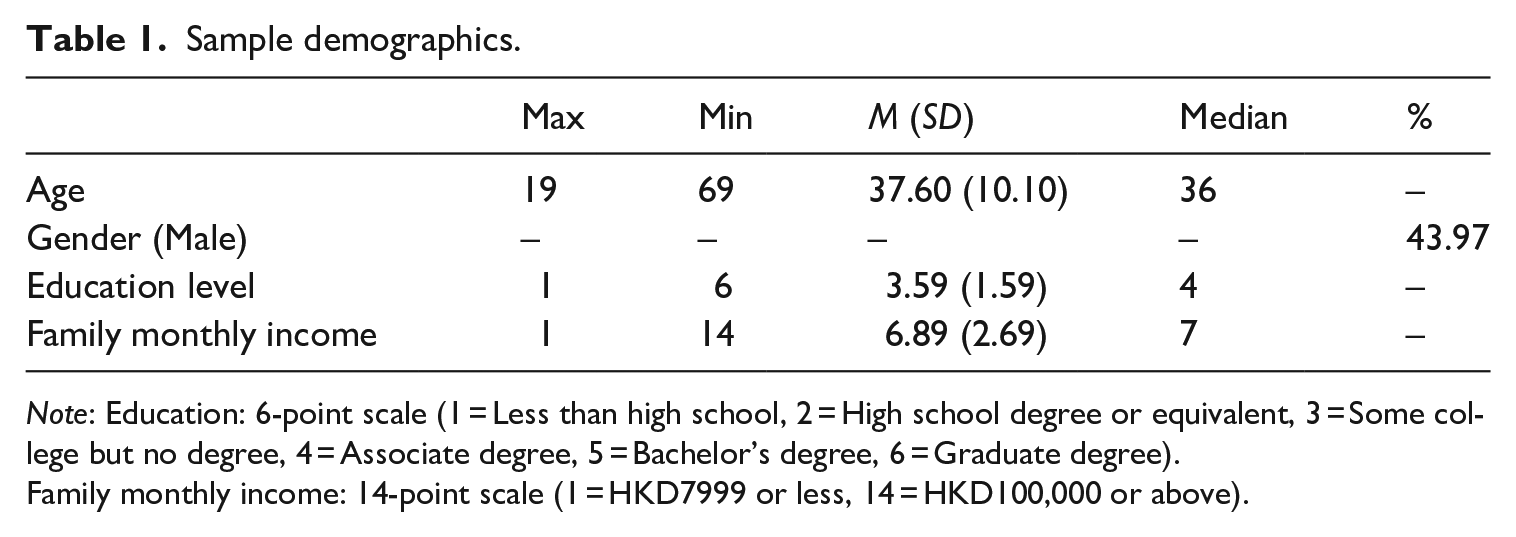
Note: Education: 6-point scale (1 = Less than high school, 2 = High school degree or equivalent, 3 = Some college but no degree, 4 = Associate degree, 5 = Bachelor’s degree, 6 = Graduate degree).
Family monthly income: 14-point scale (1 = HKD7999 or less, 14 = HKD100,000 or above).
Measures
Information consumption and political expression on social media
Respondents were asked how frequently they used social media for informational and expressive purposes on a 7-point scale (1 = not at all to 7 = very often). Based on a Principle Component Analysis with a Promax (oblique) rotation, two factors emerged and explained a total of 82.02% of the variance in W1 and 83.24% in W2. Items assessing political expression strongly loaded onto one factor, explaining 65.72% of the variance in W1 and 68.49% in W2. Items tapping into informational use loaded onto the other factor, explaining 16.30% of the variance in W1 and 14.75% in W2.
Political information consumption was assessed using two items asking respondents how often they used social media to get news about current events and to stay informed about local communities (W1: rs = .56, M = 4.06, SD = 1.36; W2: rs = .62, M = 3.86, SD = 1.53). The scores of the variable generated from the two waves were fairly correlated (r = .44, p < .001). The paired-sample t-test showed a significant mean difference between the two waves, t(397) = 2.70, p < .01. On average, the W1 survey yielded a higher average score than the W2 survey by .21 point (95% CI [.06, .36]).
Similarly, we measured political expression on social media with three items. Respondents were asked how often they used social media to express their opinions, to discuss with others about political or social issues, and to persuade others (W1: Cronbach’s α = .91, M = 3.14, SD = 1.49; W2: Cronbach’s α = .91, M = 2.90, SD = 1.56). The scores between waves were largely correlated (r = .61, p < .001), but with a significant difference in the mean by .24 point, t(397) = 3.53, p < .001, 95% CI [.11, .37]. In addition, there is a moderate to substantial correlation between the two types of political behaviors (W1: r = .57, p < .001; W2: r = .62, p < .001).
Politically motivated unfriending
This variable was measured in W1 with the question “have you unfriended or unfollowed anyone because of comments or posts related to politics in the past 6 months” (0 = no, 1 = yes, 2 = do not know). In total, 11.81% (N = 47) of the social media users reported to have done so, while 76.38% (N = 304) did not. In total, 11.81% (N = 47) respondents reported “do not know.” The “do not know” answers were treated as missing values in the analysis. The retention rates are similar among the respondents who reported to have unfriended others (32.63%), those who did not (34.34%), and those who reported “don’t know” (33.18%). It indicates that the topic under study did not affect participants’ participation in the W2 survey.
We note that lumping unfriending and unfollowing together might have conflated different disconnective practicess. For example, we can unfriend or unfollow someone on Facebook, and unfollow someone on Twitter and Instagram. While unfollowing on Facebook is a way to “stop seeing posts but stay friends,” unfriending on Facebook and unfollowing on Twitter and Instagram cut the social tie. Nevertheless, unfollowing on these platforms achieves similar effect in terms of information exposure, that is, avoidance of someone’s posts and activities, same as unfriending on Facebook. In other words, they can filter out someone’s views and activities entirely. Besides, arguably both unfriending and unfollowing can be symbolic acts of taking distance from someone and making a political statement. However, they differ in terms of preventing others from accessing our own posts and activities. Unfriending someone on Facebook prevents that person from viewing or commenting on our non-public posts. But unfollowing others on Facebook does not stop them from seeing our own posts in their newsfeeds. While acknowledging the different mechanisms and regimes of disconnectivity across platforms, we highlight that Facebook played a crucial role in disseminating information and mobilizing protests during the Umbrella Movement and is the most popular social media platform in Hong Kong; indeed, 84.92% (N = 338) of our sample reported to have used Facebook for information about current events, social issues and politics.
Opinion minority status
Similar to many studies on spiral of silence (e.g. Gearhart and Zhang, 2013; Matthes et al., 2010), we measured perceived opinion minority status with two items in W2. First, respondents were asked, if they could vote, which candidate they would vote for in the upcoming Hong Kong Chief Executive election (1 = Carrie Lam, 2 = John Tsang, 3 = Woo Kwok-hing). A total of 55.53% (N = 221) of them reported to prefer John Tsang (the candidate from the pro-democracy camp), followed by 16.33% (N = 65) voting for Carrie Lam (the candidate from the pro-government camp) and 8.29% (N = 33) for Woo Kwok-hing (the independent candidate). Second, respondents were asked what percentage of the general population in Hong Kong they believed supported each of the three candidates. The percentage score of the preferred candidate indicated the level of support one believed to have from the general public. For example, if a respondent preferred John Tsang and believed 30% of the general public supported Tsang, it means they expected 30% of the general public shared their opinion. Based on the percentage scores, we computed a majority or minority index. That is, participants who perceived less than 50% of the public support were assigned the minority status (1 = minority, N = 158), whereas the rest were assigned the majority status (0 = majority, N = 161).
Control variables
Our analyses controlled for demographic variables including age, gender, education, and income, as well as political orientation variables including political interest (single-item 5-point scale; M = 3.11, SD = 1.09) and internal political efficacy (single-item 7-point scale; M = 3.71, SD = 1.52) measured in W1. We also included political discussion network size in our model since it is a stable predictor of political participation (Eveland and Hively, 2009). To measure it, participants were asked to estimate the number of people with whom they discussed political affairs through social media in the past month, using a 7-point scale (1 = “I didn’t discuss political affairs via social media,” 2 = “1–20 people,” 3 = “21–50 people,” 4 = “51–100 people,” 5 = “101–200 people,” 6 = “201–500 people,” 7 = “more than 500 people”), M = 2.14, SD = 1.38. We also controlled for two variables about the general use of social media in the model; they are the frequency of social media use (single-item 6-point scale; W1: M = 3.90, SD = 2.01) and the extent of using social media for relationship purposes (i.e. staying in touch with families and friends and getting connected with more people, 7-point scale. W1: rs = .61, M = 4.82, SD = 1.41).
Results
H1 and H3 predicted that political unfriending is positively associated with political expression and negatively related to political information consumption over time. Taking advantage of the panel design, we estimated two time-lagged ordinary least squares (OLS) regression models to test the hypotheses. Specifically, we regressed political expression and information consumption on social media measured at W2 on political unfriending measured at W1, while controlling for the outcome variables measured at W1 together with other control variables (see Table 2). By incorporating the autoregressive effect, the models estimated the residual variances of the outcome variables that could be explained by unfriending (W1). Moreover, it allows us to control for the exogenous differences in respondents who engaged in political unfriending and those who did not. The results showed that politically motivated unfriending (W1) was positively associated with political expression on social media (W2), B (SE) = .42 (.18), β = .09, p < .05. H1 was thus supported. However, politically motivated unfriending (W1) was not a significant predictor of information consumption on social media (W2), B (SE) = .05 (.22), β = .01, p = .81, hence rejecting H3 (see Table 2).
Summary of lagged OLS regression predicting political information and expression on social media (W2).
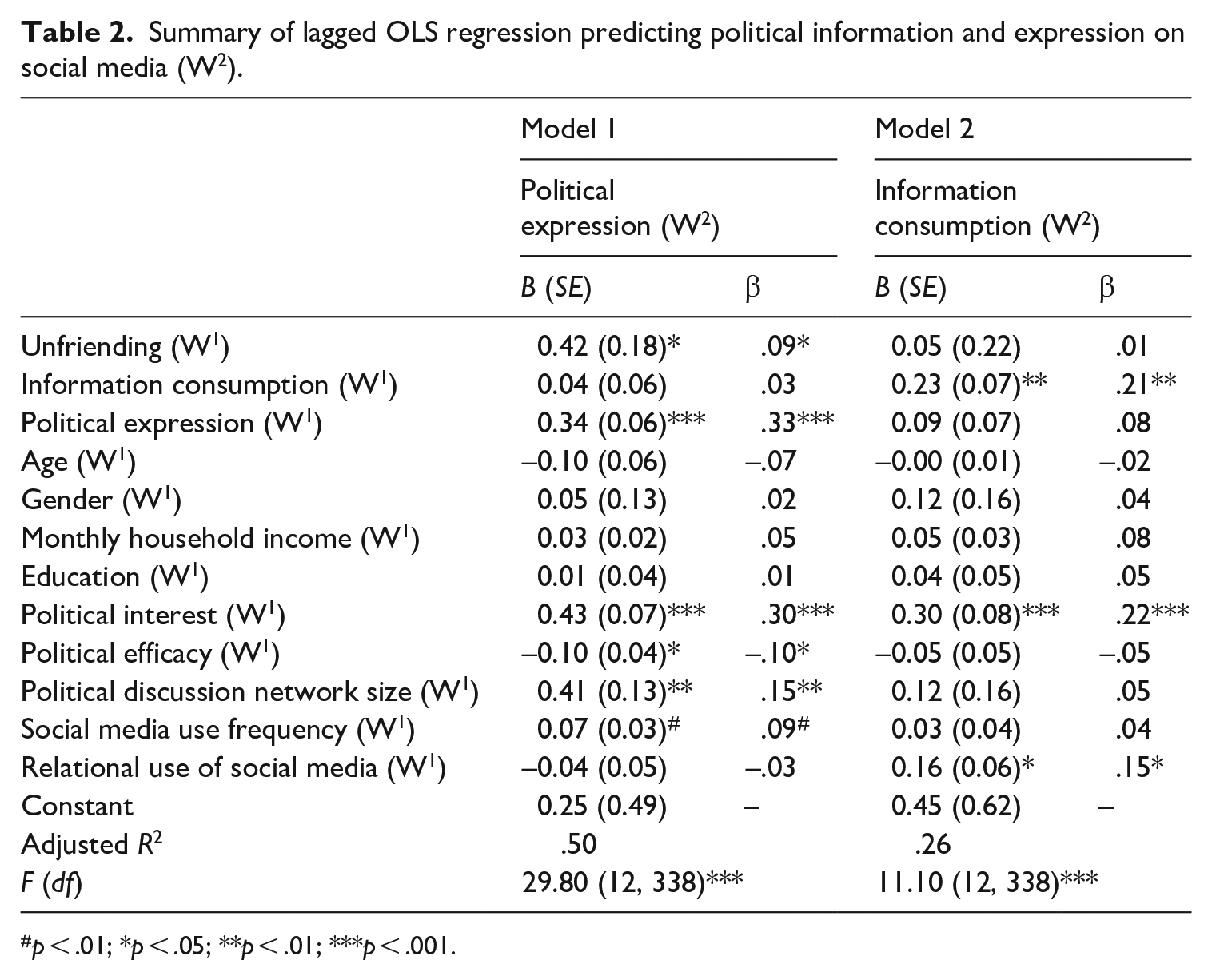
p < .01; *p < .05; **p < .01; ***p < .001.
H2 predicted that the positive relationship between unfriending and political expression would be strengthened by perceived opinion minority status. To test the theoretical model, we employed Hayes’ (2013) SPSS macro PROCESS, using politically motivated unfriending (W1) as the IV, political expression on social media (W2) as the DV, and perceived opinion minority status (W2, 1 = minority, 0 = majority) as the moderator. It also controlled for the effect of prior political expression (W1) and other control variables. As listed in Table 3, perceived opinion minority status (W2) was not a statistically significant moderator, B (SE) = .46 (.41), p = .27, thus rejecting H2. However, we probed the result further using the “pick-a-point” approach with the Johnson–Neyman technique (using 1 = majority, 0 = minority; Hayes, 2013). The result showed that only among opinion minorities was the relationship positive and statistically significant, B (SE) = .64 (.32), p < .05 (see Table 4). It suggests that although the relationship between unfriending and political expression is not moderated by perceived opinion minority status, it is conditioned by the minority status. We also tested the hypotheses using the within-panel data and the results are consistent with the lagged regression models reported above. The analysis results are listed in the supplementary material file.
Summary of OLS regression with the interaction term predicting political expression on social media (W2).
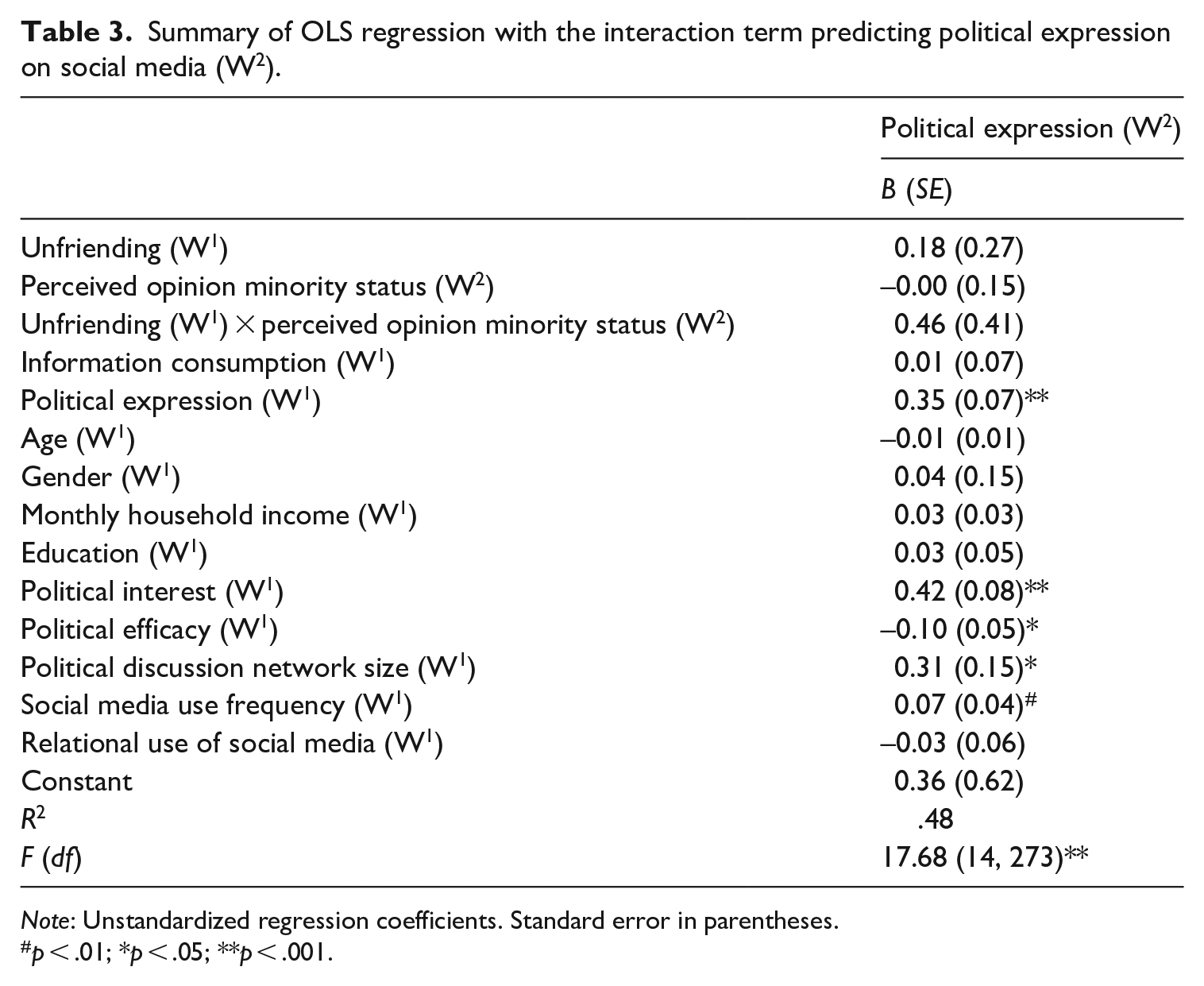
Note: Unstandardized regression coefficients. Standard error in parentheses.
p < .01; *p < .05; **p < .001.
Conditional effect of unfriending (W1) on political expression (W2) at values of opinion minority status (W2).
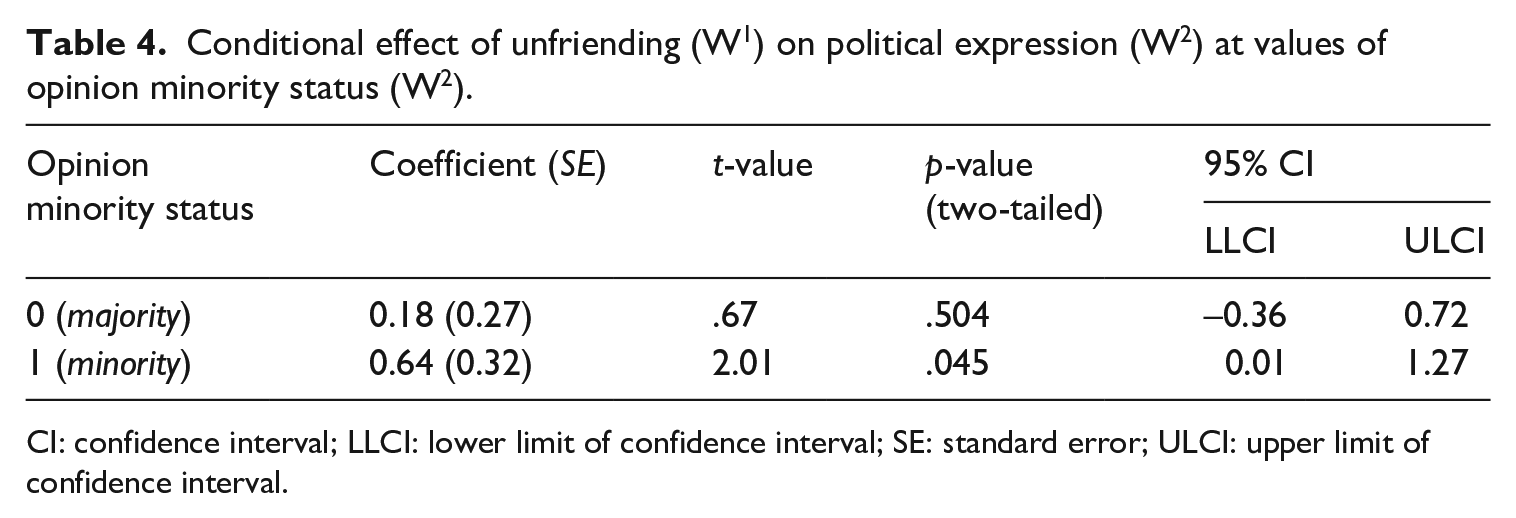
CI: confidence interval; LLCI: lower limit of confidence interval; SE: standard error; ULCI: upper limit of confidence interval.
Discussion and Conclusion
This study advances our understanding of the political implications of social media use through the lens of disconnectivity. Based on a two-wave panel survey conducted in post-Umbrella Movement Hong Kong, the findings suggest that in times of heightened political conflict, the act of severing ties on social media over political issues is associated with increased political expression over time. Importantly, this is only evident among people who perceive that their political preferences are different from that of the dominant majority. This is in line with the previous research showing that politically motivated unfriending can be seen as an exercise of power for minorities (John and Agbarya, 2020). Our results further suggest that unfriending can help build digital “safe spaces,” which empowers minorities to voice their dissenting views. At the same time, there is little evidence that politically motivated unfriending hampers information consumption, despite the dire warning that digital tie dissolution can disrupt information flow. We also note that politically motivated unfriending is not a dominating tendency among social media users, given that less than 12% of social media users reported to have unfriended or unfollowed someone for political reasons in the past 6 months. In summary, our study makes the following contributions.
First, our findings lend further support to the existing research that politically motivated unfriending is positively associated with political participation (John and Dvir-Gvirsman, 2015; Zhu et al., 2017). By employing a panel design, we move the research forward by providing more robust causal evidence of this relationship. Specifically, political unfriending predicts increased political expression over time. Based on the existing research on unfriending, we argue that this is likely because unfriending can prune network disagreement (Bode, 2016; John and Dvir-Gvirsman, 2015; Rainie and Smith, 2012), which consequently fosters network homogeneity and further spurs people into action. It can also function as a means of social exclusion and confrontation avoidance, which can reduce social anxiety that often inhibits political action (Grevet et al., 2014; John and Agbarya, 2020; John and Gal, 2018). Alternatively, politically motivated unfriending can be seen as a form of political statement (John and Gal, 2018), which has a self-mobilizing effect (Cho et al., 2018; Valkenburg, 2017).
We also probed the political implications of unfriending by taking into account the minority–majority power relations. The results show that cutting ties over political reasons can encourage people to voice their political opinions in their online social networks, but only among those holding minority views. According to the previous findings, it is likely that minorities mainly cut ties with those from a majority whose acts or views are perceived as provocative or threatening because of the power dynamic (John and Agbarya, 2020). Research based on in-depth interviews shows that this type of unfriending has two motivations. First, it is “punching up”—an act through which they protest against the hegemony of a dominant majority (John and Agbarya, 2020: 1). In other words, it is an exercise and expression of power by individuals who perceive themselves repressed and their political preferences marginalized. In the context of Hong Kong, the pro-democracy supporters feel that their democratic demands are being suppressed by the Chinese state and the pro-Beijing Hong Kong government. The pro-establishment side sees that their preference for stability and economic prosperity is being delegitimized by the morally charged pro-democracy public discourse. In this context, unfriending may thus be an act that conveys a defiant message to what they consider to be a more powerful majority. This can further empower individuals to express their political preferences.
Second, minorities also engage in politically motivated unfriending in order to turn away from confrontation with their majority counterparts because it can lead to sanction (John and Agbarya, 2020). This can be understood in the spiral of silence theory as well that opinion minorities tend to have a heightened fear of being penalized for expressing dissenting views and hence are pressured to conform or self-censor (Hayes, 2007; Noelle-Neumann, 1974, 1979). In the context of Hong Kong politics, the pro-democracy protesters worry that their online and offline activities are monitored by the Chinese authorities and see pro-Beijing sympathizers with suspicion. Those on the other side are aware of the unpopularity of pro-Beijing anti-democracy sentiment. Thus, opinion minorities from both sides may perceive people holding disagreeing views as a potential threat. Given this context, our finding indicates that digital tie dissolution could help those feeling marginalized create digital “safe spaces”—by shielding them from words and acts perceived threatening and excluding disagreeing others, it could prevent potential sanctions and thus empower people to “safely” express their opinions. It corroborates the existing finding that minorities experienced a greater sense of freedom of expression after unfriending a member from a dominant group (John and Agbarya, 2020).
The positive influence of politically motivated unfriending on political expression has important repercussions beyond the social media environment, as existing research consistently shows that political expression is an important pathway to concrete offline political actions (Boulianne, 2015, 2019; Skoric et al., 2016). Indeed, it is possible that unfriending, either as a form of political statement or a means to build “safe spaces,” could prepare people to acquire the courage and skills that are necessary to face challenges and provocations and engage with disagreements in the future (Lee et al., 2015). However, this kind of “closed door” political activity may also have its own shortcomings. First of all, shielding ourselves from challenges while at the same time exposing ourselves to mainly reinforcing opinions is likely to move us to the more extreme versions of our views. Second, surrounding ourselves in the enclaves of the like-minded might make us dwell on our subjective experience of being marginalized and hence more prone to see ourselves as victims. John and Agbarya (2020) note that “when a member of the minority unfriends someone from the majority group—even if they are punching up—they are distancing themselves from the centers of power” (p. 13). It confines political expression within the boundaries of “personal public sphere” (John and Gal, 2018), which may not be effective in mobilizing supporters and advancing political claims in a political contest. Moreover, many aspects of political life are like our immune systems: for an immune system to work properly, it needs to be exposed to a healthy dose of stressors and challenges. We thus worry that disconnective behaviors on social media may keep people away from that confrontation, and hence, deprive them the opportunities to learn, adapt, and grow.
Nevertheless, we find little evidence that politically motivated unfriending is associated with decreased information consumption. This can be encouraging, as cutting ties on social media can disrupt information flows over the networks (Thorson and Wells, 2016). It suggests that digital disconnection over political disputes may not necessarily lead to the undesirable asymmetry that an informed citizenry is dwindling while prospects for participation are escalating (Fowler and Margolis, 2014; Mutz, 2006). At the same time, however, we also note that digital ties often dissolve over lines of political disagreement (Bode, 2016; John and Dvir-Gvirsman, 2015; Rainie and Smith, 2012). This means that, although politically motivated unfriending may not reduce the amount of political information people consume, it can still decrease the chance of them hearing the other side. Future research should look into the effects of politically motivated unfriending on cross-cutting exposure and understanding of oppositional views.
We note that this study has several limitations. First of all, our measures of social media use do not assess different platforms separately, while noting that Facebook was the dominant platform in Hong Kong and played a major role in the Umbrella Movement. This may have conflated different disconnection acts. Different platforms have different regimes of disconnectivity and have distinct implications for political polarization (Yarchi et al., 2020). Particularly, unfollowing someone on Facebook does not prevent that person from accessing one’s posts, which potentially weakens our “safe” argument. We thus suggest that future studies should differentiate between platform-specific disconnection acts and examine their implications for political engagement separately. Second, our measure of politically motivated unfriending required respondents to recall whether their unfriending was related to politics, which may have introduced systematic measurement error (Prior, 2013). Without specifying what politics means, it is open to interpretation by the respondents. However, we also note that given that the survey was conducted during the period of the heightened political tensions, namely during the Chief Executive election in 2017, it is highly likely that respondents interpreted “politics” within this context. Third, we measured the opinion minority status by asking respondent the percentages of the population they perceived to support the candidates they preferred. We acknowledge that the visibility of a specific opinion may not be necessarily in direct correlation with the number of people who share the opinion. We thus suggest that future research could improve the measure of opinion minority status by also directly asking people their subjective experiences of seeing themselves on the minority side. Fourth, the measurements of political expression and information consumption could be improved. Specifically, measures of political expression could separate the socially oriented political talks from the civic-minded political deliberations, and differentiate among different types of political expression by motives such as corrective and persuasive action. A finer-grained measurement of information consumption may also be useful to identify the effects of digital disconnection. For instance, future studies could further examine the potential differences between the balanced versus biased information seeking behaviors. Finally, although the observed relationship between unfriending and political expression among opinion minorities can be explained by the “safe space” effect, this was not explicitly tested in the study. Future research should thus consider doing so by examining the role of the fear of social sanctions and emotional comfort in the process.
Supplemental Material
sj-pdf-1-nms-10.1177_1461444821999994 – Supplemental material for Political implications of disconnection on social media: A study of politically motivated unfriending
Supplemental material, sj-pdf-1-nms-10.1177_1461444821999994 for Political implications of disconnection on social media: A study of politically motivated unfriending by Qinfeng Zhu and Marko M Skoric in New Media & Society
Footnotes
Authors’ Note
We hereby confirm that all authors have agreed to the submission and that the article is not currently being considered for publication by any other print or electronic journal.
Funding
The author(s) disclosed receipt of the following financial support for the research, authorship, and/or publication of this article: by City University of Hong Kong.

Supplemental material
Supplemental material for this article is available online.
Author biographies
References
Supplementary Material
Please find the following supplemental material available below.
For Open Access articles published under a Creative Commons License, all supplemental material carries the same license as the article it is associated with.
For non-Open Access articles published, all supplemental material carries a non-exclusive license, and permission requests for re-use of supplemental material or any part of supplemental material shall be sent directly to the copyright owner as specified in the copyright notice associated with the article.
