



Abstract
#IAmMetiria began on Twitter in July 2017, after a speech by New Zealand Green Party co-leader, Metiria Turei, challenging political consensus on welfare policy. Turei confessed she lied to authorities in the 1990s, prompting a flood of supportive posts. Soon after, right-wing oppositional tweets were posted (n = 288) contesting the arguments of Turei and her supporters, and left-wing responses to those arguments (n = 214). Drawing on Mouffe’s dissensual model, this article undertakes a close, qualitative analysis of those 502 tweets, in order to move towards a method for empirically distinguishing between antagonistic and agonistic tweets, identifying the latter as putting forward arguments which can be identified by the researcher and potentially engaged with by ideologically opposed adversaries. The results show a majority of the tweets were agonistic, with implications for the future study of social media policy debates and for the online practices of scholars.
Introduction
On 16 July 2017, Metiria Turei, the Māori female co-leader of the New Zealand Green Party, gave a pre-election speech outlining the party’s new unemployment benefit policies, which promised to raise levels by 20% and ‘immediately remove all financial sanctions’ (Turei, 2017b). The party was signalling its intention to break with 30 years of neoliberal consensus in New Zealand around social welfare which had seen real incomes fall and child poverty levels soar (St John and Cotterell, 2019). During that time, successive governments had instigated a punitive regime of sanctions, including single mothers being forced to divulge the name of the father of their child 1 and declare any sexual relationship, as well as anyone living with them, or else risk losing their benefit. Within this context, Turei, while announcing that such sanctions would be removed should the Greens gain power, admitted that she herself had failed to inform Work and Income New Zealand (WINZ) about the fact she lived with ‘extra flatmates, who paid rent’ (Turei, 2017b) in the 1990s.
The following day (17 July), the #IAmMetiria Twitter hashtag began with a flood of confessions by current and former beneficiaries who had been similarly forced to lie to WINZ in order to avoid sanctions. Moreover, the confessions (268 of which came in the first two full days following Turei’s speech) painted a damning picture of a culture within WINZ centred around the denial of entitlements, intrusive questioning and guilt-inducing judgments, termed by Hodgetts et al. (2014) as ‘structural violence’. A further 81 tweets over the same 2-day period praised Turei’s braveness in exposing a welfare regime which structurally discriminates in terms of class, gender and race, giving a voice to a groundswell of opinion which sought to change it.
The extent of the Twitter activity following Turei’s speech was unprecedented in a New Zealand context where, unlike the United States, the United Kingdom or even Australia, large-scale, spontaneous political hashtags spearheaded by marginalised minorities are rare. And while Turei was eventually forced to resign as Greens co-leader 24 days after her speech, following a considerable amount of pressure from other politicians, journalists and right-wing commentators (see Phelan and Salter, 2019), the hashtag can be seen to have opened up the conversation on benefits, whereby the iniquitously low levels and punitive sanction regime became the subject of considerable public, media and policy scrutiny over the next 3 years. 2
Empirically, this article concentrates on the period shortly after that initial outpouring of confessions. On 18 July, right-wing oppositional tweets began to be posted which contested the idea that Turei was a hero who had exposed the unfairness of the benefits regime to the general public. These posts (numbering 288 between 18 July and 3 September) instead emphasised the criminality of her actions, the immoral act of lying and a political strategy which aimed to manipulate the public in the lead up to an election. These right-wing oppositional tweets then drew a similar number of tweets in response (214), from left-wing supporters of Turei’s actions.
Through a close, qualitative analysis of these 502 tweets (288 right-wing oppositional and 214 left-wing responses), this article seeks to investigate what happens when conflicting ideas are encountered by Twitter users, and the kinds of values, arguments and narratives employed. Drawing on Chantelle Mouffe’s (2000, 2005, 2014, 2018), conceptual differentiation between antagonism and agonism, together with the theory of her late partner, Ernesto Laclau, I show that, despite the often heated nature of the debates between right-wing detractors and left-wing supporters of Turei, a majority of the tweets were agonistic, rather than antagonistic. For a tweet to be classed as agonistic, I argue that it needs to make an argument, grounded in a set of societal values, rather than concentrating on the personal attributes of the opponent, or being too ambivalent to be engaged with. In the era of rising online polarisation, extremism and hate speech, which poses significant challenges to pluralistic, democratic debate (Beaufort, 2018; Connolly, 2005), it becomes increasingly important to look for examples of how social media can sometimes foster discussions between agonistic adversaries on important policy matters. If we think about arguments which are ideologically contrasting as agonistic, rather than antagonistic (while still classing personal attacks as the latter), then we may be able to encourage less polarised debates online.
Before the empirical sections, the following theory section outlines the most relevant concepts from Mouffe and Laclau, and their applicability to studying online democratic discourse, before I situate the article within the context of the wider literature on Twitter and democratic debates.
Agonism and political debates on Twitter
The dissensual model of political debate outlined by Mouffe argues against the Habermasian emphasis on rational consensus. Rather than aiming for consent through a process of rational deliberation, the dissensual model recognises that differences in opinion cannot necessarily be resolved, even claiming that differences should be encouraged, because pluralism and conflicts are vital to democratic politics (Karppinen et al., 2008). Mouffe highlights how ‘democratic consent’ often means the construction of the views of a narrow elite as the only possible political horizon, furthering a neoliberal ‘post-political consensus’ (Mouffe, 2005: 1).
Rather than a struggle between right and left-wing ideologies (fundamentally opposed visions of how society should be organised), Mouffe (2005) argues that post-political debate regularly becomes a moral ‘struggle between right and wrong’ (p. 5), which narrows pluralism by excluding certain dissenting voices as anti-democractic ‘extremists’ (2018: 25). The exclusion of such voices from debates only creates further resentment from those who are excluded, contributing to a vicious cycle which encourages polarised, extremist views and furthers the growth of far-right populism. The only way to address this, Mouffe (2018) contends, is to advocate for agonism, a ‘perspective [that] recognizes the necessar[ily] partisan character of democratic politics’ (p. 68). The agonistic perspective, therefore, argues that discursive conflicts centred around ideological difference are normatively desirable, and should be actively encouraged, rather than attempted to be shut down through technical or policy means (as is now the predominant trajectory for social media, see Kuehn and Salter, 2020).
This does not mean, however, that an agonistic perspective encourages online hate speech, with Mouffe clearly differentiating between agonism and antagonism. Mouffe, alongside her late partner Ernesto Laclau, argue that antagonism has an ontological function in regards to politics and identity (see Marchart, 2018). Drawing on Lacanian psychoanalysis, their discourse theory (see Laclau and Mouffe, 2001) posits that all identities are initially formed in opposition to an other – normally the mother, which allows the infant subject to recognise their own distinct subjectivity. Laclau and Mouffe transpose this psychoanalytic insight onto the formation of group identities, which, similarly, ‘can only exist by the demarcation of a they’ (Mouffe, 2005: 15). This ontologically necessary demarcation does not unavoidably lead to polarised, friend-enemy distinctions, but they are more likely as our interactions increasingly move online, where we experience ‘information overload with rumors and misinformation [. . .] threatening social orders that are built upon certainty and universality’ (Lu and Yu, 2018: 10).
Laclau’s (1990) concept of dislocation becomes useful here, because it accounts for certain significant moments when ‘the agent’s identity and its forms of representation’ (p. 37) tend to become less fixed and stable. During such moments of instability and uncertainty, alternative discourses can potentially have more of an effect. In other words, identities become politicised during periods of dislocation, when increased exposure to the ‘radical contingency’ (Laclau, 1990: 19) of social relations potentially leads identities to seek belonging within new political movements, which are perceived as able to provide stronger explanatory narratives (Glynos and Howarth, 2007; Howarth, 2000). In the case of Turei’s speech and the subsequent WINZ horror stories shared to #IamMeteria, I argue that it created a space for the articulation of alternative discourses around welfare beneficiaries and policy, increasing the potential for ideologically opposed agonistic debates.
However, as Glynos and Howarth (2007) argue, the nature of the dislocation is discursively constructed. In other words, there are no guarantees that a dislocative moment, such as Turei’s speech and the welfare beneficiary confessions which flooded the hashtag, will lead to progressive, agonistic debate, or conversely, antagonistic online hate. This is where it becomes important to encourage the former, whereby ‘the opponent is not considered an enemy to be destroyed but an adversary whose existence is perceived as legitimate’ (Mouffe, 2018: 67). Agonistic debate occurs within a framework of clear procedural rules, which are agreed on by all sides, who may hold a broad plurality of values. An example of such a framework is parliamentary rules and procedures, which have been developed to ensure civil debate between ‘adversaries’, with whom we ‘have a shared adhesion to the ethico-political principles of liberal democracy’ (Mouffe, 2000: 15).
This need for a pre-agreed framework to ensure that online debate remains within certain bounds of civility is becoming broadly recognised as important, evidenced by the recent efforts of policy makers, big tech and non-governmental organisations (NGOs) to design policy and tweak algorithms to discourage online hate (see, for example, Davids, 2018; Department for Digital Culture Media & Sport, 2019; Facebook, 2019). In terms of academia, many critical scholars argue that these efforts are doomed to fail, citing that the algorithms which generate revenue for the FAANG (Facebook, Apple, Amazon, Netflix, Google), also seem custom-built to encourage hate, trolling and cruelty (e.g. Seymour, 2019).
However, the present pessimistic atmosphere around social media discourse has the potential to lead us to abandon it as a space for the study of democratic debate and miss spaces where it might still occur. One problem is that we still lack a framework for identifying democratic debate online. Mouffe herself, being a political theorist and not an empiricist, has never stipulated in concrete terms how to identify agonistic, as against antagonistic discourse (Evolvi, 2019). Hence, in the final part of this section, I draw on Ernesto Laclau’s (2005) concept of the equivalential chain, in order to facilitate a move towards a method of empirical distinction.
For Laclau and Mouffe, following a dislocative moment, a struggle occurs between the dominant hegemonic order and an insurgent counter-hegemony, ‘which will attempt to disarticulate the existing order’ (Mouffe, 2005: 15), by colonising events, phenomena and identities with its own discourse, or layers of meaning. It does this by constructing an equivalential chain of signifiers, which connect to a key disputed signifier, causing its meaning to ‘float’ (Laclau, 2005: 132–138). The key example of this floating signifier given by Laclau is ‘the people’ in US politics, which, until the 1950s, was most closely associated with left-wing, rather than right-wing populism. But the anti-communist discourse of the McCarthy era constructed ‘a new regime of equivalences [which] cement[ed] the articulation between popular identities and right-wing radicalism’ (Laclau, 2005: 135–138). As I will outline in the ‘Analysis’ section, the name Metiria, as well as the hashtag #IamMetiria, became the key floating signifiers in this article’s empirical case study, with both right-wing oppositional tweets and left-wing responses articulating different signifiers alongside those floating ones, in order to attempt to fix meaning, thereby making that the dominant meaning-making framework for understanding events. While left-wing tweeters struggled to fix the meaning of Turei as ‘heroic’ and ‘self-sacrificing’, the opposed right-wing tweeters attempted to fix meaning to another chain, which included signifiers such as ‘fraud’, ‘dishonest’ and ‘liar’.
In this way, agonistic arguments, which rely on ethico-political principles, can be identified by a researcher such as myself who is familiar with the context, and who has immersed themselves into the data (as is the norm with qualitative research, see Tracy, 2013). Hence, signifiers, as well as making up opposed equivalential chains, refer to ideas, worldviews and moral frameworks, which can be recognised and named as a political argument or logic (Glynos and Howarth, 2007; Howarth, 2005), even within the confines of a 140-character tweet. 3 In contrast, antagonistic tweets either focus on the characteristics of an individual person or group, or their political argument is ambiguous (Phillips and Milner, 2017), limiting the possibility of an adversary engaging with it on agonistic terms.
The following section places this study within the context of the wider literature on Twitter hashtags, finding links to the differentiation between civility and incivility, and offering a rationale based on the need for more smaller scale qualitative research.
Studies of Twitter and democratic debate
Since the election of Donald Trump as US president in 2016, the primary emphasis in the literature has been on Twitter and other social media platform’s purportedly negative effects on political discourse (Deb et al., 2017; Han, 2017; Seymour, 2019). While in the early 2010s, social media was hailed as heralding a utopian dawn of unbridled communication which would necessarily challenge entrenched power by broadening debates and enlarging the public sphere (Benkler, 2011; Castells, 2012), recently it has become viewed primarily through the prism of dystopia (Zuboff, 2019), with democratic debate struggling to ‘survive’ (Persily, 2017) the onslaught of distorting bots (Bessi and Ferrara, 2016), trolls (Bulut and Yörük, 2017), fake news (Marda and Milan, 2018; Vosoughi et al., 2018) and disinformation (Ghosh and Scott, 2018; Guo et al., 2018). Even before the 2016 US election, scholars had already claimed Twitter’s affordances encourage isolated bubbles of ideological homogeneity (Himelboim et al., 2013), or at least homophily (Colleoni et al., 2014), rather than exposure to arguments which potentially challenge the user’s presuppositions.
However, while Twitter’s follow function does encourage the user to ‘expos[e] herself primarily to the messages authored by the people she selects’ (Himelboim et al., 2013: 155), exposure to contrasting viewpoints, necessary to agonistic debate, can arise through the hashtag function. While primarily a vehicle for the articulation of shared interests and/or shared identities (Walton and Rice, 2013; Wills and Fecteau, 2016; Zappavigna, 2013), Twitter hashtags have become vibrant fora for marginalised groups in recent years, with #BlackLivesMatter (Harlow and Benbrook, 2019; Ray et al., 2017) and #MeToo (Hu et al., 2020) having particularly notable impacts on mainstream discussions around race and gender respectively. While in some ways such hashtags can function as echo chambers, where previously marginalised opinions can find community and support through retweets and comments (Ray et al., 2017), they can also attract oppositional tweets, offering ‘an inherent opportunity for ingroups and outgroups to interact’ (Jenkins et al., 2019: 15).
Such interactions between political opponents can, of course, lead to antagonistic exchanges, rather than agonistic debates. Empirical studies (Hmielowski et al., 2014; Lu and Yu, 2018) have found that encountering an opposing opinion online can lead to ‘flaming’, which is ‘extremely argumentative communication’ (Baym, 2010: 51), often aggressively worded and/or inflammatory. Baym (2010) notes that the particular context of online communication, which lacks the range of social cues found in face-to-face, can contribute to the offence taken, which then contributes to a spiral of increasingly uncivil discourse (Hmielowski et al., 2014; Papacharissi, 2004). Such enflamed discourse can encourage withdrawal from participation by those with controversial opinions that differ from what they see as the mainstream view (Chen, 2018), thereby decreasing plurality.
Rather conversely, Hutchens et al. (2019) find that engaging in online debate with participants from out-groups with oppositional opinions increases affective feelings of enthusiasm for such debates. Importantly, for the argument of this article, the authors test for both uncivil and civil forms of disagreement, with enthusiasm more likely felt after encountering the latter. The authors’ distinction between civil and uncivil comments maps well onto Mouffe’s distinction between agonism and antagonism, with incivility being ‘attacks that do not progress the discussion’ (Hutchens et al., 2009: 204), relying instead on stereotyping and leading to closed polarised certainties, rather than opening up oneself to the perspectives of the other (see also Connolly, 2005; Papacharissi, 2004). According to Hutchens et al. (2019), civil discourse, by contrast, leads to ‘the exchange of ideas’, through ‘a willingness to hear contrary opinions in a mutually respectful manner’ (p. 205), while importantly noting that such openness does not preclude disagreeing with the arguments of the other.
Other studies have linked the anonymity afforded by online communication (unlike other social media platforms Twitter still allows the use of anonymous profiles) with enabling and even encouraging the practice of trolling (Edstrom, 2016; Galán-García et al., 2014; Jakubowicz, 2017). Bishop (2014) notes that this term has shifted from meaning the practice of ‘provoking others for mutual enjoyment to meaning abusing others for only one’s own enjoyment’ (p. 8), partly due to negative representations in the media. Bishop therefore distinguishes between two distinct types of trolling: kudos (with the purpose of entertaining others) and flame (with the purpose of abusing others). However, in the context of a popular political hashtag which attracts oppositional tweets, such distinctions become harder to maintain. Such cases tend towards the formation of strong in-group and out-group identifications (Harlow and Benbrook, 2019; Ray et al., 2017), where even trolling couched in a humorous tone, with the purpose of entertaining other members of an in-group, can be ‘destructive and alienating for members of the outgroup’ (Phillips and Milner, 2017: 92). Furthermore, Phillips and Milner note that humorous trolling is often ambivalent in meaning, making the exchange of ideas difficult and offering little possibility for the uncivil friend/enemy mode to be overcome.
The specific dynamics of these interactions between ideological opponents on Twitter has been under-studied, particularly at the fine-grained level of meaning construction. In general terms, social media studies have been rather dominated by ‘Big Data’ analytical methods (Fuchs and Qiu, 2018). While these can be useful for mapping and visualising networks and the flows of information (e.g. Bruns and Highfield, 2015), they are less suited to studying the nuance of argument and identity performance (Bulut and Yörük, 2017; Evolvi, 2019). As Fuchs and Qiu (2018) plainly argue, quantitative methods are very good at demonstrating the ‘how’, but not so good at explaining the ‘why’ of social media interactions, including aspects such as ‘political interests [and] moral judgements’ (p. 222), which are particularly relevant to the identification of agonistic arguments.
Hence, contributing to the rationale behind this study is a current lack of empirical work which examines in detail what goes on when a hegemonic discourse is challenged by an ideologically opposed, counter-hegemony. With the outpouring of narratives which directly challenged the dominant representation in New Zealand of welfare beneficiaries as the agents of their own misfortune (Kingfisher, 1999), #IamMetiria offers a rare opportunity to study in-depth the arguments drawn on by right-wing opponents and left-wing responders, as well as the moral underpinnings of those arguments. While at first glance, the marked division of discussion on #IamMetiria into two opposed groups may be evidence for flaming and polarisation, Mouffe’s theory urges us to look closer, to look instead for evidence of dissensual debate, in the context of an issue which has historically divided the political left from the right: the treatment of those without work. The next section details how the tweets were coded and the arguments identified, and how these were defined as either antagonistic or agonistic.
Data and methods
A corpus of 2598 tweets posted to the #IamMetiria hashtag between 17 July (its first day) and 3 September 2017, inclusive (49 days), were downloaded before being qualitatively analysed. Re-tweets, original tweets and replies were included in the corpus, however, duplicates were not coded more than once. 3 September was chosen as the cut-off date as, by this point, 26 days after Turei’s resignation, use of the hashtag had declined to approximately one tweet every 3 days (and these were not directly referring to Turei or welfare policy). I was, therefore, satisfied that all relevant tweets were captured over this period.
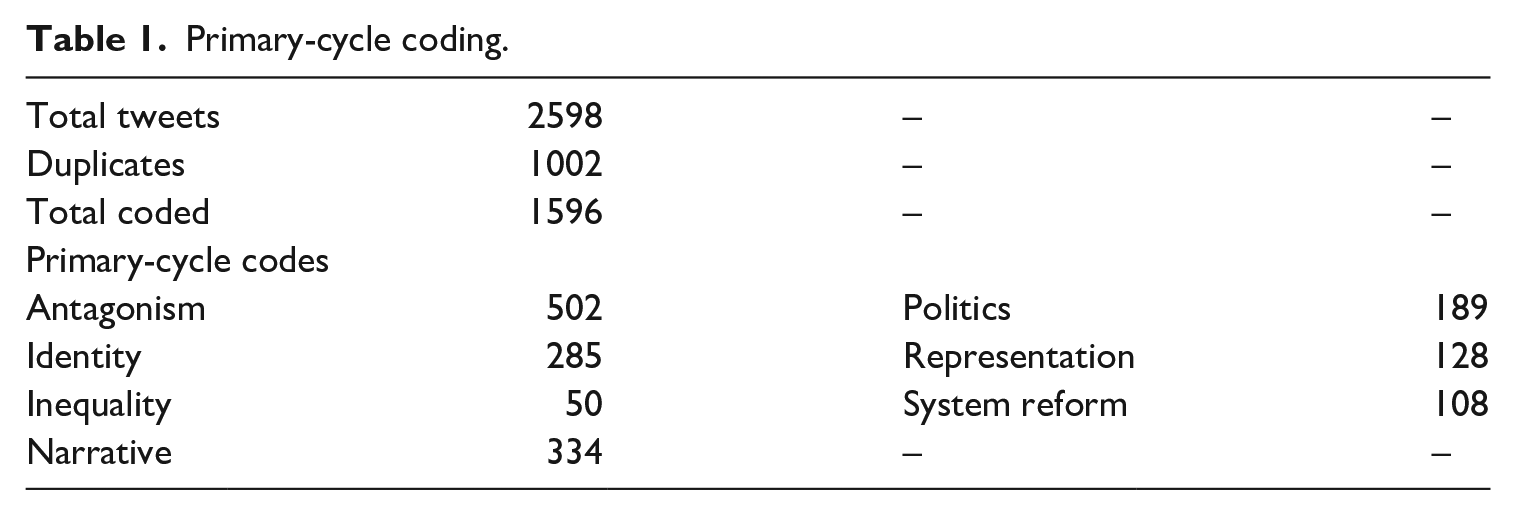
Guided by Tracy’s (2013: 188–190) primary and secondary-cycle coding process, each tweet was read carefully, before being allocated a first-level, descriptive code. In this preliminary stage, immersion within the data set is important, whereby ‘the goal is to absorb and marinate in the data’ (Tracy, 2013: 188), but reserving judgment as much as possible (while acknowledging that the researcher cannot remove themselves entirely from the process of qualitative research). This preliminary stage resulted in the following seven broad, primary-cycle codes: antagonism, identity, inequality, narrative, politics, representation and system reform. The totals for each primary-cycle code are included in Table 1.
Primary-cycle coding.
Secondary-cycle coding then ‘critically examines the codes already identified’ (Tracy, 2013:194), by going beyond the initial descriptive categories in attempting to identify more focused patterns, or ‘cause-effect progressions’ (Tracy, 2013: 194) within them, typically using theory to do so. The secondary cycle also allows for the qualification and confirmation of primary-cycle codes (with some tweets being re-coded on a second reading, when a higher level of immersion and, therefore, understanding of the context was achieved).
In the case of this study, I drew on a research interest in digital democracy, a conceptual interest in Laclau and Mouffe’s theory, and the wider literature on Twitter, in order to narrow the empirical focus. As outlined in the previous section, while the initial outpouring of confessions from those who had been treated badly by WINZ was important to document, I felt, in these times of polarised debates, that it was even more important to document how Turei’s left-wing supporters had reacted to the critique of her right-wing opponents, as well as the kind of arguments deployed by both sides.
Consequently, for the secondary cycle, I focused on the 502 tweets which had been previously coded in the primary cycle as antagonism. This was a broad category (including potentially agonistic, antagonistic, ambiguous and ambivalent tweets), which included those I judged as right-wing oppositional and as left-wing responses to their arguments. As outlined earlier, the two sub-categories of left- and right-wing tweets could be identified by a researcher such as myself, who is familiar with the national political context, and who has immersed themselves into the data during the primary cycle. Furthermore, the emergence of two relatively stable political identity groups within this category fitted with Mouffe’s (2018) definition of agonistic debate as arising in contexts where there are clear ideological divides articulated.
After coding right-wing oppositional tweets and left-wing reactions, I then applied further focused codes, based on the arguments each side were forwarding. These codes were emergent, in that I had no set pre-conceived idea of what the arguments would be. I was only guided by a desire to differentiate between agonistic and antagonistic tweets, as I wanted to develop a typology on what kind of tweets could be classified as agonistic, rather than antagonistic. Through conducting the analysis, I decided antagonistic tweets would be defined as those read as either attacking the personalities, tactics or identities of the opponent, or mocking their beliefs, without offering an argument grounded in a belief system.
Analysis
The below analysis categorises the right-wing oppositional and left-wing response tweets in the corpus, in terms of antagonistic/agonistic, and for the latter, classifying the arguments offered by way of tables. I also outline in some detail key agonistic arguments articulated, which for right-wing oppositional were criminality, lying, politicking, poor role model and public opinion, while for left-wing responses they were against lying, no choice, nobody’s perfect and no experience of hardship.
Right-wing oppositional tweets
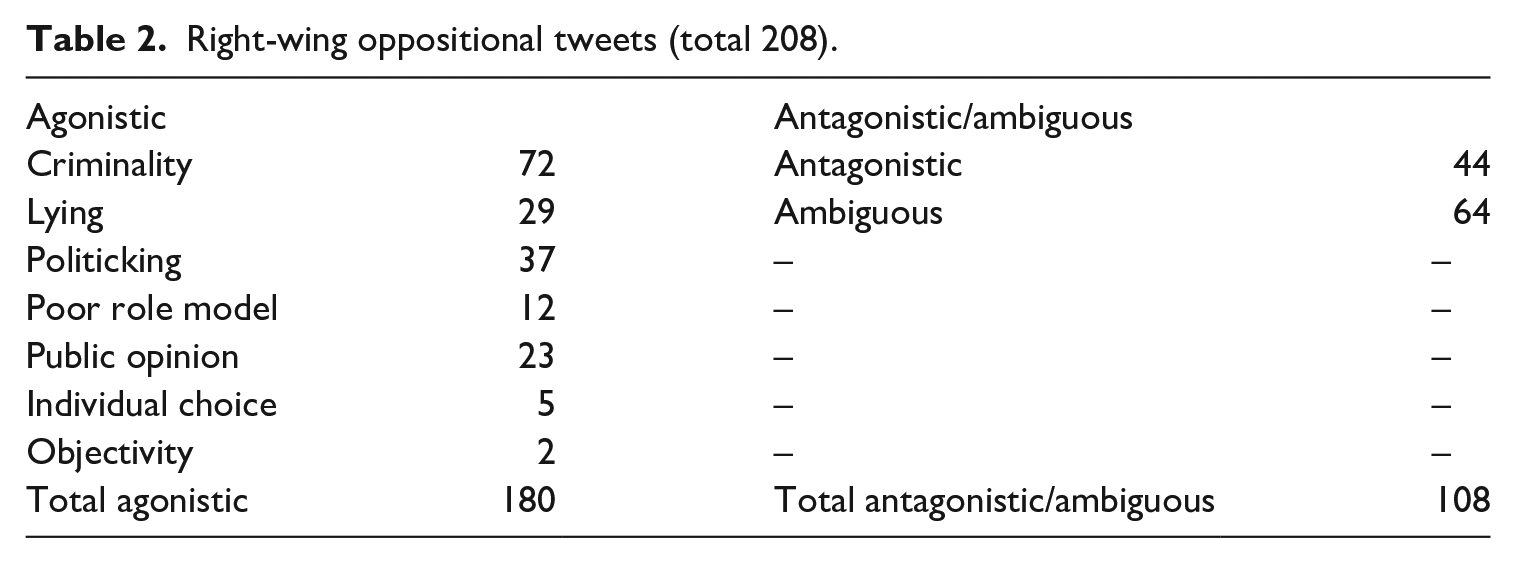
As displayed in Table 2, of the 288 tweets using the #IamMetiria hashtag which were coded as right-wing oppositional, a clear majority (180) were coded as agonistic (defined as where a clear argument or idea was forwarded to ground the opposition). This compares with 44 which were coded as antagonistic, because they were mocking in tone, ambivalent, made fun of left-wing arguments, were racist/sexist/classist, attacked Turei’s character, or called for her resignation without justification. The remaining 64 were coded as ambiguous – it could not be ascertained whether they were agonistic or antagonistic (e.g. they discussed strategy, without offering a clear argument to be engaged with).
Right-wing oppositional tweets (total 208).
Of the 44 tweets coded as antagonistic, not all were hateful or aggressive (while some of them were). Many used humour to mock Turei’s supporters claims that she was heroically drawing attention to an important issue, and that she had no choice in lying to WINZ about her circumstances, often by drawing equivalential links to acts of stealing such as shoplifting, using stereotypical representations of beneficiaries. For example, a tweet on 21 July read ‘When I was four I stole a Mars bar by hiding it in my underpants’. Hence, while not necessarily abusive (the most common contemporary meaning of trolling, see Bishop, 2014), such tweets could be described as uncivil (Hutchens et al., 2019), or closed, in that they lack an articulation of a political argument that could be engaged with by the left-wing responders. Agonistic tweets, by contrast, are open, or civil, in that they offer a clear political argument or idea as their primary focus, which can be responded to, rather than the primary focus being stereotyping or mocking the other side (although they still may use humour to make that argument).
Of the agonistic tweets, by far the most common argument outlined was criminality – 72 tweets drew equivalences between Turei admitting to lying to WINZ and the signifiers of fraud and/or theft, with their obvious moral connotations. These tweets generally emphasised that the law is (and must always be) black and white and inflexible, meaning that stealing is stealing, no matter the circumstances. For example, tweets on 18 July warned the early confessional users of the hashtag that ‘No level of theft is acceptable’ and they were ‘condoning a crime, regardless of extenuating circumstances’. Others quantified the monetary aspects, with the need for her to pay back ‘the country $57k’.
The criminality argument was then given further boost by two subsequent developments. On 25 July, Turei (2017a) wrote about the hashtag in a newspaper opinion piece, while also revealing that she had been personally contacted by hundreds of people who had been similarly forced to lie to WINZ, but refused to report them to authorities. Consequently, she was cited as committing the double crime of ‘No (sic) only [. . .] commit[ting] fraud now condoning others who do the same’. Then on 3 August, it was revealed that in 1993, she lied about her address when registering to vote (Green Party, 2017), further colonising the signifier Turei as ‘fraudster’ in increasingly affectively charged oppositional tweets.
The third most common right-wing agonistic argument (closely linked to but not reducible to criminality) was lying (29 tweets) – an act which was seen to harm honest beneficiaries and/or taxpayers (whose interests are merged). Unlike criminality, this argument references intrinsic moral obligations, rather than the breaking of extrinsic rules. Hence, in a tweet on 19 July, Turei was seen to be both ‘stealing from taxpayers and the poor [which] is low of lows’. In another from 19 July, Turei’s lack of moral compass was contrasted against ‘other people, who were also finding things just as tough, who pay tax, and wont steal’. In order to merge the interests of taxpayers and honest beneficiaries, this argument assumes that there is only a limited amount of money available to be spent on welfare payments, and therefore, ‘Turei ripped off poor people by taking taxpayers’ money from honest beneficiaries’ (30 July).
The second most common right-wing oppositional argument was politicking (37 tweets) – that Turei made her announcement to cynically engineer more votes for herself and the Green Party, by way of ‘A Publicity Stunt’ (18 July). This argument (common within neoliberal discourse, see Phelan, 2014) rests on an individualistic representation of politicians as cynical self-servants, possessing no moral orientation towards the common-good. Any appeals to a common-good by politicians are in fact seen as morally corrupt (Salter and Phelan, 2017); a sign that they are trying to use emotions (rather than the objective reason of market logics) in order to manipulate the public for their own advantage, with the latter seen as gullibly still believing that common, unifying causes still exist.
Hence, the Act Party’s (which advocates for a hard neoliberalism) official Twitter account accuses Turei of ‘Using your own fraud to score political points’ on 21 July. Tweets from members of the public deploying this argument demonstrate the utility of the ‘SJW’ (Social Justice Warrior) to online neoliberal discourse (Phelan, 2019), as well as its representation as morally corrupt (Massanari and Chess, 2018). Consequently, equivalences are made between left-leaning female politicians (such as Turei) and the figure of the SJW, through ‘the biggest Virtue Signaling in NZs history’ (22 July). Another tweet accuses her of using displays of affect to mask her act of fraud: ‘New snowflake law: it’s not fraud if you shed tears about it’.
The arguments of individual choice (five tweets) and objectivity (two tweets) are grounded in similarly individualistic presuppositions to politicking, with the former assuming a subject that is either removed from her personal circumstances, or is responsible for them, and is who is able to make choices after rationally weighing up her options. Therefore, Turei both ‘chose her circumstances, [and] chose to break the law’ (18 July) and that she ‘Chose To Defraud The Government & Take Taxpayer Money’ (19 July). Whereas, the latter (objectivity) draws on the abovementioned gendered representation of ‘SJWs’ to contest the emotionally charged nature of the posted narratives of negative experiences with WINZ. For instance, a 20 July tweet ‘suspect[ed] that a rigorous, anonymised survey of WINZ clients would overwhelmingly reveal compassion’.
The poor role model argument (12 tweets) contests the left-wing claim that Turei was a brave hero. This argument gained more traction in the latter stages of the hashtag, following the additional revelations. An example is a tweet on 6 August, which read ‘Metiria is not an icon, beacon, brave nor trustworthy. She is a self confessed benefit fraudster. That is all . . .’ Turei’s actions were also contrasted against former Green Party leaders ‘Rob Donald(RIP) &Jeanette Fitzsimons’ (4 August), as well as two senior Green Party MPs who resigned in protest at her actions on 8 August (Kennedy Graham and David Clendon).
The final right-wing oppositional argument to discuss is public opinion (23 tweets). This contests the left-wing claim that the hashtag opened up the conversation around welfare, thereby moving public opinion towards recognition of the need for reform. Again, this argument was provided more impetus by journalistic investigations into Turei’s living situation in the 1990s (see Phelan and Salter, 2019) as well as a TV news poll which appeared to demonstrate public disapproval of her actions (Newshub reporter, 2017). Tweets aimed to particularise the support shown for Turei’s actions on the hashtag, as part of ‘the dumbass Wellington Twitterati’ (7 August), representing ‘0.05% of voters’ (10 August). In that way, the Green Party were represented as having misjudged the ‘NZs outrage to it [Turei’s announcement]’, and were, therefore, ‘totally tone deaf to the electorate’ (17 August).
Left-wing responses to critique
As outlined in Table 3, more of the tweets that were coded as specifically responding to right-wing oppositional tweets on the hashtag were coded as agonistic (105) than antagonistic (72), while 37 were coded as ambiguous. While the proportion of antagonistic tweets may appear higher in the left-wing than in the right-wing sample, it needs to be recognised that the former tweets were all in response to the latter’s arguments and provocations, which should result in more flaming. Many of the 72 tweets coded as antagonistic (particularly in the early stages of the hashtag) recognised the attempts at provocation and were explicitly naming the oppositional tweeters as ‘right wing trolls’ (21 July). Towards the latter stages, increasing personal attacks, rather than arguments (25 of the antagonistic tweets were from 4 August onwards), from the left-wing group were motivated by a significant degree of affective investment both in the hashtag and Turei’s cause, shown both in the number of tweets from particular users and in the affective language shown.
Left-wing response tweets (total 214).
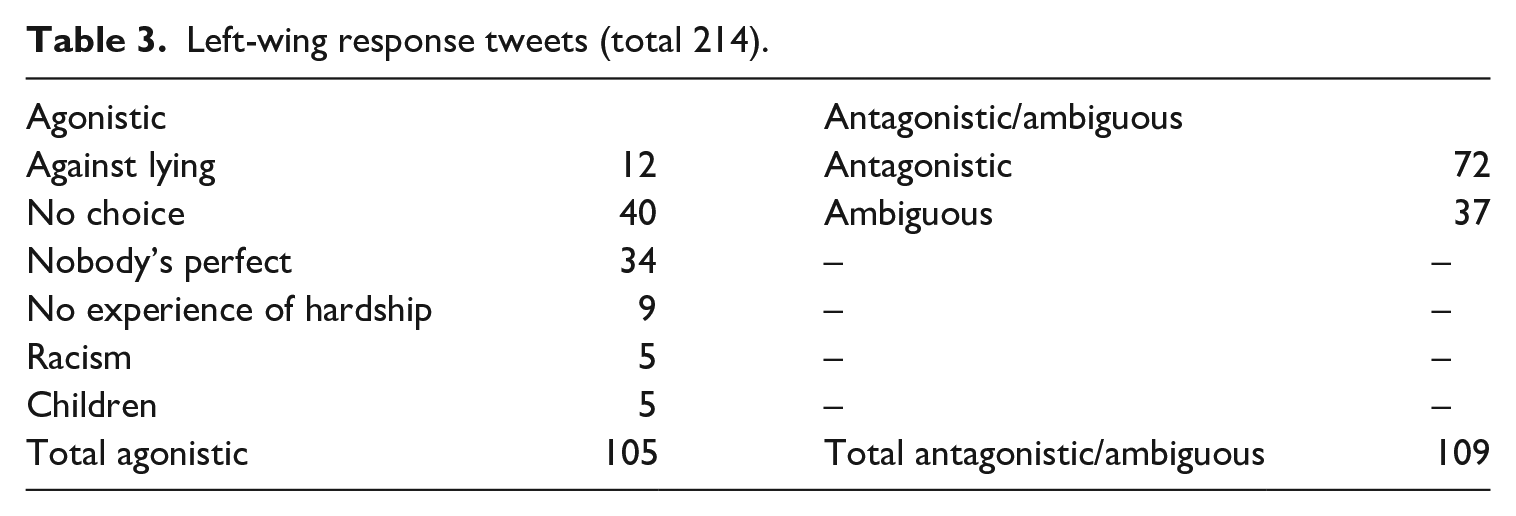
However, tweets which primarily responded to right-wing arguments with counterarguments, rather than attacks on character or motivations (thereby, classified as agonistic rather than antagonistic), were in the majority. The most common left-wing response argument (no choice, 40 tweets) specifically addresses the right-wing arguments of criminality, lying and individual choice. For example, an early tweet on 18 July wrote that ‘Beneficiaries have choices alright. Eat or heat the house’, while another a day later drew equivalences between the hashtag and a coercive and miserly welfare system which negates choice: ‘You know, people don’t WANT to say #IAmMetiria. People don’t want to rely on the tiny coins that govt gives them. They HAVE to’.
Drawing on the representation of a failing system was common within this counterargument, which asserts that right-wing allegations of individual criminality and problematic morality were out of proportion in comparison to the hundreds of thousands ‘struggling in a broken social security system & economy’ (20 July). Hence, an immoral system which caused harm on an industrial scale is contrasted against Turei’s personal ‘ethics on the welfare issue’ (23 July), which are, in fact, commended for providing ‘such a great opening for conversation’ (4 August). Similarly, against lying (12 tweets), places focus on how Turei paradoxically told ‘the truth to the whole damn country’ (18 July) and contrasted her act of lying against the ‘patronising and bullying’ of WINZ staff (4 August), which makes ‘honesty almost impossible’ (21 July).
Interestingly, only five tweets draw on the moral and affective force of children, where mothers are confronted with the non-choice of lying ‘2 feed their kids’ (21 July). And only five agonistic tweets were coded as alleging racism on the part of Turei’s critics. One tweet which did, drew equivalences with classism and sexism, alleging that much of the right’s arguments were ‘Essentially anti Women, Maori, Poor’ (3 August).
Nobody’s perfect (34 tweets) contests the law-as-black-and-white claims in the right-wing criminality argument, by questioning whether anyone can say that they have never broken the law. Equivalences are made to ‘driv[ing] over the speed limit’ (19 July), ‘Rich people [. . .] robbing us of their Taxes’ (21 July), ‘Child Support obligations’ (19 July), the corruption of senior officials, and ‘tak[ing] a cash job’ (8 August) without declaring it.
No experience of hardship (nine tweets) argues that many of the oppositional tweeters have never experienced the kind of stark choices faced daily by those enmeshed within the welfare system, which is why they are unable to show empathy towards them. While you could perhaps argue that these tweets are antagonistic, due to their focus on personal attributes, they are also making an argument by drawing attention to New Zealand’s high levels of inequality (Hodgetts et al., 2014; Wilkinson and Pickett, 2010), as well as the related separation of many of New Zealand’s political class from those most affected by their decisions. For example, on 4 August a tweet urges ‘Do NOT resign Metiria. NZ needs politicians like u who know #poverty’.
Conclusion
Through a close, qualitative analysis of 502 tweets (288 right-wing oppositional and 214 left-wing responses), posted following the initial outpouring of WINZ narratives and Turei’s confessional speech, this article has found that the majority on both sides were agonistic (180 right-wing and 105 left-wing), rather than antagonistic (44 right-wing and 72 left-wing). Agonistic tweets were defined as civil, in that they articulated ideas which can be linked to specific arguments, rather than merely attacking the personal characteristics of the opponent or mocking them (antagonistic). While previous literature has indicated that encountering opposed views online can lead to the problematic phenomena of flaming (Ceron and Memoli, 2016; Hmielowski et al., 2014), and polarisation (Beaufort, 2018), by applying Mouffe and Laclau’s concepts of agonism, dislocation and the equivalential chain, we can instead conceptualise the analysed tweets as composing two opposed hegemonies, aiming to re-fix meaning around the key floating signifier of Metiria, following the dislocative moment of Turei’s speech.
Mouffe’s (2018) dissensual model allows us to consider ideologically opposed tweets which articulate ideas and formulate identifiable arguments as part of ‘the necessar[ily] partisan character of democratic politics’ (p. 68), rather than inevitably problematic. For Mouffe, the meeting of ideologically opposed views within pre-agreed limits should be encouraged, as otherwise we inevitably see drifts towards extremism and moralism, and an increasingly fractured public sphere. At the same time, however, we do not want to further encourage hateful online discourse, and this article has attempted to pave the way towards a method for identifying agonistic tweets that articulate ideas, worldviews and moral frameworks, which can be recognised and named as a political argument, through close, qualitative analysis by a researcher familiar with the context, and who has immersed themselves within the data (Howarth, 2005; Tracy, 2013).
Through this perspective, the primary arguments articulated within the right-wing oppositional tweets can be seen as attempts to hegemonically fix meaning around the Metiria floating signifier to an individualised interpretation of events. Turei’s confession was constructed by the three most popular right-wing arguments as breaking the law, which must be punished no matter the extenuating circumstances (criminality), as being deceitful in order to steal from honest beneficiaries and taxpayers (lying), or as pre-designed to manipulate voters (politicking). All three arguments rest on the assumption that Turei the individual made rational choices, either as a beneficiary or as a politician, which were untied to messy circumstances, emotion, notions of the public good, or the heat of the moment.
Left-wing responses to these arguments, by contrast, placed emphasis on wider systemic pressures and personal circumstances, which would have impacted Turei’s choices, as well as the collective moral issue of a broken system that perpetuates structural violence. While it was to be expected that left-wing arguments would attempt to fix meaning in collectivist, and right-wing in individualist terms, the fact that left-wing arguments were seen to address specific right-wing claims (no choice addressed criminality, against lying addressed lying and nobody’s perfect addressed poor role model), indicates a level of political debate within the hashtag at a meta-level (even though the other side’s claims were most often not explicitly recognised within tweets).
Finally, there is a need to acknowledge the limitations of this article. Its main contribution is in offering a new qualitative method and theoretical vocabulary to describe democratically engaged, socially mediated political discourse, which may otherwise be dismissed as antagonistic or merely trolling. However, with it being a case study of a unique and relatively small New Zealand context, I am not suggesting that the findings could be generalised to larger, and/or more politically polarised countries. However, it may be useful for scholars based in similar sized nations, who may be as familiar with their national political context, and able to immerse themselves in similarly small-sized data sets.
Discussion and implications
In the contemporary era of fractious online discourse, I argue that it becomes normatively important for researchers to adopt an agonistic orientation to highlight examples where debates are on civil terms. While much has been written recently on the tendencies of social media’s political economy and algorithms to encourage hate and antagonism (Kuehn and Salter, 2020), abandoning it as a possible site for civil, democratic discourse going forward appears problematic, given its embeddedness within our daily communicative practice (COVID-19 has increased this) and the lack of viable alternatives available in the short-term. The agonistic research orientation I am proposing seeks both to identify instances where there is a possibility of cultivating ‘a generous ethos of engagement’ (Connolly, 2005: 31) between seemingly intractable ideological positions, and also to model such an ethos in social media practice. For the latter task, Connolly’s (2005) work can be particularly instructive, as he defines pluralism as involving an openness to the other, through accepting ‘some risk to the stability of your own identity’ (p. 31). As discussed, antagonistic, or uncivil tweets often articulate a closed identity, which displays little openness to the perspectives of the other. By contrast, being open, or civil, means being less certain as to the stability of your identity and the correctness of your opinions, which inevitably involves an element of risk, in that you may find that your opinions may be challenged or even changed. As many of us see ourselves as experts in our fields, I recognise that this can be an especially difficult position to take, however, take it we must.
At the same time, Connolly asserts that pluralism should not be conflated with relativism, with the former being grounded in principles, such as the defence of diversity and human rights, and an opposition to state oppression and plutocracy. Such principles should, therefore, be defended by scholars when engaging in online discussion, but in a way that shows compassion and an openness to the other’s political perspectives. This brings us back to Mouffe’s assertion that partisan differences and debates between those on the left and the right politically should be celebrated and encouraged, rather than retreating into our own echo chambers. Such retreats, where the perspectives of the other are treated as morally reprehensible, rather than adverserial, only leads to the growth of extremist, anti-democratic political perspectives.
Footnotes
Funding
The author(s) received no financial support for the research, authorship and/or publication of this article.

Data accessibility statement
The data that support the findings of this study are available on request from the corresponding author. While publicly available, Twitter posts contain information (such as profile usernames) that could compromise the privacy of users. Hence, no usernames have been reproduced here.