




Abstract
Employing Discourse-Theoretical Analysis coined by Laclau and Mouffe, this multi-case study examines how talent is constructed in elite youth football academies in Sweden and Germany. Based on an analysis of sixteen semi-structured interviews with coaches, scouts and sporting directors, the study identified both distinctive and overlapping patterns, contributing to a more nuanced understanding of how discursive practices shape, reinforce, and challenge conceptions of (football) talent. These dynamics are evident in the construction of the constitutive other, the repetition and reinforcement of hegemonic beliefs and power structures. The study underscores how talent functions as an empty signifier rather than a fixed or universally agreed-upon concept, which is continuously (re)negotiated through discursive struggles and marked by power and exclusion. Moreover, and with discourse-theoretical analysis being a valuable yet underutilize approach within research on communication and sport, the study also expands the theoretical and methodological scope of the field by offering a novel perspective. While offering nuanced insights into how talent is constructed and communicated, this post-structuralist study should be viewed as a context-sensitive interpretation of two specific settings, rather than a universally generalizable account.
Talent identification and development (TID hereafter) of young athletes aspiring to become professional players is a crucial task within elite football (Lund & Söderström, 2017; Söderström et al., 2021). It refers to the process of identifying, evaluating, selecting, and developing promising athletes to enhance both their individual potential and the overall success of the clubs or organizations they represent. Particularly in times of the increasing professionalization and globalization of football (Giulianotti & Robertson, 2012; Primus, 2024), efficient TID processes have become more critical than ever for both football clubs and players alike. This is particularly relevant in established football nations like Germany and Sweden, where high participation rates, large talent pools, and frequent turnover demand robust TID systems (Bennet et al., 2019; Güllich, 2014; Wattie & Baker, 2017). Given the pressures associated with having to choose and invest (financial) resources into athletes deemed most likely to succeed, football academies often begin the TID process as early as six years old – as exemplified in the case of major clubs like FC Barcelona (2025). However, this approach of early specialization has been widely critiqued in previous research (Güllich et al., 2022; Söderström & Garn, 2023), with scholars advocating for diversification (Côté & Erickson, 2015) and more holistic approaches instead (Henriksen et al., 2010; Ryom et al., 2020). In fact, the past decades have seen continuous calls of sport researchers to further investigate how high-performance environments can more effectively support young players’ well-being and progression within TID systems (Ejekwumadu & Thiel, 2024; Marques et al., 2021).
While national and international governing organizations influence clubs to adopt somewhat homogenized professional structures and objectives across borders (O'Brien & Slack, 2003), football clubs and their corresponding academies tend to operate within their own unique cultural settings regardless (Cahill & MacNamara, 2024; Kelly et al., 2024; Morganti et al., 2024). In these settings, TID stakeholders are both being influenced by and contributing to the discourses surrounding talent (Cushion & Jones, 2006, 2014; Røsten et al., 2024). Kilger (2019), for example, showed that TID processes legitimize decisions through frameworks shaped by historically specific assumptions, normative beliefs, and discursive practices. Nonetheless, TID stakeholders often hold different and sometimes conflicting understandings of talent within and across different contexts (Johnston & Baker, 2022) which is likely linked to their reliance on subjective methods such as intuition or gut feeling in decision-making (Christensen, 2009; Larkin & Reeves, 2018). Moreover, Champ et al. (2020) highlighted that coaches, many of whom have spent a significant portion of their lives immersed in football from an early age, tend to develop hegemonic beliefs that are resistant to change and challenging to negotiate. Nonetheless, beliefs are not merely a matter of individual preference, but are shaped by the broader cultural and institutional environments in which these practitioners operate. Previous research, for instance, has shown that most academy-based programs in countries like Germany differ significantly from, for example, the Scandinavian approach to sport (Bjørndal et al., 2015; Herrebrøden & Bjørndal, 2022). Given these differences, talent research has shifted in recent decades from focusing solely on the individual to also considering the broader context in which TID takes place (Larsen et al., 2013; Xia et al., 2024). Yet, a persistent gap remains in understanding how talent is perceived and operationalized across different cultural and contextual settings (Baker et al., 2024; Verbeek et al., 2023; Williams et al., 2020). Such investigations and understandings of fine nuances may be of particular importance, considering that previous research highlighted that young athletes transferring from context to context, particularly internationally, often tend to experience cultural shock not just athletically, but also socially and culturally, as they encounter different contexts and deeply embedded beliefs/worldviews (Hem et al., 2022; Lindberg, 2023).
A common belief in talent discourse and TID settings, for example, is the one of innate versus nurtured talent (Kilger & Jonsson, 2017) – although having been argued to be counter-productive and even defined as nonsensical (Ackerman, 2014; Sieghartsleitner et al., 2019). Such belief systems and discourses can have long-term implications for how athletes are viewed and evaluated, as well as impact their experience and participation in sports (Wattie & Baker, 2017). As such, and although understandings of talent cannot be expected to apply universally across different contexts (Cahill & MacNamara, 2024), the investigation of TID processes and discourses surrounding talent can offer important insights.
In response to the aforementioned calls and potential consequences relating to how talent is understood and operationalized, the aim of this study is to explore how communicative, discursive practices shape understandings of talent of 16 TID stakeholders working in a German and Swedish elite youth football club. As such, and while TID is a well-established field with a broad body of work particularly in regard to football (Baker et al., 2024; Kelly, 2024; Williams et al., 2020), this study deliberately narrows its scope to the discursive dimensions of TID. In addition, the study responds to the recent call by Wagner and Sveinson (2024), who argued that certain methods offer powerful alternatives to investigate communicative practices in sport, yet remain overlooked and underutilized in current research. As a result, a Discourse-Theoretical Analysis (Laclau and Mouffe, 1985, 1990) was employed to expand on both the theoretical and methodological horizons of existing research in the field, offering innovative frameworks for analyzing discourse within communication and sport.
Discourse-Theoretical Analysis
Discourse is a powerful social and political construct that shape perceptions and inform actions (Howarth & Stavrakakis, 2000). While discourse can be analyzed through various frameworks, such as Critical Discourse Analysis (Fairclough, 1995, 2015) or Foucauldian Discourse Analysis (Foucault, 1972, 1981), this study adopted Laclau and Mouffe’s (1985) DTA approach.
Unlike Foucault or Fairclough, Laclau and Mouffe (1990: 100) define discourse as a ‘totality which includes within itself the linguistic and the non-linguistic’. By doing so, they challenge essentialist and structuralist Marxist views arguing that society is built on natural foundations. While having ‘no definitive or natural form, no default mode’ (Jacobs, 2018, p. 297), society is structured through the ‘relationship between language and the social and cultural contexts in which it is used’ (Paltridge, 2022, p. 2). According to Laclau and Mouffe (1985), this structuring occurs through discursive practices of signification via articulation, temporarily fixing meaning of, what they refer to as, “nodal points”. As such, nodal points serve a “universal” structuring role within a given discursive field. Nodal points without fixed meaning are referred to as “floating signifiers” – their meaning only emerges when articulated in relation to other signifiers (Laclau, 2005, 2014a).
Drawing on Gramsci’s concept of hegemony, which can be defined as a dominant and collective understanding (see i.e., Gramsci & Forgacs, 1999), Laclau and Mouffe (1985) proposed that the repeated articulation of meanings can produce hegemonic structures. Nonetheless, they stressed that these connections between signifiers and signifieds are unstable and never fully fixed (Jacobs, 2018; Laclau & Mouffe, 1985). This creates a discursive arena where ideological and political struggle occurs. This contingent arena is navigated through the interplay of the logics of equivalence (i.e., what is talent) and difference (i.e., what talent is not), which continuously interact and shape the terrain of discourse. Consequently, these chains allow for the creation of collective identities through opposition to a constitutive other (Carpentier & de Cleen, 2007; Laclau & Mouffe, 1985). These discursive processes typically take place within power-laden social contexts influencing how identities are negotiated and made sense of (Carpentier & Kejanlıoğlu, 2020). It is at this polarizing point that the concept of antagonism becomes central as it introduces a fundamental division within the discursive structure. In such a context, all signifiers within the chains of equivalence and difference become aligned with a central nodal point, such as “talent”, and turn it into a so-called “empty signifier” (Laclau, 1996; Laclau & Mouffe, 1985). Consequently, the empty signifier lacks intrinsic meaning – being ‘a signifier without a signified’ (Laclau, 1996, p. 36) – and derives its significance solely from its position within the dichotomized structure. In other words: meaning is produced not through fixed definitions, but through relational oppositions (Carpentier & de Cleen, 2007; Laclau, 1996; Laclau & Mouffe, 1985; Torfing, 1990). This abstract, if not paradoxical definition, illustrates the problem of how omnipresent and ambiguous concepts may gain ‘temporary signifieds’ (Laclau, 1996, p. 35) as people struggle to establish a fixed meaning around them.
Although floating and empty signifiers often seem identical, Laclau (2014b, 2014a) draws a nuanced but important distinction between the two concepts. While a floating signifier constitutes the ‘the expression of the ambiguity inherent to all frontiers’, the empty signifier describes the impossibility of a signifier to acquire ‘any ultimate stability’ (Laclau, 2014a, p. 160). Consequently, the empty signifier, unlike the floating signifier, does not merely reflect ambiguity between competing meanings but marks the structural impossibility of achieving a fixed or final meaning while still providing temporary unity amidst hegemonic struggle for fixation of meaning.
Concluding, by employing DTA, researchers may gain a better understanding of the contingent and dynamic nature of discourses, illustrating how meanings are negotiated, contested, and hegemonized in ways that have broader social and political implications.
Methodology
Case Selection
Lacking prior connections to elite youth environments, access was a significant challenge. Therefore, club selection was primarily based on feasibility of entry. In late 2021, all youth academies of the German highest national league (Erste Bundesliga) as well as the Swedish equivalent (Allsvenskan) were contacted via email. In both cases, one club per country volunteered to participate, referred to as Club A (Sweden) and Club B (Germany). Women’s teams were contacted in both countries, however, without any success.
Club A
Club A is located in a mid-sized city in Sweden – a country defined by a decentralized and egalitarian sports structures in which talent is not necessarily culturally valued (Ibsen & Seippel, 2010; Margrain & van Bommel, 2023). Club A is renowned for its deep-rooted history and strong connection to the local community. The club has played a significant role in the development of regional football and has established itself as a key figure in its national league. Club B, on the other hand, is a relatively newer club located in a larger urban area in Germany – a country where talent and giftedness are culturally valued (Fischer & Müller, 2014).
Club B
Club B has rapidly gained prominence through a strategic focus on youth development, innovative management practices, and substantial financial investments. While Club B has faced scrutiny for its unconventional approach within the sport, it has simultaneously been recognized for its ability to achieve success both on and off the field in a short time span. Both clubs represent distinct approaches to football operations, providing valuable insights into their youth departments and organizational philosophies.
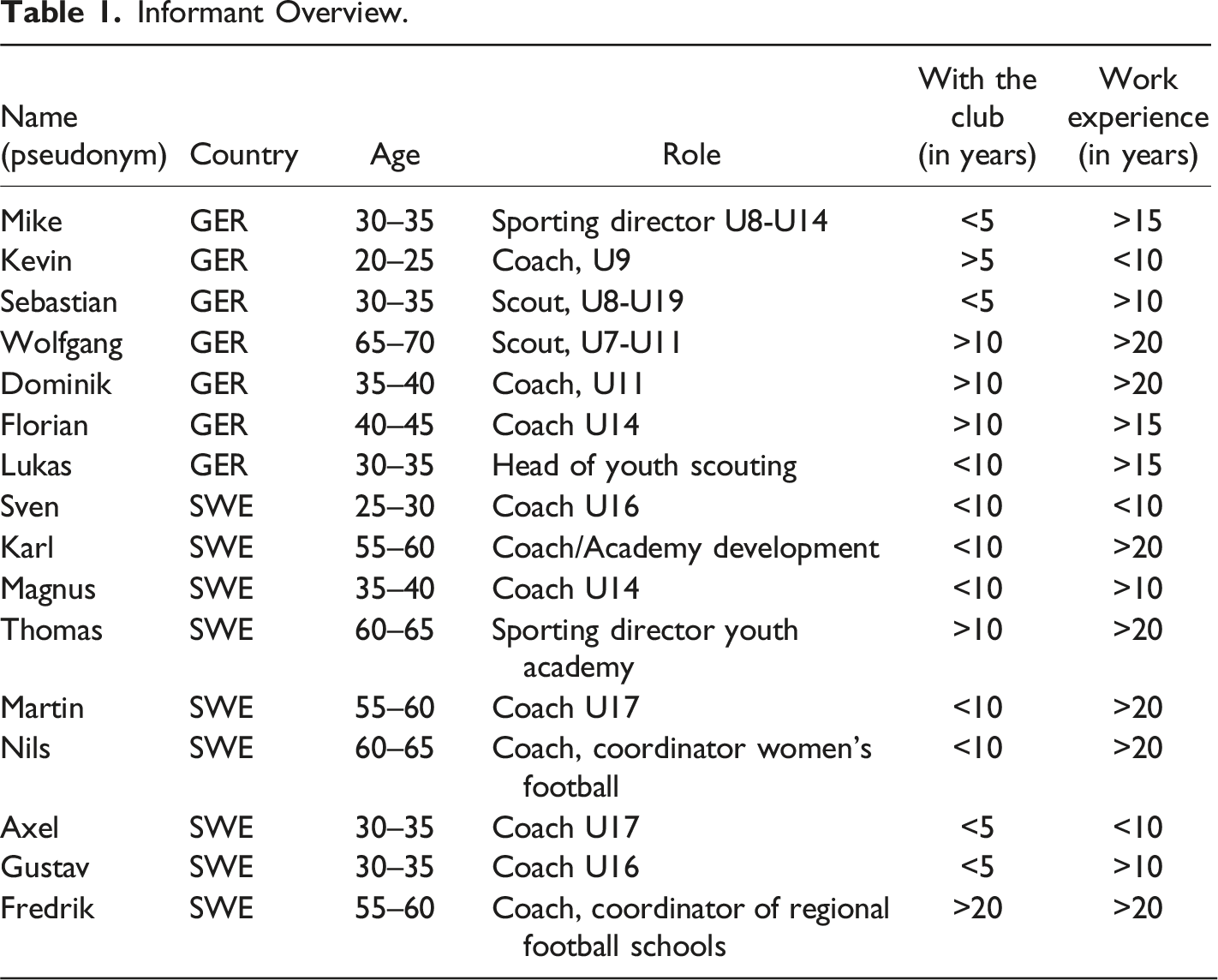
Informants
Informant Overview.
Data Collection
Taking place in October of 2022, semi-structured interviews were used to collect data. Interviews were held in Swedish and German in the respective countries. The interview guide (see Kvale, 1996) consisted of eight sections: (1) an introduction to introduce the study, obtain informed consent, and clarify ethical procedures; (2) general questions to establish rapport, gather basic demographic and background information; (3) questions concerning the informant’s current role and work context; (4) understanding and use of the term talent to explore individual and shared definitions, meanings, and uses of the concept; (5) characteristics and development of talent to examine beliefs about what constitutes talent and how it evolves; (6) youth development practices and challenges to gather insight into current practices and perceived challenges in talent development; (7) coach education and knowledge of research to understand the participant’s educational background and exposures to talent development theory; (8) closing and reflections to allow for final thoughts to be expressed, clarifications to be made, and remind about consent one more time (see supplemental material/Appendix 1). Some of the interviews naturally expanded to encompass additional topics and questions, resulting in a diverse range of interview durations lasting from 35 min up to 2 hours. A total of 1180 min recorded audio material and several hundred pages of transcriptions informed the analysis of the data. Given the amount of data collected, quotations presented in the findings section are for illustrative purposes and should not be seen as comprehensive of the entire material.
Data Analysis
Due to DTA’s lack of standardized operationalization (Howarth & Torfing, 2005), it is crucial to explain how it informed and structured the analysis. Based on Laclau and Mouffe’s (1985) approach, the analysis followed a three-step process. First, each of the 16 interviews was analyzed individually for moments, nodal points, floating signifiers, and the ways they were linked together in chains. After analyzing each interview, the chains were compared within each case to identify broader hegemonic beliefs and antagonisms. During these phases, attention was paid to how collective identities were formed through the inclusion of certain moments and the exclusion of certain elements, ultimately creating instances of the constitutive other. Finally, the totality of the discourse was examined by comparing the Swedish and German discourses, again focusing on identifying hegemonic ideas, antagonisms, and how the different discourses interacted with one another constructing boundaries of inclusion and exclusion.
Positionality and Reflexivity
The research process is inevitably shaped by our identities and social positioning. As Sveinson et al. (2025: 79) argued, ‘positionality and reflexivity are inherent to rigorous research design regardless of paradigm, adding a meaningful counter to routine means of demonstrating rigor’. As such, awareness of one’s own positionality – shaped by identity, experience, and knowledge – allows for critical reflection on one’s role and potential biases in the research process (Milner, 2007; Sveinson et al., 2025). In this study, my position as a White woman living in Western Europe likely influenced aspects such as field access, informant interactions, and data interpretation. This seems particularly relevant to mention given football’s persistent male-dominated context (see i.e., Bryan et al., 2021). This study should therefore be read as a situated interpretation rather than a universally generalizable account.
Ethical Considerations
The Swedish Ethical Review Authority waived the requirement for ethical approval (ID:2022-03401-01). All data has been collected and stored according to the General Data Protection Regulation (GDPR). Research participants and their respective clubs have been anonymized.
Findings
The findings are presented case by case, beginning with Club A (Sweden) and followed by Club B (Germany). Following the individual cases, findings will be discussed in their totality. This approach ensures that both unique and shared aspects across contexts are considered, minimizing the risk of conflation or oversimplification.
Talent Discourse in Club A (Sweden)
In Club A, athletes were generally perceived to have “some kind of talent” while still being unique. I would argue that even if they are all different, every player in our club has some kind of talent. Gustav
This notion reinforces a discourse in which talent is understood as an essential attribute for athletes to access and remain relevant for high-performance environments like Club A. Nonetheless, the expression “some kind of talent” further suggests a contingent nature of what constitutes talent and what does not. Personality traits (i.e. emphasizing self-awareness, continuous improvement, and active engagement) and cognitive abilities were particularly emphasized by the informants and, thereby, discursively constructing talent in relation to what it is not. To me, part of a lot of talent is if you easily learn things and if you have a mindset that you want to learn things. I think that is very much connected to talent because that is usually when things turn out well. (…) It's one of the most crucial aspects that the players want to develop. That should be their number one priority. They should come and think 'today will be better’ every day. But we don’t want them to just show up and train. We want them to be aware and mindful of the training and what they still need to improve. Axel I have mentioned other important aspects but if I have to choose one? I would always end up choosing ‘personality’ over others. Nils
Nonetheless, the informants also emphasized that they did not expect athletes to be good at everything. However, there was an expectation to have “some kind of edge” regardless, as seen in the following examples: You can be a little weaker than someone else, but you still need to have some kind of edge; (…). You don't have to be the best at everything, but you need to have something that stands out. Magnus When you're 14, 15, they start looking at...'OK, what are you good at? What's your specialization? Is it that you are fast? Are you good at passing? Are you good at shooting? Or are you good at saving balls? Then you try to work with this because it's quite difficult if you're good at a lot. Gustav
While this seemingly reduces the pressure for young athletes having to tick all the boxes, players who are performing averagely at most things may not be recognized as particularly talented due to their lack of specificity. As a result, such players may slowly fall outside dominant talent discourses, aligning with the logic of difference – or constitutive other – risking to become overlooked.
Furthermore, the informants expressed ideas that (1) not everyone is naturally endowed with talent, and (2) if they were, this would usually be evident from an early age without extensive training: Not all people have it, just like all people aren’t good at math. (…) You can see that quite early... young children who have a natural feeling for the ball. Martin
The notion that talent, or certain aspects of it, must be visible as early as possible was further justified and understood within the context of the sport’s increasing professionalization: At the elite level, you don't really have time to wait forever for athletes to deliver. In less fast-paced environments, you maybe have time to wait, but at the elite-level athletes are replaced quickly. But that’s also a matter of finances. Fredrik
Fredrik’s statement underscores the inherent urgency that defines elite sport and TID environments. Simultaneously, the notion that talent must be “visible” (ideally as early as possible) aligns with the logic of evaluation and commodification prevalent in elite sports and likely marginalizes alternative and more athlete-centered, holistic approaches to player development. These exclusions establish antagonistic boundaries, positioning less commodified methods of sports development as impractical or incompatible with the demands of modern elite environments. Nonetheless, the Swedish informants also emphasized the crucial role of a supportive environment within TID: We try to inspire our athletes by providing fun practices and to create an environment that is encouraging, supportive and forgiving. (…) I think that's important for talent to thrive. Karl
While these utterances seemingly challenge hierarchal and top-down approaches to TID and coach-athlete relationships, ideas of discipline and power where articulated regardless. For instance, Thomas highlighted that the success of talented athletes was deeply dependent on the context Club A provides: The talent is something that you own but what you own needs the help of a club or coach or together with parents and school in order to become a broader concept. Thomas
This statement reflects Laclau and Mouffe’s (1985) idea of hegemonic struggles, where different actors and institutions aim to establish their world views and corresponding practices as dominant. These actors are not neutral entities but have their own interests and agendas influencing how talent is nurtured and recognized. By constructing and upholding the hegemonic belief that talent depends on external environments and actors, the academy positions itself and its networks as essential to the talent pathway. As a result, it marginalizes alternative routes of development and legitimizes its own role as the primary gatekeeper of talent.
The analysis further revealed that informants struggled to establish meaning over the concept of talent due to competing discourses of talent happening beyond their coaching and club contexts. Sven, for instance, stated that: I think the term is often misused – for instance in the media. There are so many different definitions depending on who you talk to that it becomes really difficult to define exactly what talent actually means. Sven
Sven’s reflection underscores how the struggle to define talent is not merely a semantic issue or contained by strict contextual boundaries, but one deeply entangled with the discursive power of institutions, cultural norms, and mediated representations.
Talent Discourse in Club B (Germany)
“Talent” constituted a central signifier within the discourse of high-performance sport in Germany, as illustrated by Lukas: Well, I hear the term [talent] all the time. Simply because every meeting somehow involves “regional talent”, “top talent” or “talent scouting” - I'll have to check, but I think there are relatively few days I don’t use “talent”. Lukas
As he notes, references to talent are invoked on a daily basis, whether in reference to “regional talent”, “top talent”, or “talent scouting”. This example highlights the contingency of talent and how it can be understood as a “floating signifier” anchoring meaning across different contexts. This was further highlighted in the conversation with sporting director Mike arguing that: With talent, there are so many different definitions, interpretations, and perspectives I’m confronted with. When I talk to scouts, I realize that for them, other things matter than for the athletic trainer, the psychologist, or the parents who consider their child to be talented. (…) You could probably ask 230 people about a player in a complex team sport and they would all have 30 different understandings of talent. Of course, some would be similar. I have my own understanding, but we never had to define it here… but that’s also why I’m interested in the topic. Maybe we can manage to get a little closer to a common understanding. Mike
Having never needed to explicitly define talent during his time at Club B, Mike’s statement points to the implicit nature of many professional knowledge systems, where individuals often rely on tacit knowledge and shared assumptions rather than formal definitions. At the same time, Mike’s openness to “getting a little closer” to a shared understanding also suggests an awareness that these meanings are never fixed, but constructed and negotiated through discourse and discursive struggle and in relation to others.
A lack of talent usually was not explicitly associated as a cause for the deselection of athletes, but rather a lack of performance or engagement. Based on these articulations, athletic success was not necessarily understood as dependent on talent: There is talent, but at some point we expect performance. (…) I usually scout for players who are good for the team immediately. We sometimes don’t sign players for the new season because we have the feeling that they still have to develop physically, and not so much because they are lacking skills. Sebastian What actually is a disqualifying criterion for me is a lack of activity, now that I think about it. We had a cute situation during a scouting session with the younger ones – there was this one defender who spent most of the time chatting to the goalkeeper. They were just chatting away while his team had the ball. He just wanted to talk. And it’s super cute in a way, but it became clear to me, ‘OK, this is not really a talent in the sense of talent promotion’. So yes, a lack of activity, passivity. Mike
These statements suggest an expectation for talent to translate into observable performance for evaluation purposes. Nonetheless, and in line with previous research suggesting that athletic performance is an unreliable predictor of future success (Güllich, 2014), informants also pointed out that performance was not always reliable. As such, “performance” was tightly connected to articulation surrounding “development” – as seen in the following quotations by Dominik, Florian and Wolfang: Children fluctuate in their performance. Even talented children are very unstable (…). This is perhaps a bit easier with older children aged 15 and over, because their performance is a bit more consistent then. Dominik I know some players that were good from the beginning and others that were a long way from exceptional going through ups and downs but are now playing in the Bundesliga simply. You never really know for sure because development is so individual. Florian What also made him stand out is that he always had a steady development. Wolfgang
Overall, these statements construct a discourse where performance stability is positioned as desirable and normative, especially when discussing older children (in these examples, aged 15 and over). The distinction between younger and older children serves as a discursive marker that influences how performance and development variability is interpreted, ultimately shaping expectations, assessments, and opportunities within TID processes.
While talent was not bound to one specific characteristic, the informants made it clear that not all aspects were considered equally: They say, ‘he’s fast, he actually has everything, he’s technically gifted and he’s huge, but he just doesn’t do it’…that's when I realize again and again that personality is also a talent. Sebastian That I can develop and work on my technique, for instance, is less of a talent in my eyes and more practice over time. (…) maybe technique and tactical thinking could be considered something like a secondary talent. Kevin
Sebastian’s statement reflects an attempt to expand the discourse of talent to include personality traits, positioning personality as an equally important aspect of talent as, for instance, speed or physicality. Differentiating between innate and acquired abilities, Kevin, on the other hand, frames technique and tactical thinking as “secondary talents”. This differentiation between “primary” and “secondary” talents can be understood as an attempt to fix the meaning of “talent” through a hegemonic articulation. This discursive move establishes a hierarchical structure within the talent discourse, producing relations of equivalence and difference that privilege certain understandings of talent while marginalizing others. In other words: Kevin reinforces a discourse in which primary (inherent) talent is more foundational than secondary (learned) talent.
Discussion
Talent constitutes a common point of identification for TID stakeholders in both Swedish and German football academies. However, as shown in the analysis, what talent is or is not, is a fragile concept dependent on ongoing negotiation of its meaning. The messiness of this ongoing negotiation is arguably what makes talent so hard to pinpoint, complex (Christensen, 2009; Larkin & Reeves, 2018), and ultimately, is the reason as to why certain talent understandings are not necessarily transferable outside of their specific contexts (Cahill & MacNamara, 2024; Xia et al., 2024). As such, the analysis highlighted that talent can be argued to be an empty signifier – a term lacking intrinsic meaning and depending on being put into relation to other signifiers to make sense. Considering that high-performance environments do not have the capacity or resources to take in everyone, it is not surprising to find that TID environments leverage concepts like talent despite their fluidity. In fact, it could be argued that its fluid and contested nature allows them to set boundaries of inclusion and exclusion in ways that serve their institutional interests, while appearing meritocratic and objective.
Comparing the German and Swedish case, both exhibited shared and unique articulations surrounding talent were visible. For instance, in both cases talent was articulated around nodal points such as “environment”, “performance”, “development” or “personality”. Aligning with previous research (Larkin & O’Connor, 2017; Lenz et al., 2020), “personality” was particularity highlighted as important for success within both academies. Nonetheless, how exactly understandings of key TID factors, such as “personality”, are constructed might look similar from afar but look very different when closely examined (see also Monsees, 2024; Xia et al., 2024). For example, while Mike (Club B) articulated overly social personalities as problematic, overly social personalities were not specifically articulated to be problematic in the Swedish talent discourse even if “personality” was perceived as important here, too. As such, and while “personality” was valued across both contexts, paying attention to the specific attributes linked to it is crucial for a nuanced view of how athletes are perceived in TID settings. As such, nodal points connected to “talent”, like “personality”, are often floating signifiers. Which personality traits exactly are favorable in football settings is likely shaped by broader societal expectations. Dominant societal discourses, particularly those linked to gender, class, and cultural norms, may play a significant role in defining what constitutes a “successful” personality (Bishop & Borrie, 2025; Rocha, 2025). The dominance of specific personality traits in TID discourses risks marginalizing athletes who do not fit this hegemonic mold –particularly those athletes from underrepresented social classes or cultural backgrounds (see i.e., Kelly et al., 2024; Morganti et al., 2024) and whose personalities may not align with the dominant values. As a result, this might reinforce the favoritism of athletes whose backgrounds and behaviors resonate with the dominant cultural and institutional narratives. This process reflects the broader historical and socio-political power dynamics (see i.e., Kilger, 2019) that shape the opportunities available to different groups of athletes, highlighting how certain children may have more access to the type of talent development environments that reward these “successful” personality traits, leading to social differentiation. Consequently, the findings align with previous research by Cushion and Jones (2006) highlighting the enduring importance of cultural and symbolic capital for players to succeed in TID environments – even though their study was conducted nearly two decades ago, little appears to have changed since.
With football clubs being crucial environments for the development of aspiring football players (Lund & Söderström, 2017; Söderström et al., 2021), it is undeniable that they hold some kind of power over particular talent discourses (Cushion and Jones, 2006, 2014). In fact, the analysis revealed that TID stakeholders in both cases were actively involved in discursively reinforcing power structures – acting as gatekeepers of opportunity for promising athletes through the creation of the constitutive other, while also bolstering their institutional reputation as essential to player development (Pring & Walford, 1997). By positioning athletes as dependent on high-performance environments for their development and future success, TID stakeholders further marginalize alternative voices, such as grassroots clubs and community coaches, as legitimate pathways to elite performance. Consequently, this power position makes it challenging for alternative, more holistic approaches to contest dominant narratives and gain visibility or institutional recognition within the prevailing discourse of talent.
Adding to this, the findings suggest a hierarchization and fragmentation into secondary and primary talents. This reinforces more traditional discourses of nature versus nurturable talent(s) (Kilger & Jonsson, 2017), despite long-standing research that has argued that ‘both the extreme nature and the extreme nurture views are silly’ (Ackerman, 2014, p. 15). Such persistence illustrates how hegemonic discourses, sustained through repetition, institutional endorsement, and the marginalization of alternative perspectives, can shape what is considered legitimate knowledge. Over time, these narratives become normalized and taken-for-granted, making them resistant to critique or reconfiguration even when faced with contradictory evidence.
Hegemonic beliefs about the importance of early specialization for the success of talented athletes were articulated in both contexts, despite previous research continuously arguing against such practices (Güllich et al., 2022; Söderström & Garn, 2023). Previous research, for instance, has shown that specifically deselection due a lack of physical maturation can significantly impact athletes’ well-being across social, physical, and psychological dimensions (Brown & Potrac, 2009; Edwards & Brannagan, 2023; Robb et al., 2025). Nonetheless, TID was characterized by urgency in the form of instant visibility and effectiveness, aligning with the logic of evaluation and commodification prevalent in elite sports (Giulianotti & Robertson, 2012; Primus, 2024) and running the risk of reinforcing the RAE (Kelly et al., 2020). Concerning the latter, Sedeaud et al. (2025) suggested that TID environments must consider relative, biological, and training ages of athletes and ensure the implementation of corrective adjustment procedures, such as age rebalancing, to mitigate unintended disadvantages and biases in TID. As such, talent discourses are influenced by financial and practical considerations which serve as signifiers legitimizing decisions about who gets to stay and who does not. Together, these discourses marginalize alternative approaches positioning less commodified methods of sports development as impractical or incompatible with the demands of elite environments. These beliefs, too, may impede the adoption of alternative, more holistic discourses and approaches that many have advocated for in the past (Henriksen et al., 2010; Ryom et al., 2020).
That some understandings of talent appear not only context-specific but also increasingly universal, such as those on early specialization, is perhaps unsurprising given the ongoing professionalization and globalization of football (Giulianotti & Robertson, 2012; Primus, 2024). National and international governing bodies play a key role in this process, encouraging clubs to adopt homogenized professional structures and performance objectives across borders (O'Brien & Slack, 2003). However, the findings suggest that these hegemonic understandings might overshadow more localized, cultural discourses within TID academies. For instance, despite Sweden’s decentralized and egalitarian culture (Ibsen & Seippel, 2010; Margrain & van Bommel, 2023), the Swedish informants emphasized the need for athletes to stand out in order to be deemed “talented”. While Monsees (2024) found that Swedish media would typically articulate talented football players as “humble”, thereby matching and reinforcing broader cultural expectations, however, this was not the case for the interviewed staff of this study. Although it may be difficult to move away from global and decontextualized talent discourses due to the professionalization and pressures of elite sport (Giulianotti & Robertson, 2012; Primus, 2024), finding a balance between global demands and the specific cultural and contextual nuances is crucial. Previous research, for instance, suggested that high-performing Swedish football players often experience significant pressure to conform to cultural expectations (Kilger & Jonsson, 2017). As such, finding a balance between global and local discourses could promote athletes’ well-being and progression within TID environments (Henriksen et al., 2010; Söderström et al., 2021).
Conclusion
In response to previous calls for deeper explorations of the nuanced understandings of talent in sport, this study aimed to explore how communicative, discursive practices shape understandings of talent among sixteen TID key stakeholders working in a German and Swedish elite youth football club. By analyzing the sixteen semi-structured interviews, the study identified both distinctive and overlapping patterns, contributing to a more nuanced understanding of how discursive practices shape, reinforce, and challenge understandings of talent. These dynamics become evident in the construction of the constitutive other, as well as the repetition and reinforcement of hegemonic beliefs and power structures. As a result, the study underscores how talent functions as an empty signifier rather than a fixed or universally agreed-upon concept, which is continuously (re)negotiated through discursive struggles and marked by power and exclusion. Additionally, given the limited application of DTA in sport and communication research, this study expanded both the theoretical and methodological scope of the field by offering a novel perspective on how dominant concepts of sport talent are constructed, understood, and communicated within and across contexts (Wagner & Sveinson, 2024). However, and acknowledging the limitations of this study, it should be highlighted that discourse research does not aim to establish a definitive truth. Consequently, and despite offering nuanced insights into how talent is constructed and communicated, this post-structuralist study should be viewed as a context-sensitive interpretation of two specific settings, rather than a universally generalizable account. Future research could explore talent constructions in non-European, non-Western, and non-football environments. Given the dominant focus on male coaches and male athletes in existing talent research, more work on how talent is constructed from inclusive gender perspectives could yield novel and insightful findings.
Supplemental Material
Supplemental Material - Talent Constructions in German and Swedish Academy Football: A Discourse-Theoretical Approach
Supplemental Material for Talent Constructions in German and Swedish Academy Football: A Discourse-Theoretical Approach by Leah M. Monsees in Communication & Sport
Footnotes
Acknowledgments
I would like to thank the informants for their time and trust. Their participation was invaluable for this study.
Declaration of Conflicting Interests
The author(s) declared no potential conflicts of interest with respect to the research, authorship, and/or publication of this article.
Funding
The author(s) received no financial support for the research, authorship, and/or publication of this article.
Ethical Statement

Data Availability Statement
The data that support the findings of this study are available on request. The data are not publicly available due to containing information that could compromise the privacy of research participants.
Supplemental Material
Supplemental material for this article is available online.
References
Supplementary Material
Please find the following supplemental material available below.
For Open Access articles published under a Creative Commons License, all supplemental material carries the same license as the article it is associated with.
For non-Open Access articles published, all supplemental material carries a non-exclusive license, and permission requests for re-use of supplemental material or any part of supplemental material shall be sent directly to the copyright owner as specified in the copyright notice associated with the article.
