



Abstract
The objective of this study was to investigate YouTube as a venue for social connection among LGBTQ individuals (N = 428). Exposure to LGBTQ YouTubers positively contributed to self-esteem and collective self-esteem (specific to the LGBTQ community). Social connectedness mediated the relationship between exposure to LGBTQ YouTubers and self-esteem, which was moderated by social support and outness. Viewing LGBTQ YouTubers was positively related to social connectedness among participants open about their LGBTQ identities and who reported the lowest social support, but negatively related to social connectedness among those concealing their LGBTQ identities and who reported very strong social support. Open-ended data suggest that entertainment and social connection were the primary motivations for viewing YouTube videos. Results are discussed in terms of minority stress, and the value of social media platforms for social connection with like-others among marginalized populations.
Lesbian, gay, bisexual, transgender, and queer (LGBTQ) individuals experience unique minority stressors related to their sexual or gender identities that can negatively influence their self-esteem (Teasdale and Bradley-Engen, 2010), which is particularly concerning given that heightened self-esteem can alleviate stress, foster coping skills, and increase emotional health among LGBTQ individuals (Longares et al., 2016; Swann and Spivey, 2004). Indeed, both personal self-esteem (i.e. individual worth; Diener and Diener, 1995) and collective self-esteem (i.e. worth derived from social group membership; Crocker et al., 1994) have been argued to be among the strongest predictors of subjective well-being.
Although LGBTQ identities do not necessitate dysfunction and LGBTQ acceptance has improved in many parts of the world, navigating LGBTQ identities in hetero- and cisgender-dominant societies can nonetheless result in discrimination and marginalization (Lee and Ostergard, 2017). Social factors such as perceived support from friends (social support) and a sense of belonging (social connectedness) are critical to protect against the hindrances to self-esteem induced by minority stressors (Romijnders et al., 2017). For many LGBTQ individuals, particularly youth, establishing interpersonal relationships and engaging in communal experiences that could strengthen social support and connection can be arduous for a variety of reasons, ranging from geographic limitations to identity concealment (Gray, 2009). A limited but growing body of research suggests that social media may provide LGBTQ individuals with LGBTQ-relevant information and access to like-others that is needed to bolster perceptions of social support and connection (Baams et al., 2011; Ceglarek and Ward, 2016; Fox and Ralston, 2016). Much of the research investigating the role of social media in establishing and maintaining LGBTQ social support and connectedness has considered social media cumulatively, though there is reason to believe that individual platforms may differ in their utility for marginalized individuals. YouTube is one such platform.
YouTube is functionally unique from other social media platforms because the format encourages long-form video content that may facilitate more authentic emotional expression and greater self-disclosure among content creators than text-based platforms such as Twitter or short-form video-based platforms such as Snapchat, Instagram, or TikTok (Tian et al., 2019). Critical analyses support this claim, often concluding that LGBTQ YouTube videos are accessible windows into visibly diverse and complex sexual and gender identities, narratives, and communities (Lovelock, 2019; Wuest, 2014). If YouTube content is perceived as especially authentic and intimate, the platform may have increased value among marginalized individuals seeking information and connection, which may explain why an online survey of more than 6000 LGBTQ adolescents and young adults throughout North America found that time spent on YouTube outweighed time spent on other social media platforms (see Austin et al., 2020; Craig et al., 2021). Lawson (2015) referred to YouTube as a “gay oasis” when arguing that the platform allows queer people to see and be seen like never before. Although interview research suggests that LGBTQ individuals often turn to YouTube for social purposes (Fox and Ralston, 2016) and studies investigating LGBTQ YouTube videos (Green et al., 2015) and comments (Levinson et al., 2020) argue that YouTube serves as a safe, public stage for LGBTQ expression and experimentation, little is known about the relationship between exposure to LGBTQ YouTube content and LGBTQ viewers’ perceptions of social support and connectedness.
This study broadens the scope of understanding YouTube as a digital arena for LGBTQ visibility by employing survey methods to analyze the relationships between exposure to LGBTQ YouTube vloggers (i.e. YouTubers), social support, social connectedness, and (personal and collective) self-esteem among a sample of LGBTQ individuals who consume YouTube content. Moreover, the data were collected by utilizing novel procedures involving YouTube influencers as recruitment spokespersons, a potentially fruitful method for future social media audience receptivity research. Research on LGBTQ social media use and effects is briefly reviewed before further justifying the value of studying YouTube using minority stress theory.
Social media and LGBTQ users
Social media provide LGBTQ youth with alternative spaces to rehearse the coming out process, find like-minded others to interact with and learn from, and enculturate into the LGBTQ community (Craig et al., 2021). The design and utility of many social media sites accentuate both consumption and interactivity and, as such, have been found to provide LGBTQ individuals with digital communal grounds perceived as safe and supportive (Austin et al., 2020; Baams et al., 2011; Fox and Ralston, 2016; McConnell et al., 2017). A national survey of LGBTQ youth highlights the value of social media sites for this population: 18% reported participating in an LGBTQ group outside of school, but 52% reported participating in an online community that addresses issues facing LGBTQ youth (Human Rights Campaign [HRC], 2012).
Social media may be markedly important for LGBTQ individuals who feel they are missing socialization resources that would help them understand their sexual or gender identities. Those who have difficulty finding LGBTQ-inclusive information (Fox and Ralston, 2016), who do not see themselves reflected in mainstream representations of LGBTQ people (Gray, 2009), or who have difficulty connecting with other LGBTQ individuals in their real-lives (Grossman and D’Augelli, 2004) have been shown to benefit the most from LGBTQ-focused social media engagement. The benefits of social media for this population has been primarily conceptualized as well-being, which has varied in operationalization from measures of anxiety and hostility (Ceglarek and Ward, 2016) to psychological distress (McConnell et al., 2017). Regardless of measurement discrepancies, the positive effect of social media use on LGBTQ individuals’ well-being is typically attributed to online social support (Baams et al., 2011; McConnell et al., 2017). The relationship between social media use and well-being, and the role of social support in this relationship, can be explained by minority stress theory (Meyer, 2003).
LGBTQ minority stress
LGBTQ individuals are twice as likely as their heterosexual peers to experience verbal harassment and physical assault (HRC, 2012), which may manifest into minority stress that harms LGBTQ individuals’ self-esteem. Meyer’s (2003) minority stress theory posits that LGBTQ individuals live with unique, chronic stressors cultivated from the stigma attached to their sexual or gender identities. These minority stressors, such as institutional discrimination, negatively affect self-esteem. In line with minority stress theory, Williams and colleagues (2017) found a negative correlation between minority stressors and self-esteem among LGBTQ individuals. Lowered self-esteem is particularly concerning given its connection to depression, risky behaviors, and suicide ideation in the LGBTQ community (Longares et al., 2016; Swann and Spivey, 2004). Increased resilience and sophisticated coping abilities that stem from social support and connection can dampen the effects of minority stressors (Meyer, 2003).
Social support and social connection
Social support consists of individuals’ perceptions that they would receive emotional or instrumental assistance from people within their social network when needed. Social support is crucial to coping with minority stressors, and an increased perception of social support among friends has been strongly correlated with well-being among LGBTQ individuals (Shilo and Savaya, 2011).
Social support may influence the utility of YouTube and its relationship to LGBTQ individuals’ sense of belonging or social connectedness. Social connectedness is an internal sense of belonging and finding place within one’s social world (Detrie and Lease, 2007). Social connectedness is distinct from social support, as it regards how individuals fit in with like-others rather than their perception of support from others. Social connectedness has also been correlated with self-esteem (Lee and Robbins, 1998), and LGBTQ youth who have LGBTQ friends report less depressive symptoms (Ueno, 2005), arguably because social networks inclusive of like-others bolster feelings of social connection to the LGBTQ community, which can dampen deleterious effects of discrimination or marginalization as predicted by the minority stress model (Meyer, 2003).
Social media can act as venues for social connection, particularly among individuals who are seeking a sense of belonging that they lack in their offline lives (Lucero, 2017). A national survey of LGBTQ youth points to the potential value of social media for social connection: only 49% of LGBTQ youth have an adult that they could turn to for social support compared with nearly 80% of heterosexual youth, and almost 90% of LGBTQ youth report hearing positive messages about being LGBTQ on the Internet, far more than the next most frequent source of positive messages (i.e. peers at 69%; HRC, 2012). The lack of offline social connection and the frequency of online supportive messages increase the importance of social media. Social connectedness is negatively related to minority stress, and positively related to self-esteem (Lee and Robbins, 1998). Fox and Ralston (2016: 639) note in their interview study with LGBTQ informants that “video sites like YouTube can be particularly useful because they provide rich video content and their searchability makes it easy to identify relevant content.”
YouTube
YouTube was launched in 2005 as a video sharing site. YouTube converged traditional media such as television, film, and music but also catered to amateur content creators who could post original content to the site no matter the production value. YouTube is also embedded with social networking features that allow users to actively engage with content creators and other users. Haridakis and Hanson (2009) found that YouTube videos were viewed for information and entertainment, similar to traditional screen media, but that social interaction was also a significant predictor of YouTube exposure. Such a motivation is distinct from traditional screen media and reflects the social nature of YouTube. The unique affordances of YouTube that shape users’ interactions with the platform likely account for its success. The ability to like, dislike, share, and comment on videos cultivates both a perception of user control and a sense of community (Rotman and Preece, 2010). Individuals do not just watch videos, they engage with videos (and with each other). Rotman and Preece (2010) argued that YouTube allows users to interact, find shared purpose, and garner practical and emotional support that are innate elements of community building, which could explain why LGBTQ young adults are more likely to use YouTube than message-based platforms such as Facebook or Twitter to answer questions, learn new things, and seek LGBTQ-specific information (Craig et al., 2021). An analysis of YouTube comments further suggested that LGBTQ audiences not only share and view YouTube for entertainment but also for information-seeking, social connection, and validation (Levinson et al., 2020). Tian and colleagues (2019) predict that the preference for YouTube stems from strong perceptions of authenticity and intimacy that are more difficult to cultivate in static, more curated posts on platforms such as Instagram and Facebook.
YouTube’s video library and embedded interactive features may provide LGBTQ individuals with the resources, connections, and space needed to develop a sense of social connection that would correlate not only with personal self-esteem but also with feelings toward the LGBTQ community in which they belong, or collective self-esteem. Collective self-esteem refers to the positive evaluation and attitude toward social in-groups (Barker, 2009; Crocker et al., 1994). Collective self-esteem may be decidedly important for LGBTQ individuals given that marginalization can cause social shortcomings that could be remedied by meaningful membership within the LGBTQ community (Detrie and Lease, 2007). Research suggests that a strong, positive perception of LGBTQ community membership is related to social support (Romijnders et al., 2017), less psychological distress (Sanchez and Vilain, 2009), and self-esteem (Lebeau and Jellison, 2009). Barker (2009) found that collective self-esteem was correlated with social compensation motivations for using social media among adolescents, suggesting that those who feel negative about their social identities may seek support from like-others via social media platforms.
LGBTQ YouTubers have vastly altered the accessibility of LGBTQ-inclusive information and connection with LGBTQ others (Fox and Ralston, 2016) that may influence LGBTQ individuals’ perception of social connectedness. Feeling a strong sense of belongingness is associated with self-esteem (Lee and Robbins, 1998) and with collective self-esteem (Barker, 2009). Given the LGBTQ visibility and interactivity rendered on YouTube, and the assumptions of minority stress theory, the following hypotheses are proposed:
Hypothesis 1 (H1). Exposure to LGBTQ YouTubers will be positively correlated with self-esteem, a relationship that will be mediated by social connectedness.
Hypothesis 2 (H2). Exposure to LGBTQ YouTubers will be positively correlated with collective self-esteem, a relationship that will be mediated by social connectedness.
A lack of interpersonal resources increases the importance of online social connection (Gray, 2009). Bond (2018) found that LGBTQ youth had stronger connections to their favorite media personae if they reported fewer offline LGBTQ friends. LGBTQ YouTubers may be more strongly associated with feelings of social connectedness among LGBTQ individuals who are employing YouTube as compensation for deficiencies in social support. As such, the following is hypothesized:
Hypothesis 3 (H3). The predicted relationship between exposure to LGBTQ YouTubers and social connectedness will be moderated by social support, such that the relationship will be stronger for those reporting less social support among offline friends.
Previous research suggests that outness may be a factor worthy of attention when investigating social media use among LGBTQ individuals (Fox and Ralston, 2016). Individuals exploring their sexual or gender identities may benefit most from LGBTQ-inclusive YouTube content as they are seeking information to understand and label their identities. Alternatively, those committed to their sexual or gender identities may have stronger desires for social connection with other LGBTQ individuals as they move to integrate their identities into their environments. As such, the following research question is proposed.
Research Question 1 (RQ1). Will outness moderate the predicted relationship between exposure to LGBTQ YouTubers and social connectedness?
The duality of YouTube as a video database and a social hub has sparked interest in how consumers engage with the platform. User motivation studies have been grounded in the uses and gratifications perspective, which presumes that people use media to gratify specific needs, and that ascertaining user motives can illuminate potential effects of media exposure (Sundar and Limperos, 2013). Studies employing college-aged samples specifically studying YouTube and those using LGBTQ samples studying social media more generally have discerned common motives for consumption, such as social interaction, entertainment, and education (Craig et al., 2021; Haridakis and Hanson, 2009, respectively). An extensive literature review, however, failed to uncover any research specifically examining motivations for YouTube use among LGBTQ individuals, sparking the final research question.
Research Question 2 (RQ2). What are the self-reported motivations for YouTube exposure among LGBTQ individuals?
Method
Procedure and participants
Participants were recruited by 12 LGBTQ YouTubers who volunteered to mention the study in a video or text message posted to their YouTube channel or other social media platform. YouTubers who served as recruiters self-identified as gay (n = 5), lesbian (n = 5), or transgender (n = 2) on their YouTube channels. They had between 10,000 and 110,000 followers, and regularly posted vlogs in which they spoke directly to their viewers, often about their sexual or gender identities. For example, representative posts at the time of data collection were titled, “How Lesbians Prepare for a Second Date,” “Two Year Transition Highlights,” and “I Asked Him To Be My Boyfriend.” YouTubers noted in their recruitment messages that they were helping researchers find participants for a study about YouTube habits and how people feel about themselves. YouTubers were required to mention that the study was anonymized and participation was voluntary. A hyperlink to the online questionnaire was provided in the recruitment video description or in the body of the text message posted. Individuals 18 years of age and older provided digital consent to participate; assent was provided by those younger than 18 years. Parental consent was waived by the granting IRB because participation in the study was unlikely to result in any heightened risk: the study was about YouTube and LGBTQ identities, and recruitment only occurred via LGBTQ YouTuber channels. The questionnaire was completed by 460 individuals. Given the focus on LGBTQ individuals, those who identified as heterosexual and cisgender (n = 32) were removed from the sample (N = 428). Participant demographics are displayed in Table 1.
Sample composition.
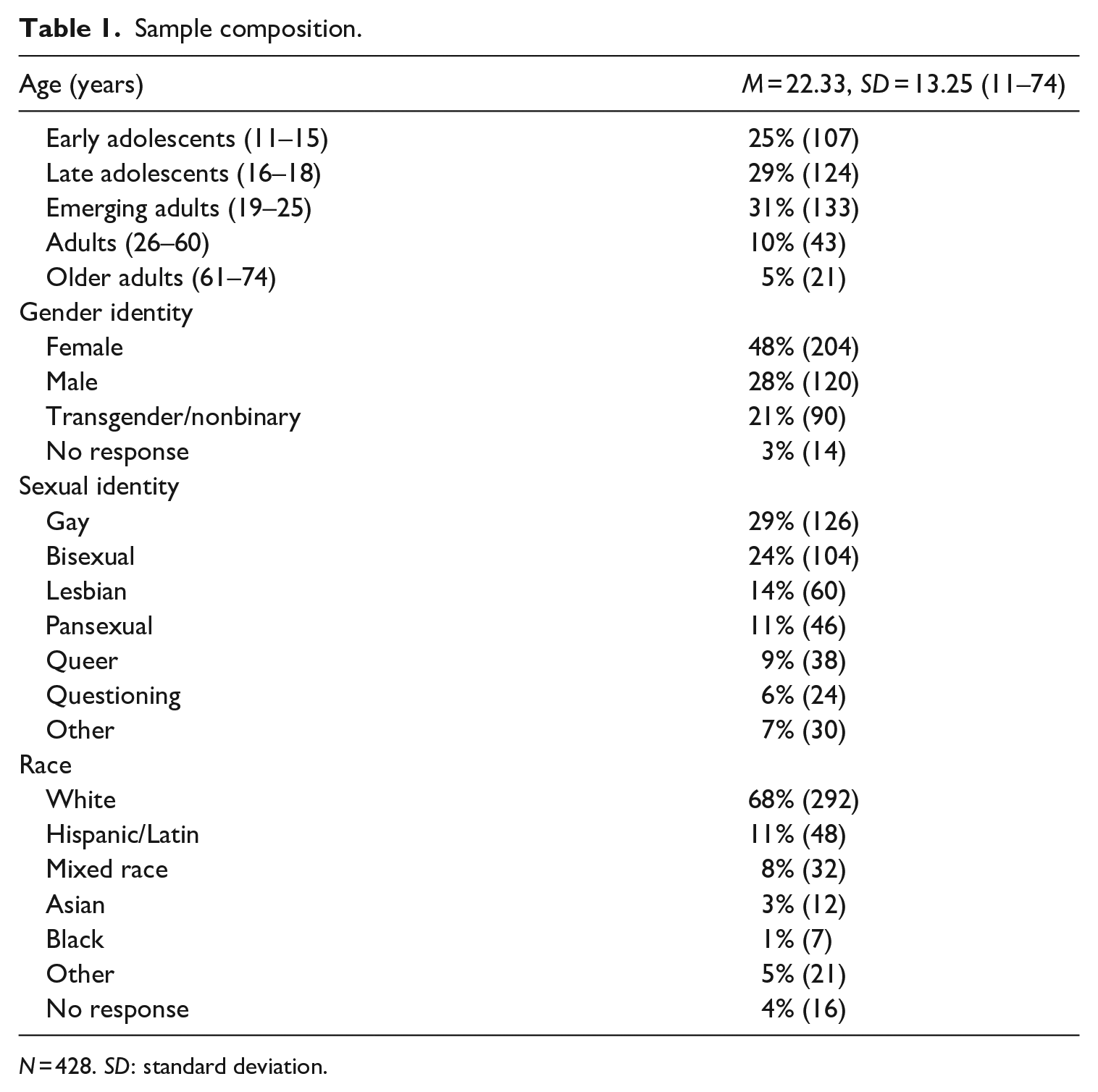
N = 428. SD: standard deviation.
Measures
All participants responded to the LGBTQ YouTuber exposure measure first and the demographic items last. Scales measuring social support, social connectedness, outness, self-esteem, and collective self-esteem were randomized to avoid potential order effects. Measures of social support, social connection, and personal self-esteem were not specific to LGBTQ identities. Rather, they quantified general, global perceptions of these concepts. Only the collective self-esteem scale was LGBTQ-specific because an ingroup was needed as a reference point. Employing more generalized operationalizations of these measures arguably increases the salience of any findings: LGBTQ YouTubers may act as important components of viewers’ perceived social worlds and, in turn, LGBTQ YouTubers exposure may influence their global perceptions of social support, social connection, and self-esteem, not limited to support, connection or self-esteem specific to their sexual or gender identities. Other variables were included on the questionnaire but are not reported here.
LGBTQ YouTuber exposure
This study’s focus on social connectedness guided the operationalization of LGBTQ YouTuber exposure, as simple exposure to others who identify as LGBTQ should contribute to feelings of belongingness (Detrie and Lease, 2007). As such, participants listed up to 10 of their favorite YouTubers and then reported how often they were exposed to each from 1 (Not Often) to 5 (Everyday). Two coders dummy-coded the YouTubers (n = 1923) as either heterosexual/cisgender (0) or LGBTQ (1). Coders used YouTubers’ self-disclosure in their own videos to determine sexual and gender identities. If judgments could not be made based on YouTube content alone, coders were allowed to use additional information as long as the source included direct quotes from the YouTubers about their identities. No speculation (e.g. gossip websites) was allowed to determine YouTubers’ sexual or gender identities. A third coder analyzed 10% of the sample to ensure inter-coder reliability was achieved (Scott’s pi = .91). LGBTQ YouTuber exposure was calculated by multiplying each YouTuber’s identity (0 = heterosexual/cisgender, 1 = LGBTQ) by the frequency with which the participant reported exposure to the respective YouTuber, and then summing the products of the YouTubers listed by a given participant. This procedure was deemed more nuanced than asking participants to self-report how often they were exposed to LGBTQ YouTubers, and was molded from prior research using content and level of exposure in the formula for quantifying media exposure (see Pardun et al., 2005). LGBTQ YouTuber exposure could range from 0 (no LGBTQ favorite YouTubers) to 50 (10 LGBTQ favorite YouTubers, each viewed every day), M = 18.31 (10.44).
Social support
The four friend items (α = .94) from the multidimensional scale of perceived social support were used to measure participants’ perceptions that their friendships provided support (Zimet et al., 1988). Items included, “I can count on my friends when things go wrong” and “I can talk about my problems with my friends.” Participants responded to items on a 7-point scale ranging from 1 (strongly disagree) to 7 (strongly agree). All four items factored together (e = 3.39, 85% variance). Higher scores equated to more perceived social support from friends, M = 5.26 (1.55).
Social connectedness
The social connectedness scale contains eight items measuring general belongingness (Lee and Robbins, 1998). The scale has been used in previous studies of social media and social connectedness. Items included, “I feel so distant from people” and “I feel disconnected from the world around me.” Participants responded to items on a 7-point scale ranging from 1 (strongly disagree) to 7 (strongly agree). All eight items factored together (e = 5.84, 73% variance). All items were reverse-coded so that higher scores equated to more belongingness (α = .95), M = 4.20 (1.65).
Outness
Participants responded to a single item asking them to whom among their friends they had disclosed their sexual and/or gender identities. Response options ranged from 1 (none of my friends) to 5 (all of my friends). Piping was used to customize the item. For example, if a participant reported being bisexual, the question would have appeared as, “How many of your friends have you told that you are bisexual?” If transgender and nonbinary participants also reported being gay, lesbian, or bisexual, the questionnaire presented two items measuring sexual and gender identity outness separately. In these cases, the two items were averaged for analysis, M = 3.87 (1.38).
Self-esteem
The Rosenberg (1965) self-esteem scale was used to measure self-esteem. Participants responded to items such as, “I feel that I have a good number of good qualities” and “On the whole, I am satisfied with myself” on a 5-point scale ranging from 1 (never) to 5 (always). The scale’s 10 items (α = .94) factored together (e = 6.54, 65% variance). Higher scores equated to greater self-esteem, M = 3.12 (.95).
Collective self-esteem
The nine items adapted by Herek and Glunt (1995) to measure collective self-esteem among the LGBTQ community were used in this study. Eight items factored together (e = 4.98, 62% variance); the ninth item was subsequently dropped. Items such as “I’m glad I belong to the LGBTQ community” and “I feel good about being part of the LGBTQ community” measured the degree to which participants felt their sexual and/or gender identities made them part of a desirable group (α = .91). Participants responded to items on a 7-point scale ranging from 1 (strongly disagree) to 7 (strongly agree), such that higher scores equated to more collective self-esteem, M = 5.41 (1.20).
Demographics
Age, gender identity, sexual identity, and race were measured using single items. Age was an open-ended item asking participants to write in the age they turned on their last birthday; all other items were close-ended.
Analysis plan
Hypotheses were tested using the PROCESS macro for SPSS (Hayes, 2018). Mediation hypotheses (H1 and H2) were tested with Model 4; the moderated mediation hypothesis (H3) and RQ1 were tested with Model 10. Each model was run with 10,000 bootstrapping samples. Participant age, gender identity (1 = cisgender, 2 = transgender), and race (1 = White, 2 = racial minority) were included as covariates in each model. Zero-order correlations between variables are presented in Table 2. To shed light on RQ2, open-ended responses to the question “Why do you watch YouTube?” were categorized into themes by both authors using an inductive, grounded approach. Once initial themes were developed, the authors reviewed the data to confirm the themes. Differences were discussed until consensus was reached on the themes reported herein. Each participant response was then dichotomously coded for each theme.
Zero-order correlations.
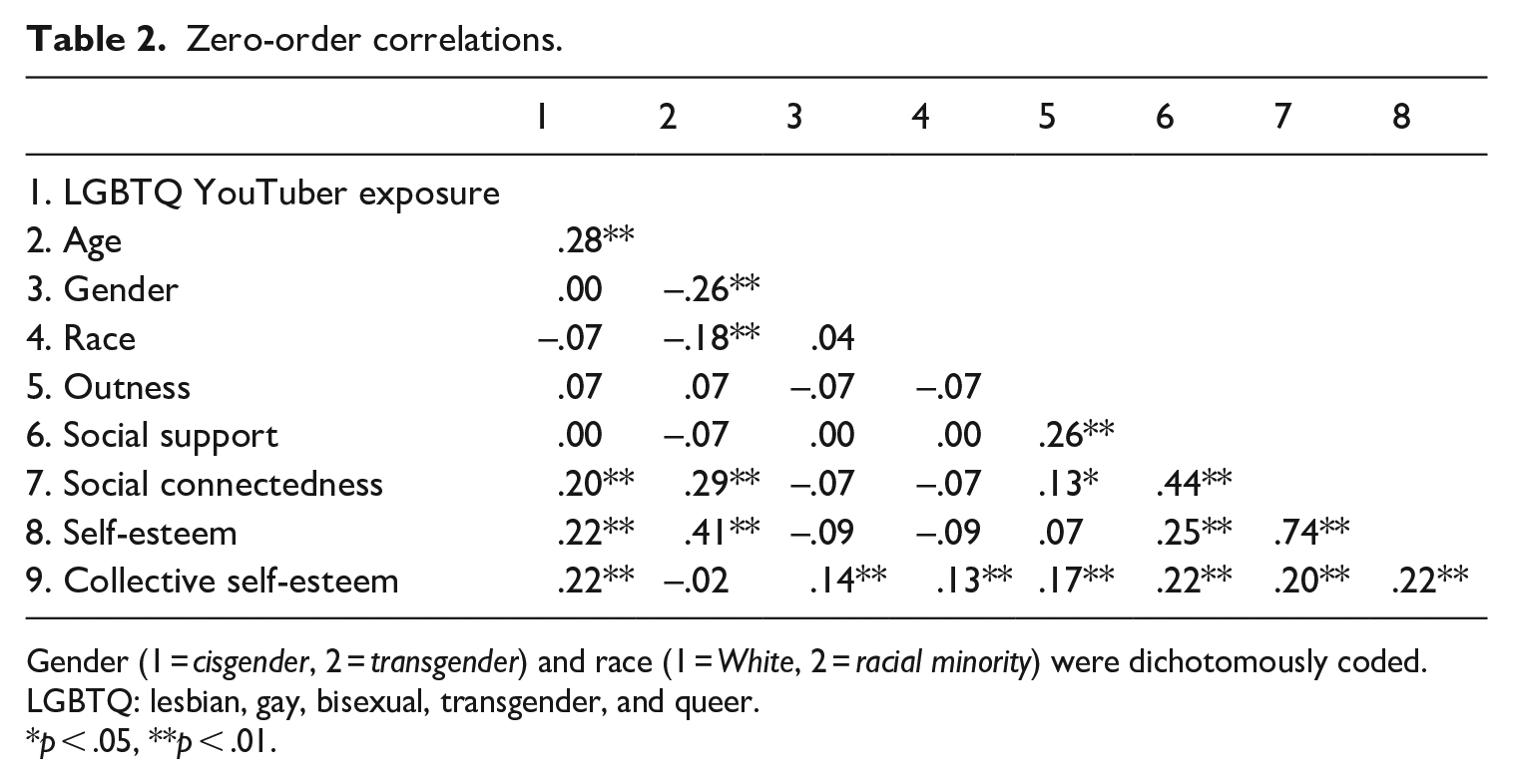
Gender (1 = cisgender, 2 = transgender) and race (1 = White, 2 = racial minority) were dichotomously coded. LGBTQ: lesbian, gay, bisexual, transgender, and queer.
p < .05, **p < .01.
Results
Participants reported spending an average of 4.84 (SD = 3.63) hours/day viewing YouTube content, slightly higher than previous reports of LGBTQ viewers’ YouTube consumption (Austin et al., 2020), which may be an artifact of the recruitment procedures that were rooted in YouTube itself (see limitations). When asked to list up to 10 favorite YouTubers, a majority of participants listed 10 names (66%, n = 284), M = 8.56 (SD = 2.14). Only 6% (n = 24) cited all LGBTQ YouTubers. It was more likely that participants listed three to five LGBTQ YouTubers among their favorites, M = 4.54 (SD = 2.69).
Mediation
H1 predicted that social connectedness would mediate the relationship between LGBTQ YouTuber exposure and self-esteem. LGBTQ YouTuber exposure was correlated with social connectedness (a = .07, SE = .03, 95% CI = [.01, .13]), and social connectedness was correlated with self-esteem (b = .38, SE = .02, 95% CI = [.34, .42]). The residual direct effect of LGBTQ YouTuber exposure on self-esteem was not significant (c′ = .01, SE = .01, 95% CI = [−.01, .03]), but the total effect was significant (c = .04, SE = .02, 95% CI = [.01, .07]). These results support H1: Social connectedness mediated the relationship between LGBTQ YouTuber exposure and self-esteem.
H2 predicted that mediation would also occur when investigating collective self-esteem as the outcome variable. Social connectedness contributed to collective self-esteem (b = .18, SE = .04, 95% CI = [.10, .25]). The residual direct effect of LGBTQ YouTuber exposure on collective self-esteem was significant (c′ = .10, SE = .02, 95% CI = [.06, .14]), as was the total effect (c = .11, SE = .02, 95% CI = [.07, .16]). These results partially support H2: Social connectedness partially mediated the relationship between LGBTQ YouTuber exposure and collective self-esteem.
Moderated mediation
H3 predicted that social support would moderate relationships between LGBTQ YouTuber exposure and social connectedness. RQ1 investigated the potential additional moderating effects of outness. Results are displayed in Table 3. Age and social support were positively correlated with social connectedness. Gender identity was negatively correlated with social connectedness, suggesting that cisgender participants reported stronger social connectedness than transgender/nonbinary participants. Interactions predicting social connectedness were also significant. Probing the conditional effects of LGBTQ YouTuber exposure at values of the moderators revealed significant positive effects for those who reported moderate social support and were out to most friends (b = .14, SE = .03, 95% CI = [.07, .21]) or out to all friends (b = .18, SE = .04, 95% CI = [.10, .27]). A significant negative conditional effect existed for those who reported very strong social support but who were not out (b = −.11, SE = .06, 95% CI = [−.22, −.01]). Both indices of partial moderated mediation were significant (social support = −.02, SE = .01, 95% CI = [−.03, −.01]; outness = .02, SE = .01, 95% CI = [.01, .03]), suggesting moderated mediation occurred. The conditional effects are visualized in Figure 1.
Moderated mediation results.
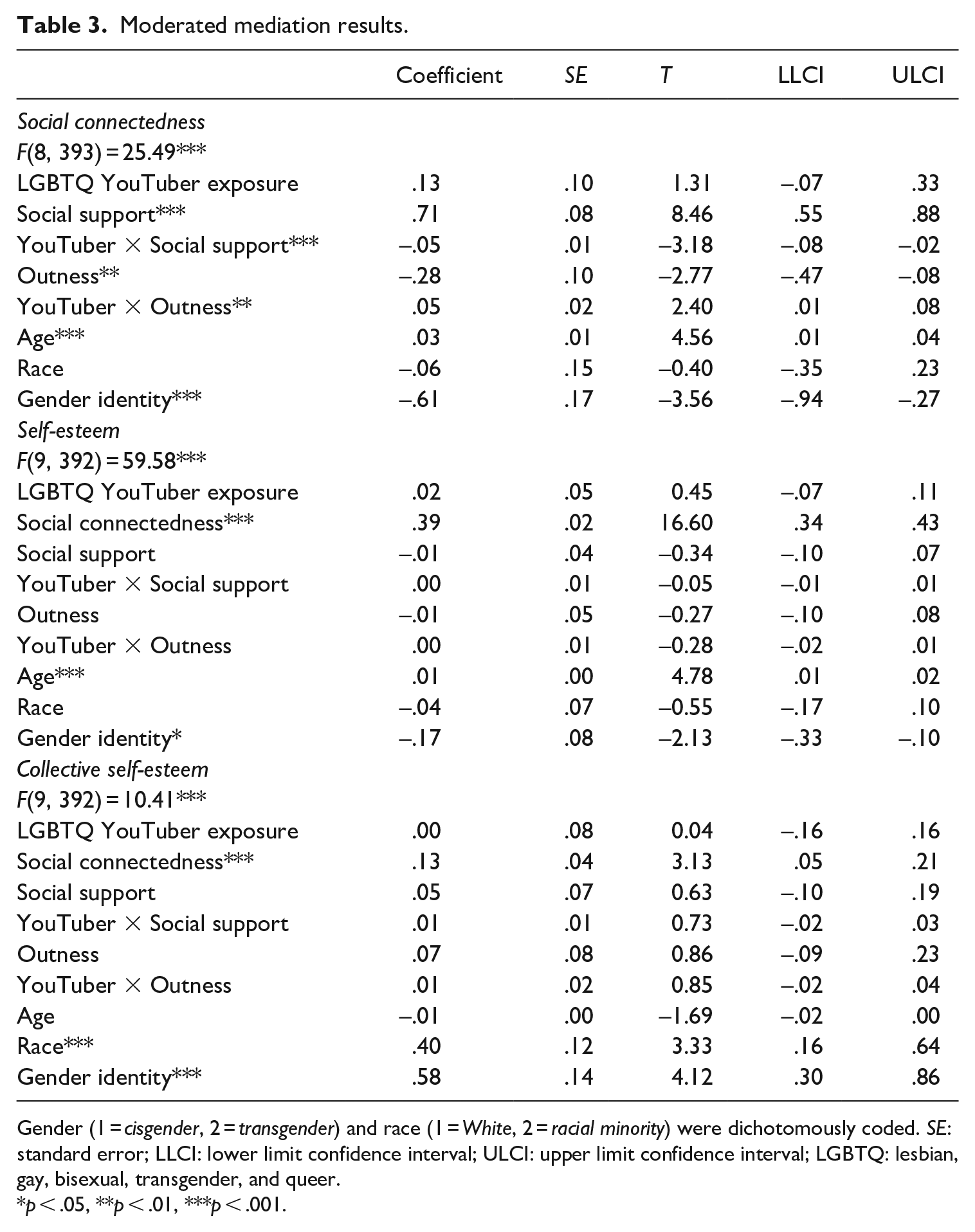
Gender (1 = cisgender, 2 = transgender) and race (1 = White, 2 = racial minority) were dichotomously coded. SE: standard error; LLCI: lower limit confidence interval; ULCI: upper limit confidence interval; LGBTQ: lesbian, gay, bisexual, transgender, and queer.
p < .05, **p < .01, ***p < .001.
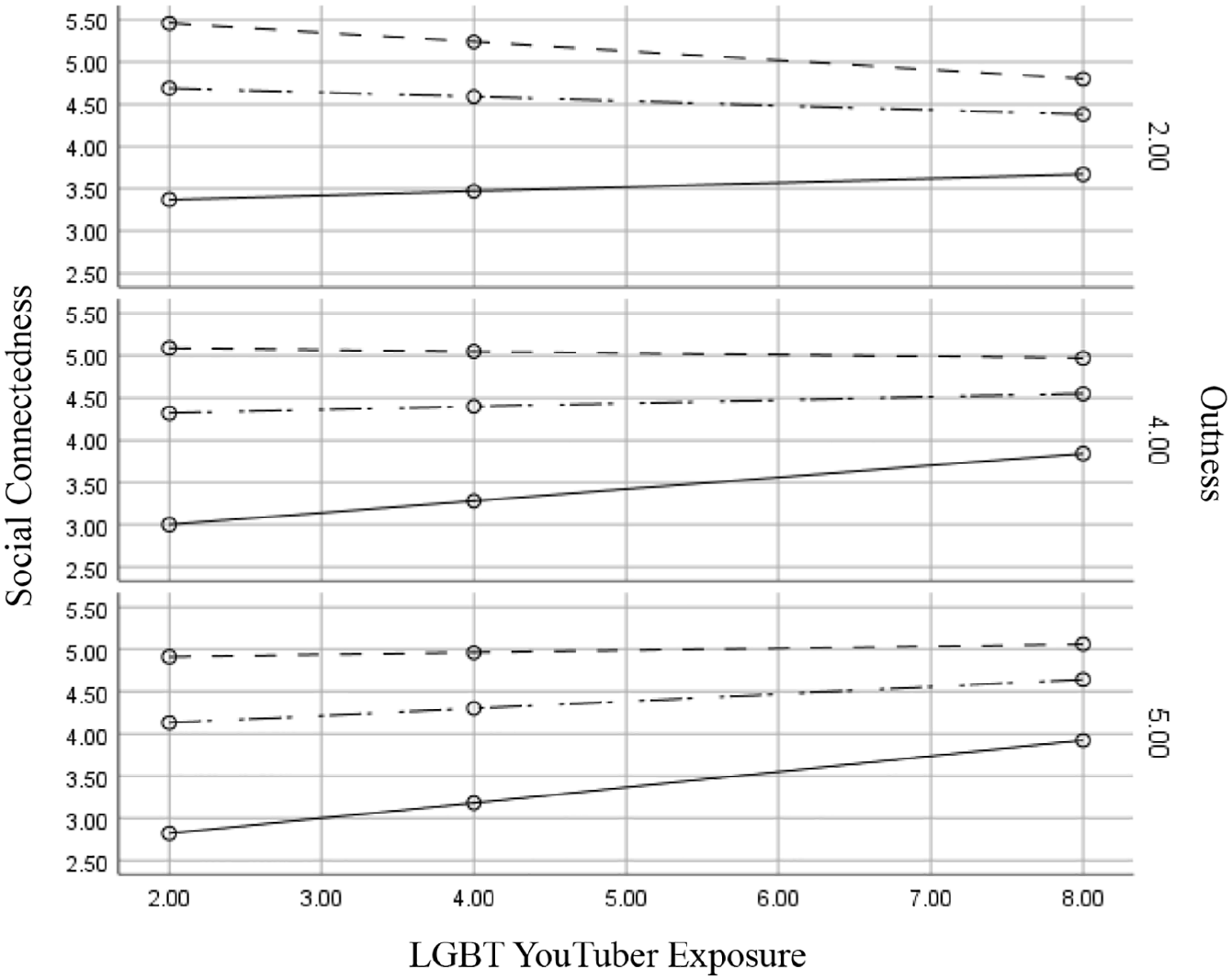
Visualization of conditional effects of LGBTQ YouTuber exposure on social connectedness at various values of the moderators.
Social connectedness was the strongest predictor of both self-esteem and collective self-esteem, though age and gender identity were also correlated with self-esteem such that older participants and cisgender participants reported stronger self-esteem than younger participants and transgender/nonbinary participants, respectively. Race and gender identity were also correlated with collective self-esteem such that racial minority participants and transgender/nonbinary participants reported stronger collective self-esteem than White participants and cisgender participants, respectively. No interactions contributed to self-esteem or collective self-esteem. H3 was partially supported; RQ1 analyses suggest that outness also served as a moderator.
User motivations
When asked to list the topics that they enjoyed watching on YouTube, half of participants (50%, n = 208) specifically mentioned LGBTQ content. YouTube videos about personal vlogs (18%, n = 75), gaming (14%, n = 60), music (7%, n = 28), and mental health (6%, n = 26) rounded out the top 5 most frequently cited topics. RQ2 explored participants’ motivations for watching YouTube videos. The primary motivations were entertainment, social connection, and information, largely in line with previous research on YouTube uses and gratifications (e.g. Haridakis and Hansen, 2009). All motivations are detailed in Table 4.
Motivations for YouTube exposure.
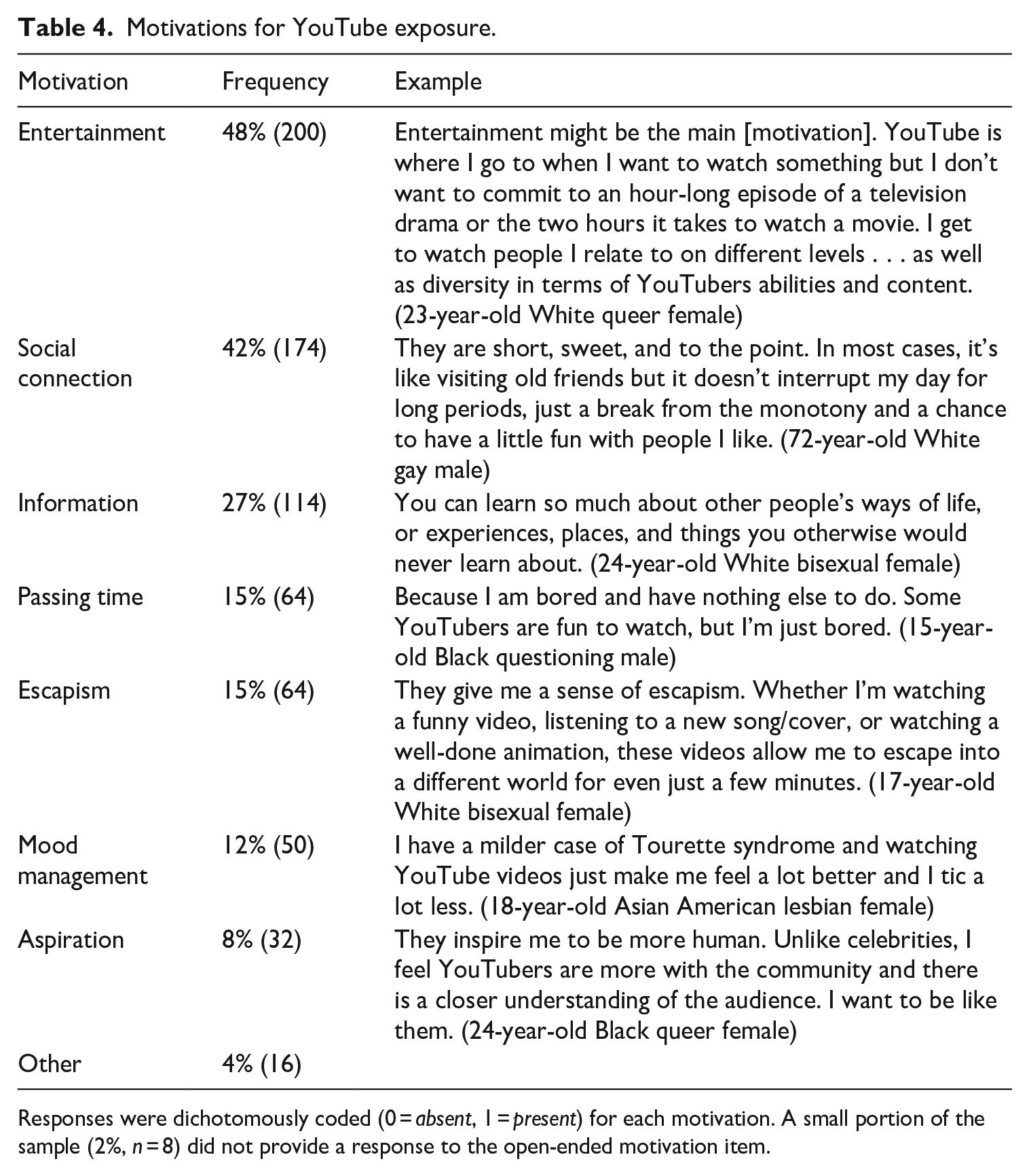
Responses were dichotomously coded (0 = absent, 1 = present) for each motivation. A small portion of the sample (2%, n = 8) did not provide a response to the open-ended motivation item.
Entertainment appeared as a motivation among nearly half of the sample. However, entertainment was often intertwined with other motivations that are likely more specialized within stigmatized populations. Consider the following participant’s perspective on YouTube as entertainment:
I’m on YouTube to relax, have fun, [sic] laughing. To search for information about certain topics that are interesting to me. To get help when I feel sad or stressed about my career or my sexuality. And to have a new and fresh point of view about how others see the world and live their lives. (20-year-old gay gender-fluid individual)
Although their first instinct was to write that YouTube provides them with a space to relax and have fun, later the individual notes that the site is helpful when they are emotionally distressed about their sexuality, signifying that the site can play a more notable role in managing their identity as a gay, gender-fluid individual. This was mirrored in responses coded as information. One 60-year-old gay male noted, “I love the length of the videos, and the gay focus of the bloggers I watch. Their topics speak to me about how gay men interact, what is important, and how they deal with life issues.” For this individual, YouTube is teaching him about gay lifestyles and cultures, and the format of YouTube’s videos is one of the reasons for using the platform for educational purposes.
Social connection was second only to entertainment, reinforcing the social utility of YouTube suggested by the statistical analyses in this study. A 56-year-old gay male participant found his favorite LGBTQ YouTubers similar to his offline social relationships, explaining that when he watches their videos it is “like having coffee with an old friend.” Consider the social utility of YouTube as articulated by the following participant:
I am LGBT, but I go to a Christian School so hardly anyone knows [that I am LGBT]. I always feel so left out. I just do. So I watch a lot of LGBTQ YouTubers to feel less alone. That’s the big reason. (15-year-old bisexual gender-fluid individual) Watching the day to day lives of other people with similar life issues and relatable lifestyles makes me feel like I am less alone. I love to see the way other people’s lives work. I often look to queer YouTube as a way to cheer myself up. (24-year-old lesbian female) Some of the LGBTQ community YouTubers make me feel right at home. It’s really nice to see gay relationships that are healthy and viable. (71-year-old gay male)
YouTube provided these individuals, who ranged in age from 15 to 71 years, with a virtual space from which they could develop social connection. YouTube was also viewed as more authentic than traditional screen media such as television. For example, participants described YouTubers as “genuine,” “real,” and “authentic.” One participant noted that YouTubers were “great people with genuine personalities,” while another wrote that YouTubers were “. . . real people, not fake like people on TV series.” YouTubers’ perceived authenticity likely heightened the social connection garnered from exposure (Tian et al., 2019).
A smaller portion of the sample reported motivations related to passing time, escapism, mood management, and aspiration. It is worth noting that many participant responses coded as mood management also mentioned anxiety and depression:
I watch videos that make me happy. I have generalized anxiety disorder and the voices of the people I “know” help my brain into thinking someone is there with me, and then my anxiety levels go down. The LGBTQ YouTubers give me hope that I can and will be able to come out someday and be who I truly am. (14-year-old gay transgender individual) YouTube makes me feel better. It’s a place you can go when you feel shitty or dysphoric or anxious. Most of the time I watch LGBTQ YouTubers because I can relate, because there is an immediate comfort in knowing that they get it, they get me. With trans YouTubers in particular, it is so comforting to know that these people are so far into their transformation when they started where most of us are now. (15-year-old queer transgender individual)
The open-ended responses are quite discerning. They speak to the social connectedness inherent in YouTube consumption and production, as one participant refers to YouTubers as people they “know,” and another stresses the comfort that comes from identification with YouTubers. However, these responses go beyond social connectedness, as they focus on YouTube as mentally and emotionally restorative.
Discussion
The findings of this study suggest that YouTube may serve as a viable space for community building among LGBTQ audiences, and that social connectedness is correlated with both self-esteem and collective self-esteem, but that the intersection of perceived social support from friends and outness may impact how LGBTQ YouTuber exposure relates to social connectedness.
Social connectedness mediated the relationship between LGBTQ YouTuber exposure and self-esteem. Seeing LGBTQ individuals on YouTube was positively correlated with social connectedness, which was positively correlated with self-esteem. The relationship between LGBTQ YouTuber exposure and social connectedness was moderated by perceived social support and outness: a significant positive correlation existed only for LGBTQ participants who reported moderate social support (the lowest level of social support in this study) and who were out to most or all friends. Individuals who have disclosed their LGBTQ identities to others have typically already navigated a period of LGBTQ information-seeking when accessible and trusted social media platforms such as YouTube may have served as resources (Fox and Ralston, 2016; Owen, 2017). In addition, social media may be most beneficial for those seeking social support from like-others (Baams et al., 2011; Bond, 2018; McConnell et al., 2017). Out LGBTQ participants in this study who felt they did not have strong social support, then, may have turned to YouTube to solidify connections with LGBTQ others, thereby strengthening their perceptions of social connectedness. Such a conclusion fits with the minority stress theory. Out individuals are highly likely to experience minority stress—their marginalized identities have been made known to those in their social environments. Out individuals who do not report significant social support look to other forms of connection beyond their offline friends for that support (Baams et al., 2011; Bond, 2018). Results suggest they potentially find those socio-emotional bonds of support via YouTube, reinforcing arguments from critical and interpretive scholars who contend that the authenticity and realism of YouTube increases its social value to viewers, particularly those in marginalized groups (Lovelock, 2019; Wuest, 2014).
The moderated mediation also revealed a significant negative correlation between LGBTQ YouTuber exposure and social connectedness for those who reported very strong social support but were not out. Participants at this intersection are unlikely to be garnering important LGBTQ-specific social support from their friends if they are not open about their LGBTQ identities. As such, these individuals may feel they are hiding their true selves from their otherwise strongly connected social network. Owen (2017) found that LGBTQ participants who were concealing their sexual or gender identity managed their social media use to ensure that their LGBTQ identities were not exposed. Viewing LGBTQ-focused YouTube content may then trigger negative feelings related to their own concealment behaviors, causing participants to question the validity of their own social connection and belongingness. This potential explanation lies squarely in the social comparison literature (e.g. Verduyn et al., 2015). Exposure to LGBTQ YouTubers who are not only open with their LGBTQ identities, but broadcasting them to the world, may decrease self-esteem by increasing social comparison and envy among those who are not out themselves.
Moderation differences by outness may also be explained by potential exposure to negative content on YouTube. Although YouTube is replete with positive representations of LGBTQ individuals (Miller, 2017), a quick search for LGBTQ content may navigate users to videos narrating vitriol for the LGBTQ community, or simply to negative comments on otherwise positive videos. Exposure to hate and fear online negatively affects the social connectedness of all LGBTQ viewers (Green et al., 2015; McConnell et al., 2017), but those who are out may have developed more matured coping mechanisms to employ in such situations. LGBTQ individuals who are not out may lack coping mechanisms that would buffer negative effects of exposure, which may be particularly difficult to process for those with strong social support who feel they cannot access that support due to their concealed LGBTQ identities. Future research should continue to investigate exposure to differing types of LGBTQ videos and comments, and potential differences in receptivity to LGBTQ social media influencers based on life experiences and identity intersections of LGBTQ audiences.
Social connectedness did not mediate the relationship between LGBTQ YouTuber exposure and collective self-esteem in the same fashion: The direct correlation maintained significance even when including social connectedness as a mediator. Social connectedness and self-esteem were measured as general subjective perceptions of the self, whereas collective self-esteem was specific to the LGBTQ community. This measurement discrepancy could explain the lack of mediation when analyzing collective self-esteem. The conceptualizations of these variables may also provide clarity: Social connectedness is conceptualized as an internal sense of belonging and closeness. Self-esteem is also an internal, subjective evaluation of worth. Collective self-esteem, however, is external to self, conceptualized as group affiliation (Detrie and Lease, 2007). LGBTQ YouTuber exposure may increase self-esteem among LGBTQ viewers because content creators are seen as authentic, real, socially attractive others who strengthen viewers’ social connectedness. However, LGBTQ YouTubers may also serve as representatives of the LGBTQ community more broadly, beyond viewers’ own perceived social ties, thereby directly influencing viewers’ perceptions of group affiliation in addition to their own social connectedness.
Descriptive analyses revealed that LGBTQ participants in this study spent an average of almost 5 hours/day on YouTube. The notably high rate of YouTube consumption among LGBTQ individuals reinforces previous research suggesting that LGBTQ individuals are heavy consumers of social media, but it also likely indicates the value of YouTube creators and content to the LGBTQ audience (Austin et al., 2020; Craig et al., 2021). LGBTQ audiences were also highly likely to report following numerous LGBTQ YouTubers on the platform, suggesting that these audiences are not simply heavy consumers, but are seeking out YouTubers specifically for their sexual or gender identities, depictions still rather sanitized in mainstream television, film, and print (Fox and Ralston, 2016).
Self-reported motivations for exposure were largely in line with previous research investigating the uses and gratifications of social media broadly (Sundar and Limperos, 2013) and among LGBTQ audiences specifically (Craig et al., 2021). Motivations for consumption were most commonly categorized as entertainment, social connection, and information. Less frequently cited motivations included passing time, escapism, mood management, and aspiration. The self-reported motivations reinforced the statistical analyses in this study, especially as they relate to YouTube’s capacity to render social connectedness. Participants’ narratives suggested that spending time viewing LGBTQ YouTubers had a remedying effect, alleviating negative affect lingering from having a bad day at work, feeling alone at school, or when one just feels “shitty or dysphoric or anxious.”
The open-ended responses also highlighted the value in studying LGBTQ audiences’ socio-emotional bonds with characters. Bond (2018) found that LGBTQ youth formed strong connections with LGBTQ celebrities and fictional characters, especially when LGBTQ youth in the study were lonely or had few offline LGBTQ friends. These connections to mediated others are referred to as parasocial relationships; they lack reciprocity but are otherwise akin to offline friendships. In this study, participants wrote about LGBTQ YouTubers using language indicative of parasocial relationships. Participants described YouTubers as “people I know,” “great people with genuine personalities,” or “old friends.” The format of YouTube (e.g. interactive features, confessional-style head-on camera angles) only increases the likelihood of parasocial relationship development (Kurtin et al., 2018). Future research should continue to dissect how LGBTQ audiences may uniquely develop parasocial relationships in the social media realm.
Limitations
The study was designed as a cross-sectional survey, eliminating the ability to make causal claims about relationships between variables. Mutual causation likely exists among the variables measured in this study. Longitudinal designs would help bring clarity to the causal relationship between the variables investigated within the current work. This study operationalized LGBTQ YouTuber exposure, but it did not distinguish between time spent viewing audiovisual content, the type of content YouTubers posted, or time spent reading comments produced by third parties. Parsing video content, text content, and interactive elements would further highlight the role of YouTube, and potentially other social media platforms, in the development and sustainability of social support and connectedness among LGBTQ audiences (Levinson et al., 2020). This study also operationalized social support in reference to “friends,” but it did not distinguish between online friends, offline friends, or YouTubers (or other celebrities or characters) who feel like friends. More precisely measuring with whom social support is perceived would add nuance to these findings.
An additional aspect of the study’s design that could limit the generalizability of the findings is the novel use of YouTubers as recruiters. Social media influencers are effective study spokespeople because their audiences perceive them as authentic and trustworthy (Tian et al., 2019). This method of recruitment has promise for future studies investigating social media, especially when attempting to collect a sample from a hidden or vulnerable population that may be reluctant to participate in institutional research. However, the use of YouTubers as recruiters may have also limited the sample. For example, the average time spent with YouTube among participants was notably high, and the sample was highly likely to report viewing LGBTQ-themed content on YouTube. These results could be a product of recruitment—only those who spend significant time on the platform may have been willing to respond to YouTubers requests for participation. Future research should consider ways to implement the recruitment procedures used here while diversifying the pool of potential participants. Similar procedures could also be used to investigate other marginalized or minoritized populations.
YouTube is home to video content and registered users catering to a wide variety of interests and identities. Investigating the value of the platform for groups who may not see themselves reflected in mainstream media, or who may have difficulty developing strong social support or building community would be informative and constructive work. Studies investigating if YouTube functions similarly as a platform for social support and social connection among individuals with physical disabilities, religious minorities, or indigenous groups, for example, would add to a literature base that could cumulatively be used to alter policies or content accessibility that could heighten well-being among those in society most vulnerable to social exclusion.
Footnotes
Funding
The author(s) received no financial support for the research, authorship, and/or publication of this article.
