




Abstract
The current study explores the videos of eight popular transgender YouTubers. A content analysis was conducted to examine the themes present in videos, the specific issues discussed, and the educational value for viewers. In particular, the present research was interested in the amount of videos that contain transgender-specific content, and in the types of issues—both general and in terms of gender transition—about which transgender YouTubers converse. Videos were also analyzed in relation to self-identified type of transgender individual (e.g. male-to-female [MTF] or female-to-male [FTM]), and significant differences were found in both the amount of transgender-specific content as well as the educational value of videos. This article positions transgender YouTube content as an educational tool that can both help serve as guidance for transgender viewers, as well as increase mainstream audiences’ understanding of transgender persons, subjects, and struggles.
With over two million subscribers and 263 million video views, Gigi Gorgeous is a YouTube celebrity. She has been featured in People and Marie Claire magazines, walked the runway at Fashion Week, and presented at the 2015 MTV Video Music Awards. Her top YouTube video features Kylie Jenner, and she can be seen as a make-up guru on Jenner’s app, Kylie. Like most YouTube beauty gurus, Gigi’s videos consist mostly of make-up, fashion, and tales of her extravagant lifestyle. Unlike most other YouTube beauty vloggers, however, Gigi is transgender. When she began her YouTube career discussing fashion and make-up, she identified publically as a gay male teenager, using the name Gregory Gorgeous and establishing a popular channel from her home in Toronto, Canada. When Gigi transitioned, she did it in the public eye. Among her most popular videos are “My Facial Plastic Surgery Story,” wherein she discusses the procedures she had done to feminize her face, “I am Transgender,” wherein she publically discloses being transgender for the first time, and “Boob Job Update,” wherein she discusses her breast implant surgery and recovery.
Gigi is one of many transgender individuals who have taken to the Internet to document their gender transition, either as a means of attracting an audience, or for the purposes of taking an already-existing audience on a journey. The transgender community is well represented on YouTube, yet little scholarship has been conducted about the content they provide or the possible effects of this content. Nevertheless, it has been established that the Internet operates as a space for the organization of transgender communities (Shapiro, 2004). Cyberspace has also been found to serve as an educational source for transgender individuals to learn about being transgender and being a part of the transgender community (Mackenzie, 1994; Shapiro, 2004). Transgender persons have been known to search out information on their identity online and, in one study, three quarters of participants mentioned using technology as a source of information (Hill, 2005). YouTube videos created by transgender individuals, in particular, may serve as a significant tool for transgender viewers due to their autobiographical and often informational nature (Raun, 2015).
Beyond serving as education for transgender individuals, the Internet may be able to function as a tool for decreasing transphobia in society. Transphobia can be described as prejudice toward transgender individuals, often motivated by feelings of fear or revulsion (Winter, Webster, & Cheung, 2008). Because many individuals do not have frequent and/or meaningful real-world contact with transgender persons, mediated intergroup contact may serve an important function. Since some of the content on most transgender YouTubers’ channels is made up of more traditional YouTube fair (e.g., make-up tutorials, funny stories, taste tests, etc.), and because of the linked nature of YouTube videos and the side panel suggestions, the potential audience is likely to be considerably wider than for other transgender-themed media that must be sought out. One can easily be connected to a story about Julie Vu’s post-op recovery after watching one of her shopping videos; curious cisgender individuals may be more tempted to explore trans identity in this manner rather than engage with a television program, which requires more deliberate planning and a considerably longer time commitment. While the current study explores the educational capacity of transgender-created and transgender-themed YouTube content, the reality is that not much is known about the actual audience of these videos, nor how they may impact transphobia when those outside the self-selected audience are exposed to the content.
Nonetheless, transphobia is a well-documented cultural problem. While transphobia toward male-to-female (MTF) individuals has been found to be more prevalent than transphobia directed at female-to-male (FTM) persons, all transgender individuals experience prejudice. This prejudice is even more prevalent than prejudice for others within the lesbian, gay, bisexual, transgender, and queer (LGBTQ) community (Dispenza, Watson, Chung, & Brack, 2012; Norton & Herek, 2013). As such, transgender persons are at risk of a number of negative outcomes related to their experiences of prejudice, including low self-esteem, depression, anxiety, and substance misuse (Clements-Nolle, Marx, & Katz, 2006; Dispenza et al., 2012; Gainor, 2000; Irwin, 2002). They are also at an increased risk of violence (Stotzer, 2009), physical and psychological abuse (Nuttbrock et al., 2010), and employment discrimination (Kirk & Belovics, 2008; Lombardi, Wilchins, Priesing, & Malouf, 2001; Reed, Franks, & Scherr, 2015).
Some of the issues transgender individuals face may be due to a lack of education on the part of cisgender persons. For example, in one study on being trans in the workplace, transgender individuals report others not respecting their preferred names or pronouns, and not being able to utilize the bathroom corresponding to their gender identity (O’Neil, McWhirter, & Cerezo, 2008). While these situations may be rooted in hatred and fear, they may also be linked to a lack of exposure to transgender individuals, corresponding to a lack of edification on the importance of things like pronouns and bathrooms. YouTube videos featuring transgender vloggers may be one way to increase understanding and compassion for issues affecting transgender individuals and communities. Many transgender-crafted YouTube videos are geared toward a curious and potentially uneducated cisgender audience. For instance, videos about how to talk to transgender persons, what it is like to date a transgender person, and how to be an ally to transgender persons are commonplace. However, even videos targeted toward other transgender persons may be able to decrease stigma and prejudice by allowing people to tell their own unfiltered stories. Humanization of transgender people seems to be an important factor in decreasing transphobia. Research has shown that interaction with a transgender individual—in this particular case, a canvasser discussing recycling—nearly erased transgender prejudice in one in 10 individuals, an effect that lasted for 3 months (Broockman & Kalla, 2016).
The current study explores the videos of eight popular transgender YouTubers. A content analysis was conducted to examine the themes present in videos, the trans-specific issues and trans-specific physical transition elements discussed, and the educational value for viewers. In particular, the present research was interested in the amount of videos that contain trans-specific content, and in the types of issues—both general and in terms of gender transition—about which transgender YouTubers converse. Videos were also analyzed in relation to self-identified type of transgender individual (e.g., MTF or FTM), and significant differences were found in both the amount of trans-specific content as well as the educational value of videos. Transgender-created YouTube videos were found to have a wide array of themes, to discuss a plentiful amount of trans-specific issues, and, more often than not, to have a clear educational component.
Literature Review
Cisgender individuals are those people for whom the sex assigned at birth matches both their outward bodily presentation and their internal gender identity (Kozee, Tylka, & Bauerband, 2012). Contrastingly, gender-variant individuals exhibit “behaviors and/or identities that are outside what is considered normal or typical by a society or culture for an individual’s natal sex or assigned gender as male or female” (Pleak, 2011, p. 1063). For the purposes of this article, the term transgender is used to refer to gender-variant individuals. Transgender is an umbrella term, which includes (but is not limited to) those who identify as transgender, transsexual, gender-variant, genderqueer, or gender non-conforming (Carroll, 2010). According to the World Professional Association for Transgender Health (WPATH), the word transgender is an “adjective to describe a diverse group of individuals who cross or transcend culturally defined categories of gender. Gender identity of transgender people differs to varying degrees from the sex they were assigned at birth” (Coleman et al., 2012, pp. 221–222).
Historically, transgender individuals have not been featured heavily in mainstream media, and when they have been featured, depictions have been overwhelmingly negative and stereotypical. Transgender women, in particular, have been noted as being heavily sexualized and fetishized in popular culture, particularly in pornography (Abbott, 2013). They are often projected as keepers of secrets and the salacious details of their lives are exploited for ratings and attention. For example, the Australian program There’s Something About Miriam was a reality program revolving entirely around a pre-operative transgender woman and her potential suitors who were unaware of the fact that she was transgender (Lewis, 2009). Many fictional television depictions of transgender individuals—from Nip/Tuck’s Ava Moore to Degrassi’s Adam Torres—have tended to employ this same secret-keeping narrative that positions transgender individuals as deceptive and manipulative.
Transgender youth may be particularly in need of media depictions and mediated role models, as they have been marked as an especially vulnerable population due to both peer violence and adult harassment (Sausa, 2005). The small amount of mediated depictions of transgender youth and adolescents has, therefore, been deemed particularly important. As Sandercock (2015) stated, “There are few screen representations of trans young people. In light of this, the depictions in Glee and Degrassi are significant and groundbreaking . . .” (p. 440). While mainstream media has been slow to warm to transgender representation, the Internet has long been a safe haven for the transgender community.
Transgender Individuals and the Internet
A lack of mainstream media representation of transgender individuals may have contributed to the community’s need and desire to find information and exemplars online. Fink and Miller (2014) point to the mainstream media’s focus on professional, middle-class transgender persons as a limitation that leads many transgender individuals to the Internet. According to these authors, it is “the silences and fetishistic misrepresentations in public culture around trans existence” that lead transgender individuals to cyberspace, which itself “facilitates information exchange and self-exploration for many trans people” (p. 614). The Internet has been deemed a valuable source of education for transgender individuals, particularly for youth or for those who are geographically isolated from an offline transgender community (Shapiro, 2004).
In one study, participants detailed coming to know their identities by engaging with print, television, radio, and the Internet (Hill, 2005). Technology, in particular, seemed to be important for the development of a positive transgender identity. Hill (2005) noted that “respondents attributed broadcast technologies like radio and television or the Internet to their connections with other trans people” (p. 39). For those in Hill’s sample, online connections or information seeking often led to offline meet-ups with other transgender individuals. Clearly, technology can help transgender individuals feel a sense of community, and it may also allow them to learn about their identities in a safe and private manner.
Marciano (2014) found that transgender individuals utilize cyberspace in a variety of ways. First, they may employ the Internet as a preliminary sphere in which the virtual world can serve as a test-run for the offline world. Second, transgender individuals may utilize cyberspace as a complementary sphere, wherein the separation between the online and offline world is minimal. In this utilization, the Internet may function as an extension of the user’s offline social life. Finally, Marciano claims that transgender individuals may turn to the Internet for an alternative sphere, or a space where they can experience their gender differently than they do offline. Similar to this notion, Whittle (1998) proposed that, online, gender should be seen as a detachment from the body.
For transgender individuals, the Internet allows for the ability to self-identify in terms of gender, a right that is often not afforded to those who are gender-variant in the offline world. As Whittle (1998) has noted, “Cyberspace has presented a safe area where body image and presentation are not among the initial aspects of personal judgment and social hierarchy within the transgender community” (p. 400). The Internet, in a sense, frees individuals to self-present their gender identity in a way that the offline world does not (Stone, 1995). It also creates a safe space for transgender cultural production (Fink & Miller, 2014).
Both YouTube and Tumblr have been identified as spaces where transgender cultural production occurs (Fink & Miller, 2014; Raun, 2015; Tompkins, 2014). As Raun (2015) has highlighted, video blogs, or vlogs, can act as a mirror, allowing individuals to record and upload videos depicting their actual likeness. Transgender individuals, the author notes, tend to be preoccupied with their mirrored image, which marks “the beginning of a ‘self-validation’ that many trans vloggers say has not been possible before because of a dissatisfaction with one’s own appearance and because of a lack of confirming mirroring from one’s parents” (p. 368). These spaces may offer other transgender individuals—as well as cisgender persons—an informative and entertaining way to experience the transgender community.
YouTube as Education
Launched in May of 2005, YouTube is a distribution platform for individuals to share their videos, as well as a space for audiences to uncover and watch content. According to its site, YouTube has over a billion users across the world, and hundreds of millions of hours of videos are viewed each day (YouTube, 2016). This particular online space offers everything from popular music videos to talk show clips, but it is perhaps most well-known for its user-generated content, which includes tutorials, reviews, reactions, pranks, confessionals, and much more. The current research is interested in the educational capacity of user-generated content created by transgender individuals for the public.
There is the capacity for transgender-created YouTube videos, particularly those with transgender themes, to teach, engage, and inspire transgender viewers. As King (2009) stated, “Podcasting, blogging, vlogging, and virtual communities provide the ability for underrepresented groups to develop new scales of global citizenship, empowerment, and voice in formal and informal education” (p. 56). Viewing YouTube as an informal space for education, one might conceive of how transgender individuals may benefit from informative online content that is both educational and autobiographical. For example, because transgender individuals may seek psychological, medical, and/or surgical treatment to achieve a desired physical appearance and legal status (Levine et al., 1998), videos documenting others’ experiences transitioning may serve as encouragement, or even as a guide for transitioning.
Transgender individuals have been noted for creating vlog updates about physical changes they are experiencing, as well as their emotional and psychological well-being (Raun, 2015). Transgender women, or MTF individuals, have been found to focus more on surgical procedures in their YouTube vlogs, while transgender men, or FTM individuals, have been found to focus more on testosterone as the primary element of a physical transition or reassignment (Raun, 2015). This is often evident in the way that vlogs are labeled (e.g., “9 months on testosterone update”), and may relate to the relative ease with which FTM may “pass” as men when compared to the visibility of transgender women (Raun, 2015).
The Internet has been found to serve as a place for education, as well as organization and protest, for transgender individuals (Shapiro, 2004). Cyberspace has opened up new avenues for connection for transgender individuals, as well as increased their ability to find information about being trans. As Shapiro (2004) has noted, “prior to the Internet, it was possible for trans people to have no knowledge of anyone else like themselves . . . before the Internet, trans people were reliant on the medical profession and the few trans support organizations for information” (p. 170). YouTube, in particular, has been noted for its ability to serve as a space for transgender self-reflection, which may then have the ability to rouse or inspire other transgender people. Raun (2015) has called transgender vlogs that are autobiographical in nature “voyages into an authentic and recognizable self, narrating and visualizing transition in a certain way” (p. 371).
Since physical transitions are so rarely documented as vividly offline, outside of perhaps larger urban spaces where transgender communities are able to safely congregate, cyber accounts of the process may serve an educational purpose for those looking to transition themselves. Nonetheless, transgender YouTubers typically offer more than information on the physical aspects of their gender transitions. Many transgender YouTubers will delve into emotionally charged and even painful topics, such as dating, bullying, family relationships, and experiences with prejudice. This is in contrast to mainstream media’s focus on the more sensational aspects of transgender lives without much discussion of the social and cultural context (Ryan, 2009). Some transgender-themed videos may even feature cisgender individuals, as Tompkins (2014) noted in an examination of videos created by cisgender partners of transgender individuals. Outside of YouTube, there aren’t many spaces for cisgender partners, family members, or friends to congregate, discuss issues, and explore ideas.
Transgender people experience prejudice in a variety of manners, including microaggressions, which often include nonverbal exchanges that may be hard to articulate to perpetrators (Dispenza et al., 2012). Popular YouTube stars explaining their experiences with more subtle forms of prejudice might allow for cisgender individuals to more clearly note the ways that they unintentionally create unsafe spaces for gender-variant people. Other forms of prejudice encountered by transgender individuals may range from hostile comments or a refusal to use preferred names and pronouns to denied access to preferred bathrooms or discrimination in housing, education, personal social support relationships, or governmental policies (Dispenza et al., 2012; O’Neil et al., 2008).
Furthermore, transgender individuals are more likely to be victims of violence than either gay men or lesbians (Kuehnle & Sullivan, 2001). They have an increased likelihood of serious personal injuries, up to and including hospitalization and death, and they are more likely to be victimized in their own homes (Kuehnle & Sullivan, 2001). In one study, more than half (51.3%) of the transgender participants reported having been physically abused, and even more (53.8%) reported being forced to have sex (Kenagy, 2005). As such, transgender individuals may have experienced unique experiences of prejudice and violence that is not mirrored by many outside this particular community. Therefore, collective sharing of experiences in a mediated format may aid in the healing capacity for these individuals, as well as educate the mainstream about transgender physical safety.
One reason why mediated social support, and mediated role models in general, may be especially important for transgender individuals concerns a lack of offline support. For example, Factor and Rothblum (2007) explored the familial origins of 295 transgender people and their non-transgender siblings. Not only did they find that transgender siblings experienced a larger amount of discrimination, harassment, and violence, as one might expect, but the authors established lower levels of family support for the transgender siblings. Other research has also established lower levels of support for transgender individuals when compared to cisgender sexual minorities (Dargie, Blair, Pukall, & Coyle, 2014). Rural or more isolated transgender individuals may have an increased need for online support and community (Gray, 2009).
Mediated intergroup contact may be another theoretical lens by which we may examine transgender YouTuber videos. When majority group members do not have contact with minority group members, prejudice may develop (Allport, 1954). Conversely, interacting with disparate persons may lead to less prejudice and less intergroup conflict (Allport, 1954). While education itself has proved to decrease transgender prejudice, intergroup contact with transgender individuals only increases this effect (Walch et al., 2012). However, as a minority population, transgender individuals may not always be visible or accessible for offline intergroup contact. Since individuals who rarely engage with a minority population in their real-world lives are more likely to rely on mediated portrayals when forming opinions about the minority group (Hart, 2000), transgender-themed YouTube content may also have the capacity to educate cisgender individuals. Mediated intergroup contact has been shown to increase positive feelings about group interaction with sexual minorities as the target of study (Ortiz & Harwood, 2007), and there is no reason to doubt that this finding could extend to include transgender depictions in the media and its effect on cisgender audiences. Because many transgender YouTubers include mainstream content on their channels, such as beauty videos or taste tests, the potential audience for these YouTubers’ channels may include cisgender individuals who do not specifically seek out trans-content, but who come to find it organically.
Research has found that the humanization of transgender media subjects is crucial to increasing positive attitudes toward transgender persons (Tompkins, Shields, Hillman, & White, 2015). In one study, participants in the education-only condition showed no improvement in anti-transgender prejudice, while participants who viewed a humanizing media clip—a film documentary featuring a transgender girl and her family—and engaged in a subsequent perspective-taking task exhibited more favorable attitudes toward transgender individuals (Tompkins et al., 2015).
An earlier study found that a documentary clip functioned similarly to educational fact-sheets and third-person coming out letters in decreasing anti-transgender attitudes and debunking transgender myths (Case & Stewart, 2013). Because most of the transgender community’s YouTube content is highly personal in nature, it is possible that this content may have a similar humanizing effect. As Chen (2010) has stated, “For all the digital transiency of an entity like YouTube, these trans-narratives are told ‘in one’s own voice’ as compared with the degree of their broad accessibility (formerly the province of mass media)” (p. 202). When coupled with educational elements, transgender-themed YouTube videos may serve as an important tool in decreasing anti-transgender attitudes and misconceptions.
It is important to note that not all education on transgender YouTubers’ channels is focused on gender identity or issues related to the self. Make-up tutorials, for example, may serve to educate cisgender women and transgender women alike, as well as cisgender men, transgender men, and/or gender non-binary persons. In the current analysis, coders examined the educational capacity of both trans-specific and non-trans-specific YouTube content. Nonetheless, from an audience perspective, even non-trans-specific videos like make-up tutorials or shopping hauls might be deemed “trans-specific” when viewed by trans audience members. A trans woman, for instance, can never quite consume a make-up video without it being about applying make-up as a trans woman, which is wrapped up with other issues, such as passing in public and the cultural expectation for trans women to conform to popular notions of femininity.
Based on the literature, the following research questions were proposed:
RQ1. How many transgender YouTubers’ videos contain an educational component?
RQ2. Do the educational components of posted videos differ between MTF and FTM transgender YouTubers?
RQ3. What are the most common overall themes of the videos posted by transgender YouTubers?
RQ4. Do MTF and FTM transgender YouTubers differ in the presence of trans-related themes in their posted videos?
RQ5. Which trans-specific issues are discussed in transgender YouTuber’s videos, and what proportion of videos discusses each issue?
RQ6. Which trans-specific physical transition elements are discussed in transgender YouTuber’s videos, and what proportion of videos discusses each transition element?
Method
Sampling
Because there exists no master list of transgender YouTubers, popular channels were identified based upon three online articles—YouTubeBuzz’s Top Four Transgender YouTubers (Sean, 2015), PopBuzz’s 5 YouTubers You Should be Watching in Honor of “Trans Day of Visibility” (Dryden, 2015), and NewMediaRockstars’ Top 5 Most Influential Transgender YouTube Creators Who Have Helped Build The Trans Community Online (2013). These articles generated 12 transgender YouTubers, of which the eight with the most subscribers were chosen for analysis. While these eight YouTubers are not necessarily the most followed transgender video bloggers, they represent YouTubers who have garnered some degree of prominence within the online sphere.
The 15 most viewed videos for each of the eight YouTubers included in the study were analyzed. This yielded a total of 120 videos in the final sample. Combined, the included YouTubers have over three million subscribers, and their videos have garnered over 350 million views. Table 1 contains a list of the transgender YouTubers whose videos were included in the sample, as well as subscription data on their channels.
Subscriber and Viewership Statistics.
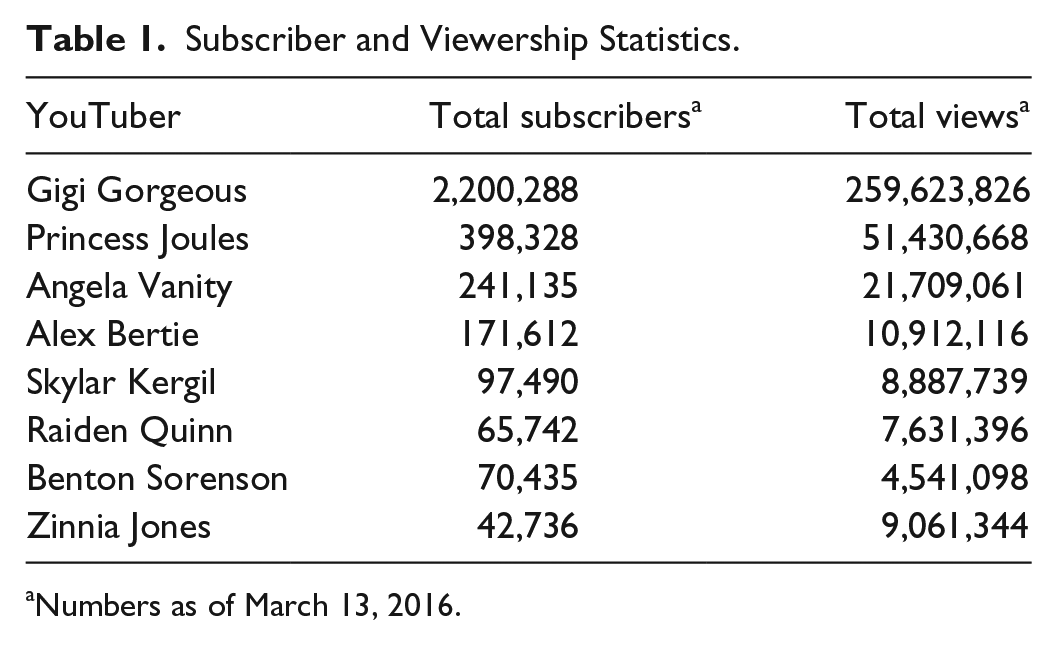
Numbers as of March 13, 2016.
Coder Training
Two undergraduate coders served as coders in the examination of these YouTube videos. Both coders were cisgender females, and both received training on terminology commonly encountered in trans-specific videos (e.g., packing, tucking, passing). Coders were trained for approximately 7 weeks before coding the final sample. Discrepancies were discussed during training, and the codebook was refined numerous times. Additionally, a third coder was dropped from the study during this time, leaving the two coders who analyzed the final sample. Reliabilities reported below were calculated using Krippendorff’s alpha, and an overlapping subset of the actual sample (25%, n = 30).
Unit of Analysis and Operationalization of Variables
The unit of analysis for the current study was the YouTube video. Judgments were made regarding each video as a whole, and coders were instructed to consider the entire video before making coding decisions. Because of a lack of previous scholarship on transgender-created YouTube content, variables were crafted from observations based upon the sampled YouTuber’s channels. Variables are grouped below based on whether they relate to basic video characteristics, viewer engagement, physical transition elements, or transgender issues.
Basic Video Characteristics
Coders assessed a number of variables related to the YouTuber and to the video as a whole. First, coders analyzed the identification of the transgender YouTuber in the video, which has been deemed the “type” of video for the purpose of this study (α = 1.0). This assessment was based upon self-identified labels such as transguy, transgender woman, and so forth. While some have critiqued the terms MTF and FTM as promoting the idea of a two-gender binary (e.g., Theron & Collier, 2013), the transgender YouTubers whose videos were analyzed overwhelmingly self-described using this terminology. The current study aims to respect the self-identified terminology used by individuals. Therefore, for simplicity, consistency, and accuracy, the two categories for the type variable will hereto forth be referred to as FTM for any masculine-identified YouTuber, and MTF for any feminine-identified YouTuber. Coders also evaluated the main theme of each video (α = .74), and the educational nature of each video (α = .71).
Physical Transition Elements
Coders were asked to analyze whether the YouTube video mentioned the users’ physical transition (α = .93), as well as to note the discussion of a number of specific transition elements. The discussion of issues such as surgery (α = 1.0), hormones (α = .93), hair growth (α = 1.0), hair removal (α = 1.0), non-surgical procedures (α = 1.0), and voice (α = .72) were all measured. The surgery variable included both general discussions of surgery, as well as discussion of recovery or post-op progress. A follow-up variable also measured the type of surgery discussed in the video (α = 1.0).
Physical transition elements specific to one “type” of transgender person (i.e., masculine-identified or feminine-identified transgender individuals) were also measured; these included elements such as binding (α = 1.0), packing (α = 1.0), tucking (α = 1.0), and dilation (α = 1.0). Binding refers to the practice of binding one’s breasts, a practice often utilized by FTM individuals who have not yet had top-surgery. Similarly, packing also refers to a FTM-specific practice, in this case the use of a prosthetic penis to simulate biological maleness. Tucking and dilation are MTF-specific terms. Tucking applies to pre-operative individuals, and refers to the practice of tucking one’s penis so that it is not visible through clothing. Dilation applies to post-operative individuals, and refers to the use of dilators to ensure that the surgically created vagina does not lose width or depth.
Transgender Issues
Coders also recorded the discussion on specific transgender issues in each video. For these variables, any discussion of the issue was recorded, whether or not it was a personal account or a more abstract discussion. Transgender issue variables included disclosure (α = .83), or discussion about coming out and telling others about one’s trans identity, and passing (α = .90), which refers to a transgender person being able to venture out in public and pass as their desired gender without being clocked as a transgender person (to “pass” as cisgender,” effectively). Other issue variables were dating (α = .84), sex (α = 1.0), family (α = .80), bullying (α = .87), religion (α = 1.0), mental health (α = .87), bathrooms (α = 1.0), names/name changes (α = .87), terminology/pronouns (α = .84), and male/female stereotypes (α = .80). As reliability could not be achieved for variables on friendship and transgender stereotypes, these variables were dropped from the study. In total, 12 issue variables were measured in relation to the final sample.
Results
Research Question 1
The first research question examined the educational potential of YouTube videos made by transgender individuals. In particular, this research question was concerned with how many videos capitalized on the ability to serve as educational tools for other transgender, as well as cisgender, individuals. The majority of videos in the sample (n = 64, 53.5%) were found to educate about trans-specific issues or topics. Another sizable proportion of videos (n = 23, 19.2%) was educational in nature, but not in reference to a trans-specific issue or topic. Many of these videos included make-up tutorials, product reviews, and other traditional YouTube video content. Finally, the remainder of the sample (n = 33, 27.5%) was found to have no educational value.
Research Question 2
The second research question was concerned with the differences in the educational value of videos based upon the identification of the YouTuber who created the content. Significant differences were found. Two cases where the type (i.e., MTF or FTM) of YouTuber in the video was unclear were excluded from the analysis. This resulted in 75 MTF videos (63.6%) and 43 FTM videos (36.4%). A chi-square analysis was used to test RQ6.
The analysis revealed significant differences between the educational value of videos produced by FTM YouTubers and MTF YouTubers, χ2(2, N = 118) = 23.360, p < .001, V = .445. FTM YouTubers were overrepresented in creating videos that contained educational components related to trans-specific issues and topics (ASR = 4.5), while MTF YouTubers were underrepresented in this area. On the other hand, MTF YouTubers were overrepresented in having videos that educated on non-trans issues and topics (ASR = 3.8), such as Julie Vu’s video on how to get rid of blackheads. FTM YouTubers were, correspondingly, underrepresented in this area (ASR = −3.8). While ASR was not sufficient to claim significant differences between the groups in non-educational videos, MTF YouTubers were found to have a higher instance of these types of videos as well.
Research Question 3
The third research question asked which main themes would be the most prevalent in the top videos from transgender YouTubers. While all 17 thematic categories were identified for at least one video, certain themes were much more common than others. The most common theme was unspecific, in that the most videos were not trans-specific and not related to beauty/make-up/shopping (which was a category in itself). In all, 24 videos, or 20%, fell into this thematic category. The second most popular video theme was beauty/make-up/shopping (n = 18, 15%). The remainder of the top themes related to trans-specific issues, including hormones, dating, and bullying. Table 2 lists the top 10 themes and their frequencies. The main theme variable was then condensed to assess the proportion of videos that discussed transgender-specific versus non-transgender-specific themes. Overall, transgender-specific main themes were present in 65% of the videos (n = 78). The other 35% of videos (n = 42) were not trans-specific.
Themes in Trans-Created YouTube Videos.

Research Question 4
The fourth research question aimed to probe whether the presence of a trans-specific main theme would differ for videos by MTF versus FTM individuals. The condensed main theme variable (trans-specific theme versus non-trans-specific theme) was used in the analysis of RQ2. Two cases where the type (i.e., MTF or FTM) of YouTuber in the video was unclear were excluded from the analysis. This resulted in 75 MTF videos (63.6%) and 43 FTM videos (36.4%). A chi-square analysis was used to test RQ2.
There existed significant differences between MTF and FTM YouTubers’ videos and the presence of trans-specific themes, χ2(1, N = 118) = 21.883, p < .001, V = .431. MTF YouTubers were overrepresented in having non-trans-specific main themes in their videos (ASR = 4.7), and FTM YouTubers were underrepresented in having non-trans-specific main themes in theirs (ASR = −4.7). Conversely, MTF YouTubers were underrepresented in having videos with trans-specific main themes (ASR = −4.7), and FTM YouTubers were overrepresented in posting videos with trans-specific main themes (ASR = 4.7).
Research Question 5
The fifth research question was concerned with which trans-specific issues would be most prominent in the videos in the sample. While the main theme variable required coders to choose one theme, the issue variables were not mutually exclusive. A video could discuss multiple issues, or none at all, and coders were instructed to measure any non-passing discussion of the 12 trans-specific issues on the list. The following represent the variables, from most-to-least discussed trans-issues: male/female stereotypes, family, passing, bullying, dating, disclosure, religion, terminology/pronouns, names/name changes, mental health, sex, and bathrooms. Table 3 contains the full results and frequencies for RQ3.
Trans-Specific Issues Discussed in the Videos.

Research Question 6
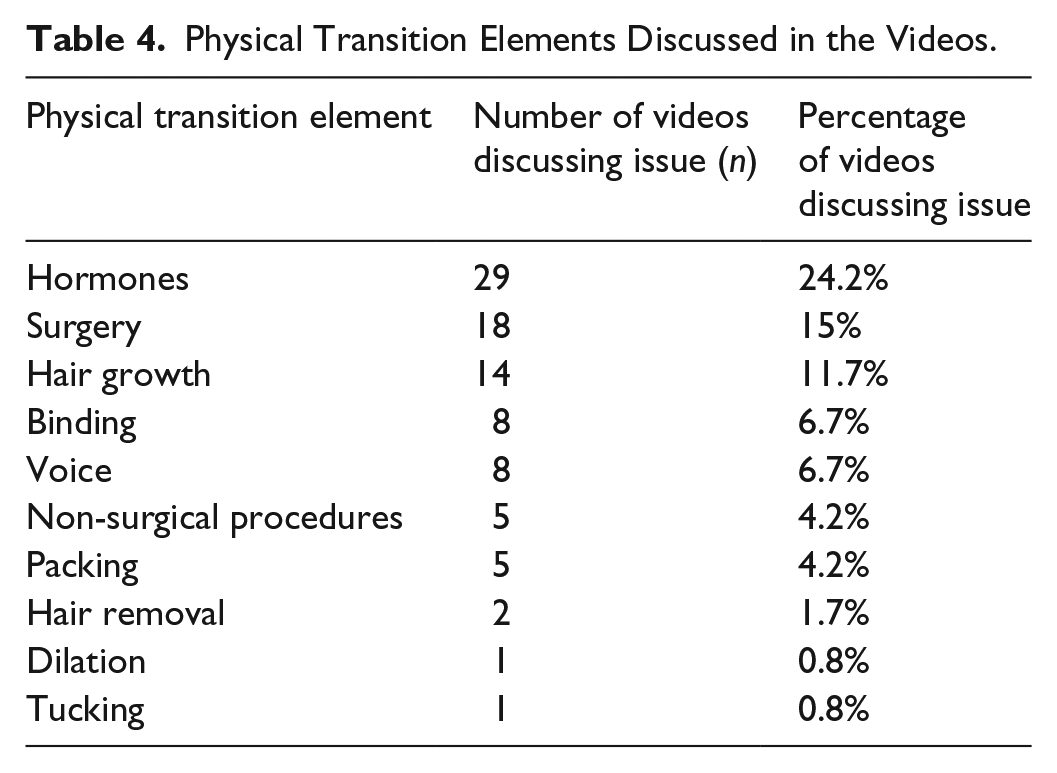
The final research question was concerned with the number of videos that would discuss physically transitioning genders, and the types of physical transition variables that would be discussed. A total of 41 videos (34.2%) discussed elements of the physical transition, such as surgery or hormone therapy. The following represent the variables, from most-to-least discussed physical transition elements: hormones, surgery, hair growth, binding, voice, non-surgical procedures, packing, hair removal, dilation, and tucking. Table 4 contains the full results and frequencies for RQ6.
Physical Transition Elements Discussed in the Videos.
Discussion
The present study explored the content and themes of transgender-created YouTube videos. The results paint an interesting picture of transgender content on YouTube, as well as the topics that fans find interesting. Since the most popular videos from each of eight channels were analyzed, the content represents some of the most widespread and enjoyed videos that the transgender community has to offer on YouTube. The findings indicate that the videos touch on a disparate amount of topics, both trans-specific and not, and that there are significant differences in MTF-created versus FTM-created videos.
There persists the idea that transgender individuals are pretenders or are somehow deceptive in the ways they choose to present their gender (Winter et al., 2008). This may very well be partly due to mainstream culture’s lack of understanding about what it means to be transgender, and what the physical transition process entails. YouTube videos serve as a unique educational tool, presenting discussions about gender identity, transitioning, and stigma from an autobiographical standpoint. There is no pretending in these videos, as transgender YouTubers tend to lay themselves bare and disclose far more than the average individual chooses to disclose to the world (e.g., information about their genitals, prescriptions they take, procedures they have had done, and so forth). These YouTubers may be aiding in breaking down the myth that transgender individuals are trying to deceive people, instead promoting the idea that transgender people are—like many humans—striving to live honestly and comfortably in their own skin.
Interestingly, one of the most prevalent themes for videos in the sample was beauty, make-up, and shopping. As transgender individuals have been found to perpetuate traditional gender roles, this is not entirely surprising. For example, Dargie et al. (2014) found that transgender women identified strongly with traditional feminine gender norms, while transgender men did the same with traditional masculine gender norms. Thus, rather than break down the gender binary, some transgender individuals may simply serve to reinforce conventional ideas about what it means to be a man or a woman. The transgender YouTubers whose videos were included in the current study subscribed to relatively strict notions of masculinity and femininity. It must be noted, however, that this also signifies that beauty, make-up, and shopping videos are, in themselves, a form of trans-specific content. These videos may be viewed as performative acts that position the YouTuber within the dominant female discourse to which cisgender women have easier access. The ability for a transgender woman to publically perform femininity, whether or not she acknowledges her gender identity explicitly, is one of the key features of these videos. The fact that a transgender woman could inspire and educate cisgender women in the areas of make-up, skin care, clothing, and so forth validates their identities as women. Nonetheless, for those gender-variant individuals who do not identify as MTF or FTM, such as those who see their gender as fluid, viewing YouTube videos that subscribe to these conventional masculine and feminine norms may be troubling. More research is needed on the full scope of transgender YouTube cultural production, both in terms of the issues discussed as well as the cultural norms reinforced or subverted. Research is also needed on how viewing these videos affects transgender persons and their sense of self.
It is also important to note the class dynamics that might contribute to the focus on beauty, make-up, and shopping videos. Despite being transgender and hosting some trans-specific content on their channels, vloggers like GiGi Gorgeous and Julie Vu often operate strikingly similarly to traditional YouTube beauty gurus. They make it a habit to test out new and expensive products, they flaunt their consumer purchases, and they tell stories about extravagant adventures. Designer labels and big-name brands are central to these channels and their success, and may have little relevance to transgender persons who do not exist in these wealthy conditions. Nonetheless, by appealing to middle- and upper-class female viewers, GiGi, Julie, and their peers may also be expanding the traditional viewership for transgender-themed channels. The fact that their gender isn’t the sole driving force of their channel’s success is an important factor in itself.
It is evident from the findings that FTM individuals bear the brunt of presenting transgender-specific YouTube content when compared to MTF individuals. Nonetheless, while MTF individuals, in particular, tended to focus on beauty, fashion, and physical appearance, there were a large proportion of videos that focused on trans-specific content. In fact, 65% of videos were specifically focused on a theme (or topics) related to being transgender, with hormones, surgery, and dating being large areas of interest. There seems to be an interest in the physical transitions of transgender individuals, as well as a desire for transgender YouTubers to document and share information about their transitions. At times, the information shared may be incredibly graphic, but it may also be the sole outlet for personalized information of the sort. For example, Julie Vu (a.k.a. Princess Joules) created a vlog about scars and orgasms post-sexual reassignment surgery in which she offers a compelling, emotional, and detailed account of post-operative life that one would not get from a medical textbook or static webpage. For transgender individuals considering the same surgery, it may offer the most real glimpse into what they can expect. For other audience members, it may help to increase their understanding of what it means to be transgender, what the physical transition can entail, and what tolls transitioning can take on the body, both emotionally and physically. It is Vu’s willingness to share personal details about her transition that makes this video and others like it noteworthy, for it goes far beyond what we would expect mainstream television or even film to discuss.
Research has found that transgender persons have lower levels of social support (Dargie et al., 2014), which may indicate that they must become creative with the ways in which they find support. The Internet seems to be one such way. Many of the trans-specific issues discussed in videos may serve as lifelines for transgender individuals looking for guidance and information. Videos on issues such as maintaining positive familial relationships, disclosing one’s transgender identity, and dealing with bullying all offer prosocial value. These videos contextualize and personalize transgender lives in a way that many mainstream transgender depictions do not. Therefore, the ability for individuals to cast YouTubers in the role of expert or role model may be enhanced. Future work must explore the roles filled by transgender YouTubers, and the mechanisms that contribute to their ability to serve as community leaders.
As previously stated, passing refers to the ability of a transgender person to “pass” as their desired gender. Passing may be a constant source of concern for some transgender individuals (Bockting, Miner, Swinburne Romine, Hamilton, & Coleman, 2013). It is logical that a greater ability to pass as cisgender may mean decreased experiences of discrimination on a daily basis. Surprisingly, the theme of passing made up only a small proportion of videos. Often, passing was integrated more subtly into videos that fell into other themes. This can be seen in the results for the physical transition elements discussed in videos. Packing, binding, and tucking are all practices that are specifically designed for passing as male (the first two) or female (the latter). Videos that discuss these topics offer instruction for transgender individuals on how to better present as the gender of their choice. Expectedly, hormones and surgery were the most common physical transition elements discussed, as these two elements encompass the most definitive steps one can take on the path to gender transition.
Beyond offering informative and engaging content for transgender audiences, YouTube videos about transgender issues and topics may also hold educational value for mainstream audiences. Cisgender persons may be unaware of the ways in which they are given privilege. Examples include having government-issued ID that matches their gender identity, access to the proper restrooms, and not being asked about their genitals in everyday conversation (Johnson, 2013). These are issues that popular transgender YouTubers have been known to discuss at length, but that few mainstream media outlets discuss in detail. Although these topics have begun to be discussed on programs such as the docu-series I am Jazz and I am Cait, and in fictional programming such as Orange is the New Black and Transparent, YouTube allows for a more thorough, more personal, and more frank discussion of cisgender privilege and of transgender issues. More than half of the videos in the sample were found to educate about transgender-specific issues.
It has been established that individuals who already have had contact with LGBTQ communities exhibit a greater willingness to have contact with transgender individuals (Tompkins et al., 2015). These individuals also hold more favorable attitudes about transgender people (Tompkins et al., 2015). Future work should examine the impact of transgender-created YouTube videos on cisgender audiences—particularly those who have had limited to no contact with the LGBTQ community. This would allow for the examination of the impact of transgender-themed media content on society’s most uninformed and unlikely transgender allies. Many of the videos in the sample humanized issues such as bullying and discrimination, and there may be the potential for these videos to create more empathetic allies of the transgender community if shown widely.
Correspondingly, research is also needed on the actual—rather than perceived or assumed—audience for transgender-themed YouTube videos. There is no scholarship on the people who are viewing transgender-created and/or -themed content online, nor is there effects studies related to extant trans YouTube channels. Future work should explore transgender YouTube content using survey or experimental methods, examining the impact of such content on attitudes, identities, and behaviors. It would be particularly interesting to explore perceptions and effects for transgender YouTubers who have become more mainstream and who may have a large number of cisgender followers. GiGi Gorgeous, for example, landed a starring role in an Adam Lambert music video, and has even served as the face of Crest Canada. She has more than two million YouTube subscribers, and nearly as many followers on Instagram, which gives her clear potential to reach cisgender audiences with her online content. Nonetheless, researchers know not of how far her reach extends or the real-world impact of her videos. Gigi has been called upon to speak in the media as a transgender community leader, but most of her current videos are about make-up, puppies, and what is in her purse. The audience for her videos must be analyzed and explicated before one can make any accurate declarations of her utility in the promotion of transgender rights and goodwill.
While it is doubtful that many truly transphobic individuals would spend time watching transgender-created YouTube content, there is the potential for these videos to be used to educate both youth and adults, and to increase the mainstream public’s understandings of gender identity. Transphobic attitudes and behaviors have been linked with essentialist views of sex, gender stereotyping, homophobia, heterosexism, and political conservatism (Norton & Herek, 2013; Winter et al., 2008). If transgender-created YouTube content were to be shown in the classroom, or in workplace diversity training, there may be the potential to break down some of the misconceptions and prejudice targeted at the transgender community. Exposure to mediated depictions of transgender individuals may be especially important for men, as cisgender men have been found to be more transphobic than cisgender women (Norton & Herek, 2013; Winter et al., 2008).
The current study contributes to the literature on transgender media representation, particularly as it relates to transgender-created online content. It also elucidates the types of topics that are popular in this niche area of YouTube content, and suggests some ways that transgender-themed content may be useful for educational purposes. In a world that has been slow to understand and accept the transgender community, YouTube is an avenue for transgender individuals to share their stories. It is also an avenue for those who are interested—transgender and cisgender alike—to follow along, show support, and educate themselves.
Footnotes
Declaration of Conflicting Interests
The author(s) declared no potential conflicts of interest with respect to the research, authorship, and/or publication of this article.
Funding
The author(s) received no financial support for the research, authorship, and/or publication of this article.