




Abstract
This study replicated and expanded social comparison theory predictions in regard to how exposure to online models and explicit comparison goals affected planned behaviors and self-efficacy to lose weight in men and women. A 2 (models’ attractiveness: more attractive vs less attractive) × 2 (models’ weight status: lower vs higher) × 2 (explicit social comparison instructions: present vs absent) × 2 (gender: female vs male) factorial design was adopted (N = 418). Women and men exposed to online photos of more attractive models reported higher planned behaviors to lose weight relative to those who were exposed to photos of less attractive models, thus replicating previous research. Participants exposed to more attractive and higher weight models reported higher self-efficacy to lose weight relative to those exposed to more attractive and lower weight models. Contrary to the prediction, women who did not receive social comparison instructions showed higher planned behaviors to lose weight relative to women who were instructed to explicitly compare themselves against the models. The study discusses implications for social comparison research and avenues for future inquiry.
Keywords
Social media is an omnipresent part of modern everyday life, and in particular, photo and video-based platforms show growing numbers of registered users and daily active users (Pew Research Center, 2021). For example, 31% of Americans use Pinterest and 40% of Americans use Instagram in 2021 (Pew Research Center, 2021). However, studies document that social media use, particularly Instagram use, is associated with body dissatisfaction and self-objectification as it enables individuals to compare themselves to attractive influencers and models (Cohen et al., 2019; Fardouly and Holland, 2018; Tiggemann and Anderberg, 2019). Just as studies that document the detrimental effects of exposure to TV shows, music videos, and advertisements featuring an idealized slim female body also known as the “thin-ideal” (Grabe et al., 2008; Tiggemann and Slater, 2004), studies also report a negative association between exposure to thin-ideal images through social media and body satisfaction (Fardouly et al., 2017b).
At the same time, sharing body positive content, such as messages paired with photos of women and men of different shapes, sizes, skin colors, and features that are aimed at cultivating body self-acceptance, has been more commonly observed on popular social media sites (Cohen et al., 2019; Pan and Peña, 2017). On one hand, exposure to body positive social media posts may lead to favorable attitudes toward body positive Instagram accounts, but, on the other hand, it may also lead to increased body objectification (Cohen et al., 2019). In addition, some research reports focusing on the exposure effects to curvy body ideals show mixed results in that several studies report positive outcomes such as decreased endorsement of body disturbance, dissatisfaction, and disordered eating (Hunter et al., 2021), whereas other studies report negative consequences, such as lower body appreciation, appearance evaluation, and overweight preoccupation (Betz et al., 2019; Hernandez et al., 2021). Considering that it is still unclear how and why exposure to body positive content may increase or decrease individuals’ body satisfaction, charting the exposure effects of online models’ photos on perceivers’ body image concerns has theoretical and societal importance.
Most related studies adopt body satisfaction, defined as satisfaction regarding one’s weight or general self-appearance, as the main outcome variable for exposure effects (for a review, see Want, 2009). Although these psychological states are worth studying due to their proven impact on individuals’ psychological and physical well-being, planned weight loss behaviors should also be considered to extend research on social comparison processes as they are strongly associated with individuals’ actual behaviors. Planned behaviors include intentions, attitudinal beliefs, and self-efficacy beliefs, which are fundamental factors in the theory of planned behaviors (Ajzen, 1985) that may effectively predict individuals’ future decisions (Ajzen and Kruglanski, 2019). Relative to body dissatisfaction, which is construed as a negative outcome, planned weight loss behavior represents a subjective intent and is not necessarily a positive or negative consequence from exposure to online model photos. Thus, this study focuses on the exposure effects of models with higher or lower weight which vary in physical attractiveness on men and women’s planned behaviors to lose weight (i.e. intentions and attitudes) and self-efficacy to lose weight (i.e. beliefs about one’s capacity and control over losing weight).
Contrary to the commonly held belief that beauty is a subjective appraisal, studies report strong agreement both within and across cultures on factors that underlie individuals’ physical attractiveness perceptions (for meta-analysis, see Langlois et al., 2000). Moreover, studies that separate the effects of models’ physical attractiveness from weight effects find that women’s and men’s self-esteem and attitudes to lose weight are more reliably influenced by models’ physical attractiveness (Pan and Peña, 2017, 2020). Models’ attractiveness is operationalized in terms of the extent to which observers perceive the models as good-looking and attractive physically (i.e. physical attractiveness, McCroskey and McCain, 1974). This factor is distinguishable from exposure to models with lower or higher weight bodies, as ratings of same-gender models’ attractiveness and weight show no correlation (Pan and Peña, 2017, 2020).
Media exposure and social comparison
Defined as a process through which individuals seek information and evaluate themselves in relation to others (Festinger, 1954), social comparison is often cited as an explanatory mechanism underlying the exposure effects of media body portrayals on perceiver’s body image (Fardouly et al., 2017a). Upward social comparison denotes when individuals compare themselves to targets who are perceived as superior, whereas downward social comparison refers to when individuals compare themselves against targets deemed as inferior (Meier et al., 2020). Comparisons to others who are perceived as about the same level are referred to as lateral or equal comparisons (Wood et al., 1985).
Social comparison is conceptualized either as a stable individual motivation to monitor status and position in social circles (Strahan et al., 2006; Want, 2009), such as trait-level social comparison, or as contextual processes through which individuals engage in upward, downward, or lateral comparisons with a target (Tiggemann et al., 2009). Contextual processes include state-level social comparison and experimental manipulations of environmental features that influence self-other comparisons (Want, 2009). Regarding the effects of trait social comparison, individuals with higher pre-existing body image concerns engage in more upward social comparison and this, in turn, results in higher body dissatisfaction (Fardouly et al., 2015). Regarding contextual processes, state-level social comparison statistically mediates the link between exposure to thin-ideal images on body dissatisfaction (Fardouly et al., 2017b).
Explicit versus implicit social comparisons
The upward or downward direction and intensity of state social comparisons can be measured either explicitly or implicitly (Gerber et al., 2018). For instance, studies use explicit retroactive instruments to assess to what degree participants engaged in social comparisons (Betz et al., 2019; Engeln et al., 2020; Fardouly et al., 2017b; Tiggemann and McGill, 2004). Following exposure, participants are asked to explicitly rate the degree to which they compared themselves to a set of pictures while viewing them (Engeln et al., 2020). Implicit measurement involves providing participants with a target for potential comparison, instructing them to rate targets and themselves in terms of appearance and weight, and then calculating target versus self-differences to operationalize the direction and intensity of social comparisons (Lin and Kulik, 2002; Pan and Peña, 2017, 2020).
Experimental manipulations of explicit social comparisons involve directly asking participants to compare themselves with a target (for meta-analyses, see Gerber et al., 2018; Want, 2009). Explicit social comparison instructions (direct comparison vs distraction vs neutral) interact with image type, such that women exposed to thin-ideals in TV commercials who also receive explicit comparison instructions indicate greater appearance dissatisfaction (Cattarin et al., 2000). Want’s (2009) meta-analysis reports that processing instruction significantly moderated effects size in the opposite direction: the mean effect size was smaller in studies instructing explicit appearance processing, but it was larger when participants were asked to engage in distractor processing. Gerber et al.’s (2018) meta-analysis finds no significant difference between implicit and explicit social comparison instructions and they attribute this to the limited number of studies. The existing mixed findings regarding explicit social comparison effects thus warrant further scholarly research.
It should be noted that studies that experimentally manipulate social comparison context show mixed results relative to studies that conceptualize social comparison as a trait. Participants who are instructed to make comparisons indicate higher body dissatisfaction compared to those who are not instructed to make comparisons (Bury et al., 2016; Cattarin et al., 2000; Tiggemann and McGill, 2004). In another study, women who are directed to compare themselves and thin-ideal images in advertisements show higher negative mood and lower body satisfaction in comparison to women who are directed to focus on the advertisement’s products (Tiggemann et al., 2009). However, women who are instructed to compare their bodies with the bodies of women in a video clip (comparison instruction condition) do not significantly differ from those who are instructed to rate the clip for its creativity (distractor instruction condition) in terms of their state mood or body satisfaction (Tiggemann and Slater, 2004). An empirical review shows that effect sizes are smaller and experimental manipulations tend to fail or have the opposite intended effect when participants are given explicit social comparison instructions relative to no explicit social comparison instructions (Want, 2009). It is therefore possible that explicit social comparison instructions increase awareness of the intended exposure effect of the manipulation, and thus individuals may correct or undo the comparison by instead focusing on their self-worth and positive self-esteem when a comparison is unfavorable (Gilbert et al., 1995; Want, 2009). Considering this, more studies are needed to untangle the mixed evidence for explicit social comparison instructions on body satisfaction.
The exposure effects of thin and attractive ideals on planned behaviors to lose weight
Social comparison theory is often invoked as an explanatory mechanism behind the effect of thin-ideal images and photos featured in advertisements (Harper and Tiggemann, 2008; Krawczyk and Thompson, 2015) and social media (Holland and Tiggemann, 2016; Meier and Gray, 2014) on individuals’ body image satisfaction. One issue with this line of inquiry is the inconsistency in the use of experimental stimuli (see Groesz et al., 2002; Want, 2009, for meta-analyses). For example, past studies use average-sized models (e.g. Tiggemann et al., 2020), higher weight models (e.g. Lin and Kulik, 2002), or pictures portraying no human (e.g. Tiggemann and McGill, 2004) as control conditions to study the relative exposure effects of thin-ideal images. Consequently, the reported effect sizes of the thin-ideal image exposure are inconsistent (Want, 2009). For example, a study examining the exposure effects of body ideals (thin-ideal, athletic-ideal, and curvy-ideal) uses “body acceptance” messages and photos that de-emphasize bodily appearance and promote acceptance of all bodies as control and report no control in terms of the models’ attractiveness (Betz et al., 2019). In addition, studies conflate the exposure effects of thin-ideal images on women’s body satisfaction with models’ weight status and attractiveness (e.g. Tiggemann et al., 2009) in that the thin-ideal images previously employed are also physically attractive. Thus, it is unclear whether the exposure effects are caused by exposure to models’ physical attractiveness and/or their weight status.
Although most of the body image–related studies focus on women, men also suffer from negative exposure effects to idealized images (Gomez-Baya et al., 2019; Grogan, 2016; Jung et al., 2010). For instance, there is a growing trend of portraying lean and muscular idealized male bodies in traditional media and social media (Ridgeway and Tylka, 2005; Smolak and Murnen, 2008; Voges et al., 2019). Men exposed to male images of the thin-ideal also show lower appearance and weight esteem (Pan and Peña, 2020). In addition, girls show higher awareness regarding their body weight compared to boys (Shriver et al., 2013), though some studies show that both women and men are equally susceptible to idealized image exposure (Aubrey, 2007; Botta, 2003; Grogan, 2016). The association between body dissatisfaction and depressive symptoms is also stronger for women than for men (Gomez-Baya et al., 2019). Women show higher levels of body dissatisfaction compared to men, and additionally, women’s weight influences their body image concerns more strongly compared to men (Ålgars et al., 2009). Moreover, weight seems to be more relevant to the self-worth of women relative to men in Western society (Owens et al., 2010). Idealized physical appearance and weight are regarded as socially desirable virtue for women more so than for men and, in particular, thin-ideals are more uniformly presented in media for women compared to men (Buote et al., 2011).
The present study
Building on Pan and Peña’s (2017, 2020) procedures combined with explicit social comparison instructions, this study examines whether explicit social comparison interacts with exposure to models’ differing in attractiveness and weight status on influencing women and men’s planned behaviors to lose weight. To expand on Pan and Peña’s (2017, 2020) procedures and to account for the effects of individuals’ traits, this study attempts to account for the effects of participants’ trait social comparison (Betz et al., 2019; Myers and Crowther, 2009).
Replication studies are further needed to test for the robustness of the effects of models’ attractiveness relative to their weight status observed among women (Pan and Peña, 2017) and men (Pan and Peña, 2020). Conducting replication studies also promotes theory-building and knowledge accumulation because it enables researchers to self-correct, falsify, and reduce ambiguity in empirical inquiries (Keating and Totzkay, 2019). By directly replicating the effects of models’ attractiveness and models’ weight status manipulations on planned behavior and self-efficacy to lose weight (Pan and Peña, 2017, 2020), using an online experiment with a non-student sample, this study attempts to reproduce and expand the literature in regard to the exposure effects of online model pictures and social comparison processes.
Based on the previous discussion regarding the separate and joint effects of exposure, explicit social comparison instructions, and gender differences, we first predict a main effect of models’ physical attractiveness (H1), three two-way interactions between models’ attractiveness and weight status (H2), between models’ attractiveness and social comparison instructions (H3), between models’ attractiveness and gender (H4), and three-way interactions among models’ attractiveness, weight status, and social comparison instructions (H5). We then predict a main effect of social comparison instructions (H6), followed by two-way interactions between social comparison instructions and gender (H7). Considering that exposure to model pictures with different weight status alone have not shown statistically reliable effects (Pan and Peña, 2017, 2020), this study does not include prediction regarding the main effect of models’ weight status and, instead, it predicts two-way interactions between models’ weight status and participants’ gender (H8).
H1: There will be a main effect such that compared to participants exposed to less attractive model pictures, participants who are exposed to more attractive models will report higher level of (a) planned behaviors and (b) self-efficacy to lose weight.
H2: There will be two-way interactions such that participants exposed to more attractive and lower weight models will report higher (a) planned behaviors and (b) self-efficacy to lose weight relative to participants who are exposed to less attractive and lower weight models, less attractive and higher weight models, and more attractive and higher weight models.
H3: There will be two-way interactions such that participants exposed to more attractive model pictures who also receive explicit social comparison instructions will report higher (a) planned behaviors and (b) self-efficacy to lose weight compared with participants exposed to less attractive models and who receive explicit social comparison instructions, participants exposed to more attractive models who do not receive explicit social comparison instructions, and participants exposed to less attractive models who do not receive social comparison instructions.
H4: There will be two-way interactions such that women who are exposed to more attractive model pictures will report higher (a) planned behaviors and (b) self-efficacy to lose weight compared with women who are exposed to less attractive models, men who are exposed to more attractive models, and men who are exposed to less attractive models.
H5: There will be three-way interactions such that participants exposed to more attractive and lower weight model pictures who receive explicit social comparison instructions will report the highest level of (a) planned behaviors and (b) self-efficacy to lose weight in comparison to all remaining conditions. 1
H6: There will be a main effect such that compared to participants who do not receive explicit social comparison instructions, participants who receive explicit social comparison instructions will report higher (a) planned behaviors and (b) self-efficacy to lose weight.
H7: There will be two-way interactions such that women who receive explicit social comparison instructions will report higher (a) planned behaviors and (b) self-efficacy to lose weight relative to women who do not receive explicit social comparison instructions, men who receive explicit social comparison instructions, and men who do not receive explicit social comparison instructions.
H8: There will be two-way interactions such that women who are exposed to lower weight model pictures will report higher (a) planned behaviors and (b) self-efficacy to lose weight compared with women who are exposed to higher weight models, men who are exposed to lower weight models, and men who are exposed to higher weight models.
Method
Participants
Participants were recruited from Amazon Mechanical Turk (MTurk). MTurk has been adopted in previous body image studies as it ensures higher demographical diversity compared with college students’ samples (Tiggemann and Anderberg, 2019) while retaining similar levels of reliability relative to laboratory experiments (Buhrmester et al., 2011). Only participants with a registered location within the United States were allowed to participate. On MTurk, the study was introduced as a survey about appearance and body and described under the cover story of building fashion websites for university students.
The minimum number of participants required was determined by an a priori power analysis using G*Power (Faul et al., 2009). The alpha level for the analysis was p < .05. Considering that previous studies have found the exposure effects to thin-ideal images were between small to medium, the required sample size was 404 with an effect size f = .18 based on the observed effect sizes reported in previous studies. In total, 517 participants finished the online experiment and received compensation. After deleting participants who finished the online experiment within 5 minutes, the final dataset included 418 participants.
The sample included 218 male and 200 female participants with an average age of 36.84 (SD = 11.12) years. The self-reported average body mass index (BMI) for male participants was 25.72 (SD = 4.31) and 24.59 (SD = 4.63) for female participants. Most participants identified themselves as Caucasian (61.7%), followed by Asian (18.9%), African American (7.2%), Latino/Hispanic (5.7%), other (4.3%), and Pacific Islander/Native American (2.2%). Demographic information can be found in Table 1.
Descriptive statistics of participants demographics (N = 418).
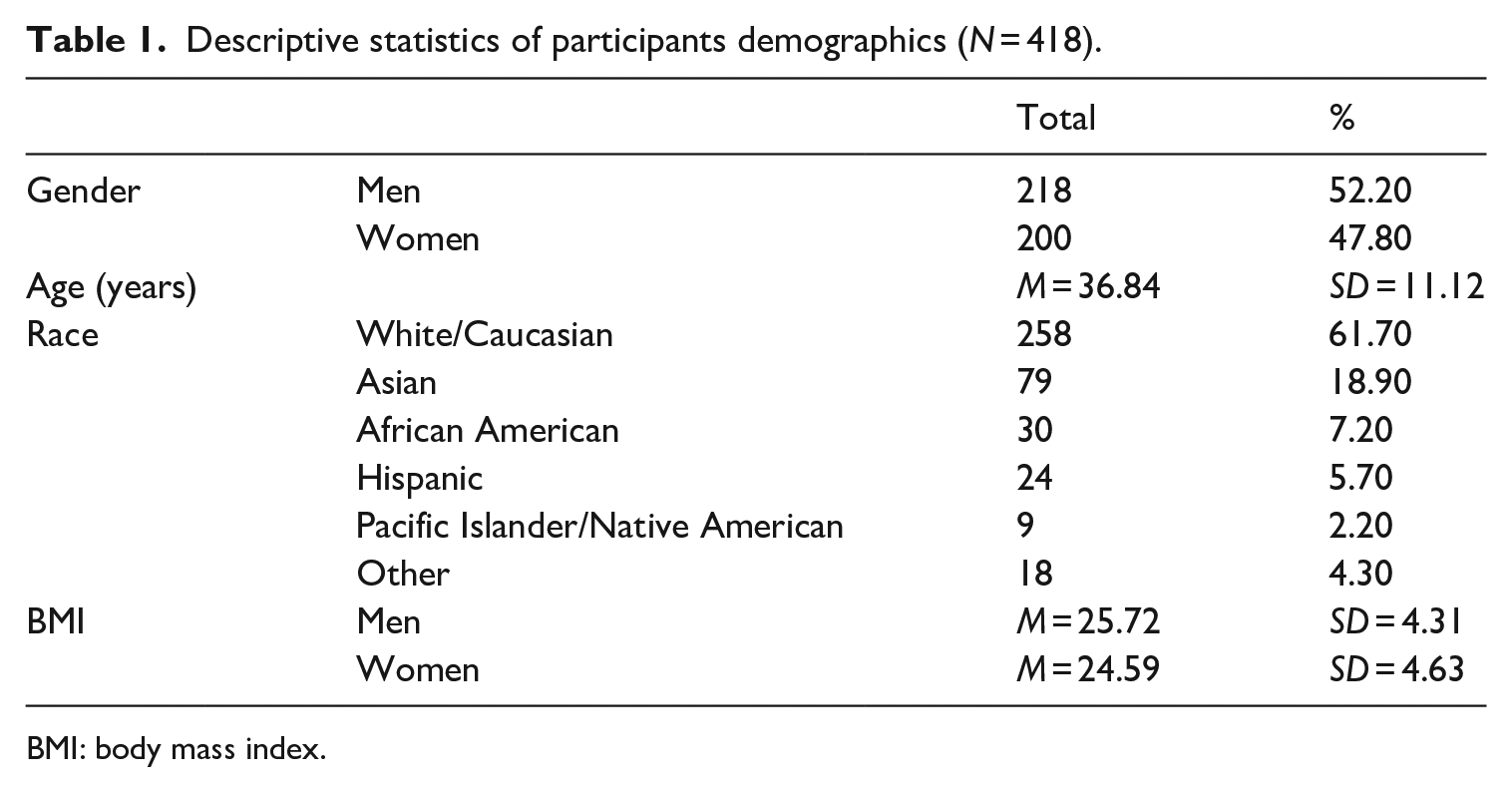
BMI: body mass index.
Materials
Model pictures
The model pictures were previously pilot-tested with a separate sample of female and male college students (Pan and Peña, 2017, 2020). Ninety-six96 pictures (half female models and half male models) depicting either more or less attractive models of lower or higher weight were purchased from a stock photo website. The pictures were presented in full frontal portrait layout with a uniform background. Four major races were represented (Asian and Pacific Islander, Black, Latino, and White), due to the lack of Native American models that would fit into all weight status and attractiveness conditions. Female model pictures were pilot-tested using a sample of 120 female students; male model pictures were pilot-tested using 80 male students. The perceived physical attractiveness of the models was measured with five items on a 7-point Likert-type scale (McCroskey and McCain, 1974). This scale has been used extensively by previous studies to measure perceived physical attractiveness in computer-mediated communication (Antheunis and Schouten, 2011; Peña and Brody, 2014; Walther et al., 2008). Sample items included “I think he or she is quite handsome/pretty” and “I find him or her very attractive physically.” These items showed good reliability in female (α = .95) and male samples (α = .92).
Perceived model weight status was measured with two items. The first item asked participants to compare the models’ weight status against nine silhouettes with various body sizes (Stunkard et al., 1980), and the second item asked participants to rate models’ weight status on a 9-point Likert-type scale (1 = extremely underweight, 9 = extremely overweight). The two items showed good reliability (female: α = .98, male: α = .97). Ratings of models’ attractiveness were not correlated with their perceived weight status, r(118) = .29, ns for female model targets, and r(78) = −.06, ns for male model targets. Based on Pan and Peña’s (2017, 2020) pilot test results, 48 model pictures were selected for this study with six pictures in each attractiveness and weight status condition for each gender. Sample pictures can be found in Figure 1.
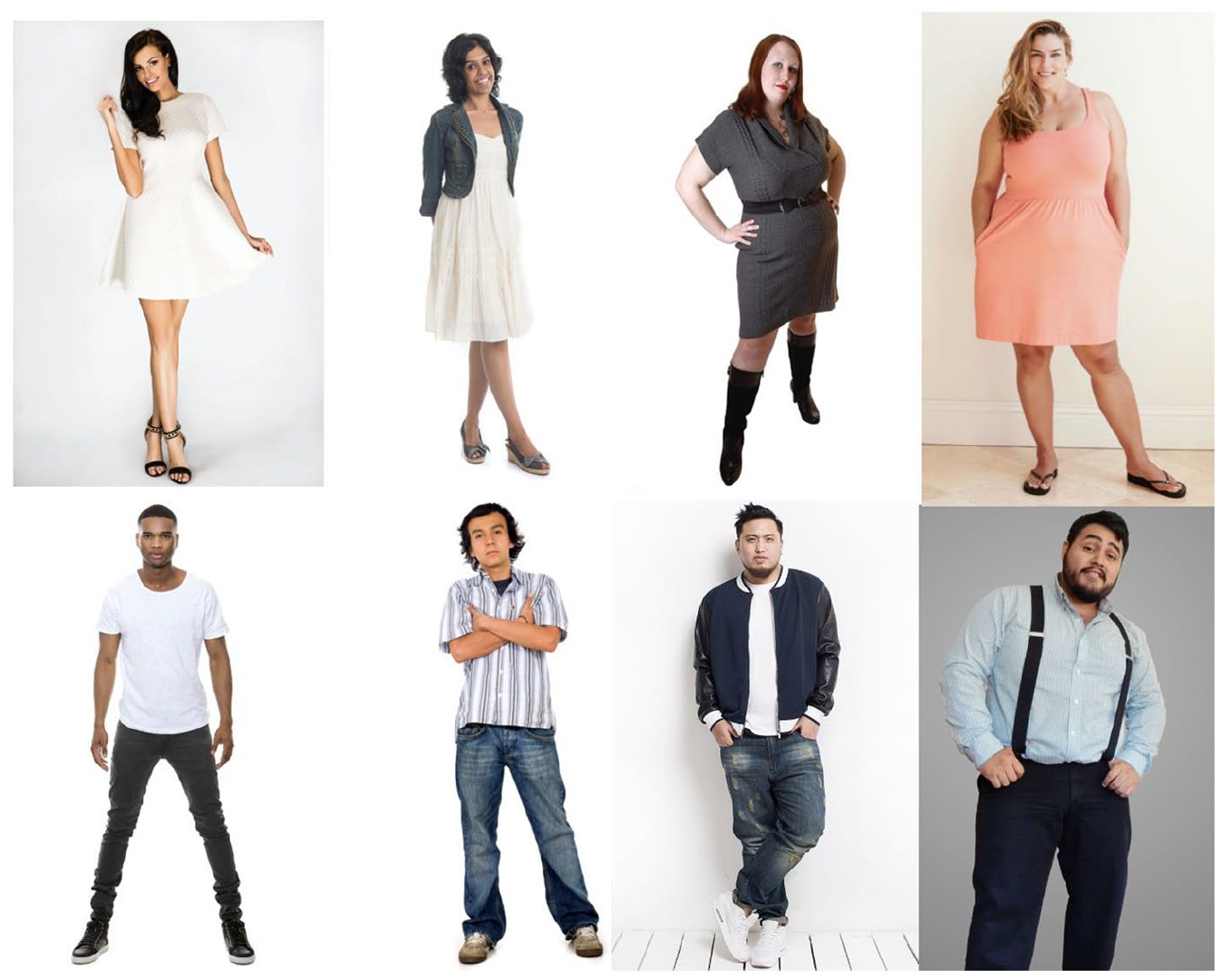
Sample pictures used in the experiment.
Dependent variables
Planned behaviors and self-efficacy to lose weight
Eight questions on a 7-point Likert-type scale measured participants’ planned behaviors to lose weight. The theory of planned behavior (Ajzen and Fishbein, 2000) guided the design of this scale and it proved to be reliable in previous studies (Pan and Peña, 2017, 2020). Four items measured participants’ planned behaviors to lose weight (e.g. “I intend to lose weight between now and the holiday season: extremely unlikely–extremely likely”) and showed good reliability (α = .92). A separate set of four items measured participants’ self-efficacy to lose weight (e.g. “For me to lose weight between now and the holiday season would be: impossible–possible”), which had good reliability (α = .83).
Trait social comparison
This factor was measured with five items on a 5-point Likert-type scale (Schaefer and Thompson, 2014). Sample items included “At parties or other social events, I compare my physical appearance to the physical appearance of others” and “In social situations, I sometimes compare my figure to the figure of other people.” The scale showed good reliability, α = .84.
Procedure
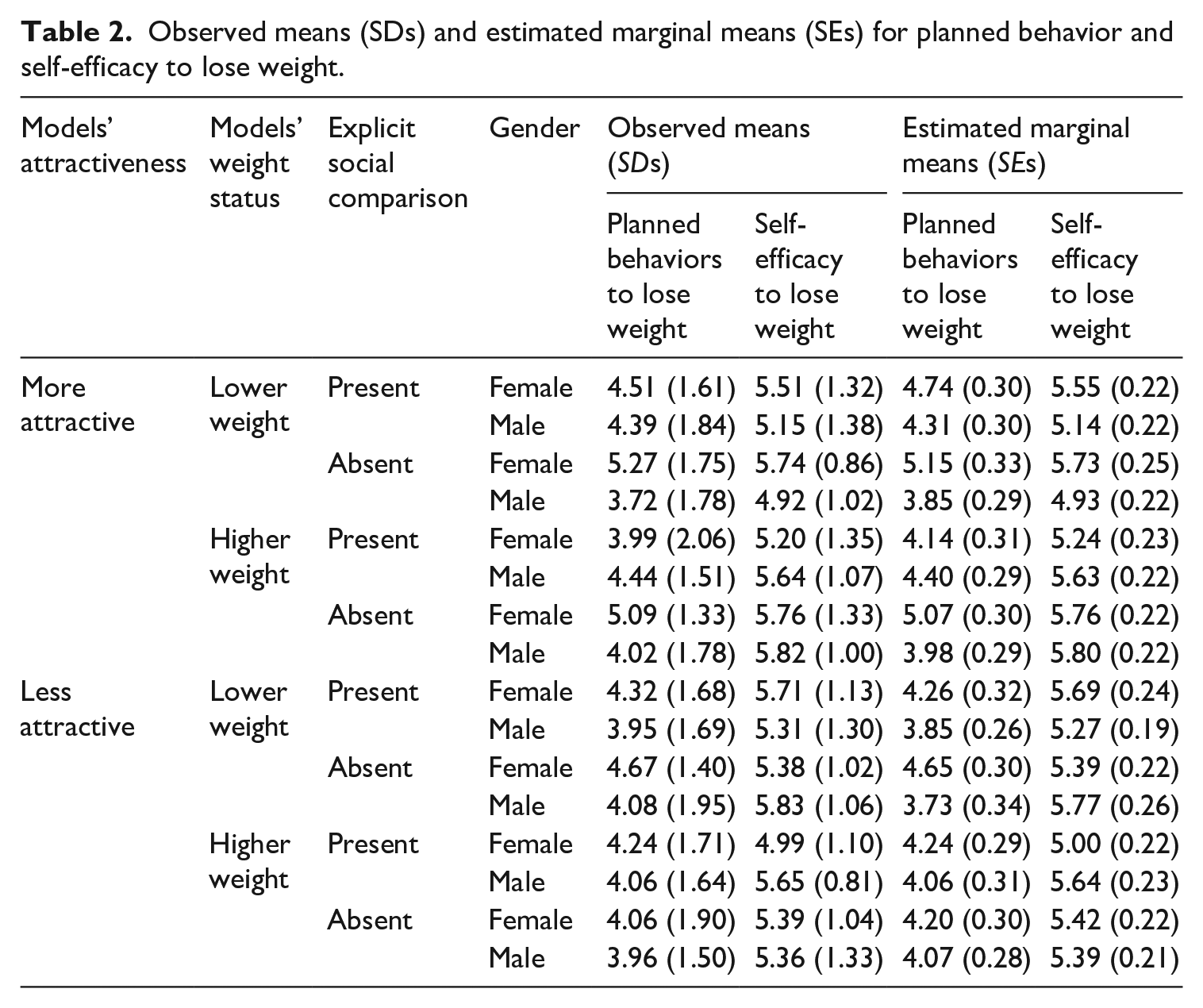
The experiment was a 2 (model attractiveness: more attractive vs less attractive) × 2 (model weight status: lower weight vs higher weight) × 2 (explicit social comparison: present vs absent) × 2 (gender: female vs male) factorial design, resulting in 16 unique conditions (Table 2). MTurk participants were redirected to a Qualtrics survey page to complete the online experiment. The survey told participants a cover story explaining that researchers were building a fashion website and wanted to know their opinion about several model pictures before uploading them to the website. Participants were each paid US$1 to agree to participate. After consenting to participate, they were first instructed to answer the trait social comparison scale and indicate their gender. Based on their indicated gender, they were then asked to choose their cultural ideal weight based on nine types of weight silhouettes with matching gender (Stunkard et al., 1980).
Observed means (SDs) and estimated marginal means (SEs) for planned behavior and self-efficacy to lose weight.
Using Qualtrics’ randomization function, half of the participants received explicit social comparison instructions (“When looking at the model pictures, please compare yourself to the models in the pictures. Please focus on the overall appearance as well as specific body parts when you are making comparisons.”), whereas the remaining participants received no instructions. This instruction manipulation was adapted from a study by Cattarin et al. (2000). Participants were then presented with six model pictures in random order with each picture only showing on one page. Participants were required to stay on each page for at least 15 seconds as the “next page” button will only appear after 15 seconds. While looking at the pictures, the participants were instructed to rate the model in the picture on their perceived physical attractiveness and weight status. Participants then completed manipulation check questions, planned behavior, and self-efficacy to lose weight scales and provided demographic information, including gender, age, race, height, and weight.
Manipulation check
Explicit social comparisons
Three items on a 7-point Likert-type scale (Tiggemann and McGill, 2004) were used as a manipulation check for the explicit social comparison manipulation. The three items included “While viewing model pictures, to what extent did you think about your own appearance relative to the people in the pictures?,” “While viewing model pictures, to what extent did you compare your overall appearance to the people in the pictures?,” and “While viewing model pictures, to what extent did you compare your specific body parts to the people in the pictures?” The items showed very good reliability (α = .95). Compared to those who did not receive social comparison instructions (M = 3.50, SD = 1.99), participants who received explicit social comparison instructions engaged in more appearance-based comparisons (M = 4.45, SD = 1.87) between themselves and the models, t(416) = 5.03, p < .001, Cohen’s d = 0.49.
Data analyses
The study’s hypotheses were pre-registered as they attempted to replicate previous findings (https://osf.io/5sqtp). We utilized several multivariate analyses of covariance (MANCOVA) with participants’ BMI and trait social comparison as covariates (Cohen et al., 2019; Tiggemann and Anderberg, 2019). BMI was calculated from self-reported height and weight. SPSS 26 (IBM Corps) software was used for the statistical analyses. Participants’ planned behavior and self-efficacy to lose weight were entered as dependent variables. Models’ attractiveness, models’ weight status, explicit social comparison manipulation, and participants’ gender were entered as four fixed factors resulting in a total number of 16 conditions. Participants’ trait social comparison scores and BMI were entered as covariates. BMI was significantly related to participants’ planned behaviors to lose weight, F(1, 400) = 60.45, p < .001, η2 = 0.12, and their self-efficacy to lose weight, F(1, 400) = 6.03, p = .01, η2 = 0.01. Participants’ trait level of social comparison was significantly related to planned behaviors to lose weight, F(1, 400) = 34.20, p < .001, η2 = 0.07, but not self-efficacy to lose weight, F(1, 400) = 0.58, p = .45. Means and standard deviations appear in Table 2. The results of MANCOVA were presented in Table 3.
MANCOVA predicting planned behavior and self-efficacy to lose weight.
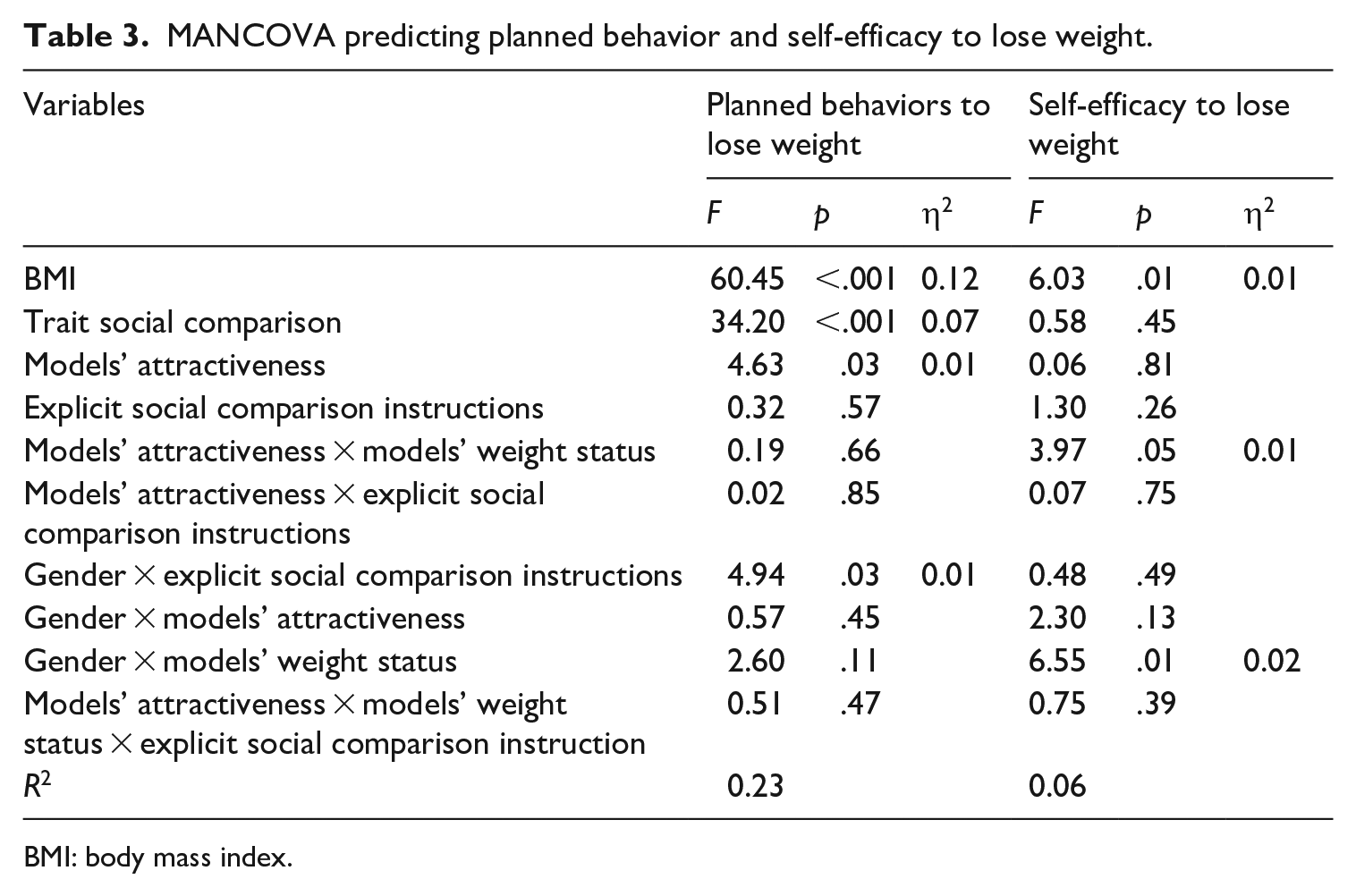
BMI: body mass index.
Results
Main effects of models’ attractiveness
As predicted, participants who were exposed to more attractive models reported higher planned behaviors to lose weight (M = 4.40, SD = 1.76) compared with those who were exposed to less attractive models (M = 4.15, SD = 1.67), F(1, 400) = 4.63, p = .03, η2 = 0.01. However, self-efficacy to lose weight did not differ significantly between those who were exposed to more attractive models (M = 5.46, SD = 1.18) and those who were exposed to less attractive models (M = 5.42, SD = 1.13), F(1, 400) = 0.06, p = .81. Therefore, H1(a) was confirmed but H1(b) was rejected.
Interaction effects of models’ attractiveness, weight status, gender, and explicit social comparison instructions
The two-way interactions between exposure to photos of models with different levels of attractiveness and weight status were not significant for planned behaviors to lose weight, F(1, 400) = 0.19, p = .66, but were statistically significant for self-efficacy to lose weight, F(1, 400) = 3.97, p = .05, η2 = 0.01. Contrary to our prediction, planned contrast analysis showed that in terms of self-efficacy to lose weight, among participants who were exposed to more attractive models, those who saw lower weight model pictures (M = 5.30, SD = 1.15) had lower self-efficacy to lose weight compared to those who saw higher weight model pictures (M = 5.62, SD = 1.20), t(402) = 3.43, p = .04, Cohen’s d = 0.27. Participants who were exposed to more attractive and lower weight model pictures did not differ from those exposed to less attractive and lower weight model pictures, p = .08, or those exposed to less attractive and higher weight model pictures, p = .46. Thus, H2(a) and H2(b) were not supported.
The proposed two-way interactions between exposure to model photos and explicit social comparison instructions were not significant for planned behaviors (p = .85) or self-efficacy (p = .75) to lose weight. The two-way interactions between models’ attractiveness levels and participants’ gender were not significant for planned behaviors, F(1, 400) = 0.57, p = .45, or self-efficacy to lose weight, F(1, 400) = 2.30, p = .13. The predicted three-way interactions between exposure to photos of more or less attractive models, their weight status, and explicit social comparison instructions were not significant for planned behaviors (p = .47) or self-efficacy to lose weight (p = .39). Therefore, H3, H4, and H5 were not supported.
Main effects of explicit social comparison instructions
Contrary to our prediction, participants’ planned behaviors to lose weight did not significantly differ between those who received explicit social comparison instructions (M = 4.23, SD = 1.70) and those who did not receive such instructions (M = 4.33, SD = 1.73), F(1, 400) = 0.32, p = .57. Also, participants’ self-efficacy to lose weight did not significantly differ between those who received explicit social comparison instructions (M = 5.38, SD = 1.19) and those who did not receive such instructions (M = 5.50, SD = 1.13), F(1, 400) = 1.30, p = .26. Thus, H6(a) and H6(b) were not supported.
Interaction effects of explicit social comparison instructions and gender
The predicted two-way interactions between gender and explicit social comparison instructions were not significant for self-efficacy to lose weight, F(1, 400) = 0.48, p = .49, but were significant for planned behaviors to lose weight, F(1, 400) = 4.94, p = .03, η2 = 0.01. Planned contrast analysis showed that in terms of planned behaviors to lose weight, female participants who did not receive explicit social comparison instructions (M = 5.09, SD = 1.50) showed higher planned behaviors to lose weight compared with female participants who received social comparison instructions (M = 4.60, SD = 1.75), t(402) = 2.33, p = .02, Cohen’s d = 0.30, male participants who received social comparison instructions (M = 4.67, SD = 1.52), t(402) = 1.97, p = .05, Cohen’s d = 0.28, and male participants who did not receive social comparison instructions (M = 4.37, SD = 1.54), t(402) = 3.47, p = .001, Cohen’s d = 0.47. Contrary to our prediction, female participants who were not told explicitly to compare themselves to the models indicated the highest level of planned behaviors to lose weight. Therefore, H7(a) and H7(b) were not supported.
Interaction effects of models’ weight status and gender
The predicted two-way interactions between participants’ gender and models’ weight status were significant for self-efficacy to lose weight, F(1, 400) = 6.55, p = .01, η2 = 0.02, but not for planned behaviors to lose weight, F(1, 400) = 2.60, p = .11. Planned contrast analysis showed that female participants exposed to lower weight models (M = 5.57, SD = 1.04) showed higher self-efficacy to lose weight compared with male participants exposed to lower weight models (M = 5.27, SD = 1.24), t(402) = 3.44, p = .04, Cohen’s d = 0.26. Male participants exposed to higher weight models (M = 5.61, SD = 1.08) showed higher self-efficacy compared with female participants exposed to higher weight models (M = 5.33, SD = 1.22), t(402) = 3.58, p = .04, Cohen’s d = 0.24, and compared with male participants exposed to lower weight models (M = 5.27, SD = 1.24), t(402) = 4.00, p = .02, Cohen’s d = 0.29. Thus, H8(a) was rejected and H8(b) was supported.
Discussion
Though previous studies had investigated the effects of thin-ideal images (Betz et al., 2019; Bury et al., 2016; Tiggemann and McGill, 2004), this study highlighted that the exposure effects of models’ attractiveness and weight status should be separated based on the significant effect of the attractiveness manipulation coupled with the nonsignificant effect of models’ weight status on planned behaviors and self-efficacy to lose weight. We first predicted a main effect of exposure to online model photos with different levels of attractiveness on participants’ planned behaviors and self-efficacy to lose weight (H1). Congruent with previous studies (Pan and Peña, 2017, 2020), participants exposed to photos of more attractive models indicated higher planned behaviors to lose weight compared to those who saw less attractive models.
We then predicted two-way interactions between models’ attractiveness and weight status (H2). The manipulation of models’ weight status affected self-efficacy to lose weight, but only when the models were attractive. In addition, participants who were exposed to more attractive and higher weight models reported higher self-efficacy to lose weight compared with those who were exposed to more attractive and lower weight models. This finding was consistent with previous findings showing how women who were exposed to attractive and higher weight model pictures reported higher weight loss intentions compared to those who saw attractive and lower weight model pictures (Pan and Peña, 2017). This finding also resonated with how men indicated lower appearance esteem after exposure to photos depicting attractive and higher weight male models (Pan and Peña, 2020).
In addition, explicit social comparison instructions had nonsignificant main effects (H6), nonsignificant two-way interactions with models’ attractiveness manipulation (H3), and nonsignificant three-way interactions with models’ attractiveness and weight status manipulations (H5). Contrary to our hypothesis (H7), women who were not told explicitly to compare themselves to the models showed higher planned behaviors to lose weight than women who were told explicitly to compare themselves to the models, and relative to men who were told or not to engage in explicit comparisons. This revealed an unintended boomerang effect that may arise when media messages generate the opposite attitude or behavior than was originally intended (Byrne and Hart, 2009). Boomerang effects are found in health campaigns, advertising, and communication strategies developed to reduce negative effects of the media (for a detailed review, see Byrne and Hart, 2009). Boomerang effects are commonly observed for messages promoting social norms, and messages with authoritative or demanding sources (Byrne and Hart, 2009).
Considering that the explicit social comparison instruction was successful as indicated in the manipulation check, it is unlikely that the observed boomerang effect was explained by the explicit instruction being too weak. Instead, this boomerang effect may have occurred because the explicit message was too overt and thus participants resisted its intended effect through mechanisms such as psychological reactance (Brehm, 1966). Receiving explicit social comparison instructions may have limited participants’ perceived freedom and possibly made them more motivated to resist the influence of explicit social comparison instructions. Along these lines, participants who received explicit social comparison instructions and were exposed to attractive models may have defended their self-esteem by engaging in post-comparison comparisons (Wood, 1989) to enhance their self-image and body satisfaction. From this perspective, explicit social comparison instructions may have triggered defensive reactions among women which then thwarted the intended exposure effect of more attractive models.
In addition, women who did not receive social comparison instructions indicated higher planned behaviors to lose weight compared to the those who were instructed to make the comparison. This is consistent with mixed and counter-intuitive findings reported in the literature (see Want, 2009, for a meta-analysis), which underscores the importance of combining different social comparison mechanisms into an integrated framework. For example, future studies should incorporate the trait-level social comparison, state-level social comparison, implicit versus explicit social comparison manipulation, and implicit versus explicit retrospective measurements of social comparison, and consider the upward, downward, or lateral direction of social comparison to form an integrated framework and to increase researchers’ ability to anticipate and account for unexpected effects.
The findings revealed no significant gender differences when exposed to model photos with distinct levels of physical attractiveness (H4). However, women exposed to lower weight models showed higher self-efficacy to lose weight compared with women exposed to higher weight models (H8). This is consistent with how women who engaged in upward comparisons with others who are perceived as more socially desirable (i.e. attractive, in shape, well-achieved) exhibited lower self-evaluations and were more likely to engage in dieting behaviors (Haferkamp and Krämer, 2011; O’Brien et al., 2009). However, men exposed to higher weight models indicated higher self-efficacy to lose weight compared to men exposed to lower weight models. Previous studies have also found the self-boosting effects of downward social comparisons among men (Pan and Peña, 2020) and women (Tiggemann and Polivy, 2010). In sum, the observed gender difference implies that exposure to attractive and lower weight models may increase women’s efficacy to lose weight, whereas exposure to attractive and higher weight models may increase men’s efficacy to lose weight. Gender norms regarding the ideal body type may have contributed to the different self-comparison standards for men and women, as the thin-ideal is more applicable to women relative to men (Grogan, 2016). Future studies should continue to examine the effects of gender differences in ideal body type and social attributions in relation to weight.
The results revealed that participants’ BMI and trait-level social comparison were strongly associated with their planned behaviors to lose weight. Previous studies on body image often found positive associations between individuals’ BMI and body dissatisfaction (e.g. Tiggemann and McGill, 2004). BMI has been measured as a covariate in body dissatisfaction studies to show the discrepancy between participants’ actual and perceived bodies (Grabe and Hyde, 2006). Individuals’ trait-level social comparison has also been identified as a significant factor to moderate the effect of exposure to ideal images on women’s body appreciation and body esteem (e.g. Betz et al., 2019). Instead of using BMI as a proxy to represent weight, future studies could use more sophisticated and comprehensive measures such as the waistline and thigh girth together to capture individuals’ weight, curves, and muscularity (Betz and Ramsey, 2017).
Practical implications
The present findings have practical implications in regard to the exposure effects of higher weight ideal bodies. Although media campaigns and social media users’ sharing of different body ideals may be well intended, they may result in higher behavioral intentions and self-efficacy to lose weight (Pan and Peña, 2017, 2020). Paradoxically, exposure to curvy and attractive idealized models may also harm women’s body image in that many studies have reported that exposure to curvy ideals may still lead people to make comparisons feel dissatisfied with their own body (Betz et al., 2019; Betz and Ramsey, 2017; Pan and Peña, 2017; Tiggemann and Zaccardo, 2015), and exposure to more attractive and higher weight male models can also affect men’s self-esteem (Pan and Peña, 2020).
Previous studies attributed this result to evolutionary perspectives implying that attractive men with bigger body sizes exude more dominance in comparison to slender and attractive counterparts (Frederick et al., 2016). However, for women, comparing themselves to attractive and higher weight women may still remind them that targets can be attractive even when they are of lower or higher weight. From a social comparison perspective, individuals may have engaged in upward social comparison and self-promoting behaviors such as weight loss, to compensate for the negative consequences caused by such disadvantageous social comparison. Future studies should combine both explicit and implicit measurements to quantify the extent and the direction of social comparison to explain this observed effect.
The results may also inform interventions and public health campaigns that aim to cultivate body acceptance and appreciation. The observed boomerang effects suggest that the social comparison process may happen automatically without explicit instruction, and individuals’ trait level of social comparison also contributed to their future planned weight loss behaviors. Future efforts should be targeted toward promoting self-acceptance and warn individuals against the possible negative effects of upward social comparison. Health practitioners and other stakeholders should be aware of the possible detrimental effects of promoting body ideals with higher weight, as the current study showed that exposure to more attractive and higher weight models led to higher planned behaviors and self-efficacy to lose weight.
Limitations and future directions
This study has several limitations. First, participants were instructed to look at the online models and then rate them and this forced comparison situation may limit the ecological validity of the findings. In real-life situations, individuals may vary in terms of their exposure frequency and length to models featured in social media and websites. Future studies should adopt a more generalizable approach to measure participants’ spontaneous behaviors and experiences in real life, such as ecological momentary assessment which utilizes self-reported and structured diary to capture participants’ psychological phenomena in a natural environment (Stevens and Griffiths, 2020).
Second, the study had no baseline measurements of participants’ pre-existing body image concerns, body esteem, or weight loss attitudes and intentions. This may limit the generalizability of the present findings considering that participants’ pre-existing body dissatisfaction and thin-ideal internalization may predict their planned weight loss behaviors. While adopting pre- and post-measurement designs enables researchers to detect the change in participants’ beliefs before and after experimental manipulation (e.g. Tiggemann and Anderberg, 2019), they may also run the risk of sensitization, awareness about the aims of the study, and test–retest issues (Salkind, 2010). These pre-existing differences may have been accounted for by the random assignment of participants to each experimental condition as done in previous studies (Betz et al., 2019; Cohen et al., 2019). Future studies may adopt more subtle pre- and post-measurement experimental designs to control for confounding variables.
Third, the photos posted on social media platforms portray people with different appearances. Future studies should adopt more comprehensive experimental designs to include various levels of models’ attractiveness levels and weight status to separate the exposure effects caused by models’ attractiveness and weight status, test for more in-depth interaction effects of model photo manipulations (i.e. physical attractiveness, body size, waist–hip ratio, muscularity), and examine which type of images (e.g. lower weight with more or less attractive appearance, higher weight with large waist–hip ratio, less attractive appearance with high level muscularity) may elicit upward or downward social comparisons which in turn may influence weight loss planned behaviors.
Fourth, the exposure effects of online models and explicit social comparison manipulation were reliable but statistically small. Small effect sizes are consistent with previous studies examining social comparison effects on body satisfaction (Want, 2009). To maintain consistency between experimental stimuli, participants in each experimental condition were only exposed to six model pictures. Future studies may attempt to measure the effects of single versus multiple social comparison targets.
Finally, although we attempted to replicate and extend previous studies using a non-undergraduate student sample, most of the sample was White (n = 258, 61.70%). Thus, the results may not generalize to other races and cultures. For instance, research suggests cultural and ethnic differences in body ideals such as Black women, reporting a more positive body image than White women (e.g. Duncan et al., 2003), and Asian Americans were less satisfied with their appearance than White women (Frederick et al., 2016). Black women were slightly more satisfied with their bodies compared to White, and the differences between other ethnicities were close to zero (Grabe and Hyde, 2006). Other studies reported that although mean differences were observed among ethnic groups in terms of thin-ideal internalization and BMI, there were no reliable ethnic differences in risk factors associated with eating disorder onset, and the identified appearances pressures coming from family, peers, and the media are similar across racial or ethnic groups of young adult women (Burke et al., 2021; Cheng et al., 2019). Future studies should continue studying cultural similarities and differences in body ideals so as to determine how individuals from diverse cultural backgrounds may respond to model portrayals and social comparison instructions.
Conclusion
This study reaffirmed how online models’ physical attractiveness had reliable social comparison effects on observers’ planned behaviors and self-efficacy to lose weight. In addition, for women, exposure to lower weight models caused the most self-efficacy to lose weight, whereas for men, exposure to higher weight models caused the most self-efficacy to lose weight. Women who did not receive social comparison instructions showed higher planned behaviors to lose weight, thus indicating a boomerang effect among women but not men. In conclusion, the effects of social comparisons operated differently on women and men, and explicit social comparison instruction manipulations continued to yield unintended effects. Health practitioners should be cautious when developing media messages promoting body positive content and designing body acceptance campaigns due to their potential effects on planned weight loss behaviors.
Footnotes
Acknowledgements
The authors thank the editor and two anonymous reviewers for their helpful feedback.
Funding
The author disclosed receipt of the following financial support for the research, authorship, and/or publication of this article: This study was supported by the Journalism and Marxism Research Center, Renmin University of China (MXG202008).
