



Abstract
This study explored how social capital has been utilized in video-game studies by conducting a scoping review. In total, 74 peer-reviewed publications were analysed from three different databases. The following aspects pertaining to social capital were analysed: definition, methodology, game or genre as stimulus, its utilization inside or outside the stimulus, whether it was the sole concept or variable, how it was utilized, whether social capital was used to predict variables or whether variables were used to predict it, and what where the predicted or predicting variables. The results of the analysis show that Putnam’s research, the quantitative method and Massively Multiplayer Online Role-Playing Games were most commonly combined. Social capital was predominantly utilized in binary form. It was utilized almost equally inside and outside the video games’ sphere of influence. The study then presents the main findings and discusses future research avenues.
Introduction
Social capital as a concept has existed for over a century (for its first mention in academia, see Hanifan, 1916), but it has received increasing scholarly attention since the late 1980s, when Bourdieu (1986) presented a framework in which social capital constitutes one type of capital, when Coleman (1988) examined the concept and types of social capital, and Lin (1982), whose work continues to this day, first approached social structures and capital through network theory and analysis. Social capital as a concept does not have a single definition; rather, it is defined as an interface for transforming various social concepts and issues into a resource, one given more concrete form and context to better utilize and study it (Neves and Fonseca, 2015; Villalonga-Olives and Kawachi, 2015a, 2015b). Increasing ubiquitous access to the Internet, digitalization and the recent surge in how mobile devices are utilized in people’s everyday lives have transformed the social functionalities of societies. These advances and changes have given opportunities for academics to critically examine contemporary social life and its various aspects, resources and needs nowadays and how such changes have affected the ways in which they are accumulated and used (Fussey and Roth, 2020; Hilbert, 2020).
Numerous assessment tools or questionnaires exist to measure social capital. The oldest tool for assessing social capital was published already in the late 1970s by McCallister and Fischer (1978), and it focused, like many similar studies at the time, on social networks. Since then, the focus has shifted to an individual’s social capital (Chen et al., 2015; Wang et al., 2014; Williams, 2006), and especially during the 2010s additional assessment tools have been published (Salisu and Hashim, 2017). The rise in popularity of video games has raised questions as to whether gaming contains more flaws than strengths and more threats than possibilities for individuals. As such, video games have long been stigmatized and received much attention by academics as to their exact effects on people.
The social aspects of digitalization and video games have received scholarly attention especially in 2010s as the Internet has become more globally available. The way in which people in communities socialize has changed, but not disappeared. Social capital has also received much theoretical and conceptual attention in the last two decades, with scholars employing a wide array of validated models and applications to study video games and their sphere of influence. Instead of utilizing movie theatres or cafés as ‘third places’ (Putnam, 2000) to socialize, players now gather in virtual worlds to play and chat with others. For many, these virtual worlds now serve as a ‘third place’ to fulfil their social needs outside work and family (Steinkuehler and Williams, 2006). Williams’ (2006) Internet Social Capital Scale is popular because it can be adjusted relatively easily to measure both outside and inside social capital regarding an online video game (Collins and Freeman, 2013; Kim et al., 2013; Korkeila and Hamari, 2020; for further examples of development theoretical models or frameworks utilizing social capital in the context of video games, see Amory, 2007; Lavoué, 2012; Molyneux et al., 2015 and Steinkuehler and Williams, 2006).
Identifying the research aims
This study maps out how social capital as a concept or framework has been utilized within the sphere of influence of video games by conducting a scoping review of peer-reviewed articles. The study does not examine various social capital definitions or their meaning, but rather just lists the survey findings to avoid any perceived subjectivity in how they are interpreted, especially given the heated debates surrounding video game studies and the multiple understandings of social capital within academia. Despite the growing popularity of video game studies, few comprehensive reviews exist on how scholars apply social capital as a research concept in video game studies. To complement existing research, this study provides a large dataset together with numerous comments and connections emerging from the data analysis, with the aims of (1) concatenating pre-existing study methods and approaches to discussing social capital in video-game studies so that they are more accessible and easier to read, (2) highlighting the various ways in which social capital has been studied within the context of video games, such as, whose definition of social capital was referenced and whether the author used the concept more inside or outside the video-game ecosystem, and (3) intentionally utilizing broader search queries and analysing more than 50 articles to provide a strong and holistic perspective on the topic. The findings presented in this study provide a cross-sectional overview of how scholars have discussed various aspects of gaming in relation to social capital.
The article then presents the methodology used to assess the findings, which consists of the process of data gathering, elimination criteria, and various descriptive statistics for the final dataset, followed by the ‘Results’ section, where all the analysed issues are presented together. Next, the ‘Discussion’ section provides an in-depth analysis of the dataset, with the findings not directly inferable based on the results alone, coupled with a look at the era sensitivity of the results. The article then discusses the limitations of the approach, future avenues of research and final conclusions.
Methodology
Instead of conducting a literature review, meta-analysis, or systematic analysis of the topic, a scoping review was deemed the most feasible for several reasons. First, game studies are a relatively recent scholarly subject, and thus, there is a widespread lack of strictly defined frameworks, with the terminology and definitions varying greatly and sometimes being used interchangeably (Nieborg and Hermes, 2008). Second, game studies present somewhat controversial findings due to the newness of the field, and likewise, game studies are trying to keep up with rapid technological and scientific advancements and video game trends, making it difficult to set definitive frames and borders. Third, game studies methodologies are not widely accepted at this point, and hence, there is a need to utilize research concepts from other fields (see, for example, Aarseth, 2019; Lammes, 2007; Rozali et al., 2007; Zagal and Bruckman, 2008). For these reasons, it is more reasonable to utilize a scoping review as the methodology of choice because prior studies have not been concatenated based on journals, publishers, conferences, or other publication venues. This makes, in some cases, conducting a literature review or systematic analyses extremely difficult, as not enough relevant studies may exist or they might be hard to find or even inaccessible. Using scoping reviews as a method can help circumvent some of these obstacles since they chart concepts in emerging scientific fields or provide an overview or clarity to some research questions or aims (Levac et al., 2010). Thus, the purpose of this study is not to provide insightful dialogue into how social capital has been utilized as a concept in video game studies, apart from a brief synopsis of the results in the ‘Discussion’ section.
To this end, Arksey and O’Malley’s (2005) five-step framework for conducting a scoping review was used, as outlined in studies about advancing scoping reviews by Levac et al. (2010) and Sucharew and Macaluso (2019). The first step is to identify the research question or aim, which in this study is charting the use of social capital in the context of video-game studies. Identifying relevant articles is the second step, and in this case, it includes selecting databases, conducting search queries and screening the search results. The third step, article selection, involves devising post hoc inclusion and exclusion criteria for the screened studies. Charting the data is the next step, which involves listing the central questions and items analysed with a description of how the analysis was conducted. In the fifth and final step, the results are presented in a clear and understandable manner. This framework does have an optional sixth step tied to the external actors involved in the study who provide additional insight, namely consumers and stakeholders. For the purposes of this article, step 1 is discussed in the introduction, steps 2 and 3 in the ‘Methodology’ section, and steps 4 and 5 in the ‘Results’ section.
Identifying the relevant studies
Unlike many other review studies, this study used results mainly available from a single database, Google Scholar, with complementary results taken from the Web of Science and Scopus databases. Reproducibility of the search results is one of the key elements in any scientific study. However, with scoping reviews, the method should be reproducible as is, rather than the results. As more and more articles that fit the search criteria are published, exact reproduction becomes nigh impossible, unless one somehow has access to archived versions of the searched databases. Therefore, it is advisable to approach scoping reviews as a product of their time, not as a means of conveying absolute truths on the topic that survive the test of time. In addition, resource and feasibility limitations restrict the absolute robustness of scoping reviews. The overarching and most important aim should be to find enough relevant results for analysis to provide a proper and satisfactory overview of the topic. Since Google Scholar includes more than journal articles in its results listings, it is better suited for conducting a scoping review than for systematic or meta-analyses and literature reviews that focus on specific research questions (Gusenbauer, 2019; Gusenbauer and Haddaway, 2019; López-Cózar et al., 2018). Google Scholar includes book chapters, conference proceedings and doctoral theses, and each type of publication is present in the dataset compiled for this study. Table 1 includes concatenated information for search results regarding publisher, publishing year, journal, and keywords. The search was conducted on 6 March 2020, and it was then repeated by colleagues in multiple countries. This was done to ensure the validity of the search results. In each case, the number of results for that day remained the same: 14,100. Only the first 1000 results are accessible in Google Scholar (Gusenbauer and Haddaway, 2019). This was deemed a satisfactory number, especially since the relevance of the results dropped significantly after 500 results. All 1000 results were manually inspected regardless.
Descriptive statistics for the analysed articles.
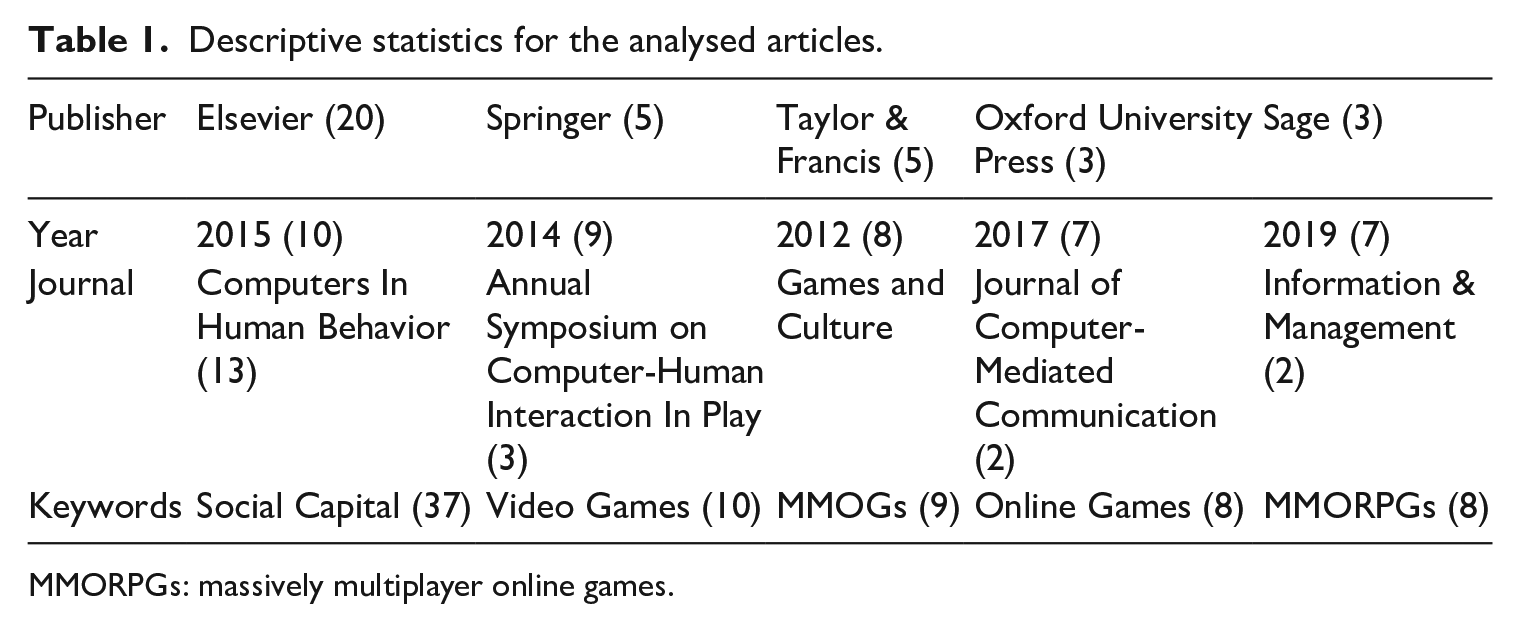
MMORPGs: massively multiplayer online games.
To compare and complement the available query results provided by Google Scholar, two commonly used databases in the field of information technology, Web of Science and Scopus, were searched as well. The search parameters ‘Social capital’ AND ‘video games’ in Web of Science returned 17 results as of 16 January 2021. The exact search criteria used was ‘ALL FIELDS: (“social capital” AND “video games”)’. The specification ‘ALL FIELDS’ was used to remove any limitations on the search results and to replicate how the search was conducted with Google Scholar. Nine of the 17 results were included in the original screening of 223 results, and 7 of them were included in the analysis done for this study. The remaining eight results would not have been analysed during the initial screening or elimination phases.
With Scopus, the search term used was ‘TITLE-ABS-KEY (“social capital” AND game)’, which resulted in 427 publications as of 12 February 2021. Instead of using ‘ALL’ or ‘video games’, the default title, abstract and keyword search was conducted to search for additional or missing articles. The search term ‘video game’ was changed to ‘game’ to increase the number of search results to a feasible number for manual analysis. After manually assessing the results, 22 publications were added to the screening data, 11 of which were suitable for analysis. Of the 427 results, 41 publications were matched to the original screening of 223 publications, while the remaining 182 were not found in the search results when using Scopus.
The search query used for Google Scholar was ‘social capital’ AND ‘video games’. This specific query was chosen because it encapsulates the concept of socialness within the more restricted subcategory ‘social capital’. Social capital in this study is not tied to any single concept, such as how Bourdieu (1986) or Putnam (2000) presented it or how Williams (2006) subsequently continued to quantify Putnam’s work on social capital. The intention was, as outlined earlier, to examine how social capital as a concept and tool has been studied previously within the context of video games. The intent was to use social capital as one aspect of the search query and study without any other constraints. Limiting the usage of the first part of the search term further would not have yielded nearly as robust an overview of its multimodality or the various types of research approaches that make use of it.
The second part of the search query, ‘Video Games’, made it possible to identify studies that do not examine just one game or platform but instead focus on certain phenomena from a specific viewpoint. Articles certainly have been written that focus on a single game or genre, but that is not how they are framed. This delicate choice can further include texts approaching video games, or social capital, in a less obvious manner. Just as with the ‘social capital’ part of the study, an agnostic approach was intentionally employed to avoid bias in the results caused by the search term and data gathering process. While such a choice does come with the caveat of likely have missed relevant studies focusing on a single game, genre or different wording, such as replacing ‘video games’ with ‘videogames’, using forward or backward search methods in the hopes of finding relevant publications was not deemed feasible for this study due to the overwhelming number of video games on the market.
The study selection
In total, 245 publications were selected for further analysis based on title, abstract, keywords or a combination of them. After removing duplicates and unavailable texts, 239 publications remained, 74 of which were ultimately chosen for the actual analysis after conducting multiple elimination rounds based on five criteria. The elimination rounds were not executed in linear fashion, where one criterion needed to be fulfilled before then moving on to the next criterion, because some studies simultaneously violated multiple criteria. The criteria used were as follows:
Criterion 1. Social capital must be mentioned more than once in the body of the text and at least once in the references to best ensure that the term does more than just describe a neighbouring subject or even seemingly randomly mention possible research avenues. Specific mention of the term in the references ensures that pre-existing research is cited and that such publications are then eliminated from further study.
Criterion 2. Study setting must be within the context of video games in one way or another. Just as with the ‘social capital’ part of the query, the publications needed to mention video games more than once in the body of the text. Even more so, the study needed to fall within the broader context of video games. For example, it was not enough just to list hobbies, with video games being one option, as ways to increase social capital.
Criterion 3. Social capital must be clearly defined in the publication. Not only was it necessary for the study to mention social capital in the body of the text to be considered relevant, but it needed to define the term and include a proper citation to a previously published study.
Criterion 4. Social capital must be part of the study setting. Although studies may have discussed social capital within the body of the text, and even have provided a definition and appropriate citations, publications in which social capital was not part of the actual research setting were eliminated. Social capital must have been the focus of the study in some way.
Criterion 5. Text must be a scientific publication, such as a journal article, book chapter or doctoral thesis. While a number of excellent studies may have adopted unique approaches relevant to this study, they still needed to have been peer-reviewed to ensure a certain degree of objectivity, fallibility and quality and that the analysed texts can be accessed online for others to read.
Results
Charting the data
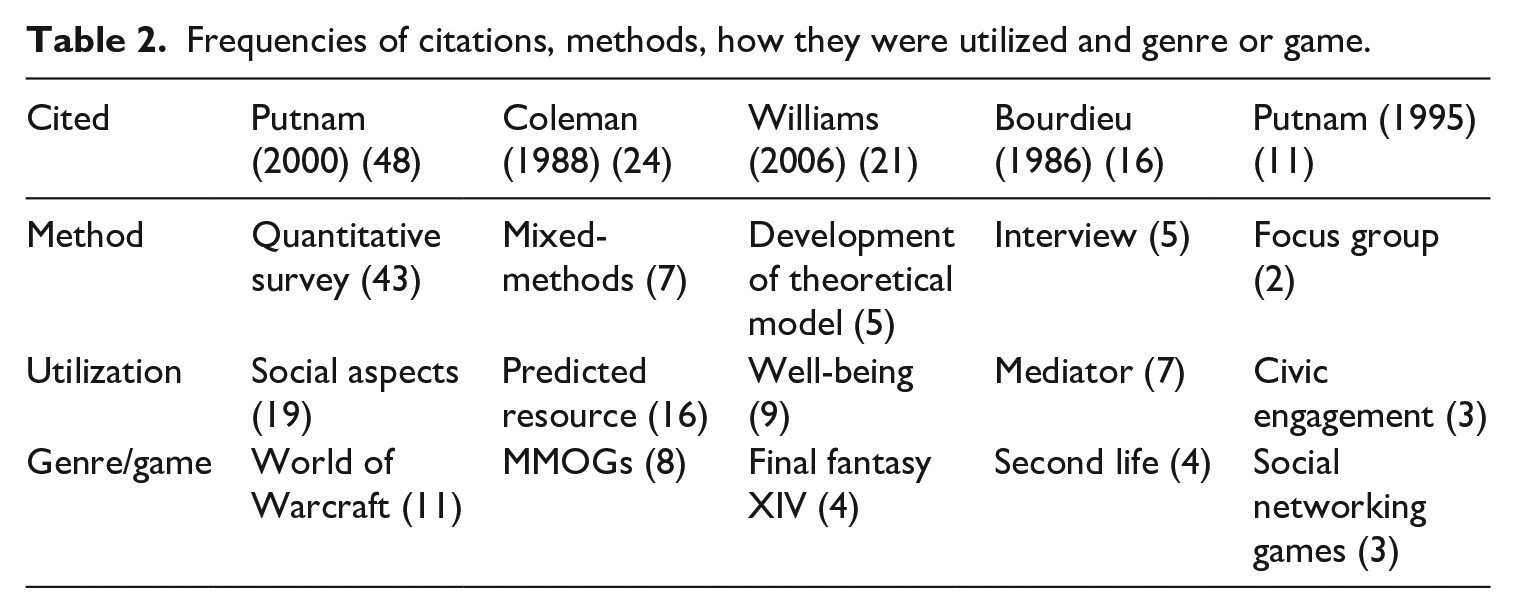
In addition to the descriptive statistics listed, we also addressed the following questions in the 74 analysed studies: who was cited when defining social capital, what was the selected research method, how did the study approach or utilize social capital, which genre or game(s) were used as the stimulus, was social capital the only item studied, and if not, what else was studied, what variables did social capital predict or did the variables predict it, and was social capital used inside or outside the video games. We compiled all these findings on an Excel sheet before conducting more quantitative and numerical analyses. Table 2 includes the five most cited publications when defining social capital, the most common methods, approaches or utilizations, and genres or games.
Frequencies of citations, methods, how they were utilized and genre or game.
Presenting the results
The citation count for publications both mentioning and defining social capital included, if applicable, the paragraph in which it was defined to guarantee that the definition, and subsequently the citations, included the framing and context of the study itself. In addition, not all studies defined social capital in a brief and straightforward manner followed by a citation(s). Some publications explained the social aspects of gaming by linking them to the concept of social capital and including citations. The exact method by which they defined social capital and its practical uses varied greatly, though, which might derive from the fact that different scientific fields have different expectations and guidelines for defining or framing the study’s methodology sections. For this reason, the number of separately cited works for social capital was 102, with five articles being cited more often than the rest.
Studies frequently employed social capital as a framework or concept to explore various social aspects, while then discussing social capital as a variable that predicted a particular resource and studying links between social capital and video games’ effects on well-being, how video games are utilized as a mediating effect and how they can affect civic engagement. Some studies also focused on social capital as a tool of expression (Balnaves et al., 2012) and as a means for increasing reciprocity (Boudreau and Consalvo, 2015; Meachem, 2012), as well as its relation to continuance intention (Hsiao and Chiou, 2012b; Kim et al., 2013) and in-game aggression (Lee et al., 2015).
The numerous ways in which social capital has been addressed within the context of video games has raised the question of whether social capital was the sole variable being studied, and in 29 articles that was the case. The most common method of inquiry was quantitative survey, with social capital being treated either as the only variable or concept being utilized or as the sole variable on one side of the research model used in the study. For example, one article employed social capital as the sole variable and predicted by presence, interactivity and engagement (Davis, 2011). In the other 45 articles, social capital was not the sole variable, meaning that they also used social capital as part of a higher level concept, such as well-being, in relation to other variables.
Social capital as a concept can be applied and utilized in a wide variety of ways, and it has successfully been utilized both as a high-level and low-level variable. Four articles linked social capital with Bourdieu’s (1986) notions of economic and cultural and symbolic capital. Other common variables included communication frequency, continuance intention, familiarity, motivation to play, proximity, community and well-being. Many studies likewise made use of Yee’s (2006) ‘Motivations for Play in Online Games’ survey. Generally, articles that focused on well-being included related discussions on life satisfaction, self-esteem, self-disclosure, loneliness and escapism. In addition, the data revealed the following established theoretical frameworks: needs satisfaction, empathy quotient, telepresence theory, game object model 2 and Oldenburg’s (1999) ‘Third Place’ theory.
In 14 articles, social capital did not predict any variables and was not predicted by any variables either, whereas in nine articles social capital appeared on both sides of the research model. In the remaining 51 cases, 24 found that social capital predicts the variables in question and in 27 it was predicted by certain variables. In most of the cases where social capital was not part of the research model examining the relationships between variables, the articles either employed it as part of framework development, as part of a general overview (e.g. of gaming habits and social changes related to digitalization), or as part of a more theoretical orientation. In the nine articles where social capital both predicted other variables and was, in turn, predicted by certain variable, the concept was used to directly compare how social capital varies between virtual worlds and offline settings.
When social capital predicted certain variables, those variables included continuance intention, well-being, civic engagement, health disruptions, offline socialness, success of crowdfunding and social support. Some of the singular variables receiving attention included online self-identity, aggression, life satisfaction, willingness to pay and play, group success and popularity of a game. The overarching theme linking the studies is that when social capital predicts certain variables, the concept can be used to measure or examine extra-game (i.e. external to the video game world itself) variables and concepts.
When social capital was itself predicted by certain variables, the most common variables included Yee’s (2006) motivation types, trust, co-operation, information exchange, game play, presence, engagement, interactivity, demographical variables, passion and frequency of group play. Variables receiving less attention included self-disclosure, daily game usage, connectedness, reciprocity, intimacy and membership. In this scenario, the theme tended to be that in-game actions predicted social capital more than extra-game actions.
Eleven articles examined social capital both inside and outside the virtual world’s or game’s sphere of influence, meaning they approached both in- and extra-game actions, at least in part, using social capital as the measuring concept or variable. Thirty-five articles only mention social capital in relation to in-game actions, while 28 articles do so in relation to extra-game actions. In-game actions include the number of in-game friends and interactions with friends, guild, family, strangers, who they play with, how much they play with others and why they play with others. Similarly, extra-game actions include number of interactions with friends, family, in-game friends, strength of these ties, number of people to interact with and the social support gained through such interactions.
Discussion
Most studies reviewed here opted for a combination of citing Putnam (1995, 2000) and Williams (2006), employing the quantitative survey method and assessing massively multiplayer online games (MMORPGs) as the stimulus for participant observation and recruitment. This finding was not unexpected, especially since Williams transformed Putnam’s thought process regarding the aspects of social capital in the modern, digital era into a 20-item survey questionnaire that is still widely utilized. At the same time, advancements in technology and the Internet have become increasingly ubiquitous throughout the world, alongside the explosive traction of iconic MMORPGs, such as World of Warcraft (Blizzard Entertainment, 2004), EverQuest II (Sony Online Entertainment, 2004), Dark Age of Camelot (Mythic Entertainment & Electronic Arts, 2001), RuneScape (Jagex, 2001), EVE Online (CCP Games, 2003) and Lineage II (NCSoft, 2003). Therefore, it is no wonder that studying the social aspects of persons inhabiting virtual worlds through a quantitative survey is quite common. It is, however, rather interesting that during the 2010s the popularity of genres has shifted from MMORPGs to survival horror to battle royale games, with the latter two genres not having thus far generated such attention with respect to social capital. While one study focused on League of Legends (Riot Games, 2009) and two on Counter-Strike: Global Offensive (Valve Corporation & Hidden Path Entertainment, 2012), most studies focused on World of Warcraft, Final Fantasy XIV (Square Enix, 2010), Second Life (Linden Lab, 2003) or MMORPGs as the stimulus.
Fifteen articles focused on one of the longest running and successful online games, World of Warcraft, as the stimulus for participant observation and recruitment. Four studies focused on Final Fantasy XIV and Second Life, tied for the second most popular game. Several studies on Final Fantasy XIV were published between 2018 and 2020, more than 5 years after the release of the critically acclaimed reboot of the game. To this day, Final Fantasy XIV keeps gaining in popularity, and some have estimated that it has even surpassed World of Warcraft in current subscribers. This might have been true during the expansion cycle of Shadowbringers (2019), when World of Warcraft included Battle for Azeroth (2018) in the current cycle, which many did not find so impressive. The increasing popularity of Final Fantasy XIV might have been one reason for recent academic interest years after it was first launched.
As for Second Life, while the sheer number of active players does not warrant academic attention, the affordances, possibilities and links to the real world do. Second Life was published 1 year earlier than World of Warcraft in 2003, and it has remained active ever since, with peak player numbers reported at just above 1 million. Second Life is not an MMORPG; it is a Massively Multiplayer Virtual World that acts as a huge sandbox for players to inhabit and play around in. Comparatively, the articles in this dataset were published much earlier than those using Final Fantasy XIV as stimulus: 2006, 2010, 2011 and 2018. This is not so surprising since the game is relatively old.
It was possible to construct a cross table showing how many times social capital was used outside or inside the game’s sphere of influence to predict variables or be predicted by variables. Table 3 depicts these results. We found that in total, there were 44 cases in which studies utilized social capital as a one-way variable, meaning that in seven cases social capital was utilized on both sides of the research model. We found that the studies utilized it quite evenly, with both ‘In-game actions being predicted’ and ‘Extra-game actions being predicted’ occurring in 11 cases, ‘Extra-game actions predicting’ occurring in nine cases and ‘In-game actions predicting’ occurring in 13 cases. Thus, it was possible to interpret a level of skewness in the data, which means that social capital can be, and has been, successfully used in numerous ways.
Inside or outside games × predicting or predicted.

The dataset reveals various ways of defining social capital. Most common are binary definitions, where social capital as a variable is depicted as a strong or weak social connection, such as in a study by Granovetter (1973). Later, in 1995 and 2000, Putnam published texts about the decline of social capital in contemporary society due to technological advancements. Based on Putnam’s ideas, Williams presented a 20-item survey on bonding and bridging social capital, 10 items each. Granovetter’s (1973) and Williams’ (2006) definitions are sometimes used as conceptual synonyms, with strong ties being equal to bonding social capital, meaning close or intimate social connections and weak ties being the same as bridging social capital, meaning more casual connections with higher turnover than bonding social capital-related ties. Other studies opted to use Coleman’s (1988) approach, where trust or community belongingness affect individuals’ social capital, Adler and Kwon’s (2002) conceptual model, which breaks social capital down into three main categories, market, social and hierarchical relations, and Nahapiet and Ghoshal’s (1998) model, which breaks social capital down into structural, cognitive and relational categories.
Coleman’s (1988) approach was indeed used frequently in conjunction with gameplay continuance intention, civic engagement and subjective well-being in their various forms, each with three occurrences. Regarding Adler and Kwon’s (2002) model, the three main categories further comprised as follows: market relations of task and symbolic contingencies; social relations of opportunity, motivation and ability, which then converge at benefits and risks of social capital; and hierarchical relations of complementary capabilities. All three categories then together form the value of the social structure and people affected by it. For their part, Nahapiet and Ghoshal (1998) presented structural social capital as the presence of an access network for people; relational, cognitive social capital as the subjective interpretations of shared habitus; and relational social capital as the shared understandings, trust and identity within a social context, such as a community or organization.
Of the six times that studies cited Adler and Kwon (2002) when defining social capital, twice they did so in combination with Nahapiet and Ghoshal’s (1998) work, and twice in combination with Williams’ (2006) work. Nahapiet and Ghoshal’s (1998) work was cited a total of six times. Based on these findings, we can infer that when studying video games through the lens of social capital, scholars rarely utilize a non-binary approach and even less the three- and two-structure methods in the same study. The two articles that utilized both were authored by Hsiao and Chiou (2012a, 2012b), and both were published in the same year. These studies examined the players of World of Warcraft, their role in their respective in-game communities and how it affects their continuance intention. In their article, Collins and Freeman (2013) referred to both Adler and Kwon’s (2002) and Williams’ (2006) work to examine whether problematic video game play would reveal differences in online and offline social capital. In contrast, an article by Meng et al. (2015) viewed social capital as a resource predicted by multimodal connectedness, or the number of media channels players use to communicate with other players.
The data thus reveal that gaming studies commonly employ the notion of social capital in its binary form, making use of the concepts presented by Coleman (1988), Putnam (1995, 2000) and Williams (2006) as strong or bonding and weak or bridging social ties. Sometimes, social capital is studied together with other sociability concepts (e.g. Lin, 1982) and not just as a sole resource predicted or predicting certain behavioural effects or as a measurement of subjective well-being.
Limitations, future research avenues
Elimination criterion was designed before analysing the various aspects of the data, and this resulted in first assessing all the articles on a one-by-one basis and eliminating articles violating any of the criteria. This was chosen as the most feasible approach for filtering out all irrelevant studies from the initial 245 articles. Instead of comparing articles according to just one criterion at a time, as has been done in the elimination phase of other review studies, this approach saved a considerable amount of time.
We excluded all articles with ‘social capital and <single game>’, even if they would have otherwise fit the parameters for the dataset. We did so for two reasons. First, some articles whose title began with the words ‘social capital and video games’ still focused on just one game, meaning such articles better fit the dataset assessing solely community or the social capital of World of Warcraft (Castillo, 2019; Hsiao and Chiou, 2012a) or Final Fantasy XIV (Korkeila and Hamari, 2020). Second, though an ever increasing number of online multiplayer games include social affordances in a manner that could be relevant to this study, searching for dozens of video games and then going through a similar process to include them in the data analysis phase was just not feasible. In addition, going through numerous games to find suitable articles on top of the more than 50 analysed for this study would not have been possible, though such a decision may have affected its absolute robustness.
Similarly, we surely left out other fitting articles from the results, and subsequently the analysis, where the term ‘video games’ had been replaced by, for example, ‘videogames’, ‘digital games’ or ‘computer games’. While all these possible variations in terminology are viable in their own right, it was not deemed necessary to comprehensively searching all three options or trying to think of other uncommon terms for an article search. The many different variations in how video games and related definitions and terminology are studied gives credence to the fact that video game studies are a relatively young discipline. For this reason, most academic studies of video games and related aspects are in a state of flux for the time being, at least when it comes to defining and using video game-related terminology. Another possible reasons for the vast differences in how academics currently study ‘video games’ are that no clearly defined and suggested guidelines yet exist regarding what terms to use and how to use them in any given study (for discussion of this topic, see Arjoranta, 2019). Ultimately, the exact terminology used in a study for the most part does not matter because articles are reviewed based on other metrics, such as methodology, quality, relevance and its contributions to the discipline, regardless of whether they are related to game studies.
Analysing a great number of articles does increase the chances of discovering how certain concepts have been used in combination with one another over the years. Some literature reviews slightly suffer from having applied overly restrictive elimination criteria, which is warranted in some cases, though it does result in an extremely narrow and specific viewpoint rather than providing a broader and indeterminate or holistic view of how the topics have previously been studied. Some of the downsides of analysing a vast number of articles are the lack of space to comprehensively focus on several key items emerging from the data, or even to present all possible results. These issues, combined with balancing between superficial and deeper level results, are not present in literature reviews conducted with very specific research questions or search queries.
Prominent avenues for future research that continue this line of approach on the links between sociability and video games include the following. It would be important to look in more detail at Bourdieu’s (1986) types of capital in the context of video games, either singly or in combination with each other to ascertain how resources or resourcefulness are formed and used within the sphere of video games. The findings presented here should be compared to determine how the concept of capital and its utilization differ based on the chosen approach, for example, how various types of capital can be used differently and applied to one source or concept rather than to other types of capital, like in this study. Utilizing or re-visiting the links between social capital and video games on various platforms and in relation to recent technological changes in social media, digitalization, virtualization or augmented reality would also be important.
Conclusion
This study mapped out how video games have been studied through the lens of social capital. Rather than test various hypotheses, the additional goal of this study was to provide deeper insight into how social capital can be utilized in a great number of ways. The results were in this regard rather unexpected, as scholars have understood social capital as a resource, mediator, concept, framework, tool, catalyst and central factor used for a number of purposes. The search query was intentionally extensive to accurately map out the ways in which social capital is utilized within the sphere of influence of video games, even if it meant a greatly increased workload.
The intention behind analysing a wide range of features found in the data was to provide a more holistic and in-depth overview of how social capital has been utilized, some of the common issues that have been discovered and how it has been combined with other research concepts, methods or approaches. This strategy allowed for more than just a rather superficial assessment of commonly descriptive information in the articles together with answers to just a few research questions; still, it did not delve into more abstract and philosophical discussions of how social capital relates to video game studies. Instead of strictly defining a set of research questions, this study greatly profited from framing the search with research aims that reduced author bias and assumptions about gathering, analysing and interpreting the data.
Scoping review methodology proved to be the most viable for this study. As the research aim of this study was to map out a complex concept in an emerging scientific field, the level of precision needed to conduct a literature review or systematic analysis would have been extremely difficult. A scoping review allows for more exploratory reviews and outlooks on a topic or a concept that can be used to conduct pre-liminary studies or mapping out emerging fields or trends. This is especially true when the number of studies on a subject or topic is relatively few and far between. While this method bypasses some of the strict requirements set by other review methodologies, the amount of time required is still sizable if a more proper analysis, like in this study, is conducted. Just listing descriptive information obtained from hundreds, if not thousands, of results would take much time, as the search criterion is broad and there is no exclusion criterion for method, stimulus or publication type.
Finally, this study has collected information about how social capital has been utilized in the context of video game research in academia without regard for publication year, venue, publisher, methodology or approach in an attempt to provide a robust overview of the topic. The study provides an impressive dataset for other researchers both inside and outside the field of game studies and for those in the private sector looking into how aspects of sociability can be studied when the target subject area is video games. The results and other findings reported here can be used as a quick way to look at certain approaches to see if there are obvious gaps in the research or to use the articles discussed here as the foundation for new studies. By analysing 74 academic peer-reviewed articles, the study has pushed game studies forward to provide more insight on a subject than would have been possible with a highly delimited study looking at just one specific phenomenon. In the future, game studies, along other emerging scientific fields, could benefit from widening the net to capture more results via a scoping review.
Footnotes
Acknowledgements
The author would like to thank the following colleagues for their input for the study, without whom it would be have been impossible to publish: Jonne Arjoranta, Mila Bujić, J. Tuomas Harviainen, Veli-Matti Karhulahti, and Jaakko Suominen.
Funding
The author disclosed receipt of the following financial support for the research, authorship, and/or publication of this article: This work has been funded by Turun Yliopistosäätiö, and Alfred Kordelin foundation (grant number 200241).
