



Abstract
Digital game technologies, that is, games and emerging game-based applications, are pervasively spread in society as a means of entertainment, education and exercise, amongst other uses. With this popularity, attention has been directed towards the accessibility of these technologies to people with disabilities to ensure equity, equal access to opportunities and realize earnings from a significant customer group. This study investigates: How is the attention of academic game accessibility research divided across game technologies, disability categories and use domains? And where is attention needed? To answer these questions, I conducted a review of research (162 manuscripts) on game technologies’ accessibility published between 2016 and 2020, inclusive. The reviewed literature appears to have a utility focus (e.g. on education and health management) that relatively de-emphasizes the importance of game accessibility for entertainment or fun purposes. Auditory, motor and mobility disabilities, and emerging gamification, exergames, virtual reality (VR) and augmented reality (AR) are especially under researched in the academic domain.
Keywords
Introduction
The aim of this literature study is to provide an overview of academic research on the accessibility of games and connected game-based applications. Game accessibility, in the context of this article, is understood as effort, designs, products and technological features that aim to make games playable by everyone, primarily people with disabilities (see Anderson, 2023; Brooks, 2017 for longer treatise of this definition). ‘Game’, part of ‘game accessibility’, is harder to define and there is significant scholarly debate on what a game is (Stenros, 2017), let alone what game-based applications are or how they differ from each other. Within this article, games are understood as a means of entertainment, according to Jesper Juul’s (2010) definition of games as rule-based systems made of various quantifiable variable and outcomes that the user is emotionally invested in and can affect. Connected game based applications vary in definition from each other, but they can be generally understood as applications that employ game design in different ways to reach a primary use goal other than entertainment, such as learning or exercise (Deterding, 2015). These game-based applications have gradually made games a significant part of many aspects of contemporary society under the labels of gamification (Hassan, 2018; Koivisto and Hamari, 2019), serious games, educational games (Hassan et al., 2020b; Rieber, 1996), civic games (Hassan, 2017; Hassan and Hamari, 2019, 2020), and exergames (Hassan et al., 2019, 2020c), amongst other labels. For brevity purposes, games, along with game-based applications, are referred to in this article as ‘game technologies’. For similar brevity purposes, game accessibility refers to the accessibility of all game technologies. Distinctions as to specific game technologies will be made throughout the text when the need arises.
It is estimated that there were 2.69 billion gamers in the world in 2020 (ESA, 2020), close to half the world’s population. This estimate is of gamers who play PC, console or mobile games, as defined by the Entertainment Software Association, a globally recognized game industry association. The number of gamers is further expected to rise to over 3 billion by the end of 2023 (Nestor, 2023) and these large number estimate do not account for users of game-based applications who are harder to quantify and would significantly increase the estimate of people who come into contact with game design (Nast, 2019). Of gamers, around 400 million are thought to game with a disability (Anita, 2022). Other sources postulate that around 20% of gamers have a disability that affects their gaming (Hamilton, 2016). These estimates, however significant, remain conservative given how disability is often invisible and rarely publicly disclosed due to fears of stigmatization and exclusion that can result from disclosing it while gaming (Andrade et al., 2019; Baltzar et al., 2023a).
Many people with disabilities experience immense difficulties in accessing game technologies, and up to 90% of surveyed gamers with disabilities in one study reported access barriers to games because of disability (Baltzar et al., 2023a). Games can be inaccessible given that these technologies are highly visual, require fine motor abilities, and often employ auditory cues to communicate important information (Brown and Anderson, 2021; Forssell et al., 2023; Wästerfors and Hansson, 2017). Each of these aspects of game-technologies, and others that I did not recount, provides a challenge to a different disability group, and hence, accessibility work is often needed to facilitate equal access to technology and opportunity. Internationally, several governmental, commercial and non-governmental organizations have released accessibility standards and guidelines, from relatively generic ones such as those for all web technologies by the World Wide Web Consortium (W3C) (Moreno et al., 2015), to specialized, game specific guidelines, such as those published by AbleGamers or the website gameaccessibilityguidelines.com. Commercially, Microsoft, for example, released Xbox accessibility guidelines and established a dedicated accessibility testing panel (Daws, 2021). A few notable game developers have released games with enhanced accessibility, such as Naughty Dog releasing Last of Us 2 (PlayStation, 2023a; Wilds, 2020) and Santa Monica Studios releasing God of War Ragnarök (PlayStation, 2023b; Stark and Clarck, 2022), which won the Innovation in Accessibility award of the 2022 Game Awards (Negron, 2022).
What these examples show is that there are, indeed, possible ways to design highly accessible and critically acclaimed games. Accessible games, nonetheless, remain scarce (Aguado-Delgado et al., 2020; Anderson and Schrier, 2021; Brown and Anderson, 2021; Costello et al., 2019) and many developers on social media and similar channels report challenges with regard to implementing accessibility, including: lack of understanding of what game accessibility is, why it is relevant, or how to implement it in their games. Hence, advocacy groups and accessibility actors such as AbleGamers, CanIPlayThat? and IGDA Game Accessibility SIG, have called for accelerated accessibility efforts, in terms of research and practice.
Over the years, academic game accessibility research has fluctuated in terms of the attention directed towards game technologies and disabilities (see Figures 2 and 3, respectively, for visualization of said research attention). Previous literature reviews of academic game accessibility research have studied the general state of the art of digital games accessibility at large (Aguado-Delgado et al., 2020; Cairns et al., 2019a; Fortes et al., 2017) and in specific to people with cognitive (Cinquin et al., 2019), intellectual (Sousa, 2020), motor (Santos Nunes et al., 2018) and visual (Garcez et al., 2020; Nesteriuk, 2018; Teixeira Borges and de Borba Campos, 2017) disabilities, as well as Autism Spectrum Disorder (ASD) (Spiel et al., 2019; Spiel and Gerling, 2021; Tharian et al., 2019; Valencia et al., 2019). Reviews also examined the accessibility of serious games at large (Salvador-Ullauri et al., 2020b) and in specific to people with cognitive (Cinquin et al., 2019; Jaramillo-Alcázar et al., 2017a) and mental (Francillette et al., 2021) disabilities. Finally, reviews examined the accessibility of educational gamification at large (Coelho et al., 2020), in specific to people with ASD (Camargo et al., 2019) and cognitive disabilities (Cinquin et al., 2019; de Franca et al., 2019), and the use of gamification in accessibility implementation (Marques and Graeml, 2017). These efforts have been important to summaries existing academic research and chart future directions for what research is needed. Nonetheless, new game technologies are continuously emerging and old ones are evolving, necessitating new literature studies that examine the updated literature and provide relevant mappings of research directions.
The aim of this study is to provide a wide scale literature review that allows for a relatively holistic vantage point on academic research of game accessibility, for several disabilities, game technologies, and use areas simultaniously. This would also allow for cross-section comparisons accross research strands. Given the scale of this objective and that this study started in January 2021, a publication time limit was put on the reviewed literature, and I examined only the most recent research on game accessibility (both games and game-based applications) published between 2016 and 2020, inclusive (and January 2021). One hundred sixty-two manuscripts were reviewed out of the initially identified 1156 manuscripts from Scopus. The reviewed manuscripts primarily discussed digital games, mobile games, serious games, gamification, exergames and other game-based applications across cognitive (including neuropsychiatric), visual, auditory, motor and mobility disabilities. The literature spanned several domain areas across entertainment, education, health management and more. The results of the literature study reveal a utility focused research that has directed comparatively less attention to the entertainment and fun value of game technologies to people with disabilities (rather than, for example, education or health management). Auditory, motor and mobility accessibility, as well as the accessibility of emerging gamification, exergames, virtual reality (VR) and augmented reality (AR) are especially in need of more research attention. Based on these results, I recommend frameworks to expand the theoretical base of game accessibility research, discuss an approach to examining game technologies across domain areas rather than through the focus on such labels such as games, gamification and so on, and I problematize the utilitarian view of gaming. I also outline the need for future accessibility research of technologies such as AR and VR, as well as research of accessibility for auditory and motor disabilities, other research directions.
Methodology
The goal of this literature study is to chart the status of academic research of game technologies’ accessibility and outline directions for future research. Accordingly, I utilized a summarization of knowledge systematic literature review approach that aimed to broadly describe and analyse the literature (Paré et al., 2015). In combination with this approach, I employed thematic analysis (Grant and Booth, 2009) where relevant, to analyse the literature under study according to variables of interest as elaborated on later in this section. The combination of these approaches can also label this study as a (qualitative) meta-analysis.
The literature search was performed in January 2021. Initial exploratory searches were conducted to determine the possible keywords to be used. Starting from the search words ‘disability’ and ‘accessibility’, I observed that researchers used different terms to refer to disabilities, including, impairment, special needs, differently abled and many other terms. It became challenging to confidently account for all possible term variations, as new terms referring to disability kept emerging from the exploratory searches. It was clear that, as with any literature review, the keywords selected will not lead to exhaustive results as some terms will inevitably be excluded from the search query. In the end, I decided to use ‘accessibility’ in my search query, rather than ‘‘disability’’, as the term accessibility appeared more standardized than the terms used to describe disabilities. Next, the scope of the search was narrowed on games and game-based applications and narrowed again through a focus on a 5-year timeframe of 2016–2020 inclusive (and January 2021). This timeframe covered the most recent research published in the last 5 years at the time of starting the literature review in January 2021. The time limit also ensured that I had a relatively reasonable number of papers to parse within a realistic research timeframe.
I used Scoups as the search engine as it is a technology-oriented database, where most journals and conference proceedings explicitly relevant to technology accessibility in general (and potentially game accessibility in specific) are indexed (Guz and Rushchitsky, 2009). The employed search query was: (TITLE-ABS-KEY (accessibility) AND TITLE-ABS-KEY (gam*)) AND (LIMIT-TO (PUBYEAR, 2021) OR LIMIT-TO (PUBYEAR, 2020) OR LIMIT-TO (PUBYEAR, 2019) OR LIMIT-TO (PUBYEAR, 2018) OR LIMIT-TO (PUBYEAR, 2017) OR LIMIT-TO (PUBYEAR, 2016)
The use of an asterisk ‘*’ in the search query is to account for all variations of the word ‘gam’ such as games, gameful, gamification and so on. The query yielded 1156 results. These hits were screened according to the following criteria: (1) Language of the article is English, Arabic or Finnish, the languages I am competent in. Notable, however, no manuscripts in Finnish or Arabic were identified. (2) The study focuses on digital games or any type of digital game-based application. (3) The study focuses on accessibility to people with disabilities. (4) Full text of the article is accessible through the libraries of my universities, online repositories or through directly contacting the authors of the manuscripts being reviewed. Manuscripts not fulfilling these criteria as well as, posters, workshop and conference proceedings’ introductions were excluded from further analyses. Figure 1 presents a summary of the screening process.
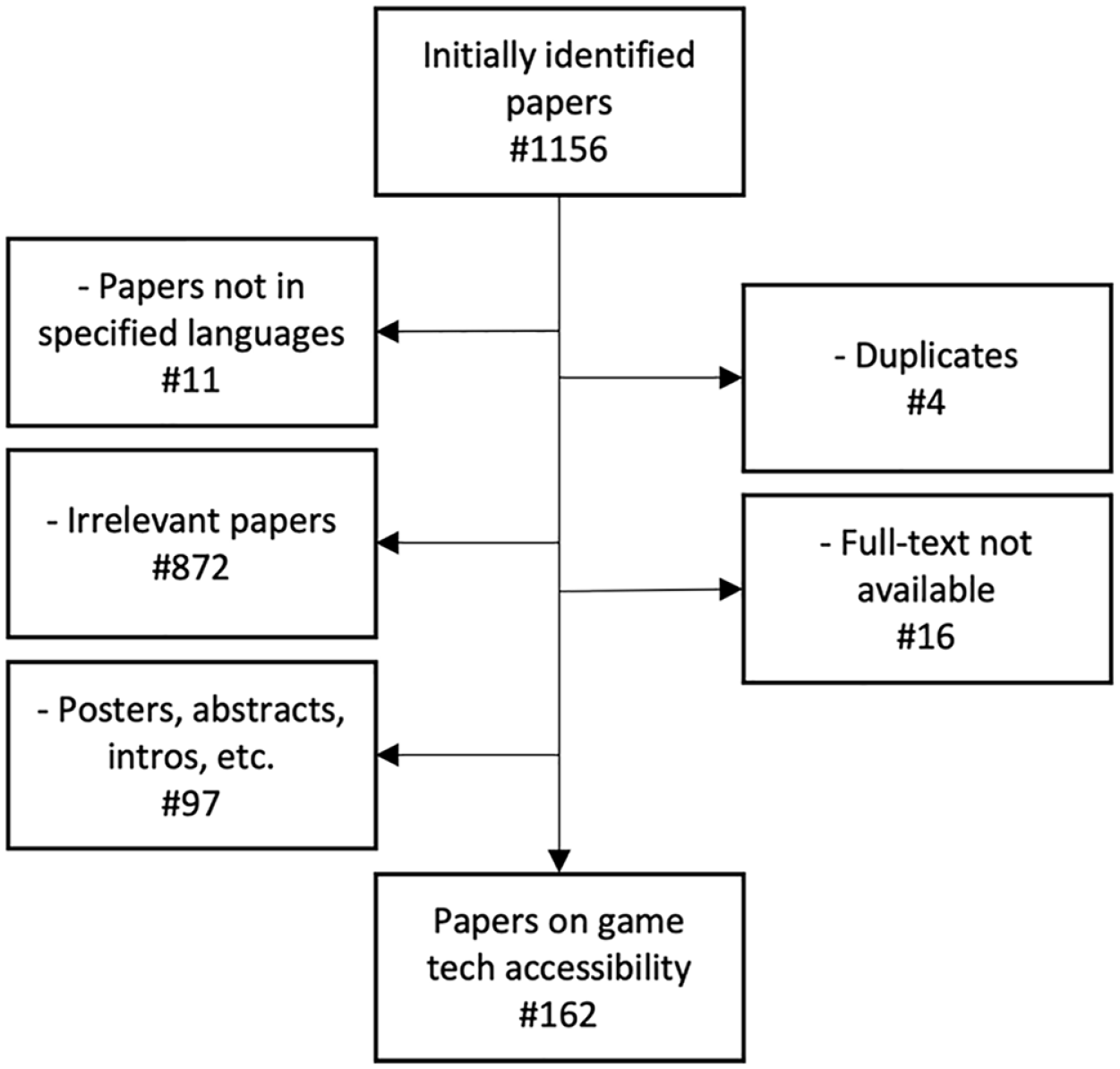
Summary of the literature screening process.
Screening, coding and analysis of the manuscripts were conducted by me, the sole author and researcher of this study. Initial results were presented and discussed at university research seminars (Research Seminar of Game Studies at Tampere University) as well as at a conference (Hassan and Baltzar, 2022). Feedback received from these presentations was incorporated in the refinement of the analysis and findings. The selected literature was coded iteratively according to many themes and variables of interest: game technology type (video game, mobile game, serious game, gamification, exergame, etc.), domain (entertainment, education, health management, etc.), research objective (design and evaluate an accessible technology, understand the needs of people with disabilities, etc.), disability category (visual, auditory, motor, mobility or cognitive), and many other variables. Some of these themes had pre-defined codes that did not change throughout coding, other themes were coded in two iterations, the first was to identify possible codes, and the second to clean and harmonies these codes. These codes and the coding process for each theme are discussed and defined in the relevant subsection in the ‘Coding and findings’ section.
A third round of fast, targeted reading of the manuscripts was conducted to revise the initial coding and correct human error. Validation of the coding was not possible as the coding, analysis and writing of this article was conducted by a sole author. After these three iterations of coding, I conducted random checks where I picked approximately 20 papers randomly and revised how I coded this sample. I did not note any discrepancies in my own process and hence proceeded with the analysis. This single-author coding (and consequent lack of validation) can mean a relatively high internal consistency in coding, as all coding was conducted by a singular author according to a singular mind-set, but it also means that this review is subject to researcher bias and human error as is communicated in the ‘Limitations’ section of this study.
Finally, given the scale of this review as it required screening 1156 manuscripts and the extensive reading and coding of 162 manuscripts across 25 variables and themes of interest, forward and backward references of the identified manuscripts were not examined to keep the scale of the documents reviewed manageable. Nonetheless, in an effort to contextualize the findings of this review within the larger traditions of game accessibility research, this study included not only empirical works, but additionally 19 previous literature reviews that have examined the general accessibility of digital games accessibility at large (Aguado-Delgado et al., 2020; Cairns et al., 2019a; Fortes et al., 2017) and in specific to people with cognitive (Cinquin et al., 2019), intellectual (Sousa, 2020), motor (Santos Nunes et al., 2018) and visual (Garcez et al., 2020; Nesteriuk, 2018; Teixeira Borges and de Borba Campos, 2017) disabilities as well as ASD (Spiel et al., 2019; Spiel and Gerling, 2021; Tharian et al., 2019; Valencia et al., 2019); the accessibility of serious games at large (Salvador-Ullauri et al., 2020b) and in specific to people with cognitive (Cinquin et al., 2019; Jaramillo-Alcázar et al., 2017a) and mental (Francillette et al., 2021) disabilities, and the accessibility of educational gamification at large (Coelho et al., 2020), in specific to people with ASD (Camargo et al., 2019) and cognitive disabilities (Cinquin et al., 2019; de Franca et al., 2019) and in implementing accessibility (Marques and Graeml, 2017). Including these 19 reviews was to ensure a level of reflection on research conducted before the 5-year timeframe of this current literature study. My work expands on these previous literature reviews by simultaneously covering several game technologies, disabilities and use domain areas, allowing for cross-section comparisons between the literature reports. This literature review is also a continuation of these previous works by reviewing the most recent research at the time of conducting it, and hence, providing an up-to-date literature mapping.
Coding and findings
Twenty-five variables and themes of interest were examined in this literature review. This necessitated that all reviewed manuscripts were read in full to identify or deduce needed information. Attempting a full summary of that number of variables is challenging. The coming sections present intriguing intersectionality of several variables in ways that aim at informing future research in game accessibility fields. The coded literature by variable is indexed in an online, interactive, scalable Notion 1 database, where they can be interacted with and updated by researchers or any interested party. The database can be found at https://lobnahassan.notion.site/fe0fb70a253e4108adfb049cd677e77f?v=18dfd8574d0a4af8a5db55add7baa06c&pvs=4.
Game technologies across disability categories
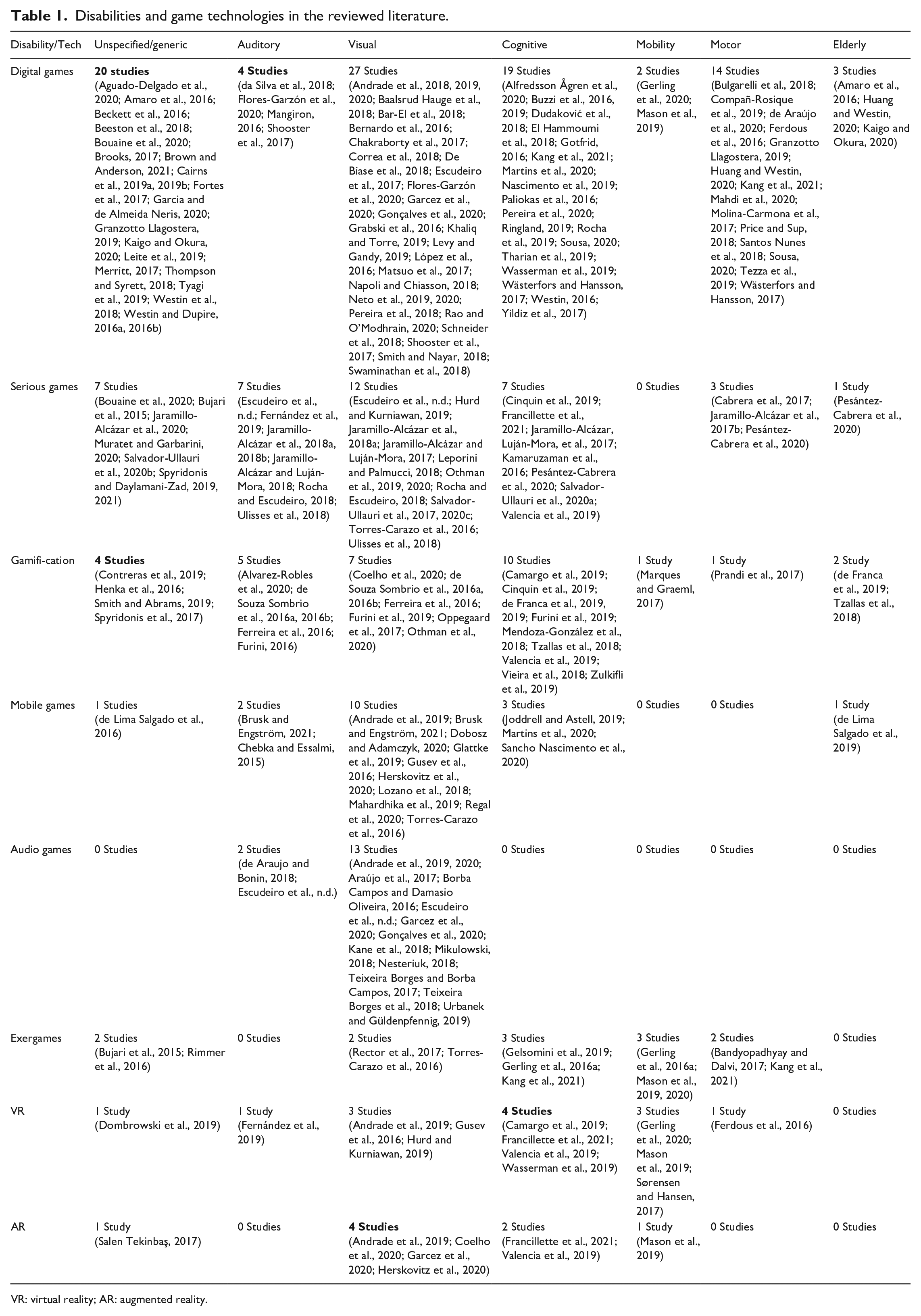
Table 1 presents a summary of the game technologies reported on in the reviewed literature across different disability groups. Some research might appear in more than one category if the authors of said research examined more than one game technology or disability.
Disabilities and game technologies in the reviewed literature.
VR: virtual reality; AR: augmented reality.
I started coding game technologies with some predefined codes. These codes included games, serious games, gamification, exergames, mobile games, VR games and AR games. The coded technologies can and are defined differently by different authors. For example, there is no standard definition for what a game is (Stenros, 2017), let alone emerging game technologies such as gamification (Landers et al., 2018). In coding these terminologies and technologies, I did not impose a definition for these codes, but I coded the reviewed literature according to what the authors of the literature themselves reported. For example, if an author used the term ‘game’ or ‘serious game’ in their research, their research would be coded according to those used terms and not recorded according to definitions of these terms imposed by me. I reflect on the strengths and limitations of this approach in the ‘Discussion’ section of the article.
With regard to the coding of disability categories, a similar process unfolded. I started with predefined codes. The codes included (1) visual disabilities: disabilities pertaining to the vision and eyesight, (2) auditory disabilities: disabilities pertaining to hearing, (3) cognitive disabilities: disabilities pertaining to cognition but also including mental, emotional, developmental disabilities and neuropsychiatric conditions, (4) motor disabilities: disabilities pertaining to hand movement, and (5) mobility disabilities: disabilities pertaining to movement and mobility. The code ‘elderly’ emerged as I encountered studies on accessibility of game technologies for the elderly. The word ‘elderly’ was used in said literature as a summative word for the disabilities that can come with age as well as to refer to lack of familiarity with game technologies, which tends to be associated with the older adults. The manuscripts differed in the way they defined ‘‘elderly’’ in terms of age, reflecting larger societal and academic debates over the use of the word. The category ‘all / unspecified’ also emerged to include research that examined disability / accessibility at large for all disability groups without further specification. Noteworthy is that some of the manuscripts reported sub-categories of investigated disabilities, that is, a specific type of, for example, visual or auditory disability that they were studying, while others did not report such information. Reporting larger disability categories in the article has allowed me to provide a vantage point on the literature as a whole and to still include all manuscripts in it regardless of whether or not they have a focus on a specific disability sub-category. But it is important to note, as I discuss more in the ‘Discussion’ and ‘Limitations’ sections of this work, that this approach is reductionist to the differences that exist between people with the same exact disability, let alone people within different disability sub-categories (e.g. blind, colour blind, low vision) of the same disability categories (e.g. visual disability).
In this pool of literature most research on accessibility in this literature pool appears focused on games and mobile games. This is unsurprising given that games have appeared much earlier than game-based applications, which are, as their name implies, designed based on game design. Next, research attention goes to, in order of popularity, serious games, gamification, mobile games, audio games, exergames, VR and AR. In terms of disability, the bulk of accessibility research has focused on visual accessibility, followed by, in order, cognitive disabilities, generic discussion of disabilities, auditory, motor, mobility and elderly disabilities.
Figure 2 visualizes the number of manuscripts focusing on the categorized game technologies across the 5-year timeline of the reviewed literature. As observed from Table 1, this figure highlights the general popularity of accessibility research of games, followed by mobile games. We generally see a down curve in the research popularity of all game technologies (except for serious games and AR). Perhaps this was due to the 2020 COVID-19 pandemic affecting academic publishing during 2020 or perhaps this is a reflection of relatively increased interest in serious games and AR. We also see that gamification and VR spiked in popularity between 2018 and 2019. These were possibly times of increased hype around these technologies. But they became some of the least researched game technologies in 2020. Exergames appear to more consistently be losing popularity over the years, perhaps reflecting a decreased research interest in that area. Alternatively, it is possible that the terms exergames and gamification lost popularity after an initial hype and that that same research is now happening under the label of serious games at least within some domain areas.
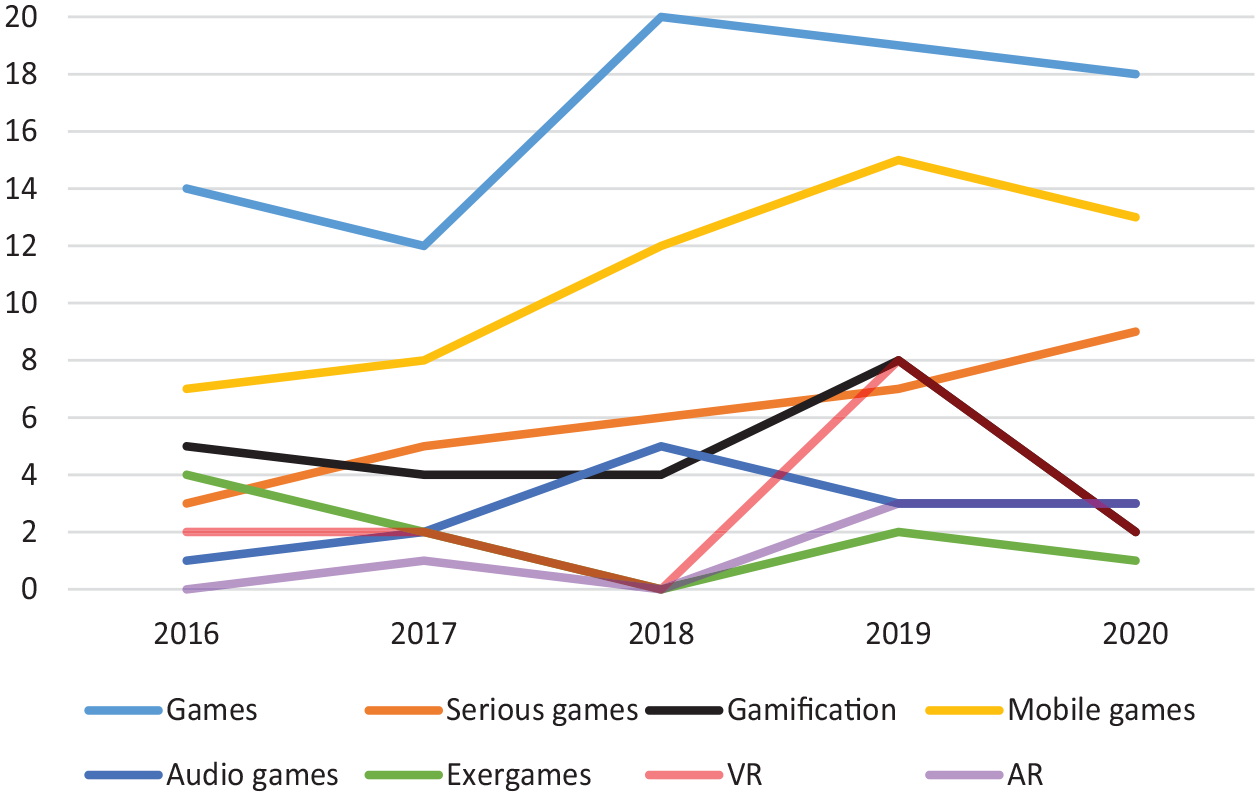
Number of manuscripts per game technology per year.
Figure 3 visualizes the number of manuscripts focusing on the categorized disabilities across the 5-year timeline of the reviewed literature. The timelines here are slightly more sporadic but there is a general up curve since 2018 for research of all disabilities except for the generic category of disabilities. This development is potentially positive, reflecting that researchers are recognizing that disabilities are different and in need of differentiated research. Research of cognitive (and neuropsychiatric) disabilities appears on a significant upwards trend, at least until 2020, perhaps reflecting a relatively increased societal discourse around mental health and illnesses in recent years. Visual disabilities have consistently received academic research attention while auditory and mobility disabilities have significantly fluctuated in popularity.
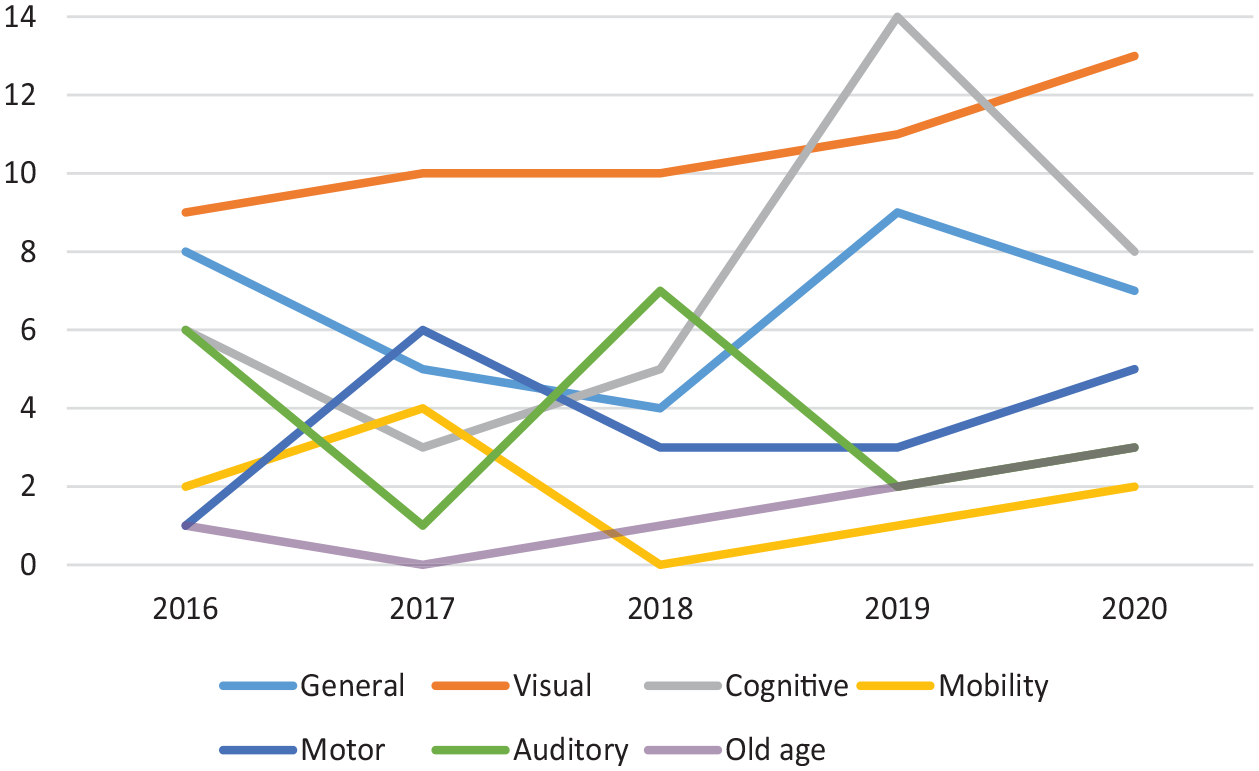
Number of manuscripts per disability category per year.
Game technologies across domains areas
Table 2 presents the intersection between game technologies and the research/use domain of the game technologies. The coding process of the game technologies was presented in the previous section. Coding of the domain areas followed a deductive process. I started with predefined domain areas which were entertainment, education, health management and design and development. I read all identified manuscripts in full and categorized them within one or several of these categories based on what I deduced to be the context of the research. Manuscripts in the entertainment category primarily examined the non-utilitarian use of game technologies, such as for fun or enjoyment. Manuscripts examining teaching and learning are under education. Manuscripts examining health applications, for example, mental health management or medication tracking, are under health management. Manuscripts concerning development, developers, designers or accessibility in the development process were placed in the design and development category. Crowdsourcing was an emergent coding category where I placed manuscripts that examined the deployment of crowds (average citizens) in implementing accessibility through game technologies, for example, crowd mapping of streets or crowd transcription of media using a game.
Game technologies across domains in the reviewed literature.
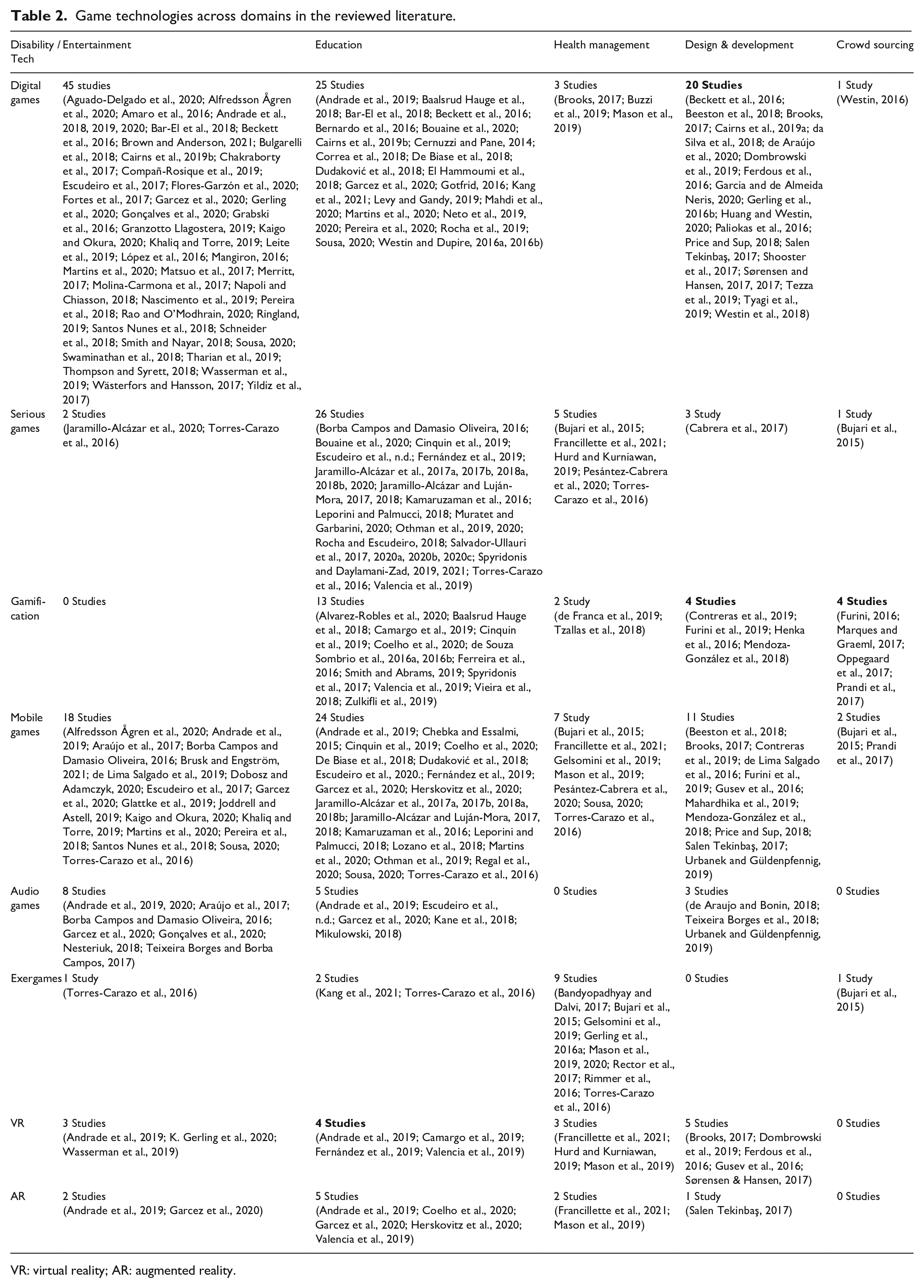
VR: virtual reality; AR: augmented reality.
Most of the research focused on education, followed by, in order, entertainment, design and development, health management and crowdsourcing. As discussed with Table 1, most research on accessibility in this literature pool appears focused on digital games followed by, in order, serious games, gamification, mobile games, audio games, exergames, VR and AR. Most game, and audio game, research was in the field of entertainment. Most serious games, gamification, mobile games and AR research was in the field of education. Most exergames research was in the field of health management.
Research domains of game technologies across disability categories
Table 3 presents the intersection between disabilities and research domain areas found in the literature. Coding of the disability categories was presented under the ‘Game technologies across disability categories’ section, while coding of the domain areas was presented in the ‘Game technologies across domains areas’ section. Table 3 shows the extent of attention directed towards each disability in the different context of game technologies use.
Disabilities across research domain areas in the studied literature.
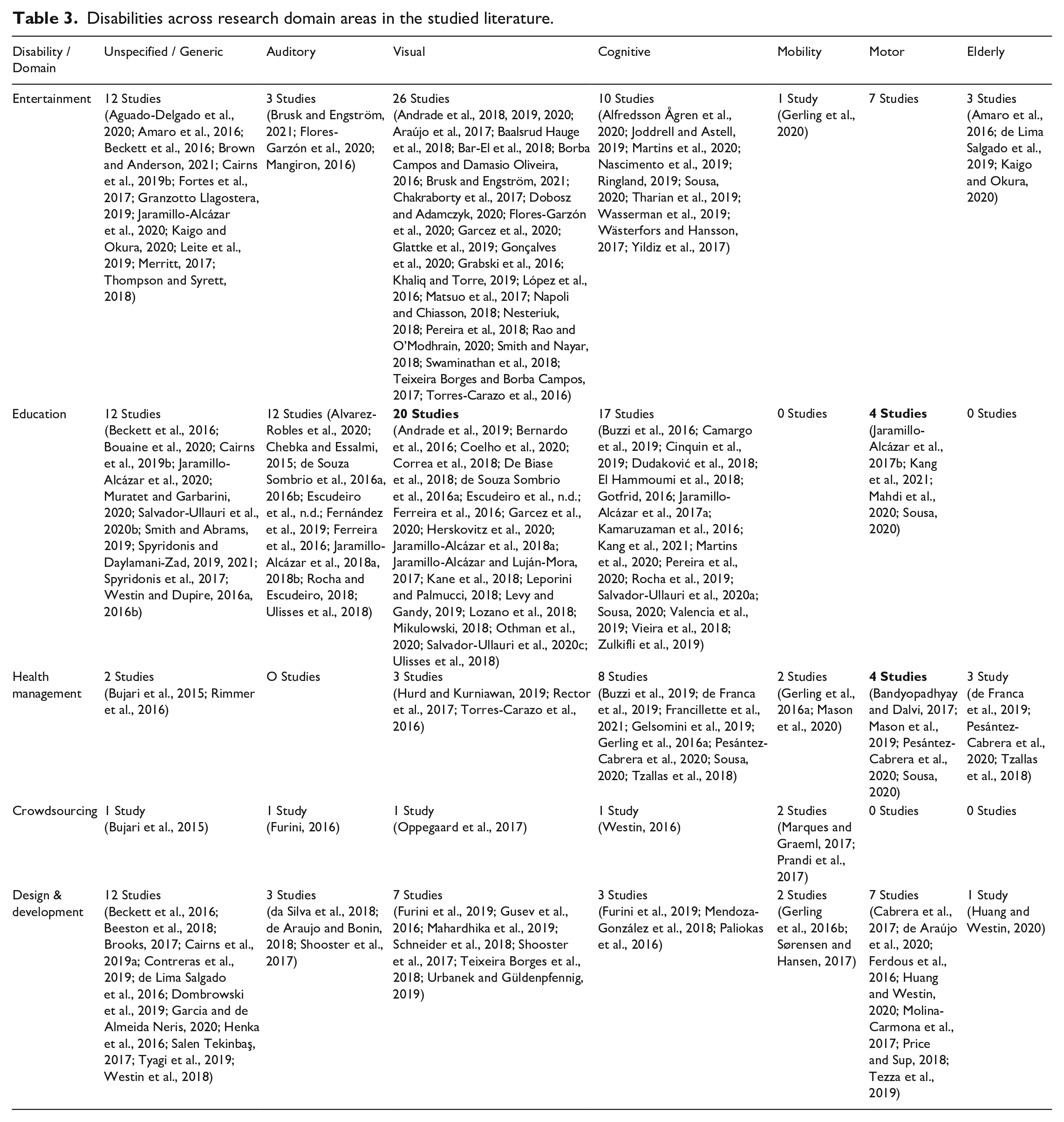
Notable from Table 3 is that disability categories received different levels of research attention across different domain areas. In this pool of literature, visual disabilities have been the most investigated in the entertainment and education contexts. Cognitive disabilities received the most research attention in education. Research on mobility disabilities is generally rare and divided in popularity between health management and crowdsourcing. Research on motor disabilities is similarly rare and divided in popularity between health management and education. Elderly research is divided between entertainment and health management. Notably, research on accessibility design and development appears more focused on general discussions of disabilities rather than on a specific disability or another. Focused research in that domain, however, is focused on visual and motor disabilities, in a pattern that appears similar to that of research on entertainment.
Research objectives
Table 4 presents a summary of the research objectives reported on in the reviewed literature. I did not have any initial codes for this theme, but the codes emerged as the coding process progressed. The codes were identified through a full read of the manuscripts reviewed, with specific attention to statements such as ‘the aim of this research is’ or ‘this research contributes’. Initially identified categories were further refined through the second iterations of going through the literature to revise any human error in the coding of all the variables discussed. Some research might appear in more than one category in Table 4 if the authors of said research had more than one objective.
Objectives of the reviewed literature.
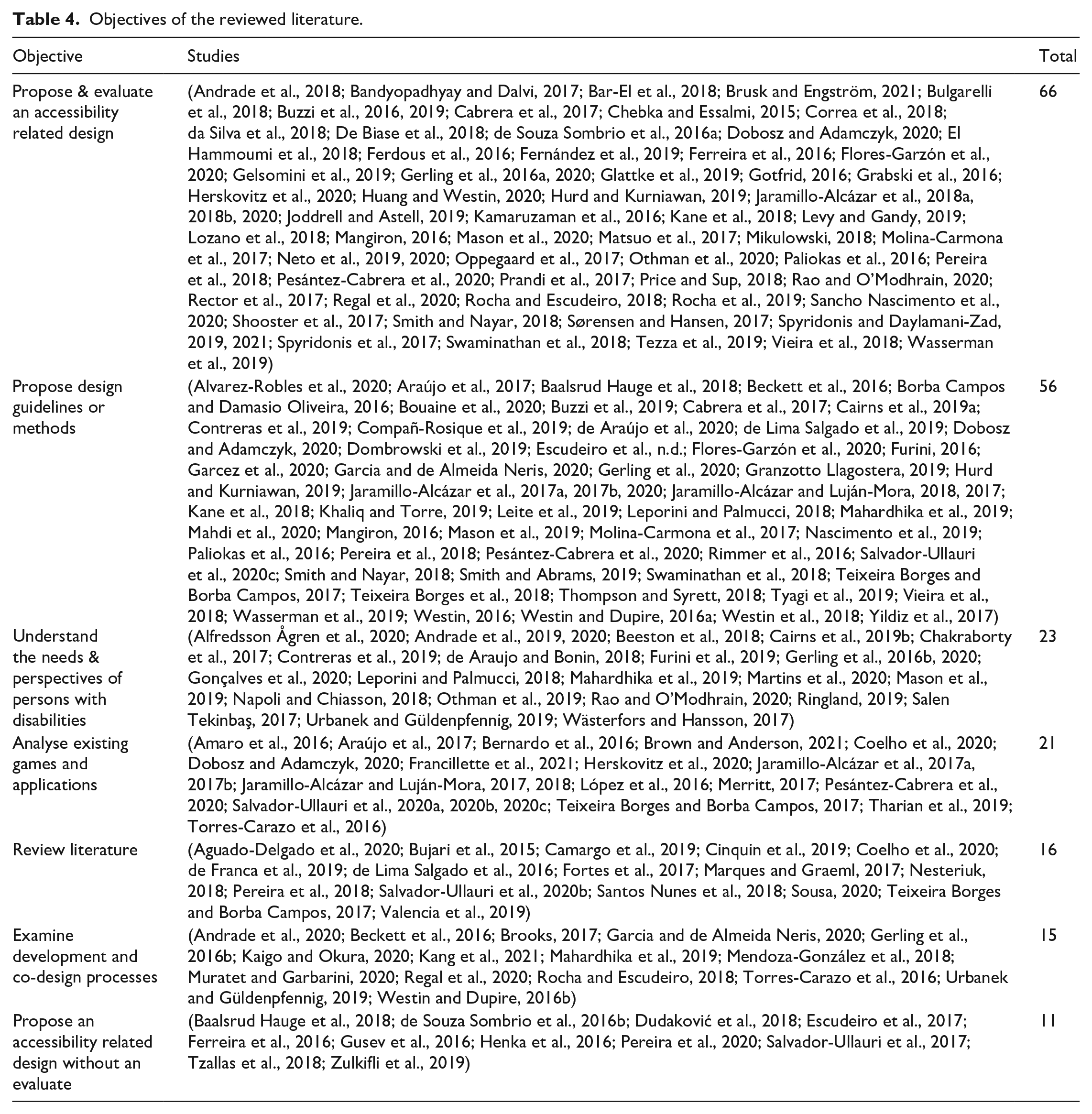
The most found research objective in the reviewed literature was the design and evaluate an accessibility related artefact, specifically, a full or partial game or game-based application. A second significant portion of the research focused on proposing accessibility related design guidelines or design methods. Research also investigated the needs and perspectives of people with disabilities in an aim to delineate their experiences and perhaps design for it in the future. A segment of the research focused on examining the accessibility of existing game technologies. Some research conducted literature reviews of previous literature. They were included here to inform this study with previous findings from older research as discussed in the ‘Methodology’ section. A few studies also examined co-design and co-development with people with disabilities and what strategies or modifications to the development process would be required. Finally, a small segment of the research focused on designing an accessibility related artefact, specifically, a full or partial game or game-based application, however, without conducting an evaluation of these designs.
Additional variables
This section includes a brief report on some of the key additional variables that were coded in this literature study.
Funding sources
I was interested in examining who is funding academic game accessibility research. Hence, I examined the acknowledgement sections of the reviewed literature. I googled the names of the reported funding organizations and classified the funders as presented in Table 5. Many manuscripts acknowledge more than one source of funding but overall, only 58 unique manuscripts disclosed funders in the acknowledgement section, meaning that this information could not be extracted for 104 manuscripts.
Sources of funding acknowledged in the literature.
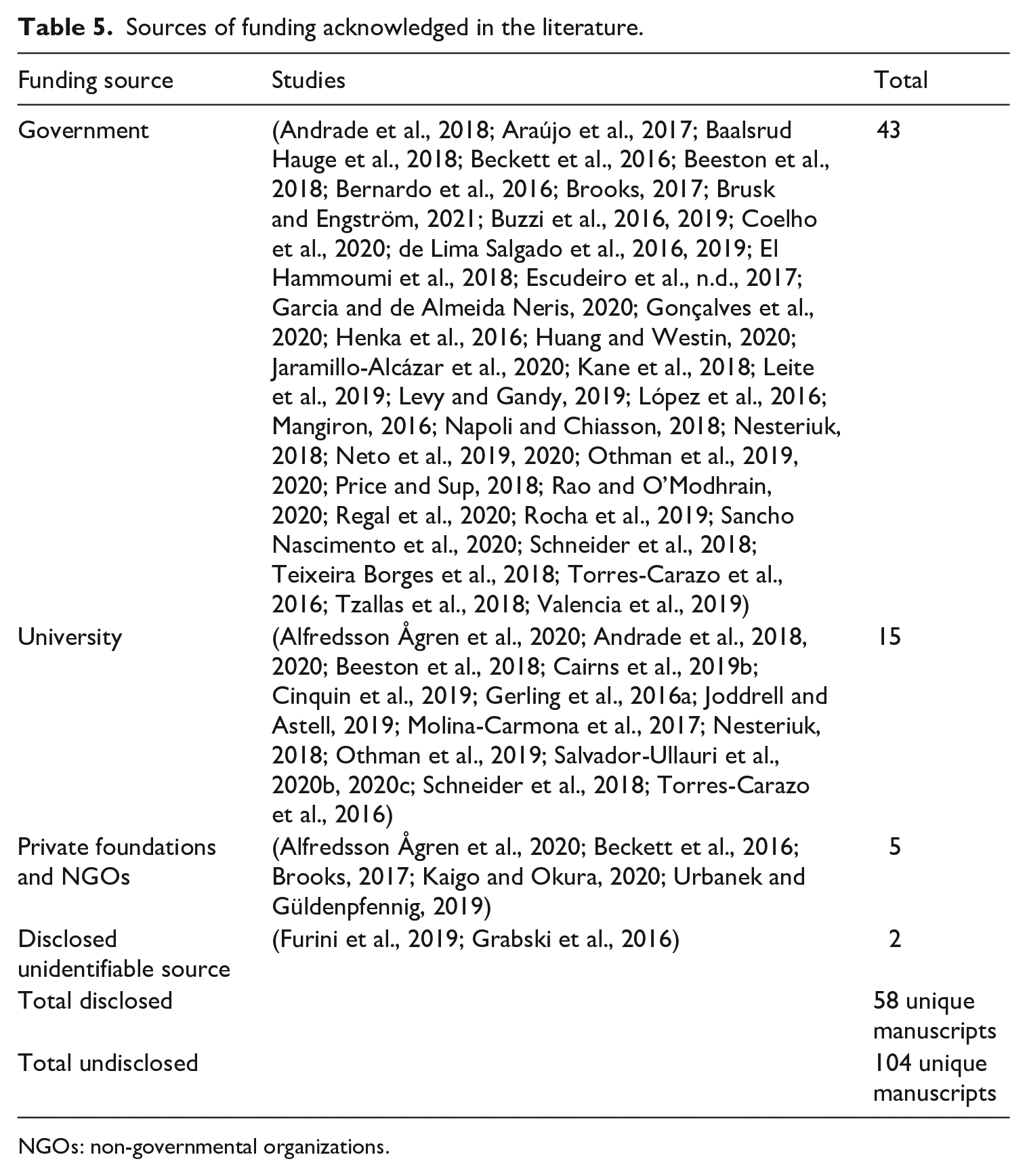
NGOs: non-governmental organizations.
Research participants
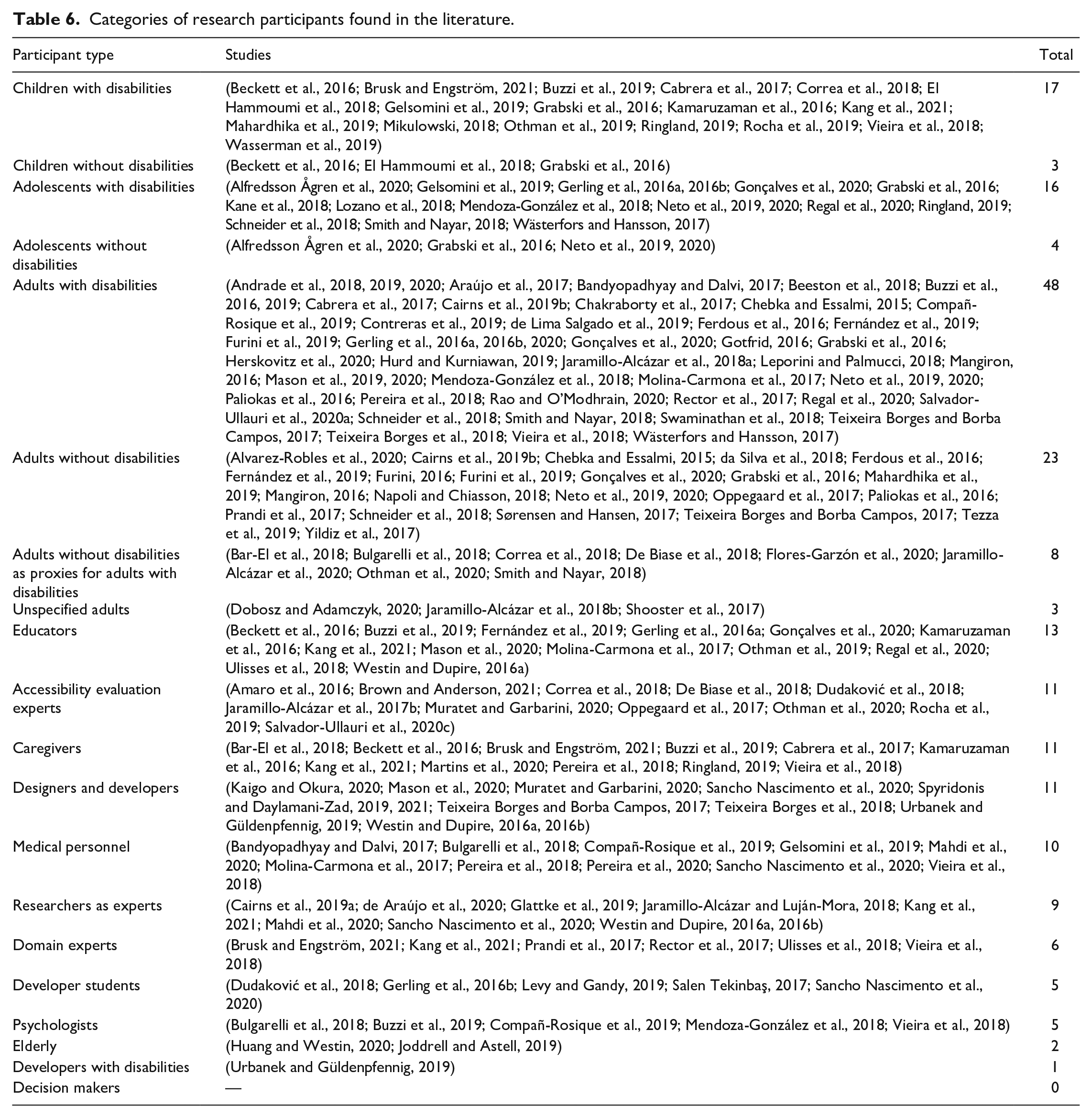
I was also interested in tracking who participated in empirical research. I noted who participated in the studies in pre-defined categories that included children with/without disabilities, adolescents with/without disabilities, adults with/without disabilities, adults without disabilities as proxies for adults with disabilities, designers and developers, and decision makers as presented in Table 6. A few categories of participants that were not predefined emerged, including unspecified adults, elderly, accessibility evaluation experts, domain experts, researchers as experts, educators, psychologists, caregivers and developer students. Please note that the reviewed studies often had more than one category of participants in the same study.
Categories of research participants found in the literature.
Theoretical angles
I, additionally, tracked what theoretical angles were utilized in the literature. I initially focused on tracking mentions of the medical and social models of disability that are popularly used within disability studies and humanities to define and examine disability (Haegele and Hodge, 2016). I thought that given the foundational importance of said models in the disability literature, they would be the most likely theory used by accessibility researchers. Twelve studies (Beckett et al., 2016; Beeston et al., 2018; Bujari et al., 2015; Cairns et al., 2019b; Cinquin et al., 2019; Dombrowski et al., 2019; Garcia and de Almeida Neris, 2020; Gonçalves et al., 2020; Leite et al., 2019; Merritt, 2017; Salen Tekinbaş, 2017; Wasserman et al., 2019) made explicit or strong implicit reference to the social model of disability, which I identified through full-reads of the manuscripts. Universal design in learning (de Souza Sombrio et al., 2016a, 2016b; Merritt, 2017) followed as one of the frequently utilized theoretical framework in the literature. Universal design can also be considered an application of the social model of disability (Hamraie, 2017).
Researchers utilized frameworks such as applied behavioural analysis (Pereira et al., 2020) or Self-determination theory (Zulkifli et al., 2019). These frameworks, while technically are not called ‘medical model of disability’, approach disability with similar ontological and epistemological lenses as the medical model. The focus in these frameworks tends to be on changing the individual, or designing solutions exclusive to an individual, rather than changing the social environment as is elaborated on in the ‘Discussion’ section. In addition, the concept of disability was rarely problematized or extensively defined by most of the studies that interfaced with it. This, overall, implies that game accessibility researchers may be approaching disability with an unconscious medical lens, or at least without explicit interrogation of their understanding of disabilities and the ontologies and epistemologies they employ during their research. This is a finding that has also been noted by previous literature reviews of disability in Human–Computer Interaction (HCI) (Spiel et al., 2019; Spiel and Gerling, 2021).
Discussion
Theoretical implications
First, it appears that the theoretical base of the reviewed research was relatively limited. In the examined literature, I saw dispersed theories borrowed from psychology, education and the medical sciences as touched upon in the ‘Additional variables’ section. Notably however, I saw little of disability studies (13 studies out of 162) despite the relevance of the field to the study of accessibility and that frameworks exist to explicitly connect disability studies with accessibility fields (see, for example, Hamraie and Fritsch, 2019; Hofmann et al., 2020; Mankoff et al., 2010; Shew, 2020). This could be a limitation of this study in identifying literature to review, as outlined in the ‘Limitations’ section, but it could also be a reflection of a gap between humanities and engineering sciences, specifically when it comes to game accessibility. Disability studies has crosspollinated game studies (see, for example, Carr, 2014, 2018; Jones, 2018) mostly in terms of formal analyses, close readings, and critiques of game design. Disability studies has also crosspollinated game accessibility research to a certain extent, as evident by this literature review. Nonetheless, academic game accessibility research has been a relatively niche area, prior to the current boom in popularity, hence, it might still be a relatively emergent area, without significant theoretical grounding yet. Regardless the reason, this relative lack of theoretical groundings in disability studies is perhaps why disability, within said literature, is approached as a ‘problem’ to be solved through engineering, as has even been noted by previous literature reviews of disability-related research in HCI (Spiel et al., 2019; Spiel and Gerling, 2021).
Many people with disabilities, as well as disability scholars (e.g. Dolmage, 2017; Hamraie and Fritsch, 2019; Kafer, 2013; Shakespeare, 2005) have long noted the limitation and low effectivity of viewing disability as a ‘problem to be fixed’ through design or technology. This notion reflects the medical model of disability which aims to develop disability-specific fixes rather than societal change. Disability studies scholars advocate that disability is better conceptualized and approached as a multifaceted, context-specific, and almost inevitable human experience that we all share. Hence, different ways of conceptualizing and approaching disability have been proposed and increasingly gain popularity within humanities, which include the social model of disability (Haegele and Hodge, 2016), Nordic model of disability (Shakespeare, 2005), political-relational framings of disability (Kafer, 2013), treatise of ableism (Dolmage, 2017), treatise of technoableism in specific to technology (Shew, 2020) and the framework of crip technoscience (Hamraie and Fritsch, 2019). What these framings of disability have in common is that they emphasize that some exclusion and lack of access associated with many disabilities are experiences that society constructs/contributes to, rather than these experiences entirely being an inherent part of disability. Experiences of access barriers can be alleviated when society acknowledges its role in conceptualizing and enacting disability as well as that the experience of disability and its needs differ across gender, location, age, country, socioeconomics and so on. For example, should society reframe its understanding of the ways through which humans move beyond the mere use of legs, then streets might be built wheelchair accessible from the get-go, especially in poorer areas where people using wheelchairs are most likely to not have cars and would be using streets more frequently to manage their daily life than their richer peers. In such a society, some negative experiences of access barriers, associated with the use of a wheelchair for mobility, could cease to exist, even if the medical (and often negative) experience of disability remains.
Within the reviewed literature, there were studies that explicitly utilized such framings of disability (Beckett et al., 2016; Beeston et al., 2018; Bujari et al., 2015; Cairns et al., 2019b; Cinquin et al., 2019; Dombrowski et al., 2019; Garcia and de Almeida Neris, 2020; Gonçalves et al., 2020; Leite et al., 2019; Merritt, 2017; Salen Tekinbaş, 2017; Wasserman et al., 2019) and I can specifically note the popularity of universal design (de Souza Sombrio et al., 2016a; Merritt, 2017; Sombrio et al., 2016) as a social model approach to implementing accessibility by designing environments that can be used by everyone with no barriers (Hamraie, 2017; Iwarsson and Ståhl, 2003). Overall, however, such studies were a minority in the examined literature. While I did not find explicit mentions of the medical model of disability in the rest of the research, perhaps given how it has come under criticism in recent years (Dolmage, 2017; Hamraie and Fritsch, 2019), I saw research carrying the same spirit of trying to provide solutions to be exclusively used by people with disabilities, with a relative disregard of the larger social context within which people with disabilities exist (Hassan and Baltzar, 2022).
For example, while audio games have significantly provided a gaming avenue for people with visual impairments (and to segments of people without visual impairments as well), they are a fix to gaming with a visual disability that can isolate, rather than integrate, blind gamers from mainstream gaming that they Hassan often wish to be a part of (Urbanek and Güldenpfennig, 2019). Solutions with such a medical spirit as audio games, yes, can lead to accessible tools, but tools that can isolate people with disabilities and have undesirable effects (Alfredsson Ågren et al., 2020; Andrade et al., 2019; Cairns et al., 2019b). The medical model has brought about notable and significant medical advances that have done a great deal to improve the quality of life of people with disabilities, for example, eyeglasses and hearing aids. Similarly, technologies such as voice control and eye-tracking have significantly facilitated access to technology to people with and without disabilities. Nonetheless, it remains that these solutions, for many reasons, are not always effective nor accepted by people with disabilities (Kafer, 2013; Shew, 2020). It is important for technology researchers to utilize alternative models of approaching disability in their research – that do not centre on fixing the individual – for their research to have relevance to the community it is intended for (Dolmage, 2017; Shew, 2020; Spiel et al., 2019). Effective technology solutions could be brought about with an examination of the potentially implicit ableist ideologies driving some of technology research and implementation (Shew, 2020) as well as through work with people with disabilities as designers with agency (Spiel et al., 2019) rather than consumers to design for or mere domain experts to occasionally consult (Hamraie and Fritsch, 2019). Similar recommendations were also put forwards by a literature review of HCI play solutions for autistic children, showing that the solutions proposed did not match their authentic needs and desires (Spiel et al., 2019).
A second key theoretical implication from this literature study is noting that it is more effective – theoretically and practically – to overlook labels such as game, gamification, serious games, etc. Instead, I call upon researchers to examine game technology by its application domain area, for example, education, entertainment, exercise and so on. This allows for combining theory and design traditions across game technologies within domain areas, strengthening the overall domain area.
With the diversification of labels for game technologies, researchers have long reported difficulties in differentiating between them and their underlying theoretical and design traditions (Hassan and Hamari, 2020; Koivisto and Hamari, 2019; Landers et al., 2018; Majuri et al., 2018). Researchers have also long called for standardization of definitions, so that we are better able to theoretically and practically distinguish games, from serious games or gamification and so on. Acknowledging the socially constructed nature of science, I chose not to impose a definition of these technologies on the examined literature but rather classified the literature based on the keywords that the authors of the reviewed literature chose, a practice followed by many researchers before me (Hassan and Hamari, 2019, 2020; Klock et al., 2020; Koivisto and Hamari, 2019).
But, in an attempt towards some harmonisation, I also classified the research based on application domain area. This was in an effort to create some salient understanding of the literature based on my research experience and intuition of what classification method could yield interesting results. Indeed, it is not clear, for example, how a gamified educational app differs from an educational game or a serious educational game (Stenros, 2017). Nonetheless, what is common between these technologies is that they all focused on education. That had similar implications on their research objective, theoretical base, implementation, evaluation and so on. It created coherence in the literature I examined, where it was not easily found when researchers examined one game technology across domain areas (e.g. Koivisto and Hamari, 2019). The difficulties of label standardization are known to many researchers and practitioners. It is unlikely that we would see such a standardization in the game field soon. Hence, my call for the use of application domain areas to distinguish between technologies until such standardization of definitions takes place.
Finally, I call upon researchers to examine their reasons for investing in game accessibility. What justifies accessibility work? Why is it needed? Theoretically, the distinction between game technologies based on that one provides entertainment (e.g. games) and the other provides entertainment and utility (e.g. serious games) (Hassan et al., 2019; Koivisto et al., 2019; Koivisto and Hamari, 2019; van der Heijden, 2004) is of little benefit to the gaming community. Why does an activity need to have a utility/benefit? What implications would such a moralist view have on the design and development of technology? Is entertainment, having fun, meeting new friends and so on, not a utility/benefit that we reap every day from technology? Why is access to these benefits deemphasized in accessibility research? Who decides what is a (worthy) utility to provide access to and what is not? On what basis?
The currently popular utilitarian view of game technologies asserts that games have numerous benefits (Granic et al., 2014; Hassan et al., 2019; Koivisto et al., 2019). Within this view, gaming is not ‘a waste of time as mere entertainment’, it provides benefits that make it a legitimate activity for society. The utilitarian view of gaming coincides with the rise of game-based applications and their utilization in non-entertainment contexts for education, health management, or rehabilitation (Deterding et al., 2011; Koivisto and Hamari, 2019; van der Heijden, 2004). The goal of these technologies is to utilize the positive experiences that game-design can give rise to such as fun, enjoyment, escapism (sometimes referred to as hedonic experiences) ‘for good’, to engage people with activities that offer utility but are not necessarily engaging to everyone, such as exercise or going to school (Landers et al., 2018).
Utility in this context primarily means utilities that can be generally reaped from gaming, such as improved spatial reasoning, problem-solving skills, social skills and so on (see Granic et al., 2014 for a review of these utilities). In the contexts of game-based applications, these utilities can additionally include, for example, learning of math, physical exercise, mental health management (see Koivisto and Hamari, 2019 for a review of possible utilities). Utility in this article does not pertain to disability specific rehabilitations or trainings, but rather to these general utilities. This is because of the focus of this article on accessibility, which is not a word commonly used in rehabilitation research as rehabilitation tools are often custom-made for people with disabilities and do not particularly need to be made accessible. To clarify this distinction, please consider that for example, research of mental health tools made to rehabilitate autistic people does not appear in this literature (it does not use an accessibility framework), but research that looks into making a (mental health) game accessible to people with autism as they are to neurotypicals was included in this research as it is about accessibility. This selection criteria and focus of the article, as noted in the ‘Methodology’ section, hence, organically excluded rehabilitation research from this literature review. Noteworthy, uses of game technologies to rehabilitate people with disability, for example, to teach autistic children social skills (in)compatible with neurodivergence (Spiel and Gerling, 2021), can come close to being a parallel of the medical model of disability that focuses on changing the individual rather than the society, and it can have positive or severe negative outcomes, but this treatise is outside the scope of this work.
With the outlined understanding of utility in mind, Table 2 shows that most of the identified research on game accessibility had a focus on utility, rather than pure entertainment, despite the latter being a key aspect for why people play games (Ryan et al., 2006). It is not surprising to see the relative dominance of utility in the accessibility literature given the general popularity of the utilitarian view of gaming (Granic et al., 2014; Koivisto and Hamari, 2019), but this imbalance remains concerning. Entertainment and other such uses of game technologies should not be overlooked by, for example, the emphasis on the educational value of these technologies. People with disabilities have the same rights to entertainment as everyone and access should be facilitated to it regardless of whether it can bring about some ‘utility’ or not – the same way access to entertainment is facilitated to people without disabilities just for entertainment.
Looking at Table 2, we see that research within the entertainment domain is comparatively less than that in other domain areas. Furthermore, extensive research examining game technologies as a means of entertainment almost always had to emphasize that games are not only a means of entertainment but that they can also provide people with disabilities numerous utilitarian benefits. It is as if utility is mentioned to justify or strengthen the importance of the research, implicitly indicating that fun is not enough on its own. Perhaps this reveals an underlying assumption that accessibility work can only be justified by the hard-core utility it can bring people with disabilities. Perhaps this is a general trend in society that gaming and play need to have a purpose such as to aid with education, otherwise, games are seen as a waste of time and resources. Or perhaps the literature data, basis of this literature review, is skewed. The reasoning behind this utility focus cannot be glimpsed from this literature study but the values driving accessibility research would almost always benefit from examination and possible revision.
Practical implications
The aim of this section is to discuss what the findings of this research mean to practitioner and researchers, so that game accessibility practice can be advanced.
Disabilities in game accessibility research
There are significant differences in the academic research attention directed to different disability groups within this pool of literature. This hints at possible design, or structural issues that would need to be investigated and remedied to ensure more equality and equity in access. A key observation from Table 1 is that comparatively more research had been focused on visual accessibility compared with mobility or motor accessibility. This is perhaps understandable in the light of game technologies being highly visual. If one does not see the game, one can’t engage with it. Nonetheless the same applies to other aspects of the game. If a game highly uses auditory cues, then one cannot effectively play the game with a hearing disability. Similarly, if playing a game requires using controllers with fine motor skills, one cannot (easily) play the game with a motor disability. Hence, I wonder, why have academic game accessibility researchers directed more attention to visual disabilities compared to other disabilities? Perhaps this took place due to a passible comparative ease in developing solutions for visual impairments (that have often revolved around software adjustments), compared with the more financially demanding and labour intensive research that would be needed to, for example, develop controllers for people with motor disabilities. It is possible that there are difficulties in finding and recruiting research participants from some disability groups more than others. For example, psychiatric disabilities are hard to identify, diagnose, gain social legitimacy and are rarely publicly disclosed. Disability associations are also different in their organization, fragmentation, proactivity and visibility, which could have impacted research with the individuals they represent. It is possible that organizations for visual disabilities have been relatively more active than others. It is also possible that gamers with visual disabilities have been more active or visible and emphasized the financial relevance of visual accessibilities to game developers more than gamers with other disabilities. It is hard to lend support to one of these explanations over the other but there possibly appears to be structural issues that need investigation and remedy.
Furthermore, large categories of disabilities (e.g. visual, motor, auditory) include numerous types of disabilities that are vastly different and require different accessibility work and features. Within visual disabilities for example, some individuals are fully blind, others have low vision or colour blindness among other visual impairments. Often, the reviewed research did not make a distinction between these sub-categories of disabilities. Hence, even though relatively extensive attention has been directed to some disability categories, such as visual disabilities, not all disabilities within that category received the same level of attention. For example, little research is directed to facilitating access to individuals who only see with peripheral vision (Pereira et al., 2018). I also saw little to no research examining temporary disabilities, that is, how individuals without disabilities can temporarily benefit from accessible technologies when they are, for example, playing with a broken arm. Given that some aspects of game accessibility, for example, finding a suitable adaptive controller, can be demanding of people with disabilities in terms of time, money, and energy, these barriers can be significantly high for people with a temporary disability who may not see a return on their investments in accessibility by the time they find a potentially suitable solution to their temporary disability. They might not be aware of solutions altogether, or have the expertise needed to know where to get relevant accessibility information. Temporary solutions, such as loaning of accessibility devices could be worthy of research as well as examining how easy it is to retrieve information about accessibility and its related solutions.
Stakeholders
It is imperative that accessibility work is carried out in collaboration with people with disabilities if we are to reach solutions that address their genuine needs and genuine experiences of disability that cannot be emulated through, for example, the artificial use of a blindfold to test visual accessibility (Ferreira et al., 2016; Spiel and Gerling, 2021). Accessibility work, however, does require multi-actor collaborations between people of different expertise, roles and backgrounds. Stakeholders such as guardians, medical personal, or friends without disabilities are also important to include in game accessibility research. For example, it would be important to involve players without disabilities when studying the accessibility of mainstream multiplayer games, as multiplayer gaming can involve both stakeholders (Hassan and Baltzar, 2022). It would be important to involve developers – alongside people with disabilities – when discussing the technical feasibility of a game accessibility solution, or to involve game writers in research when discussing challenges to positive disability representations in games.
In the reviewed literature, I have seen some of such collaborations take place as well as studies focused on how to facilitate co-design and co-production with people with disabilities (Mahardhika et al., 2019; Regal et al., 2020). Nonetheless, I saw a disparity in stakeholder representation in the conducted research. I saw very few studies involving decision makers, policymakers, guardians, friends, support groups of people with disabilities or social care workers, despite the role these actors play in (game) accessibility. I encourage the inclusion of these, potentially able, stakeholders in research, not as a replacement for people with disabilities, but to strengthen it and to approach accessibility topics from multiple vantage points simultaneously. As another example, if we are to research the regulation of game accessibility, said research would extend to at least people with disabilities and policy makers. Coincidentally, regulation (Brooks, 2017) and social gaming as previously discussed (Baltzar et al., 2023b; Hassan and Baltzar, 2022) are two domains where we lack game accessibility research and would need multi-actor involvement to approach it. I see this lack of diversity in stateholders as a positive indicator for the emphasis the literature has placed on directly working with people with disabilities. But I also see it as a potential sign that accessibility research is removed from the social and political context of disability.
Game technologies
Emerging game technologies are in need of timely accessibility research to ensure people with disabilities continue to have access to the latest technologies as people without disabilities. Games received the most research attention out of the examined game technologies, as communicated in Table 1. VR and AR-based game technologies received little research attention despite the pervasive spread of these technologies and that they have become mainstream for quite some time already. We see some research, for example, examining the popular AR game Pokémon Go (Salen Tekinbaş, 2017), acknowledging that it is an unlevelled playing field. The motor skills required to play the game, as well as most mobile touchscreen games, are hard to command in many cases of motor disabilities. Furthermore, when people with disabilities play a game ‘in the wild’ with their phones, that can subject them to unwanted – negative and positive – social attention from bystanders, the magnitude and type of which is not equally experienced by people without disabilities (Salen Tekinbaş, 2017). As acknowledged earlier, research on mobility disabilities and emerging game technologies, in general, is relatively rare, although it is important to acknowledge that there is research of prototype wheelchairs for VR gaming, as well as the use of VR and AR to provide outdoor experiences that may otherwise be inaccessible (Gerling et al., 2016a, 2020; Mason et al., 2019, 2020).
Research on gamification accessibility mainly focuses on utilizing it as a means to facilitate accessibility implementation through crowdsourcing by, for example, asking volunteer citizens to map mobility barrier (Prandi et al., 2017) or transcribe audio content (Furini, 2016). Little research examined the accessibility of gamification in and of itself (Smith and Abrams, 2019) or whether or not the addition of a gamification layer to a design increases design complexity, cognitive overload and inherently inaccessibility.
Future research directions
Overall, this literature review identifies several accessibility and game technologies research avenues where work has been done and where more work is needed. Some of these directions have already been mentioned in the ‘Discussion’ section and I would direct the reader to a close reading of that section. Here, I summarise some key research directions and delve into even more directions for future research.
We need more research examining and facilitating entertainment-related uses of game technologies for people with disabilities. More abstractly, we need examinations of the moralities people and researchers ascribe to game technologies and the implications of that on access. I encourage researchers and practitioners to expand their accessibility work with regard to all disability categories and to specifically define what type of a disability or impairment they are paying attention to. We need research that examines the differentiated accessibility needs of different individuals with specific disabilities (e.g. color blindness, peripheral vision loss) rather than research of generic disability categories (e.g. vision impairment). This would help in advancing more nuanced accessibility designs that don’t treat all impairments within the same category as equal. This, consequently, has the potential to help develop games that are more suited to their target group.
We also need recognition of the mediating roles of demographics and socioeconomics on accessibility needs. It has long been noted that disability is contextual and needs to be examined in context (Kafer, 2013). Hence, I advise research to delve deeper into the socioeconomics and geopolitics of accessibility. We, additionally, need a more conscious and explicit problematization of disability conceptualization in technology/accessibility research and how said conceptualization influences research design, implementation and communication with designers and developers. We need to examine how the social model of disability can be applied in the commercial context of games. How can we encourage developers towards implementing it and what role could regulation have, if any. In that light, I call for research that examine a how game accessibility ties in with good usability, potentially making it a recognized universal standard in game design.
In this work and beyond, I encourage researchers and practitioners to strengthen their cooperation with people with disabilities in genuine co-design and co-development under frameworks of crip technoscience (Hamraie and Fritsch, 2019). I say this with a word of caution. It remains that the experiences of people with disabilities are unique and there is a need to work with them to understand their needs. However, such co-design can often involve token-istic participation, and disregard for genuine collaboration. It is essential to work with people with disabilities as co-creators and not just as domain experts of disability. Furthermore, in line with recommendation by Hamraie and Fritsch (2019), I encourage future game researchers to document solutions and hacks that people with disabilities employ daily in gaming. I encourage researchers to examine any explicitly or implicit biases they have and to generally always examine who they think of when they design technologies and how they frame people with disabilities in their cooperation with them. What skills and abilities does their target audience have and do their assumptions match reality? I also encourage researchers to involve more stakeholders in accessibility research, such as, but not limited to decision makers, policymakers, guardians, friends and support groups of people with disabilities, or social care workers.
Temporary disabilities, and the benefits of accessible designs to people without disabilities also need to be examined. Game accessibility tends to be framed as features and solutions that only a limited number of people will make use of. Experiments by developers, such as with opt-out subtitle features, have shown that game accessibility can be of relevance to all gamers (Sinclair, 2019). Hence, we need studies that attest to the relevance of game features to people without disabilities so as to establish the relevance and universal value these features can provide all gamers. What would the curb-cut effect look like in games? I encourage researchers to find out the answer.
More research is needed with the accessibility of emerging game technologies that have received relatively less attention compared with others, such as gamification, exergames, AR and VR. We also need to account for the disability-unique experiences that individuals with disabilities encounter as they are using these emerging game technologies. VR and AR, given their immersive nature (Hassan et al., 2020a), hold the potential for facilitating access to in-accessible experiences to people regardless disability, such as travel for people who cannot afford it, or diving for people who are concerned about their physical safety. Hence, I encourage researchers to examine to what extent VR can facilitate such realistic access to experiences that many people with or without disabilities may wish to experience more easily, realistically, and safely.
Funding is important to any research. While I cannot make conclusive reflections on the funding scene in game accessibility research, as this information was only collected from the acknowledgement sections of a few papers, I encourage commercial organizations to especially increase their investments in academic, relatively non-licensed accessibility research. Increased investments could lead to the development of viable and affordable solutions that are more financially accessible to people with disabilities as well as financially rewarding to commercial entities, increasing the growth of the accessibility industry overall. We have seen growth in such investments in recent years, but we, not only need investments, but the open publications of findings within the public domain.
Limitations
This study is a literature study. As such, it is inherently limited by the search query, keywords and database employed in finding the literature to study. While I aimed to use as wide a search query as reasonable, the query was limited to publications within 2016–2020, inclusive (and January 2021) and only to research indexed within the Scopus database. Research outside these parameters and database was inherently excluded by these limits. Furthermore, Scopus as a database has a higher focus on engineering research, which is a highly relevant field in the study of accessibility, but that focus on engineering is to the exclusion of humanities in the database (Guz and Rushchitsky, 2009). Even within these boundaries of timeframe and database, a large number of publications was examined and screened (1156 papers), and it is inevitable that I failed to identify relevant research on game technologies accessibility or made human errors in the screening and coding of the identified research. I encourage future researchers to investigate further databases, using different search strings, and within a larger timeframe to reflect on accessibility research within game technologies.
In addition, non-academic literature was not within the scope of this study. Hence, significant developments in the game accessibility field may have been overlooked in this review. I encourage future researchers to look into non-academic research and grey literature to map the state of game accessibility research outside academia. This research, like any other, is prone to human error. While the screening, analysis, and coding of the studied literature were performed by a highly experienced researcher, involved the reading of full manuscripts, and was revised through a second iteration of reading and coding, errors still could have occurred. Furthermore, the coding of the reviewed literature was done by a single person, which may increase internal consistency, but create bias in coding.
Conclusion
As games and game-based technologies continue to pervasively spread in our societies, it is imperative that we ensure equal access to these technologies regardless of whether or not a person has a disability. I conducted a literature review of academic research on accessibility of games and game-based applications published between 2016 and 2020, inclusive, to investigate: what is the status of academic research on the accessibility of games technologies? Which of these technologies is receiving academic research attention, for which disabilities, in which domain areas, and for which objectives? What are the game technologies, disabilities and domain areas in need of increased attention? The results reveal a utility-focused research that has directed comparatively little attention to entertainment uses of games. Auditory, motor and mobility accessibility, as well as the accessibility of many emerging game-based applications have received comparatively less research attention than other disabilities and technologies. We need more research examining and facilitating entertainment uses of games among people with disabilities, the differentiated accessibility needs of different individuals with disabilities, the mediating roles of demographics and socioeconomics on accessibility needs, and the cascading effects of game technologies accessibility on individuals without disabilities. We additionally need a more conscious and explicit examination and problematization of disability conceptualization in accessibility research and how said conceptualization influences research design, implementation, and communication with designers and developers.
Footnotes
Acknowledgements
I would like to extend my sincere thanks to the reviews editor Dr Dave Park and the peer reviewers for such an exceptionally insightful review process. It was a pleasure to work with you and I hope to work with you again in the future! I also extend my gratitude to my dear colleagues and friends at Tampere University’s Game Research Lab who provided a unique environment rich in support and constructive enquiry, within which I was privileged to start my research on game accessibility. Thank you!
Funding
The author(s) disclosed receipt of the following financial support for the research, authorship, and/or publication of this article: This work was supported by the Academy of Finland project: Centre of Excellence in Game Culture Studies (CoE-GameCult) (grant: 353265) and the Finnish foundation for economic education (grant number 22-12430).

Notes
Author biography
At the time of publishing this manuscript,