



Abstract
While the role of social media in the spread of conspiracy theories has received much attention, a key deficit in previous research is the lack of distinction between different types of platforms. This study places the role of social media affordances in facilitating the spread of conspiracy beliefs at the center of its enquiry. We examine the relationship between platform use and conspiracy theory beliefs related to the COVID-19 pandemic. Relying on the concept of technological affordances, we theorize that variation across key features make some platforms more fertile places for conspiracy beliefs than others. Using data from a crossnational dataset based on a two-wave online survey conducted in 17 countries before and after the onset of the COVID-19 pandemic, we show that Twitter has a negative effect on conspiracy beliefs—as opposed to all other platforms under examination which are found to have a positive effect.
Conspiracies around COVID-19 enjoy appreciable endorsement in many Western societies. These endorsements are worrying because such beliefs are associated with less adherence to government guidelines and less willingness to take tests or to be vaccinated (Freeman et al., 2020; Romer and Jamieson, 2020). It is thus important to understand the processes that may be boosting their proliferation. Of particular importance is the role of social media. While in earlier times, conspiracy theories circulated among mostly small, local communities; social media offers a fertile ground for their proliferation at a much larger scale (Del Vicario et al., 2016; Tucker et al., 2017). Affordances such as the focus on short texts, and the ease of sharing across networks dubious material without the necessity to provide elaborate arguments, facilitate the propagation of rumor-spreading through informational cascades, and helps the dissemination of “fake news” (Bimber and Gil de Zúñiga, 2020; Vosoughi et al., 2018). This spread is problematic as it enhances exposure to false information, which in turn might enhance recall and belief through familiarity (Berinsky, 2017; Tsfati et al., 2020).
Although the role of social media in the spread of conspiracy theories and other kinds of misinformation has received much attention, a key deficit in previous research is the lack of distinction between different types of social media. Evidence suggests that the prevalence of conspiracy theories might differ across platforms. For example, recent research on the propagation of conspiracy theories during the COVID-19 pandemic shows that platforms differed not only with respect to the amount and volume of misinformation, but also with respect to the dynamics of amplification of such content (Cinelli et al., 2020b). The researchers concluded that the main drivers of information-spreading may be related to “specific peculiarities of each platform,” but did not theorize why propagation might work differently in some social media architectures than others. We aim to address this gap, placing the concept of social media affordances at the center of our enquiry.
The main purpose of this study is to investigate the relationship between social media platform use and conspiracy theory beliefs related to the COVID-19 pandemic, focusing on the following five different social media platforms: Messenger, WhatsApp, YouTube, Twitter, and Facebook. Relying on the concept of technological affordances (Bossetta, 2018; Evans et al., 2017), we theorize that variation across different key features makes some platforms more fertile places for the spread of conspiracy beliefs than others. In addition to our focus on platforms, we also investigate whether the patterns found are stable or vary across countries. Empirically, we will rely on a two-wave online survey that was conducted in 17 countries. This unique dataset gives our study a broader, comparative scope, which allows for testing the role of various platforms across different countries with great statistical power. The panel structure of the data also allows us to handle reverse causality problems by enabling us to measure reported usage of a variety of social media platforms previous to any exposure to conspiracy beliefs around COVID-19. Finally, propensity score matching is used to test against self-selection effects and as a further robustness check.
Social media and the proliferation of conspiracy theories
What counts as, and what causes, conspiracy theorizing is vigorously debated across disciplines (Butter and Knight, 2020). Conspiracy theories have been defined as a subset of false beliefs that “generally implicate a malevolent force (e.g., a government body or secret society) involved in orchestrating major events or providing misinformation regarding the details of events to an unwitting public, in part of a plot towards achieving a sinister goal” (March and Springer, 2019: 1; see also Uscinski, 2019). While other definitions have also been offered, the attribution of the causes of some event to the machinations of powerful people attempting to conceal their role is the essence of many prominent and influential conspiracy theories (see, for example, Sunstein and Vermeule, 2009: 205). While past approaches to conspiracy beliefs link them to social stresses or personality type, research has shown that they can emerge from both situational triggers and subtle contextual variables (see overview in Radnitz and Underwood, 2017), and that their adoption may also depend on the availability of conspiratorial information and how people use information to acquire their beliefs (Sunstein and Vermeule, 2009: 211). In light of these considerations, studying conspiracy beliefs around COVID-19 invites caution. 1 For the purposes of this study, we follow the pragmatic approach suggested by Sunstein and Vermeule (2009: 203) and focus on beliefs which at the time of the fieldwork were perceived as false, unfounded, potentially harmful for public health, with policy implications (e.g. resistance to mask wearing) and with consequences for scientific efforts to fight against the virus (e.g. vaccination; see Calisher et al., 2020).
While the role of social media in the spread of conspiracy theories is the subject of debate, little evidence exists about the role technological affordances might be playing given that these tend to vary significantly across platforms. It is very unlikely that there is such a thing as a “uniform effect” of social media on conspiracy beliefs. For instance, Guess and Lyons (2020: 26) note that according to the few studies adopting a cross-platform perspective, presentation of misinformation (including conspiracy theories) on WhatsApp tends to be visual, when on Facebook it mostly takes the form of links to conspiratorial or extremist news sites. In addition, little understanding of the role of contextual factors exists in the literature and how these interact with platforms, as the popularity of these varies across countries. We suggest that built-in properties of various platforms that constrain or enable specific behavioral outcomes (Evans et al., 2017) and what users in different countries have come to expect of them (which has in turn led platforms to optimize their services accordingly), can play a decisive role in the spread and consumption of conspiracy beliefs—COVID-19-related or otherwise. A key question, then, is which features make some platforms more suitable vessels for carrying conspiracy theories than others.
Network features and their consequences
The spread of conspiracy theories relies not only on the unique features of the structure of networked communication within each platform, but also on the overall communication environment. Predominant among these structural features is the mode of following others, which in all network-based platforms takes the form of symmetrical or asymmetrical followership. The comparison of Facebook’s symmetrical relationships with Twitter’s asymmetrical ones is instructive for understanding how ties are established and how information coming from others may be perceived (Gruzd et al., 2011).
Information is more easily diffused in small and dense networks of mutual relationships (Kadushin, 2012), such as those people build with close relatives and high-school friends on Facebook or on Messenger services. Things are different in larger, open, one-directional, and asymmetrical networks, such as those people establish with celebrities, politicians, and journalists on Twitter. Such networks are often fragmented and impede the efficient circulation of information in strategic communication (such as when information is exchanged for the organization of collective action; González-Bailón and Wang, 2016). A Twitter or a YouTube user’s theoretical audience is the entire user base of the platform, making most user connections weak, one-directional and without any reliance on in-person contact. Symmetricity, then, can have consequences for conspiracy theory sharing, the type of content people have learned they can find on different platforms, and their broader perceptions of what the platform is for.
Symmetrical followership environments imply that information is meant to be shared with friends, and less so with strangers. Considering that social media platforms’ primary use is socialization and entertainment, this has led scholars to stipulate that Facebook users’ expectation is that the content exchanged will primarily be social. For instance, in their study on misperceptions about the Zika virus on Facebook and Twitter, Vraga and Bode (2018) theorized that the differences they uncovered across platforms in the reduction of misperceptions could have originated from the users’ expectation about the platform (on Facebook people expect social content while on Twitter people expect news). They allude to the possibility that this happens on Facebook because people assume that discussions are mostly opinion-rather than fact-driven. Differences between the two platforms have also been found in other studies. Sharma et al. (2020), for example, show that posts with misinformation about the Zika virus were more common than correct posts on Facebook. Other research shows that Facebook has played an outsized role in the diffusion of misinformation, with the absolute quantity of engagement with disinformation being significantly higher than on Twitter (Allcott et al., 2019).
These findings bring Facebook and messenger services like WhatsApp in contrast to asymmetric follower-based platforms like Twitter where most exchanges between users take place publicly and with strangers. Moreover, while people do get exposed to cross-cutting political content on platforms like Facebook (Bakshy et al., 2015), content on Facebook and messenger services is in principle more likely to come from more socially homogeneous sources than on Twitter. This is because most users predominantly choose to befriend people they already know. This difference is critical for how people might be exposed to conspiracy theories posted by others on the platform. A study by Allington et al. (2021: 5) showed a significant relationship between holding one or more conspiracy beliefs and using friends and family as a source of information about COVID-19. Indeed, social homogeneity has been shown to be critical for content diffusion, with the formation of homogeneous and polarized clusters often being a feature of this (Del Vicario et al., 2016: 555). In fact, research shows that political content shared by friends on Facebook has a strong influence on people’s political attitudes and behaviors precisely because of the role of peers (Bond et al., 2012). As noted by Nyhan (2020), people may be particularly vulnerable to misinformation from trusted sources “given the way many use source identity as a heuristic for accuracy” (p. 226). This underlines that the platform’s affordances make the proliferation and possible impact of such content stronger in comparison to platforms with asymmetrical follower structures, and in which people’s audience is not their peers.
A by-product of the symmetrical way of connecting is that environments in which connections between people are mutually agreed upon are generally perceived as safer (Valeriani and Vaccari, 2016). Therefore, people may have less hesitation to voice opinions that could be criticized in a more public environment. This applies to Facebook’s semi-private environment and especially to messenger services. Valeriani and Vaccari’s (2016) study of political discussions on WhatsApp, for example, found that such services provide a private, intimate, and controlled “safe” environment for discussion. Twitter’s asymmetric follower structure, however, means that it fundamentally operates on weak-tie social networks which allows users to be exposed to heterogeneous, cross-cutting political views, and information (Eady et al., 2019). Still, compared to Facebook’s social focus, the main purpose of using Twitter is to get news (Gottfried and Shearer, 2016) and get in touch with knowledge networks (Vraga and Bode, 2018). These two characteristics allow Twitter users to become exposed to a more diverse crowd (Barberá et al., 2015), and receive information in a more timely manner and from diverse sources (Silver et al., 2019). Twitter, therefore, is perceived as a much less safe environment, with research showing that many groups suffer aggression and harassment for expressing their views (Munger, 2017).
These aspects have implications for the consumption and spread of conspiracy theories. A study focusing on engagement and interest on COVID-19 (Cinelli et al., 2020b) shows that Twitter had the most neutral content compared to Instagram, YouTube, Reddit, and Gab, with a different study concluding that disinformation outlets are largely ignored by Twitter audiences and playing a peripheral role in online political discussions (Cinelli et al., 2020a). Likewise, a study by Singh et al. (2020) observed that the proportion of tweets which included shared URLs containing misinformation or myths about COVID-19 was small. One reason might be that Twitter’s environment offers quicker and sharper public scrutiny, leading to faster fact-checking and publicly debunking of misperceptions than on other platforms.
The special case of YouTube?
For several reasons, YouTube may be a special case. First, YouTube is not a venue to which people turn to establish social connections in the same fashion as on other social networking sites. Users visit YouTube to consume audiovisual material—its core service. This has consequences for the mode of connection formation on the platform. While in terms of network features, YouTube shares asymmetricity with Twitter (users can “subscribe” to others but others might not subscribe back), in many ways, YouTube is in a category of its own. Contrary to Facebook’s or Twitter’s “News feed” function, where once logged in, users are faced with their friends’ latest updates, YouTube users receive video recommendations from the platform’s algorithm. This means that content does not primarily come from their close or even distant friends; it is tied primarily to people’s interests and can come from a variety of sources with whom people might have no kind of connection. Unsurprisingly, these interests might range from figuring out how to do things you have not done before to just passing the time or understanding things happening in the world (Smith et al., 2018).
These affordances do not take out the social connection element completely, but encourage a different type of network building. Apart from recommending videos of interest, YouTube’s architecture encourages individuals to build audiences and promote themselves, supporting a type of “microcelebrity” culture and promoting niche celebrities who tend to be well-known within specific communities (Lewis, 2018: 4). From the perspective of conspiracy theory proliferation, this is critical because these affordances allow actors, organizations, and communities built around fringe ideas and conspiracy theories to create intimate relationships with audiences, aided by the visual aspect of video-sharing. These, in turn, might perceive them as belonging to their in-groups, which might turn them into political influencers. Research on celebrities and social media has shown that parasocial relationships are often mediating the relationships between social media interactions and source trustworthiness and that source trustworthiness has a positive effect on the credibility of the celebrity (Chung and Cho, 2017). While we know little about those consuming conspiracy theory-related videos on YouTube, it is thus plausible that audiences who have a proclivity to endorse conspiracy theories develop emotional ties with these new actors and emerging communities. Compounded by the fact that users can keep their preferences hidden, this might be an important motivator to consume, and engage with, content and actors that one would not engage with on a platform where interactions are visible.
Anonymity, or at least dissociation with one’s near community, can also have important consequences for the spread of conspiracy theories on the platform (Bimber and Gil de Zúñiga, 2020). This is not only an aspect of the user demand side, where videos can be effortlessly upvoted (thereby, becoming more popular and more recommended by the algorithm) by those who would otherwise not “like” them on a platform where this action would be visible to their network. It is also an aspect of the supply side of the production of videos, where anonymity is tightly connected with “facilitating deception about authorship” and “obscuring the provenance of information” (Bimber and Gil de Zúñiga, 2020: 701)—key aspects of sharing misperceptions. Stocking et al. (2020) have shown that, among around 3000 videos posted by the 100 most-viewed YouTube news channels, only 4% contained conspiracy theories. If, however, only the videos from independent channels and creators were considered, 14% of them dealt with conspiracy theories, and 21% mentioned conspiracy theories (Stocking et al., 2020). In the same vein, Berger (2018) found that Twitter accounts affiliated with the alt-right shared URLs from YouTube more often than from any other website. According to another study, more than one-quarter of the most-viewed YouTube videos about COVID-19 consisted of misleading information (Li et al., 2020).
Content moderation practices and their consequences
It is also important to consider variations in how different platforms engage with content moderation. Here, platforms have been struggling for years to keep misinformation and harassment at bay (some more than others) following different strategies. Papakyriakopoulos et al. (2020) found that Facebook controlled the least number of posts about COVID-19-related conspiracy theories compared to Twitter, Reddit, and even 4chan. Twitter, in contrast to both Facebook and YouTube, implemented early strict content moderation rules against misinformation. Those were further expanded to include diverse forms of misinformation, including flagging or removing conspiracy theories that could place people in risk of transmitting COVID-19.
Moderation practices not only vary across social media platforms, but it is one of the most important elements distinguishing social media from messenger services. Moderation practices and interventions—when they happen—are critical for curbing the spread of conspiracy theories. YouTube’s decision to give greater prominence to mainstream media sources and introduce a system that would automatically add information from Encyclopedia Britannica or Wikipedia to videos recognized as presenting conspiracy theories, successfully cut down misinformation (Nicas, 2020). The banning of Donald Trump on Facebook and Twitter likewise slowed the spread of election misinformation (Dwoskin and Timberg, 2021).
While platforms where information is primarily public have extensive moderation practices, it is important to acknowledge the absence of those—and its possible consequences for the spread of conspiracy theories—in messenger apps such as WhatsApp and Facebook Messenger. This absence of moderation gives users the freedom to post conspiratorial content that under different circumstances could be curbed by algorithms or manual moderation practices. Exposure to viral conspiratorial misinformation on messenger services has been linked to real-world violence. In India, for example, experts could trace two dozen deaths due to conspiratorial information that spread on WhatsApp (Samuels, 2020). WhatsApp’s encryption is efficient in keeping malice found in other platforms (such as harassment by others) at bay, but this core security feature is a double-edged sword. On the one hand, it safeguards user content and allows users to post material that they might have hesitated to post in a more public-oriented platform. On the other hand, it rules out any kind of policing of content as its end-to-end encryption is by default incompatible with content moderation. These factors taken together mean that users of messenger apps can expose others—and get themselves exposed—to information of a very different nature to that which could be shared in a platform that entails any kind of public scrutiny.
The consequences can be diverse. Through WhatsApp, individuals have been shown to learn about political issues (Vermeer et al., 2020) and interpersonal political discussion on the platform can increase political participation (Gil de Zúñiga et al., 2019). Research has also shown that, in South Korea, people shared news and expressed political opinions about the president’s impeachment on an instant messaging app (Kakaotalk) more often than on Facebook (Min and Yun, 2018). At the same time, however, in a study on WhatsApp groups in Brazil, it was observed that 13% of links were coming from what the study’s authors call “junk news” sources, with only 2.7% of links coming from professional political sources (Machado et al., 2019). Also, in the study about South Korean instant messaging (Kakaotalk), people tended to hold more tolerant attitudes toward fake news when the network with whom users communicated was more homogeneous (Gill and Rojas, 2020). Finally, in studies exploring content shared during presidential elections on WhatsApp, researchers found that messages containing misinformation tended to diffuse faster, reaching more users within groups than across groups (for an overview, see Guess and Lyons, 2020), and that misinformation was likely to circulate longer in political groups.
Summing up, based on both empirical evidence and theoretical ideas pertaining to platform affordances, network features, and content moderation practices, we expect that
H1. There is a negative relationship between using Twitter for news and holding conspiracy beliefs about COVID-19.
H2. There is a positive relationship between using Facebook for news and holding conspiracy beliefs about COVID-19.
H3. There is a positive relationship between using YouTube for news and holding conspiracy beliefs about COVID-19.
H4. There is a positive relationship between using messenger services (Facebook Messenger and WhatsApp) for news and holding conspiracy beliefs about COVID-19.
Data and methodology
Data and measurement
To investigate our hypotheses, we relied on data collected from a two-wave panel survey fielded in the following 17 mostly European countries: Austria, Belgium, Denmark, France, Germany, Greece, Hungary, Israel, Italy, Netherlands, Norway, Poland, Romania, Spain, Sweden, Switzerland, and the United Kingdom. This diverse country selection allows us to expand on previous work on conspiracy thinking by widening the scope of scholarship beyond merely Western and wealthy democracies, and follows recommendations of past researchers to model elements of the political and societal context that are not often controlled for, such as the political information environment (Walter and Drochon, 2020). The study was designed as a two-wave survey. Wave 1 was fielded in December 2019 (before the outbreak of the COVID-19), and wave 2, in May and June 2020 (after the outbreak of the COVID-19). Although the two-wave survey was not originally designed to exploit an exogenous shock such as COVID-19, we used this as an opportunity to study how different uses of media and changes in those uses might be related to COVID-19-related conspiracy theories. The fieldwork was conducted by Dynata and quotas were used for age, gender, and metropolitan region. A total of 28,317 respondents completed the online survey in wave 1. The sample size per country ranges from 1600 to 1723 cases. The average age in wave 1 was 42 (SD = 13.28) and 55.4% of the sample were female. In total, 14,218 respondents completed the online survey in wave 2. The sample size per country ranges from 641 to 1002 cases. The average age in wave 2 was 45 (SD = 12.42) and 52.4% of the sample were female. The retention rate ranged from 39.9% to 60.6%.
Main dependent and independent variables
Our survey contains several questions related to the use of social media platforms, news consumption, political knowledge, and conspiracy theories related to COVID-19. While our key independent variable (use of social media platforms and messenger services) and most controls were measured in both waves, our dependent variable—conspiracy theory beliefs (CTB) related to the COVID-19—was measured only in wave 2 (after the outbreak of the COVID-19). This forecloses the possibility of studying CTB dynamics and the influence of platforms in these dynamics. But it enables us to study how the use of social media platforms—before the outbreak of the pandemic—might have affected beliefs in COVID-19-related CTB. In wave 2 of our survey, we presented panelists with six different statements related to the origin and possible treatments of COVID-19 and asked them to report whether they thought they were true. Among these six statements, three were related to conspiracy theories about the origin of COVID-19 (see Online Supplemental Appendix for the full wording). Respondents had to answer whether these statements were very false (0), somewhat false (1), uncertain whether true or false (2), somewhat true (3), very true (4).
To construct our dependent variable—CTB—we used the three questions specifically asking about some of the most popular COVID-19-related conspiracy theories circulating on social media at the time (Romer and Jamieson, 2020). Our choice was supported by previous research tapping conspiracy beliefs by asking about particular conspiracy theories (Douglas et al., 2019). Since the pandemic gave rise to several conspiracy theories pointing at the role of pharmaceuticals, and the Chinese and US governments as malevolent forces behind the virus’ origins and treatment, it offered a good opportunity to tap on these beliefs. Our choice was also informed by factor analysis. The three statements were highly correlated (>.5) and loaded most heavily in one factor (Cronbach’s α = .73) reflecting an underlying conspiracy thinking dimension (Douglas et al., 2019; Oliver and Wood, 2014). The analysis is based on a continuous measure which is an additive index that averages over the scores obtained in the three conspiracy questions. To facilitate the interpretation of results, we normalized this index to range between 0 and 1. The normalized conspiracy index has a mean of 0.29 (SD = 0.23, min = 0, max = 1). With this transformation, coefficients can easily be interpreted as the percentage change in the CTB scale of a unit change in x.
To construct our main independent variable, we used questions asking respondents how often they follow news on social media during a typical week. To those not answering never, a follow-up question asked about the use of specific platforms for getting news. In answer to this question (which social media, if any, provides political news that you read?), respondents were given eight non-exclusionary options in the form of different platforms or messenger services: Instagram, Facebook, Twitter, YouTube, Snapchat, WhatsApp, Messenger, and Reddit. They were asked to choose all the options that applied. Reported use of the five platforms which are central to this study (Twitter, Facebook, YouTube, WhatsApp, and Messenger) is our independent variable. 2 Respondents answering never to the first question were filtered out of the analysis.
Controls
A first set of controls includes political knowledge, political and media trust, three likely confounders. Conspiracy theories have been linked to a number of cognitive processes, among them a tendency to accept unwarranted beliefs (Lobato et al., 2014), which in turn may be prompted by low political knowledge (Zaller, 1992). A greater predisposition to believe in conspiracy theories has also been shown to be strongly connected with low trust in political and media institutions and with being an outsider (e.g. Einstein and Glick, 2013; Uscinski and Parent, 2014), and media trust has been found to influence media use (Strömbäck et al., 2020). A second set of controls includes the frequency of news consumption through different media, involving social media, the Internet, and traditional media. Different media might be expected to affect conspiracy beliefs differently. For example, news consumption through traditional mainstream media has been found to increase political knowledge (Shehata and Strömbäck, 2021), which might reduce endorsement of conspiracy theories.
We also included key political attitudes and socio-demographics. Political interest, ideology, and ideological extremism have all been related to the use of social media and conspiracy theories (Barberá et al., 2015). Typical socio-demographics were also included: age, gender, income, and education, all of which have been related to the use of social media, with education and income being among the most important determinants of conspiracy beliefs (Douglas et al., 2019). A final set of controls include subjective knowledge assessments about politics and COVID-19, and a question asking participants to report whether they knew someone infected by COVID-19. Subjective knowledge assessments tap on important dimensions, such as self-confidence and certainty, that have been related to CTB (Douglas et al., 2019). The question about knowing someone who has been infected with COVID-19 also taps on an important dimension: reality, which might affect the propensity to believe in conspiracy theories.
Analytical strategy and robustness tests
To investigate our hypotheses, we relied on standard linear regression (OLS) and multilevel linear (or mixed-effects) models. With properly specified models, OLS coefficients are assumed to be unbiased (Moulton, 1990). However, with clustered data, OLS is also assumed to produce inaccurate standard errors, which may lead to inflated Type I error rates (McNeish, 2014). To minimize risk of false positives, we use multilevel linear models, which can be seen as robustness checks on OLS estimates.
To address selection bias in our estimates, as a second step, we relied on propensity score matching and weighting. Propensity score matching allows us to create “balanced” groups by selecting on observables (Rubin and Thomas, 2000: 573; Soroka et al., 2013). It consists of comparing treated and non-treated individuals (such as, for example, Twitter vs non-Twitter users) with similar characteristics on the observed covariates. In that sense, it is the analogous to randomization in ideal experiments in observational studies (Rubin and Thomas, 2000, see also Arpino and Cannas, 2015). Yet, in achieving balance through the propensity score, comparisons are done post-treatment and the balance can only be achieved on the observed covariates. Hence, as a process, it is less complete than randomized experiments, where balance is achieved on all covariates—observed and unobserved (Rubin and Thomas, 2000: 575). In our case, we used matching to find, for example, Twitter and non-Twitter users with comparable characteristics, and the same for all other platforms. Following Rubin and Thomas (2000), propensity scores were estimated using the largest possible set of covariates, though smaller sets of covariates were also tried (for a longer elaboration of our application of propensity score matching, see discussion in the Online Supplemental Appendix). Our set of covariates is restricted only to controls that were measured in wave 1. Since the independent variable was measured in wave 1, controls measured in wave 2 (e.g. knowing someone who has been infected from COVID 19, subjectively assessing the amount of knowledge on COVID 19 and politics) were post-treatment and were consequently excluded from the set of covariates. In all or almost all instances, balance was achieved using the largest set of covariates, and all the estimations we present are based on matching on this set of covariates. To cope with the nested structure of our data, we applied propensity score matching first across the pooled data and next within each cluster (i.e. by country).
Results
Before proceeding to test the hypotheses, it is worth visualizing the distribution of our key dependent and independent variables—conspiracy beliefs and use of platforms—across countries. Visualizing country variance along our study variables is substantively interesting and adds important information to further interpret the regressions by pointing to the existence of correlations between the relevant variables at the aggregate level.
Figure 1 presents descriptive information of our dependent variable, plotting the mean of the conspiracy index by country. The figure shows a first group of countries that is above the mean (Romania, Poland, Greece, Hungary, Israel), another group that falls just on the mean (Belgium, France, Italy, and Spain) and a last group that is below the mean (Austria, Denmark, Germany, Netherlands, Norway, Sweden, Switzerland, and the United Kingdom). Figure 2 shows the map of conspiracy beliefs across countries. While comparative studies on conspiracy beliefs are scarce due to the fact that popular conspiracy theories differ across countries, our findings corroborate previous comparative work on conspiracy beliefs. More specifically, our findings are in line with Walter and Drochon’s (2020) study of nine European countries which reports a tendency similar to that seen in our data, namely, East European countries having the highest level of conspiracy beliefs, Nordic countries the lowest, and Mediterranean countries being somewhere in the middle. While it is plausible that cultural differences and historical experience might have affected our participants’ responses (e.g. that belief in US responsibility might be higher in post-Soviet nations whereas belief in Chinese malfeasance might be higher in Western nations), our findings show that this is not the case. When looking at the level of endorsement for both items by country (see Supplemental material), there is no striking difference between the items. The countries in which we see high endorsement for one item rank high in endorsement for the other item. In this sense, our research is also in line with previous empirical work on conspiratorial thinking showing that people can endorse mutually incompatible conspiracy theories (Wood et al., 2012). Incompatibility is represented in our study by two statements, one identifying the origins of COVID-19 in the United States and the other China. The percentage of respondents believing in both of these items is almost 30%. Figure 3 provides information on the relative popularity of platforms by country. In this figure, the percentages reporting use of the five studied platforms are normalized to sum 1 so that we can see the relative popularity of each platform within countries.
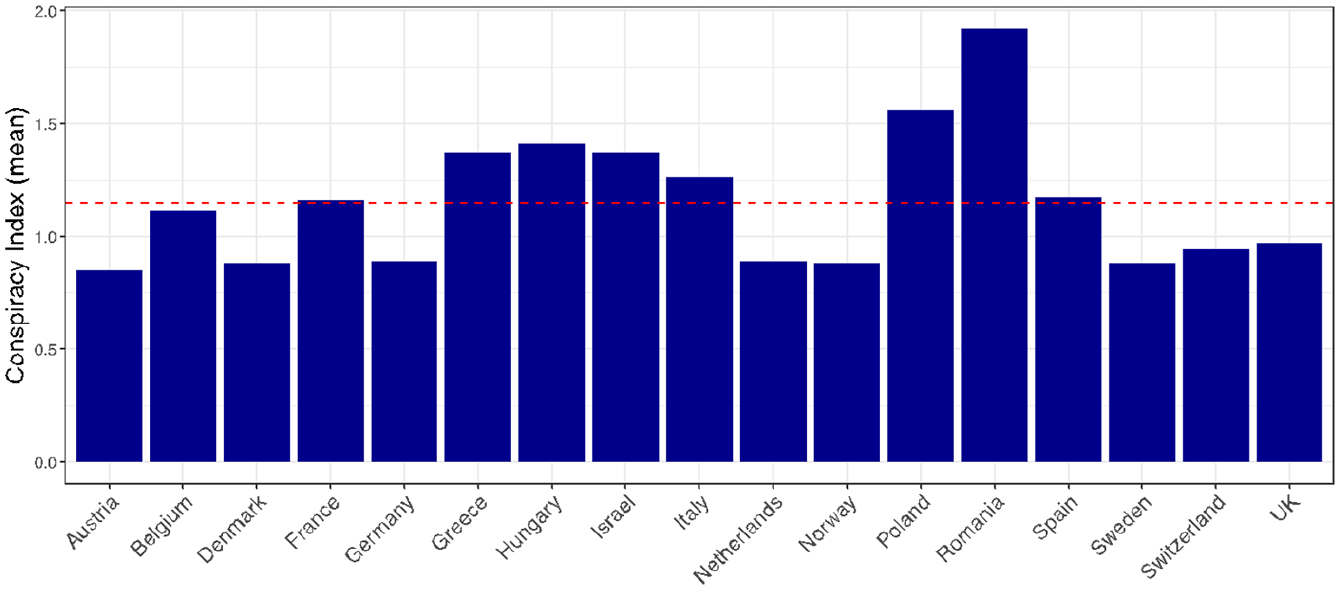
Conspiracy theory beliefs by country.
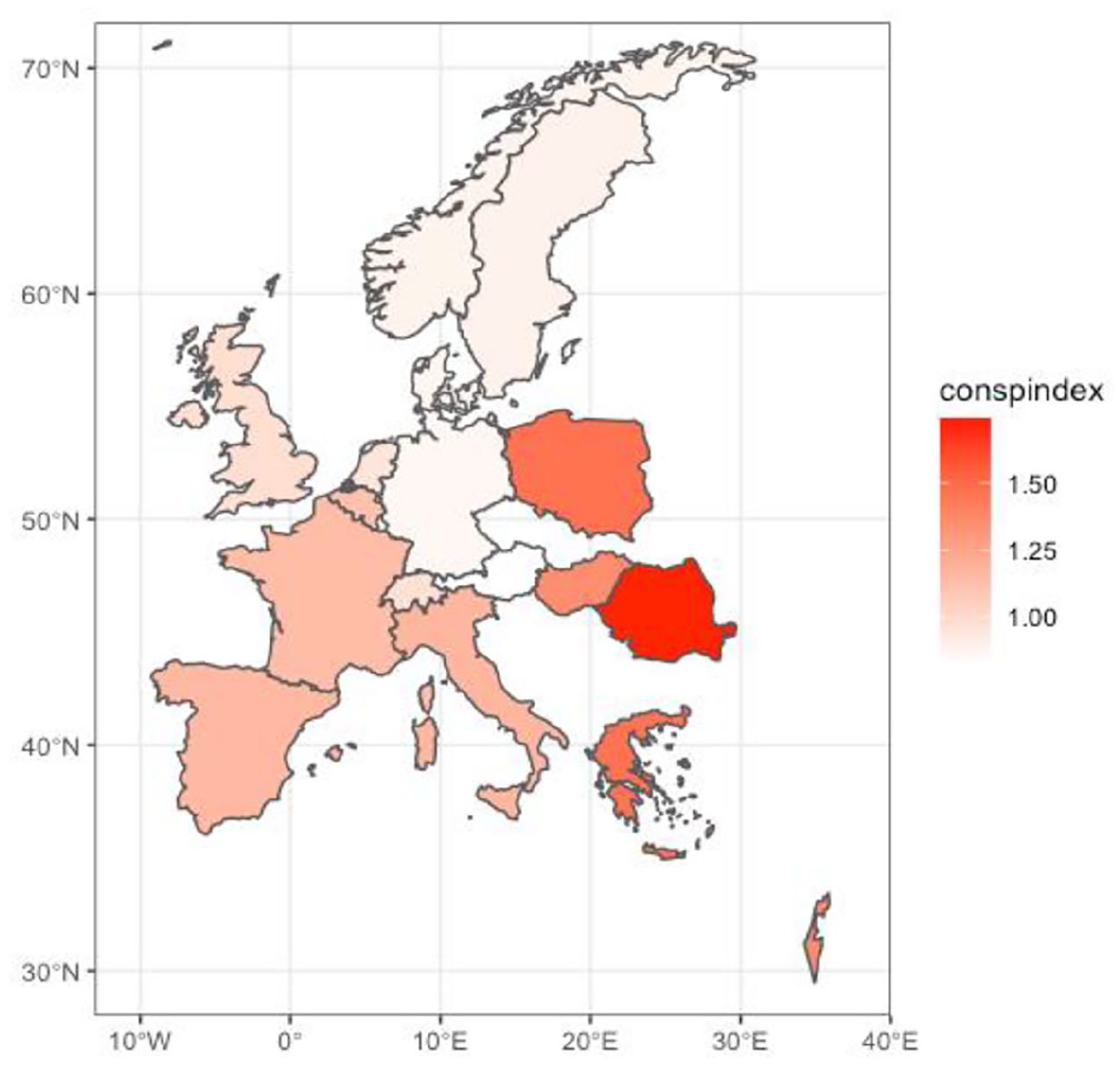
Map of conspiracy beliefs across countries.
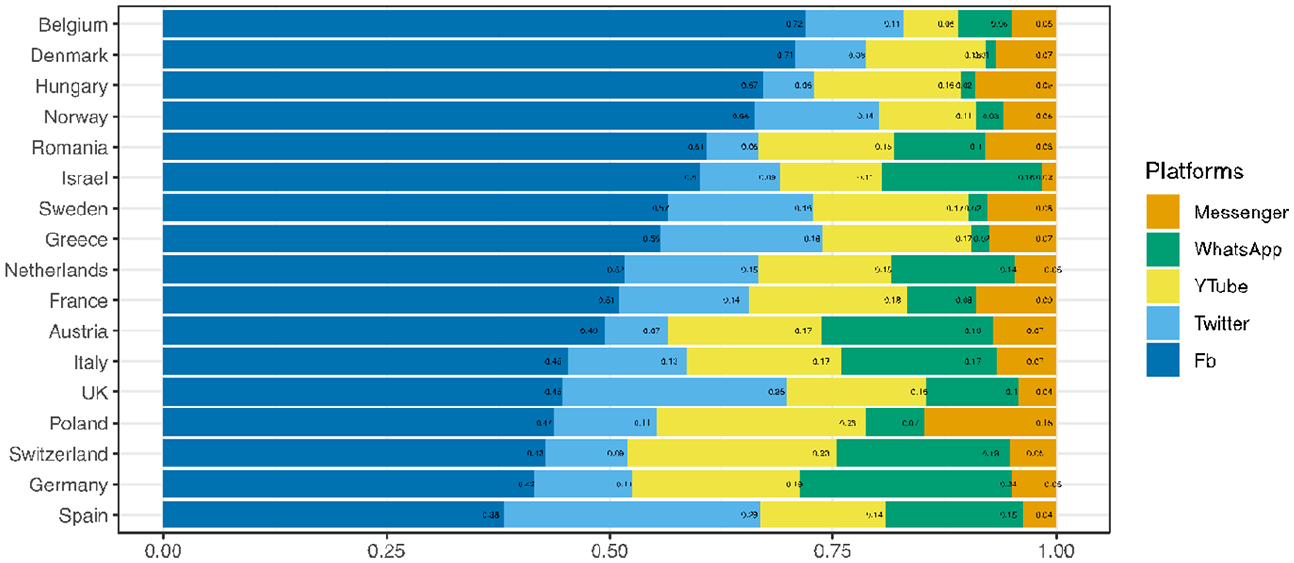
Use of platforms by country.
In Figure 3, we can see that Facebook continues to be the most popular platform, followed by YouTube, WhatsApp, or Twitter depending on the context, and Messenger. Combined with information from Figure 1, we can also see that there is not a clear pattern or association at the aggregate level between countries ranking high or low in conspiracy beliefs and platform popularity. Among the countries where Facebook is most popular (>0.50), we find countries with low (e.g. Denmark) and high conspiracy beliefs (e.g. Hungary, Israel). High (e.g. Poland) and low (e.g. Switzerland) conspiracy belief countries are also found among the countries where Facebook is less popular (<0.50).
Platform effects
Turning to the hypotheses, we expect that, depending on their affordances, platforms influence CTB differently. More precisely, our hypotheses state that Twitter will have a negative effect on CTB (H1), while Facebook (H2), YouTube (H3), and messenger services (WhatsApp and Messenger, H4) will all have positive effects on CTB. Figure 4 plots platform effects for the dependent variable (Conspiracy Index), which has been normalized to 0–1, and presents results from the OLS and the multilevel mixed-effects models (all models depicted can be found in tabular form in the Online Supplemental Appendix).
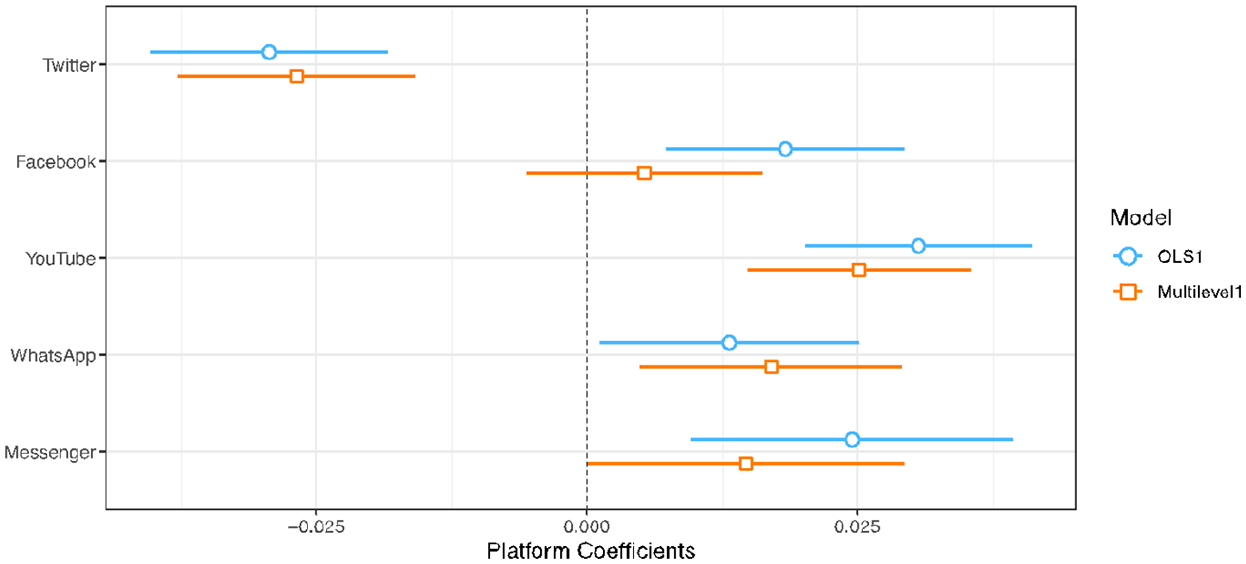
Platforms coefficients for OLS and multilevel linear models.
As can be seen, the results support H1, which predicted a negative effect of Twitter on conspiracy beliefs. On average, Twitter reduces CTB by 3% on the conspiracy scale. H2–H4 predicted a positive effect of Facebook, YouTube, and messenger services on CTB. We find positive effects for all these platforms, though for some platforms—Facebook and Messenger—the effects are only significant when country differences are not considered, suggesting that they are probably driven by a few countries where both CTBs and use of these platforms are widespread. 3 The results furthermore show that YouTube increases CTB with between 2% and 3%, and WhatsApp between 1% and 2%. These are all significant positive effects and they hold both when country differences are not weighted (OLS) and when they are weighted (multilevel model).
Robustness tests
People using social media may have special characteristics or certain motivations may shape the decision to use specific platforms, and this in turn might be correlated with the outcome; that is, the propensity to believe in conspiracy theories. It is possible that the effects reported in the previous analyses might be biased due to selection problems. To address this, propensity score matching (see the “Data and methodology” section) is employed as a test of robustness. Table 1 reports the average treatment effects (ATE) for the pooled data after matching, and Table 2 reports the ATE by country. Covariate balance graphs for all platforms can be found in the Online Supplemental Appendix (the analysis by country is available upon request). As Table 1 shows, after matching on the set of relevant observables, the effects reported previously hold; Twitter continues to have a significant negative effect on CTB, and all the other platforms continue to have a significant positive effect on CTB. In particular, according to these estimations, use of Twitter reduces CTB by 4%, whereas the rest of the platforms increase CTB between 3% and 5%.
ATE for platforms for the pooled dataset.
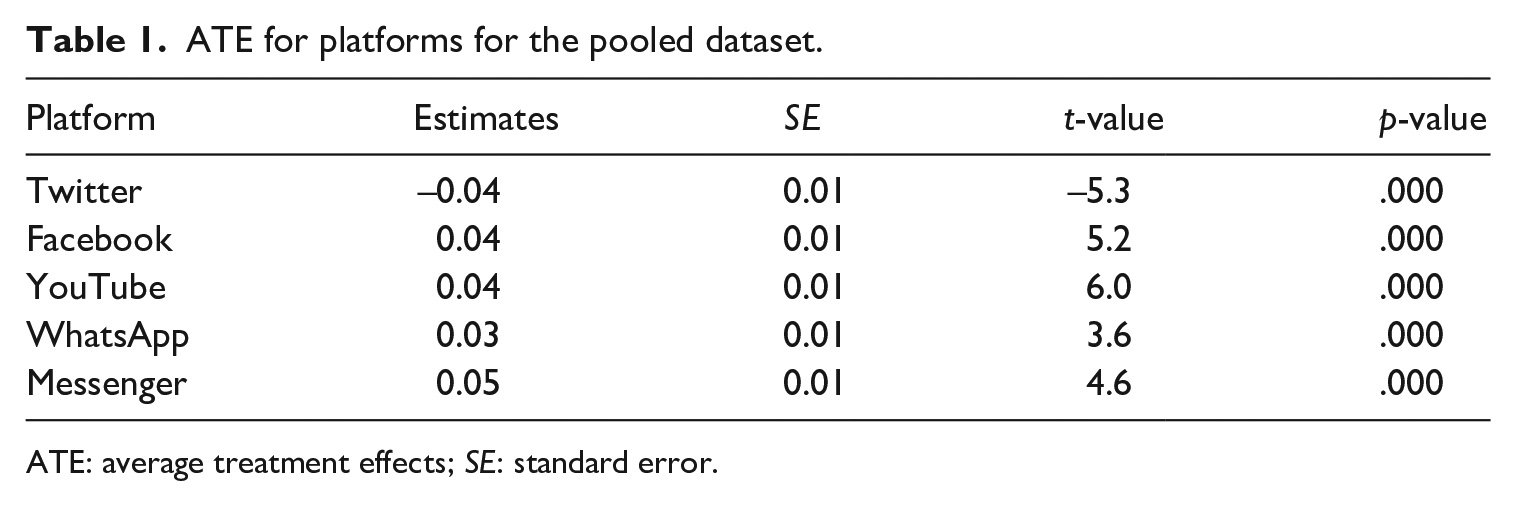
ATE: average treatment effects; SE: standard error.
ATE for platforms by country.
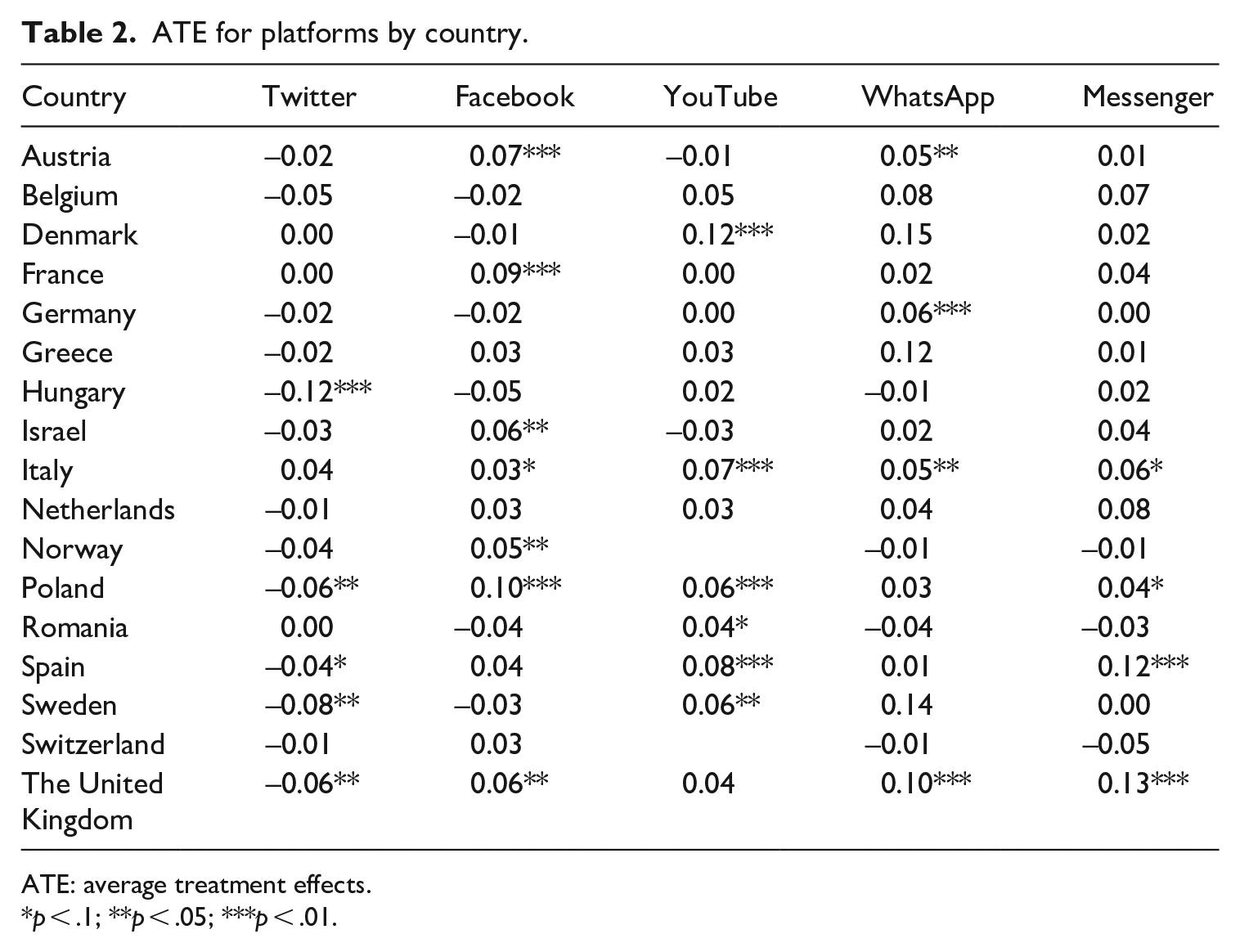
ATE: average treatment effects.
p < .1; **p < .05; ***p < .01.
Table 2 provides additional support for our hypotheses by showing the matching results by country. The positive effect of Facebook on CTB is highly significant in six countries (Austria, France, Israel, Italy, Norway, Poland, and the United Kingdom) and the effects are quite large (they range from 5% to 10%). YouTube is also positive and highly significant in six countries (Denmark, Italy, Poland, Romania, Spain, and Sweden). Twitter has a negative and significant effect in five countries (Poland, Hungary, Spain, Sweden, and the United Kingdom). Finally, messenger services (WhatsApp and Messenger) have positive and significant effects in four countries (which differ across services). However, they have some of the largest observed effects (with Messenger producing a maximum of a 13% change on the CTB scale). Important to note is also that in most other countries, even though the coefficients are not significant, they are in the expected direction. Taken together, we thus interpret these results as supporting all hypotheses.
Conclusion
While the Internet has always served as a meeting place for fringe groups and conspiracy theorists, social media have added a new layer to this reality. Aided by the platforms’ interactive and networking features, as well as their capacity to deliver different kinds of content to very different audiences, social media have become hotspots for unsubstantiated information and the diffusion of misperceptions. Nevertheless, not all social media platforms should be painted with the same brush as different architectural features and affordances of social media platforms have consequences for how users encounter content and others with whom they can interact and build relationships (Bossetta, 2018).
The outbreak of the COVID-19 pandemic gave rise to many conspiracy theories, providing us with a unique opportunity to study conspiracy theory proliferation in platforms during the initial phase of the pandemic. We theorized that variation across different features of social media platforms might make some platforms more likely to accommodate conspiracy theory beliefs than others. Our results support the hypothesis that Twitter has a negative effect on conspiracy beliefs, while use of Facebook, YouTube, Messenger, and WhatsApp were found to have positive effects. For Facebook and its private messaging counterpart Messenger, it should, however, be noted that coefficients are only significant for the pooled models, when country effects were not weighted. Although this suggests that effects might not be uniform across countries, scrutinizing country differences is beyond the scope of this study and could make for a valuable endeavor for future research.
Our study makes several contributions. We show that not all social media platforms are the same when it comes to conspiracy theory beliefs about COVID-19. Our findings resonate with the core theoretical tenets of affordances theory, that there is a multifaceted relational structure between a technological tool and the user which might enable (in the case of Facebook, YouTube, and Messenger services) or constrain (in the case of Twitter) behavioral outcomes in a particular context (Evans et al., 2017: 36). This has implications for theory-building. Understanding how the spread of conspiracy theories differs across social media platforms is key to developing strategies to correct misperceptions, as well as to theorizing about how different features lead to different information diffusion dynamics. Our design does not allow us to tease out the specific effect of different affordances which would help understand why precisely we observe these effects, but the main finding lays the ground for future research zooming into individual affordances (network features, type of content, etc.) and studying the particular dynamics they give rise to. Specifically, a number of platform-specific features that we discussed earlier may have a link to how CTB proliferate. Future research focusing on the micro-mechanisms of the effects tied to specific affordances could consider a number of possibilities when studying, for example, Twitter’s distinct effect in comparison to other platforms. Twitter’s users combine higher than average education with a greater tendency for news-seeking and engagement into political discussions than any of the platforms in our study. This could imply that a larger number of users with potentially high-quality information sources were there to create content which, due to the asymmetrical structure of connections on the platform, can reach very far very fast through retweeting that cuts across different types of networks. In this fashion, it is possible that conspiratorial content—when it appeared—could be debunked fast or possibly “drown out” with better quality information or the sheer volume of those willing to quickly jump in and correct misperceptions. This is in contrast to platforms like Facebook or Messenger services, where the networks are not only more homogeneous, but countering opinions may be harder to emerge for different reasons. For example, precisely because of Facebook’s more family-and-friends oriented connections, users might think twice before attempting to correct conspiratorial content, as they are more likely to have to face the cost of jeopardizing social relationships. Indeed, the topic of how to talk to friends and family sharing conspiracy theories on social media became the subject of many articles in reputable news sources once conspiracy theories started to emerge (Warzel, 2020). But while this might be very relevant to Facebook users, it is not a barrier to Twitter users who could have happened upon a conspiratorial content and decided to interject (or hijack) a discussion with their own evidence. The contrast between Twitter also holds for YouTube where, due to the platform’s architecture, upon watching a video users have to move to the comments to encounter any debate about the content, thus possibly having less exposure to corrective information other than those flagged by the platform (when that happenes).
Different approaches to platform governance might have also played a significant role, meaning that some platforms need more oversight than others. Twitter quickly put in place measures such as deprioritizing content that could pose risks to people’s health along with labels and warning messages to content that contained COVID-19 misinformation. Facebook, which eventually instituted similar measures, continues to face criticism for being too slow to act on groups profiting from COVID-19 conspiracy theories (Jackson et al., 2021) and it is possible that related content or groups were able to gain substantial audiences before they were blocked (Marchal and Au, 2020). Finally, as none of the two messenger services has the type of warnings or content removal practices implemented on Twitter or Facebook, letting private conversations (often among large groups) be unmoderated could have increased the likelihood for conspiratorial content to proliferate on these. Zooming into the specific affordance-related mechanisms would help identify which parts of the conspiracy theory diffusion chain platforms need to work harder on to make their products safer, especially when it comes to public health. While the COVID-19 pandemic should serve as an important case study on how platforms react when scientific consensus in relation to content previously labeled as misinformation shifts, our findings add to the mounting evidence enticing social media platforms to self-reflect on the information quality in their environments and its potential broader effects on citizen attitudes and beliefs that are essential for public choices.
While our study has focused on conspiratorial beliefs about COVID-19, there is a little theoretical reason to believe that the effects we uncover would not apply to other types of conspiracy theories. This reasoning implies that our study has applications to a far larger problem than COVID-19-specific conspiracy theories. Future research should re-examine the connection of platform type and conspiracy theory beliefs using other conspiracy theories.
Our study does not come without limitations. The most important one is selection bias, which our data and design do not allow us to settle definitively. We have provided a strong theoretical rationale that platforms’ diverse features might be responsible for the way in which each platform is connected to conspiracy theory beliefs. It is, however, also possible that users’ particular characteristics or motivations may shape their decision to use this or the other platform precisely because it can offer the type of environment that fits their individual or community needs best. In recognition of this limitation, we employed propensity score matching which enabled us to find users with comparable characteristics to non-users across platforms, thus providing an additional test that our assumptions about the role of platforms are robust. This is an important test as, compared to regression-based techniques, this technique at least does not rely on out of data range extrapolations. Nevertheless, the ideal design for disentangling the causal order in this puzzle is, ultimately, a randomized experimental design. Random assignment into platforms could come with significant challenges, however, given the social media saturated environment of our times, and the difficulties of compliance with being active on a singular platform (Theocharis and Lowe, 2016). Ultimately, one would have to trade external validity for internal validity, which is why no single study design can stand alone.
Despite these shortcomings, our study provides important evidence that future studies based on other designs can build upon to address an issue of increasing importance given the role of platforms in people’s media and socialization diets.
Supplemental Material
sj-pdf-1-nms-10.1177_14614448211045666 – Supplemental material for Does the platform matter? Social media and COVID-19 conspiracy theory beliefs in 17 countries
Supplemental material, sj-pdf-1-nms-10.1177_14614448211045666 for Does the platform matter? Social media and COVID-19 conspiracy theory beliefs in 17 countries by Yannis Theocharis, Ana Cardenal, Soyeon Jin, Toril Aalberg, David Nicolas Hopmann, Jesper Strömbäck, Laia Castro, Frank Esser, Peter Van Aelst, Claes de Vreese, Nicoleta Corbu, Karolina Koc-Michalska, Joerg Matthes, Christian Schemer, Tamir Sheafer, Sergio Splendore, James Stanyer, Agnieszka Stępińska and Václav Štětka in New Media & Society
Footnotes
Acknowledgements
The authors are grateful to Spyros Kosmidis and Sebastian Adrian Popa for reading and insightfully commenting on an earlier version of this manuscript.
Author’s Note
Laia Castro is also affiliated with Universitat Internacional de Catalunya, Spain. Karolina Koc-MIchalska is also affiliated with University of Silesia, Katowice, Poland.
Funding
The author(s) disclosed receipt of the following financial support for the research, authorship, and/or publication of this article: This project was financially supported by the Network of European Political Communication Scholars (NEPOCS). Data collection in Denmark was supported by the University of Southern Denmark. The collection of data in Hungary and Poland was supported by the Economic and Social Research Council [ES/S01019X/1]. The collection of the data in France was supported by an Audencia Foundation grant. The collection of data in Sweden was supported by the research project “Knowledge resistance: causes, consequences, cures”, funded by Riksbankens Jubileumsfond. Yannis Theocharis would like to acknowledge the support of the ZeMKI Lenkungskreis at the University of Bremen, which generously contributed to funding this research.
ORCID iDs

Supplemental material
Supplemental material for this article is available online.
Notes
Author biographies
References
Supplementary Material
Please find the following supplemental material available below.
For Open Access articles published under a Creative Commons License, all supplemental material carries the same license as the article it is associated with.
For non-Open Access articles published, all supplemental material carries a non-exclusive license, and permission requests for re-use of supplemental material or any part of supplemental material shall be sent directly to the copyright owner as specified in the copyright notice associated with the article.
