




Abstract
This article proposes a theoretical framework for how critical digital literacy, conceptualized as incorporating Internet users’ utopian/dystopian imaginaries of society in the digital age, facilitates civic engagement. To do so, after reviewing media literacy research, it draws on utopian studies and political theory to frame utopian thinking as relying dialectically on utopianism and dystopianism. Conceptualizing critical digital literacy as incorporating utopianism/dystopianism prescribes that constructing and deploying an understanding of the Internet’s civic potentials and limitations is crucial to pursuing civic opportunities. The framework proposed, which has implications for media literacy research and practice, allows us to (1) disentangle users’ imaginaries of civic life from their imaginaries of the Internet, (2) resist the collapse of critical digital literacy into civic engagement that is understood as inherently progressive, and (3) problematize polarizing conclusions about users’ interpretations of the Internet as either crucial or detrimental to their online engagement.
Keywords
Introduction
Media literacy, understood as the ability to access, evaluate and produce media content, is crucial to a well-informed citizenry’s participation in society. Digital literacy, a variant of media literacy, consists of functional and critical skills and knowledge about the Internet. Two major limitations, however, affect research on whether and how its critical dimension, in particular, facilitates participation in civic life, understood as both community and political life. First, media literacy research has focussed predominantly on users’ ability to evaluate online content, with little attention to their understanding of the digital environment, from how Internet corporations operate to the Internet’s potentials and limitations for civic life. Second, users’ critical reflections have often been approached as conducive to progressive action, thus leaving little room for civic engagement underpinned by different ideologies.
To overcome these limitations and facilitate richer analysis of whether and how critical digital literacy contributes to civic engagement, this article draws on utopian studies and political theory to offer a novel conceptualization of critical digital literacy. Such a conceptualization is grounded in notions of utopian thinking and social imaginaries. While the latter consist of expectations of society that are often ideologically driven (Thompson, 1982), utopian thinking, understood as relying dialectically on both utopianism and dystopianism, represents a powerful force for social change. We live in an age when the social is increasingly intertwined with the digital, which is why (re)imagining and participating in society require an understanding of the digital environment. This article therefore proposes a framework for how critical digital literacy, conceptualized as incorporating utopian/dystopian imaginaries of society in the digital age, facilitates civic engagement.
Such a framework enables us to disentangle the ways in which users construct and deploy, in line with different ideologies, their imaginaries of the Internet from their imaginaries of civic life. Applying utopianism/dystopianism to critical digital literacy prescribes that the latter requires an understanding of the Internet’s potentials and limitations for civic life. It is argued here that constructing such an understanding does not necessarily lead to civic engagement and can intersect with different ideologies. At the same time, this article theorizes that deploying, and not just constructing, such an understanding is crucial to pursuing civic opportunities. In doing so, it problematizes media literacy research that has polarized users’ positive or negative interpretations of the Internet as, respectively, crucial or detrimental to their online engagement.
The first section of this article discusses the role of the Internet in civic life. A section follows on how, and with what limitations, different traditions of media literacy research have explored digital literacy and how its critical dimension intersects with civic engagement. The article then draws on utopian studies and political theory to frame utopian thinking as relying dialectically on both utopianism and dystopianism in ways that can underpin civic engagement in line with different ideologies. After examining the intersection of utopian studies and media studies, a two-stage framework is proposed for how critical digital literacy, based on the construction (stage 1) and deployment (stage 2) of utopian/dystopian imaginaries of society in the digital age, facilitates civic engagement. Finally, the implications of the framework for media literacy research and practice are discussed.
The Internet and civic engagement
For the past few decades, Western liberal democracy – a system of representative institutions operating under principles of individual liberty and equality – has suffered from a decline in citizens’ participation in electoral politics (Coleman, 2017). While this decline is exacerbated by distrust in institutions and traditional media, the Internet is often praised for facilitating civic engagement, understood more comprehensively as how citizens take part in community and political life, which can be either institutional or non-institutional (i.e. unmediated by institutions) (Dahlgren, 2003). Examples of civic engagement, which might be meaningful to citizens and to their subjectivity but might not necessarily affect decision-making, include community involvement, volunteering, contacting politicians, sharing or commenting on political content on social media, signing a petition, participating in a demonstration and using alternative media (Dahlgren, 2003; Smith, 2013).
Understanding the Internet requires an understanding of its technical features, online content and Internet usage, as well as of the ownership, governance and business models of corporations such as Google and Facebook (Van Dijck, 2013: 28). Within civic life, the Internet is praised for its potential to facilitate decentralization of power, public debate, and interaction between citizens and politicians (Enjolras et al., 2013; Lee and Shin, 2014). It contributes to a deliberative democracy based on citizens’ public deliberation (Blumler and Coleman, 2010). Furthermore, it is beneficial for community building, networked activism and better-organized protest (Garrett, 2006).
At the same time, the Internet can be used for political repression and voter manipulation based on economic and government surveillance. We live in an age, which some describe as postdigital (e.g. Selwyn and Jandrić, 2020), of facial recognition and datafication. As exemplified by the Snowden revelations or the Cambridge Analytica scandal, this is an age when Internet corporations, which collect, track and profile users’ data for advertising purposes, can work closely with governments or political parties (McChesney, 2013). In addition, not only do private interests prevail within public debate online, but also those who participate are predominantly male, white and well educated, which makes the Internet elitist (Hindman, 2009). This problem is exacerbated by the ‘economic structure’ of the Web, which ‘encourages audiences to cluster around’ a few sites that enjoy visibility (Hindman, 2009: 55). Internet corporations, furthermore, use algorithms that expose users primarily to information which, regardless of its authenticity, reinforces their pre-existing beliefs. This is referred to as the problem of the filter bubble. As a result, public debate online is increasingly subject to polarization and misinformation, which undermine democracy’s reliance on a well-informed citizenry (Vaidhyanathan, 2018).
Critical digital literacy and civic engagement
Media literacy is often used as an umbrella term encompassing various literacies, including information, media, digital, data, multimodal and network literacies. Functional digital literacy requires operational, information-navigation, social and creative skills that users need in order to engage practically with the Internet. In addition, it can be understood as incorporating users’ understanding of what the Internet affords in terms of its technical features, as well as their dispositions towards its advantages and disadvantages in relation, for instance, to finding information or to online safety. By contrast, the critical dimension of digital literacy can be approached not only as the ability to evaluate online content in terms of bias and trustworthiness, but also as knowledge about the role of the Internet in relation to broader socio-political and economic forces (Polizzi, 2020a). Critical digital literacy is essential to the active participation of critically autonomous and well-informed citizens in society (Hobbs, 2010; Polizzi, 2020b). Media literacy research, however, has often prioritized their evaluation of media representations, both offline and online, with little attention to whether or how their understanding of the digital environment facilitates their civic engagement. This literature can be categorized into four traditions: (1) educational research informed by social psychology, (2) research on digital inequalities, (3) research inspired by cultural studies and critical pedagogy, and (4) the New Literacy Studies. Each is now discussed briefly.
Employing methods adopted in social psychology, a few educational studies have found that students’ ability to analyse news articles and their knowledge of mass media are positively associated with their intention to participate in civic life (Duran et al., 2008; Martens and Hobbs, 2015). Their ability to evaluate online content, furthermore, corresponds to more exposure to political discussions (Kahne et al., 2012). Despite under-researching students’ understanding of the Internet, these studies have focussed on critical aspects of digital literacy. By contrast, another strand of educational research has prioritized students’ functional digital skills and dispositions towards the Internet’s advantages and disadvantages for playing games, learning, socializing and finding information. According to this strand, students’ positive or negative dispositions explain, respectively, their willingness or reluctance to use the Internet (e.g. Chou et al., 2009; Meelissen and Drent, 2008). This strand, however, has under-explored users’ understanding of the Internet within civic life and in ways that transcend the individual.
Research on digital inequalities, which has also paid more attention to functional digital literacy, has argued that users’ digital skills are crucial to overcoming gaps in democratic participation (e.g. Min, 2010). In addition, a few studies have focussed on users’ dispositions towards the Internet, but not in the context of their civic engagement (e.g. Eynon and Geniets, 2016; Hakkarainen, 2012; Reisdorf and Groselj, 2017). According to these studies, users’ dispositions may be positive or negative for their online engagement, depending on whether or not the Internet is perceived as safe and useful for health, information seeking, social interaction and online shopping. Recent work on digital inequalities has argued that limited engagement online, if it leads to quality outcomes, is not necessarily problematic (e.g. Van Deursen and Helsper, 2018). But, as with the educational studies reviewed above, this strand of research has ultimately polarized users’ positive or negative interpretations of the Internet as facilitating, respectively, their online engagement or disengagement.
Indebted to Marxist education scholar Freire (2000), media literacy research inspired by cultural studies and critical pedagogy has employed notions of critical literacy – which refers to the ability to question power and authority – to examine how students construct critical reflections about mainstream representations in ways that inform their production of alternative content challenging dominant ideologies (e.g. Kellner and Share, 2007, 2019). However, ‘there is little . . . of critical digital literacy that appears specifically “digital”’ as in incorporating users’ understanding of the Internet as embedded in power structures (Pangrazio, 2016: 164). Exceptionally, recent work on data literacy within this tradition has argued that civil society organizations, on the one hand, should understand the implications of how governmental data can be accessed and used to promote causes important to their communities (e.g. Fotopoulou, 2020). Users, on the other hand, should understand how Internet corporations like Google and Facebook operate and how to protect their privacy online (e.g. Pangrazio and Selwyn, 2019). Similarly, for Buckingham (2007), the critical dimension of digital literacy requires an understanding not only of media representations but also of the political economy of the Internet, along with its implications for public debate, campaigning and surveillance (Banaji and Buckingham, 2013: 82–83). Ultimately, for Fry (2014: 133), digital literacy should be approached as including an understanding of the Internet’s potentials and limitations for democracy. Nevertheless, such an approach, and whether it has the potential to challenge polarizing conclusions about users’ interpretations of the Internet as positive or negative for their online engagement, has remained under-studied.
Conceiving of critical digital literacy as incorporating an understanding of the digital environment raises the question of how to disentangle users’ understanding of the Internet from their understanding of the socio-political order. This question has remained under-explored both within and beyond the critical pedagogy tradition. According to Fotopoulou (2014), while feminist activists are motivated by imaginaries of networked feminism grounded in the Internet’s potential for freedom and open data, gaps in their digital skills undermine their civic engagement. Their imaginaries, for Fotopoulou (2014), are not a dimension of their digital literacy. By contrast, according to critical pedagogy, users’ critique of the socio-political order, while not necessarily focussed on the Internet, is indicative of critical literacy. A limitation of this tradition lies, however, in its interpretation of the critical. Critical pedagogy research has collapsed users’ critique into a normative vision of civic engagement as inherently progressive (e.g. Kellner and Share, 2007, 2019). In doing so, it has left little room for civic engagement that, while not necessarily critical of the political establishment, may be underpinned by a critical understanding of the Internet’s political and democratic potential. By the same token, it has hardly recognized that resisting dominant ideologies does not necessarily imply a critical understanding of the Internet. Critiquing the Internet, furthermore, does not inherently overlap with critiquing the social or with progressive action.
Approaching literacy as a socio-cultural practice, the New Literacy Studies tradition has often emphasized users’ creative engagement with multimodality – referring to the integration of different media texts – over their critical understanding of online content and the Internet, while also paying little attention to their civic engagement (e.g. Bulfin and North, 2007; Jewitt, 2008). Exceptionally, a few studies inspired by the New Literacy Studies and critical pedagogy have argued that digital literacy should be based on civic imagination, which enables users to imagine socio-political alternatives (Jenkins et al., 2016; Mihailidis, 2018). These studies, however, have under-researched whether and how users imagine the Internet in ways that intersect with, and may be differentiated from, how they imagine such alternatives. Jenkins et al. (2016) have found that the production and sharing of multimedia content enables young activists motivated by progressive ideals to question the Internet’s potential for activism and to critique dominant ideologies. Leaving exceptions aside, however, the New Literacy Studies has generally overemphasized the importance of creating ‘“new” things, while along the way learning skills of mastery and critique’ (Pangrazio, 2016: 167).
Given the limitations of media literacy research, this article conceptualizes critical digital literacy as incorporating users’ utopian and dystopian imaginaries of society in the digital age, differentiating between their imaginaries of civic life and of the Internet. Before unpacking how such a conceptualization facilitates richer analysis of whether and how critical digital literacy contributes to civic engagement, the next section draws on utopian studies and political theory to frame utopian thinking as relying dialectically on both utopianism and dystopianism.
Utopianism/dystopianism: a dialectical approach to utopian thinking
Utopian thinking, which deals with questions of power, the socio-political system and participation in civic life, has the potential to generate social change. Utopian studies and philosophy – drawing on science fiction literature, political theory, Marxism and postmodernism – represent an interdisciplinary field that identifies and analyses utopian forms, content and functions in society (Levitas, 2010: 6, 179). Before reflecting on the relationship between utopian thinking, action and social change, a brief account of the history of utopian thinking can help us to grasp the dialectic between utopia and dystopia.
Utopianism consists of movements producing utopias. The term utopia was coined by Sir Thomas More in 1516 when he published his Utopia, which tells the story of a homonymous fictional island and its perfect society. More Latinized two Greek compounds – ou (not) and topos (place), and eu (good) and topos (place) – to refer ambiguously to a place that is both a non-place and a good place. By contrast, dystopia, understood as a fictitious abhorrent socio-political world, is believed to derive either from the Greek prefix dys standing for bad, dysfunctional, or from ‘Dis’, the Greek mythological underworld of the dead (Ransom, 2009: 118, 123).
Since one person’s utopia can be another’s dystopia, no binary opposition should be asserted between the two, not least because of the role of dystopianism in shaping utopianism. Utopian thinking can be understood as fulfilling a twofold function: (1) raising awareness through a critique of dystopian limitations of the present, while (2) promoting contemplation of utopian elements projected into the future (Shor, 2010: 125). Essential for critiquing the present and envisioning social change, the probing of utopian moments of building another world . . . requires some understanding of the dystopian elements of this and future worlds. In order to comprehend the utopian/dystopian dialectic, one needs to define that dialectic in ways that underscore . . . [its] fictive and real nature. (Shor, 2010: 124)
Dating back to Hegelian theory, the concept of dialectic refers to a process of reasoning whereby opposed ideas – thesis and antithesis – are negotiated to reach synthesis (Maybee, 2016). While Harvey’s (2000) dialectical utopianism relies on the interdependence of alternative space and time, for post-structuralist Marin (1990: xxiv) utopian thinking, based on imagination and realism, requires the creation of a ‘timeless no-place’ where contemporary socio-political forces undergo ‘critical examination’. Similarly, according to Marxist political theorist Fredric Jameson (2005: 15, 180), ‘utopian space is an imaginary enclave within real social space’ where tensions are played against each other in a ‘negative dialectic’. Such a dialectic suggests that utopian thinking relies on both utopianism and dystopianism, provided that these are not synthesized but in a constant state of conflict. Examples of utopian/dystopian configurations include anti-utopianism, critical utopianism and critical dystopianism. Inasmuch as utopian thinking must be political and ideological to facilitate social change, anti-utopianism refers to the rejection of utopianism erected from the perspective of power (Jameson, 2005: 199). Theorized in the 1970s in the light of optimism about the anti-war, civil rights and environment movements, critical utopianism consists of ‘ideological critique . . . and social dreaming/planning’ (Moylan, 2000: 82). Finally, theorized as scepticism about Western neoliberal politics in the 1980s and 1990s, critical dystopianism is forged when a utopian enclave is carved from a dystopia (Moylan, 2000: 185, 189).
Not only has Marxism informed discussions of ideology and utopia, but it has also influenced how utopian thinking may be expected to guide action and social change. Arguably, the utopian/dystopian dialectic is embedded in Marx’s dialectical materialism, which sits within his political project of overturning capitalism. Referring to a method through which dialectical reasoning problematizes sociality as developing through material conditions, dialectical materialism reflects the aspiration to transcend the contradictions resulting from power asymmetries through action challenging the status quo (Edgley, 1990). While anti-utopianism has often translated into a rejection of left-wing utopianism, Marxism has informed forms of critical utopianism and critical dystopianism resisting capitalism, the patriarchal society and ecological degradation (Jameson, 2005: 199; Moylan, 2000: 82).
Drawing on Bloch’s (1995) approach to utopia as imagination and hope, Levitas (2010) has argued that social change results from combining utopian desire with action. But utopian thinking does not intrinsically translate into action. Marxism assumes a link between the two, which leads to ‘over-optimis[m] about . . . utopia’ (Levitas, 2010: 200). Notions of action and social change, furthermore, are far from univocal, even within the Marxist tradition. Western Marxism differs from orthodox Marxism in its diminished concern with the socialist revolution as a utopian project aspiring to empower the working class to overturn capitalism through controlling the state (Anderson, 1979). Acknowledging the failure of such a revolution in the West, Western Marxism, central as it is to critical theory, critical pedagogy and cultural studies, has informed work on hope and utopia that has approached radical action as multifaceted.
For Bloch (1995), alienation from Western societies is a precondition for radicalism that resonates with orthodox Marxism in its aspiration to overturn capitalism. By contrast, Giroux (2004: 38) has defined radical hope as a pedagogical practice that teaches citizens to take civic action. Hope, for him, represents ‘utopian longing’ that serves as a ‘subversive force . . . evoking . . . different futures’ (Giroux, 2004: 38–39). But its subversive nature does not necessarily equate with a rejection of capitalism. It aligns with a vision of radical democracy that aims to facilitate social justice and equality through institutional and non-institutional politics. Finally, for Raymond Williams (1980: 198), utopian thinking consists of a cultural creativity whereby left-wing possibilities can be imagined.
Although much work relevant to utopian studies is indebted to Marxism, Levitas (2010: 214) has emphasized that ‘utopias are not the monopoly of the Left’. While socialist and progressive utopias promote social justice and egalitarianism by rejecting power imbalances, there are also ‘utopias of the dominant classes in society’ (Levitas, 2010: 214). However different in content or purpose, these utopias also operate through a utopian/dystopian dialectic. Neoliberal utopianism, for instance, promotes individual freedom and free-market values by framing taxation and bureaucracy as dystopian threats. We can portray the neoliberal utopia as a dystopia. But we cannot deny that it projects a vision of a desired society (Levitas, 2010: 215–216). Similarly, conservatism encapsulates a utopia that is critical of the individualistic character of liberalism while promoting preservation, centralized power, defence, law and order, and loyalty to the state (Levitas, 2010: 218).
Since utopianism varies in terms of its socio-political purpose, understanding ‘the utopist as a radical revolutionary is problematic’ (Morgan, 2015: 107). Ideologies, furthermore, are not fixed systems of ideas and can overlap. Operating through a utopian/dystopian dialectic, democratic socialism and sustainable development exemplify progressive ideologies that, while coexisting with capitalism and liberal democracy, resist social inequalities and environmental degradation by often relying on policy reforms and on institutions as actors for social change (Morgan, 2015: 115, 118). In short, not only does the utopian/dystopian dialectic apply to different ideologies that potentially, but not inherently, underpin participation in society, but the latter can also be institutional or non-institutional, ranging from voting for policy reforms to participating in resistance and activism.
Conceptualizing critical digital literacy as incorporating utopian thinking
Insofar as the complexity of change represented by the Internet requires a more nuanced understanding of its interrelation with the social, what can media literacy research gain from utopian studies and political theory? Conceptualizing critical digital literacy as incorporating utopian thinking, as framed above, has the potential to facilitate richer analysis of whether and how critical digital literacy contributes to civic engagement. Such an approach sheds light on the ways in which users participate in civic life by constructing and deploying, in line with different ideologies, utopian/dystopian imaginaries of society in the digital age. Before discussing this further, it is worth examining the intersection of utopian studies and media studies.
A dialectical approach to utopianism/dystopianism can serve as a lens through which to examine the Internet’s potentials and limitations for civic life. As addressed above, the Internet facilitates, for example, decentralization of power, political participation and deliberative democracy, but also political repression, surveillance and misinformation (Enjolras et al., 2013; McChesney, 2013; Vaidhyanathan, 2018). Indeed, media scholars have employed notions of both utopia and dystopia to explore, for instance, the implications of digital commons for transcending online commodification (e.g. Loustau and Davis, 2012), or the potential of Internet-mediated collective action (e.g. Wilken, 2012). Discussions of utopianism and the Internet, in addition, have often been accompanied by discussions of ideology. Mejias (2012), for instance, has argued that optimism about the use of Twitter during the Arab Spring has served as a utopian discourse diverting attention in the West from the deepening of social inequalities resulting from capitalism. According to Turner (2006: 244), furthermore, digital technologies have led to cyberlibertarianism, which amounts to a digital utopianism promoting individual liberty by drawing on progressive values that have ‘turned away from political struggle and toward social and economic . . . change’.
Contemporary utopian and dystopian imaginaries of society in the digital age reflect different discourses about the Internet that shape, as examined by research on socio-technical imaginaries (e.g. Milan and Ten Oever, 2017), policy decisions about the digital infrastructure. According to Cohen (2012: 12), these discourses are embedded within the dialectic of information as freedom and information as control (Cohen, 2012: 12). On the one hand, the Internet is expected to promote either economic and political freedom in line with cyberlibertarianism or collective participation against social injustice. On the other hand, a vision of information as control underpins forms of online coercion as well as the expectation that financial profitability, citizen welfare and collective security will require Internet regulation and surveillance (Mansell, 2017).
As captured by the literature on socio-technical imaginaries, media research intersecting with utopian studies has largely prioritized questions about the digital environment. Less is known, however, about whether and how Internet users draw on utopian thinking to understand and participate in society in the digital age, with a few exceptions that, as discussed below, can be found in media studies on social movements. Mindful of these studies, this article now proposes a framework for researching critical digital literacy within civic life in ways that incorporate utopianism/dystopianism, contributing, in turn, to media literacy research and practice.
A two-stage framework
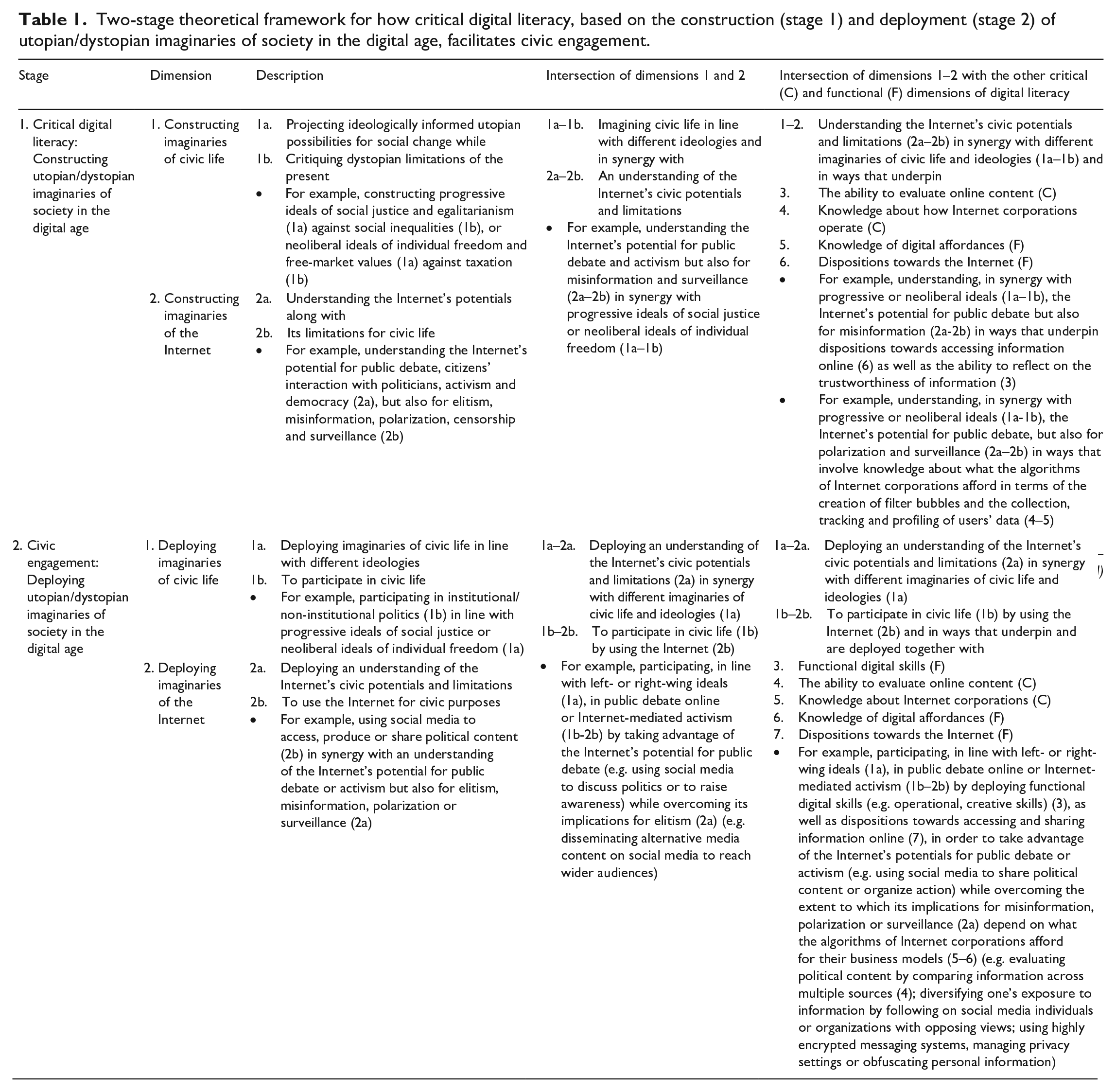
What does applying utopianism/dystopianism to critical digital literacy involve? What should users know about the Internet? In what ways can we expect their knowledge to intersect with their visions of social change? And what can we expect of their civic engagement once they deploy utopianism/dystopianism? This section proposes a two-stage framework for how critical digital literacy, based on the construction (stage 1) and deployment (stage 2) of utopian/dystopian imaginaries of society in the digital age, facilitates civic engagement (see Table 1).
Two-stage theoretical framework for how critical digital literacy, based on the construction (stage 1) and deployment (stage 2) of utopian/dystopian imaginaries of society in the digital age, facilitates civic engagement.
It is important to keep in mind that the framework is theoretical, which means, as discussed later in this article, that it requires empirical testing. Nevertheless, it is supported by references to empirical studies that, as reported in this section, are grounded in media literacy research and in political research. Furthermore, it should be clarified that critical digital literacy may be expected to facilitate civic engagement as part of a framework that is wider than the one presented here. Such a framework should include multiple elements, from the different dimensions of digital literacy to access to resources such as time and money. It should also include political motivation and efficacy, which refers to citizens’ perceived ability to influence decision-making (Morrell, 2003), along with civic literacy, which requires knowledge about the socio-political system (Lund and Carr, 2008). While unpacking such a wider framework transcends the scope of this article, the question of how critical digital literacy, as conceptualized here, reshapes digital literacy more broadly is an important one for the media literacy field. Therefore this section, which theorizes how critical digital literacy facilitates civic engagement on the basis of incorporating utopianism/dystopianism, reflects on the ways in which each stage of the framework presented below intersects with the other critical and functional dimensions of digital literacy. These dimensions range from the critical ability to evaluate online content and knowledge about Internet corporations to functional digital skills, knowledge of digital affordances and general dispositions towards the Internet (Polizzi, 2020a).
Stage 1
As shown in Table 1, the first stage of the framework – constructing utopian/dystopian imaginaries of society in the digital age – prescribes, as a result of applying utopianism/dystopianism to critical digital literacy, what users should know in order to be critically digitally literate. Inasmuch as utopian thinking represents a lens through which to articulate both social change and the implications of the Internet, users need to construct (1) imaginaries of civic life and (2) imaginaries of the Internet. More specifically, given the dialectical nature of utopian thinking, on the one hand they need to project visions of social change rooted ideologically in the contemplation of utopian possibilities based on critiquing dystopian elements of the present. On the other hand, they need to understand the Internet’s potentials and limitations for civic life. Users might construct their imaginaries of civic life, for example, as progressive or neoliberal expectations of the socio-political order that promote ideals of social justice or individual freedom based, respectively, on transcending social inequalities or taxation. At the same time, they should understand that the Internet facilitates, for instance, not just public debate, citizens’ interaction with politicians and activism, but also elitism, misinformation, polarization and surveillance.
This stage of the framework enables us, therefore, to examine whether and how users’ imaginaries of civic life intersect with their imaginaries of the Internet. This means, in practice, that users may well appreciate, for example, that the Internet provides democratizing opportunities to share their political opinions, while also amplifying the spread of misinformation, in ways that may be intertwined with different visions of social change and different ideologies. These may range from socialism and progressivism, with some users longing for forms of egalitarianism, to conservatism or neoliberalism, with others projecting hope for law and order or for the free market. Indeed, we know from media research on social movements, which has hardly engaged with notions of media literacy, that activists’ progressive visions of collective freedom or their anti-democratic values are often blended with an understanding of the Internet’s implications for surveillance and visibility as well as with cyberlibertarian principles that champion its potential for individual liberty (e.g. Postill, 2014; Treré, 2019). Relatedly, the ways in which users’ imaginaries of civic life can intersect with their imaginaries of the Internet are captured by media activism, which refers to activism around traditional media and/or digital technologies. On the one hand, for example, British organizations such as the Open Rights Group and the Campaign for Freedom of Information – which, in accordance with progressive principles, are critical of online censorship and surveillance – promote visions of a better society by campaigning for users’ privacy and free speech. On the other hand, Accuracy in Media in the United States and Mediawatch UK campaign against media bias and harmful content in line with socially conservative and economically liberal agendas (Hackett and Carroll, 2006: 57).
Finally, this stage of the framework suggests that the process of constructing utopian/dystopian imaginaries of the Internet in synergy with imaginaries of civic life may well intersect with the other critical and functional dimensions of digital literacy. Media literacy research on the expertise of digital specialists, including information, IT and media professionals, has found that their ability to evaluate online content is underpinned by knowledge about the Internet’s potential for public debate but also for misinformation, knowledge that intersects with functional dispositions towards the Internet in relation to accessing information (Polizzi, 2020a). Experts, furthermore, are often conscious of the Internet’s implications for the polarization of public debate and for surveillance in ways that are blended with a critical understanding of how Internet corporations like Google and Facebook operate. Such an understanding relies on practical knowledge of how the algorithms of these corporations function and what they afford in terms of the creation of filter bubbles and the tracking of users’ data for commercial purposes (Polizzi, 2020a). Similarly, according to data literacy research, users need socio-technical knowledge to understand how search engines and online platforms function, with emphasis on their implications for privacy and surveillance (Pangrazio and Selwyn, 2019). Considering this research, what this stage of the framework adds is that, in concert with their different imaginaries of civic life and ideologies, users should understand the Internet’s potentials and limitations for civic life in ways that underpin the other dimensions of their digital literacy.
Stage 2
The second stage of the framework – deploying utopian/dystopian imaginaries of society in the digital age – prescribes how critical digital literacy, as conceptualized here, can facilitate civic engagement. For this to happen, users should not only construct (stage 1) but also deploy (stage 2) imaginaries of civic life in synergy with imaginaries of the Internet. As argued earlier, utopian thinking, provided it relies on both utopianism and dystopianism, can underpin participation in institutional or non-institutional politics in line with different ideologies. It follows that, in order to participate in civic life in ways that are mediated by the Internet, users need to deploy imaginaries of civic life that resonate with different ideologies. This might include, for instance, raising awareness of social justice issues in accordance with progressive ideals, or supporting neoliberal causes. At the same time, they need to deploy imaginaries of the Internet’s civic potentials and limitations. To give an example, users’ civic engagement, in line with left- or right-wing ideals, might be underpinned by an understanding of the Internet’s potential for public debate but also for elitism in ways that enable them to take advantage of using social media to discuss politics or raise awareness of socio-political issues. Given the potential for alternative media to reach wider audiences through social media platforms (Fenton and Barassi, 2016), on the one hand this might include disseminating progressive content in opposition to social inequalities via alternative news sites or activists’ own websites, thus avoiding the limitation of interacting primarily with users from higher socio-economic backgrounds. On the other hand, it might include using alternative media online to reach different communities with a view to promoting not just left-wing but also right-wing causes, reflecting conservative principles of centralized power or neoliberal values of competitive individualism.
We know from political research that citizens and activists with different political views use the Internet in ways that are informed by knowledge of its implications for political expression, building support and organizing action (e.g. Barassi, 2015; Kwak et al., 2018). Media research on social movements, furthermore, has found that activists know how to adapt to the media ecosystem insofar as they are largely aware of both its potentials and its limitations. McCurdy (2011), for instance, has argued that they often understand that mainstream media have a wider reach but are driven by corporate interests, while alternative media have limited visibility – which is why they use both media, both online and offline, to compensate for their respective limitations. Similarly, Barassi (2015) has found that activists know that social media platforms like Facebook are shaped by corporate power, which has negative implications for users’ privacy and in terms of surveillance. At the same time, they value online platforms for their potential to create networks of solidarity. As a result, they use social media to organize action, but they use also alternative platforms, including their own websites and newsletters.
Building on this research, this stage of the framework suggests that critical digital literacy can facilitate civic engagement provided it incorporates imaginaries of the Internet’s potentials and limitations for civic life. But this can only happen as long as users deploy other dimensions of their digital literacy in synergy with their imaginaries. In the light of empirical research reported below, we can assume that they will need to deploy, for instance, sophisticated functional digital skills as well as dispositions towards accessing and sharing information online in order to take advantage of the Internet’s utopian potential for public debate or for activism. At the same time, they will need to overcome its dystopian limitations in terms of misinformation, polarization or surveillance, which requires knowledge of how Internet corporations operate and function as platforms or search engines. This is how users might be able to produce and share political content online or organize action in line with left- or right-wing ideals, while using platforms and search engines in ways that enable them to evaluate and diversify their exposure to information, or to minimize the tracking of their data. This means, more concretely, that, by deploying different dimensions of their digital literacy together with utopian/dystopian imaginaries of the Internet and of civic life, they might be able, for example, to use social media platforms to raise awareness about the environment or individual economic freedom, while using fact-checking websites to corroborate information or, when discussing sensitive issues, messaging systems with higher encryption.
Indeed, we know from digital inequalities research as well as from political research that users need a range from operational and information-navigation skills to social and creative skills in order to use the Internet for civic purposes, from seeking to producing and sharing political content (Anduiza et al., 2010; Min, 2010). In addition, we know that digital experts, who are particularly conscious that the algorithms of Internet corporations create filter bubbles that exacerbate both misinformation and polarization, often deploy their ability to evaluate online content in ways that involve the use of multiple sources. This includes comparing political content across different search engines as well as diversifying their exposure to information by following on social media individuals or organizations with opposing views (Polizzi, 2020a). Finally, according to data literacy research, users’ data tactics aimed at protecting their privacy, from managing their privacy settings to obfuscating personal information online, rely on an understanding of the technical features of online platforms as well as of the privacy implications of how the latter operate (Selwyn and Pangrazio, 2018). With these findings in mind, what this stage of the framework adds is that not only do users need to deploy – and not just to construct – imaginaries of society in the digital age in order for their critical digital literacy to facilitate their civic engagement, but also their imaginaries need to be deployed together with, and in ways that underpin, the other dimensions of their digital literacy.
Implications for media literacy research and practice
The framework proposed above contributes to media literacy research by facilitating richer analysis of whether and how critical digital literacy, conceptualized as incorporating utopian/dystopian imaginaries of society in the digital age, facilitates civic engagement. The framework enables us to (1) disentangle users’ imaginaries of the Internet from their imaginaries of civic life, (2) resist the collapse of critical digital literacy into civic engagement understood as inherently progressive, and (3) problematize polarizing conclusions about users’ interpretations of the Internet as either crucial or detrimental to their online engagement. More specifically,
As argued earlier, leaving aside research that has prioritized users’ functional over their critical digital skills and knowledge, with little attention to their civic engagement (e.g. Chou et al., 2009; Reisdorf and Groselj, 2017), a few educational studies informed by social psychology have found that digital literacy facilitates civic engagement. These studies have focussed, however, on students’ ability to evaluate online content and on their knowledge of traditional media rather than on their critical understanding of the Internet (e.g. Duran et al., 2008; Kahne et al., 2012). Research inspired by critical pedagogy, furthermore, has approached users’ critique of dominant media representations as inherently progressive, with little room for different ideologies (e.g. Kellner and Share, 2007, 2019). Exceptionally, a few studies have framed digital literacy as incorporating an understanding of the digital environment. These include data literacy research (e.g. Pangrazio and Selwyn, 2019) as well as research arguing that digital literacy should be based on civic imagination enabling users to imagine socio-political alternatives (e.g. Mihailidis, 2018). The framework proposed above builds on these studies. The literature, however, has remained silent on whether and how users understand the Internet in ways that intersect with their imaginaries of civic life. By contrast, applying utopianism/dystopianism to critical digital literacy is analytically valuable because it enables us to disentangle how users draw on utopian thinking to understand the Internet – with emphasis on its civic potentials and limitations – from how they construct visions of civic life that can align with different ideologies. Given the dialectical nature of utopian thinking, such an approach suggests that critical digital literacy requires both utopian and dystopian imaginaries of the Internet.
Marxist utopian studies have collapsed utopian thinking into action. But utopian thinking does not inherently guide civic engagement. The utopian/dystopian dialectic, furthermore, applies to different ideologies and regardless of whether social change is promoted through institutional politics or resistance and activism. Applying utopianism/dystopianism to critical digital literacy suggests that the latter potentially, but not inherently, facilitates civic engagement. As captured by the framework above, in order to participate in civic life, users need not only to construct (stage 1) but also to deploy (stage 2) their imaginaries of society in the digital age, and alongside the other critical and functional dimensions of their digital literacy. These range from the critical ability to evaluate online content and knowledge of Internet corporations to functional digital skills, knowledge of digital affordances and dispositions towards the Internet (Polizzi, 2020a). It follows that users may well understand the role of the Internet in civic life in synergy, for example, with progressive or neoliberal ideologies, without necessarily deploying such an understanding, or without participating in civic life at all, which might be the result of limited digital skills, of limited resources or of a lack of political motivation (Min, 2010). Media literacy research inspired by critical pedagogy has collapsed users’ critique of dominant media representations into a normative vision of civic action and resistance, approached as intrinsically progressive (e.g. Kellner and Share, 2007, 2019). By contrast, conceptualizing critical digital literacy as incorporating utopianism/dystopianism facilitates broader analytical inquiry by suggesting that users’ utopian/dystopian imaginaries of the Internet may (or may not) contribute to their civic engagement in ways that may be blended with different imaginaries of civic life and ideologies.
Approaching utopian thinking as projecting utopian possibilities for social change while critiquing dystopian limitations of the present prescribes an imagination/realism dialectic that makes the expectation of constructing both utopian and dystopian imaginaries of the Internet a sine qua non for critical digital literacy. Understanding the Internet’s civic potentials and limitations does not necessarily translate into civic engagement. But, as theorized above, deploying, and not just constructing, such an understanding, along with different imaginaries of civic life and ideologies, can enable users to pursue civic opportunities provided that it is deployed together with, and in ways that underpin, the other dimensions of their digital literacy. Conceptualizing critical digital literacy in this way has repercussions for research on digital inequalities and for educational research inspired by social psychology. As discussed earlier, these strands of research have largely polarized users’ positive or negative interpretations of the Internet as facilitating, respectively, their online engagement or disengagement (e.g. Chou et al., 2009; Hakkarainen, 2012; Reisdorf and Groselj, 2017). By contrast, media studies on social movements have found that activists participate in civic life in ways that are informed by knowledge of both the potentials and the limitations of the media ecosystem (e.g. Barassi, 2015; McCurdy, 2011). Bridging this body of work with media literacy research, applying utopianism/dystopianism to critical digital literacy suggests that the latter can facilitate civic engagement provided it incorporates imaginaries of the Internet’s potentials and limitations for civic life.
Besides its implications for media literacy research, the framework proposed here has practical implications for the promotion of critical digital literacy and of digital literacy more broadly. On the one hand, it prescribes that users should understand the utopian/dystopian potential of the Internet for civic life – an understanding that requires knowledge of how Internet corporations operate, with what privacy implications, and how they function as platforms or search engines. On the other hand, the framework suggests that, when deployed in concert with functional digital skills and the ability to evaluate online content across multiple sources, such an understanding, in synergy with different imaginaries of civic life and ideologies, can enable users to pursue civic opportunities online.
In countries of Europe and beyond, educationalists and policymakers are committed to promoting digital literacy as a lifelong set of digital skills and knowledge that users should develop from an early age (Frau-Meigs et al., 2017). To reach adults, most of whom are no longer in school, is challenging. But when it comes to children, often these efforts include ensuring that digital literacy is taught across the school curriculum. When considering, for example, the national curriculum for England, a few recommendations can be made on the basis of the framework described above. While subjects like Computing are suitable for teaching functional digital literacy, the Citizenship curriculum should be revised to ensure that it equips students with knowledge about the digital environment. Such a knowledge area, which is currently missing from the curriculum (Polizzi and Taylor, 2019), should be promoted in tandem with students’ imaginaries of civic life. This task involves embedding critical digital literacy within civic education, and encouraging students to be critical of information online as well as to understand the political economy of the Internet and, ultimately, both its potentials and its limitations for civic life. At the same time, they should be encouraged to construct and deploy imaginaries of civic life that may well align with different ideologies.
Conclusion
This article provides a novel perspective for media literacy research by proposing a theoretical framework for researching how critical digital literacy, based on constructing and deploying utopian/dystopian imaginaries of society in the digital age, facilitates civic engagement. In doing so, it opens up possibilities for richer analysis of whether and how critical digital literacy facilitates civic engagement. The framework is grounded in the proposition, borrowed from utopian studies and political theory, that utopian thinking relies dialectically on projecting utopian possibilities for social change while critiquing dystopian limitations of the present. Approaching critical digital literacy as incorporating utopianism/dystopianism allows us to disentangle users’ imaginaries of civic life from their imaginaries of the Internet. Such an approach builds on the idea that critical digital literacy should refer not only to the ability to evaluate online content, but also to knowledge of the political economy of the Internet, along with its potentials and limitations for civic life. While critical pedagogy research has framed users’ critique and civic action as necessarily progressive, applying utopianism/dystopianism to critical digital literacy suggests that in the digital age users’ utopian/dystopian imaginaries of society are potentially, but not inherently, beneficial for their civic engagement in line with different ideologies. At the same time, building on media studies on social movements, such an approach problematizes polarizing conclusions about users’ interpretations of the Internet as either crucial or detrimental to their online engagement. Indeed, this article prescribes that critical digital literacy can facilitate civic engagement provided users construct and deploy both utopian and dystopian imaginaries of the Internet within civic life, and in ways that underpin and are deployed together with the other critical and functional dimensions of their digital literacy. These dimensions range from the critical ability to evaluate online content and knowledge about Internet corporations to functional digital skills, knowledge of digital affordances and dispositions towards the Internet.
Conceptualizing critical digital literacy in this way has repercussions for how educationalists and policymakers should promote digital literacy through the education system, with civic education being particularly suitable for encouraging students’ understanding of the digital environment in synergy with different visions of social change. Such a conceptualization invites new intellectual directions by suggesting that critiquing both the Internet and civic life is paramount for (re)imaging society in the digital age through utopian thinking, which requires an imagining of potentialities together with realism. This article invites researchers working at the intersection of media studies and utopian studies to explore more closely how different socio-technical imaginaries, besides reflecting different discourses about the Internet, can be constructed and deployed by users in the context of their civic practices, which is an empirical question. This is why empirical research cutting across different literatures and epistemologies is needed to test the framework proposed above and explore, in practice, whether and how critical digital literacy, as theorized here, facilitates civic engagement within different contexts and among different populations. Qualitative research should explore how users construct and deploy utopian/dystopian imaginaries of society in the digital age. Meanwhile, quantitative research should measure the extent to which their imaginaries correlate with their civic engagement. New measures and survey items should be created and tested. Finally, regardless of its methodology, research is needed on whether and how critical digital literacy facilitates civic engagement as part of a wider framework including, as well as the other dimensions of digital literacy, access to resources, civic literacy, political motivation and efficacy.
Footnotes
Acknowledgements
The author thanks Sonia Livingstone, Ellen Helsper, Nick Couldry, Lilie Chouliaraki and his PhD colleagues at LSE for their useful feedback on earlier versions of this article. In addition, he would like to thank the anonymous reviewers for their comments.
Declaration of conflicting interests
The author(s) declared no potential conflicts of interest with respect to the research, authorship and/or publication of this article.
Funding
The author(s) disclosed receipt of the following financial support for the research, authorship and/or publication of this article: This work was supported by the Economic and Social Research Council (grant number ES/J500070/1).
