




Abstract
Internet studies researchers have shown that Black participants on social media platforms often drive the development and culture of these platforms through dynamic production, analysis, and critique of race-related digital media. However, little education research has been done on how adolescents in general – including Black adolescents – learn the skills involved in these activities. Through analyzing data from the nationally representative National Survey of Critical Digital Literacy, this 7-day daily diary study found that Black and Latinx youth reported significantly higher daily frequencies of practicing critical race digital literacy skills than their White counterparts. Enactment of these skills also varied by day of the week and was reported more on weekdays than on weekends. These findings show that Black adolescents have practices of critical digital literacy skills they can build upon, and suggest White adolescents need additional support in developing these skills.
Introduction
Internet studies researchers have shown that Black participants on social media platforms often drive the development and culture of these platforms through dynamic production, analysis, and critique of race-related digital media (e.g. Brock, 2020). However, little education research has been done on how adolescents in general – including Black adolescents – learn the skills involved in these activities. A deeper understanding of existing adolescent critical race digital literacy learning activities (ways that adolescents learn to critique race and racism in online discourses and infrastructures) can provide empirical evidence to inform growing critical media and digital literacy curriculum design and pedagogical practices. This can support designers and teachers in building on the learning activities that adolescents of various racial-ethnic groups already engage in, supplementing these with additional activities in ways that are attuned to differences in existing learning across racial-ethnic group membership and temporal patterns of learning across weekdays and weekends.
Adolescent digital literacy learning is consequential for multiple ethical and political reasons. Adolescents spend a large amount of time engaging with digital media (Vogels and Gelles-Watnick, 2023), often describing it as their most common and most preferred way to learn about current events (Dautrich, 2018; Gottfried et al., 2016; Robb, 2017). Social media provides young people with connection, education, entertainment, and creative expression (Plaisime et al., 2020; Vogels and Gelles-Watnick, 2023), but it also exposes them to misinformation, disinformation, and propaganda (Chen et al., 2022; Del Vicario et al., 2016; DiResta et al., 2018), which is troubling because many adolescents struggle with critically evaluating sources of digital information (Breakstone et al., 2021; Flanagin and Metzger, 2007; Hargittai et al., 2010; Kahne and Bowyer, 2017; Metzger et al., 2010). Many schools and educational settings have begun to teach general media literacy skills (Baker, 2020; Hobbs et al., 2022; Mihailidis et al., 2021). Some states have developed policies to ensure media literacy education in public schools; however, these remain sparse across the country and vary greatly in defining key priorities and providing resources to support them (DiGiacomo et al., 2023).
More specifically, adolescents in the United States need opportunities to learn to critically evaluate race-related digital media given the widespread proliferation of race-related disinformation and propaganda (DiResta et al., 2018; Reddi et al., 2021). They need to learn to navigate a sociohistorical context in which corporate digital platforms have become racialized battlefields featuring far-right and fascist attacks on Black people, indigenous people, and people of color (Garcia and de Roock, 2021). For example, in 2025, xAI’s Grok chatbot was found to have made claims about a genocide against White citizens in South Africa (Reuters, 2025), while other large language models have been found to make racist judgments based on users’ dialects (Gibney, 2024). To address these challenges, scholars have identified and studied key critical digital literacy skills such as seeking and evaluating race-related digital information (Tynes et al., 2021), challenging racist media narratives and propaganda (Tynes et al., 2021), and creating media that supports the liberation of one’s community from systemic racism (Degand, 2020; Garcia et al., 2021; Stanton et al., 2020). Education research needs to provide a deeper understanding of adolescents’ current processes of learning these skills.
Despite the clear need for critical race digital literacies (CRDL) in addressing race-related disinformation and bigotry, a wave of “critical race theory” (CRT) bans and Diversity, Equity, and Inclusion (DEI) restrictions has swept through numerous states and reached the federal level via several anti-DEI executive actions from the Trump Administration, curtailing open discussions of systemic racism in classrooms across the United States (Kaerwer and Pritchett, 2023; Kelly, 2023; The White House, 2025; Vue et al., 2024). This legislative momentum reflects a broader ideological backlash against acknowledging racial inequities in educational contexts. Consequently, such bans have a chilling effect, discouraging educators from engaging meaningfully with race-related or justice-oriented curricula and suppressing open discourse about historically marginalized groups (Kelly, 2023). These constraints on teaching and learning underscore the need for critical race frameworks that explicitly attend to power, equity, and structural oppression in schools (Kaerwer and Pritchett, 2023; Vue et al., 2024).
Theoretical framework
To address the structural and sociopolitical challenges outlined above, we draw on the CRDL framework, an approach grounded in CRT and media literacy research. The CRDL framework provides a lens for studying adolescents’ learning activities in this context of race-related digital media. We developed the concept in previous papers on the National Survey of Critical Digital Literacy (Coopilton et al., 2023), a pilot study that shaped the survey (Tynes et al., 2021), and a report sponsored by the National Academy of Education (Garcia et al., 2021). In this literature, we have defined CRDL as “the knowledge, skill, and awareness required to access, identify, organize, integrate, evaluate, synthesize, critique, create, counter, and cope with race-related media and technologies” (Tynes et al., 2021: 112). CRDL is an application of CRT, which was originally generated in the field of law and has been applied across various fields of study to analyze and critique race and structural racism as social constructs with real social consequences (Crenshaw et al., 1995). Media literacy researchers and educators have built on theorizations of CRT in educational research (e.g. Ladson-Billings and Tate, 1995) to study how people critically read racialized social power dynamics in various forms of media (e.g. Hawkman and Shear, 2020; Mills and Unsworth, 2018; Watts et al., 2002; Yosso, 2002).
Just as CRT assesses racism as a systemic presence that pervades American society and media, CRDL views it as similarly pervasive in digital discourses and infrastructures (Benjamin, 2019; Daniels, 2018). Recent work also emphasizes that the Internet was shaped by sociotechnical histories in which whiteness is often treated as default, embedding racial biases and inequities into platforms and algorithms (Daniels, 2013). Building on these insights about how the logic of White supremacy becomes embedded in digital infrastructures, CRDL provides a useful lens for understanding how race-related disinformation and propaganda has intensified deeply historically rooted patterns of racial oppression and division in U.S. society (Coopilton et al., 2023; Tynes et al., 2021), and the ways that contemporary White supremacist ideologies are fueled by technically sophisticated digital activities, sometimes using emerging technologies and computational propaganda (Coopilton et al., 2023; Daniels, 2018; Tynes et al., 2025). CRDL highlights the necessity of adolescents learning to challenge these forms of racism–as well as racism in all of its forms, from online to offline, subtle to explicit, and interpersonal to structural. In previous research (Coopilton et al., 2023) we argued that CRDL is a skill that can be learned over time.
In line with this perspective, Bliuc et al. (2018) synthesize a decade of research showing that cyber-racism manifests in multiple online spaces – both through individual users engaging in racialized harassment and through organized hate groups that leverage social media for recruitment and propaganda. Similarly, adolescents’ participation in social networking sites can influence their social, academic, and civic development (Ahn, 2011), which means that educators and parents must play critical roles in guiding youth toward deeper, race-conscious digital literacies. Moreover, Bolton et al. (2013) explain that youths’ immersion in social media demands a closer look at how young people navigate these platforms to enact or confront race-related discourse. Together, this body of literature underscores the importance of examining how adolescents not only consume race-related digital content but also engage in producing, remixing, or challenging it – crucial abilities for developing CRDL.
Literature review
Empirical education research has begun to measure adolescent digital literacy skills and needs broadly, and critical race digital literacy skills and needs in particular. It has also begun to study various learning opportunities and activities that predict the development of these skills.
Adolescent digital literacy needs and skills
Research has shown that many adolescents struggle with critically evaluating sources of digital information; for example, they are often misled by seemingly credible design features of websites (Breakstone et al., 2021; Flanagin and Metzger, 2007; Hargittai et al., 2010; Kahne and Bowyer, 2017; Metzger et al., 2010). The Stanford History Education Group (SHEG) has conducted a series of assessments of adolescents’ online civic reasoning skills and needs; they have asked participants to engage with real-life examples of digital media and have assessed their responses on a rubric with Beginner, Emerging, and Mastery levels (Breakstone et al., 2021; McGrew et al., 2018; Wineburg et al., 2016; Wineburg and McGrew, 2017). These studies examined adolescents’ lateral reading skills: their abilities to assess the credibility of the digital media artifacts by looking up what other credible sources say about them; professional fact checkers use this skill, and SHEG argues it should be taught more in schools. These studies report generally low scores, showing that most adolescents in the United States need to develop their abilities to analyze biases in sources and to distinguish credible information from disinformation (intentionally biased information) or misinformation (accidentally incorrect information). Despite the relevance of race-related digital media in online civic discourses, for example, around recent elections (DiResta et al., 2018; Reddi et al., 2021), the SHEG studies have not assessed adolescents’ abilities to make sense of race-related digital media in particular.
Critical race digital literacy needs and skills
Research from our colleagues and us on adolescent critical race digital literacies (CRDL) has filled this gap by assessing how adolescents analyze real-life race-related digital media from platforms such as Google, Twitter, Tik Tok, and Facebook, assessing their CRDL skills on a rubric with Beginner, Emerging, and Mastery levels (Coopilton et al., 2023; Tynes et al., 2021). Some studies also identified responses that included some level of digital literacy skills coupled with racist ideologies (Coopilton et al., 2023; McGee et al., Forthcoming). This finding highlights the need for digital literacy curricula to explicitly confront racial biases; indeed, media literacy interventions that address racial stereotyping have been shown to significantly improve students’ attitudes toward Black and Latino people (Erba et al., 2019).
Overall, previous CRDL studies have found that the majority of adolescents were able to analyze race-related search results (Tynes et al., 2021) and to assess the credibility of race-related websites (Tynes et al., 2021), which requires race-related lateral reading. However, we found that these skills were not sufficient when it came to identifying and/or challenging race-related misinformation, disinformation, and propaganda in news and social media artifacts; most adolescents performed at beginner level when given tasks involving these skills (Coopilton et al., 2023; Tynes et al., 2021). For instance, while 61% of participants could critically analyze a pro-Trump election propaganda tweet, only 1.6% questioned its potential origin from a bot or troll (Coopilton et al., 2023). This underscores the need for adolescents to bolster their existing skills with technical knowledge to identify and critique digital propaganda and algorithmically driven racism (Coopilton et al., 2023). Analyzing responses across tasks, these studies also demonstrate a need for adolescents to deepen their sociohistorical knowledge of how race and racism operate at a structural level in U.S. society, which could allow them to better contextualize their critical analyses of particular race-related digital media (Coopilton et al., 2023; Tynes et al., 2021).
Recent scholarship has further underscored how CRT can shape data literacy practices and empower youth to question systemic biases in computational tools. For example, Johnson et al. (2021) highlight that CRT can prompt data workers to see how the “ordinariness” of racism seeps into everyday data work, thereby calling for pedagogy that helps individuals recognize and challenge normative racial classifications in datasets and algorithms. In that study, one participant in a CRT-informed data literacy workshop used data to uncover the historical significance of the predominantly Black neighborhood she lived in while simultaneously finding patterns of gentrification that was shifting the demographic makeup of the neighborhood’s inhabitants to be more White. As the authors note, “while the data she sourced did not identify race, racism was implied with each article that spoke about class and economics (p. 9).” Similarly, Mirra et al. (2022) and McGrew and Kohnen (2024) emphasize that effective CRDL initiatives must explicitly address the structural context of online misinformation; adolescents need practice probing issues of power, ideology, and the political interests served by racist disinformation campaigns. Research also suggests that these challenges can manifest as early as middle childhood, as young people navigate algorithms on YouTube or TikTok – experiences that shape their conceptions of racial groups and their own identities online (Starks and Reich, 2024).
Moreover, Chomintra (2024) proposes a CRDL-based rubric for lesson plans on mis/disinformation, urging educators and librarians to adopt pedagogies that explicitly foreground race and structural power. This approach complements earlier findings that adolescents often struggle to spot race-related propaganda or pseudo-facts without guidance in connecting sociohistorical context to present-day digital practices (McGrew and Kohnen, 2024). Taken together, these works support the idea that CRDL training must go beyond simple “fact-checking” to illuminate how racism is institutionalized through platform algorithms, big data practices, and daily online interactions (Hassoun et al., 2023).
Finally, as Tynes has argued (Stewart et al., 2023), adolescent digital literacy interventions are most effective when they build on students’ own cultural knowledge and strategies for navigating race in online spaces. This ensures that CRDL instruction not only equips youth with the abilities to critically read and counter racist messaging but also leverages students’ existing funds of knowledge (Moll, 1990) for confronting racial inequities and algorithmic bias. By approaching CRDL in this expansive way, we can better prepare adolescents to interpret, resist, and transform the racialized digital worlds they inhabit.
Racial-ethnic differences in digital literacy needs and skills
The existing series of digital literacy studies have found differences in digital literacy skills among adolescents from various racial-ethnic groups, but with contradictory results. One of the SHEG studies of online civic reasoning found that Black students scored significantly lower than other racial-ethnic groups when they were asked to analyze real-life digital media that was not related to race or racism (Breakstone et al., 2021). In contrast, one CRDL study has found that Black students scored significantly higher than White students across tasks assessing their ability to critically analyze real-life race-related digital media (Coopilton et al., 2023).
The CRDL study findings are consistent with an earlier study that found that Black students had higher scores on measures of political knowledge most immediately related to how the government interacts with their communities (Cohen and Luttig, 2020). It is also consistent with broader research which shows that Blacks in particular are the group least likely to uncritically hold the belief that opportunity structures in the United States are meritocratic (Godfrey et al., 2019), suggesting they have a more developed ability to recognize and critically reflect on systemic racial inequality. And it is consistent with Internet studies research that shows that Black people tend to shape and catalyze race-related discourses on social media platforms such as Twitter (Brock, 2020) and multiplayer gaming and streaming (Gray, 2020). The contradictory findings around racial-ethnic differences show that measures of digital literacy standardized around race and ethnicity are not feasible; measurement of these skills must account for sociocultural context and should not assume that White students are the norm to which other groups should be compared (Coopilton et al., 2023). The CRDL studies also challenge the idea that Black students are at a deficit or in a gap or digital divide when it comes to their digital literacy skills, while showing that all students, especially White students, could benefit from additional opportunities to learn and develop critical race digital literacy skills.
Digital literacy learning opportunities
Empirical research supports the idea that digital literacy skills can be learned. For example, the National Survey of Critical Digital Literacy (the larger dataset the current study is drawn from) found that digital consumption and engagement learning opportunities (e.g. practicing how to effectively share one’s opinion on social issues online, searching for information online, and assessing the trustworthiness of digital sources) predict higher CRDL skills such as critiquing racist propaganda and disinformation (McGee et al., Forthcoming). This builds on previous studies which found that some of these learning opportunities predicted online participatory politics, off-line civic engagement (Bowyer and Kahne, 2020), and/or increased abilities to assess the credibility of online information (Kahne and Bowyer, 2017).
The NSCDL findings add to a growing body of qualitative and mixed methods studies of critical race media literacy learning environments which have studied how people learn to critique race in various forms of media (e.g. Hawkman and Shear, 2020; Mills and Unsworth, 2018; Watts et al., 2002; Yosso, 2002). However, the CRDL findings have focused specifically on which classroom-based learning activities do and do not predict CRDL performance, and have not yet reported data on specifically race-related learning activities that might occur on a daily basis inside and outside the classroom, for example, the frequency at which adolescents encounter and respond to White supremacist propaganda within the context of their daily lives online.
Thus, further research is needed to provide firmer empirical details about how often young people practice critical race digital literacy skills inside and outside the classroom, when they practice them throughout the week, and whether there are differences in how often various racial-ethnic groups practice them. The measures of learning opportunities in the studies reviewed above involved asking participants about their frequency of practicing each skill over the past year (Bowyer and Kahne, 2020; McGee et al., Forthcoming), so they did not provide evidence of how often young people practice them on a daily or weekly basis, and may be subject to inaccuracies in participants’ memories over such long time scales.
Daily diary studies provide a way to gather data about young people’s online learning activities with a greater degree of accuracy and granularity; they involve asking participants specific questions each day, pinging them via electronic communication to remind them to respond (McKellar and Wang, 2023). They have been used to study phenomena such as adolescents’ daily sense of school connectedness and academic engagement in remote, hybrid, and in-person learning modalities during the early stages of the COVID19 pandemic (McKellar and Wang, 2023).
However, to our knowledge, a daily diary study on critical race digital literacy learning activities has not yet been published. The current study fills that gap, providing deeper, higher resolution, empirical evidence around how young people learn to critique and challenge racism online. More broadly, we were unable to find any studies on digital literacy learning patterns across different days of the week, so this study also fills this broader gap. Exploring potential variation in weekly CRDL actions can provide insights into how time and daily routines (e.g. school attendance) might inform CRDL experiences. All of these empirical details can provide nuance and context to existing CRDL research, providing key insights that can inform teaching and curriculum development.
The current study
The current study aims to understand how, if at all, the frequency in U.S. adolescents’ critical race digital literacy learning activities varies based on race-ethnicity and day of the week. It does this through analyzing daily diary data from the nationally representative National Survey of Critical Digital Literacy (NSCDL, Brendesha Tynes, PI), implemented by the University of Southern California’s Center for Empowered Learning and Development with Technology and conducted by Ipsos. This specific phase of the study encapsulated a Wave 1 survey (including demographic measures) and a Daily Diary survey, the latter administered across seven consecutive days to a subset of Wave 1 survey respondents. We analyzed this data, asking the following questions:
Research questions & hypotheses
RQ1: Do 7-day CRDL activity means vary across racial and ethnic groups?
Hypothesis 1: Significant differences will exist in 7-day CRDL activities among demographic groups, with racially/ethnically minoritized students more frequently enacting CRDL than White students.
RQ2: Do CRDL activities differ between weekdays and weekends?
Hypothesis 2: CRDL activities will differ between weekdays and weekends for all race and ethnicity groups, peaking on weekdays due to school influence.
RQ3: How do CRDL activities vary over a week and interact with race and ethnicity?
Hypothesis 3: CRDL activities will show day-to-day and between-individual variability. These fluctuations will be associated with participants’ racial and ethnic backgrounds.
Methods
Data was gathered through daily diaries to capture real-world participant interactions with digital media. Surveys were administered daily in the afternoon, with a 24-hour response window, from Dec 8th to Dec 15th, 2020. These diaries captured insights from the participants’ digital literacy practices and took 3–8 minutes to complete.
Participants
The participants for this study were drawn from the largest online panel in the United States, KnowledgePanel®, which uses probability-based sampling methods to provide a representative sampling frame based on the U.S. Postal Service’s Delivery Sequence File. Sampling targeted non-institutionalized teens aged 11–19 across various racial and ethnic backgrounds. An over-sample was used to boost Black participant responses. Parents from eligible households were invited to enroll one teen (randomly selected if more than one in a family), who joined after parental consent and their own assent.
Surveys were distributed in the afternoon each day and were available for completion for 24 hours after the invitation was sent, over seven consecutive days. Due to an error with data capture in Day 1, Latinx teens were asked to complete a Day 8 daily diary survey. The qualification and completion rates for each wave varied, with the first day seeing a completion rate of 53.7% (271 out of 504 initial participants), and subsequent days typically having rates upward of 80%. In terms of participation enhancement, standard email reminders were sent to non-responders throughout the survey periods. Participants received escalating incentives for each completed diary, with Black participants receiving higher amounts to encourage participation.
The study’s daily diary sample included 271 teens with a mean age of 14.8 (SD = 2.62). Racial composition was 21.4% White, 45.38% Black, 23.25% Latinx, and 9.96% bi/multiracial Black. Gender distribution was 55.02% female, 44.24% male, with two participants identifying as non-binary.
Measures
For the analysis, we used validated scales and custom NSCDL scales to assess the frequency of opportunities participants had to practice CRDL. Participants were instructed to consider their last 24 hours and responded on a scale from [1] “Never” to [6] “Constantly.” The measures are operationalized as follows:
Lateral reading in general information searches
This scale gauges the frequency of participants cross-verifying information from different sources online. Example item: “I researched information about a story after I read about it.,” M (SD) = 1.470, 0.933)). Although this scale does not directly measure race-related information searching, previous studies have found it to be a necessary prerequisite and/or component part of race-related searching as well as other critical race digital literacy skills (Coopilton et al., 2023; McGee et al. Forthcoming; Tynes et al., Forthcoming).
Race-related information searches
A single item assesses the frequency of participants searching for race-related information online. Item: “I did a search for race-related information.,” M (SD) = 1.315, 0.859)).
Critical content creation and action
This scale assesses participants’ frequency of creating critical content and engaging in online activities related to that content. Example item: “I created content (like Instagram stories) to educate others about people of color.,” M (SD) = 1.189, 0.578)).
Identifying misinformation, disinformation, and propaganda
This scale measures participants’ frequency of identifying various forms of false information online. Example item: “I recognized a meme, article, or comment that was White supremacist propaganda (e.g. calls for violence against people of color masked as U.S. patriotism or commentary on the election).,” M (SD) = 1.235, 0.677)).
Responding to misinformation, disinformation, and propaganda
This single item with a binary response assesses participants’ frequency of and tactics for responding to and countering false information online. Item: “When I came across the White supremacist information I. . .(1) Challenged it, or (2) Reposted it,” M (SD) = 1.167, 0.373)).
Race-ethnicity
Participants self-reported their race and ethnicity, supplemented by parent reports when needed. A composite variable was created using student data where available, and parent data otherwise.
Analytical procedures
To address our research questions, we used repeated measures ANOVAs in Python with statsmodels and pingouin packages. For RQ1, one-way ANOVAs compared 7-day aggregate means across race/ethnic groups for each outcome. Normality was confirmed, and significant results (
To address RQ3, daily means and standard deviations were calculated and visualized across the entire sample for each outcome. Multilevel models were used to account for nested data (daily measures within individuals), treating demographic variables as fixed effects and allowing for random intercepts, capturing individual variability. We assessed the stationarity of our dependent variables and observed no substantial trends over the 7-day period, adhering to the assumption of intensive longitudinal data analyses, which expect daily fluctuations but no overall trends. We then calculated the Intra-Class Correlation (ICC) for each scale, indicating the proportion of total variance attributed to the differences between individuals. Time trends (day) were then incorporated to explore interactions within each demographic group, serving as a daily slope, in the multilevel models. By doing so, we aimed to understand how the day-by-day trend might differ by race-ethnicity group without imposing a specific trajectory. For the non-interaction effect multilevel models, the equation is represented as:

Where:
K: Total number of demographic variables
For the interaction effect models that incorporate a time trend, the equation becomes:

Where:
β1k : Coefficient for the interaction between the k-th demographic variable and day
We looped through each measure above as an outcome and fit the corresponding multilevel model. Effect sizes and p-values are reported for all significant findings.
Results
RQ1: demographic variations in CRDL actions
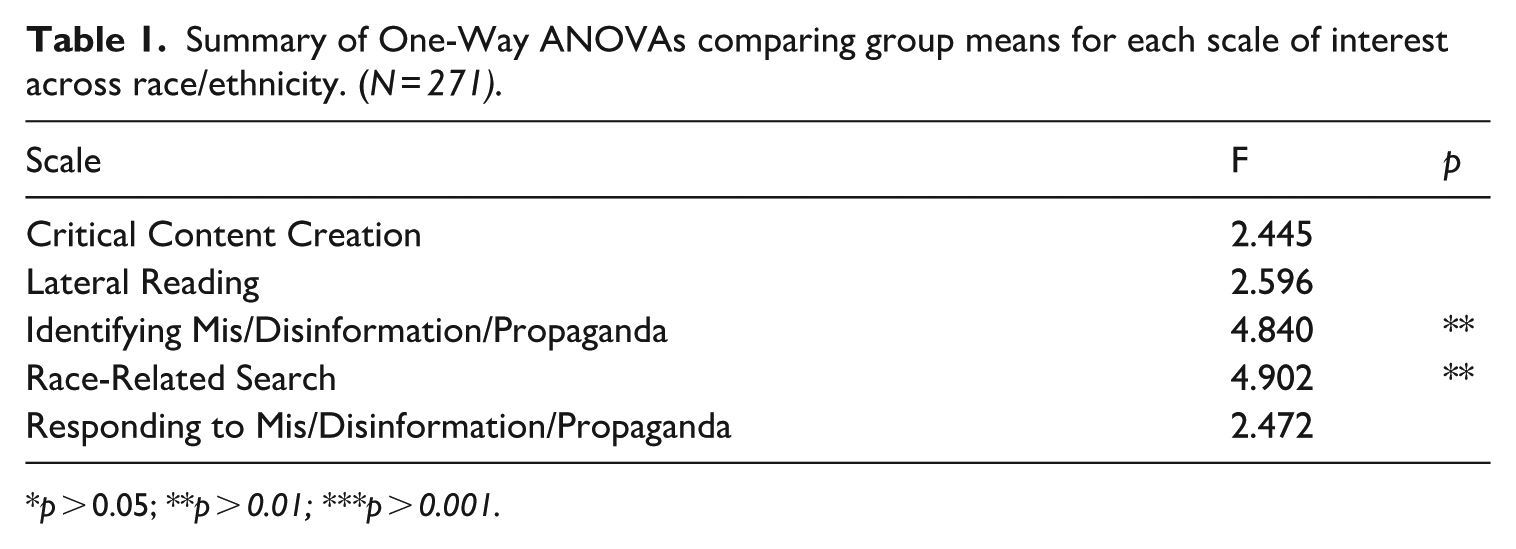
The study investigated mean differences across five measures between distinct race and ethnicity groups. The mis/disinformation and propaganda as well as search for race-related information measures significantly varied between groups (p < 0.01). Conversely, the other measures, including critical content creation, lateral reading, and responding to misinformation, disinformation, and propaganda, did not display any significant variations based on race and ethnicity. The summary of the One-Way ANOVA results can be found in Table 1.
Summary of One-Way ANOVAs comparing group means for each scale of interest across race/ethnicity. (N = 271).
p > 0.05; **p > 0.01; ***p > 0.001.
Post hoc analyses of identified mean differences
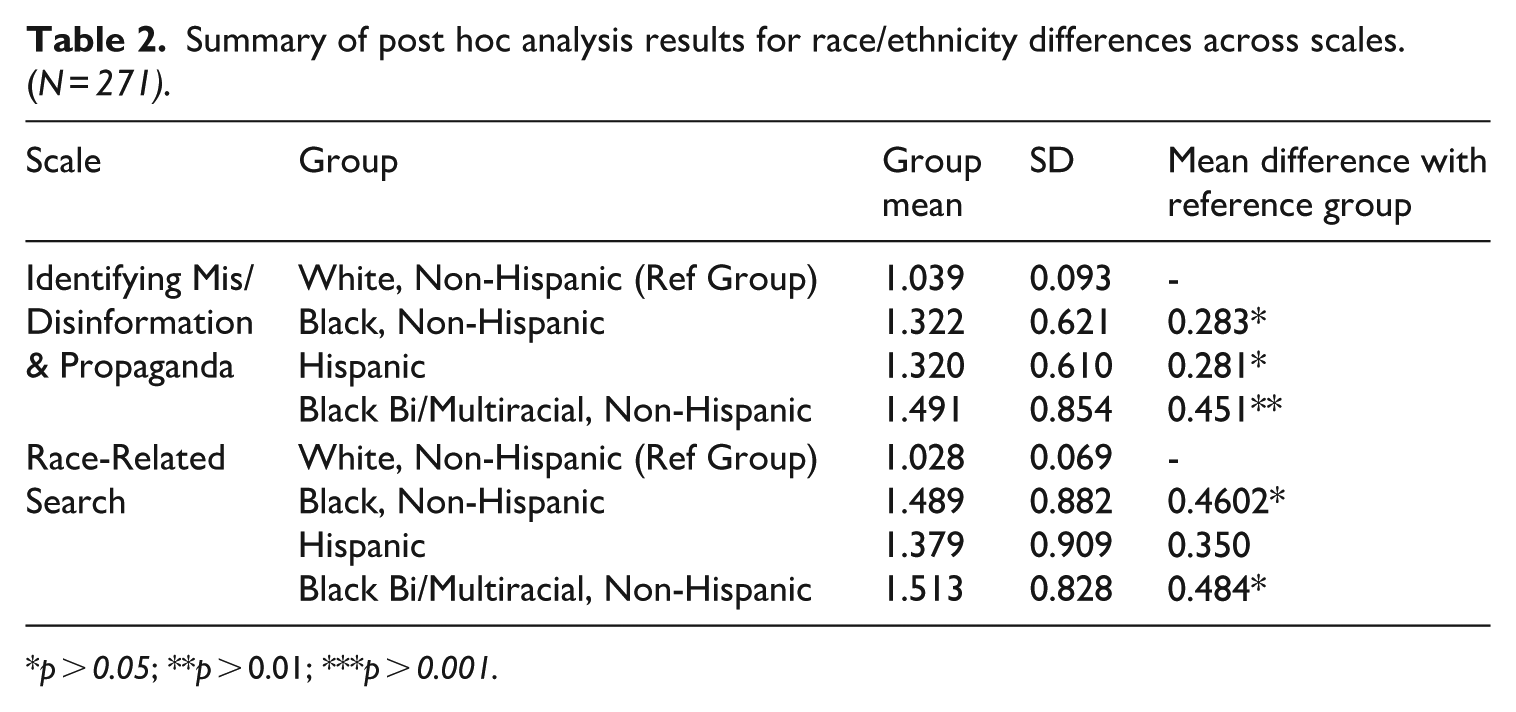
Post hoc analyses confirmed racial and ethnic differences in daily frequency of identifying mis/disinformation & propaganda and searching for race-related information. In identification tasks, White participants averaged 1.04 (SD = 0.09), Black participants 1.32 (SD = 0.62), Latinx participants 1.32 (SD = 0.61), and Black Bi/Multiracial participants led with 1.49 (SD = 0.85). Tukey HSD and Bonferroni tests confirmed significant differences between White and other groups (p < 0.05 to p < 0.001), but not among non-White groups.
In searching for race-related information, White participants averaged 1.03 (SD = 0.07), Black participants 1.49 (SD = 0.88), Latinx participants 1.38 (SD = 0.91), and Black Bi/Multiracial participants led with 1.51 (SD = 0.83). Tukey HSD and Bonferroni tests showed significant differences between White and both Black and Black Bi/Multiracial groups (p < 0.05), but not with Latinx. No significant differences were found among people of color. See Table 2 for summary.
Summary of post hoc analysis results for race/ethnicity differences across scales. (N = 271).
p > 0.05; **p > 0.01; ***p > 0.001.
RQ2: differential performance on scales on weekday vs weekend
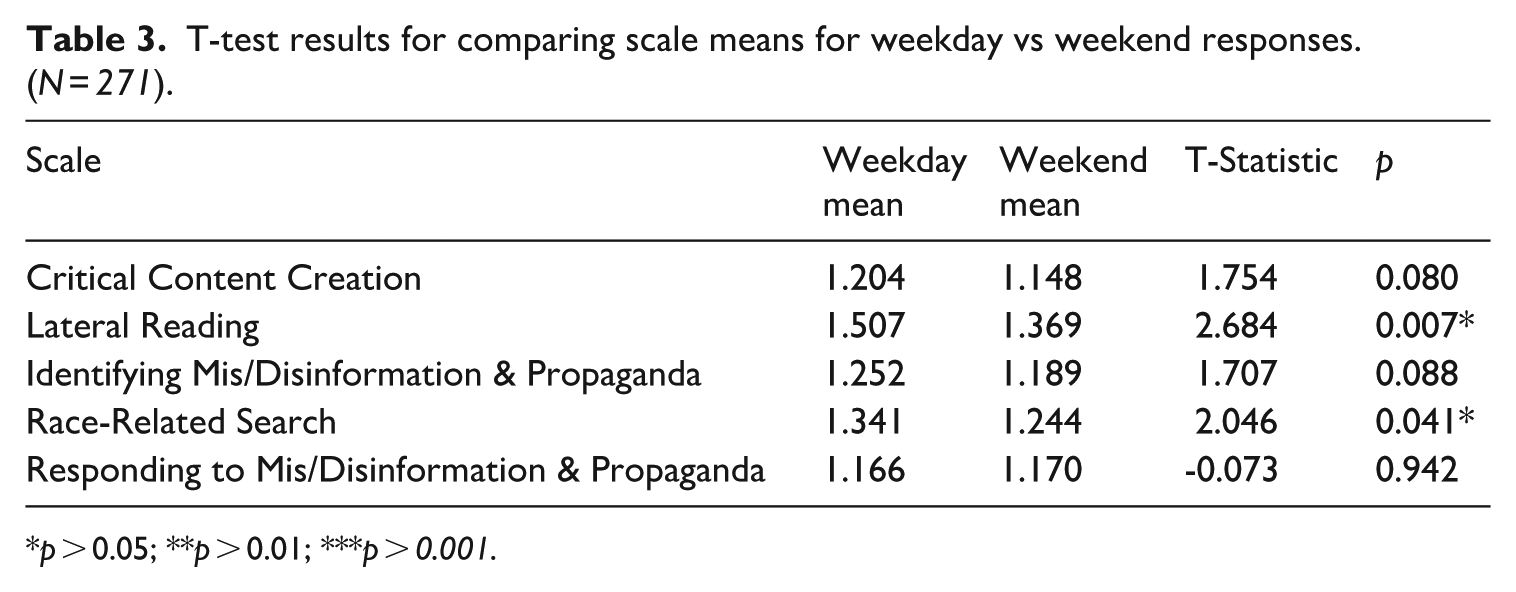
Significant differences between weekday and weekend scores were found only for Lateral Reading and Searching for Race-Related Information, both higher on weekdays. Both lateral reading and searching tasks are commonly required for completing academic tasks, so their higher frequency during the week makes intuitive sense. Although results for Critical Content Creation and Identifying Misinformation were not statistically significant, both scales showed trends of elevated levels during weekdays that warrant future exploration. No interaction effects between day type and ethnicity were found, indicating independent effects. See Table 3 for T-test results.
T-test results for comparing scale means for weekday vs weekend responses. (N = 271).
p > 0.05; **p > 0.01; ***p > 0.001.
RQ3: day-by-day variability analysis of CRDL practices
Multilevel model
Race and ethnicity consistently emerged as significant across various measures, underscoring race-ethnicity as a meaningful predictor for these outcomes. While we found that race-ethnicity was a significant predictor for identifying misinformation, disinformation, and propaganda, our model for responding to misinformation, disinformation, and propaganda had no significant demographic predictors, implying that the demographic variables incorporated did not substantially predict that item.
Critical content creation: Black, non-Latinx participants scored significantly higher than White, non-Latinx participants, with a coefficient of . Similarly, Latinx participants also scored significantly higher than White, non-Latinx participants on the critical content creation scale with a coefficient of
Lateral Reading: Black, non-Latinx participants scored significantly higher than White, non-Latinx participants, with a coefficient of
Misinformation, disinformation, and White supremacist propaganda: Black, non-Latinx participants scored significantly higher than White, non-Latinx participants with a coefficient of . Latinx participants also scored significantly higher than White, non-Latinx participants with a coefficient of
Searching for race-related information: Black, non-Latinx participants scored significantly higher than White, non-Latinx participants with a coefficient of
Responding to misinformation, disinformation, and propaganda: There were no statistically significant differences among race-ethnicity groups compared to White, non-Latinx participants on the Responding to misinformation, disinformation, and propaganda online scale.
Random Effects: The presence of random effects variance underscores the variability in baseline scores for each scale across individuals. Such variability is an interesting outcome in and of itself and also lends credence to our decision to deploy a multilevel model, ensuring that individual-level variability is adequately accounted for. Scales for lateral reading and searching for race-related content exhibited moderate between-individual variability, (
Intra-class correlation
The intra-class correlation (ICC) reveals varying levels of between-person and within-person variability for different scales. For critical content creation, 38.33% of the variance is between individuals and 61.67% is day-to-day within the same person. Similar patterns are observed for lateral reading (37.33% between, 62.67% within), mis/disinformation and propaganda (37.59% between, 62.41% within), and search for race-related information (37.12% between, 62.88% within), all indicating moderate day-to-day consistency. However, responding to misinformation shows a somewhat different pattern, with only 27.21% of the variance between individuals and a substantial 72.79% within-person, suggesting higher day-to-day variability. Overall, while day-to-day fluctuations are significant, consistent individual differences also exist, especially noted in the responding to misinformation scale. This is consistent with what one might expect in daily diary data, where individuals’ responses can fluctuate from one day to the next based on various daily experiences. However, there’s also a non-trivial portion of the variance that is between individuals, indicating that there are consistent individual differences in these measures. Below, we examine the between-racial/ethnic group variations more closely.
Multilevel model with interaction effects
In the refined analyses leveraging multilevel models (MLMs), a consistency in significance emerged. Many of the primary effects that were deemed significant in preceding MLMs maintained their significance in the interaction effects models. A notable example is the race-ethnicity variable, which consistently showed significance in the majority of the models, other than responding to mis/disinformation and propaganda. Second, the introduction of interaction terms enriched our understanding. These terms enabled an exploration of how the relationship between specific outcomes and days might diverge across various race-ethnicity strata.
When considering day-to-day variability between groups with critical content creation as the outcome, the Latinx group demonstrated a significant decrease in critical content creation scores with increasing day variability,
Regarding lateral reading scores and when considering day-to-day variability, Black, Non-Latinx participants demonstrated a significant decrease in lateral reading scores with each one-unit increase in Day
For day-to-day variability of the identifying misinformation, disinformation, and propaganda scale, Black, Non-Latinx participants exhibited a significant decrease in scores with each one-unit increase in Day
In terms of day-to-day variability for the race-related search item, Black, Non-Latinx participants exhibited a significant decrease in scores with each one-unit increase in Day,
A similar trend was observed for Latinx participants, with a decrease of 0.046 units for every unit increase in Day
Furthermore, the Day variable played a pivotal role in some models, illustrating an overarching effect of the day of the study on the outcome of interest. Nevertheless, the inclusion of interaction terms occasionally modified the significance or scale of the effect that “Day” held. This underscores the significance of demographic determinants in elucidating the variability observed from day-to-day.
The data shows a trend of declining scores in CRDL practices for Black and Latinx participants relative to their White peers as the study progressed. This could be due to factors like fatigue, engagement, or other external influences not captured in the study. The consistent trend across multiple scales for these groups hints at systematic factors affecting their daily CRDL practices, such as school attendance on weekdays. Alternatively, this could indicate a relative increase in CRDL activities for White participants, although their overall scores remain lower.
Discussion
Our study aims to contribute to a holistic understanding of critical race digital literacy (CRDL) and its implications for adolescent development. These insights could prove instrumental in informing curriculum design, instructional scheduling, and interventions targeted toward addressing the challenges that Black and Latinx students face in navigating the digital world.
The findings from this study paint a robust picture of racial-ethnic differences in the critical digital literacy practice opportunities of youth over a week-long period. The finding that Black and Latinx young people identified misinformation, disinformation, and propaganda more frequently than their White counterparts contextualizes previous research which found that young Black people performed higher than their White counterparts on tasks asking them to analyze real-life examples of race-related digital materials, including race-related misinformation, disinformation, and propaganda (Coopilton et al., 2023). This higher performance might be due to higher frequency of practicing the skills involved in these analyses, and further longitudinal research with the ability to study possible causal relationships (i.e. cross-lag analyses of both waves of NSCDL data) are needed to examine this possible relationship further. Moreover, further research should look into whether Black and Latinx young peoples’ higher frequencies of practicing these skills might relate to their sociocultural experiences such as racial socialization and/or encountering racism online more frequently than White students. For Black students in particular, their parents might be more likely to discuss issues of race and racism (Hughes et al., 2006), while White students discuss race less frequently in family contexts (Abaied and Perry, 2021), and critiques of racism might be common for Black students as they engage with other Black people both online and offline (Brock, 2020; Tynes et al., 2011, 2016).
The day-to-day variability in digital literacy practice opportunities, influenced by racial-ethnic group membership, hits at the dynamic nature of these opportunities to face CRDL challenges and take critical actions in digital spaces. The influence of current events, personal experiences, or classroom discussions might lead to these fluctuations. For educators and curriculum designers, this underscores the importance of recognizing these day-to-day shifts and tailoring digital literacy interventions accordingly. For example, there is evidence that police violence against Black persons affects the mental health of Black youth in the immediate aftermath of that violence and, as such, may affect daily variations in CRDL (Carney-Knisely et al., 2024).
Our findings also suggest there are within-individual variations in CRDL practice, emphasizing that beyond demographic factors, situational factors may play a critical role in shaping these practices. For example, a student’s exposure to a classroom discussion about race could elevate their engagement in race-related digital information searches on that particular day. Similarly, current events, such as news stories on racial issues or social media trends focusing on racial or ethnic identities, might also serve as catalysts for increased CRDL engagement. The role of peer interaction – online or offline – cannot be discounted either. For instance, a discussion with friends about a specific racial issue might prompt an individual to later seek or share related digital content. Therefore, while our study underscores demographic variations, it also hints at a layer of complexity introduced by situational factors. These factors, often transient yet impactful, offer another dimension that should be investigated in the future to understand the full scope of how CRDL is practiced among adolescents.
An important facet of our findings lies in the discrepancy between the ability to identify misinformation, disinformation, and propaganda and the act of responding to it. While Black and Latinx adolescents identified this content more frequently, their response rates were not proportionally higher, leveling to those of their White counterparts who are not identifying these issues as frequently. This pattern suggests complex motivational dynamics at play. For youth of color, responding to such content might be associated with increased risks and costs, such as social backlash or threats to personal safety, which could make the act of responding less appealing despite the recognition of the racist content. Moreover, discussions circulating in online communities may be influencing these patterns. For instance, there is a growing narrative that suggests it should not solely be the responsibility of Black, Indigenous, and People of Color (BIPOC) to challenge White supremacy (for example: DiAngelo, 2021, 2022). White adolescents who possess the skills to identify these issues might be encouraged, either explicitly or implicitly, to take on the responsibility of responding, thereby elevating their response rates. Therefore, the data suggest a complex interplay between identification and response, mediated not just by skill level but also possibly by the perceived risks and responsibilities associated with taking action. This underscores the need for a more nuanced understanding of how sociocultural factors might impact CRDL practices, beyond mere identification.
Further research is needed to identify the challenges that learners may encounter while engaging in these activities. For example, questions remain about whether students are exposed to biased curriculum materials in their digital literacy learning activities, either in the classroom or online. These areas represent crucial avenues for future investigation to enhance our understanding of critical race digital literacy development.
These findings are particularly important in the context of mainstream digital literacy scholarship that posits the existence of digital literacy deficits in the Black and Brown community. We counter that argument with an assertion that colorblind racism can render whiteness as the norm in digital spaces (Chaudhry, 2016). Without situating digital literacy scholarship in a critical framework, researchers may miss important information about the specialized skills that Black and Brown youth bring to digital spaces. This theoretical lens of whiteness as an invisible norm (Bonilla-Silva, 2003) provides an important backdrop for understanding racialized differences in digital literacy practices.
Because whiteness is the default in society, youth from marginalized racial groups often have distinctly different and inequitable online experiences than their White peers. Black and Latinx adolescents regularly confront race-related content, from cultural representations to overt discrimination, that necessitates a critical eye. One study showed that adolescents encounter six online race-related experiences per day including 3.2 daily encounters with online racism, outweighing positive online racial experiences (Tynes et al., 2025). Prior research on racial socialization supports this pattern: Black and Latinx parents commonly prepare their children for bias, teaching them to recognize and respond to racism in everyday life and potentially online spaces (Frey et al., 2022). These experiences can translate into stronger CRDL skills. Our findings align with this idea: the Black and Latinx youth in the study demonstrated more adeptness at evaluating online misinformation through a racial lens, which reflects their lived necessity to discern trustworthy information about their identities and communities. In contrast, White youth – who seldom face racialization in their daily lives – may not perceive race as a relevant factor in digital content. As Hagerman (2018) documented, many White parents and youth believe race is no longer a pertinent issue, which leads them to treat online information at face value without considering racial context. Their racial group membership remains unmarked and unchallenged, leading many White youth to approach online content with a color-evasive mind-set. This gap underscores how whiteness as an unseen norm can leave White youth less equipped to detect the racial or other dimensions of online misinformation.
In summary, the overarching narrative of these findings suggests that while all youths navigate the digital landscape, the frequency with which they enact and practice key CRDL skills is deeply intertwined with their social identities, especially their racial and ethnic backgrounds. These experiences are not static, but vary from day to day, influenced by a myriad of factors, both personal and societal. As we continue to navigate an increasingly digital world, understanding these nuanced experiences is paramount for educators, policymakers, and technologists alike.
Limitations
Here, we acknowledge several limitations of this study. First, because our data rely on daily self-reported frequency of CRDL practices, our measures rest on participants’ ability to recognize opportunities for the tasks being measured. This dependence on subjective interpretation may result in varying interpretations of what constitutes relevant practices, like “Race-Related Information Searches” or “Responding to Misinformation.” Similarly, there may be diverging definitions among participants about what constitutes “white supremacist propaganda.” In addition, our measures do not capture implicit knowledge or awareness. Participants might be engaging in the behaviors of interest without recognizing them as such. As a result, true frequencies of the behaviors in question may be underestimated in the data. Although daily diary designs can mitigate recall biases by prompting participants in real-time or at short intervals, our 7-day collection still presents a relatively brief window. The short interval may not capture important fluctuations in CRDL practices tied to major current events, school schedules, or seasonal variations. Future work could extend data collection over multiple weeks or months to observe how CRDL practices evolve or respond to shifts in trends and news cycles. Multilevel models used here incorporate only a limited set of predictors (primarily demographic variables) to assess within-person variation. This was a deliberate choice to focus on racial-ethnic group differences, but it also means that other potential within-person predictors (e.g. daily stress, classroom activities, and exposure to racially charged current events) remain unexplored. Including such factors in future diary-based research could yield a more nuanced picture of how situational or temporal circumstances interact with demographic variables to shape CRDL engagement. Finally, our self-report method does not allow us to observe the type or content of participants’ online experiences. Combining diary methods with direct digital trace data or qualitative interviews could help validate these self reported measures and further triangulate the findings here. Taken together, these limitations suggest directions for future inquiry that would deepen our understanding of how and why adolescents practice critical race digital literacy skills in their everyday online lives.
Conclusion
Given the fact that race-related digital content such as disinformation campaigns (DiResta et al., 2018; Tynes et al., 2021), deepfake discrimination, and cyberbullying (Alexander, 2025; Tynes et al., 2025) can be uniquely harmful to adolescents and their families, equipping young people with the necessary skills to critically navigate and interact with digital media is one of the most pressing issues of our time. By shedding light on their daily practices using a CRDL framework, this study fills significant gaps in digital literacy and critical race media literacy research, which can inform future policy-making and practice in the fields of education, health, media and technology.
Footnotes
Funding
The authors disclosed receipt of the following financial support for the research, authorship, and/or publication of this article: This study was funded with a Lyle Spencer Research Award to Transform Education (#202000140, Brendesha Tynes, Principal Investigator) from the Spencer Foundation. This article and findings do not necessarily represent the views of the foundation. The study was approved by the University of Southern California Institutional Review Board (UP-19-00825).
