




Abstract
This article considers the use of public social media in transnational expatriate activism. It is an investigation of connections among users of Facebook event pages associated with 122 cities worldwide where demonstrations took place in 2017, in support of the anti-corruption Romanian #rezist protests. An exploration of interconnections between socio-demographics, space and network characteristics, it probes the association of geographic location and the gender of page users to connectivity in comment and share networks to reveal a connectivity differential. Connections increased when users were active on the same pages whereas users’ common location related to comparatively lower levels of commenting but not sharing activity. At the same time, while a larger proportion of them were male, users displayed a systematic tendency to interact with the other gender. Renewed attention should thus be paid to socio-spatial variations in the use of social media that both localize and help bridge transnational activism.
Introduction
This article examines connections among activists using Facebook event pages associated with protests worldwide in support of the 2017 anti-corruption Romanian #rezist demonstrations. Relying on a combination of methods for social network analysis, it investigates empirically and at network scale the use of event pages as an organizational vector for transnational collective action occurring in geographically discrete locations (see Bennett et al., 2014; Earl, 2014; Kavada, 2015). The study is guided by the question, to what extent did the #rezist event pages help to connect transnational expatriate activism to homeland protests?
The 2017 #rezist protests were prompted by the politics of the homeland. Following a period when the Romanian expat population was characterized as organizationally inchoate, having a limited capacity for interest representation (Trandafoiu, 2006: 136) in formal relations with homeland and host countries and remaining largely ‘uninvolved in Romanian politics’ (Burean, 2011), a notable turning-point came in 2013. That year, a wave of solidarity protests erupted in more than 30 cities worldwide in support of a long-running environmental protest against the largest proposed open-cast gold mine in Europe, in North-Western Romania. Weekly rolling demonstrations ran for 3 months simultaneously in the country and abroad bringing to light a transnational network of Romanian expatriates who seized on social media – particularly public Facebook event pages – to organize demonstrations locally and coordinate cross-nationally (Mercea, 2018).
Sparked by government-proposed amendments to the country’s anti-corruption legislation, the #rezist protests were likewise a succession of weekly demonstrations and marches. Commencing in late January 2017, they called for the rescindment of emergency ordinance no. 13 (or OUG 13). An extraordinary form of legislation reserved for parliamentary recesses, the ordinance introduced a collective pardon and a redefinition of graft and abuse of power involving or committed by public officials (Pfiszter, 2017: 130). Rallies were staged in cities large and small across Romania and overseas culminating with the mobilization of more than 500,000 people across the country on 5 February 2017, the day that OUG 13 was withdrawn by the government (Adi and Lilleker, 2017). More protests followed that year – albeit on a smaller scale (Skurtu, 2017) – as the ruling Social Democratic Party mounted new attempts to rewrite the country’s anti-corruption laws.
The #rezist uprising garnered the attention of broadcasting media, internationally (Adi and Lilleker, 2017: 6). In turn, participants seized on social media – chief among which was Facebook, at that point the most widely used social platform in the country (Facebrandsro, 2017) and globally (eMarketer, 2018) – as a means for political expressiveness and collective organization (Man, 2017). The social network analysis that follows probes the structure of the #rezist network to understand what links formed among users of event pages associated with 122 unique locations inside Romania and abroad and how both individual and group relations imprinted on the connections created with public Facebook pages. To that end, it analyses the extent to which the geographic location and the gender of page users bore a systematic relation to connectivity. Networks among protest event pages are explored for insights into layers of transnational relations effected with socio-technical affordances for connectivity – namely, the Facebook functions to comment and share posted messages (Fox and Moreland, 2015).
Connectivity among users in the comment and share networks was associated with being active on the same page and an inclination to interact with the other gender. Users’ common location related to comparatively lower levels of commenting but not sharing activity. Moreover, the plurality of protests connected to each other did not map neatly onto a division between locations inside Romania and abroad. These insights shed a fresh light on the relation of exogenous attributes to protest networks and contribute empirically to the theorization of a socio-spatial patterning of transnational activism on social media. The next section introduces the conceptual building blocks of the investigation. It reviews the use of social media in transnational activism, considers their widely debated organizational utility as well as the inequalities that mark their usage. Accounting for these aspects, one research question and four hypotheses regarding the transnational #rezist network are delineated.
Background
The transnational space of collective action
The space of transnational activism is at once physical and social. The embodiment of physical space, squares and streets in cities across the world are doubly connected by the causes protestors espouse and the digital links between them (Sassen, 2002: 219). They are the locus of social encounters where members of the public congregate, display the bonds and interests that bring them together and act on them collectively (Parkinson, 2012: 74). While it may continue to be enacted in physical space, such collective action is visible on social platforms where activists are able to disseminate ‘calls for action and reports from protest events to wider publics’ (Uldam, 2017: 44).
The same platforms also open the possibility for contiguity of transnational interpersonal connections in space and time (Marino, 2015). As members of expatriate groups organize to take collective action, they form transnational relations wherein grievances with host countries, homelands or both are articulated (Koinova and KarabegoviĆ, 2017). The formation of transnational expat networks has been likened to that of social movements (Adamson, 2012; Sökefeld, 2006). Social movements amalgamate various ‘actors, be they individuals, informal groups and/or organizations, [who] come to elaborate through either joint action and/or communication, a shared definition of themselves as being part of the same side in a conflict’ (Diani, 1992: 2) . That formative process, Diani (1992: 13) argues, unfolds in social networks.
Assorted groupings of transnational actors may coalesce into a movement as they strategically develop links with each other, building solidarity and capacity around shared – for example, national – identities (Adamson, 2012: 32). The span, strength or quality of the bonds activists form have recently been surveyed in network analyses of platform socio-technical affordances – that is, the range of possibilities provided by technological platforms for users to act and pursue their aims – namely for connectivity, identity-building or collective action (Bennett et al., 2014; González-Bailón and Wang, 2016; Khazraee and Novak, 2018: 2; Smith and Graham, 2019). To this research strand, the article adds an exploration of socio-spatial relations in transnational activism.
The communicative organization of collective action
A substantive body of work has coalesced around the use of information and communication technologies (ICTs) – among which one counts social media – in collective action (see Neumayer and Rossi, 2016). In a review of the field, (Earl, 2014) traced the lineage of this strand of social movement research back to the 1970s and an intellectual preoccupation with how certain prerequisites to collective action – resources of time, money, know-how, creativity – could help explain why it would come to pass or not. Organizations were the primary vehicle for the mobilization of those resources. Scholarship scrutinizing the use of ICTs in collective action cast organizations in another light, namely as conduits of germane communication assembling social relations, ideas or resources (Bimber et al., 2012). This proposition rests on the notion that ICTs form the backbone to a social infrastructure of latent network ties ‘that exist technically but have not yet been activated’ (Haythornthwaite, 2002: 385) – made purposefully more visible with social platforms (Uldam, 2017).
Related studies of collective action have spotlighted socio-technical affordances of ICTs that diminish the cost of communication while increasing the organizational capacity for decentralized coordination (Earl, 2014). The transnational Occupy Movement epitomized a mode of organization where public meetings in physical encampments were coterminous with conversations on social media (Kavada, 2015). On social media, horizontal, rapid and scalable organization feeding into the workings of the encampments was attained through the personal communication of ideas and identities, the pooling of resources and peer production (Bennett et al., 2014).
Yet, evidence also emerged of a power law distribution marking the circulation of personal accounts relating to collective action on social media. A limited number of them garnered a disproportionate amount of attention among social media peers (Mustafaraj et al., 2011). In addition, the capacity of activist groups to harness social platforms for organizational purposes was described as unequal; rooted, for example, in pre-existing material inequalities (Schradie, 2018: 69). Theorized as a digital activism gap, this disparity hampered the ability of resource-poor users to maximize the socio-technological affordances of social media for organization and participation in collective action.
Equally, scholars inquired into the opportunity for digital activism by female protestors. Restricted geospatially by the boundaries of the state – a historically male-dominated structure – digital socio-spatial settings characterized by ‘horizontal forms of communication and action’ were depicted as expanding arenas for women to contest entrenched gendered power relations, transnationally (Khazraee and Novak, 2018; Youngs, 2015: 5). Socio-technological extensions of physical spaces, ICTs were used to organize transnational activism opposing the patriarchy and hegemony of the dominant economic and political consensus (viz. the World Social Forum, The European Social Forum, Smith et al., 2017), allowing for continuity of interaction in activist networks operating at ‘multiple scales’, that is, local, national and transnational (Smith et al., 2017: 15). On Facebook, specifically, affordances for collective discourse and the performance of a common identity through posts, comments and shares on public pages, were employed by Iranian female activists to create an international stage for mobilization against gender-based inequality (Khazraee and Novak, 2018).
Likewise, ICTs were leveraged by members of national diasporas engaged in transnational protests to elicit greater accountability from the government in their homelands (Bernal, 2013); to publicize a sense of global civic (Mercea, 2018) or ethnic (Ong, 2003) citizenship invoked in solidarity with fellow nationals and their local plights. This study extends such research through a combined geo and socio-spatial analysis of transnational activism supporting national protests on social media (see Mercea, 2018).
The latter investigation submitted that Facebook event pages were a means for distinct local groups to achieve ‘coordination in the absence of other organizational infrastructures . . . such as the physical assemblies of the Occupy Movement’ (Mercea, 2018: 559). Links across protest sites assisted in the simultaneous organization of discrete overseas demonstrations through knowledge transfers while at the same time folding them into a collective – civic – identity (2018: 558). However, that analysis untangled semantic links between expatriate locations mentioned in posts and comments. By contrast, this article considers geo-social patterns of relations among protests in the homeland and abroad formed through the use of public event pages.
Research questions and hypotheses
A purpose-built feature of the platform, an event page enables Facebook users to promote an action through posts on the page wall, invitations to follow it and secondary dissemination in user ego-networks (Khan and Jarvenpaa, 2010: 110). Event pages have been embraced as an expedient for the publicization of protests, one of multiple ‘digital materials’ – alongside hashtags, images or memes – encountered in collective action over the last decade (Clark, 2016: 243). Used by activists to advertise offline protests, they have been more closely linked to protest sites than generic Facebook pages (Hensby, 2017: 471). In what follows, through a three-pronged approach, attention is afforded to digital connections among cities in the #rezist event page network. Subsequently, the social network is examined for network brokerage patterns. Third, the relation of location and gender to connectivity in the transnational page network is assayed.
Earlier indications from research into the US Occupy Movement portrayed communication on Twitter as geographically concentrated, flowing out from the most prominent movement locations on the ground – for example, New York, cities in California, Washington, DC. Those sites were the source of over half of the retweeted Occupy posts (Conover et al., 2013). These authors inferred that the geo-structural characteristics of the Occupy network were tied to an organizational capacity exogenous to Twitter, to mobilize ‘human resources at the local level’ (Conover et al., 2013: 2). The geospatial structure of the #rezist network was thus inspected with a focus on the sharing network. On Facebook, shares have a comparable functionality to that of retweeting, namely as an affordance for content circulation (Alhabash and McAlister, 2014). A supposition contemplated was that the share network would be marked by geographical concentration, with content diffusing outwards from a small number of locations in the transnational #rezist network
Comments, on the other hand, add new content to the public store of ideas created by a social movement. They not only diffuse ideas but also occasion ‘cognitive elaboration’ (Alhabash et al., 2019) allowing participants to contribute to a common discourse while engaging with each other (Smith and Graham, 2019: 1317). The Facebook comment network of the transnational anti-vaccination (or anti-vaxx) movement studied by Smith and Graham (2019: 1314) was approximately one order of magnitude smaller than the share network of the same movement. The finding seemed to corroborate experimental research highlighting that users are more likely to share than to comment on Facebook posts (Alhabash and McAlister, 2014: 1331) as well as the contention that content on social platforms is dominated by the imperative to maximize its circulation, the downside of which is limited discursive engagement with it (Kaun, 2015: 16). Overall, the Facebook page network of the anti-vaxx movement was described as sparse because it exhibited a low density of connections, that is, a small number of the possible connections between users were actually realized.
In light of these insights, a second hypothesis was that the transnational #rezist event page network would similarly be characterized by a low density of connections, wherein the comment network would be smaller in size than the share network (H2). That result would testify to a more limited and concentrated production of movement content as opposed to its circulation, with more users sharing rather than commenting the same posts. Prima facie, this supposition was in line with the above-cited specialized activist use of event pages as a means to publicize specific protests (Hensby, 2017). The analysis of core-periphery structures in the comment network additionally provided an opportunity to discuss the geospatial structure of content circulation as well as production.
Second, Facebook event pages were shown to prop up an organizational infrastructure for resource transfers during the 2013 transnational anti-mining protests (Mercea, 2018: 559). Structural brokers act as lynchpins of such networks (González-Bailón and Wang, 2016). Structural brokers bridge densely connected groups that would otherwise be separated by a structural hole (Burt, 2004). Brokers help to disseminate ‘resources and information’ outside of such groups (Sajuria et al., 2014: 714). Organizationally, brokers are best placed to ascertain when a transfer of ideas or practices encountered in one group can benefit another and to carry it out (Burt, 2004: 355). They can help maintain a sense of community, that is of common experience and mutual respect (Downton and Wehr, 1998: 542). Structurally, they can therefore play an instrumental role in the formation of bridging social capital by connecting discrete groups (Sajuria et al., 2014: 210). Nevertheless, in the conspicuous case of the Occupy Movement, analysis of the use of the #OWS Twitter hashtag revealed low levels of brokerage, which were assumed to be an upshot of the geographical – and especially the transnational – span of the network (Sajuria et al., 2014: 729). These authors attributed that outcome to the focus of #OWS communication on local events in individual cities (see also Conover et al., 2013) and to the large range of claims the movement encompassed under its umbrella.
While the #rezist event pages may have been a vehicle for local communication, the singular focus of the protests, on fighting corruption in Romania, would have acted as an incentive for disparate local actors to act cohesively (Mercea, 2018). If Facebook event pages were used to that end, structural brokers would have been instrumental to engendering such coherence despite any focus on local events. This researcher therefore asked whether user brokerage capacity was associated with core-periphery status in the geospatial comment and share networks (RQ1)? The expectation was that no clear-cut association would be found between location and brokerage as the singular focus of the #rezist protests would have provided an opportunity for users from a plurality of locations to connect with others outside of their own locale (H3).
Third, an inferential network analysis was conducted to account for exogenous factors associated with connectivity. Exogenous factors are individual attributes preceding network formation that are independent of it (Sun, 2020: 3). Actors who share the same attributes may form homophilic relations. Homophily represents the quality of social networks of being homogeneous in respect to a set of individual attributes (McPherson et al., 2001). Gender was designated by these scholars as a prominent basis for homophilic relations. Likewise was geography, both for relations offline and on social media (Bastos et al., 2018; Takhteyev et al., 2012).
As already outlined, the geography of the US Occupy Movement seemed to bear on network connectivity. The question of whether geography imprinted systematically on transnational connectivity in the #rezist network appeared pertinent against the backdrop outlined earlier of rising numbers of Romanian emigrants and the widespread use of Facebook, globally. Gender, on the other hand, was shown to mark participation in the aforementioned anti-vaccination movement. In that case, a sizable female skewness (3:1) was observed in the activity on the movement’s Facebook pages (Smith and Graham, 2019: 1319). Nonetheless, that research did not investigate the presence of any systematic relation of gender with connections between posters and those who commented or shared their posts. Yet, research on a regional social media platform pointed to a salient gender pattern in activity, with men posting more times than women and women commenting more than men (Lesser et al., 2017: 1616).
In Romania, a study of student participation – the largest protest demographic in the country at the turn of this decade – found that female students were more likely to engage in protest activities than their male counterparts (Burean and Badescu, 2014: 394). Gender did not, however, correlate with their acts of online activism – an index which incorporated posting on political and social topics – on Facebook. The interest in this article is to determine whether gender imprinted on the connectivity helping to produce and circulate content in the transnational #rezist network. These two exogenous factors – the geographic location of the #rezist protests and the gender of those posting about them – were thus posited to have a systematic relation to connectivity in the Facebook event page network (H4). A separate variable indexing the event pages was used as a control measure for the association between geographic location and network connectivity (cf. Hensby, 2017). The null hypothesis was that the relations of these factors to connectivity were not systematic and therefore that other unobserved dependencies (see Cranmer et al., 2017) influenced connectivity in the #rezist networks.
Data and methods
The research data cover the period from late January 2017 to the end of November that same year. 1 A public record of the #rezist protest event pages was maintained throughout 2017 on the website www.underprotestez.ro. Created by activists involved in the protests, the website catalogued previous events and advertised forthcoming actions. A total of 387 Facebook event pages were monitored, of which 317 were for protests taking place in Romania and 70 for actions outside of it. Data collection – with the NodeXL Pro template – started on 16 January 2017, 2 days ahead of the first planned protests that year (Adi and Lilleker, 2017) and continued through the rest of the year. Rather than to retrieve hashtagged posts (for shortcomings of that approach, see Hanna, 2013), data gathering was distinctly aimed at acquiring all available traces of activity on the #rezist event pages. Subsequently, from the event page dataset, two types of networks were extracted for analysis: the comment and the share networks. In those networks, an edge represented a connection between two users who either commented on or shared the same post. Trends in monthly activity are reported in Figure 1.
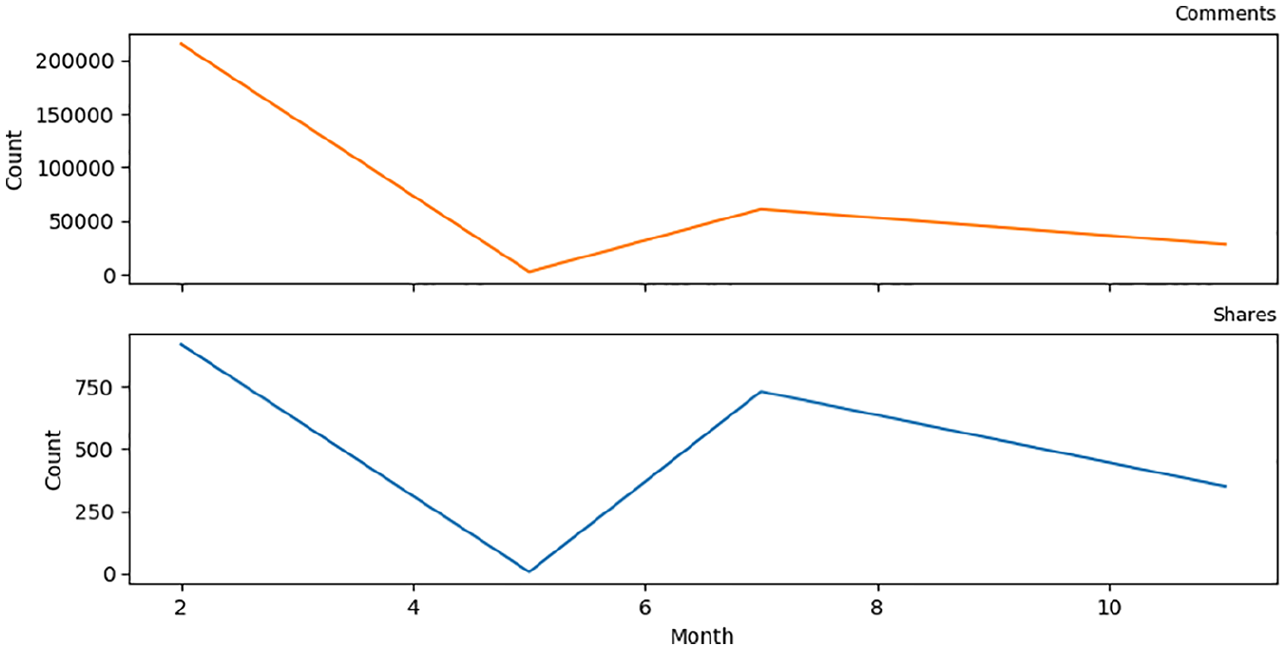
Comments and shares on the #rezist event pages (January–November 2017).
Descriptive statistics for network connectedness – density as well as average degree, reciprocity and transitivity – were calculated for the directed comment and share networks. Average degree is the average number of ties of each node; reciprocity is the count of reciprocated ties divided by the total number of ties in a network and transitivity is a property of a network whereby a relationship between nodes A and C can be expected if one already exists between node pairs A and B, and B and C (Borgatti et al., 2018: 176-179).
To test H1, the researcher relied on the Python NetworkX implementation of the Kojaku–Masuda configuration algorithm for finding the number and size of core-periphery pairs in a network (KM-config, number of runs = 10, see Kojaku and Masuda, 2017). The algorithm pinpoints non-overlapping core-periphery pairs by calculating the density of edges within and between them, comparing them with the total density of the network (Kojaku and Masuda, 2017: 0523132-0523137). The KM-config algorithm identifies both meso, subnetwork structures, and relations among their members, including roles they may take, for example, as drivers or followers of transnational activist communication on Facebook event pages. It employs a configuration null model that randomly rewires edges while preserving the degree of each node and assuming that there is more than a single core-periphery pair in the network (Kojaku and Masuda, 2017: 05231313).
The algorithm detects pairs of densely connected nodes – that is, core groups – and those nodes that link into them – that is, peripheries – that are sparsely connected between them. Accordingly, it helped shed light on the cities that saw a concentration of core nodes driving the transnational production (i.e. with comments) and dissemination of #rezist content with shares; and conversely, of cities that were marginal to these processes. This approach was intended as a complement to cognate research on the Occupy Movement that assigned either status to members of its Twitter network through a frequency-based and qualitative reading of their discursive proximity to known activist accounts (Bennett et al., 2018: 672-673). The NetworkX implementation of the KM-config algorithm (Hagberg et al., 2008) can be used with weighted and unweighted, but not directed networks. Therefore, and because the substantive interest underpinning its use was to identify subnetwork structures and relations within them – rather than relations between network members alone – undirected comment and share networks were generated prior to running the algorithm.
To evaluate RQ1 and H2–H3, Burt’s (2004) structural constraint measure was used to discover network brokers who span structural holes. Structural constraint measures local density and the redundancy of personal network connections (González-Bailón and Wang, 2016: 99). The lower the structural constraint of a user, the higher is her or his brokerage capacity. Illustratively, a Facebook user i in either of the #rezist networks would have a high constraint if her or his connections were confined to a group of interconnected nodes that would thereby limit i’s capacity to span multiple groups (Sajuria et al., 2014: 726). The test was conducted with the Python NetworkX implementation of the structural constraint algorithm. To measure the relationship between individual brokerage, core-periphery status and location (H3), the researcher used Friedman’s test with bootstrapped samples (similarly, see González-Bailón and Wang, 2016). The test is a non-parametric alternative to the repeated measures analysis of variance (ANOVA).
No individual-level geo-locational data were available through the Facebook Application Programming Interface (API) for users in the comment or share networks. The geographical variables in the analysis record the stated location of a #rezist event as advertised on the Facebook page dedicated to it. This approach to geo-location was in line with the aim to apprehend overt relations between homeland and expatriate protest localities. On the other hand, gender was considered not as an identity category but as a heuristic for the investigation of parity in movement participation on Facebook (cf. Ford and Wajcman, 2017: 516).
Consequently, a female–male binary classification of Facebook users was undertaken. The Python client for the Genderize classifier (Ehrhardt, 2018) was used for the binary categorization of user names. All unique first names of users in the comment and share networks were extracted and inputted into the Genderize classifier. Following the automatic classification, results were manually inspected for accuracy and annotated wherever necessary. Alongside geographic location, gender was subsequently used as a variable in a quadratic assignment procedure (QAP) multiple regression.
Multiple regression quadratic assignment procedure (MRQAP) is predicated on permutation tests that preserve the dyadic structure of network, autocorrelated data (i.e. data that is characterized by within row and within column correlations, Dekker et al., 2007: 564, 572). MRQAP was used to test the hypothesis that public Facebook connectivity was underpinned by systematic exogenous relations between event page users (H4). MRQAP performs random permutations that rearrange the rows and corresponding columns of the test variables organized in square matrices. Randomization ensures that variable values in the outputted matrix are assigned independently of those in the inputted matrix while the structural properties of the two remain the same (e.g. the same mean or standard deviation, Dekker et al., 2007: 566).
The linear model for square matrix data (Dekker et al., 2007: 567) is:
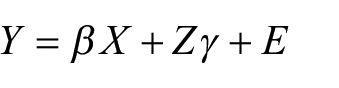
in which Y, X and E are n × n matrices; β is the regression coefficient, Z is an n × n × q array, γ is q × 1. The model always ignores the diagonals of the matrices. The null hypothesis is H0: β = 0 and γ = 0. The procedure performs significance tests that yield a ‘p-value’ indicating whether there is a statistical relationship between the randomized and the observed values of the tested variables (Borgatti et al., 2018: 146–147). The t statistic is used to reject the null hypothesis. The analysis was conducted with the Python MRQAP package (Espin, 2017). 2
Square matrices for the dependent (DV, connection) and independent variables (IV, geographic location, gender and event page) were generated in Python with the Pandas package (McKinney, 2010). The cells (i, j) in square matrices for location and page were the count of unique cities and pages, respectively, where nodes i and j commented or shared a post. Nodes i and j could have commented on or shared a post from one or more pages or locations. Geographic location represented common locality, while the event page variable counted links between users posting on the same page. There were 563 instances of the same pairs of users (.0004%) in the comment network and 16 (.005%) in the share network that were active in two or more unique locations (up to four in the share network and five in the comment network). Finally, for the gender IV, a node-by-node matrix was constructed wherein the cell (i, j) took a value of 1 if nodes i and j shared the same gender, and 0 if they did not. MRQAP allows for the regression of the categorical gender variable (Borgatti et al., 2018: 149), with resulting coefficients interpreted as a rise or reduction in the number of same gender ties corresponding to the size of that coefficient.
Results
Addressing first the geo-structural characteristics of the networks, Figures 2 and 3 are bar plots of statistically significant core-periphery pairs (p < .05, Kojaku and Masuda, 2018) binned according to their location. In the share network, there were 20 statistically significant core-periphery pairs. The key localities in the network – comprising the largest number of core nodes (ranging from 22 to 2 nodes) – were in descending order Bucharest, Timişoara, Braşov, Galaţi, Iaşi, Bonn, Cluj, Constanţa and Vienna. Six other localities, three of which were overseas (Birmingham, Glasgow and Paris), each included a core node. Bucharest was the most prominent location in the share network, present in 10 of the 20 pairs. Paris and Birmingham were expat locations with core nodes in the same core-periphery pair as another homeland location, that is, Bucharest.
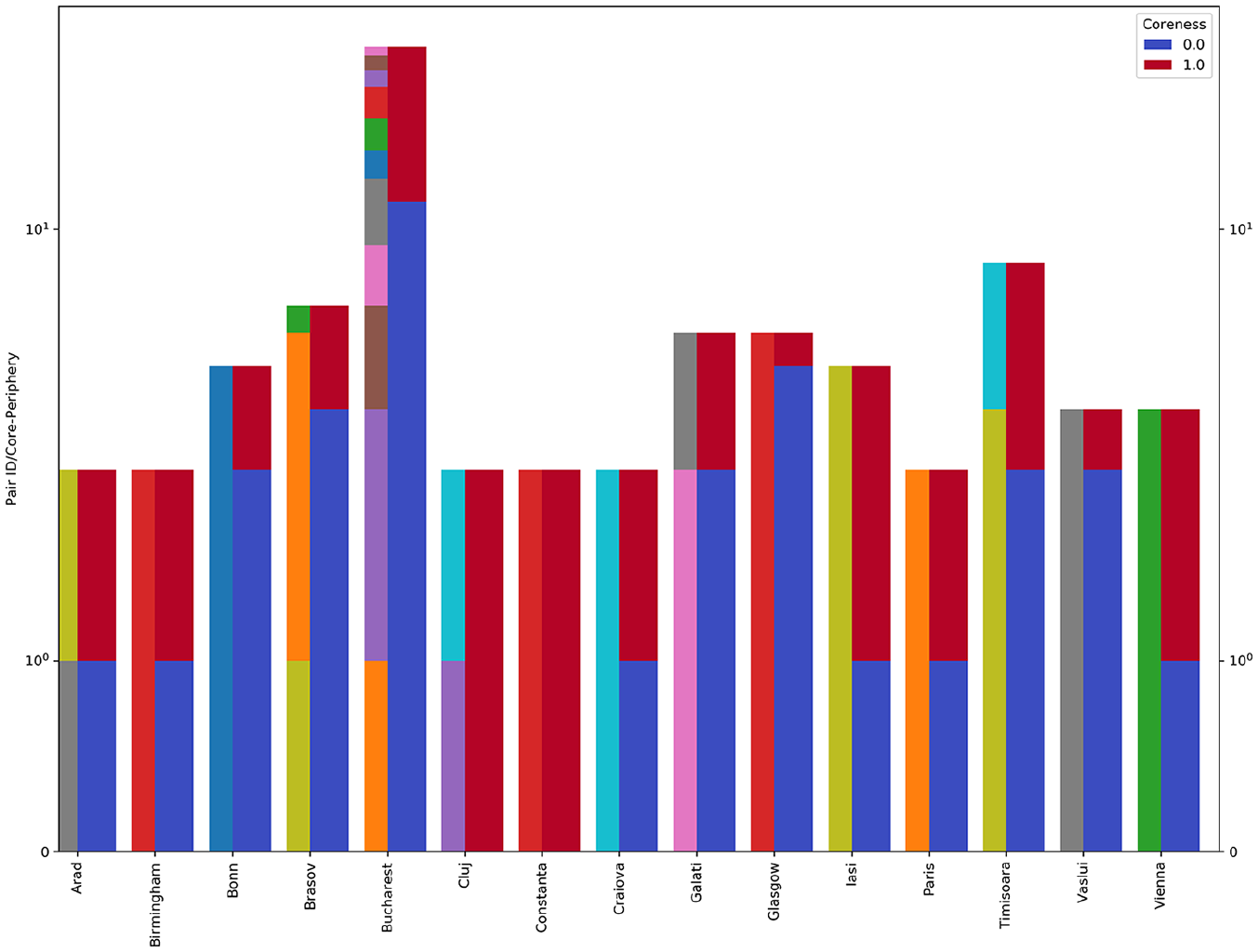
Stacked bar plot with location of core-periphery share pairs. Left column represents core-periphery pair; right column represents core-periphery status (0 = peripheral node, 1 = core node). Scale is logarithmic.
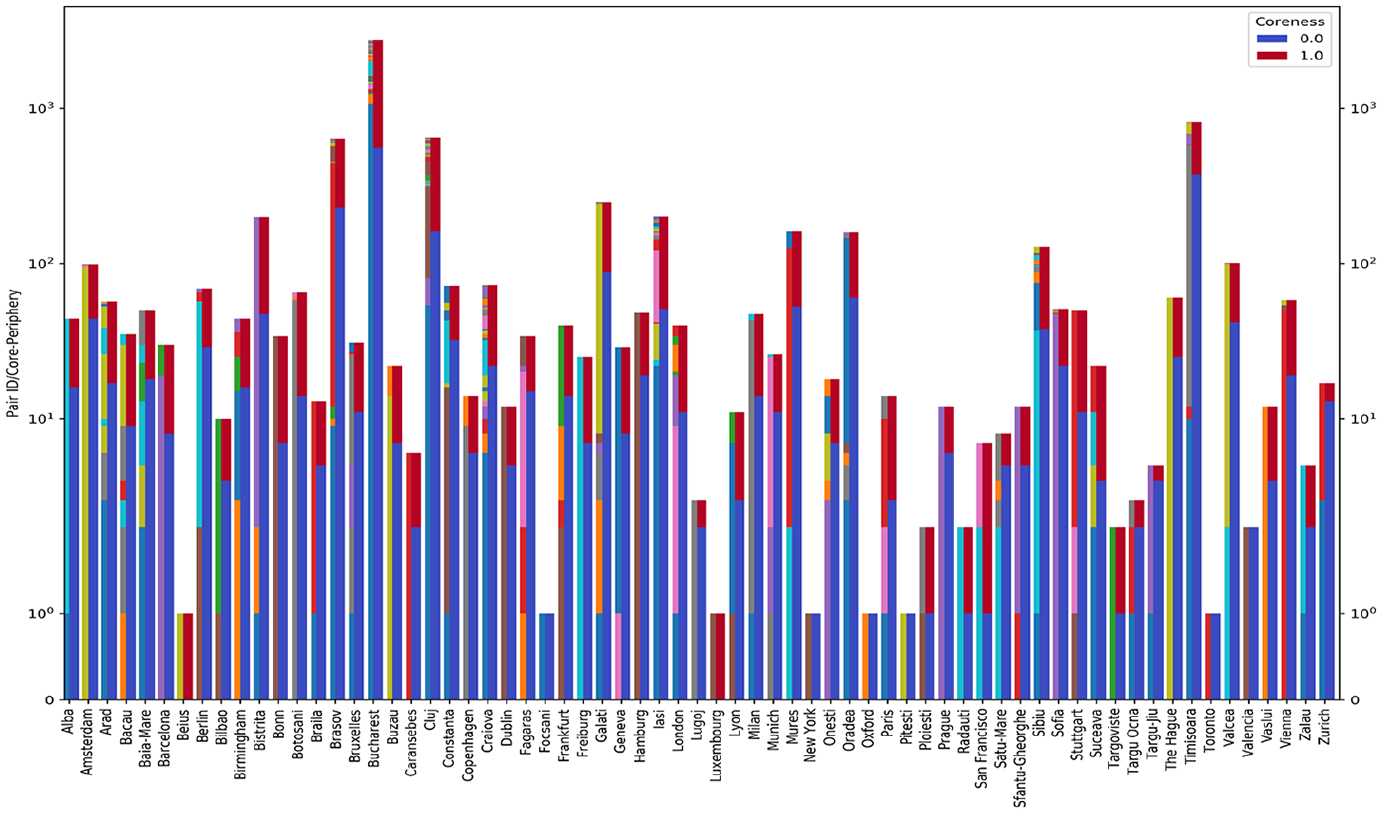
Stacked bar plot with location of core-periphery comment pairs (left column) and status (right column). Scale is logarithmic.
In the comment network, there were 206 statistically significant core-periphery pairs. A majority of the core nodes were found in Romanian cities – 35 of 61 cities. Bucharest (N = 2206) had the highest concentration of core nodes; Cluj, Timişoara and Braşov had between 4 and 5 times fewer core nodes. All other localities in the comment network had 14 times fewer core nodes than Bucharest or less. Amsterdam, Berlin, Stuttgart, Vienna, The Hague, Milan, Hamburg, London, Sofia and Birmingham were, in descending order, the top ten locations for core nodes found abroad. The number of core nodes in Amsterdam – the overseas city with the largest concentration of such nodes – was 40 times lower than in Bucharest. It ranked 17th among all localities by number of core nodes. Finally, there were 25 core-periphery pairs that included core nodes from both inside of Romania and abroad.
Together, these results offered a confirmation of H1. They pointed to a concentration of core nodes in both the share and comment networks inside six cities in Romania (Bucharest, Cluj, Timişoara, Galaţi, Iaşi and Braşov, see Figures 2 and 3). However, core nodes in both the comment and the share networks were spread across multiple localities and core-periphery pairs, which included 26 cities overseas in the case of the former and 5 in that of the latter. Similarly, among the locations in the comment network indexed by number of peripheral nodes (N = 66), 43% (N = 29) were cities overseas. In the share network, peripheral nodes were associated with 13 different localities, five of which were abroad.
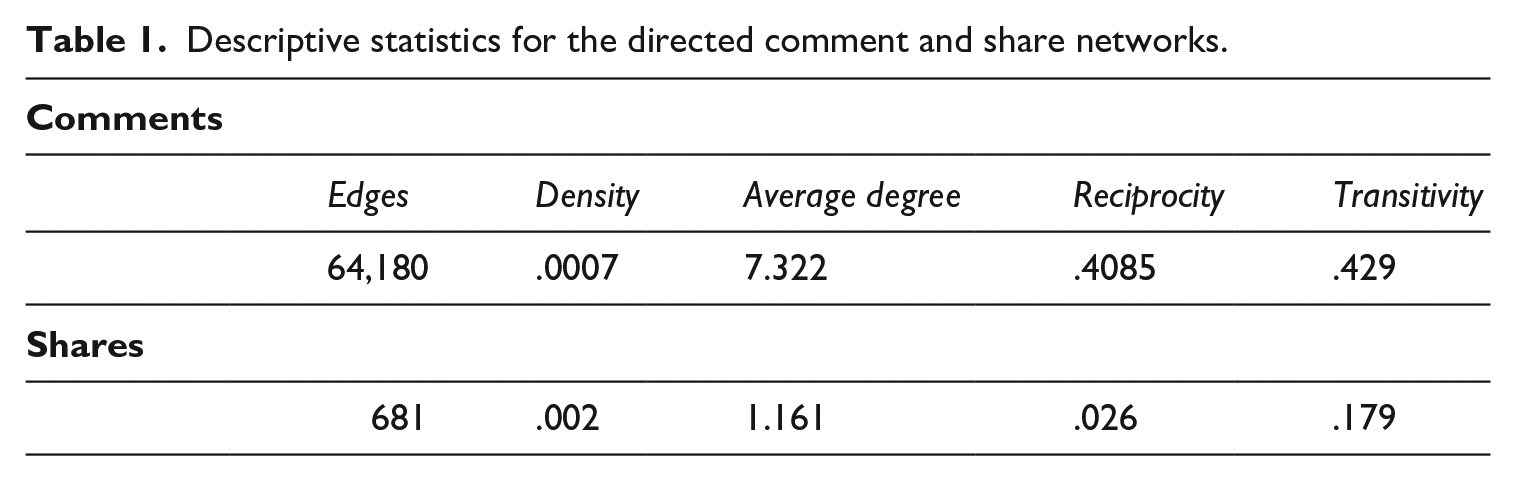
Second, considering network descriptives, graph density was very low in both the comment and the share networks (Table 1). Average degree was higher in the comment than the share network suggesting that the low density of the much larger comment network concealed a higher degree of connectivity. In the comment network, nearly half of the connections were reciprocal and transitive. That is, they were bidirectional and, on average, there was a good chance of two users commenting on the same post if they had a common connection with another user in that network. These results lent themselves to a characterization of the #rezist networks as sparse, connected first through the production of content and only secondarily through its purposeful circulation. Thus, an expected relative prevalence of shares as a low-involvement activity was infirmed (H2), the production of content being more widespread and a greater source of connectivity than its sharing. This observation is discussed in the final section.
Descriptive statistics for the directed comment and share networks.
Exploring RQ1, structural constraint was higher in the share (M = 1.1, SD = .74) than in the comment network (M = .53, SD = .48). There was a positive albeit weak Spearman’s rank correlation between brokerage and core status in the comment network (r = .002, p < .03, bootstrapped CI = .001–.038), but not in the share network (r = −.029, p> .05, bootstrapped CI = −.052–.11). The result suggested that core nodes exhibited a high constraint and therefore low brokerage capacity in the comment more so than in the share network. Subsequently, the Friedman test indicated that there was a statistically significant difference in the distribution of user brokerage capacity, core-periphery status and location. This held true for the comment (χ2 = 2632.398, p < .000; with Nemenyi post hoc tests for all pairwise combinations showing significant differences between the variables, p < .001) and the sharing networks (χ2 = 1105.589, p < .000 and differences between variables confirmed by the Nemenyi post hoc test, p < .001). Altogether, these results provided a nuanced albeit negative answer to RQ1 while seeming to confirm H3 to the extent that they pointed to a brokerage capacity that did not map neatly onto the core-periphery or the locational structure of the two networks (see Figures 4 and 5).
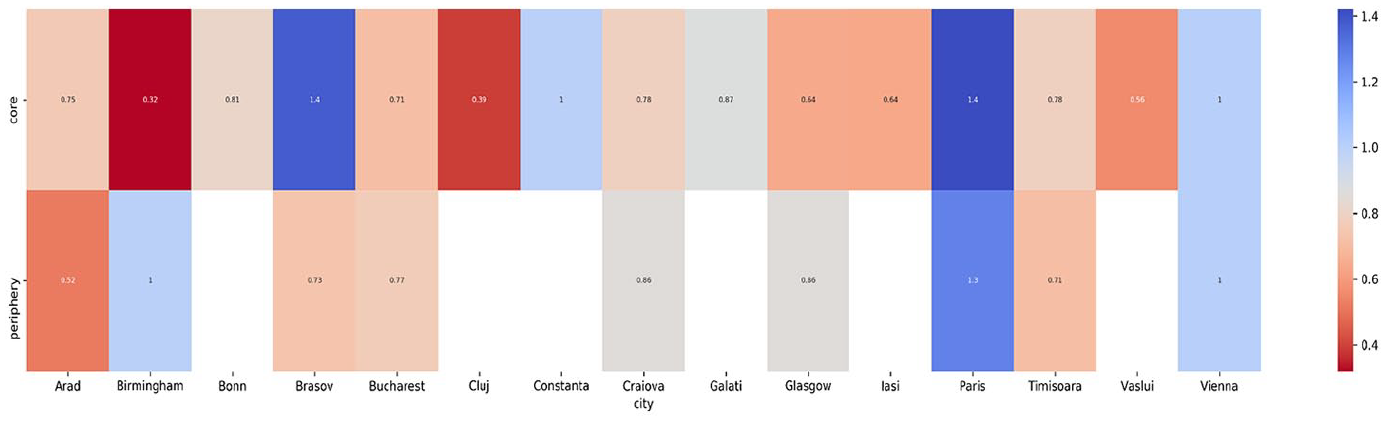
Reverse heatmap of structural constraint in core and periphery among cities in the share network.
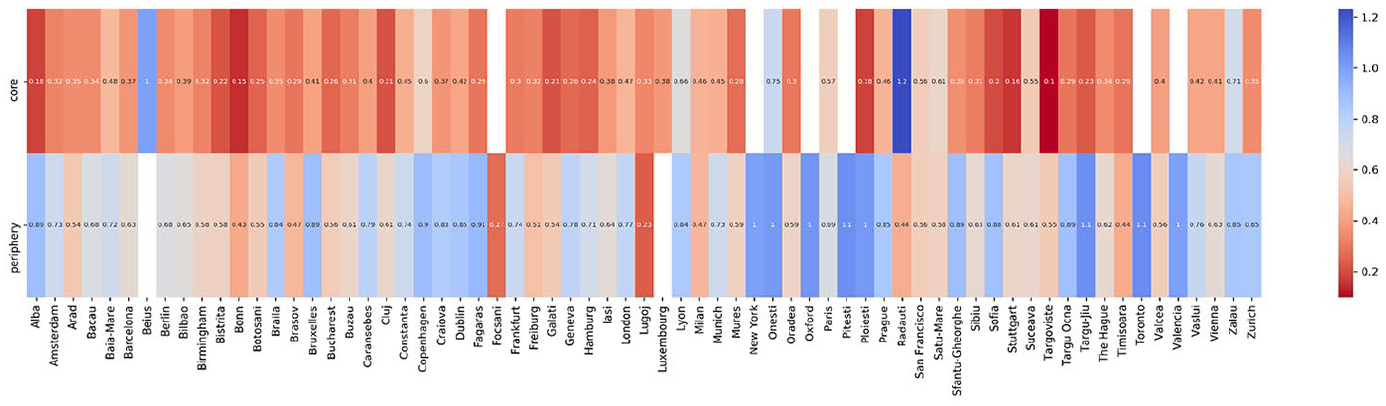
Reverse heatmap of structural constraint in core and periphery among cities in the comment network.
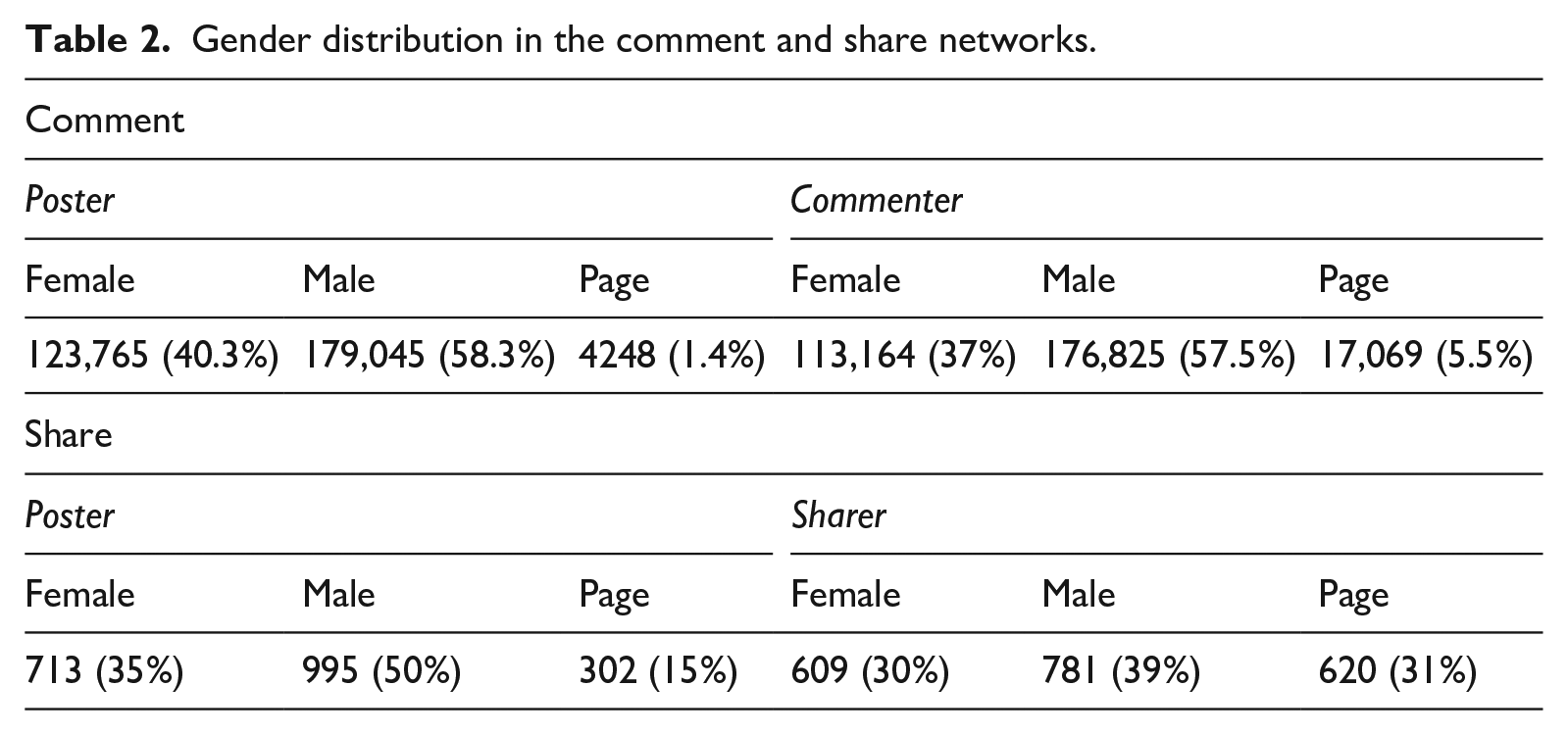
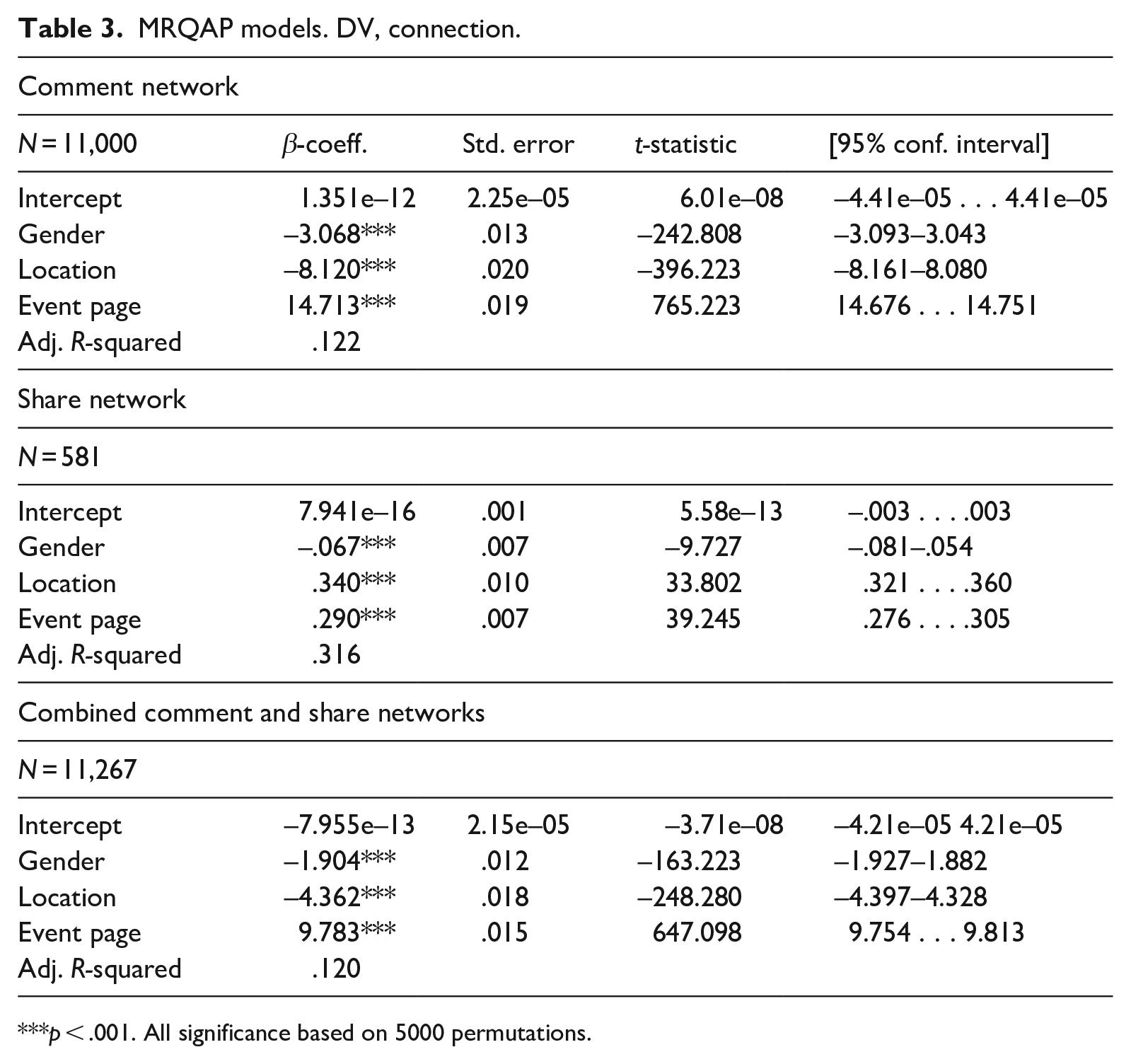
Turning to H4, there were more male than female users in both the comment and the share networks (Table 2). Male users posted more messages while also commenting and sharing more than their female counterparts. Outside of the gender binary, Facebook pages were a third category of users in the comment and share networks. They were classified as such and were included in the analysis. In the comment network (MRQAP, Table 3), more than by chance alone, common gender and location bore a negative relation to the number of times users formed a comment-based connection. Conversely, the number of times users commented on the same post increased if they did it on the same event page. Put differently, there was a rise in connectivity when users commented on the same pages; and a comparative drop in it when they shared the same gender and a common location.
Gender distribution in the comment and share networks.
MRQAP models. DV, connection.
***p < .001. All significance based on 5000 permutations.
In the share network, connectivity correlated with gender, location and event page. Gender had a negative although weak relation to it, whereas location and page were positively associated with connectivity. Thus, gender sameness was linked to a decrease in the number of shares while common location and posting on the same page related to an increase in the number of times users shared the same post. The negative regression coefficients suggested an inclination to associate with the other gender (see also Borgatti and Cross, 2003: 438), while the positive coefficients signified a tendency to connect with users from the same location and, more so, who were active on the same page. Altogether, while gender, location and page each had a statistically significant relation to connectivity, they explained more of the variance in it in the share (r = .316) than in the comment (r = .122) network.
Discussion and conclusion
Transnational activism in support of national protests is a distinct form of contemporary collective action. This article scrutinized geo-social patterns of relations in the transnational Facebook event page network associated with the #rezist protests. Foregoing research into the degree to which social media enable organization among activist networks on Twitter highlighted their fragmentation and even an absence of connections typical of social networks. Structural holes were one prominent network characteristic that limited connectivity among activists on that platform (González-Bailón and Wang, 2016: 102). On Facebook, the public comment and share #rezist networks were sparse, exhibiting geographic skewness.
On the geospatial dimension, the #rezist network was marked by a concentration of activity – to wit commenting and sharing – that radiated out of a subset of key locations from within Romania and abroad. While this was largely to be expected given the national focus of the protests (Koinova and KarabegoviĆ, 2017; Mercea, 2018), the considerable number of locations with core nodes together with the differing distributions among users in both networks – of core status and low structural constraint – signalled that users associated with a plurality of sites inside of Romania and overseas bridged the production and circulation of content. Notwithstanding, common location was linked to a rise in the number of shares, which also increased if users were active on the same event pages. As connectivity rose among users active on the same pages in the comment network, it suffered a relative decrease with gender sameness and common location.
Notably, a minority of users acted as rooted cosmopolitans – local activists with a transnational outlook (Tarrow, 2005: 42) – jointly active on multiple protest event pages. Their activity is ripe for further investigation, in the vein of Bennett et al. (2018), to ascertain the extent to which it mapped onto existing – for example, organizational – activist networks, as Tarrow (2005) would posit; or if it was an extension of such networks achieved by a range of actors including public personalities, journalists, alternative media organizations contributing to framing the protests. Their presence in the #rezist networks impressed the need for individual-level geo-locational information – unavailable through the Facebook Graph API – to chart their transnational paths and the imprint of these on network connectivity.
On the social dimension, alongside brokerage, gender patterns in the #rezist networks were similarly noteworthy for not readily aligning with earlier findings (Lesser et al., 2017; Smith and Graham, 2019). Men were prevalent in both the comment and the share networks. In the anti-vaxx movement, Smith and Graham (2019) attributed gender skewness to a likely sensitivity to the topic among child-carers, amid which women remained the predominant group. The #rezist protests were marked by an inverse imbalance in the proportion of active male and female users. Yet, despite the prevalence of males, there appeared to be an inclination among users to associate with the other gender in both the comment and the share networks. The present investigation thus evinced that connectivity in either of those networks was not skewed by gender. In this way, the protests signalled a break with a deep-seated patriarchal culture among Romanians (Miroiu, 2010). In addition, a considerable proportion of users in the share network were Facebook pages. They, nonetheless, likewise connected more often with a different variety of user than with other pages. This evidence, derived from an analysis of event pages, should further be tested for other page variants or, indeed, social media.
The larger number of comments as opposed to shares again placed it in contrast with the anti-vaxx movement. It indicated that comments were a versatile Facebook function for the production of movement content as well as for connectivity across protest sites. This research showed that event pages may not only publicize (Hensby, 2017) but equally connect local protests, also when used in transnational expatriate activism (cf. Mercea, 2018). At the same time, a connectivity differential may be at play among event page users that is linked to platform functions. Commenting appeared to bridge discrete transnational locations more so than sharing as common location among commenters correlated negatively to connectivity when measured against being active on the same page. Additional data, further robustness tests and experimental designs can query transnational connectivity relative to platform functions as well as types of content, their tenor or style.
Moreover, a location-based digital activism gap that maps onto other inequalities, potentially restricting one’s ability for civic, political or social engagement (Parker et al., 2007), bears renewed investigation. In the case of the #rezist protests, differential connectivity was not dictated by chance alone, appearing broadly in line with the geography of the mobilization, which centred around Bucharest and several other key cities in the country and overseas (Adi and Lilleker, 2017).
Finally, there are important limitations to this study. The absence of user-level geo-locational and ego-network data delineate the scope and external validity of this otherwise systematic assessment of connectivity. Furthermore, a binary gender classification does not completely capture the entire gamut of user categories on Facebook. Even though the manual annotation of the gender classification allowed this researcher to reduce the number of unclassified names (cf. Freelon et al., 2016), Facebook pages were an important tertiary user category, especially in the smaller share network.
Notwithstanding, the relation of activist connectivity on social platforms not only with location and gender but also class, ethnicity or race should continue to be investigated. Scholars have cautioned that the use of social platforms for activism is maximized by women who prize digital activism and have resources available to commit to it (Scharff et al., 2016). This article revealed interconnections between socio-demographics, space and structural network characteristics whose causal analysis may be probed with survey instruments. Their relationship with mediated forms of civic engagement needs to continue to be appraised.
Footnotes
Acknowledgements
The author owes a great debt of gratitude to Dan and Flavia Craioveanu for the many conversations that helped him to design this article, query its methodology and think through its argument.
Author’s note
The author confirms that the manuscript is original and not under simultaneous consideration for publication elsewhere, either in part or full.
The author confirms that I have read the journal’s aims and scope and consider that the submission falls within those boundaries.
The author confirms that I have read and followed the author guidelines of the journal when preparing this submission.
Funding
The author(s) received no financial support for the research, authorship and/or publication of this article.
