




Abstract
This article argues that digital publics unleash and bolster everyday racism, creating an unregulated space where anonymity and ubiquity enable the dissemination of racist message. By creating broader visibility and wider reach of racist texts and facilitating more participation for racists, social media platforms such as Twitter normalize gendered and place-based racialization of refugees. Recently, hostility and hate became the norm in derogating the refugee identity on social media platforms. To investigate the complexity of digital racism, this article presents a unique case study on Twitter, capturing the widespread user reactions in the aftermath of the mass resettlement of Syrians in Turkey. It examines varying racialization of Syrians on the Turkish Twittersphere, using sentiment and qualitative content analyses of hashtags and mentions on Syrians, when they hit Twitter trends for Turkey for a year, first, for mundane events and, second, during the Turkish state’s occupation in Northern Syria.
Keywords
Introduction
Racist discourses informing anti-immigrant political action is nothing new. However, social media resonate and bolster extant racism and anti-immigrant movements today. The digital space serves as a ventriloquist for the obscene that cannot be said in person. This article points to the ways in which the Internet unleashes everyday racism, generating unregulated platforms, where anonymity and ubiquity facilitate a wider dissemination of the anti-immigrant and racist message. This article presents a unique case study on Twitter to show the evolution modes of racialized expression online. We define digital racism by illustrating how the figure of ‘the Syrian refugee’ in Turkey is depicted through Twitter publics at the cusp of both the mundane and dramatic events. Our social media analysis comprises 106K tweets collected through hashtags and mentions for a year between 2018 and 2019 during mundane events related to Syrians in Turkey as well as during the Turkish state’s occupation of Northern Syria in October 2019. In addition to the sentiment analysis (SA) to code the chunk of big data and skim through the broader racist framework, our research involved a qualitative content analysis to pinpoint the emerging patterns of widely shared online texts. A year-long Twitter data collection and analysis display the anti-immigrant and racist digital publics through the politically situated place-based and gendered expression of Twitter users and capture the evolving anti-immigrant public speech in different periods.
More broadly, this article responds to the current rise, visibility and mainstreaming of racism on social networking sites by exemplifying the recent racialization of the refugee figure and identity, which is conveyed to wider audiences via online expression. Racialization ‘draws attention to the process of making “race” relevant to a particular situation or context’ (Garner, 2010: 21) and involves in (re)producing discourses – ‘reality/truth’ about subordinated groups to naturalize common-sense assumptions about them (Lentin, 2008: 491). The textual mechanisms of transmitting the racist message to its potential audiences via online platforms, specifically the racialized anti-immigration message, rests on a gendered, neo-colonial and territorial mind-set, which creates an audience or public for the transmitted media (Garnham, 1987: 32). We argue that the spread of such textual rhetoric represents a return from ‘new cultural racism’ to a ‘new colonial racism’, amid the global ascendance of authoritarianism and neo-colonialism. Our paper, first, shows that on an everyday basis, social media users have reproduced a neo-colonial image of the refugee figure as leisurely and lavish, sitting at cafes or swimming in seaside. Second, during the Turkish state’s invasion of the Northern Syria, the refugee figure is depicted as a coward, ‘dangerous other’, ‘invader’, and ‘marauding migrant’, which serves a territorial mind-set boosted by military strife (see Ibrahim and Howarth, 2018; Sharma and Nijjar, 2018). The refugee figure, thereby, is identified as a Janus-faced threat that demarcates both the internal and external borders of the statehood as well as the identity and lifestyle of an imagined nation. As such, this article reflects on ‘the refugee crisis’ that saw the mainstreaming of racism globally. The mediatization and politicization of the ‘refugee crisis’ and anti-refugee rhetoric in Europe (see Goodman et al., 2017; Kreis, 2017; Krzyżanowski et al., 2018; Rettberg and Gajjala, 2016; Triandafyllidou, 2018) and their portrayal on global media with a political hostility accompanied by negative discourses (see Balabanova and Trandafoiu, 2020; Schuster, 2011) received much attention in the existing research. By harnessing widespread user reactions on Twitter, this article studies Turkey as a new migrant destination and breaks down the common themes of the online racist messages towards Syrians, when they have settled down in Turkey in the late 2010s.
Following the open-door policy of the AKP government (2002–present) for the Syrians in 2011, approximately four million Syrians have reached Turkey. Inter-communal tensions, mob lynching and sporadic attacks against Syrians have been commonplace in both rural and urban Turkey. Digital attacks have emerged and climaxed in 2018 and 2019 when Syrians settled down, opened businesses and/or acquired Turkish citizenship. Different from its nationalist and conservative peers in Europe, the AKP government, a neoliberal and Islamist right-wing party, initially adopted a narrative depicting ‘Syria is our internal affair and the Syrians are our Muslim brothers’ (Korkut, 2016) and refrained from spreading public hate and fear related to the mass resettlement of Syrians in Turkey. The AKP usurped its open-door policy towards Syrians to boost its standing and prestige within the ‘Muslim world’, while using its ‘protection’ policy as a trump card against the West. In time, the AKP has increasingly securitized the Syrians’ presence, ‘giving up on its “humanitarian” responsibility’ (Koca, 2016: 56). This transformation served the public philosophy of ‘national security threatened by the “enemy within” and the “enemy at the gate”’ (Sharma and Nijjar, 2018: 73). More recently, a securitization approach is legitimized both by policy and practice, leading to regular mob attacks in physical geographies and hate speech on online platforms. The government recently chose to respond to the public outcry by deporting some Syrians in 2019.
Long before social media’s invention, Turkish society had latent racism that expressed itself against the religious and ethnic other (Korkut, 2014), such as the Kurds or Armenians. Existing literature studied offline perceptions on Syrians in Turkey. Yaylacı and Karakuş (2015) undertook content analysis of the mainstream Turkish newspaper coverage on Syrian refugees, arguing that the newspapers’ general attitudes towards the Turkish government strongly affected their news about Syrian refugees. Furthermore, Yıldız and Uzgören (2016) conducted interviews with Syrians in Izmir on their experiences living in Turkey and with the Turkish communities on their perceptions on Syrians, concluding that most Syrians in their sample faced not much discrimination on the basis of their nationality, but experienced socioeconomic challenges about housing, employment and education. In the existing literature, online political reaction to Syrians has not been examined, except for a comparative study of Turkish and English tweets on ‘the refugee crisis’ from a SA and data-mining perspective (Öztürk and Ayvaz, 2018), without an engagement with the problematic nature of the public discourse of ‘the Syrian problem’ in Turkey and beyond. Our research identifies a gap in the existing literature on the perceptions on and media framings of Syrians in Turkey, pointing out the visibility and appeal of the large-scale racism against Syrians on an everyday basis and the ways social media facilitates it. As such, the first part of our article defines digital racism as a platform discrimination and social exclusion that unveils ‘racism with races’. The ensuing part lays out the methodology of the article combining sentiment and qualitative content analyses of big data collected on Twitter, which informs the subsequent analysis sections.
Digital racism
In its theoretical perspective, this article is built on the existing literature that shows how racism is deeply embedded in the formation of Western modernity and technological innovation (Murthy and Sharma, 2019: 195), which pervades – both offline and online – social relations globally. Such racism is anchored in material structures and is embedded in the historical configurations of power (Shohat and Stam, 2014 [1994]: 19). In the existing scholarship on racism, ‘cultural racism’ is identified as the defining principle that shapes racist discourse today, rather than the traditional perspective of ‘biological superiority’ (Ang, 2018: 1177). Barker (1981) defines this as ‘new racism’ (pp. 23–24), which proposes that it is in ‘our’ biology and ‘our’ instincts to defend ‘our’ own way of life, traditions and customs against outsiders not because outsiders are biologically inferior but because ‘they’ are part of different cultures. Balibar (1991) points out that this new/cultural racism is centred upon the immigration complex and proposes ‘the insurmountability of cultural differences built on the incompatibility of lifestyles and traditions’ (pp. 21–24), which fits into a framework of ‘racism without races’.
Our article argues that the racist everyday speech and action, resting on biological heredity, which postulates the superiority of certain races, strike back today partly through the conspicuity that the far-right has gained on and through platform societies. Earlier research cherishing the promises of the Internet ‘to free everyone from the shackles of geography’ (Barnhurst, 2007: 2) is increasingly challenged in the recent years (see Banks, 2010; Benjamin, 2019; Florini, 2019; Noble, 2018). Being free from the shackles of the geographical space, in addition to the unregulated nature of social media platforms create more civic participation, but they simultaneously jeopardize freedom of speech and expression. Although the Internet broke media monopolies and enabled the free flow of information, arguably, it also freed users from social responsibilities and conventions (Chun, 2008: 2). Allowing users to exercise freedom of speech, social media platforms also allow users to engage in othering and hate. Users frequently employ the phrase ‘freedom of speech’ to defend the right to voice their own opinions, whereas they also silence others on social media platforms (Lim, 2017: 420).
As an example of the appeal of online hate and silencing, ‘far-right movements, groups, parties, and individuals that share racist posts among other things, are some of the most widely followed social media profiles today’ (Fuchs, 2020: 13). Schneider (2018) argues that national histories and patriotic sentiments are not passively consumed but are actively constructed in a creative interplay between different stakeholders, including state authorities, commercial enterprises and private users (p. 6). The interactions between different stakeholders are mediated through digital technologies, which sit on top of our psychological, social and political propensities to form ties and make sense of our world in terms of imagined communities and networks. These communities are increasingly reinforced by verbal and visual rhetoric, shared on online platforms, especially through the rapid and unregulated online production and circulation of texts, images and/or videos. Today,
anonymity, instantaneity and the global nature of the Internet makes it an ideal tool for extremists and hatemongers in their aims to promote hate and racism, compounded by the difficulties in policing such activities, as the Internet remain largely unregulated. (Banks, 2010: 233–234)
The recent controversy on Facebook’s unregulated management, which facilitates the spread of fake news and allows propaganda for the far-right (Grinberg et al., 2019), is a stark example of this. By acting as portals of shared information determined to be sought (algorithmically or otherwise) by users, social media platforms, especially Facebook, may have helped far-right political leaders such as Trump win, through cultivating ideological filter bubbles that lacked cross-cutting information (Groshek and Koc-Michalska, 2017: 1390). Noble (2018) points out how the tools of algorithmic decision-making in society, such as Google’s search algorithms, are not ‘objective’ or ‘neutral’, but they are facilitators of racism, sexism and false notions of meritocracy (pp. 1–2).
In addition to approaches related to algorithms and global social networking sites, existing research on the far right’s online mobilization focused on specific groups and technologies. Atton (2006) shows that the British National Party’s (BNP) website maintains a hegemony of ideas presented through populist symbols, such as a mythic past (p. 585). Ekman’s (2018) study on the Swedish far-right group Soldiers of Odin exemplified how professional far-right groups use online platforms to disseminate their racist, anti-refugee and anti-immigration opinions and form wider online-based communities that their nationalist and sexist agendas inspire. In addition to an analysis of specific groups such as the BNP or Soldiers of Odin, other studies such as Sharma and Nijjar (2018) examined the technological surveillance of larger communities, for example, Muslims, identifying how the construction of the Muslim-as-terrorist figure on Western media legitimizes technologies of control and surveillance (p. 72). New media and technologies can thus disrupt democratic governance and civic participation, despite their initial achievement in facilitating wider participation for users. Using digital platforms, ‘imagined communities generate new kinds of collective expression, new needs for social discipline and surveillance on the part of elites’ (Appadurai, 1996: 54). Allowing the formation of a ubiquitous, visible and open access content of ‘colonial racism’ back into the picture, these platforms enable an easier expression and wider reach of racism.
Methodology, discussion and analysis
Methodology
In combining sentiment and qualitative content analyses, this article identifies the common patterns and sentiments on the texts disseminated by actors on Twitter within meso-level social structures. Conceptualizing online racialized expression as an individualized phenomenon of prejudiced individuals, or conversely, as wholly determined by societal conditions, in other words, framing racism in either ‘micro’ or ‘macro’ terms, fails to grasp the complexity of how racism emerges online (Murthy and Sharma, 2019: 196). The meso-level demonstrates the dynamism of local level social units and treats the whole rather than the sum of the parts (Schenk et al., 2007). Although macro-level approaches have also studied the sum of the parts, the analysis has been too generalized and not sensitive enough. Our article identifies social media platforms as facilitating ‘a dynamic process of interaction between the pre-existing social structure, for example, institutional racism and human actor, for example, private users’ racist posts, through which a given social structure is reproduced and transformed over time’ (Reid et al., 2010: 310–315). In examining the sentiments and patterns on tweets collected through hashtags and mentions for a year, our research investigates the nuances of political speech online, related to the structural mechanisms, relationships and the interactions between macro- and micro-level racism on Syrians in Turkey; between the state-sanctioned narrative and the individual users’ reaction.
In order to study the meso-level interaction on the anti-refugee publics and extant racism on social networking sites, our data collection consisted of tweets around specific hashtags and mentions on Syrians in Turkey over a year. We collected over 106K (106,574) tweets by using hashtags and mentions of #Kale (#Kale), #ülkemdesuriyeliistemiyorum (#IDon’tWantSyriansInMyCountry) (same hashtag trended twice), #SuriyelilerDefolsun (#GetOutSyrians), #SuriyelilerdenBıktıkUlan (#WeAreFuckingFedUpWithSyrians), #SuriyelilerDefoluyor (#SyriansAreGettingOut), #Suriyeliler (#Syrians) in Turkish. We used the software Mozdeh and Python programming language when these hashtags hit Twitter trends for Turkey (https://trends24.in/turkey/) between October 2018 and October 2019. On the first six times when we collected the data, these hashtags and mentions hit Twitter trends as a response to mundane events -these hashtags trended for ‘no obvious reason’. Previous research used the concepts of mundane and ‘everyday’ interchangeably and defined mundane as opposed to the dramatic (Enloe, 2011), marvellous (Whitehead, 2005) and profound (Clarke, 1993). Although there is a nuance between the first six mundane events, they were all related to the alleged everyday situations and existence of Syrians in Turkey. In the first six instances of mundane events about Syrians that hit Google trends for Turkey, we gathered tweets using Mozdeh (Twitter’s API) to collect hashtags. Finally, we gathered another set of tweets in October 2019 using Python programming language, when Turkey occupied parts of Northern Syria. As opposed to the first six mundane events, we frame the Turkish state’s occupation of Northern Syria as a dramatic political event.
The first time when Syrians became the trending topic was a response to a sexual assault allegedly perpetrated by Syrian males in the Kale district of Denizli, a city in the Western Turkey. We gathered hashtags and mentions of #Kale between 10 and 14 October 2018 following the event. In the second instance, we collected tweets between the 1st and 7th of January 2019, in the aftermath of the New Year celebrations of Syrians on the Taksim Square on the 31st of December 2018, when #SyriansGetOut trended as the number one item on Twitter trends for Turkey. We collected tweets between the 13th and 19th of February 2019 after a hashtag related to Syrians hit Twitter trends for ‘no obvious reason’. Hashtags about Syrians hit Turkish Twitter trends in May and June 2019 again when Turkish people saw Syrians on beaches and in other public places more than before. #Syrians hashtag trended as the number one item in October 2019 when the Turkish state occupied Rojava in Northern Syria where Kurdish parties YPG and YPJ had declared their autonomy since 2014. Between October 2018 and October 2019, users in Turkey employed other hashtags to support Syrians and/or create empowerment against racism, such as #sığınmacılarkomşumuzdur (#guestsareourneighbours), #Mültecilerhoşgeldiniz (#refugeeswelcome) or #ırkçılığason (#endracism) but they remained small samples. We thus kept the focus on the more visible trending topics in this period.
Following a longitudinal data collection, we employed SA of the collected tweets using Excel and Python, which requires a large amount of time to assign a significant feature and class to each tweet in the set, and to train the automatic classifier so that a set of parameter values are optimized or a set of induced rules are correctly constructed (Prabowo and Thelwall, 2009: 144). Traditionally, SA mainly focuses on the classification of sentiment polarity, typically detected by a machine-learning approach (Thelwall et al., 2012). However, most computational algorithms are incapable of reading data precisely the same way humans do. Computer-coding methods can efficiently deal with large data, but they have also been criticized in their ability to understand the subtle latent meanings of opinion expressed (Su et al., 2017: 408). As our data were in Turkish and were formed out of nuanced formulations of language such as sarcastic messages, three human coders coded all data on Excel between November 2018 and November 2019. We divided the overall data into three random datasets of about 35K tweets each. Three researchers worked simultaneously by consulting each other’s opinion on what to/not to identify as racist. With this approach, human coders can manually create a set of sophisticated syntactical rules (Su et al., 2017: 407–410). In our SA analysis, we appealed to human coding methods to maximize the validity of measurement even if these methods are time-consuming and limited in their ability to deal with large databases.
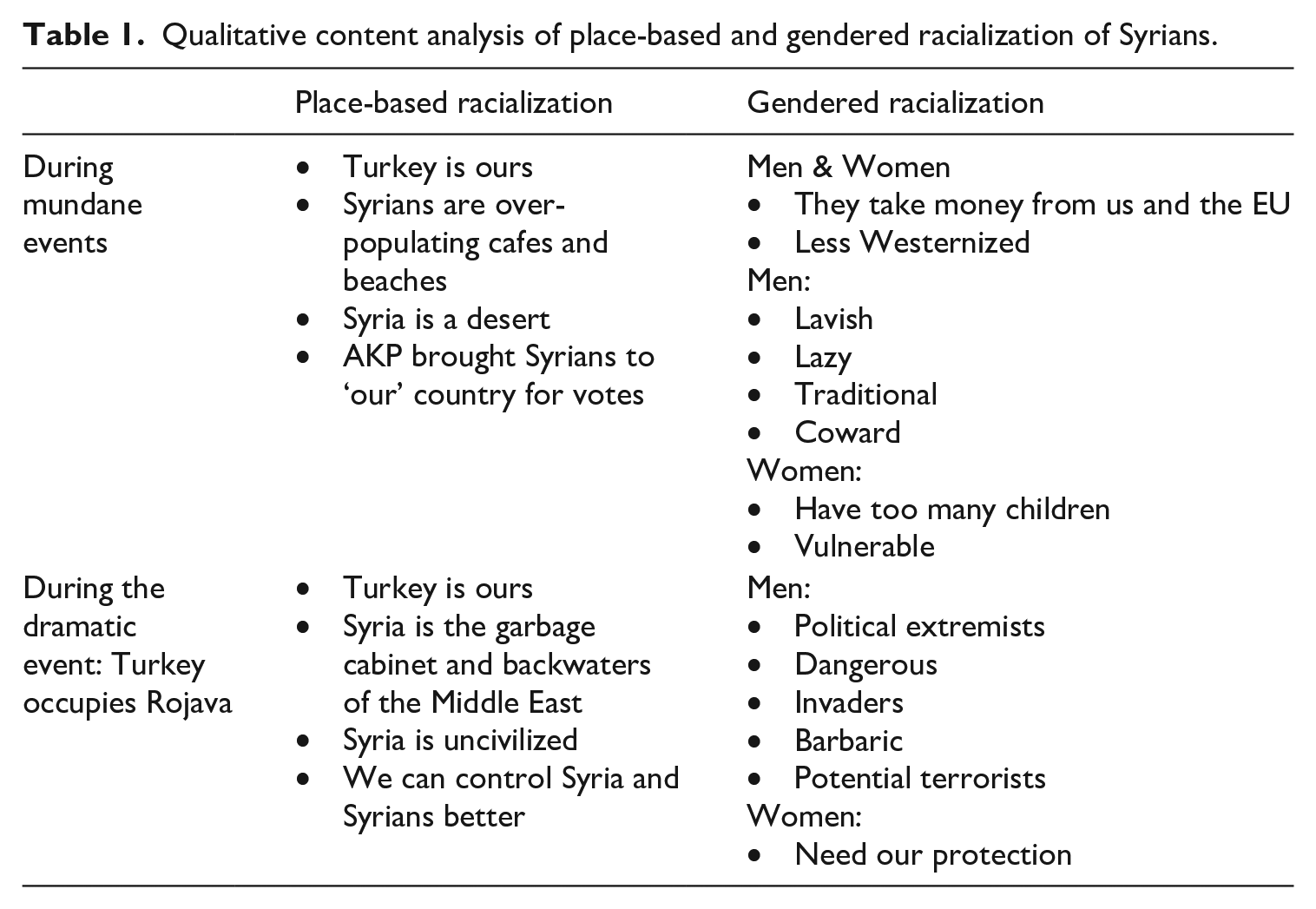
While SA formed the first part of our analysis, we also undertook a qualitative content analysis. Content analysis has primarily been used as a quantitative research method, with text data coded into explicit categories and then described using statistics (Morgan, 1993). More recently, the potential of content analysis as a method of qualitative analysis has been recognized (Hsieh and Shannon, 2005: 1278). Content analysis can be used to analyse communications such as letters, memoranda, reports or social media texts to identify intentions of the communicators; to reveal the focus of the individual, communal, institutional or societal attention; to describe trends in communication content and to examine attitudes, interests and values of population groups (Insch et al., 1997: 2–3). For each tweet as units of analysis for the content analysis, the coders determined whether each category of gendered and place-based racialization was present in that tweet when undertaking SA. This implies that each unit of analysis received multiple codes, as a message could contain references to multiple cultural rhetoric (Bourgonjon et al., 2016: 1737), such as references to both gender and place. To facilitate a content analysis, we used Excel to count and colour-code related words such as sexist swear words and words for location and place. We employed Python to collect words, clean and pre-process data and used word art (https://wordart.com/) to create two word clouds in order to oversee the broader use of words in the datasets, including the stop words. In our content analysis, we do not display the sexist words used in the dataset but map the overall toxic masculinity using Table 1 and present the most important and common place-based words while showing these words’ evolution in different types of events.
Qualitative content analysis of place-based and gendered racialization of Syrians.
Discussion of the SA
Existing research used SA to find sentiments in subjective sentences (Pang and Lee, 2004) and topics (Nasukawa and Yi, 2003), to explore product reviews and determine the user opinions on a product (Haddi et al., 2013: 26), and to grasp collective political preferences of voters, such as the Brexit vote (Georgiadou et al., 2019). Sentiments are found within comments, feedback or critiques, which mainly shed light on the role of emotion in online communication and offline events (Thelwall and Buckley, 2013: 1608). Sentiments can be categorized either into two categories: positive and negative; or into an n-point scale, for example, very good, good, satisfactory, bad, very bad. We grouped sentiments in three categories on publicly shared tweets, namely negative, positive and neutral/unrelated. Negative tweets comprise openly racist comments, an overt expression of the superiority of the Turkish over the Syrian or the inferiority of the latter. Positive tweets contained either a solidarity message with Syrians or were a critical response to a previous racist message. The neutral ones were either unrelated comments or unidentified sentiments.
Our SA of tweets shows that over 89% of the overall tweets in the whole data set (106K tweets) directly favoured the superiority of the Turkish race over Syrians and/or Arabs in their use of words and expressions (see Graphs 1 to 3). The initial data collection took place over mundane events such as the Syrian men’s celebration of the New Year’s Eve in the Taksim Square, which met with an immediate online reaction by the Turkish ‘hosts’/users. Our initial analysis, based on the SA of the first sample (63,591 tweets) collected during mundane events, shows that over 85% of tweets (54,238 tweets) expressed overtly racist attitudes towards Syrians during mundane events (see Graph 1), specifically pointing to the backward cultural life of Syrians compared to Turks. The positive texts formed 4% of the first sample (2412 tweets), while the remaining 11% (6941 tweets) consisted of neutral or unrelated propositions (see Graph 1). The user reactions became explicitly more hostile during the Turkish state’s occupation in Northern Syria in October 2019 (see Graphs 2 and 3).
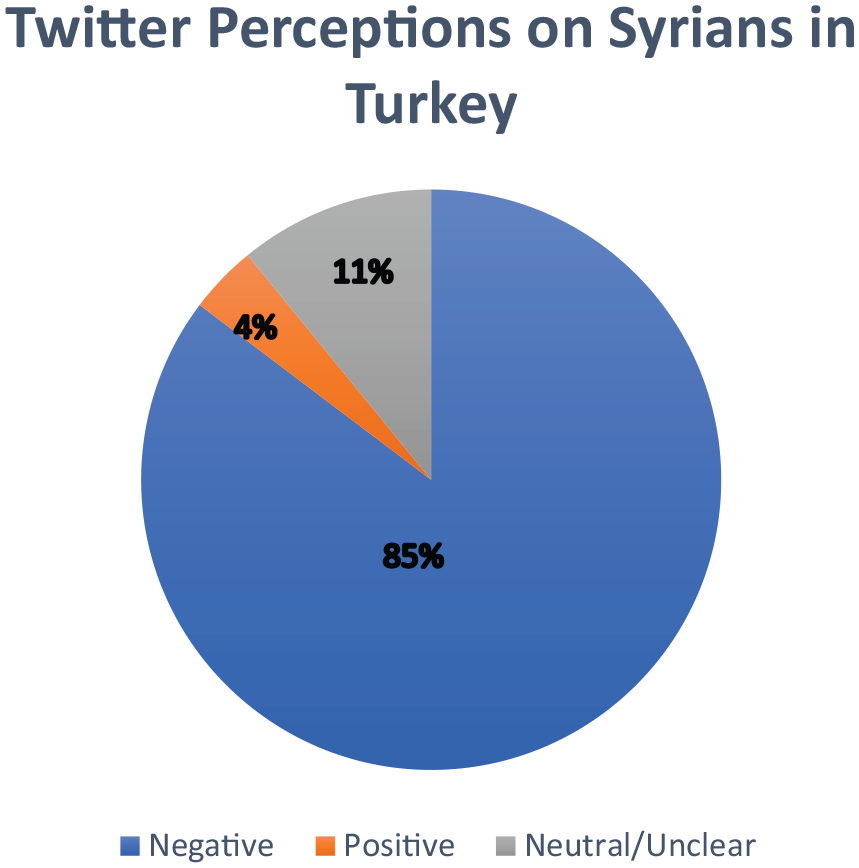
Twitter perceptions during a total of mundane events.
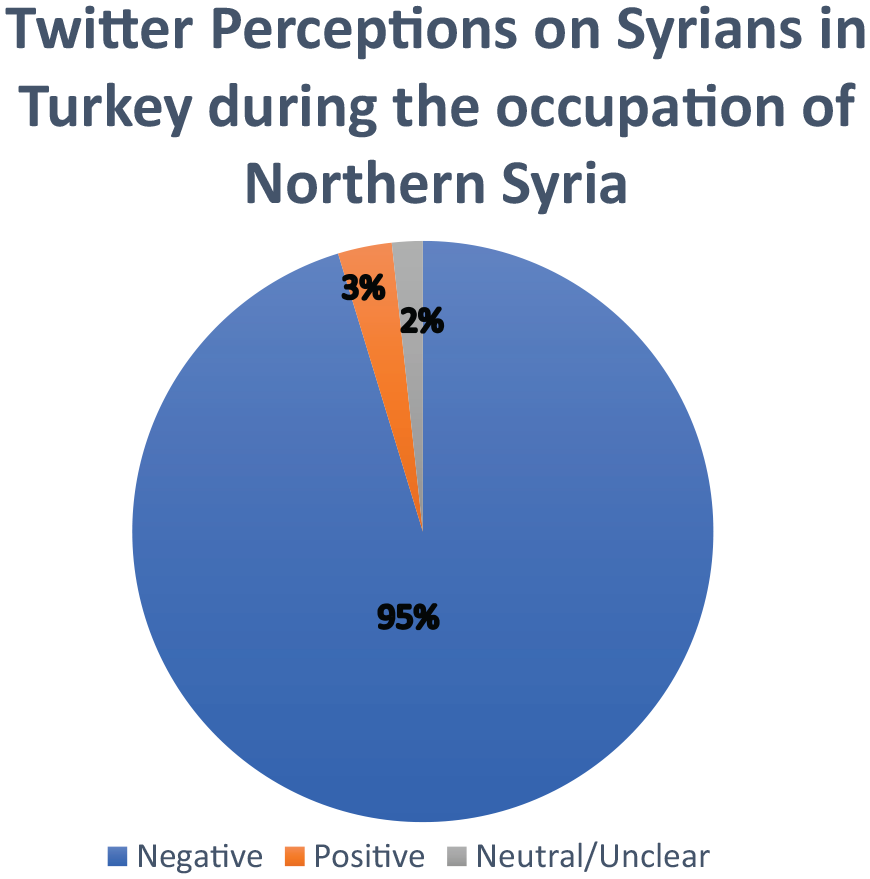
Twitter perceptions during the occupation of Northern Syria.
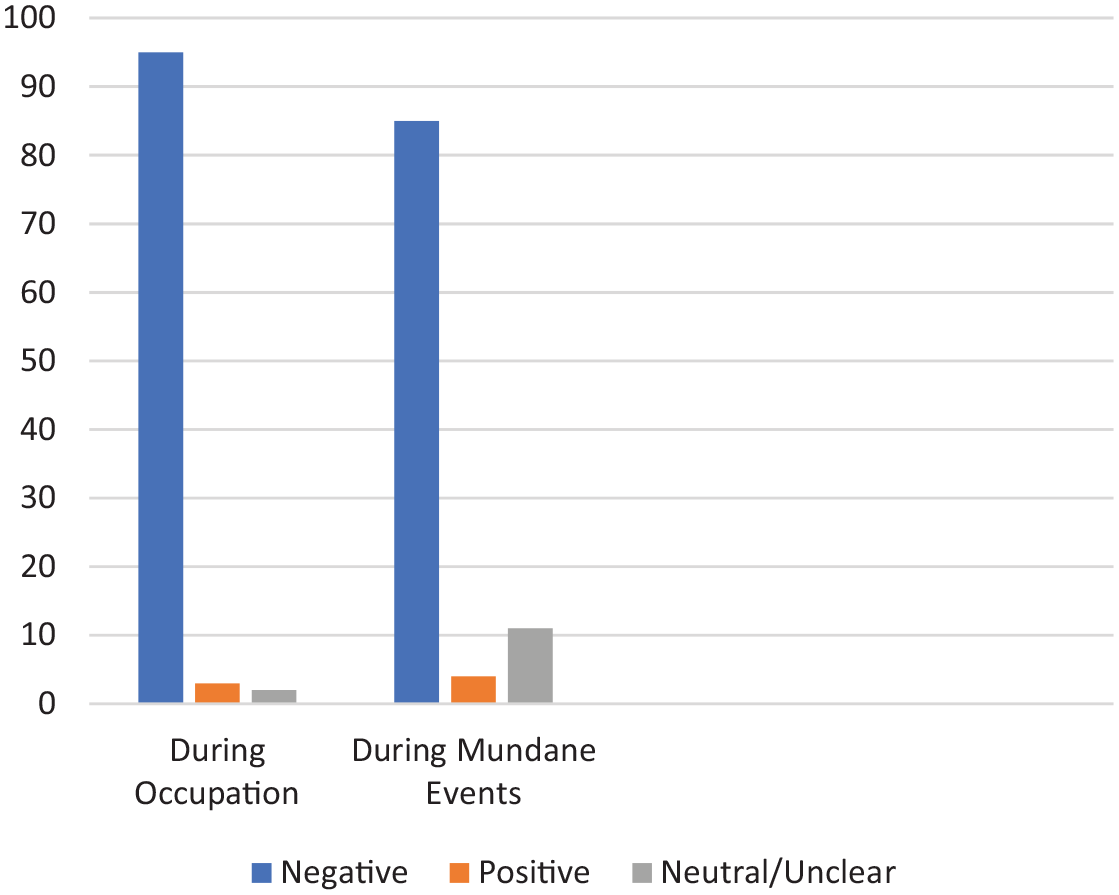
Sentiment analysis comparison of the occupation and mundane events.
Based on our data collection for the dramatic political event during and in the immediate aftermath of the Turkish state’s invasion in Northern Syria, we identified a rise of racist publics, from over 85% of racist posts to over 95% (40,956 tweets), with a much more straightforward overall racist message composing of 3% anti-racist (1290 tweets) and only 2% (735) neutral/unrelated posts. The racist tweets in the occupation period included an added colonialist proposition that the Turkish state would bring peace to and create a safe zone in Syria, where Syrians can settle back. The rise to 95% racist tweets during the Turkish occupation in the Northern Syria a.k.a. Rojava represents the hostility against refugees in Turkey as well as towards Kurds. Rojava is not only a geographical space hosting the different parties/institutions of the Kurdish movements, but it also acts as an alternative to the idea of nation-state (Dinc, 2020). The occupation triggered the latent racism towards the Kurds in Turkish public philosophy, grounded in Turkey’s colonialist and nationalist rhetoric that proved essential to the formation of Turkish nation-state (Günay, 2013).
The mainstream media immediately endorsed the occupation, which is also a persistent trend of the statist and right-wing mainstream media in Turkey in its support of the Turkish state’s actions (see Somer, 2005; Yesil, 2014). Although political polarization and hate speech towards Kurds and/or other dissidents and minorities are consistent on social networking sites (Ozduzen and Korkut, 2020; Ozduzen and McGarry, 2020), extant racism on digital platforms exploded during the occupation (see Graphs 2 and 3). This article retrieved #Syrians hashtag for this period, when it hit Twitter trends for Turkey as the number one item. Our SA shows that discourses on ‘cultural racism’, such as racialized propositions on ‘Syrians’ behaviours, actions and lifestyles’ as unfit to ‘Turkish society’, were replaced by directly colonial racist discourses on biological inferiority during the occupation. Overall, the SA not only showcased significant overt cultural racism against Syrians but also accounted for a significant increase in the racist content devouring a neo-colonial occupation of foreign land (Rojava in Northern Syria) and displayed a general hostility towards the Kurdish identity and autonomy.
Discussion of the qualitative content analysis
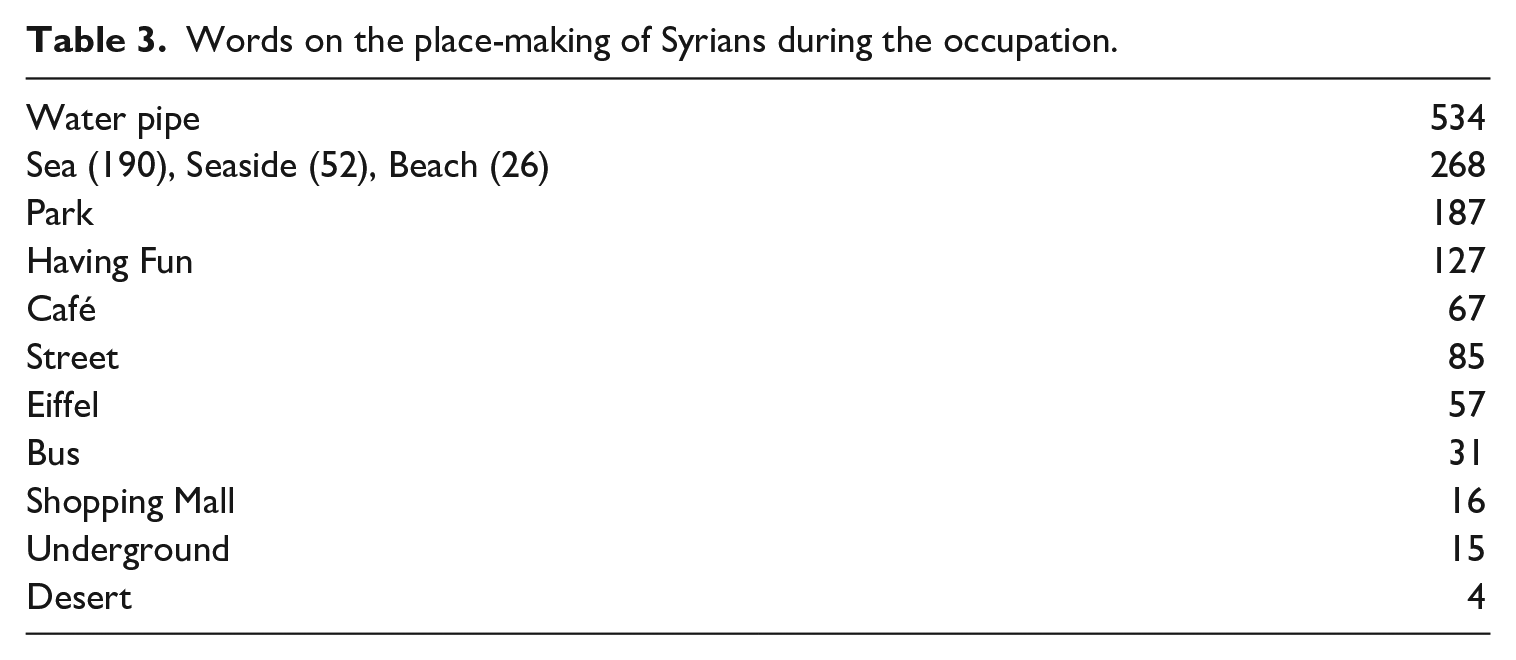
We used qualitative content analysis simultaneously with SA, which focuses more widely on ideas in text than the sentiments, ‘lending perspective to those ideas to identify and contrast meanings for one or more text units, (b) in hypothesis testing, or (c) in exploratory inquiries – especially where questions are complex and changing, for instance changes over time’ (McTavish and Pirro, 1990: 252). To go beyond an analysis of sentiments, we identified patterns and/or trends and created interpretations within our textual data (He et al., 2013: 465). We did this by highlighting the most used words and expressions on Excel based on the assigned categories during our SA analysis (see Table 1), as well as by working on a content analysis of two word clouds (see Graphs 4 and 5) and specific word-sets (see Tables 2 and 3) created from our data sets. Qualitative analysis of content involves a process designed to condense data into categories or themes based on valid inferences (Zhang and Wildemuth, 2017: 319). On our dataset, we roughly identified two main patterns and themes related to the online racialization of Syrians and Arabs: place-based and gendered racialization (see Table 1). Among these categories, Syrians are presented unfitting to the imagined national composition of Turkey and Turkish society.
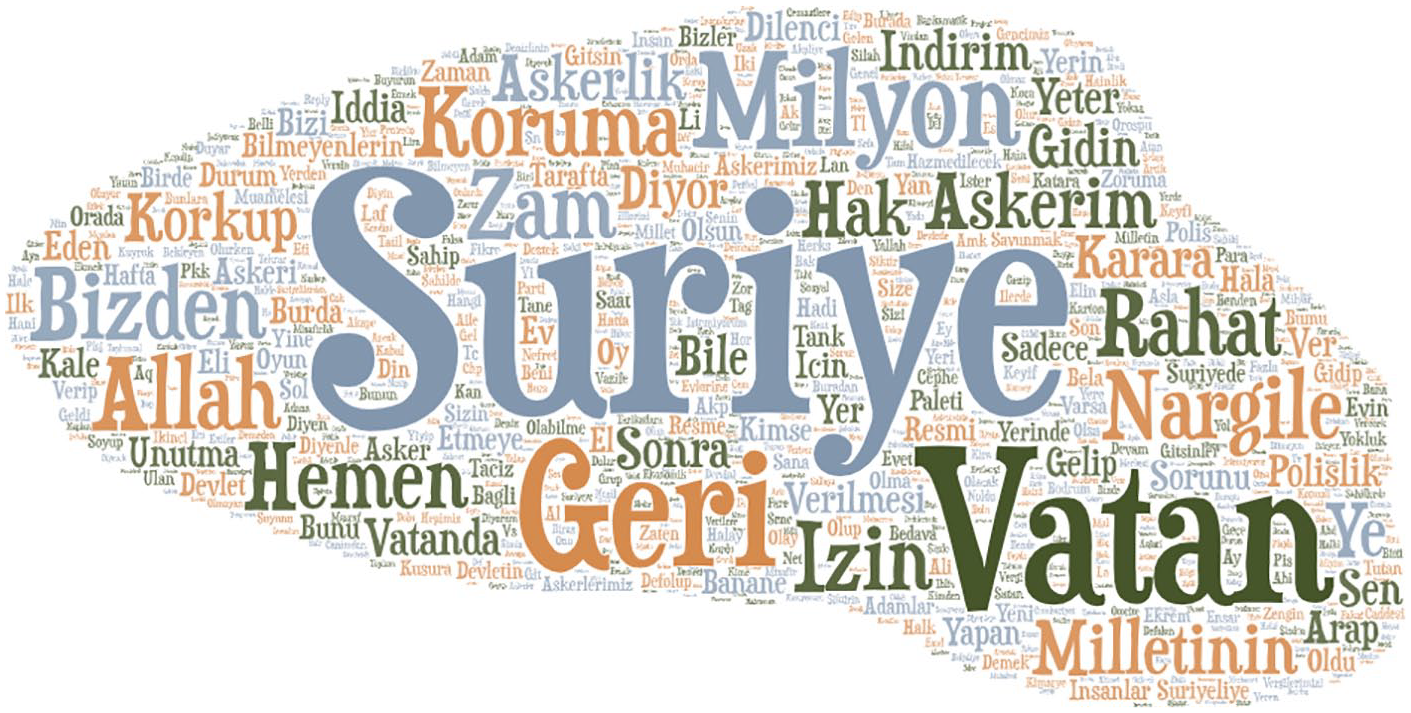
Word cloud for the data collected on mundane events.
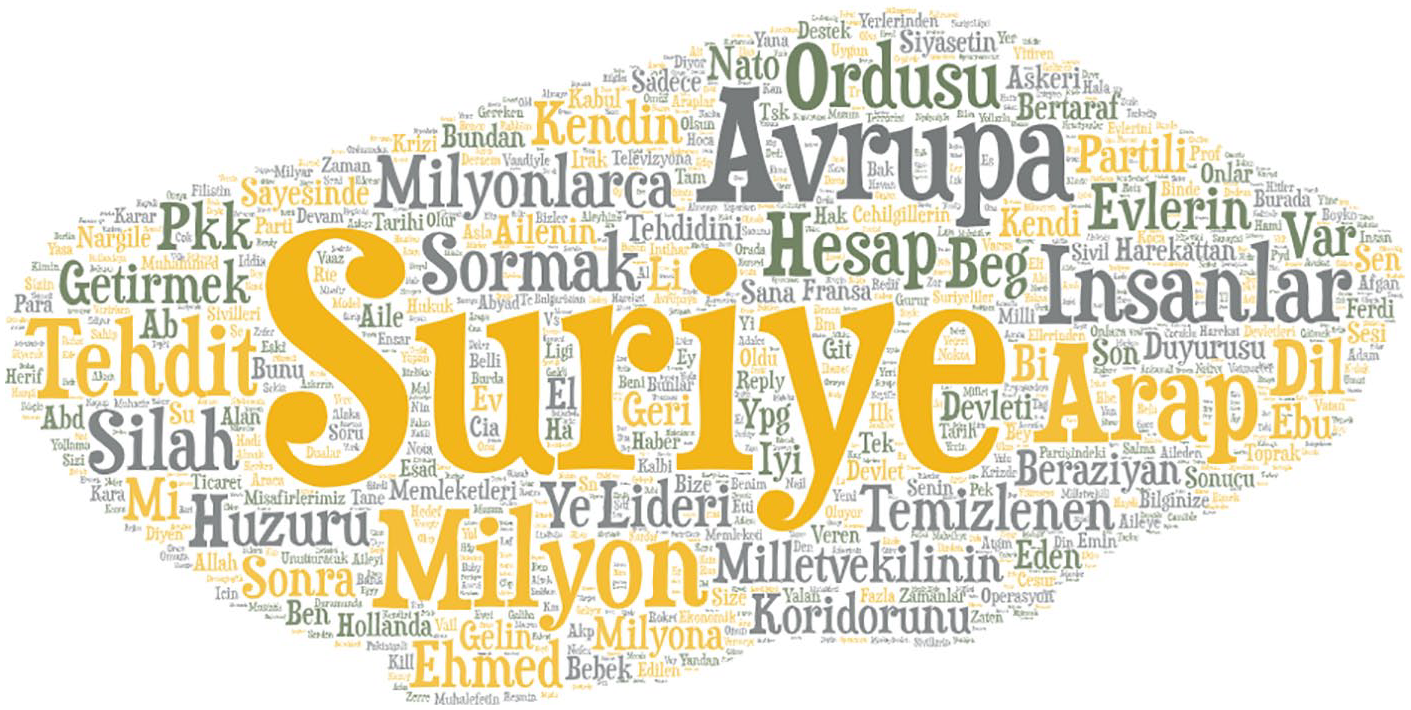
Word cloud for the data collected during the Turkish state’s occupation in Syria.
Words on the place-making of Syrians during mundane events.
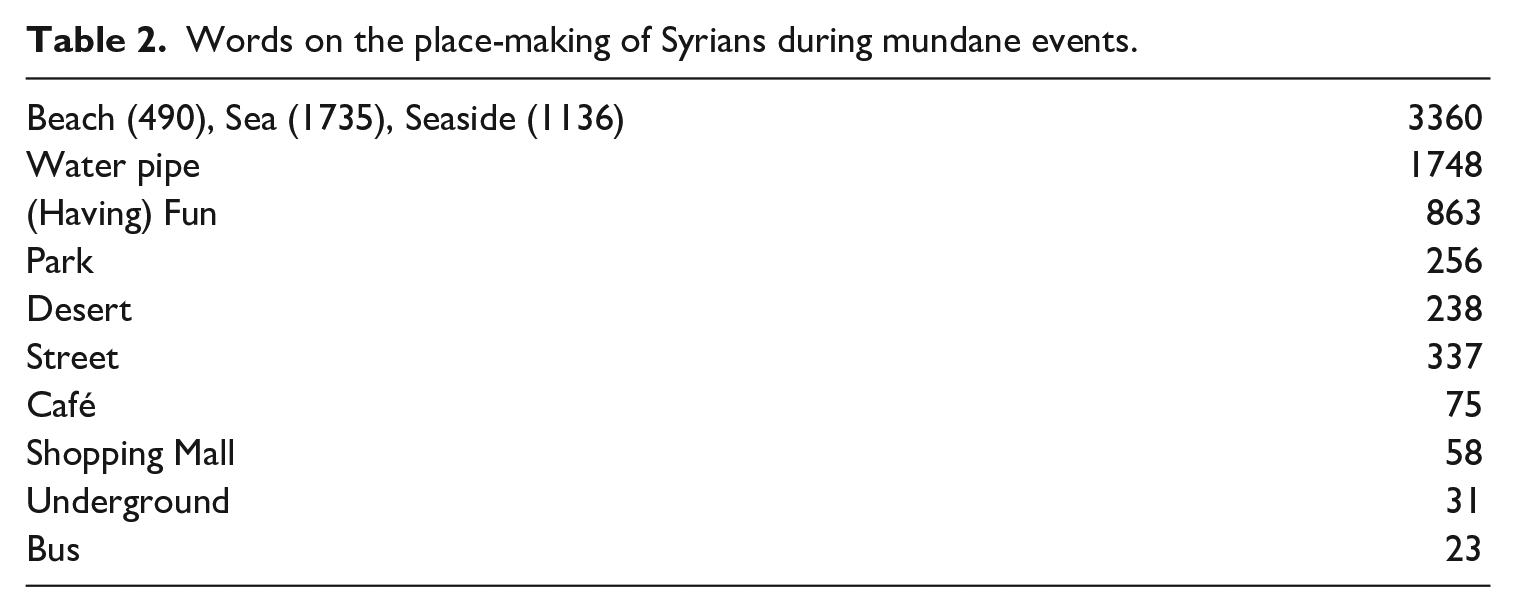
Words on the place-making of Syrians during the occupation.
First, most tweets imagined a shared set of gendered character traits common to Syrian men and women. During mundane events related to Syrians, the tweets racialized the alleged character traits of Syrian men as lavish, leisurely, promiscuous and coward, which represents the general shifting public discourse from ‘Muslim brother’ and ‘war victim’ to ‘coward and lazy guest that overstayed their welcome’ and ‘promiscuous Arab’ from 2011 to 2019. In marking and fixing categories of Syrians, exclusionary discourse of Turkishness (e.g. only Turks can belong here) dominated the tweets, while the message ‘Turkey is ours’ was consistent across all the data.
In line with the exclusionary politics of Turkishness, sampled tweets recounted the incompatibility of Syrian lifestyle, traditions, social and political identities with their Turkish hosts during the mundane events and promoted the biological superiority of Turks over Arabs and Syrians during the occupation. Turkish state’s invasion in Syria revealed an underlying association of Syrian men with religious fundamentalism and political radicalism and a depiction of refugees as ‘dangerous others’ (Tsagarousianou, 2016) and invaders (Ibrahim and Howarth, 2018). Such discourses not only racialize truths about immigrants and refugees, but they also dehumanize migrant communities and help states securitize them. Looking at the hierarchical racial formations of immigration in the United Kingdom, Back et al. (2012) discussed how immigrants are made to feel culpable, originating from the hierarchies of mobility and inequities among people and their ‘rights’ to belong (p. 141). Tweets in our sample fostered ‘hierarchies of belonging’ among refugees by positioning the host Turkish people in a power position with the ‘privilege’ to define a good or bad Syrian. These tweets also allegedly argued that the EU took the ‘educated’ and ‘civil’ refugees, while the rest of Syrians in Turkey were ‘barbaric’, dirty’, ‘uncivilized’ and simply inhuman.
In this context, users also described the Syrians that were not ‘taken’ by the European countries as unfitting to the allegedly ‘Western’ ways of how things run in Turkey. ‘The dominant manifestation of the postcolonial anxiety in Turkey has varied depending on the period. During the Kemalist Turkey, becoming more “Western-oriented” was eminent. During the AKP era, the criticism of “Western norms” became its expression’ (Çapan and Zarakol, 2017: 195). While identifying the alleged collaboration between Syrians and the government, these tweets equally blamed the ‘external’ powers namely the EU, United Kingdom and the United States for ‘sending back’ the refugees to Turkey. These posts were generally not from the AKP supporters or sympathizers as they accused Erdoğan for the alleged spatial and cultural occupation of Syrian men in Turkey. The word ‘ballot’ was conspicuous in tweets, used in order to blame the AKP for bringing Syrians to consolidate its votes, based on a general belief that the government provides citizenship to Syrians. The Turkish users also racialized Syrians as a homogeneous group that would vote for an ‘Islamist’ and neoliberal party. These tweets countered the government’s initial Islamist official message that Syrians were ‘our Muslim brothers’ but still presented a conservative and right-wing take on immigration, refugees and Turkish national identity. While the notion of ‘homeland’ is one of the most important building blocks of data collected in different types of events, the interpretations of defence emerged more strongly during the Turkish occupation of Northern Syria. Interestingly, the last set of data collected during the occupation includes two second set of hashtags along with the #Syrians hashtag. #FreeEUForRefugees is used 970 times, while #BizTürkiyeyiz (#WeAreTurkey) is used 297 times. During the occupation, some of the tweets and mentions were intended for the English-speaking world, which surfaced in our sample for the first time. Users employing #FreeEUForRefugees hashtag in English recommended Syrians to leave Turkey for the EU countries.
As such, place-making constitutes the most fundamental component of racialization in our data expressed with words for location and place, namely Syria, Turkey and adverbs of place like here, there and everywhere. Spaces convey social information based on their very physical properties and affect the spatial knowledge of their partakers. Urban studies can provide us with an understanding of the normative contexts that online spaces host, given the allegory that one can draw between the spatial and online interactions (Stromer-Galley and Martey, 2009: 1046–1056). Today, interaction has moved from streets to cyberspace, where digital urbanism, deep mapping, neogeography, and e-government converge to create interactive online spaces. Digital place-making also involves the production of place through its representations on the Internet (see Bork-Hüffer, 2016; Karduni and Sauda, 2020).
Our presumption is that Syrians’ digital presence makes them protruding for the majority, similar to the spatial presence of the Syrians in physical spaces, which makes them conspicuous. Thereby, one can study the interactions between the physical presence of Syrians at cafes, bars and squares and their representations on online spaces, essentially in the everyday of the majority. Syrians’ online portrayal trigger persistent racist reaction of users and these users engage in counter-place-making against Syrians at the cusp of spatial meeting the digital. In our sample, the most expressed experiences of the users with the Syrians were at the beach and at semi-public spaces such as the shisha bars. The beach functions as a marker of civility in the Turkish public philosophy and the shisha bar represents a hallmark of the oriental, both of which provide the pretence of the Syrians’ uncivilized behaviours in the eyes of the Turkish majority. Furthermore, in the last group of tweets collected during the occupation, users sarcastically engage with the mundane act of smoking water pipes and suggest Syrians ‘to smoke their water pipes “freely” in iconic places in Europe’, such as the Eiffel Tower.
Overall, we detected that the most used word is a combination of beach (plaj) + sea (deniz) + seaside (sahil) (3360 times) on the tweets collected during mundane events. The Turkish Twitter users generally felt uncomfortable that Syrian men swim, lounge and ‘have fun’ at seaside and beaches. The Mediterranean coastline has been a crucial location for ‘white tourists’, but when Syrians visited, there came a plethora of negative reactions, illustrating how ‘leisure makes racial discrimination expressive’ (Philipp, 2000: 122). In this context, ‘having fun’ (863) captured the most vivid reaction as an activity. For this mind-set, Syrians should not participate in leisure activities but fight, get injured or killed for their ‘homeland’. In the mundane events dataset, the second most repeated word in relation to place-making was nargile/water pipe (1748). The users expressed their discontent with the sight of Syrians in public and semi-public spaces by demarking shisha bars as the hedonism of the lavish oriental. Syrians’ presence on streets (337) and parks (256) was also undesirable (see Table 2).
In the second set of tweets (over 40K) collected during the occupation, the impact of the imagined place-making of Syrians in Turkey decreased. Instead, Twitter users in Turkey prioritized their own imagined place-making in Syria, thanks to the occupation (see Tables 1 and 3 and Graph 5). The posts during the occupation were fully supportive of the AKP government and replaced the popular discontent on the Syrians’ presence and ‘hedonism’, which were otherwise affiliated with the government. An increased sympathy for the government if/when the government appeals to the militaristic and nationalistic sentiments of the Turkish public illustrates how the colonial and territorial mindsets serve each other.
The tweets in our sample not only categorize Syrians as ‘occupying’ and thus place-making in Turkish geographies but they also frame Syria as a geographical space – the Middle East’s ‘garbage cabinet’, an uncivilized and filthy place to be conquered. This colonialist perspective marks the Turkish people as ‘the makers of history’ as they advance, progress, and modernize the Middle East, although Syria remains backwaters. This dichotomy rests on a binary opposition of ‘inside’ and ‘outside’; while inside leads, outside lags. Blaut (1993) defines this pattern as Eurocentric diffusionism, based on the theory of ‘the autonomous rise of Europe’ (p. 1–2). This points to a newer ‘construction of colonial imaginative geographies and identities’ (Nash, 2002: 222). Political community as national political order is central to the Turkish self-understanding like Europe. Turkey was also an imperial state as much as a national state. This framework acknowledges the political state as it is more stratified than otherwise considered (Bhambra, 2017: 404). Furthermore, portraying Third World as undeveloped suggests topographical reductionism of the Orient to desert and – metaphorically –to dreariness. The desert is the essential unchanging decor in Orient’s history (Shohat, 1997). Although Syria is not a desert and made up of many different geographical zones, users called it çöl (desert) during mundane events and tell Syrians ‘to go back to their desert’. Home is also commonly employed both to tell off anti-racist users to take Syrians to their homes if they like them too much and to call out to the government to send Syrians back to their previous homes in Syria.
A spatial gender regime – coward Syrian males in cafes and beaches vis-à-vis the glorious Turkish soldiers fighting in Syria – was constructed online. These mediated discourses rest on a heterosexist racialization of Syrians and ignore the actual economic, geographical, political and cultural factors that contribute to the complex process of why people cross borders. The characteristics of the gender regime around Syrians also contrast with the study of Rettberg and Gajjala (2016) on the Twitter hashtag #refugeesnotwelcome that portrayed the Syrian male refugee as a potential terrorist (p. 179). In our data, rather than ‘the terrorist’, Syrian male is generally portrayed as leisurely and lavish in mundane. Users articulated them as cowards and ‘incapable’ of defending their own country while having fun on a beach, a random street, a bench or at a café. They are ghoulish in the mundane and unfitting. In this gendered framework, Syrian women were depicted as not only inhuman and invaluable, but also as victims, vulnerable and ‘in need of men’s protection’. Although a good deal of tweets suggested that all Syrians in Turkey should go back to Syria, some others proposed that Syrian women and children can continue to stay in Turkey, as women and children are ‘in need’. This assigns the majority the privilege to decide on the fates of the ‘needy’. Likewise, many users objectified Turkish women and suggested that they cannot protect themselves from the imagined threat that the ‘Syrian male’ poses as rapists, which, in this view, necessitates the women’s protection by the Turkish men. Such a gendered neo-colonial regime points to what Sharpe identifies as ‘non-consensual racial fantasies’ (Sharpe, 1999: 1094), provided abundantly through digital publics.
In our dataset, there were also some anti-racist messages shared through hashtags and mentions used as replies to racist post, on especially the Islam-related messages, including the words Ramadan, Muslim brotherhood and prophet Muhammed (totalling 1199). However, they still rested on a selective and imagined solidarity with ‘Syrians as Muslims’. Most anti-racist tweets in our sample thus highlighted ‘the Muslim brotherhood’ and religious duties, rather than political or humanitarian reasons to facilitate solidarity with Syrians in Turkey. Yet, the number of Islam related words on the solidarity messages decreased to 442 from 1199 during the occupation. The Turkish state’s military operations and occupation in Syria minimized the users’ alleged ‘Muslim solidarity’ with Syrians in Turkey.
Conclusion
This article used a sentiment and qualitative content analysis of 106K tweets related to Syrians in Turkey that hit Twitter trends for Turkey between 2018 and 2019. This article pointed out that these posts are not just random opinions based on individual prejudices, but they represent how systemic hostility and hate became the most conspicuous form of communication in engaging with the refugee figure and identity. Although some of the hashtags hit Twitter trends for Turkey responding to a dramatic political event, such as Turkey’s intended occupation of Northern Syria, the emergence of these hashtags as trending topics did not generally necessitate a specific event. An interaction between the individual agency and societal phenomena facilitated the breaking out of these tweets, which we identify as a networked phenomenon (Murthy and Sharma, 2019: 196). Our article argues that in today’s neo-colonial condition, anonymity, non-regulation as well as the ubiquitous nature of social networking sites such as Twitter enable the expanse and reach of racist comments. This revives ‘biological superiority’ as a gendered and geographical phenomenon, feeding everyday communication on online social networking sites, especially in the aftermath of the mass movement of Syrians following the Syrian revolution and civil war.
While this article captures the broader loci and the context in which the lives of Syrians unfold in Turkey, it does not talk about their own experiences, interactions with each other and with others. We have identified key relational processes qualifying identity-positions, real and imagined dialogues and othering of Syrians that sustain the view that Turks are threatened by Syrians, specifically the Syrian men. At a social representational level (i.e. the common thinking), the Turkish public developed common themes about the nature of the threat that immigration poses to their everyday life, specifically on the Syrians’ imagined place-making not only in Turkey but also in Western countries. These themes combined with the strategies to make decisions on the existential threats to Turkey as a geographical and cultural entity, and the solutions that reclaiming the power back from the AKP, ‘Arabs’ as well as Kurds could cater for what Turkey as a nation-state incidentally needs are based on a racialization of Syrians in Turkey. We acknowledge that digital categories are social constructions determined through talk and that Twitter analysis may not always be representative. However, visible and widespread online communication would have real-world implications for the people who become categorized and/or racialized (Goodman et al., 2017: 106–107), informing how they should be treated in society. Our article articulates the existing anti-refugee and anti-immigrant rhetoric in Turkey, which, we argue, is representative of and feeds our understanding of the rise of such rhetoric on a global scale today.
Footnotes
Acknowledgements
The authors would like to thank Serkan Atesman for his help in the data analysis. The authors are also thankful for the two anonymous reviewers and the editor Steve Jones for their aid in developing the paper.
Funding
The author(s) disclosed receipt of the following financial support for the research, authorship, and/or publication of this article: This project has benefited from the funding by the British Academy (Newton International Fellowship, Grant NF170302) and the European Union’s Horizon 2020 research and innovation programme DEMOS CONTEMPORARY POLITICS 15 (Democratic Efficacy and the Varieties of Populism in Europe) under grant agreement No 822590. Any dissemination of results here presented reflects only the authors’ view. The agencies are not responsible for any use that may be made of the information it contains.
