




Abstract
Yahoo’s purchase of make-your-own-website platform GeoCities in 1999 and subsequent implementation of a new Terms of Service agreement led to one of the most notable boycotts in Web history. During the “Haunting,” GeoCities users stripped their homepages of color and content, replacing blinking GIFs with excerpts of the offending Terms of Service. In this landmark battle over content rights and access control, protestors used the platform antagonistically, disrupting the value of user-generated content and undermining the company’s strategic vision for the platform. Within a week, the Haunting of GeoCities successfully forced Yahoo to acquiesce to protestor demands and set enduring standards for Terms of Service that preserved greater rights for content creators. This case study from the early Web demonstrates how access is always bound up in a struggle over control and offers a timely reminder of how users have been—and can be—vital agents of platform politics.
Keywords
Introduction
In the summer of 1999, Silicon Valley became a ghost town. So, too, did Hollywood, Nashville, College Park, and Capitol Hill. Places that once buzzed with lively activity suddenly stood eerily quiet and gray. Or such was the case in cyberspace when users of the popular make-your-own-website platform GeoCities organized a Haunting. GeoCities users, known colloquially as homesteaders, stripped their personal Web pages of content, replacing bright colors and blinking GIFs with dull shades of gray and excerpts of the website’s Terms of Service (TOS). Designed to turn thriving neighborhoods into ghost towns, the Haunting was part of a broader protest movement following the acquisition of GeoCities by the then-popular Internet portal Yahoo. 1 The protests were not about the purchase per se, but rather the changes that Yahoo made to GeoCities’ TOS that granted the company greater rights to and control over user-generated content. In the face of social and spectral pressures, Yahoo changed the TOS twice in order to meet the homesteaders’ demands. Within a week, Jim Townsend, one of the public faces of the protest, made the following announcement on his aptly named website Boycott Yahoo: “As of 9 PM PST, July 6, 1999 the boycott of Yahoo is over” (Townsend, 1999c). With the revised policy in place and the ghosts exorcized, clicks, colors, and greater user control over user-generated content returned to GeoCities.
The keyword of this conflict is access. Yahoo’s revised TOS were intended to guarantee corporate access to the vast body of content housed on GeoCities’ servers. Users, in turn, sensed that Yahoo’s unfettered access to this content threatened their creative control and diluted their power to make decisions about how and where to display their content. In addition to conventional protest tactics like signing a petition or speaking to the press, some enterprising homesteaders sought to foil Yahoo’s legal and digital access to their intellectual property by removing it from the service altogether. In so doing, these users strategically mobilized the design of GeoCities, which co-founder David Bohnett described as “a bottoms-up, user-generated content mode” (McCullough, 2015). The success of the boycott relied on the monetizable value of access to user-generated data and content, as well as the actionable threat of revocation. With the Haunting, users asserted the value of corporate access to their original content through an organized movement that successfully demanded contractual concessions from a major corporation. Homesteaders managed to preserve a remarkable and industry-shifting level of control over their content, demonstrating the possibility of challenging and changing the ubiquitous TOS agreements that govern platform and user relations.
Yahoo’s acquisition of GeoCities represents an early instantiation of what José Van Dijck, Thomas Poell, and Martijn de Waal (2018) call the platform society, a society in which social and economic traffic is increasingly channeled by and through a (corporate) global digital platform ecosystem. While most work on the politics of platforms, to borrow Tarleton Gillespie’s (2010) felicitous phrase, tends to focus on contemporary giants such as Google, Apple, Facebook, Amazon, and Microsoft (see, for example, Nieborg and Poell, 2018), an examination of earlier instances can help surface constitutive features and conflicts of platformization that might otherwise be overlooked or taken for granted. In this article, we analyze the politics of access and control in the 1999 boycott of GeoCities, showing how platform policies can act as a site of collective contestation that complicates a positivist understanding of access (Ellcessor, 2017) tied to participation, democracy, and opportunity. In the first section, we review the literature on platform policies and argue for the importance of work that goes beyond content analysis or individualized interpretations of policies. Second, we theorize the term “access control” as a compound concept to make sense of disputes between content creators and online platforms. Third, we present a brief history of the Haunting of GeoCities reconstructed from archival sources, business reports, and popular press accounts. Finally, we trace the impact of the protest on understandings of content ownership and access rights on online platforms, along with the composition and reception of subsequent TOS agreements. Whatever else its ghostly legacy, the Haunting of GeoCities offers a reminder that access is not simply a top-down accomplishment, something to be given or withheld as appropriate; instead, access is a site of contestation, an engagement of competing visions of what the world is and what it should be.
The politics of platform policies
As disclosures of guiding principles and disclaimers of liability, platform policies matter. In Nieborg and Poell’s (2018) framework for studying the platformization of cultural production, policies show how “platform power is operationalized through platform governance frameworks” (p. 4285). While their discussion focuses on content moderation, platform policies encompass a broad range of political issues, including privacy (Jensen and Potts, 2004), intellectual property (Fiesler et al., 2016), harassment (Pater et al., 2016), participation (Stein, 2013), and data use (Puschmann and Burgess, 2014). Policies include both formal documents like TOS that are legal and binding, along with informal policies such as community guidelines that are primarily normative in nature (Fiesler et al., 2016). Whether contractual or not, such policies have a “regulatory-like function” with significant implications for civil liberties (Braman and Roberts, 2003) and platform culture (Massanari, 2017). Thus, platform policies represent an important site for investigating the relationship between platforms and society.
However, research on platform policies tends to focus on either the content of the policy documents or individual interpretations of policies. Formal platform policies are a legacy of the Fair Information Practice Principles first introduced in the late 1970s by the US Department of Health, Education, and Welfare (Obar and Oeldorf-Hirsch, 2018). While giving notice about the use of personal data is, in theory, supposed to ensure consent and protect the privacy and reputation of individuals, in practice, such policies are often inaccessible (Marotta-Wurgler, 2009), written at an advanced reading level (Fiesler et al., 2016; Luger et al., 2013), and biased toward the commercial interests of corporations (John and Nissenbaum, 2019; Puschmann and Burgess, 2014). Indeed, the average Internet user would need to spend 200–300 hours per year to read all the TOS policies they are currently subject to, which would cost the US national economy alone an estimated US$781 billion annually (McDonald and Cranor, 2008: 543–544).
Given these challenges, it is perhaps unsurprising that most people do not read TOS agreements. Using surveys (Obar and Oeldorf-Hirsch, 2020; Fiesler at al., 2016), experiments (Good et al., 2007), and behavioral trace data (Bakos et al., 2014), researchers have consistently found that very few people read policies. Even when people do read platform policies, their understanding and interpretation significantly differ according to prior knowledge levels (Reidenberg et al., 2015) and expectations (Martin, 2015: 220), suggesting that most policies are too ambiguous to function as meaningful decision-making tools. Such ambiguity should be understood as a strategic choice for companies. The business model once attributed to spyware, where “users gain the functionality of software in exchange for giving up private data, tolerating advertising messages, or both” (Good et al., 2007), has long become standard for commercial platforms.
While this work demonstrates significant issues with the notice approach to information protection, leading researchers to suggest implementation improvements (e.g., Pater et al., 2016) and alternative policy frameworks (e.g., Obar, 2015), content and individual interpretation are only part of the story of platform policies. Although TOS are typically discussed as top-down mechanisms of exerting power, a form of governance that platforms do to users, such policies can provoke outrage and political contestation (Fiesler and Hallinan, 2018). Controversies involving platform policies, such as the Haunting of GeoCities, provide an ideal opportunity to study how policies can become sites of common concern.
Access + control
Access, understood as the “opportunity, ability, or right to gain entry to a space or possession of a thing,” is a prominent concept in the history of digital culture (Ellcessor, 2017), frequently tied to optimistic visions of computing, the Internet, and the World Wide Web. For example, in the mid 1990s, Al Gore (1994) imagined the Internet as “information superhighways on which all people can travel.” In this account, which heavily influenced the development and regulation of the Internet in North America and Europe, the Internet not only facilitates access to information, but also to people, places, and particular political values. In framing digital technology as a tool to break down access barriers, Gore participated in a long tradition of Internet utopianism that traces its roots to the early days of computing and information science. In the 1930s, Paul Otlet speculated about the potential “to imagine and give institutional expression to new ways of organising and disseminating knowledge” (Rayward, 2003: 5) by making information universally accessible through standardization. Subsequent iterations of the dream of universal accessibility range from Ted Nelson’s visionary vaporware Project Xanadu, to the adoption of packet switching as a technology that “helped achieve fairness in [network] access” (Abbate, 1999: 28), to Tim Berners-Lee’s implementation of hypertext on the World Wide Web (Abbate, 1999: 214–215). Ideas of accessibility are also embedded in the infrastructure of the Internet and reflected in its historical development, such as the creation of TCP/IP as “a universal, non-proprietary data communications protocol” (Kessler, 2019) that enables mass interoperability between different computer systems (Abbate, 1999: 142).
The excitement surrounding information access was heightened by a belief in its transformative potential: new information would produce new types of communities. The linking of information and community is evident in the organization of early social networks like GeoCities and webrings, where communities formed around shared interests and information exchange. Ian Milligan (2017) situates GeoCities as an exemplar of this optimistic moment because of its “unique focus on community” (p. 138), in accordance with Patrice Flichy’s (2004: 9) description of virtual communities as a foundational myth of the Web. However, as Milligan further explains, GeoCities functioned as a peer-driven system run by community participation and leadership, making community something more than a myth (Milligan, 2017: 151). Such belief in the transformative power of access has grown even more prominent with the rise of contemporary social media platforms as evidenced by Mark Zuckerberg’s (2017) vision of Facebook as “the social infrastructure to give people the power to build a global community that works for all of us.” From democratic revolutions (Buhl, 2011) to the global redistribution of opportunity (Heinrichs, 2013), visionaries, advocates, and investors have long argued that digital technologies expand access and thus have the power to make and remake our world (Shirky, 2008).
If access has long been one of the great virtues of the Internet, it has simultaneously emerged as one of its great challenges. The unequal distribution of Internet access threatens to restrict access to public life, economic opportunity, and other promised rewards. Such are the concerns animating research and policy around the digital divide, which includes access to physical technologies like computers and local area network (LAN) lines (Compaine and Mitchell, 2001), paywalled or otherwise restricted portions of the World Wide Web (Sandvig, 2007: 137), and affordable data and Internet connections (such as through the Lifeline Broadband program for low-income people in the United States). These approaches represent what Sharon Strover (2014) terms the “access definition” of the digital divide: “Simply ensure that computers and connections are available and the rest will take care of itself” (p. 116). As Ramesh Srinivasan (2017) argues, scholars simultaneously analyze the social constructedness of technology while perpetuating “a myth that treats these tools as sacrosanct and untouchable” (p. 162), limiting the desire and opportunities to reenvision the design, values, and possibilities of technology.
In popular discourse, access takes on a normative valence of opportunity and benefit. More access, be it to information, communities, economic opportunities, or entertainment, is generally regarded as a desirable and worthy end. Critical scholars have thus argued that the term “has a positive and positivist bent” (Ellcessor, 2017), which often results in channeling discussions about access through a commodity framework (Lievrouw and Farb, 2003: 506–508). Despite the prevalence of this discourse, technology-focused access solutions have proven tenuous, with issues such as censorship (Roberts, 2018: 43–44) and the deliberate disruption of network technologies and information flow (Tufekci, 2017: 228–230) demonstrating that access is a process rather than an endpoint. The failure of technological access to deliver on the social and political promises of the Internet demands a broader view of access that, as Elizabeth Ellcessor (2017) explains, moves away from the notion that “access is a discrete state that can be identified and achieved.” No single barrier prevents access and no single solution can ensure access universally. Rather, access is an ongoing practice of negotiation among multiple stakeholders, where certain types of access for one stakeholder may trade-off with access for another. It is thus imperative to move away from the “unifying feature of all the uses of access,” the assumption that access is in all cases “a positive outcome” (Ellcessor, 2016: 7, emphasis in original).
Critical disability studies provides a useful challenge to normative and positivist understandings of access (Ellcessor, 2016: 4). Access (and the related term accessibility) has long been an important organizing concept for disability activism because conceptualizations of what access means and who has an access issue “influence how people perceive these issues and act upon them” (Titchkosky, 2011: 3). Access is neither a neutral, descriptive state nor an unqualified social good—it is, instead, both a site of contestation and a form of social control. Tanya Titchkosky (2011) outlines the stakes involved in theorizing access as social control, explaining access as a way to orient to, and even come to wonder about, who, what, where, and when we find ourselves to be in social space. Though the perceptual consciousness of “access” people take social life into account as a space of questions regarding who belongs where, under what auspices or qualifications, and during what times or through what particular thresholds. Access, then, is tied to the social organization of participation, even belonging. Access not only needs to be sought out and fought for, legally secured, physically measured, and politically protected, it also needs to be understood—as a complex form of perception that organizes socio-political relations between people in social space. (pp. 3–4)
In this formulation, access is deeply contextual and bound up in the expression and negotiation of power relations. Questions of who can access what, and to what ends, have important implications for the organization of social life and the balance of informational and cultural power in digital societies. Although disability certainly has direct relevance to the digital sphere—for example, accessibility standards or content warnings (Ellcessor, 2016)—the articulation of access alongside social control is also relevant to issues concerning TOS, platforms, and user-generated content.
We deploy the compound concept of access control to provoke a consideration of the crosscurrents between the logics of access and social control, between communication policy and social theory. Access control is a technical term of art in telecommunications law and refers to a set of standards for determining whether particular users should be able to access protected systems, servers, and information. 2 Access control thus limits some users and activities while enabling others (Sandhu and Samarati, 1994: 40). From the perspective of social theory, access is a dominant mechanism of what Gilles Deleuze (1992) terms “societies of control,” where control operates as “a modulation, like a self-deforming cast that will continuously change from one moment to the other… (p. 4). As a particular mode of governance and manifestation of power, control grants and denies access. Our discussion of access control as a compound concept thus forwards both the idea that access itself is at the center of disputes and struggles over power, and that the regulation of access, as well as its inability to ever be definitively “achieved,” is an instantiation of the principles of the control society.
In approaching the historical situation of the Haunting of GeoCities through the lens of access control, we raise the following three considerations: first, we challenge the idea that “access” is an inherently positive concept, with more access being necessarily better than less. By contrast, we establish through the GeoCities boycott that corporations, platforms, service providers, and users are all stakeholders in discussions about access. Corporations, in this case Yahoo, have a distinct economic stake in certain forms of access, such as access to a user base, user-generated content, and usage data. As a result, users and service providers are often in conflict over digital content access. Second, we contend that questions of access subsequently raise questions of control. The compound concept reinserts questions of how access is gained and the costs to various stakeholders into discussions over user access to online platforms and content. Finally, we examine how struggles over access control have produced an option outside of the common binary framework of the use or non-use of platforms, a mode of engagement we term antagonistic use. To demonstrate the utility of access control as an analytic, we return to the Haunting of GeoCities and the struggle over access between Yahoo and the homesteaders.
The antagonism of access on GeoCities
To understand and appreciate the significance of the Haunting, it helps to know a bit about GeoCities and life on the early Web. Inspired by the concept of self-forming communities, John Rezner and David Bohnett founded GeoCities in the dot-com boom of the 1990s. Real-life cities inspired (and gave name to) cyber gathering places for people with shared interests. If you wanted to create a website that paid homage to John Waters’ mustache or tracked Jennifer Aniston’s love life, you would join the Hollywood neighborhood. Country music fans congregated in Nashville, golf addicts gathered at Augusta, politicos parked on Capitol Hill, and so on. These virtual zoning policies allowed homesteaders to sort themselves into communities of interest and made it comparatively easy for people to access content on specific subjects, an important feature for a platform that pre-dated the rise of major search engines. This strategy of self-sorting according to topics of interest mimicked that of earlier online forums, including IRC channels, Usenet groups, and BBS message boards. As Tarleton Gillespie (2018) retrospectively explains, “This participatory culture, many hoped, would be more egalitarian, more global, more creative, and more inclusive,” (p. 15) that is, more free of gatekeepers than any form of mediated culture before it.
In 1999, GeoCities, the third-most trafficked site in the world, was purchased by Yahoo, an early and massive Web portal that boasted 30 million unique monthly visitors. Yahoo’s monetary investment in GeoCities was significant: a US$3.6 billion cash deal with at least US$1 billion in additional stock options (Junnarkar, 1999b), an astonishing price that remains one of the most expensive purchases in Internet history. 3 Yahoo was at its peak in terms of market value (Udland, 2016), lacking major competitors and building investor excitement on the back of the GeoCities acquisition (Bicknell, 1999; Junnarkar, 1999b) and, shortly thereafter, the purchase of Broadcast.com for approximately US$5.7 billion (CNN Money, 1999). Yahoo was a corporate giant in the dot-com space while GeoCities, though a popular online destination, maintained many of the cultural valences associated with a bottom-up, user-driven community.
On 25 June 1999, Yahoo began to integrate GeoCities into the larger suite of Yahoo products. Some of the changes were cosmetic, such as logo and home page redesigns. According to its press release about the acquisition in May, Yahoo hoped that GeoCities pages would integrate other Yahoo content and services, such as “sports scores, weather, news stories, auction information, portfolios, and more” (Yahoo! Inc, 1999a). The eventual goal was to have GeoCities sites offer a mix of user-generated content and corporate-produced information and advertisements. In a similar press release a month later, Yahoo Vice President of Production Tim Brady welcomed the merger as “a clear win-win for the GeoCities homesteaders and Yahoo! users” (Yahoo! Inc, 1999d). This corporate exuberance was poorly timed; on the same day that Yahoo released a celebratory press release describing its newly acquired user base as a “GeoCommunity,” it also made the new TOS public. GeoCities homesteaders, upon logging in on 28 June 1999, had no choice but to agree to the new TOS in order to proceed to their Web pages. Many users, in the ongoing tradition of not reading the TOS, undoubtedly clicked through the agreement without a glance. A few curious homesteaders, however, desired to know what changes Yahoo had planned.
In the midst of many minor and largely semantic changes to the TOS was the soon-to-be notorious Section 8 regarding “Content Submitted to Yahoo.” The section, in its entirety, read as follows: By submitting Content to any Yahoo property, you automatically grant, or warrant that the owner of such Content has expressly granted, Yahoo the royalty-free, perpetual, irrevocable, non-exclusive and fully sublicensable right and license to use, reproduce, modify, adapt, publish, translate, create derivative works from, distribute, perform and display such Content (in whole or part) worldwide and/or to incorporate it in other works in any form, media, or technology now known or later developed. You acknowledge that Yahoo does not pre-screen Content, but that Yahoo and its designees shall have the right (but not the obligation) in their sole discretion to refuse, edit, move or remove any Content that is publicly available via the Service. Without limiting the foregoing, Yahoo and its designees shall have the right to remove any Content that violates the TOS or is otherwise objectionable. You agree that you must evaluate, and bear all risks associated with, the use of any Content, including any reliance on the accuracy, completeness, or usefulness of such Content. In this regard, you acknowledge that you may not rely on any Content created by Yahoo or submitted to Yahoo, including without limitation information in Yahoo! Message Boards, Yahoo! Clubs, and in all other parts of the Service. (Quoted in Townsend, 1999d)
The intimidating wall of text seemed to grant Yahoo the right to use any content uploaded to the GeoCities servers without royalties, credit, or notification. The backlash to this reading was understandably severe. “I just don’t like the idea of this huge company saying they own my photos” (Miller, 1999), one photographer told the Los Angeles Times. “Somebody please tell me that this does not mean that Yahoo is demanding the rights to a large portion of my professional writing and photography if I use my Web site there,” another homesteader complained to Wired (McCullagh, 1999), with a third making it clear that “I’m definitely going to take [my content] elsewhere” (Miller, 1999).
The addition of Section 8 generated overwhelmingly negative buzz from both homesteaders and copyright pundits, and also spurred the creation of several related protests, including Townsend’s Boycott Yahoo site and the Haunting of GeoCities, wherein users replaced the colorful content of their personal Web pages with the gray-scale text of the offending TOS (see Figures 1 and 2). 4 Granting Yahoo access rights to user-generated content did not, on its face, remove user access to the same content; access to digital content is not inherently competitive since multiple people can use, view, and interact with it simultaneously. What the policy did do, however, was shift the rights of content control from content creators to Yahoo. GeoCities users wanted the control to dictate both where their content did go (namely, their own GeoCities pages) and where it did not go (wherever else Yahoo might decide to use it). In the face of this perceived incursion, homesteaders turned their formerly thriving neighborhoods into ghost towns, choosing to haunt their carefully constructed digital homes rather than turn the keys over to Yahoo. The implication was clear: if Yahoo valued its new TOS so much, it could have it, copied over and over again on GeoCities pages, while users shifted their content elsewhere.
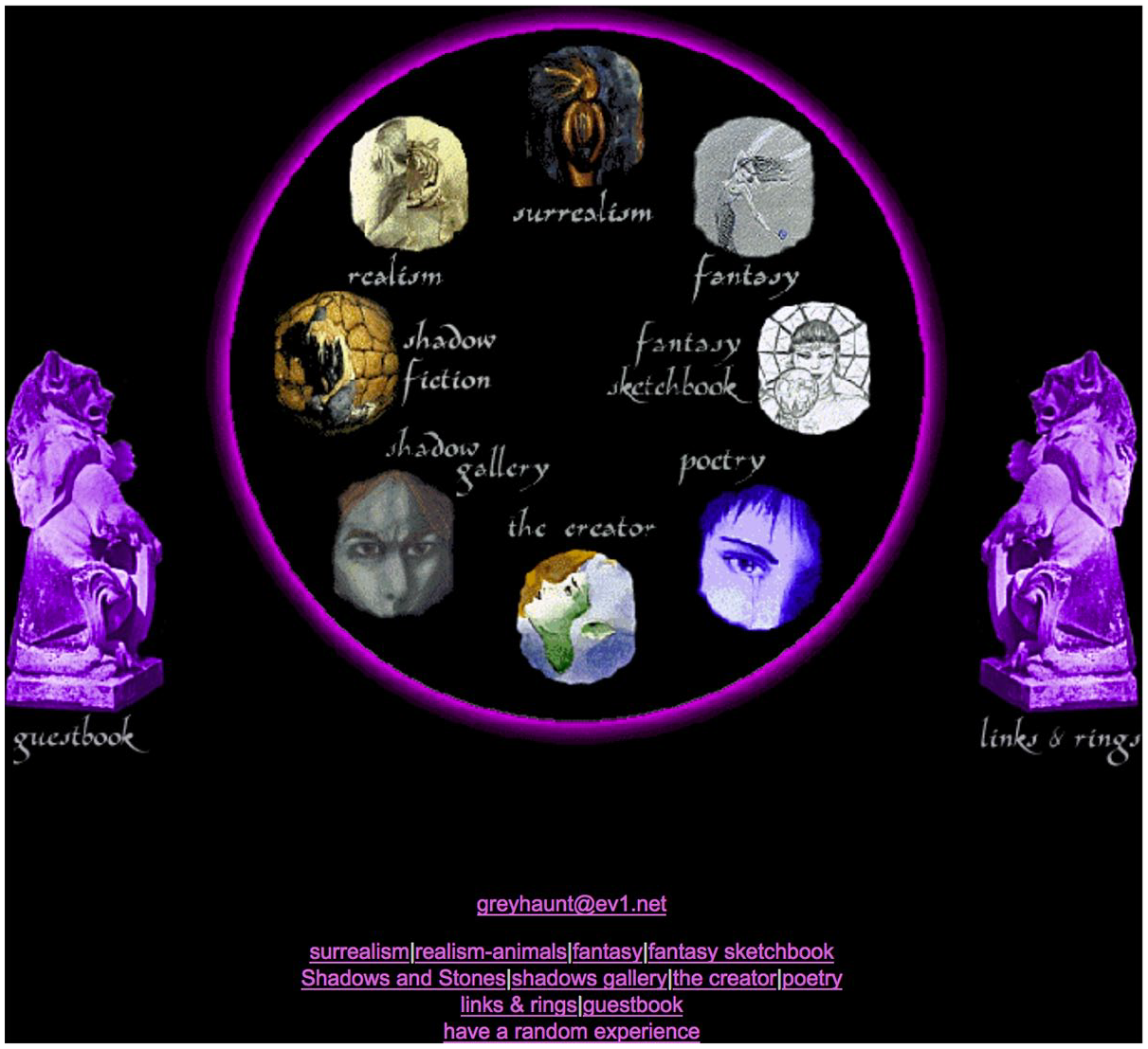
Author screenshot of Greyhaunt Galleries, where the Haunting format began, in its non-Haunted layout on 8 October 1999, originally located at http://www.geocities.com/SoHo/Lofts/9264/indextest.html and currently available through the Wayback Machine.
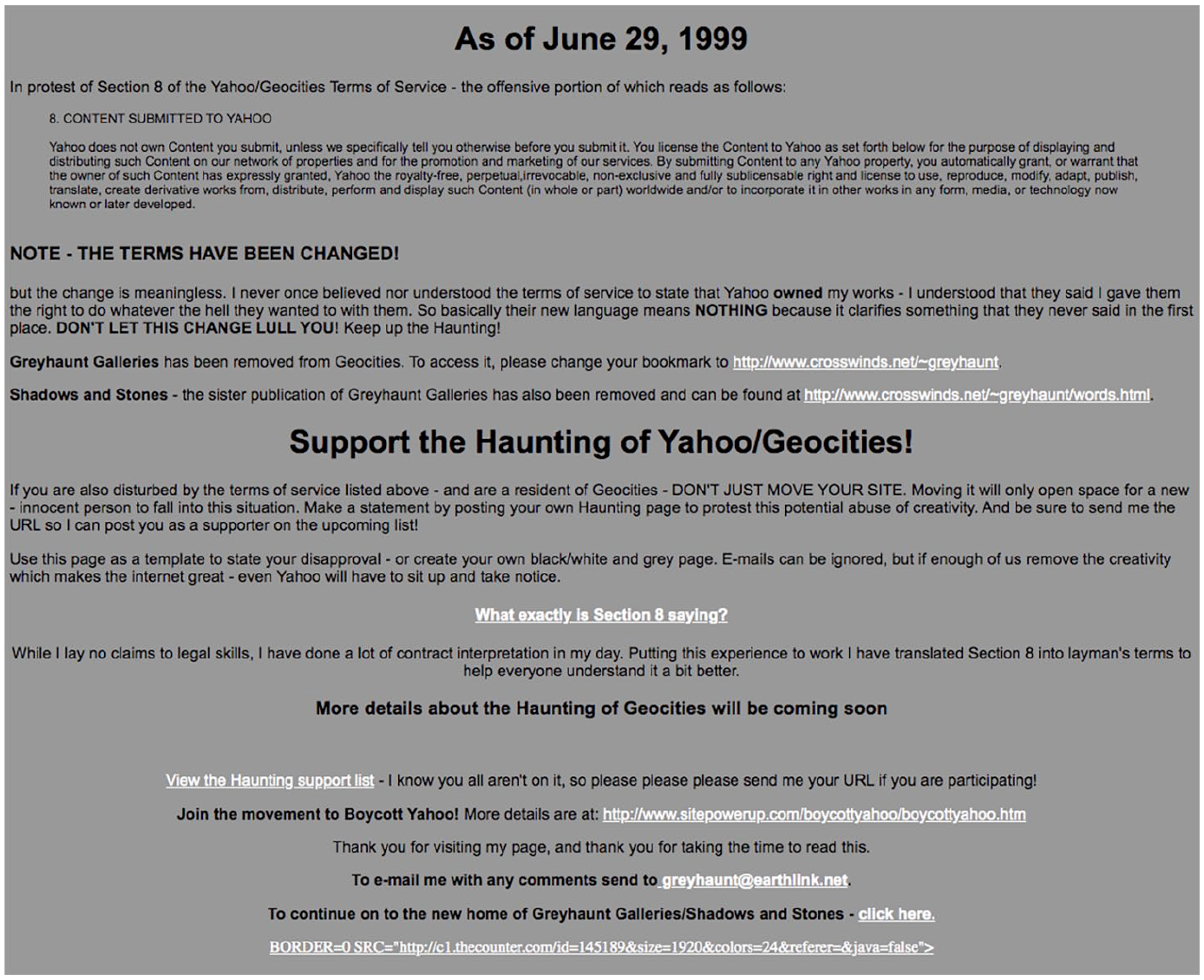
Author screenshot of the Haunted version of Greyhaunt Galleries from midway through the dispute with Yahoo, originally located at http://www.geocities.com/Area51/Shire/5872/ and currently available through the Wayback Machine (https://web.archive.org/).
A user boycott was not what Yahoo had expected when it purchased GeoCities. By 30 June 1999, the day after the launch of the boycott and the accompanying press coverage, Yahoo was in damage control mode. “This is not a grounds for us to grab stuff and somehow package it for moneymaking purposes,” Yahoo’s Tim Brady told the Los Angeles Times. “Trust is a pretty fragile thing,” Brady added presciently, “and we know users would absolutely flee if we did anything like that” (Miller, 1999). Brady was only partially correct; while it seems true that many people would flee from a site that blatantly appropriates and monetizes their copyrighted content, GeoCities users were not willing to wait and see if Yahoo would actually attempt to do so. The perception of legal permissibility was enough to self-evict many users from the Yahoo-controlled hub. Behind the few homesteaders speaking to the press were many others who silently shared their concerns. When Yahoo changed the TOS, the cultural significance of community and control quickly became evident. Because of the unusual level of interaction and perceived intimacy between homesteaders and the owner-operators of the platform prior to the acquisition, paired with a marked distrust toward Yahoo as a large corporation, GeoCities users took notice of changes to the TOS in substantial numbers and with uncommon intensity. Yahoo was facing a public relations disaster and a user revolt on a property it had acquired, at a massive cost, just weeks before.
A public letter to GeoCities homesteaders attempted to correct what Yahoo perceived as a misunderstanding about the changes (Yahoo! Inc, 1999c). The letter explained that the new TOS was designed to grant Yahoo the rights necessary to manage and promote a large Web community and conceded that its expansive content license would terminate upon the deletion of one’s GeoCities account, providing a link in the letter to a form where GeoCities members could request their site be deleted from Yahoo’s servers. 5 Yahoo’s strategy projected an image of forthrightness to counteract the obfuscating legal language of the official policy. Rather than quelling the backlash with this tone change, many GeoCities homesteaders found the letter condescending and insincere. Yahoo’s letter, though meant as a clarification of the TOS terms, did not carry the valence of an enforceable legal agreement the way the TOS did and thus was treated as less representative of the company’s true intentions (see Figure 2; Welch, 1999). Even in an attempt at straightforwardness, Yahoo persisted in using corporate formality to address GeoCities users as customers of its services rather than community members or content-generating partners.
Yahoo executives continued to frame the protests around the TOS as a misunderstanding rather than a fundamental disagreement over contractual terms (Junnarkar, 1999a; Napoli, 1999). For example, Yahoo noted in its letter that “the Yahoo! GeoCities TOS (which have been standard on the Yahoo! network) are very similar to the TOS of many major Web sites and online services, including other home page providers” (Yahoo! Inc, 1999c). Yahoo was correct that the additions to the GeoCities TOS were similar to those deployed by prominent competitors (Junnarkar, 1999a), and that many homesteaders angry about the new TOS did not recognize that several of the terms they objected to were already in place pre-acquisition, albeit in less explicit forms. For example, the 1997 TOS stated that “GeoCities reserves the following rights… To use images of homesteader pages for promotional and other commercial purposes” (GeoCities, 1997). Being technically correct, however, solved neither its public relations problem nor granted the desired access to user content that the TOS had been designed to provide. Furthermore, early TOS, like the best practices for early Web design that Megan Sapnar Ankerson (2018) examines, “often became codified as industry standards” and “were used in turn to reproduce particular ideological meanings about the social life of the web, including how it should properly be imagined and designed and how users ought to experience it” (p. 5). Thus, Yahoo’s appeal to standard industry practices raised the stakes of the dispute, making the GeoCities TOS into a referendum on the standards of an entire industry (McCullagh, 1999), while also demonstrating that companies and users had wildly different outlooks on the settledness of industry norms. 6
Yahoo’s carefully constructed contract likely did safeguard the company’s use of content more fully than the original TOS by including the ability to sublicense content rights. For example, where GeoCities’ (1997) TOS reserved the right to use “images of homesteader pages,” presumably screenshots of the entire page based on the marketing images used in preserved versions of the GeoCities home page, Yahoo reserved the right to use any piece of the site through the language of “in whole or part,” regardless of the content’s original context. This difference highlights the centrality of control in the dispute; while GeoCities still leveraged user creations for marketing purposes, they did so in a way that seemed to maintain the integrity of the original user’s design and personal expression by displaying the entire page. Yahoo’s terms, by contrast, allowed the separation of content from its context and creator, undermining the sense of self-representation at the heart of the GeoCities experience and moving control of the content and its display at least partially into the hands of the company. Yahoo was perceived as a hostile corporation (as Townsend described them, “corporate clowns”) invading an independent community and making a grab for control over valuable user-generated content (Townsend, 1999d).
Yahoo changed its TOS two more times before reaching an accord with the boycotting homesteaders. The first revision, released on 30 June 1999, offered only minor changes, most notably the addition of the following line: “Yahoo does not own Content you submit, unless we specifically tell you otherwise before you submit it” (quoted in Townsend, 1999e). David Fiedler, editor-in-chief of online magazine WebDeveloper.com, described the change as “window dressing” and warned protestors that “this is intended to lull your suspicions but it doesn’t really change” (Napoli, 1999) Yahoo’s legal rights. Fiedler and other protestors noted that Yahoo’s changes failed to address one of the main points of contention among boycotters, the “sublicensable” portion of the TOS which enabled Yahoo to sell the content rights it reserved to third parties, who could then adapt and monetize the content at will in exactly the ways Yahoo itself promised not to do. Unsatisfied, protestors continued to join the Haunting; as hundreds of sites removed their content, Townsend sent press releases to mainstream news outlets, and homesteaders recruited support on forums and Usenet newsgroups like alt.homepages.geocities. 7
With protest tactics spilling outside the boundaries of the Internet and onto broadcast mediums like television, including interviews on CNBC and Fox News (Townsend, 1999a), Yahoo backed down. The final version of GeoCities’ TOS, with the relevant portion reconfigured as Section 7, was released on 6 July 1999 and read as follows: Yahoo does not claim ownership of the Content you place on your Yahoo GeoCities Site. By submitting Content to Yahoo for inclusion on your Yahoo GeoCities Site, you grant Yahoo the world-wide, royalty-free, and non-exclusive license to reproduce, modify, adapt and publish the Content solely for the purpose of displaying, distributing and promoting your Yahoo GeoCities Site on Yahoo’s Internet properties. This license exists only for as long as you continue to be a Yahoo GeoCities homesteader and shall be terminated at the time your Yahoo GeoCities Site is terminated. (Yahoo! Inc, 1999b)
The changes restrained Yahoo so thoroughly that they isolated the new TOS, applying it exclusively to GeoCities, while maintaining the more expansive version on their other properties. Boycotters claimed victory in the dispute (Townsend, 1999c), with the terms simplified in content and language, the sublicensing clause completely removed, and Yahoo’s control over user content explicitly limited. While some pages permanently moved off of GeoCities during the boycott, others restored their content (see Figure 1) and returned to homesteading.
The Haunting of GeoCities was a struggle over access control. The value of user-generated content helps explain the effectiveness of the Haunting strategy, where users removed their marketable content but left a ghostly presence taking up space on Yahoo’s servers. As Yahoo’s Tim Brady conceded, “If [homesteaders] don’t publish, we don’t have anything to sell” (quoted in Napoli, 1999). Yahoo ultimately relented because the discord the policy created among homesteaders and the broader public was detrimental to its business interests. The company understood that encouraging users to keep generating and hosting content on its service was more valuable than claiming control over the content that remained on GeoCities after the backlash. As Guardian tech reporter Charles Arthur (2006) put it, “to echo Field of Dreams, if you build it, they will come. The trouble, as in real life, is finding the builders.” The structure of GeoCities, even more than modern social media platforms, required users to develop their original content in the form of a personal website in order to be full participants in the community. Driving away these builders meant undermining the very structure of the third-most popular site in the world and, therefore, the value of the content platform Yahoo had just invested in.
Economic analysis of the value of access has continued in 21st century social media acquisitions, including Facebook’s 2014 purchase of messaging app WhatsApp for US$19 billion (Covert, 2014), which represented a cost of US$19 for each of WhatsApp’s then 1 billion users. Such deals demonstrate that companies pay not just for technical infrastructures, but access to a pre-constituted user base. In this sense, Yahoo placed a very high value on access to GeoCities users in its acquisition; indeed, Yahoo’s acquisition of GeoCities remains one of the most expensive per-user deals in Web history at a cost of more than US$800 per GeoCities homesteader (Baio, 2012; Sterling, 2014). Each homesteader driven away represented a very real and calculable loss to Yahoo. The company’s view of access, encoded in the conversion of users and their content into dollars, demonstrates the pervasive influence of economic calculus in the development of Web communities, turning would- be representations of personal identity into so many bytes of monetizable data. Denied free use of user content, threatened with the migration of its users to competitors, and faced with increasingly bad publicity surrounding its expensive new acquisition, Yahoo eventually acquiesced to the demands of GeoCities users, limiting its ability to control content and removing the “sublicensable” portion of Section 8 altogether. While GeoCities has since been deleted and its homestead vacated, the modifications to Section 8 maintain a haunting presence in current TOS agreements and user-platform relationships.
Section 8’s ghostly legacy
The Haunting of GeoCities serves as a landmark case of the contestation and successful negotiation of content rights online. The coming together of dispersed netizens, united primarily by their usage of GeoCities, reflects “a much larger shift in social life” that involves “a movement away from central bureaucracies and vertical hierarchies toward a broad network of autonomous social actors” (Galloway, 2004: 13). The power of decentralization is a recurring trope in the rhetoric of platforms, most recently reflected in the celebration of blockchain technologies as a tool to disrupt online hierarchies (e.g., Popper, 2018), a goal embraced by platform CEOs like Mark Zuckerberg (2018) and Jack Dorsey (2019). Before contemporary platforms touted the power of decentralization, this was the promise of GeoCities; by offering free Web hosting, server space, and easy-to-use page builder tools that helped digital newcomers create an online presence, GeoCities took up the democratizing mandate of the early Web ethos, removing some of the major barriers that deterred new users from participating in Web culture. 8 The boycott of GeoCities was a distributed protest that nevertheless shared very similar ideas and sensibilities, supported by a significant amount of peer interaction and organization. While many protestors flocked to centralized points of protest like Townsend’s website, 9 even his was not a singular voice as he frequently circulated the statements of others.
As important as these elements of decentralization were, however, centralization also sustained the conflict. In an era of the Web where pages were scattered across a multitude of servers, often without search engine indexing or significant hyperlinking in and out, GeoCities cultivated a large, relatively centralized collection of user-created Web pages and encouraged community norms and expectations to develop. The centralized structure of GeoCities enabled Yahoo’s acquisition and attempts to apply a blanket TOS to change the conditions of all GeoCities users with a single click-through agreement. Simultaneously, users were able to take advantage of the way their sites were gathered together to resist such changes so that a casual browser could pass from one site to the next and be confronted with the same protest content over and over again. Conflicts between users and companies, between the technical and the social, and between the centralized and decentralized structures of the Web are enduring points of tension in platform societies.
The successful boycott of GeoCities also generated wide-ranging effects on the agreements between platforms and users about who ultimately owns and controls uploaded content. At the time of the protest, while Yahoo received the brunt of public wrath, competing Web services like Xoom and Tripod had passages similar to Yahoo’s Section 8 in their TOS. During the GeoCities boycott, Tripod cannily tweaked its TOS, limiting the rival Web host’s own expansive content license by adding the phrase “for the limited purposes of displaying and promoting the user’s personal homepage and for displaying the content of such personal homepages within the Lycos Network” (quoted in Townsend, 1999b). The GeoCities conflict catalyzed changes on other platforms, conceded Geoff Strawbridge, Director of Membership Services at Tripod, adding, “We feel strongly that [intellectual property], member-generated content, and creativity are fundamental issues which Tripod supports and champions on the Net” (Junnarkar, 1999c). Yet another competing service, Hobbyhost, posted a message at the top of its home page to let users know that “Hobbyhost does not and will not ever claim the rights to your hard work as other WebHosts are doing in their Terms of Service contracts” (quoted in Townsend, 1999b). When Microsoft launched its homepage creator later that year, it admitted that it was “examining the language” of its TOS carefully “in light of what happened with Yahoo” (Leonard, 1999). The ripples of the boycott extended beyond the domain of website creation and hosting. In a Wired article on the controversy, Jim Moloshok, President of Warner Bros. Online, attempted to distance the motivations of his company from those of Yahoo. “We don’t have those claims on the consumer’s content, nor would we ever do so,” Moloshok told Wired. “As copyright owners, we know the value of content” (McCullagh, 1999).
Conflicts over TOS and the value of content have continued long after the rise and terrible fall of GeoCities. Indeed, a strikingly similar situation occurred in 2012 after social media giant Facebook purchased photo-sharing app Instagram and tweaked the TOS, adding a mandatory arbitration clause intended to prevent the sort of class-action lawsuits Facebook users had launched against the company in recent years and updating its licensing terms for content. These changes resulted in a lawsuit, Rodriguez vs. Instagram, LLC (2014), in which plaintiff Lucy Rodriguez argued that Instagram’s TOS changes constituted a breach of contract because, The New Terms modified the original terms in three allegedly material respects… (1) the addition of sublicensing authority; and (2) removal of any limitations on the scope of the license and (3) the New Terms add a liability waiver. (p. 2)
While GeoCities boycotters engaged in a collective, grassroots action that leveraged their value as content creators, Rodriguez sought a legal remedy through the more technical and exacting method of contract law. However, Rodriguez undermined her lawsuit by continuing to use Instagram after filing her breach of contract case, which courts ruled to be an implicit acceptance of the new TOS (Cocozza, 2015: 379–380). In this way, Rodriguez committed a mistake that GeoCities protestors avoided through the strategy of the Haunting boycott: she continued to access Instagram, stored her content on Instagram’s servers, and derived value from using the service. While Haunting a Web page is not the same as ceasing to use GeoCities, protesters’ use of the platform purposefully gutted the value they could derive from GeoCities (and it from them) and made a public spectacle of the dispute. 10 In contrast to the negligible attention Rodriguez’s lawsuit generated, the GeoCities boycotters’ mode of protest engaged the drive for attention at the heart of advertising-supported Internet platforms and turned that attention against Yahoo. In so doing, they demonstrated a third mode of user/platform interaction beyond the binary of use and non-use: antagonistic use.
Antagonistic use leverages the affordances of platforms as socio-technical structures while pushing back against platforms’ dominant position in the platform society. Commercial moderation on platforms makes content removal, as Sarah T. Roberts describes it, invisible “by design” (Roberts, 2019: 3), whereas the Haunting of GeoCities involved a strategy of highly visible and antagonistic content removal. Examples of such antagonism represent prominent moments in the history of online culture, both before and after the rise of platforms. For instance, in 1996, websites protested the Communications Decency Act which proposed to restrict access to so-called “indecent” content online by converting the background color of Web pages to black. The protest, known as the Great Web Blackout, counted hundreds of prominent web sites among its ranks, including sites from US Representatives, Senators, and major online businesses like Netscape (Lewis, 1996; Mitchel, 1997). The Center for Democracy and Technology cataloged at least 1500 participating sites in what they termed “by far the larges [sic] and most successful Internet demonstration in history” (Center for Democracy and Technology, 1997). Interestingly, one of the protesting sites was Yahoo. Similarly, the 2012 protest against proposed legislation in the United States known as the Stop Online Piracy Act (SOPA) and the Protect IP Act (PIPA) mobilized more than 115,000 websites to feature protest graphics, including Yahoo-owned site Flickr, or disable access to some or all of their content, as Wikipedia did (Wortham, 2012). While the protest against SOPA/PIPA was later taken up by mainstream and corporate sectors of the Internet, it began with everyday users mobilizing in much the same way GeoCities homesteaders did: on message boards, email chains, and user-driven communities (Wortham, 2012). 11
By recognizing the powerful position platforms occupy in digital discourse, antagonistic use offers a mode of provocation that demonstrates possibilities for the resistance and reclamation of platform power. Legal challenges to the Communications Decency Act resulted in the blocking or amending of key portions of its regulations. SOPA/PIPA were tabled by Congress after the 2012 protests and have not been raised again. Even outside of direct TOS agreements and platform boundaries, online content creators have leveraged the value of their creativity through collective actions that directly challenged mass media operations such as Warner Brothers’ ill-conceived attempt to take down Harry Potter fan sites (Stanfill, 2019: 115–116). Antagonistic uses of online platforms can effect change both on those platforms and within the larger digital landscape, offering a way to counter the “learned helplessness” many users experience when interacting with platforms (Fiesler and Hallinan, 2018: 9) and major media companies. The cadre of GeoCities competitors who changed their TOS agreements to accord with the demands of Yahoo protestors, despite not being specifically targeted by them, shows the spillover potential of effective antagonism. In Haunting their GeoCities sites, homesteaders not only threatened Yahoo’s value by asserting access control over their content, but also shifted the policies of the most prominent representatives of an entire online business sector.
Access is a site of contestation, and one that is useful for making sense of contemporary platform politics. While there remains a tendency to think of access as a positive value, as something that should be increased, our examination of GeoCities shows that access for one stakeholder can trade-off with access control for other stakeholders, particularly users who generate most online content. Yahoo’s TOS were designed to secure the company greater access to user-generated content. For content creators, this change reduced their ability to control how and where their content was accessed and used, disempowering their personal choices and taking advantage of their labor and creativity. Homesteaders leveraged the very tools Yahoo provided to create value (in the form of content) to undermine that value and retake control. Access control as an analytic helps reveal the desires and goals of multiple stakeholders and provides another rubric for assessing the politics of platforms alongside terms such as fairness, accountability, transparency, and ethics.
The mass mobilization against Yahoo in 1999 makes it clear that platforms, and their politics, are not new phenomena. This flashpoint from an earlier era of Internet culture offers ongoing lessons for platform studies today, including a demonstration that users are (or can be) agents of platform politics. Engaging the technical affordances of service and server access, as well as the social affordances of GeoCities’ community structure, size, and popularity, and the economic imperative of Yahoo to maintain the value of its content and user base, homesteaders leveraged the principles of access control to effect change on the platform they helped build. In doing so, they demonstrated that “platforms, in their technical design, economic imperatives, regulatory frameworks, and public character, have distinct consequences for what users are able to do, and in fact do” (Gillespie, 2015: 1). In other words, the politics of platforms are not only a top-down affair, something done to users. Understanding access as fundamentally an issue of control offers a more complete understanding of the power relations at play in the Haunting of GeoCities, a key historical situation that offers a different model of platform politics that can inform and inspire the study of contemporary Internet platforms and the debate over who owns, accesses, and controls Web content. Even as GeoCities is no longer with us, we can continue to draw inspiration from its reminder that platforms are always under construction.
Footnotes
Acknowledgements
The authors would like to thank the many readers who helped us figure out how to shift a story about GeoCities in 1999 from the observation of “this is neat” to an argument about why this continues to matter. Liz Ellcessor provided exceptional early guidance and inspiration, while the Philosophy, Theory, and Critique division of ICA and the truly excellent anonymous reviewers at New Media & Society pushed us to sharpen the stakes and extend the theoretical contribution. Finally, our sincere thanks to the Internet Archive and GeoCities preservationists, for without them our work would not be possible and the Internet would be a smaller place.
Funding
The author(s) received no financial support for the research, authorship, and/or publication of this article.
