




Abstract
This article presents a transnational study of the classification and evaluation of social media content. We conducted a large-scale survey (N = 4770) in five countries (Germany, Italy, Japan, South Korea, and the United States) with open-ended questions about the types of content people like and dislike. Through iterative and inductive coding, we identified 29 topics, or broad areas of interest, and 213 recurrent genres, or narrower categories that share elements of form and content. We compared the results according to country, gender, age, and education level, identifying patterns of cultural difference and commonality. While we found significant differences in the prominence and preferentiality of content, these distictions were less pronounced for disliked topics around which social media users tended to converge. Finally, we discuss genre imaginaries as normative maps that reflect ideas about morality in general and the purpose of social media in particular.
People around the world share content through social media at unprecedented levels, with over 720,000 hours of video uploaded to YouTube, 95 million photos and videos posted to Instagram, and 500 million Tweets sent each day. 1 Compared to print or television, there are few barriers to create, upload, and circulate things online. Despite the vast geographic reach and volume of content, social media is not a realm of randomness and chaos. Instead, people create and interact with recognizable patterns of content like selfies (Marwick, 2015) and video game gameplay (Postigo, 2016). Such genres both reflect the organizational logics of social media and shape the contours of digital culture (Lomborg, 2011).
While studies of discrete social media genres have demonstrated their relevance to an array of societal issues, there have been few attempts to move beyond case studies toward a broader overview of the social media content ecosystem. Even as social media platforms have distinct features and cultures (Burgess and Green, 2018), it is increasingly common for people to use multiple platforms (Zhao et al., 2016), for content to circulate across platforms (d’Andreá and Mintz, 2019), and even for the design of platforms to converge around similar features and information (Helmond, Nieborg, and van der Vlist, 2019). In response to these developments, there have been calls for more cross-platform academic research (Hall et al., 2018; Matassi and Boczkowski, 2021). Accordingly, this article is based on the premise that mapping social media content beyond the boundaries of individual platforms responds to the conditions of social media use and provides a framework for future comparative research.
In this study, we chart a transnational map of prominent social media genres, focusing on everyday perceptions of genres—that is, how people categorize and evaluate content (Beer, 2013; Chandler, 1997). We argue that a focus on user perspectives, embedded in our take-up of the concept of social media imaginaries, offers a productive way to investigate the relationship between global media systems and local cultures, complementing comparative anthropological investigations of this topic (Miller et al., 2016). We extend this line of research by asking when people from different parts of the world think about social media, what types of content do they think of? And how do they feel about that content?
In what follows, we review the literature at the intersection of genre, culture, and social media and introduce the idea of the social media imaginary as an analytical strategy for identifying genres. Next, we describe our research design of asking 4770 people from five countries to name and describe types of social media content that they like and dislike, collaboratively coding the open-ended responses in an iterative process, and analyzing the resulting collection of topics and genres according to demographic categories. Following previous research showing that genre preferences construct identities and draw social boundaries (Bryson, 1996; Wilk, 1997), we focus our comparison on country, gender, age, and education levels. Finally, we present the findings of our study and discuss the implications for broader issues of globalization, media, and moral judgment.
Genres as culture
It is hard to imagine culture without genres. From movie Westerns to happy birthday wishes on social media, human creativity and interaction take place within patterned structures of expression. The concept is even relevant to this very minute, as you interpret these words according to a set of expectations associated with the genre of the academic journal article. Interest in the concept spans disciplines, each with distinct questions and analytic tools. For example, linguistic anthropologists have investigated how genres shape and are shaped by our daily interactions (e.g. Briggs and Bauman, 1992), while media and communication scholars have shown how the meaning of genres is entwined with culture-specific processes of production and reception (e.g. Mittell, 2001). Although there are disagreements about the formulation of the concept, genres are broadly understood as socially recognized categories of cultural expression that share elements of form, content, and interpretative expectations (Miller, 2015; Mittell, 2001; Orlikowski and Yates, 1994).
Since genres are always anchored in social and historical contexts, they are indicative of power structures and values. The association between Westerns, masculinity, and rugged individualism (Roberts, 1997) and the emergence of rap as a form of counter-hegemonic authenticity (Pennycook, 2007) are but two examples of the deep connections between genres and culture. Moreover, genres create templates for cultural production that channel expression toward recognizable formats (Todorov and Berrong, 1976).
By setting expectations and offering an opportunity for social distinction, genres also influence cultural consumption. Researchers have explored people’s perceptions of media genres using surveys, interviews, and ethnography. Often, this work focuses on specific genres, such as Janice Radway’s (1984) foundational study of gender and romance novel readers or Jason Mittell’s (2013) study of the classed discourses surrounding television talk shows. Strong reactions to genres, especially low-brow ones, demonstrate that classifications are simultaneously evaluations bound up in social categories (Wilk, 1997). Consequently, the perspectives of “anti-fans,” or people who dislike a genre, can be especially revealing since behind dislike, after all, there are always expectations—of what a text should be like, of what is a waste of media time and space, of what morality or aesthetics texts should adopt, and of what we would like to see others watch or read. (Gray, 2003: 73)
Most investigations of genre and taste focus on specific genres, communities, and subcultures. However, researchers have also mapped genre preferences across populations to identify broad structural patterns, particularly in the realm of music. In an influential study, Bethany Bryson (1996) used survey data to identify a process of taste-based “symbolic exclusion” in which people use musical genre preferences to reinforce symbolic boundaries between themselves and others. Subsequent studies have extended the initial class-oriented analysis to show the salience of age and generation in patterns of disliking (e.g. Lizardo and Skiles, 2015). While researchers have had some success investigating audience evaluations in the realm of music where there are comparatively well-established genre categories, Internet genres pose a greater challenge.
New media, new genres
Genres are intimately tied to communication technologies, with cultural and generic transformations accompanying technological developments. For instance, during the 1970s, folklorists analyzed an emergent body of humorous genres they dubbed photocopylore, xeroxlore, and faxlore—texts that were created and circulated in workplaces through photocopiers and fax machines, the “new media” of that era (Dundes, 1983). Photocopylore reveals deep congruence between medium and message: not only did the content rebel against bureaucracy and standardization, but the act of creation required the subversive exploitation of workplace resources (Roemer, 1994). More recently, Phillips and Milner’s (2018) investigation of vernacular creativity on the Internet shows how memes both continue and transform the antagonistic legacy of photocopylore. They also trace how the modifiability, modularity, and achievability of digital communication shape generic forms of cultural production.
The vast amount of user-generated content, the experimental spirit of Internet users, and the reach and speed of interaction (Miller, 2015) lead to a situation in which Internet genres are extremely fluid and do not “have the same obligatoriness and ritualized expectedness” (Giltrow and Stein, 2009: 11) as older media genres. Furthermore, the flow of digital content erodes boundaries between historically distinct modes of cultural expression: amateur and professional, mass and personal (Cunningham and Craig, 2019). Digital culture thus brings together different scales of cultural expression, resulting in a situation where your social media feed is likely to feature a clip from the evening news alongside a snapshot of your neighbor’s dog.
Genres, while hard to pin down, play a pivotal role in the production and consumption of digital culture. People tend to mold their contributions around specific genres (Milner, 2012) that create a sense of community and provide others with keys for participation (Brown and Duguid, 2000). Much of the early work analyzed textual genres associated with email (Orlikowski and Yates, 1994) and blogs (Giltrow and Stein, 2009), while more recent work has privileged visual formats like selfies (Abidin, 2016; Marwick, 2015) and vlogs (Burgess and Green, 2018). Although there have been some attempts to create maps or develop taxonomies of Internet genres (especially blogs), very few focus on social media. There are, however, two notable exceptions: Westman and Freund (2010) categorized five prominent genres on Twitter based on formal attributes such as purpose, content, and form, and Rieder et al. (2020) conducted a large-scale quantitative analysis of channel categories and subcategories on YouTube established by the platform and selected by content creators.
While these taxonomies highlight larger patterns in social media content, they are limited in three ways. First, they adopt a top-down approach to genre classification that builds on formal attributes and platform standards. This does not account for everyday perceptions of genres that influence how people interact with and interpret media (Chandler, 1997). Second, they are platform-specific, focused on Twitter or YouTube. While these platforms are indeed important, other platforms such as Instagram and Facebook are also relevant to the overall landscape of digital genres. In addition, the investigation of individual platforms does not account for the broader social media ecology in which people use multiple platforms (Zhao et al., 2016) and content circulates across platforms (d’Andreá and Mintz, 2019). Finally, they do not directly investigate the relationship between genres and culture, even as the transnational character of social media platforms (Jin, 2019) raises questions about globalization and the development of similar genres across geographic locations (Shifman, 2016). At the same time, research has also shown how social media use expresses local values (Miller et al., 2016). Thus, social media genres epitomize the complex nexus of global–local relationships.
Toward a transnational social media genre imaginary
We use the phrase social media imaginary to refer to the ways in which people understand and relate to social media platforms. In so doing, we bring together research interested in folk theories of social media (e.g. Siles and et al, 2020) with what Ilana Gershon (2010) refers to as media ideology, or “people’s beliefs, attitudes, and strategies about the media they use” (p. 391). Although the language of the imaginary is not always used, there is growing interest in ordinary, everyday, and folk perspectives on social media platforms, spanning perceptions about the future of digital technology (Markham, 2020), algorithmic recommendation (Bucher, 2017), and content moderation (Caplan and Gillespie, 2020), to name a few. Social media imaginaries are both descriptive and normative; that is, they pertain to ideas about what a platform is and what a platform should be (Hallinan et al., 2020). In turn, how people imagine platforms shapes how they communicate and interact (Van Dijck et al., 2018).
As a prism that foregrounds user perspectives, social media imaginaries offer an important complement to structural or top-down analyses of platforms. However, as an emerging area of research, there is much that can be developed and expanded upon. First, while there has been significant work on the algorithmic governance of social media platforms, we know very little about how people conceptualize what is recommended, shared, and moderated on social media—namely, social media content. Second, research on the social media imaginary has been predominantly Anglocentric and there is a need to investigate more diverse geographic and cultural contexts (see Siles et al., 2020 for a notable example). Third, although prior research supports the notion that people imagine social media platforms as interconnected (Zhao et al., 2016), and that content regularly circulates across platforms (d’Andreá and Mintz, 2019), more work is needed to understand how people relate to the broader social media ecology.
Bringing together work on the social media imaginary and genres, we propose a transnational comparison of the ways that people conceptualize and evaluate social media content. While most of the research on social media imaginaries privileges localized perspectives, drawing upon ethnographic research, interviews, and content analysis, the conceptual framework can fruitfully be deployed for other scales of analysis. For example, Litt and Hargittai (2016) used a combination of media diaries and interviews to develop a model of how people imagine the audience of social media posts across platforms. Given the relative lack of taxonomic research on social media content, as well as our interest in the platform ecology and dynamics of globalization, our research design is geared toward charting the genre imaginary as a kind of bird’s-eye view, concerned with broad patterns in classification and the general attitudes people hold toward social media content. In other words, we posit that the relationship between social media platforms is akin to the relationship between television channels rather than the larger conceptual gap between television and other mediums.
Drawing on these foundations, our study is organized around the following three research questions:
RQ1. What types of content do people identify on social media?
RQ2. How do people evaluate different types of content in terms of liking and disliking?
RQ3. How does content identification and preference vary according to country, gender, age, and education level?
Together, the answers to these questions will allow us to create a map of prominent genres of social media content as understood by users and investigate transnational patterns of commonality and difference. In so doing, we will bring a cross-platform and cross-national perspective to bear on the concept of the social media imaginary.
Method
To develop a map of social media genres, we combined quantitative and qualitative research methods, applied in four phases: (1) reviewing prior research on social media genres, (2) conducting an open-ended survey of social media content likes and dislikes in five countries, (3) iteratively coding topics and genres, and (4) analyzing patterns of classification and preference. The study was conducted by a multi-lingual team consisting of native speakers of the main language of each country.
Phase 1: Reviewing research on social media genres
We began by reviewing types of social media content mentioned in existing research, surveying all article titles and abstracts from 15 prominent media and communication journals published between 2005 and the end of 2019. We selected journals focused on the Internet, along with generalist journals in the fields of media and communication. We added each type to a list arranged alphabetically, using emic terms when possible; larger categories were created only in the presence of clear textual evidence connecting the entries (e.g. the category of Selfies includes subcategories of Luxury Selfies, Activist Selfies, and Pregnancy Selfies).
Phase 2: Surveying social media content likes and dislikes
Our initial survey of the literature confirmed that (1) there is no established list or schema of social media genres, (2) the total number of genres mentioned in the research is too large and unwieldy to implement as a closed-ended question, and (3) the majority of social media genre research focuses on the United States and English-language content. Consequently, we decided to use open-ended survey questions to solicit subjective responses and developed a protocol where we asked people to name and describe specific types of social media content that they like and dislike.
We distributed the survey in five countries to facilitate transnational comparisons: Germany, Italy, Japan, Korea, and the United States. Each of these countries has high rates of Internet use, relatively open Internet policies, and similar government structures, yet their respective value systems are often depicted as divergent (e.g. Hofstede, 2003). Although prior research has demonstrated the utility of asking about likes and dislikes to solicit genre categories in English (Buckingham, 1993), we checked the cross-cultural validity of the approach with a pilot survey.
Based on the informal pilot, we decided to ask participants to list two types of content they like on social media, two types of content they dislike, and to provide a description for each. We also included several examples of genres in the survey to get respondents thinking about social media content, as well as a set of closed questions about age, gender, and level of education.
The survey was administered through Qualtrics and participants were randomly selected from online panels using age quotas based on 2020 social media trends in each country (Kemp, 2020), along with a balance of men and women. We included a question to screen out people who have never used social media. The survey ran from 24 March and 10 April 2020. We excluded data from respondents who provided unusable answers such as gibberish yielded by hitting random keys or non-related answers such as “have a nice day.” After excluding these responses, the overall sample size of each survey was: Germany (N = 989), Italy (N = 946), Japan (N = 945), Korea (N = 945), and the United States (N = 945).
Phase 3: Iteratively coding topics and genres
Transforming 19,100 descriptions of social media content from 4770 respondents into a map of genres is a significant undertaking. We analyzed the data in several rounds, combining emergent categories observed in the data with theoretically informed ones, following the principles of grounded qualitative content analysis (Lindlof and Taylor, 2019). Based on the list from the first phase and our initial reading of the survey responses, we drafted a codebook that included genres and topics. The addition of the topic category emerged from the nature of the data as some of the responses were too broad to be labeled as a genre, yet clearly indicated the subject matter (see below). We further developed the codebook using a sample of 100 responses from each of the five countries to detect new categories and refine our classification scheme.
Next, five of the researchers coded the full dataset independently, working in their language and national context of expertise. Throughout this process, the team met regularly to discuss questions, complications, and emergent categories. Once again, we revised the codebook, adjusting the genres, topics, and descriptions to better reflect the survey responses. Using the final version of the codebook (available in full upon request), we recoded the responses as categorical variables.
Phase 4: Analyzing patterns of identification and preference
We conducted a descriptive statistical analysis to examine the prevalence of different types of social media content. To investigate people’s basic disposition toward topics and genres, we generated a variable to distinguish content that is consistently liked, disliked, or contested (a mix of likes and dislikes). The disposition toward content variable was calculated by dividing the frequency of liking by the frequency of disliking, resulting in the following three basic dispositions: (1) leaning toward liked, (2) contested between liking and disliking, and (3) leaning toward disliked.
To test whether the proportions of the topics differed according to demographic variables, we used Fisher’s exact test for 2 × 2 and 2 × 3 tables (age, gender, and education) and a chi-square test of independence for 2 × 5 tables (country). We adjusted the P values for multiple testing using a false discovery rate (FDR) of 5% based on the Benjamini-Hochberg procedure. For each of these tests, we deleted duplicates in liked or disliked topics mentioned by the same person (e.g. if someone mentioned both Recipes and Cooking Videos as liked genres, the topic Food was counted once).
Results
Topics, genres, and logics of classification
We asked people to name types of social media content and their answers demonstrated different logics of classification, ranging from the very specific (e.g. the name of a popular YouTube channel like Ozzy Man Reviews) to the very general (e.g. subjects like travel or news). To account for the variation in scope, we coded the responses at two levels of specificity: topics, or broad areas of interest such as Animals or Sports, and genres, or narrower categories that share elements of form and content such as Animal Inspiration Stories or Mukbang. 2
We identified 29 distinct topics (see Table 1) as a result of this process. Most topics are organized around subject matter (e.g. Animals, Food, and Politics), with people primarily describing the topic and specifying which aspects of it they liked or disliked. However, some topics are organized around alternative principles, such as a specific communicative purpose (e.g. Ads & Promotions and Education) or affective response (e.g. Humor and Horror). The popularity of topics varied significantly, with respondents invoking Sports the most (n = 1775, 11.49%) and Books & Writing the least (n = 26, 0.17%).
Social media topics and prominent genres.
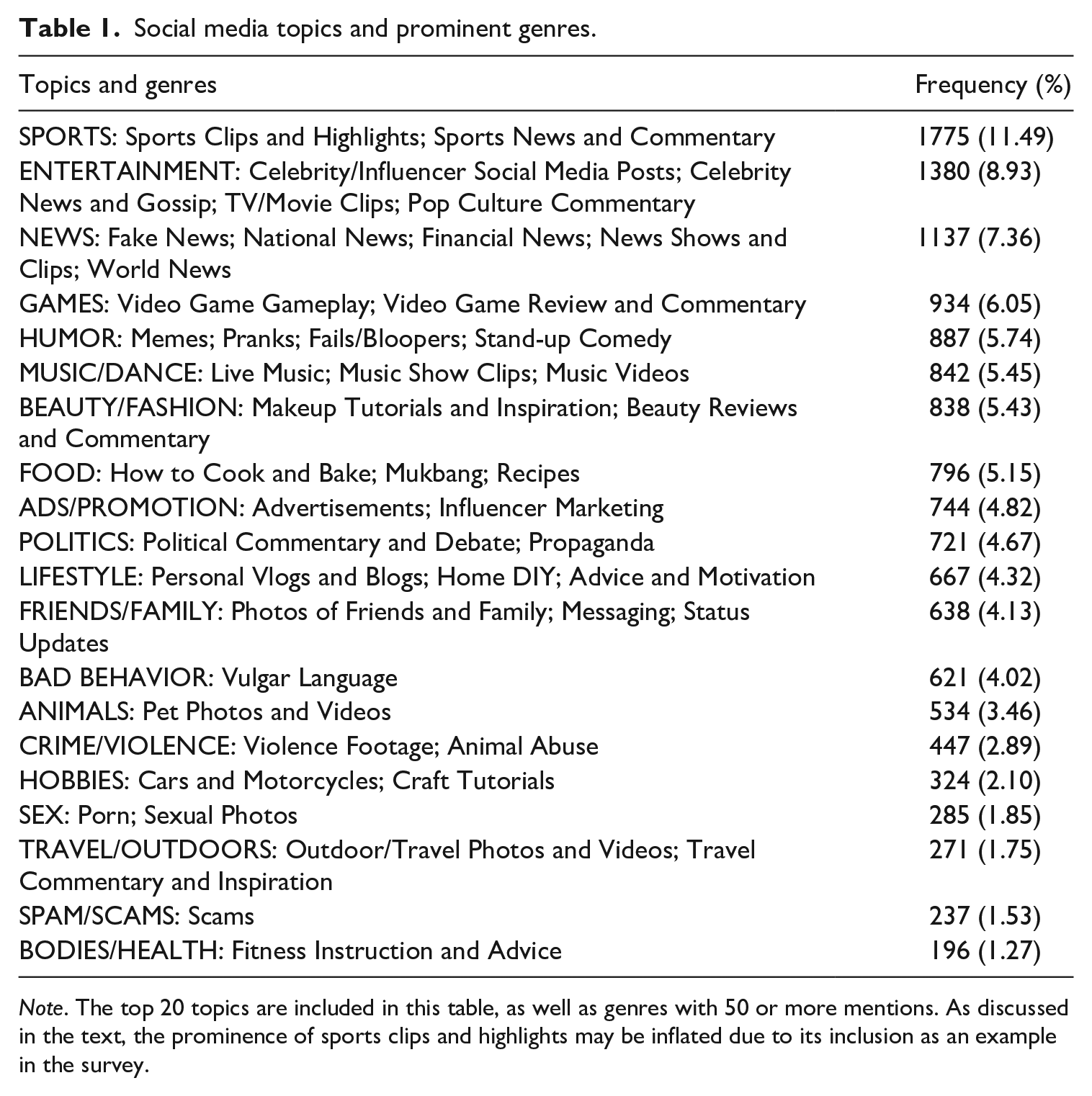
Note. The top 20 topics are included in this table, as well as genres with 50 or more mentions. As discussed in the text, the prominence of sports clips and highlights may be inflated due to its inclusion as an example in the survey.
Beneath the broad map of topics, we identified 213 recurrent genres, eliminating any with three or fewer responses. While each genre is associated with a single topic, the relationship between topic and genre is dynamic. On average, each topic encompasses 7.34 genres (7 median), with Entertainment containing the largest share of genres at 19 and Bad Behavior containing the smallest with only a single genre. For some topics, especially those with a clear subject matter or strong ties to legacy media formats like television, it was very easy to identify genres. For example, Entertainment featured popular genres like TV/Movie Clips, Pop Culture Commentary, and Try Something Challenges. Although Entertainment is associated with professional media companies, the descriptions of the associated genres suggest a mix of user-generated and professionally produced content in line with prior research (Cunningham and Craig, 2019). Other topics proved quite difficult. Bad Behavior, for example, brings together responses about bullying, hate speech, and harassment. Although these issues were frequently invoked by respondents, the descriptions often emphasized intentions or outcomes rather than content characteristics and, as a result, did not readily translate into genres. The only discernable genre we identified within this bundle of issues was Vulgar Language. While this has not been recognized as a genre in the academic literature, we included Vulgar Language here to reflect the way that respondents treated the use of “explicit” or “lewd” terminology as a definitional feature of content, even in the absence of other characteristics.
Liked and disliked social media content
Popularity reflects the prominence of particular topics and genres, but popularity alone does not tell us how people think—or feel—about such content. Breaking the data into likes and dislikes helps us understand the affective and evaluative dimensions of classification (see Table 2). Nearly two-third of the topics had positive associations, with Books & Writing, Science & Technology, Travel & Outdoors, and Fandom constituting the most consistently liked topics. While fewer topics had negative associations, there was greater consensus about their undesirability. In line with existing research about television (e.g. Alwitt and Prabhaker, 1994; Fam et al., 2013), people overwhelmingly disliked Ads & Promotion, along with topics explicitly tied to harm like Spam & Scams. More surprisingly, given its industrial prominence and lucrative status, was the strong consensus around disliking Politics. The remaining topics, including the popular categories of News and Entertainment, were almost equally liked and disliked.
Disposition toward social media topics.
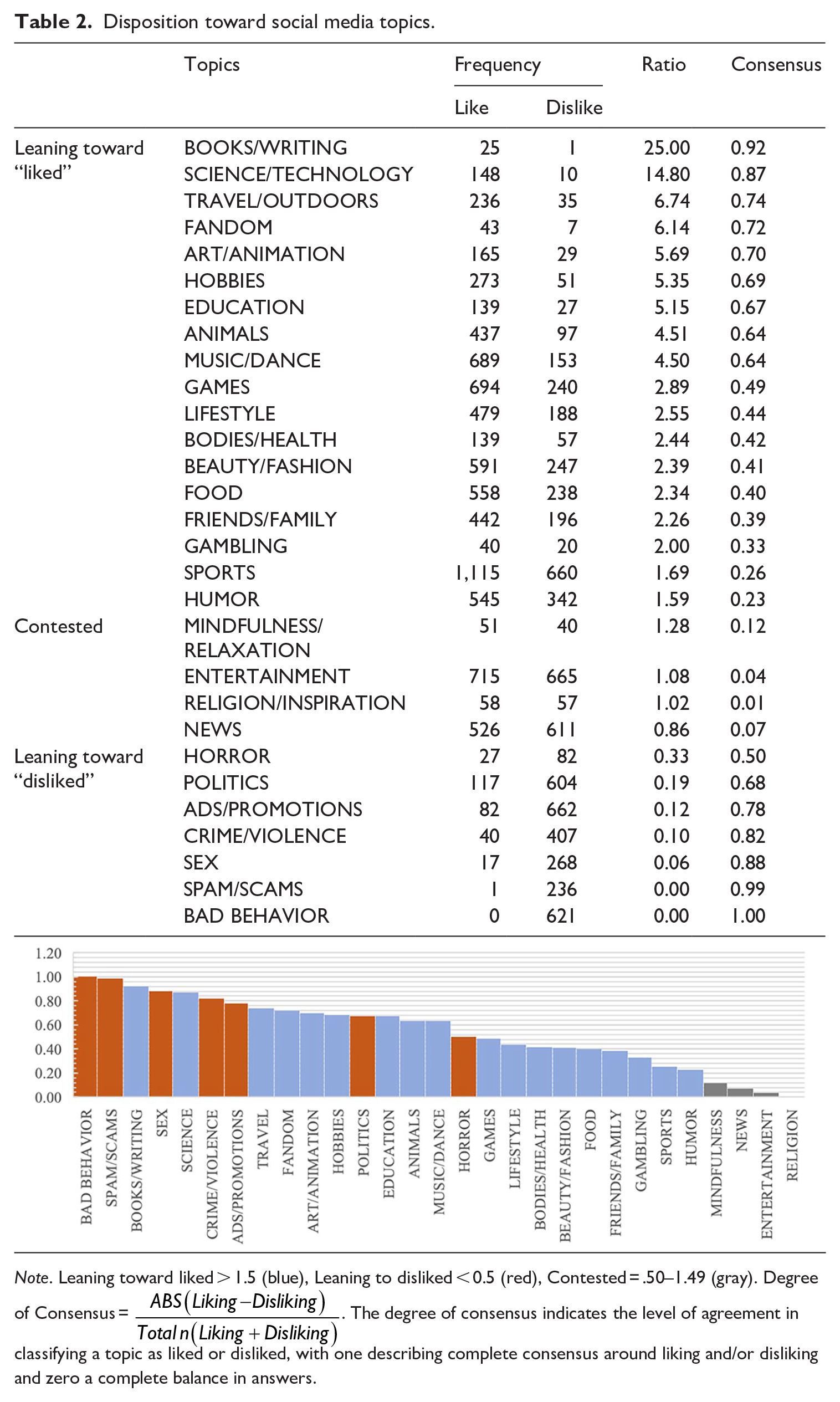
Note. Leaning toward liked > 1.5 (blue), Leaning to disliked < 0.5 (red), Contested = .50–1.49 (gray). Degree of Consensus =
Analyzing the most popular liked and disliked genres shows general congruence with the “likability” of their associated topics, with genres such as Pet Photos & Videos and How to Cook & Bake among the most liked, and Advertisements and Fake News
3
among the most disliked. We also found striking differences in the ways that people characterized genres that they liked and disliked. The descriptions of favorable genres tended to provide concrete details about style and substance with relatively neutral language. Consider the following typical descriptions of How to Cook & Bake: A person experienced in cooking shows you how to cook a certain dish or food. Foods can range from a snack to a full course meal. (the United States)
4
Cuisine videos that show the step-by-step procedure to realize delicious dishes different from your average meal. (Italy) Videos that show how to select pork and cook with it. (Korea) Short hand-focused videos to introduce how to cook dishes, make sweets, and bake bread. (Japan) Short video clips on how other people try, prepare and taste extraordinary recipes. (Germany)
Other accounts of the genre reference specific content creators (e.g. Tasty, Food Network), subject matter (e.g. easy meals, desserts), and elements of video style (e.g. narration, music). Compare these accounts with descriptions of the disliked genre of Sexual Photos & Videos: Videos that are too sexy, vulgar, and distasteful. (Japan) Nakedness of women on Instagram. You should always present yourself respectably (seriously) on the Internet. (Germany) Photos of half-naked women: they are disgusting, also because children can look at their parents’ phones. (Italy) Broadcasts of female streamers and BJs [broadcast jockeys] wearing sexual clothes. (Korea) I dislike pictures that are crude, rude, or lewd. (the United States)
While there are occasional details about this type of content, moralizing language like “disgusting” or “distasteful” is much more prominent in the depictions, reflecting a broader tendency toward distancing and moral evaluation that we address in the discussion.
Content classifications across social categories
Our third research question investigates variance in the classification and evaluation of social media content according to nationality, gender, age, and education level. In some cases, the salience of a topic for a certain population explains the patterns of evaluation: for example, high rates of both liking and disliking suggest that a group is particularly passionate about a given topic. In other cases, however, we find overwhelmingly positive or negative evaluations of certain topics and genres, which suggest a different relationship to social media content that we detail below.
Nationality
We examined the patterns of topic identification across different countries. While most of the 29 topics were found in all countries, the probability of invoking a given topic was not equally distributed. As can be seen in the upper dendrogram in Figure 1, Italy and the United States had the most similar patterns of mentioning topics, with some similarity to Germany, while the responses from Japan and Korea were the most dissimilar from the other countries. This analysis also highlights topics that were more or less prominent in each country when compared to the others. For example, people from Germany were more likely to mention Hobbies and Beauty & Fashion; Italians were more likely to mention Science & Technology and Sports; Japanese respondents were more likely to talk about Gambling and Music & Dance; Koreans frequently mentioned Food and Gaming; and people from the United States were more likely to mention Religion & Inspiration and Politics. 5 The map also draws attention to topics that are less prominent or even absent from respondents’ imaginaries, such as Education in the United States, Politics in Japan, and Friends & Family in both Japan and Korea.
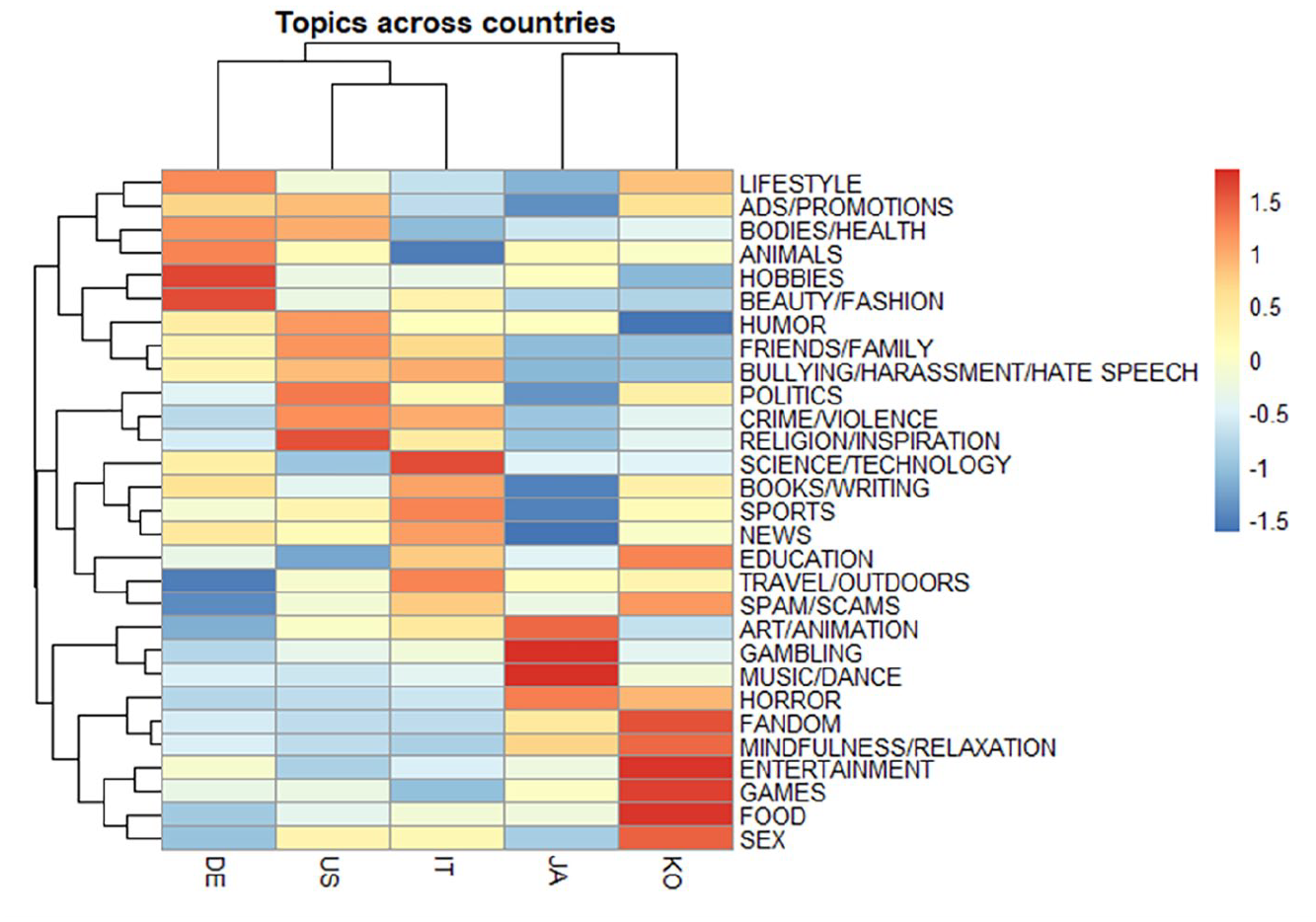
The distribution of topics mentioned in each country.
Some of the cross-national differences regarding topic prevalence can be explained by the prominence of specific genres. As Table 3 illustrates, some genres have broad transnational reach while others are more closely associated with specific countries. The most popular genres mentioned in all five countries were Sports Clips and Highlights, Political Commentary and Debate, Advertisements, Pet Photos and Videos, and Video Game Gameplay. Although the popularity of Sports Clips and Highlights may be inflated due to its presence in the survey example, people mentioned it significantly more than the other examples we included. In addition to the 18 genres that appeared more than 10 times in all five languages, most genres had some degree of transnationality—that is, they were invoked in at least two national contexts. Some genres, however, were particularly salient in specific places; for example, Buy, Sell, & Trade Listings in the United States, Paranormal Stories in Japan, and Fan Spamming in Korea. As negatively inflected genres like Fan Spamming suggest, awareness of a genre as indicated by its overall popularity is not the same as endorsement.
Transnational and unique social media genres.
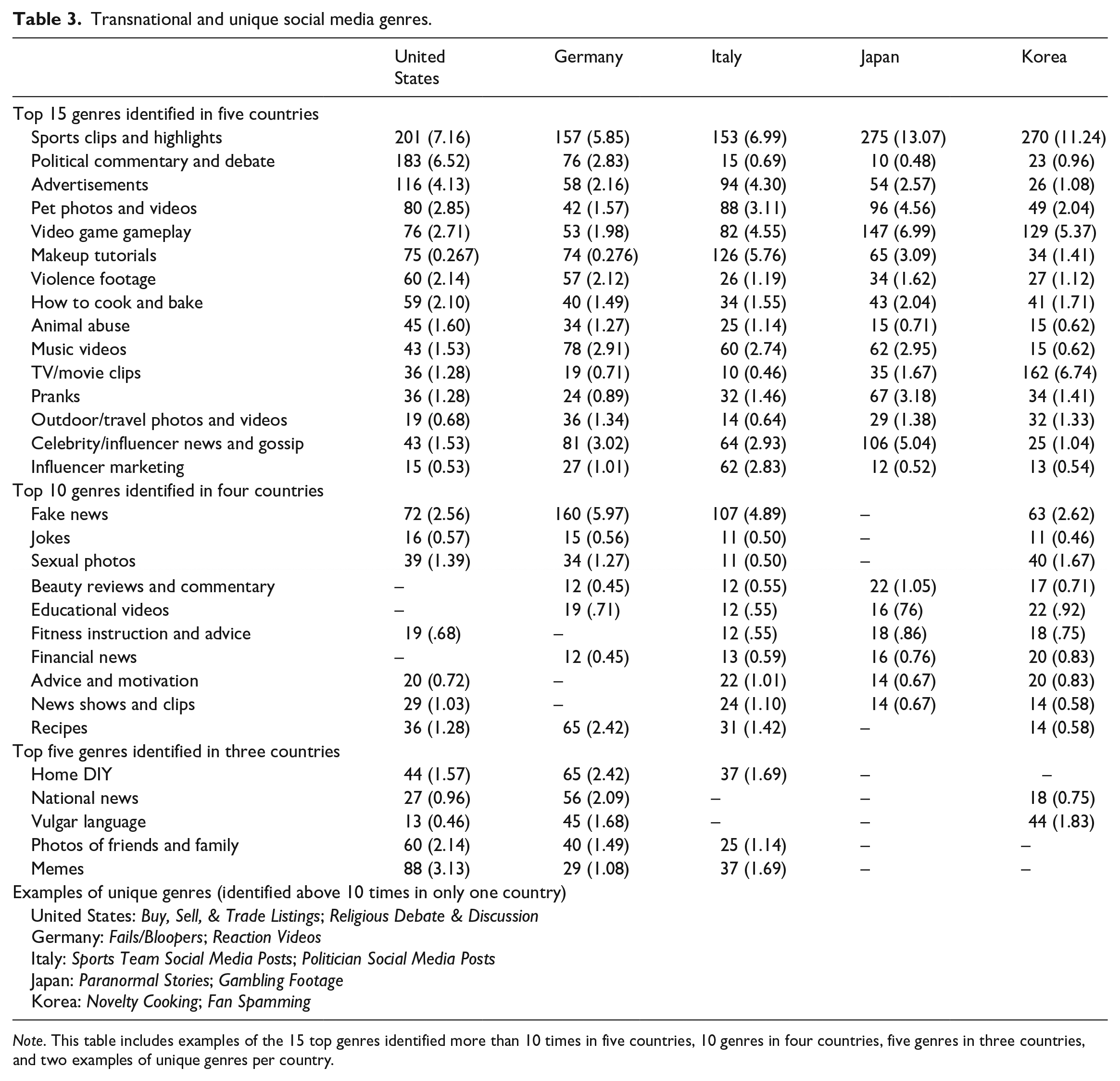
Note. This table includes examples of the 15 top genres identified more than 10 times in five countries, 10 genres in four countries, five genres in three countries, and two examples of unique genres per country.
Turning to the evaluation of topics, we found greater cross-national consensus around disliked topics. The same six topics scored as the most negative in all five countries: Ads & Promotion, Bad Behavior, Crime & Violence, Sex, Spam & Scams, and Politics. Lower in the ranked list of disliked topics, we found Entertainment (for Italy), Horror and Humor (for Japan and Korea), and Gambling, Religion & Inspiration, and News (for Korea). On cross-national average, there were 7.6 disliked topics, of which the aforementioned six were shared. With regard to liked topics, the variation was wider (15.8 topics on average) and there was no coherent group of “top liked” topics. However, we did find nine topics that were liked in all languages, including Animals, Art & Animation, Books & Writing, Education, Fandom, Hobbies, Music & Dance, Science & Technology, and Travel & Outdoors.
Although quantitative comparisons help reveal general patterns between countries, the numbers tell only a partial story. Taking the prominent and consistently disliked topic of Politics as an example, we comparatively investigated the reasons behind the negative evaluations through a close reading of the content descriptions (n = 593). In all countries, people criticized the substance of specific political viewpoints and bias in the presentation of political opinions. For example, a participant from Italy disliked “videos or posts about racism, fascism, communism, homophobia, male chauvinism, and feminism” because “people understand nothing and they only seek to fuel hatred.” Similarly, a participant from Japan expressed dislike for a “political blog that favors the administration.” Another frequent reason for disliking politics concerned a perceived lack of civility in political discussions. However, we found dramatic cross-national differences with regard to this notion: while people in all countries criticized uncivil politicians, respondents from the United States (and to a lesser extent Italy) argued that uncivil political discourse poses a threat to interpersonal relations and the broader social fabric. As one participant from the United States put it, “I hate anything that is related to politics. It turns people into mean and ugly humans.” The different arguments against politics align with studies on the cultural specificity of the relationship between politics and sociality (Kligler-Vilenchik, 2019).
Gender
In analyzing gendered patterns of genre appreciation, we also found more significant differences between men and women in terms of what they liked compared to what they disliked (see Figure 2). Among positively evaluated topics, we found statistically significant differences for 17 topics, compared to only seven significant results for negatively evaluated topics. Many of the topic preferences align with expectations or stereotypes about media consumption. For example, in our dataset, women were substantially more likely to positively evaluate Beauty & Fashion, Food, and Lifestyle, while men were substantially more likely to positively evaluate Sports, Games, and News. In contrast, there was much more gender convergence around disliked topics. We also found that some topics tend to be both liked and disliked by a specific gender, such as News among men or Mindfulness among women, suggesting that patterns of disliking can reflect the degree of interest in a topic. To put it differently, our data suggest that the opposite of liking might be disinterest rather than dislike.
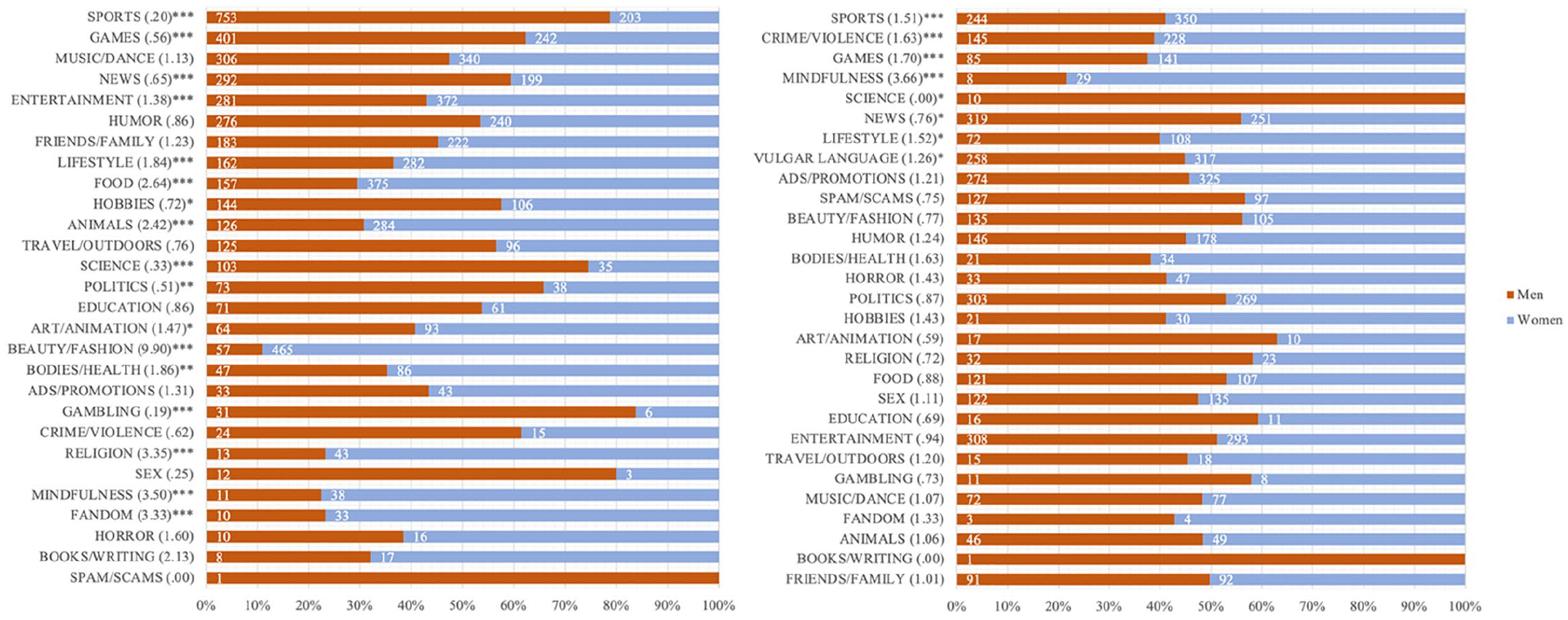
Liking (left) and disliking (right) social media topics by gender.
Age
As demonstrated by Figure 3, engagement with topics varies significantly between age groups. While older people were more likely to appreciate Friends & Family, Religion & Inspiration, and Politics, younger people were more likely to appreciate topics like Games and Entertainment. In terms of dislike, most of the topics with significant differences reflect prominent interests and mirror the pattern of likes, with the youngest age group more likely to negatively evaluate Games and the oldest group more likely to negatively evaluate Friends & Family. Overall, we found a similar (yet less strong) tendency as the gender analysis: more significant differences between groups for liked topics compared to disliked topics.
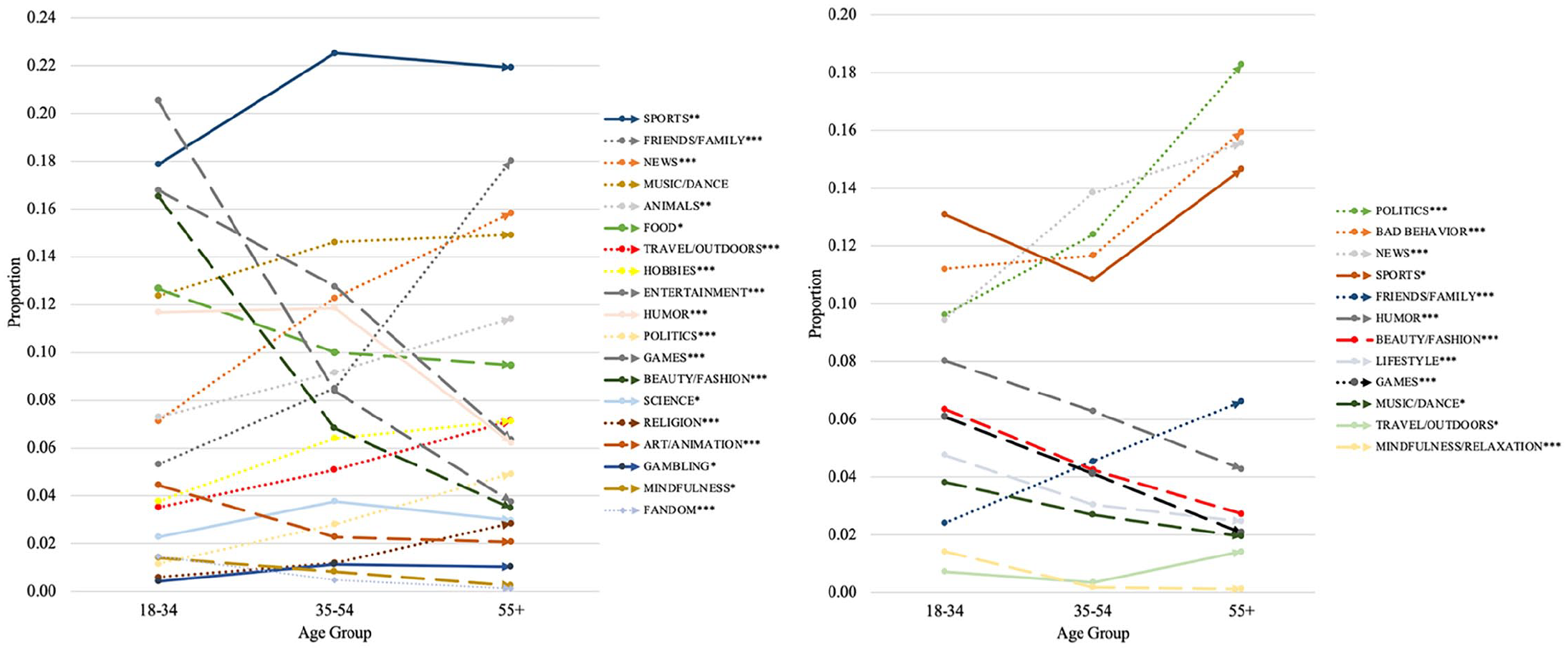
Liking (left) and disliking (right) social media topics by age groups.
Education
In contrast to the other demographic categories, and to previous findings in studies about taste and cultural distinction, we did not find strong overarching education-related differences. In terms of liking, there were only three topics with statistically significant differences: people with at least some amount of post-secondary education were more likely to positively evaluate the topics of Entertainment and Travel & Outdoors, while people without were more likely to positively evaluate Gambling. In terms of dislike, we found that people without any post-secondary education were more likely to negatively evaluate Crime & Violence, while people with some post-secondary education mentioned disliking genres related to Food, Ads & Promotion, and Politics. Yet, as there is no consistent pattern evident from these findings, our ability to make sense of them is limited.
Discussion
An integrative analysis of our findings leads to some overarching observations about how people from different parts of the world imagine social media content. First, we examine how our results fit with the notion of a transnational genre imaginary. Second, we highlight the unifying function of negative evaluations across social categories of nationality, gender, and age. Finally, we discuss how genre imaginaries reveal normative perceptions about how people should behave and the purpose of social media.
Overall, our study demonstrates the transnational character of the social media genre imaginary, at least at a basic level. That is, when people from different parts of the world think about social media, they generally think of the same kinds of content. The level of commonality is evident in the fact that the vast majority of topics and genres were invoked in more than one national context. As such, the study further corroborates notions about genre flows and diffusion across countries. However, there was significant variability between countries in terms of the relative prominence of social media content. Furthermore, as our qualitative analysis of the example of politics suggests, even when imaginaries appear similar, additional investigation can reveal complex and divergent ideas about social media content and the platforms on which it circulates. Thus, the shared core of the genre imaginary exists alongside cultural and personal differences in the prominence and preferentiality of social media content.
Yet beyond this variability, one finding related to patterns of liking versus disliking was consistent across country, age, and gender. In each case, it seems that disliking unifies individuals from different social categories. This was most pronounced with regard to gender. Although men and women differed significantly in the types of content they liked, these differences diminished dramatically when it came to disliking. To a lesser extent, we saw the same patterns with age and country. This finding is curious given prior research on disliking as a form of boundary work—at least from these data, people express unique group identities more strongly through the content they like. In an inversion of Tolstoy’s famous aphorism about happiness and family life, it seems that all unhappy social media users resemble one another.
As with findings from television research (Buckingham, 1993), notions of disliking social media content were closely tied to moral judgments. Even in the context of an anonymous survey without the supervising eye of peers or an interviewer, respondents expressed strong feelings about content they disliked and distanced themselves from such content. When speaking about sexual, violent, promotional, and political content, respondents tended not only to use judgmental language but also refrained from providing detailed descriptions about the substance of that content. In so doing, they indicated an awareness that such content exists without suggesting too much familiarity. Some of the disliked topics were expected, given the long history of resentment and moral panics around sex and violence in the media which date back to the rise of mass communication (e.g. Barker and Petley, 2003). As noted earlier, resentment toward ads has also been documented in studies about television, although the reasons for disliking ads seem to be less moralistic and more closely associated with notions about the purpose of television, such as the complaint that ads interrupt the expected flow of escapist entertainment (Fam et al., 2013).
Connecting the evaluation of content to perceptions about the “proper” function of a medium sheds some light on our discovery of the strong tendency to dislike Politics. Internet users in the United States and Italy implied that politics pollutes the desired purposes of social media to promote sociability or offer entertainment. And in all countries, respondents expressed annoyance with exposure to political bias and opposing viewpoints, which interrupt a positive, conflict-free, and filtered version of reality in their social media feeds. This desire for social media as a kind of de-political “safe space” is also supported by the list of most popular genres, which lean strongly to the side of entertainment. Our observations about liked and disliked topics, as well as our qualitative analysis of Politics, points to an overall tendency for social media users to romanticize a “clean” or “cozy” version of social media in their stated preferences. These statements may correspond with actual ways of using social media, such as unfriending people with opposing political views (John and Gal, 2018). However, given the enduring popularity of sensationalist content on social media (Zuckerberg, 2018), it is likely that these stated preferences do not neatly align with actual consumption practices. The gap between the two indicates that the classification of content is never just about content—it is bound up in social relationships and identity, even in the relatively sheltered context of an anonymous survey.
Conclusion
In this study, we presented a transnational map of social media content. An open-ended survey of people from five countries led us to identify 213 distinct genres and 29 topics encompassing diverse subject matters, communicative purposes, and affective responses. Although most genres were invoked in more than one national context, there was significant variation between countries concerning the frequency of topic and genre mentions. In addition, we found a surprising consensus around disliked content that crossed demographic groups. We connected these patterns of preference to notions of moral judgments, both general and medium-specific; in other words, evaluations of social media content reveal ideas about how people should act as well as the purpose of social media platforms.
Despite the large dataset and collaborative, inductive analysis, our study is limited by the scope of the sample and the analytical framework of social media imaginaries. Although our survey included respondents from Asia, Europe, and North America, the applicability of our findings to countries from the Global South, or to countries with stronger Internet restrictions such as China, remains undetermined. In addition, the perspectives of younger social media users are not reflected because we only surveyed people over the age of 18. Finally, even though we found only a few direct references to COVID-19 or public health, collecting data during a global pandemic may have influenced how people were thinking about social media. In terms of our analytical framework, the social media imaginary directs attention toward how people conceptualize content rather than the content itself. The gap between the two may be significant and we have preliminary data from a follow-up study which suggests that some genres (e.g. Best Friend Selfies) take on distinct formal qualities in different parts of the world.
Future studies can build on our map of social media content by charting new terrain or adopting a different scale of analysis. Beyond investigating additional parts of the world, researchers might consider connections to older media systems. Our findings, especially in terms of topics, strikingly resemble categories found in early studies of broadcast television (Horton et al., 1951). The potential continuities between mass and social media suggest the need for holistic comparisons of genres across time and communication technologies. Researchers can also zoom in on some of the phenomena we identified using interviews, digital ethnography, and content analysis to create more nuanced accounts. Such analyses could unpack some of the more expansive genres we identified, such as Photos of Friends and Family or Personal Vlogs, connecting them to processes of media production, circulation, and consumption. Finally, future work could examine the relationship between the affordances of specific platforms to the formation of genres.
While every map offers a partial account of the world, the map we have presented in this article offers practical, methodological, and conceptual contributions to the study of social media. At the most basic level, the list of over 200 inductively generated genres, as well as the codebook with our definitions, can serve as a resource for future investigations, including deductive surveys and studies of different geographic contexts. In terms of methods, we believe that the unique research protocol that we have designed, in which open-ended questions about liking and disliking content are coded into genre categories and then analyzed quantitatively and qualitatively, provides a pathway for researching social media imaginaries in other contexts. Finally, the article’s conceptual contributions concern the moralizing nature of evaluating social media content and the unifying power of disliking. Although platforms tend to minimize, downplay, and conceal so-called antisocial or negative reactions, disliking represents a crucial means by which people conceptualize desirable conduct and imagine the identity, purpose, and future of social media.
Footnotes
Authors’ note
Bumsoo Kim is also affiliated with Joongbu University, South Korea and Saki Mizoroki is also affiliated with The University of Tokyo, Japan.
Funding
This project has received funding from the European Research Council (ERC) under the European Union’s Horizon 2020 research and innovation programme (grant agreement No 819004).
Notes
Author biographies
 .
.
.
.