



Abstract
This article uses the case study of Internet Protocol (IP) delivery for streaming television to demonstrate how technology and globalization combine to change what media firms do, how they create value and with whom. Media delivery – the sum of the value-adding tasks necessary to transfer content from source to audience – has become a mosaic of technologies that sustain a complex and fast-evolving video ecosystem. Broadcasters had been in charge of the full transmission process once, of tasks deemed core to their business. Today, media delivery is externalized to the market and devolved to a network of suppliers. These suppliers are no ordinary firms, but tech giants that have developed deep global capabilities. They gain further leverage by being cross-sectoral, serving clients across multiple industries. Who are these suppliers? What makes them unique? And what are the implications for the television industry?
Keywords
Introduction: thinking through media globalization
We are accustomed to thinking about media globalization, analysing the cultural and political implications of large-scale conglomeration (e.g. Herman and McChesney, 1997). The aim of this research is to think it through. How does media globalization work? Which dynamics does it bring into play and how do they re-shape the industry? This article uses the case study of Internet Protocol (IP) delivery for streaming television to demonstrate how technology and globalization combine to change what media firms do, how they create value and with whom.
Media delivery – the sum of the value-adding tasks necessary to transfer content from source to audience – has become a mosaic of technologies that sustain a complex and fast-evolving video ecosystem. Broadcasters had been in charge of the full transmission process once, of tasks deemed core to their business. Today, media delivery is externalized to the market and devolved to a network of suppliers that collaborate along the value chain. These suppliers are no ordinary firms, but tech giants that have developed deep global capabilities and can leverage an unprecedented infrastructure to deliver content to and from (almost) any location in the world. They gain further leverage by being cross-sectoral, serving clients across multiple industries. This research identifies these suppliers, analyses their key features and evaluates the implications for the television industry.
The article is set out in the following manner. First, it compares and contrasts old and new media delivery mechanisms, analysing each segment of the current media delivery chain to provide an overview of the IP-driven video ecosystem. Next, it introduces the concepts of global value chain (GVC) and global suppliers, identifying those operating in media delivery. It follows with an analysis of the evolving firm boundaries and the links between businesses in the media delivery GVC. The final section demonstrates that the rise of global suppliers is furthering the global integration of the sector and facilitates industry co-evolution through the formation of a supply base that is shared among several industries.
This evolution matters because it is changing both the structure and nature of the television industry. Some broadcasters, such as NBC in the United States or the BBC in the United Kingdom, were at the forefront of developments in broadcast engineering. They built and designed their own broadcast infrastructure. Today, while retaining a certain amount of technological expertise, they increasingly outsource media delivery tasks and rely upon the infrastructure of tech giants. Engineering was once part of the broadcasters’ corporate identity but traditional broadcasting has had to ‘pivot away from what’s been an engineering-led activity’ (SGreenaway, interview 2019), to redefine the contours of organizations and sometimes form larger entities (as illustrated, among others, by the acquisition of NBCUniversal by Comcast; Crawford, 2013).
Television used to be akin to the Galàpagos Islands: a self-reliant engineering ecosystem that was distinct and separate from other industries. Today, it shares technology, transmission infrastructure and suppliers, with other industries. This new dependency curtails the autonomy of the TV industry, and represents a power shift, this research will argue, between media firms and the new class of global suppliers they rely on. Furthermore, the size asymmetry between the former and the latter make it difficult – if not impossible – for media firms to grow and compete effectively with those tech giants that have entered the video market.
This research uses GVC theory and methodology in order to understand the nature and implications of this evolution (Gereffi, 2011; Gereffi et al., 2005; Gereffi and Fernandez-Stark, 2016). GVC analysts have an established track record in unpacking power relations between lead firms and their suppliers. This article will focus on the concepts of global suppliers and shared supply base, which will be applied for the first time in the context of the media industries. While fieldwork was primarily conducted in the United Kingdom, the GVC framework is inherently holistic and multi-scalar, and is commonly applied to analyse the transnational production networks that structure the world economy (Gereffi, 2014). As GVC research develops in the media industries, the same outlook can be applied to different geographies.
From a methodological standpoint, this research relies on fieldwork conducted between 2017 and 2019, using British broadcasters as a case study. In line with GVC research, data were gathered from multiple sources, including industry reports, trade publications and webinars, and face-to-face interviews. This research also benefits from informal conversations with industry executives and one of the co-author’s extensive field experience. 1
The past and present of media delivery
Since the origins of sound broadcasting, and for the greater part of the 20th century, media delivery consisted of the analogue transmission of a signal from a broadcasting facility to listeners’ and viewers’ radio and TV sets. It was a task broadcasters carried out themselves. In the United Kingdom, the BBC was in charge of the entire transmission process and developed its own network of transmitting stations (Briggs, 1995: 225–228, 997). Engineering skills and prowess was at the heart of the Corporation’s identity, which evolved into a world-leading institution in the field of broadcast engineering. The long list of innovations attributed to the BBC includes the first TV standards converter, the first electronic recording apparatus and the first transatlantic transmission in the 1950s (BBC, 2017). Between the 1920s and the 1970s, some 350 patents were issued to the BBC that it used and licenced to manufacturers (Pawley, 1972: 528). When ITV joined the fray in 1955 it, too, equipped itself with a substantial engineering department in order to surmount the numerous technical challenges the newcomer faced (Sendall, 1983: 324–329; Stevens, interview 2017). 2
The media delivery these broadcasters established can be characterized by four key attributes. It was unimodal because broadcasters dealt with a single (terrestrial) transmission path. It was proprietary, as they operated their own hardware-centric infrastructure for the sole purpose of transmitting their channels. Even though the BBC and ITV would eventually share some transmission stations, each operated their own network (Sendall, 1983: 2).
Media delivery was vertically integrated because it was a task that broadcasters carried themselves and were equipped to do. Although British broadcasters have always collaborated with equipment suppliers, these arrangements were related to specialized processes and they remained in charge of the entire operation.
Finally, the transmission of TV signals was strictly national; broadcasters had no business beyond their borders and European countries prohibited foreign TV signals. As a reflection of the national nature of broadcasting, broadcasters’ transmission facilities followed the contours of national territory and never ventured beyond (e.g. Reith, 1924: 15; Scannel, 1996).
The advent of IP delivery
Media delivery was changing and progressing well before the Internet became a vehicle for video distribution. The number of transmission paths increased with the emergence of cable and communication satellites. Yet, these two means of transmission were to remain at the fringes of the TV industry until a breakthrough in signal compression was achieved through advancements in digital technologies (Starks, 2013). With the capability to package more channels in the same bandwidth, pay-TV platforms could offer more choice, which made their product considerably more attractive to consumers. Sky, for instance, Europe’s foremost satellite broadcaster, began trading in the United Kingdom in 1989 with four channels transmitted to a few thousand subscribers. Sky Digital, by way of contrast, broadcast hundreds of channels to millions of customers by the 2000s (Horsman, 1997).
Videocassette recorders (VCRs), and later digital video recorders (DVRs), were the first ‘time-shifting’ technologies. Cable providers invented Video on Demand (VoD). They first delivered ‘near VoD’ by providing content carousels where films started every 20 minutes, and then offered true VoD when capacity increased. Even though IP delivery followed an evolution, it remains a game changer. IP transport not only comprehensively changed media delivery, it transformed business models and brought about a new video ecosystem that far exceeds, both in terms of volume and complexity, the broadcasting ecology of the recent past.
The complexity stems from several factors. First, video originators have multiplied and include the VoD offerings of broadcasters and pay-TV providers, social media networks (e.g. Facebook Watch or Snapchat), video-sharing apps and platforms (such as YouTube, Twitch or Line Live), and the direct-to-consumer (DTC) platforms of tech and media conglomerates (Amazon Prime Video, Apple TV+, Disney+, AT&T’s HBO Max, etc.; Cunningham and Craig, 2019; Rein and Venturini, 2018; Spilker et al., 2018). There is also a growing variety of rights holders from sports leagues to news organizations with their own video-enabled websites. Video-sharing alone lends itself to several applications, such as live streaming (widely used by the popular video-game oriented streaming websites), transactional VoD and TV channel distribution (Fontaine et al., 2018).
Furthermore, VoD is a 24/7 universe where users expect to stream or download programming anytime and anywhere, regardless of whether in a fixed location or on the move. The devices used to access content are increasingly disparate, ranging from mobile phones and tablets to game consoles and ultra-high definition (HD) 105-inch TV screens. Finally, audiences are more fragmented and dispersed than in the past. Transnational TV networks such as CNN, Discovery or Disney, and entertainment platforms, need to reach viewers across borders. Even national broadcasters, which had one feed per channel in the analogue era, now air multiple regional and sub-regional feeds in order to accommodate local taste and needs (Chalaby, 2019).
This ecosystem is experiencing dramatic growth driven by the surge in VoD consumption. In the United Kingdom, for instance, the percentage of households with subscriptions to a VoD service has risen from 14% in 2014 to 47% in 2019 (among whom an increasing number subscribe to more than one; Ofcom, 2019: 59). Non-broadcast content makes up 31% of total video consumption (an average of 59.5 minutes per day/user), and 58% of the total viewing time of 16- to 34-year-olds (averaging at 2 hours and 39 minutes per day; Ofcom, 2019: 4–5). In this age group, YouTube alone is viewed 64 minutes per day (Ofcom, 2019: 5).
This consumption is reflected in Internet traffic data. Video applications constitute the largest part of total Internet traffic, growing faster than any other. In 2017, IP video traffic accounted for 75% of total IP traffic, and this percentage is set to rise to 82% by 2022, ‘when the amount of VoD traffic will be equivalent to 10 billion DVDs per month’ (Cisco, 2018: 2). Much of the forecast growth in IP traffic, from 46,600 GB per second in 2017 to 105,700 GB per second in 2022 is attributable to video applications (Cisco, 2018: 5).
Attributes of media delivery 2.0
This video environment could not exist without an intricate and efficient media delivery chain, which bears little in common with the old one. In contemporary terms, media delivery starts when content creators have delivered the master tape and aggregators (broadcasters and platforms) package it up in order to reach various audiences. The chain’s key segments are publication, transmission and reception (Chalaby, 2019). Publication involves the preparation and conversion of files into various formats for transmission, which begins when a signal/file is sent out from the playout system. Transmission paths vary: signals sent to pay-TV platforms and international channels will be delivered through fibre optic cables and/or communications satelllites, while files for streaming services will be distributed through the open Internet and content delivery networks (CDNs; below).
The way media delivery is handled today differs vastly from that of the past. The attributes of the new delivery chain contrast with the old ones and help explain the vast changes that are affecting the television industry (Table 1). The contemporary media delivery chain is best described as multimodal. Broadcasters and media conglomerates that operate both TV channels and on-demand platforms have to deal with two distinct sets of transmission protocols. In a classic broadcast transmission path – or multicast – a single piece of content is transmitted over a radio wave; there is only one copy at any time (and frequency), which is shared by all the recipients. Even in this configuration, although the transmission paths vary between cable, satellite and terrestrial. The second transmission mechanism – unicast – runs over IP and is used by all over-the-top (OTT) media services. 3 In the unicast model, every single stream is a unique copy, and if a million viewers watch the same show, it means that a million copies are being viewed simultaneously. This transmission protocol is a pull mechanism, as viewers request their own copy of the material, in opposition to the push structure of the broadcast path.
Media delivery (past and present).
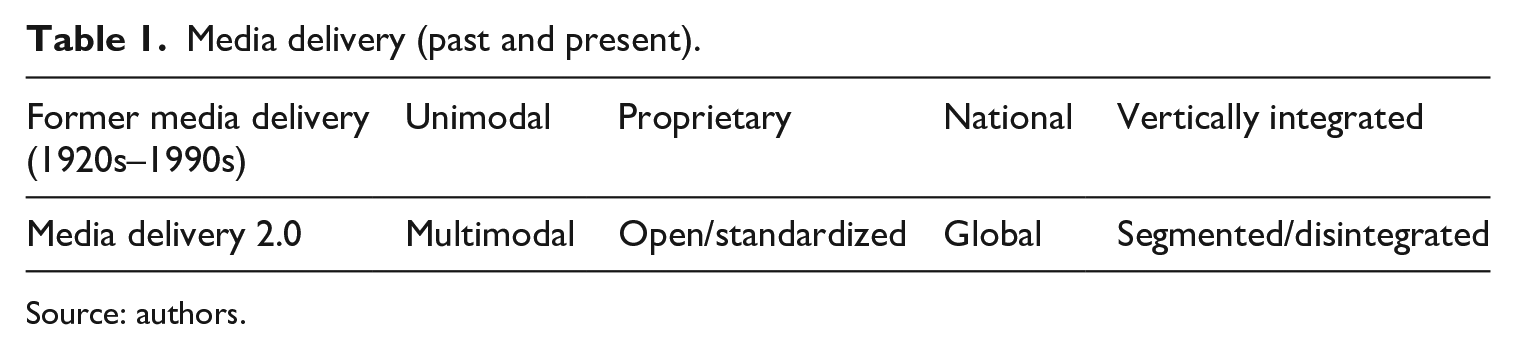
Source: authors.
There are two distinct classes of OTT delivery – VoD and live streaming. On-demand content is watched at the time and place of the viewers choosing and consists of catalogues of movies and TV shows such as those made available in major subscription services, or ‘catch-up’ content with shorter rights windows on traditional broadcaster platforms (e.g. BBC’s iPlayer).
Live streaming content is event-driven programming such as live sports and news. While both on-demand and live streaming content are carried across OTT networks, the live streaming use case has particularly stringent latency requirements. Audiences expect live action content to be delivered in near or real-time so the content publication and transmission paths must be optimized to make this possible. Live streaming content of the most popular events presents another challenge – that of concurrency and scale. This results in significantly different approaches to encoding and transport optimization of OTT content depending on whether its VoD or live streaming. However, as live streamed content is often tomorrow’s on-demand content (as when a sports event becomes available on a catch-up service), there is often an additional live-to-VoD phase where the content encoding and packaging is converted from one use case to the other.
Broadcast networks used to be proprietary in the sense that they were owned by a single operator which used them for the sole purpose of transmitting TV channels. As a consequence, broadcasting developed as a separate ecosystem akin to the Galàpagos Islands: the industry developed its own infrastructure for connectivity and transport with its own cables, ports, switches, together with its own vocabulary and set of terminologies. With the transition to IP delivery, broadcasting is embracing the common IT stack and sharing technologies and equipment with other industries. When broadcast engineers procure equipment, they only purchase the upper level broadcast-specific application, not the entire physical device. Apart from the specialist applications, the hardware, the operating systems and the rest of the IT stack are all generic.
Third, the geographical scope of media delivery has changed. As seen, transmission networks delineated the contours of nations to ensure the whole population had access to the same programmes – and only those. Today, media conglomerates, streaming services and most other video aggregators aim to reach audiences across borders. It is a myth that entertainment platforms are born global, but compared to the transnational TV networks that preceded them, they internationalize very rapidly (Chalaby, 2005, 2009). The flag-bearer, Netflix, launched streaming content for US customers in 2007. In total, 12 years later, it was present in 190 countries and had more subscribers outside its home market than within (99.4 million vs 67.7 million subscribers for a total of 167.1 million members; Netflix, 2020). Apple TV+ and Disney+ both launched in November 2019, the former in over 100 territories and the latter in 5 key markets (Australia, Canada, the United States, the Netherlands, and New Zealand). Walt Disney needed time to retrieve the streaming rights it had sold to third parties before spreading its DTC platform, but had already reached 16 countries by summer 2020.
Media delivery today is a value chain that involves networks of collaborating firms. Broadcast vendors have long existed but broadcasters assumed the bulk of the work and remained in charge of the whole operation. Today, the trend is towards outsourcing. In the United Kingdom, broadcasters no longer perform most media delivery activities. The BBC, ITV and Channel 4, among others, began contracting out media delivery in the 2000s (Chalaby, 2019). Broadcasters encountered the same set of issues: the transition to HD, the growth of non-linear services, the need to automate broadcast services and playout, each required heavy investment. Sinead Greenaway, UKTV’s chief technology officer, remembers, ‘every time a new platform arrived we’d just build another workflow, so it’s completely inefficient’ (SGreenaway, interview 2019). Faced with an increasingly complex, expanding and fast-evolving set of technologies, British-based terrestrial broadcasters came to a tipping point and reached the conclusion that it would be more efficient and less costly to devolve media delivery to specialist providers. Shane Tucker, Channel 4’s broadcast engineering officer, recalls, I think our CFO made the decision at the time and it was purely based on cost and efficiencies. Channel 4 was about to launch a HD channel when we were negotiating and that was basically one of the drivers. All the investment to upgrade our entire infrastructure to be HD would cost us x amount and then they thought, actually we could outsource the entire operation, and that was the driving force really (Tucker, interview 2017).
The remainder of this research focuses on the scale and scope of these suppliers, and the implications for television industry.
Standing on the shoulders of giants: GVCs and their global suppliers
The objective of this section is twofold. First, it places the evolution of television in the wider economic context. Although every industry has its own particularities, they all must adapt to a rapidly changing world political economy. Responding to the affordances of contemporary capitalism, many industrial sectors have globalized and reorganized into GVCs, or transnational networks of production with a system of governance coordinating internationally dispersed firms and activities (Gereffi et al., 2005; Gereffi and Fernandez-Stark, 2016). GVCs entail a distinction between lead firms and suppliers, even though the nature of their relationship changes from one sector to another (Gereffi et al., 2005). The scope of suppliers can also vary, and the most advanced GVCs have witnessed the rise of suppliers with global capabilities. This research identifies and analyses those operating in the media delivery chain. Such work has never been conducted in the context of the media industries, so a second objective is to introduce the concept of global supplier, operating under the premise that the characteristics of global suppliers, as identified by GVC researchers, will be relevant to our purpose.
In GVCs, goods and services flow along a chain made of segments that involve different sets of firms and activities. The segmentation of production processes and the specialization of firms within one segment are known to economists as the disintegration of production and vertical specialization (Feenstra, 1998; Langlois, 2003). The presence of such trends in the media, most notably the film industry, has already been identified. According to scholars, the de-verticalization of production processes started with the disintegration of studio film production, which occurred with the dismantling of the Hollywood Studio System (Caves, 2000: 87–102; Scott, 2005: 29, 40). The ensuing transition to spot production produced ‘several observable changes in the film industry’s structure’ (Caves, 2000: 96), notably the emergence of specialist suppliers and a more flexible production system, but also a more casual workforce (Caves, 2000: 96–97, Scott, 2005: 120–121).
In a less dramatic – and perhaps less visible – manner, the TV industry went the same way a few decades later, as broadcasters (in Europe at least) outsourced a growing proportion of their programmes (Chalaby, 2016). By contracting out some of their activities, media firms have embraced a practice that is a common feature of global capitalism (Feenstra, 1998). In the past, large corporations were vertically integrated and sought to keep in-house as many tasks as possible, an organizational configuration known as the Chandlerian firm (Inomata, 2017: 18). The closing decades of the 20th century saw widespread economic liberalization and free trade agreements combine with rapid progress in transport (e.g. intermodal containers) and information and communications technologies, enabling multinationals to allocate activities in function of their varying costs in different territories. They found it more efficient to break up the value chain and outsource – and often offshore – non-core activities. Today, many industries, from fashion to electronics, are dominated by ‘fabless manufacturers’ such as Nike or Dell that sell goods they do not manufacture (Grossman and Helpman, 2005; Langlois, 2003; Milberg and Winkler, 2013). Ardent outsourcers include Apple: the world’s first trillion-dollar company by market value owns no plant and offshores the entirety of its manufacturing operations to Asian subcontractors (Davies, 2018; Dedrick et al., 2010).
As a result of the disintegration of production, Chandlerian industries characterized by large vertically integrated corporations have been progressively replaced by GVCs. The 2008/2009 financial crisis proved to be a short-lived break in the momentum, and the fragmentation of production has since continued apace to expand in the world economy, representing a significant share of international trade (Timmer et al., 2014).
GVCs have long been driven by Western-based multinationals such as retail chains and branded manufacturers that offshore production to networks of small and predominantly Asian suppliers (Frederick and Gereffi, 2011). But as outsourcing and offshoring grow, so too the suppliers. GVC researchers have observed, ‘the rise of a global supply base populated by large, international, highly capable suppliers, contract manufacturers, intermediaries, and service providers, something unique in the history of the world economy’ (Sturgeon et al., 2011: 232). ‘A new class of huge global suppliers’ has emerged, they argue, made of manufacturing and trading companies ‘that no one has ever heard of’ but which have developed deep global capabilities (Sturgeon et al., 2011: 235, 236).
Such suppliers, this article contends, have emerged in television, and particularly, in the media delivery chain. What make them distinctive, and what are their key characteristics? Answers are provided by GVC scholars, who have so far identified such suppliers in three industries: fashion (e.g. Li & Fung), electronics (e.g. Flex) and automotive (e.g. Valeo). First, they have a global footprint in terms of production and distribution coverage. For instance, Flex (formerly Flextronics), which is among the world’s largest electronic manufacturing service (EMS) companies, is supplier to many of the world’s most famous consumer electronics brands. It operates 137 centres for logistics, manufacturing, or research, across 27 countries (Flex, 2018; Sturgeon and Kawakami, 2010). Li and Fung’s (2019) extensive network of supply chains involves 17,000 staff spread across 230 locations in 40 different territories.
Second, these firms are no longer mere ‘captive’ but full-fledged turnkey suppliers (Sturgeon and Lee, 2005: 41). They orchestrate entire supply chains, starting with product design, carrying into sourcing, manufacturing and packaging, and ending with global logistics and retail management (Sturgeon et al., 2011: 253).
Finally, global suppliers are multi-sectoral and operate across several industrial sectors. Flex, for instance, has clients in 13 different industries from aerospace and defence to healthcare and consumer electronics (Flex, 2018).
Global suppliers derive a competitive advantage from their scale and capabilities. To start with, only they can provide worldwide support to their clients. The lead firms they serve invariably operate in multiple markets and need manufacturing or logistics support irrespective of geography. For example, in the automotive industry, a braking system manufacturer is expected to instal equipment in all the plants that its clients operate. As an automotive supplier explains, Today it is a requirement to serve platforms – it is part of the bid. If a supplier doesn’t have a global strategy, it can’t bid. New projects are no longer seen as an opportunity to expand globally – instead, a supplier must have a global base in place to even make a bid. (in Sturgeon and Florida, 2004: 69–70)
Global suppliers generate economies of scope, which they achieve by buying raw materials in bulk, manufacturing the same component on an unprecedented scale, or saving costs by switching production from one client or component to another in the same facilities (Sturgeon and Florida, 2004: 69). Substantial economies of scale are obtained by deploying generic assets and processes in manufacturing or logistics across their customer base (Sturgeon and Lee, 2005: 39–40).
Contra expectations, global suppliers are agile and have the flexibility in their network of facilities to shift production between regions in adjustment to changing tax regimes and trade policies. For example, they can shift from global to local sourcing by moving production from Asia to North America should an American car manufacturer need to adapt to the current US administration’s raft of protectionist measures (Sturgeon and Florida, 2004: 68).
Finally, multi-sectoral suppliers are in the unique and privileged position of being able to transfer knowledge across markets, clients and industries. Like Li and Fung, Flex operates across more than 1000 supply chains, dealing with 30,000 suppliers in 35 countries. As it solves issues that are specific to a sector, it gains knowledge that can be applied across others. In addition, the spread of these activities generates a wealth of data and feedback that give the business unique insights into trends ahead of industries and markets (Flex, 2018). This research will now argue that a similar type of suppliers has emerged in the media delivery GVC.
The rise of global suppliers in the media delivery GVC
Neither 19th-century telegraph companies nor early 20th-century wireless operators (e.g. Marconi) matched the capabilities of today’s global and multi-sectoral suppliers (Raboy, 2016). The ability to operate an infrastructure on a global scale and deliver content anytime/anywhere on the planet came later. As TV networks began to internationalize in the 1980s, they turned to the satellite industry for distribution. Satellite operators as suppliers with deep global capabilities were the precursors to a trend that has become prevalent. The growing preponderance of an IP-driven video transport environment has facilitated the emergence of global suppliers in two other areas of media delivery: CDNs and cloud computing.
Communications satellite operators
The first communications satellites launched in the 1960s and most satellite operators had a national or regional remit. Intelsat was the exception, and the Washington-based organization was the first to achieve global coverage in 1969. Early communications satellites, however, were not designed to transmit TV signals (Labrador and Galace, 2005: 49–58). Satellites could only be exploited commercially by TV stations later, and the first TV network to reach global distribution was CNN in 1989. The news network used satellites from various organizations, including the Soviet Union’s Intersputnik, to complete its coverage (Chalaby, 2009).
Once private satellite operators were given freer rein by most governments, the industry went through several decades of growth and consolidation, to leave three operators that fit the global supplier label: Intelsat, Eutelsat and the Société Européenne des Satellites (SES). As shown in Table 2, their satellite fleet, orbital positions, premium video neighbourhoods and ground facilities cover six continents and allow them to deliver content and bandwidth to and from virtually any location on the globe. SES, for instance, operates satellites from Europe to the South Pacific region, serving over 8000 TV channels to more than 1 billion people in 367 million homes (Société Européenne des Satellites (SES), 2020: 5).
Communications satellite operators with global capabilities.
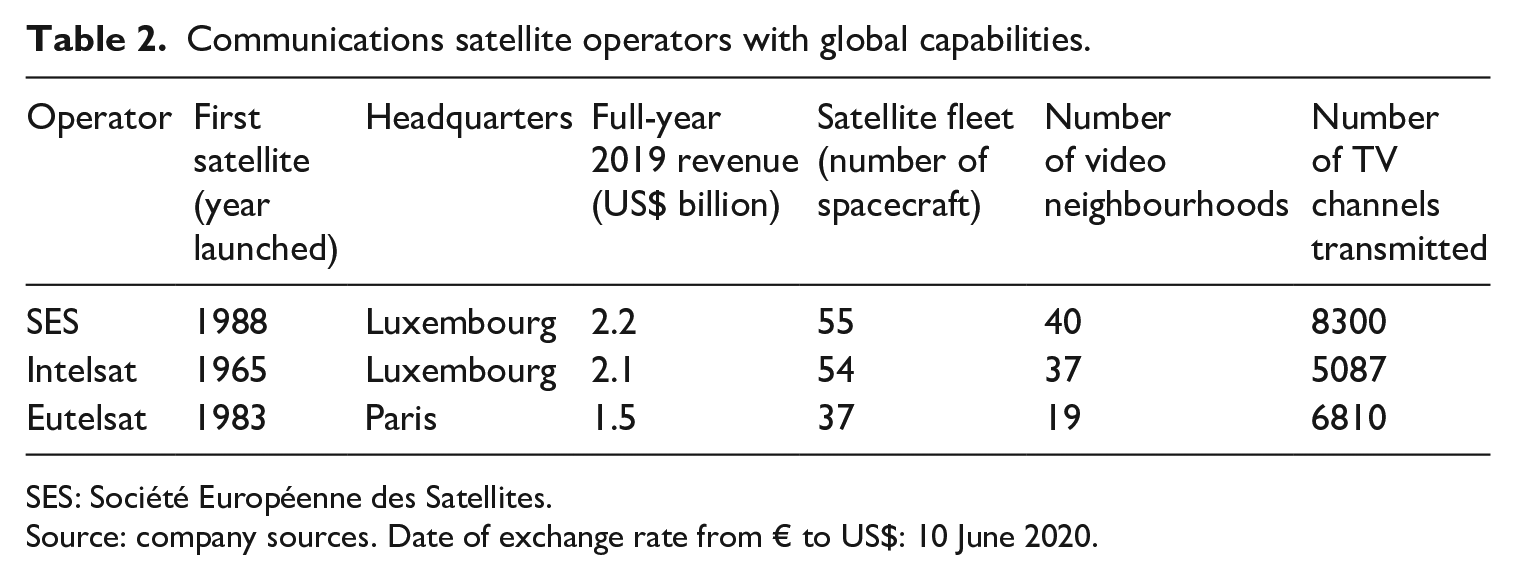
SES: Société Européenne des Satellites.
Source: company sources. Date of exchange rate from € to US$: 10 June 2020.
Today, these satellite operators’ client lists span several industries with global connectivity needs and include most of the world’s broadcasters and pay-TV platforms. They serve them in several capacities: transmission of their TV channels and direct distribution to households, delivery of live content such as major sports events and music festivals to viewers around the world, and connecting newsrooms to field reporters and other news organizations.
The CDN industry
The Internet backbone would not be able to cope with the current level of demand for video distribution, and CDNs have been built to carry the bulk of this traffic. They currently transport 56% of total Internet traffic, and this percentage is forecast to reach 72% by 2022 (Cisco, 2018: 3).
A CDN is a worldwide network of servers whose role is to improve the speed and reliability of content delivery by storing content as close as possible to end users. When a user’s device sends a request for content, it is directed to the CDN’s nearest front-end (or edge) server. The CDN will recover the first request for a particular piece of content from the originator (origin server) and will then store a copy. Subsequent requests from the same location will no longer travel to origin but will be dealt with by the CDN’s front-end server. The second (and subsequent) request for Chilling Adventures of Sabrina from a London-based Netflix customer will no longer travel to California but will be routed to a data centre in London (Telehouse North in Docklands, in this instance). The CDN will replicate the operation as many times as necessary by storing content on its network of servers located at the edge of the Internet, as close as possible to where end users live.
CDNs represent ‘a seismic shift in how the Internet is interconnected’ and their rapid deployment is down to the multiple benefits they offer (Stocker et al., 2017: 4). CDNs are designed to answer the scale implications unicast create; by routing much of the traffic to the nearest Point of Presence (PoP), a CDN offloads an enormous amount of data onto local networks and enables the scaling of IP content distribution. By reducing travel between source and destination, CDNs help reduce latency (delay) and improve the viewing experience that is essential in the competitive world of VoD consumption. With no exception, all major video originators (even those with access to a proprietary network) have recourse to third-party CDNs. In the media and entertainment sector, six providers control between half and three-quarters of the market (Table 3).
Global CDNs for the media and entertainment sector.
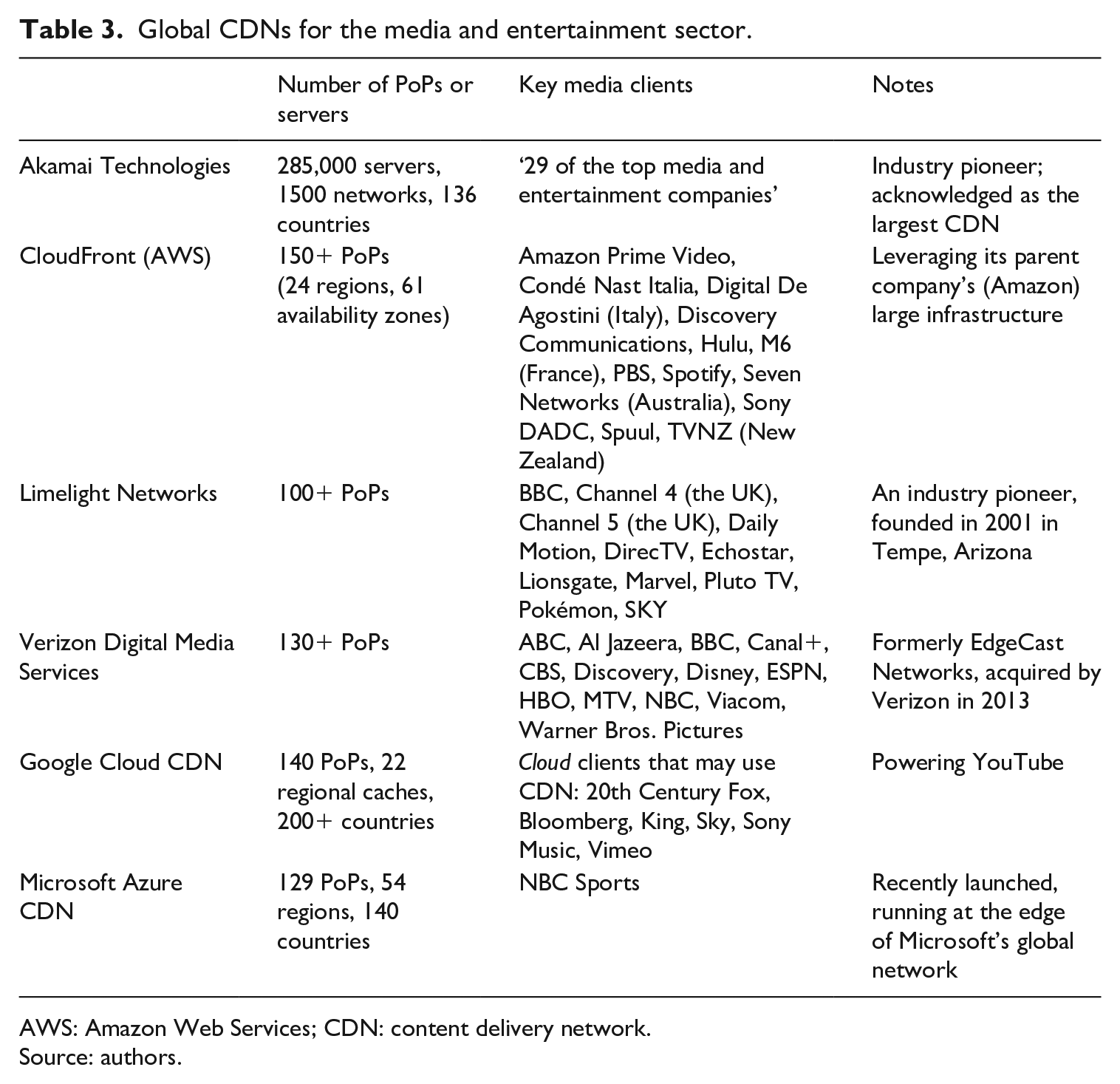
AWS: Amazon Web Services; CDN: content delivery network.
Source: authors.
The CDN industry is highly concentrated because the need for scale – and the benefits that brings – creates high entry barriers to market. Although smaller CDNs can deploy mitigating strategies, 4 those with global scope have an in-built commercial and technological advantage. First, content owners request global coverage from their CDN providers. Yves Boudreau, VP of Partnerships and Ecosystem Strategy at Ericsson, explains, ‘When Fox goes and pays a global CDN to deliver its content, it pays a global CDN to deliver globally’ (Boudreau, 2017). Similar to automotive firms, media conglomerates operate across geographies and demand adequate support from their suppliers, who hence need global capabilities to be in the market. In truth, no CDN covers the whole planet and content aggregators must turn to multiple providers. Despite its parent company’s remarkable infrastructure, Amazon Prime Video needs six networks, and although Netflix has built its own CDN (Open Connect), it uses a few others to reach its customers (Kilpatrick, interview 2019). In all cases, however, a global CDN constitutes the backbone of the distribution network.
A second advantage of global CDNs is their elasticity, because of the ‘upside flexibility’ it allows (Sturgeon, 2002: 458): large providers can scale up capacity at short notice, ensuring they are able to fulfil any streaming demand, no matter how large. For Amazon Web Services (AWS), this includes European-wide streaming of the Six Nations Championship (rugby) and continent-wide coverage of the Indian Premier League (IPL, cricket). For the IPL, the Amazon subsidiary needs to cope with over 10 million concurrent streams each night (Kilpatrick, interview 2019).
This upside flexibility provides yet another incentive for media owners to contract out CDN deployment: they can upscale without capital investment because expenditure increases only as needs expand. And for the CDN providers spreading their own investment and cost across thousands of users, this expenditure represents a fraction of that involved in running a proprietary CDN. Being able to leverage scale, large CDN providers like Akamai are profitable, and the regional or national players (such as the main telcos, for example, BT in the United Kingdom), can do well by bundling CDN services into their wider service portfolio.
Furthermore, ‘distributing CDN servers over a wide geographic area expands the range of options for serving content from a server that is geographically close to the end-user’ (Stocker et al., 2017: 11). This wide range of options not only brings down latency (the CDN being closer to a greater number of users) but also increases resilience as traffic can be rerouted in case of any technical issue (outage, etc.) that can take a data centre out of action (Kilpatrick, interview 2019).
The ability to leverage scale brings economic benefits. Essentially, CDN providers sell a commodity – bandwidth – whose price, like oil, varies little globally. First and foremost, buyers consider cost per gigabyte, and global providers can leverage significant economies of scale. Because of the high volumes they are dealing with, they can lower the average costs on delivering data to reach a point beyond the minimum efficient scale of the long-run average cost curve, which smaller firms cannot do (Sloman et al., 2016: 155–157). In addition, as the ratio of fixed costs/variable costs is very high in the CDN industry, once the largest suppliers have invested in infrastructure the costs of adding features and clients is marginal, and having large numbers of clients brings costs down further. For instance, AWS was able to reduce prices over 60 times in the past 5 years (Darnell, interview 2019; Google executive, interview 2019; Kilpatrick, interview 2019).
Cloud computing
Cloud computing is an industry that is equally concentrated. Worldwide, the sector is dominated by the following five global suppliers: AWS, Microsoft Azure, Google Cloud Platform, Alibaba and IBM (Synergy, 2018). In addition to the benefits of consumption-based pricing, the elasticity, scalability and overall performance of cloud services increasingly tilt the balance in their favour.
AWS alone controls one-third of the market, and the top three providers hold more than half the market in their hands (Panettieri, 2018). Furthermore, the growth rate of the top four providers exceeds that of the ‘small-to-medium sized cloud operators who collectively have seen their market share diminish’ (Synergy, 2018). In the media and entertainment sector, the market leader is undoubtedly AWS. In EMEA alone, it serves in excess of 5000 clients, including broadcasters, publishers, TV production and post-production companies, visual effect houses, storage firms, analytics companies, digital distributors, digital advertisers and advertising agencies (Atkinson, 2017; Kilpatrick, interview 2019).
Cloud computing plays an increasingly important role in media delivery, not least because of the growing prevalence of the OTT space. Internet-based applications encode, store, transfer, encrypt and distribute files, support all asset management operations, and facilitate collaboration and editing through file sharing. Cloud computing is particularly useful for processing and analysing large bodies of viewing data.
Some media firms have invested in their own infrastructure but do-it-yourself datacentres have a low utilization rate (circa 20%), which has negative implications in terms of amortization and depreciation (Kilpatrick, interview 2019). As the industry’s leading survey shows (100,000+ responses worldwide), the favourite option is to externalize computing services and migrate workflows to the public cloud (computing services offered by third-party providers over the Internet; Devoncroft, 2018). Most broadcasters in Europe and the United States are in the process of moving workflow to the cloud. In the United Kingdom, those broadcasters moving their streaming platforms include BBC (iPlayer), Channel 4 (All 4), and UKTV, as have Turner, Fox and Comcast in the United States. Discovery Networks has closed its own VoD operations and moved 300 TV channels onto cloud, streaming them globally from North Virginia. Netflix uses a variety of CDNs to distribute its content (including Open Connect, its own distribution network), but for everything else, it is AWS. Netflix shut its last data centre in 2016 and ‘almost hundred percent of everything they do is on AWS’ (Kilpatrick, interview 2019).
As with CDNs, the upside flexibility and consumption-based pricing of cloud services enable media owners to scale up without capital investment. These services’ overall performance and resilience further tilt the balance in their favour. Microsoft Azure’s network, for instance, is split into 54 regions worldwide (e.g. Norway West, US Gov Arizona, Japan East), each region is divided into geographical availability zones, and each zone consists of multiple datacentres and thousands of servers which themselves sit on different power supplies. Microsoft has built the resilience of its network to the point where it can lose an entire availability zone to a catastrophic failure without any loss of performance (Darnell, interview 2019).
Resilience alone is an important reason why a media owner like Netflix migrated to the cloud. When the website launched on 14 April 1998 as an online DVD rental store, it ‘crashed all day’ (Randolph, 2019: 112). The Santa Cruz-based start-up had no choice but to spend the little money it had on extra servers (Randolph, 2019: 112–116). The cost of financing and the complexity of running Netflix’s datacentres were growing exponentially, not least when Netflix pivoted to streaming in 2007. Despite huge investment, the platform was not immune to problems. In 2008, a data centre failure shut its entire operation for 3 days, and the management ‘faced a choice: turn Netflix into a world-class data centre operations company or more the service to the public cloud’ (Macaulay, 2018). The company picked the right option, and not merely because of resilience: its growth and ever-increasing infrastructure needs could only be met by a major cloud services provider.
Concentration stems from the strong economies of scale that prevail in the cloud computing industry. Developing cloud infrastructure is capital intensive, and an availability zone alone can cost up US$4 billion (anonymous industry source). Once in place, this infrastructure needs to be amortized with the largest possible number of clients. Thus, large cloud providers are multi-sectoral and serve clients across industrial sectors. AWS, Google Cloud and Microsoft Azure have adopted a similar structure, whereby centralized product teams develop the applications that are used across the ‘verticals’: the client-facing teams that take care, among others, of media and entertainment, gaming, social media networks, web hosting, e-commerce, financial services, healthcare, education and policing. While some features vary, the underlying assets remain the same: the discs and servers, the datacentres and fibre optic cables, the field enablement portals and most platforms are standardized across all verticals. For instance, AWS has 120 product teams whose work and research is leveraged across all sectors (Kilpatrick, interview 2019).
In addition, size benefits global cloud providers because the technology they deploy is essentially borderless. Computing processes are today assisted by artificial intelligence and machine learning (AIML), which are applied in multiple ways to automate operations along the media delivery chain. AIML technology is used in asset management systems to tag content, search assets and add metadata. AWS AIML applications include automated picture selection, transcription and translation, and face recognition, a feature first tested by Sky during its coverage of the wedding of Prince Harry and Meghan Markle in May 2018 (Kilpatrick, interview 2019). In transmission, AIML is used to optimize CDN performance and scale up resources by predicting usage peaks, for instance, in the occurrence of live sport events and new releases (Zanni, 2019). Google works with DeepMind, its AIML division, to control electricity flows in its datacentres (Google executive, interview 2019). Cognitive technology drives personalization and plays a key role in the recommendation engines of broadcasters and platforms alike (Atkinson, 2017).
Like all multi-sectoral suppliers, cloud providers – and their clients – reap the benefits of knowledge transfers and cross-fertilization: Microsoft Azure has made advances in latency – crucial for the media and entertainment sector – after lessons learnt from clients in finance, and Google Cloud from its involvement in gaming. Google has changed its recommendation algorithms based on its experience with retail customers. Conversely, AWS transcoding engines for video streaming, which are primarily used in media and entertainment, are also deployed in health and policing (Darnell, interview 2019; Google executive, interview 2019; Kilpatrick, interview 2019).
From global suppliers to a shared supply base
In the space of a few decades, an activity once deemed core by broadcasters is now devolved to a task network that involves global suppliers. Why outsource, why a task network and why a global supply base?
Faced with the mounting cost of upgrading technology, the need to access a complex video ecosystem and to serve audiences across borders, broadcasters began to outsource media delivery in the 2000s (Chalaby, 2019). This evolution gathered pace with the advent of IP-based transport facilitating the collaboration of firms in media delivery and the formation of multi-sectoral suppliers capable of significant economies of scale.
IP-based technologies have enabled the formation of a task network because the conversion of media files into bytes – a highly standardized commodity – has greatly increased the interoperability and modularity of the media delivery GVC (Sturgeon and Kawakami, 2010: 10). IP standards being known and agreed upon, it is easier for suppliers to enter the chain at a specific point, and specialize in a task or segment of their choice. Standards minimize the amount of knowledge firms need to exchange in order to interact, thereby lowering transaction costs among firms involved in the network. Low-cost transactions can now occur at thin crossing points which are located between the chain’s segments (Baldwin, 2007).
How is specialization in a task or segment a viable business model? Media files have become data packets like any other, thus it makes no difference to a server or a router if the file it transports is a parking surveillance video or a reality TV show. This has made it possible for suppliers to serve the broadcasting sector with the same common IT stack and general-purpose equipment that they use in other industries, allowing them to serve a cross-sectoral customer base with the same underlying and generic assets.
The formation of a media delivery GVC raises issues of power and governance within the chain. Lead firms are usually in charge of GVCs in which they operate. Fashion, for instance, is best described as a captive value chain as Western-based retailers yield considerable power over suppliers, which are smaller in size, have limited capabilities and are scattered in low-cost developing countries (Frederick and Gereffi, 2011). Media delivery is a modular chain. In this configuration, the arm’s length interaction between lead firms and suppliers is based on codified specifications and agreed standards, and coordination and capabilities are more equally distributed along the chain (Gereffi et al., 2005: 86). This type of governance denotes a fairly low degree of power asymmetry between lead firms and suppliers (Gereffi et al., 2005: 89).
The concept of polarity is useful to examine the chain governance at macro-level, beyond and above the linkage mechanisms and power relations among its actors. Who drives the chain, and who determines its trajectory? Ponte and Sturgeon distinguish between unipolar, bipolar and multipolar chains. The first are driven by a few powerful actors and characterized by a high level of ‘drivenness’, while multipolar chains exhibit ‘multiple foci of power and various kinds of linkages’ (Ponte and Sturgeon, 2014: 215). More research is needed to determine with certainty the polarity of the media delivery chain. Provisionally, it shows signs of being bipolar, its trajectory being co-defined by media conglomerates of tech giants. But the rise to power of tech companies who now co-drive this chain is remarkable. Broadcasters are no longer the innovation centres they used to be and struggle to recruit high-calibre engineers who do not regard them as tech companies (Stevens, interview 2017). Much of the capabilities, skillset and innovation drive that determine the shape of the chain now rests in the hands of the latter. The suppliers’ rise to prominence is underlined by the strategy of the tech giants (e.g. YouTube, Amazon Video Prime) who have launched content arms that compete directly with their own media customers.
The rise of global suppliers has the following three major implications: consolidation, global integration and industry co-evolution. The media technology sector – valued at about US$51 billion – has gone through intense rounds of mergers and acquisitions (M&A) in recent years, sharply reducing the number of operating firms (Devoncroft, 2017: 16). M&A activities help businesses to become leader in their chosen segment, generate economies of scale and acquire global scope – a pre-requisite to serving the sector’s lead firms. Consolidation is accentuated by lead firms’ preference to run lean supply chains, and new media technology projects tend to involve two to three suppliers only (Devoncroft, 2017: 39). Although there is no indication that the supply market in media delivery is oligopolistic, these trends not only consolidate the sector but limit the ability of new entrants and smaller suppliers to compete in the market. Several specialist suppliers are struggling to survive: Deluxe Entertainment, a US-based post-production firm filed for Chapter 11 bankruptcy, and TVT Media, a UK-based end-to-end content services provider, also filed for insolvency, both in October 2019. Smaller suppliers’ only option is to find an innovative niche and hope to attract the attention of a large supplier.
Global integration has a double meaning. First, it refers to the scale of the companies involved. With the consolidation of the media technology sector, media delivery has become a chain where lead firms and their suppliers have an equally large footprint; it has become a multinational-to-multinational operation. Second, media delivery has become a global-scale production system, in the sense that the firms involved have developed the capability to deliver content to and from any location in the world on a 24/7 basis. The key beneficiaries are the leading OTT platforms that need to operate at scale and use this system to route content to their users irrespective of distance (unless prevented to do so by local regulations). Audiences benefit too as both the amount and diversity of content they can watch is unprecedented in history.
There are, however, losers, including small specialist suppliers whose skillset and technology has become redundant, and traditional broadcasters. The latter operate predominantly in national markets and have limited ability to grow. In addition, they are losing the battle for attention (as illustrated by the Ofcom figures, quoted earlier), and market shares in the advertising market. Some of these shares are lost to the tech giants’ own video services. Alphabet, YouTube’s parent company, announced a record US$15.1 billion in advertising revenue for 2019 (Foster, 2020). Broadcasters are acutely aware of the presence of YouTube in their market and see it as a direct competitor (Greenaway, interview 2019).
Finally, the television industry now shares a supply base with other sectors, leading to the phenomenon of industry co-evolution, which occurs when lead firms across different industrial sectors ‘interact with broadly shared supply bases to drive the evolution of entire industries’ (Sturgeon and Lee, 2005: 35). This shared supply base is triggering a self-reinforcing mechanism that strengthens the necessity of outsourcing and the strategic pre-eminence of global suppliers: Shared supply bases, as in the modular production network, tend to generate a self-reinforcing dynamic – a classic network effect – because pooling effects create large external economies of scale and scope and powerful learning effects. These learning effects induce an increasing number of lead firms to tap the network, which in turn further enhances the competence, scale, and scope of the turnkey supply base and induces more firms to participate. Thus a historical process is unleashed, where the development of an external supply base through outsourcing encourages further outsourcing, and so on. (Sturgeon and Lee, 2005: 45)
For the television industry, the implications of a shared supply base are double edged. Media firms benefit from cross-sectoral research and development that brings costs down, allowing them to deliver more content for less. However, they have lost a certain amount of control with evolving technology, and so must rely on third-party infrastructure to deliver content.
Conclusion
The transition towards IP delivery comes with pros and cons for media firms. Streaming is a requirement in order to remain relevant in a fast-evolving and competitive video ecosystem. While it enables media firms to reach consumers directly through DTC platforms, broadcasters and streamers depend on the infrastructure of the tech giants in order to operate them. The presence of these companies in the media delivery GVC presents traditional businesses with a significant challenge. First, tech giants having realized the edge that a global infrastructure gives them, have gone on to develop their own video services. Second, the size asymmetry between media firms and the tech giants is substantial. While the market capitalization of RTL and ITV, Europe’s two largest commercial broadcasters, stands at US$5.83 billion and US$4.35 billion, respectively, the three leaders in the CDN and cloud computing industries (Google’s parent company Alphabet, Amazon and Microsoft) are worth US$990.7 billion, US$1.3 trillion and US$1.4 trillion, respectively (Google Finance, 9 June 2020). In an industry which increasingly operates on a global basis, the benefit that scale brings cannot be underestimated and may be a key factor tipping the balance of power in favour of the tech giants.
The future of this asymmetrical relationship, however, will no longer entirely depend on industrial actors. As Cunningham and Craig state, tech giants have so far benefitted from a laxed and lenient regulatory environment worldwide (Cunningham and Craig, 2019: 266). A new regulatory era is taking shape as governments are waking to the vast influence that is brought to bear on societies and economies. In their home market, the big tech firms have been subject to ongoing inquiries as their scale and market power attract increasing attention from lawmakers. Alphabet itself acknowledges in its latest report that ‘we are subject to increasing regulatory scrutiny as well as changes in public policies governing a wide range of topics that may negatively affect our business’ (Alphabet, 2020: 15). The US Congress, various regulatory agencies and several attorneys have launched investigations questioning aspects of their business practices, from the way they handle data to potential antitrust violations (Del Rey, 2020; Nicas et al., 2019; Swartz, 2020).
In Europe, the French government will be the first to tax the local revenues of global tech firms, and a French minister has warned that the new tax is ‘just the tip of the iceberg in terms of new regulations that must be introduced internationally to deal with the powerful tech giants’ (Chrisafis, 2020).
The European Commission has begun to draft a comprehensive digital strategy that aims to harness digital technologies in a way that protects Europe’s open societies, reflects their values and benefits their businesses. It is an assertive policy drive that involves regulating an array of technologies (e.g. AI, online platforms), placing digital transformation at the heart of the foreign policy agenda, and building up Europe’s digital capabilities. Overall, the European Union is seeking to retain (or regain) its ‘technological sovereignty’ by building its own ‘key capacities’ and reducing its ‘dependency on other parts of the globe’ (European Commission, 2020: 3).
It is an ambitious policy project which, if completed, may redraw the geographic boundaries of some GVCs, including media delivery. But even Ursula von der Leyen, the President of the European Commission, sounds a note of caution. While she states her aim to achieve technological sovereignty, she acknowledges that ‘it may be too late to replicate hyperscalers’ (von der Leyen, 2019: 13). The merit of the EU policy, however, is to recognize the power that scale brings in the digital economy, and to carry the debate in to the diplomatic arena.
Footnotes
Acknowledgements
The authors would like to express their deep gratitude to all the interviewees for their time and cooperation. They are also indebted to the anonymous reviewers for their constructive criticism and helpful suggestions.
Funding
The author(s) received no financial support for the research, authorship, and/or publication of this article.
