




Abstract
In the past decade, a wealth of research has focused on women and social media. Typically assembled according to the logic of ‘risk’ and ‘exposure’, this extensive work tends to operate within a negative paradigm whereby women’s engagement with the digital produces harmful outcomes for wellbeing. This article makes a novel contribution to this literature by tracing the ways in which women who are in recovery from eating disorders and engaged in weightlifting strategically navigate their social media ‘worlds’ and give meaning to this process. Our data draw on 19 in-depth interviews and our findings examine 2 key themes. First, we challenge the negative paradigm that frames women’s social media use and demonstrate how the digital can support positive wellbeing for women in recovery. Second, we introduce the concept of ‘digital pruning’, a personal political project framed within the language of self-care, which involves unfollowing unhelpful or triggering content.
Introduction
Within contemporary western cultural consciousness, social media looms as the boogieman for issues relating to women’s body image and self-esteem, with reductionist and sensationalist media reporting framing social media use as either ‘good’ or, more commonly, ‘bad’ (Gerrard, 2018; Gill, 2012). These prevalent digital sceptic discourses are reinforced by extensive work which evidences a negative relationship between women’s holistic wellbeing and social media. Specifically, academic research on the topic argues that women’s interaction with social media platforms predicts body dissatisfaction, poor self-esteem, the internalisation of the thin ideal, increased self-objectification and a heightened risk of developing eating disorder symptomology (Holland and Tiggemann, 2016).
Despite the negative associations between social media content and health, women are engaging with social media more than ever. Between 2010 and 2017, the share of female respondents who reported creating a profile on any social media site increased from 56% to 81% (Statista, 2018). Moreover, research shows that the average UK adult spends approximately 12 hours a week using social media platforms such as Facebook, Twitter and Instagram (ComRes, 2018). While women are warned against the potentially damaging nature of media-effects, the digital is incrementally taking up more space in our everyday lives. This prompts the following conundrum: women are unconsciously causing themselves harm, engaging with social media to their detriment despite overwhelmingly negative affect. Conversely, women may develop conscious and experience-informed strategies to navigate potentially damaging social media content, a process which so far remains absent from existing empirical research.
This article makes an original contribution to literature on new media by focusing on a sample of women who, we argue, would be characterised as particularly vulnerable to the negative impacts of using digital spaces: women weightlifters with a history of eating disorders. Existing literature typically focuses on the measured effects of women’s ‘exposure’ to social media and this particular sample would be deemed ‘at risk’ of potentially damaging messaging, due to the transactional media-effects associated with exposure to pro-eating disorder 1 (pro-ED) content and ‘fitspiration’ discourses which promote the achievement of (often unrealistic) lean body-types through exercise (Perloff, 2014; Valkenburg and Peter, 2013). In this respect, previous research has focused on the ways in which the thin ideal and pro-ED content on social media negatively impacts women’s wellbeing (Ghaznavi and Taylor, 2015; Mingoia et al., 2017; Rodgers et al., 2016). More recently, research in this field has explored the negative outcomes associated with the shift towards a more muscular ideal for women, marked by the emergence of fitspiration on social media platforms (Robinson et al., 2017; Tiggemann and Zaccardo, 2015). Most women in our sample reported to regularly observe thin ideal and/or pro-ED content online when suffering from an eating disorder, as well as muscular ideal/fitspiration imagery when recovering through weightlifting. Due to their exposure to this damaging content, these women lie at a specific intersection of expertise and lived experience, making their insights on social media particularly significant and novel.
Our research details the ways female weightlifters in recovery from eating disorders strategically and consciously navigate online spaces. By exploring how this population of women subjectively reconceptualise and design their social media ‘worlds’ to enhance positive health and wellbeing, we develop and extend existing work in this field, building towards a significant, more complex framework for scholarship on women’s relationship to the digital.
We begin by critiquing some of the ontological assumptions underpinning much of the work on the relationship between women’s wellbeing and social media. In particular, we interrogate the notion of ‘exposure’ to the digital, drawing attention to its limitations before considering the need for research which takes into account agency and subjectivity. We then overview the study methods, emphasising the value of approaching the data using Interpretive Phenomenological Analysis (IPA), before moving on to our findings, which examine two key themes. First, we challenge the negative paradigm maintained by extant research on women’s engagement with social media, by demonstrating how digital spaces can positively support wellbeing for female weightlifters in recovery from eating disorders. Second, we turn to this article’s novel theoretical contribution, ‘digital pruning’ – a personal political project whereby this population critically sift through social media content and make informed decisions about the affectual impact of their online environments. Finally, in the ‘Discussion’ section, we critically engage with the neoliberal rhetoric underpinning digital pruning as a subjective practice which places the responsibility for content regulation firmly in the hands of individual users. We explore this in connection with postfeminist literature, which theorises the centrality of ‘choice’ and self-knowledge to contemporary western feminine subjectivity (Gill, 2007; McRobbie, 2009).
‘Exposure’ and the vulnerable female gaze
The relationship between women’s wellbeing and the Internet has been extensively written about since the arrival of social media platforms in the late 2000s/early 2010, with a particular focus on sites that support the sharing and editing of digitally mediated images (such as Facebook, YouTube, Instagram, Twitter and Snapchat). Significantly, studies which look at women’s interaction with social media find an overwhelmingly negative effect (Fardouly et al., 2015; Tiggemann and Slater, 2013), with the exception of some notable work on the positive impact of self-compassion messaging and body positivity (Cohen et al., 2019; Slater et al., 2017). According to this cache of research, engagement with social media platforms facilitates self-comparison (Tiggemann and Miller, 2010), body surveillance (Vandenbosch and Eggermont, 2012) and self-objectification (Fardouly et al., 2018). Moreover, the reportedly high prevalence of thinspiration (images that promote the thin ideal) and fitspiration (images that promote the achievement of a lean body-type through exercise) within the social media landscape has directed the focus in much of this body of research. This scholarship reveals that ‘exposure’ to thinspiration/fitspiration messaging predicts greater body dissatisfaction and negative mood (Prichard et al., 2017; Tiggemann and Zaccardo, 2015), Furthermore, and of particular interest to our study, conceptual models have been developed that attempt to link eating disorder symptomology to the viewing of these images (Griffiths et al., 2018).
The language of ‘exposure’, which assumes a lack of protection from harm, proliferates within scholarship on women’s engagement with social media (Slater, 2004). Yet, there is little critical engagement with the underpinning theoretical and ontological assumptions held by this frequently mobilised terminology. Exposure also forms the basis of key methodological processes, most commonly through experiments which replicate the encounter between social media users and images that contain specific messaging (e.g. fitspiration, thinspiration, attractive celebrity images; Brown and Tiggemann, 2016; Griffiths et al., 2018; Tiggemann and Zaccardo, 2015). Typically, before and after a sample of women are ‘exposed’ to the chosen images, they are asked to complete one or more measures relating to body image and wellbeing (e.g. body satisfaction and mood). The comparative results of these two time points are then utilised as evidence of the effects of certain social media content on women’s wellbeing. While this research offers some insight into women’s initial reactions to certain messaging, it fails to take into account the dynamic and everyday use of mobile technologies (Ibrahim, 2015). Moreover, as Holmes (2017) contends, such a persistent emphasis on risk (as well as the insistence on the girl as a consuming subject), directs attention away from questions of media production…as well as the digital practices through which constructions of the self are actively negotiated and produced. (p. 4)
Moreover, within writing on women and girls’ engagement with the digital and the development of eating disorders, a seductive discourse of contagion has emerged from the moral panic associated with exposure to pro-ED spaces on social media, compounded by the assumed passivity and vulnerability of the female gaze (Bell, 2009; Burke, 2006; Gerrard, 2018; Holmes, 2017). As Burke (2006) writes, ‘the prevalence of the idea that women can “catch” anorexic behaviours from looking at each other or images of slenderness displaces feminist ideas about imagery oppressing women and instead foregrounds a sensationalised, “pathological” bodily schema’ (p. 316). This idea of contagion within digital spaces is convincingly challenged by Gerrard (2018), whose study of hashtags and pro-ED spaces reveals that social media platform moderation protects those who might be characterised as ‘at risk’ but not those who are already embedded within these systems. In addition, Chancellor et al.’s (2016) work on lexical variation in pro-ED online communities (e.g. the use of #thyghgapp instead of #thighgap) demonstrates that while pro-ED content still exists on social media, it has to be actively sought out using special terms developed within the subculture. However, there is a dearth of empirical literature relating to how potentially vulnerable female populations experience social media environments.
We argue that the language of exposure and the methodology that accompanies it, deprives women of agency and fundamentally falls short of the ways in which both platforms and users operate. In their 2014 agenda setting piece, Prieler and Choi (2014) write, ‘it is necessary to differentiate the effect of social media use through passive exposure to social media content from the effect of the active use of social media, such as commenting, disseminating, seeking information, and posting’ (p. 381). While we agree that there is a need to incorporate user agency into research on women’s social media use, we would go further to suggest that the very notion of ‘passive exposure’ itself is not ontologically possible (Rose, 2016). Whether images are sought out, created, or unintentionally viewed, there is a dynamic process occurring at the site of the user which involves recognition, interpretation and absorption (Van Dijck, 2009). As Rose (2016) contends, ‘as images circulate, pausing and materializing in specific places with specific people, cultural meanings are encountered, interpreted, ignored, lost, liked, resisted and deleted. All this is friction’ (p. 343). It is this process which remains entirely absent from writing on women’s wellbeing and media-effects and yet is crucial to understanding how individuals strategically engage with and react to the discourses they observe.
Agency in the digital age
Research in the digital age requires a more dynamic, multi-sited approach to media-effects scholarship, which takes into account both the capacity for individuals to subjectively design their own personal online ‘worlds’ and the structural make-up of social media platforms. In this regard, while the literature on women’s wellbeing and ‘exposure’ to social media detailed earlier falls short in sufficiently accounting for agency and subjectivity, it is important to also not take for granted the socio-spatial geographies of the digital, which shape online environments in particular ways (Rose, 2016).
It is surely the case that individuals have more agency in their engagement with new media than they did old media, and as such, a variety of concepts have been developed which characterise this shift towards a more participatory media culture (Jenkins et al., 2016). For example, convergence culture refers to a paradigm shift whereby ‘consumers’ of content can no longer be considered an audience in the traditional sense, due to widespread access to the tools for production and distribution (Jenkins and Deuze, 2008). In a similar vein, produsage describes ‘the collaborative, iterative, and user-led production of content by participants in a hybrid user-producer, or produser role’ (Bruns, 2006). Moreover, these ideas have been adapted and extended with the advent of social media, to account for the ever-increasing methods by which Individuals can act with and through the digital (Jenkins et al., 2013). In this respect, social media users can exercise agency by choosing what or who to ‘follow’, interacting with content (through ‘liking’ or commenting), and producing/editing theirs and others’ content. Picone et al. (2019) have developed the concept of ‘small acts of engagement’ (SAOE) which conceptually accounts for these kinds of productive practices that constitute everyday user agency. In this respect, there is a wealth of literature which accounts for the various ways the Web 2.0 has given rise to new ways of communicating, creating and living.
However, the boundaries to user autonomy are unclear, as the architecture of social media platforms is partially constructed by algorithms which sift and instrumentalise user data in particular ways (Beer, 2009; Hayles, 2012; Rose, 2016). In this respect, feedback loops embedded within a platform’s design determine, to some extent, what kind of messaging an individual user will be presented with in future interactions (Gerrard, 2018). However, the underpinning mechanisms that metabolise and leverage data are not generally obvious or visible to the average user, meaning the role these platforms play in shaping agency is not always clearly discernible (Eslami et al., 2015). Boulton and Zook (2013) refer to the naturalisation of these structures as the ‘duplicity of code’, whereby ‘code works to produce space and, by doing so, defines the boundaries of knowledge production, codifies the meanings of place, and delimits a field of potential practice’ (p. 440). It could therefore be argued that digital platforms co-constitute action by making certain activities possible and even desirable (Van Dijck, 2009).
Significantly, as social media spaces are created in a ‘for-profit’ model, platforms are governed by the logic of visibility, engagement and status, rather than social responsibility or public good (Marwick, 2013). As a result, algorithms provide an architectural framework which often reifies problematic social dynamics that are observable in wider society (Petre et al., 2019). In this regard, those with power and status tend to enjoy an elevated exposure and normative beauty ideals (such as thinspiration and fitspiration) proliferate (Carah and Dobson, 2016). This being said, platforms are habitually required to adapt and evolve their regulations and ethics in response to user demand. Consider, for example, Flat Tummy Co., a company who sells ‘appetite suppressant lollipops’ and ‘flat tummy tea’, who accrued significant wealth by ‘gaming Instagram to sell women the unattainable ideal’ (Wong, 2018). Famous influencers who endorsed these products include, Kim Kardashian, who has 154 million followers on Instagram (as of December 2019) and Amber Rose who has 19.2 million followers on Instagram (as of December 2019). This highly visible campaign was met with significant resistance from feminists, body positive activists and health professionals. This, among other contested instances of toxic messaging on platforms, led Facebook and Instagram to tighten their restrictions on posts related to diet products and cosmetic surgery (BBC, 2019). In this respect, the relationship between social media platforms and user agency mutually constitutes, as the successful structural development of platforms relies on the push and pull of user feedback and engagement.
When theorising agency within social media use, structural features of platforms such as algorithms, the ‘for profit’ governance model, and content regulation policies, all impact user experience by somewhat determining the ‘temporal and spatial horizons for experience’ (Boulton and Zook, 2013: 440). However, a wealth of literature has emerged in the field of new media and communication focusing on the methods by which individuals and groups attempt to resist algorithms by organising collectively or mobilising them to their own advantage (Cotter, 2018; O’Meara, 2019; Petre et al., 2019; Velkova and Kaun, 2019). For example, research by Cotter (2018) explores the conscious strategies mobilised by social media influencers to engage with Instagram’s algorithm. This study demonstrated that this population of users have an acute awareness of how to ‘play the game’ on social media, by strategically harnessing the algorithms’ power to increase their own visibility. Moreover, Rheingold (2012) has written extensively on digital literacy and how individuals can mindfully engage with the Internet to achieve personal and collective empowerment. In this regard, there is evidence that user agency is being enacted both materially and discursively in relation to social media platforms and their internal structures.
Theorising agency within the context of social media is multifaceted and both digital structures and user agency should be accounted for. For the purposes of this article, we have chosen to explore experiential accounts of social media use, from the perspective of female weightlifters in recovery from eating disorders. To do this, we approach the data using IPA, which asks the question, ‘what is this kind of experience like?’ (Shinebourne and Smith, 2009). In this sense, while we believe it is important to acknowledge the role of structure in shaping online experiences, and have done so here, this research is primarily interested in participants’ understanding of agency as it pertains to the digital. This is an important and highly original line of enquiry given the lack of attention paid to female subjectivity in previous work on women and social media, which has typically tended to operate according to the logic of ‘risk’ and ‘exposure’.
Our primary research questions are as follows: What impact do social media have on wellbeing and recovery for female weightlifters in recovery from eating disorders? How do female weightlifters in recovery from eating disorders strategically navigate social media spaces and give meaning to this process?
Methods
The data for this article come from a wider project on women’s use of weightlifting as a mode of recovery from eating disorders. Female participants, aged 17 and over, living in the United Kingdom, who have a history of eating disorders and are weightlifting during their recovery, were sought to take part in the study. In order to ensure rigour in our recruitment strategy, a two-pronged approach to sampling was used, which enabled us to recruit respondents from what could be defined as a ‘hard to reach’ group (i.e. women weightlifters in recovery from eating disorders). First, the study was advertised in a selected group of gyms in England. Second, calls for participants were posted on the lead researcher’s Instagram and Twitter accounts and individuals who fit the study criteria were identified and direct messaged through social media. These two methods in combination with snowball sampling and recruitment by word of mouth secured the complete sample (n = 19).
In-depth semi-structured interviews were then conducted with participants in various locations across the United Kingdom (see Table 1). In terms of the ethnic make-up of the sample, 16 participants identified as White British, 2 as British Indian, and 1 as Chinese. Their ages range from 17 to 36 and they live in various different locations across the United Kingdom. The women who took part in this study were all amateur participants in a range of weight training styles. These included bodybuilding, strength training, powerlifting, strongwoman and CrossFit. Participants did 1 or a combination of these activities on a weekly basis and had done so for a minimum of 8 months at the time of interview.
Participant information
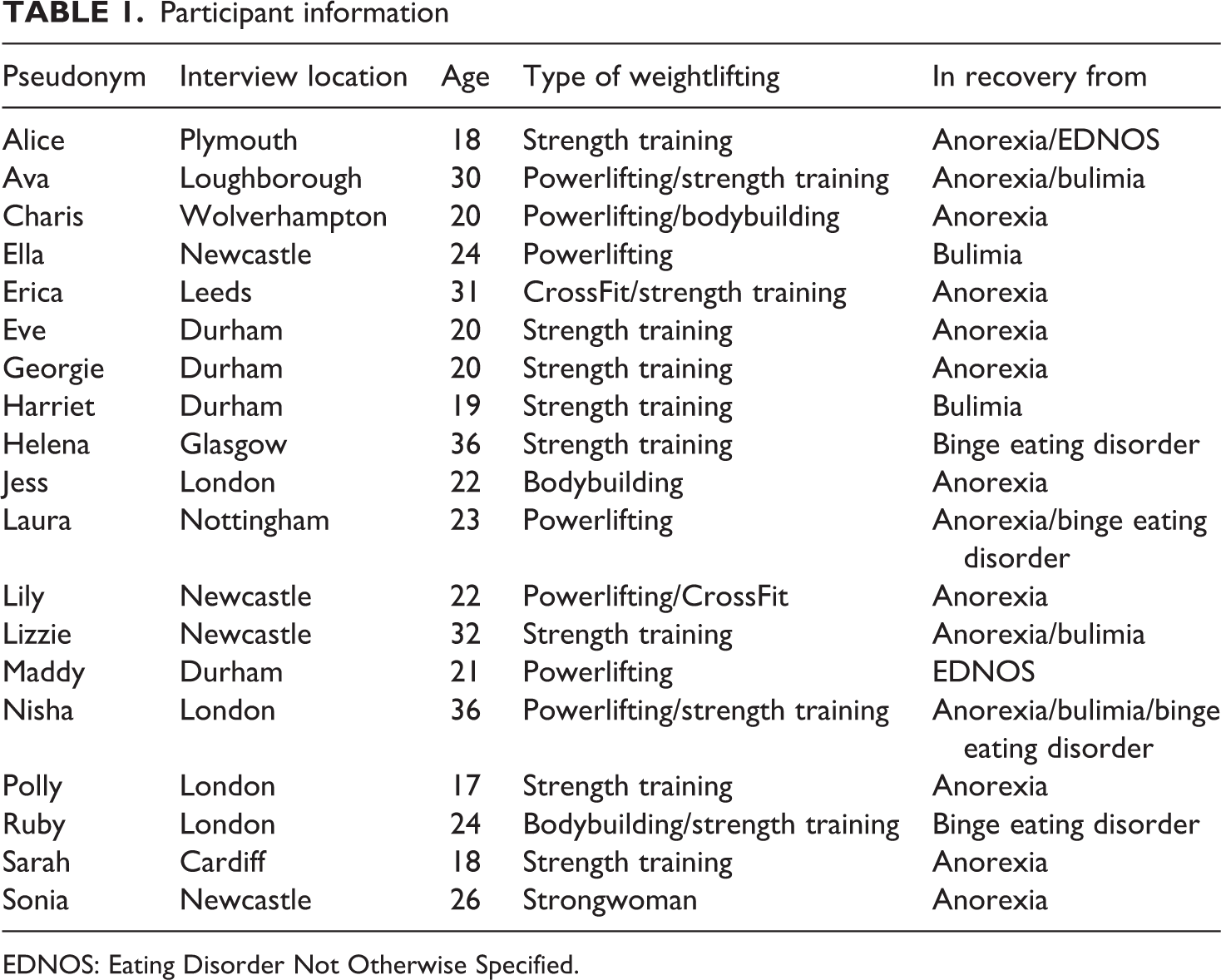
EDNOS: Eating Disorder Not Otherwise Specified.
This project employs a feminist approach to health and self-care which affirms ‘a positive view of women as experts of their own health experiences’ (Weaver et al., 2005: 190); therefore, women were asked to self-report their recovery status. While a minority of participants considered themselves ‘recovered’, the majority of women self-identified as ‘in recovery’, despite often being no longer considered clinically at risk, due to being weight-restored. Participants viewed recovery as a daily practice and there was a great deal of discussion regarding the degree to which a person ever truly recovers from an eating disorder. Two participants identified as ‘still suffering’ with an eating disorder. Just under half of the women who took part had never received any treatment or therapeutic support for their eating disorder. Of the participants who had at one time accessed care, two were inpatients, three were outpatients and the remainder saw a therapist or psychologist. However, many of these women reported struggling to engage with formal treatment, citing weightlifting instead as the key driver for their recovery.
Mobilising the language of digital fitness culture, interviews were presented in recruitment materials as informal discussions about participants’ fitness and recovery ‘journeys’. Interviews were conducted by the lead researcher in a variety of locations (based on participants’ preferences), which were mostly cafes and university meeting rooms. The interviews were semi-structured, lasting between 1 and 2 hours (averaging at 1.5 hours), and the interview guide was split into the following 3 experiential categories: (1) weightlifting and strength, (2) eating disorder recovery and (3) social media usage. A total of 5 to 10 questions were drafted for each category to prompt discussion; however, interviews rarely followed a neat, linear format. Given that participants were extremely well-versed and understanding of the internal mechanisms through which weightlifting and social media impacted their recovery, the three categories were largely discussed at once, with participants drawing connections between weightlifting, recovery and social media in a narrative style that is mirrored within social media spaces (Rettberg, 2018).
Due to the stigmatised and potentially vulnerable nature of the research participants in this study, ethical considerations were embedded in the research design. Ethical approval was gained from the host institution and participants were provided with written informed consent before any data were collected. It was anticipated that discussing exercise and food during the interviews may be triggering or interfere with recovery. This was not found to be the case as, when asked to reflect on how the interview made them feel (immediately after the interview and in follow-up conversations), participants reported the process to be positive, as it allowed them space to reflect on their experiences in a non-therapeutic context. However, in situations where participants disclosed that they were struggling to recover, they were signposted towards various resources such as eating disorder helplines and information on how to access support.
The lead researcher conducted all interviews for this study due to having an ‘insider’ status through her participation in amateur weightlifting and engagement with health and fitness social media content. In order to facilitate an informal, conversational atmosphere, some personal experiences with diet, exercise and social media were shared by the lead researcher when interacting with participants. These attempts at connection served to readdress the power imbalance inherent within the interviewer/interviewee dynamic, as well as allow for a rapport to be developed (Cotterill and Letherby, 1993). In particular, the lead researcher’s relevant experience was valuable when the technical details of weightlifting (e.g. certain exercises or styles of training like ‘hypertrophy’) and social media (e.g. ‘stories’ on Instagram) were discussed (Kerr and Sturm, 2019).
A central aim of the study was to determine the role that social media plays in the use of weightlifting as a mode of recovery. As a result, data were collected regarding participants’ social media use and its impact (if any) on health and wellbeing. Participants in this study have unique and important insights to offer into current debates in this area. For one, this group of women have a history of eating disorders and over half of the participants in the study reported to engage with pro-ED content prior to starting their recovery. According to the extant research, this situates them within the category of potentially most ‘at risk’ and vulnerable to negative social media messaging (Perloff, 2014). Second, as they are all weightlifters and gym-goers, the women in this study observe and engage with so-called ‘online fitness communities’ on social media. This makes them well-placed to comment on fitspiration discourses which, research indicates, proliferate within this online space (Griffiths et al., 2018). Finally, this group of women represent a range of voices within the social media landscape. The majority are casual and active users, engaging with digital spaces to document their weightlifting and recovery progress. In total, 4 participants have cultivated followings of over 2000 on Instagram and 1 participant could be considered to be ‘influencer’ status, 2 due to having over 201k followers of her Instagram account. It is noteworthy that two of the women in the study did not use social media, for one participant this was due to a lack of interest and for another her avoidance of social media was described as a conscious means of maintaining positive mental health.
In terms of social media platforms, 17 of the sample used Instagram, citing it as their most frequently used social media application. Some declared the use of the earlier established social media platform Facebook to be ‘dead’ and ‘somewhere your parents are at’ (Erica). This is reflected by research that demonstrates photo and video sharing is progressively the highest form of social currency online, with image-based apps such as Instagram achieving increased popularity among women and young people (Ibrahim, 2015; Rainie et al., 2012). As a result, a great deal of the following discussion centres around Instagram, however occasional reference is also made to Twitter, YouTube and Facebook.
We approached the data using IPA. This analytic approach is well suited to health-related research with small sample groups, as it seeks to interpret meaning from the depth and richness of personal narratives within a given phenomenon (Shinebourne and Smith, 2009). Moreover, at its core, IPA is interested in experience, subjectivity and relatedness, which are central to the research questions for this project (Larkin and Thompson, 2012). With the exception of work by Hill et al. (2015), IPA is seldom adopted in the field of new media and communications. However, given the lack of agency theorised within previous research on women’s wellbeing and social media, we believe this approach facilitates access to highly novel and important information on how groups of women (in this case, female weightlifters in recovery from eating disorders) perceive their own self-efficacy as it pertains to the digital.
All interviews were transcribed verbatim and pseudonyms have been assigned to protect anonymity. These data were inductively coded using Scrivener, a piece of software which facilitates the compilation and sorting of multi-media data. Emergent themes were identified and organised into clusters according to their conceptual relatedness. The final codes were then cross-checked between the authors working on the project in order to ensure rigour and synergy of analysis. Examples of salient codes that emerged from analysis on social media use included, ‘following/unfollowing’, ‘media literacy’ and ‘online bodies’. Finally, while a handful of participants have been quoted in the findings due to their explanation being illustrative of a particular practice or sensibility, it must be noted that the themes they speak to resounded across the sample.
In practice, IPA attempts to get as close as possible to the viewpoint of the participants, while acknowledging that researchers, who hold their own subjective and experience-informed perceptions, will inevitably bring to bear their own conceptions of the data (Hill et al., 2015). In efforts to make this visible by clearly demarcating the participant voice from the researchers’, the following sections are organised into the following: (1) findings, which centralise the participants’ experience and point of view and (2) discussion and conclusion, in which the authors extend the analysis by pointing to the wider implications of the findings.
Findings
Social media, wellbeing and recovery from eating disorders
Not all women in this study reported wholly positive relationships to social media; however, there was a coherent sense in which digital platforms are too readily mobilised to explain away social ills such as negative body image, poor mental health and the development of eating disorders. In particular, participants were highly alert to discourses in which social media is perceived to be detrimental to self-esteem and body image. While they did not deny that engagement with certain harmful content online can reinforce and reproduce negative affect, they expressed frustration at the idea that social media might be the ‘true cause’ of poor wellbeing. For example, Lizzie contends, I think in the past it was just magazines and celebrities, whereas I think with Instagram it’s like real people, like someone from Sunderland doing things, it’s so much more real. And it’s more realistic as well, so when people say things negative about women’s body image and the internet and social media and how bad it is, I completely disagree, because I think it gives us more access to real people and to people who are having the same thoughts as I might be having and it’s like a community and I think it’s a lot better to have it than not have it because if it wasn’t there, I’d just be seeing the same things that I saw as a teenager that made me think like this to begin with. Just skinny people in fashion magazines that I’m tearing out photos of and sticking them on the wall as ‘thinspiration’ and I don’t do that anymore, I don’t buy those magazines anymore, I use Instagram, and I look at the page of someone from Leeds, who’s not skinny but is well and happy and exercises. So I went through in early recovery this phase of not wanting to get dressed or leave the house or do anything because I just felt really ashamed that my body was changing and I was eating and doing this thing that for so long I felt like I shouldn’t be doing. So this is one of the first days that I sort of got out of bed and even though I felt really really bad about myself, I still got dressed, I still…and I felt like, Instagram really helped with that because I tried to make myself post once a day and I was like, well you can’t post in your dressing gown, so I would make myself get dressed and make myself do something productive. Even if I just did that and then went back to bed for the rest of the day, it was just about forcing myself to accept that life was still happening and that it couldn’t completely ground to a halt just because I needed to do this recovery thing. So, like, that kind of having to have some self-discipline, even when it’s really hard, is difficult but I did it. I did get there- most of the time.
Participants made sense of this liminal phase through the process of documentation, communication and reflection. In this sense, the act of posting on social media was found to precede and co-constitute concrete action. As Nisha shared, *shows picture of breakfast from Instagram* I broadly know when I’ve been in an okay place, because I’m okay to post about food, and otherwise I just don’t at all, ever.
The idea of choice was also central to participants’ understandings of their social media use and the women in this study viewed themselves as ultimate architects of their online ‘worlds’. Underpinning this logic was the central belief that ‘it’s all about who you follow’ (Polly). Alice echoes this sentiment, explaining, It’s not a good or a bad thing, it’s a tool and like anything else, it depends on the way that you use it and the way that you engage with it. So you can either engage with it and put out negativity and pro-anorexia and all of this stuff that has real influence but in a negative way or you can use it for good and to connect with people and to learn and all of these things and I think it can be really helpful in that way and it’s not just the negative space. Sonia: I have to go through and unfollow people sometimes. People that are just unhelpful as well like when they start promoting laxative teas and stuff like that…nah. Interviewer: So, what does your feed look like now? What kinds of accounts do you follow? S: Mainly other trainers, my friends, loads and loads of dog accounts, a few strong women, because I work behind a coffee machine, loads of coffee. So just all stuff that I like, without, like, influencers…I feel like my personal training account is totally different though. It comes up with ‘suggested for you’ all the time and there will be like someone with their butt sticking out and I’m like, ugh. Interviewer: Ah I see… S: But it’s just knowing who not to follow.
Digital pruning: the strategic design of social media ‘worlds’
The women in this study were highly media literate and regularly offered well-formulated deconstructions of problematic social media content. Moreover, they were keen to explain how they put their ideas about harmful messaging into concrete actions: I normally unfollow as an act of defiance, if I think someone is selling something like skinny teas or like, skinny coffee or like, you know, those slightly awful like…I instantly unfollow when someone does that. Purely because I think it’s like a political action. But um yeah so I’m quite good at unfollowing. Or if I think someone is putting out a message that is damaging to other people…yeah sometimes I’ll unfollow as a little vote. Social media is a good place because at the end of the day…it sucks that the 21st century relies on it but that’s just how it’s gone and that’s just how it’s happened, but if you’re in a position where you’re understanding and knowledgeable about what triggers you, what’s good for you and what’s harmful and you’re making social media a safe place for you, that’s fine. (Sarah) Obviously you have to be quite careful with who you follow. Because when I was ill, I was like on pro-ana sites and all that kind of thing. So there’s a lot of negative stuff on the internet and you can follow a lot on Instagram where you’re like, ‘well I’m never going to look like that’…so I’m quite careful. Somebody mentioned like, Instagram is your personal magazine, and you curate your own magazine. And I try and do that with it. So I try and make sure that it’s, like, a healthy place for me to be, instead of somewhere where there’s like loads of people calorie counting and being like, ‘this is what’s in my food’ or ‘this is my 4 hour workout’ I try not to follow that but yeah…it is a balance. (Eve) Not everything you see is like how it is so I just disassociate myself with certain things because I know that I can’t…like recently my boyfriend has suggested that I go through and mute and unfollow just people I don’t know, people that trigger me, people that I’m like…I am a lot better but sometimes you’re looking through people and you’re like ‘god look at her she looks incredible, wow’ just in admiration but if I’m constantly seeing these things it’s going to stick in my head that I don’t look like her. So I just mute people and unfollow them. So I did and now I don’t see those people come up anymore and it’s quite nice.
Significantly, digital pruning was also framed by participants as a skill. As Maddy noted, ‘I’m quite good at unfollowing’. This attitude was reflected in a conversation with Jess, who explained, I think in terms of harms, like I said before, a lot of people will misinterpret their place or misinterpret what they should actually be doing [um]…that there’s a hell of a lot of non-personal trainers that decide to sell fitness programmes and that can be very frustrating [um]…but I think any harm of social media isn’t intentional. I think nobody apart from potentially skinny teas and companies like that, they are there to take advantage of hypes, they are there to take advantage of trends, but that’s kind of a business and to some extent that’s what all businesses do…I think in terms of individual people there are absolutely brilliant people and as long as you can remind yourself exactly why you are there and what you are there for and what your aims are, that you are not this person, you shouldn’t aim to be this person, like, either their lifestyle or how they look. There aren’t necessarily any negatives. It’s only really a negative if you are very easily influenced.
And for those who are not able to successfully ‘manage’ their affective relationship to social media, abstinence is viewed to be the best option. Ella is one of two participants in the study who chooses not to use image-based social media platforms. Here, she explains some of her reasons: I chose to get off Instagram and it has been really the best thing that I have done and stuck to in the past couple of years. Not seeing those bodies lifting- that typical body that I want, that kind of thick bum, thick legs, lifting…. ‘she lifts’ kind of mentality. I just had to get away from it. (Ella)
Discussion
Our findings explore how female weightlifters in recovery from eating disorders use social media as a liminal form of agency, to sustain recovery and positively support wellbeing. Furthermore, from these data emerged the practice of digital pruning, which describes the individual process of sifting through and unfollowing content that prompts negative affect. Digital pruning, we argue, opens up an interesting discussion for thinking about who is expected to take responsibility for harmful or triggering messaging on social media. In what follows, we explore the wider implications of digital pruning as a subjective practice.
For the women in this study, choice and the ability to design their online ‘worlds’ was central to sustaining recovery, as they reported to often encounter unhelpful or damaging content in their use of these platforms. However, it could be argued that this emphasis on individual culpability and the strategic negotiation of risk through ‘digital pruning’ is problematic in numerous ways. For one, it places the task of content regulation firmly in the hands of the user, which reflects a characteristically neoliberal sensibility. While ‘neoliberalism’ has multiple definitions and meanings in a variety of fields and substantive contexts, here we define it as a form of conduct emphasising that individuals should take up responsibility for maximising their own potential, rather than focusing on collective gain or structural change. Thus, instead of defining this term according to specific set of political and economic rationalities, here we refer to a neoliberalism as kind of subjectivity, which has come to permeate the logic of everyday life (Gill and Orgad, 2018; Gill, 2008).
Due to the intersections with neoliberalism in the wider socio-political climate, contemporary hegemonic western feminisms are defined by choice, individual culpability and personal empowerment (Gill, 2008; McRobbie, 2009). This cultural shift is characterised by the theory of ‘postfeminism’, defined by McRobbie (2004) as ‘an active process by which feminist gains of the 1970s and 80s come to be undermined…while simultaneously appearing to be engaging in a well-informed and even well-intended response to feminism’ (p. 255). Crucially, postfeminist rhetoric champions individual agency above all else, with little nuanced acknowledgement of the socio-cultural factors, influences and motivations that shape action (Budgeon, 2015; Gill, 2008). In this regard, women are viewed to be autonomous agents, making choices free from the constraints of inequality or structural power imbalances (Gill, 2007). In this regard, while the women in this study regularly encountered problematic and potentially damaging messaging on social media, there was a coherent sense among participants that it is the responsibility of the individual to avoid this content (by ‘unfollowing’, ‘muting’ or ‘blocking’ certain accounts) and maintaining their own wellbeing.
This is perhaps unsurprising when many interventions in this area take a similarly individualistic approach (Gill, 2012). In this regard, body image researchers have done a great deal of work around developing media-literacy interventions to combat disparities in critical engagement with online content (Jeong et al., 2012). These interventions generally target ‘at risk’ groups (such as young women) and aim to protect them from harmful media-effects by equipping them with the knowledge and skills to mindfully assess, analyse and create content online. However, this neoliberal logic of personal responsibility and the notion that we need to make young women more resilient to media-effects is a supposition that surely absolves platforms, advertisers, and those with the greatest influence from culpability (Gill, 2012). When speaking with participants, there was a concerning sense in which this emphasis on choice and personal autonomy prevented any form collective action against the systemic structural inequality that underpins toxic messaging. In this regard, digital pruning and the underpinning ‘choice’ narrative espoused by participants, serves to depoliticise inherently sexist or anti-feminist messaging, as well as reprivatise issues that have only recently become public and collective (Gill, 2007; McNay, 1992). In this respect, as a novel theoretical tool, digital pruning captures both the everyday practices and the socio-culturally informed subjectivity that gives shape to contemporary relationships to new media.
It is noteworthy that, for participants, digital pruning was framed as a skill. This assumes that women will be able to acquire the ability to successfully navigate harmful content through a concerted application of effort, discipline and practice. It is unclear whether developing self-awareness and knowledge of one’s own interior workings through therapy is a significant factor in ensuring individuals are able to successfully engage in digital pruning. With regard to the women in this study, just over half of the sample had (at one time) accessed support for their eating disorder through inpatient/outpatient treatment or therapy. While there was no discernible difference in ‘skill’ between participants who had and had not received treatment, more research is needed to understand the relationship between mental health support and relationships to social media.
In this respect, while we argue that women have agency in their engagement with social media and regularly make conscious and experience-informed decisions about the content they view, there is no guarantee that individual evaluations will always have positive outcomes for wellbeing. As Gill (2012) aptly summarises, the project of critique, dissection, comparison and deconstruction seems to rely upon a model of the subject as unified and rational…it relies upon the idea of subjectivity as coherent, rather than split or contradictory, with the assumption that affect follows knowledge in rather a neat and obedient manner. (p. 740)
Conclusion
In this article, we demonstrate how online worlds can be mindfully and intentionally constructed to support positive health and wellbeing for female weightlifters in recovery from eating disorders. This research reaffirms the degree to which the digital is embedded in health-seeking practices, sustaining the everyday practice of recovery by providing access to a liminal and immanent form of agency.
Our notion of digital pruning serves as a novel heuristic tool to explore an individuals’ process of sifting through digital content and designing their online space. This article therefore lays a strong foundation for future studies in the fields of sociology and new media and has the potential to meaningfully inform how future research at the intersection of women’s wellbeing and social media approaches user agency. Moreover, extending beyond women’s wellbeing and the digital, while the specific behaviours of our sample may be not immediately generalisable to other populations, digital pruning offers a new theoretical contribution and a useful conceptual lens for approaching other groups’ strategic use of social media to personalise online environments.
In our discussion of digital pruning, we point to the socio-political contexts in which this practice has emerged as a set of skills. In particular, we are critical of the neoliberal rhetoric underpinning discourses that place the responsibility for content regulation firmly in the hands of individual users. Such an approach serves to absolve social media platforms and advertisers from accountability and reproduces neoliberal sensibilities which favour the development of internal resources over collective action. Furthermore, inequalities that exist with regard to the emotional and educational resources available to individual actors surely inhibits many from engaging in the time consuming and emotionally demanding practice of ‘digital pruning’. Nevertheless, an awareness that some populations of women are successfully negotiating and manoeuvring in this online space – in some cases to aid in their recovery from eating disorders – is in and of itself an important and significant finding and points to fertile ground for further research.
While this article makes a novel contribution to literature on the everyday navigation of digital media, more research is needed which theoretically and methodologically integrates both user agency and the dynamic architecture of social media platforms. We argue that designing qualitative methods that capture the transportable, scanning, in-the-moment nature of everyday technology use, will provide access to new data on how social media use intersects with understandings of health and subjectivity (Hayles, 2012). In this regard, rather than assessing technology as inherently ‘good’ or ‘bad’ for specific populations and groups, more is gained by exploring how technology use changes and adapts depending on user needs, value-systems, circumstances and experience.
Footnotes
Acknowledgements
The authors thank the anonymous reviewers for their useful feedback on earlier drafts of this article. They are also incredibly grateful to the women who participated in this study for giving up so much of their time to share their stories with us.
Declaration of conflicting interests
The Author(s) declared no potential conflicts of interest with respect to the research, authorship, and/or publication of this article.
Funding
The Author(s) disclosed receipt of the following financial support for the research, authorship, and/or publication of this article: This work is supported by the Economic and Social Research Council [grant number ES/P000762/1] and the Arts and Humanities Research Council [grant number AH/N004841/1].
