




Abstract
In contexts where media and political actors cannot or will not address crucial issues important to ordinary people, alternative forms of communication emerge. This article suggests Internet memes as one of these forms. Analysis on memes, comments and reactions posted on Moroccan satirical Facebook pages suggests that online groups that define themselves as entertainment or ‘just for fun’ can spark instances of political participation. Through digital discourse analysis, I identify hidden discourses on power relations and oppression embodied in memes of the country’s monarchy. Conceptually, I suggest the role of digital amateur activists as architects and instigators of political debates that seek to disempower systems of oppression. Internet memes, this article contends, can build groups of participation that engage in important but often silenced political conversations. Furthermore, theorising memes in Morocco contributes to debates on memetic culture, entertainment media and the significance of amateur culture beyond the Anglophone world.
Keywords
Participation is a key feature in memetic culture as Internet memes can only thrive through sharing, spreading and mutating (Hardesty et al., 2019: 7–8; Hristova, 2014: 266; Shifman, 2014). Internet memes encourage mass participation because they may be read as a shared common language (McCulloch, 2019; Milner, 2016). Consequently, memes do not appeal to an individualised experience but to the collective ‘forming and signifying communal belonging’ (Nissenbaum and Shifman, 2017: 485). A group of people with similar life experiences can relate to each other and reproduce images that address the particularities of those circumstances, especially in what concerns systems of power. For this reason, Internet memes are intrinsically appealing to the collective and are generally described as groups of digital items such as still images, videos and GIFs that share common characteristics, are co-created and shared online by multiple participants (Shifman, 2014). As with other forms of popular culture (Frith, 1996: 250), memes do not simply reflect social values, they can also create them. They are therefore social processes that acquire meaning through negotiation between participants reflecting their beliefs, values and attitudes (Harrison, 2003: 47).
Due to their participatory nature, Internet memes are ambivalent (Phillips and Milner, 2017b). On one hand, studies show that memes can reproduce and perpetuate stereotypes and normative narratives (Hristova, 2014; Milner, 2016) such as reinforcing depictions on poverty (Dobson and Knezevic, 2017) or racism (Yoon, 2016). On the other hand, memes can also act as forms of political and social critique (Denisova, 2019; Mina, 2014; Phillips and Milner, 2017a: 207; Seiffert-Brockmann et al., 2018: 2866). In spite of how serious or humorous they are, all memes are political because they speak to the ways people see themselves in terms of race, class, gender, sexuality, ability and so forth (Phillips and Milner, 2017a: 196). Consequently, to understand the different collective experiences and communities, we are compelled to gather in-depth knowledge of the contexts in which memes are created, circulated and engaged with (Zebracki and Luger, 2018: 11).
Particularly scholars studying memes beyond the United States and Western Europe have emphasised the role of memes in forming and disseminating political narratives that oppose dominant state discourses (Denisova, 2019; Li, 2011; Mina, 2014, 2019; Pearce and Hajizada, 2014). This is the case with studies on digital media in Arabic-speaking countries that are notable for their interest in examining whether technology is able or not to deliver democracy and revolution (Breuer and Groshek, 2014; Howard and Hussain, 2013; Khamis, 2013; Lynch et al., 2016; Martin et al., 2016). This tendency fits in well with the prism through which these countries have often been framed following the transitology paradigm. This framework places countries in the Middle East and North Africa (MENA) in constant evolution towards liberal democracy or authoritarianism (Bogaert, 2018: 29–30; Cavatorta and Durac, 2011: 1). Instead, we must develop different approaches to study more seriously the social and cultural effects of Internet in the region (Hofheinz, 2011) looking at how digital media can ‘transform the dynamics of Arab public opinion and political activism’ (Lynch, 2007). In the MENA region, some scholars (see, for example, El Khairat, 2015; El Marzouki, 2015; Kishtainy, 2009; Mifdal, 2016; Pearce and Hajizada, 2014) have paid special attention to humour when studying the affordances of digital media as a strategy to attack authority. While considering the important role of humour, language use and visual semiotics are key in understanding how Internet memes work throughout different political ecosystems, design audiences, create communities, and share local and global interests and values. This analysis is especially important in warding off arguments that overstate the (North)Americanisation of global culture in the digital age (see, for example, Shifman et al., 2014).
In this endeavour, this article positions memetic culture within debates on media and cultural studies between entertainment and politics critically engaging with digital media studies in the Arabic-speaking countries. It argues that especially in countries with low participation (in the traditional sense, that is, through political parties and civil society membership and voting), memes may be considered one of the multiple modes, even if informal, of creative political participation as ordinary people find alternative ways of engaging in politics (Ferrari, 2018). Along this line of argument, this study renders value to the concept of small acts of engagement (SAOE; Picone et al., 2019) or ‘tiny actions’ (Mina, 2014: 369) rooted in everyday online participatory practices. Even if what constitutes as ‘small’ (from liking to posting) may vary depending on social and political contexts, SAOE are related to mundane everyday life practices important as a way of connecting to politics and the public world (Couldry et al., 2010). Simply put SAOE are online or offline practices that we do not think about (Picone et al., 2019: 2017). In paying attention to SAOE, online participation is not limited to the creation of memes that would require certain level of consciousness from the creator but compels studies to take a serious look into the acts of liking, sharing and commenting on meme posts. In this line, this article argues that when posting political memes, the SAOE that surround them are crucial in creating online spaces where participants become actors that speaks the unspeakable.
Specifically, this article looks at the growing number of user-generated (UG) memes created and shared by the Moroccan Internet to analyse memetic conversations among ordinary people on power. Power in Morocco is represented by the monarchy as the highest political, military and religious authority in the country. Memes of King Mohammed VI are often devoted to challenging his supreme power presenting him as the figurehead of oppression and economic inequality. By examining instances where participants of the Moroccan Internet breach the well-known red lines, such as mocking and criticising the King, this article argues that this particular use of memes in Morocco contributes to sharing counter-hegemonic discourses that would be problematic if discussed openly in traditional media formats, on formal political settings or by well-established and defined social movements. In this way, memes posted on Facebook pages that claim to be ‘just for fun’ or entertainment can unleash snapshots of political participation through the meme itself, the comment section (which often include more memes as will be shown below) and reactions. These memetic dialectics on power and class build and perpetuate important social, economic and political discussions shedding light into systems of oppression, and also nurturing matters important to ordinary people, yet conveniently ignored by political institutions and state-controlled media.
Entertainment, participation and politics
Entertainment as a category has been often dismissed because it is deemed as an uninteresting form of culture (Harrington, 2017: 2). Media and cultural studies scholars, however, have blurred the lines between informational programming and entertainment (Moy et al., 2005: 113) showing instances of cultural engagement and how this has inspired civic participation (Bartsch and Schneider, 2014; Duncombe, 2007; Fiske, 1989; Jenkins, 2006). Studies on memetic culture have elaborated on debates that discuss whether popular culture and entertainment media are acts of political engagement (Milner, 2016; Mina, 2014; Phillips and Milner, 2017a). While for most entertainment is not opposed to political discourses (Phillips and Milner, 2017a: 198), what counts as political engagement in one context can differ in another.
In her research on social change memes in China, An Xiao Mina (2014) claims that not all memes cross the red lines of what is politically and socially appropriate arguing that some memes in this category talk about environmental issues or other causes. Stefka Hristova (2014: 274) goes further in her study on the Occupy Movement reading online participation as mainly ‘entertainment’ and concluding that while the Internet is a tool for amplifying a message, it is only a space for the civil and cultural and not the political. For Hristova, ‘the political’ is related to modes of governance, what Chantal Mouffe (2005) calls politics. However, in analyses on cultural production, the political is closer to Mouffe’s (2005) definition of ‘a space of power, conflict and antagonism’ (p. 9). In this regard, the political may be perceived in terms of agency. John Street (2012) understands the political in music as any given situation that ‘present[s] people with a choice, and one which they can act upon; they must have agency’ (p. 7). On this account, the mere act of releasing an album into the market (Moreno-Almeida, 2017) or of singing (Street, 2012: 44) may be read as political, as well as an act of participation and resistance. Regarding Internet memes, Robby Hardesty et al. (2019: 4) have argued that politics must be framed as an affective event and not in terms of ideology claiming that memes undermine the capable political subject (p. 8). In memetic culture, they explain the master subject loses control over the memesphere and reluctantly becomes a meme.
Alongside with agency, power and visibility have been key in debates on online UG cultural production and participation. Jenkins (2006) idea of bottom-up participatory culture has been met with critical voices that question online diversity and the limited power of participants to be heard in a field controlled by big corporations (Fuchs, 2011: 266; Van Dijck, 2013: 128–129). As Hindman (2009: 18) puts it, while anyone can post, getting read goes through a set of informal barriers that specially affect ordinary citizens to reach an audience. For this reason, while memes may allow ordinary people to tell their own stories which can occasionally lead to some repercussion on mainstream media, they might not have the potential for sparking off bottom-up resistance and social change (Zebracki and Luger, 2018: 8). If agency is a key component of the political, however, in evaluating participation in digital media we cannot forget constraints such as the effects of digital inequalities in silencing numerous voices. Taking this limitation into consideration, in entertainment media, we can define participation as a space ‘that may support, and at times even encourage, grassroot activism and civic participation’ (Brough and Shresthova, 2012: 12).
While acknowledging the pitfalls of an all-inclusive and democratic definition of participatory culture as we have discussed elsewhere (Banaji and Moreno-Almeida, 2020), in countries where the state retains control and keeps under close surveillance political discourses and journalists, it is important to read into the not-so-obvious and subtle ways in which people are being political online without the repercussions of engaging in political activism. In the MENA region, participation has often been looked through a traditional lenses (see, for example, Lust-Okar and Zerhouni, 2008), and also as entertainment versus political communication (Armbrust, 2012; Zayani, 2011: 85–86). The proneness to oppose politics and communication to entertainment online is embodied in a yearly report on media consumption in Qatar, Egypt, Lebanon, Tunisia, United Arab Emirates and Saudi Arabia (Dennis et al., 2018). In this report, entertainment media is examined as opposed to news and politics. Forms of entertainment are simplistically categorised according to their physical requirements as passive (such as watching television or listening to music), not so passive (video games, reading and online participation) and those that require physical activity (practicing sports or going to the cinema; Dennis et al., 2018: 17). While the report briefly discusses issues of identity politics and censorship, such an understanding of media practices depoliticises entertainment media limiting its potential to encourage participation or political action. It therefore ignores the opportunities for young people to co-create and engage with other participants and form groups such as fan clubs that can lead to civic or political knowledge and strengthening participatory networks (Moreno-Almeida and Banaji, 2019).
Digital amateur activists
Where the state retains absolute control over the media and where mainstream channels only partially report on or avoid speaking about matters important to ordinary people, Internet memes I argue, join gossip, rumours, songs, jokes, in materialising people’s opinions and can play the role of criticising power (Scott, 1990; Sreberny-Mohammadi and Mohammadi, 1994: 131). Participants on Internet meme pages would work as what Asef Bayat (2010) calls a nonmovement. In discussing the politics of the Arab street, Bayat describes instances of political activism within neoliberal authoritarian regimes where ordinary citizens may be political without any association to formal political or social movements. Nonmovements are therefore actions taken by actors that do not belong to an established and formal collective, but that manifest practices shared by ‘large numbers of ordinary people whose fragmented but similar activities trigger much social change, even though these practices are rarely guided by an ideology or recognizable leadership and organization’ (Bayat, 2010: 14). These shared experiences could be forms of discrimination against a woman in the marketplace where other women raise their voices to defend her, what in the digital age could be supporting someone on social media who is being attacked by trolls.
These nonmovements may be built on social media as debating forums in which to share experiences and push for common agendas. Antonio Gramsci (1999 [1971]) defines these type of informal forums as black parliamentarism that is a substitute for the real parliament and professional politicians addressing the need for ‘an “implicit,” unofficial, and extralegal forum for the political expression of various forces and tendencies in any society’ (Saccarelli, 2008: 81). Even if a real parliament is constituted in a liberal democracy, the black parliament still holds effective power (because the capital is effectively in power). Gramsci argues a black parliament is needed within the new absolutism or dictatorship of the proletariat as it results in progressive development and democratic enhancement. He also claims that black parliamentarism is a historical necessity, that is, progress and therefore even in political contexts where parliamentarism functions publicly, it is the black parliament the effective one.
The actors who belong to nonmovements and architects of the black parliament are not necessarily activists in the traditional sense in spite of acting occasionally like one. Instead, these are ‘amateurs’ that momentarily become activists and politicians. Drawing on the role of the amateur in theatre (Eagleton, 1985; Ridout, 2003), the amateur actor in cultural activism is the one that can pose those naïve questions that are never heard in parliament or asked by professional politicians (Milohnic, 2005: 7). Those participants who set up instances of political participation through their online cultural production focussing on issues silenced by state-controlled media and politicians are the digital amateur activists (DAAs). DAAs are therefore ordinary citizens who do not engage in online formal forms of political activism but who are political through creative forms of entertainment media or popular culture generating alternative forms of parliamentarism and social movements. This conceptual framework unravels alternative, unofficial and implicit politics to critically analyse the political dimension of online cultural production often marketed under the rubric of entertainment. Such a framework is not meant to address whether or not memetic culture leads linearly to civic or political action. Instead, in conceptualising memes as part of digital amateur activism, important political messages and the role they play in different political context surface and become public in countries and contexts where formal participation denotes complicity with hegemonic power.
Methodology
In this study, I employ digital discourse analysis (DDA; Bou-Franch and Garcés-Conejos Blitvich, 2019; Jones et al., 2015) and multimodal discourse analysis (MDA) as research methodologies. DDA draws upon discourse analysis theories and methods addressing the combination of affordances and constraints introduced by digital media to formulate new concepts and methodologies (Jones et al., 2015: 1). MDA looks at visual and verbal text as integrated in a multimodal text (Kress and Van Leeuwen, 2006: 177) meaning that ‘different semiotic modes (for instance, language and picture) are combined and integrated in a given instance of discourse or kind’ (Van Leeuwen, 2015: 447). A DDA perspective forces us to rethink how digital media changes definitions of terms such as texts, context, interaction, power and authorship (Jones et al., 2015). DDA and MDA allow us to consider meaning in memes as a combination of partial meanings of text and pictures (Yus, 2019: 107) which includes those written texts, still images and GIFs.
Reconceptualising James C. Scott’s seminal work, digital hidden transcripts (DHTs) help to look at online participant tactics in resisting power. Guobin Yang (2009) identifies four forms of DHT employed by online activists: (1) using code to break code; (2) a type of online guerrilla to fight censorship; (3) linguistic such as creatively altering words to avoid detection; and (4) organisational creativity. Here, these activists’ tactics serve as a point of departure. In our case, however, participants in entertainment Facebook meme pages do not necessarily identify as ‘activists’ and therefore require a more versatile and flexible set of forms for us to uncover the less obvious but latent criticisms in creative artistic expressions.
Data collection and analysis
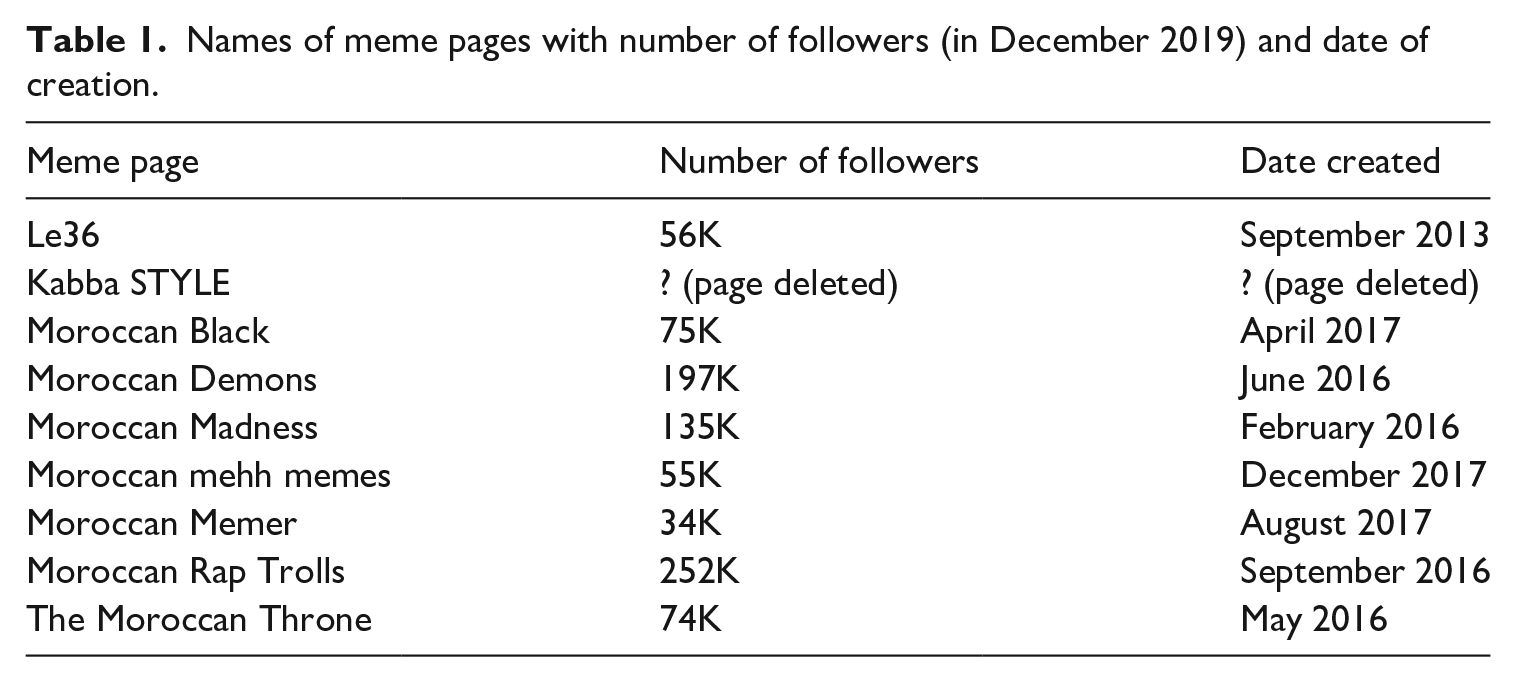
This study examines memes of the Moroccan monarchy posted on Facebook public groups and pages meaning groups that everyone can find and join without needing approval to become a member. I followed nine Moroccan Facebook meme pages (see Table 1) using my personal social media account. All of these pages have shared at least one meme of the royal family. I collected into a corpus, I called ‘Political memes’, memes in different formats (still macros, GIFs and videos) shared in these pages and their comment sections where the King, members of the royal family, and politicians appear visually or are alluded to in the written text. In my analysis of these pages, I used Netvizz to grasp the popularity of the monarchy as a theme in memes. Although Netvizz has its limitations (at the time, it only allowed you to do 50 searches per day), it showed Facebook posts with more comments and reactions. As many of the pages contain over several hundreds of posts, Netvizz allowed me to find the first 10 most popular publications and confirm whether memes of the royal family or politicians, appeared among these or not. The usefulness of Netvizz was evaluating the popularity of political memes among non-political Facebook meme pages. From there, I analysed the resulting memes, the comment sections and followed memes posted as response by individual participants. Therefore, Facebook meme pages in Table 1 were a starting point as I also followed memes posted by individuals mainly in the form of comment to other memes.
Names of meme pages with number of followers (in December 2019) and date of creation.
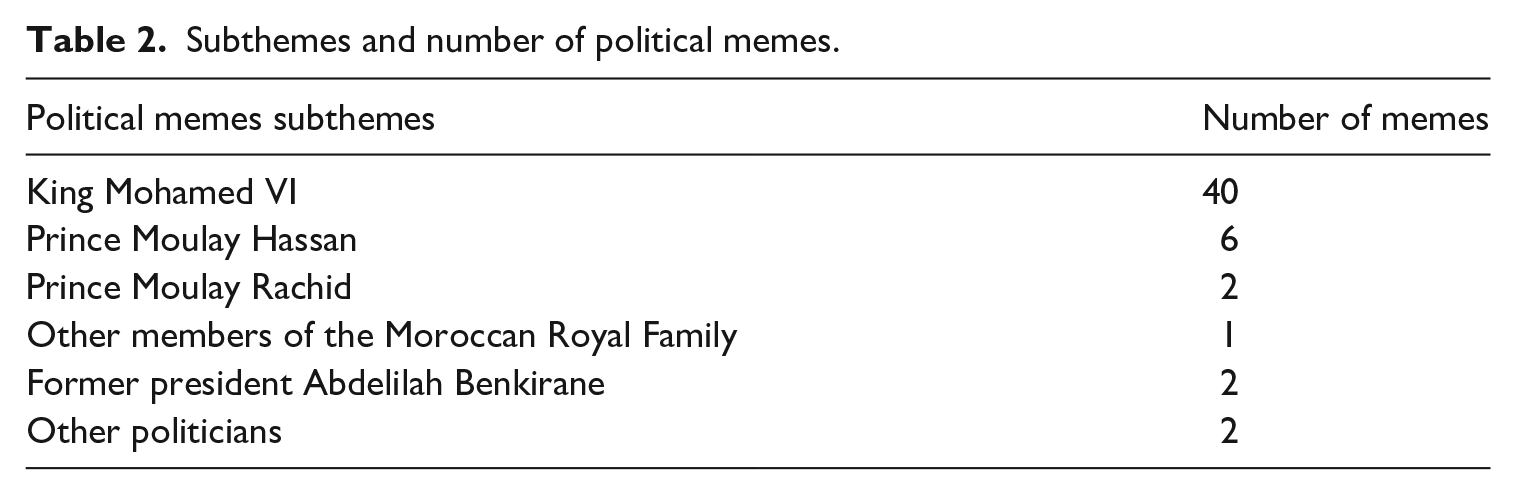
I recorded and took snapshots of political memes together with the comment section and the number of reactions to better reflect the dialectic originated by these posts. I took notes on themes, reactions and looked into the comment sections for relevant debates. My final corpus was made of 53 political memes from which 49 memes made reference to the royal family and four alluded to governance without mentioning to the monarchy (Table 2) as well a collection of over 20 examples of the bottle meme both as text and as picture (see some of these in Figure 1). All of these memes have in common the following traits: (1) They belong to the Moroccan Internet, meaning that the content is unequivocally created or shared by and addressed to Moroccans with most texts written in Darija (the language most Moroccans speak in their daily lives). (2) They are shared by or within pages described as ‘just for fun’, community, personal blog or entertainment; they are public; and they do not profess to have a political or activist agenda. (3) Their main content is satirical memes and include some of King Mohammed VI and the Moroccan royal family but are not exclusively devoted to criticising the monarchy.
Subthemes and number of political memes.
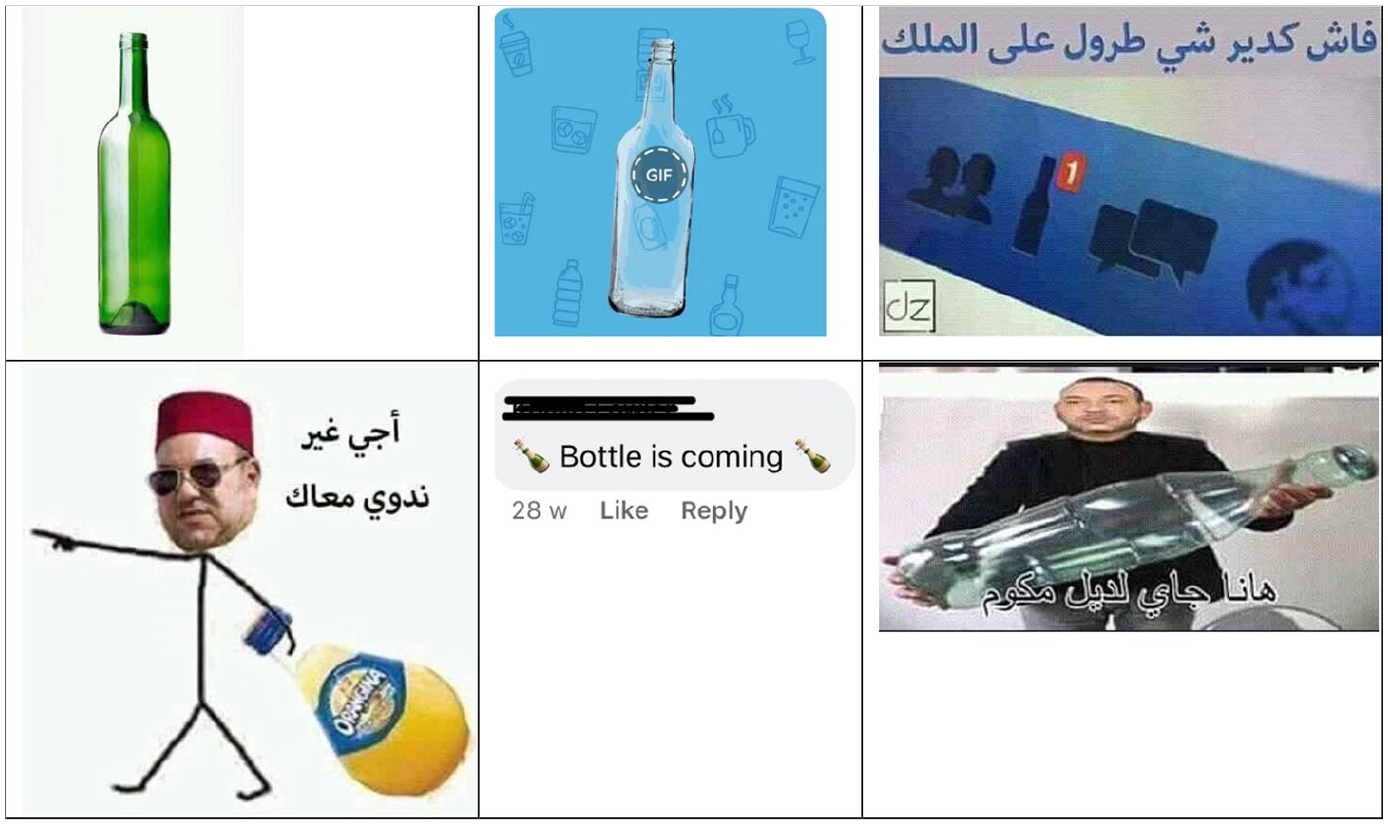
Six bottle memes shared by participants on Facebook comment section.
I divided findings into three intertwined subsections where I examine five macros and the bottle meme. First, I introduce the status of the King in Morocco and discuss the repercussions of digital media in the monarch’s public image. Then, the first subsection examines memes related to the viral hashtag #10YearChallenge. This case study shows how what had started as a trivial online hashtag became a space in which to challenge power. The second and third subsections are devoted to the bottle meme present in most comment sections of posts where the monarchy is mocked. Here, I zoom into one of the meme pages from my corpus inspired by the TV show Game of Thrones (GoT) that has capitalised on the bottle meme and GoT themes such as power, modes of governance and class inequalities evidencing the potential for entertainment media and popular culture to denounce systems of oppression. By identifying political memes and memetic dialectics such as the bottle meme, this methodology allows me to analyse memes discursively within their ecosystem to address the main question of this article: in authoritarian contexts, can memes become forms of participation and cultural resistance simply by being shared on public Facebook pages, by inducing comments, debates and reactions?
Memes and the monarchy
Since 2016 in Morocco, meme pages on Facebook have mushroomed including many which feature the royal family. Disguised as entertainment media and humour, the King has become a recurrent meme. Until the proliferation of visual social media platforms like Facebook and Instagram, public pictures of the royal family were limited to those officially distributed to the press or hanged in the walls of coffee shops, hotel lobbies and every official building in Morocco. Nowadays, numerous non-official and photoshopped images of King Mohammed VI surface the Internet. While traditionally the King appeared in formal and official settings, dressed in a suit or with the traditional djellaba, on social media the King often wears informal attire and is occasionally accompanied by ordinary people he encounters in his everyday life. Such a turn in public representations of the monarchy is significant in a country where rulers have been shaped as sacred figures and criticisms to the royal family continue to be one of the well-known red lines in the country.
Morocco’s red lines together with a history of repressing dissent evidences the impediments in sharing unofficial pictures or satirical memes of the monarchy. A prevailing culture of fear, oppression and humiliation, in particular but not exclusively against journalists and members of the civil society, has encouraged silence or privacy especially when talking about subject matters that cross the red lines. The omnipotent power of the King has also discouraged many, especially young people, to trust the effectiveness of the voting system and political parties (Zerhouni, 2019) because voting or belonging to political parties is perceived as a collaboration with a system that legitimates the status quo (Cavatorta, 2009; Daadaoui, 2011: 111). It is for this reason that especially well-known artists rarely engage in capital-P politics, if it is not to support the King, as they fear persecution or accusations of co-option. This relationship that explains the main operator of power relations in Morocco has been conceptualised as a master (the monarchy)/disciple (ordinary people) dynamic (Hammoudi, 1997).
The #10YearChallenge
Multimodal memetic culture allows for complex public debates on the evolution of the Moroccan King from a public offline to online representations. One example of these conversations is the memes capitalising on the hashtag #10YearChallenge. The 10-year challenge hashtag became viral at the beginning of 2019 initially triggering people to post a decade old picture of themselves together with a recent one. Following the global viral trend, the satirical news Facebook page Le36 posted an image with a formal and older photograph of King Mohammed VI and an informal current one (Figure 2). In the first one, the King is wearing a suit, while in the second one, he is dressed in shorts with a sleeveless tank top showing a marihuana leave with the American flag and holding a tote bag. Although the unusual and daring attire of the latter could hint at a photoshopped picture, it has been widely shared becoming a symbol of the changing times for the monarchy. Historically, the Moroccan King has worn simple garments such as a white robe and no crown or jewels to blend with ordinary men without visually differentiating from the others (Combs-Schilling, 1999: 183–184). In this line, posing with casual outfits on social media photographs may be read as a bonding performance which renders the rulers as more youthful and approachable to ordinary people. While these pictures revamp the monarchy showing it in tune with digital youth culture, they also run the risk of demystifying the sacred character of the Moroccan royal family. On one hand, keeping traditional depictions of the monarch’s sacredness can spark debates in defence of the country’s modernisation; on the other hand, an excessive dose of modernity and closeness to ordinary people has the potential of threatening the King’s power because it might convey the message that the King renounces the heritage of legitimacy (Bourqia, 1999: 251).
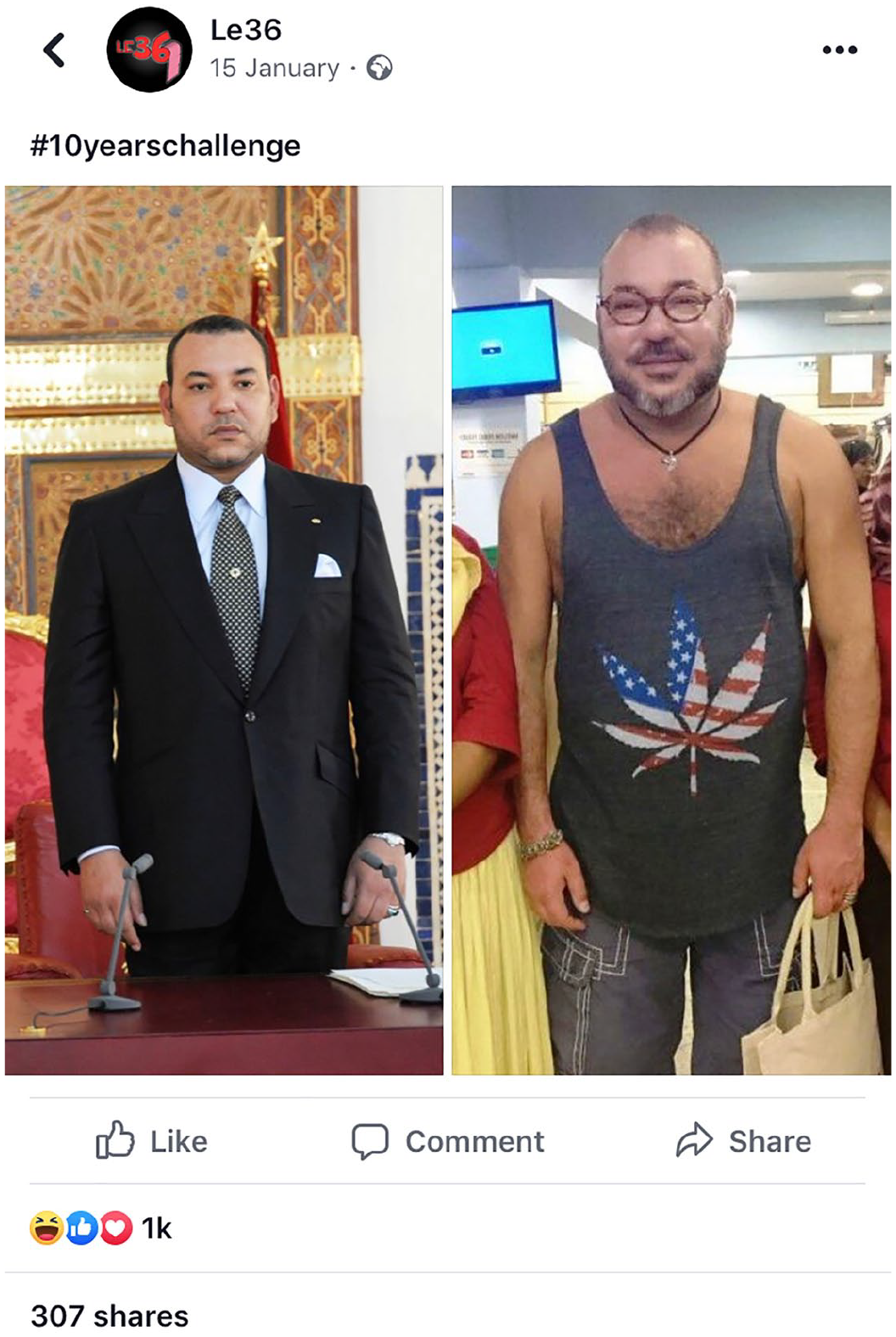
#10YearChallenge meme showing King Mohammed VI; posted on Le36 Facebook page, 2019.
The monarch’s aesthetic change to casual attire and an ungroomed appearance pairs up with the rapidly made, sloppy and amateurish aesthetics that characterises Internet memes. Nick Douglas (2014) refers to this aesthetics as Internet ugly. In the world of Photoshop and AutoCorrect, Douglas (2014) argues, ugly memes and comic strips ‘exploits tools meant to smooth and beautify, using them to muss and distort’ (p. 314). Its dialectical purposes, he claims, involve ‘glorifying the amateur, validating the unglamorous, and mocking the self-serious, formulaic, and mainstream’ (Douglas, 2014: 334). The significance of ugly Internet is that users can generate clever ideas for comic strips reaching a wide audience without going through editors judging its artistic worth (Douglas, 2014: 330). Even if this DIY aesthetic can also be reproduced by well-funded professionally made videos (Lim and Golan, 2011: 712), the unfinished and amateurish may help to ‘fill the gaps, address the puzzles, or mock its creator’ (Shifman, 2014: 88) enhancing in this way memetic spreadability, adding new meanings and bestowing agency to its creators.
Further versions of the #10YearChallenge reflect a political use of ugliness as amateurish, unfinished and informal aesthetics that empower ordinary people. Figure 3 shows a picture of King Mohammed VI with his former wife Princess Lalla Salma as the old image and a picture of the King with the German Moroccan UFC fighter Abu Azaitar as the current one. A previous version of this meme (Figure 4) had been published before the #10YearChallenge became viral showing two versions of the second (‘current’) picture. Both of these images are photoshopped from the original posted on fighter’s Instagram account on 16 June 2018. Both of these macros serve as a public acknowledgement of two rumours circulating about the King’s private life: his divorce (only made public in the summer of 2019) and an alleged romantic relationship with Abu Azaitar. Considering that article 46 of the 2011 Constitution grants respect towards the King and position him above the law ( ‘the King is inviolable, and respect is due to Him’) and that homosexuality is punished by law and not accepted by conservative sectors of the Moroccan society, these memes constitute a public and daring exhibition of contempt towards power. In openly discussing such rumours about the King’s personal life and voicing subject matters silenced by local media, these memes display ordinary people’s potential to shun gatekeepers and speak the unspeakable. In a sarcastic tone, participants appropriate a viral global meme, criticised by many for its superficiality and narcissistic character, 1 and become DAAs by taking control of the monarch’s life narrative for the moment the meme is alive.
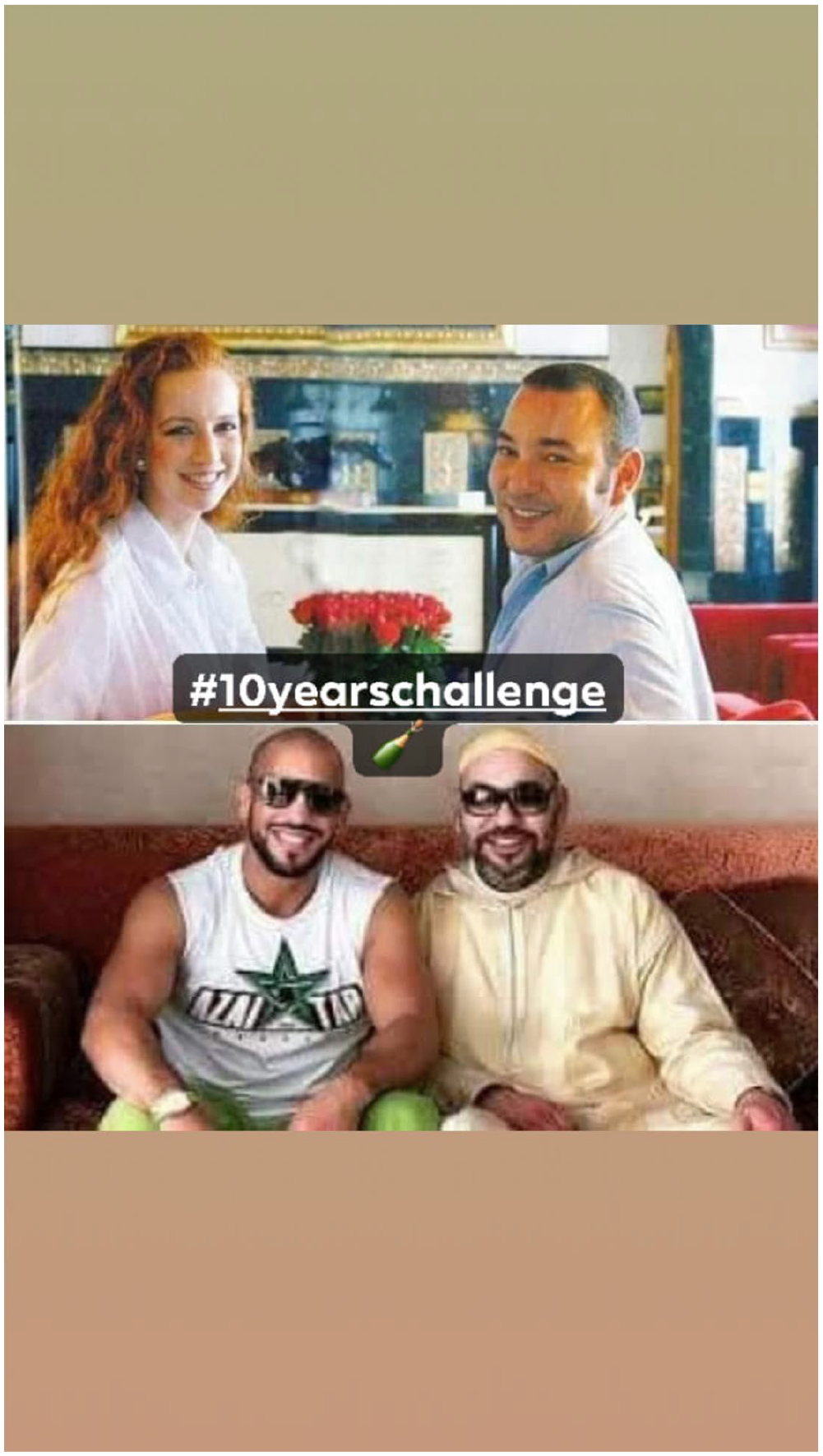
#10YearChallenge meme showing King Mohammed VI, Princess Lalla Salma and Abu Azaitar; posted on Facebook, 2019.
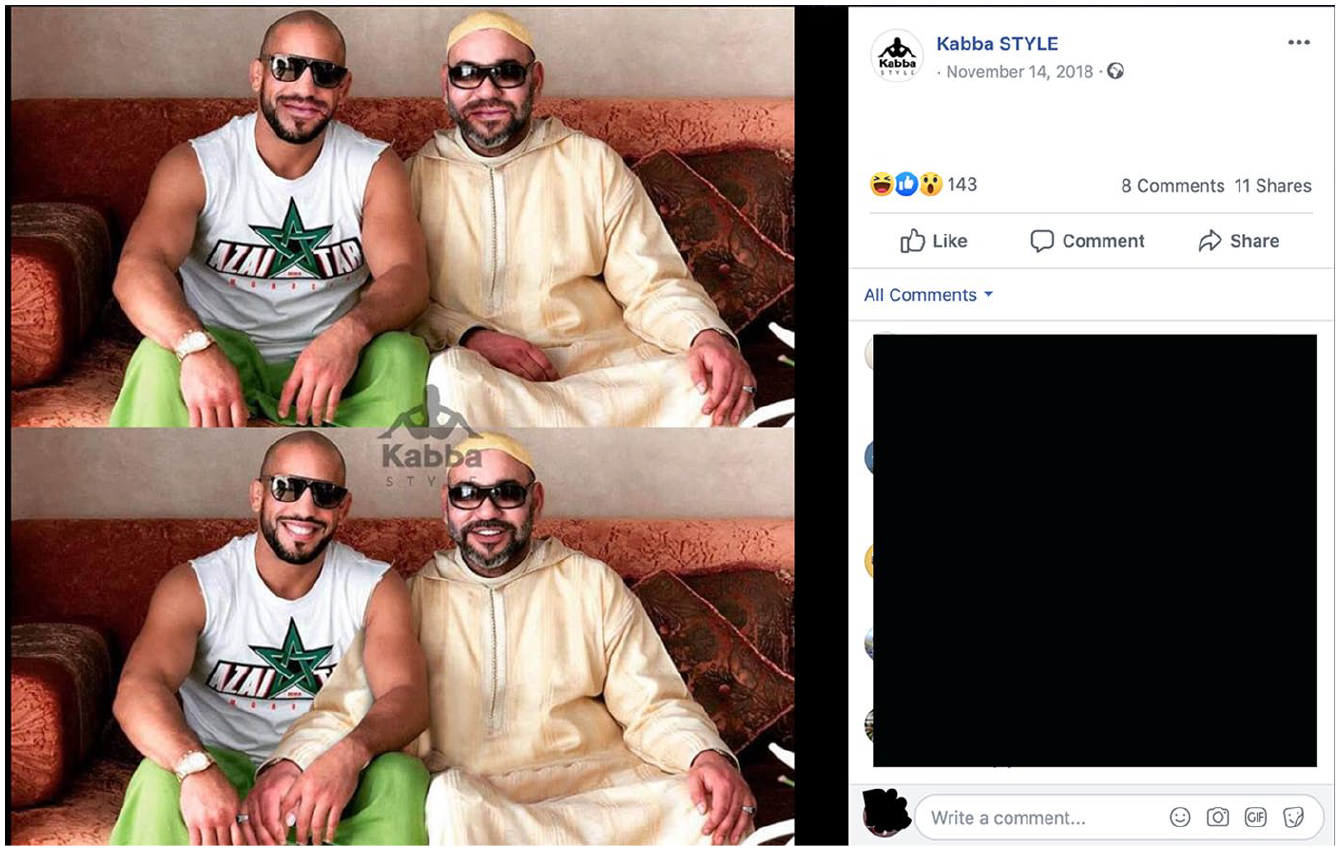
Meme showing King Mohammed VI and Abu Azaitar; posted on Kabba STYLE Facebook page, 2018.
Taking a closer look at the implications of these memes, one uncovers underlying competing narratives that speak to the contradictory character of popular culture (Hall, 1981: 233). While it seems clear that in mocking the King, ordinary people become DAAs fight against ruling elites, participants also use homosexuality as a laughing matter and contributing to the perpetuation of dominant perceptions of LGBTQ+ communities. A later meme posted in 14 February of that same year maintains this narrative of contempt towards LGBTQ+. Again, Le36 Facebook page posted a macro of Abu Azaitar with the message ‘Joyeuse Saint Valentin’ (Happy Valentine’s Day) playing on the brouhaha caused by the rumours and memes that served to publicly mock the King (Figure 5). In referencing Figures 2 and 3, sharing this macro on a date globalised as a celebration of romantic relationship helps maintain the #10YearChallenge joke alive in the Moroccan imaginary. As long as the joke is funny, the meme remains alive. The affordances of digital culture allow for public debates on rumours of King Mohammed VI’s unthinkable years ago when little was known about his father King Hassan II romantic relationships. From this angle, behind this rather meaningless image of a public figure wishing Happy Valentine’s Day lies a daring message: 10 years ago, the King was the master (handsome, heterosexual married to a woman and the righteous ruler), and now he has become a meme (and the antithesis of all of the above).
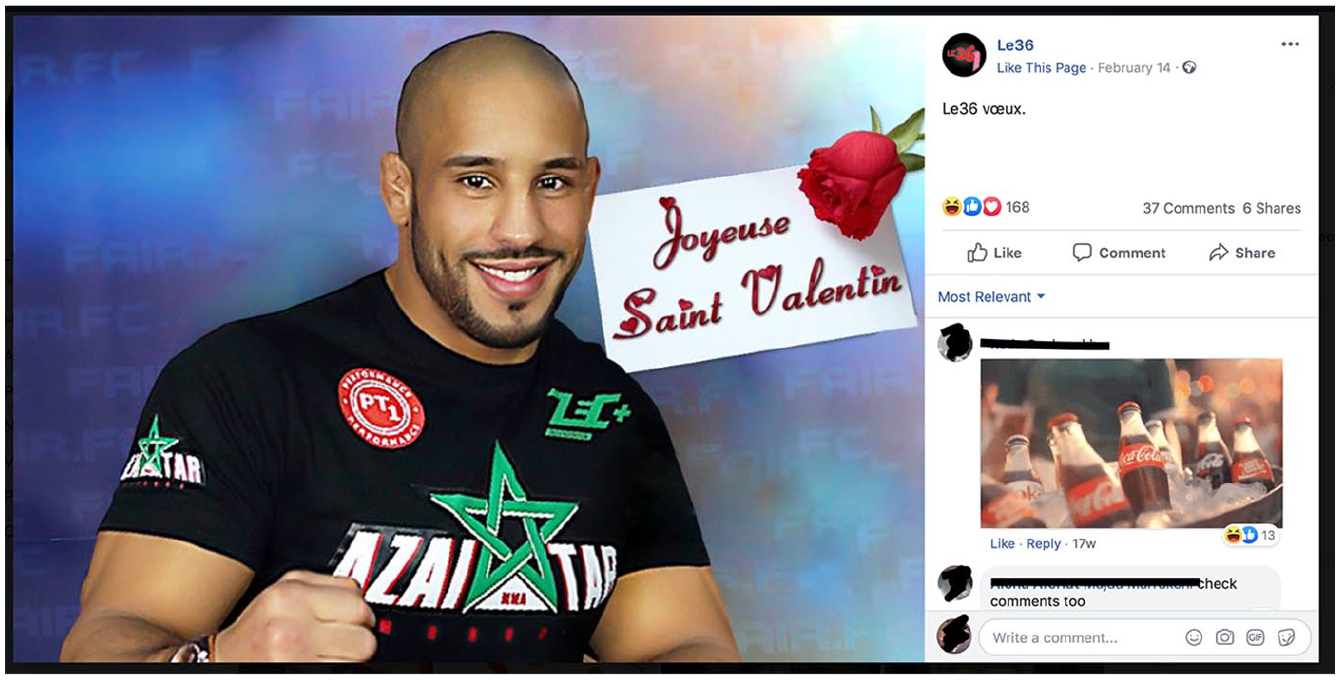
Abu Azaitar with the message ‘Joyeuse Saint Valentin’ (Happy Valentine’s Day); posted on Le36 Facebook page, 2019.
The bottle meme
Responses and reactions to memes of the monarchy add to the layers of meanings stimulating public debates key in understanding the memesphere as a space for participation. As observed during this study, Facebook memes of the royal family are often answered with other memes as is the case in Figure 5 where a participant reacts with a GIF of Coca-Cola bottles (and Figure 7). A key finding in the analysis of comment sections of our main corpus is the presence of still images, linguistic references in Arabic, English and French, and GIFs memes of one or several bottles (see examples in Figure 1). Unique to Moroccan Internet, the presence of bottles within satirical memes of the royal family or on their own is a mnemonic tool alluding to one of the best-known and favoured ways the Moroccan security forces has tortured or threaten to torture: the rape with a bottle. In a report on the matter, Amnesty International (2015) provides with several accounts on how this method has been used to threaten and torture detainees. 2 The bottle as a visual meme associated to satirical posts of effective power in Morocco has, however, come to life in the social media.
Reading the bottle memes as a form of DHT reveals how Moroccan DAAs have creatively converted this meme in a language for counter-hegemonic discourses. Internet memes are language, as Gretchen McCulloch (2019: 260) argues, because in creating and sharing them participants claim their membership to Internet culture, and thus becoming DAAs. This language can take different creative forms such as a picture, a GIF or mentioned in a phrase as one of the examples in Figure 1. The bottle as a meme allows participants to criticise the absolute power of the monarchy without actually using traditional language of dissent. Furthermore, the use of images in Facebook renders its detection through Internet search engines implausible. Nonetheless, to Internet participants, a simple reference to a bottle serves as a warning and reminder of the culture of repression. The presence of the bottle meme highlights a country divided between the monarchy (the master) and ordinary people (disciple). As a meme that repetitively responds to memes mocking the monarchy in most comment sections of Facebook meme pages, this space becomes a black parliament and produsers’ DDAs denouncing the culture of oppression and humiliation ignored by mainstream media.
The Moroccan Throne Facebook page
The amalgamation of entertainment and the political in Moroccan memetic culture is best understood through one Facebook page that has devoted much of its content to the monarchy and the iconography to the bottle. The Moroccan Throne (TMT) is a satirical Facebook page inspired by the TV show GoT. Many of the posts shared on this page merge GoT with local culture such as traditional Moroccan music, local TV shows and everyday events including political issues to make funny video and still image memes. Its motto, in English, ‘Bottle is coming’ plays with the famous catchphrase of the show ‘Winter is coming’ (Figure 6) and has also become a memetic phrase on its own referencing the TV show in its warning of difficult times ahead it (see one example in Figure 1). In the interplay between Anglophone culture and local politics, this page blurs the lines between entertainment and political communication as references to politics and power are also present everywhere in TMT. Although this page does not exclusively reference the monarchy, memes of the royal family and ruling elites abound facilitated by the subject matters addressed in GoT. One example of this thematic amalgamation is a meme that draws on a scene from the last episode of the show (Figure 7). This scene shows the character Samwell Tarly advising a council of powerful leaders arguing that the next ruler should be elected by the people. In the meme, Samwell says in Arabic ‘Why don’t you let the people decide who governs’ to the leaders who are replaced with laughing faces of King Mohammed VI, his son Prince Moulay Hassan and Aziz Akhannouch, a well-known businessman, close friend to the King, and current Minister of Agriculture. As it happened in the show, to Moroccan elites, the instauration of a democratic system where ordinary have a voice sounds ridiculous. Figure 7 reactions in the comment section showing laughing emoticons and a GIF of a bottle exemplify the comment section of our corpus. Further comments to this meme read ‘be ready’ together with a picture of a bottle or omit the picture altogether and only write ‘the bottle is calling us’.
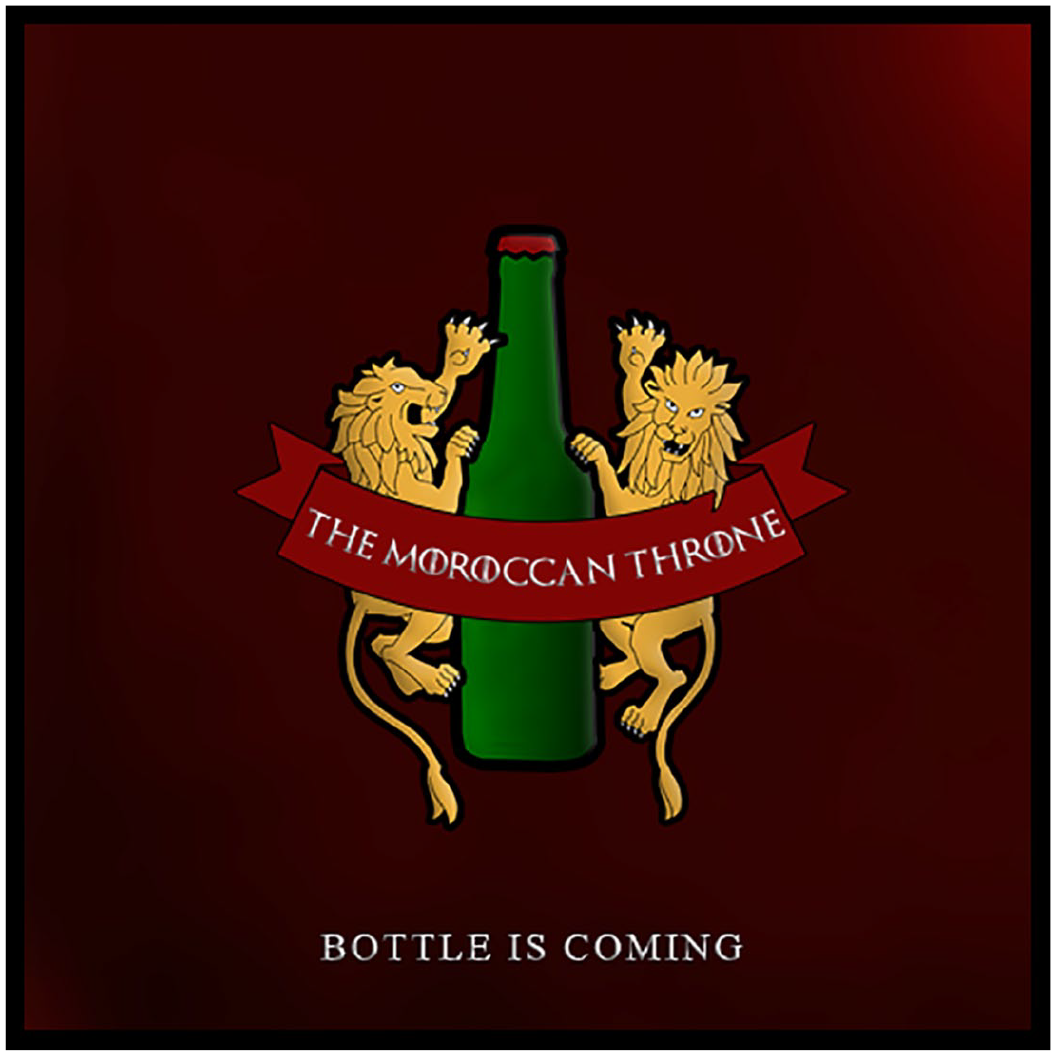
Profile picture of the Facebook page The Moroccan Throne; posted by The Moroccan Throne Facebook page, 2019.
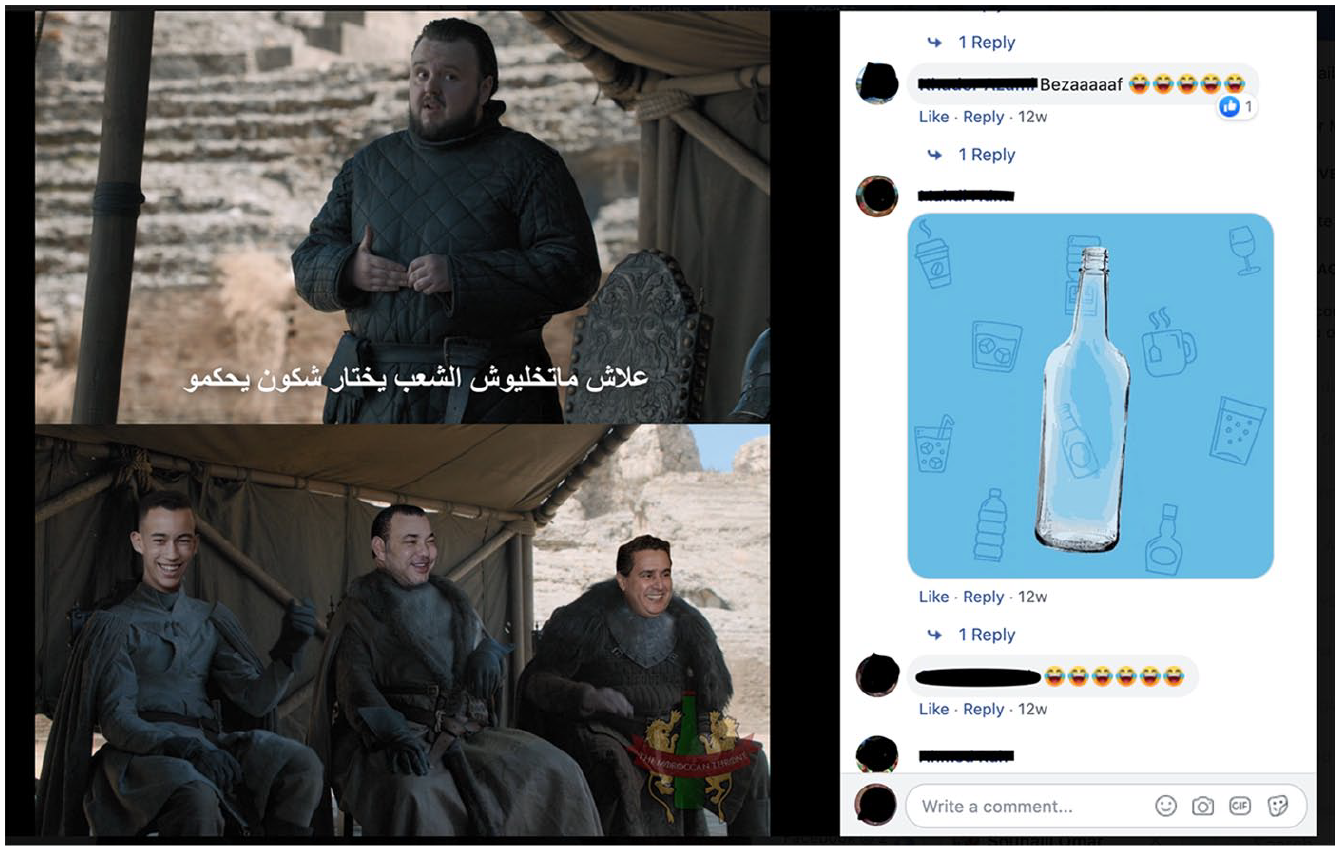
Game of Throne Finale episode meme; posted by The Moroccan Throne Facebook page, 2019.
In the perpetuation of the bottle meme and thus building a community that bonds through the acknowledgement of a repressive regime, what Ryan Milner (2016) calls spread, emotional resonance and collectivism, a banal object like a bottle has absorbed a complex set of meanings in the Moroccan digital imaginary. Still images, GIFs or phrases mentioning the bottle are SAOE that suffice to transmit the message that the page or participant have gone too far and crosses the red lines, creates moments of unity and communal belonging among digital participants as they all relate to a system of torture and fear of the state, all under the rubric of entertainment media. Disguised as humour, the bottle meme and its acquired meaning within TMT’s iconography stand at the crossroad between what is entertainment and what is political illustrating that the lines are not that clear. More importantly, even if part of the inspiration for TMT is rooted in an Anglophone TV show (and book), the bottle meme is only significant as part of an everyday form of political expression within the Moroccan public world.
The existence of memes like the bottle and pages like TMT confirm a significant change in online attitudes. A previous study on humour on Moroccan Facebook observed a lack of political satire before the 2010 to 2011 uprisings in the region but a rise in criticisms to the deep state at the time of the protests. However, these critical voices rarely risked to pass the red lines and attack the monarchy (Mifdal, 2016: 51). Because a majority of Moroccans at the time desired stability fearing similar consequences to the Syrian revolution, the author concludes, Facebook participants were unresponsive even on expressing likes to satirical posts that overstepped the red lines (Mifdal, 2016: 58). The examples here analysed show that this is no longer the case, at least for now.
Discussion
In their insolence, Moroccan political memes temporarily suspend hierarchies allowing citizens to criticise political power without the consequences of explicit criticism through formal political groups (Hardesty et al., 2019: 8; Li, 2011: 83). Memes, comments and reactions as SAOE are able to break public illusions of unitary opinion, in this case, that everyone loves, admires and respects the Moroccan King. In a context where citizens, especially young people, feel excluded from the political system, memes act as forms of creative political agency showing people’s will to participate in the political arena by targeting those who are held unaccountable by formal institutions. On this account, agency is acquired through photoshopping and mocking the master’s body. In doing so, those participants in creating, sharing and commenting on memes become DAAs united as a digital nonmovement forming a black parliament in which to debate and challenge the absolute power held by the monarchy. It is in these instances that Internet participants become DAAs and memes snapshots of participation.
As a creative language, Internet memes are forms of DHT and of counter-hegemonic discourses within non-political Facebook groups in the following ways. First, ‘just for fun’ meme pages are difficult to identify because memes of the King are shared among other content. Second, the anonymity of the pages and the lack of official registration (unlike social and cultural associations) makes it difficult for the state to target them. Even if participants and admins are found, persecuting ordinary people without connections to political groups or associations has proved problematic for the state in the past as it may lead to social unrest and challenges to the modernisation narrative. More importantly, in adding their logo to the memes they share these pages show a lack of concern for legal prosecution (see Figures 4 and 7). Third, these pages target people that may not be connected or interested in otherwise political groups and activist networks. This means that they can go beyond online echo chambers reaching people that may or may not question the authority of the state and its institutions. Occasionally mocking the King may not trouble those users who otherwise do not see any wrongdoing in the ruler’s supreme power, yet a repeating theme unveils challenging perceptions on the monarchy’s official image.
Absent from this corpus are memes that in one way or another protect the image of the King which have only started to appear through one Facebook page called Moroccan Nationalist Memes created in April 2019. Until now, neither in the Facebook meme pages, nor in their comment sections did I find examples of memes where the royal family was not the target of mockery with the exception of one meme comment praising the King. Instead, amateur Facebook pages that pay tribute to the monarchy such as ‘His Majesty the King, Mohammed VI, King of Morocco’ with over 3.5 million followers 3 have a preference for posting traditional pictures of the royal family omitting memetic culture altogether. According to these findings, it is safe to claim that until 2019 Moroccan memetic culture has had a preference for counter-hegemonic discourses when capital-P politics is the subject matter. This result indicates that in certain contexts memes might not be as ambivalent as the literature suggests.
Conclusion
Addressing the participatory potential and ambivalent characteristic of Internet memes, this article asks whether Internet memes shared on public Facebook pages and their comment sections could be regarded as snapshots of political participation in authoritarian regimes. Pondering over debates on whether entertainment media may engage in forms of dissent, this article evidences that disguised as ‘just for fun’ pages, Moroccan Internet memes open up debates that challenge dominant political discourses. Among the hundreds of memes shared, some of these digital creative artefacts visually report on forbidden topics such as challenging the sacredness of the Moroccan monarchy. Reading through DHTs, one uncovers a collective effort that keeps the monarchy accountable, an issue that the royal family has managed to avoid through legal means until now. Therefore, understanding the affordances of amateur digital actors in creating public pages that share memes, the topics they are concerned with and the participants they are able to gather is crucial in determining the potential of memes to spark and maintain conversations around matters that mainstream media and politicians cannot or will not debate.
More work needs to be done on the evolution of the memesphere in Morocco especially in light of new far-right meme pages and the chain of arrests related to social media content. By the end of 2019, one rapper, one YouTuber, a journalist and several ordinary citizens had been imprisoned for online negative comments towards the King and other Moroccan institutions. The rise in aleatory arrests related to online freedom of expression evidences the power of digital media in disseminating oppositional narratives. These cases, however, also attest to the state’s use of digital media to maintain the culture of fear as a measure to curb criticisms to the master. None of these arrests are nevertheless related to memetic culture. Further research on Internet memes in neoliberal authoritarian regimes will shed light on the role these artefacts play in online participation beyond the Anglophone world.
Footnotes
Acknowledgements
I gratefully acknowledge Dr Paolo Gerbaudo, the anonymous reviewers and the editorial team for their constructive and insightful comments on this manuscript.
Funding
The author disclosed receipt of the following financial support for the research, authorship, and/or publication of this article: The author gratefully acknowledges funding support from the British Academy.
