



Abstract
Palestinian cultural identity has always been the flip side of the Palestinian people’s political resistance. While many studies have examined Palestinian culture from political and historical perspectives, limited academic works have investigated how social media plays a role in providing opportunities for Palestinians to resist negative stereotypes and provide alternative representations of their cultural symbols, including traditional customs. In its attempt to fill a gap in the existing body of knowledge, this article examines the contemporary representation of Palestinian culture, in particular, national garments—the thobe and keffiyeh—in the digital public sphere. Through employing theories of representation, the digital public sphere and applying semiotic analysis, this article follows four main X (formerly known as Twitter) hashtag-based trends that highlight traditional Palestinian garments (thobe and keffiyeh): #MyHistoricalThobe, #TweetYourThobe, #WorldKeffiyehDay, and #KeffiyehDay. Forty tweets extracted from top 10 X accounts, which first appeared in a hashtag search and were tweeted using these hashtags, were selected and coded. Using a semiotic analysis, the article deconstructed the tweets into connotation and denotation elements to better understand what the thobe and the keffiyeh mean collectively in the context of Palestinian cultural narrative. This research contributes to the debate concerning the relationship between interactive digital platforms and contemporary cultural resistance. It pushes forth the argument that shared representations of national cultural symbols are noticed when examining, and collectively reading, particular social media-based campaigns.
Introduction
Digital media, including social media platforms, continues to contribute to the globalization of local cultures, which potentially has the ability to bring about change in audiences’ perception and cultural representations. The level of interactivity that these platforms provide enables users to interact with the content and increases levels of transnational connectivity via the online web. Moreover, the internet provides multiple sources for information seekers on different cultures, thus transforming the globe into a web-connected world. All of these factors have likely contributed to changes in traditional stereotypes, old frames, and media representations.
New media influence has also impacted contemporary intercultural communication, including how individuals from different cultures and ethnic groups interact and understand each other (Chen, 2012), as technologies provide spaces for cultures to be mediated by aiding the process of establishing and transforming cultures (Hartley, 2011). Although policies on content moderation for social media platforms have been heavily criticized and perceived in many cases as a form of censorship, these platforms have contributed to the advancement of the digital public sphere in which cultural symbols are mediated and exchanged.
Based on Habermas conceptualizing of the term, Fuchs (2021) argues that the public sphere is a political communication space in which society’s sub-systems, including economy, politics, and culture, are mediated. This digital public sphere, where cross-border ideas are mediated and exchanged, is gradually assuming a central role in influencing perceptions and representations of different cultures and contributing to combating the traditional media’s long-term representations, including negative stereotypes of global cultures.
In this context, interactive media, mainly social media platforms, provide a space where exchanging and negotiating representations of these cultures take place. They provide a contemporary arena for the practice of cultural resistance. Cultural resistance, throughout the history of colonized nations, has accompanied armed resistance, whereby this form of resistance to imperialism has been seen as a private space for natives (Said, 1993).
For Hall (1997), culture is mainly concerned with the process of producing, as well as the exchange of meaning among society and group members, whereby meaning and language are connected to culture, arguing that representation—a concept that plays an important role in studying culture—via the use of language, signs, and visuals, is a process of meaning-making.
While it is vital to understand communication technologies’ mediation of cultures via the media, it is also necessary to examine any given culture within its contexts that shape it (Tawil-Souri, 2011). To better examine people’s cultures and their contexts, it helps to look at individual representations of their cultural symbols as a form of cultural narrative. Cultural narratives, is a collective of existing images about a particular social group in a particular culture, in which these images are constructed based on collectives of “stories, imaginaries, meanings, representations, archetypes, views and stock images” (Laceulle, 2018, p. 64).
The intervening relationship between culture and resistance is evident in the Palestinian national movement’s historical efforts to preserve the national identity and confront colonization, by which the production of culture contributes to the national political struggle. This production, as Salih and Richter-Devroe (2014) see it, has historically resonated and shaped a national identity that struggles for survival. While Palestinian producers of culture in Israel built a discourse of solidarity, in which both resistance and culture are seen as major players in global struggles against colonialism (Nassar, 2014), Palestinian activism in the cultural field has deep roots, explicit in the intersection among heritage, production of culture, and politics of liberation (De Cesari, 2019).
Throughout the last decade, social media has played a role in highlighting the Palestinian national struggle and relayed daily life and reality under Israeli colonization and control to global audiences. These interactive media enabled Palestinians to bypass—to some extent—the traditional influence of Western mainstream media, which is known as being continuously biased against the Palestinian national and cultural narratives. While social media utilization in the quest of cultural resistance is relatively new, Palestinian cultural resistance efforts are old. Khoury-Machool (2007) dates Palestinian cultural resistance though media back to 1908, when local media, mainly AL-Karmel newspaper, took it upon itself to defend Palestinian national rights against successive occupations of Palestine, and preserve the national and cultural identity.
The Palestinians’ cultural identity has always been the flip side of their political resistance, comprising their collective narrative, which revolves around their history and struggle for liberation and has a cultural identity and an aspect of cultural resistance. This includes the period after they were forced out of their homeland by the Zionist movement in 1948. This aspect manifests as part of Palestinian history and the contemporary struggle in which appreciating cultural and national symbols, including traditional customs, such as wearing the thobe and kufiyah/keffiyeh, is prevalent among Palestinians.
In his work, Said (1993) highlights the point that cultural resistance of imperialism received modest support in main cultural thought departments. While many studies have examined Palestinian culture from political and historical perspectives, it remains essential to engage in a scientific inquiry that investigates how social media plays a role in providing opportunities for resisting negative stereotypes and representing the people of Palestine’s cultural symbols, including their traditional customs, through understanding what they symbolize for Palestinians.
In an attempt to fill a gap in the existing body of knowledge, this article examines the contemporary representation of Palestinian culture, in particular national attire—the thobe and keffiyeh—in the digital public sphere. Studying contemporary representation of Palestinian traditional garb through social media sites is crucial to the relevant body of literature. Understanding how Palestinian cultural heritage is represented by online communities could provide a non-traditional approach to examining the relationship between interactive social media platforms and cultural representations.
To achieve this goal, semiotic analysis provides an effective tool for examining culture through the lens of media, including interactive social media. A main purpose of media semiotics, as Danesi (2019) argues, is understanding how media process disseminates signs. This can be done through examining what the object of analysis represents and means, how this representation has been shown, and why it carries this meaning. To identify what the two traditional pieces of clothing represent and mean to X users, the tweets were deconstructed based on the notions of connotation and denotation.
Through employing theories of representation and the digital public sphere and applying semiotic analysis, this article follows four main X hashtag-based trends: #MyHistoricalThobe, #TweetYourThobe, #WorldKeffiyehDay, and #KeffiyehDay. These hashtags were created on different occasions and on multiple social media platforms, including X, in an attempt by online Palestinian users to shed light on their heritage through traditional clothing, namely the thobe and keffiyeh.
Literature Review
Digital Public Sphere
If we consider the role of digital technology as an inevitable factual factor in contemporary human communication processes, understanding the merits and characteristics of this communication arena becomes vital to understanding human views of the world and their associated narratives. Using Heidegger’s (1977) conceptualization of technology as a mode for revealing and a resource for human utilization, we can see how internet-based communications practices, where to an extent, ideas are openly discussed, are a manifestation of technology as a tool and an activity aimed at presenting conflicting representations of people, countries and ethnicities. The term “revealing” in Heidegger’s (1977) understanding of technology suggests that technology, more than just a tool, plays a significant role in shaping humans’ perception and understanding of the world.
The term digital public sphere is inspired by the German philosopher and social theorist Jürgen Habermas’ concept of the public sphere. It is a result of scholarly attempts to contemporize the term through applying it to the digital realm and interactive social media. The public sphere concept, as Habermas (1974) coined it, is a social life field available for all citizens in which the formation of public opinions takes place. In this arena, the formation of the public body takes place as a result of individual conversations. An ideal sphere can perform as an open space that contributes to amplifying citizens’ participation in an equal free space. The concept of a digital public sphere is an attempt to analyze Habermas’ public sphere from the perspective of contemporary digital media-based practices.
In this context, scholars who have studied the advancement of internet-based media as a second phase of structuring the public sphere, focused on examining how communication practices within this new media are taking place, and to what extent they are open to all participants (Schäfer, 2016). They found that “the digital public sphere tends to successfully make diverse actors and their positions visible, and at least sometimes influences others for collectively binding decision-making” (p. 1).
It may be evident that social media platforms are enabling forms of communicative actions, where social movements gather and mobilize around hashtags and where the media sphere becomes a venue for competing discourses (Pond & Lewis, 2019). Nevertheless, the existence of online digital technologies does not necessarily mean they form a public sphere. These technologies may enable it, but forming this kind of sphere is not a technological decision (Papacharissi, 2002).
From a power analysis perspective, Fuchs (2021) situates the digital public sphere as one dimension of the societal public sphere. However, he argues that this digitalized version is similar to the public sphere influenced by power forces, which prevent it from being an ideal sphere. In other words, the ideological, dominant and capitalist forces that shape digital practices prevent them from being a public sphere. “The digital public sphere has then, as Habermas (1989) argues, been colonized and feudalized. We can then speak of an alienated digital sphere and alienated communication but not of a digital public sphere” (Fuchs, 2021, p. 13).
Interactive platforms are governed by profiting goals in which the economic agenda of social media companies plays a role in influencing online content. Discussions that take place in the networked public sphere are shaped by these platforms’ algorithms that are designed to increase profit (Pfister & Yang, 2018). The influence of social media corporations on freedom of speech are shaped by forms of “concentration” and “fragmentation.” While the latter refers to the private sector transformation of the public sphere, the former refers to providing personalized content and experiences to users on social media platforms, which contributes to the landscape of politics being fragmented (Smyrnaios & Baisnée, 2023).
Even though these platforms are governed by elements of profit, algorithms and content censorship, the digital transformation of the classic public sphere has contributed to an increase of representation where a variety of users, issues, and topics are discussed in the digital public space (Enjolras & Steen-Johnsen, 2022). Despite factors that govern the content format and levels of freedom of discussion on social media, indigenous people, minorities, misrepresented, and underrepresented groups around the globe, do see these platforms as a refuge that provide alternative spaces for reaching wider audiences, where they are able to represent their identity, culture, and causes from their own perspective.
Although social media companies, including Meta and X, have been censoring the content of Palestinian activists (Alimardani & Elswah, 2021), Palestinians found a refuge in these interactive social media platforms where they engage in a digital form of culture resistance by highlighting and educating online communities on their cultural symbols. Through enabling the process of forming Palestinian identity online, the internet facilitated the global circulation of Palestine events (Shehadeh, 2023), in which Palestinians used social media platforms to educate global publics about their national narrative (Whitacre, 2020). While the Palestine global solidarity movement has been utilizing these platforms to organize and collaborate efforts in solidarity with the Palestinians (Abu-Ayyash, 2018), Palestinian women in the diaspora utilized the internet’s interactive platforms to represent their cultural identity and highlight their traditional thobes through social media-based campaigns, including “Tweet Your Thobe” campaign (Abu-Rub, 2020).
Representation, Semiotics, and Cultural Narratives
Representation, as discussed by its pioneering scholar Stuart Hall (1997), links culture with meaning production, in which language works as a system of representation. It discusses the media’s impact on the audiences’ way of thinking about the world (Dixon, 2020). A shared meaning among a certain culture’s members requires them to have a sort of collective conception of particular images and ideas that play a role in their interpretation of the world (Hall, 1997) as they must share, broadly speaking, the same “cultural codes.” In this sense, thinking and feeling are themselves “systems of representation,” through which our concepts, images and emotions “stand for” or represent, in our mental life, things which are or may be “out there” in the world. (p. 4)
Nonetheless, negative stereotypes that have an exclusionary effect on these classes and minorities, as Hall (1997) suggests, can be transformed via a process of transcoding. In this process, dominant representations can be challenged. Transcoding practices consist of appropriating representations, counter typical representations, and deconstructed representations (Dixon, 2020), in which a counter typical representations process “combats negative connotations by producing representations that reverse stereotypes” (p.68). Resisting dominance representations can take place via communication, “in which communicative exchange enables dominant representations to be challenged, rejected or transformed . . . through the articulation of oppositional representations” (Howarth, 2011, p. 3).
To better understand how representations and/or opposing representations are structured, a deconstruction of language and symbols of the content becomes useful. To this end, semiotic analysis provides a direct approach. Semiotics is defined as something that stands/represents another thing in the form of words, objects, colors, and so on. Hence, representation is a central topic to semioticians. According to Chandler (2022), it is “concerned with how meanings are made and how reality is represented (and indeed constructed) through signs, sign systems, and processes of signification” (p. 2).
For de Saussure, signifiers consist of sounds and images while the signified are the concepts that these sounds and images bring to our minds (Berger, 2016). Meanwhile, in the cultural analysis context, the relationship between semiotics and culture is well established in the academic field. One of the leading scholars of semiotics, Eco (1976), sees culture as a semiotics phenomenon, in which relations between signification and communicative process are established. He argues that “the whole of culture is signification and communication and that humanity and society exist only when communicative and significative relationships are established” (p. 22).
In the same context, Danesi (2019) differentiates between the signified, the signifier, and signification. The signifier is the actual form of representation, while the signified is the meaning generated from this form. Signification refers to the kind of meaning that can be drawn from this representation, which is influenced by the cultural environment.
Understanding media ideas and images, according to semiotician and scholar Roland Barthes, relies on the two processes of denotation and connotation. In the first phase, denotative reading of the media lies in an instant recognition of the content or the image. In the second phase, connotative decoding occurs, when viewers analyze the deep meaning of the content. This stage entails an in-depth understanding of media-promoted ideas as well as the symbolic or ideological significances that this understanding brings to the audience (Dixon, 2020).
Visuals, including art work, much like language, can be recruited in the process of reversing negative stereotypes and providing an alternative representational narrative. A critical visual analysis research, which examined cultural representations of African Americans through studying Mural Arts in Philadelphia, PA, found that members of ethnic communities, when given the opportunity to produce self-representations through art, produce artworks that are in contrast to those images produced by dominant media images, portrayed as themes of resistance (Moss, 2010).
Similar to meanings provided by representation, cultural narratives are also resources of knowledge, given the generations of meaning produced and without which viable identities cannot be formed. Some narratives within the same culture occupy a more prominent place than others (Laceulle, 2018). This is what is called a “cultural master narrative,” resulting from a mutual agreement among people of a given culture (Laceulle, 2018; Lindemann, 2001).
Media and Cultural Resistance
We may argue that any given culture is portrayed by two forms of representations: the publicly mediated representation through the media, including international media and the image that individuals hold toward their own culture. These two forms may not necessarily be identical. On one hand, media plays a role in informing, entertaining, and educating audiences about different global cultures. Nonetheless, media content also carries the danger of mediating negative stereotypes and distorting images of these cultures. In fact, media, through the use of language and visuals, as Hall (1997) argues, disseminates meanings among cultures in unprecedented scale. For this, the media’s unfavorable portrayal of global cultures possesses a great challenge to local cultures, which suffer from negative stereotypes, misrepresentation, and their consequences.
On the other hand, people’s perception of their own culture may be completely different from the one portrayed by the media. Gramsci’s (2000) definition of culture, in which he links culture to self-experience and personality, reroutes the discussion to the centrality of identity vis-a-vis a person’s culture. For instance, if we are to examine the symbolism of the Palestinian keffiyeh, we may find that it represents a traditional piece of clothing and a symbol of cultural identity and national resistance for the Palestinians. Meanwhile, in other contexts, including many Western mainstream media discourses, the same keffiyeh may represent a symbol of political violence or terrorism.
In his article, Permission to Narrate, Said (1984) argues that an acceptable narrative is required to support and circulate the facts. For Palestinians, this narrative, which needs a beginning and an end, must end with a resolution to their exile from their homeland, which began in 1948. He further argues that what he calls the “humble narrative of native Palestinians” (p. 36) has been rejected by the West, which played a complementarily role to the Zionist role in Palestine.
It does no justice to examine representation of any given culture only through the external portrayal of this culture. On the contrary, it is vital to study it from the lens of its indigenous people. Examining the meaning of cultural symbols from within their local contexts is important in understanding the relationship between culture and representation. It is also crucial to look at how the process of reversing and altering media misrepresentation is taking place; a process that can be summed up as a form of cultural resistance. It has been argued that analysis of the process of decolonization of cultural resistance centers around three related topics (Said, 1993). The first is the right to present people’s history as a complete and coherent history, in which national language along with practices of national culture are evident. The second concept is that resistance is not solely a response to imperialism but represents an alternative perspective on understanding human history and the story of mankind, while the third revolves around the idea of integrating cross-border, human-centered liberation.
Said’s position on cultural resistance and the occupied indigenous people’s need to narrate, is echoed by Tawil-Souri (2011) who considers culture creation in the Palestinian context as a form of political resistance. For her, Palestinian culture lies in efforts by witnesses and victims to vocalize the truth about the events that transpired in historic Palestine before and after 1948 when the Palestinian Nakba took place. Tawil-Souri (2011) further explains that the Palestinian cultural struggle is based on the need for visibility and being heard. Despite the systematic Israeli policies of silencing Palestinian voices and combating their narratives in all private and public arenas, including media, the Palestinians continued to reproduce their past through images and discourse.
Another examination of cultural resistance from the indigeneity perspective of Palestinian citizens of Israel, which is offered by Pappe (2018) who concluded that the Palestinians view their cultural struggle as a national one, arguing that the centrality of the struggle of Palestinians inside Israel and in general, lies in the binarity of settlers and the indigenous people.
Cultural resistance, as defined in this article, is the process in which Palestinian social media users combat negative stereotypes concerning media representation of their culture and its symbols by providing alternative cultural narratives through the use of language and visuals.
Thobe and Kufiyah/Keffiyeh
Palestinian women’s thobe (traditional handmade embroidered dress) has, over the past two centuries, expressed regional identify, age, and status, mainly among villagers and Bedouin. The garments were created using embroidery in a way that distinguishes each thobe’s region (Saca & Saca, 2006), which would be passed down through generations, from mothers to daughters (Yamamoto & Kawabata, 2022).
While traditional embroidery was a component of indigenous Palestinian cultural life before the Nakba of 1948, it later became a symbol of an ongoing Palestinian struggle and resistance (Ulloa, 2020). The thobe often symbolizes political and national identity. During the first popular Intifada in 1987, “Women began to embroider symbols of Palestinian nationalism onto their gowns to protest Israeli repression and encourage women’s participation in the resistance” (Journal of Palestine Studies, 2018, pp. 117–118).
The keffiyeh, on the other hand, is considered by Palestinians as a piece of clothing from national folklore. It is a traditional Arab headdress/scarf made out of cotton (usually black and white or red and white). Popularized by [Former Palestinian President] Yasser Arafat, it became a symbol of Palestinian resistance, and is now worn all around the world to signify solidarity with Palestinians. (Patyna, 2012, p. 4)
The traditional male outfit consists of a coat (qumbaz), overcoat (‘abaya), a belt (hizam), and a headdress (keffiyeh). Men’s traditional clothes were similar throughout the Levant region (Saca & Saca, 2006).
Still, the symbolism of the Palestinian keffiyeh has gone beyond the notion of a mere piece of clothing. It became a global symbol for solidarity and social justice, the shift in its perception a result of the contemporary process of its politicization, de-politicization, and commodification (Renfro, 2018).
Palestinian cultural symbols, including the thobe and keffiyeh, have been subject to Israeli appropriation since the early days of the Nakba. Palestinian embroidered dresses and clothing were left behind when Palestinians were forcibly displaced from their homes. Israeli settlers engaged in object appropriation by asserting ownership over the abandoned clothing (Zayad, 2019). In fact, one of the motives behind social media-based campaigns aimed at raising awareness of Palestinian embroidery is to protect these Palestinian symbols, which have been subjected to Israeli appropriation.
Palestinian Customs in Online Hashtags
The #TweetYourThobe online social media-based campaign was launched in 2019 when Palestinian-American Congresswoman Rashida Tlaib wore the thobe during her swearing-in ceremony. Many Palestinian women followed suit, tweeting photos of themselves wearing their thobes.
Another similar hashtag, #MyHistoricalThobe, was launched in 2022 by a local Palestinian culture-oriented TV station, Falastini TV. It organized the campaign to educate social media users on Palestinian heritage, mainly after Miss Universe contestants who were visiting Israel, posted photos on Instagram wearing the Palestinian thobe, claiming to have experienced Israeli culture. This hashtag was also active during Palestinian Traditional Dress Day on July 25.
Meanwhile, #WorldKeffiyehDay and #KeffiyehDay are two hashtags used on social media during an annual online solidarity campaign, on May 11, a few days before the commemoration of the Palestinian Nakba. The campaign was created by the Solidarity for Palestinian Human Rights at Concordia University in Canada in 2016, to educate users on this national symbol and the Palestinian national struggle.
Within the Palestinian context, the considerable literature on representation of culture and cultural resistance has offered little contribution to the study of how social media plays a role in providing new forms of representation of cultural symbols. This is an area of inquiry that could shed light on contemporary cultural representation in the digital sphere.
This article attempts to answer the following question:
How do Palestinians and their supporters represent the symbolism of the thobe and the keffiyeh, on X (formerly known as Twitter)?
Method and Study Design
This qualitative research article adopts a descriptive approach, through content analysis, to examine how X-based hashtags provided representation for Palestinian traditional clothing and their symbolism. X-based data, that is, tweets, were collected and organized, and later analyzed using a semiotic analysis approach.
First, contents from a number of X accounts (N = 10) were selected and coded. These accounts were the top 10 accounts that first appeared when searching the four hashtags, #MyHistoricalThobe, #TweetYourThobe, #WorldKeffiyehDay, and #KeffiyehDay. The appearance of these accounts at the top of the search results for the X hashtags is influenced by the platform’s algorithms.
While users tweeted statements on and images of the thobe and the keffiyeh at different times—mainly in the years 2016, 2019, 2020, and 2022, data on the 40 tweets (N = 40) were extracted from these 10 accounts on June 20, 2023.
It should be noted that the 10 X accounts belong to a variety of users. These users represent Palestinian-American politicians and activists, Palestine-based non-governmental organizations (NGOs), Arab journalists, and US- and Europe-based supporters of the Palestinian cause.
Data Process
After classifying and tabling tweets, a new table was created to identify the significations of the keffiyeh and thobe, according to content, by identifying the elements of denotation and connotation.
Extraction of the 40 tweets led to the identification of five main themes: aesthetic and diversity features of the thobe, cultural identity, protecting national heritage, solidarity, and national struggle.
The 40 tweets were organized into tables. Each hashtag-related tweet was inserted into a separate table, with tweets placed inside the table across from their corresponding theme. At the same time, the tables included the number of occurrences for each theme.
Data Analysis
After classifying data into its corresponding elements in the tables, a semiotics analysis was applied. This was applied through deconstructing the content of the 40 tweets with Barthes’s denotation/connotation approach, to identify the symbolic or ideological meanings of the tweets.
Two elements that provide representation and signification of cultural objects are denotation and connotation. “Denotative meaning is primarily associated with an informational function and connotative meaning with an aesthetic function” (Chandler, 2022, p. 210). While denotation may be understood as an obvious meaning of an object, connotation may carry different interpretations and meanings. Barthes (1988), who conceptualized these two terms in his effort to explain the process of signification, highlights the importance of examining connotations, which carry rich, social and symbolic aspects. He sees this as the outcome of an unconscious system that is always functioning meaning production (Danesi, 2019). For him, denotation comes as the first order of signification, while connotation comes later (Chandler, 2022).
Based on this conceptualization of differences between the two processes (denotation and connotation), this article identifies first, what is the connotative meaning of the thobe and keffiyeh, according to explanations by users in their tweets. Second, it traces what connotative meanings X users imply when describing the symbolic and representational meaning of these two symbols.
To this end, analysis of the denotative reading (the object description) and connotative reading (cultural meaning) of these tweets provides us with an understanding of the representative ideas and meanings that tweeters of the four campaigns intended to communicate.
Findings
Campaign Content Themes
Grouping and classifying the ideas from the 40 tweets provided five main themes; aesthetic and diversity features of the thobe, cultural identity, protecting national heritage, solidarity, and national struggle. While the occurrences of these themes varied in each campaign, the solidarity (37%) and cultural identity (28%) themes were prevalent in the content. These two themes were evident in the four campaigns (see Graph 1).

Percentage distribution of the main content themes.
#TweetYourThobe Hashtag
The solidarity theme in the #TweetYourThobe campaign was a prime subject, where five of 10 tweets were dedicated to pictures of users wearing the thobe as a form of solidarity with the Palestinian people. While it was Tlaib’s thobe during her swearing-in ceremony into the US Congress, which prompted the X action (mostly by female users tweeting their thobes), the content associated with these tweets held meanings far beyond the event itself.
As shown in Images 1–5, several ideas were circulated alongside the images. The aesthetic and diversity features of the thobe were discussed, noting how each thobe design is affiliated with different regions and cities of Palestine. The representation of the thobe as part of the national identity, obvious from the text, is part of the focus on the symbolic meaning of this dress. The solidarity theme, which was dominant (see Table 1), was a result of the media-wide coverage afforded to Tlaib’s move, whereby supporters of the Palestinians and their national cause took part in the tweeting, using this hashtag to show their support and solidarity.
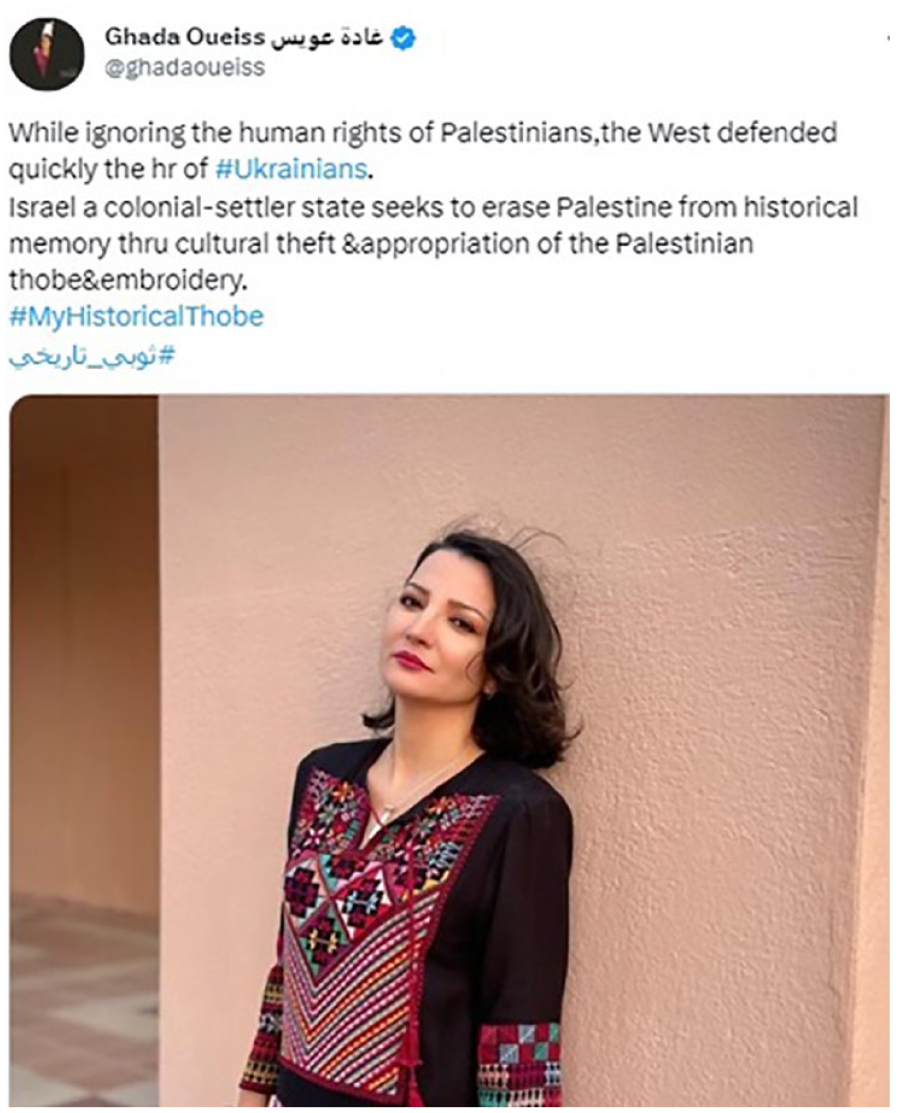
Journalist for Al Jazeera Ghada Owais tweeting her picture wearing a Palestinian thobe.
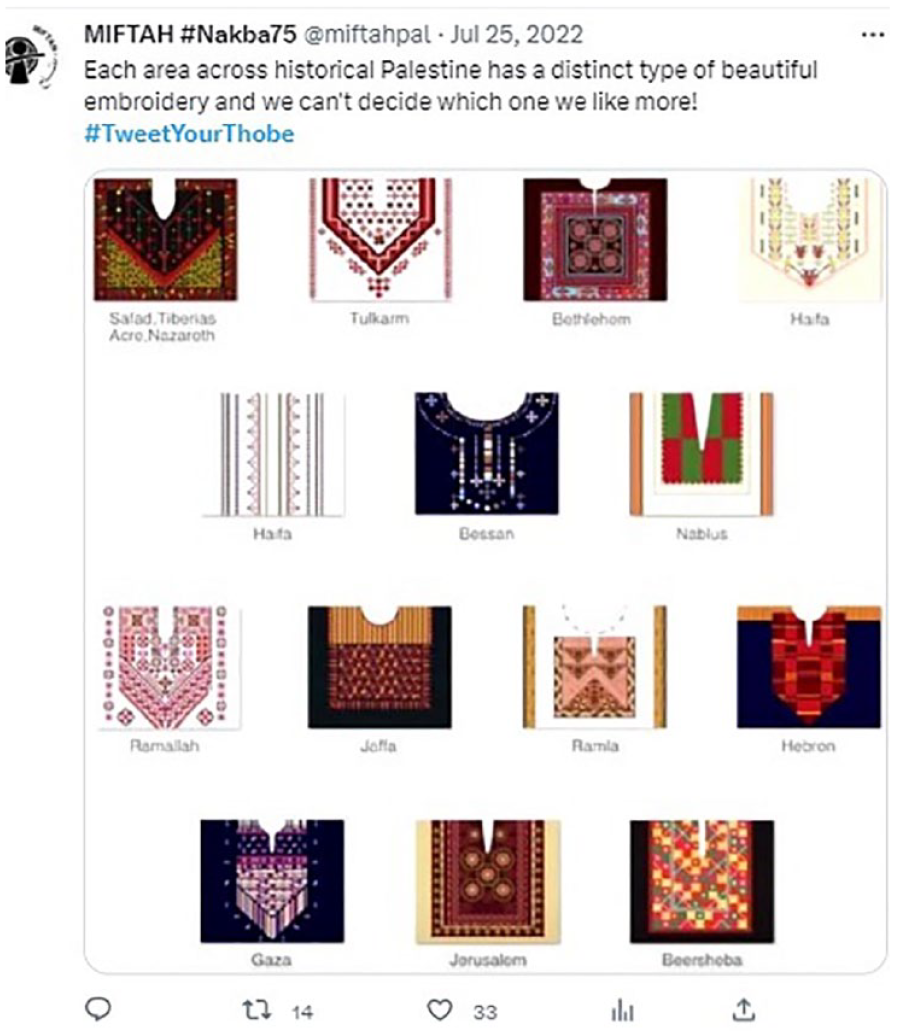
The local Palestinian NGO, Miftah, tweeted images of thobes from different cities.

A news report on the Palestinian-American Congresswoman Rashida Tlaib being sworn into office wearing the thobe.

X user tweeting the meaning behind the colors and shades of the Palestinian keffiyeh.

A Twitter user tweeting a picture of himself and a young girl wearing the kufiyah in solidarity the Palestinians.
Main Topics and Related Texts on the Twitter-Based Hashtag #TweetYourThobe.

The globalized nature of social media platforms provides opportunities for individuals around the world to express their solidarity with the Palestinian people and their national struggle. The utilization of these opportunities is evident in this study, where the majority of tweets using the hashtag #TweetYourThobe expressed solidarity and support for the Palestinian struggle, as well as for Tlaib’s decision to wear her thobe during the swearing-in ceremony in the US Congress.
Not only is social media viewed, light of this article results, as a platform for conveying the Palestinian narrative in relation to the symbolism of their cultural attire, but the results also demonstrate that these online platforms serve as spaces where their national struggle is supported by individuals worldwide.
#MyHistoricalThobe Hashtag
Analysis of the second similar hashtag advocating for the Palestinian thobe on X,
Consequently, most of the top 10 tweets were dedicated to the identity of the thobe and protection of Palestinian national heritage from theft. As Table 2 shows, the remaining four tweets also discussed related topics of cultural identity, where the thobe represented an icon of this identity.
Main Topics and Related Texts on the Twitter-Based Hashtag #MyHistoricalThobe.

Only one tweet was written in Arabic (see Table 2), situating these campaigns within the context of their primary goal, which is to raise awareness of Palestinian cultural symbols among global audiences. Furthermore, these English language-based campaigns are similar to many other Palestine-centered online campaigns that aim to engage in global online activism, in which the use of English as the primary language helps to reach wider audiences, not limited to Palestinians or Arabs.
These results indicate that specific X hashtags, such as #MyHistoricalThobe, require the use of associated discourse. In other words, the topic of the hashtag, or any social media campaign for that matter, influences the type of discourse, language, and slogans employed by social media users who use this hashtag. Because the hashtag #MyHistoricalThobe is associated with the history of Palestine and its people, we observed that the theme of “Protecting national heritage” dominated the discussions on X surrounding this hashtag.
Furthermore, understanding the significance of the thobe in the context of users’ efforts to challenge dominant stereotypes or misrepresentations of Palestinian culture, “protecting national heritage” discourse became a major goal in the process of countering misrepresentation and misinterpretation of the cultural significance of the thobe.
#KeffiyehDay Hashtag
Similar to the “TweetYourThobe” hashtag, almost half of the top 10 tweets that used the hashtag #KeffiyehDay were a representation of solidarity with the Palestinian people. The iconic symbol of the keffiyeh, associated with the Palestinian national struggle, attracted users who took advantage of this day to show solidarity with the Palestinians and their struggle (see Image 5).
As shown in Table 3, the themes of cultural identity and national struggle were also present in the discussion, where users reaffirmed the symbolism of the keffiyeh to the Palestinian culture and its iconic representation of the national struggle.
Main Topics and Related Texts on the Twitter-Based Hashtag #KeffiyehDay.

As the literature suggests, it is essential to examine cultural narratives in their context. In this regard, considering the political and national dimensions of the keffiyeh symbolism, where it represents an icon of political struggle, in which the Palestinian people are resisting the Israeli colonization project, the keffiyeh’s symbolism has transformed and is now regarded as a symbol of this national struggle.
Understanding this shift in the keffiyeh symbolism, particularly in the context of transcoding representations, the results indicate that cultural symbols like traditional attire are also enlisted in the process of the national struggle. Cultural resistance can be observed here as a process in which cultural symbols are digitally discussed and mediated not only as traditional icons to be preserved and defended but also as symbols representing the national cause.
#WorldKeffiyehDay
Analysis of the use of the #WorldKeffiyehDay hashtag showed clear similarities to the analysis of the hashtag #KeffiyehDay, in terms of the dominant solidarity theme, followed by the national struggle and national identity themes (see Table 4).
Main Topics and Related Texts on the X (Twitter) -Based Hashtag #WorldKeffiyehDay.

In this sense, the digital sphere can be seen as a platform for collaborative support of particular narratives. Cultural narratives on social media are not only highlighted by indigenous people expressing their cultural identity, but also users from other parts of the world actively participate and contribute to the building and preservation of these cultural narratives on the digital web.
Significations of the Keffiyeh and Thobe
As for the detonations and connotations of the thobe and keffiyeh, the results, in Table 5, indicate a cross-reference of signifier and signified elements, whereby denotation is related to the shape of both pieces of clothing, while connotation points to deeper meanings related to national identity, culture, and national struggle.
Denotations and Connotations of the Keffiyeh and Thobe.

X users who utilized hashtags related to the thobe and keffiyeh in various campaigns and at different times have commonly identified these clothing pieces as traditional garments, each with its unique shape and design. Table 5 presents the predominant concepts associated with the thobe and keffiyeh in the minds of X users. These concepts closely align with the main themes discussed earlier, notably solidarity, national identity, and political struggle.
An interesting observation here is that although the thobe and keffiyeh are distinct attires traditionally worn by women and men, each symbolizing a different gender, they both hold significance concerning Palestinian cultural identity. While discussions about the thobe’s denotation (physical description) often emphasize its feminine characteristics and are linked to legacies passed down from grandmothers and mothers, its connotation (suggested meaning) shares common ground with the keffiyeh. Both garments carry symbols of national and cultural identity.
The close connection between Palestinian gender and embroidery is evident, with embroidery playing a vital role in conveying Palestinian nationalism, preserving cultural identity, and resisting occupation. It serves as a symbol of heritage and operates as a dynamic form of cultural expression, continually responding to the demands presented by modern possibilities in fashion.
Not only do they both equally contribute to symbolizing Palestinian struggle, identity, and history, but they are also perceived as compelling symbols of cultural resistance that draw global solidarity in the digital sphere. Interestingly, the distinctions between feminine and masculine characteristics of these garments fade when examining their representations in the context of nationality and culture.
Discussion
This article aimed at examining representations of the two Palestinian traditional attires, the thobe and the keffiyeh, on social media. It sought to understand how Palestinians and their supporters on X platform provide their own representational meanings of these two traditional symbols. The findings contribute to a better understanding of how social media platforms serve as a venue for practicing cultural resistance through providing alternative cultural narratives.
Connotation and denotation analysis of the tweeted text and images indicates that traditional customs carry a deeper meaning beyond their physical appearance, as they do not only signify heritage, but also convey the points of view of personal sentiment, national identity and political struggle.
The article’s research question revolves around the way Palestinians and their supporters represent the symbolism of the thobe and the keffiyeh, on X. The results suggest that two intersecting approaches to representing the thobe and the keffiyeh were adopted: a national and a personal approach. The first relates traditional customs to the current Palestinian national and political struggle, a finding that coincides with the traditional notion that the Palestinian approach to cultural production, including national identity, struggle (Salih & Richter-Devroe, 2014), and heritage, is connected to national liberation (De Cesari, 2019).
The second approach in the production of cultural representation, is the personal element. While the collective interaction with the four hashtags manifests an interest in highlighting the national and cultural significance of the two symbols, most of the studied tweets contained personal involvement by users who tweeted their pictures wearing their thobes. These users reasserted sentiments related to the thobe, regarding generational inheritance, thus highlighting its connection to mothers and grandmothers. That is to say, X users acknowledged the national and cultural identity of the two symbols, in that, they highlighted their personal attachment to these identity-related symbols. Through combining the national with the personal, they provided personal accounts that support a national cultural representation.
Among the strategies for changing dominant representations, are strategies of challenging, rejecting, transforming and providing oppositional representation (Howarth, 2011) or through the process of transcoding in which dominant representations are challenged (Hall, 1997). Results of this article show that challenging negative stereotypes and misrepresentation of Palestinians is evident from the way the thobe and keffiyeh hashtags have been utilized. Not only do these hashtags represent an effort of solidarity and appreciation of own cultural heritage and identity, but also serve as an educational effort to counter typical stereotypes. The pride of celebrating the two symbols and relating them to self and to Palestinian collective identity, is also an effort of narrative-building through challenging negative representations.
In the considerable body of literature that examines cultural resistance within the context of resisting colonization (Said, 1993), in which the Palestinian cultural struggle is guided by the need for visibility and for being heard (Tawil-Souri, 2011), the struggle is framed as a struggle between settlers and the indigenous people (Pappe, 2018). Meanwhile, this article affirms the diversity of themes employed in highlighting the national identity and national struggle when providing Palestinian representations.
The identified five themes: aesthetic and diversity features of the thobe, cultural identity, protecting national heritage, solidarity, and national struggle, all share common elements, which are distinct aspects of Palestinian culture, its connection to the national political struggle and the globalized nature of the Palestinian cause.
Celebrating the aesthetic and diversity features of the thobe bring an educational perspective to the utilization of these hashtags, whereby educating social media audiences about Palestine and the Palestinians proves the globalized aspect of cultural narrative efforts.
The globalization of cultural resistance in the Palestinian context, has been identified in this article in the solidarity theme. This is evident in form of tweets (texts and images) where supporters expressed support to the Palestinian national struggle. Based on this, we can argue that social media audiences are both perceiving learners and participating actors in this context of globalized narrative-building. Furthermore, Palestinians who participated in these online campaigns were based in different countries, in Palestine, and in the exile.
In the context of the digital public sphere, the opportunities social media platforms provide, such as increase in the variety of representation of topics and issues (Enjolras & Steen-Johnsen, 2022), facilitated by technical formats, such as hashtags that contribute to mobilization around ideas and issues (Pond & Lewis, 2019), are well understood by users, as the results suggest. Understanding that large audiences may interact or at least closely observe the discussions taking place on X, thobe and keffiyeh hashtag users embedded reminders within most of their tweeted texts and images, about the national struggle against the Israeli occupation. These inseparable elements of culture, identity, and national struggle have been very clear in themes identified in this article.
We understand this utilization of current interactive media as an ongoing effort of cultural resistance, which has been shaping the Palestinians’ efforts to protect their identity since the first part of last century. While this form of resistance has been evident since 1908, appearing in local newspapers (Khoury-Machool, 2007), contemporary interactive social media enables the continuity of this old effort of resistance, where individuals are now participating in this resistance individually and collectively.
Conclusion
This article’s findings contribute to the field of representation, cultural resistance and cultural narrative-building and disseminating via social media. They expand the knowledge surrounding the relation between utilization of social media for providing an alternative narrative and the representation of cultural symbols online.
The article also expands knowledge concerning the nature of the digital public sphere that contains different forms and variety of representation of misrepresented groups and it provides insights into a cultural aspect of the Palestinian cause, in which identity, culture, and national struggle are inseparable.
A replicate study that expands the size of the sample and takes into consideration wider and other social media-based campaigns may provide additional insights into the nature of culture representation in Palestine and in other contexts around the world.
Footnotes
Declaration of Conflicting Interests
The author(s) declared no potential conflicts of interest with respect to the research, authorship, and/or publication of this article.
Funding
The author(s) received no financial support for the research, authorship, and/or publication of this article.
